Table of Contents
Toggle🏛️ Where Faith Meets Modern Madrid
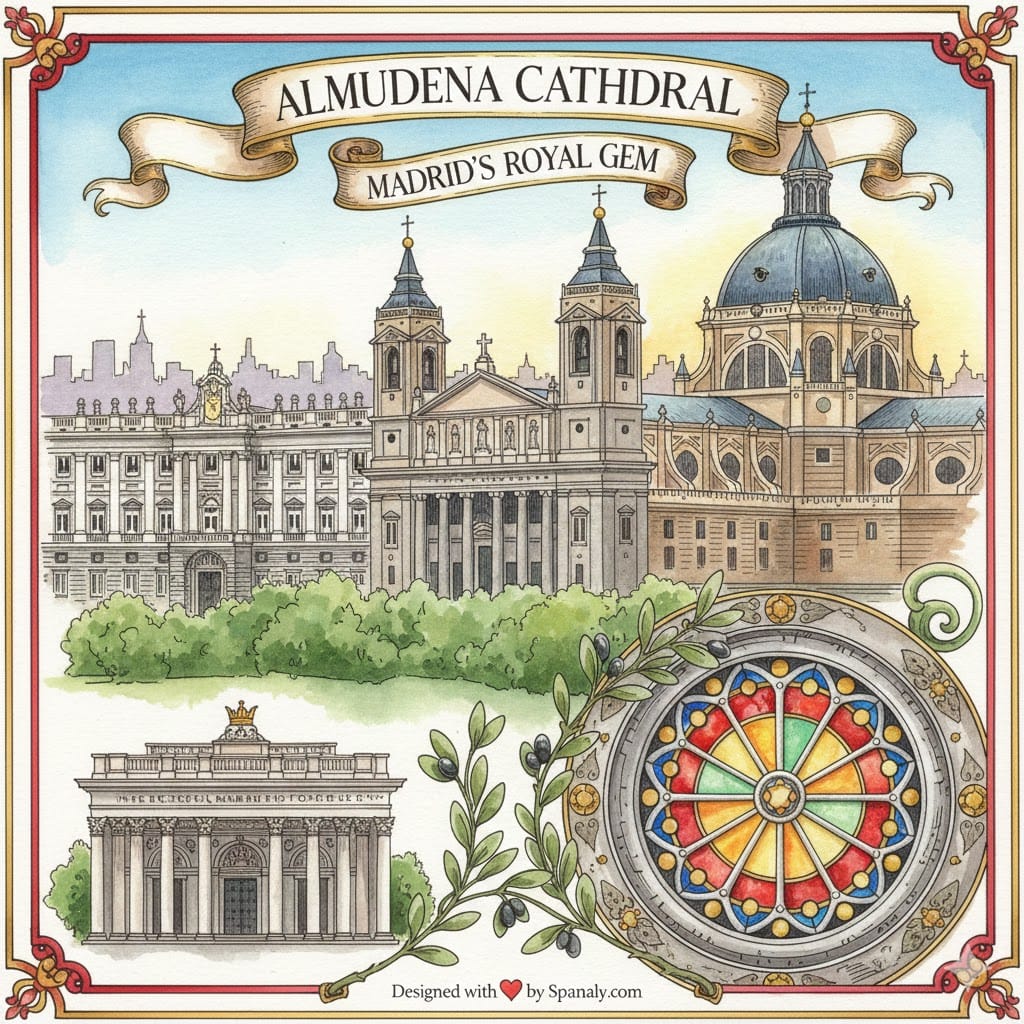
Few cities blend the ancient and the new quite like Madrid. Specifically, nowhere is this more visible than at the Almudena Cathedral. Standing proudly opposite the Royal Palace, this sacred landmark redefines what a cathedral can be. Indeed, it represents a unique union of old devotion and modern artistry.
⏳ A Recent Masterpiece: Completed only in 1993, this cathedral tells Madrid’s story from a hidden medieval icon to a contemporary symbol. To plan your trip around this area, explore our Ultimate Madrid Travel Guide.
🎨 Artistic Diversity: Step inside to find vibrant stained glass and modern murals. Furthermore, the Romanesque crypt echoes with centuries of faith.
🌍 A Universal Experience: Whether you are an art lover or a spiritual traveler, Almudena offers a deeply cultural experience. Therefore, it is a “must-see” on any Spanish itinerary.
💡 Spanaly Insight: To capture the best of this site, visit during the late afternoon. Consequently, the way the sun reflects off the neoclassical stone while the palace shadows grow creates a spiritual atmosphere you won’t find elsewhere.
⏳ The Legend of the Virgin & The Long Road to Completion
Madrid’s devotion to the Virgin of Almudena dates back to the Reconquista in 1085. According to legend, King Alfonso VI found a hidden wooden statue within the city’s old Moorish walls. Consequently, this rediscovery inspired centuries of veneration. Eventually, it led to the ambitious dream of building a grand cathedral to honor her.
Timeline of Creation
The journey to complete this sacred gem was not easy. In fact, it took over a century to finish.
| Year | Milestone |
| 1883 | King Alfonso XII laid the foundation stone. |
| 1900s | Construction was paused due to civil unrest and wars. |
| 1944 | A new design was adopted to match the Royal Palace. |
| 1993 | Pope John Paul II finally consecrated the cathedral. |
❓ Did you know? Almudena Cathedral’s orientation runs north-south, not east-west like most cathedrals. Specifically, it was designed this way to align visually with the Royal Palace across the plaza. Therefore, it creates a perfectly symmetrical architectural ensemble.
🏛️ Architectural Symphony: A Clash of Three Eras
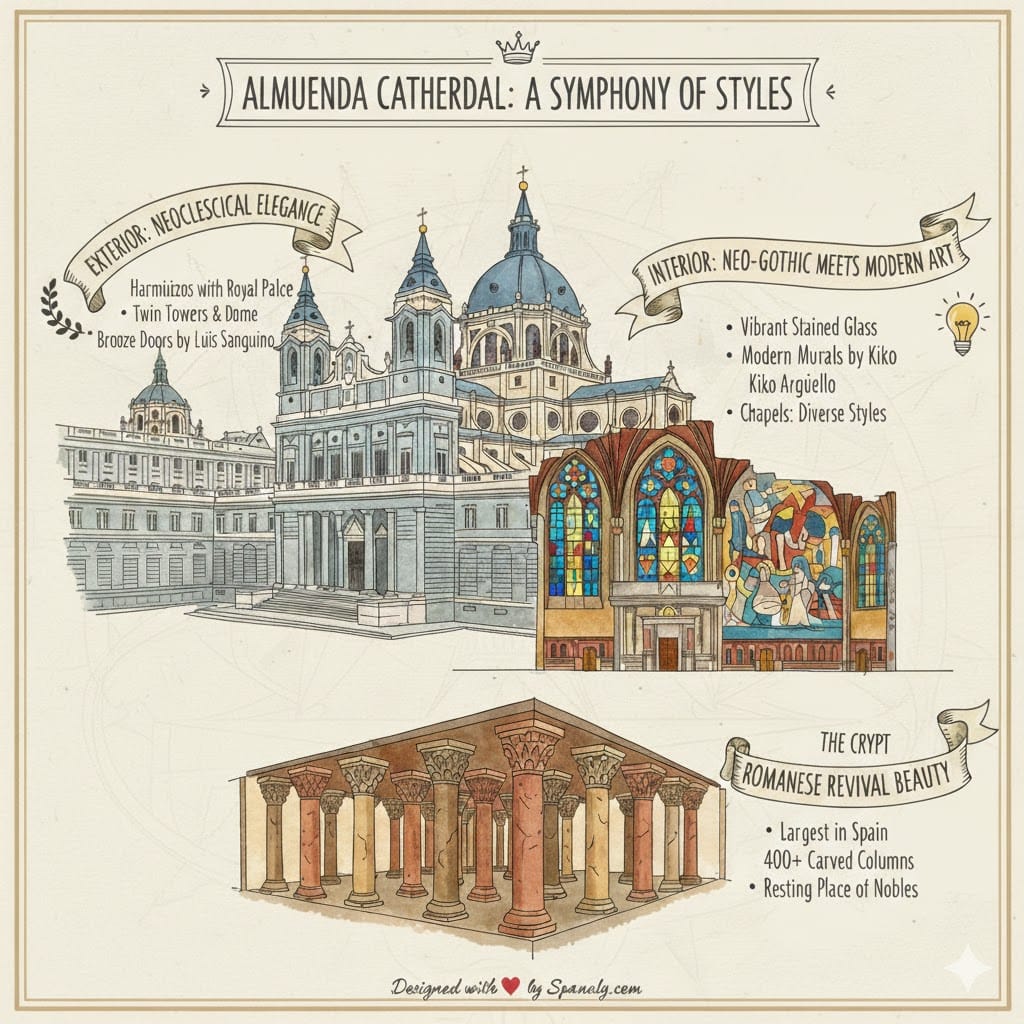
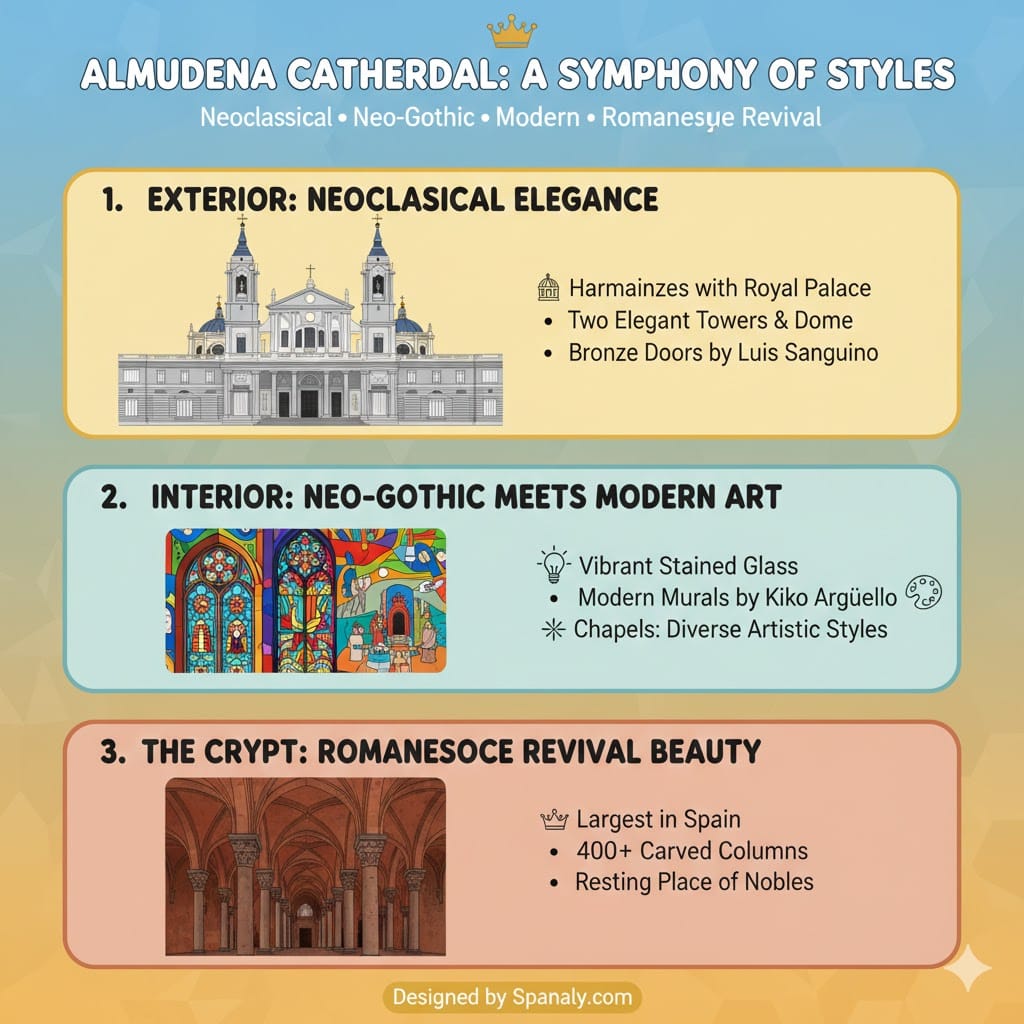
Madrid’s cathedral is a rare example of architectural coexistence. Specifically, it embraces multiple periods and philosophies while staying uniquely Spanish. Because of its long construction history, the building avoids a singular style in favor of a visual “symphony.”
Exterior – Neoclassical Elegance
The outside of the cathedral was modeled to harmonize with the Royal Palace façade. Consequently, the two buildings create a grand, unified visual square. You can explore more about this royal connection in our Madrid Royal Palace & Plaza Mayor Guide.
Key Features: Two elegant towers and a central dome dominate the skyline.
Artistic Detail: Look closely at the bronze doors by Luis Sanguino. Indeed, they depict pivotal moments from Madrid’s history. Furthermore, sculptures of Spanish saints guard the main entrance.
Interior – Neo-Gothic Meets Modern Art
Step inside and you will find a surprising departure from tradition. Unlike the dark gloom typical of many Gothic churches, Almudena is bright and colorful.
Modern Touches: Vibrant stained glass replaces traditional scenes with geometric patterns.
The Main Altar: This area features green marble and contemporary murals by Kiko Argüello. As a result, each chapel offers a visual journey from medieval faith to modern spirituality.
Crypt – Romanesque Revival Beauty
Beneath the main floor lies the neo-Romanesque crypt. Notably, it is the largest in Spain, featuring over 400 carved columns.
Historical Significance: It serves as the resting place for nobles and the original architect. Therefore, the crypt offers a peaceful, atmospheric contrast to the bright interior above.
💎 The Museum & Hidden Treasures: Beyond the Altar
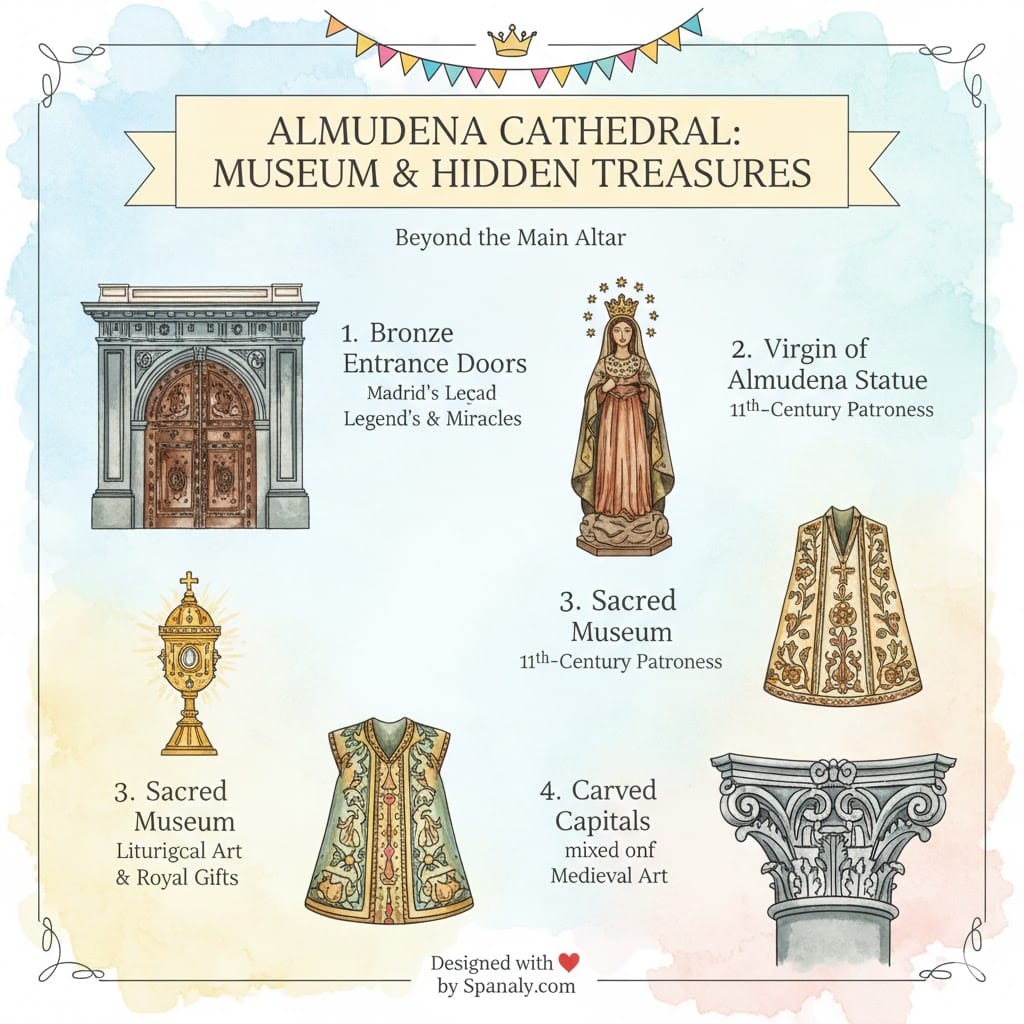
Exploring Almudena Cathedral is not limited to its majestic nave. Specifically, the Cathedral Museum offers a deep dive into Spain’s religious and artistic heritage. Indeed, many visitors miss these treasures because they focus only on the main altar. However, taking the time to see these artifacts provides a much richer cultural context. For those who want to expand their artistic journey, this sacred collection is the perfect complement to the masterpieces found in the Golden Triangle of Art in Madrid.
What to See Inside the Museum
The collection spans centuries of Madrid’s history. Furthermore, it includes rare liturgical items and royal gifts that have survived wars and political shifts. Consequently, the museum is considered one of the most significant sacred collections in the city.
| Detail | Why It’s Special |
| Bronze Entrance Doors | Intricately engraved with Madrid’s religious legends and miracles. |
| Virgin of Almudena Statue | A beautiful replica of the 11th-century icon, the patroness of Madrid. |
| Cathedral Museum | Displays a stunning 17th-century monstrance and royal vestments. |
| Carved Capitals | Feature biblical scenes creatively mixed with animals and castles. |
| Stained-Glass Rosettes | Masterpieces created by modern Spanish artists after the year 2000. |
💡 Spanaly Insight: If you are interested in the fine details, look closely at the Carved Capitals in the museum section. Notably, they depict a unique blend of religious symbolism and medieval architecture that you won’t find in standard travel brochures.
🔭 Climb the Dome: The Best 360° View of Madrid’s Skyline
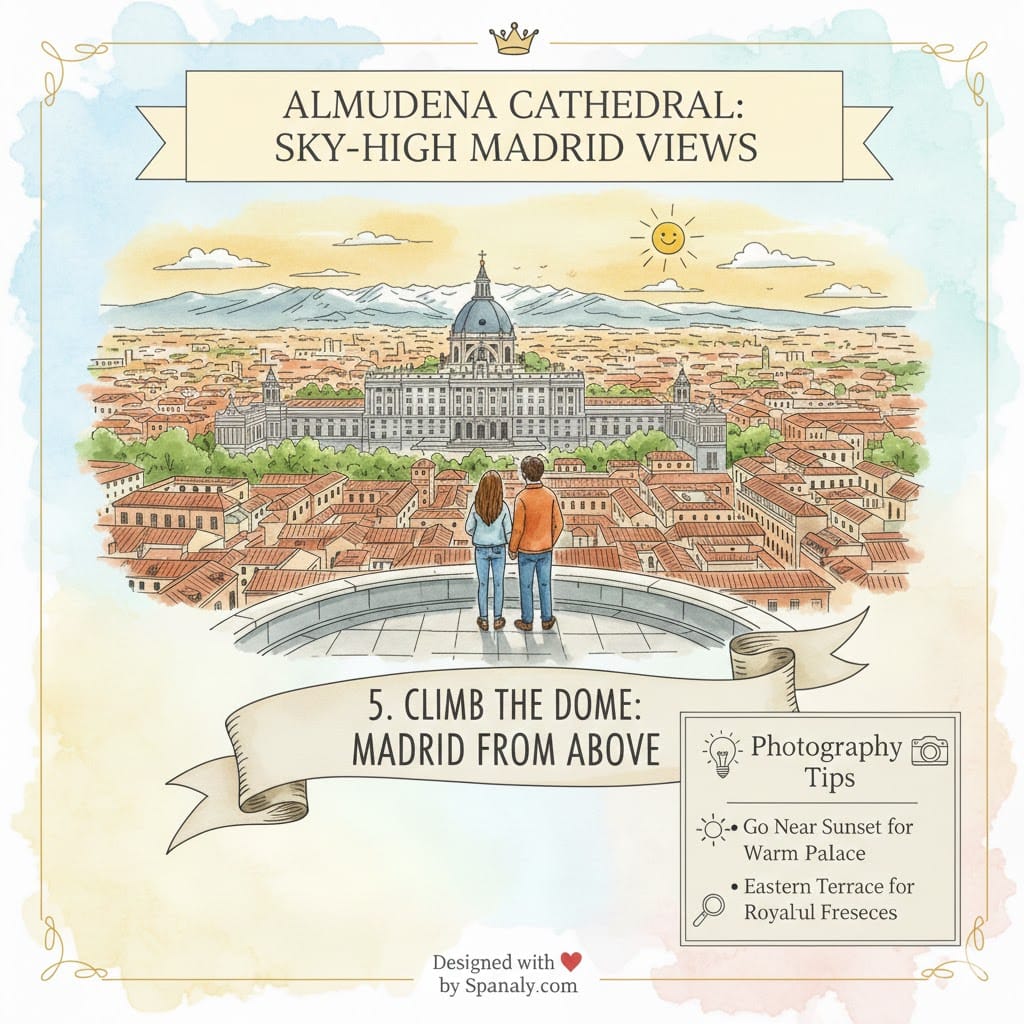
One of the absolute highlights of visiting Almudena is climbing to its panoramic dome. Specifically, it offers one of the most breathtaking vantage points in the capital. From here, the view stretches from the lush palace gardens to the distant Sierra de Guadarrama mountains. Indeed, standing atop the dome allows you to appreciate the city’s layout in a way that ground-level exploration cannot provide. After enjoying this high-altitude perspective, you can easily navigate back to the city’s vibrant heart at Puerta del Sol Madrid, which remains visible from many points on the terrace.
📸 Photography Tips for the Perfect Shot
To capture the essence of Madrid from above, timing and positioning are everything. Consequently, we recommend following these simple tips:
Golden Hour Magic: Go near sunset for warm, golden light that reflects beautifully off the limestone.
The Royal Perspective: Use the eastern terrace for stunning shots of the Royal Palace and Plaza de la Armería.
Don’t Miss the Interior: The dome’s interior also features colorful frescoes often missed by visitors. Therefore, look up and take your time before heading out to the terrace!
💡 Spanaly Insight: Access to the dome is via the Cathedral Museum. Because the climb involves several stairs, make sure to wear comfortable shoes. However, the effort is rewarded the moment you step out and feel the Madrid breeze while the entire city unfolds beneath you.
👑 Royal Weddings & Historic Events: A Living Monument
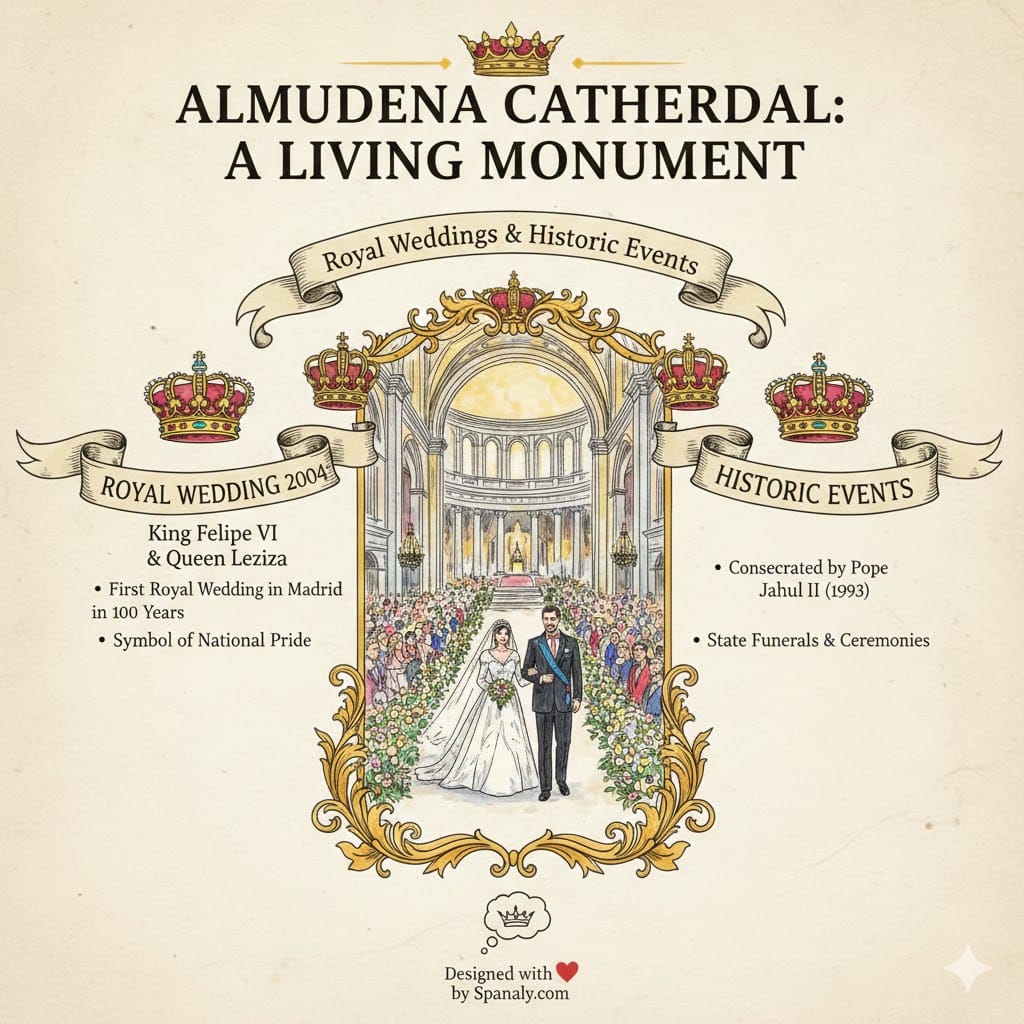
Almudena Cathedral is much more than a quiet place of worship; it is a central stage for Spain’s modern royal history. Specifically, its significance grew immensely on May 22, 2004. Indeed, this was the day it hosted the royal wedding of King Felipe VI (then Prince of Asturias) and Queen Letizia. Because it was the first royal wedding held in Madrid in nearly a century, the event transformed the cathedral into a symbol of national pride and continuity.
Why Its Royal Status Matters
The connection between the crown and the cathedral is deeply rooted in its location. Consequently, its proximity to the Royal Palace makes it the official site for state religious ceremonies.
State Funerals: The cathedral has hosted solemn services for Spanish monarchs and national figures.
Proclamation Ceremonies: While not a coronation site, it remains the spiritual home for the Spanish monarchy’s most pivotal moments.
The Papal Blessing: Notably, it was consecrated by Pope John Paul II in 1993, making it the only Spanish cathedral to be consecrated by a Pope.
💡 Spanaly Insight: When you walk down the central nave, imagine the grand procession of the royal wedding. Therefore, looking at the altar from the perspective of the royal couple gives you a unique sense of the “Living History” that defines this modern monument. However, remember that while it is a historic site, it remains a functioning church where royal and common citizens alike come to pray.
🏛️ Cultural Insight: Why Almudena is Different from any Spanish Cathedral

If you have visited the dark, somber cathedrals of Seville or Toledo, Almudena will come as a complete surprise. Specifically, it challenges the traditional “Spanish Gothic” stereotype with a bold, modern personality. Indeed, many traditionalists were initially shocked by its design. However, understanding the cultural etiquette in Spain helps visitors appreciate how this landmark balances religious solemnity with contemporary artistic expression. Today, this very difference is what makes it a must-visit landmark in Madrid.
A Departure from Tradition
Most Spanish cathedrals feel like ancient stone fortresses. However, Almudena feels like a living art gallery. Because it was completed in the late 20th century, the architects chose to look forward rather than backward. Consequently, the cathedral serves as a bridge between Spain’s Catholic roots and its modern, vibrant future.
Light vs. Dark: Unlike the shadowy interiors of old cathedrals, Almudena is flooded with natural light. Indeed, this creates a welcoming, uplifting atmosphere.
Pop-Art Influence: The ceiling features geometric patterns that feel almost “Pop-Art” in style. Furthermore, these colors represent the diverse regions of Spain, making it a truly national monument.
Modern Saints: While other churches focus on 15th-century art, Almudena incorporates 21st-century murals. As a result, it feels relevant to the people living in Madrid today.
💡 Spanaly Insight: Many visitors ask why the cathedral doesn’t look “old.” Notably, the answer lies in its long construction delay. Therefore, instead of trying to fake a medieval look, Madrid chose to embrace its contemporary identity. However, it still maintains a deep spiritual connection to the city’s patroness.
📅 Practical Planning: 2026 Visitor Guide
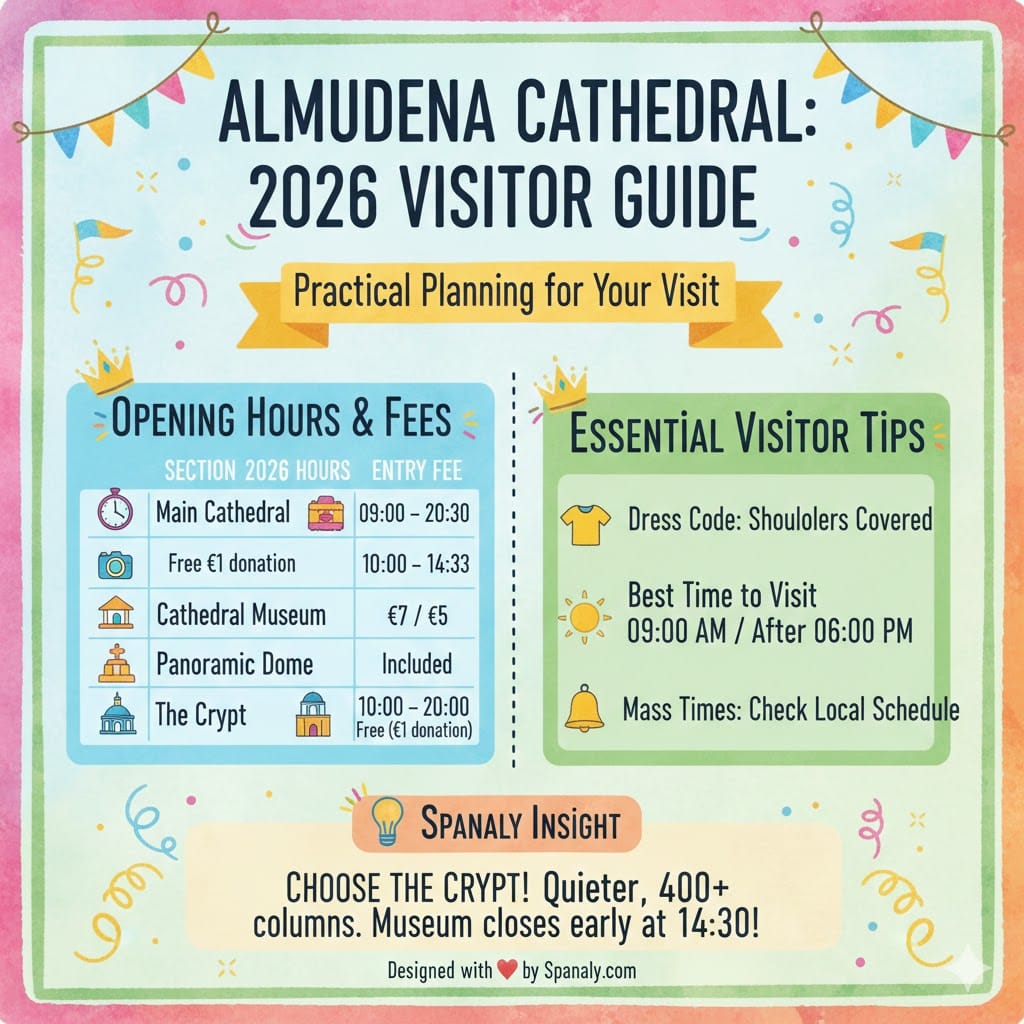
Planning your visit to Almudena Cathedral requires a bit of strategy to avoid the crowds. Specifically, being located right next to the Royal Palace means it gets busy during peak hours. Indeed, knowing the latest 2026 updates will save you time and ensure a smooth experience. To better prepare for your entire journey, we recommend checking these essential Spain travel tips to handle everything from local transport to cultural nuances.
Opening Hours & Entrance Fees
The cathedral maintains a welcoming policy for all visitors. However, please note that the museum and dome have separate schedules.
| Section | 2026 Hours | Entry Fee |
| Main Cathedral | 09:00 – 20:30 (Daily) | Free (€1 suggested donation) |
| Cathedral Museum | 10:00 – 14:30 (Mon-Sat) | €7 (Standard) / €5 (Reduced) |
| Panoramic Dome | Included with Museum | Included with Museum Ticket |
| The Crypt | 10:00 – 20:00 (Daily) | Free (€1 suggested donation) |
Essential Visitor Tips
To make the most of your trip, keep these practical points in mind:
Dress Code: Because this is a sacred site, modest dress is required. Consequently, ensure your shoulders are covered.
Best Time to Visit: Arrive at 09:00 AM or after 06:00 PM to enjoy the light without the large tour groups.
Mass Times: Access to the main altar is restricted during religious services. Therefore, check the local schedule if you wish to attend or avoid mass.
💡 Spanaly Insight: If you only have time for one thing, choose the Crypt. Notably, it is often quieter than the main cathedral and offers a completely different architectural vibe with its 400+ columns. However, remember that the museum closes early at 14:30, so plan your morning accordingly!
📍 The Ultimate 1-Day Royal District Itinerary
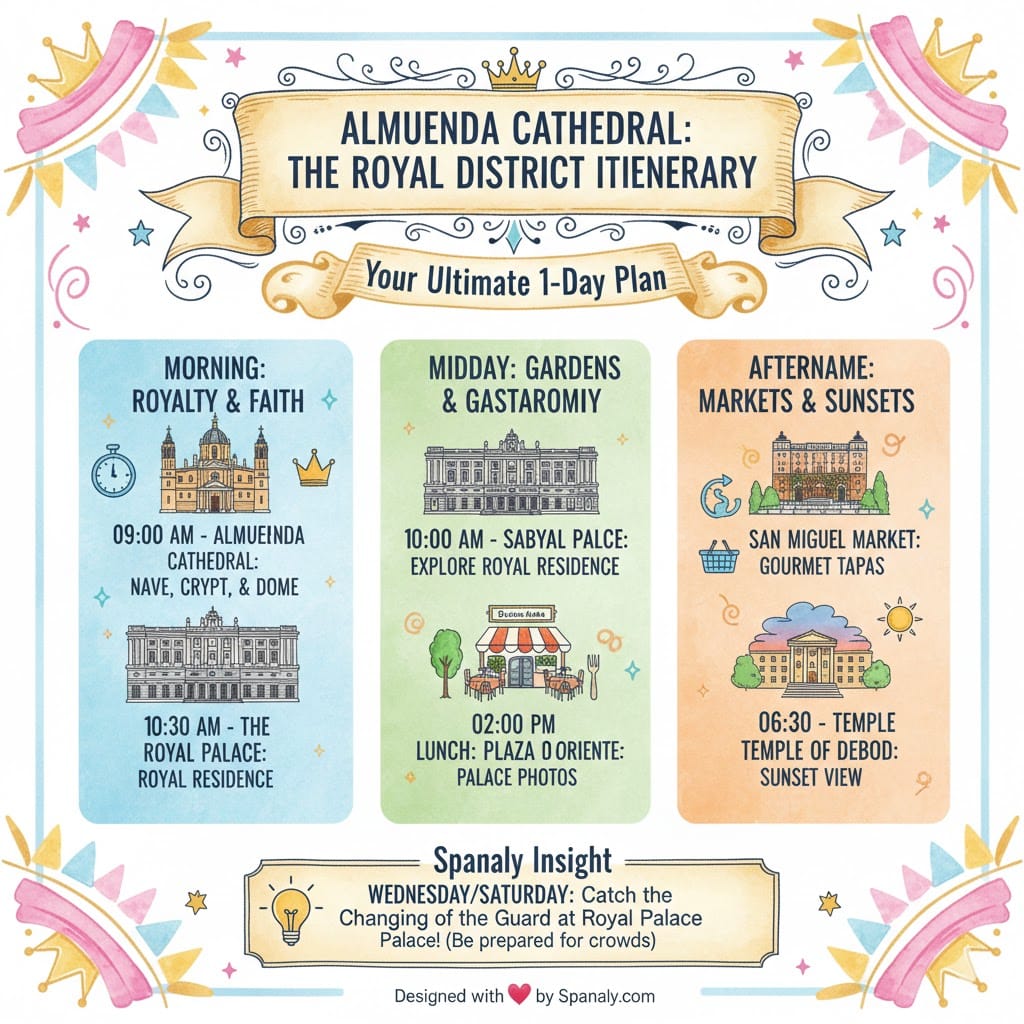
Almudena Cathedral is perfectly positioned within Madrid’s most historic and regal district. Specifically, you can experience a full day of culture, royalty, and gastronomy within a short walking distance. Indeed, following this curated route ensures you don’t miss any of the surrounding gems. While exploring these busy tourist areas, it is always wise to keep an eye on your belongings; reviewing our guide on travel safety in Spain will help you enjoy your walk with peace of mind.
Morning: Royalty and Faith
09:00 AM – Almudena Cathedral: Start early to enjoy the light in the nave and the quiet of the crypt.
10:30 AM – The Royal Palace: Head right across the plaza to explore the largest royal residence in Western Europe. Consequently, you’ll be ahead of the largest tour groups.
Midday: Gardens and Gastronomy
01:00 PM – Sabatini Gardens: Take a stroll through these neoclassical gardens for the best photos of the palace’s north facade.
02:00 PM – Lunch near Plaza de Oriente: Enjoy a meal at one of the elegant cafes. Notably, this is a great spot to soak in the “Hapsburg Madrid” atmosphere.
Afternoon: Markets and Sunsets
04:00 PM – San Miguel Market: Walk down Calle Mayor toward this historic iron-and-glass market for some gourmet tapas.
06:30 PM – Temple of Debod: End your day with a short walk to this ancient Egyptian temple. Indeed, it offers the most iconic sunset view of the Palace and Cathedral together.
💡 Spanaly Insight: If you’re visiting on a Wednesday or Saturday, try to catch the Changing of the Guard at the Royal Palace’s Puerta del Príncipe. Therefore, timing your cathedral visit around this event adds an extra layer of royal spectacle to your day. However, be prepared for larger crowds during these times!
💡 Expert Tips for a Flawless Visit (What Others Won't Tell You)
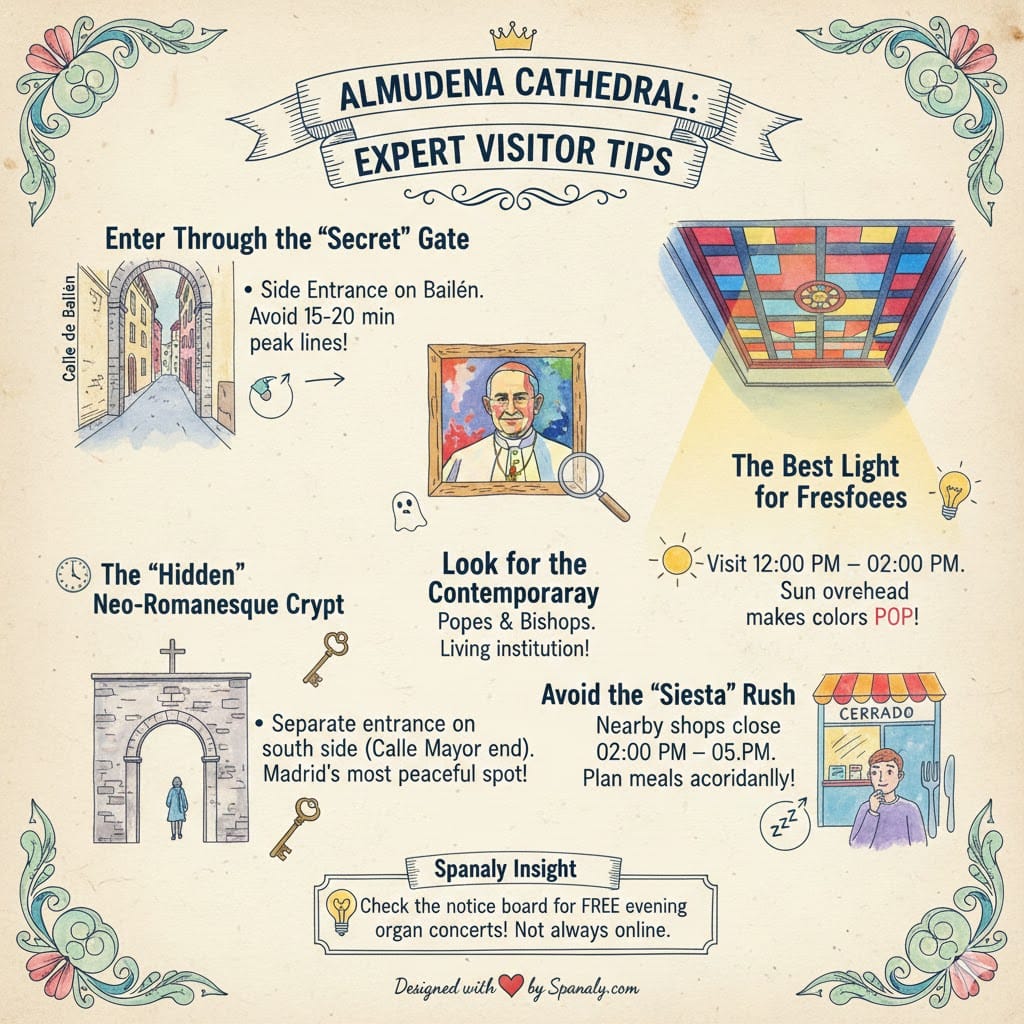
To truly master your visit to Almudena, you need more than just opening hours. Specifically, these “insider” tips will help you navigate the cathedral like a local and discover its quietest, most beautiful corners.
Enter Through the “Secret” Gate: While most tourists crowd the main plaza entrance facing the Palace, there is often a much shorter line at the side entrance on Calle de Bailén. Indeed, using this gate can save you 15–20 minutes during peak season.
The “Hidden” Neo-Romanesque Crypt: Many visitors don’t realize the Crypt has its own separate entrance outside the main cathedral grounds. Consequently, it remains one of the most peaceful spots in Madrid. Look for the entrance on the south side (Calle Mayor end).
Look for the Contemporary Portraits: Inside the museum, don’t just look at the gold. Notably, there are modern portraits of recent Popes and Bishops that showcase how the cathedral continues to evolve as a living institution.
The Best Light for Frescoes: If you want to see the vibrant colors of the ceiling frescoes at their best, visit between 12:00 PM and 02:00 PM. Because the sun is directly overhead, the light hits the geometric patterns perfectly, making the colors “pop” without shadows.
Avoid the “Siesta” Rush: While the cathedral stays open, many nearby smaller shops and local eateries close between 02:00 PM and 05:00 PM. Therefore, plan your souvenir shopping or heavy meals outside of these hours to avoid disappointment.
💡 Spanaly Insight: If you are a fan of classical music, check the cathedral’s notice board near the entrance. Notably, they occasionally host free organ concerts in the evenings. However, these are not always advertised online, so a quick physical check during your visit can lead to a magical, unplanned musical experience.
⛪ Visitor FAQs – Almudena Cathedral Guide
🎟️ Is the Almudena Cathedral free to visit?
Entrance to the main cathedral is free, though a voluntary donation of €1 is appreciated. **Specifically**, in 2026, the combined ticket for the Museum and Panoramic Dome is €7, which remains one of the best value-for-money cultural experiences in Madrid.
📷 Can I take photos inside the cathedral?
Yes, photography is allowed for personal use. **However**, you must not use flash or tripods. **Notably**, photography is strictly prohibited during Mass services to maintain the sacred atmosphere. If you're looking for the best "palace-view" shots, head to the museum's upper balconies.
🧭 Why is the cathedral facing the "wrong" way?
While most cathedrals face East-West, Almudena is uniquely oriented North-South. **Indeed**, this was a deliberate architectural choice to ensure the cathedral's facade perfectly mirrors the Royal Palace, creating a harmonious and unified Royal District.
🧳 Is there a cloakroom for luggage?
**Unfortunately**, the cathedral does not have a luggage storage facility. **Because** of security protocols, large suitcases are not permitted inside. **Therefore**, we recommend using local locker services near Opera or Plaza de España before arriving at the Royal District.
👗 Does the dress code apply to the Dome?
**Yes**, the respectful dress code (covered shoulders and modest lengths) applies to the entire complex, including the Dome and Museum. **Consequently**, even during hot Madrid summers, it is wise to carry a light scarf to ensure entry to all areas without issues.
Madrid Sacred Guide by Spanaly.com
✨ The Soul of Modern Sacred Madrid
Almudena Cathedral is more than a landmark. Specifically, it is a bold statement of Madrid’s modern identity. It honors deep traditions while embracing a fearless future.
The cathedral is a stunning modern marvel. However, it is just one chapter in Spain’s vast architectural story. To see the bigger picture, you can explore our Spain historical monuments guide.
Indeed, the cathedral is the living heart of the capital. Whether you are enjoying the colorful nave or the majestic dome views, the experience is unique.
Because it survived centuries of delays, it now stands as a symbol of courage. Consequently, your visit to the Royal District is only complete after stepping inside. It reminds us that art and faith never stop growing. Madrid is a city of layers, and Almudena is its most vibrant one.
Final Takeaway for Your Journey:
Reflection: Find peace in the Neo-Romanesque Crypt.
Perspective: See the Royal Palace from the high dome.
Discovery: Let the modern murals speak to you.
💡 Final Spanaly Thought: Don’t just look at the stone; discover the stories and colors. Therefore, we hope this guide brings your visit to life. However, the true magic only happens when you are there in person.