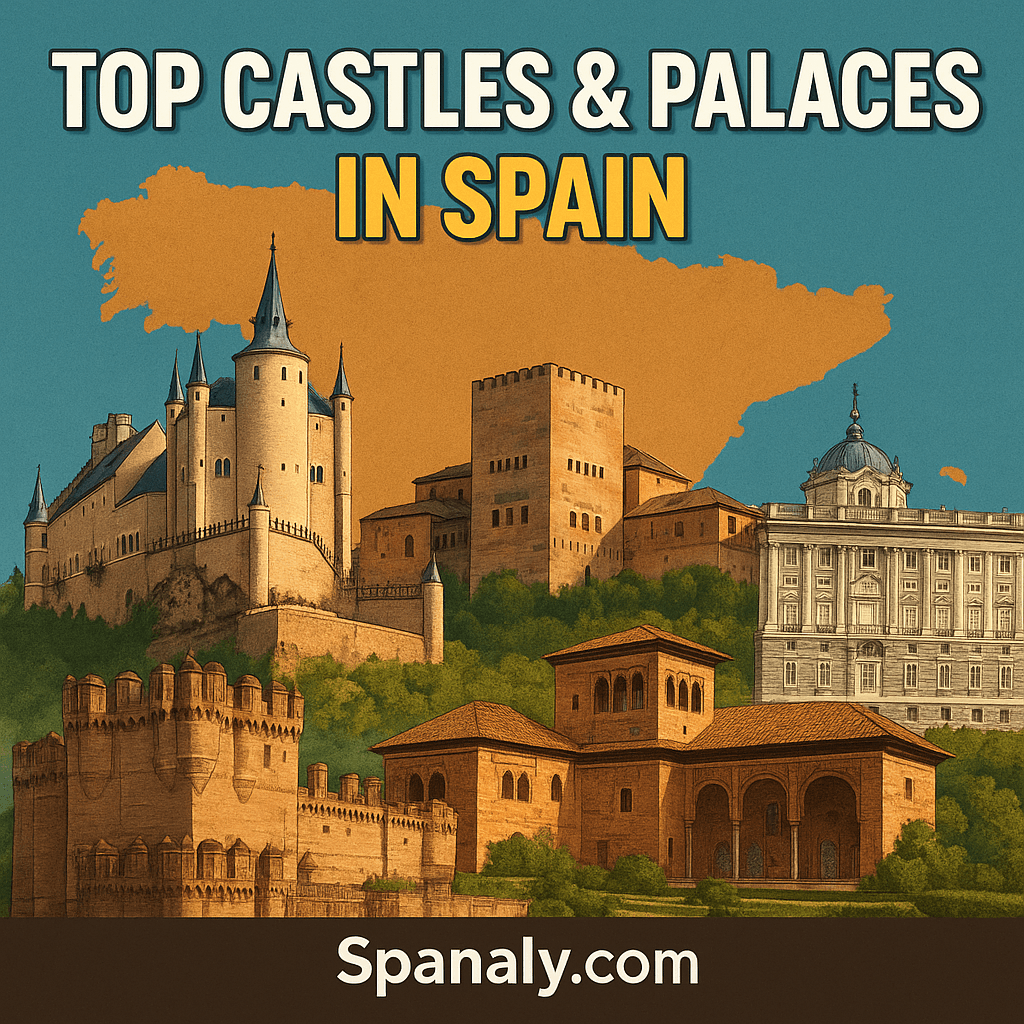
🌍 Spain’s landscape is a living museum of stone, power, and imagination. Scattered across mountains, rivers, and historic cities, castles and palaces in Spain reflect centuries of conflict, royal ambition, artistic brilliance, and cultural exchange.
Furthermore, from imposing medieval fortresses built for defense to luxurious palaces designed to display wealth and authority, these landmarks tell the story of Spain’s transformation through Roman, Islamic, Christian, and Renaissance eras.
Ultimately, this guide explores the most important castles and palaces in Spain, offering historical insight, architectural highlights, and practical travel inspiration.
Table of Contents
Toggle🏰 Spain’s Most Iconic Castles
🏯 Alcázar of Segovia (Castile and León)
Perched on a rocky cliff, the Alcázar of Segovia is one of Europe’s most recognizable castles. Originally a Roman fortress, it later served as a royal palace and military academy.
🔹 Fairytale silhouette with soaring towers
🔹 Lavish royal halls and armory
🔹 Symbol of Castilian royal power
🔹 Inspiration for Disney castles
📍 Location: Segovia
🌐 Official website
🕌 Alhambra (Granada, Andalusia)
The Alhambra is not just a castle — it is a fortified palace city and a masterpiece of Islamic art. Built by the Nasrid dynasty, it represents the peak of Moorish civilization in Spain.
🔹 Intricate geometric patterns and calligraphy
🔹 Nasrid Palaces and Generalife Gardens
🔹 Panoramic views over Granada
🔹 UNESCO World Heritage Site
📍 Location: Granada
🌐 Official website
🛡️ Castle of Loarre (Aragon)
Standing isolated against dramatic mountain scenery, Loarre Castle is one of the best-preserved Romanesque castles in Europe.
🔹 11th-century military architecture
🔹 Thick walls and watchtowers
🔹 Authentic medieval atmosphere
🔹 Popular filming location
📍 Location: Huesca Province
🧱 Castle of Coca (Castile and León)
A rare gem of Mudéjar brick architecture, the Castle of Coca blends Gothic defensive design with Islamic decorative elements.
🔹 Decorative brick façades
🔹 Deep defensive moat
🔹 Unique Spanish-Moorish fusion
🔹 One of Spain’s most distinctive castles
📍 Location: Segovia Province
👑 Spain’s Grand Royal Palaces
🏛️ Royal Palace of Madrid
The Royal Palace of Madrid is the largest royal palace in Western Europe and a symbol of Spain’s monarchy.
🔹 Over 3,000 opulent rooms
🔹 Throne Room, Royal Armory, and chapels
🔹 Used for official state ceremonies
🔹 Baroque and Classical design
📍 Location: Madrid
🌿 Royal Palace of Aranjuez
Surrounded by rivers and historic gardens, the Royal Palace of Aranjuez reflects royal elegance and leisure.
🔹 UNESCO World Heritage Site
🔹 Bourbon-era royal residence
🔹 Formal gardens and fountains
🔹 Harmony between architecture and nature
📍 Location: Aranjuez
💎 Royal Palace of La Granja de San Ildefonso
Often compared to Versailles, La Granja showcases French-inspired luxury and monumental garden design.
🔹 Spectacular Baroque fountains
🔹 Summer residence of Spanish kings
🔹 Mountain setting near Segovia
🔹 Impressive interior decoration
📍 Location: Segovia Province
🌺 Alcázar of Seville
Still in active use by the Spanish royal family, the Alcázar of Seville is a living palace blending multiple architectural styles.
🔹 Mudéjar, Gothic, and Renaissance influences
🔹 Lush courtyards and gardens
🔹 UNESCO World Heritage Site
🔹 Famous filming location
📍 Location: Seville
🧭 Visitor Tips for Exploring Castles & Palaces in Spain
🎟️ Book Tickets Online & Early
Book tickets online in advance, especially for high-demand landmarks such as the Alhambra and the Alcázar of Seville, where daily visitor numbers are limited.
☀️ Plan for Off-Peak Hours
Plan your visit for early morning or late afternoon to enjoy softer light, cooler temperatures, and a more immersive experience with fewer crowds.
👟 Prioritize Comfortable Footwear
Wear comfortable walking shoes, as many castles feature stone floors, narrow staircases, towers, and uneven medieval pathways.
🗣️ Benefit from Guided Tours
Furthermore, consider joining a guided tour or using an audio guide to fully appreciate the historical context, architectural details, and royal stories behind each site.
📸 Respect Interior Regulations
Follow photography and access regulations, since some royal interiors and exhibition areas restrict photos to preserve heritage and artworks.
✨ What Makes Spain’s Castles & Palaces Truly Unique?
A remarkable fusion of architectural styles, blending Islamic artistry, Christian fortification, and Renaissance elegance into a uniquely Spanish identity.
Their status as living royal heritage means many palaces and alcázars are still used today by the Spanish royal family or for official state ceremonies.
These sites feature spectacular settings, from hilltop fortresses and riverbanks to historic city centers and royal gardens, enhancing their visual and cultural impact.
Ultimately, they represent over a millennium of history, reflecting Spain’s complex political evolution, cultural exchange, and artistic achievements across centuries.
🏰 Visitor FAQs – Spanish Castles & Palaces Guide
🏰 Are castles and palaces in Spain open to visitors all year?
Yes, most major sites are open year-round. However, in 2026, many monuments have shifted to seasonal hours; they usually close earlier during the winter months (November–February). Always check the official websites for temporary closures due to royal events or restoration, especially for the Royal Palace of Madrid.
👑 What is the difference between a "Castillo" and a "Palacio"?
In Spain, a Castillo (Castle) was built for military defense, often found on hilltops with thick walls and battlements. A Palacio (Palace), like the Alhambra or the Alcázar, was designed as a luxurious residence for kings and nobility, focusing on gardens, intricate art, and grand ceremonial halls rather than warfare.
🎟️ Is it necessary to book tickets weeks in advance?
For top landmarks, absolutely. Tickets for the Alhambra in Granada, the Alcázar of Seville, and the Royal Palace of Madrid often sell out 2–4 weeks in advance during peak seasons. We strongly advise booking your time slot online to avoid the disappointment of long queues or being turned away at the gate.
📸 Can I take photos inside the royal chambers?
Outdoor photography is usually allowed and highly encouraged! However, interior photography is often restricted or forbidden in specific rooms to protect delicate tapestries, paintings, and royal furniture. Always look for signage and avoid using flash, as it is prohibited in almost all Spanish historic sites.
👨👩👧 Are these historic sites suitable for families with children?
Most are very family-friendly, offering wide courtyards and gardens for children to explore. However, be prepared for many stairs and uneven stone floors. If you are traveling with a stroller, keep in mind that some medieval castles have limited elevator access, so a baby carrier might be more practical for certain areas.
Heritage & Architecture Guide by Spanaly.com
🏁 Spain’s castles and palaces are timeless witnesses to ambition, artistry, and power. From Moorish elegance to royal grandeur, these monuments reveal the layers of Spain’s identity and history.
Exploring them is more than sightseeing — it is a journey through centuries of culture, architecture, and royal legacy. Whether you admire towering fortresses or refined palaces, Spain offers an unforgettable experience carved in stone.