SPANALY · PRACTICAL SPAIN TRAVEL
Spain High-Speed Trains: Routes, Prices and Booking Tips
Spain’s high-speed rail network can make travelling between major cities quick and comfortable. The key is knowing which routes are worth taking by train, when to book, and how to compare the full journey—not just the ticket price.
Use this guide to plan your route, budget for tickets, and avoid common booking mistakes.
Spain High-Speed Train Guide: Quick Snapshot
Best for
Travel between major cities such as Madrid, Barcelona, Seville, Valencia, Málaga, and Zaragoza.
Best booking habit
Compare several departure times and book once your dates are reasonably firm.
Ticket cost
Fares vary widely by operator, demand, travel time, flexibility, and how early you book.
Most important check
Compare the station locations and total door-to-door time, not only the train duration.
Important: There is no single reliable fare for every route. Treat any price example as a planning estimate and check the operator’s current fare for your exact date.
How High-Speed Trains Work in Spain
Spain has several rail services and operators. High-speed services connect many large cities, while conventional and regional trains serve additional destinations and smaller towns. A journey shown in a search result may involve a high-speed train, a conventional service, or a connection, so check the full itinerary before paying.
Renfe: AVE and Avlo
AVE is Renfe’s established high-speed service; Avlo is its low-cost option. Fare types and included features differ, so compare the conditions for the exact ticket.
Official Renfe websiteIryo
A private high-speed operator on several major corridors, including Madrid–Barcelona and Madrid–Seville. Check the route and timetable for your travel date.
Official Iryo websiteOuigo España
A low-cost high-speed operator on selected routes. The lowest advertised fare is limited by availability, and extras or ticket conditions may affect the final price.
Official Ouigo websiteThese operators do not serve every route in the same way. Search your exact city pair and date rather than assuming that all three run on every corridor.
When comparing options, look for the departure and arrival stations, whether a transfer is required, what luggage is allowed, and whether the ticket can be changed or refunded. The cheapest fare may have stricter conditions than a more flexible ticket.
A fast train is most useful when it takes you between central stations and saves enough time to improve your actual day. For a short trip, the time spent reaching an out-of-centre station can change which option is best.
Popular High-Speed Train Routes in Spain
These are common routes to compare when planning a multi-city trip. Journey times and direct-service availability can change by date and timetable; verify the exact service before booking.
Madrid ↔ Barcelona
Major city linkA strong choice for travellers combining Spain’s capital with Barcelona. Fast direct services commonly take around 2 hours 30 minutes to 3 hours. Indicative one-way fares can range from roughly €15 to €100+, depending on the operator, date, demand, and fare conditions.
Main stations: Madrid-Puerta de Atocha and Barcelona-Sants. Check your ticket because some services or timetable changes may affect the station or journey time.
Madrid ↔ Seville
AndalusiaUseful for a trip that starts in Madrid and continues south. Direct high-speed journeys are often around 2 hours 30 minutes to 2 hours 45 minutes. As a planning guide, one-way fares may range from about €15 to €100+; popular dates and flexible tickets can cost more.
Main stations: Madrid-Puerta de Atocha and Sevilla-Santa Justa. During Semana Santa or the Feria season, book transport and accommodation early because demand can rise.
Madrid ↔ Valencia
City and coastWorth comparing for travellers adding Valencia to a Madrid itinerary. Many direct high-speed journeys take roughly 1 hour 50 minutes to 2 hours. Indicative one-way fares may start around €10–€20 when low-cost tickets are available, but can be considerably higher closer to departure.
Main stations: Madrid-Chamartín for many services and València Joaquín Sorolla. Confirm the departure station shown on your ticket.
Madrid ↔ Málaga
Costa del SolA practical rail option for reaching Málaga and the Costa del Sol. Direct high-speed journeys are commonly around 2 hours 45 minutes to 3 hours. A rough one-way planning range is €20–€100+, with prices varying by operator, date, and availability.
Main stations: Madrid-Puerta de Atocha or Chamartín depending on the service, and Málaga-María Zambrano. Check the specific departure station carefully.
Barcelona ↔ Zaragoza
Northeast SpainThis route can fit into a wider itinerary between Catalonia and central Spain. Direct journeys often take around 1 hour 30 minutes to 2 hours. Prices vary by train and booking date; compare the available services rather than relying on one fixed fare.
Main stations: Barcelona-Sants and Zaragoza-Delicias.
For routes involving smaller towns, you may need a regional train, bus, or local connection after the high-speed leg. Do not assume that every destination has a direct high-speed service.
How Much Do High-Speed Train Tickets Cost?
Ticket prices are dynamic rather than fixed. They can rise as popular departures sell out, and different operators may offer different fare types on similar routes. A low headline fare may also come with restrictions on changes, refunds, or luggage.
| What affects the price? | What to do |
|---|---|
| Booking lead time | Compare fares once your dates are set; earlier booking can offer more choice, but it does not guarantee the lowest fare. |
| Day and departure time | Check nearby departure times and, where possible, compare different days. |
| Operator and fare type | Compare the total price and conditions, not only the service name. |
| Flexibility | Choose a flexible fare if your plans may change and the extra cost is worthwhile. |
| Connections | Check whether a cheaper itinerary includes a transfer and enough time to make it. |
A practical way to budget
For your trip budget, price each intercity leg separately before adding the totals together. Keep a small buffer in case your preferred departure is more expensive or you need to change your plans. Intercity train tickets are not included in the daily food, accommodation, local transport, and attraction budgets discussed in the Spain travel budget guide.
For example, if you plan Madrid, Barcelona, and Seville, list each journey, compare direct options and connections, then add the actual fares you find. Avoid using one average fare for every leg because route length and demand differ.
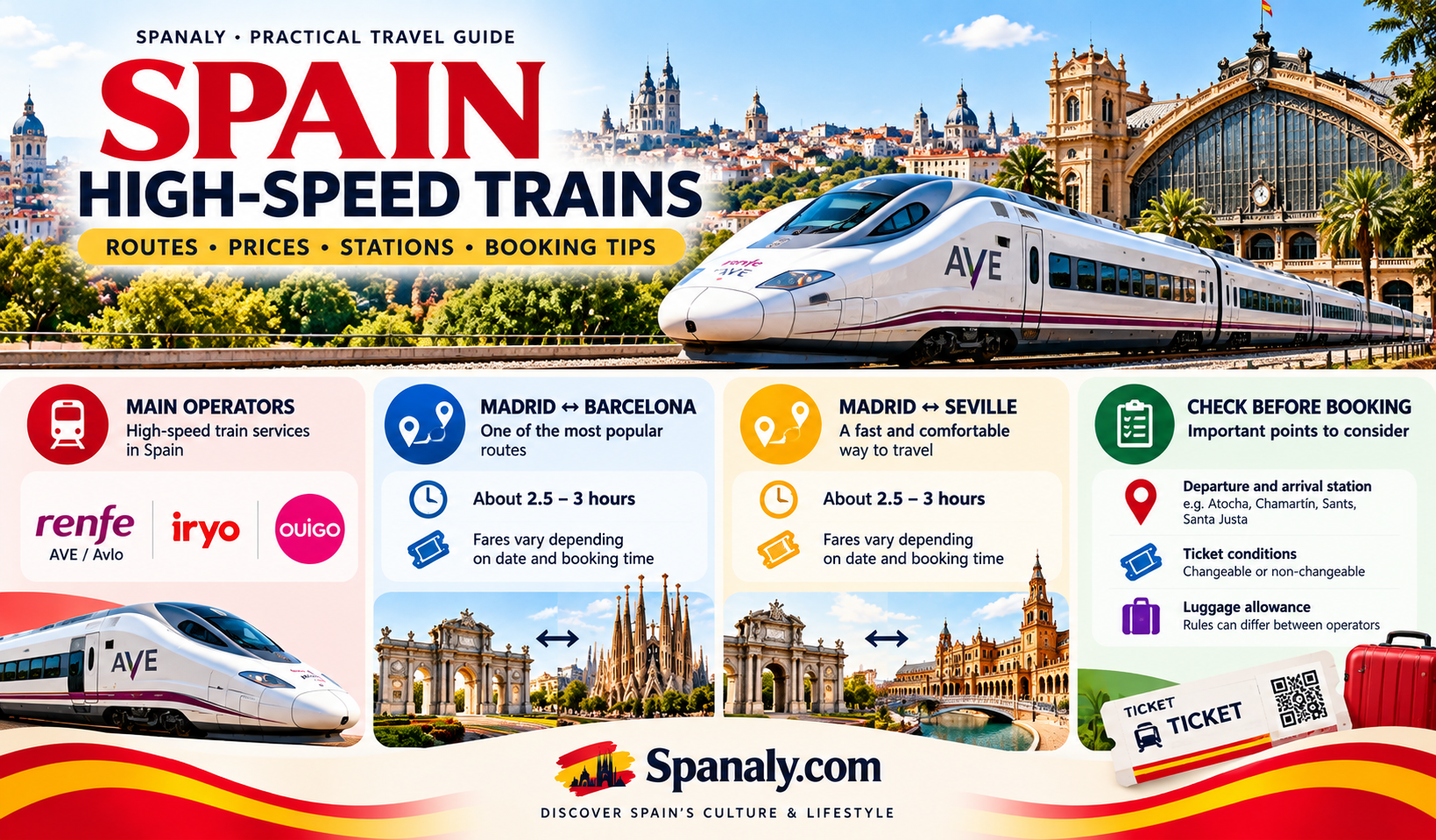
How to Book Train Tickets in Spain
- Set your route and date. Confirm the city pair and the day you want to travel.
- Compare operators and departure times. Check the official operator pages and reputable booking options, then compare the full journey.
- Compare ticket conditions before choosing the cheapest fare. Check whether changes or refunds are allowed, whether luggage or seat selection costs extra, and what the final price includes.
- Check station names carefully. Large cities may have more than one relevant station, and a station change can add time and cost.
- Save your ticket. Keep the confirmation accessible on your phone and follow the operator’s instructions for boarding.
For current national tourism information and trip-planning inspiration, visit the official Spain tourism website. For live train times and fares, use the relevant rail operator’s official booking service; schedules and conditions can change.
Train, Bus, Car, or Plane: Which Is Best?
High-speed train
Best when: you are travelling between connected major cities and value speed, comfort, and city-centre-to-city-centre travel.
Check: fare, station access, baggage rules, and the time needed to reach the platform.
Bus
Best when: price is the main priority or the destination has limited rail connections.
Check: journey length, departure station, arrival location, and luggage conditions.
Rental car
Best when: you want to explore rural areas, small villages, or several stops that are awkward by public transport.
Check: fuel, tolls, parking, rental terms, and whether you actually need a car in the cities.
Plane
Best when: the route is long or a suitable rail journey is unavailable.
Check: airport transfers, check-in time, baggage fees, and total door-to-door time.
There is no universal winner. Compare the full journey once—including access to the departure point and the arrival transfer. On some long-distance routes, a bus can be noticeably cheaper if journey time is not a priority.
Plan Your Departure and Arrival
- Confirm the exact departure and arrival stations on your ticket.
- Estimate how you will get from your accommodation to the station.
- Allow enough time for station entry, finding the platform, and any required checks.
- Check the arrival time against hotel check-in, restaurant reservations, or timed attractions.
- If changing trains, verify the connection time and whether the journey is sold as one itinerary.
- Keep your ticket, booking reference, and identification required by the operator easy to access.
If you arrive late, check whether local public transport is still running and estimate the cost of a taxi or other transfer. This is especially important when choosing a low-priced departure that reaches the city late at night.
Practical Tips for Saving Time and Money
Compare several departures. A small shift in travel time may reveal a better fare or a more convenient arrival.
Book when your dates are firm. Waiting until the last moment can reduce your choice on busy routes.
Check the full fare conditions. Understand the rules before choosing a ticket that cannot easily be changed.
Check station access. Confirm how you will reach the departure station and continue from your arrival station.
Pack within the stated rules. Review the operator’s current baggage policy before travelling.
Keep the itinerary geographically sensible. Group nearby destinations together instead of adding unnecessary cross-country journeys.
Check event dates. Festivals and public holidays can make popular travel periods busier.
Do not assume a pass is cheaper. Compare its total cost with the individual journeys you plan to take.
Planning a city stay as well as the journey? Use the Madrid travel guide, the three-day Barcelona itinerary, and the Seville budget guide to organise activities around your arrival times.
For a wider route plan, see the guide to getting around Spain and the ultimate guide to planning a trip to Spain.
How to Fit High-Speed Trains into Your Itinerary
Short trip: 3–4 days
Choose one main city and, at most, one additional city if the rail journey fits comfortably into your schedule. Avoid spending too much of a short break checking in, travelling, and transferring.
One week
Two or three bases may work well, depending on your interests. Check train times before booking accommodation so you can choose sensible departure times and avoid losing most of a day to transfers.
Two weeks
You have more room to combine regions, but more cities also mean more tickets, packing, and station transfers. Build a route that moves in one general direction and leave time to enjoy each destination.
For additional route ideas, browse the Spain travel itineraries and plans.
Frequently Asked Questions
Are high-speed trains in Spain worth it?
They can be excellent value for time on routes connecting major cities. Compare the ticket price with the full door-to-door journey and the amount of time you save.
How far in advance should I book?
Book once your travel dates are reasonably firm, especially for busy routes and peak periods. Availability and fare rules vary by operator, so check the specific service rather than relying on one universal booking window.
Are train tickets cheaper if I book early?
Early booking can give you more departure choices and access to lower-priced fare categories, but the cheapest price is not guaranteed. Compare several times and review the conditions before buying.
Is the high-speed train cheaper than flying?
It depends on the route and date. Compare the train fare with flights plus airport transfers, baggage charges, check-in time, and the time needed to reach the final destination.
Is the train cheaper than the bus?
Buses can be cheaper on some routes, while high-speed trains usually offer a faster journey between connected major cities. Compare the total cost and journey time for your exact date.
Do high-speed trains serve every Spanish city?
No. The network connects many major destinations, but smaller towns may require a regional train, bus, or another connection. Check the complete itinerary before booking.
Are intercity train tickets included in a daily Spain travel budget?
Not in the daily budget estimates in this guide’s related Spain travel budget article. Add each intercity ticket separately to calculate the total trip cost.
Should I buy a rail pass?
Do not assume a pass will save money. Add up the journeys you expect to take and compare that total with the pass price, reservation requirements, and restrictions.
How early should I arrive at the station?
Follow the instructions shown by your operator and on your ticket, and allow extra time if the station is unfamiliar or you need assistance. Do not leave your arrival until the last minute.
The Best Way to Travel by Train in Spain
High-speed rail can be one of the most convenient ways to connect Spain’s major cities, but the best choice depends on your route, budget, and schedule. Compare current fares, station locations, fare conditions, and total door-to-door time before you book.
Plan your route first, price each intercity journey separately, and leave enough flexibility to enjoy the destinations—not just the travel between them.