🏰 Alhambra Granada
Visiting the Alhambra in Granada feels like stepping into a living masterpiece where history, art, and nature align perfectly. Notably, perched on the Sabika Hill, this ancient citadel represents the pinnacle of Moorish architecture in Europe. Specifically, it stands as the most visited landmark in Spain, drawing millions who seek to witness the legacy of the Nasrid Dynasty.
✨ A Living Legacy: Explore the “Red Castle,” a sprawling complex that served as both a military fortress and a royal city.
🕌 Architectural Wonder: Witness the world’s most refined Islamic geometry and the famous Court of the Lions.
🌅 Panoramic Splendor: Enjoy breathtaking views of the Sierra Nevada and the historic Albayzin Granada Moorish Quarter.
🎫 Essential Planning: Learn how to navigate the strict 2026 booking rules to secure your entry.
Indeed, while many travelers focus on the Seville Travel Guide to start their Andalusian adventure, no trip to Southern Spain is complete without seeing Granada’s crown jewel. Specifically, understanding the layout of this complex is essential for an unforgettable experience. Ultimately, the Alhambra is not just a monument; it is the heartbeat of Spain’s cultural evolution.
💡 Spanaly Insight: Most tourists miss the subtle change in the castle’s color. In fact, the Alhambra appears silver under the moonlight but glows with a fiery red hue during the sunset. Notably, this unique transformation is what gave the “Red Fortress” its legendary name!
🏰 Quick Facts & The Legend of the Red Fortress
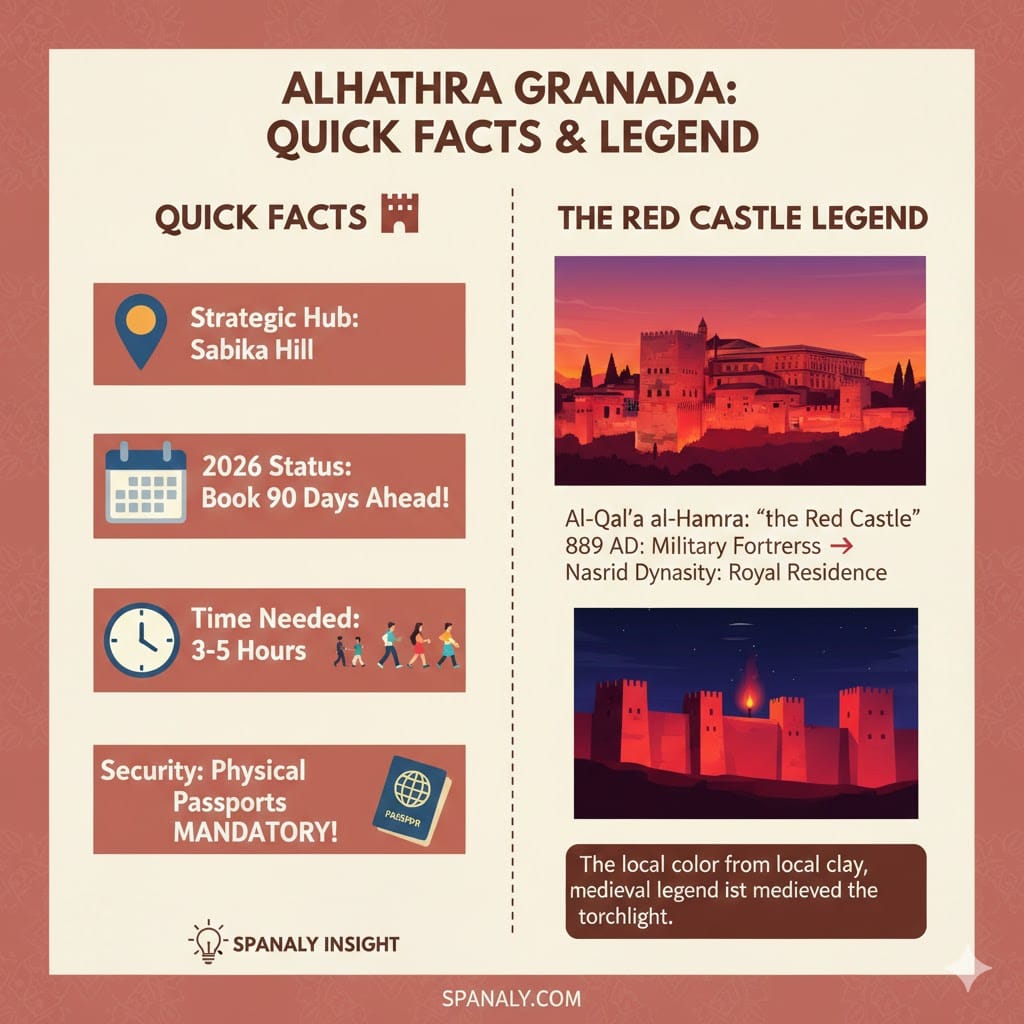
Before diving into the intricate halls, it is essential to understand the scale of this UNESCO masterpiece. Notably, the Alhambra is not just a palace; it is a self-sufficient “Palatine City” that has survived over a millennium of shifting empires.
📍 Strategic Hub: Perched on Sabika Hill, guarding the city’s ancient secrets for centuries.
📅 2026 Status: Timed entry is strictly enforced; secure your slot 90 days in advance.
🕰️ Time Needed: A complete visit typically requires 3 to 5 hours of walking.
🛡️ Security: Original physical passports are mandatory at all internal checkpoints.
The Legend of the “Red Castle”: The name Alhambra originates from the Arabic al-Qal’a al-Hamra, meaning “The Red Castle.” Initially, the site served as a modest military fortress in 889 AD. Specifically, it was the Nasrid Dynasty in the 13th century that transformed these rugged walls into a sophisticated royal residence.
Indeed, the breathtaking preservation of this site is one of the main reasons Why Visit Spain remains at the top of every traveler’s bucket list. Ultimately, the “Red” hue of the walls comes from the local ferruginous clay used in its construction, which glows brilliantly during the Andalusian sunset.
💡 Spanaly Insight: Many believe the red color was chosen for aesthetics. In fact, it was a practical choice of local materials. Notably, medieval legends claimed the castle was built at night by torchlight, and the reflection of the fire against the walls gave it its permanent crimson name!
🛡️ The Legend of the Red Fortress: From Fortress to Royal City
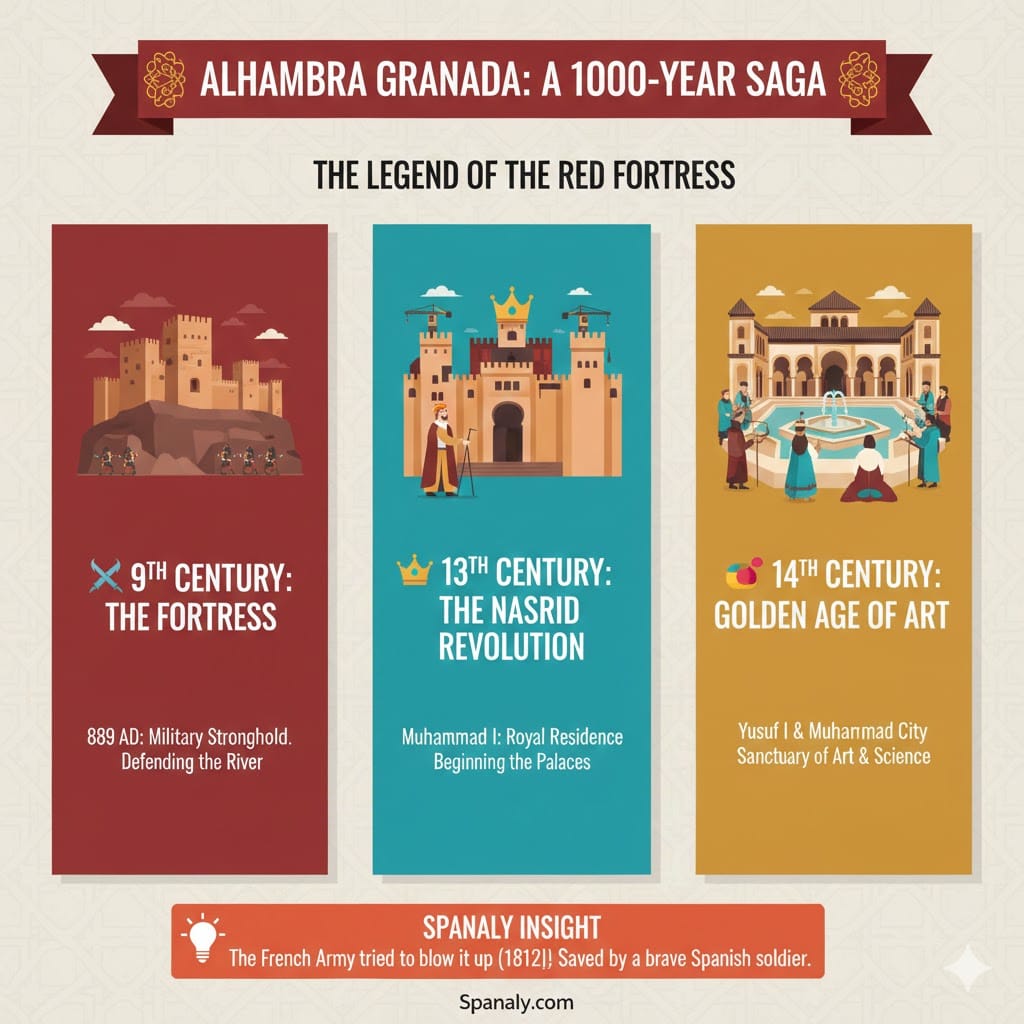
The story of the Alhambra is a saga of continuous transformation. Notably, it did not emerge as a palace overnight. Specifically, it grew like a living organism through three distinct and powerful chapters of Spanish history.
⚔️ The Fortress of the Caliphs (9th Century): It began in 889 AD as a modest military stronghold. In fact, its primary purpose was defense, guarding the river below from its strategic perch.
👑 The Nasrid Revolution (13th Century): Muhammad I, the founder of the Nasrid Dynasty, saw the hill’s potential. Specifically, he moved the royal residence here, beginning the construction of the massive walls and towers we see today.
🎨 The Golden Age of Art: Under Yusuf I and Muhammad V, the fortress evolved into a sophisticated “Palatine City.” Ultimately, it became a sanctuary for artists and scientists fleeing the changing frontiers of Al-Andalus.
Indeed, the breathtaking preservation of these layers makes Granada a cornerstone of the Spain Travel Guide Cities. Specifically, while the Moorish era defined its soul, the fall of Granada in 1492 introduced Christian influences that reshaped its destiny. Ultimately, walking through the Alhambra today is like leafing through a 1,000-year-old manuscript of stone and power.
💡 Spanaly Insight: Did you know that the Alhambra was almost lost to history? In fact, during the Napoleonic occupation, the retreating French army tried to blow up the entire complex. Notably, it was only saved at the last second by a brave Spanish soldier who defused the explosives!
🕌 The Nasrid Palaces: The Heart of Islamic Geometry
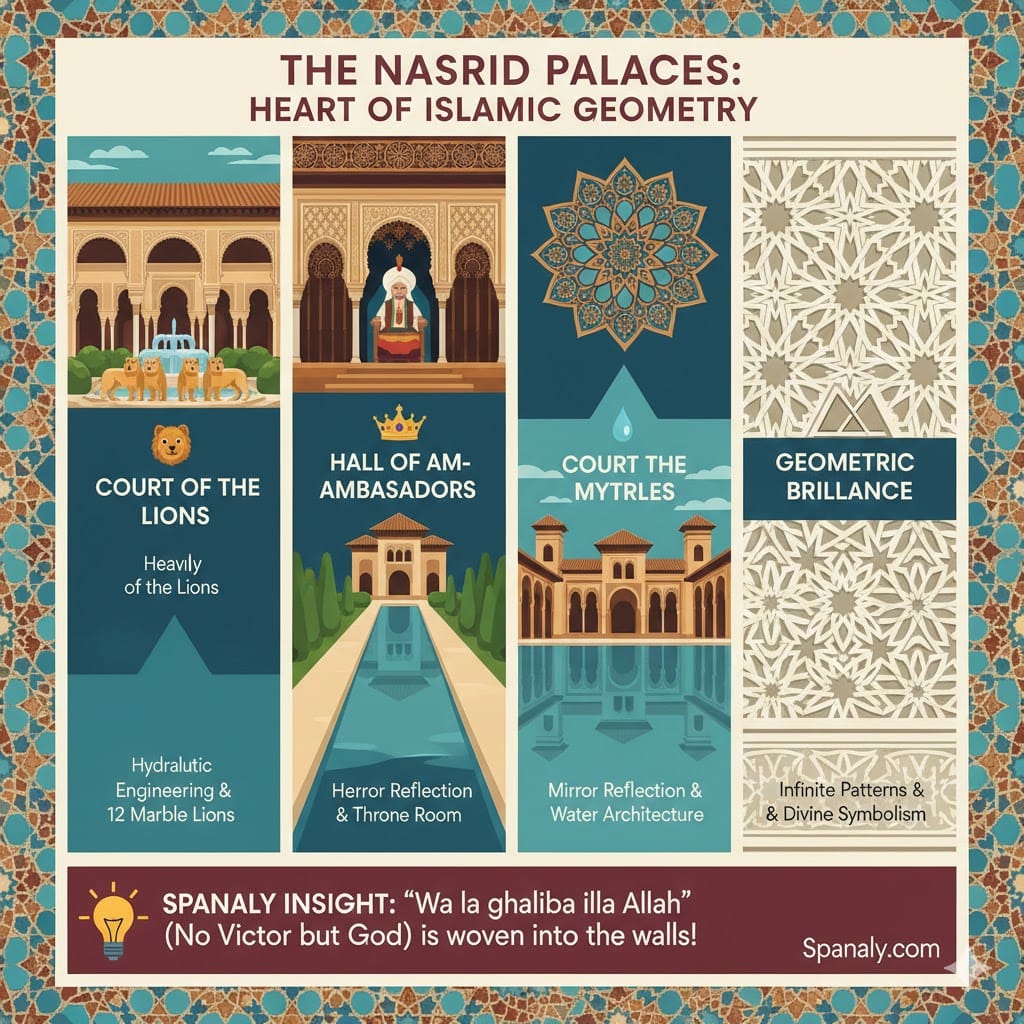
The Nasrid Palaces represent the most refined royal residence of the Moorish kings. Notably, as you walk through these halls, every wall acts as a canvas of “Zellij” tiles and intricate stucco. Specifically, the architects designed these spaces to blend mathematical perfection with the soothing elements of light and water.
🦁 The Court of the Lions: Witness the peak of hydraulic engineering in the central fountain supported by twelve marble lions.
👑 Hall of the Ambassadors: Step into the throne room where sultans received foreign dignitaries under a wooden ceiling representing the seven heavens.
💧 Court of the Myrtles: Capture the perfect mirror reflection of the towering Comares Palace in the massive central pool.
📐 Geometric Brilliance: Observe the infinite patterns that symbolize the divine and eternal nature of Islamic art.
Indeed, the rhythmic beauty and decorative stucco found here often remind travelers of the intricate work seen in the Alcázar of Seville. Specifically, while both sites showcase Mudéjar and Islamic mastery, the Nasrid Palaces remain the purest example of the original Andalusian royal lifestyle. Ultimately, water acts as the “silent architect,” cooling the air and creating a sense of celestial peace.
💡 Spanaly Insight: Look closely at the plasterwork in the Hall of the Ambassadors. In fact, there are poems and Quranic verses woven into the decorations. Notably, the most repeated phrase is “Wa la ghaliba illa Allah” (There is no victor but God)—the humble motto of the dynasty that built this paradise.
📜 Hidden Symbols & Calligraphy: Decoding the Walls
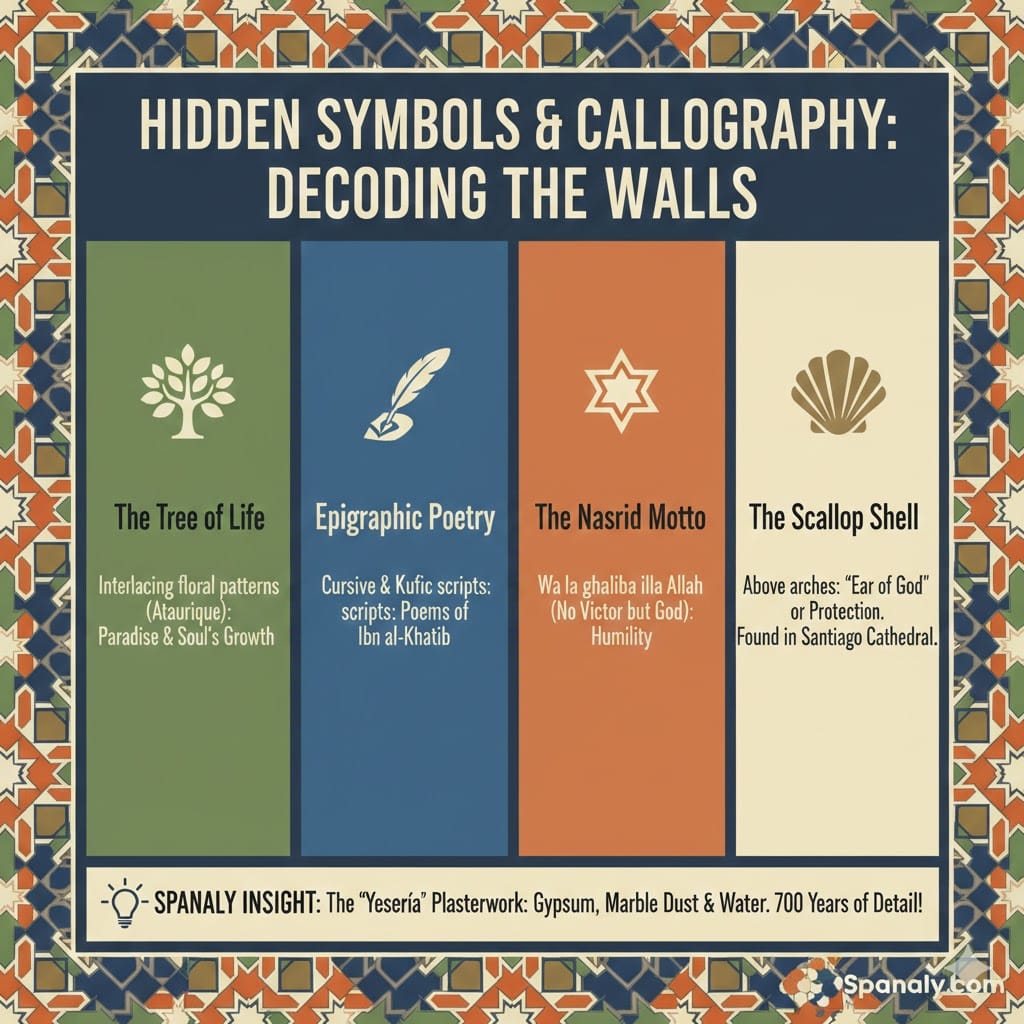
The walls of the Alhambra do not just hold up ceilings; they speak. Notably, every inch of the Nasrid Palaces is covered in a “silent language” of poems, prayers, and complex geometry. Specifically, understanding these symbols transforms your visit from a simple walk into a deep cultural immersion.
🌿 The Tree of Life: Look for interlacing floral patterns (Ataurique). In fact, these represent paradise and the eternal growth of the soul.
✍️ Epigraphic Poetry: Notice the cursive and Kufic scripts. Specifically, the walls feature verses by famous Andalusian poets like Ibn al-Khatib, celebrating the beauty of the palaces.
💠 The Nasrid Motto: Search for the phrase “Wa la ghaliba illa Allah” (No Victor but God). Ultimately, it appears hundreds of times as a reminder of humility amidst royal grandeur.
🐚 The Scallop Shell: Often seen above arches, this symbol represents the “Ear of God” or protection, a motif also found in the Cathedral of Santiago de Compostela.
Indeed, respecting the sacred nature of these inscriptions is a key part of Cultural Etiquette in Spain when visiting historical religious sites. Specifically, while the calligraphy is breathtakingly beautiful, it was primarily designed to inspire reflection and spiritual peace. Ultimately, the Alhambra is a “carved book” that requires patience to read.
💡 Spanaly Insight: Many visitors mistake the plasterwork for carved stone. In fact, it is actually “Yesería”—a mixture of gypsum, marble dust, and water. Notably, this material allowed artisans to create such impossible levels of detail that have survived for over 700 years!
🌿 Generalife Gardens: The Sultan’s Earthly Paradise
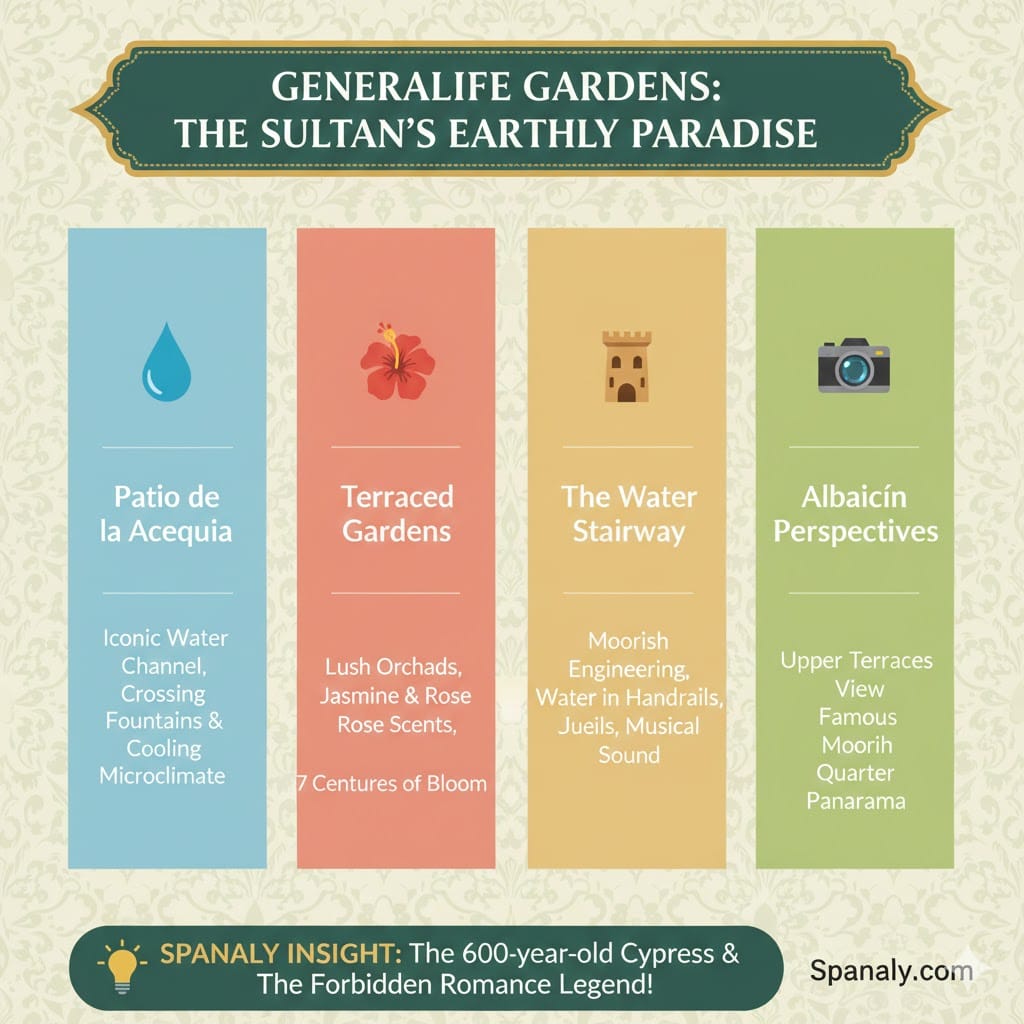
Located just a short walk from the main fortress, the Generalife served as the private summer estate of the Nasrid kings. Notably, it was designed as a “Garden of Paradise” to provide a serene escape from official court duties. Specifically, the layout is a masterclass in how to use water as a natural cooling system.
💧 Patio de la Acequia: Walk along the iconic Court of the Water Channel. In fact, the crossing fountains and long pool create a refreshing microclimate even during the peak of summer.
🌺 Terraced Gardens: Explore the lush orchards and aromatic flower beds. Specifically, the scent of jasmine and roses has filled this air for over seven centuries.
🏰 The Water Stairway: Witness the ingenuity of Moorish engineering. Notably, water flows through the handrails of the stairs to keep the stone cool and the sound of the garden musical.
📸 Albaicín Perspectives: Look out from the upper terraces for the most famous view of the old Moorish quarter.
Indeed, if you appreciate the blend of history and botanical beauty, you will find a similar tranquility in the Jardines de Murillo Seville. Specifically, while the Generalife is larger and more rugged, both gardens share the same Moorish philosophy of creating a “heaven on earth.” Ultimately, the Generalife remains the oldest surviving Moorish garden in the world.
💡 Spanaly Insight: Notice the Cypress trees in the Court of the Sultana’s Cypress. In fact, one of these trees is over 600 years old! Notably, legends say it was the secret meeting spot for a forbidden romance between a knight and a queen, leading to a dramatic turn in the dynasty’s history.
⚔️ The Alcazaba: The Ancient Military Stronghold
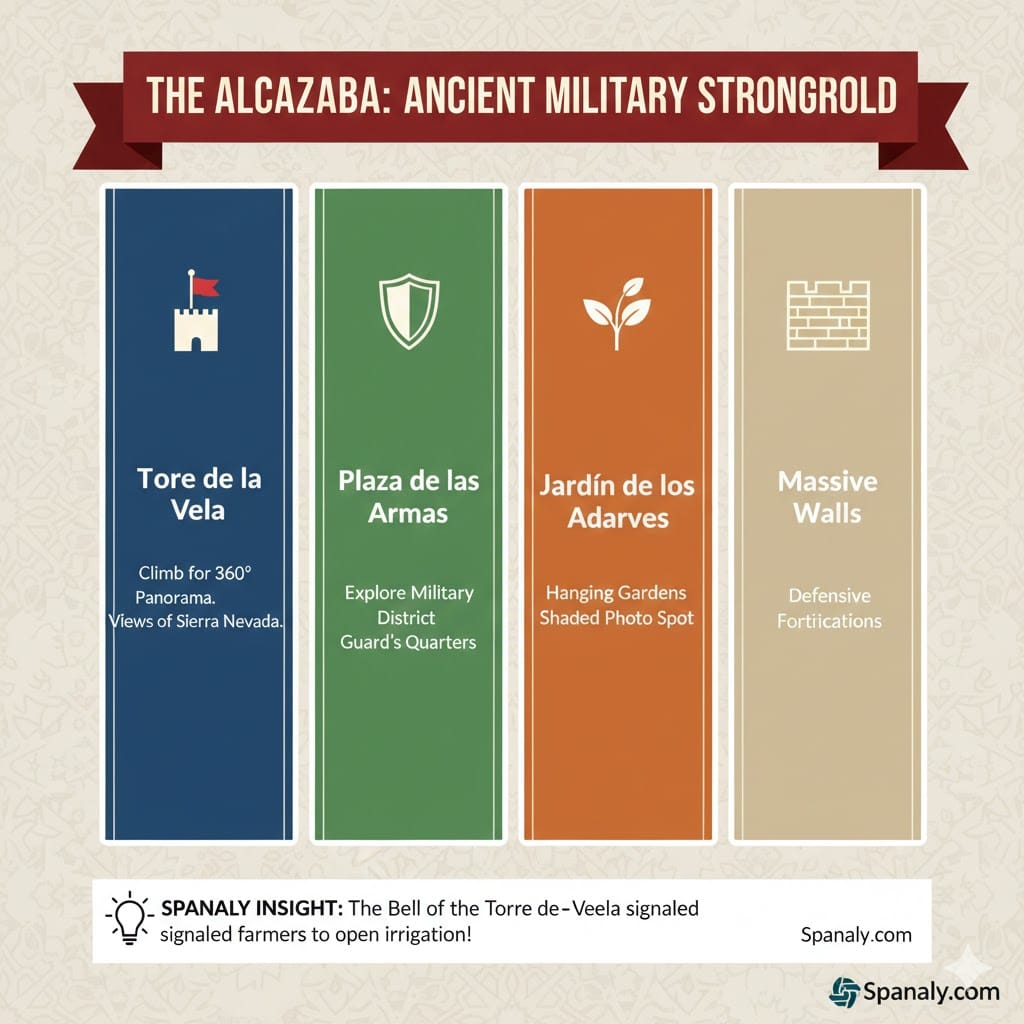
The Alcazaba is the oldest structure within the Alhambra complex. Notably, it was built as a formidable military fortress to protect the Nasrid royal family and the city below. Specifically, walking through its ramparts offers a raw, powerful contrast to the delicate beauty of the palaces.
🚩 Torre de la Vela: Climb the iconic Watchtower for a 360-degree panorama. In fact, it offers the most breathtaking views of the Sierra Nevada mountains and the city of Granada.
🛡️ Plaza de las Armas: Explore the foundations of the ancient military district. Specifically, you can still see the urban layout where the elite palace guards once lived.
🌿 Jardín de los Adarves: Relax in these beautiful hanging gardens located on the ramparts. Notably, they provide a peaceful, shaded spot for photography amidst the stone walls.
🧱 The Massive Walls: Observe the thickness of the defensive fortifications that withstood centuries of sieges and battles.
Indeed, if you are fascinated by Spain’s strategic military history, you should also explore the Alcázar of Segovia, which served a similar defensive purpose but with a distinct Northern architectural style. Specifically, while the Alcazaba is rugged and functional, both sites represent the peak of medieval fortification. Ultimately, the Alcazaba remains the best spot to feel the “pulse” of old Granada.
💡 Spanaly Insight: Look for the bell on top of the Torre de la Vela. In fact, it wasn’t just for warnings. Notably, for centuries, the ringing of this bell signaled to the farmers of the Granada plain exactly when to open their irrigation channels to water their crops!
🏛️ Renaissance Transformation: The Palace of Charles V
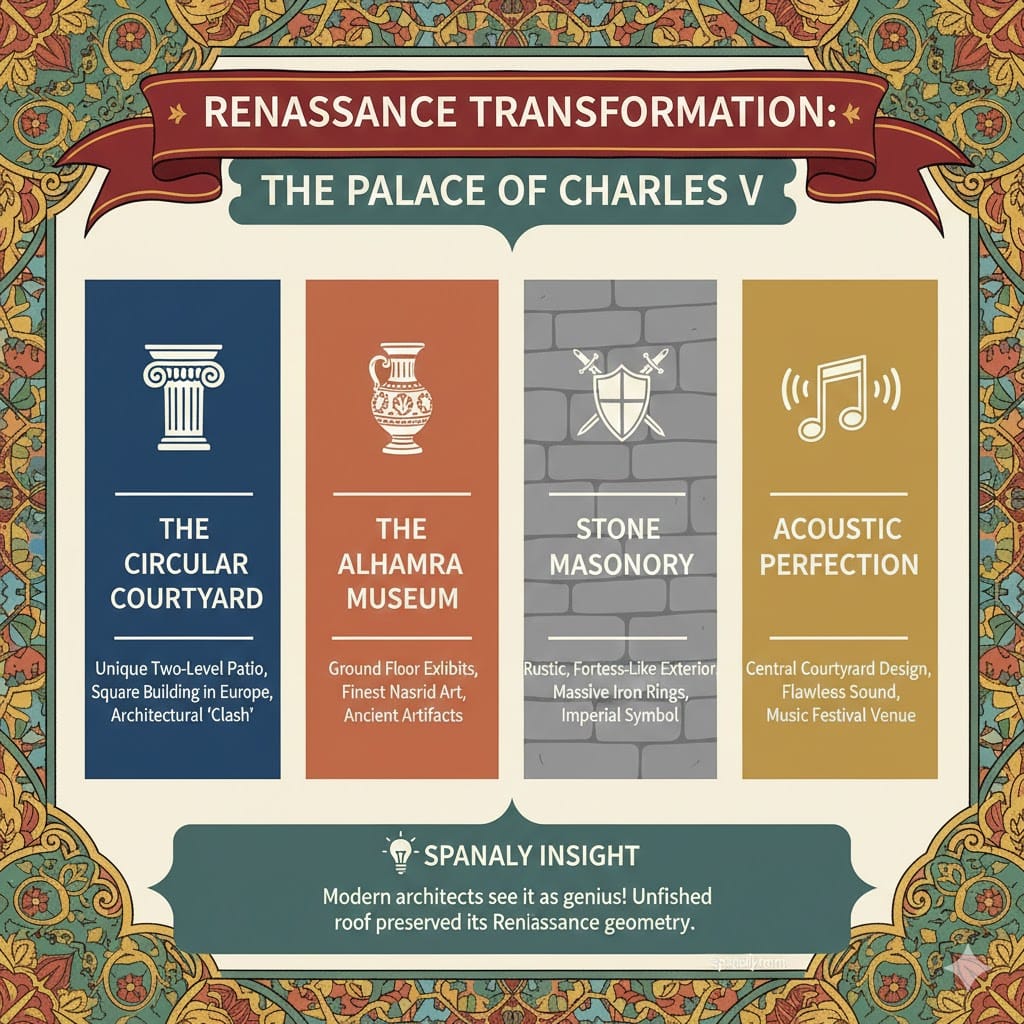
Rising in sharp contrast to the delicate Moorish arches, the Palace of Charles V is a masterpiece of the Spanish Renaissance. Notably, Holy Roman Emperor Charles V ordered its construction in 1527 to establish a permanent royal residence within the Alhambra. Specifically, it represents the “clash” and eventual harmony between Islamic and Christian architectural worlds.
🌀 The Circular Courtyard: Step into the world’s most unique Renaissance patio. In fact, it is the only two-level circular courtyard found in a square building in Europe.
🏺 The Alhambra Museum: Explore the ground floor, which houses the finest collection of Nasrid art and artifacts. Specifically, look for the famous “Alhambra Vases.”
⚔️ Stone Masonry: Observe the rustic stone exterior with massive iron rings. Notably, this “fortress-like” appearance was meant to symbolize the strength of the new empire.
🎵 Acoustic Perfection: Stand in the center of the courtyard. Ultimately, its design creates such perfect acoustics that it remains a premier venue for the Granada International Festival of Music and Dance.
Indeed, the sheer scale of this imperial project often reminds visitors of the grandeur found in the Royal Palace of Madrid. Specifically, while the Madrid palace is Baroque and much later, both buildings share the same purpose of projecting royal power over the landscape. Ultimately, the Palace of Charles V serves as a monumental bridge between two eras.
💡 Spanaly Insight: Many critics in the past felt this palace “damaged” the Alhambra’s harmony. In fact, modern architects now view it as a stroke of genius. Notably, because it was never finished (it lacked a roof for centuries!), the building was preserved in a way that allows us to see the raw brilliance of its Renaissance geometry.
⚔️ Alhambra vs. Alcázar of Seville: Understanding the Two Icons
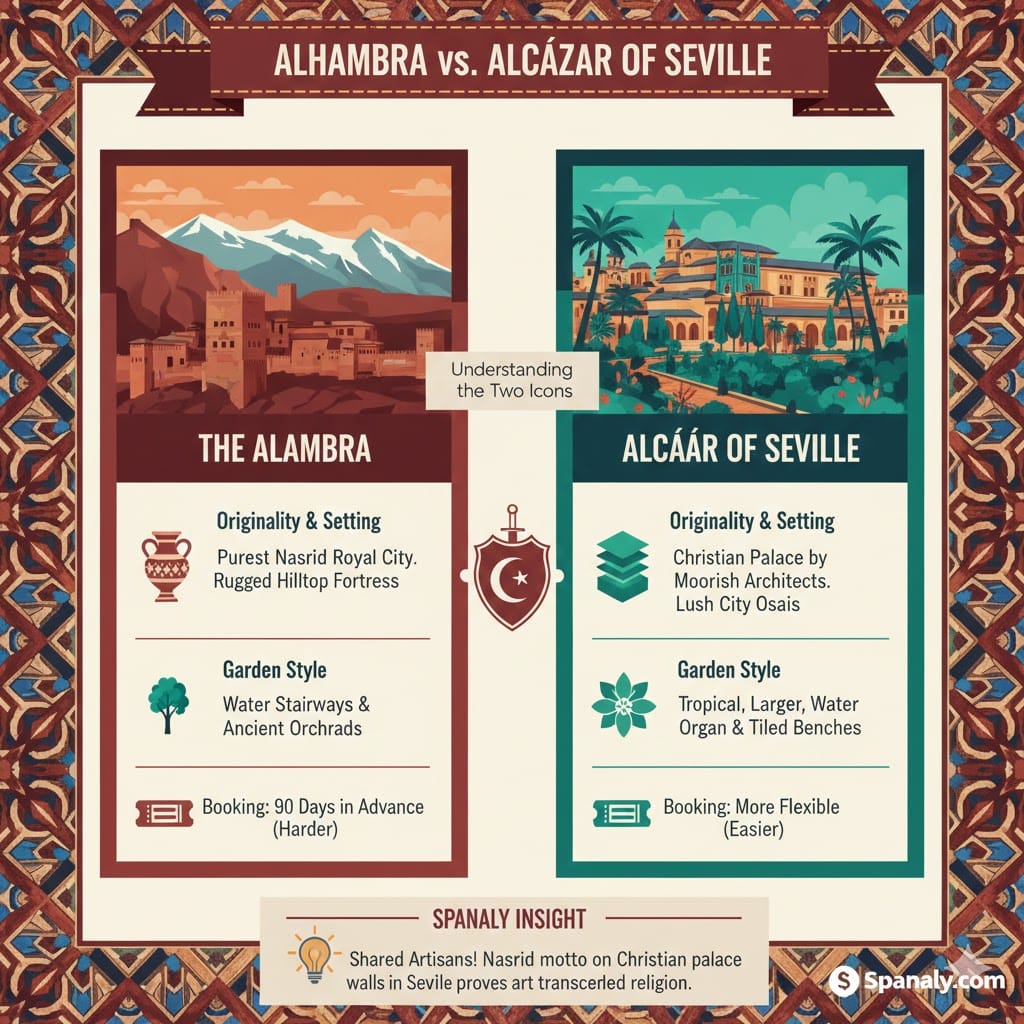
It is the ultimate traveler’s dilemma: If you only have time for one, which should you choose? Notably, while both are UNESCO World Heritage sites showcasing Mudéjar and Islamic art, they offer vastly different emotional experiences. Specifically, understanding these nuances is key to mastering your Andalusian itinerary.
🏺 Originality vs. Layers: The Alhambra is the purest, most complete original Nasrid royal city. In fact, the Alcázar of Seville is a fascinating “hybrid” where Christian kings built their own dream palaces using Moorish architects after the Reconquista.
🏔️ Setting & Atmosphere: Perched on a rugged hill with the Sierra Nevada as a backdrop, the Alhambra feels like a secluded fortress. Specifically, the Alcázar is a lush, hidden oasis tucked right into the vibrant heart of Seville’s city center.
🌿 Garden Styles: The Generalife in Granada is famous for its “Water Stairways” and ancient orchards. Notably, the gardens of Seville are larger, more tropical, and feature the famous “Water Organ” and tiled benches.
🎟️ Booking Difficulty: Ultimately, the Alhambra is much harder to visit. You must book 90 days in advance, whereas Seville is generally more flexible (though still busy!).
Indeed, most experts agree that the Alhambra is the architectural “soul” of Al-Andalus, while the Alcázar is its “living evolution.” Specifically, if you want a raw, historical fortress feel, Granada wins. If you want a romantic, lush palace experience integrated with city life, Seville is your destination. Ultimately, visiting both provides the complete story of Spain’s golden age.
💡 Spanaly Insight: Did you know that some of the artisans who worked on the Alhambra were later sent to Seville? In fact, this is why you will see the same Nasrid motto (“No Victor but God”) on the walls of a Christian palace in Seville! Notably, it proves that beauty and craftsmanship always transcended religious borders in medieval Spain.
📸 Photography Guide: Best Spots & Timing

Capturing the Alhambra’s soul requires more than just a good camera; it requires perfect timing and an eye for hidden angles. Notably, the way light interacts with the red stone and intricate plasterwork changes every hour. Specifically, following this guide will help you avoid the “tourist crowds” in your frames.
🌅 The Golden Hour at San Nicolás: For the iconic wide shot of the entire complex against the Sierra Nevada, head to the Mirador de San Nicolás in the Albayzín at sunset. In fact, this is when the “Red Fortress” truly earns its name.
🦁 Court of the Lions (Morning Light): Aim for the earliest possible slot. Specifically, the low morning sun creates dramatic shadows through the 124 marble columns, highlighting the “forest” effect.
💧 Mirror Reflections: In the Court of the Myrtles, crouch low near the water’s edge. Ultimately, this allows you to capture the perfect, symmetrical reflection of the Comares Tower.
🌿 Generalife Arches: Use the botanical arches as natural frames for your photos of the distant palace. Notably, this adds depth and a “secret garden” feel to your shots.
Indeed, having the right gear is essential, so don’t forget to check our Spain Packing List for recommendations on wide-angle lenses and portable power banks. Specifically, a wide-angle lens is a “must-have” to capture the vastness of the Palace of Charles V’s courtyard. Ultimately, the Alhambra is a place where “patience” is your best filter.
💡 Spanaly Insight: Avoid using flash inside the Nasrid Palaces. In fact, it is strictly prohibited to protect the ancient pigments. Notably, to get clear shots in low light, use the “Night Mode” on your smartphone or increase your ISO—just keep your hands steady against a marble pillar for support!
📍 Location & Logistics: Reaching the Sabika Hill
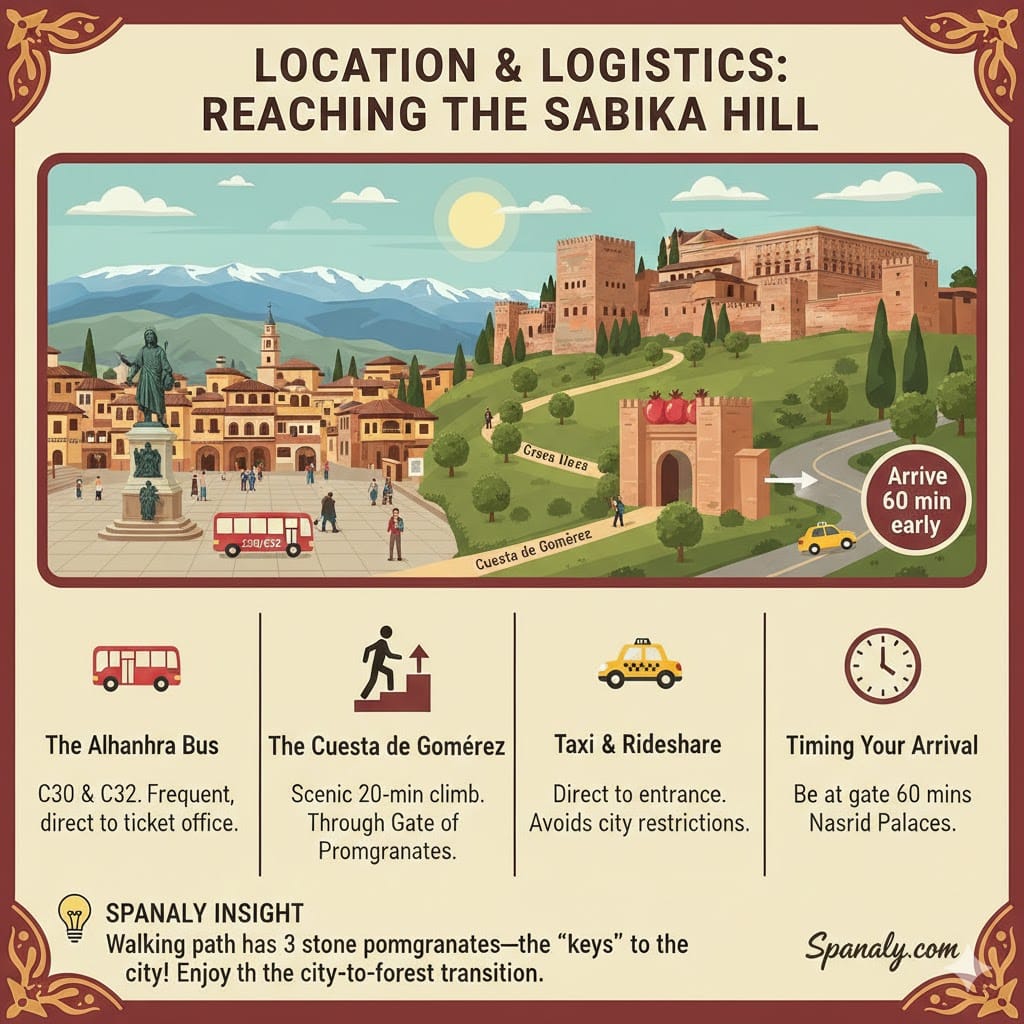
The Alhambra sits majestically atop the Sabika Hill, overlooking the city of Granada. Notably, while it looks close to the center, the climb is steep, and choosing the right transport is essential for saving your energy for the palaces. Specifically, planning your arrival time is as important as the journey itself.
🚌 The Alhambra Bus (C30 & C32): The most convenient option. In fact, these small red buses run every few minutes from Plaza Isabel la Católica directly to the ticket office.
🚶 The Cuesta de Gomérez Walk: For those who enjoy a scenic climb. Specifically, you walk through the lush forests of the Alhambra, entering through the historic Gate of Pomegranates.
🚕 Taxi & Rideshare: Taxis can drop you off right at the entrance. Notably, private cars are restricted in many parts of the old quarter, so a taxi is often faster than a rental.
⏰ Timing Your Arrival: Ultimately, you should arrive at the main entrance at least 60 minutes before your scheduled Nasrid Palace entry.
Indeed, checking the Best Time to Visit Spain will help you understand how Granada’s weather affects these logistics. Specifically, in summer, the midday sun makes the uphill walk exhausting, while spring offers the perfect temperature for a stroll. Ultimately, the goal is to reach the gates relaxed and ready to explore.
💡 Spanaly Insight: If you choose to walk, look for the three stone pomegranates on the Puerta de las Granadas. In fact, they are the symbolic “keys” to the city. Notably, walking this path allows you to see the transition from the modern city to the ancient forest, a feeling you miss entirely if you take the bus.
🗺️ Suggested Route & Walking Distances
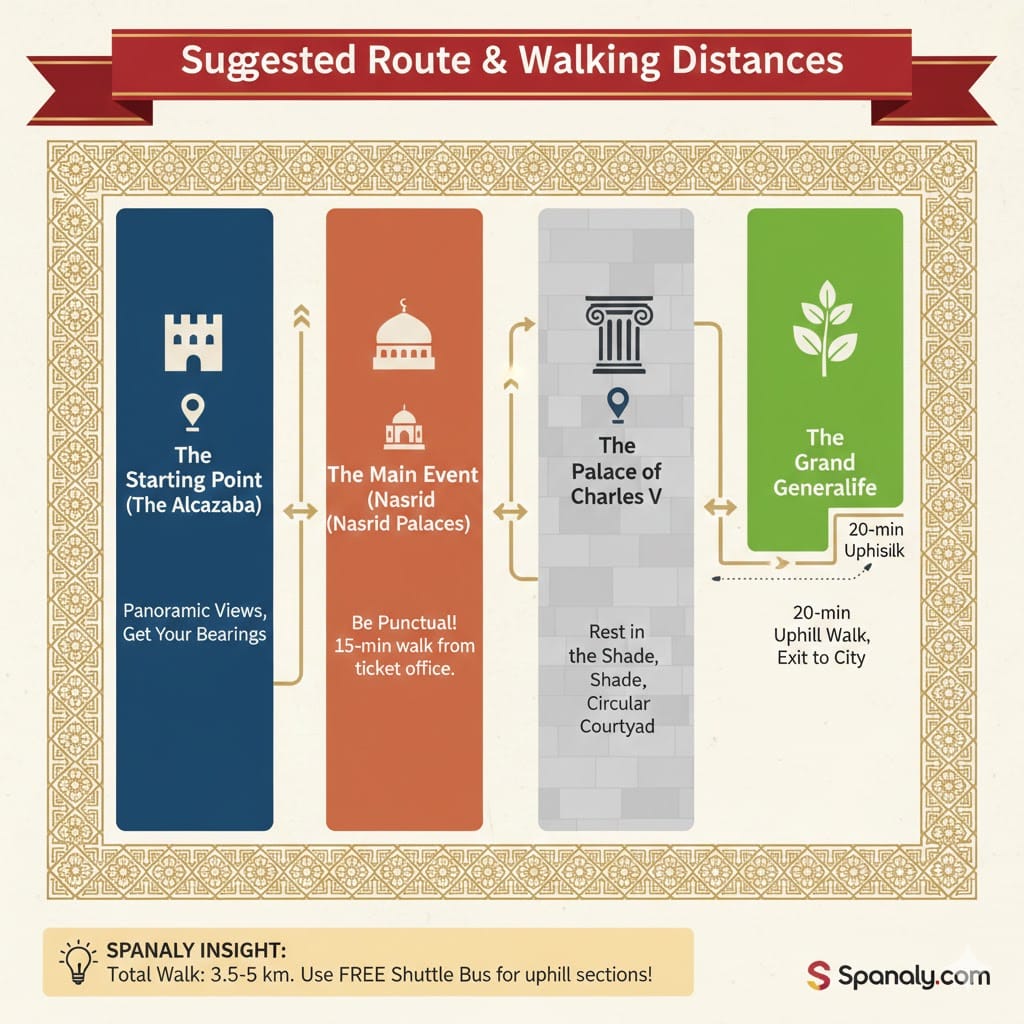
The Alhambra is not just a palace; it is a vast royal city stretching over 140,000 square meters. Notably, many visitors exhaust themselves by backtracking or miscalculating the time needed between sections. Specifically, following a logical “one-way” flow will save your feet and your time.
📍 The Starting Point (The Alcazaba): Begin here for the panoramic views. In fact, it’s the best way to get your bearings and understand the scale of the fortress before entering the delicate palaces.
🕌 The Main Event (Nasrid Palaces): You must be at the entrance exactly at your ticket time. Notably, it takes about 15 minutes to walk here from the main ticket office, so don’t be late!
🏛️ The Transition (Palace of Charles V): Located right next to the Nasrid Palaces, this is the perfect spot to rest in the shade of the circular courtyard.
🌿 The Grand Finale (Generalife): Save the gardens for last. Specifically, it is a 20-minute uphill walk from the Nasrid Palaces. Ultimately, ending your tour here allows you to exit through a different gate closer to the city.
Indeed, mastering the distances in Granada is great practice for the rest of your trip. If you are heading west next, our guide on Getting Around Seville provides essential tips on using the metro, trams, and buses to navigate the Andalusian capital. Specifically, while Granada is a hill-climbing adventure, Seville offers a flatter landscape with a wider variety of public transit. Ultimately, whether you are walking the Sabika Hill or taking a tram in Seville, comfortable footwear is your best friend.
💡 Spanaly Insight: The total walking distance for a full tour is approximately 3.5 to 5 kilometers (2-3 miles). In fact, there is a free shuttle bus that runs inside the complex between the Generalife and the main entrance. Notably, if you have mobility issues or are visiting with kids, use this shuttle to skip the longest uphill sections!
🍴 Dining & The Full Granada Experience

After hours of walking through history, your reward awaits in the vibrant streets of Granada. Notably, Granada is one of the last cities in Spain where the legendary tradition of “free tapas” is still thriving. Specifically, when you order a drink, a small, delicious plate of food arrives at no extra cost, making dining here a true cultural adventure.
🍷 The Free Tapas Tradition: Explore the bars around Plaza Nueva or Calle Elvira. In fact, each round of drinks brings a new surprise, from Spanish omelets to slow-cooked meats.
🍵 Moroccan Tea Houses (Teterías): Wander into the Albayzín district for an authentic mint tea. Specifically, Calle Calderería Nueva feels like a slice of Marrakesh tucked into the heart of Granada.
🍽️ View with a Meal: For a splurge, book a table at a “Carmen” (a traditional Granada house with a garden). Notably, many offer terrace dining with a direct view of the illuminated Alhambra at night.
🍦 Local Delights: Don’t miss the “Piononos,” small, sweet pastries originally from the nearby town of Santa Fe.
Indeed, experiencing this culinary tradition is a highlight of any Andalusian trip. If you are planning to continue your food journey, comparing these free treats with the famous Traditional Sevillian Tapas is a must. Specifically, while Granada is famous for its generosity with free portions, Seville is renowned for its culinary sophistication and specialized small plates like Espacas con Garbanzos. Ultimately, both cities offer a unique taste of the Spanish soul.
💡 Spanaly Insight: Looking for the best local secret? In fact, head to the bars near the Bullring (Plaza de Toros). Notably, this is where the locals go to avoid the tourist prices of the center, and the tapas portions here are often large enough to be a full meal!
💡 Master the Fortress: Expert Tips for a Flawless Visit
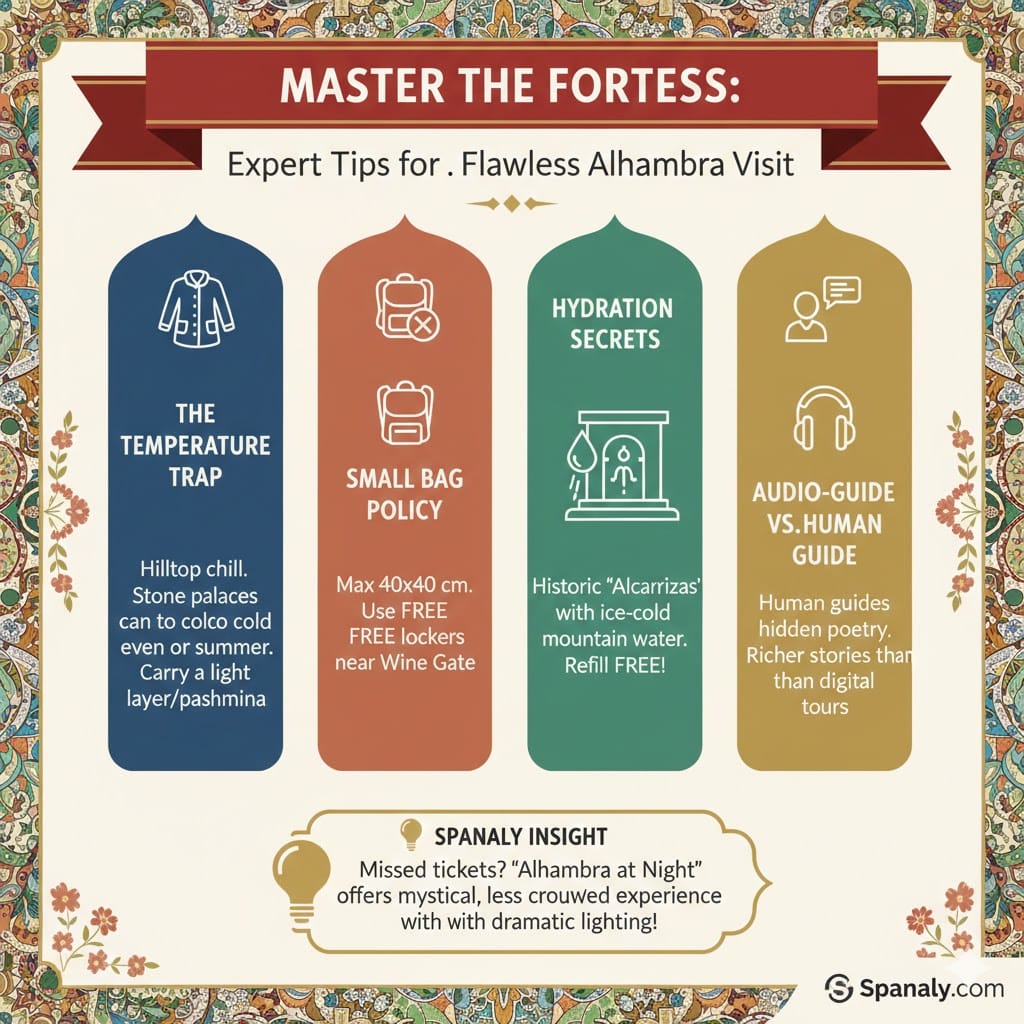
To truly experience the Alhambra like a seasoned traveler, you need to look beyond the basic logistics. Notably, these “insider” strategies will help you navigate the nuances that most tourists miss. Specifically, they are designed to save you from common frustrations and enhance your emotional connection to the site.
🧥 The Temperature Trap: The Alhambra is built on a hill, and the temperature can drop significantly in the evening or remain surprisingly chilly in the morning. In fact, even in summer, the stone palaces can feel cold. Specifically, always carry a light layer or pashmina to stay comfortable.
🎒 Small Bag Policy: Security is strict. Notably, backpacks larger than 40×40 cm are not allowed inside the palaces. Ultimately, use the free lockers near the Wine Gate (Puerta del Vino) to store your heavier gear so you can walk freely.
💧 Hydration Secrets: Don’t keep buying plastic bottles! In fact, there are several historic “Alcarrizas” (public drinking fountains) with ice-cold mountain water throughout the complex. Specifically, bring a reusable bottle and fill it up for free at the fountain near the Palace of Charles V.
🎧 Audio-Guide vs. Human Guide: While the official audio guides are good, the Alhambra is about stories. Ultimately, if your budget allows, hire a private guide for the Nasrid Palaces to explain the hidden poetry carved into the walls, which is often skipped in digital tours.
Indeed, these nuances are part of the broader Spain Travel Tips you should master before landing. Specifically, understanding local etiquette and site-specific rules across Spain will transform your trip from “standard” to “extraordinary.” Ultimately, the Alhambra rewards those who are prepared.
💡 Spanaly Insight: If you missed out on Nasrid Palace tickets, don’t give up! In fact, there is a separate “Alhambra at Night” ticket. Notably, it offers a much more intimate, mystical experience with fewer crowds and dramatic lighting, often available even when day tickets are sold out.
🏰 Alhambra Essential Q&A – Expert Travel Wisdom
🎟️ Is there a "waiting list" for sold-out Nasrid Palace tickets?
Officially, no. However, cancelled tickets often reappear on the official website at midnight (Spanish time). Check the portal at 12:01 AM a few days before your visit; you might find a last-minute slot.
🪪 Can I change the name on my Alhambra ticket after purchase?
No, tickets are strictly non-transferable. The name must match your original physical passport exactly. If there is a typo or you try to use someone else's ticket, security will deny you entry without a refund.
🌙 Does the "Night Visit" include the entire Alhambra complex?
No. Night tickets are split into two types: Nasrid Palaces OR Generalife Gardens. You cannot visit both on the same night ticket. Most travelers prefer the Nasrid Palaces at night for the mystical lighting and silence.
🔭 Are tripods or selfie sticks allowed inside the palaces?
No. Tripods and selfie sticks are strictly prohibited to prevent damage to the delicate carvings and to keep the crowd moving. Professional photography requires a special permit obtained weeks in advance.
🥪 Can I bring my own food and eat inside the Alhambra?
Eating is forbidden inside the palaces and gardens. However, there are designated picnic areas near the Wine Gate (Puerta del Vino) and the museum. Keep snacks in your bag until you reach these specific zones.
Curated by Spanaly.com
🏰 Your Alhambra Story Awaits
The Alhambra is more than just a monument; it is a walk through a dream that has survived for centuries. Notably, whether you are mesmerized by the poetry on the walls or the scent of the Generalife jasmine, this place will leave a permanent mark on your soul.
✨ The Soul: Witness the peak of Nasrid artistry and Moorish history.
📸 The Memory: Capture breathtaking views and perfect water reflections.
🍷 The Reward: End your day with sunset tapas in the vibrant Albayzín.
🗺️ The Journey: Use our Spain Historical Monuments Guide to plan your next stop after Granada.
Indeed, the Alhambra is just the beginning of your adventure. Specifically, while it is the “crown jewel,” our broader guide to historical landmarks will help you discover the hidden gems scattered across the peninsula. Ultimately, the best way to see the Alhambra is to take your time, breathe in the history, and let the red walls tell you their secrets.
💡 Final Spanaly Tip: Don’t forget to put your camera away for at least 10 minutes. In fact, the best “photo” is the one your memory takes when you simply stand still and listen to the sound of the running water.