🏛️ San Sebastián
Forget the frantic pace of Barcelona; San Sebastián is where Spain slows down to eat world-class food.
Tucked between lush green hills and the Atlantic Ocean, it offers a rare mix of elegance, natural beauty, and authentic Basque character. Here, life moves at a pleasant pace — long walks along the bay, world-class food, and that unmistakable feeling of being somewhere refined yet relaxed.
✨ What makes this city special?
🌊 Iconic La Concha Beach: Often described as one of Europe’s most beautiful urban beaches, with its perfect shell shape and calm golden sands.
🍽️ Culinary Excellence: Home to one of the highest concentrations of Michelin-starred restaurants in the world, alongside the lively pintxo culture in the Old Town.
🎨 Elegant Atmosphere: Belle Époque architecture, royal heritage, and a proud Basque spirit that welcomes visitors warmly.
🍃 Natural Setting: Flanked by Mount Igueldo and Mount Urgull, offering stunning views over the Bay of Biscay.
Whether you come for a romantic getaway, a food-focused trip, or simply to enjoy the sea air, San Sebastián delivers a balanced and memorable experience.
If you’re planning a wider journey through the north, our Ultimate Northern Spain Guide will help you see how San Sebastián fits into the bigger picture of Green Spain from dramatic mountains to wild coastal routes.
⚡ Quick Summary: San Sebastián at a Glance
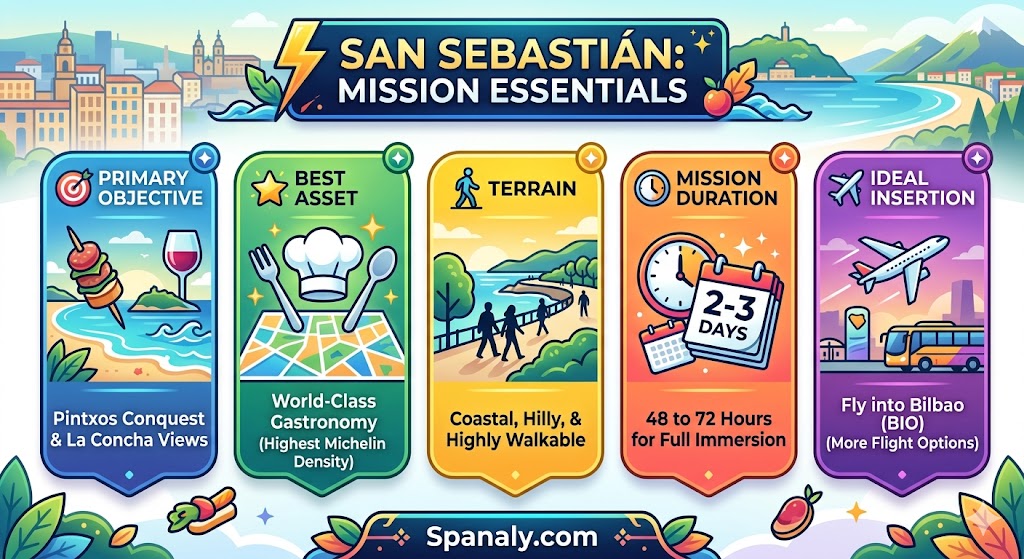
Before you dive into the details, here is a helpful snapshot to help you plan your visit. This overview covers the essentials for anyone heading to the Basque coast for the first time.
| Category | Helpful Details & Tips |
|---|---|
| Primary Goal | Enjoying La Concha Bay and the local Pintxo scene. |
| Best Asset | World-class dining and high-end coastal atmosphere. |
| Terrain | Coastal and flat in the center, with gentle hills for views. |
| Suggested Stay | 2 to 3 days for a relaxed experience. |
| Arrival Hub | Bilbao Airport (BIO) for more international flight options. |
Key Practicalities to Remember:
📅 Best Time: Late spring (June) or early autumn (September) for mild weather.
👟 Mobility: San Sebastián is a walking city; bring your most comfortable shoes.
🗣️ Language: Spanish and Basque are spoken; English is widely understood in shops.
💰 Budget: Generally higher than in Southern Spain, especially for dining and hotels.
✨ Why San Sebastián is a Must-Visit Destination
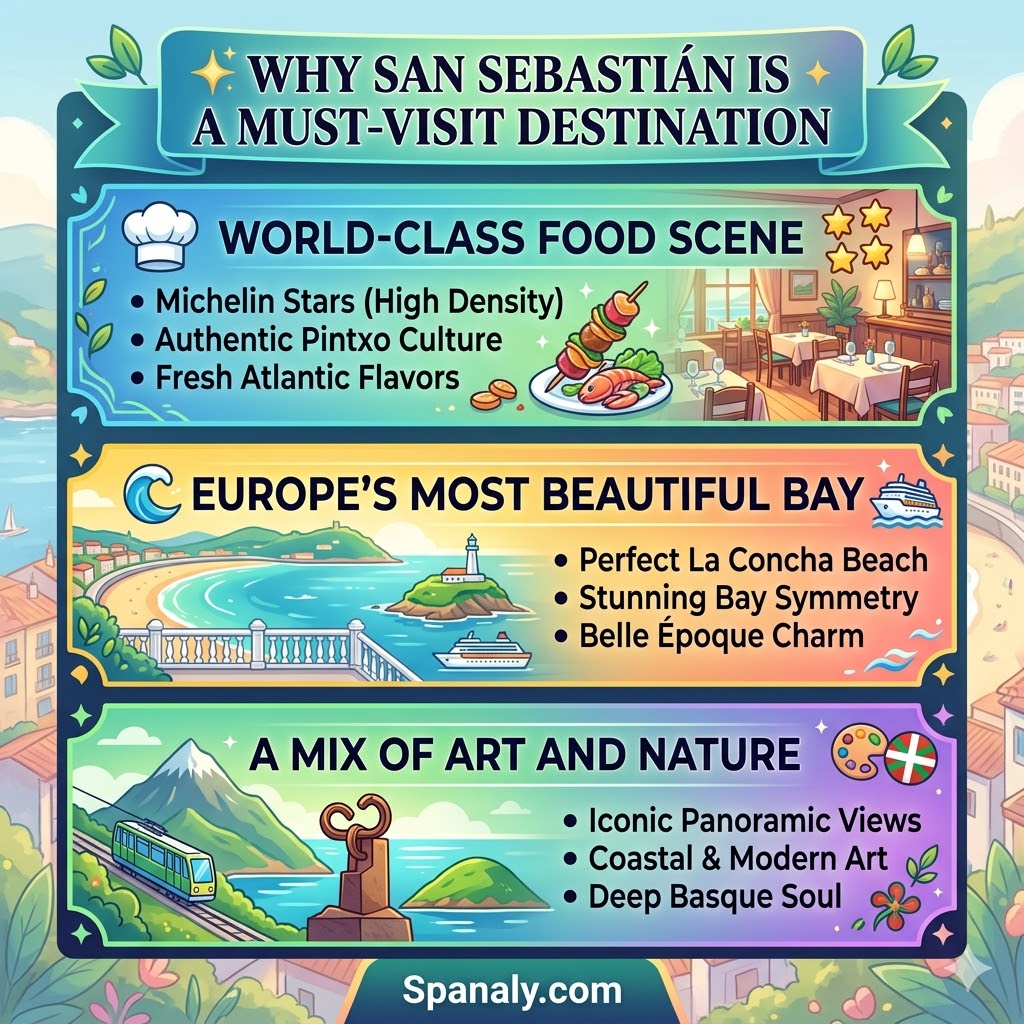
While Madrid is the heart of Spain and Barcelona its vibrant energy, San Sebastián feels like the country’s sophisticated soul. It offers a rare balance where world-class dining, natural beauty, and Basque elegance exist in total harmony.
🌊 Europe’s Most Beautiful Urban Bay
The Golden Shell: Playa de la Concha is a perfectly shaped bay with calm waters and a long royal history.
Royal Architecture: Stunning Belle Époque buildings give the city a graceful, almost aristocratic atmosphere.
Twin Peaks: Mount Igueldo and Mount Urgull flank the city, offering breathtaking views over the deep blue Bay of Biscay.
🍽️ A Gastronomic Identity Like No Other
Culinary Excellence: Home to a staggering number of Michelin stars and innovative chefs.
The Pintxo Tradition: Experience the lively social ritual of bar-hopping in the historic Old Town.
Expert Tip: If you are planning a longer adventure, San Sebastián is a highlight of any Northern Spain Road Trip.
🎨 Where Culture Meets Nature
The Wind Comb: Iconic steel sculptures where the wild Atlantic waves interact with modern art.
Basque Spirit: A welcoming yet fiercely independent culture that you can feel in every neighborhood.
🏖️ The Golden Trio: A Guide to the City’s Urban Beaches
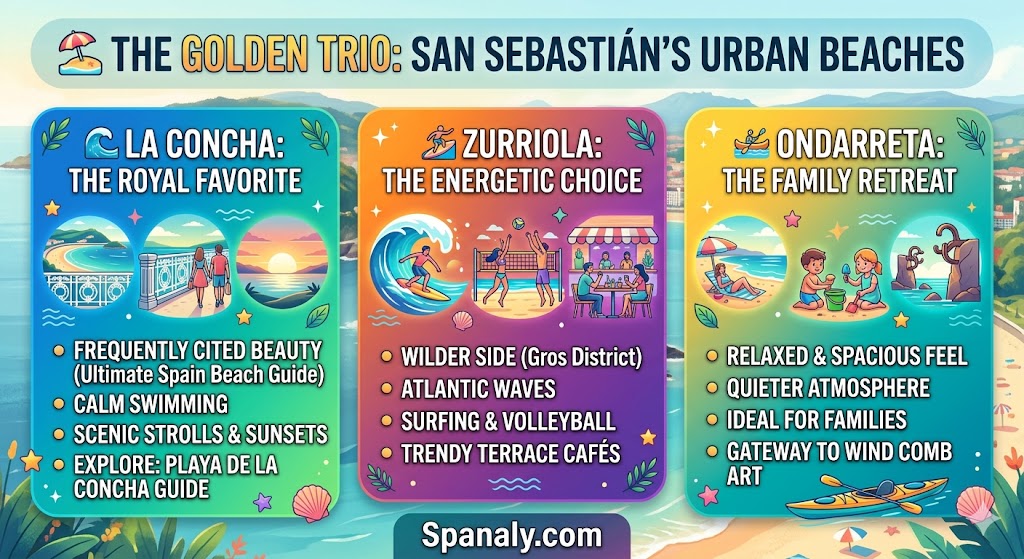
The coastline of San Sebastián is defined by three distinct beaches. Each one has its own personality, ranging from quiet royal elegance to vibrant surf vibes. Knowing which one fits your mood is the key to a perfect day by the sea.
🌊 La Concha: The Royal Favorite
The Atmosphere: Frequently cited as one of the most beautiful urban spots in our Ultimate Spain Beach Guide, its crescent shape is truly iconic.
Best For: Calm swimming, scenic walks along the ornate white railings, and watching the sunset.
Don’t Miss: Exploring the full details in our dedicated Playa de la Concha guide to plan your visit perfectly.
🏄 Zurriola: The Energetic Choice
The Atmosphere: Located in the Gros district, this is the city’s wilder side where the Atlantic waves meet a younger, local crowd.
Best For: Surfing, beach volleyball, and enjoying a coffee at one of the trendy terrace cafés nearby.
🛶 Ondarreta: The Family Retreat
The Atmosphere: Tucked at the western end of the bay, it offers a more relaxed and spacious feel than its famous neighbor.
Best For: Families with children and those taking a stroll toward the famous “Wind Comb” sculptures.
Spanaly Insight: If you want a unique perspective, take the small boat (motorita) from the harbor to Santa Clara Island. It sits right in the middle of the bay and has its own tiny “disappearing” beach that only reveals itself during low tide—a local secret for a quiet escape.
🍽️ The Gastronomic Identity: Beyond the Michelin Stars
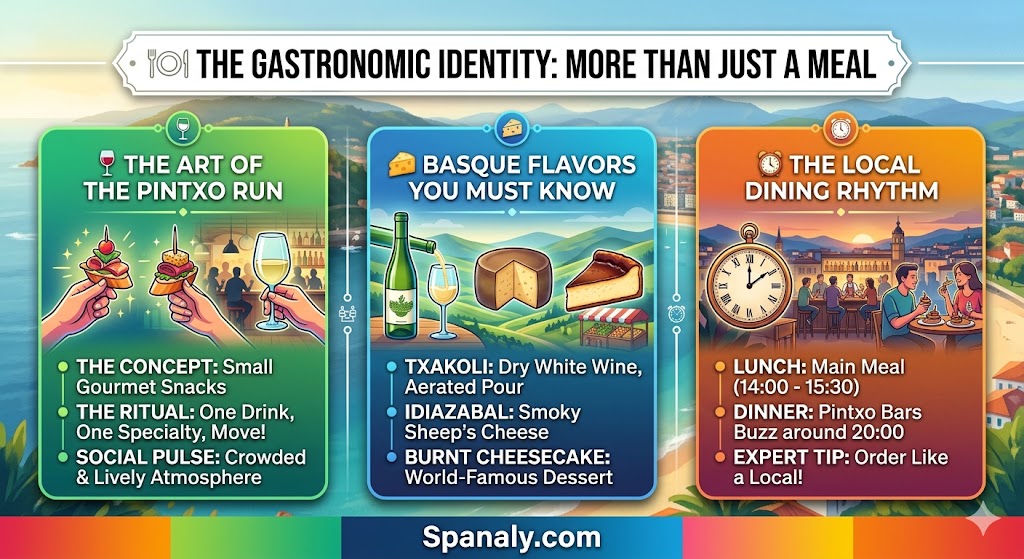
In San Sebastián, food is more than a meal; it’s a shared social ritual that defines the city’s pulse. While it is famous for having the highest density of Michelin stars per capita, the real heart of the culinary scene beats in the crowded bars of the Old Town. To fully appreciate these flavors, it helps to understand the broader context of Spanish Cuisine and its regional diversity.
🍷 The Art of the Pintxo Run
The Ritual: Forget a formal sit-down dinner. Do as the locals do and go on a “Pintxo Crawl”—enjoy one signature bite and a small drink at one bar, then move to the next.
Must-Try Flavors: Look for the “Gilda” (the original pintxo) or the legendary burnt cheesecake at La Viña.
Pairing: Always ask for a glass of Txakoli, a crisp, sparkling local white wine poured from a height to aerate the bubbles.
🦐 Seafood and Tradition
Fresh Catch: Being a coastal city, the Atlantic seafood is unrivaled. Try the Kokotxas (hake cheeks) or grilled turbot.
The “Txuleta” Experience: For meat lovers, the thick, charcoal-grilled Basque ribeye steak is a non-negotiable experience.
Local Insight: For more tips on navigating these menus without stress, check our guide on How to Order Food Like a Local.
🏰 Exploring Cultural Treasures & Historic Districts
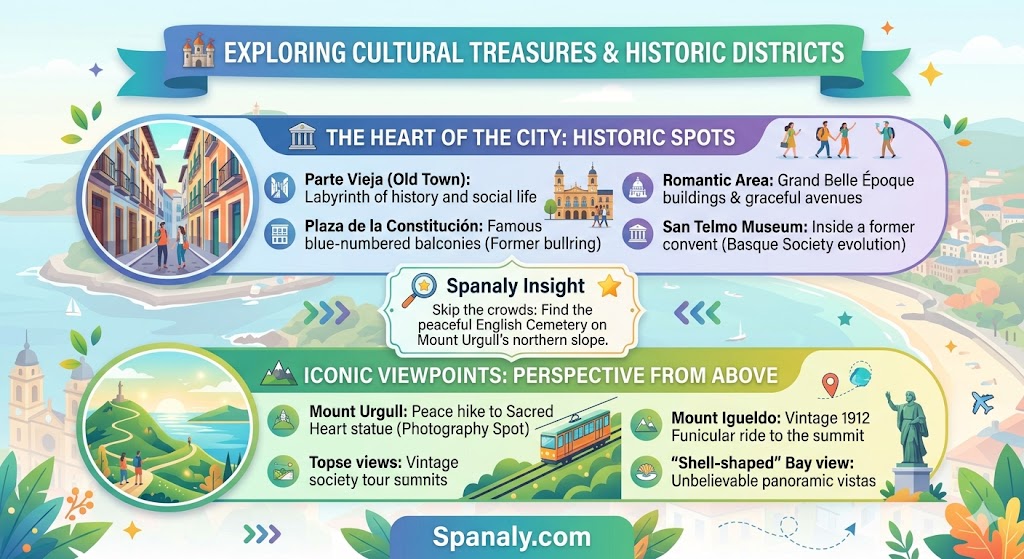
Beyond its stunning shoreline, San Sebastián hides a rich heritage within its stone walls and green hills. Walking through the city feels like moving between two different worlds: the narrow, lively alleys of the past and the grand, open avenues of the 19th century.
🏛️ The Heart of the City: Historic Spots
Parte Vieja (Old Town): A labyrinth of history where the social life never stops. The Plaza de la Constitución is its center stage, famous for the numbered balconies that remind us of its days as a bullring.
The Romantic Area: Known for its wide streets and Belle Époque buildings. This district reflects the city’s royal past and offers a graceful atmosphere for a late afternoon stroll.
Cultural Hub: The San Telmo Museum, set in a former convent, is the best place to find local insights into the evolution of Basque society.
⛰️ Iconic Viewpoints: Perspective from Above
Mount Urgull: A historic hill topped by the Sacred Heart statue. It offers a peaceful hike and remains one of the best Photography Spots in Spain to capture the bay from a historic angle.
Mount Igueldo: Hop on the vintage 1912 funicular to reach the summit. It provides the most famous “shell-shaped” view of the coastline, making it one of the most beloved Spanish Attractions for families and photographers alike.
Spanaly Insight: For a quiet escape that most travelers miss, head to the northern slope of Mount Urgull to find the “English Cemetery.” It’s a moss-covered, atmospheric sanctuary with hauntingly beautiful views of the Atlantic waves crashing against the rocks below.
🎭 Annual Highlights: A Calendar of Festivals & Events

San Sebastián comes alive through its world-class events, turning its streets into an open-air stage for art and culture. If you want to see how these celebrations compare to other major events across the country, don’t miss our comprehensive guide to Spanish Festivals.
✨ Top Cultural Moments Throughout the Year:
Jazzaldia (July): One of Europe’s oldest jazz festivals. Stages are set up directly on the golden sand, allowing you to enjoy world-class music under the stars.
Semana Grande (August): A high-energy week featuring international fireworks competitions that light up the bay every night, alongside traditional Basque sports.
International Film Festival (September): One of the most prestigious cinema events in the world, transforming the city into a star-studded gala for a week.
📅 Planning Your Trip:
If you are visiting during the summer, make sure to check our guide on the Best Time to Visit Northern Spain to align your trip with these vibrant festivities.
🚆 Essential Logistics: Reaching the Basque Coast
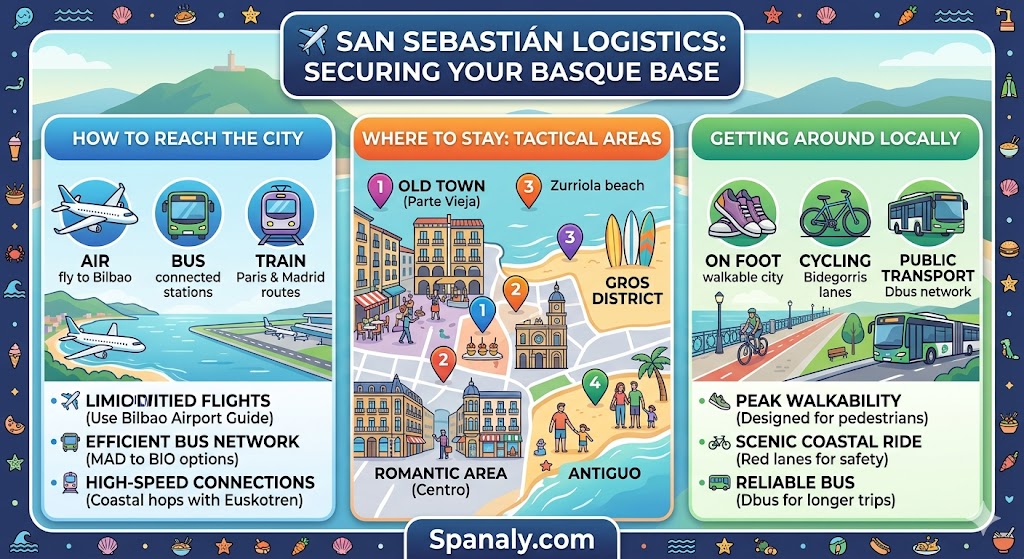
Getting to San Sebastián is part of the adventure. The city is exceptionally well-connected, making it easy to arrive whether you are coming from abroad or exploring other parts of Spain.
✈️ Arriving by Air
Local Option: San Sebastián Airport (EAS) handles domestic flights from Madrid and Barcelona.
International Hub: Most travelers find better options by flying into Bilbao Airport (BIO). It offers more international connections and is only a 60-minute scenic bus ride away. Check our Bilbao Airport Guide for the smoothest transit tips.
🚆 Rail & Bus Connections
The Train Experience: The city is a major stop for high-speed trains. You can enjoy a comfortable journey directly from the capital using our Madrid to Bilbao transport briefing, which covers the best routes to the north.
Bus Travel: For those on a budget, long-distance buses are modern and reliable, connecting the city to nearly every major Spanish destination.
👟 Moving Around the City
Walking: The center is remarkably pedestrian-friendly. You can walk from one end of the bay to the other in about 40 minutes.
Public Transport: Use the “Dbus” for longer urban trips or the “Euskotren” for charming day trips to nearby coastal villages.
Expert Tip: For a broader look at navigating the region, see our guide on Getting Around Spain.
Spanaly Insight: Don’t rent a car if you plan to stay strictly within the city center. Parking is notoriously expensive and hard to find. San Sebastián is designed for walking and cycling; save the car rental for when you’re ready to head out on a broader coastal road trip!
🏨 Premium Stays: Navigating the Best Neighborhoods
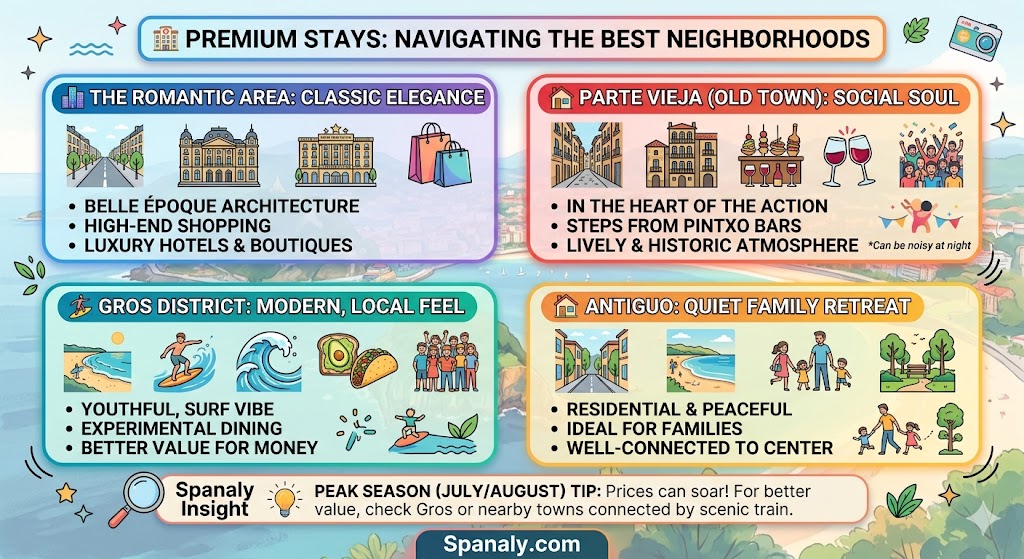
Choosing where to stay in San Sebastián depends on the “vibe” you want to wake up to. From grand historic hotels to trendy local districts, each area offers a different perspective on the city. For a deeper look at all types of lodging, check our guide on Accommodation in Spain.
🏙️ The Romantic Area: For Classic Elegance
The Vibe: Wide avenues, Belle Époque architecture, and high-end shopping.
Best For: Travelers seeking luxury and proximity to both La Concha Beach and the cathedral.
Top Picks: The iconic Hotel Maria Cristina for a royal experience, or boutique options near the promenade.
🏘️ Parte Vieja (Old Town): For the Social Soul
The Vibe: Lively, historic, and steps away from the best Pintxo bars.
Best For: Those who want to be in the heart of the action and don’t mind a bit of evening bustle.
Tip: It can be noisy at night, so choose a street-facing room only if you are part of the late-night crowd!
🏄 Gros District: For a Modern, Local Feel
The Vibe: Youthful, surf-oriented, and home to Zurriola Beach.
Best For: Solo travelers, younger couples, and foodies looking for experimental dining.
Tip: This area often provides better value for money compared to the beachfront hotels in the center.
🏡 Antiguo: For a Quiet Family Retreat
The Vibe: Residential, peaceful, and located right by Ondarreta Beach.
Best For: Families or long-term stays. It’s well-connected by bus but far enough to feel like a true escape.
Spanaly Insight: If you are visiting during the peak months of July or August, prices can soar. For a smarter Spain Travel Budget, consider staying in the Gros district or even nearby towns like Getaria, which are connected by a short, scenic train ride.
🌦️ Best Time to Visit & Weather Practicalities
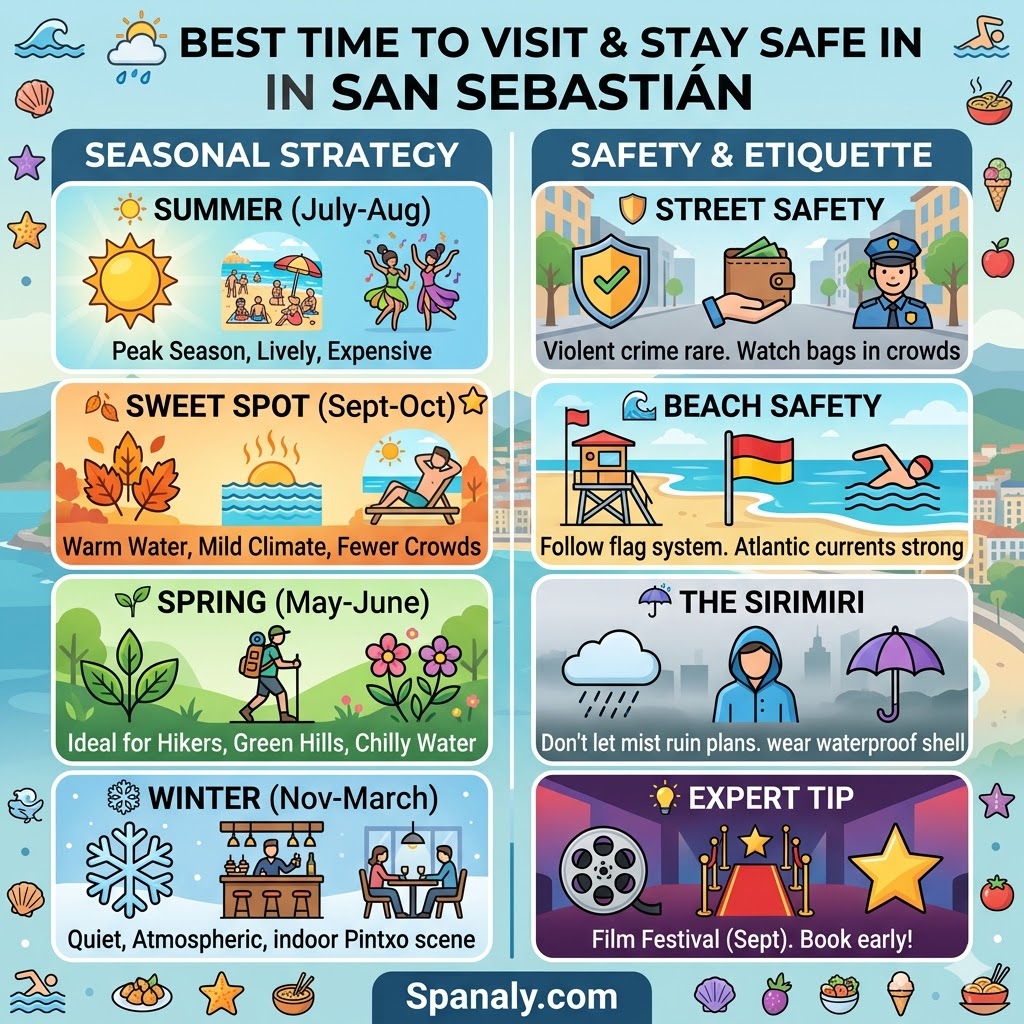
San Sebastián is famous for its lush, green landscapes—a beauty that comes from its unique Atlantic climate. Unlike the scorching heat of the south, the weather here remains mild and refreshing, making it an excellent stop on any Northern Spain Road Trip.
📅 Seasonal Overview:
Peak Season (June – September): This is the golden window for sun-seekers. The water is warm enough for swimming, and the city is at its most vibrant.
Shoulder Season (May & October): Ideal for those who prefer cooler temperatures and fewer crowds. It’s the perfect time for hiking Mount Urgull without the summer humidity.
Surfing Season (November – February): While too chilly for casual swimming, this is when the Atlantic swells are at their best for experienced surfers.
🧥 Understanding the “Sirimiri” In the Basque Country, you’ll often hear the word Sirimiri. It refers to a very fine, persistent mist-like rain that is characteristic of the region.
Don’t let it stop you: It rarely lasts all day and is what keeps the city’s parks so vibrant.
Travel Tip: Instead of a heavy umbrella, pack a lightweight, high-quality waterproof shell. It’s the local way to stay dry while navigating the streets.
🌞 Planning for the Sun: If your main goal is hitting the beach, check our guide on the Best Time to Visit Spain to see how the northern coast compares to the Mediterranean alternatives during the summer months.
Spanaly Insight: September is my personal favorite month here. The ocean has spent all summer warming up, the major tourist crowds have thinned out, and the city hosts the International Film Festival, giving the streets a special, star-studded energy.
🏙️ Day Trips: Exploring the Coastal Neighbors
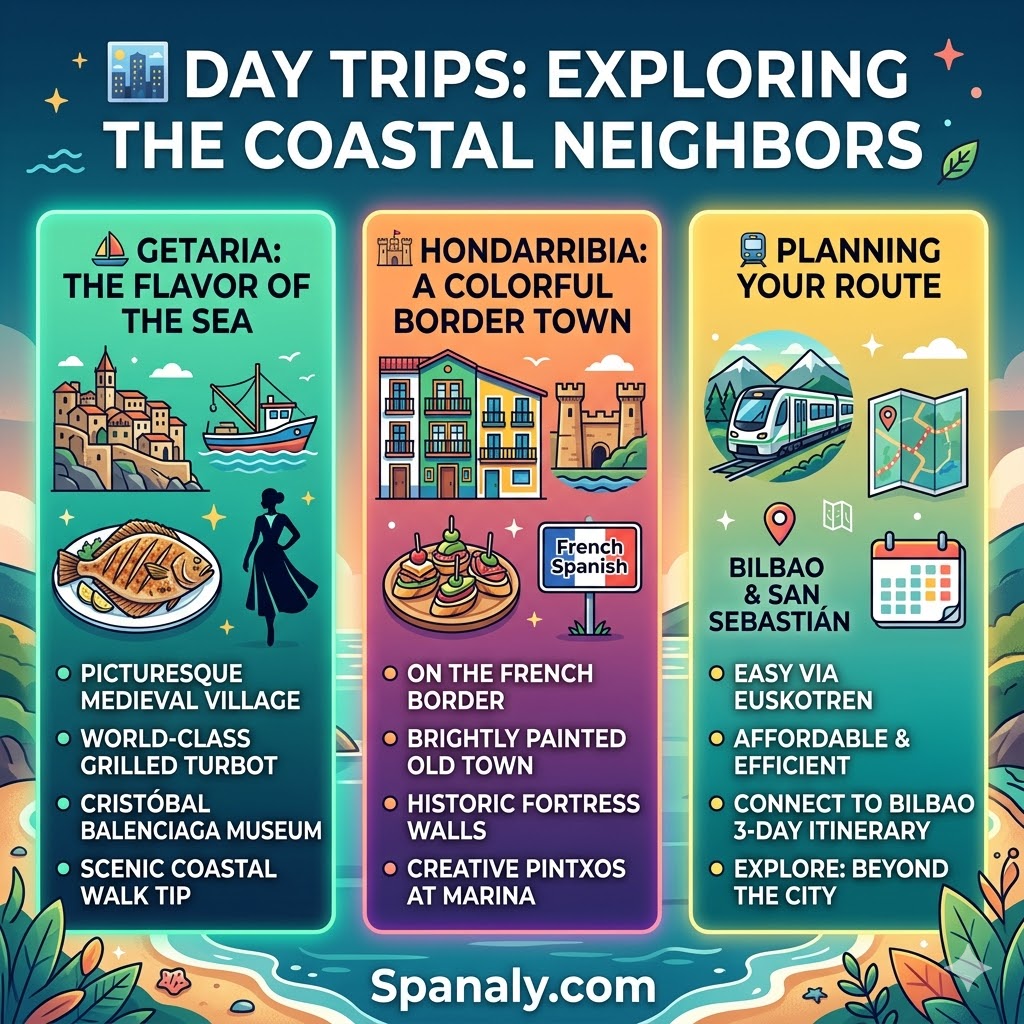
San Sebastián is the perfect base for exploring the Basque coast. Within a short drive or train ride, you can find charming fishing villages and dramatic landscapes that feel worlds away from the city bustle.
⛵ Getaria: The Flavor of the Sea
The Highlight: A picturesque medieval fishing village famous for its grilled turbot and being the birthplace of fashion icon Cristóbal Balenciaga.
Pro Tip: Walk the coastal path between Zarautz and Getaria for some of the best Atlantic views in the region.
🏰 Hondarribia: A Colorful Border Town
The Highlight: Located right on the French border, its Old Town is filled with brightly painted Basque houses and a stunning historic fortress.
Pro Tip: Head to the Marina district for some of the most creative pintxos outside of San Sebastián.
🚆 Planning Your Route
For those who want to see the best of both worlds, our Bilbao to San Sebastián 3-Day Itinerary perfectly connects these coastal gems with the region’s largest city.
Most of these villages are easily reachable via the Euskotren, a scenic local rail service that is both affordable and efficient.
Spanaly Insight: If you have an afternoon to spare, visit Pasaia Donibane. It is a tiny, one-street village tucked between the mountains and the sea. You have to take a tiny green boat (just a 2-minute crossing) to reach it, and it feels like stepping back into a 17th-century maritime storybook.
🤝 San Sebastián vs. Biarritz: The Atlantic Elegance Duel
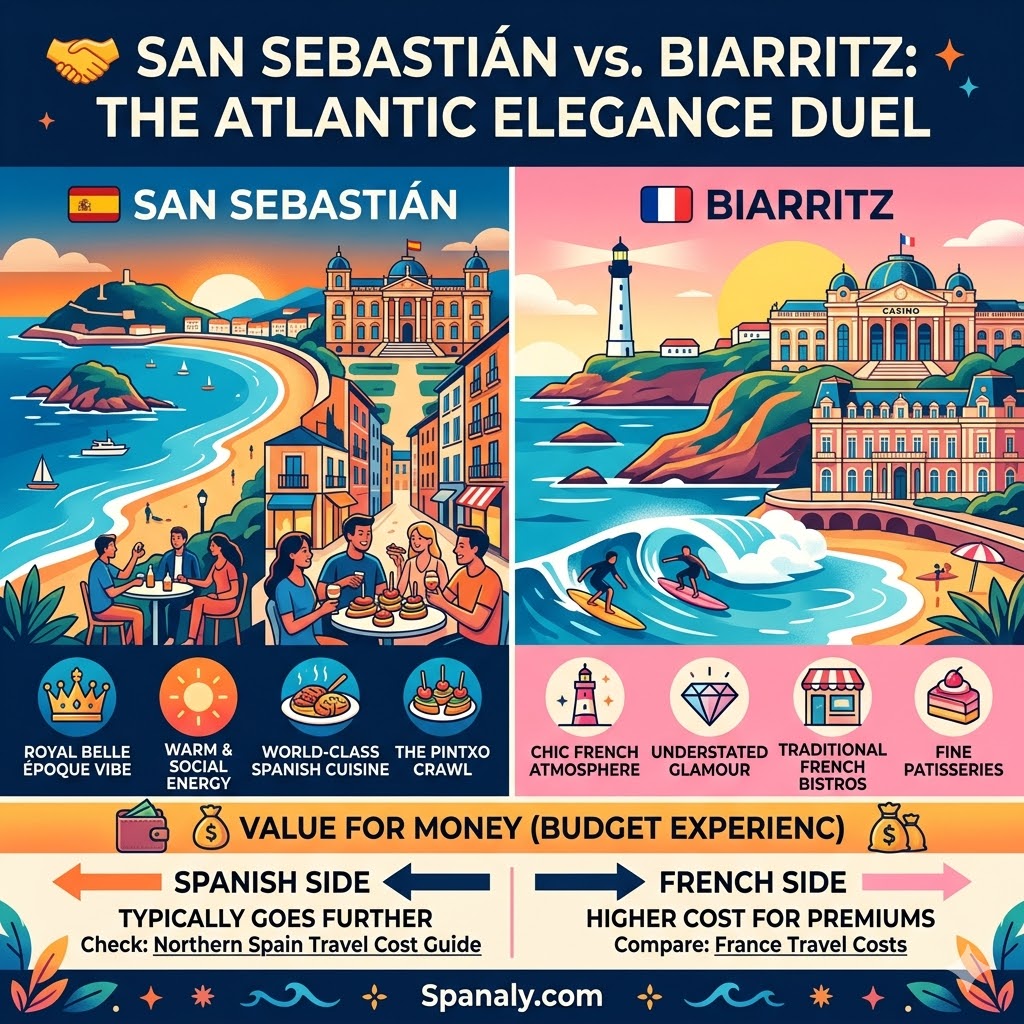
While San Sebastián is often compared to its Basque neighbor Bilbao, many travelers find themselves choosing between the Spanish coast and the nearby French Riviera. Just 45 minutes across the border sits Biarritz, offering a different flavor of Atlantic luxury.
🏰 The Sophistication Factor
San Sebastián: Offers a “Royal Belle Époque” vibe. It feels warmer, more social, and deeply centered around its world-class Spanish Cuisine.
Biarritz: Has a “Chic French” atmosphere. It’s slightly more understated, with grand casinos and a surfing history that feels distinctly glamorous.
🍽️ The Food & Budget Experience
Dining Culture: San Sebastián is all about the lively Pintxo Crawl, while Biarritz focuses on traditional French bistros and fine patisseries.
Financial Planning: While both are premium destinations, understanding the Northern Spain Travel Cost is essential to see how your money stretches further on the Spanish side, especially for high-end dining.
Spanaly Insight: Why choose? If you have a car, you can have breakfast in France and be back in San Sebastián for a sunset Pintxo run. The contrast between the two—the Spanish passion and the French chic—is what makes this border region so fascinating.
💡 Spanaly Pro Tips: Insider Secrets for a Local Experience

Forget the generic tourist brochures. To truly master San Sebastián, you need the “underground” knowledge shared by frequent travelers and savvy locals on platforms like Reddit.
🥓 The Pintxo Strategy: Cold vs. Hot
The Rookie Mistake: Filling your plate with the cold pintxos already sitting on the bar.
The Pro Move: Those are just the “appetizers.” The best food is on the “Pizarra” (chalkboard). Always order the hot, made-to-order dishes from the waiter. If you don’t see a chalkboard, you’re in the wrong bar.
🍷 The “Mugi” Card Trick
Save Big: Don’t pay individual fares for buses or the Euskotren. Buy a Mugi Card at any “Tabacos” shop. It slashes transport prices significantly and can be shared between multiple people. It’s the single best way to manage your Northern Spain Travel Cost.
🌅 The Sunset “Invisible” Spot
Skip the Crowds: Everyone goes to Monte Igueldo for the sunset. Instead, grab a drink and head to the Sagüés area at the far end of Zurriola Beach. Sit on the sea wall (the wall) with the locals. It’s the most authentic, laid-back sunset vibe in the city.
🧀 The Cheesecake Protocol
La Viña Secret: If you want to try the world-famous burnt cheesecake at La Viña, don’t wait until 8:00 PM. They often sell out of individual slices early. Go around 4:00 PM or 5:00 PM (Spanish Merienda time) to guarantee a taste without the chaotic dinner crowds.
🚶 The Vertical Shortcut
Save Your Legs: To get from the city center to the high viewpoints or certain residential hotels, look for the urban public elevators. Many tourists hike steep hills unnecessarily; locals use the hidden outdoor lifts (like the one at Calle Prim) to glide up the slopes for free.
Spanaly Insight: When doing a Pintxo run, never stay for more than two drinks at one place. The “Donostiarra” way is movement. If a bar is empty, move on. If it’s packed and people are standing in the street, that’s your signal to join the crowd—that’s where the magic is happening.
🛡️ Visitor FAQs – San Sebastián Travel Guide
🍴 Do I need to tip at Pintxo bars in the Old Town?
Tipping is not mandatory in Basque culture. Locals usually leave small change (a few cents) or nothing at all. However, if you receive exceptional service at a sit-down restaurant, leaving 5-10% is appreciated but never expected.
👗 Is there a dress code for Michelin-starred restaurants?
While San Sebastián is sophisticated, it is also a beach city. For high-end dining, "Smart Casual" is the gold standard. Men usually wear chinos and a collared shirt, while women opt for dresses or elegant trousers. Avoid flip-flops or swimwear, even in casual seaside bistros.
🕒 Why are the shops closed in the middle of the afternoon?
Many local boutiques and family-owned shops still observe the Siesta. They typically close between 1:30 PM and 4:00 PM or 4:30 PM. Use this time for a long lunch or a walk on the beach. Major shopping malls and international brands in the Romantic Area usually stay open all day.
🚲 Is the city safe for cyclists and electric scooters?
San Sebastián is a cycling paradise with an extensive network of "Bidegorris" (red bike lanes). It is very safe, provided you stay on the designated paths. Be aware that riding on sidewalks or through the narrow pedestrian streets of the Old Town can result in fines.
🗣️ Will I have trouble if I don't speak the Basque language (Euskara)?
Not at all. While locals are very proud of Euskara, everyone speaks Spanish fluently, and English is widely understood in the tourism and hospitality sectors. Learning a simple "Kaixo" (Hello) or "Eskerrik asko" (Thank you) will earn you many smiles from the locals!
San Sebastián Guide by Spanaly.com
San Sebastián is more than just a pin on a map; it is a city that teaches you how to slow down and savor life, one bite at a time. Whether you are surfing the Atlantic swells or lost in the flavors of the Old Town, you don’t just visit this city—you feel it.
✨ Your Next Steps:
Start Planning: If you’re ready to dive deeper into the local culture, make sure to explore our curated list of the Best Things to Do in San Sebastián to build your perfect day.
Be a Traveler, Not a Tourist: Walk more, eat seasonally, and don’t be afraid to try a pintxo you can’t pronounce.
Capture the Moment: Find that “invisible” sunset spot we talked about, put your phone away for a second, and just breathe in the salty Atlantic air.
One Final Tip: The magic of San Sebastián happens in the transitions—the walk between two beaches, the silence of a morning hike, and the shared laughter in a crowded bar. Don’t overschedule. Leave room for the city to surprise you.
Safe travels, and we can’t wait to hear which beach becomes your favorite!