🌸 Where Faith, Art, and Emotion Converge
Every spring, as the scent of orange blossoms fills the air, Spain transforms into a living stage of profound beauty. Semana Santa (Holy Week) is much more than a religious observance; it is a multisensory masterpiece where centuries-old faith, dramatic art, and collective memory intertwine.
To understand this event is to understand the soul of the country. Just as we explore in our Ultimate Spain Festivals Guide, Semana Santa reveals Spain not as a single narrative, but as a mosaic of regional expressions. From the soul-stirring Saetas of Seville to the silent processions of the North, it remains one of the most powerful Spanish Attractions for any traveler.
✨ Why Experience Semana Santa in 2026?
🎭 Living Masterpieces: Witness Baroque and Renaissance statues paraded through ancient streets.
🕯️ Cultural Contrast: Experience the vibrant passion of the South versus the austere solemnity of Castile.
🌍 Global Heritage: Join a tradition recognized by UNESCO as part of the world’s intangible history.
Spanaly Thought: Whether you are following our Ultimate Seville Travel Guide or exploring the streets of Madrid, Semana Santa is the one time of year when Spain’s modern pace stops to honor its ancient heartbeat. It is the ultimate reason Why Visit Spain this year.
📜 A Brief History of Semana Santa: Layers of Faith and Art
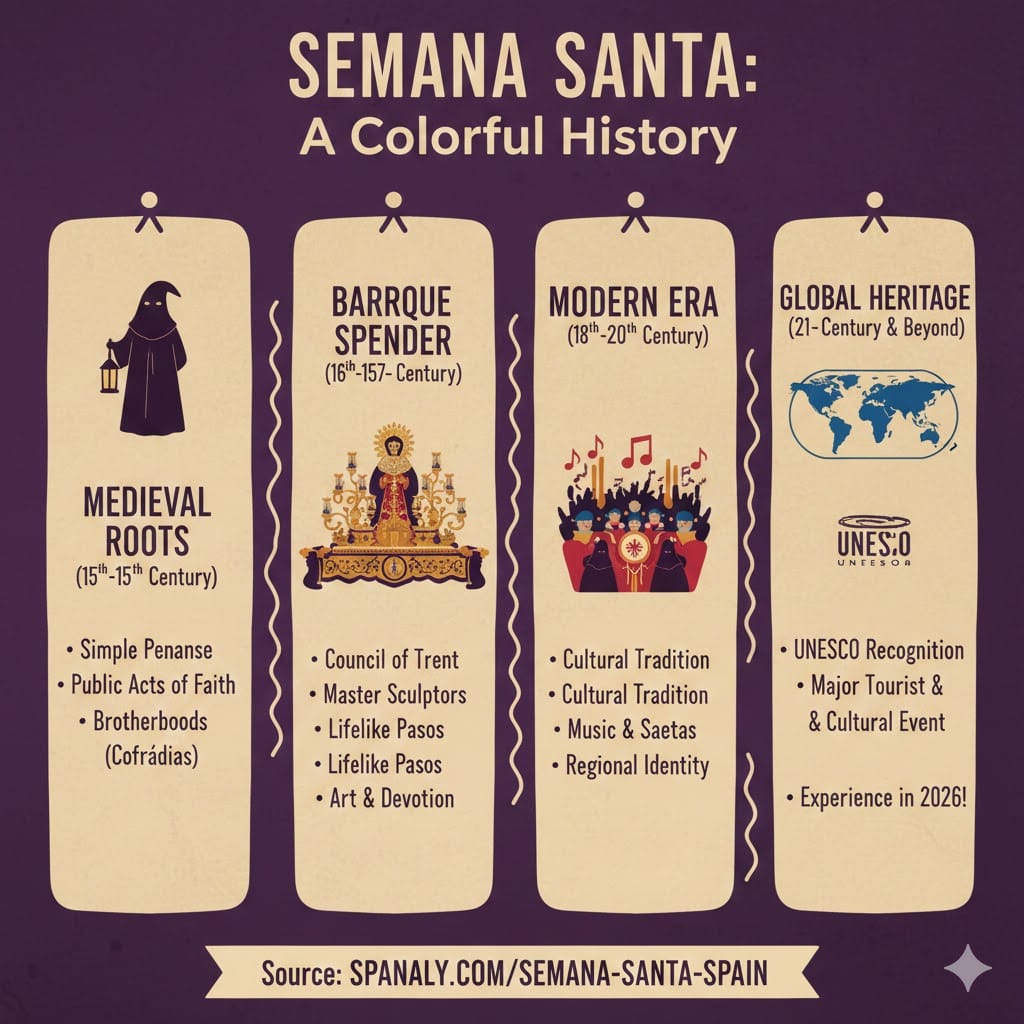
The roots of Semana Santa stretch back to the Middle Ages, when religious brotherhoods began organizing public acts of penance. These early processions were designed to bring the sacred stories of the Passion to life for everyone to see. Over time, this tradition evolved into the magnificent spectacle we witness today, becoming one of the most significant Spanish Festivals on the calendar.
As the tradition grew, it became deeply woven into the Cultural Etiquette in Spain. During the 16th and 17th centuries, the “Golden Age” of Spanish art, the most iconic and lifelike statues were commissioned. These masterworks remain the pride of the city streets, standing as timeless Spanish Attractions that draw millions of visitors every year.
🏛️ Historical Milestones to Know:
Medieval Origins: Brotherhoods started as small groups dedicated to charity and public prayer.
The Baroque Influence: A period of immense artistic growth where floats became grand, gilded stages for religious art.
National Identity: In 2026, Semana Santa remains the perfect example of Why Visit Spain, showcasing a heritage that has survived for over 500 years.
Spanaly Pro Tip: If you are planning to experience this history in person, make sure to check the Best Time to Visit Spain to ensure you don’t miss the peak of the spring celebrations!
✨ Understanding the Symbols: The Faces of Devotion
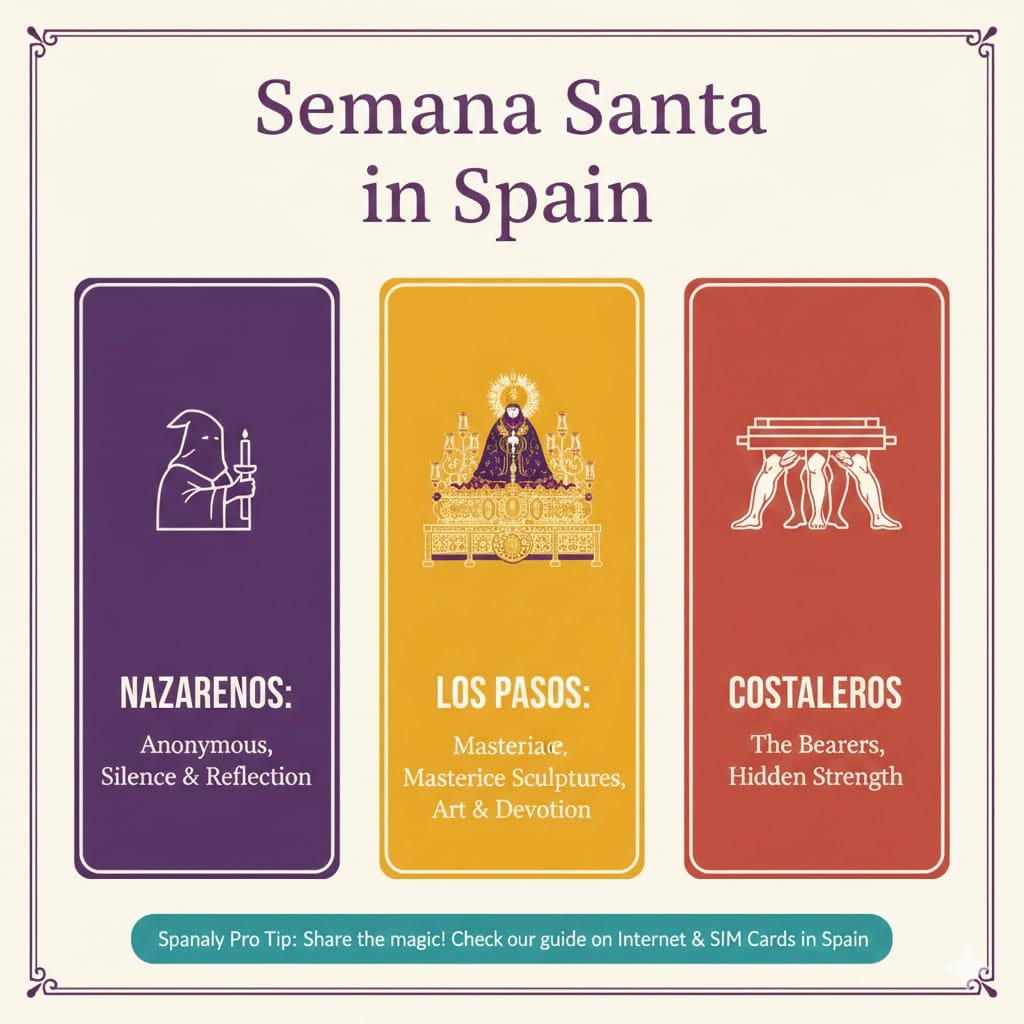
For first-time visitors, Semana Santa can feel like a dizzying array of unfamiliar sights. To truly appreciate the depth of this tradition, you must understand that these are not mere costumes—they are symbols of profound historical and spiritual meaning.
🎭 The Key Figures You Will See:
The Nazarenos (The Penitents): Dressed in long robes and the iconic pointed hoods known as Capirote, these figures represent anonymity and penance. By hiding their faces, they ensure their acts of faith remain humble and private.
The Costaleros (The Bearers): These are the invisible heroes of the festival. Carrying the immense Pasos (floats) on their necks, they move with a synchronized, rhythmic gait that is both physically exhausting and deeply moving.
The Pasos (The Masterpieces): These elaborate sculptures depict scenes from the Passion. Many are centuries-old works of art that are considered the most sacred Spanish Attractions during the spring.
🕯️ Symbols & Traditions:
The Capirote: Historically used to bring the penitent closer to heaven.
The Mantilla: Women wearing traditional black lace veils and combs, a sign of mourning and Cultural Etiquette in Spain.
The Incense: A heavy, sweet scent that fills the air, signaling the arrival of a brotherhood.
Spanaly Pro Tip: > Want to share your photos of these stunning symbols instantly? Make sure your connection is ready by checking our guide on Internet and SIM Cards in Spain to stay online while navigating the crowded streets.
📍 Main Highlights by City: Where to Experience the Passion
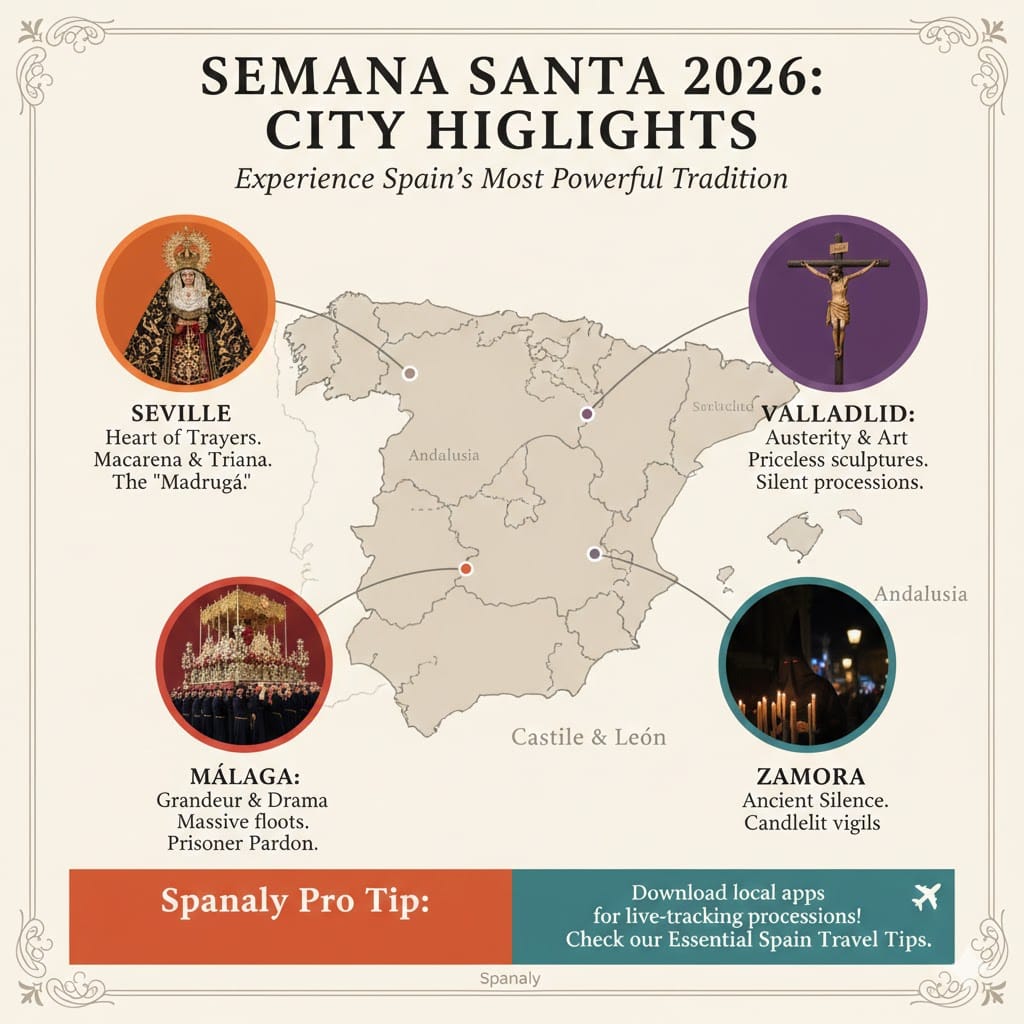
While the spiritual essence of Semana Santa is shared nationwide, each city offers a unique interpretation. Depending on your travel style and whether you use our Getting Around Spain guide to explore by train or prefer Driving in Spain for a road trip, here are the unmissable cities in 2026:
🧡 Seville: The Heartbeat of Andalusia
Often considered the spiritual epicenter, Seville hosts over 60 brotherhoods. Its narrow, winding streets (especially in areas like Santa Cruz, as highlighted in our Where to Stay in Seville guide) become a breathtaking stage for processions that can last all night.
Signature Moment: The “Saeta” – a spontaneous, flamenco-style prayer sung from a balcony, capable of silencing thousands.
Must-See: The Macarena and Esperanza de Triana processions, particularly during the legendary “Madrugá”.
Why Visit: For an unparalleled emotional and visual spectacle that defines Ultimate Seville Travel Guide.
🌊 Málaga: Grandeur on the Coast
Málaga’s Holy Week is known for its grandeur, dramatic flair, and military presence. Unlike Seville, the immense “Tronos” (thrones) are carried shoulder-high, giving them a distinct rhythmic sway.
Signature Moment: The freeing of a prisoner by Jesús El Rico, a centuries-old tradition blending mercy and devotion.
Must-See: The Cautivo (The Captive) on Holy Monday and Fusionadas on Holy Thursday.
Why Visit: For a more theatrical and expansive experience, often with sea breezes.
🏞️ Valladolid & Zamora: The Austerity of Castile
In stark contrast to the passionate exuberance of Andalusia, the celebrations in Castile and León are characterized by profound silence, solemnity, and a focus on artistic masterpieces.
Valladolid:
Signature Moment: Silent processions featuring priceless Baroque and Renaissance wooden sculptures, many by masters like Gregorio Fernández.
Must-See: The Procession of the General Vía Crucis on Holy Monday.
Why Visit: For an introspective and art-focused experience, a different facet of Spanish Attractions.
Zamora:
Signature Moment: Candlelit night processions in medieval streets, often accompanied only by a single drum or trumpet, creating an eerie, deeply contemplative atmosphere.
Must-See: The Procession of Silence on Holy Wednesday.
Why Visit: For one of Spain’s oldest and most moving Holy Week celebrations, emphasizing raw devotion.
Spanaly Pro Tip: If you plan to witness the processions in Seville, download a local app that shows real-time locations of the Pasos. This can save you hours of waiting! For general planning, check our Essential Spain Travel Tips.
🌙 The "Madrugá": The Most Emotional Night in Spain
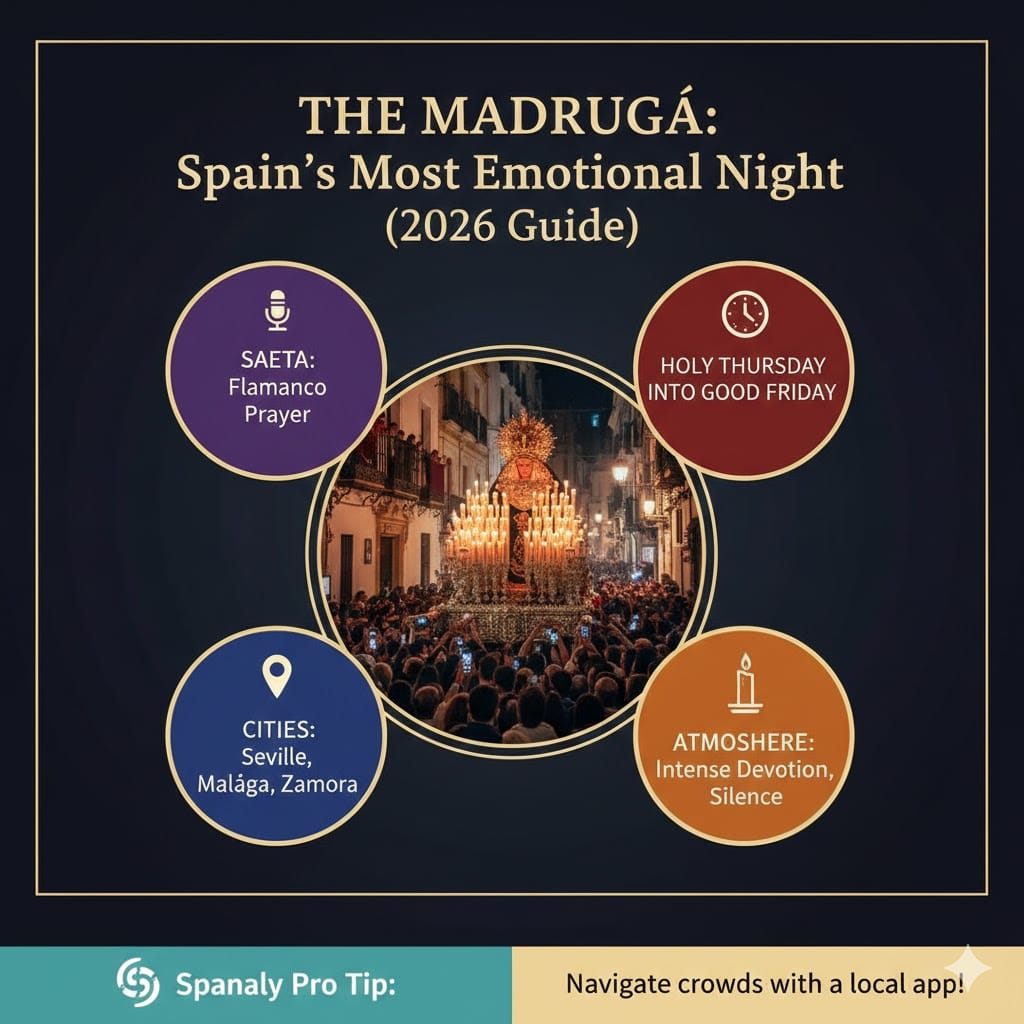
If Semana Santa has a spiritual peak, it is undoubtedly The Madrugá (from the Spanish madrugada, meaning “early morning”). This legendary night, spanning from Holy Thursday into the dawn of Good Friday, is when the devotion in cities like Seville reaches its most dramatic and breathtaking intensity.
During these mystical hours, the streets are alive with a unique energy. Thousands of people gather in a respectful hush, broken only by the synchronized footsteps of the Costaleros and the soul-piercing melodies of the Saeta. It is an essential experience that perfectly illustrates Why Visit Spain during this transformative season.
✨ What Makes the Madrugá Truly Unmissable?
The Silent Giants: Witness the “Gran Poder,” known as the Lord of Seville, as it glides through the dark streets in a silence so profound it feels like time has stood still.
A City Transformed: The shadows of historic cathedrals and the flicker of thousands of candles create a scene straight out of a Spain Historical Monuments Guide.
The Emotional Crescendo: Experience the dawn arrival of the “Macarena,” where the solemnity of the night meets a triumphant and hopeful morning.
🕯️ Expert Survival Tips for the Night:
Financial Planning: Keep in mind that prices for front-row seats (Sillas) or balcony views can be high; check our guide on Budgeting for Spain to manage your expenses during this peak week.
The Right Timing: The Madrugá is the crown jewel of the spring; ensure you’ve picked the Best Time to Visit Spain to align with these specific lunar dates.
Stay Connected: Use your Internet in Spain to access real-time procession apps, which are vital for navigating the changing routes and massive crowds.
Spanaly Pro Tip: The Madrugá is not just an event; it is an emotional marathon. Whether you are religious or not, the collective energy of the crowd is something you will carry with you long after you’ve returned to your Seville Accommodation.
🌍 Regional Variations: North vs. South
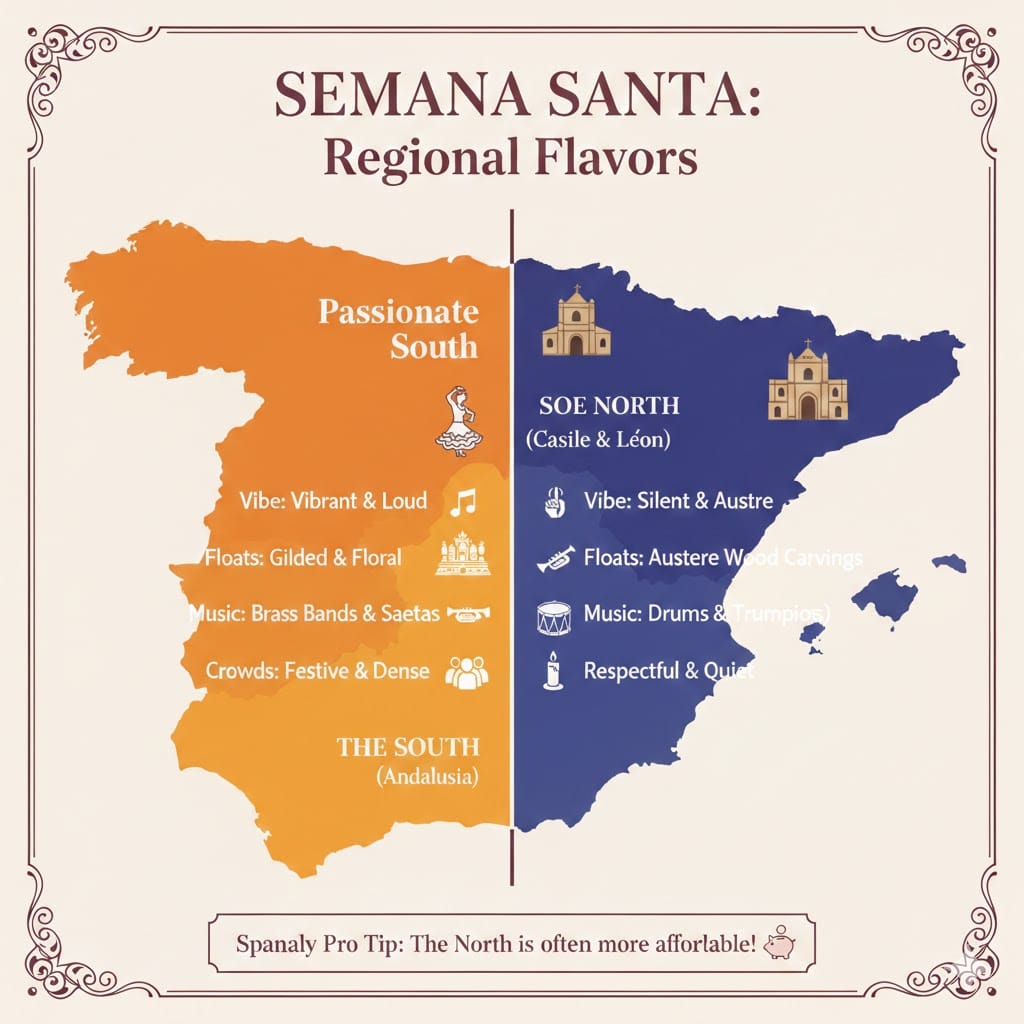
While the essence of Semana Santa remains the same across Spain, the way it is celebrated varies dramatically as you travel across the country. Understanding these regional differences is key to choosing which part of Spain to explore during your Best Time to Visit Spain trip.
💃 The Passionate South (Andalusia)
In the south, particularly in Seville and Málaga, the atmosphere is vibrant, loud, and deeply emotional.
Atmosphere: Crowded streets, the smell of orange blossoms and heavy incense, and spontaneous outbursts of flamenco singing (Saetas).
The Floats: Massive, gilded, and heavily decorated with thousands of candles and fresh flowers.
Music: Loud brass bands and drums that set a rhythmic pace for the Costaleros.
⛪ The Solemn North (Castile and León)
In northern cities like Valladolid and Zamora, the celebrations are a masterclass in austerity and quiet reflection.
Atmosphere: Pin-drop silence, dark streets, and a focus on the historical and artistic value of the sculptures. It feels more like a medieval ritual than a festival.
The Floats: Austere wooden floats without the gold leaf or excessive decoration, highlighting the raw beauty of Spanish Attractions.
Music: Often limited to a single mournful trumpet or a slow, rhythmic drumbeat.
📊 Quick Comparison Table:
| Feature | The South (Andalusia) | The North (Castile & León) |
| Vibe | Extravagant & Emotional | Solemn & Austere |
| Sound | Orchestral Bands & Singing | Silence & Minimalist Drums |
| Art Style | Baroque & Gilded | Renaissance & Realistic Wood |
| Crowds | Intense & Festive | Quiet & Respectful |
Spanaly Pro Tip: If you are traveling on a budget, the North often offers a more affordable experience in terms of accommodation compared to the high demand in Seville. Check our guide on Budgeting for Spain to see the difference in costs between regions.
🍪 Semana Santa Gastronomy: A Taste of Tradition
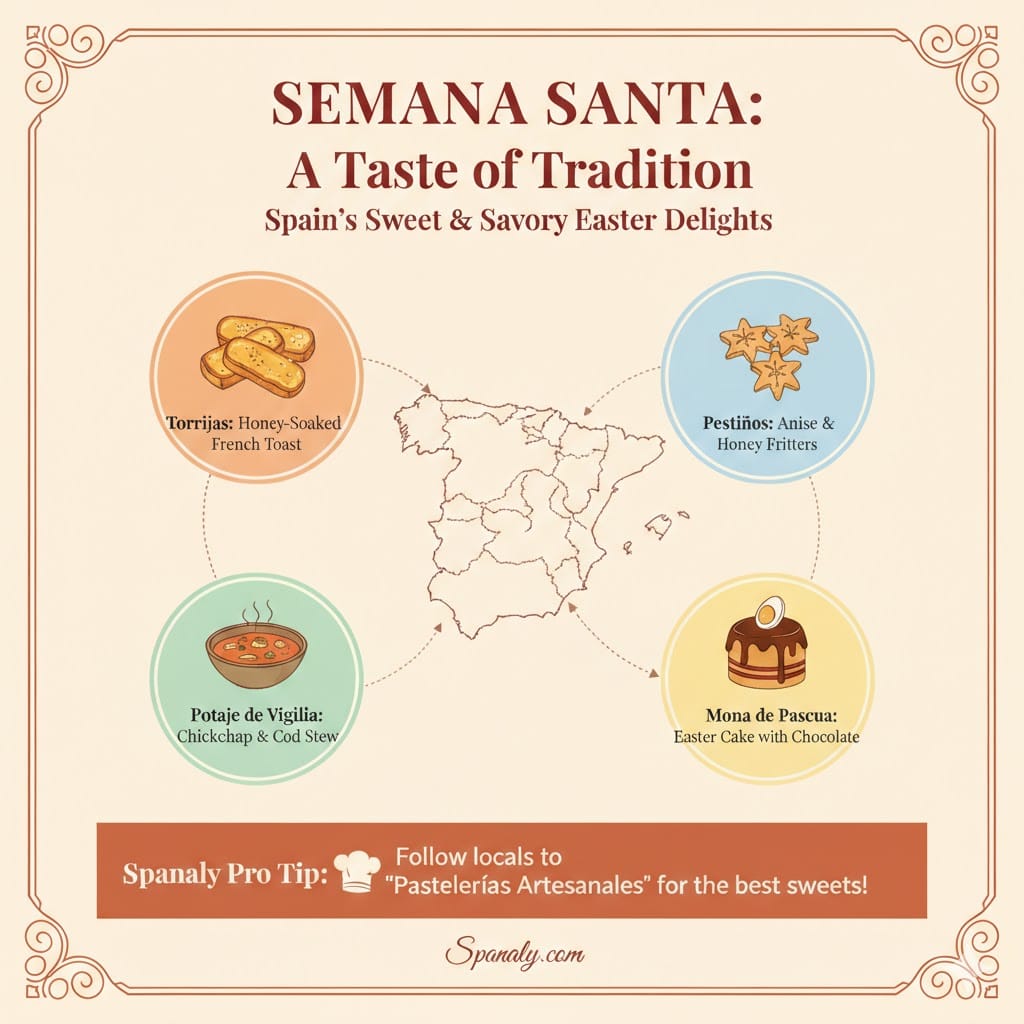
Beyond the processions and music, Semana Santa is a feast for the senses, especially when it comes to food. Traditional Spanish Easter treats are deeply rooted in history, originally designed to be filling and meat-free to respect religious fasting periods.
If you are planning your trip, knowing what to order at a local pastelería is essential. Don’t forget to check the Best Time to Visit Spain to ensure you catch these seasonal delicacies while they are fresh!
🍯 Must-Try Easter Delicacies:
Torrijas: The undisputed star of the season. Similar to French toast but richer, these are slices of bread soaked in milk or wine with honey and spices, then fried. They are the ultimate Spanish Food comfort snack.
Pestiños: Crunchy, honey-glazed fritters flavored with sesame and anise. They are particularly popular in the South (Andalusia).
Potaje de Vigilia: A hearty “Vigil Stew” made with chickpeas, spinach, and cod (bacalao). It is the traditional meat-free meal for Good Friday.
Mona de Pascua: Especially famous in Catalonia and Valencia, these are ornate Easter cakes often topped with boiled eggs or elaborate chocolate figures.
🍷 Drinks & Atmosphere: During this week, many locals gather in traditional taverns between processions. It’s a great time to experience Cultural Etiquette in Spain firsthand—remember that bars will be crowded, so patience is part of the experience!
Spanaly Pro Tip: Looking for the best Torrijas? Avoid the tourist traps and look for “Pastelerías Artesanales” with a long queue of locals. To help you plan your food tour without breaking the bank, see our guide on Budgeting for Spain.
🏨 Where to Stay During the Festival: Best Areas & Proximity
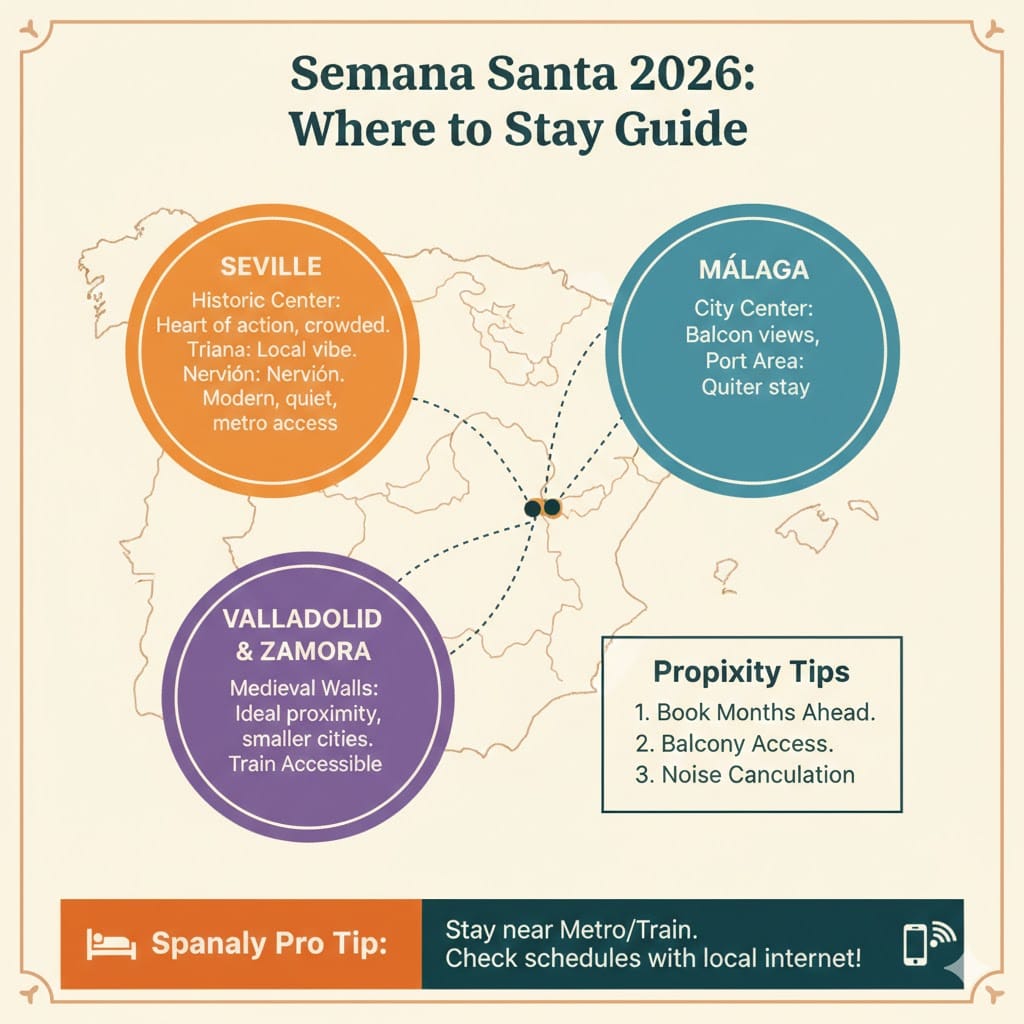
Finding the right base during Semana Santa can make or break your experience. With millions of visitors flocking to city centers, proximity to the procession routes is a double-edged sword: you get front-row access, but you also face intense crowds and noise.
To manage your expectations and costs, we recommend checking our Budgeting for Spain guide, as hotel prices can triple during this peak week.
📍 Seville: The Strategy of Location
The Historic Center (Casco Antiguo): Staying here puts you at the heart of the action, especially near the Cathedral. However, be prepared for closed streets and difficulty reaching your hotel with luggage.
Triana: Located across the river, this neighborhood offers a more local feel and is home to some of the most famous brotherhoods. Check our Where to Stay in Seville guide for specific hotel recommendations.
Nervión: A great modern alternative. It’s well-connected by metro, allowing you to escape the 24/7 noise of the center while still being minutes away.
📍 Málaga & The North
Málaga City Center: Best for those who want to see the massive “Tronos” from their balcony. If you prefer a quieter stay, consider areas near the port.
Valladolid & Zamora: These cities are smaller, so staying within the medieval walls is ideal. Since these destinations are more accessible by train, our Getting Around Spain guide will help you plan your arrival.
💡 Proximity Tips:
Book Months in Advance: For 2026, most prime spots will be gone by late 2025.
Check for “Balcony Access”: Some hotels offer balcony rentals specifically for watching processions—a luxury that is worth every penny for photographers.
Noise Cancellation: Even the best hotels can be loud during the Madrugá. Pack high-quality earplugs!
Spanaly Pro Tip: If you find city center prices too high, look for accommodations near a metro or suburban train station (Cercanías). Use your Internet in Spain to check transit schedules and avoid getting stranded after midnight!
🚶 Practical Guide: Navigating Crowds & Schedules
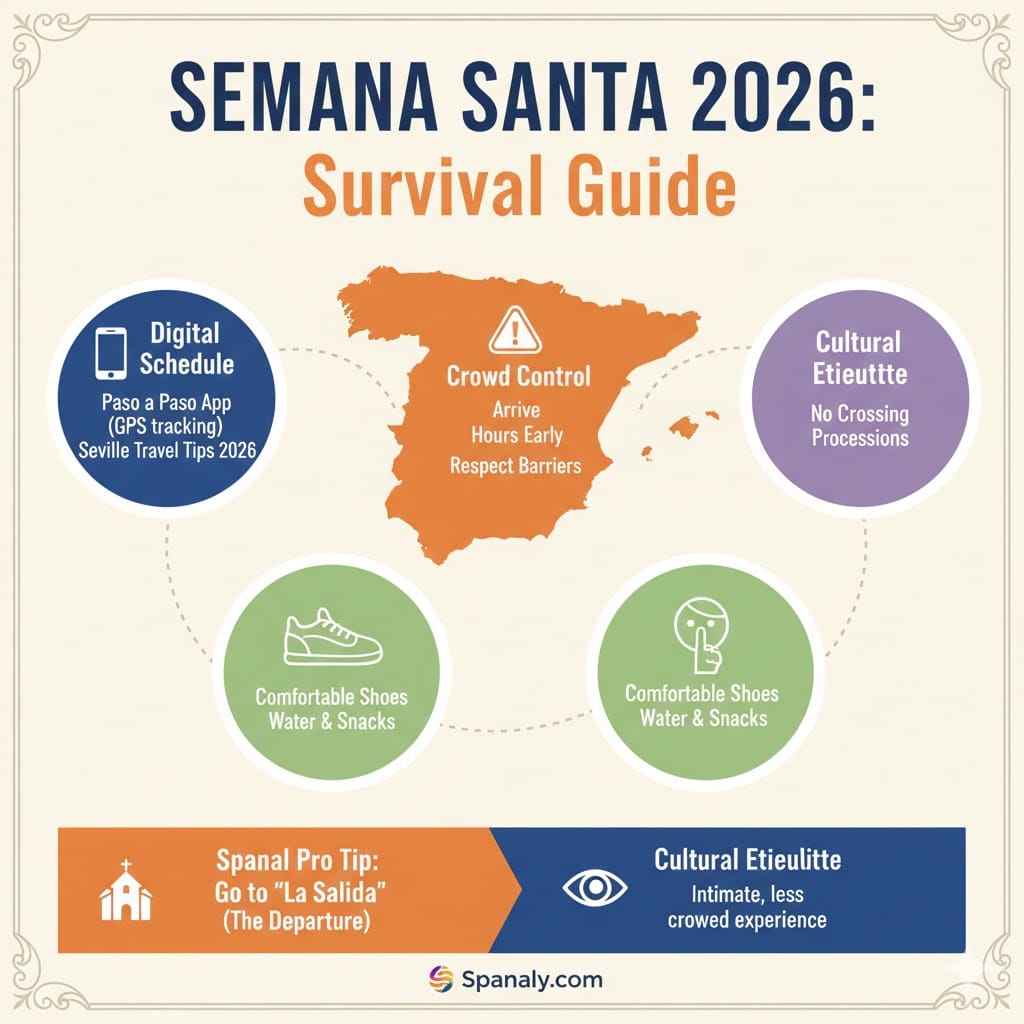
Attending Semana Santa is a rewarding but physically demanding experience. In 2026, navigating the sea of people and the intricate procession schedules requires a solid strategy. Here is how to move like a local:
📱 Master the Digital Schedule: Procession routes (recorridos) change in real-time. Download local apps like “Paso a Paso” to track the floats via GPS. This is especially vital in Andalusia, so make sure to read our Seville Travel Tips 2026 to stay ahead of the crowds.
🚧 Respect the “Aforamientos”: Major cities use strict crowd control. Certain streets are closed once they reach capacity. Arrive at least 2 hours early for famous spots and never cross through a procession line—it is considered highly disrespectful.
👟 Gear Up for the Marathon: Expect to walk over 15,000 steps daily on uneven cobblestones. Wear your most comfortable sneakers and carry a reusable water bottle, as finding a free table in a bar during peak hours is nearly impossible.
🤫 Embrace the Silence: While some moments are festive, many processions require absolute silence. If the drums stop and the crowd goes quiet, follow suit. It’s part of the profound spiritual atmosphere that defines the Spanish experience.
Spanaly Pro Tip: If the city center feels too overwhelming, head to the church where a brotherhood starts its journey (La Salida). It’s often more emotional and offers much better visibility than the main official routes.
📸 Etiquette & Photography Tips
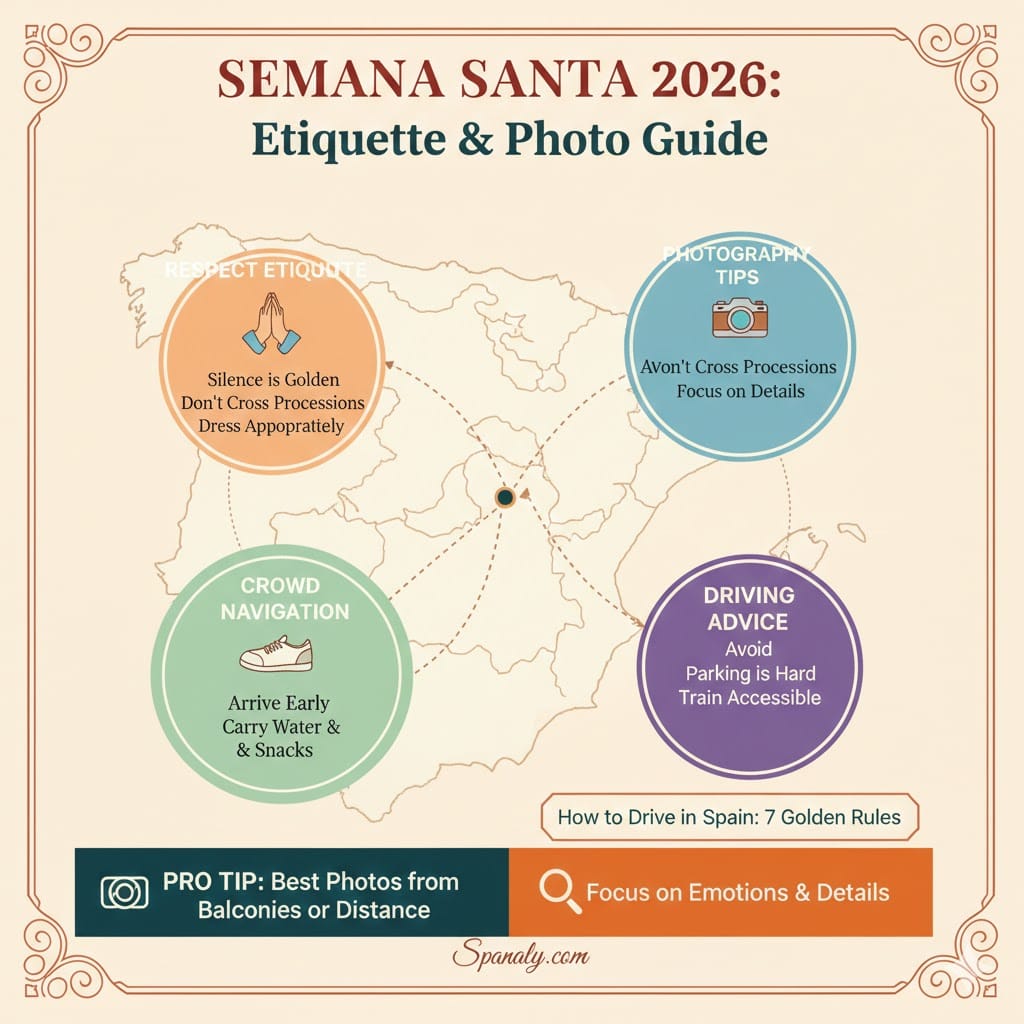
Attending Semana Santa is a privilege that requires a deep sense of respect for local customs. Whether you are a devout pilgrim or a professional photographer, keeping these cultural norms in mind is essential for a harmonious experience.
🤝 Respecting the Sacred Space
Silence is Golden: When a procession passes, especially those known as “Silencio,” stop talking. Even if you aren’t religious, the silence is a core part of the ritual’s power.
Don’t Cross the Lines: Never cut through a procession or walk between the Nazarenos. It is considered a major breach of etiquette.
Dress Appropriately: While there is no strict dress code for tourists, wearing extremely casual beachwear is frowned upon. Locals often dress in their Sunday best, especially on Holy Thursday and Good Friday.
📷 Photography Do’s & Don’ts
No Flash Photography: Using flash at night is not only disruptive to the participants but also ruins the natural, candlelit atmosphere of your photos.
Avoid Obstructing Views: Don’t hold your camera or phone high above your head for long periods, as it blocks the view for everyone behind you.
Professional Gear: If you are carrying heavy tripods or large lenses, be aware that moving through the dense crowds will be difficult.
🚗 Getting Around with Equipment: If you are planning to chase processions across different cities with your photography gear, having your own vehicle might seem tempting. However, parking in city centers becomes impossible. If you do choose to rent a car, make sure to read our guide on How to Drive in Spain to understand the temporary road closures and specific traffic rules in effect during this week.
Spanaly Pro Tip: The best photos are often captured from a distance or from an elevated balcony. If you are on the ground, focus on the details—the wax dripping from a candle, the embroidery of a mantle, or the expressions of the crowd—to truly capture the soul of the event.
🎺 Music and Atmosphere: The Soul of the Processions
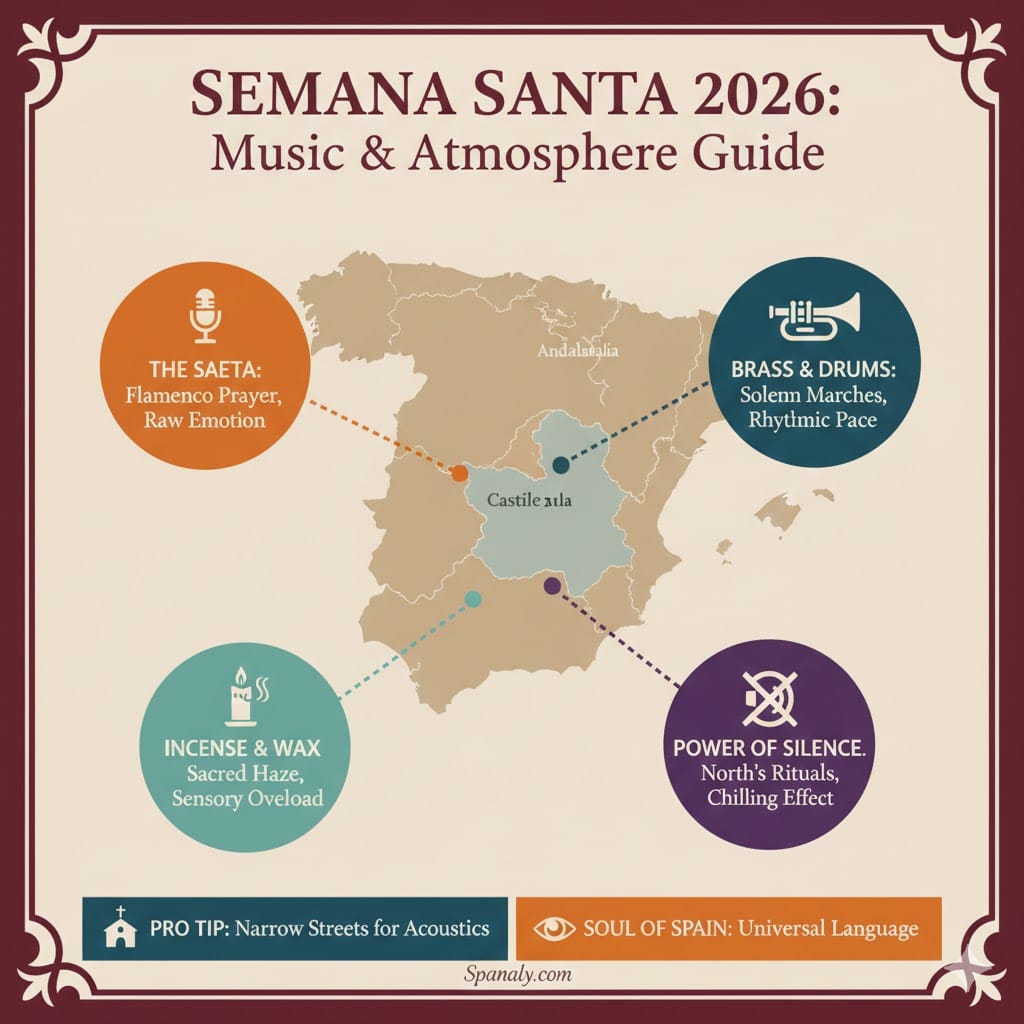
The sensory experience of Semana Santa is incomplete without its hauntingly beautiful soundtrack. The music isn’t just accompaniment; it is the heartbeat that dictates the pace of the Costaleros and stirs the emotions of the thousands watching in the streets.
🎵 The Sound of Devotion
The Bugle and Drum Bands: Most processions are led by large bands playing solemn, military-style marches. The deep resonance of the drums and the sharp cry of the bugles create an atmosphere that is both grand and mournful.
The Saeta: This is perhaps the most spine-tingling moment of all. A Saeta is a spontaneous flamenco prayer sung from a balcony as the float passes. The entire crowd falls into a sudden, heavy silence to hear the singer’s raw, emotional voice.
The Power of Silence: In the North (Castile and León), the “music” is often the absence of sound. The rhythmic clatter of wooden staffs and the clanking of chains worn by penitents create a chilling, medieval atmosphere.
🕯️ A Sensory Overload
Beyond the music, the atmosphere is defined by the thick scent of incense and the smell of melting beeswax from thousands of candles. This combination creates a “sacred haze” that hangs over the Spanish cities, making it one of the most unique Spanish Festivals to experience.
✨ Pro Tip for Music Lovers: If you want to experience the best acoustics, find a narrow street where the sound of the brass bands reflects off the ancient stone walls. It’s a powerful experience that highlights why this is a top Spanish Attraction during the spring.
Spanaly Thought: You don’t need to understand the lyrics or the liturgy to feel the music. The vibrations of the drums and the soul in a Saeta are a universal language that connects every spectator to the heart of Spain.
🚆 Quick Escapes: Semana Santa One-Day Trips
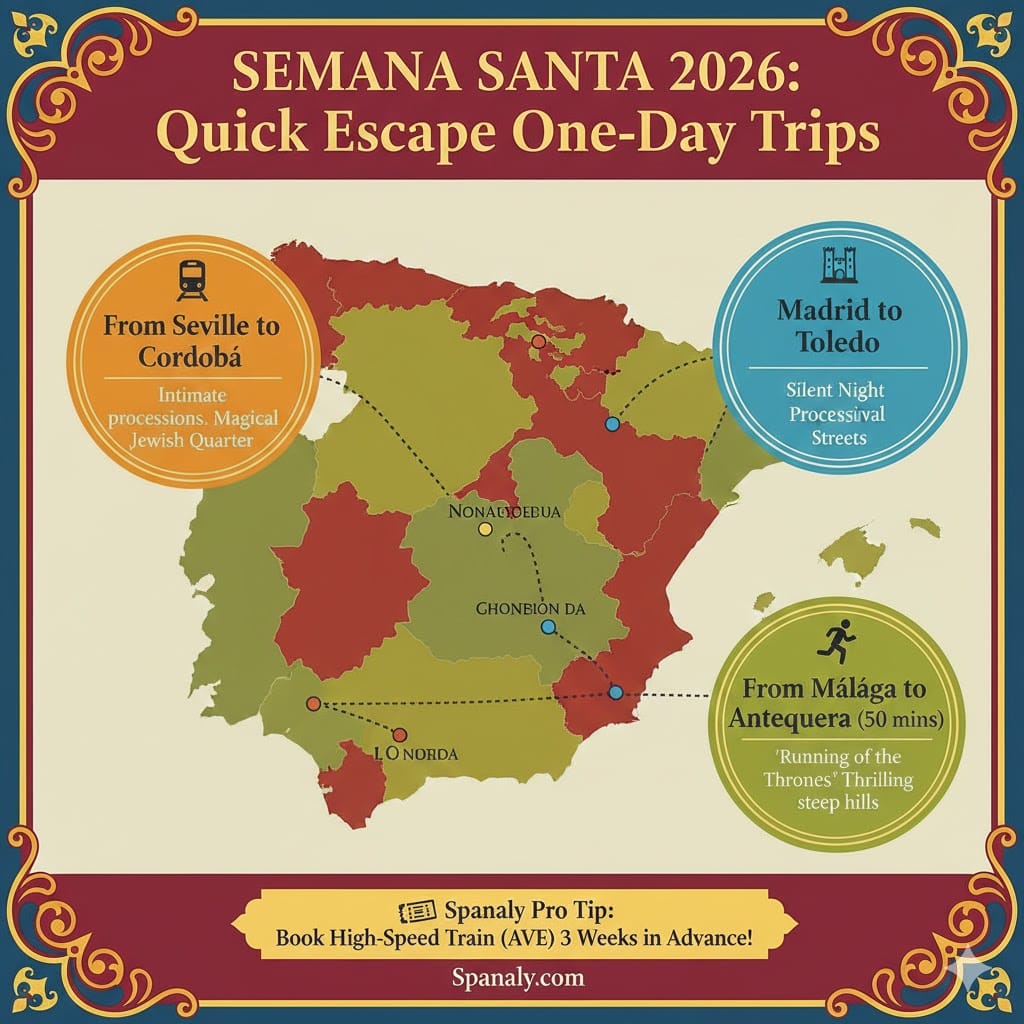
If the intensity of the main city crowds becomes too overwhelming, taking a one-day trip is a fantastic way to see a different side of the tradition or simply recharge. Thanks to Spain’s excellent rail network, these escapes are seamless.
From Seville to Córdoba (45 mins): Córdoba offers a more intimate and manageable version of the Andalusian processions. Walking through the Jewish Quarter as a float passes is magical. Check our guide on Getting Around Spain for train tips.
From Málaga to Antequera (50 mins): Antequera is famous for the “Running of the Thrones,” a unique tradition where costaleros run up steep hills with the heavy floats—a thrilling sight you won’t see in the big cities.
From Madrid to Toledo (35 mins): If you are based in the capital, Toledo’s medieval streets provide a hauntingly beautiful backdrop for silent, nighttime processions that feel like stepping back in time.
Spanaly Pro Tip: Always book your high-speed train (AVE) tickets at least 3 weeks in advance. During Holy Week, trains sell out faster than any other time of the year!
💡 Pro Insider Tips: Things No One Tells You
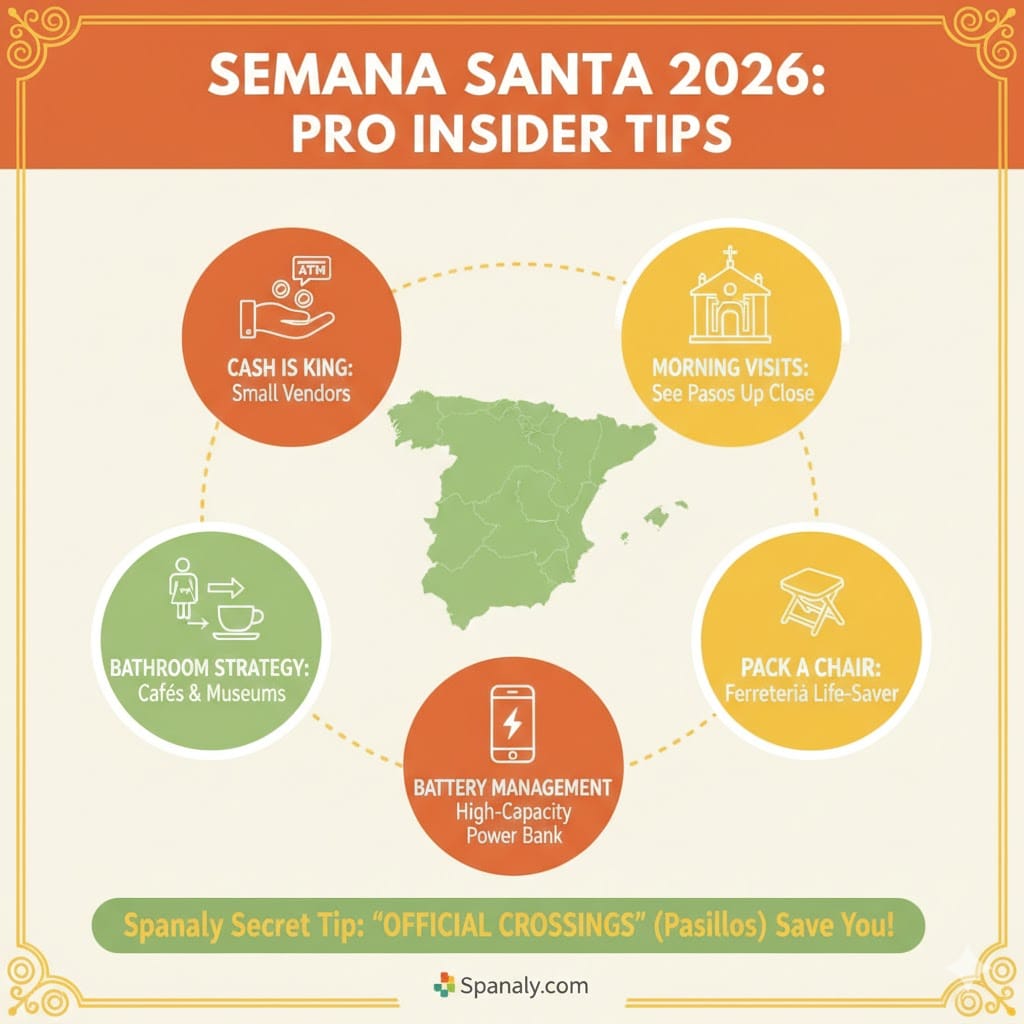
To truly master your Semana Santa 2026 experience, here are a few “under the radar” tips that will save you time, money, and unexpected headaches:
🏧 Cash is Still King (Sometimes): While Spain is very digital, the small street vendors selling traditional roasted nuts (Garrapiñadas) or the parish wax shops often only take cash. Keep a few small bills and coins handy.
⛪ Visit the Churches in the Morning: The processions happen in the afternoon and night, but the churches are open in the morning. This is the best time to see the Pasos up close, without the crowds, and admire the incredible flower arrangements and silverwork.
🚽 The “Bathroom” Strategy: Public toilets are non-existent in the crowds. Your best bet is to use the facilities in a museum, a department store like El Corte Inglés, or buy a quick coffee in a café to use their restroom before the streets are blocked.
📦 Pack a “Light” Foldable Chair: You will see locals with tiny foldable stools (taburetes). If you plan on waiting for hours in one spot, buying one at a local hardware store (ferretería) is a life-saver for your back.
📱 Battery Management: Between using GPS apps to track processions and taking hundreds of photos, your phone battery will die by 6:00 PM. A high-capacity Power Bank is the most important item in your day bag.
Spanaly Secret Tip: If you find yourself trapped on the wrong side of a street by a long procession, look for the “official crossings” (pasillos). These are small gaps managed by civil protection where they allow people to cross during breaks in the parade. Be patient and wait for their signal!
✝️ Essential FAQs: Semana Santa 2026
🔹 What are the 'Pasos' and who carries them?
Pasos are ornate wooden floats depicting the Passion of Christ. They are carried on the shoulders of Costaleros (in Seville) or Hombres de Trono (in Málaga), who move in perfect synchronization to the beat of the drums.
🔹 What is a 'Saeta' performance?
A Saeta is an emotional, acapella flamenco prayer sung from a balcony. When a Saeta begins, the entire procession and orchestra stop in total silence to honor the singer's raw devotion.
🔹 Why do 'Nazarenos' wear pointed hoods?
The Capirote (pointed hood) dates back to the Middle Ages. It symbolizes penance and the wearer's rise toward heaven, while the mask ensures anonymity, allowing the penitent to remain humble before God.
🔹 How does the experience vary across Spain?
It is a contrast of styles: Andalusia is famous for its vibrant music, gold-leaf floats, and emotional energy. In contrast, Castile and León (like Zamora) offers a somber, silent, and deeply meditative atmosphere with medieval roots.
🔹 What exactly is 'La Madrugá'?
The Madrugá is the most intense night of the festival, occurring from midnight on Holy Thursday until the dawn of Good Friday. It features the most iconic processions, including the famous Macarena in Seville.
🔹 What is the golden rule for tourist etiquette?
Respect the silence. When a procession passes, lower your voice and avoid crossing through the lines of Nazarenos. While photography is allowed, using flash is considered disruptive and disrespectful during night ceremonies.
Expertly curated by Spanaly.com
🏁 The Soul of Spain Awaits You
Semana Santa 2026 is more than a holiday; it is a profound immersion into a living history. It’s where the scent of orange blossoms meets ancient incense, and where the silence of a crowd speaks louder than words.
To make the most of this unforgettable week, remember:
Plan Ahead: 2026 will be a peak year; early booking is your best friend.
Stay Curious: Look beyond the main routes to find the most intimate moments.
Be Present: Put the camera down occasionally and simply feel the rhythm of the drums.
Whether you are drawn by faith, art, or the sheer atmosphere, Spain’s Holy Week will leave an indelible mark on your soul. The streets are ready, the traditions are waiting, and the experience of a lifetime is calling.
Spanaly Final Tip: Don’t just visit Spain—experience it. We’ll see you at the “Madrugá”!