🏛️ Royal Palace of Madrid
In the heart of the Spanish capital stands the Palacio Real de Madrid, a masterpiece of European architecture. This grand structure serves as more than a monument. It chronicles Spain’s monarchy, culture, and artistry through centuries of vivid history.
📜 Historical Roots: Built on a 9th-century Moorish site, it became the official royal seat in the 1700s.
🏰 Architectural Grandeur: This imperial residence outshines every other palace in Western Europe with its sheer scale and 3,400 rooms.
👑 Ceremonial Venue: While the King and Queen reside elsewhere for privacy, this remains the official stage for Spain’s most prestigious state events.
💡 Spanaly Insight: The palace is the crown jewel of the city’s “Golden Mile.” To make the most of your trip, check our Ultimate Madrid Travel Guide for logistical tips and the best nearby tapas spots.
🏰 The Royal Rivalry: Palacio Real vs. El Escorial
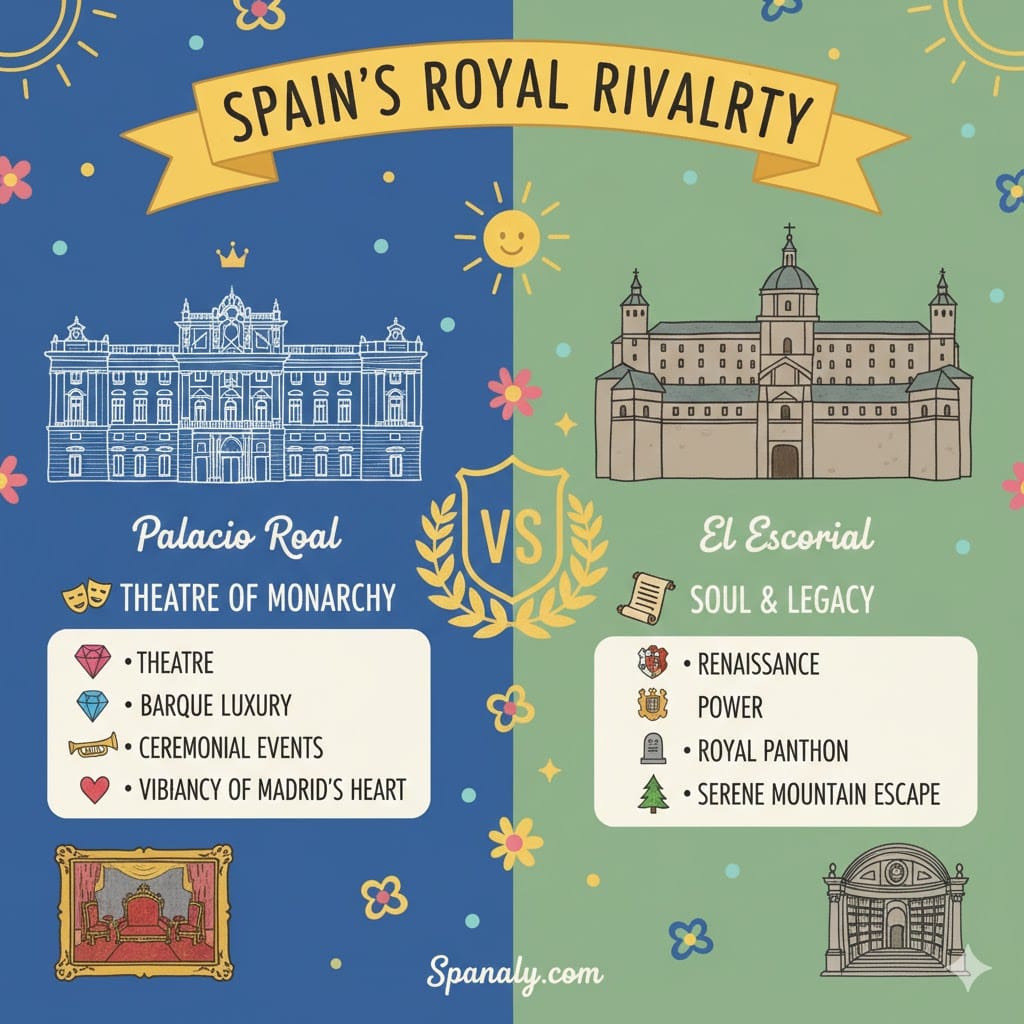
San Lorenzo de El Escorial is the only monument that rivals the Royal Palace’s grandeur. The Royal Palace showcases peak “Baroque” luxury in the city center. In contrast, El Escorial embodies the stern power of the Spanish Empire. Its “Renaissance” architecture reflects both political and religious might.
🏛️ Architectural Contrast: The Royal Palace is airy and heavily decorated. El Escorial feels like a fortress with strict, symmetrical lines.
👑 Historical Purpose: The city palace hosts royal ceremonies. Meanwhile, El Escorial serves as the official burial site (pantheon) for Spanish Kings.
🌲 The Experience: The Royal Palace keeps you in Madrid’s vibrant heart. A trip to El Escorial offers fresh mountain views and a somber, historic atmosphere.
In summary, the Royal Palace represents the “theatre” of the monarchy. El Escorial represents its “soul” and eternal legacy.
💡 Spanaly Insight: We recommend seeing both for the ultimate royal experience. You can easily plan a day trip to the mountains. Check our guide on Madrid Travel Guide to see the monastery. You can also compare this Castilian power with the Mediterranean charm found in Barcelona.
📜 A Glorious Past: From Fire to Grandeur
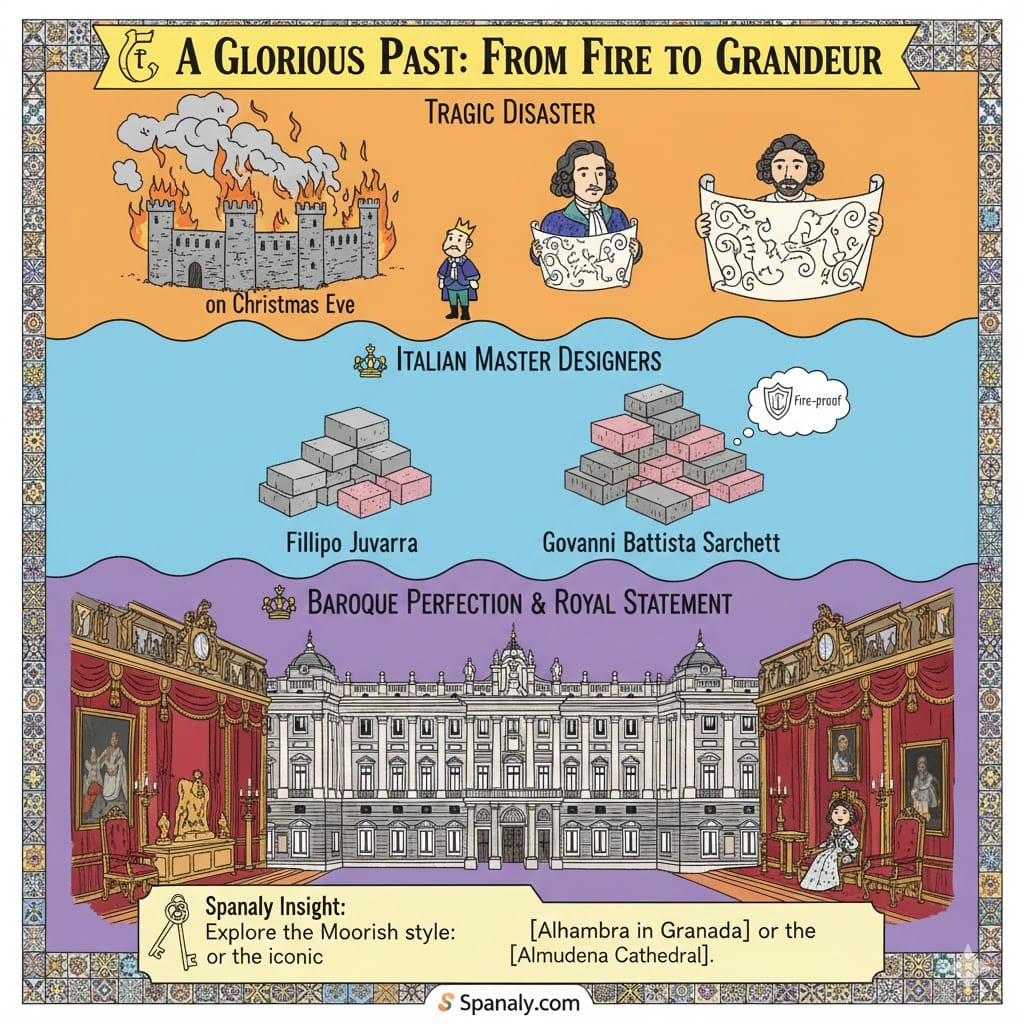
The Royal Palace of Madrid rose from the ashes of a tragic disaster. A massive fire leveled the old Alcázar on Christmas Eve in 1734. This medieval fortress had served Spanish kings for centuries. King Philip V then seized the moment. He built a limestone and granite palace to overshadow every other royal seat in Europe.
✍️ Master Designers: The King hired Italian architect Filippo Juvarra for the initial plans. Giovanni Battista Sacchetti later completed the massive project.
🏗️ Baroque Perfection: This duo blended Italian Baroque and Neoclassical styles. They avoided wood in the primary structure to ensure the building remained fire-proof.
👑 A Royal Statement: The palace was completed in 1764. It became a symbol of the Enlightenment with over 3,400 rooms filled with gold leaf and Spanish art.
In summary, the transition from a Moorish fortress to a Baroque masterpiece reflects the enduring ambition of the Spanish Monarchy.
💡 Spanaly Insight: Spain’s architectural history is a mosaic of influences. Explore our guide to the Alhambra in Granada to see how Moorish style evolved differently. You can also contrast this grandeur with the iconic Almudena Cathedral located just steps away.
💎 Iconic Halls: The Throne Room & Royal Armoury
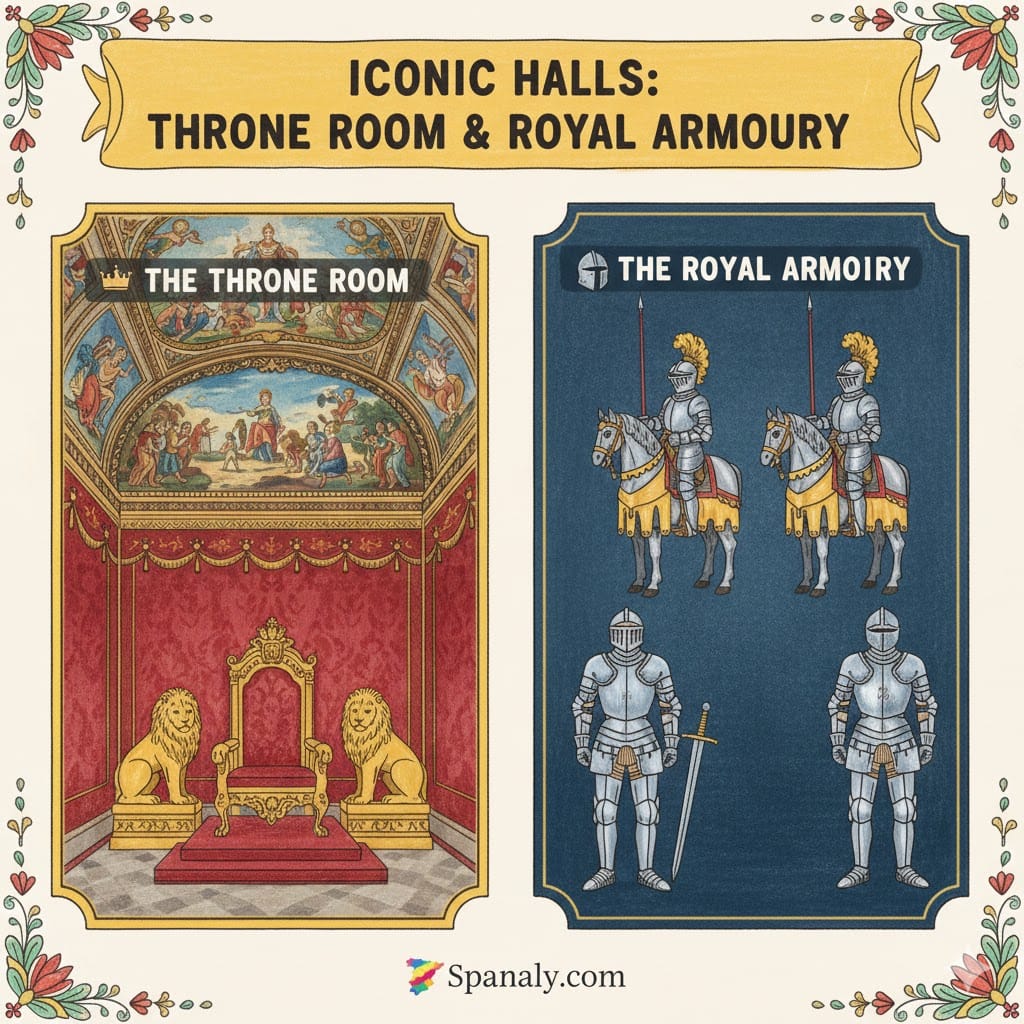
Stepping inside the Royal Palace of Madrid feels like walking through a live gallery. The palace contains over 3,000 rooms. However, a few spaces stand out as absolute masterpieces of decorative art and history.
👑 The Throne Room (Salón del Trono): This room remains virtually unchanged since the 18th century. It features crimson velvet walls and golden lions. A breathtaking ceiling fresco by Tiepolo symbolizes the glory of the Spanish Monarchy.
⚔️ The Royal Armoury (Real Armería): Experts consider this collection one of the best in the world. It houses suits of armor belonging to Emperor Charles V and Philip II. It offers a rare glimpse into the chivalry of medieval Spain.
🍽️ The Gala Dining Hall: The palace still uses this massive room for state banquets. It seats over 140 guests under shimmering chandeliers and exquisite tapestries.
In summary, these halls transform the palace into a breathtaking treasury of Spanish heritage and craftsmanship.
💡 Spanaly Insight: The artistic wealth here is immense. After marveling at the royal tapestries, continue your journey at the nearby Prado Museum. You can also explore modern masterpieces at the Reina Sofia Museum.
🎻 The Stradivarius Quartet: A Musical Treasure
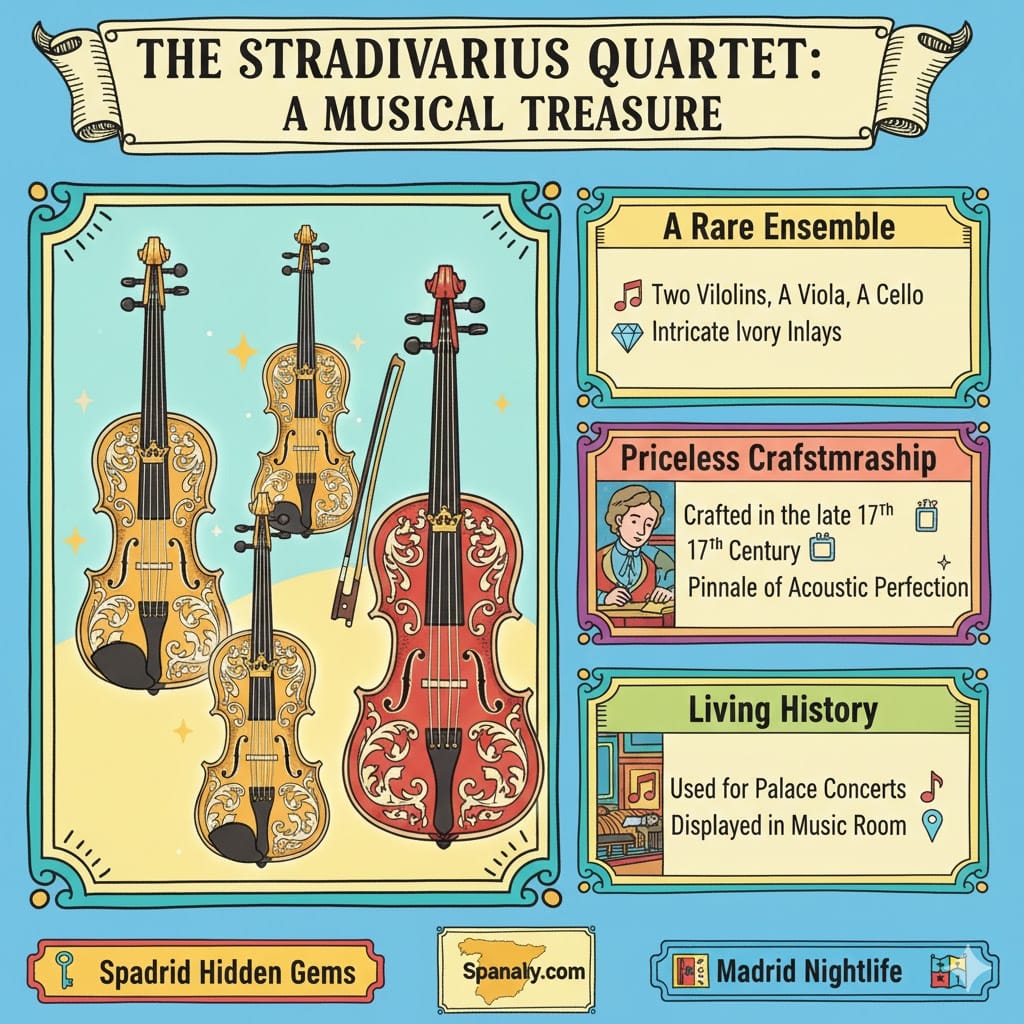
One of the most extraordinary secrets of the Royal Palace of Madrid is its musical heritage. The palace houses the Stradivarius Palatinos, the world’s only complete decorated quartet of instruments crafted by the legendary Antonio Stradivari. These are not merely museum pieces; they are living treasures still used for special palace concerts today.
🎼 A Rare Ensemble: The collection includes two violins, a viola, and a cello, all featuring intricate ivory inlays and royal emblems.
💎 Priceless Craftsmanship: Created in the late 17th century, these instruments represent the pinnacle of acoustic and aesthetic perfection.
🎧 Living History: Visitors can often see them displayed in the music room, serving as a reminder of the Spanish court’s historical passion for the arts.
In summary, this quartet is a unique fusion of history and harmony, making it a must-see for music lovers and art enthusiasts alike.
💡 Spanaly Insight: This musical collection is just one example of the “hidden” treasures within Madrid’s royal heritage. To discover more off-the-beaten-path locations and local secrets in the capital, don’t miss our guide to Madrid Hidden Gems, or learn about the city’s vibrant modern scene in the Madrid Nightlife Guide.
🍲 The Royal Kitchens: A Glimpse into Palace Life
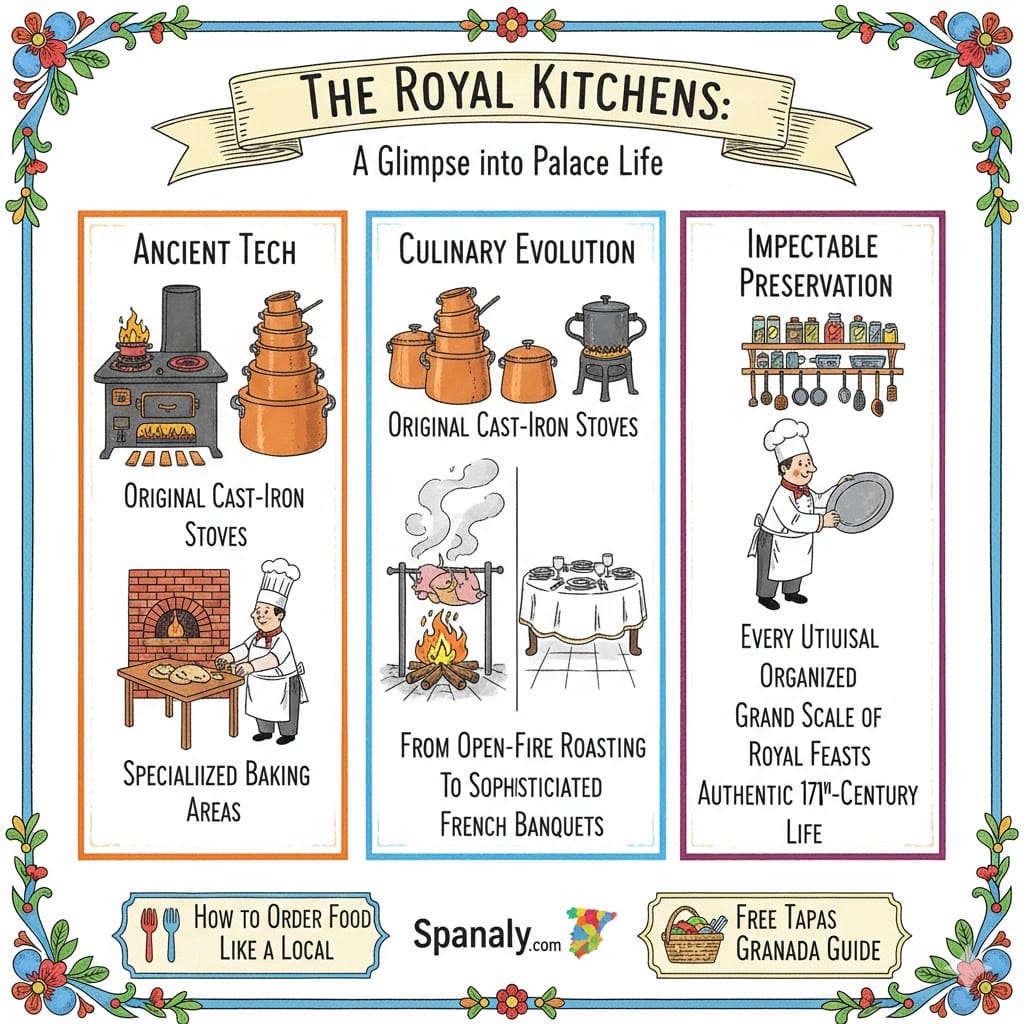
For a true change of pace, the Real Cocina (Royal Kitchen) offers a fascinating look at the logistical marvel required to feed a monarchy. Recognized as one of the best-preserved historic kitchens in European royal residences, this space allows you to escape the gold leaf of the staterooms and enter the bustling heart of palace operations.
🍳 Ancient Tech: The kitchen features original cast-iron stoves, massive copper pots, and specialized baking areas that remain exactly as they were in the 19th century.
📜 Culinary Evolution: You can trace how Spanish gastronomy evolved from open-fire roasting to the sophisticated French-influenced banquets of the 1800s.
🏺 Impeccable Preservation: Every utensil is meticulously organized, showcasing the grand scale of royal entertaining and daily life.
In summary, the Royal Kitchens provide a raw and authentic contrast to the palace’s formal luxury, making it a highlight for foodies and history buffs.
💡 Spanaly Insight: After seeing where royal feasts were prepared, you’ll likely be hungry for some authentic local flavors. We recommend heading to the nearby markets to experience Madrid’s modern food scene. Check out our guide on How to Order Food Like a Local in Spain, or if you’re traveling south later, don’t miss the Free Tapas Granada Guide.
💂 The Changing of the Guard & Solemn Relay

Witnessing the Changing of the Guard at the Royal Palace is one of the most iconic experiences in Madrid. This military display maintains traditions dating back to the times of King Alfonso XII and King Alfonso XIII, offering a powerful sense of history and discipline.
🛡️ The Weekly Change: Every Wednesday and Saturday, guards dressed in traditional blue, white, and red uniforms perform the relay at the Puerta del Príncipe.
🐎 The Solemn Relay: On the first Wednesday of every month (except January, August, and September), the palace hosts a grander version. This spectacular event involves over 400 troops and 100 horses, accompanied by a military band.
📸 Best Viewpoints: Arrive at least 30 minutes early to secure a spot near the railings of the Plaza de la Armería for the best photo opportunities.
In summary, these ceremonies provide a living link to Spain’s royal past, combining military precision with historical pageantry.
💡 Spanaly Insight: While the palace ceremony is a major highlight, Madrid’s energy extends far beyond these gates. After the display, take a short walk to the bustling Puerta del Sol to see the city’s symbolic center, or dive into the local life described in our full Madrid Travel Guide.
🌳 Royal Greenery: Sabatini Gardens vs. Campo del Moro
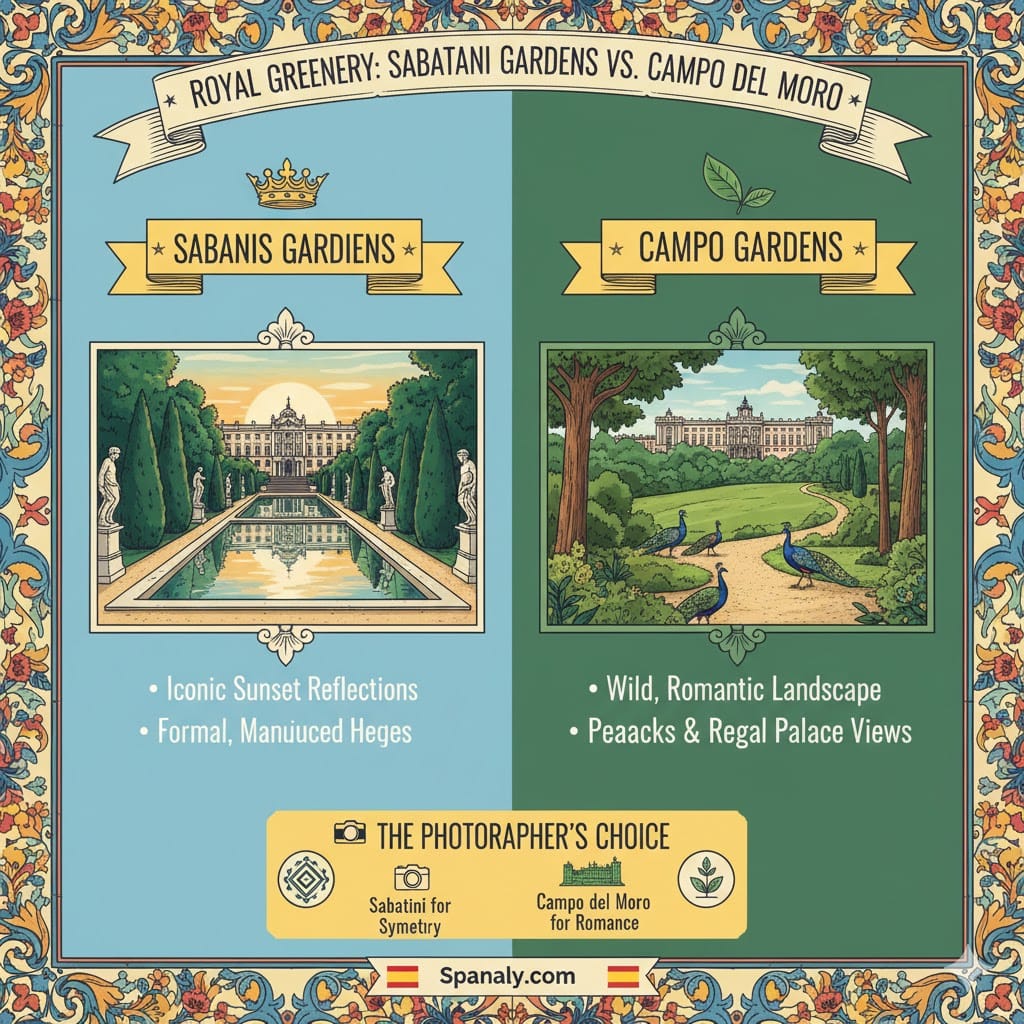
Two distinct green spaces surround the Royal Palace of Madrid. These areas offer more than just a place to rest. Each garden provides a unique view of the palace architecture and a different atmosphere.
⛲ Sabatini Gardens (Jardines de Sabatini): These Neoclassical gardens sit on the northern side. They feature perfectly manicured hedges and elegant fountains. This is the best spot to capture the iconic sunset reflection in the central pond.
🦚 Campo del Moro: This English-style park offers a natural and expansive landscape. It takes its name from a 12th-century Moorish camp. Here, you can see the palace rising above a lush green carpet, often shared with roaming peacocks.
📸 The Photographer’s Choice: Choose Sabatini for formal, symmetrical shots. Head to Campo del Moro for a romantic, forest-like backdrop with the palace in the distance.
In summary, both gardens are essential for a complete royal experience. Whether you prefer structured elegance or wilder charm, you will find it here.
💡 Spanaly Insight: Madrid is famous for its diverse green lungs. If you enjoy royal landscaping, you will love the historic statues of Maria Luisa Park in Seville. You can also explore the botanical beauty of the Jardines de Murillo for a different Andalusian vibe.
🎨 Artistic Masterpieces: Goya, Caravaggio & Tiepolo
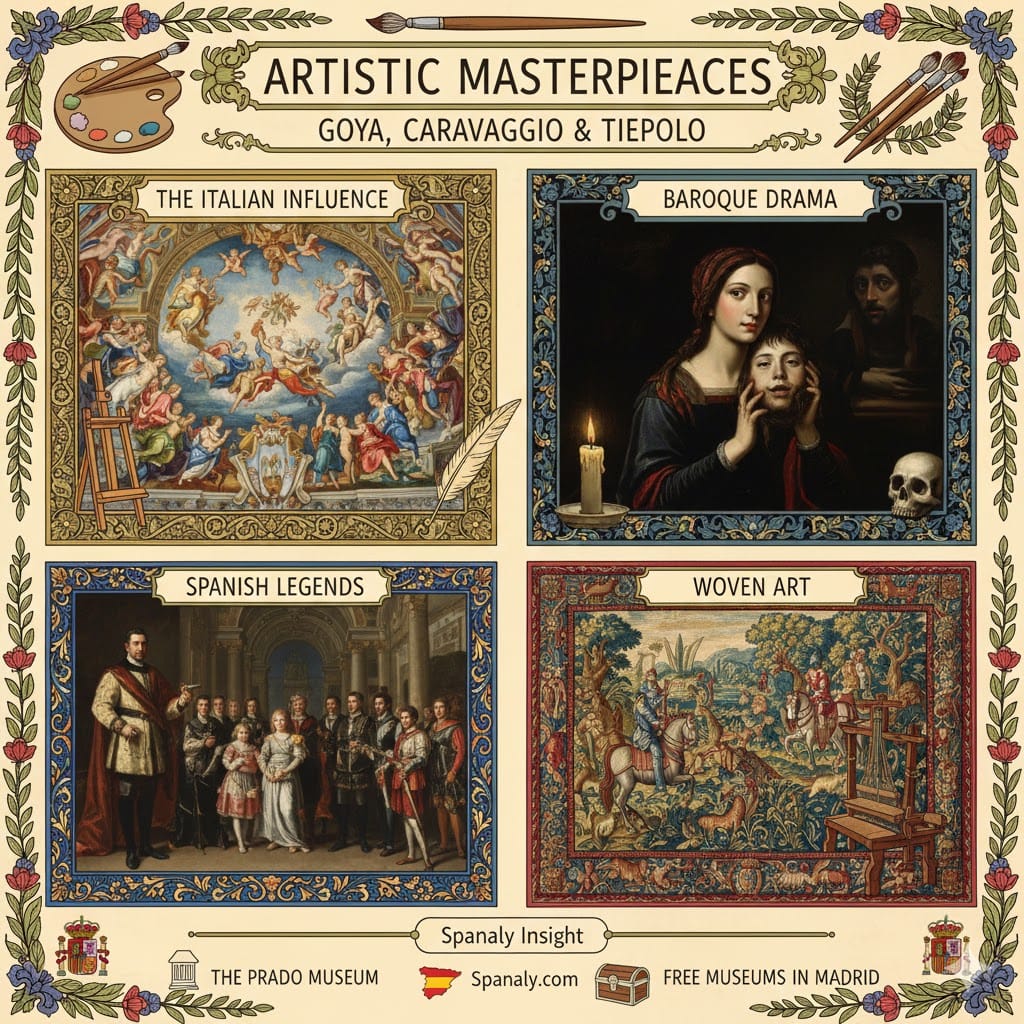
The Royal Palace of Madrid is far more than a monument to power; it is a sprawling museum of European art. As you walk through its halls, look upward and around—the walls and ceilings are adorned with masterpieces that rival the collections of the world’s most famous galleries.
🎨 The Italian Influence: The ceilings of the main halls feature breathtaking frescoes by Giambattista Tiepolo, whose work “The Glory of the Spanish Monarchy” remains a pinnacle of Baroque art.
🖌️ Spanish Legends: No royal residence would be complete without Francisco de Goya. His portraits of the Spanish royal family offer a deep, psychological look into the figures who shaped the nation’s history.
🕯️ Baroque Drama: Keep an eye out for Caravaggio’s “Salome with the Head of Saint John the Baptist,” one of the most significant and dramatic paintings within the palace’s private collections.
🧵 Woven Art: The palace also houses one of the world’s finest collections of Flemish Tapestries, showcasing incredible detail and vibrant colors that have survived centuries.
In summary, the art within the palace turns every room into a gallery, reflecting the immense cultural legacy of the Spanish crown.
💡 Spanaly Insight: If these masterpieces ignite your passion for art, you are in the perfect city. After finishing your palace tour, you can easily walk to the Prado Museum to see even more works by Goya and Velázquez, or check out our guide on the Best Free Museums in Madrid to keep your budget in check while soaking in the culture.
📍 Proximity Wonders: Almudena Cathedral & Plaza de Oriente
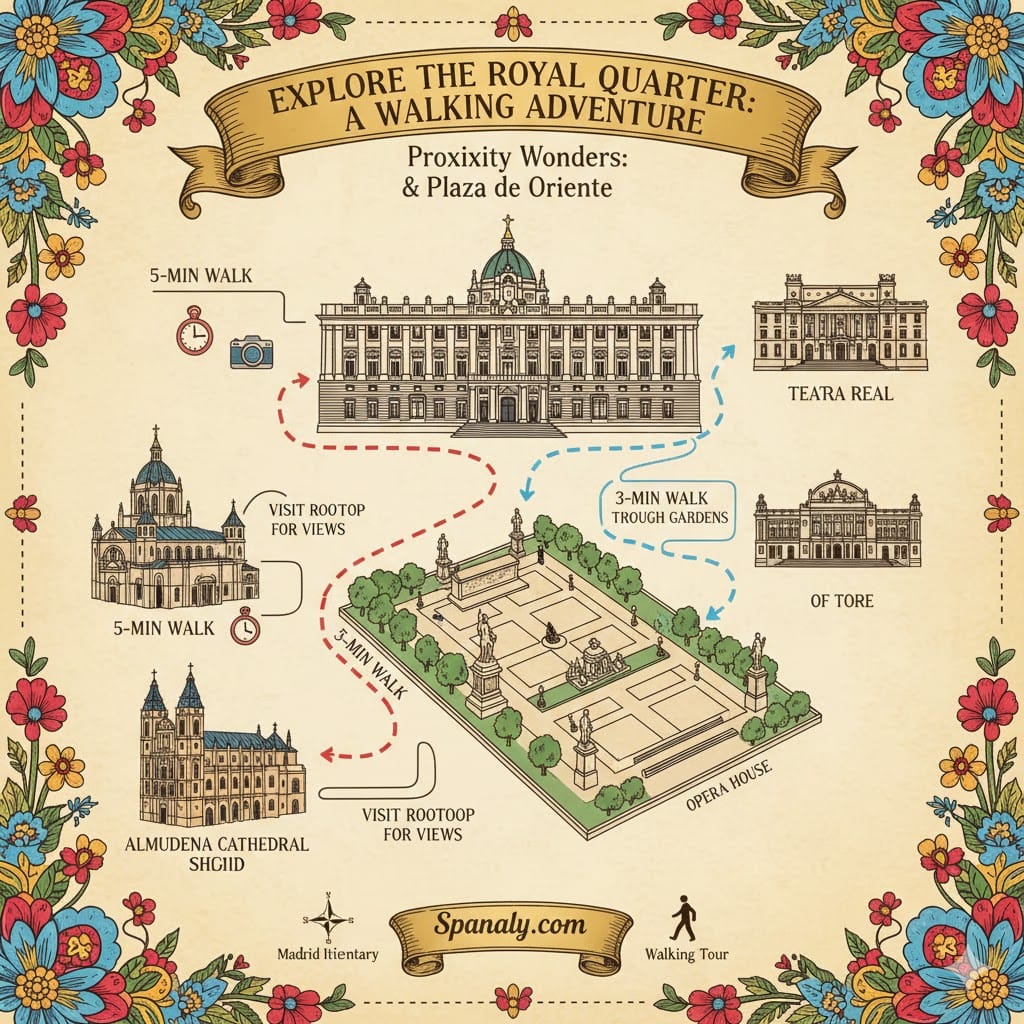
The area surrounding the Royal Palace of Madrid is a concentrated hub of history. Instead of rushing away after your tour, you can maximize your time by visiting these world-class landmarks located just steps from the palace gates.
⛪ Almudena Cathedral (Catedral de la Almudena): Standing directly opposite the palace, this cathedral offers a unique architectural contrast. While its exterior matches the palace’s Neoclassical style, the interior is strikingly modern with colorful pop-art stained glass. Pro Tip: Don’t miss the crypt and the rooftop cupola for a panoramic view of the palace.
⛲ Plaza de Oriente: This elegant square acts as a peaceful buffer between the palace and the Royal Theatre. It is lined with statues of Spanish Gothic kings and offers one of the most serene walkways in central Madrid.
🎭 Teatro Real (Royal Theatre): Just across the plaza, this is one of Europe’s premier opera houses. Even if you don’t catch a show, its majestic presence adds to the imperial atmosphere of the neighborhood.
In summary, by grouping these sites together, you can experience the spiritual, royal, and cultural heart of Madrid in a single afternoon without needing a taxi or metro.
💡 Spanaly Insight: Exploring this area on foot is the best way to soak in the atmosphere. If you’re planning a broader walking tour of the city, our One Day in Madrid Itinerary shows you exactly how to connect these royal sites with the historic Plaza Mayor for the perfect Spanish experience.
🎫 Visitor Guide 2026: Tickets, Free Hours & Security
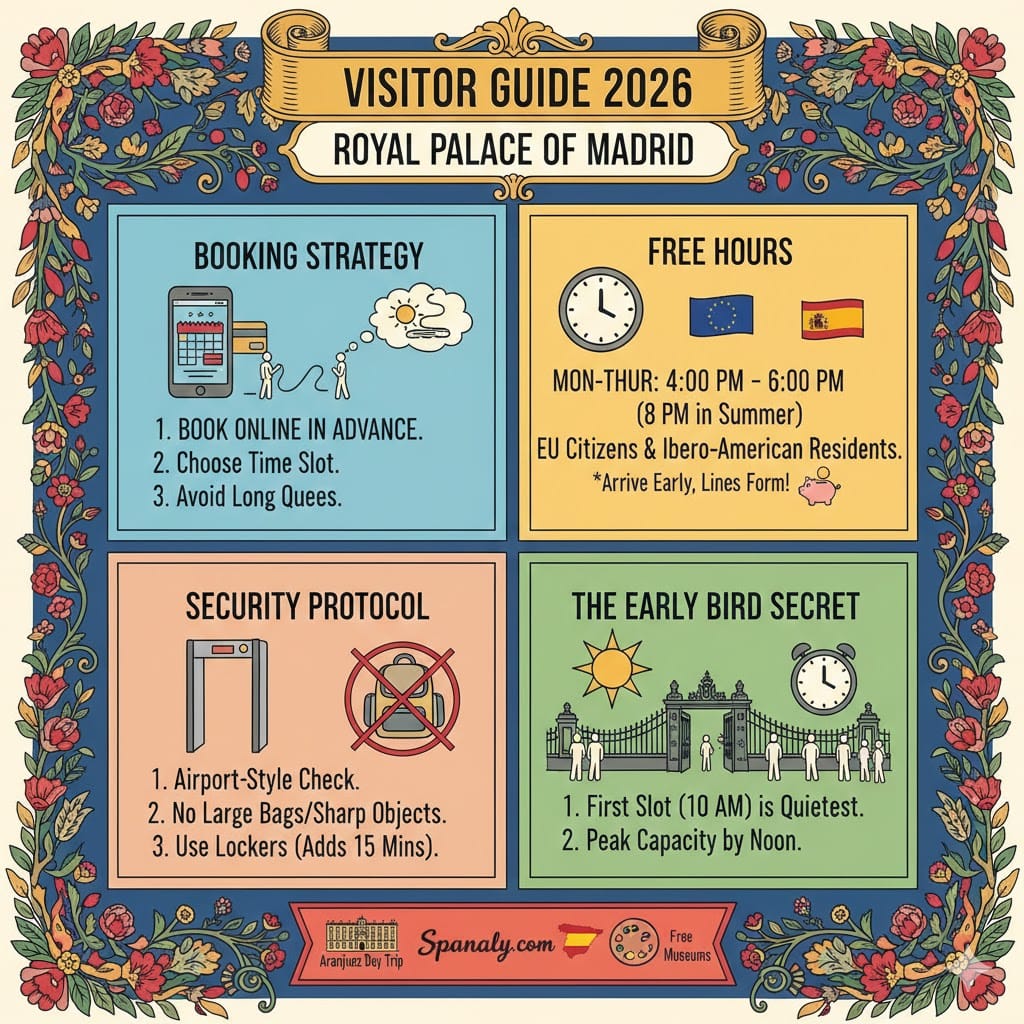
Planning your visit to the Royal Palace of Madrid requires a bit of strategy to avoid the infamous two-hour queues. In 2026, the palace remains one of Europe’s most visited sites, so efficiency is key to a stress-free experience.
🎟️ Booking Strategy: Always book online in advance. Tickets are released in time slots; if you show up without a reservation, you risk waiting in a long line or finding that the entire day is sold out.
🆓 How to Enter for Free: The palace offers free admission from Monday to Thursday, between 4:00 PM and 6:00 PM (6:00 PM to 8:00 PM in summer) for EU citizens and Ibero-American residents. Note: Lines for free hours start early, so weigh the “cost of your time” against the ticket price.
🛡️ Security Protocol: The security check is similar to an airport. Avoid bringing large backpacks or sharp objects. There are lockers available, but using them can add 15 minutes to your entry and exit time.
🚶 The “Early Bird” Secret: The first slot of the morning (10:00 AM) is the quietest. By noon, the palace reaches peak capacity.
In summary, a little pre-planning—especially booking your slot online—can save you hours of standing on the hot pavement of the Plaza de la Armería.
💡 Spanaly Insight: If you find the palace fully booked during your stay, don’t worry. Madrid has plenty of royal-vibe alternatives. Consider visiting the Royal Palace of Aranjuez for a nearby day trip, or explore the stunning Real Academia de Bellas Artes for a quieter but equally regal art experience.
💡 Expert Travel Tips for an Unforgettable Visit
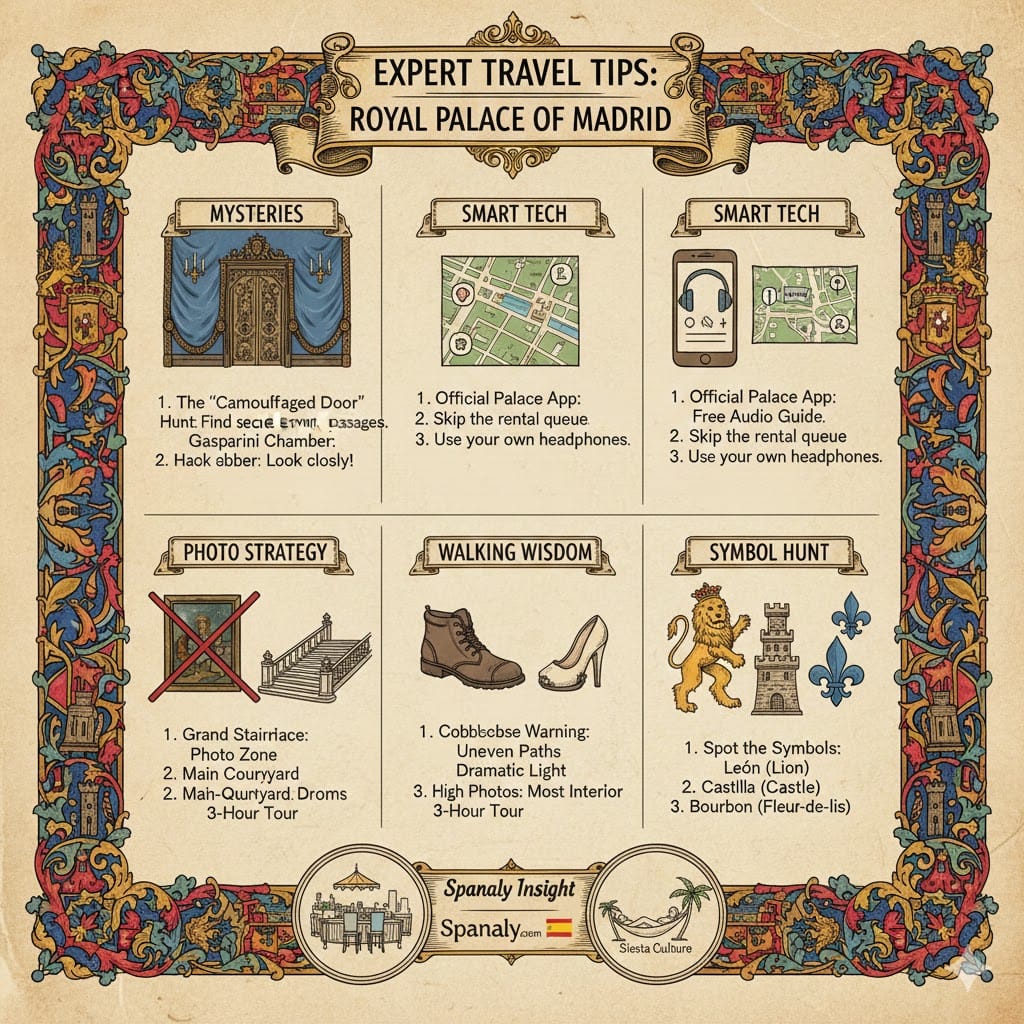
To experience the Royal Palace of Madrid like a true pro (and not just another tourist), you need to know what happens behind the scenes. These insider tips will help you bypass the stress and capture the essence of Spanish royalty.
🚪 The “Camouflaged Door” Hunt: While walking through the grand rooms, especially the Gasparini Chamber, keep an eye on the silk-covered walls. You can spot nearly invisible “hidden doors” used by servants in the 18th century to move between rooms without being seen by the royals.
📱 Ditch the Physical Audio Guide: Instead of paying for the tablet-based audio guide and waiting in another line to return it, download the official Royal Palace app on your phone. It has the same content, works with your own headphones, and saves you at least 20 minutes of logistical hassle.
📸 The “No-Photo” Strategy: Photography is strictly forbidden in most interior rooms (to protect the delicate tapestries). To avoid a reprimand from security, focus your camera on the Grand Staircase and the Main Courtyard, where photos are allowed and the light is most dramatic.
👟 The “Cobblestone” Warning: The Plaza de la Armería and the paths to Campo del Moro are paved with historic, uneven stones. Fashionable shoes might look good in photos, but high-quality walking shoes are the only way to survive a 3-hour palace tour without regret.
🦁 Spot the Symbols: Look for the three recurring symbols on the walls and furniture: the Lion (León), the Castle (Castilla), and the Fleur-de-lis (the Bourbon dynasty). It’s a fun way to engage with the history as you explore.
In summary, these small details turn a standard tour into a sophisticated exploration of Spanish heritage and secret palace life.
👑 Visitor FAQs – Royal Palace of Madrid
🏠 Does the Spanish Royal Family actually live here?
No, the King and Queen live in the Palace of Zarzuela on the outskirts of Madrid. This palace is used exclusively for state ceremonies, official banquets, and as a public museum.
🍳 Do I need a separate ticket for the Royal Kitchens?
Yes, access to the Royal Kitchens (Real Cocina) requires a small additional supplement on top of your general admission ticket. It is highly recommended to book this in advance as it has a very limited capacity per hour.
🚫 Why is the palace sometimes closed without notice?
As a working palace, it may close for Official State Acts. This can happen with very little warning. Always check the official "Patrimonio Nacional" website on the morning of your visit to confirm it's open.
🥪 Can I bring food or drinks inside the palace?
Food and drinks are not allowed inside the palace halls. However, you can carry a small water bottle in your bag, or visit the palace cafeteria located near the courtyard for a break during your tour.
👶 Is the palace stroller-friendly for families?
While strollers are allowed in the courtyard and gardens, you must leave them in the cloakroom before entering the royal apartments. Small baby carriers are recommended for navigating the interior rooms.
Created by Spanaly.com 🇪🇸
👑 Your Royal Adventure Awaits
A visit to the Royal Palace of Madrid is more than just a tour; it’s a journey through the heart of Spanish history and art. To make the most of it, remember these keys:
✨ Plan Ahead: Book your slot online to save your energy for the palace, not the queue.
✨ Look Deeper: Beyond the gold, find the hidden stories in the tapestries and frescoes.
✨ Take a Breath: End your royal day in the serene Sabatini Gardens for the perfect sunset.
✨ Expand Your Horizon: The palace is the crown jewel, but Madrid has so much more to offer.
In summary, whether you are an art lover or a history buff, the Palacio Real will leave you with a lasting sense of Spain’s grand legacy.
🚀 Ready for the next level? Once you’ve conquered the palace, it’s time to escape the crowds! Discover the secret spots most tourists never see in our exclusive guide to Madrid’s Hidden Gems.