Table of Contents
Toggle🌊 Madrid to Valencia
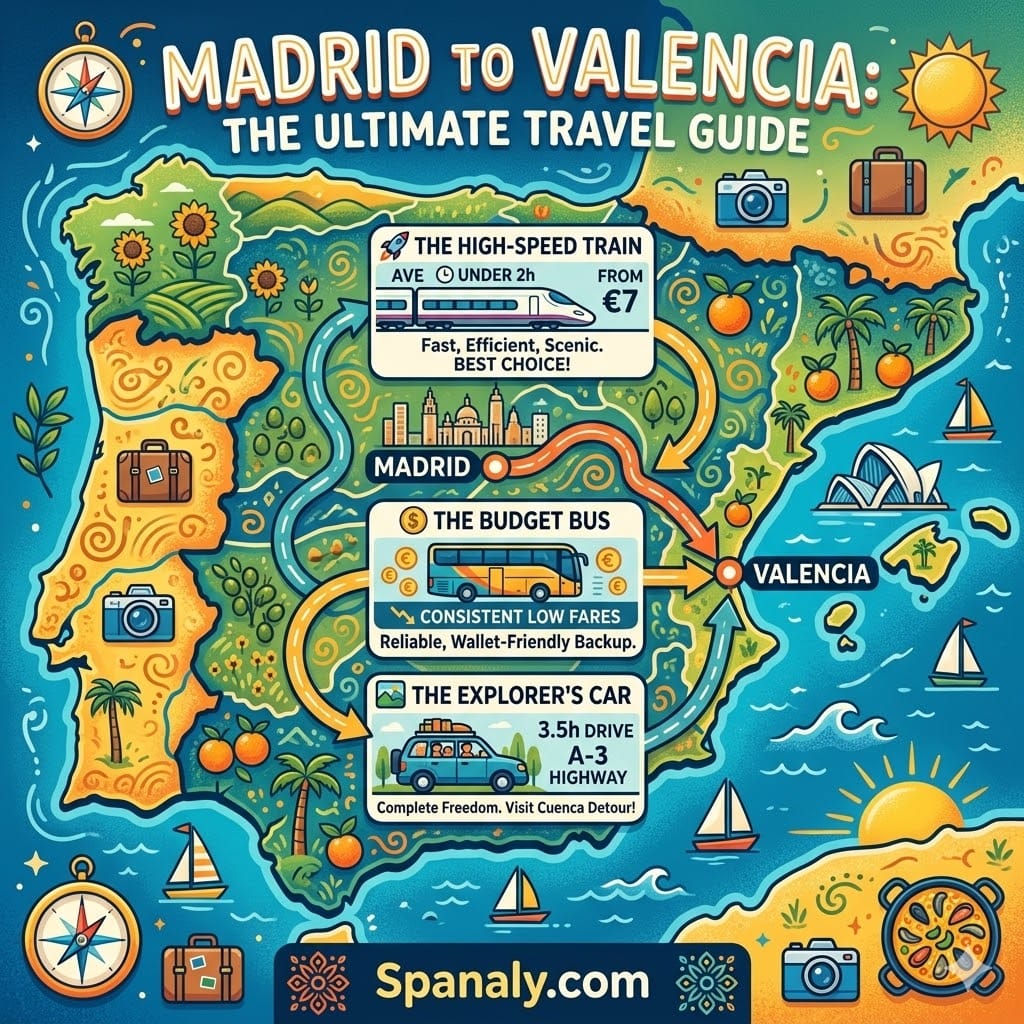
Undeniably, swapping the regal streets of Madrid for the Mediterranean breeze of Valencia is one of the best travel decisions you can make in Spain. Whether you are chasing the futuristic City of Arts and Sciences or the perfect plate of authentic Paella, getting there is easier than ever.
Distance: Approximately 360 km (223 miles). 🛣️
Fastest Option: High-speed train (under 2 hours). 🚄
Budget Option: Comfortable long-distance bus. 🚌
Explorer Option: A scenic drive through the Cuenca region. 🚗
Notably, this route is one of the most popular in the country, connecting Spain’s bustling heart to its vibrant eastern coast.
Spanaly Insight: 💡 To make the most of your Mediterranean getaway, we recommend booking your transport early. Consequently, you’ll have more time to focus on your city adventure! Once you arrive, don’t miss our Ultimate Valencia 3-Day Itinerary to discover the best hidden gems of the city. 🥘✨
📊 Quick Overview: Madrid to Valencia at a Glance
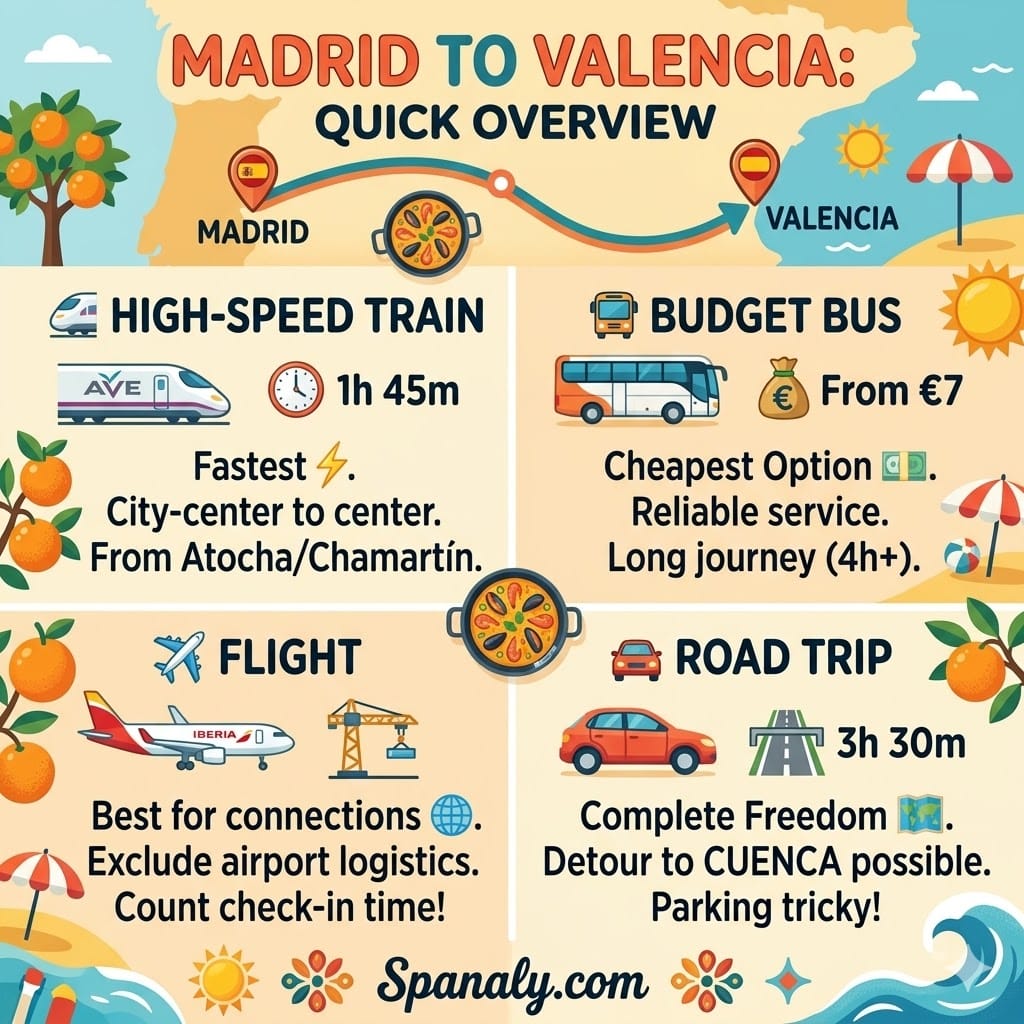
Before we dive into the details, here is everything you need to know to make a quick decision. Actually, this route is one of the most efficient in Spain, connecting the capital to the Mediterranean coast in record time!
Distance: Approximately 360 km (223 miles). 🛣️
Fastest Way: High-Speed Train (1h 45m to 2h). 🚄
Cheapest Way: Bus or Low-Cost Train (From €7 if booked early). 🚌
Flight Time: 1h (excluding airport logistics). ✈️
Driving Time: Around 3h 30m via the A-3 highway. 🚗
Spanaly Insight: 💡 For most travelers, the High-Speed Train is the absolute winner. To understand why, remember that high-speed trains to Valencia now depart from Madrid-Chamartín, taking you directly to the city center. Consequently, you avoid the 4-hour bus ride or the airport stress, arriving fresh and ready for the beach! 🌊☀️
📍 Madrid to Valencia: Interactive Route Map - Spanaly.com
Live MapSource: Spanaly.com
⚔️ The Great Debate: Which Mode Should You Choose?
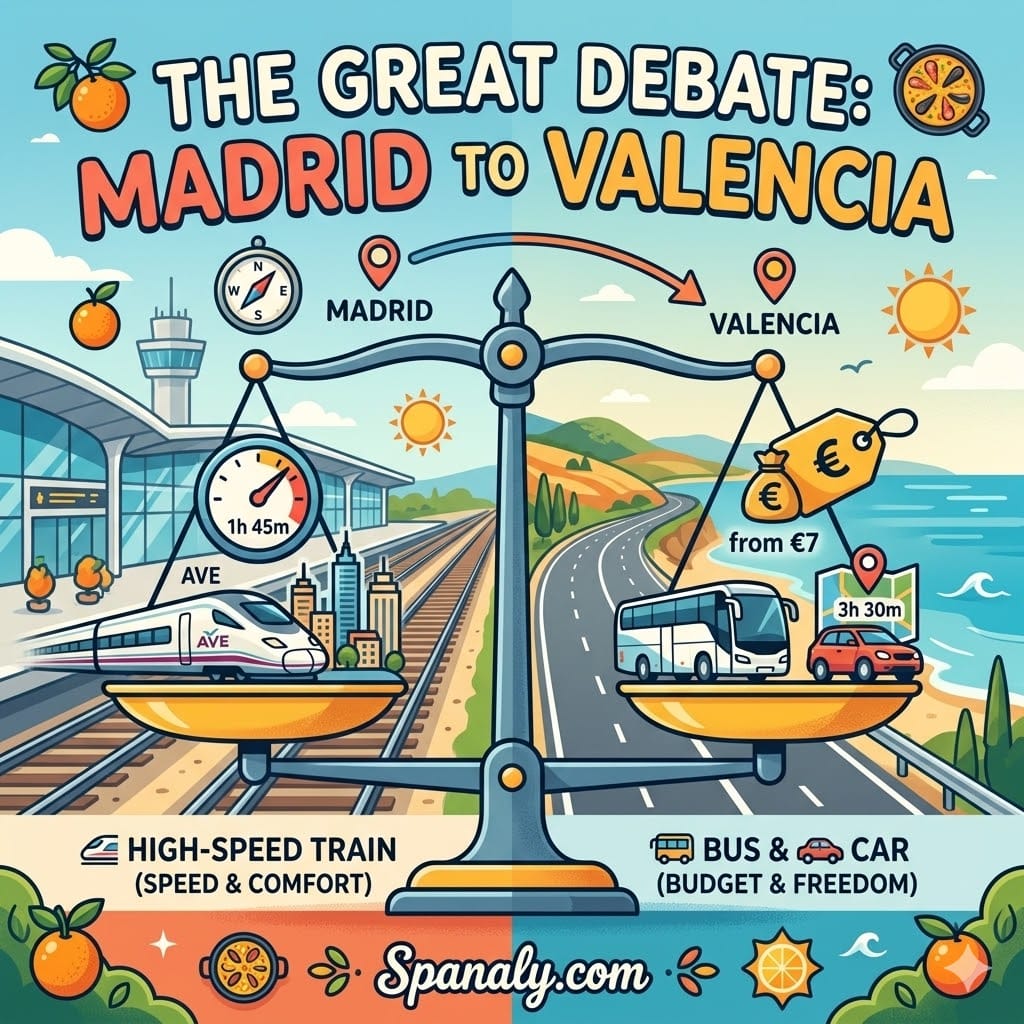
Deciding how to travel from Madrid to Valencia depends on your priority: speed, budget, or scenery. Notably, while the distance is manageable, the experience varies significantly between the “Big Four” options:
| Transport Mode | Travel Time | Price Range | Best For… |
| High-Speed Train | 1h 45m – 2h | €7 – €75 | Speed & City-to-City |
| Bus (Avanza) | 4h 15m | €12 – €35 | Budget Warriors |
| Flight | 1h (Air time) | €35 – €120 | Connecting Travelers |
| Car Rental | 3h 30m | Fuel + Rental | Road Trip Freedom |
🚄 High-Speed Train (AVE/Iryo/Ouigo): The undisputed champion. It’s faster than flying when you factor in city-center departures. Consequently, you arrive ready to explore. For a perfect stay, follow our Valencia 3-Day Itinerary.
✈️ The Flight: Actually, this is only practical for international connections at Barajas. For most, the train is faster and greener.
🚌 The Bus: Best for those saving every Euro. While it takes longer, it’s a reliable backup if trains are fully booked.
🚗 The Car: Ideal for flexibility. Notably, you can detour to see the hanging houses of Cuenca. Check our Driving in Spain guide for essential road tips.
Spanaly Insight: 💡 To get the best deal, book your train tickets 4-6 weeks early. With operators like Ouigo and Avlo, prices often drop below the cost of a bus! Consequently, you get luxury speed at a budget price. After your trip, you might want to explore another capital-to-coast route in our Madrid to Barcelona Travel Guide.
🚄 The High-Speed Train: The Fast and Easy Way
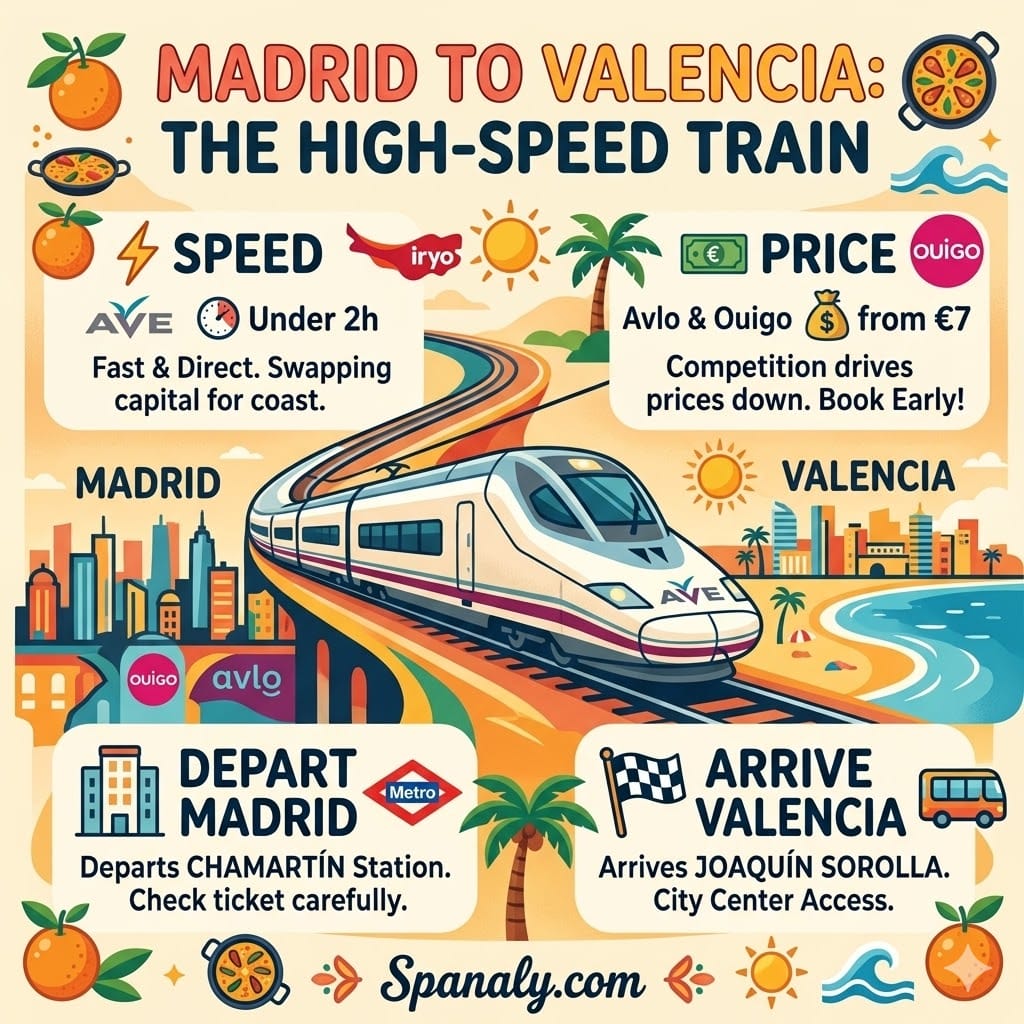
Undeniably, the high-speed train is the undisputed champion of this route. Since the liberalization of the Spanish rail market, reaching the Mediterranean has never been faster or cheaper. Notably, you can now swap the capital for the coast in under 2 hours.
Train Operators Comparison
| Operator | Price | Comfort | Notes |
| AVE (Renfe) | €€ – €€€ | ⭐⭐⭐⭐ | The gold standard; most frequent and reliable departures. |
| Iryo | €€ | ⭐⭐⭐⭐⭐ | High-end Italian design; superior comfort and dining. |
| Avlo/Ouigo | € | ⭐⭐⭐ | High-speed on a budget; ideal for saving your Euros. |
Average Duration: 1h 45m – 2h. ⏱️
Arrival Station: Valencia Joaquín Sorolla (City Center).
Key Operators:
Iryo: Best for premium comfort and flexible tickets.
Ouigo: The low-cost leader with double-decker trains.
Renfe (AVE/Avlo): The national carrier with the highest frequency.
Actually, competition has driven prices down significantly. Consequently, if you book via the official sites a few weeks early, tickets can cost as little as €7.
Spanaly Insight: 💡 To ensure a smooth trip, remember that most Valencia-bound trains depart from Madrid-Chamartín, not Atocha. Consequently, you should allow extra time to reach the station via the Metro. If you’re planning a full Spanish rail adventure, check our Madrid to Seville guide for more high-speed tips! 🚂✨
✈️ The Flight: Speed vs. Logistics
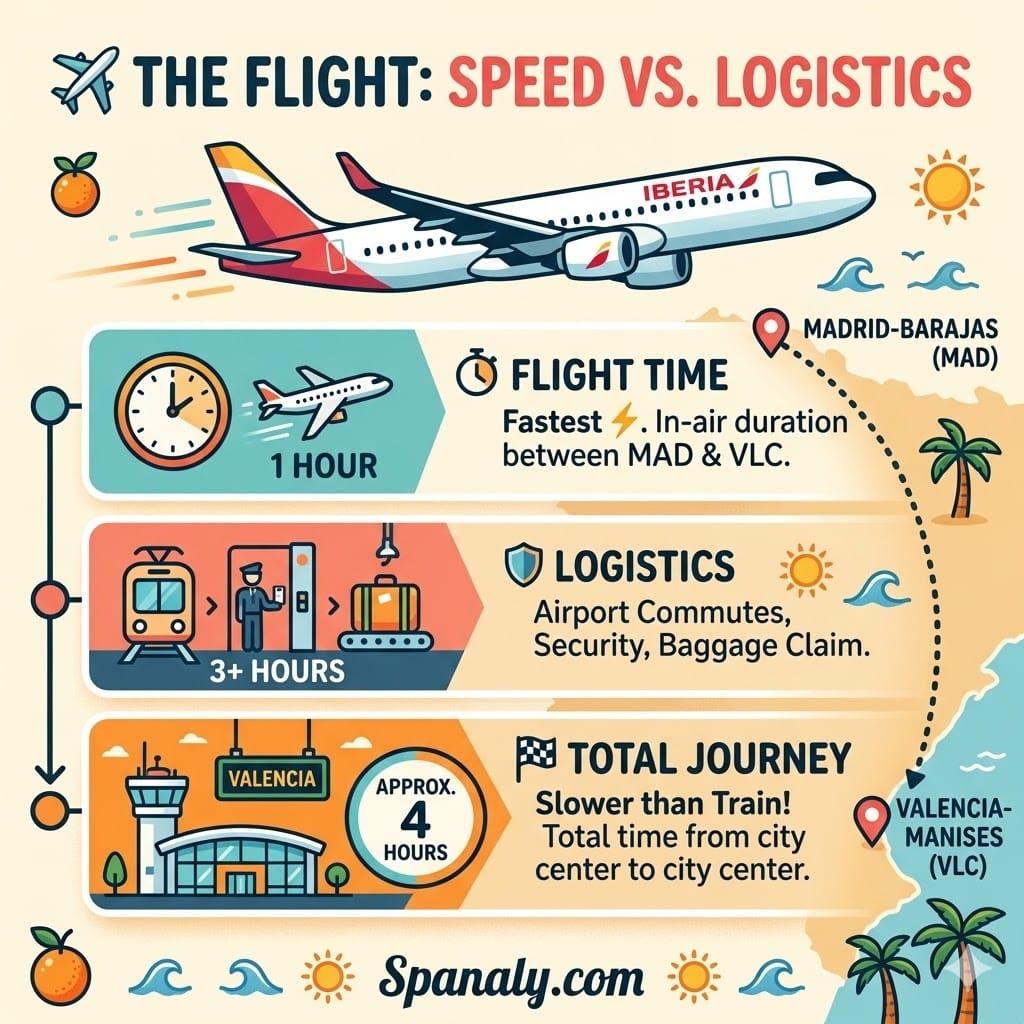
Actually, while flying might seem like the fastest way to travel from Madrid to Valencia, it is rarely the most efficient choice. Notably, the actual air time is only about 60 minutes, but once you factor in airport commutes and security, the train usually wins.
Airlines: Iberia and Air Europa are the primary carriers.
Average Air Time: 1 hour. ⏱️
Total Travel Time: Approximately 4 hours (including airport logistics).
Best For: Travelers connecting from international flights at Madrid-Barajas (MAD).
Undeniably, the commute to Barajas in Madrid and from Manises Airport in Valencia adds significant time and cost to your journey. Consequently, we only recommend this option if you are already at the airport or found an unbeatable deal that includes your luggage.
Spanaly Insight: 💡 To avoid unnecessary stress, remember that Valencia’s airport is well-connected to the city center via Metro lines 3 and 5. Consequently, if you do choose to fly, you can reach the heart of the city in about 20 minutes after landing. If you’re looking for more general travel advice for the country, don’t miss our Essential Spain Travel Tips.
🚌 The Bus: The Wallet-Friendly Alternative
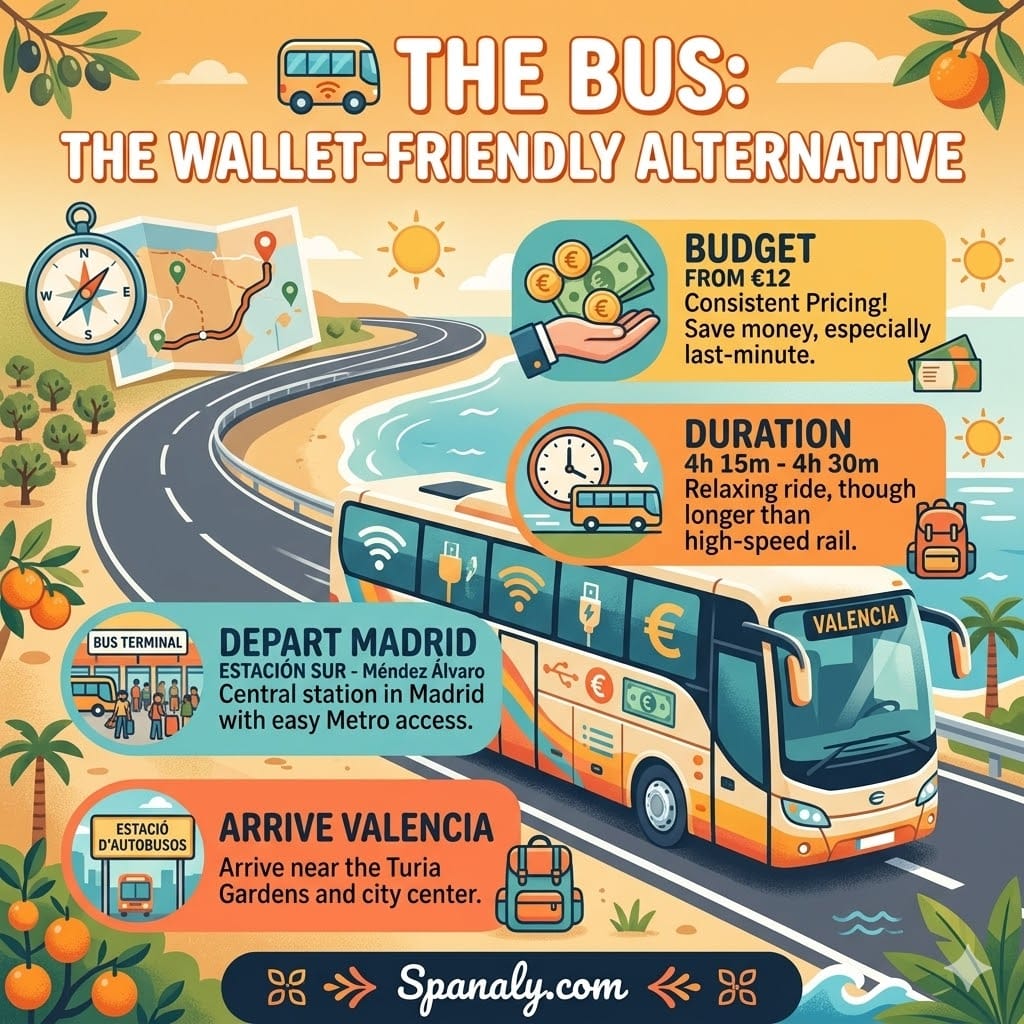
Actually, if you are traveling on a tight budget or making last-minute plans when train prices are sky-high, the bus is your best friend. Notably, the journey is comfortable and modern, though it takes significantly longer than the high-speed rail.
Primary Operator: Avanza (The main carrier for this route).
Duration: Approximately 4h 15m to 4h 30m. ⏱️
Departure: Estación Sur (Méndez Álvaro) in Madrid.
Arrival: Valencia Bus Station (Estació d’Autobusos).
Undeniably, the bus is the most consistent option regarding price. Consequently, you can often find tickets for around €12 to €25, even just a few days before departure. Most Avanza buses on this route offer Wi-Fi, USB chargers, and plenty of legroom.
Spanaly Insight: 💡 To save even more money, consider traveling during mid-week or off-peak hours. Consequently, you’ll avoid the weekend rush and enjoy a quieter ride. If you’re a fan of coastal vibes beyond Valencia, you might also want to check our Malaga Travel Guide for another sun-soaked destination! ☀️🚌
🚗 The Car: Freedom and Scenic Stops
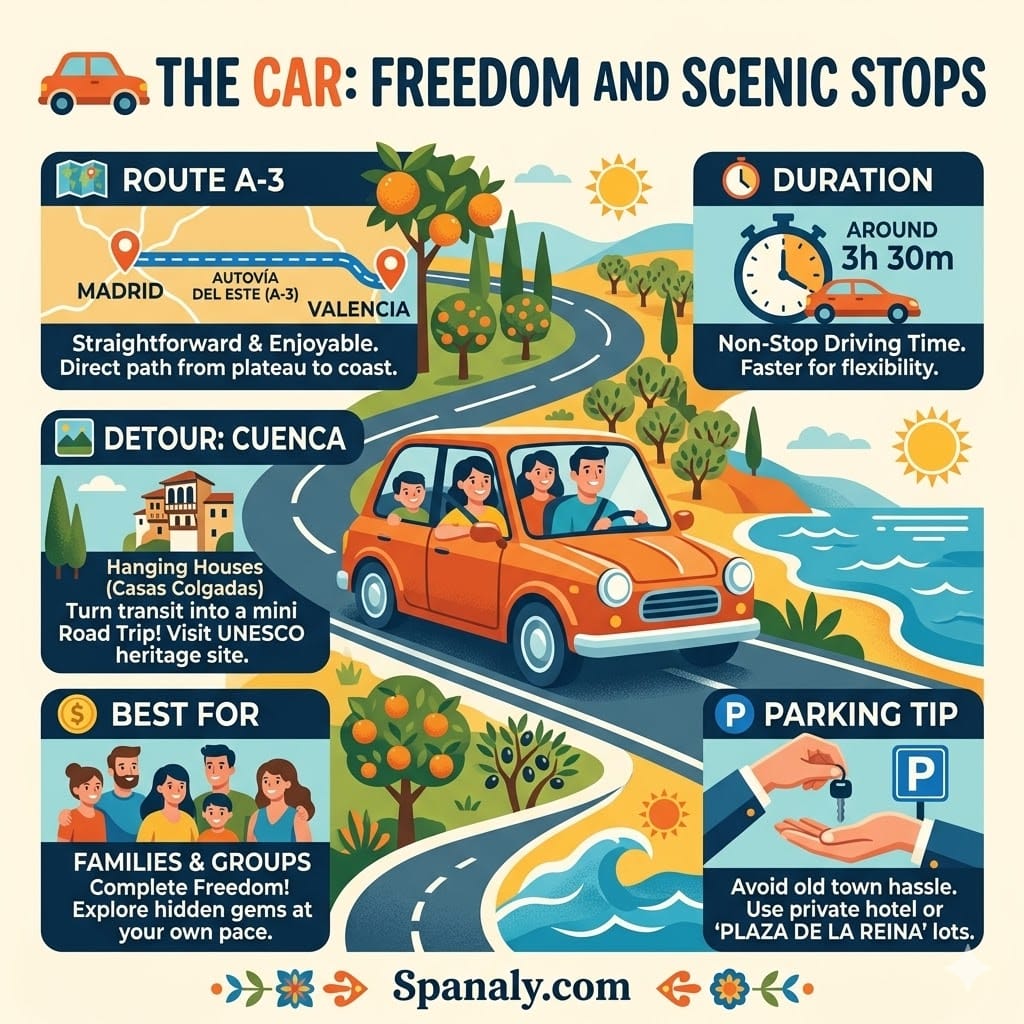
Actually, driving from Madrid to Valencia is a straightforward and enjoyable experience. Notably, the journey takes you along the A-3 highway (Autovía del Este), offering a direct path from the high plateau of central Spain down to the Mediterranean breeze.
Distance: Approximately 360 km (223 miles).
Duration: Around 3h 30m (non-stop). ⏱️
Best For: Families, groups, or those wanting to explore hidden gems along the way.
Key Route: The A-3 is a well-maintained, toll-free highway.
Undeniably, the greatest advantage of driving is the flexibility it provides. Consequently, you can turn a simple transit into a mini road trip. We highly recommend a detour to Cuenca, famous for its “Hanging Houses” (Casas Colgadas). If you plan to explore more of the region, check out our 3 Days in Cuenca Itinerary.
Spanaly Insight: 💡 To ensure a stress-free arrival, keep in mind that parking in Valencia’s historic center can be both scarce and expensive. Consequently, we recommend booking a hotel with private parking or using a large underground lot like the one at Plaza de la Reina. For more essential advice, see our guide on Driving in Spain.
📍 Logistics: Navigating Your Departure and Arrival
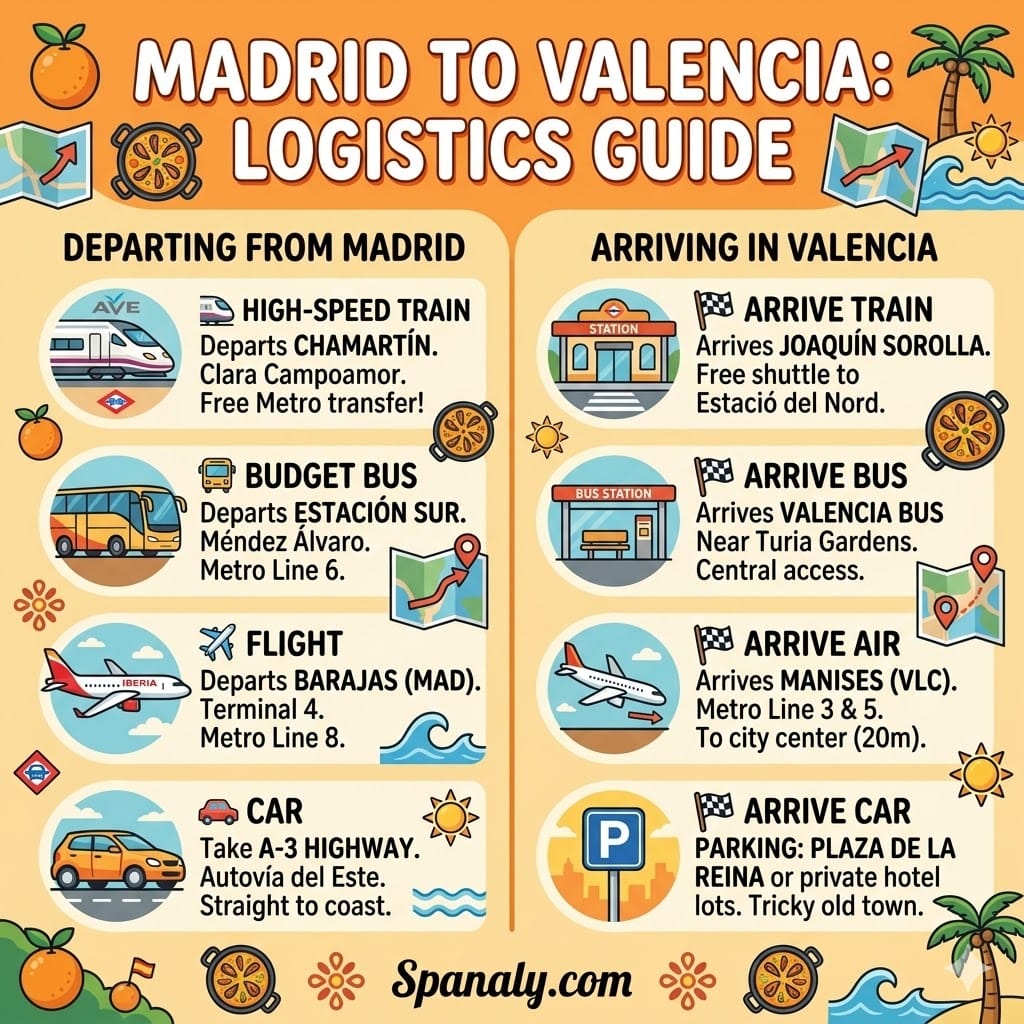
Undeniably, understanding the logistics of your trip is just as important as choosing your transport. Since both Madrid and Valencia are major hubs, knowing exactly where to go will save you time and stress. Notably, the departure and arrival points differ depending on the service you choose.
Departing from Madrid
By Train: Most high-speed services (AVE, Ouigo, Iryo) depart from Madrid-Chamartín-Clara Campoamor. Actually, some older AVE lines still use Atocha, so double-check your ticket!
By Bus: Head to Estación Sur (Méndez Álvaro), which is easily accessible via Metro Line 6.
By Air: Flights depart from Adolfo Suárez Madrid-Barajas (MAD), specifically Terminal 4 for Iberia.
Arriving in Valencia
By Train: You will arrive at Joaquín Sorolla Station. To reach the historic center, take the free shuttle bus to the nearby Estació del Nord.
By Bus: The Valencia Bus Station is located near the Turia Gardens, a 20-minute walk or a quick bus/taxi ride to the center.
By Air: Valencia Airport (VLC) is connected to the city via Metro Lines 3 and 5, taking you straight to Colón or Xàtiva stations.
Spanaly Insight: 💡 To navigate like a pro, download the Top Tourist Apps for Spain, including “Renfe” for trains and “EMT Valencia” for local buses. Consequently, you’ll have real-time schedules and ticket info right in your pocket. Planning to stay a while? Check out our guide on Where to Stay in Madrid before you head out! 📱🌆
💡 Pro Travel Tips for a Flawless Journey

Undeniably, small details can make a huge difference in your Spanish travel experience. To ensure your trip from Madrid to Valencia is as smooth as possible, keep these expert-vetted tips in mind:
Book “Billete Combinado”: Notably, if you take the AVE or Iryo, your ticket often includes a “Combinado Cercanías” code. This allows you to travel for free on local commuter trains in both Madrid and Valencia. Consequently, you can reach your hotel from the station without spending an extra Euro on Metro tickets.
The “Silent Carriage” (Coche Silencio): Actually, if you need to work or nap, look for the silent carriage option when booking Renfe. It’s a lifesaver for long-haul travelers who want to avoid loud phone calls or noisy groups.
Valencia’s “Siesta” is Real: Unlike Madrid’s non-stop bustle, Valencia adheres more strictly to the afternoon siesta. Consequently, many local shops and smaller restaurants close between 2:00 PM and 5:00 PM. Plan your meals accordingly!
Stay Connected: To navigate the streets of the Barrio del Carmen or check train schedules on the go, ensure you have reliable data. Check our guide on Internet and SIM Cards in Spain to stay online.
Spanaly Insight: 💡 If you are arriving in Valencia during mid-March, you are in for a wild ride! To experience one of Spain’s most explosive traditions, read our guide on the Las Fallas Festival Valencia. Notably, during this time, public transport routes change, and the city becomes a massive street party, so booking your train tickets months in advance is a must!
🏁 Spanaly’s Final Verdict: The Smart Way to Travel
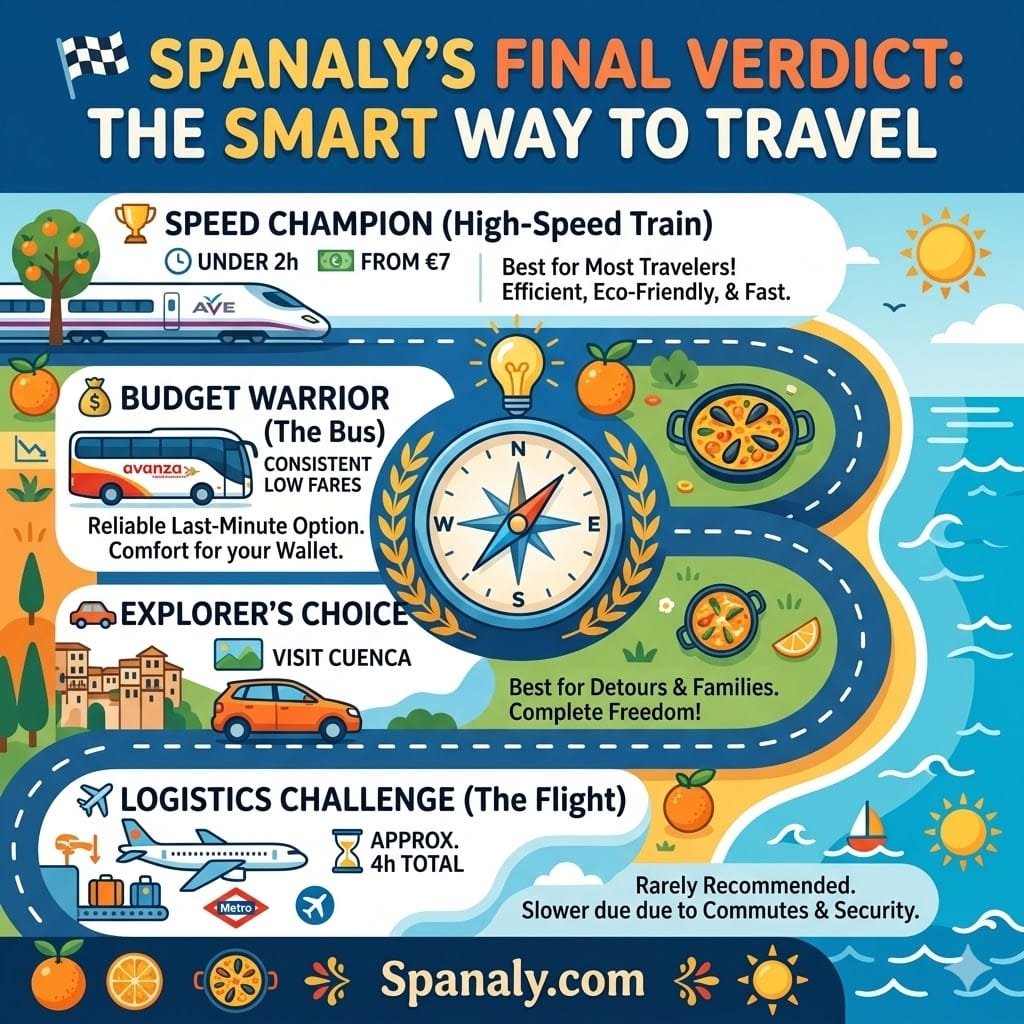
Undeniably, the best way to travel from Madrid to Valencia depends entirely on your clock and your wallet. Actually, after comparing all the data, we can confidently crown a winner for most travelers.
The Speed Champion: Notably, the High-Speed Train wins hands down. With prices starting as low as €7 and a journey time of under 2 hours, it’s the most efficient and eco-friendly way to reach the coast.
The Budget Warrior: If you’re traveling last-minute and train prices have spiked, The Bus (Avanza) is your reliable backup for consistent, low fares.
The Explorer’s Choice: Renting a Car is only the “smart way” if you plan to visit Cuenca or explore the remote beaches of the Costa Blanca.
Consequently, we recommend booking your train ticket as early as possible via official sites like Renfe or Iryo. To make the most of your Mediterranean escape, don’t forget to check our guide on Best Things to Do in Valencia.
Spanaly Insight: 💡 Whether you choose the rail, the road, or the air, Valencia’s paella and sunshine are waiting for you. Notably, always keep a digital copy of your tickets on your phone to avoid paper hassle at the station. Safe travels! 🇪🇸✨
🛡️ Visitor FAQs – Madrid to Valencia Travel Safety & Logistics
🛡️ Is the Madrid-Chamartín area safe for late-night departures?
Yes, Madrid-Chamartín station is very safe. Following its modern renovations, the station features 24/7 security patrols and advanced surveillance systems. If your train arrives or departs late, the taxi ranks are well-regulated. However, as in any major global hub, always keep a close eye on your luggage in waiting areas.
🎫 Can I buy train tickets directly at the station?
While automated machines are available, we strongly advise against waiting. The Spanish rail market is highly dynamic; "walk-up" prices are significantly higher than early-bird online fares. Always use official operator apps (Renfe, Iryo, or Ouigo) to secure the best rates and guaranteed seating.
⚡ Are there luggage weight limits on Spanish high-speed trains?
Technically, yes. Most operators allow up to 3 pieces of luggage per person. Low-cost carriers like Ouigo and Avlo are stricter regarding dimensions; they may apply extra fees at the gate if your bag exceeds the standard "cabin" size. We recommend pre-booking any extra luggage online to avoid higher station fees.
🚗 What is the "ZBE" rule if I drive into Valencia?
Valencia enforces ZBE (Low Emission Zones) in the city center. If you are renting a car, ensure it has the required environmental sticker (Distintivo Ambiental). Entering the "Ciutat Vella" without authorization or a valid sticker will result in an automated fine. Most modern rental fleets already include the necessary permits.
🥘 Is it safe to eat at the "Tourist Menus" near Valencia Cathedral?
It is safe, but often lacks authenticity. To avoid lower-quality "tourist traps," look for restaurants with the "Arroz de Valencia" certification. Remember, authentic Paella is traditionally a lunch dish and should be cooked to order, which typically takes at least 20-30 minutes.
Expertly curated by Spanaly.com
Undeniably, the journey from the heart of Spain to the Mediterranean shores is more than just a transit—it’s the start of your vacation. Actually, whether you choose the lightning speed of the train or the freedom of the road, Valencia’s vibrant energy is waiting for you.
🚄 Top Choice: Stick to the high-speed train for the ultimate stress-free experience.
🥘 Must-Do: Eat your first authentic Paella at lunch, not dinner!
📸 Best View: Visit the City of Arts and Sciences at sunset for the best photos.
🎫 Pro Tip: Book your transport at least 2 weeks in advance to save up to 60%.
Spanaly Insight: 💡 To ensure you don’t miss any of the city’s hidden gems, from the historic Silk Exchange to the futuristic Malvarrosa beach, dive into our full Valencia Spain Travel Guide. Consequently, you’ll be exploring the city like a local in no time! 🍊🌊
Safe travels, and enjoy the Mediterranean breeze! 🇪🇸✨