🌍 Why Spain is Europe’s Best-Connected Aviation Hub
Landing in Spain is more than just a flight; it is the beginning of a Mediterranean dream. Specifically, with over 40 international airports and hundreds of daily connections, reaching the Iberian Peninsula has never been easier or more affordable. Whether you are chasing the avant-garde spirit of Catalonia or the royal history of the center, your journey starts the moment you touch down at one of our world-class hubs.
✈️ The Gateway Advantage:
Connectivity: Spain sits as a bridge between Europe, the Americas, and Africa.
Cost Efficiency: A massive network of budget carriers keeps prices lower than almost any other EU destination.
Modernity: Major terminals like T4 in Madrid are architectural masterpieces designed for a seamless traveler flow.
Speed: Fast-track services and digital passport gates mean you spend less time in lines and more time exploring.
💡 Spanaly Insight: Specifically, don’t just book the first ticket you see. Indeed, many travelers make the mistake of flying into Madrid when their heart is set on the beaches of the Costa del Sol. Our expert advice? Align your arrival hub with your final destination to save hours of transit. If you are starting your journey in the capital, make sure to check our Madrid Barajas Airport guide to master the logistics of the country’s largest terminal before you land. 🛡️✨
🚀 Quick Spain Aviation Snapshot: Know Before You Fly
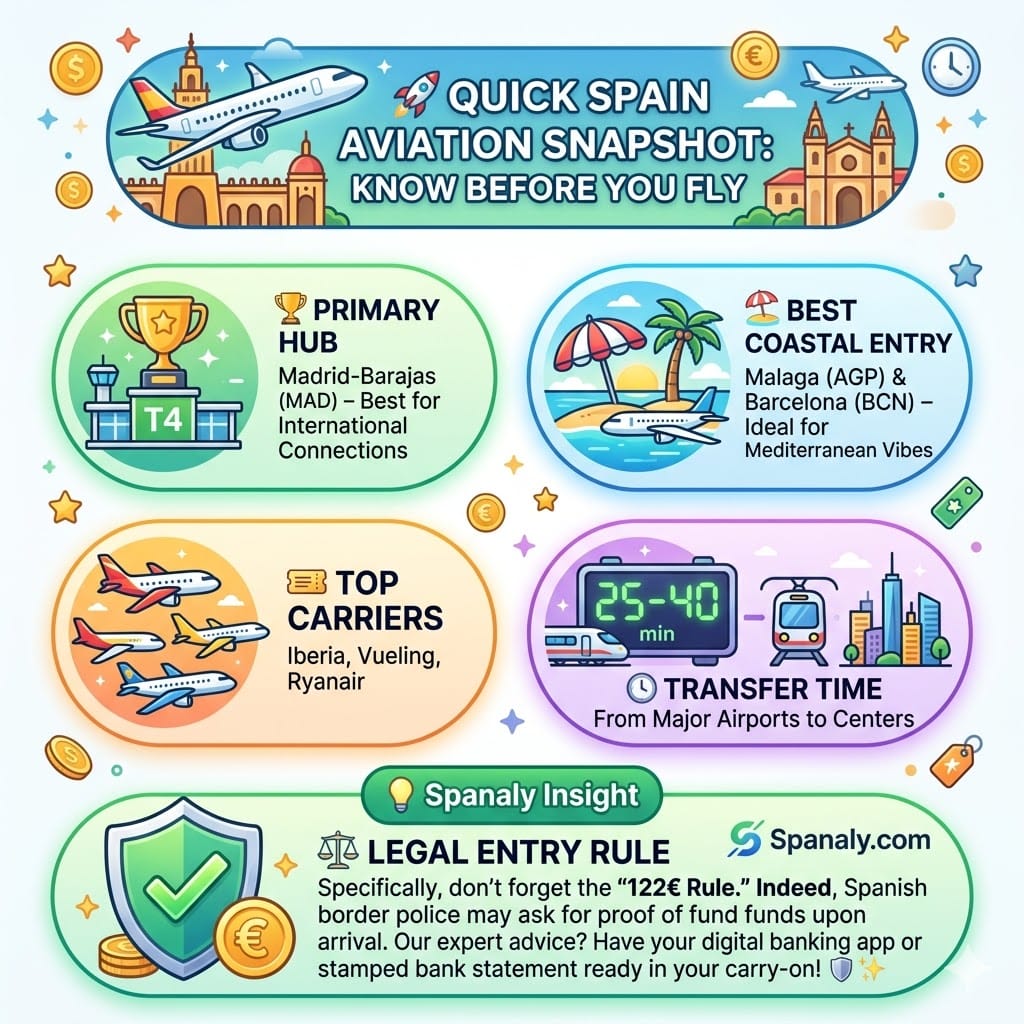
Navigating Spain’s skies requires a bit of local insider knowledge to avoid common pitfalls. Finding the right hub can save you both hours of travel and hundreds of Euros. Use this fast-track guide to master the Spanish aviation landscape before you book:
🏆 Primary Hub: Madrid-Barajas (MAD) – The best for long-haul and international connections.
🏖️ Best Coastal Entry: Malaga (AGP) or Barcelona (BCN) – Ideal for Mediterranean vibes.
🎫 Top Carriers: Iberia (Full Service), Vueling (Best Budget), and Ryanair (Cheapest).
⏱️ Average Transfer Time: 25–40 minutes from major airports to city centers via train or metro.
⚖️ Legal Reminder: Your Spain visa and entry requirements include proving financial solvency at the airport.
💡 Spanaly Insight: Don’t forget the “122€ Rule” during your arrival. Spanish border police occasionally ask for proof of funds to ensure a smooth entry. We recommend having your digital banking app ready or a stamped bank statement in your carry-on. This small detail ensures a 100% stress-free start to your journey! 🛡️✨
🏢 Main International Gateways: Your Entry Points to Spain
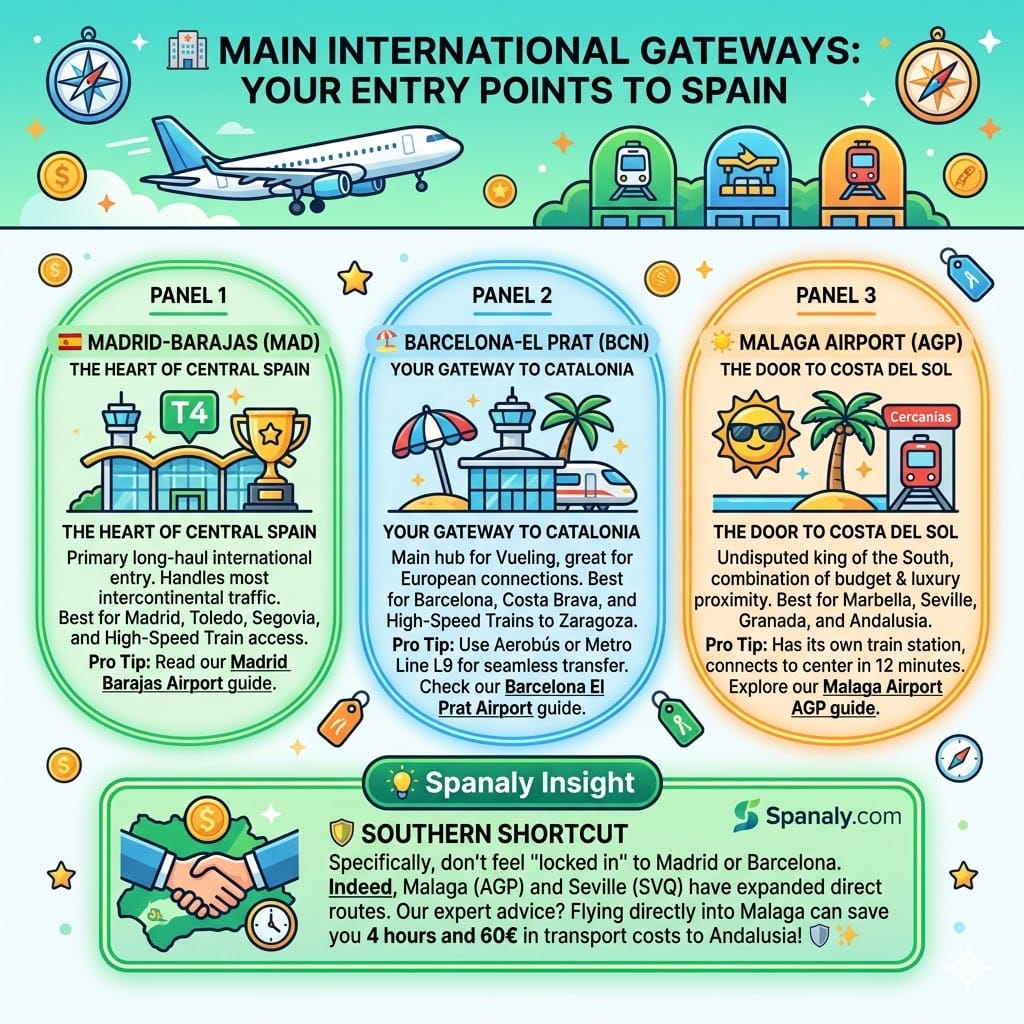
Choosing your arrival hub is the most strategic decision of your trip. Specifically, Spain’s major airports are not just transit points; they are highly efficient gateways designed to connect you to specific regions. To master your arrival, it is best to align your flight with your final destination.
🇪🇸 Madrid-Barajas (MAD): The Heart of Central Spain
As the largest airport in the country, Madrid-Barajas is the primary entry point for long-haul international flights. Specifically, Terminal 4 (T4) is an award-winning architectural marvel that handles most intercontinental traffic.
Best For: Travelers visiting Madrid, Toledo, Segovia, or those planning to use the high-speed train network to reach any corner of Spain.
Pro Tip: If you land here, make sure to read our Madrid Barajas Airport guide to navigate the terminals like a local.
🏖️ Barcelona-El Prat (BCN): Your Gateway to Catalonia
Located just 12km from the city center, El Prat is the best choice for Mediterranean lovers. It is the main hub for Vueling, making it incredibly affordable for European connections.
Best For: Exploring Barcelona, the Costa Brava, or taking a high-speed train to Zaragoza and France.
Pro Tip: Avoid the “Tourist Taxis” and use the Aerobús or Metro Line L9 for a seamless transfer. Check our Barcelona El Prat Airport guide for more hacks.
☀️ Malaga Airport (AGP): The Door to Costa del Sol
Malaga is the fourth busiest airport in Spain and the undisputed king of the South. It offers a unique combination of budget flights and luxury proximity.
Best For: Travelers heading to Marbella, Seville, Granada, or the sunny beaches of Andalusia.
Pro Tip: The airport has its own train station (Cercanías), which connects you to the city center in just 12 minutes. Explore our Malaga Airport AGP guide for detailed transport maps.
💡 Spanaly Insight: Specifically, don’t feel “locked in” to Madrid or Barcelona. Indeed, in recent years, Malaga (AGP) and Seville (SVQ) have significantly expanded their direct international routes. Our expert advice? If your heart is set on the South, flying directly into Malaga can save you 4 hours of train travel and at least 60€ in transport costs! 🛡️✨
🗺️ Strategic Selection: The Best Airport for Your Destination
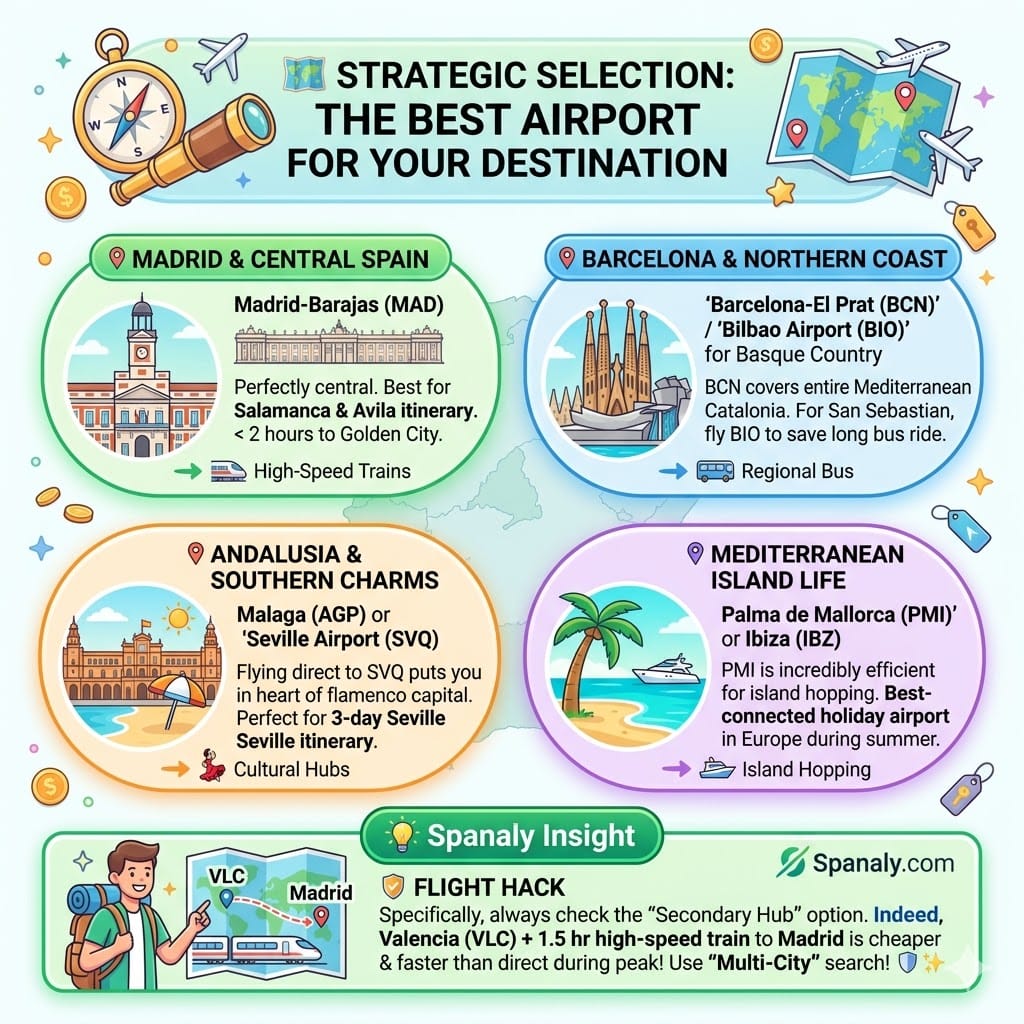
Choosing the wrong airport can add 5 hours of unnecessary travel to your itinerary. To optimize your journey, look beyond the flight price and consider your “Final Destination Logistics.” Landing closer to your hotel often saves more money than a cheap flight to a distant hub.
🏛️ Madrid & Central Spain: Madrid-Barajas (MAD) serves as the perfectly central hub for the interior. From here, you can reach the “Golden City” in less than 2 hours. This is your only logical starting point if you are planning our Salamanca and Avila itinerary.
🌊 Barcelona & Northern Coast: Barcelona-El Prat (BCN) covers the entire Mediterranean coast of Catalonia. However, travelers heading to San Sebastian should consider Bilbao Airport (BIO) to save a long bus ride from Barcelona.
💃 Andalusia & Southern Charms: Malaga (AGP) handles more international volume, but flying into Seville Airport (SVQ) puts you right in the heart of the flamenco capital. This remains the ultimate choice for those following our 3-day Seville itinerary.
🏝️ Mediterranean Island Life: Palma de Mallorca (PMI) and Ibiza (IBZ) are incredibly efficient for island hopping. Mallorca’s hub stands as one of the best-connected holiday airports in Europe during the summer months.
💡 Spanaly Insight: Always check the “Secondary Hub” option during your search. Sometimes flying into Valencia (VLC) and taking a 1.5-hour high-speed train to Madrid is cheaper and faster than a direct flight. We recommend using a “Multi-City” search tool to landing in one city and departing from another for maximum geographical coverage! 🛡️✨
🔄 The Multi-City Flight Strategy: Save Time & Transport Costs
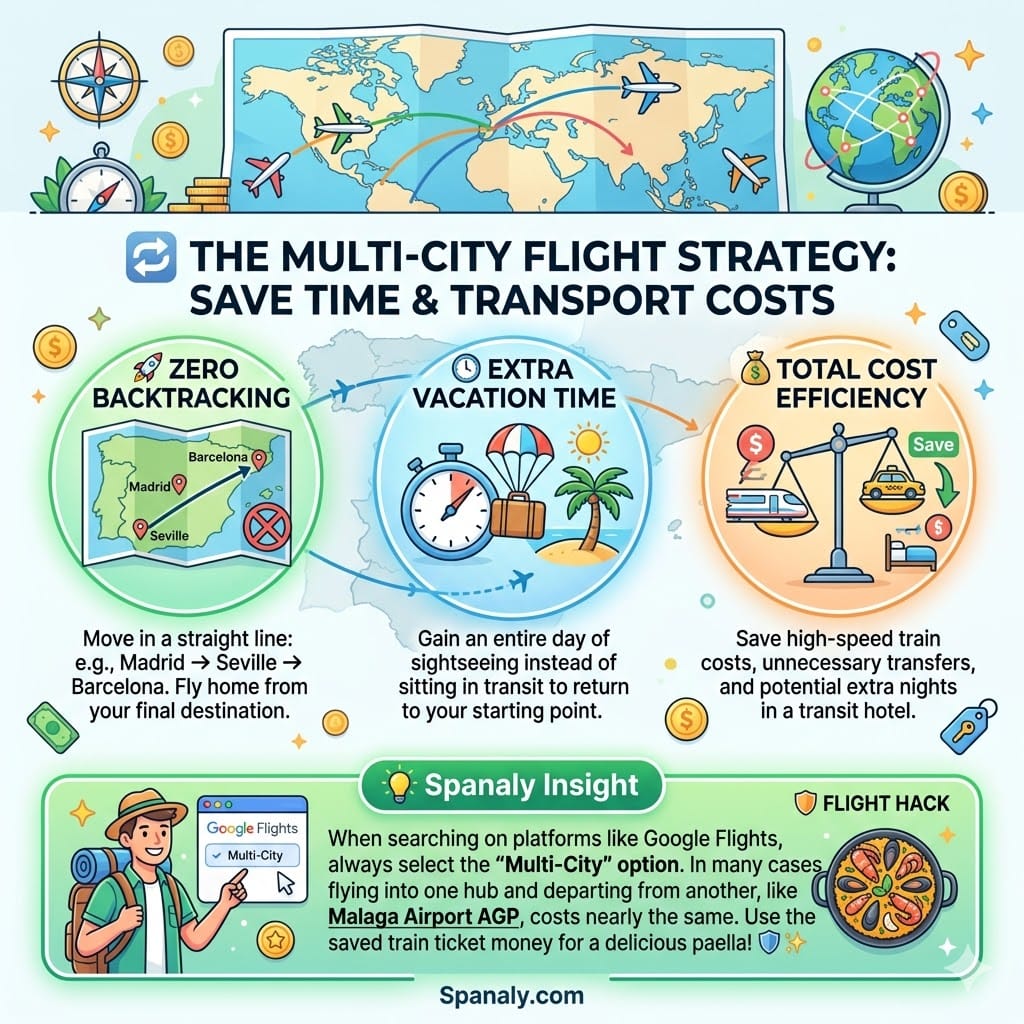
Booking a simple “Round Trip” to and from the same city is the most frequent mistake travelers make when visiting Spain. Imagine landing in Madrid, exploring the South, and ending your journey in Barcelona. Forcing yourself to take a 6-hour train or bus back to Madrid just to catch your flight home is a waste of a full vacation day and at least €80 in unnecessary transport fees.
🚀 Why “Open-Jaw” Tickets are the Ultimate Hack:
Zero Backtracking: Move in a straight line (e.g., Madrid → Seville → Barcelona) and fly home from your final destination.
Extra Vacation Time: Gain an entire day of sightseeing instead of sitting in transit to return to your starting point.
Total Cost Efficiency: While the ticket price might look slightly higher, you save the cost of a high-speed train ticket and a potential extra night in a transit hotel.
💡 Winning Multi-City Combinations:
The Classic Route: Arrive in Madrid (MAD) → Depart from Barcelona (BCN).
The Southern Charm: Arrive in Malaga (AGP) → Depart from Seville (SVQ).
The Northern Explorer: Arrive in Bilbao (BIO) → Depart from Madrid (MAD).
💡 Spanaly Insight: When searching on platforms like Google Flights, always select the “Multi-City” option instead of “Return.” In many cases, flying into a major hub and departing from another, such as Malaga Airport AGP, costs nearly the same as a standard ticket. Our expert advice? Use the money you saved on that return train ticket to enjoy a world-class seafood paella by the Mediterranean instead! 🛡️✨
🎫 Top-Rated Airlines to Spain: Full-Service vs. Budget Carriers
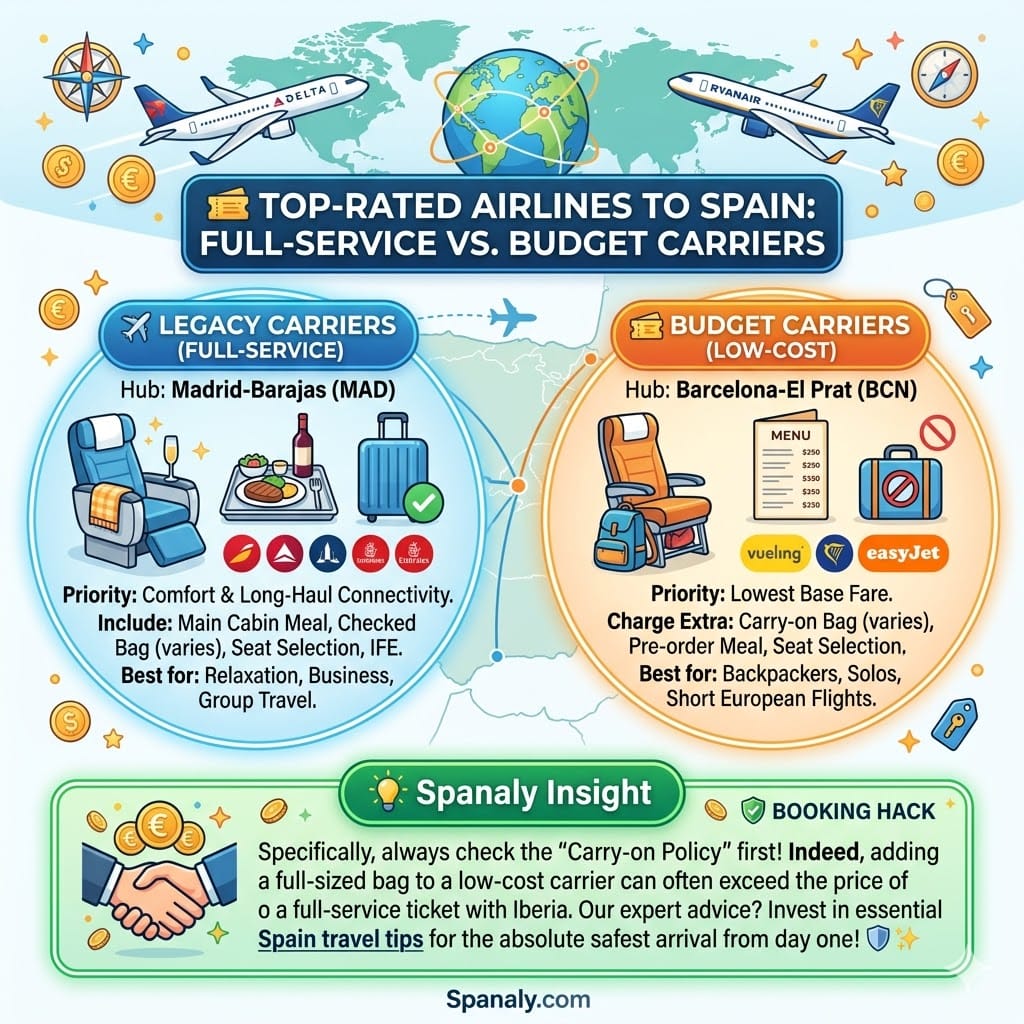
Navigating the sea of airlines flying to the Iberian Peninsula can be overwhelming. To find the best flights to Spain, you must choose between the luxury of full-service legacy carriers and the aggressive pricing of Europe’s famous budget airlines. Each choice impacts your comfort and, more importantly, your total travel budget.
✈️ Full-Service Legacy Carriers: Comfort First
Iberia: The national flagship carrier. It offers the best connectivity from the Americas and a premium experience at Madrid-Barajas.
Air Europa: A strong competitor with excellent transatlantic routes and modern Dreamliner aircraft.
International Giants: Airlines like Delta, Emirates, and British Airways provide seamless long-haul luxury into major hubs.
🎫 Budget Carriers: The Price Warriors
Vueling: Based in Barcelona, this is the most reliable low-cost option for internal Spanish flights and European connections.
Ryanair & EasyJet: Perfect for those traveling light. They often fly into secondary airports, which can be a great way to save money.
Volotea: A fantastic choice if you want to fly between smaller Spanish cities without connecting through Madrid.
💡 Spanaly Insight: Don’t let a low “Base Fare” fool you. Low-cost airlines often charge extra for everything from carry-on bags to printing your boarding pass. If you have more than a backpack, a full-service ticket with Iberia might actually be cheaper in total. Our expert advice? Use your savings to invest in the essential Spain travel tips you need to master the local culture and avoid tourist traps from day one! 🛡️✨
⚖️ Direct Flights vs. Connecting Flights: The Verdict
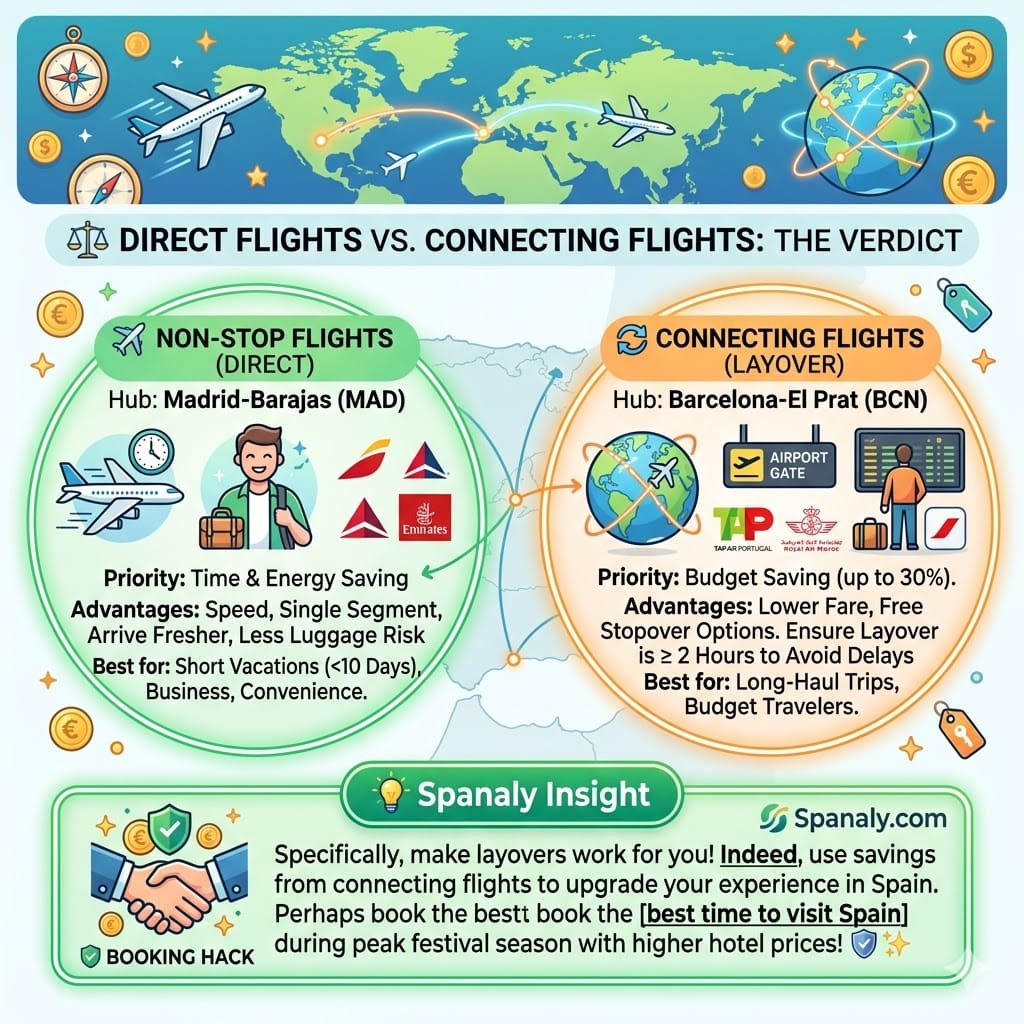
The choice between a non-stop journey and a layover often dictates the energy levels of your first day in Spain. While direct flights are the gold standard for convenience, connecting flights remain a powerful tool for those looking to slash their travel expenses significantly.
✈️ Non-Stop Flights: The Time-Saver’s Choice These routes are ideal for travelers coming from major international hubs like New York, London, or Dubai. You will arrive fresher and avoid the high risk of luggage loss during tight connections. We recommend paying the premium if your vacation is shorter than 10 days, as every hour in Spain is precious.
🔄 Connecting Flights: The Budget-Friendly Route Long-haul travelers looking to save up to 30% on airfare should prioritize this option. Frequent connections through Lisbon, Casablanca, or Paris often offer lower prices than direct routes to Madrid. Just ensure your layover is at least 2 hours to account for potential delays.
💡 Spanaly Insight: If you choose a connecting flight, try to make your “layover” work for you. Some airlines offer free stopovers in cities like Lisbon or Istanbul. Use the money you save on airfare to upgrade your experience once you land. For example, you can put those extra Euros toward booking the best time to visit Spain during a festival season when hotel prices are peak! 🛡️✨
📅 Timing Your Trip: The Cheapest Months to Fly to Spain
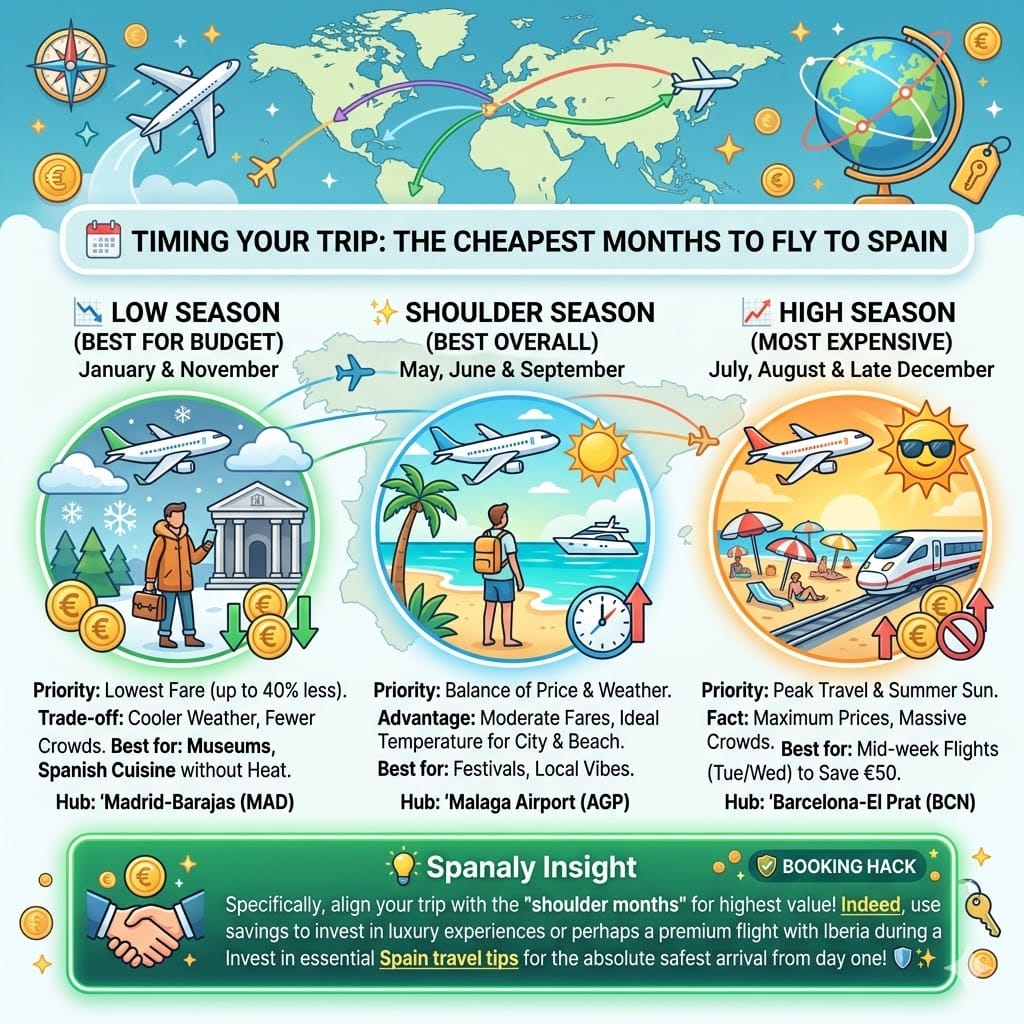
Timing is everything when it comes to airfare. While Spain is a year-round destination, your flight price fluctuates significantly depending on the season. To secure the best flights to Spain, you must understand the “Shoulder Season” – the sweet spot where the crowds thin out and the prices drop.
📉 The Low Season (Best for Budget): January & November
The Deal: These are historically the cheapest months to fly. You can often find transatlantic and European flights at 40% less than summer prices.
The Trade-off: The weather is cooler, especially in Madrid and the North, but perfect for exploring museums and enjoying the Spanish Cuisine without the heat.
✨ The Shoulder Season (Best Overall): May, June & September
The Deal: This is the Spanaly favorite. Prices are moderate, and the weather is idyllic for both city walking and beach lounging.
The Strategy: Book at least 3 months in advance for these months to avoid the last-minute price spikes.
📈 The High Season (Most Expensive): July, August & Late December
The Fact: Expect to pay a massive premium. August is when most of Europe heads to the Spanish coast, driving prices to their annual peak.
The Hack: If you must visit during summer, fly mid-week (Tuesday or Wednesday) to shave at least €50 off your ticket.
💡 Spanaly Insight: Don’t just look for the lowest price; look for the highest value. Flying in late May allows you to experience the vibrant festival atmosphere for a fraction of the July cost. Our expert advice? Align your trip with the “shoulder months” to enjoy luxury hotels and premium flights at budget prices. It is the smartest way to stretch your Euro further! 🛡️✨
💡 Expert Secrets for Scoring the Lowest Airfares
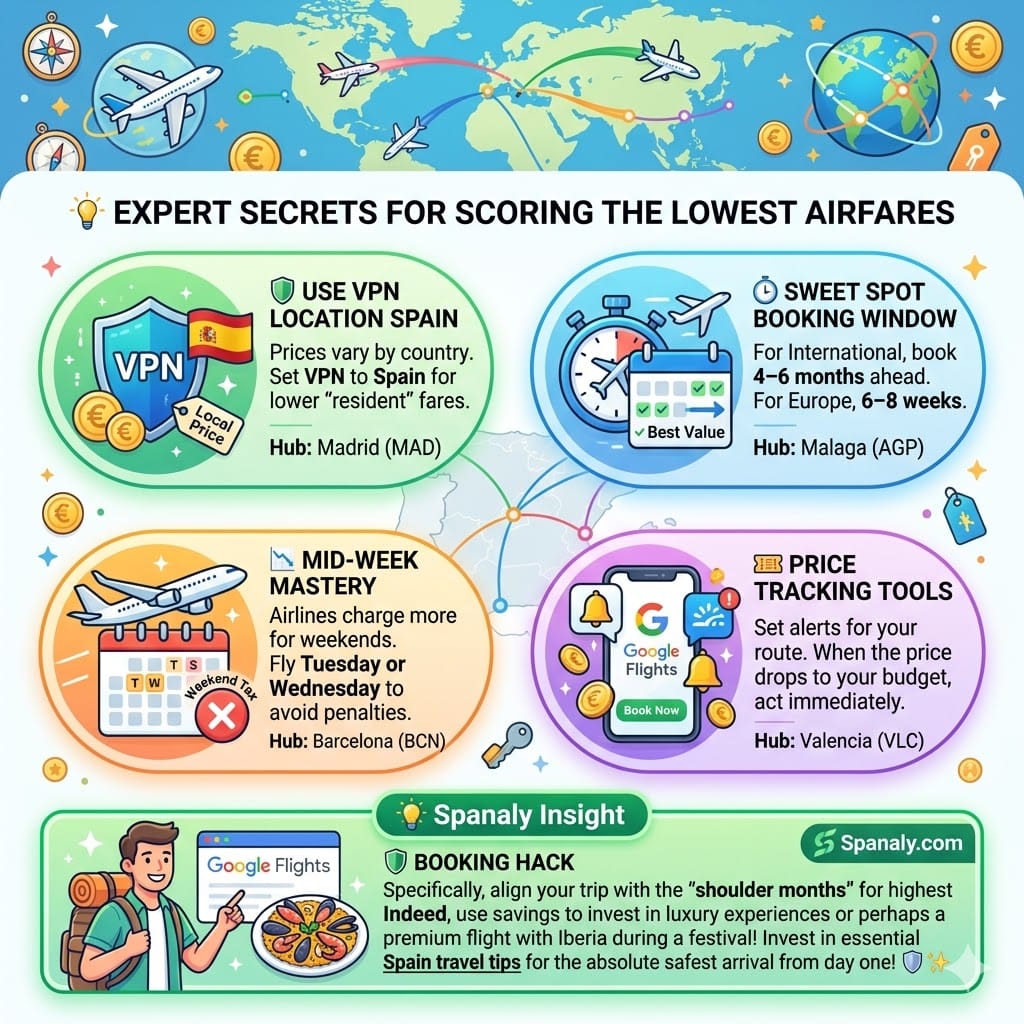
Securing a budget-friendly seat requires more than just luck; it demands a tactical approach to how and where you search. The aviation industry uses complex algorithms to price tickets, but you can use these expert-vetted strategies to stay one step ahead.
🛡️ The “Incognito” Myth & The VPN Reality
While many debate the effectiveness of clearing cookies, using a VPN is a proven strategy. Prices for flights to Spain can vary based on the country you are searching from.
The Hack: Set your VPN location to Spain or a lower-income country. Sometimes, the “local” price offered to residents is lower than the price shown to international users.
⏱️ The “Sweet Spot” Booking Window
Waiting until the last minute is a recipe for financial disaster. For international flights to major hubs like Madrid or Barcelona, timing is your best ally.
The Strategy: Book your long-haul tickets 4 to 6 months in advance. For internal European flights, the window shrinks to 6 to 8 weeks.
📉 Mid-Week Mastery
Flight demand peaks on Fridays and Sundays. By simply shifting your departure and return dates, you can bypass the “weekend tax” that airlines impose on leisure travelers.
The Strategy: Fly on Tuesdays or Wednesdays. These are statistically the least traveled days, often resulting in lower fares and emptier cabins.
💡 Spanaly Insight: Use price tracking tools like Google Flights or Skyscanner “Alerts” to monitor your specific route. Once you see a price drop that fits your budget, book it immediately. Don’t wait for a “lower” price that might never come. To maximize your savings, combine this with our Spanish Festivals guide to avoid booking during expensive local holidays! 🛡️✨
🧳 Luggage & Security: Navigating Spanish Airport Rules
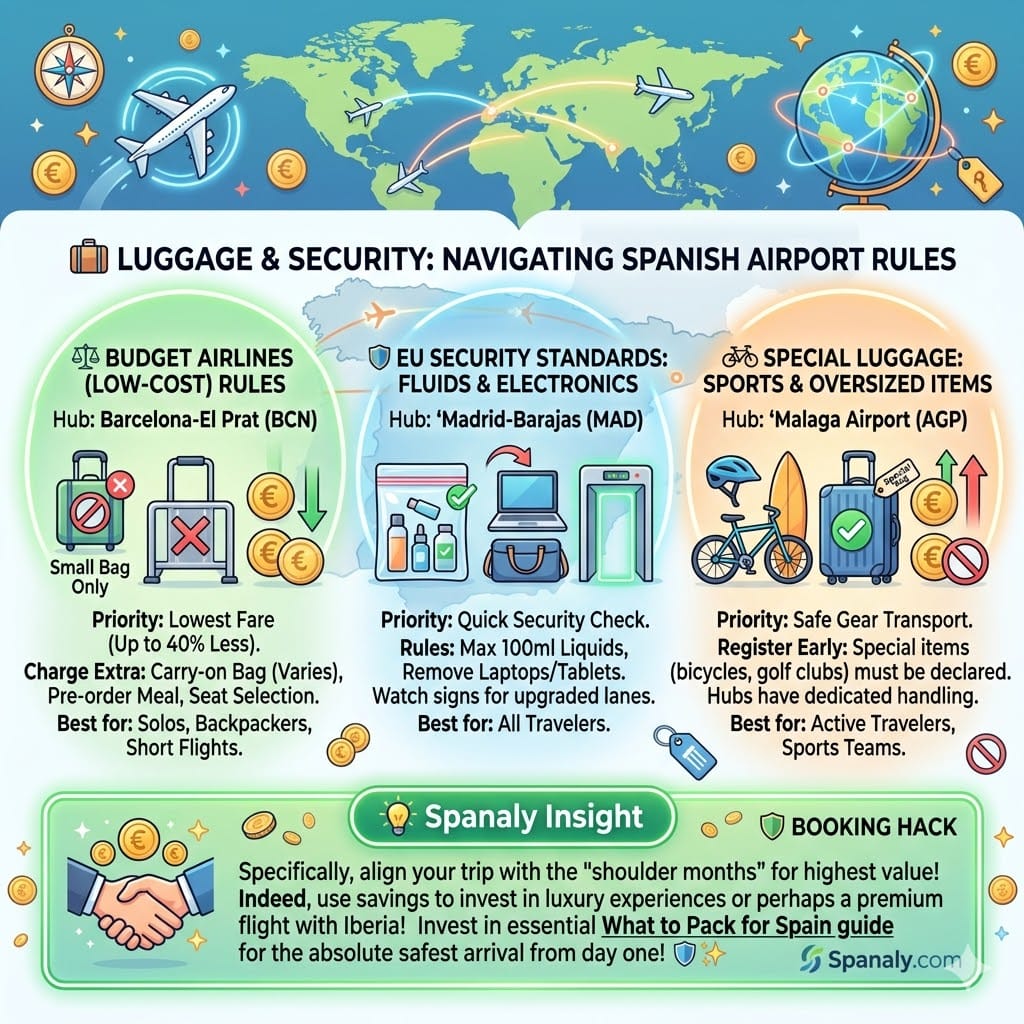
Understanding the local luggage landscape is vital to avoid unexpected “gate fees” that can quickly ruin a well-planned budget. Spanish airports follow strict EU safety protocols, but the real challenge lies in the diverse size and weight restrictions imposed by regional budget carriers.
⚖️ The “Budget” Squeeze: Vueling & Ryanair Rules
Low-cost airlines in Spain are famous for their uncompromising bag measurements.
The Rule: Most basic tickets only permit a small under-seat bag. If your carry-on exceeds the metal sizer at the boarding gate, be ready to pay a penalty of up to €60.
Pro Tip: Register your checked luggage online at least 24 hours before departure. It is significantly cheaper than handling it at the airport check-in counter.
🛡️ EU Security Standards: Fluids & Electronics
Security checkpoints at AENA-managed airports are efficient. To ensure a smooth transition through the scanners:
Liquids: Keep all fluids in containers of 100ml or less, packed inside a single transparent, one-liter resealable bag.
Electronics: Have your laptop and tablets ready to be placed in a separate bin. Interestingly, newer scanners in Madrid T4 and Barcelona T1 are starting to allow electronics to remain inside—just follow the local staff’s instructions.
🚲 Special Gear: Sports & Oversized Items
Spain is a global destination for cycling and golf enthusiasts. If you are bringing professional equipment:
The Strategy: Always declare these as “Special Luggage” during the booking process. Major hubs like Malaga and Palma have specialized belts to ensure fragile gear is handled with care.
💡 Spanaly Insight: Don’t let the weight of your souvenirs surprise you on the way back. Between Spanish leather, wine, and crafts, suitcases tend to get much heavier before departure. Our expert advice? Review our comprehensive What to Pack for Spain guide to learn how to leave enough space for your treasures while staying under the airline’s weight limit! 🛡️✨
🛂 Arrival Checklist: What to Expect at Spanish Border Control
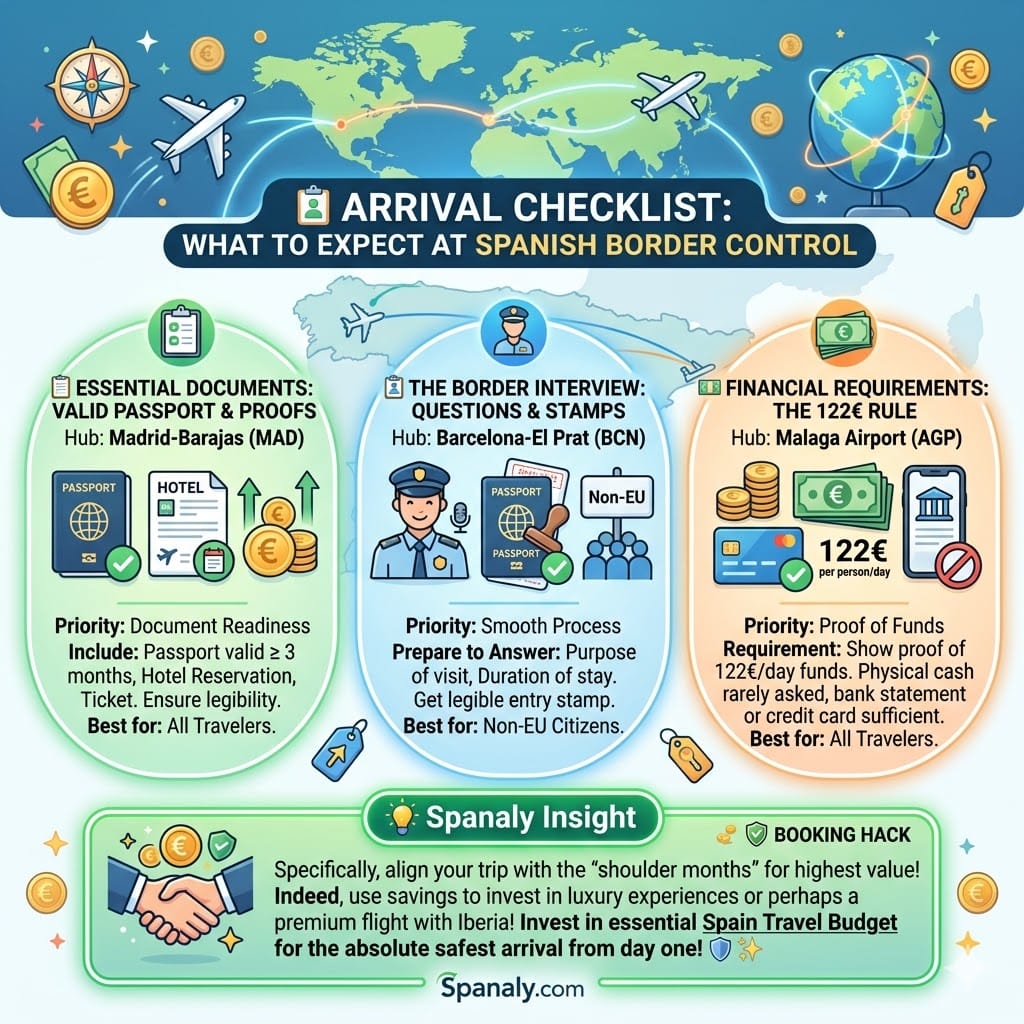
Landing in Spain is an exhilarating moment, but passing through “Control de Pasaportes” requires preparation. Whether you are arriving at a massive hub or a smaller regional airport, the protocol is standardized across the Schengen Area. To ensure a stress-free entry, follow this professional checklist to clear immigration like a seasoned traveler.
📋 Essential Documents to Have Ready
Valid Passport: Your passport must be valid for at least three months beyond your intended stay.
Proof of Accommodation: Have a digital or printed copy of your hotel reservation or invitation letter.
Return Ticket: Border officers often ask to see your confirmed departure date to ensure you don’t overstay.
🛂 The Border Interview: Common Questions
The interview is usually brief. Expect questions like “What is the purpose of your visit?” or “How long do you plan to stay?”. Answer clearly and honestly. If you are a non-EU citizen, the officer will stamp your passport; make sure this stamp is legible, as it is your official proof of entry date.
💶 Financial Requirements: The 122€ Rule
Spain officially requires visitors to prove they have sufficient funds for their stay. For 2026, the minimum amount is approximately 122€ per person, per day. While officers rarely ask to see physical cash, having a recent bank statement on your phone or a valid credit card is essential for total peace of mind.
💡 Spanaly Insight: If you are arriving from a non-Schengen country (like the USA, UK, or UAE), the queues can be long during peak morning hours. Don’t rush; follow the “Non-EU” signage carefully. Our expert advice? Use the waiting time to double-check your Spain Travel Budget to ensure you’ve accounted for local transport and tipping, so your first day in the city is as smooth as your landing! 🛡️✨
🚆 Seamless Transfers: From the Runway to Your Hotel Door
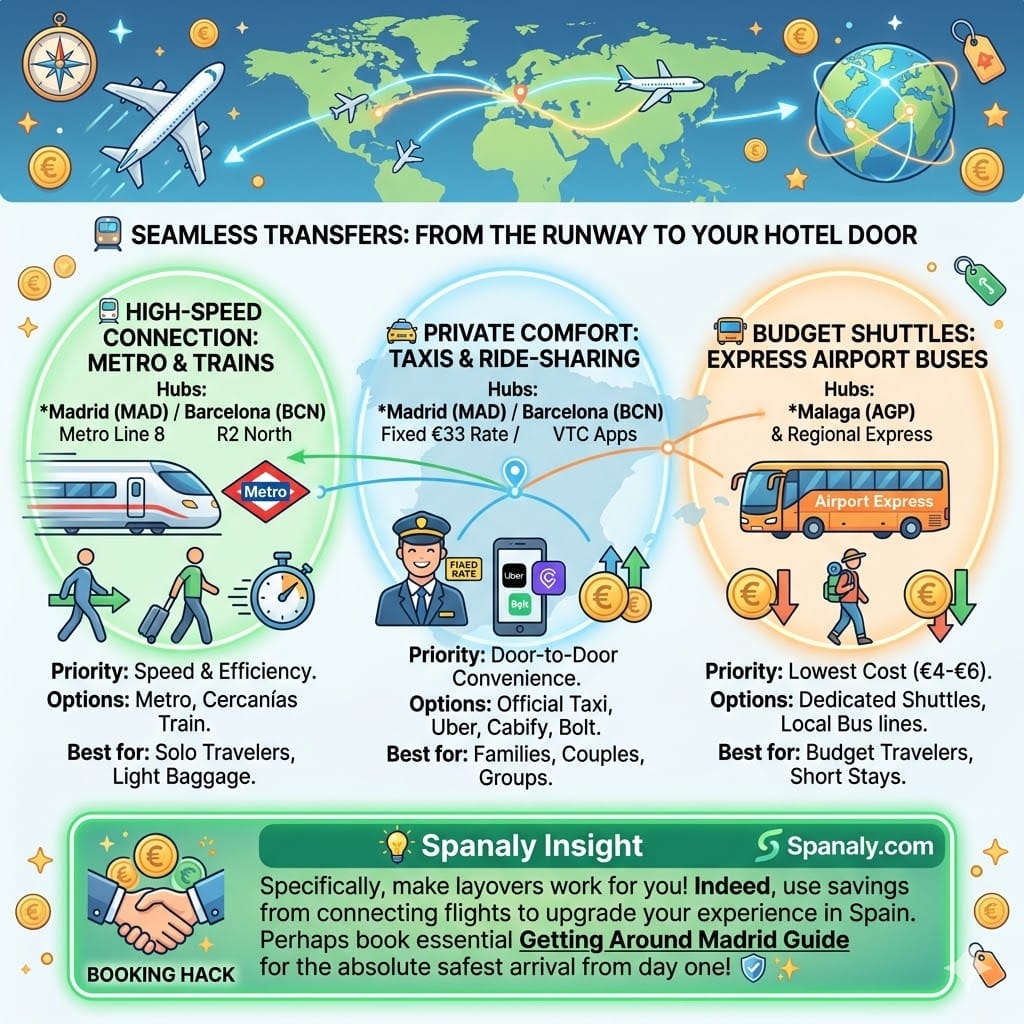
The moment you step out of the terminal, you are faced with a choice: speed, cost, or comfort. Spain’s major airports are world-class in their connectivity, offering multiple ways to reach the city center. To avoid the “airport taxi stress,” you must understand which transport mode fits your specific landing hub.
🚇 The High-Speed Connection: Metro & Trains
Madrid (MAD): The Metro Line 8 connects all terminals to Nuevos Ministerios in 15 minutes. Alternatively, the Cercanías train (Line C1) is the fastest way to reach Atocha station.
Barcelona (BCN): The Aerobús is a fan favorite for its frequency. However, the R2 North train from Terminal 2 is the most cost-effective way to reach Passeig de Gràcia.
🚕 Private Comfort: Taxis & Ride-Sharing
Fixed Rates: In Madrid, official taxis have a flat rate of €33 to the city center (interior of M-30), which is a great “ready-made decision” for families.
Apps: Uber, Cabify, and Bolt operate in most Spanish cities. They often provide a more modern vehicle, but always check the designated “VTC” pickup zones, which are separate from the standard taxi ranks.
🚌 Budget Shuttles: Express Airport Buses
Availability: Most regional airports, like Malaga and Seville, offer dedicated express buses that run every 15–20 minutes.
The Benefit: These are ideal for solo travelers and those staying near major transit hubs, typically costing between €4 and €6.
💡 Spanaly Insight: If you are planning to explore the city immediately, check if your airport transport is included in the local travel pass. For example, understanding how to navigate Getting Around Madrid can save you a fortune, as certain tourist passes cover the “Airport Surcharge” for the Metro. Our expert advice? Download the local transit app before you land to see real-time schedules! 🛡️✨
🏆 Final Verdict: Which Spanish Airport Should You Choose?
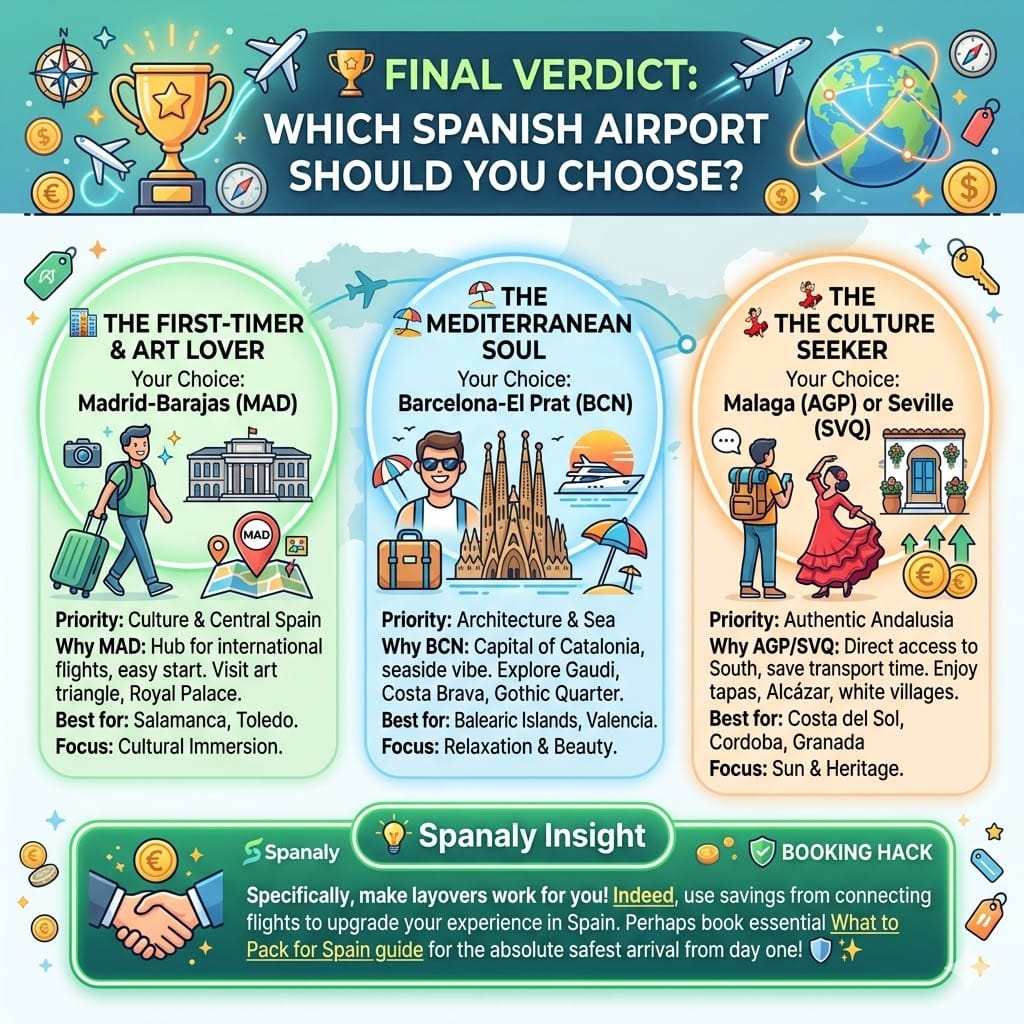
Choosing the best flights to Spain eventually comes down to your personal travel style and your first destination. There is no “one size fits all” answer, but there is a perfect choice for your specific itinerary. To make your final decision, match your profile with our expert recommendations below.
🏙️ The First-Timer & Art Lover
Your Choice: Madrid-Barajas (MAD).
Why: It offers the most international connections and places you at the heart of the country. From here, you can easily dive into our Ultimate Madrid Travel Guide and explore the “Golden Triangle of Art” within an hour of landing.
🏖️ The Mediterranean Soul & Architect Enthusiast
Your Choice: Barcelona-El Prat (BCN).
Why: If Gaudi’s masterpieces and seaside vibes are your priority, landing in the Catalan capital is non-negotiable. It is the perfect springboard for the Costa Brava and the Balearic Islands.
💃 The Culture Seeker & Sun Chaser
Your Choice: Malaga (AGP) or Seville (SVQ).
Why: To experience the authentic soul of Andalusia—from flamenco to white villages—start in the south. These airports save you hours of travel from the north, giving you more time to enjoy the Spanish sun.
💡 Spanaly Insight: Remember the “Golden Rule” of Spanish travel: your arrival airport doesn’t have to be your departure airport. Use the Multi-City strategy we discussed to land in Madrid and depart from Barcelona. Our expert advice? Focus on minimizing your ground transport time rather than just finding the absolute lowest airfare. Your time in Spain is the most valuable currency you have! 🛡️✨
💡 Pro-Tips for a Stress-Free Spanish Aviation Experience
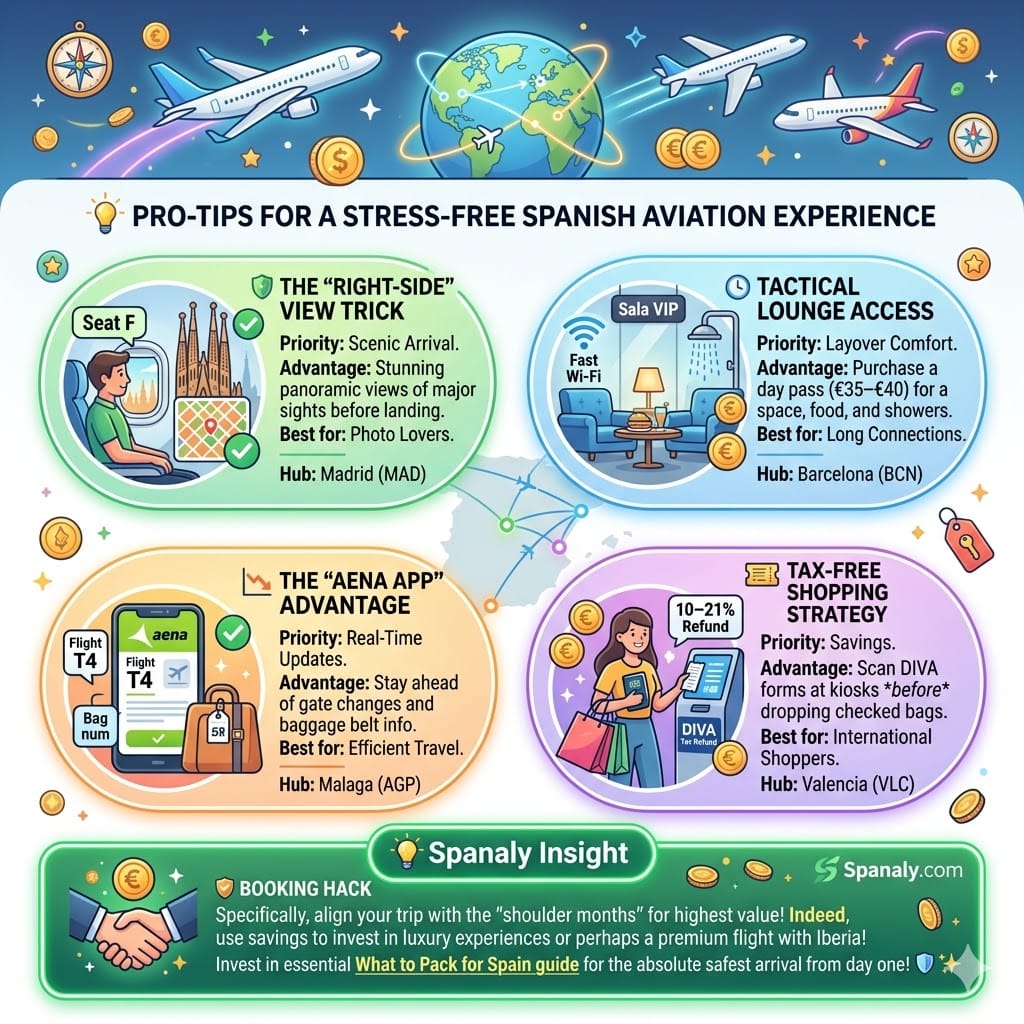
To truly master your journey, you need to know the small details that seasoned travelers use to bypass common airport headaches. These insider secrets will ensure your arrival is as smooth as a glass of Spanish Rioja.
1. The “Right-Side” View Trick
When booking your seat for a flight into Barcelona (BCN), try to choose a window seat on the right side of the plane (Seat F). Most flight paths approach from the sea, giving you a breathtaking, panoramic view of the Sagrada Família and the entire city grid before you even touch the ground.
2. Tactical Lounge Access
Spanish airports (AENA) have some of the best VIP lounges in Europe (like the Sala VIP Pau Casals in Barcelona). Even if you are flying economy, you can often buy a “day pass” for around €35–€40. If you have a long layover, this is cheaper than buying airport terminal food and gives you fast Wi-Fi, showers, and a quiet space to recharge.
3. The “AENA App” Advantage
Download the official AENA app before you land. It provides real-time updates on gate changes, luggage belt numbers, and—most importantly—estimated wait times for security and passport control. It’s the fastest way to stay ahead of the crowds in massive terminals like Madrid T4.
4. Tax-Free Shopping Strategy
If you are a non-EU resident, remember that Spain has no minimum spend for Tax-Free (IVA) refunds. Keep your receipts for any high-value purchases. Major airports have “DIVA” kiosks near the check-in counters where you can scan your forms electronically before you drop your bags, ensuring you get your 10-21% refund back easily.
💡 Spanaly Insight: For the ultimate peace of mind, always carry a physical printout of your Spain Visa & Entry Requirements and insurance. While digital is great, Spanish border tech can occasionally be slow, and having paper backups is the mark of a true professional traveler. 🛡️✨
🛡️ Visitor FAQs – Flying to Spain Logistics & Safety
🛡️ Is it safe to leave my luggage in airport lockers?
Yes, major hubs like Madrid and Barcelona offer highly secure left-luggage offices (Consigna). These facilities are monitored 24/7 and use X-ray scanning for all stored items. It is a perfect solution if you have a long layover and want to explore the city center without carrying heavy bags.
📶 Can I buy a Spanish SIM card immediately at the airport?
Absolutely. You will find official kiosks for major providers like Movistar, Orange, and Vodafone in the arrival halls of Madrid and Barcelona. While prices are slightly higher than in the city, the convenience of having data for navigation and ride-sharing apps the moment you land is well worth the extra few Euros.
💰 Do Spanish airports have ATMs that don't charge high fees?
Airport ATMs often have higher surcharges. To save money, look for bank-affiliated ATMs (like CaixaBank or Santander) rather than generic "Euronet" machines. Always choose to be charged in the local currency (Euros) instead of your home currency to avoid terrible dynamic currency conversion rates.
💤 Are there sleeping pods available for long overnight layovers?
Yes, Madrid-Barajas T4 offers Air Rooms, which are modern sleeping units you can book by the hour. Barcelona also has similar premium resting areas. These are ideal for catching a few hours of quality sleep, showering, and recharging before your next connection without leaving the secure transit zone.
🚑 Is there medical assistance available inside the terminals?
All primary Spanish airports have First Aid stations and automated external defibrillators (AEDs) throughout the terminals. If you feel unwell after a long flight, alert any staff member; they can coordinate immediate medical attention. Most major airports also have pharmacies located in the public shopping areas.
Flying to Spain Guide by Spanaly.com
Landing in Spain is the first chapter of an unforgettable story. By choosing the right airport and timing your flight strategically, you’ve already mastered the most complex part of your trip. Now, it’s time to let the Spanish rhythm take over.
🚀 Final Takeaways for a Perfect Arrival:
Double-Check: Ensure your passport and 122€ daily proof are ready. 🛂
Stay Flexible: Use the Multi-City strategy to see more for less. 🔄
Land & Relax: Book your airport transfer ahead to avoid taxi stress. 🚆
Smart Savings: Invest your flight savings into a world-class Tapas dinner! 🥘
🌟 What’s Your Next Stop?
If your heart is set on the Mediterranean breeze, Gaudi’s surreal art, and vibrant street life, don’t stop here. Dive into our Ultimate Barcelona Travel Guide to plan your perfect days in the Catalan capital from the moment you leave the terminal.
🛡️ Spanaly Final Tip: Spain is best enjoyed with an open heart and a curious mind. Whether you land in the grand terminals of Madrid or the sunny gates of Malaga, a warm “¡Hola!” is the only key you need to unlock the magic of the Iberian Peninsula.
Safe flights and see you in Spain! 🇪🇸✨