⚡ Is a Day Trip from Seville to Ronda Worth It?
Yes — and it’s one of the best day trips in Andalusia.
A day trip from Seville to Ronda gives you a dramatic change of scenery: from the flat Guadalquivir plains to a stunning 120-meter-deep limestone gorge, one of Spain’s most iconic bridges, and a historic bullring — all in a single day.
- Total Time: 10 to 12 hours (including travel)
- Ease of Access: Very good — direct buses, trains, or a scenic drive
- Main Highlights: The famous Puente Nuevo, views from the bottom of the gorge, and the old town
If your time in southern Spain is limited, this trip is highly recommended. For more background before you go, check our Ultimate Ronda Travel Guide.
📊 Seville to Ronda Snapshot: Key Logistics & Data
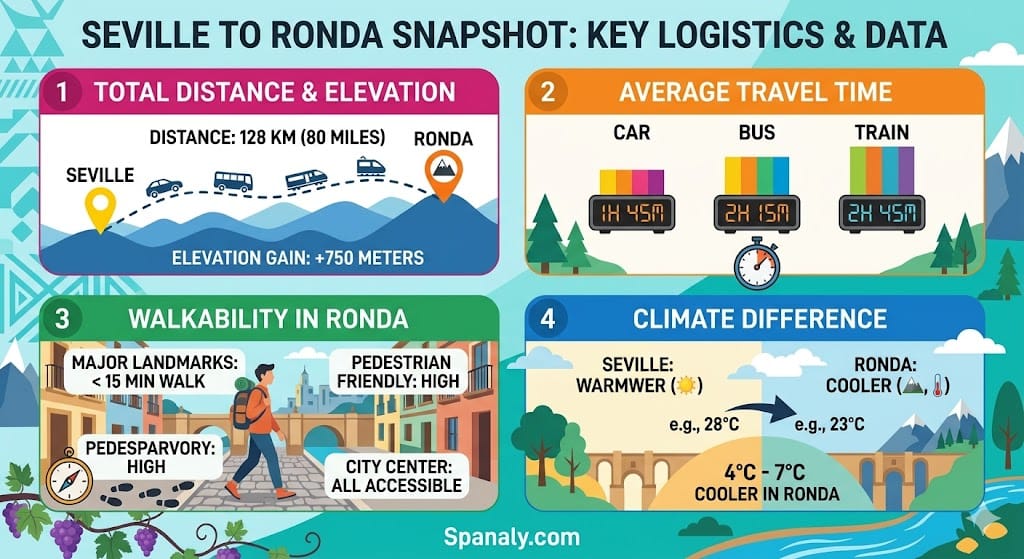
Planning your trip starts with knowing the road ahead. Ronda sits high in the mountains, approx. 130 km (81 miles) from Seville. You’ll be climbing from the flat plains of the Guadalquivir up to a rocky plateau 750 meters above sea level, so be ready for a complete change in scenery.
📏 Total Distance: 130 km via the A-375 and A-374 highways.
🕒 Travel Time: Between 1h 45m and 2h 15m for drivers; up to 2h 30m by bus.
🚶 Walkability: Very high. Once you arrive, all the main landmarks are within a 15-minute walk.
🌡️ Climate Change: It is usually 4°C to 7°C cooler than Seville. Always bring an extra layer for the mountain breeze.
Quick Comparison: Efficiency vs. Cost
| Mode of Transport | Average Time | Approx. Cost (Return) | Convenience Level |
|---|---|---|---|
| Direct Bus | 2h 00m – 2h 30m | €26.00 – €32.00 | High (Direct city-to-city) |
| Rental Car | 1h 45m – 2h 15m | €45.00 – €70.00 | Maximum (Flexible stops) |
| Train (MD) | 2h 30m – 3h 00m | €35.00 – €45.00 | Moderate (Low frequency) |
If you are planning more excursions from the capital, check our Day Trips from Seville guide to help organize your week. This data ensures you arrive with enough daylight to enjoy the gorge views without feeling rushed.
🚗 Transport Strategy: Best Ways to Travel (Bus, Train, or Car)

Choosing how to get there is the most important part of your trip. While the distance isn’t long, the winding mountain roads of the Sierra will determine how much time you actually spend exploring versus traveling.
🚍 The Direct Bus (Top Choice): Operated by Damas, this is the most practical way to travel. Buses depart from Plaza de Armas and drop you in the city center, just a 10-minute walk from the bridge and other Spanish Attractions.
Pro Tip: Skip the station queues and use the Damas App or their website to book your seat. It’s the only way to guarantee your spot for the busy return leg.
🚗 Rental Car (The Scenic Route): This gives you the most freedom. Driving allows you to stop at “White Villages” like Zahara de la Sierra along the way. Just remember to check our guide on Parking in Ronda before you arrive to avoid the narrow-street traps.
🚆 The Train (The Relaxed Choice): A comfortable and scenic ride from Santa Justa station, but direct trains are rare. You must check the return times carefully; missing the last train means a very expensive taxi back to Seville.
If you’re driving, the A-375 highway offers a beautiful climb from the flat plains into the dramatic peaks. If you’d rather not deal with the stress of navigating mountain roads, a guided tour from Seville is a great alternative that handles all the logistics for you.
💡 Spanaly Insight: Book your return ticket online or the moment you arrive at the station. Return buses to Seville often sell out by mid-morning, especially on weekends. Don’t be the traveler stranded in Ronda searching for a last-minute taxi that could cost you over €150.
⏰ The "Perfect Day" Itinerary: Hour-by-Hour Planning
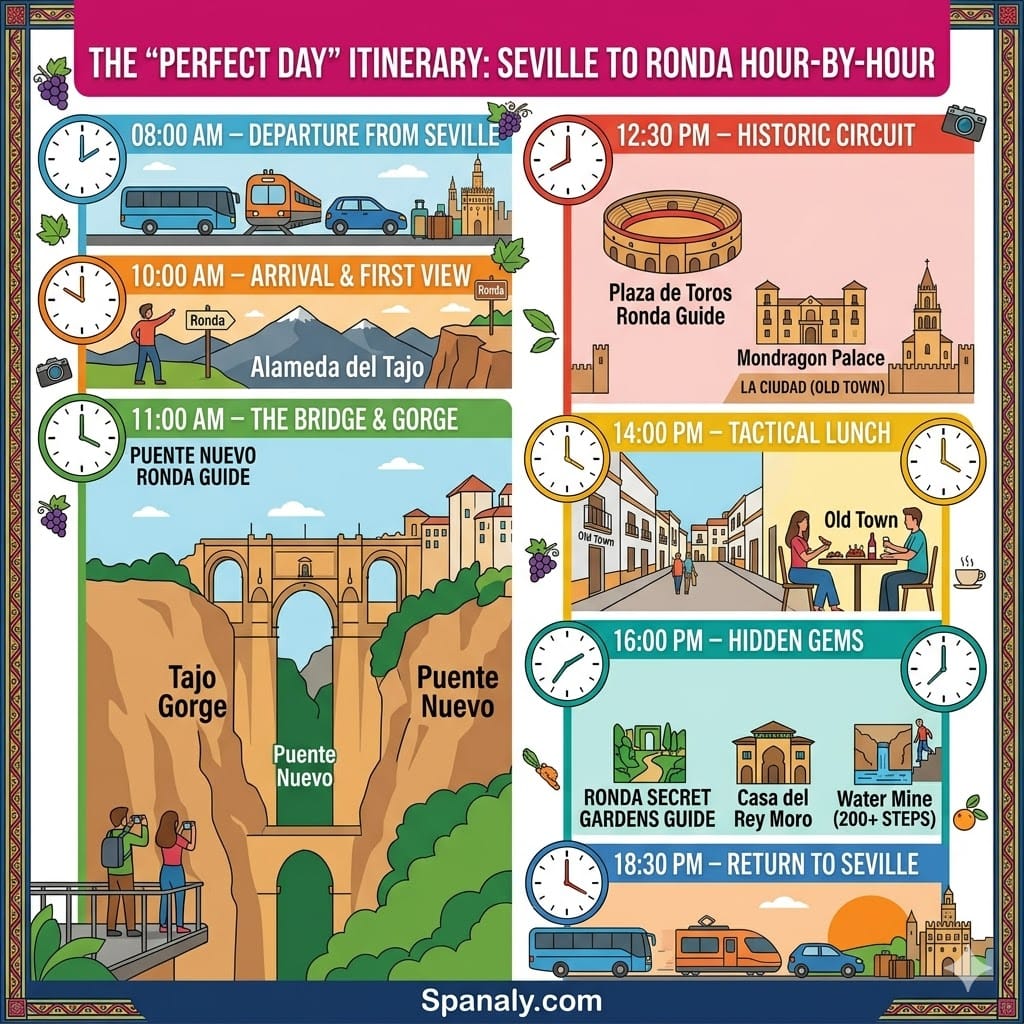
To make the most of your trip, you need to stay one step ahead of the crowds. Ronda is compact, but after 11:00 AM, the tour buses arrive in force. Following this plan helps you see the highlights before the main plazas get too busy.
08:00 – Departure: Leave Seville early (Plaza de Armas for the bus). This gets you into the mountains before the midday sun hits the valley.
10:00 – Arrival & Cliffside Views: Arrive in Ronda and walk straight to the Alameda del Tajo gardens. You’ll get those famous panoramic views while the air is still cool and quiet.
11:00 – The Bridge & Gorge: Cross the Puente Nuevo. Take your photos now; the light is perfect for capturing the depth of the gorge.
12:30 – Historic Circuit: Explore the Plaza de Toros (Bullring) and then head into the Old Town (La Ciudad) to visit the Mondragon Palace before the lunch rush.
14:00 – Smart Lunch: Head deeper into the Old Town alleys. You’ll find better food and lower prices away from the bridge-view tourist traps.
16:00 – The Water Mine & Hidden Spots: Descend the 200+ steps of the Water Mine at Casa del Rey Moro.
Note: The walk down takes 10-15 minutes, but the climb back up is a workout—allow 25 minutes to get back to the top.
18:30 – Return: Head back to the station for your bus or train. The mountain light starts to fade fast, especially in the gorge, so don’t leave your return walk too late.
This plan is active but gives you enough time for a relaxed lunch and a few “slow” moments to soak in the views. It covers the best Spanish Attractions without making you feel like you’re in a race.
🎒 Pre-Trip Essentials: Physical Prep & What to Pack
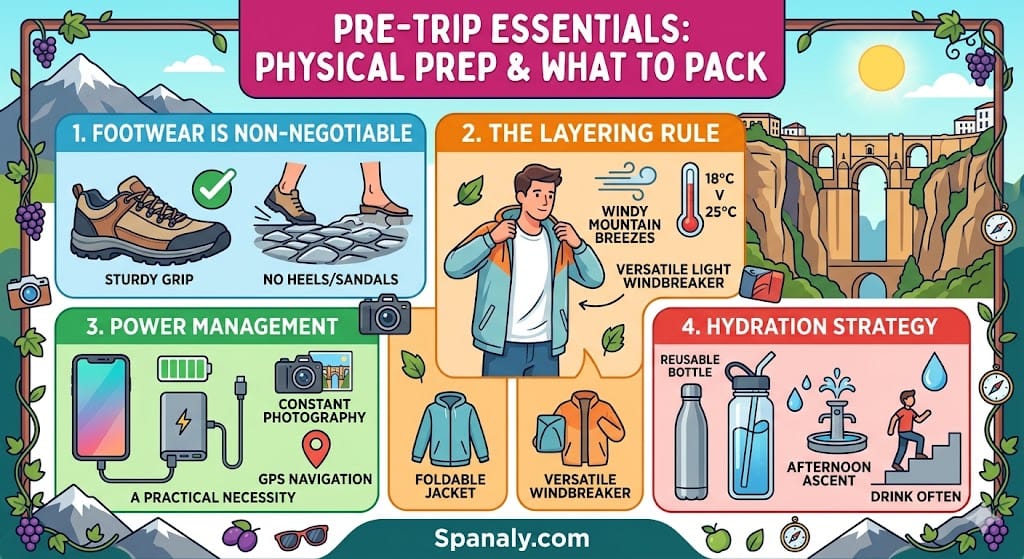
A Seville to Ronda day trip is more physically demanding than a standard walk through Seville’s flat streets. Because you are transitioning to a mountain plateau, your preparation must account for steep inclines and stone-paved alleys.
👟 Footwear is Non-Negotiable: The Old Town (La Ciudad) consists of polished, uneven cobblestones. Wear sturdy walking shoes with a good grip; leave the sandals or heels for your evenings in Seville.
🧥 The Layering Rule: Even if Seville is scorching, Ronda experiences sharp mountain breezes. A light windbreaker or a versatile layer is essential, especially if you plan to stay for the sunset.
🔋 Battery Tips: Between the constant photography of the Tajo gorge and GPS navigation, your phone battery will drain fast. A portable power bank is a practical necessity for a full 12-hour day trip.
💧 Hydration Strategy: While there are public fountains, the climb back from the lower gorge viewpoints is steep. Carry a reusable water bottle to stay hydrated during the afternoon ascent.
Preparing for these micro-details ensures your energy remains focused on the stunning views rather than physical discomfort. For more general advice on navigating the country, see our Essential Spain Travel Tips.
🌉 Ronda’s Core Highlights: The Landmarks You Can't Miss
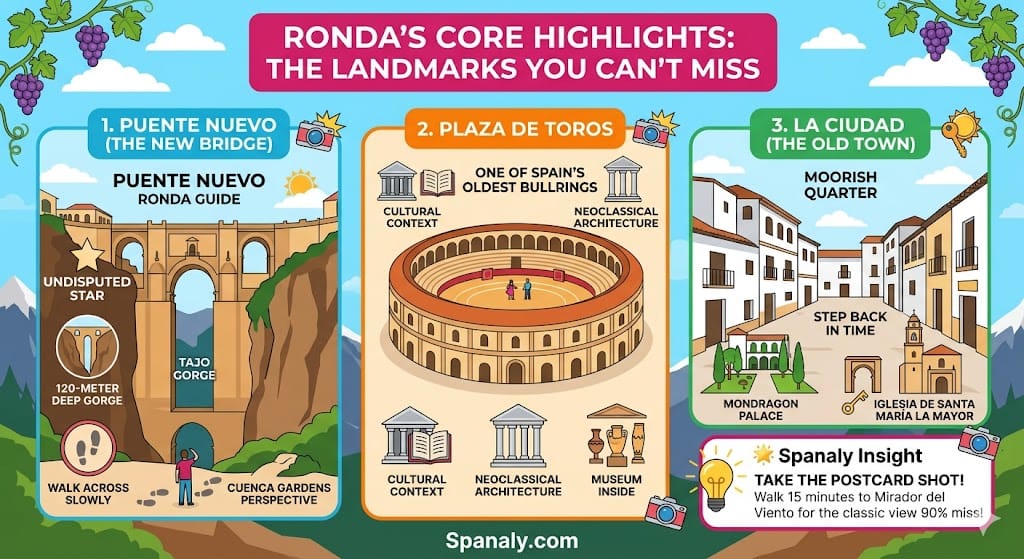
On a Seville to Ronda day trip, your time is the most valuable asset. To see the city’s soul without backtracking, you should follow a natural circuit that connects the modern side (El Mercadillo) with the ancient Moorish quarter (La Ciudad).
🌉 Puente Nuevo (The New Bridge): This is the undisputed star of the show. Spanning the 120-meter deep Tajo gorge, it connects the two halves of the city. For the best experience, walk across it slowly and then head to the Cuenca Gardens for a side-on perspective.
🏟️ Plaza de Toros: As one of the oldest and most beautiful bullrings in Spain, it represents a core part of Spanish Attractions. Even if you aren’t interested in the sport, the neoclassical architecture and the museum inside provide deep cultural context.
🏰 La Ciudad (The Old Town): Crossing the bridge into the old quarter feels like stepping back in time. Focus on the Mondragon Palace for its Moorish courtyards and the Iglesia de Santa María la Mayor, which sits on the site of a former mosque.
💡 Spanaly Insight
Most day-trippers stay on top of the bridge. For a truly professional view, walk down the Puente Nuevo Ronda path towards the Mirador del Viento. It takes only 15 minutes and offers the “postcard shot” of the bridge towering above the valley—a view 90% of visitors miss.
This circuit ensures you capture the historic essence of Ronda before the mid-afternoon rush. If you find yourself captivated by the architecture, you might consider our guide on Things to Do in Ronda for a future, longer stay.
🥘 Smart Eating: Where to Eat During Your Day Trip
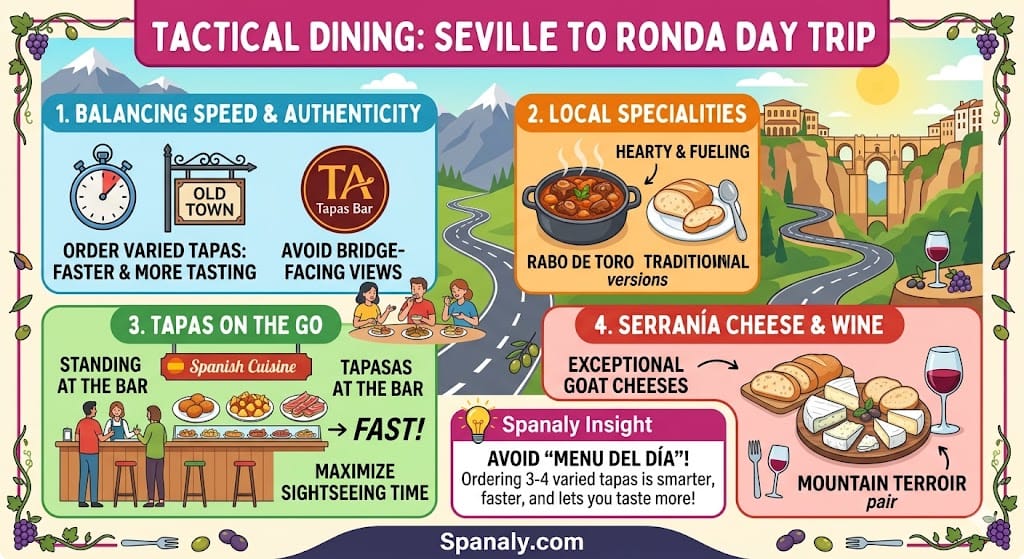
Since you only have a few hours in Ronda, don’t waste them waiting for a slow three-course meal. To eat like a local without missing your return bus, focus on quick tapas in the side streets of the Old Town. Avoid the restaurants directly facing the bridge, as they often prioritize views over culinary quality. Instead, head into the side streets for a more professional gastronomic experience.
🥩 Local Specialties: Ronda is famous for its Rabo de Toro (Oxtail stew). This dish is hearty and perfect for fueling your afternoon walk. Look for traditional taverns in the Old Town for the most authentic version.
🥟 Tapas on the Go: If you want to maximize sightseeing time, choose a tapas bar where you can eat standing at the bar. This is a staple of Spanish Cuisine and significantly faster than a full sit-down service.
🧀 Serranía Cheese & Wine: The mountains surrounding Ronda produce exceptional goat cheeses. Pair a local cheese platter with a glass of Ronda red wine for a high-value, light lunch that represents the region’s terroir.
Make sure to aim for lunch between 13:30 and 14:30 to sync with local rhythms. For a curated list of specific venues that offer fast service for day-trippers, consult our guide to the Best Restaurants in Ronda.
💡 Spanaly Insight
Avoid the “Menu del Día” if you are short on time. While it offers great value, the three-course service can easily take 90 minutes. For a day trip, ordering 3-4 varied tapas is a smarter move; it’s faster, allows you to taste more variety, and keeps you moving toward your next landmark.
📸 Best Viewpoints & Parking Tips for Day Trippers
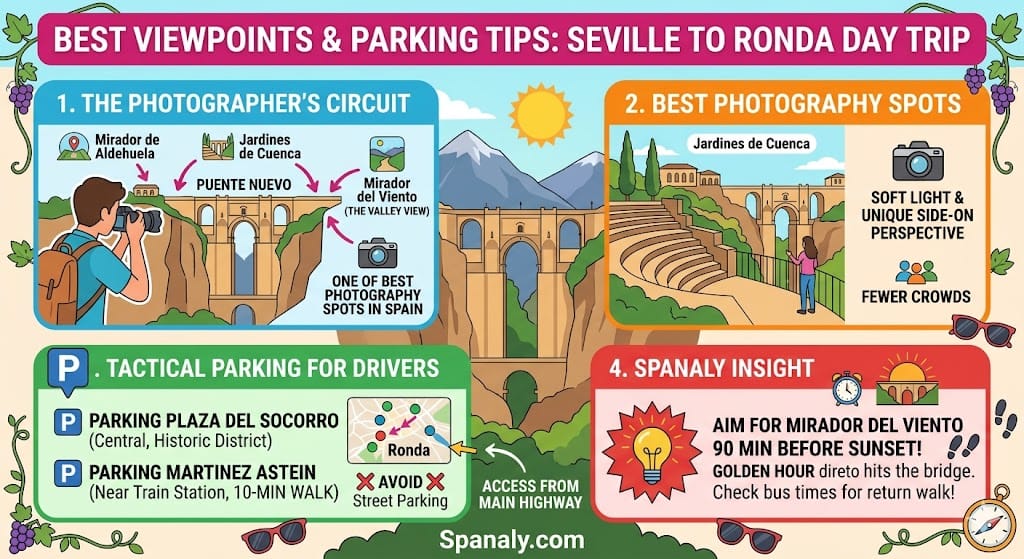
Capturing the scale of the Tajo gorge is the high-point of any mountain excursion. However, the best angles require strategic walking. If you are driving, finding a professional spot for your vehicle is your first logistical hurdle to clear.
The Photographer’s Circuit
📍 Mirador de Aldehuela: Located right next to the bridge, this offers the classic high-angle shot of the stone architecture.
📍 Jardines de Cuenca: These terraced gardens provide a unique side-on perspective of the gorge. It is much less crowded and offers soft light in the late afternoon, making it one of the Best Photography Spots in Spain.
📍 Mirador del Viento (The Valley View): For the “Epic” shot showing the bridge from below, follow the stone path down from the Old Town. It is a 15-minute descent and offers the most dramatic scale.
Parking for Drivers
If you are arriving by car, do not attempt to find street parking in the narrow Old Town; it is a logistical trap.
🅿️ Parking Martinez Astein: Located near the train station. It is a 10-minute flat walk to the center and very easy to access.
🅿️ Parking Plaza del Socorro: The most central underground option. It places you exactly where the historic district begins. For a full breakdown of rates and locations, check our Parking in Ronda Guide.
💡 Spanaly Insight
For the absolute best light, aim to be at the Mirador del Viento about 90 minutes before sunset. The golden hour hits the bridge’s stone face directly, turning it a deep orange. If you are on a bus schedule, ensure you factor in the 20-minute walk back up the hill to avoid missing your return journey.
⚖️ Strategic Comparison: Seville vs. Málaga to Ronda
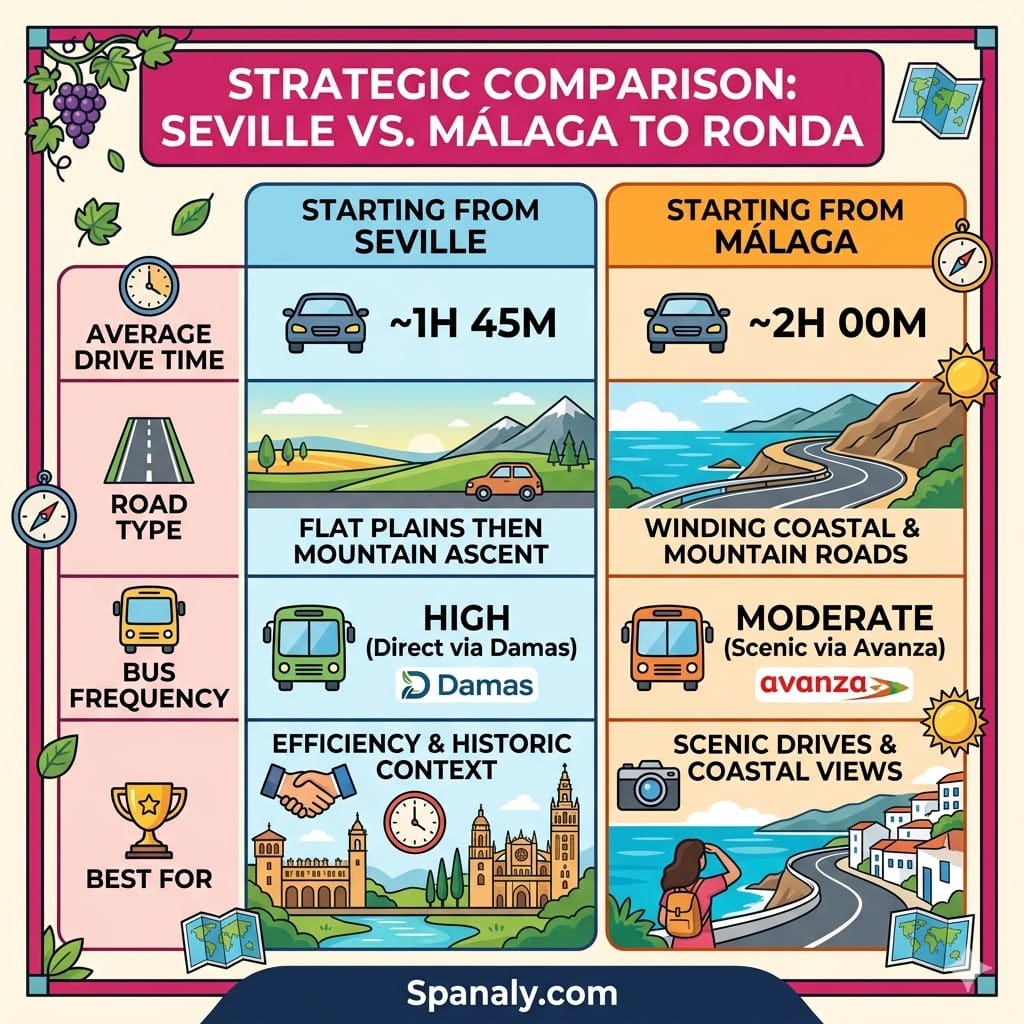
Many travelers wonder which city serves as a better base for a Seville to Ronda day trip. While both are feasible, the logistical “vibe” and technical route differ significantly.
🛣️ The Route: Starting from Seville involves driving through the agricultural heart of Andalusia before hitting the Sierra mountains. The Málaga to Ronda day trip is more winding and coastal-to-mountainous.
⏱️ Time Efficiency: Seville is slightly closer in terms of road time (about 1h 45m). Málaga can take up to 2 hours depending on coastal traffic near Marbella.
🚍 Public Transport: Seville offers more consistent direct bus connections. Málaga’s bus routes are scenic but often involve more stops in smaller white villages.
Quick Comparison: Departure Base
| Feature | Starting from Seville | Starting from Málaga |
|---|---|---|
| Average Drive Time | ~1h 45m | ~2h 00m |
| Road Type | Flat plains then mountain ascent | Winding coastal & mountain roads |
| Bus Frequency | High (Direct via Damas) | Moderate (Scenic via Avanza) |
| Best For | Efficiency & Historic context | Scenic drives & Coastal views |
If you are currently staying in the capital, sticking to the Seville departure is the most logical choice for a 12-hour window. However, if your itinerary is flexible, starting from the coast offers a different perspective on the landscape. For a broader look at planning your route, check our Spain Travel Itineraries.
💡 Spanaly Pro Tips: Secrets for a Flawless Trip
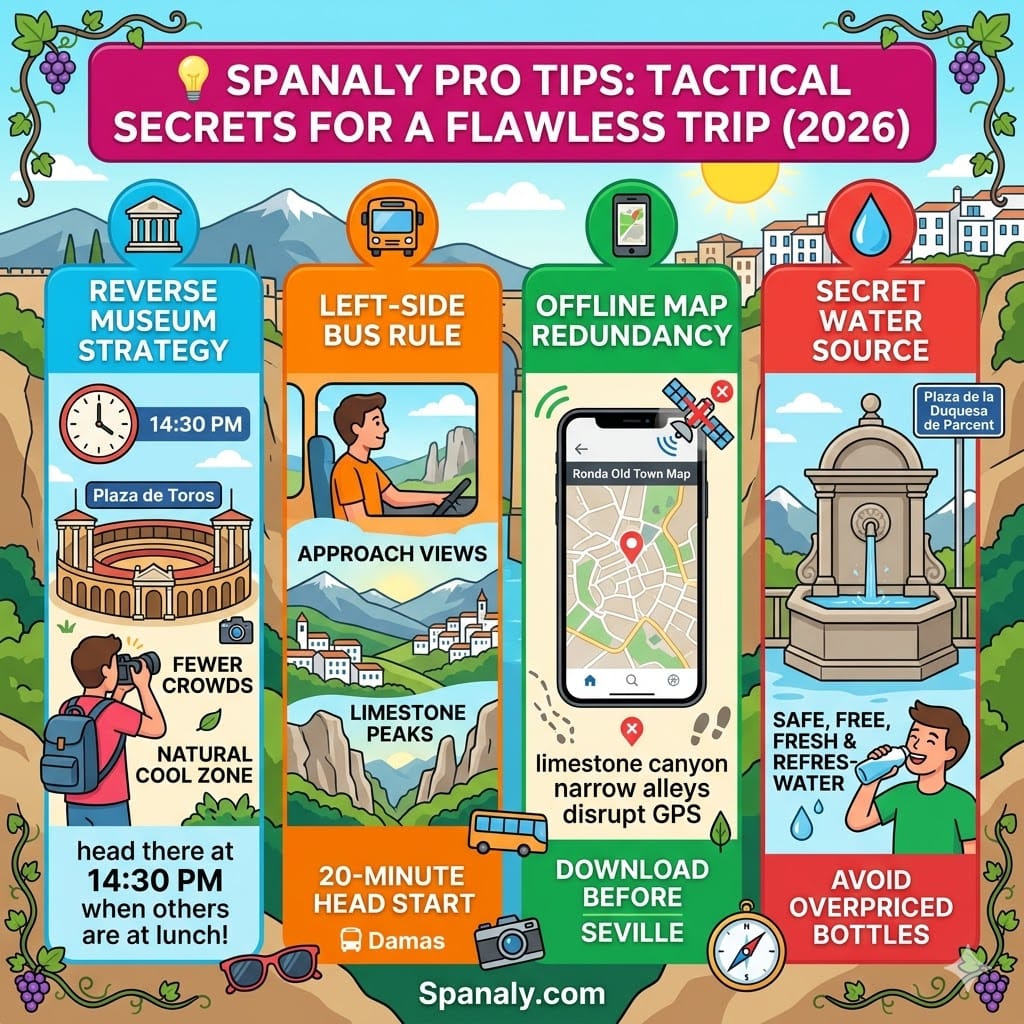
To truly master a Seville to Ronda day trip, you must look beyond the standard guidebooks. These professional insights are based on 2026 field data and logistical nuances that can make or break your mountain excursion.
🏛️ The “Reverse” Museum Strategy: Most tourists hit the Plaza de Toros at 11:00 AM. Instead, head there at 14:30 PM when the crowds are at lunch. You will have the neoclassical arena almost to yourself for photography, and the museum’s thick stone walls provide a natural “cool zone” during the day’s peak heat.
🚌 The Left-Side Bus Rule: If you are taking the bus from Seville, try to sit on the left side of the vehicle. As you approach the Serranía de Ronda, the most dramatic views of the limestone peaks and white villages appear on the left, giving you a 20-minute head start on the scenery.
📱 Offline Map Redundancy: Ronda’s Old Town (La Ciudad) is a limestone canyon of narrow alleys that often disrupts GPS signals. Download an offline version of the city map before leaving Seville to avoid losing your way in the Moorish labyrinth when your signal drops.
💧 The Secret Water Source: Don’t buy overpriced bottled water near the bridge. Head to the Plaza de la Duquesa de Parcent; there is a historic public fountain with fresh, cold mountain water used by locals. It is safe, free, and more refreshing than plastic-bottled alternatives.
Implementing these small technical adjustments will elevate your trip from a standard tour to an expert-level experience. For more high-value advice on managing your budget during the journey, consult our Ronda Travel Budget Guide.
🛡️ Visitor FAQs – Seville to Ronda Trip Logistics Guide
🛡️ Is it safe to hike down to the bottom of the Tajo gorge alone?
Yes, the main paths to the Mirador del Viento are safe and well-traveled. However, the terrain is rugged. Ensure you complete your hike at least 45 minutes before sunset, as the trails are not artificially lit. Security in Ronda is high, but always stick to the marked stone paths to avoid loose limestone.
🎫 Do I need to buy tickets for the Puente Nuevo "Interpretation Center"?
Walking across the bridge is free. However, there is a small museum inside the bridge's central chamber (the former prison). While it costs only a few euros, it is often crowded. For a better value, spend that time visiting the Mondragon Palace gardens, which offer more historical depth and panoramic views for a similar price.
🧥 How drastically does the temperature drop in the evening?
Ronda is situated 750 meters above sea level. Even in summer, the temperature can drop by 8°C to 10°C as soon as the sun dips behind the mountains. If your return bus to Seville is late in the evening, carrying a versatile light jacket is a professional tactical move to stay comfortable.
🚑 Are there pharmacies near the Ronda bus and train stations?
Yes, there are several Farmacias located along Calle Espinel (the main shopping street), which is a 5-minute walk from the stations. They are marked by a glowing green cross. Most local pharmacists can assist with minor issues like motion sickness from the winding mountain roads or sun relief.
🏰 Can I visit Ronda if I have significant mobility issues?
The modern side (*El Mercadillo*) is relatively flat and accessible. However, the Old Town (*La Ciudad*) and the gorge paths are steep and cobbled. We recommend focusing your visit on the Alameda del Tajo park and the Bullring area, which are wheelchair-friendly, and using local taxis to move between the two sides of the bridge.
Ronda Logistics Guide by Spanaly.com
A day trip from Seville to Ronda is a journey through Andalusia’s most dramatic landscapes and deepest history. By following this guide, you are ready to:
🌉 Experience the Epic Scale: Walk across the Puente Nuevo and capture that perfect, crowd-free postcard shot.
🐂 Explore Ancient Spain: Step into one of Spain’s oldest bullrings and feel the centuries of tradition.
🥗 Dine like a Local: Avoid the tourist traps and savor authentic Rabo de Toro in a traditional tavern.
🛍️ Bring Home a Piece of the Mountains: Before you leave, dedicate some time to discovering the unique local crafts and local wines highlighted in our Shopping in Ronda Guide.
Prepare well, pack light, and enjoy every breathtaking moment!