🏛️ Playa de Bolonia
Imagine standing on a golden dune, looking at Africa, with 2,000-year-old Roman columns at your back. Playa de Bolonia is not just a place to swim; it is a time machine. This wild stretch in Tarifa remains one of the few untouched coastal paradises in southern Spain.
📍 Location: A secluded bay 20 minutes from Tarifa’s kitesurfing hubs.
🏜️ Highlight: Home to the massive 30-meter high Bolonia Sand Dune.
🏺 Culture: Steps away from the remarkably preserved Baelo Claudia ruins.
If you are looking for the absolute Best Beaches in Spain, Bolonia is the undisputed crown jewel of Cádiz. It offers a raw, Atlantic energy that modern resorts simply cannot replicate.
Forget about umbrellas and beach clubs. Here, the only music is the wind and the crashing waves. Ready to explore the wild frontier where history meets the deep blue sea?
📊 Spanaly Snapshot: Bolonia at a Glance
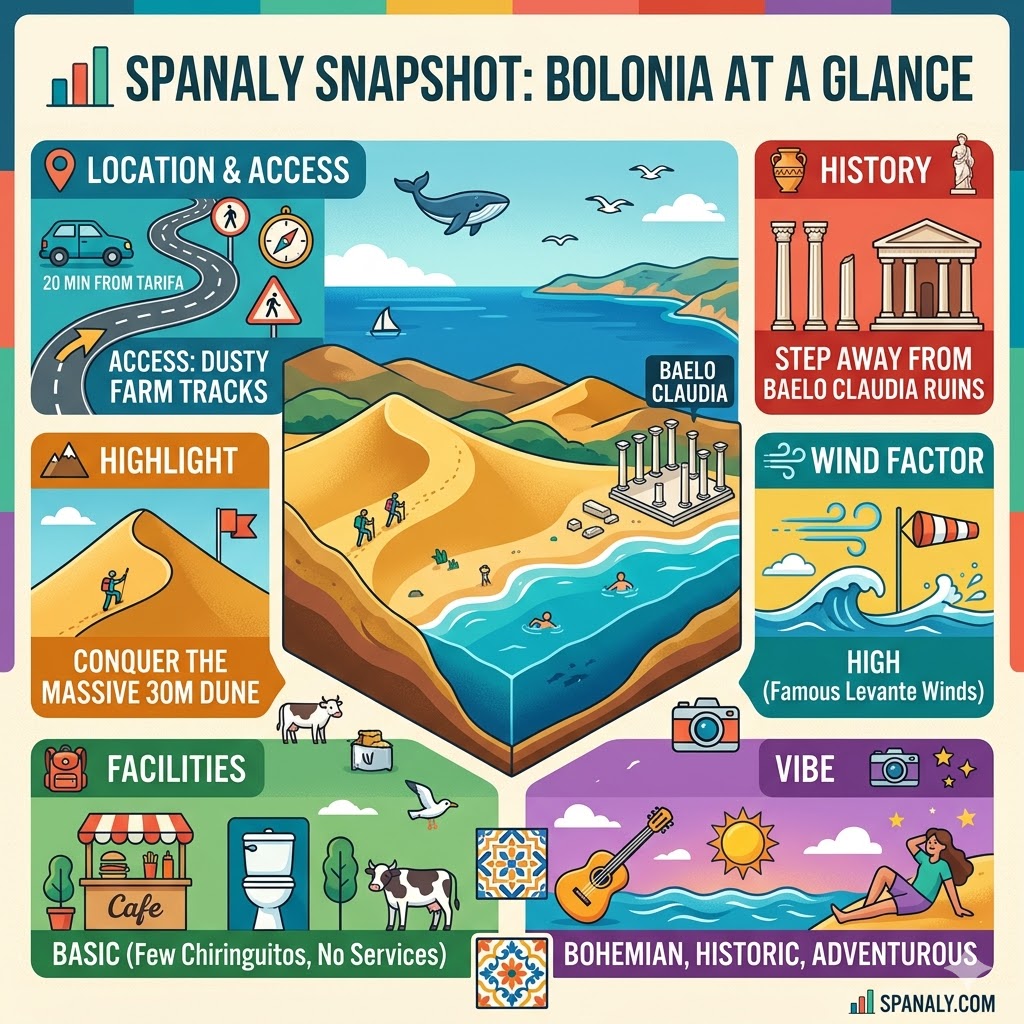
Before you pack your bag, let’s look at the essentials. Playa de Bolonia is a raw environment that rewards the prepared traveler. It belongs to that elite group of Hard-to-reach Beaches in Spain where the effort to arrive pays off in pure magic.
| Feature | The Local Lowdown |
|---|---|
| Beach Type | Wild, expansive, and natural monument |
| Sand Quality | Fine, golden, and incredibly soft |
| Wind Factor | High (Famous for the Levante winds) |
| Parking | Large dirt lots (Fill up fast in summer) |
| Services | Basic (A few chiringuitos near the entrance) |
| Vibe | Bohemian, historic, and adventurous |
Spanaly Insight: Check the wind forecast before driving down. If the Levante (East wind) is blowing over 30km/h, the sand will act like tiny needles. On those days, save your visit for the Roman ruins instead of the shore!
⚖️ Bolonia vs. Valdevaqueros: Which Tarifa Vibe is Yours?
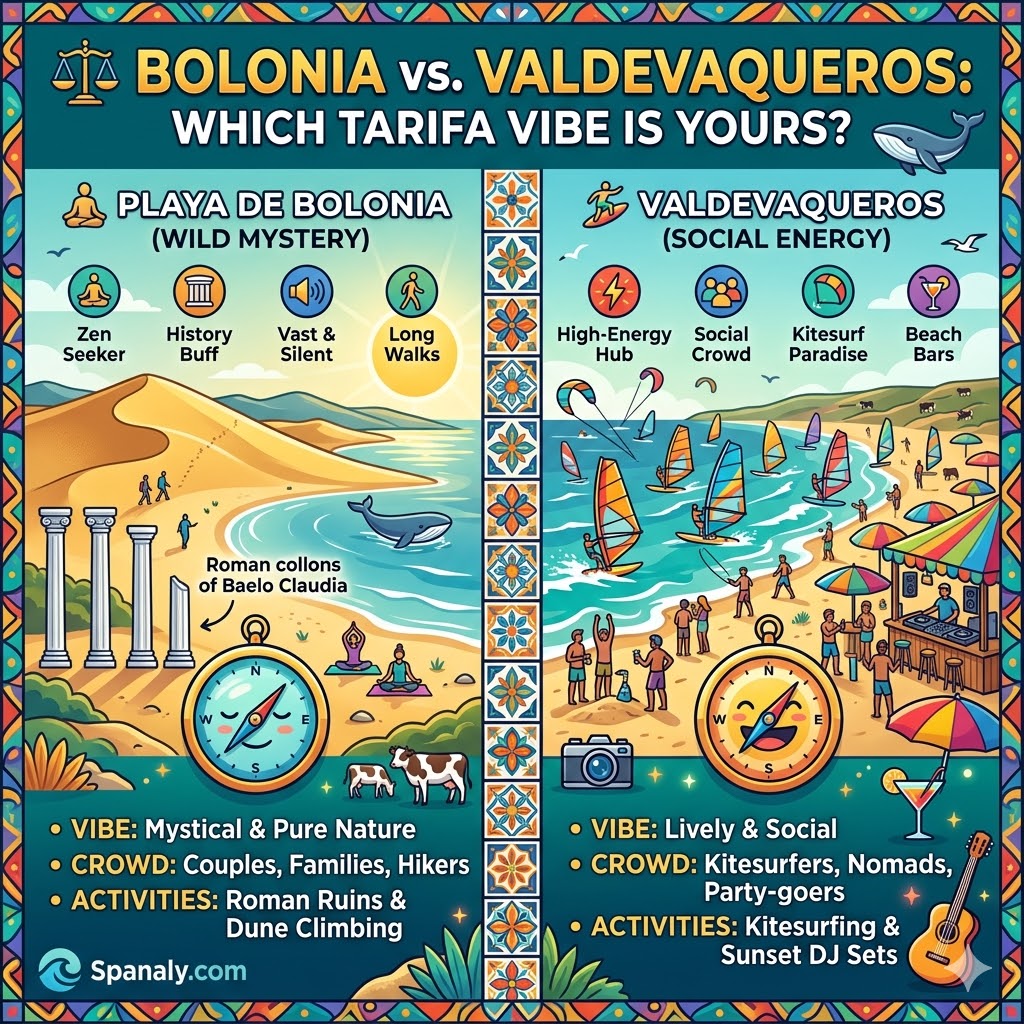
Choosing a beach in Tarifa depends on your soul’s current craving. Do you want the roar of a thousand kites or the silent majesty of history?
🧘 Playa de Bolonia: This is for the “Zen” seekers and history buffs. It is silent, vast, and perfect for long walks on the golden dune.
🏄 Valdevaqueros: This is the high-energy hub. It is filled with kitesurfers, beach bars, and a younger, social crowd.
| Feature | Playa de Bolonia (Wild) | Valdevaqueros (Social) |
|---|---|---|
| Crowd | Couples, Families, Hikers | Kitesurfers, Nomads, Party-goers |
| Facilities | Very limited (Pure nature) | Plenty of trendy beach bars |
| Activities | Roman Ruins & Dune climbing | Kitesurfing & Sunset DJ sets |
If you prefer the comfort of a city beach over these wild dunes, our Playa de la Concha Guide shows the perfect urban alternative. However, for a raw Atlantic experience, Bolonia remains the king of the south.
Spanaly Insight: If you are a photographer, Bolonia is your winner for the Roman columns. If you are looking to meet new people and grab a cocktail, drive 15 minutes north to Valdevaqueros instead.
🏜️ The Giant Dune of Bolonia
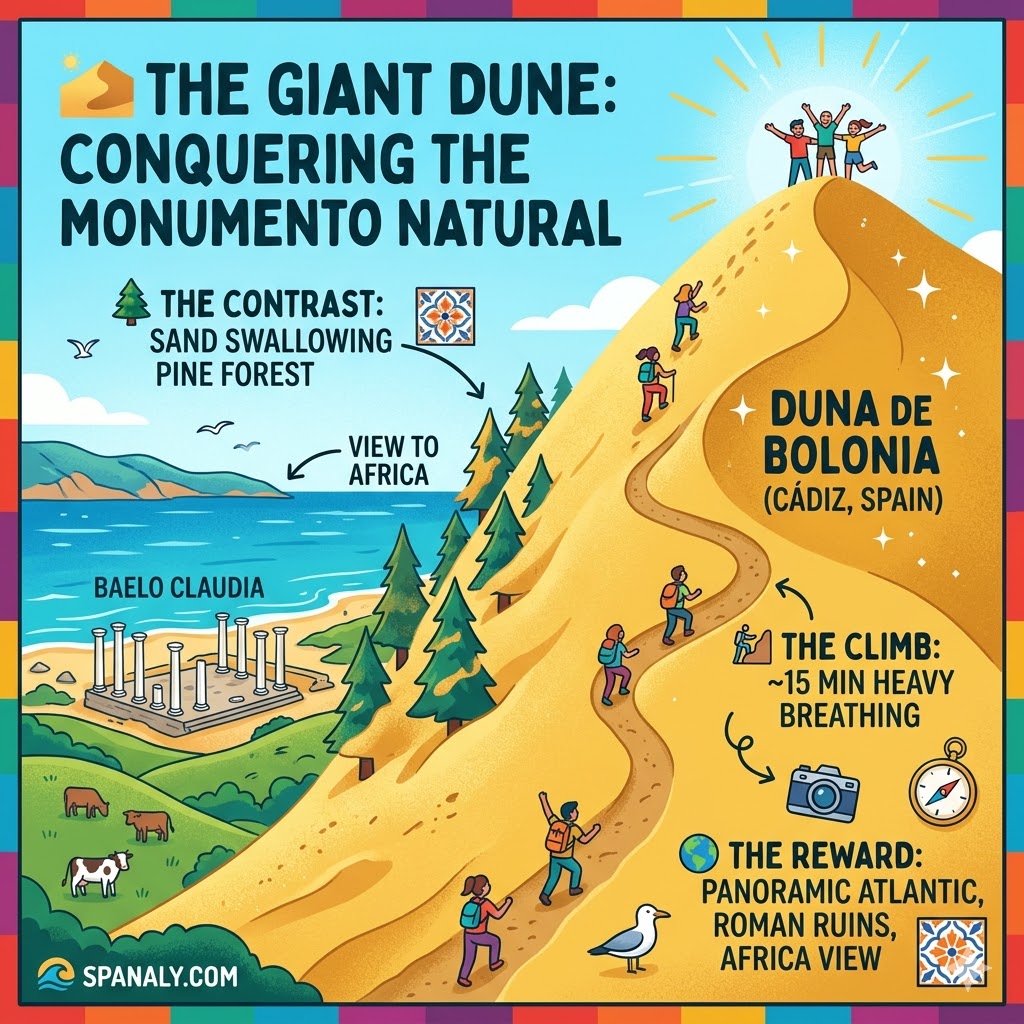
Standing at the end of the bay is a golden monster. The Duna de Bolonia is a 30-meter high wall of sand that seems to touch the sky. This is not just a pile of sand; it is a living “Monumento Natural” that moves with the wind.
🧗 The Climb: It takes about 15 minutes of heavy breathing to reach the summit.
🌍 The Reward: A panoramic view of the Atlantic, the Roman ruins, and the African coast.
🌲 The Contrast: Watch how the moving sand slowly “swallows” the nearby pine forest.
Getting to the top is a rite of passage for every traveler in Cádiz. It reminds me of the effort required to reach the Hard-to-reach Beaches in Spain, where the best views are always behind the steepest paths.
Spanaly Insight: Do not try to climb the dune in the middle of the day. The sand becomes scorching hot! Aim for the hour before sunset. The light turns the dune into liquid gold, and the temperature is much kinder to your legs.
🏺 Baelo Claudia: Walking with Romans by the Sea
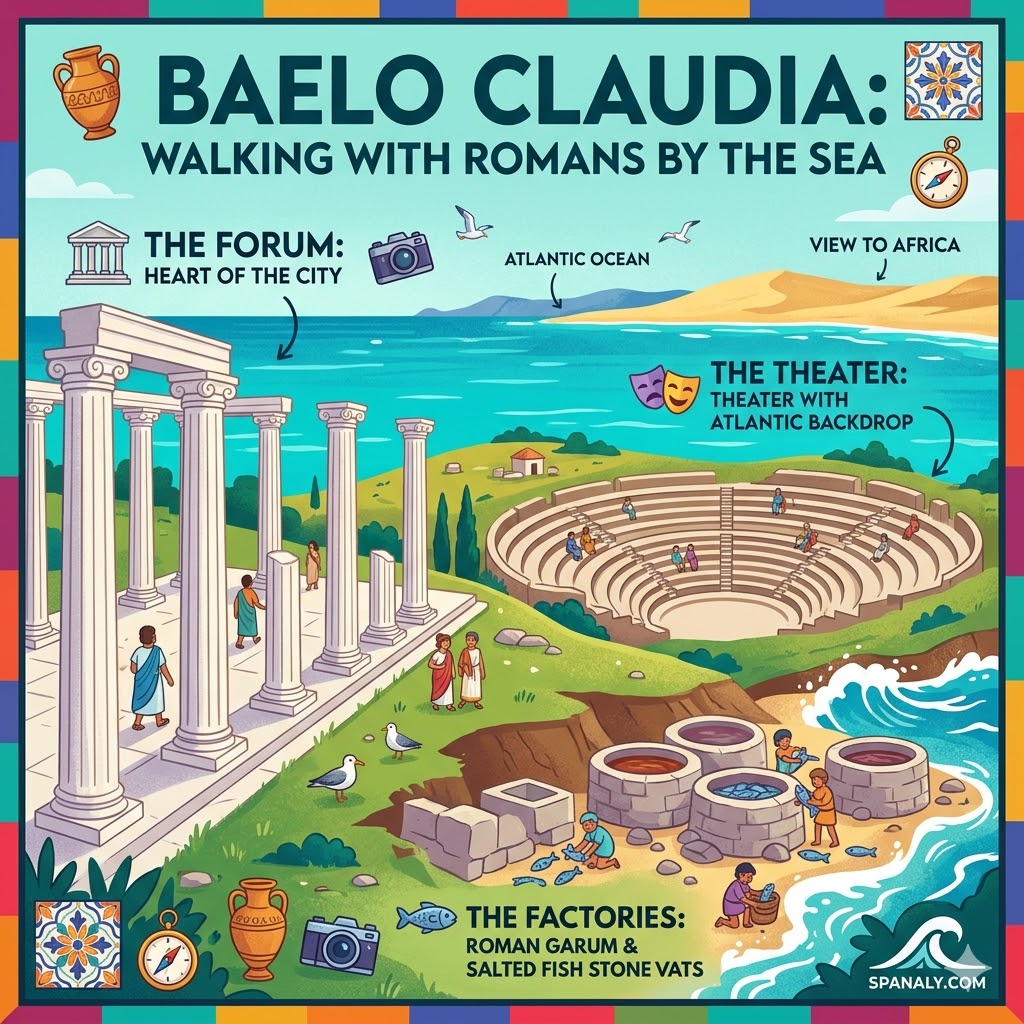
Where else can you explore an ancient Roman forum with sand between your toes? Baelo Claudia is one of the most complete Roman urban centers ever discovered. It wasn’t just a city; it was an industrial powerhouse famous for its salted fish and “Garum” sauce.
🏛️ The Forum: Walk among the towering columns that once formed the heart of the city.
🎭 The Theater: Imagine watching a play with the crashing Atlantic waves as your background music.
🐟 The Factories: See the stone vats where Romans produced the world’s most expensive ancient condiment.
This archaeological site is easily one of the most unique Spanish Attractions you will ever visit. Most ruins are tucked away in dry valleys, but here, history lives on the shoreline.
Spanaly Insight: Admission is free for EU citizens (and very cheap for others). The best photo spot is from the upper rows of the theater. From there, you can align the Roman stage perfectly with the giant sand dune in the distance—a shot you won’t find anywhere else in the world!
📍 The Road to the End of Spain: How to Get There
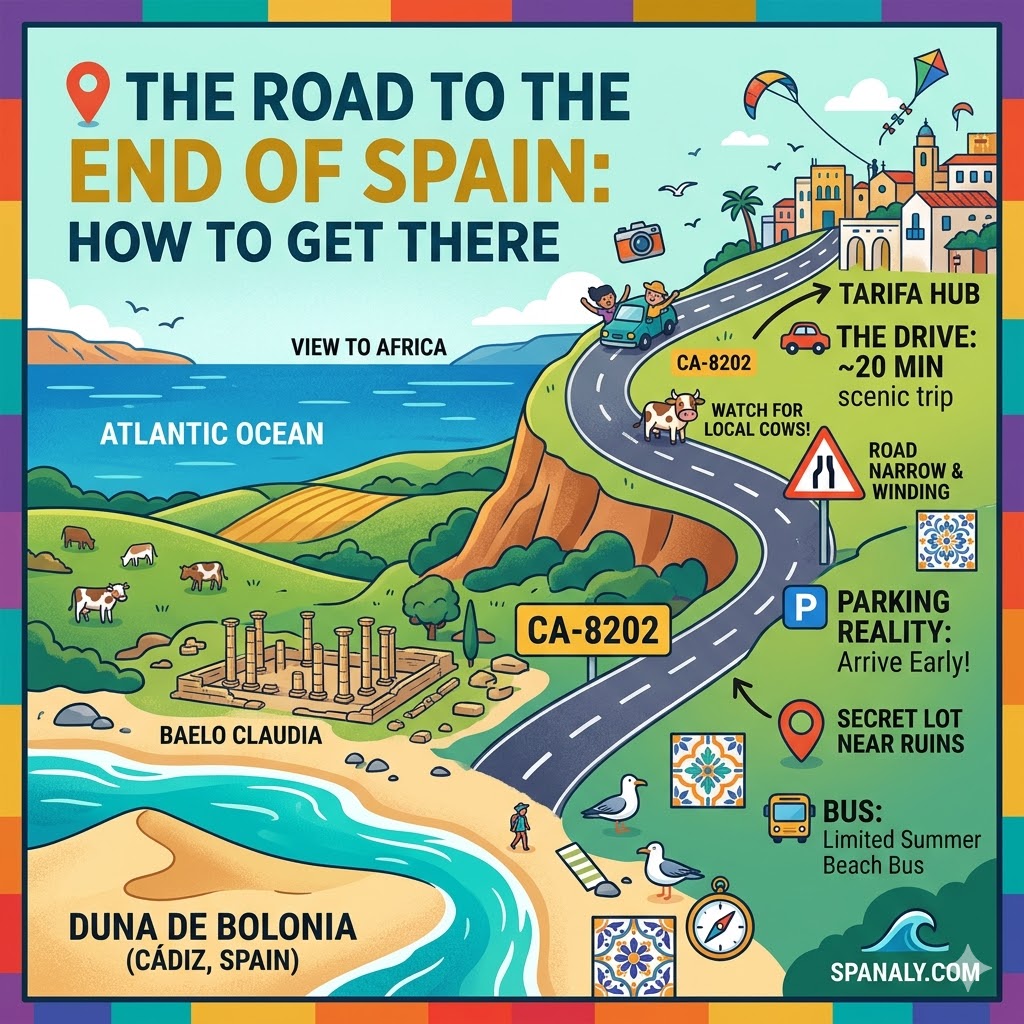
Getting to Playa de Bolonia feels like reaching the edge of the continent. There is only one narrow, winding road (CA-8202) that leads to this paradise. As you drive down from the main highway, the Atlantic suddenly explodes into view.
🚗 The Drive: A scenic 20-minute trip from Tarifa. Watch out for local cows crossing the road!
🅿️ Parking Reality: In peak season, the lots fill up by 11:00 AM. Arrive early or prepare to walk.
🚌 Public Transport: Very limited. A “Beach Bus” runs from Tarifa in summer, but a car is best.
If you are planning to rent a vehicle, make sure to read our guide on Driving in Spain to understand local road signs and parking etiquette. The road to Bolonia is beautiful but requires a focused driver.
Spanaly Insight: There is a “secret” second parking area near the Roman ruins entrance. Most people crowd the first lot they see near the chiringuitos. Keep driving until the very end of the paved road for a shorter walk to the giant dune!
🌬️ The Levante Factor: Surviving the Tarifa Winds
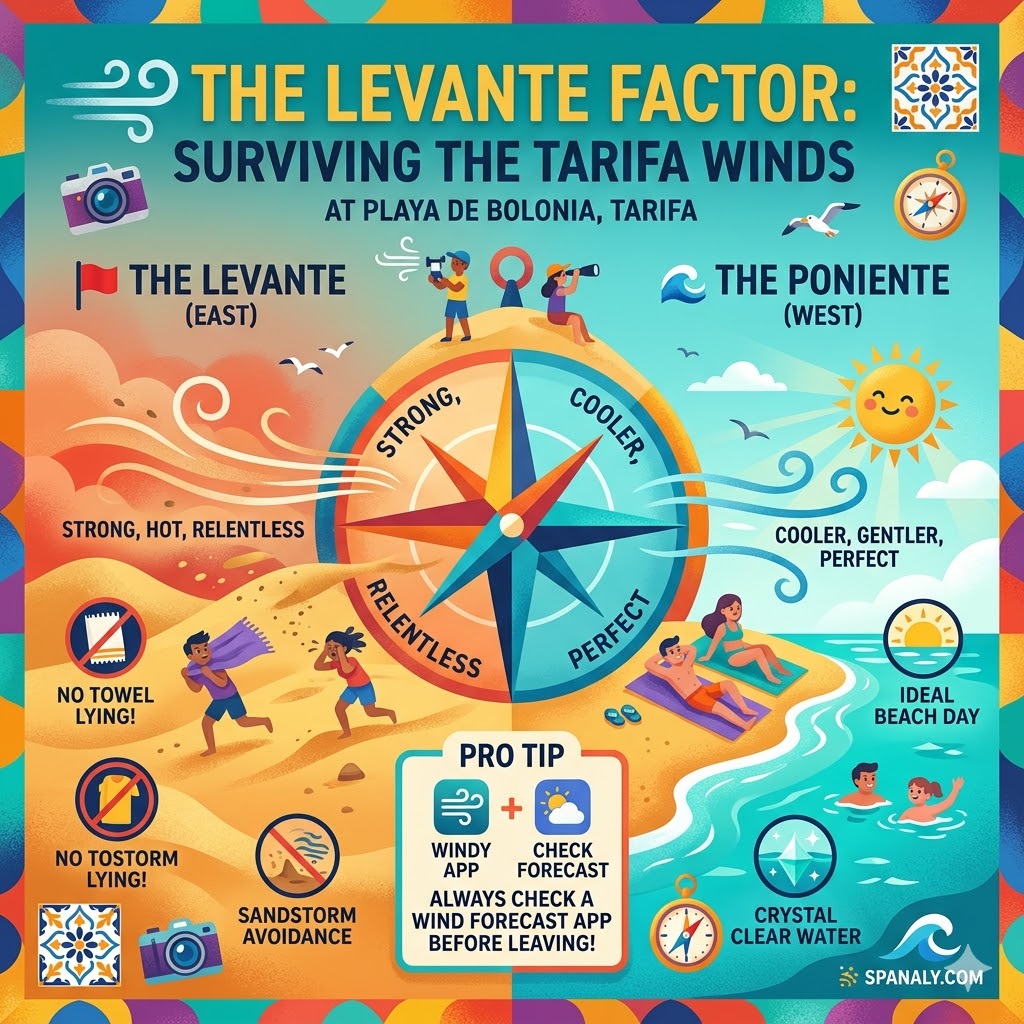
In Tarifa, the wind is the true boss. Before you drive to Bolonia, you must know the difference between the Levante and the Poniente. One brings paradise, the other brings a sandstorm.
🚩 The Levante (East): Strong, hot, and relentless. It blows sand into your eyes and makes lying on a towel impossible.
🌊 The Poniente (West): Cooler, gentler, and perfect for a beach day. The water stays crystal clear and the air is fresh.
📱 Pro Tip: Always check a wind-tracking app (like Windy) before leaving your hotel.
Timing is everything when you want to avoid the “sand-blasting” effect. Understanding these patterns is as crucial as knowing the Best Time to Visit Spain for your specific region. In Bolonia, the wind decides if you swim or hide.
Spanaly Insight: If the Levante is blowing too hard for the beach, don’t cancel your trip! Head straight to the Baelo Claudia ruins. The high stone walls of the Roman city act as a natural windbreak, allowing you to explore history in peace while the beach is a sandstorm.
🍽️ Tuna & Chiringuitos: Where to Eat Like a Local
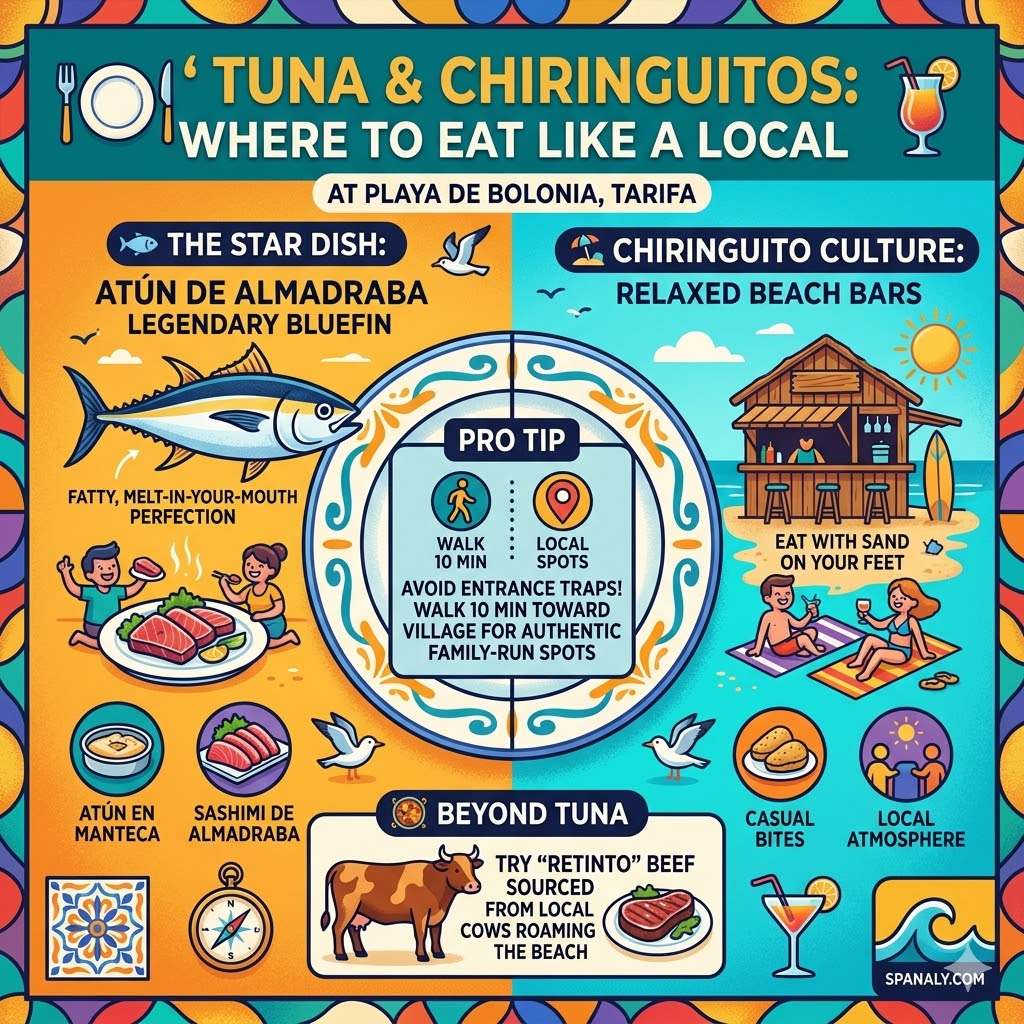
You cannot visit this bay without tasting its red gold. The Atún de Almadraba is a legendary bluefin tuna caught using traditional Phoenician techniques. It is fatty, melt-in-your-mouth perfection that defines the local soul.
🐟 The Star Dish: Order the “Atún en Manteca” or “Sashimi de Almadraba” for the purest flavor.
🏖️ Chiringuito Culture: These are relaxed beach bars where you can eat with sand on your feet.
🥘 Beyond Tuna: Try the “Retinto” beef, sourced from the brown cows you see roaming the beach.
Exploring the flavors here is a deep dive into the heart of Spanish Cuisine. While the ruins of Baelo Claudia show how Romans salted their fish, the local restaurants show how the tradition lives on today.
Spanaly Insight: Avoid the tourist traps at the very entrance. Walk 10 minutes toward the village end (opposite the dune). You will find smaller, family-run spots where the locals eat. My favorite? Ask for the “Tomato Salad with Tuna Belly”—it sounds simple, but it will change your life!
🚶 Beyond the Dune: The Secret Natural Pools
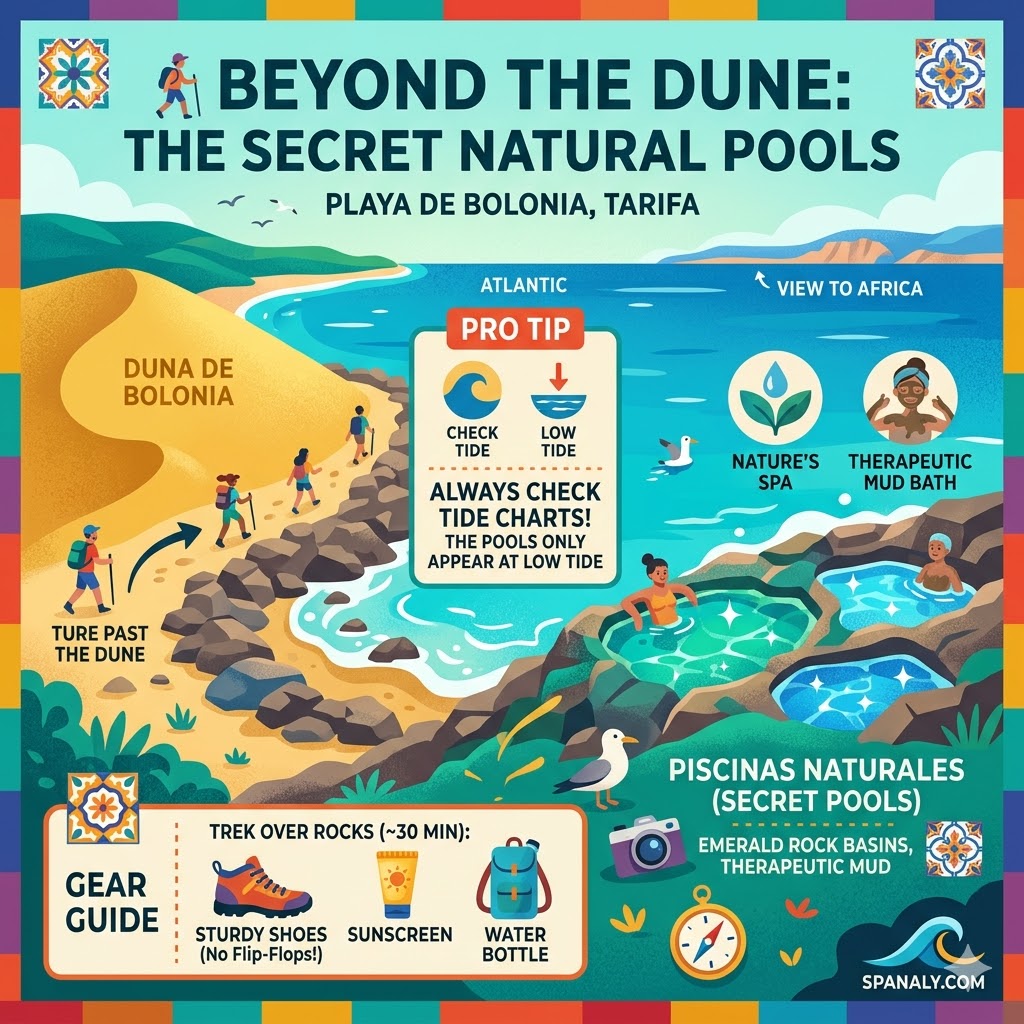
If you have the stamina to walk past the giant dune and follow the rocky shoreline, you will discover Bolonia’s best-kept secret. The Natural Pools (Piscinas Naturales) are emerald basins carved into the rocks, filled with crystal-clear Atlantic water.
🌊 The Tidal Trick: These pools only appear during low tide. Check the tide charts or you will find only crashing waves.
🧖 Nature’s Spa: The rocks here are rich in therapeutic mud. You’ll see locals covering themselves in it for a natural skin treatment.
👟 The Gear: This is a 30-minute trek over rocks. Do not attempt this in flip-flops!
This hidden gem is a reminder of the raw beauty found in Spanish Attractions that require a bit of sweat to reach. It is quiet, mystical, and feels like the end of the world.
Spanaly Insight: Looking for the perfect “mud spa” spot? Look for the areas where the slate rocks are softest. Rub a little water on the stone to create a paste, apply it to your skin, and let it dry in the sun before diving into the cold Atlantic. It’s the cheapest and most authentic spa in Andalusia!
⚠️ Rules and Etiquette at Playa de Bolonia
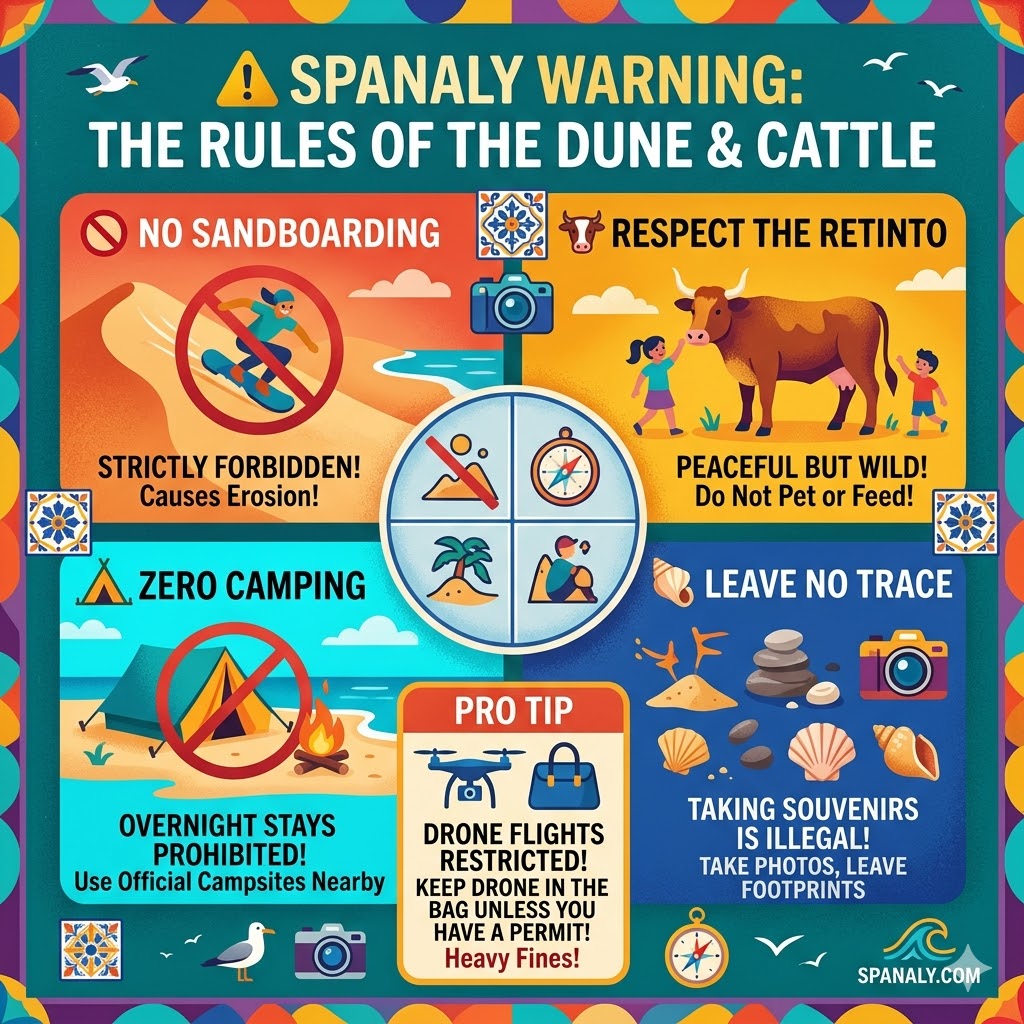
Playa de Bolonia is a delicate ecosystem protected by Spanish law. What looks like a “wild playground” actually has strict rules that, if broken, can result in heavy fines that will ruin your holiday budget.
🚫 No Sandboarding: It is strictly forbidden to slide down the giant dune with boards. This causes erosion and is monitored by local authorities.
🐄 Respect the Retinto: The cows on the beach are semi-wild. They are peaceful but don’t try to pet them or feed them. They can be unpredictable, especially with calves.
🏕️ Zero Camping: Overnight stays in campers or tents are prohibited on the beach and in the pine forest. Use the official campsites nearby.
🐚 Leave No Trace: Taking sand, Roman stones, or shells as souvenirs is illegal. Take photos, leave only footprints.
Staying safe and respectful ensures this paradise remains open for everyone. These local regulations are as important as knowing the general Spanish Festivals etiquette—respect for local heritage and nature is the key to a great trip.
Spanaly Insight: If you see a drone in the air, be careful. Flying drones in Bolonia is restricted due to its proximity to the natural park and archaeological site. Unless you have a specific permit, keep your drone in the bag to avoid a fine that could cost thousands of euros.
🎒 Tarifa Survival Kit: Packing for Wind and History
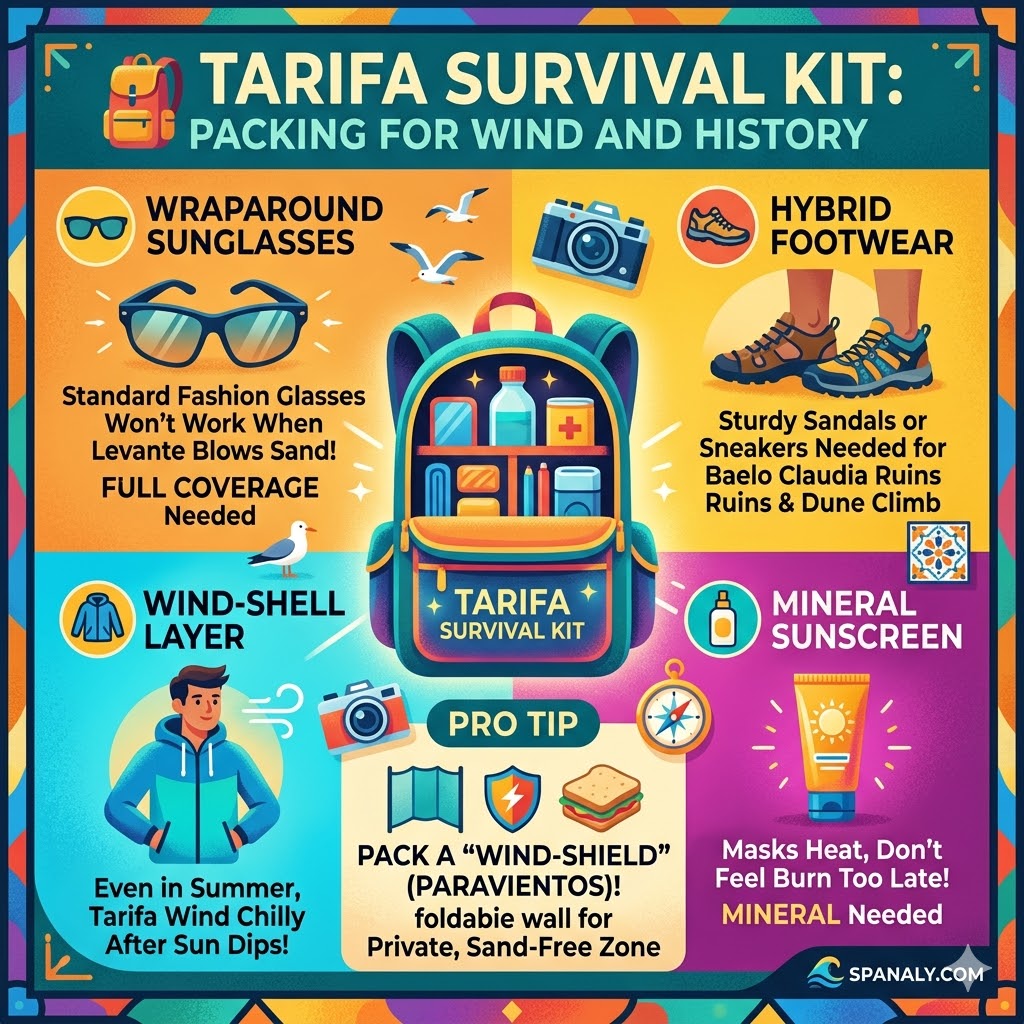
Packing for Bolonia is a tactical mission. You need to be ready for a sun-soaked morning, a sand-blasted afternoon, and a rocky trek to the pools.
🕶️ Wraparound Sunglasses: Standard fashion glasses won’t work when the Levante blows sand. You need full coverage.
👟 Hybrid Footwear: Wear sturdy sandals or sneakers. You’ll need them for the Baelo Claudia ruins and the dune climb.
🧥 The “Windbreaker” Layer: Even in summer, the Tarifa wind can feel chilly once the sun dips.
🧴 Mineral Sunscreen: The wind masks the heat, so you won’t feel the burn until it’s too late.
Unlike the urban essentials in our Ultimate Madrid Travel Guide, where fashion is key, Bolonia demands function over form. Here, your gear determines how long you can stay on the beach.
Spanaly Insight: Want to be a pro? Pack a “Wind-Shield” (Paravientos). It’s a small, foldable fabric wall used by locals to create a private, sand-free zone. Without one, you might find yourself eating a sand-sandwich by 2:00 PM!
💡 Spanaly Insight: The Whale Bone Landmark & Views of Africa
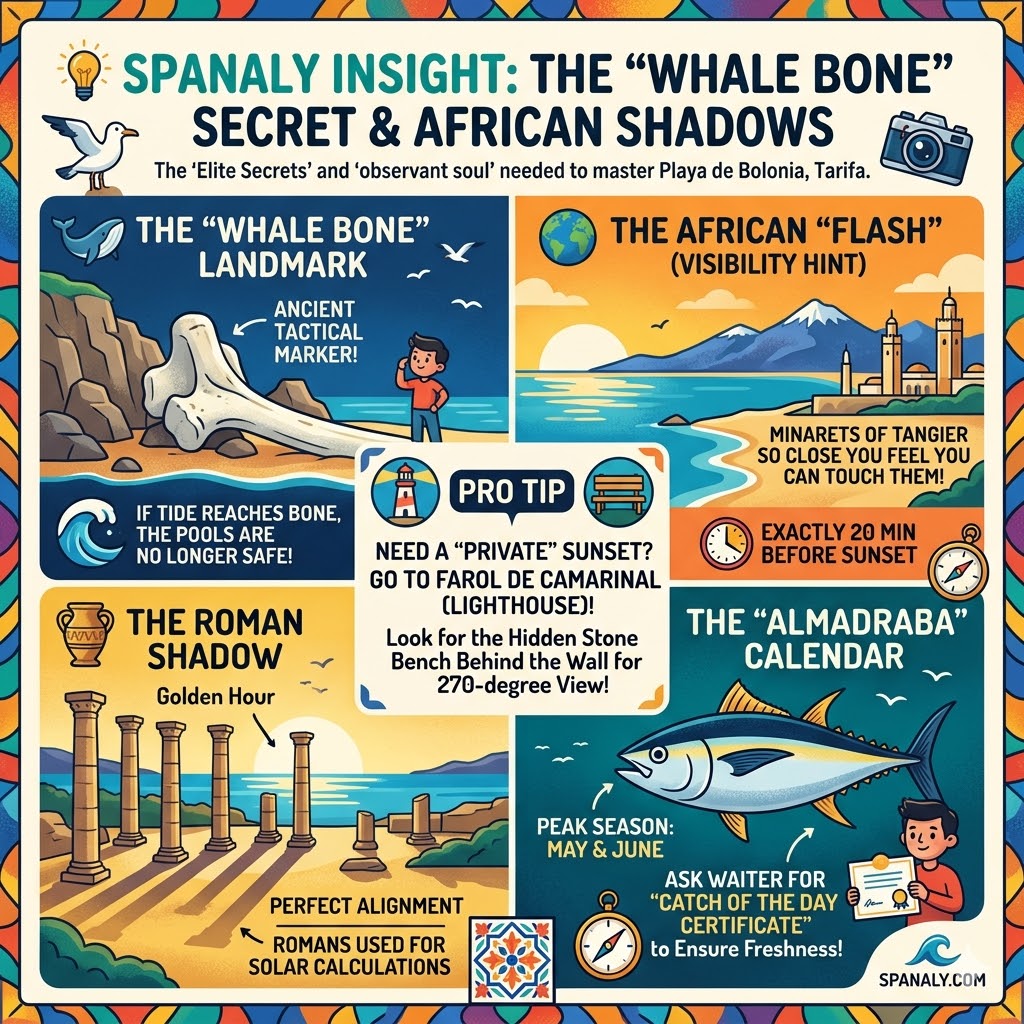
To master Bolonia, look for the subtle details that others miss. These Local Observations will help you navigate like a pro.
🛡️ The Bunker Reference: Notice the old military bunkers along the shore. Some locals use them as a rough visual reference for the tide. However, always verify with an official tide app before walking to the pools.
🌍 The Strait Visibility: On clear Poniente wind days, the Atlantic haze disappears. You may even spot the white houses of Tangier across the Strait. The lighthouse path offers the best elevated view of the African coastline.
🏺 The “Garum” Vats: Look for the deep stone pits near the beach. These are authentic Roman fish-salting vats. You are walking through the ruins of an ancient 2,000-year-old industrial factory.
🐟 The “Almadraba” Sourcing: Authentic tuna is a local treasure but expensive. Ask the waiter if the tuna is locally sourced from the recent Almadraba catches. Fresh, local tuna has a deep red color that frozen imports cannot match.
These nuances separate a tourist from a true explorer. Whether you visit after our Ultimate Seville Travel Guide or drive from Malaga, these observations ensure a smarter trip.
🛡️ Visitor FAQs – Bolonia & Tarifa Logistics Guide
🛡️ Is it safe to leave valuables in the car at Bolonia parking?
While Bolonia is generally safe, never leave bags visible in your rental car. Professional thieves occasionally target beach parking lots. It is best to use the "Secret Lot" near the ruins which is busier and more exposed, making it a safer bet than the isolated dirt patches near the pine forest.
📱 Will I have mobile signal at the Natural Pools?
Expect very patchy coverage. Once you walk past the main dune toward the secret pools, the cliffs often block the signal from Spanish towers. Sometimes your phone might pick up a Moroccan network (Roaming) due to the proximity. We recommend downloading your offline maps before starting the trek.
🏧 Are there ATMs or banks in Bolonia village?
No. There are no ATMs in Bolonia. Most Chiringuitos and the museum entrance accept cards, but for small family-run shops or parking "tips," you will definitely need cash. Make sure to withdraw Euros in Tarifa before you drive down the CA-8202 road.
🚑 What is the closest medical point for emergencies?
Bolonia has a small first-aid station near the main entrance during the summer months. For serious issues, the closest Centro de Salud (Health Center) is in Tarifa (20 min away). For any major emergency, dial 112 immediately; the coastal guard and helicopters are well-equipped to reach the dune area.
🐾 Can I bring my dog to Playa de Bolonia?
Officially, dogs are prohibited on the main beach during the high season (June to September). However, many locals take their pets to the far end of the beach (past the dune) where it is less crowded. To avoid fines, it is best to visit during the off-season when the rules are much more relaxed.
Bolonia & Tarifa Guide by Spanaly.com
Playa de Bolonia isn’t just a destination; it’s a feeling of pure freedom. Whether you are climbing the golden dune or touching Roman history, this bay will stay in your heart long after you leave.
🌅 Don’t Rush: Let the Atlantic wind wash away your stress.
🐟 Eat Local: That Almadraba tuna is a memory you can taste.
🏺 Stay Curious: The ruins have secrets only the observant can find.
If you love these “hidden inland beaches” that defy logic, you shouldn’t miss our guide to Playa de Gulpiyuri in Asturias. It’s another Spanish miracle where the ocean appears in the middle of a green field!
See you on the sand, traveler! 🥂🛡️🏝️