Table of Contents
Toggle✨ Star-Gazing
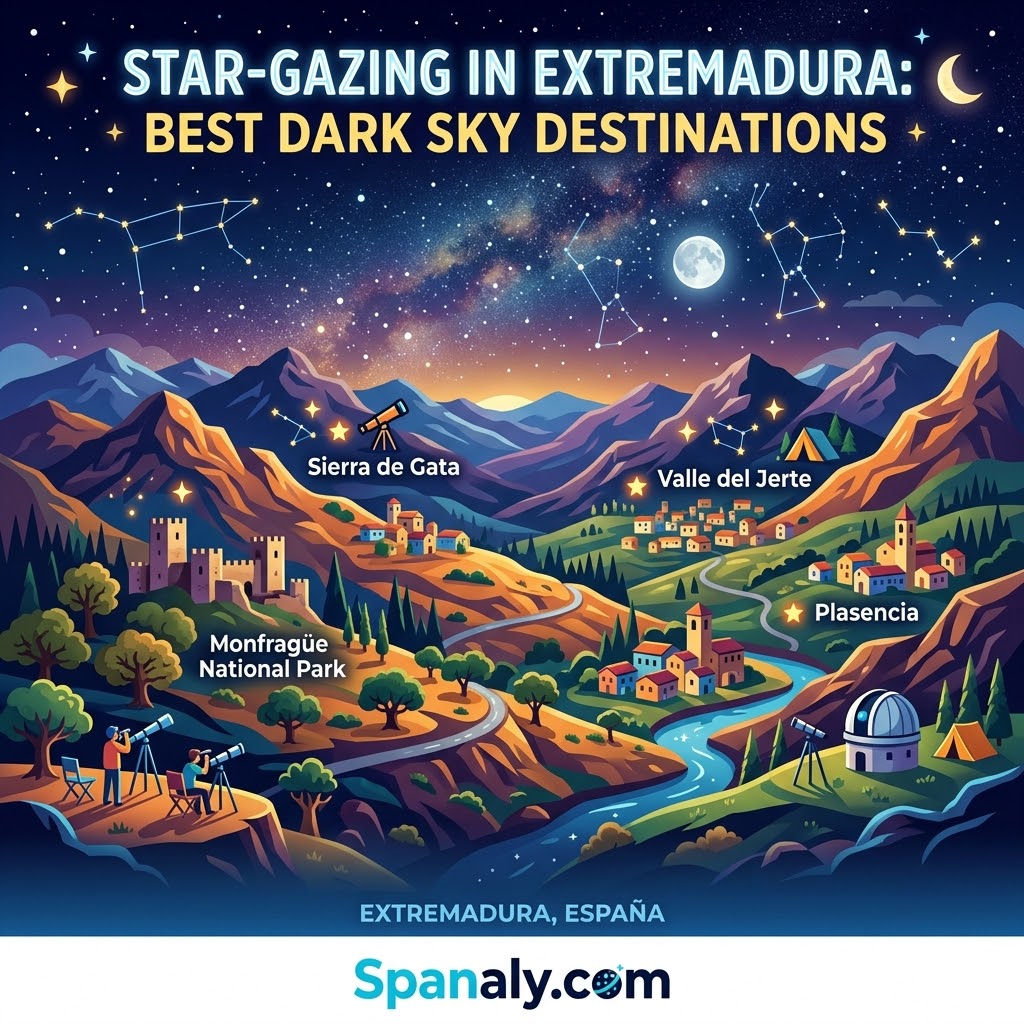
Forget the city lights and discover a universe of clarity. Star-gazing in Extremadura offers one of the darkest, most pristine night skies in all of Europe. Specifically, this region serves as a sanctuary for astronomy enthusiasts.
Certified Dark Skies: You will find vast, protected areas where light pollution is virtually non-existent.
Accessible Adventure: Whether you are a professional photographer or a curious beginner, the celestial displays here remain unparalleled.
Your Gateway: Before heading into the darkness, ensure you have your logistics ready by reviewing our Extremadura Travel Guide to navigate the region’s landscape with ease.
In fact, the combination of high altitude and low humidity creates perfect conditions for observation. Consequently, Extremadura has become the premier destination for those seeking to reconnect with the cosmos.
🌌 Quick Travel Snapshot: Planning Your Stargazing Trip
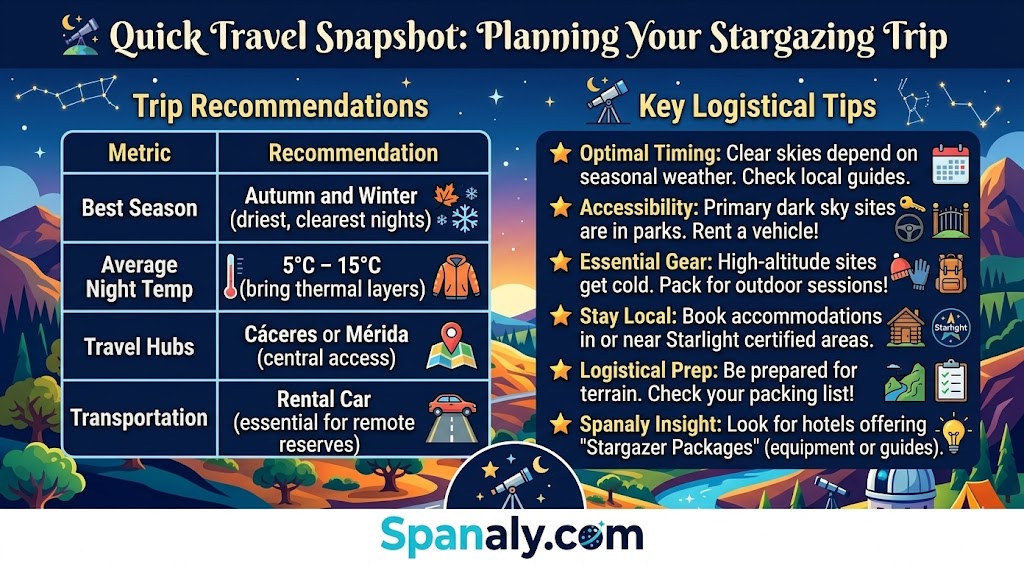
Planning a night sky adventure in Extremadura requires minimal complexity if you organize the right logistics beforehand. Use this snapshot to ensure your trip remains smooth, professional, and visually rewarding.
| Metric | Recommendation |
| Best Season | Autumn and Winter (driest, clearest nights) |
| Average Night Temp | 5°C – 15°C (bring thermal layers) |
| Travel Hubs | Cáceres or Mérida (central access) |
| Transportation | Rental Car (essential for remote reserves) |
Optimal Timing: Clear skies depend on seasonal weather patterns. For the most stable conditions, check our Best Time to Visit Extremadura guide before scheduling your deep-sky observations.
Accessibility: Most primary dark sky sites lie within protected parks. Therefore, renting a vehicle is mandatory to reach these remote, unpolluted locations safely.
Essential Gear: Even in summer, high-altitude observation sites get cold at night. Pack accordingly for static, multi-hour outdoor sessions.
Stay Local: To maximize your night-time access, book accommodations within or near the Starlight certified areas.
Logistical Prep: Before heading out, ensure you are fully prepared for the region’s terrain by reviewing our comprehensive Extremadura Packing List to cover all stargazing essentials.
Spanaly Insight: Many local rural hotels offer “Stargazer Packages” that include equipment rentals or professional guides. Ask your host if they partner with local astronomy clubs for private sessions.
🌌 Extremadura vs. The Atacama Desert: A Comparative Snapshot

While Chile’s Atacama Desert is world-famous for its arid clarity, Extremadura offers a unique, accessible alternative for those seeking a “Cultural Night Sky” experience. Compare these two premier destinations to see which suits your travel style.
| Feature | Extremadura, Spain | Atacama Desert, Chile |
| Accessibility | Easy (Central European hub) | Difficult (Remote, long flights) |
| Landscape | Rolling hills & historic villages | Barren, lunar-like high plains |
| Experience Type | Nature & Cultural immersion | Scientific & Extreme isolation |
| Cultural Blend | Medieval towns & local cuisine | Minimal local human interaction |
The Extremadura Advantage: You can spend your day exploring historic UNESCO heritage sites, then walk five minutes outside your village to witness a pristine, dark sky.
The Scientific Edge: Atacama holds the record for the driest conditions on Earth. Specifically, it caters to professional astronomers and extreme enthusiasts.
Atmosphere: In Extremadura, your stargazing session often concludes with a warm, local dinner in a nearby village. In contrast, Atacama experiences are solitary and intense.
Spanaly Insight: Don’t chase the desert for the sake of the sky alone. If you crave a destination where nature meets heritage, Extremadura’s Starlight certified areas offer the perfect balance. You get the cosmic view without sacrificing the comfort of authentic Spanish culture.
🔬 The Science of Starlight: Extremadura’s Dark Sky Reserves
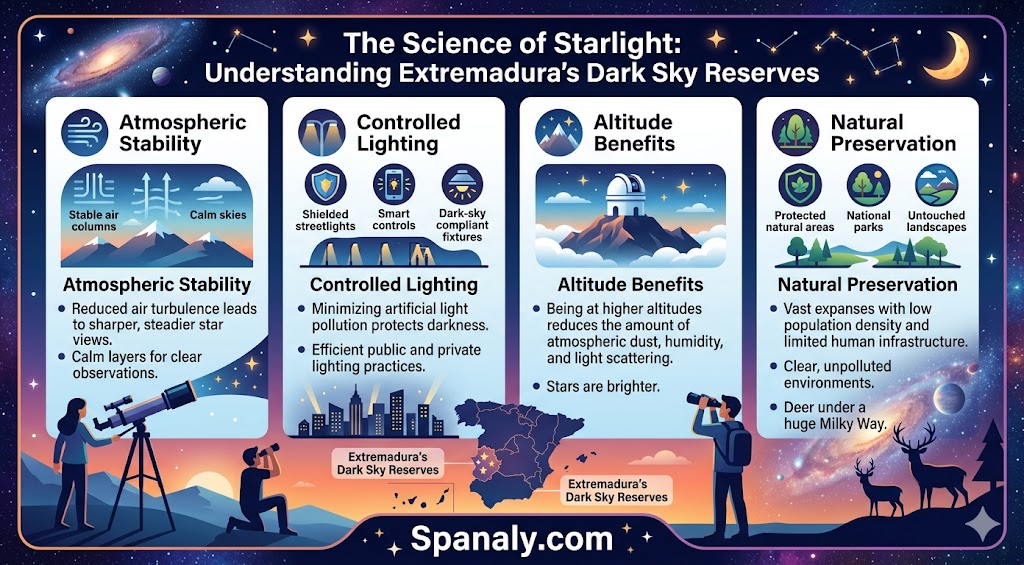
Extremadura manages its night sky to preserve celestial integrity. Starlight certification protects against light pollution, keeping environments perfect for serious astronomy.
Atmospheric Stability: Unique geography creates steady air currents. These stable conditions minimize “twinkling,” providing sharp, defined views of distant galaxies.
Controlled Lighting: Strict regional policies limit light output. This approach maintains low skyglow, allowing naked-eye visibility of the vibrant Milky Way.
Altitude Benefits: High plateaus rise above light-scattering atmosphere. This elevation provides significant advantages for capturing clear, deep-sky images.
Natural Preservation: Integrated conservation protects nocturnal wildlife. Artificial light never disrupts their natural behavior or the pristine skies.
Spanaly Insight: Check our Extremadura Attractions guide. Many protected natural landmarks mentioned there offer the darkest, most scientifically significant skies.
🦅 Best Star-Gazing Spots in Monfragüe National Park
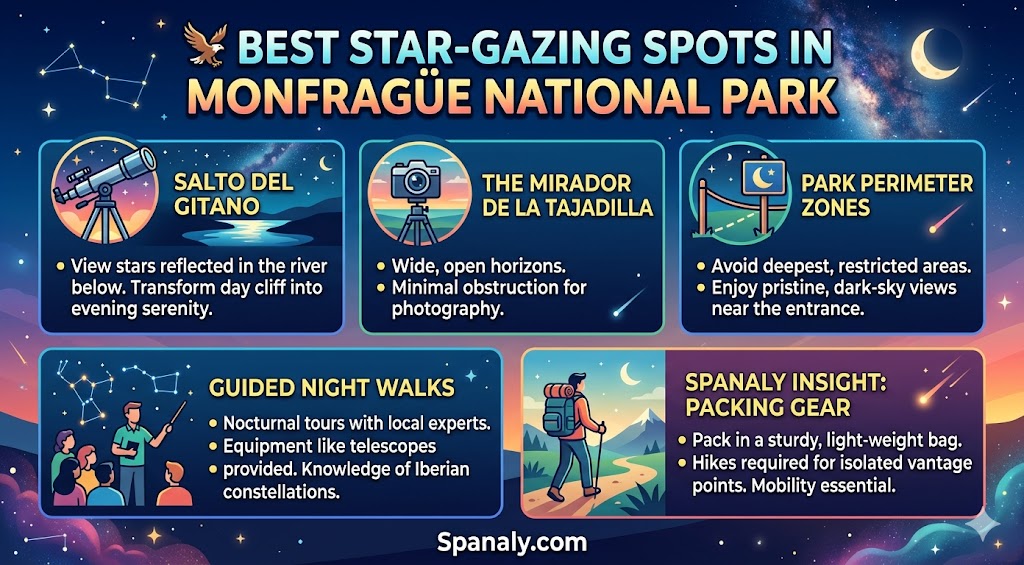
Monfragüe National Park offers more than just iconic birdlife; it is a premier celestial observatory. Specifically, the park’s low light levels transform its dramatic ridges into perfect platforms for night-sky exploration.
Salto del Gitano: During the day, this cliff attracts photographers. At night, it becomes a serene spot to view the stars reflected in the river below.
The Mirador de la Tajadilla: This accessible viewpoint provides wide, open horizons. Furthermore, the surrounding landscape offers minimal obstruction for long-exposure photography enthusiasts.
Park Perimeter Zones: Explore the areas near the park entrance. Consequently, you avoid the deepest, most restricted zones while still enjoying pristine, dark-sky views.
Guided Night Walks: Many local experts offer nocturnal tours here. Moreover, they provide telescopes and deep knowledge of the constellations visible in the Iberian sky.
Spanaly Insight: Pack your gear in a sturdy, light-weight bag. Since you may need to hike to reach the most isolated vantage points, mobility is essential for the best experience.
🌌 Understanding Dark Sky Reserves
Reserves are protected territories where artificial light is strictly regulated. They serve as global sanctuaries for celestial integrity and astronomical research.
Zero Pollution: Strict regulations eliminate skyglow. Consequently, the night remains truly dark, revealing constellations often hidden by urban light domes.
Environmental Protection: These zones safeguard nocturnal biodiversity. By reducing light, they protect the natural rhythms of local wildlife and ecosystems.
Global Certification: Reserves earn status through rigorous monitoring. This ensures high-quality conditions for both scientific study and public stargazing.
Accessible Wonder: These areas democratize astronomy. They provide professional-grade viewing conditions to photographers, families, and curious travelers alike.
🌲 Stargazing in Las Hurdes: The Ultimate Dark Sky Experience
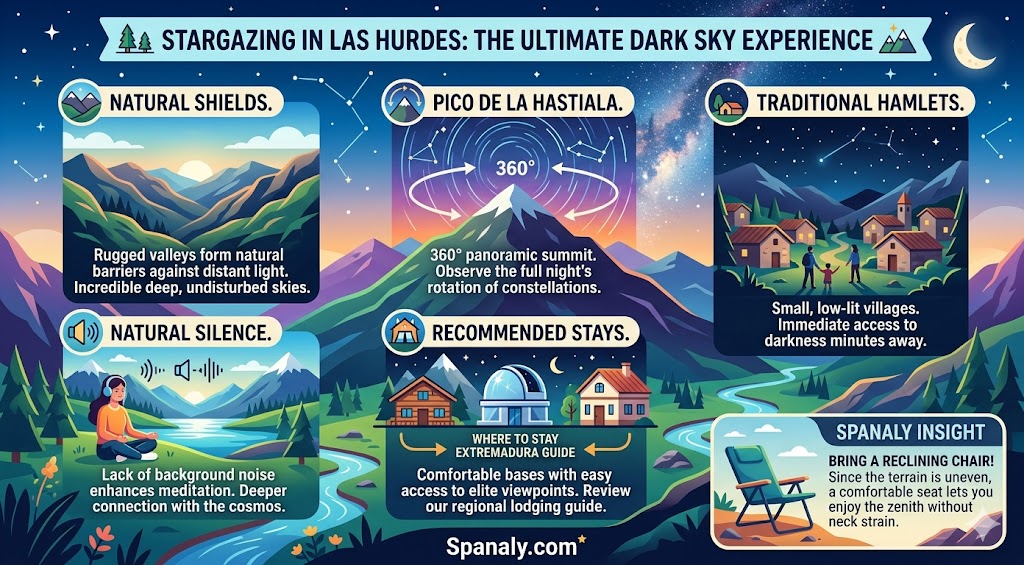
Las Hurdes stands as a rugged, mountainous sanctuary for those seeking true celestial isolation. Because the terrain is deeply etched with valleys, it creates natural shields against distant light. Consequently, the skies here remain incredibly deep and undisturbed.
Pico de la Hastiala: This summit provides a 360-degree panoramic view. Specifically, it is ideal for observing the rotation of constellations throughout the entire night.
Traditional Hamlets: Most villages here remain small and low-lit. Therefore, you can step outside your accommodation and find immediate darkness within minutes.
Natural Silence: The complete lack of background noise enhances the experience. In fact, it allows for a meditative connection with the cosmos that few places offer.
Recommended Stays: To ensure you have a comfortable base, review our Where to Stay Extremadura guide. Selecting the right lodging in this mountainous region significantly improves your access to these elite viewpoints.
🌍 Alqueva Starlight Tourism: Crossing Borders for the Night Sky
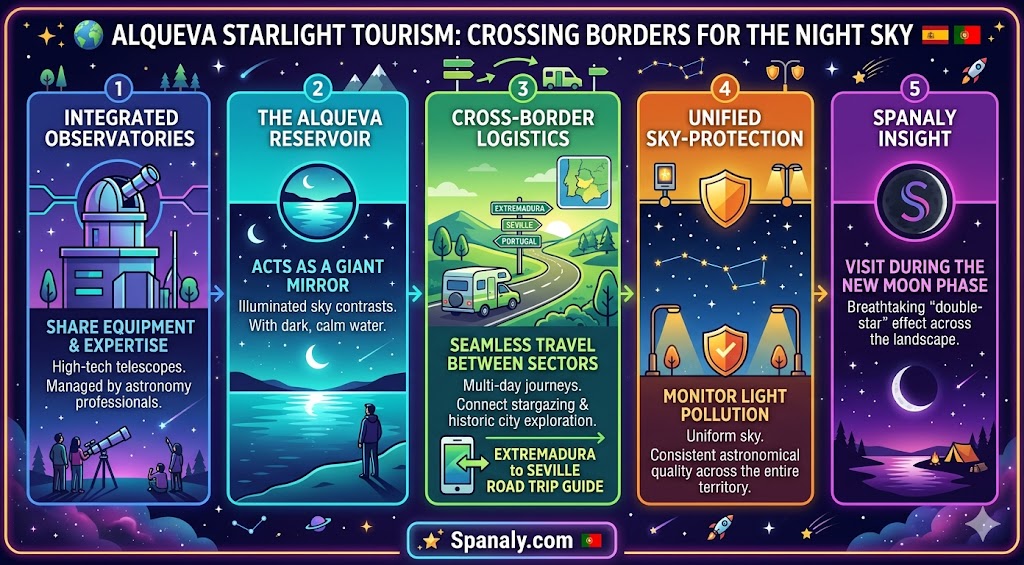
The Alqueva region represents a unique cross-border collaboration between Spain and Portugal. Specifically, it holds the world’s first “Starlight Tourism Destination” certification that spans two different countries.
Integrated Observatories: Both sides of the border share equipment and expertise. Consequently, visitors benefit from high-tech telescopes managed by regional astronomy professionals.
The Alqueva Reservoir: The massive water body acts as a giant mirror. Therefore, it provides a stunning visual contrast between the illuminated sky and the dark, calm water.
Cross-Border Logistics: Traveling between these sectors is seamless. For those planning a multi-day journey across these regions, our Extremadura to Seville Road Trip guide offers the perfect logistics to connect your stargazing sessions with historic city explorations.
Unified Sky-Protection: Experts monitor light pollution levels across the entire territory. Thus, the sky remains uniform, providing consistent astronomical quality regardless of which side of the border you occupy.
Spanaly Insight: Visit during the new moon phase. Because the water reflects the sky so clearly, you will witness a breathtaking “double-star” effect across the landscape.
📷 Essential Stargazing Gear and Photography Tips
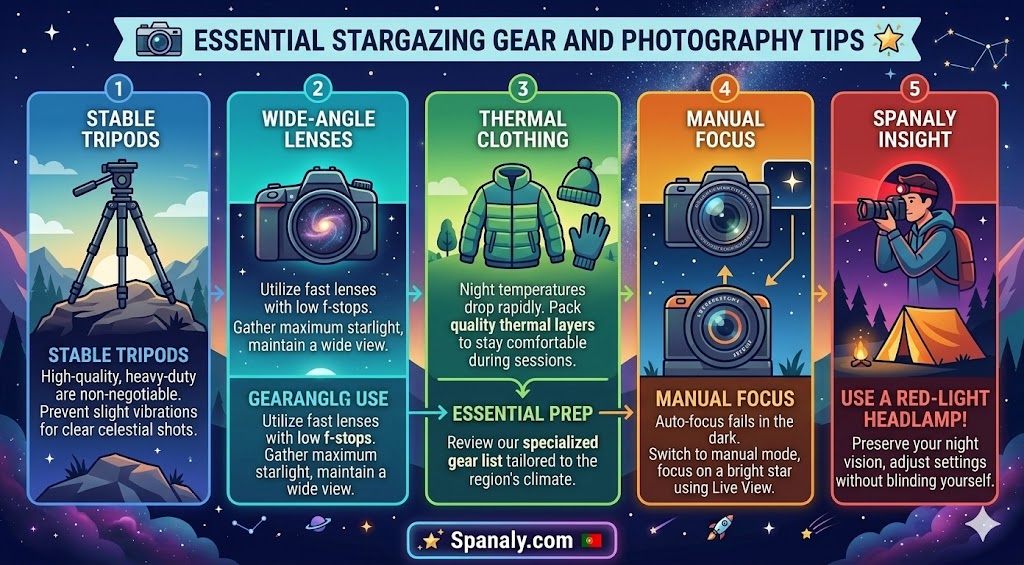
Success under Extremadura’s dark skies relies on preparation. Specifically, you need the right tools to navigate the terrain safely and enhance your astronomical observations.
Stable Support: Bring a heavy-duty tripod. Because you may spend hours observing or capturing images, a sturdy base eliminates motion and ensures comfort.
Essential Visibility: Pack a red-light headlamp. Unlike harsh white LEDs, red light preserves your natural night vision while you adjust your equipment.
Thermal Protection: Temperatures drop significantly in open, high-altitude terrain. Therefore, pack high-quality thermal layers to remain comfortable throughout your nocturnal exploration.
Strategic Planning: To ensure you arrive fully prepared for the region’s climate, consult our Extremadura Packing List for gear tailored specifically to these outdoor environments.
Observation Tools: Bring high-powered binoculars. They provide an immediate, immersive look at constellations that the naked eye alone often misses in the deep dark.
🔭 Elevate Your Experience: Astronomy Tours and Expert Services
If you prefer expert-led journeys, Extremadura offers specialized services that handle every technical logistical detail for you.
Guided Astronomy Tours: Local experts provide deep knowledge of the constellations. They lead you to secluded, certified dark-sky zones at optimal times.
Telescope Rentals: You do not need heavy gear. Many providers deliver high-end telescopes directly to your accommodation or chosen meeting point.
Astrophotography Workshops: Master your camera settings with hands-on training. These workshops focus on capturing the Milky Way with professional precision and guidance.
Starlight Hotels: Stay at elite properties that partner with astronomy centers. These hotels feature dedicated viewing platforms and immediate, expert-led night sessions.
“True celestial discovery thrives when local expertise guides your path, ensuring every moment under the stars remains perfectly seamless.”
Spanaly Insight: Book these services two weeks early. Since these boutique experiences have limited capacity, early reservation secures your spot under the clearest skies.
🗓️ Best Time of Year for Stargazing in Extremadura
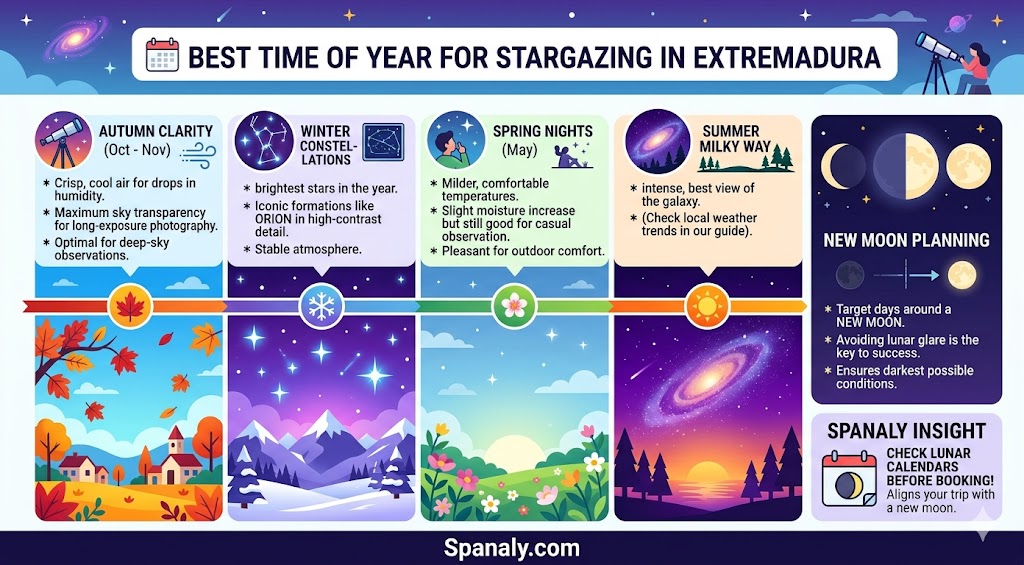
While the night sky remains beautiful year-round, specific seasons maximize your celestial clarity. Specifically, autumn and winter offer the driest, most stable atmosphere for deep-sky observations.
Autumn Clarity: October and November provide crisp, cool air. Consequently, humidity drops, and the sky achieves maximum transparency for long-exposure photography.
Winter Constellations: During these months, the sky features the brightest stars. Therefore, you can easily observe iconic formations like Orion in stunning, high-contrast detail.
Spring Nights: May offers milder temperatures. Although atmospheric moisture increases slightly, it is the most comfortable period for casual observation and outdoor comfort.
Summer Milky Way: Summer nights provide the most intense view of our galaxy. However, ensure you verify the local weather trends by reviewing our Best Time to Visit Extremadura guide for seasonal insights.
New Moon Planning: Regardless of the month, always target the days surrounding a new moon. Moreover, avoiding lunar glare is the single most important factor for success.
Spanaly Insight: Check lunar calendars before finalizing your travel dates. Aligning your trip with a new moon ensures you experience the darkest possible conditions.
🏨 Top Starlight-Certified Accommodations and Campsites
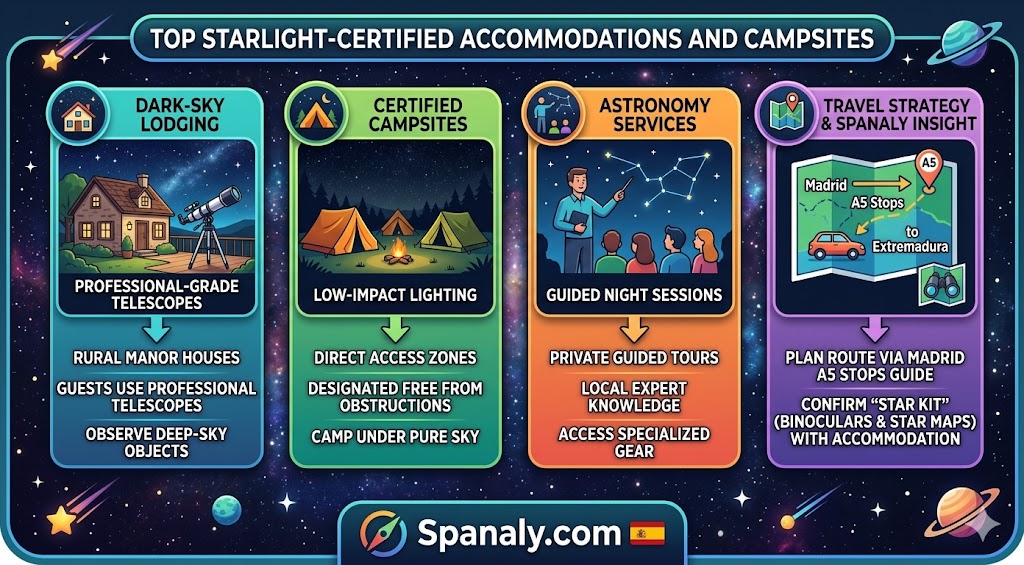
Staying in a Starlight-certified lodge transforms your trip into a continuous astronomical experience. Specifically, these properties invest in specialized infrastructure, like rooftop observatories, to enhance your comfort.
Dark-Sky Lodging: Many rural manor houses now offer professional-grade telescopes. Consequently, you can observe deep-sky objects without leaving your private garden.
Certified Campsites: These campgrounds provide low-impact lighting. Furthermore, they offer designated zones completely free from any artificial obstruction for your telescope.
Astronomy Services: Several hosts organize private, guided night sessions. Therefore, booking here guarantees direct access to local expert knowledge.
Travel Strategy: Plan your route from the capital using our Madrid to Extremadura A5 Stops guide. It perfectly bridges your journey to these serene properties.
“True celestial discovery thrives when your accommodation provides dedicated infrastructure, turning every night into an immersive, professional-grade observatory experience.”
Spanaly Insight: Always confirm if your lodge provides a “Star Kit” upon arrival. Many elite properties now include high-powered binoculars and star maps as standard amenities.
🌌 Night Sky Photography for Beginners: Capturing the Stars
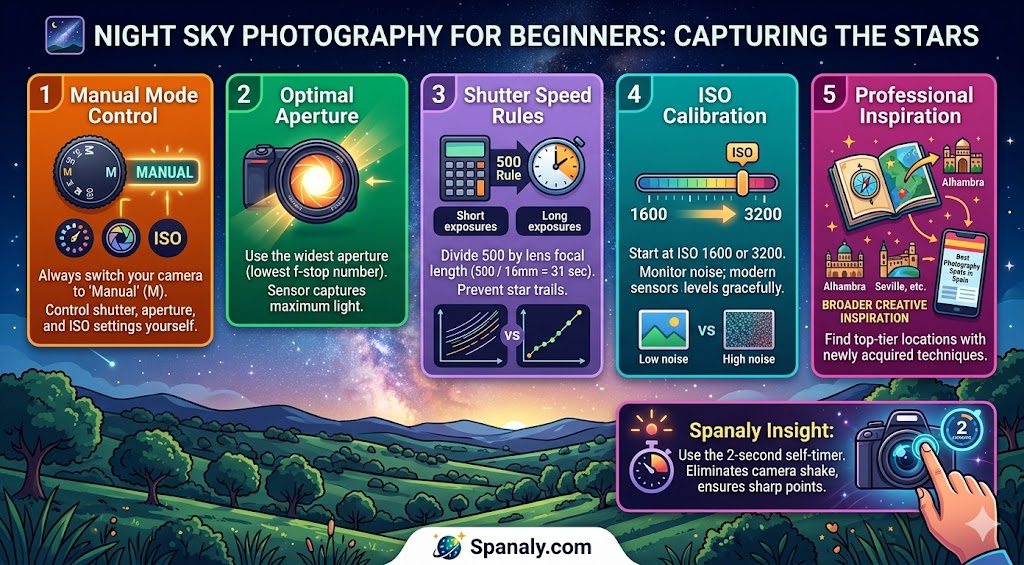
You don’t need an expensive telescope to document the Extremaduran night. Instead, focus on mastering basic camera settings to turn the Milky Way into your own masterpiece.
Manual Mode Control: Always switch your camera to ‘Manual’ (M). Specifically, you must control the shutter speed, aperture, and ISO settings yourself.
Optimal Aperture: Use the widest aperture your lens allows (the lowest f-stop number). Consequently, your sensor will capture the maximum amount of light available.
Shutter Speed Rules: Use the “500 Rule” to prevent star trails. Simply divide 500 by your lens focal length to find your maximum exposure time.
ISO Calibration: Start at ISO 1600 or 3200. Moreover, monitor your noise levels; modern sensors often handle these levels gracefully for crisp images.
Professional Inspiration: If you are seeking broader creative inspiration, our Best Photography Spots in Spain guide offers top-tier locations that pair perfectly with your newly acquired night-sky techniques.
Spanaly Insight: Use the 2-second self-timer on your camera. This simple action eliminates camera shake caused by pressing the shutter button, ensuring perfectly sharp stellar points.
⚠️ Common Mistakes to Avoid
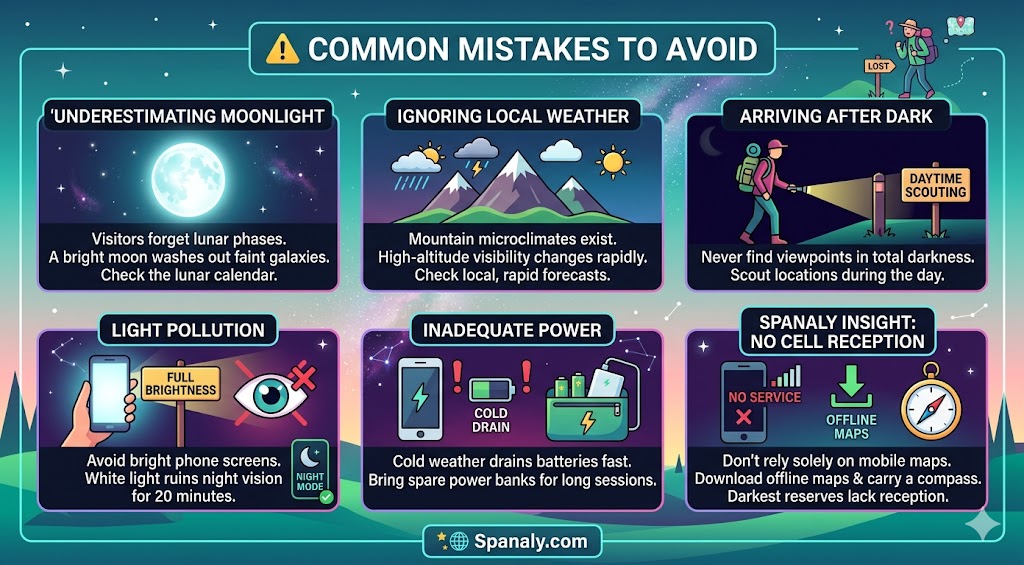
Even experienced travelers encounter pitfalls when exploring the dark. Specifically, avoiding these errors will significantly improve your comfort and success rate.
Underestimating Moonlight: Many visitors forget to check the lunar phase. Consequently, a bright moon can wash out the sky, making faint galaxies invisible.
Ignoring Local Weather: Mountains create microclimates. Therefore, always check local forecasts for cloud cover, as high-altitude visibility can change rapidly overnight.
Arriving After Dark: Never attempt to find a remote viewpoint for the first time in total darkness. Always scout your location during the day.
Light Pollution: Avoid keeping your phone screen at full brightness. In fact, even a few seconds of white light will ruin your night vision for 20 minutes.
Inadequate Power: Cold weather drains batteries faster than normal. Moreover, always bring spare power banks to keep your devices running through long sessions.
💡 Pro Tips: The Expert Stargazer’s Edge
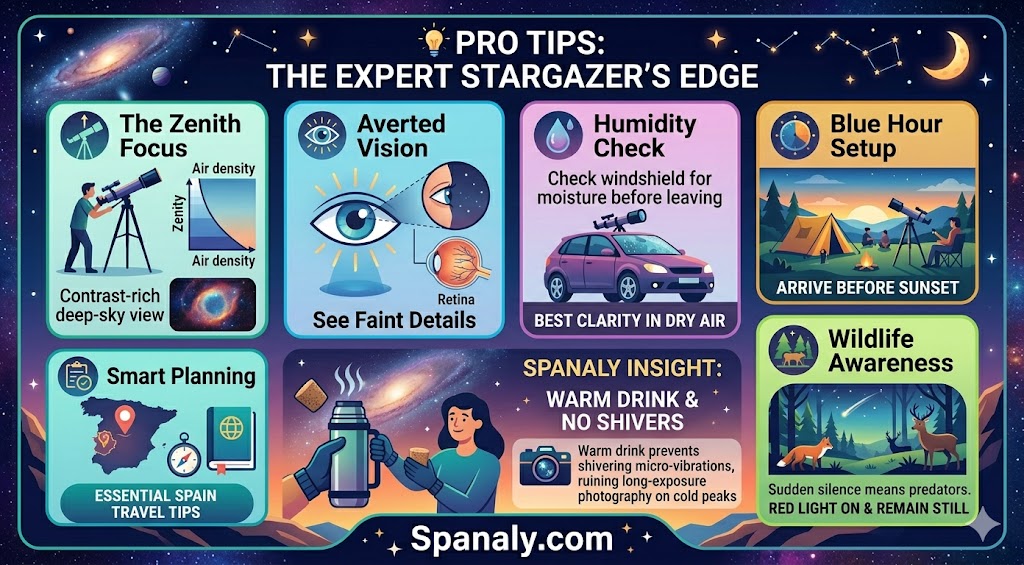
Master the night with these exclusive insights. These elite strategies ensure your astronomical experience remains truly professional and unique.
The Zenith Focus: Air is thickest at the horizon. Aim your gaze or lens directly overhead for the sharpest, most contrast-rich views.
Averted Vision: Do not stare directly at faint stars. Look slightly to the side to trigger your retina’s superior low-light sensitivity.
Humidity Check: Check your windshield for moisture before leaving. Dry, crisp air provides the best clarity for deep-sky observation.
Blue Hour Setup: Arrive before sunset. Transitioning slowly helps your eyes and gear adapt naturally to the fading daylight.
Smart Planning: Before exploring these remote reserves, review our Essential Spain Travel Tips to navigate regional logistics with ease.
Wildlife Awareness: Sudden silence in local fauna often signals predators. Keep your red light on and remain still for safety.
Extremadura is more than just a destination; it is an open invitation to reconnect with the cosmos. From the rugged peaks of Las Hurdes to the quiet reserves of Monfragüe, the pristine Iberian sky offers a profound sense of wonder that remains rare in our modern world.
Plan Your Journey: Whether you seek deep-sky photography or quiet nocturnal contemplation, the region offers unparalleled access to nature’s most spectacular light show.
Embrace the Silence: Allow the total darkness to sharpen your senses. Specifically, look beyond the horizon and experience the stars as they were meant to be seen.
Extend Your Adventure: Planning to explore beyond the region? Discover how to seamlessly connect your celestial trip with other breathtaking landscapes by following our Northern Spain to Extremadura Guide.
Your Next Step: Pack your gear, check the lunar calendar, and prepare for a transformative experience under the stars. The night sky is waiting.