🏛️ La Lonja de la Seda
Step into the heart of Valencia and discover a building that defines the city’s “Golden Age.” La Lonja de la Seda (The Silk Exchange) is not just a landmark; it is a journey back to the 15th century.
🏰 Gothic Grandeur: Witness one of Europe’s most famous civil Gothic buildings.
🧵 Silk Heritage: Explore the historic hub where the Mediterranean silk trade was born.
🌟 UNESCO Gem: A site recognized globally for its cultural and architectural value.
In fact, the moment you enter, the modern world disappears. Furthermore, the grandeur of its halls reflects the immense wealth of Valencia’s medieval merchants. Ultimately, it’s a must-visit for anyone following our Spain Historical Monuments Guide.
💡 Spanaly Pro Tip: To experience the “Golden Glow” of the stone, visit during the late afternoon. The sunlight through the high Gothic windows turns the twisted columns into a warm, amber spectacle!
📜 Historical Overview: The Silk Empire
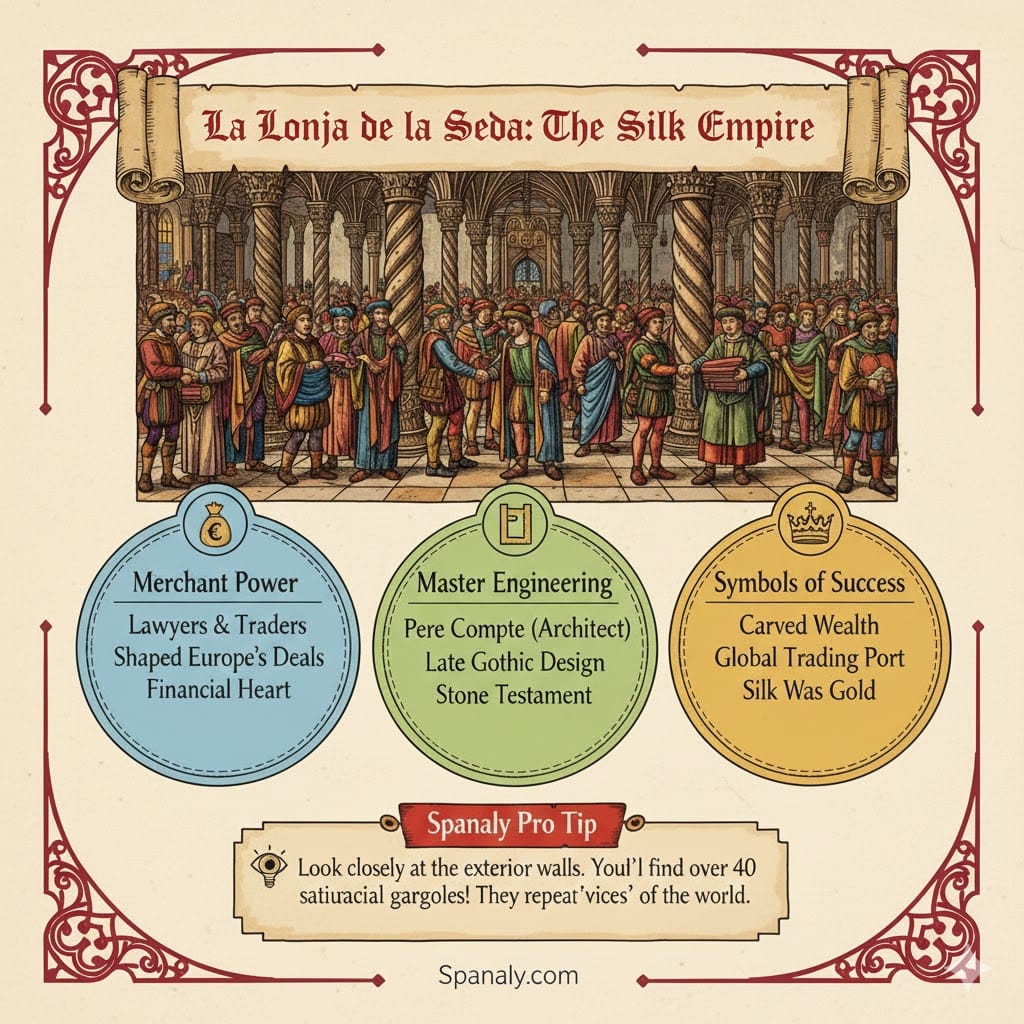
Built between 1482 and 1548, La Lonja was the financial beating heart of Valencia. It was here that the city proved its dominance over Mediterranean trade.
💰 Merchant Power: A place where lawyers and traders signed deals that shaped Europe.
🏗️ Master Engineering: Designed by Pere Compte, a visionary of Late Gothic architecture.
⛪ Symbols of Success: Every stone was carved to show off Valencia’s prosperity.
This ambitious project transformed the city into a global trading port. Moreover, its design was influenced by other iconic structures, much like the Cathedral of Santiago de Compostela represents Spain’s spiritual power. Ultimately, La Lonja stands as a stone testament to a time when silk was as valuable as gold.
💡 Spanaly Pro Tip: Look closely at the exterior walls. You will find over 40 satirical gargoyles! They were designed to represent the “vices” of the world, contrasting with the “virtue” of honest trade inside.
✨ Architectural Highlights: Stone Made Silk
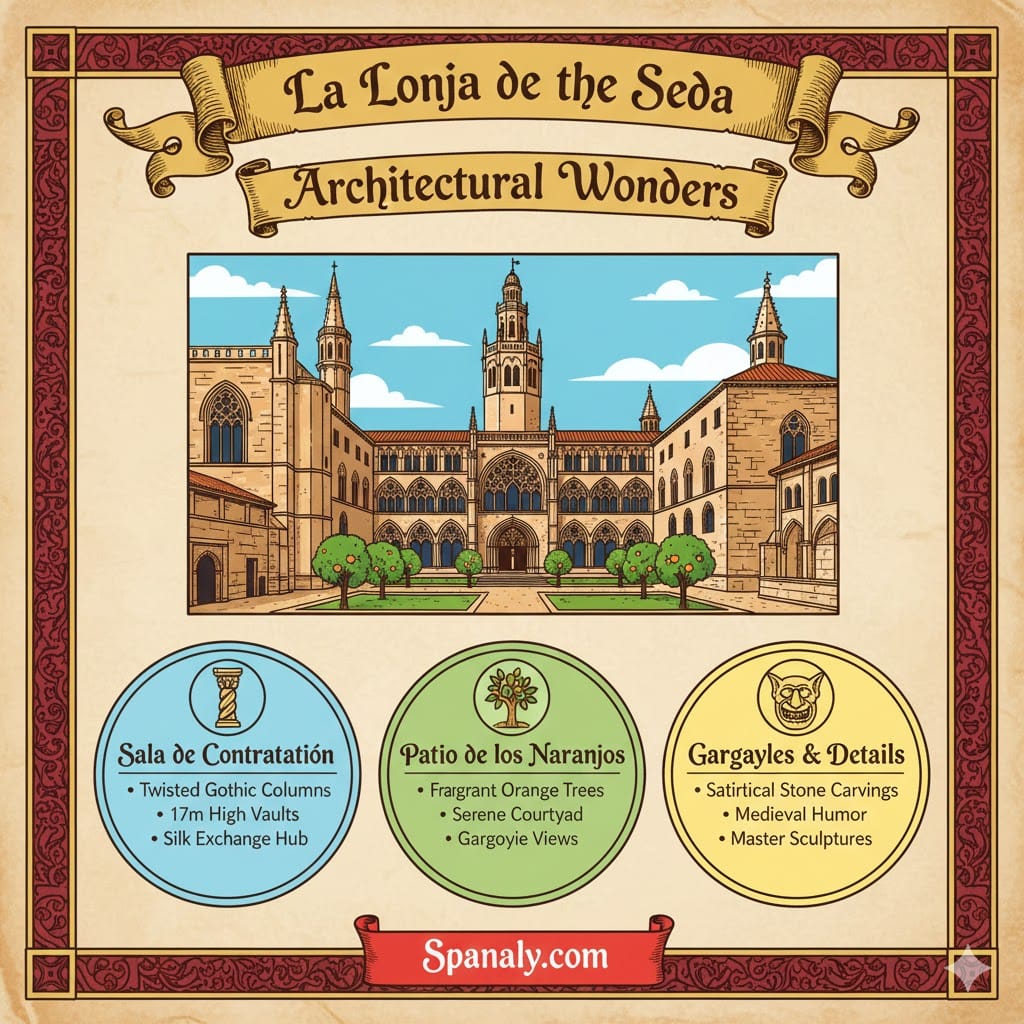
The architecture of La Lonja is a masterpiece of Valencian Gothic style. It is often said that the architects managed to turn hard stone into delicate silk.
🌀 Sala de Contratación: The main hall features 8 magnificent helix-shaped columns that rise 17 meters high, resembling twisted silk ropes.
🍊 Patio de los Naranjos: A serene Mediterranean courtyard filled with fragrant orange trees—the perfect spot for merchants to rest.
👹 The Gargoyles: Look up! The exterior is decorated with over 40 satirical stone carvings representing life’s vices and virtues.
👑 The Sea Consulate: A later Renaissance addition where maritime trade disputes were settled under a stunning carved wooden ceiling.
In fact, the twisted columns are unique in Europe and inspired many other Spain Historical Monuments. Furthermore, the harmony between the light and the stone creates a spiritual atmosphere in a commercial building. Ultimately, every arch is a testament to the engineering mastery of the 15th century.
💡 Spanaly Pro Tip: When you enter the Contract Hall, look at the floor! The colorful marble tiles are designed to mimic the patterns of the precious silk fabrics that were once traded right above them.
⚖️ The Consulate of the Sea & The Prison Tower
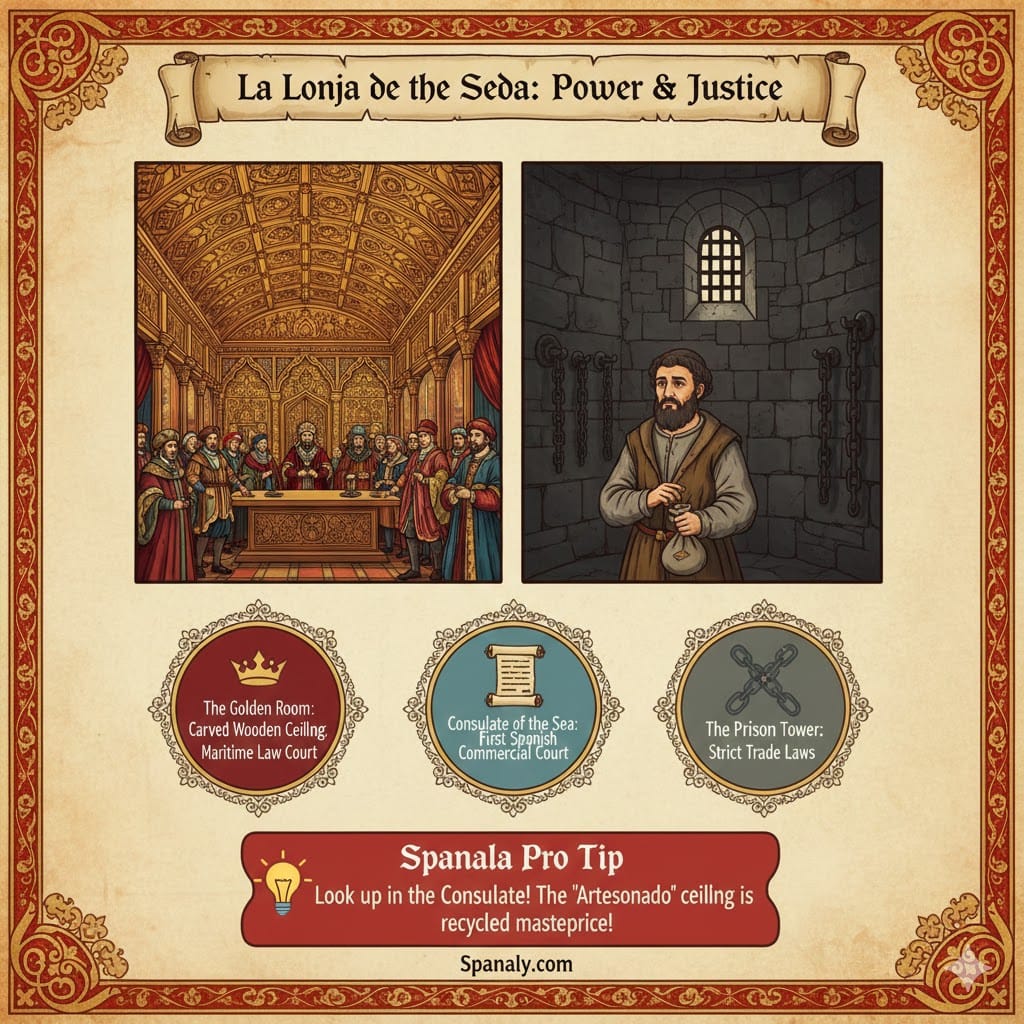
Beyond the main hall lies the administrative heart of medieval trade. This section reveals the legal and darker side of Valencia’s silk commerce.
👑 The Golden Room: Located in the Consulado del Mar, this room features a spectacular 15th-century carved wooden ceiling brought from the old City Hall.
📜 Maritime Law: This was the first place in Spain where sea-trade disputes were settled by a specialized commercial court.
⛓️ The Secret Tower: The upper floors of the central tower served as a prison for merchants who went bankrupt or failed to pay their debts.
In fact, the contrast between the beauty of the ceilings and the harshness of the prison tower is fascinating. Furthermore, it reminds us that Valencia’s wealth was built on strict commercial laws. Ultimately, it’s a site that rivals the Roman Theatre of Mérida in historical importance.
💡 Spanaly Pro Tip: Look up in the Consulate room! The ceiling is a masterpiece of “Artesonado” woodwork. It wasn’t originally built for this room, but saved from a demolished building—a true medieval recycling success!
👹 The Secrets of the Gargoyles: Medieval Satire
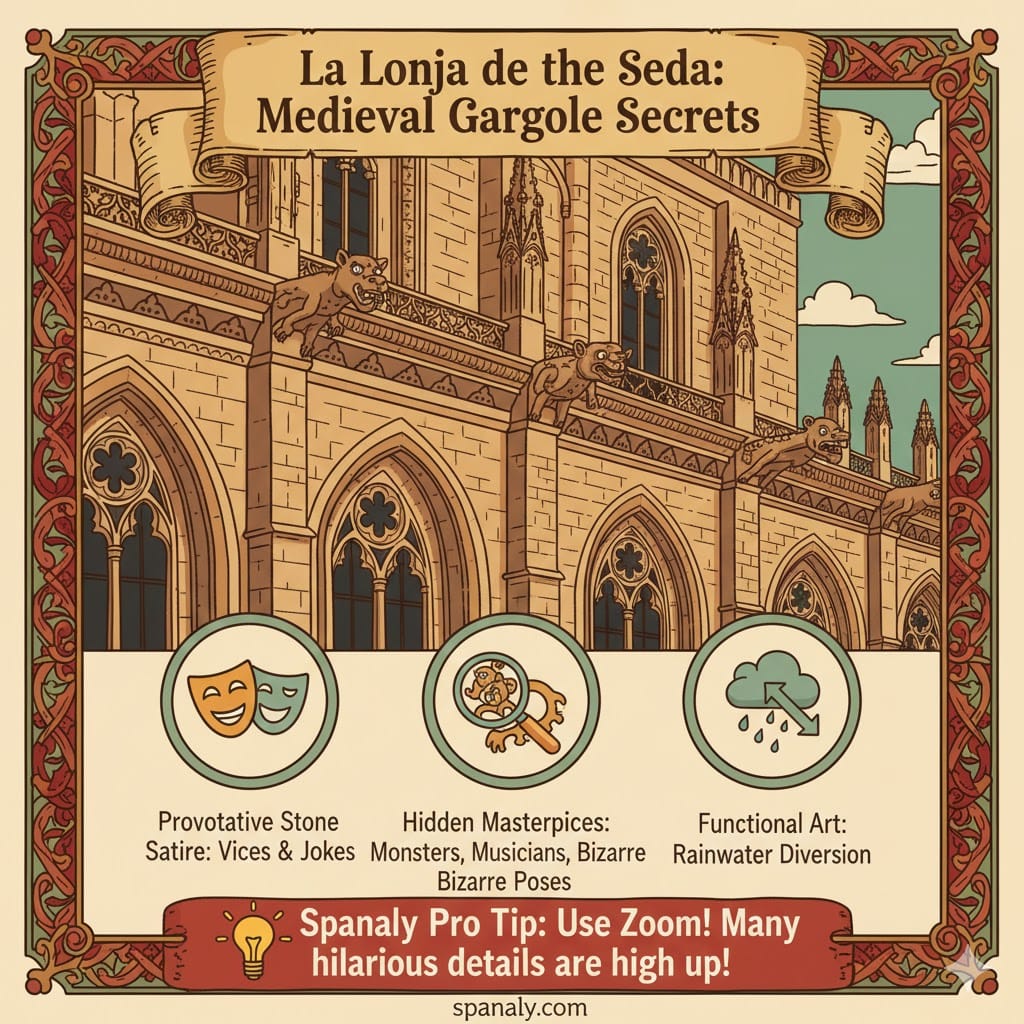
One of the most entertaining parts of visiting La Lonja de la Seda is exploring its exterior walls. Unlike the solemn religious carvings often found in medieval structures like the City Walls of Ávila, these gargoyles are famous for their “naughty” and satirical nature, offering a rare glimpse into 15th-century humor.
🎭 Provocative Stone Satire: These figures don’t represent saints; instead, they portray human vices, sins, and bold medieval jokes that will surely make you double-take.
🔍 Hidden Masterpieces: As you walk around the facade, look for monsters, musicians, and figures in bizarre, provocative poses—some are quite legendary for their “R-rated” details!
🏰 Functional Art: While they serve as a visual feast, their primary job was hydraulic—directing rainwater away from the delicate Gothic stonework to prevent erosion.
In fact, these carvings prove that the Middle Ages were far from dull; they were bursting with life and irony. Furthermore, they provide a sharp artistic contrast to the serious silk negotiations happening inside the halls. Ultimately, searching for the “strangest” carving is a favorite activity for families and photography enthusiasts alike.
💡 Spanaly Pro Tip: Bring a pair of binoculars or use your phone’s zoom! Many of the most hilarious and detailed gargoyles are tucked away near the roofline, far above eye level, and are easy to miss if you don’t look closely.
🌍 UNESCO Legacy: Why it Matters
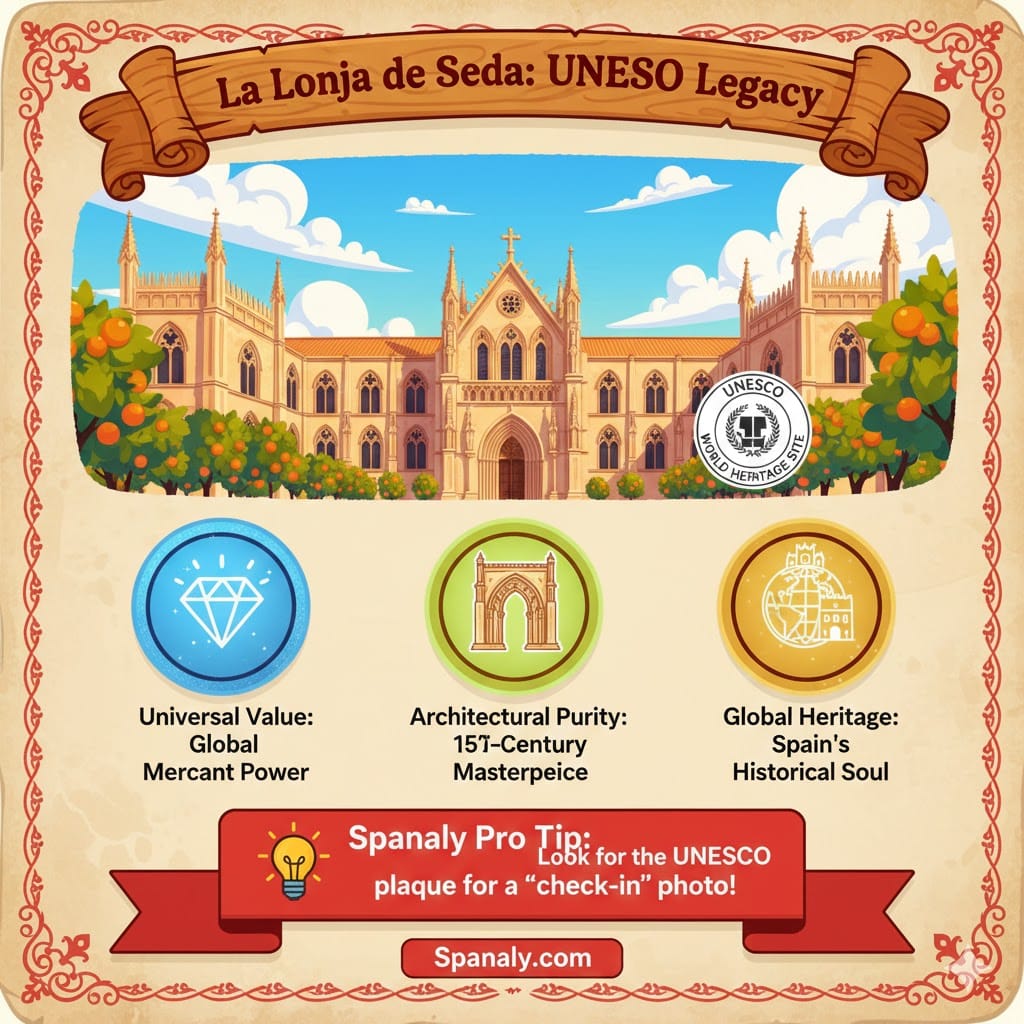
In 1996, La Lonja de la Seda was officially declared a UNESCO World Heritage site. It is not just a beautiful building; it is considered the most complete example of a secular Gothic structure in the Mediterranean, representing the bridge between the Middle Ages and the Renaissance.
💎 Universal Value: UNESCO recognizes it as a masterpiece that illustrates the power and wealth of the great Mediterranean merchant cities.
🏗️ Architectural Purity: Unlike many other monuments that were heavily modified over centuries, La Lonja remains almost exactly as it was in the 15th century.
✅ Global Heritage: It stands alongside world-renowned icons like the Alhambra in Granada as a must-see for anyone exploring Spain’s historical soul.
In fact, it is one of the few places in Europe where you can still feel the original atmosphere of a medieval trading floor. Furthermore, its preservation status is impeccable, making it a “living museum” of Gothic engineering. Ultimately, its UNESCO status is a guarantee that you are visiting a site of exceptional importance to all of humanity.
💡 Spanaly Pro Tip: Look for the UNESCO plaque near the main entrance! It’s the perfect spot for a “traveler’s check-in” photo to document your journey through Spain’s World Heritage icons.
🎫 2026 Visitor Pro-Guide: Plan Your Visit
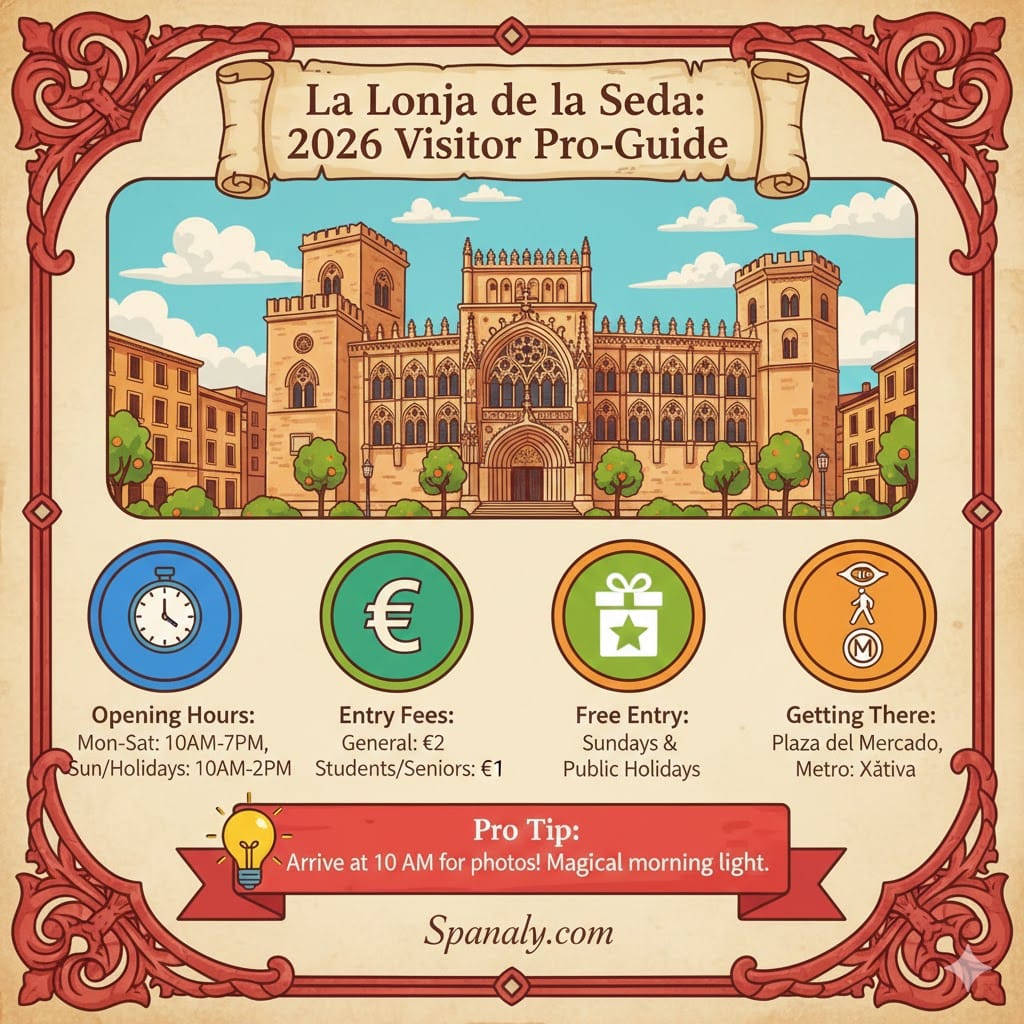
Visiting La Lonja de la Seda is straightforward, but knowing these “pro-details” for 2026 will help you avoid the crowds and save money.
⏰ Opening Hours: Open Monday to Saturday from 10:00 AM to 7:00 PM. On Sundays and public holidays, it closes early at 2:00 PM.
💶 Entry Fees: The general admission is a bargain at only €2. Students and seniors pay a reduced fee of €1.
🆓 Free Entry: In 2026, admission remains FREE for everyone on Sundays and local holidays—perfect for budget travelers!
🚶 Getting There: It is located in Plaza del Mercado. You can easily reach it via Metro (Line 3 or 5, Xàtiva station) or by a short walk from the Valencia Cathedral area.
In fact, the visit usually takes about 45 to 60 minutes, giving you plenty of time to explore the nearby Central Market. Furthermore, the building is wheelchair accessible in most areas, including the main hall. Ultimately, it is one of the most affordable UNESCO sites you will ever visit in Spain.
💡 Spanaly Pro Tip: If you want that “perfect” photo of the twisted columns without 50 other tourists in it, try to arrive at exactly 10:00 AM on a weekday. The morning light filtering through the high windows is magical for photography!
📍 Neighborhood Synergy: Your 3-Hour Valencia Route
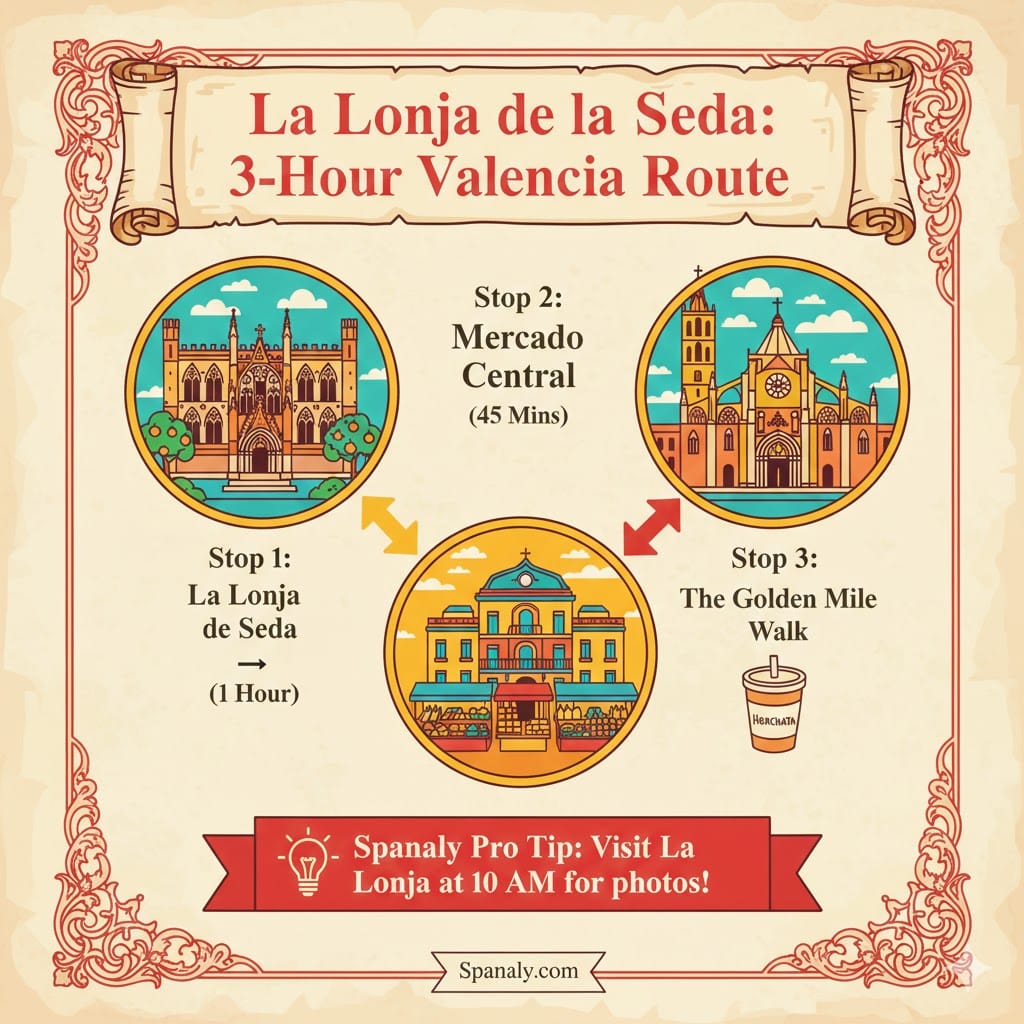
La Lonja is perfectly situated in the heart of Valencia’s historic district. To make the most of your morning, we recommend this optimized walking route that connects the city’s greatest landmarks.
🏛️ Stop 1: La Lonja de la Seda (1 Hour): Start here at 10:00 AM to enjoy the morning light in the Contract Hall and the quiet of the Orange Courtyard.
🥘 Stop 2: Mercado Central (45 Mins): Just across the street! Explore one of Europe’s largest fresh food markets. It’s the best place to buy authentic Spanish saffron.
⛪ Stop 3: The Golden Mile Walk: Walk 5 minutes toward the Plaza de la Reina. This area is a highlight of our Valencia Complete Guide, where history meets modern life.
In fact, this area was the commercial “Golden Triangle” of medieval Spain. Furthermore, the proximity of these sites makes it easy to explore even if you only have half a day. Ultimately, ending your walk with a traditional “Horchata” near the market is the most authentic Valencian experience you can have.
💡 Spanaly Pro Tip: Most people visit the Market first and then La Lonja. Do the opposite! Visit La Lonja at opening time to have the hall to yourself, then head to the Market when it’s at its most vibrant and lively.
🏛️ Expert Tips: Beyond the Silk Trade
📸 Can I use a tripod for photography inside La Lonja?
Standard photography is encouraged, but tripods and professional flash equipment usually require a special permit. For the best interior shots of the twisted columns, we recommend using a wide-angle lens and increasing your ISO to handle the natural dim light.
💰 Was there a bank inside the building?
Yes! The Taula de Canvis (Table of Exchange) was established here in 1407. It was one of the first municipal banks in Europe, designed to support silk merchants and manage commercial debts, proving that Valencia was a pioneer in modern finance.
🎧 Are audio guides available in English?
Absolutely. You can rent an audio guide at the entrance for a small fee. It covers the hidden meanings of the gargoyles and the history of the Sea Consulate. It’s a great investment if you are not visiting with a private tour guide.
👧 Is it a kid-friendly attraction?
Surprisingly, yes! Kids love the "monster hunt" outside, searching for the funniest gargoyles. The open space of the Orange Courtyard also provides a safe, car-free environment for them to breathe while you admire the architecture.
Curated by Spanaly.com
🏛️ Why You Can’t Skip La Lonja
La Lonja de la Seda is the beating heart of Valencia’s golden age. From the dizzying twisted columns to the satirical gargoyles, every stone tells a story of ambition and artistry.
It is a rare bridge between the Middle Ages and the modern world. Best of all, it offers an unforgettable UNESCO experience that is both deep and affordable.
🚀 What’s Next for You?
Ready for more Spanish wonders?
UNESCO Magic: Explore our guide to the Alhambra in Granada.
Valencia Tips: Plan your full trip with our Valencia Complete Guide.
💬 Your Turn! Which part surprised you more—the “naughty” gargoyles or the majestic silk hall? Share your thoughts in the comments below!