🏰 Alcázar of Segovia
Rising dramatically from a rocky crag, the Alcázar of Segovia is more than just a fortress—it is a vision captured in stone. With its slate-tiled turrets and ship-like silhouette, it stands as one of the most recognizable landmarks in the world.
Why this castle is extraordinary:
🎭 Disney’s Inspiration: Widely believed to be the model for Walt Disney’s Cinderella Castle.
👑 Royal Heritage: A favorite residence for 22 Spanish monarchs, including Queen Isabella I.
⚔️ Strategic Power: Built at the confluence of the Eresma and Clamores rivers for ultimate defense.
🎨 Architectural Gem: A rare blend of Romanesque, Gothic, and Mudéjar styles.
Whether you are exploring its grand halls or climbing its spiral towers, the Alcázar offers a journey through the heart of Castile. If you are staying in the capital, this is a highlight of any Day Trip from Madrid to Segovia.
💡 Spanaly Pro Tip: For the best “storybook” view of the castle, head to the Mirador de la Pradera de San Marcos. From this valley, you can see the castle’s full “ship” shape rising above the trees—it’s the ultimate spot for photographers!
🏰 The Roots of History: From Roman Shield to Royal Crown

The history of the Alcázar is as deep as the canyons that surround it. Long before the slender towers were built, this site was a strategic powerhouse for every civilization that ruled Spain.
Key Historical Milestones:
🛡️ Roman Foundations: Built on the ruins of a Roman fort, utilizing the naturally defensive granite cliff.
🏰 The Moorish Era: First mentioned in 1120 as a “fortress on the hill” shortly after Segovia was reclaimed by King Alfonso VI.
👑 The Royal Golden Age: In the 15th century, it became the epicenter of the Spanish monarchy.
📜 The 1474 Proclamation: Its most pivotal moment occurred when Isabella I left the Alcázar to be crowned Queen of Castile in the city’s main square.
This fortress didn’t just protect the city; it shaped the very nation of Spain. For travelers exploring the region’s monuments, it is a cornerstone of Spain’s Historical Monuments Guide.
👑 The Hall of Kings: A Royal Walk Through Time
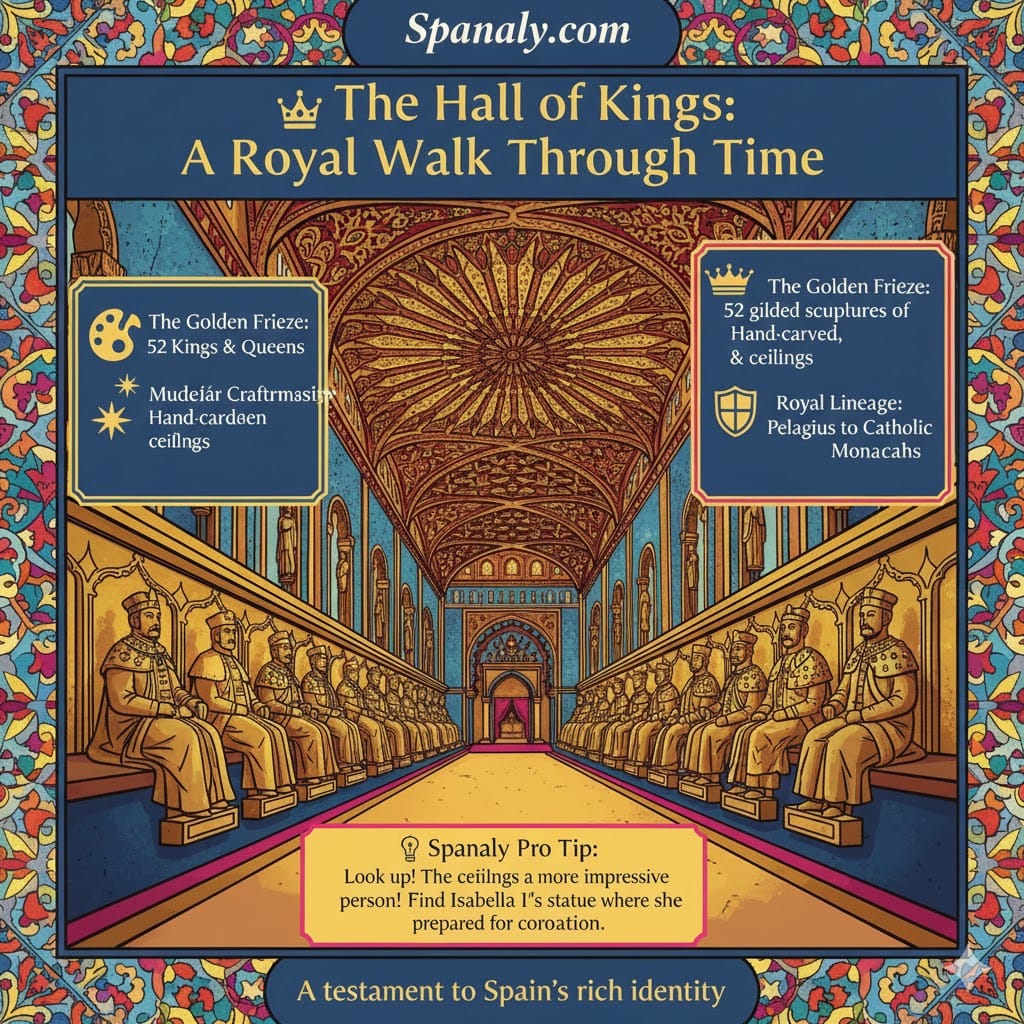
The Hall of Kings (Sala de los Reyes) is the heart and soul of the Alcázar’s interior. This breathtaking chamber was commissioned by King Philip II to immortalize the monarchs who built and defended the Spanish nations.
Why it is a Masterpiece:
🎨 The Golden Frieze: High on the walls, you will find a gilded frieze featuring 52 seated sculptures. These represent the Kings and Queens of Asturias, León, and Castile.
✨ Mudéjar Craftsmanship: The ceiling is a spectacular example of Artesonado (intricate Moorish-style woodwork), dripping with gold and historical detail.
🛡️ Royal Lineage: From the legendary Pelagius to the Catholic Monarchs, the room acts as a visual “Who’s Who” of Spanish royalty.
This hall is more than just a room; it is a testament to the rich identity that makes people understand Why Visit Spain is an essential experience for every traveler.
💡 Spanaly Pro Tip: Take a moment to look at the statue of Isabella I. It was in this very castle that she prepared for her coronation, a moment that changed the course of world history. Don’t forget to look up at the intricate patterns of the ceiling; they are even more impressive in person!
🏛️ Architectural Fusion: A Masterpiece of Spanish Styles
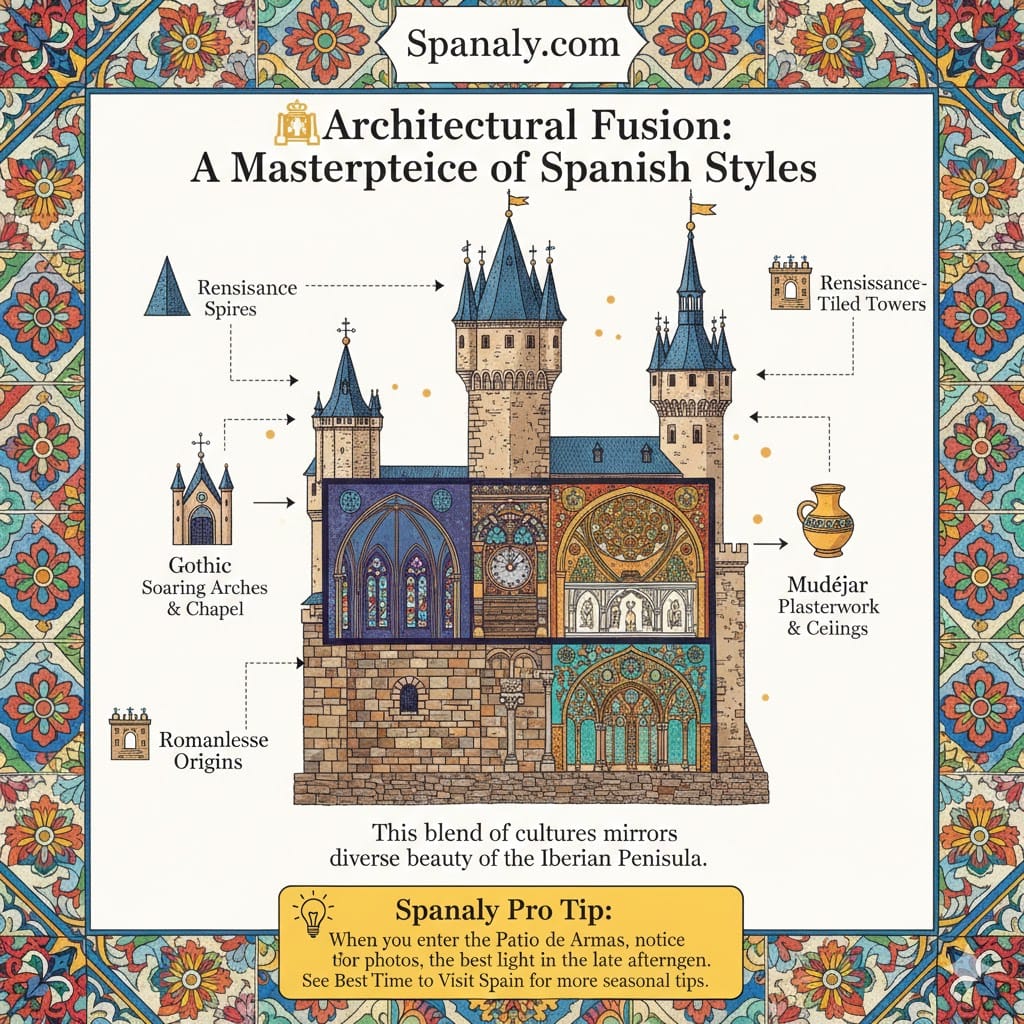
The Alcázar is not just a building; it is a “vertical museum” of Spanish architecture. Its unique ship-like silhouette is a result of centuries of layers, where medieval defense meets royal luxury.
Styles you will encounter:
🏰 Romanesque Origins: Found in the sturdy foundations and the oldest courtyards.
⛪ Gothic Grandeur: Evident in the soaring pointed arches and the majestic Chapel.
🏺 Mudéjar Elegance: Intricate plasterwork and Artesonado ceilings, similar to the artistic wealth found in our Ultimate Seville Travel Guide.
🏗️ Renaissance Spires: The iconic slate-tiled towers added by King Philip II to mimic Central European palaces.
This blend of cultures mirrors the diverse beauty of the Iberian Peninsula. To see how these styles evolved across the country, check our guide on Why Visit Spain to discover more architectural wonders.
💡 Spanaly Pro Tip: When you enter the Patio de Armas, notice the contrast between the cold military exterior and the delicate interior. If you’re planning your trip, remember that the best light for architectural photography is in the late afternoon. See our Best Time to Visit Spain for more seasonal tips.
🛡️ The Royal Armory & Museum
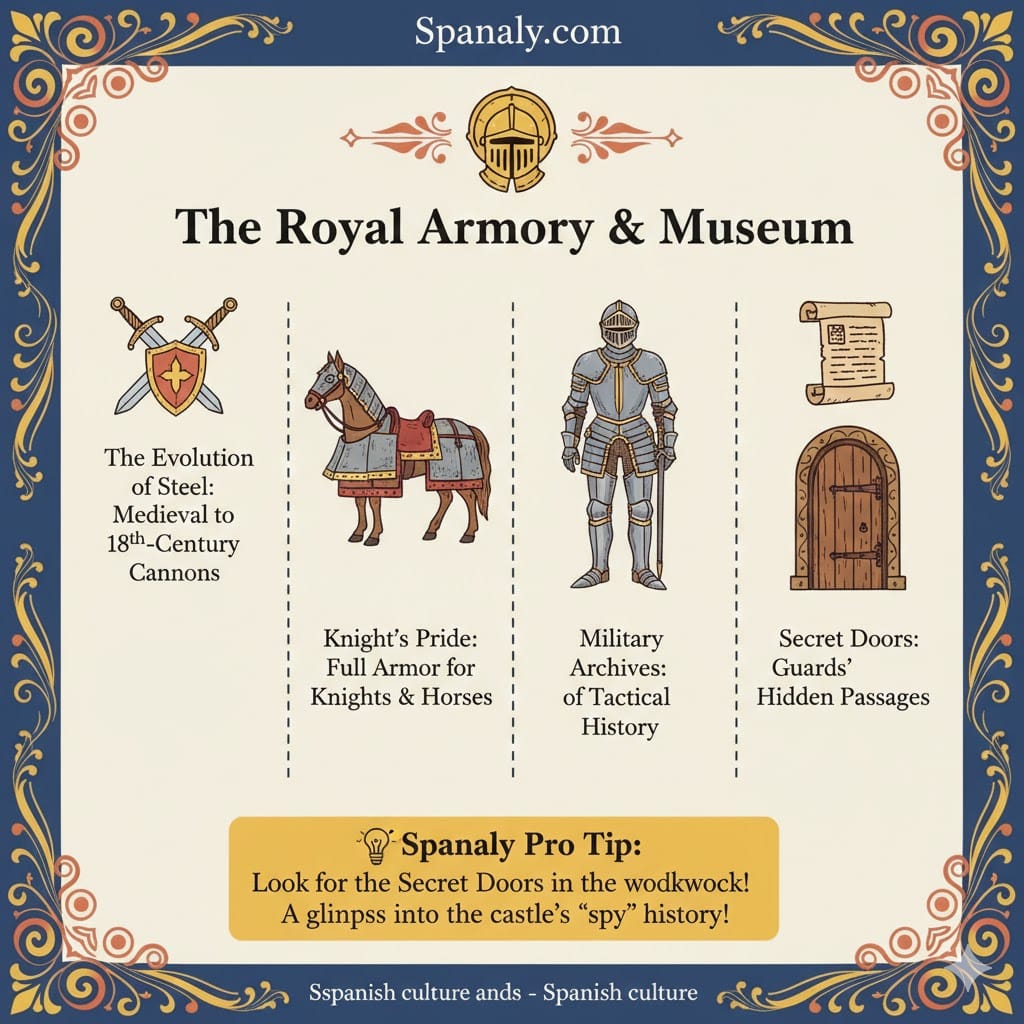
Beyond the royal luxury, the Alcázar was a military powerhouse. For centuries, it housed the Royal School of Artillery, and today it holds one of the most impressive weapon collections in Europe.
⚔️ The Evolution of Steel: From early medieval broadswords to advanced 18th-century cannons.
🐎 Knight’s Pride: Full-sized suits of armor for both the knight and his horse—beautifully preserved.
📜 Military Archives: Documents that show how the castle defended the heart of Castile for generations.
Exploring this museum is a highlight for anyone interested in the chivalry that shaped the nation. For more insights into the rules and traditions that define the country, explore our Cultural Etiquette in Spain 2026 Guide.
💡 Spanaly Pro Tip: When visiting the Armory, look for the small “Secret Doors” in the woodwork. These were used by guards to move between the royal quarters and the defensive towers without being seen by guests—it’s a fascinating glimpse into the castle’s “spy” history!
🚀 The Tower of Juan II: Segovia from the Clouds
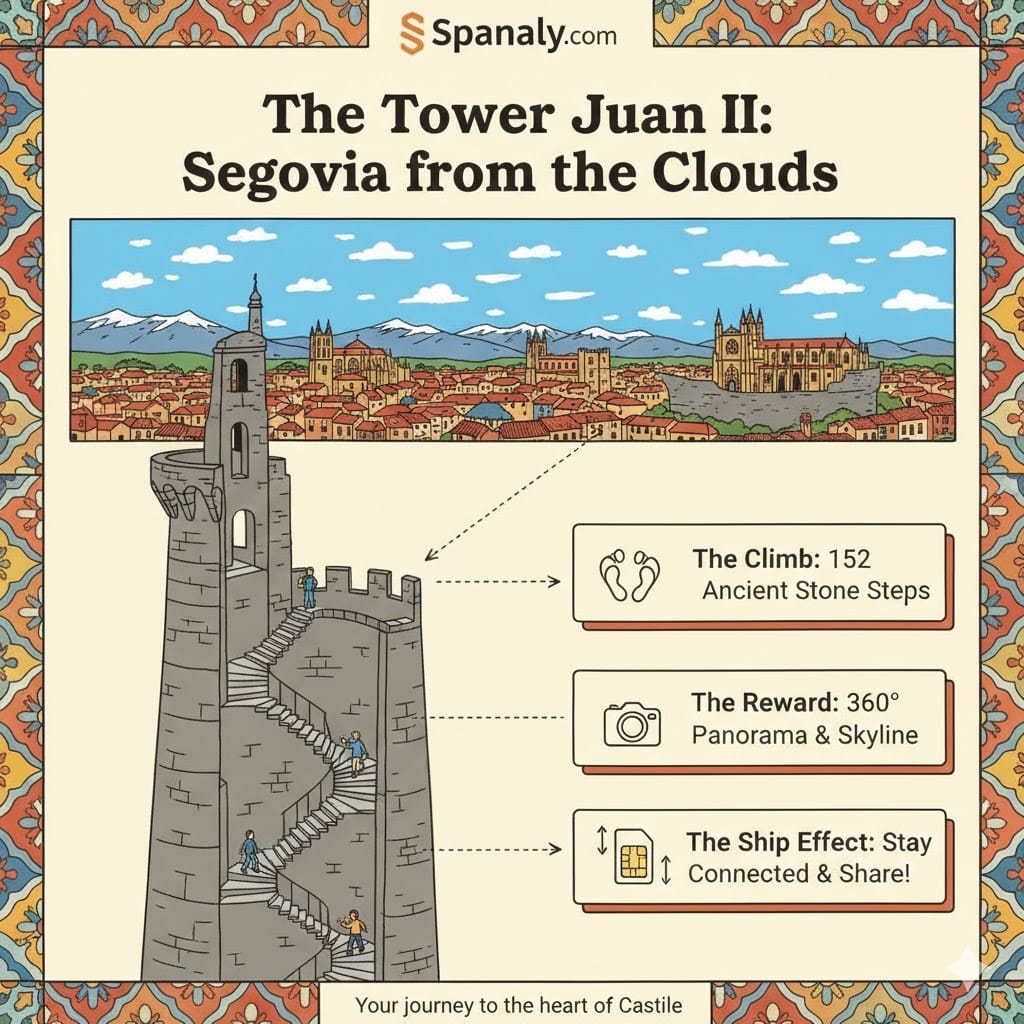
No visit to the Alcázar is complete without facing the challenge of the Tower of Juan II. This towering sentinel was once a state prison, but today it offers the most rewarding view in Castile.
👣 The Climb: A narrow spiral staircase of 152 ancient stone steps. It’s a workout, but the history embedded in the walls makes it feel like time travel.
📸 The Reward: Once at the top, you are greeted by a 360-degree panorama of Segovia’s skyline and the distant mountains.
🚢 The Ship Effect: From this height, the castle’s “bow” shape becomes crystal clear, looking like a stone ship sailing through the countryside.
💡 Spanaly Pro Tip: Don’t let the climb distract you from your belongings. For a smooth trip, make sure you have the right connectivity to share your photos instantly by checking the Internet in Spain 2026: Best SIM Cards & eSIM Guide.
🌳 The Exterior: The Moat and Gardens

The magic of the Alcázar doesn’t end at its gates; the surrounding landscape is a masterpiece of medieval engineering and landscaping. Walking around the base of the fortress allows you to appreciate its defensive power and fairytale beauty simultaneously.
Outside the Walls:
🛡️ The Deep Moat: Carved into the rock, the moat was the first line of defense. Today, it creates a dramatic frame for the soaring stone walls.
🏰 The Ship’s Bow: From the gardens below, you can see why it’s called the “Stone Ship.” The confluence of the Eresma and Clamores rivers forms the “vessel’s” path through the valley.
🌿 The Lush Gardens: Perfectly manicured paths offer the best angles for photography, especially during the golden hour.
Exploring the exterior requires a fair amount of walking on uneven paths. To ensure you are fully prepared for the Spanish terrain, make sure to read our guide on What to Pack for Spain: The Ultimate 2026 Checklist to choose the right footwear and gear.
💡 Spanaly Pro Tip: For the most iconic “postcard” photo of the entire castle, don’t just stay by the entrance. Walk down to the Pradera de San Marcos. This grassy field offers the legendary view where the castle looks like it’s floating above the trees—it’s the exact spot where artists and filmmakers find their inspiration!
🎬 The Disney & Cinema Connection: A Real-Life Fairytale

It is a widely held belief that the Alcázar of Segovia served as a primary inspiration for Walt Disney’s Cinderella Castle. While many European castles claim this honor, the Segovian fortress, with its blue-tiled spires and dramatic location, remains the most convincing candidate.
📽️ Hollywood’s Favorite: Beyond animation, the castle has been a filming location for numerous epics, including Orson Welles’ “Chimes at Midnight.”
✨ Myth vs. Reality: Whether or not Walt Disney stood on this very ground, the castle perfectly embodies the “Chivalric Legend” that defines Spanish history.
If you are a fan of these legendary stories and want to explore more mystical sites across the country, don’t miss our article on Spain’s Historical Places & Legends.
💡 Spanaly Pro Tip: Want to capture the “Disney Look” without the crowds? Head to the Tower of Juan II right as the castle opens. The morning mist often clings to the valley below, making the castle appear as if it’s floating in the clouds—the ultimate fairytale shot!
📍 Visitor Logistics (2026 Update)

Planning your visit to the Alcázar in 2026 is simpler than ever, provided you have the latest information. As one of Spain’s most visited monuments, timing and transportation are key to a stress-free experience.
Opening Hours & Tickets:
⏰ High Season (April – October): Daily from 10:00 AM to 8:00 PM.
❄️ Low Season (November – March): Daily from 10:00 AM to 6:00 PM.
🎫 2026 Pricing: A full ticket (Palace, Museum, and Tower of Juan II) is approximately €10. If you wish to skip the tower, the Palace and Museum ticket is about €7.
🖱️ Booking: We strongly recommend booking via the Official Website at least 48 hours in advance to secure your time slot.
How to Get There from Madrid: The most efficient way to reach Segovia in 2026 is via the High-Speed Train (AVE/AVANT).
🚉 Departure: Madrid Chamartín Clara Campoamor Station.
⏱️ Duration: Only 27 minutes!
🚌 From Segovia Station: Take the Line 11 bus directly to the Aqueduct/Old Town, then a short scenic walk to the castle.
Traveling on a budget? Balancing monument fees and transport costs is essential. Check our Spain Travel Budget 2026: Cost of Living & Travel Guide to see how to fit this royal visit into your overall spending plan.
💡 Spanaly Pro Tip: EU Citizens can enjoy free admission to the Palace and Museum on Tuesdays from 2:00 PM to 4:00 PM (excluding holidays). You must present a valid ID at the ticket office, but remember that the Tower of Juan II always requires a separate paid ticket!
📸 Pro Photography Spots: Capturing the Magic
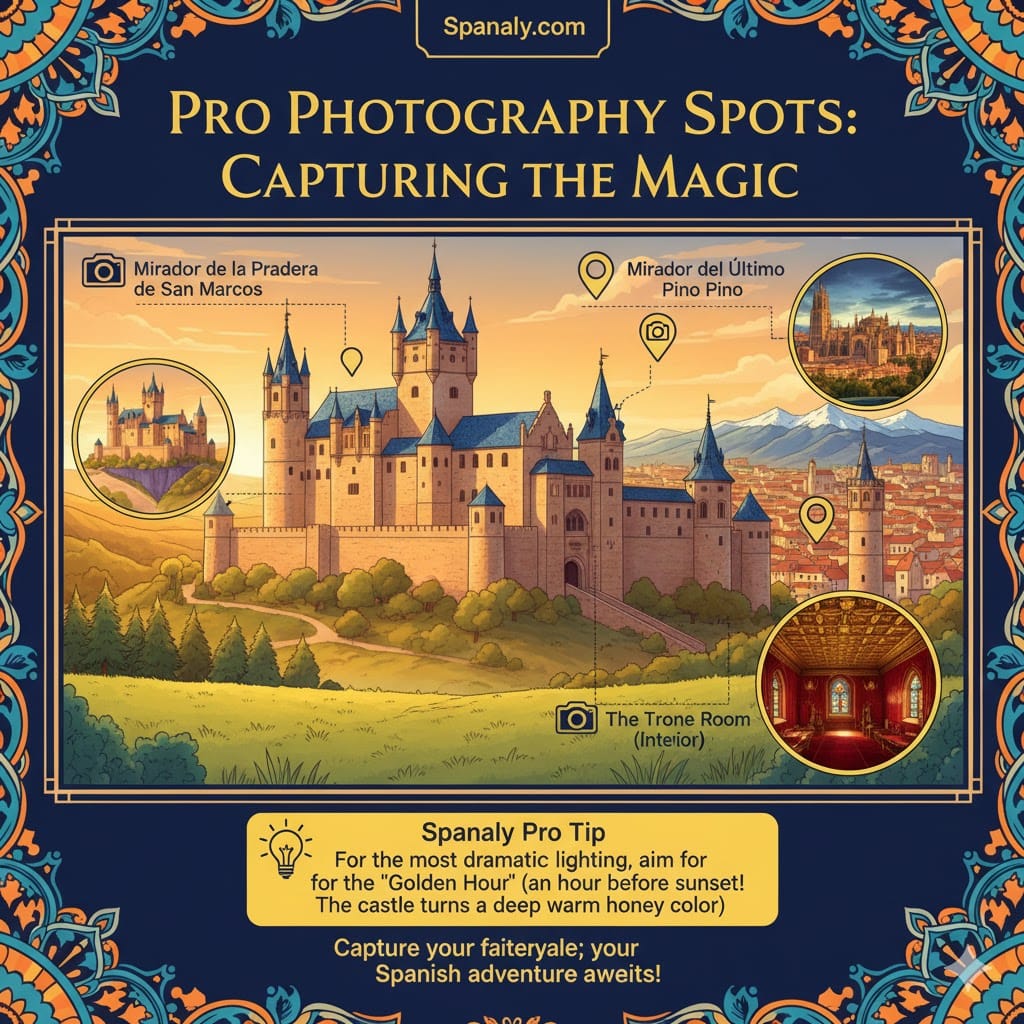
The Alcázar is one of the most photogenic monuments in the world. Whether you are using a professional DSLR or a smartphone, knowing where to stand makes all the difference. Here are the top spots to capture that perfect “fairytale” shot.
The Best Perspectives:
📍 Mirador de la Pradera de San Marcos: Located in the valley below, this grassy field offers the legendary “floating castle” view. It is the best spot to see the castle’s ship-like bow rising above the trees.
📍 Mirador del Último Pino: For those willing to hike a bit (about 20-30 minutes up the hill), this viewpoint offers a majestic, wide-angle panorama of the fortress against the rolling Castilian plains.
📍 The Throne Room (Interior): Capture the golden Mudéjar ceiling and the red velvet walls. The light through the stained-glass windows creates a mystical atmosphere in the late afternoon.
📍 The Tower of Juan II: For a 360-degree skyline shot that includes the Segovia Cathedral and the distant snowy peaks of the Sierra de Guadarrama.
To make sure your camera and other tech are ready for a full day of shooting, don’t forget to check our What to Pack for Spain: The Ultimate 2026 Checklist for gear recommendations.
💡 Spanaly Pro Tip: For the most dramatic lighting, aim for the “Golden Hour” (about an hour before sunset). The limestone walls of the castle turn a deep, warm honey color that looks incredible in photos. To plan your day around these perfect light conditions, see our guide on the Best Time to Visit Spain 2026.
💎 Nearby Segovia Gems: Completing Your Journey
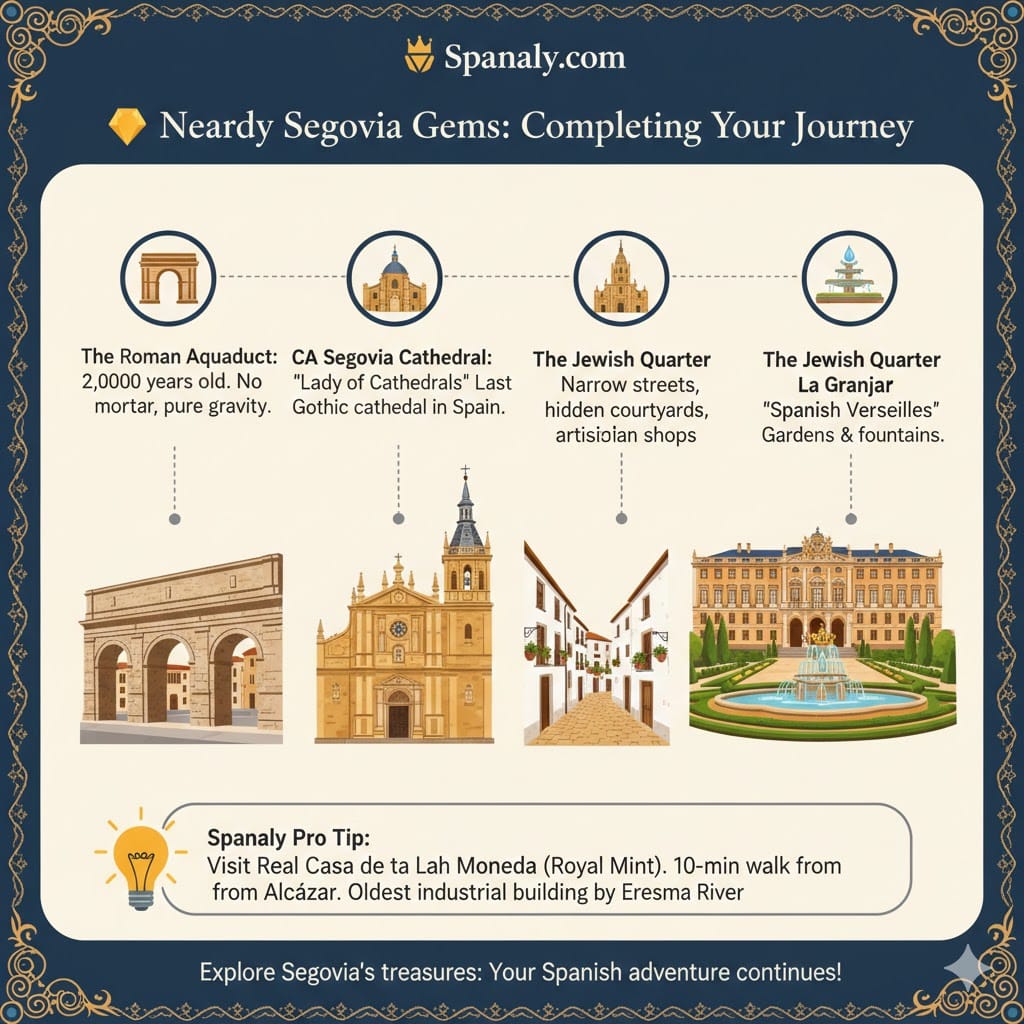
While the Alcázar is a showstopper, the entire city of Segovia is a UNESCO World Heritage site for a reason. Just a short walk from the castle gates, you’ll find other architectural wonders that are equally essential to your itinerary.
Don’t Miss These Icons:
🏛️ The Roman Aqueduct: Standing tall for nearly 2,000 years, this is one of the best-preserved Roman engineering feats in the world. No mortar holds its 167 arches together—just pure gravity and balance.
⛪ Segovia Cathedral: Known as the “Lady of Cathedrals” due to its elegance and size. It was the last Gothic cathedral built in Spain and dominates the Plaza Mayor with its golden stone.
🕍 The Jewish Quarter (La Judería): Wander through the narrow, winding streets that tell the story of Segovia’s Sephardic history. It’s a peaceful area filled with hidden courtyards and artisan shops.
💧 Royal Palace of La Granja: Just 11km from the city, this 18th-century palace is often called the “Spanish Versailles” thanks to its stunning gardens and monumental fountains.
To make the most of your time exploring these landmarks, we recommend checking out our guide on Best Things to Do in Spain: Top Cities & Sites to see how Segovia fits into your broader Spanish adventure.
💡 Spanaly Pro Tip: If you have a couple of hours to spare, visit the Real Casa de la Moneda (Royal Mint), just a 10-minute walk down from the Alcázar. It’s one of the oldest industrial buildings in Europe and sits right by the Eresma River, offering a quiet, beautiful walk away from the main tourist crowds.
📋 Spanaly Quick Guide: Alcázar of Segovia 2026
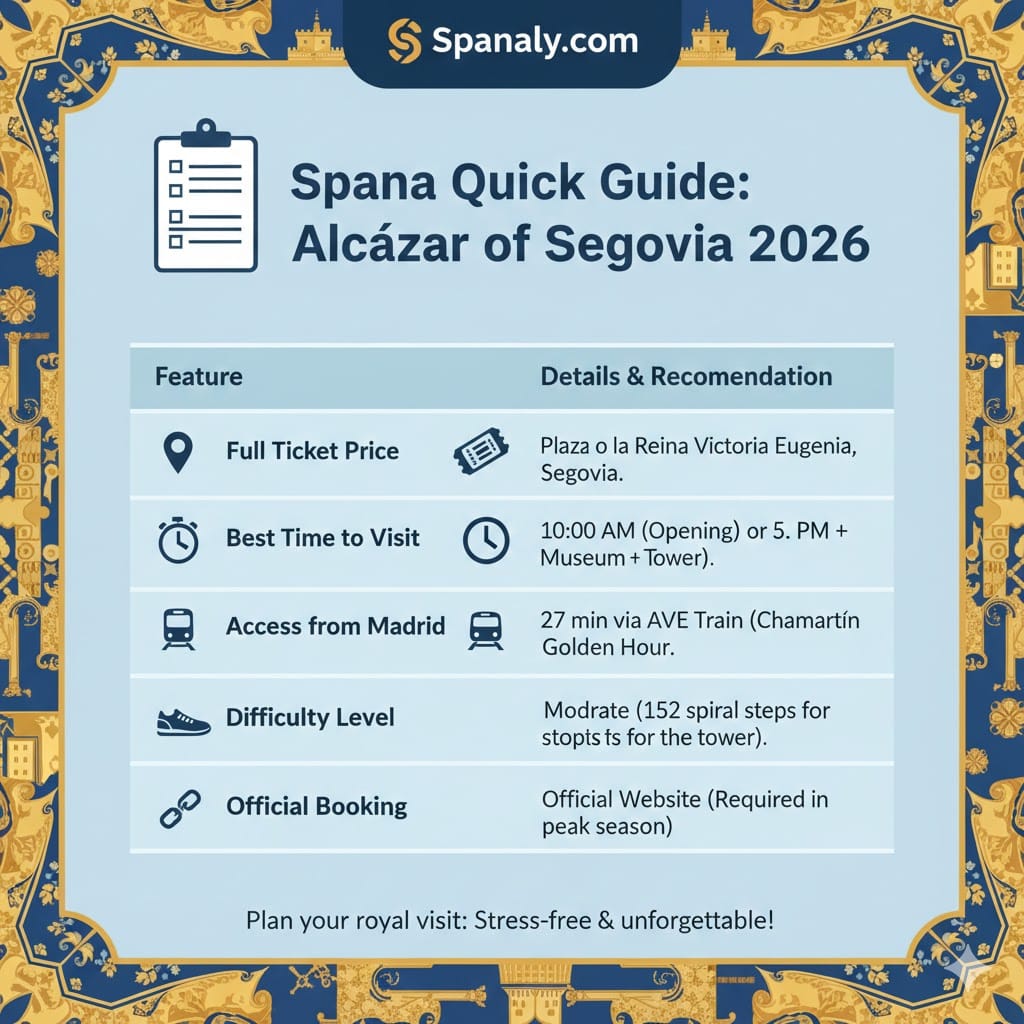
| Feature | Details & Recommendation |
| 📍 Location | Plaza de la Reina Victoria Eugenia, Segovia. |
| 🎫 Full Ticket Price | €10 (Palace + Museum + Tower). |
| ⏱️ Best Time to Visit | 10:00 AM (Opening) or 5:00 PM (Golden Hour). |
| 🚆 Access from Madrid | 27 min via AVE Train (Chamartín Station). |
| 👟 Difficulty Level | Moderate (152 spiral steps for the tower). |
| 🔗 Official Booking | Official Website (Required in peak season). |
🏰 Quick Tips – Alcázar of Segovia 2026
🎒 Is there a luggage storage or cloakroom available?
Yes, for security reasons, large backpacks and umbrellas must be left in the free lockers near the ticket office. This is especially helpful if you're planning to climb the tower, as space in the spiral staircase is very limited.
♿ How accessible is the castle for travelers with mobility issues?
The main Palace and Museum are partially accessible via ramps and elevators. However, the Tower of Juan II and certain basement armories are only accessible via stairs. We recommend notifying the staff at the entrance for personalized assistance.
📸 Can I use a tripod or professional lighting inside?
Photography for personal use is allowed (without flash), but tripods and selfie sticks are prohibited inside the palace rooms to protect the artifacts. For professional shoots, you must obtain a special permit from the board of trustees in advance.
🍽️ Are there dining options within the Alcázar grounds?
There is a small cafeteria in the garden area near the entrance. However, for a true Segovian experience, we suggest walking 10 minutes to the Plaza Mayor for traditional roast suckling pig (Cochinillo) after your tour.
⏳ How much total time should I allocate for the visit?
A thorough visit to the Palace, Armory, and Tower takes about 2 to 2.5 hours. If you also plan to walk through the exterior gardens for photos, add another 45 minutes to your schedule.
Verified by Spanaly.com
🏰 Your Royal Adventure Awaits
The Alcázar of Segovia is more than just a castle; it’s a living timeline of Spain’s grandeur. Whether you are chasing Disney dreams, exploring medieval history, or seeking the perfect panoramic shot, this “Stone Ship” will not disappoint.
✨ Why Segovia Should Be Next:
🎨 Visual Magic: A blend of Christian and Mudéjar artistry.
🚢 Unique Design: The world’s most iconic “ship-shaped” fortress.
🏔️ Natural Backdrop: Framed by the stunning Sierra de Guadarrama.
💡 Final Spanaly Checklist:
[ ] Book Early: Secure your 2026 slot online to avoid the midday rush.
[ ] Charge Up: You’ll need every bit of battery for those “Golden Hour” photos.
[ ] Stay Connected: Ensure your eSIM is ready to share your journey instantly.
Safe travels, and enjoy every step of your Segovian fairytale! 🇪🇸