🏰 Burgos Cathedral
Few monuments in Europe capture the soul of an era like the Burgos Cathedral. It rises majestically from the heart of Castile as a testament to human ambition. Moreover, its lace-like limestone spires are a true Spanish Attraction that pierce the sky with grace.
Why it’s a must-visit in 2026:
🎨 Gothic Masterpiece: It represents a stunning dialogue between medieval devotion and architectural genius.
👑 Royal Heritage: Since 1221, this building has witnessed coronations and eight centuries of Spanish history.
🐚 Spiritual Journey: It serves as a central stop for those on a Living Pilgrimage along the Camino de Santiago.
🌅 Golden Glow: The ancient façades carry the mark of generations, and they glow brilliantly at sunset.
💡 Spanaly Pro Tip: Don’t just look at the cathedral from the main plaza. Instead, walk up to the Mirador del Castillo at sunset. From this viewpoint, the cathedral’s spires look like stone lace floating above the city. Consequently, you will get a perspective that you won’t find in any standard tour.
🏛️ A Legacy Carved in Stone: The Masterpiece of 1221
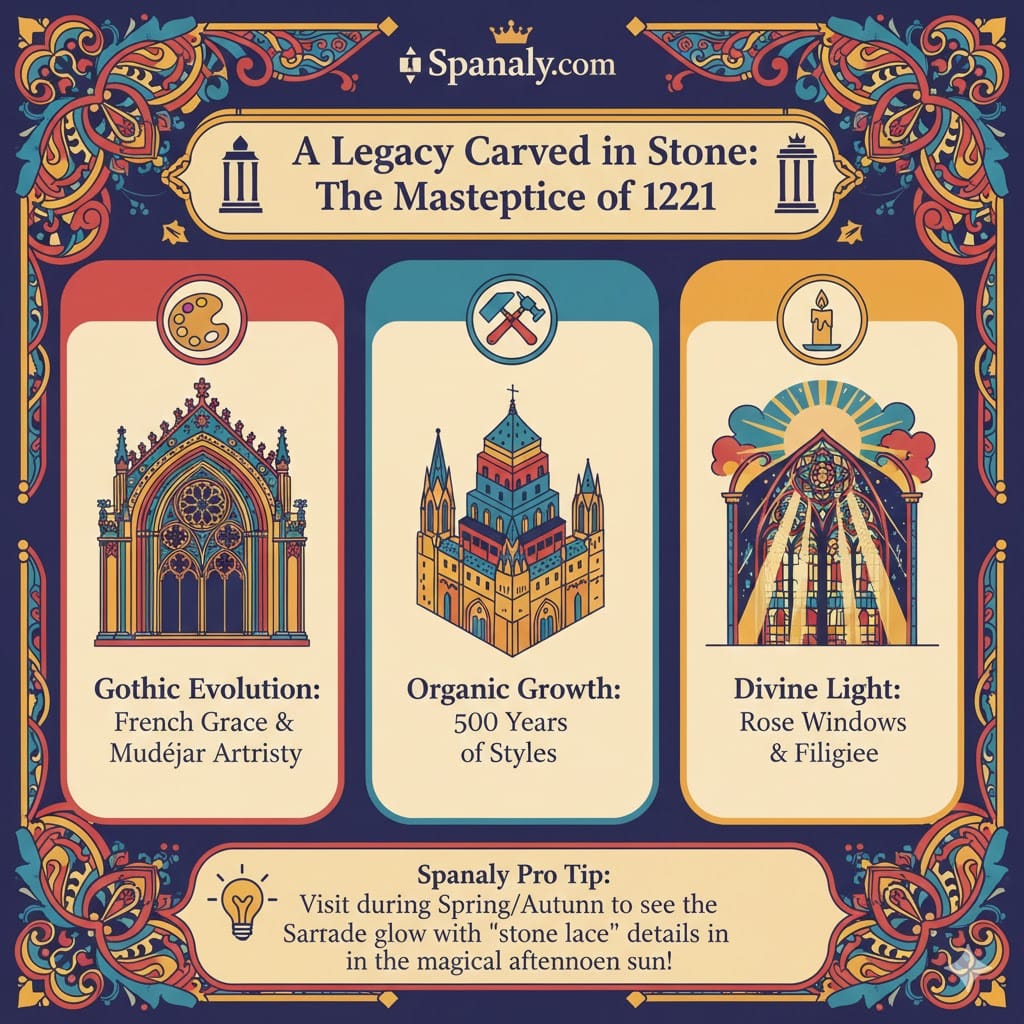
The story of Burgos Cathedral is a fascinating journey back to the 13th century. King Ferdinand III and Bishop Mauricio began this grand project together. They envisioned a temple that rivaled the elegance of the famous French Gothic style. However, what stands today is a unique Spanish transformation. This structure evolved beautifully over 500 years of history.
What makes its architecture legendary:
📐 Gothic Evolution: It offers a seamless blend of French grace and Spanish Mudéjar craftsmanship.
🌱 Organic Growth: The building didn’t just stand; it grew by adding Renaissance harmony and Baroque grandeur over centuries.
💡 Divine Light: The rose windows and filigreed spires create a play of shadows that feels truly sacred.
Whether you are exploring the Ultimate Spain Festivals or touring the north, this cathedral remains the pinnacle of stone poetry.
💡 Spanaly Pro Tip: To truly appreciate the “stone lace,” check the Best Time to Visit Spain for the spring or autumn months. During these seasons, the afternoon sun hits the Sarmental Façade at an angle that reveals hidden carvings often missed in the harsh summer glare or winter clouds.
⚔️ The Spirit of El Cid: Spain’s Knight Eternal
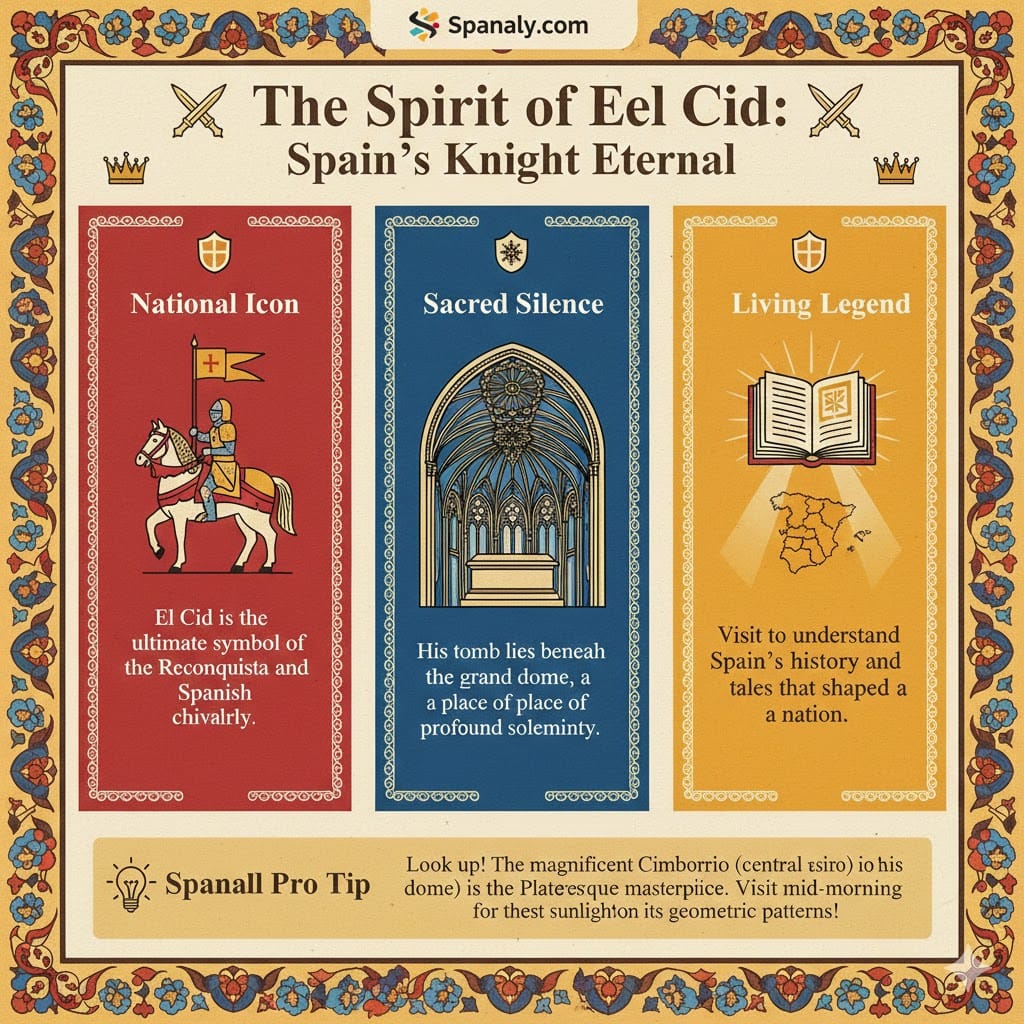
No visit to Burgos Cathedral is complete without paying homage to Rodrigo Díaz de Vivar. Most history enthusiasts know him better as El Cid Campeador. This legendary medieval knight rests beneath the cathedral’s grand central dome along with his wife, Doña Jimena. Consequently, his presence transforms the sanctuary into a temple of honor and Spanish bravery.
Why this site is legendary:
🇪🇸 National Icon: El Cid stands as the ultimate symbol of the Reconquista and Spanish chivalry.
🤫 Sacred Silence: His tomb lies in the transept, surrounded by the solemn beauty of the dome’s intricate star-vaulting.
🌍 Living Legend: Seeing his final resting place helps you understand Why Visit Spain. It allows you to touch the history that shaped Western civilization.
💡 Spanaly Pro Tip: Look up! Above the tomb of El Cid, you will see the magnificent Cimborrio (central dome). It is considered one of the most beautiful examples of Plateresque architecture in the world. For the best view without the crowds, try to visit during the mid-morning hours when the sunlight hits the dome’s geometric patterns directly.
✨ Architectural Wonders You Shouldn’t Miss
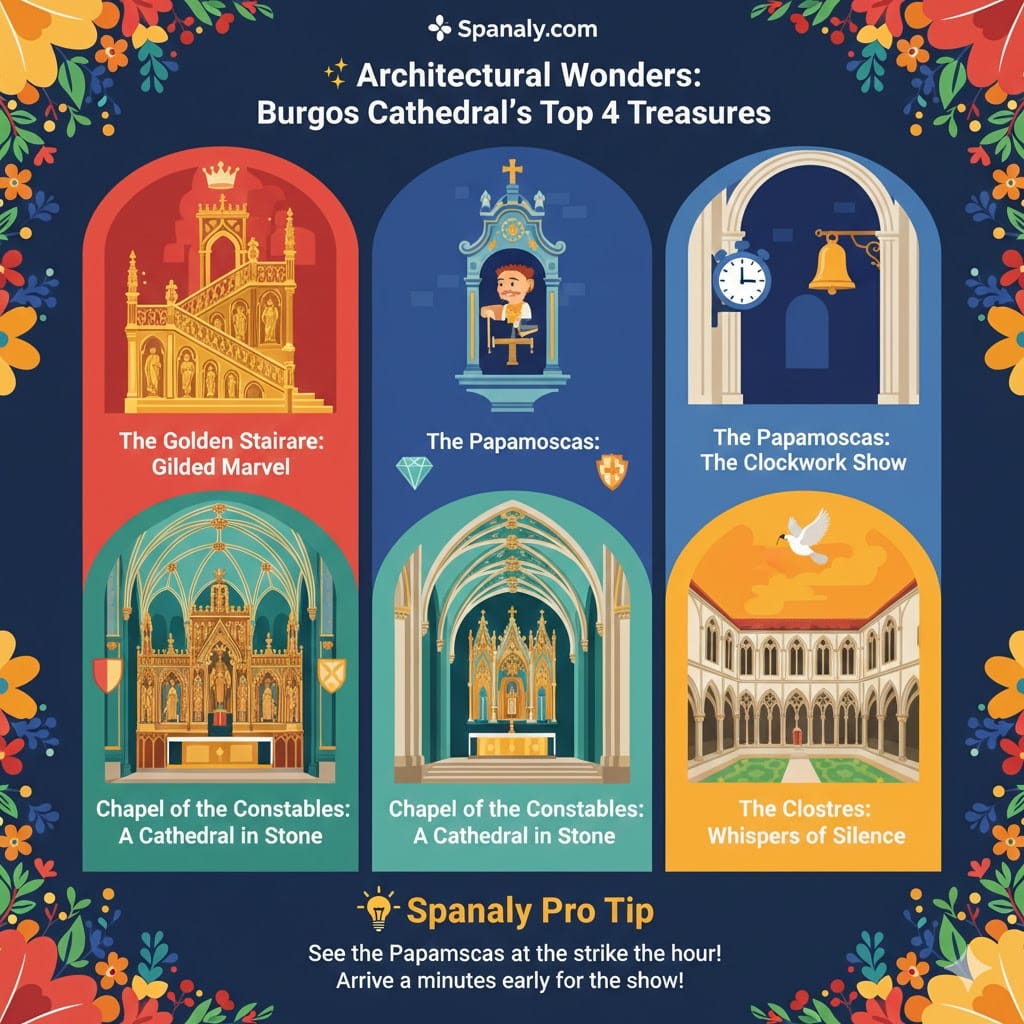
Every corner of Burgos Cathedral holds a secret that defies the passage of time. Beyond its massive walls lies a collection of artistic masterpieces. These range from whimsical automata to gilded staircases that look like they were woven by angels.
Top treasures to discover:
The Golden Staircase (Escalera Dorada): Designed by Diego de Siloé, this Renaissance marvel was inspired by Italian grandeur. It bridges the height difference of the cathedral with pure gilded elegance.
The Papamoscas (Flycatcher): This is a quirky 16th-century clock automaton. Every hour, he opens his mouth as he rings the bell. Consequently, he has become a favorite for visitors of all ages!
Chapel of the Constables: Often called a “cathedral within a cathedral,” this private mausoleum is rich with star-vaulted ceilings and intricate sculptures.
The Cloisters: This is a serene space where Gothic arches meet centuries of silence. It is perfect for reflecting on the craftsmanship.
Exploring these wonders is easier when you follow Essential Spain Travel Tips to avoid the busiest midday crowds.
💡 Spanaly Pro Tip: Don’t miss the Papamoscas at the strike of the hour! Position yourself in the central nave about 5 minutes before the hour begins. It’s one of the few places in the world where you can see a 500-year-old mechanical puppet still performing its duty with such charm.
✨ A Living Pilgrimage: Along the Camino de Santiago
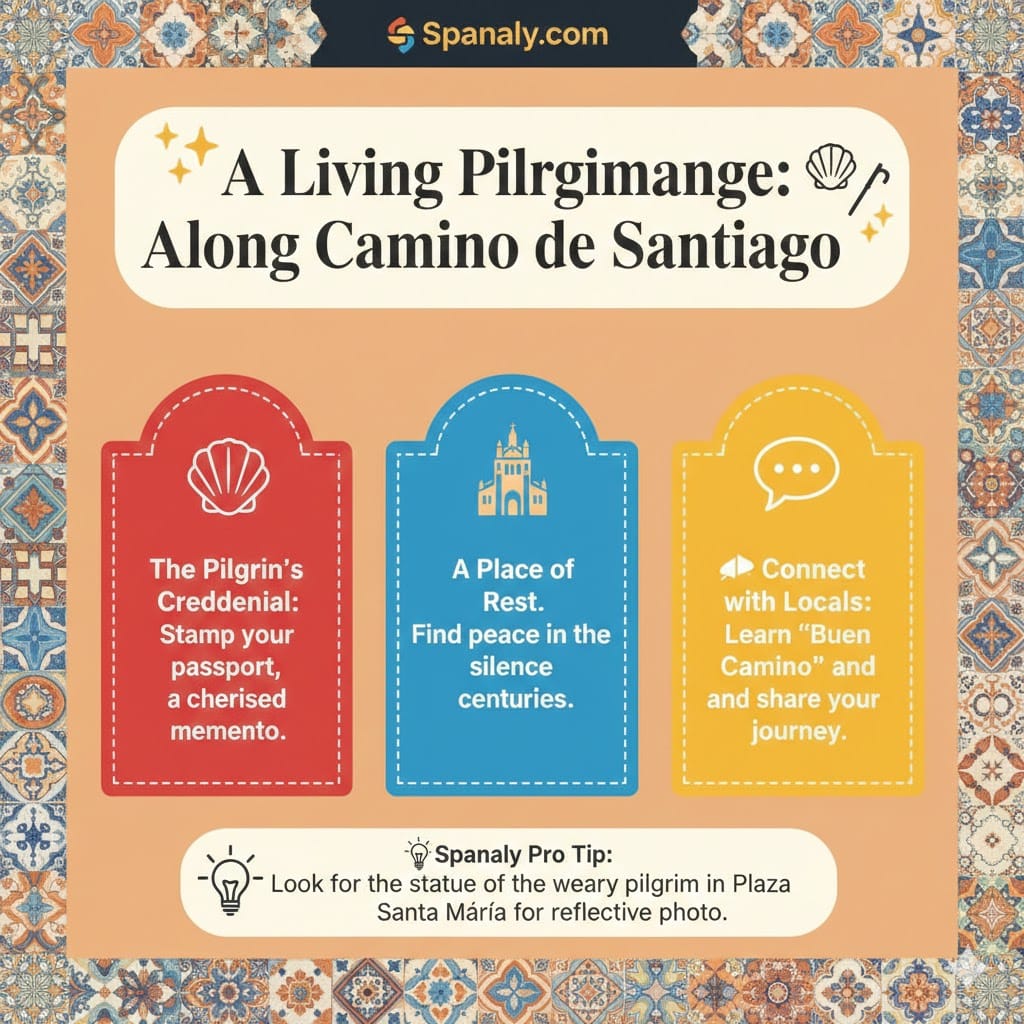
For centuries, Burgos Cathedral has been a sacred beacon for souls walking the Camino de Santiago. As a major stop on the French Way (Camino Francés), it has welcomed millions of weary travelers. These pilgrims seek peace beneath its soaring vaults. Furthermore, the cathedral is not just a monument. It is a spiritual milestone where the dust of the road meets the silence of the divine.
What pilgrims and visitors should know:
The Pilgrim’s Credential: If you are walking the Camino, you can get your passport stamped here. This serves as a cherished memento of your journey.
A Place of Rest: Even for non-pilgrims, the interior offers a profound sense of quietude. This atmosphere connects you to centuries of seekers.
Connect with Locals: You should use a few Basic Spanish Language Tips like “Buen Camino.” This simple gesture will open doors to heartwarming conversations with fellow travelers and locals alike.
💡 Spanaly Pro Tip: Look for the statue of the weary pilgrim sitting on a bench in the Plaza de Santa María. It’s the perfect spot to take a reflective photo and feel the true spirit of the Camino before you enter the grandeur of the cathedral.
🏛️ The Exterior Masterpiece: Walking the Four Façades
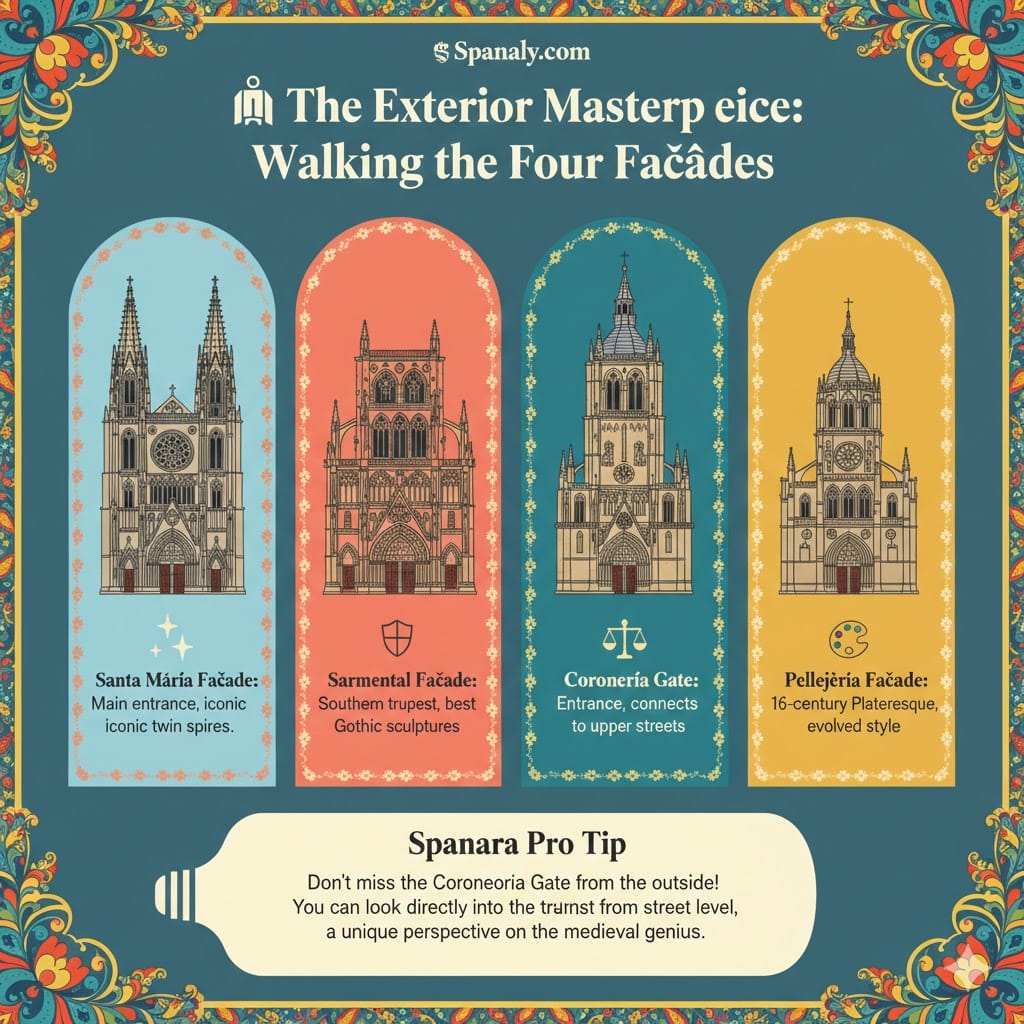
The grandeur of Burgos Cathedral isn’t confined to its interior. Because it is built on a steep slope, walking around its perimeter feels like exploring four different monuments in one. Each façade tells a different story of artistic bravery. Therefore, it makes a perfect side trip for those following our Ultimate Madrid Travel Guide.
The four gates of heaven:
Santa María Façade: This is the main entrance. It is famous for its 13th-century rose window and the iconic twin spires that define the city’s skyline.
Sarmental Façade: Many consider this the masterpiece of the southern transept. It features one of the best-preserved Gothic sculptures in Europe.
Coronería Gate: This majestic northern entrance connects the cathedral to the historic upper streets of Burgos.
Pellejería Façade: This is a stunning Plateresque addition from the 16th century. It shows how the cathedral evolved with new art styles over time.
Exploring these exterior details allows you to appreciate the sheer scale of the building. You should do this before you even step through the doors.
💡 Spanaly Pro Tip: Don’t miss the Coronería Gate from the outside. Since the cathedral is built on a hill, you can look directly into the transept from street level! It’s the only spot where you can truly appreciate the vertical genius of the medieval builders—it feels like looking into a giant “stone heart” from the sidewalk.
📸 Pro Photography Spots: Capturing the Lace
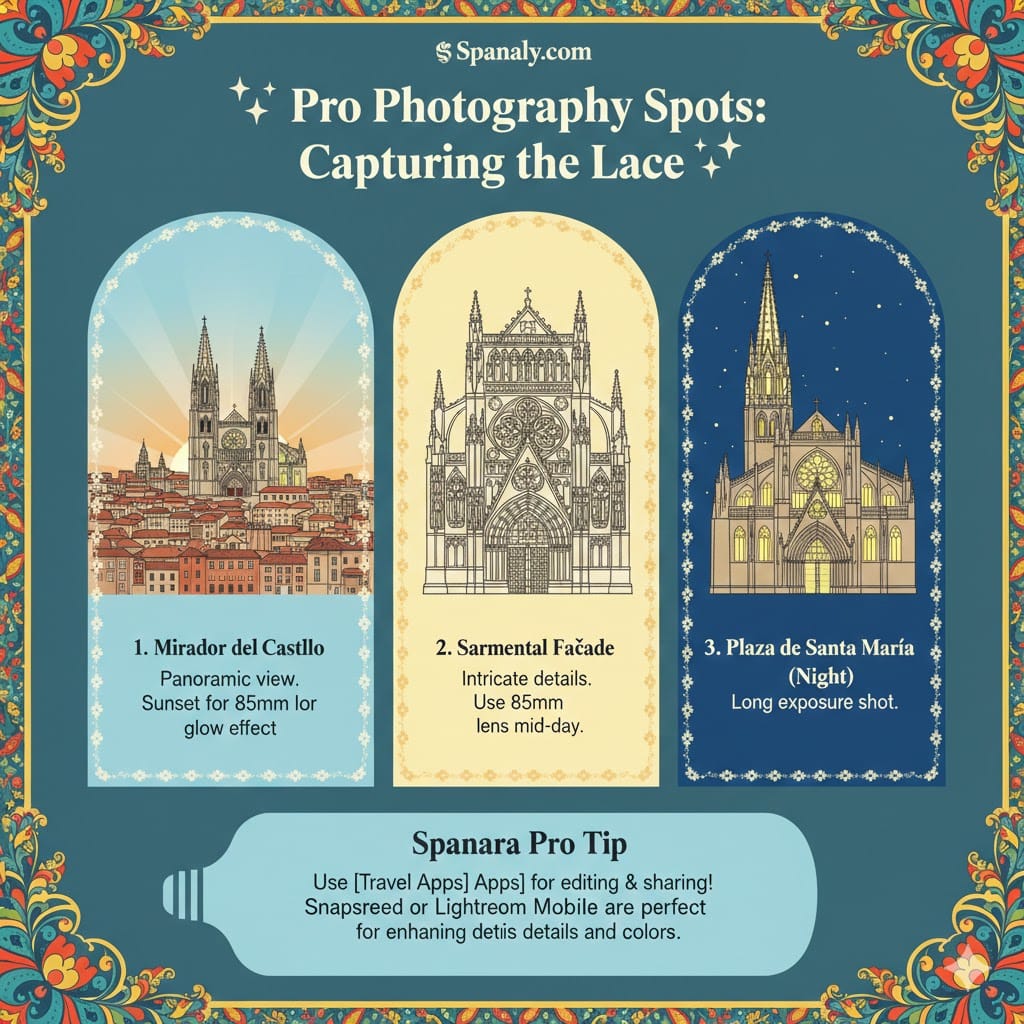
Burgos Cathedral is famously described as “stone lace” because of its intricate, airy Gothic carvings. To truly capture its soul, you need to know where to stand and when to click.
The 3 Secret Angles for 2026:
🏰 The Panoramic Masterpiece (Mirador del Castillo): For the ultimate skyline shot, hike up (15-20 mins) to the Castle Viewpoint. At sunset, the cathedral’s spires catch a “fire glow” that looks magical.
⛲ The Classic Symmetry (Plaza de Santa María): Stand near the Santa María fountain at the “Blue Hour” (just after sunset). The combination of the illuminated facade and the water in the foreground creates a deep, cinematic atmosphere.
📐 The Vertical Detail (Coronería Street): Head to the higher streets behind the cathedral. This unique vantage point allows you to photograph the spires at eye level, revealing the staggering detail of the stone carvings that are invisible from below.
Before you post your masterpieces, check out the Top Tourist Apps for Spain for the best mobile editing tools and real-time golden hour trackers.
💡 Spanaly Pro Tip: For interior shots, use an 85mm lens if you have one, or use the 2x/3x zoom on your smartphone. The “Stone Lace” is often high up on the ceilings and vaults; zooming in will reveal faces and patterns you’d never see with the naked eye.
🎟️ Visitor Logistics (2026 Update)

Planning your visit to Burgos Cathedral in 2026 is simple, but a few local “hacks” can save you time and money. As part of your Essential Spain Travel Tips 2026, we recommend booking online to skip the morning queues at the Plaza de Santa María entrance.
Key Visitor Information:
🕒 Opening Hours: * Summer (Mar 19 – Oct 31): 9:30 AM to 7:30 PM (Last entry at 6:30 PM).
Winter (Nov 1 – Mar 18): 10:00 AM to 7:00 PM (Last entry at 6:00 PM).
💰 Ticket Prices (Approx. 2026 Rates):
General Admission: €10 – €11 (Includes audio guide).
Pilgrims (with Credential): €6.
Students & Seniors: €5 – €9.
Children (under 7): Free.
🆓 Free Entry Secret: You can enter for free on Tuesday afternoons (usually from 4:30 PM to 6:30 PM in summer, and 4:00 PM to 6:00 PM in winter). Note: Capacity is limited, so arrive early!
💡 Spanaly Pro Tip: If you are visiting for spiritual reasons, you can attend Mass for free. However, tourist sightseeing (visiting the chapels, the cloister, and the museum) is restricted during liturgical services. To get that perfect “empty cathedral” feel, try to be the first in line at 9:30 AM on a Wednesday or Thursday.
🍴 Nearby Gems & Burgos Flavors: Beyond the Stone

After emerging from the spiritual dimness of the cathedral into the bright Castilian sun, your journey is only half complete. Burgos is a city that feeds the soul and the stomach in equal measure.
What to do after the tour:
🥖 Taste the Legend: You cannot leave without trying Morcilla de Burgos (spiced blood sausage with rice). Head to the vibrant Calle San Lorenzo, just a few steps from the cathedral, for the best tapas in the city.
🌳 A Riverside Stroll: Walk through the Arco de Santa María (the majestic city gate) and enjoy a peaceful stroll along the Espolón Promenade, a tree-lined walkway that feels like a living postcard.
🏰 The View from Above: If you didn’t catch it for your photos, the Burgos Castle ruins offer a peaceful escape and a lesson in medieval defense.
Burgos is exceptionally well-connected to other major cities. Whether you are arriving by high-speed train or luxury coach, our guide on Getting Around Spain will help you navigate the routes to this Gothic capital with ease.
💡 Spanaly Pro Tip: Order a “Cojonudo” tapas—it’s a slice of bread topped with a piece of Morcilla, a fried quail egg, and a spicy pepper. It is the authentic “flavor of Burgos” in a single bite!
💡 Pro Travel Tips for a Flawless Visit

To make your experience even smoother, keep these “insider” tips in mind before you arrive at the cathedral doors:
🧥 The “Gothic Chill” Factor: Even in the middle of a scorching Spanish summer, the cathedral’s thick stone walls keep the interior surprisingly cool (and sometimes cold). Bring a light scarf or cardigan to stay comfortable during your tour.
🎧 Audio Guide Etiquette: Your ticket includes a high-quality audio guide. Don’t forget to bring your own wired headphones (3.5mm jack) if you prefer not to hold the device to your ear for an hour—it makes the experience much more immersive and hands-free.
🎒 Security & Bags: Large hiking backpacks are often not allowed inside for safety reasons. If you are a pilgrim on the Camino, look for the luggage lockers (consignas) located near the main entrance or at the nearby bus station.
⛪ Respect the Silence: Remember that while this is a UNESCO site, it remains a very active place of worship. Avoid using flash photography and keep your voice to a whisper, especially near the Chapel of the Holy Christ.
⛪ Visitor FAQs – Burgos Cathedral Guide
⚔️ Where exactly is the tomb of El Cid?
The legendary El Cid Campeador and his wife Doña Jimena rest directly under the central transept. Look up at the breathtaking Mudejar-style vault above them; it is considered one of the most beautiful architectural feats in Spain.
🎭 Why does the "Papamoscas" clock open its mouth?
This 16th-century automaton, the Papamoscas (Flycatcher), opens his mouth every time he strikes the bell. Legend says it was built by a king to remember a mysterious woman's sigh, but today it’s the most beloved "mechanical" resident of the cathedral.
✨ Is the "Escalera Dorada" actually made of gold?
It is made of intricately forged iron and covered in exquisite gilding. Inspired by the Italian Renaissance, this staircase was so beautiful that Charles Garnier used it as inspiration for the grand staircase of the Paris Opera House!
⏳ How much time should I set aside for a full tour?
To truly appreciate the 19 chapels, the cloister, and the museum, you should plan for at least 90 to 120 minutes. The audio guide is detailed, so rushing would mean missing the "stone lace" details that make this site unique.
💎 What is the cathedral's "hidden" masterpiece?
Don't miss the Constable's Chapel (Capilla de los Condestables). Many visitors overlook it, but its star-shaped vault is a masterpiece of late Gothic architecture that allows natural light to rain down on the marble tombs below.
Created by Spanaly.com
🏛️ Why Burgos Remains Eternal
Burgos Cathedral is more than just a monument of stone and glass; it is a living chronicle of eight centuries of human faith and artistic ambition. From the delicate “stone lace” of its spires to the quiet gravity of El Cid’s tomb, every corner offers a reason to pause and wonder.
If you are a fan of Spain’s legendary landmarks, your journey shouldn’t stop here; the majestic Alcázar of Segovia is another architectural marvel that perfectly complements the royal history you’ve witnessed in Burgos.
✨ Why this cathedral stays with you:
🎨 Artistic Mastery: Witness the pinnacle of Spanish Gothic design, where light and stone create a celestial atmosphere.
🐚 Spiritual Legacy: Stand at the crossroads of the Camino de Santiago, a place that has welcomed millions of souls for centuries.
🥘 Pure Spanish Soul: Beyond the art, the city of Burgos offers a perfect blend of medieval charm and authentic Castilian flavors.
As you plan your journey through Castile, remember that some places are meant to be seen, but Burgos Cathedral is meant to be felt. Whether you are a pilgrim seeking a blessing or a traveler seeking beauty, this “Eternal Masterpiece” will leave an imprint on your heart long after you’ve left its hallowed halls.
🌟 Final Thought: Every traveler leaves a bit of their soul in Burgos, only to take home a piece of its eternal light.