🥘 Dining in Spain represents a social ritual that celebrates connection, culture, and flavor. Whether you enjoy tapas in Seville, seafood in Valencia, or pintxos in San Sebastián, knowing how to order food like a local in 2026 transforms your travel experience from a standard tour into an authentic Spanish journey.
In this updated guide, you will discover exactly how Spaniards approach dining. We reveal what to say, when to eat, and how you can navigate Spain’s unique restaurant culture with total confidence.
Connect Authentically: Learn the local phrases that open doors.
Avoid Tourist Traps: Understand the difference between real paella and frozen versions.
Dine with Confidence: Master the unique rhythm of Spanish mealtimes.
Before you sit down at a local Mesón, ensure you understand the broader Cultural Etiquette in Spain to perfectly blend in with the locals.
🕒 Understanding Spanish Dining Culture
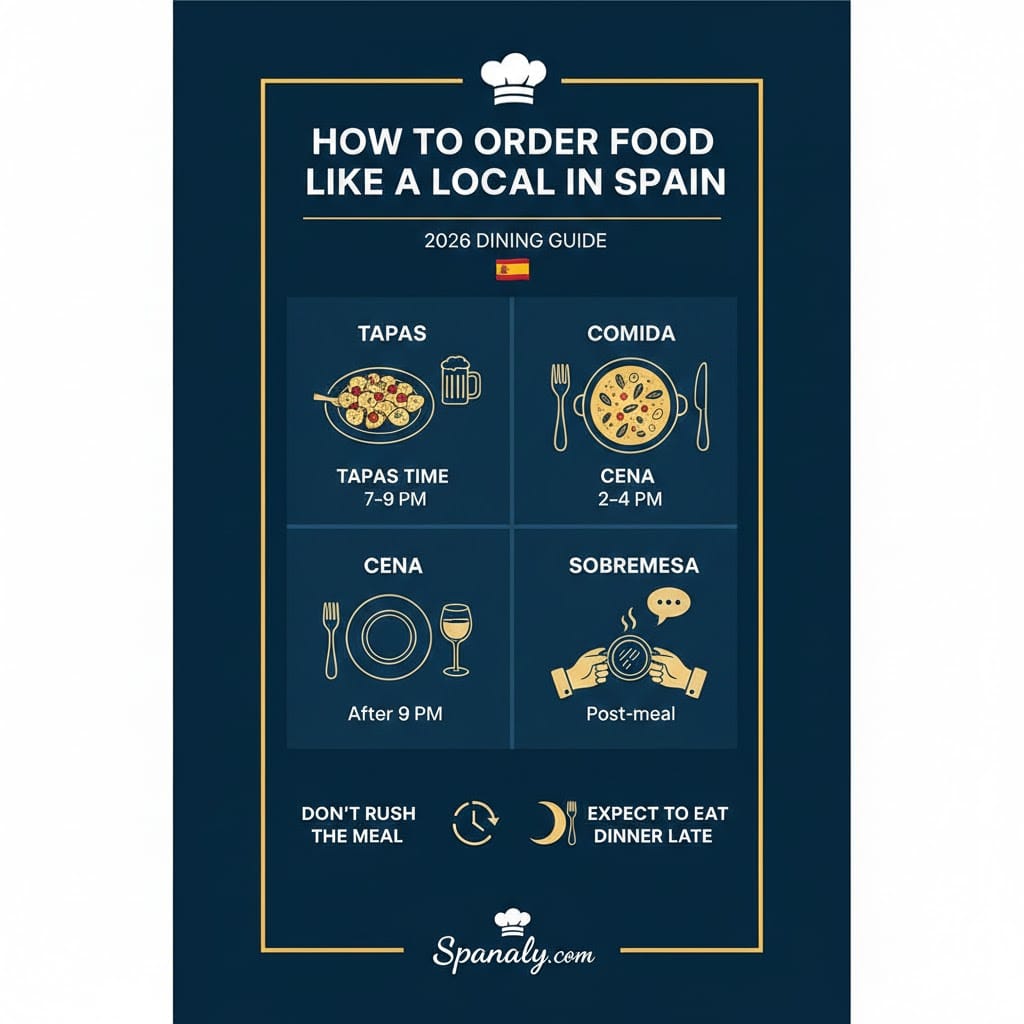
Before you take a seat, you must understand that meals in Spain follow a specific, relaxed rhythm. In 2026, you will enjoy your experience much more if you adapt your internal clock to these local times:
Lunch (Comida): Spaniards enjoy their main meal between 2:00 p.m. and 4:00 p.m. Most high-quality kitchens close strictly after this window until dinner.
The Early Evening Gap: Between 7:00 p.m. and 9:00 p.m., locals enjoy “Tapas Time.” You should use this period for light snacks and drinks rather than looking for a full dinner.
Dinner (Cena): Locals rarely start dinner before 9:00 p.m. If you arrive earlier, you might find yourself dining alone or in a “tourist-only” spot.
Master the Pace: To truly blend in, you must check our Spain Travel Tips & Essentials guide, where we explain why rushing a meal is considered a social error in Spain.
💡 Pro Tip: Spaniards view the table as a place for “Sobremesa” (post-meal conversation). You should never feel pressured to leave immediately after finishing your last bite.
📋 How to Read a Spanish Menu Like a Pro
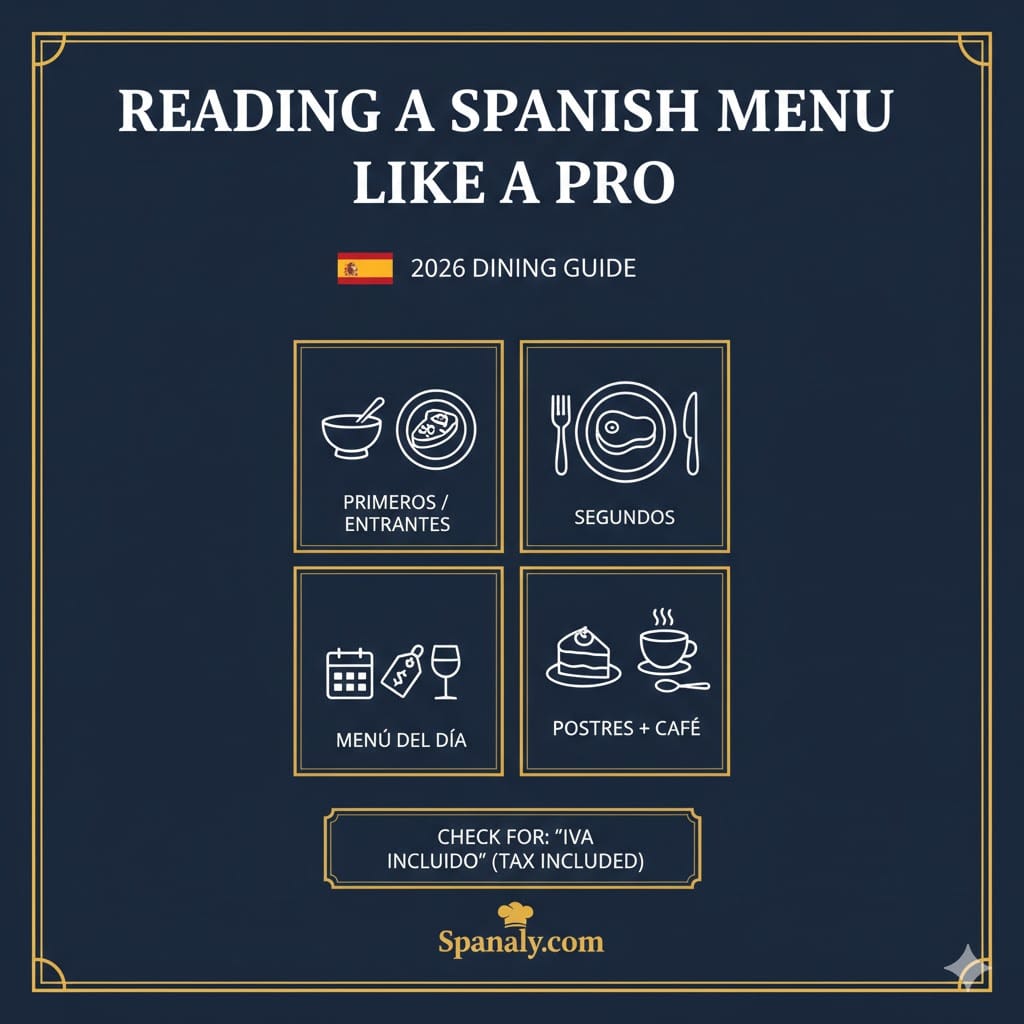
Spanish menus follow a logical flow that encourages a multi-course experience. In 2026, you will encounter these standard sections in almost every traditional restaurant:
Entrantes / Primeros: These act as starters. You should choose these dishes to wake up your palate before the main event.
Segundos: This section features the main courses, usually focusing on fish (pescado) or meat (carne).
Postres: Always save room for dessert! Locals often pair their sweets with a coffee to finish the meal.
The Famous Menú del Día: You should look for this fixed-price daily menu. It typically includes two courses, a drink, and dessert for a very reasonable price.
IVA Concerns: While most modern spots include the 10% tax in the price, you should still check for the phrase “IVA incluido” at the bottom of the menu to avoid surprises.
Regional Flavors: To understand the specific ingredients you’ll see on these menus, explore our Spanish Cuisine guide for a deep dive into local flavors.
💡 Smart Choice: If you feel overwhelmed, you can always ask for the “Sugerencias” (Suggestions), which usually feature the freshest ingredients available that day.
📲 Digital Reservations & The QR Revolution
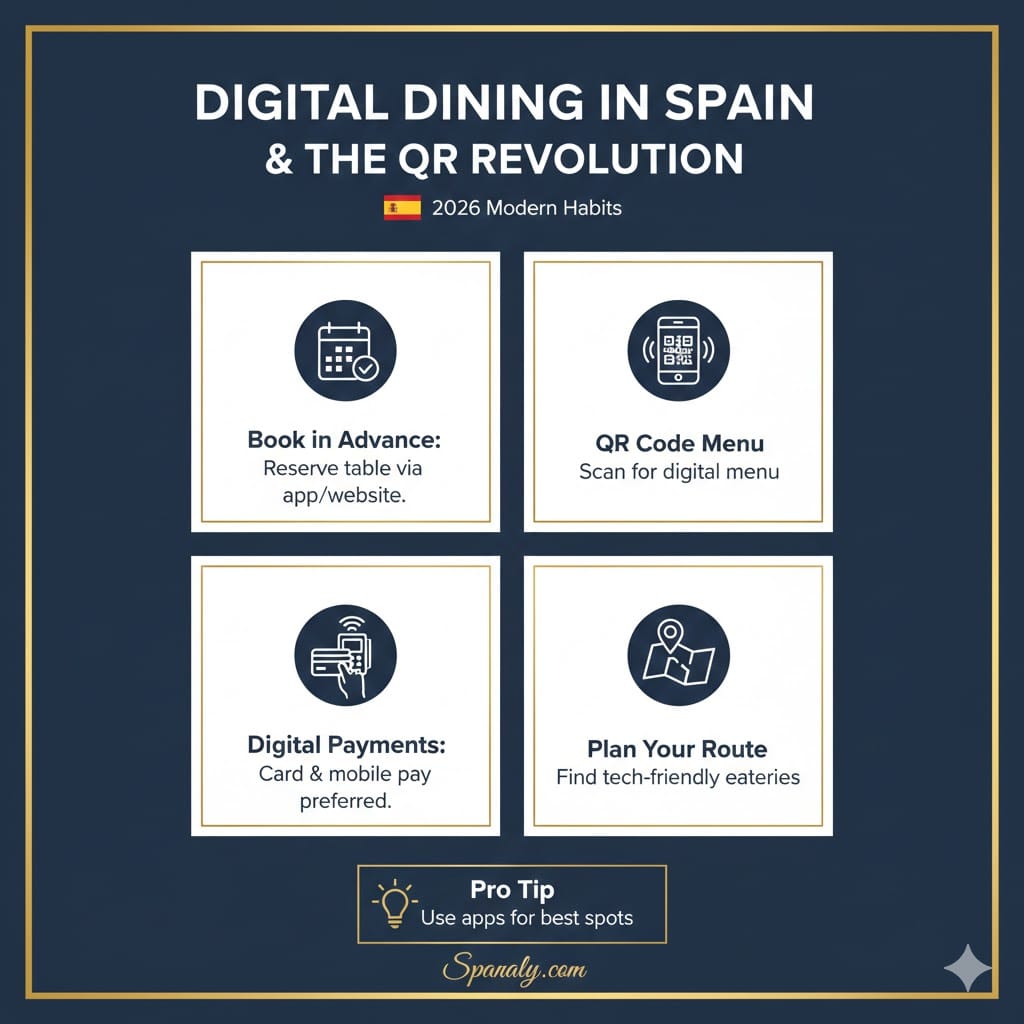
In 2026, technology plays a vital role in the Spanish dining scene. To ensure you get a table at the best local spots, you should adopt these modern habits:
Book in Advance: Popular restaurants in city centers now require digital reservations. You should use local apps or the restaurant’s website to secure your spot at least 24 hours ahead.
The QR Code Menu: Many traditional bars now use QR codes instead of physical menus. You should keep your smartphone ready to scan the code displayed on your table.
Digital Payments: While locals still carry some cash, most establishments prefer contactless mobile payments or cards for a faster checkout.
Plan Your Route: When navigating the busy streets of the capital, use our Ultimate Madrid Travel Guide to find the most tech-friendly and highly-rated eateries.
🍢 Ordering Tapas Like a Local
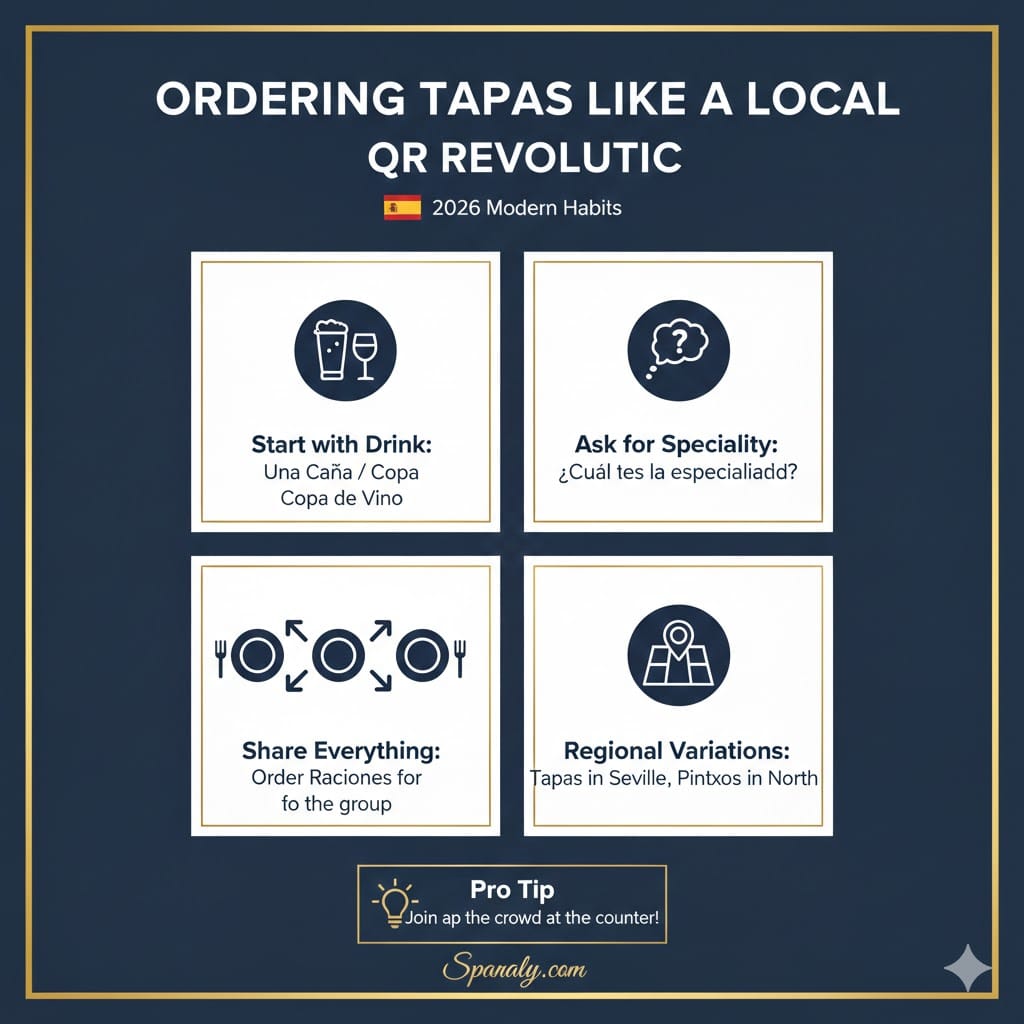
Tapas represent more than just food; they symbolize a way of life. In 2026, you can master this art by following these active steps:
Start with a Drink: You should always order your drink first—usually una caña (small beer) or una copa de vino. In many regions, the waiter will bring a small, complimentary bite with your glass.
Ask for the Specialty: Instead of guessing, you should ask: “¿Cuál es la especiality de la casa?” (What is the house specialty?). This ensures you taste the freshest and most authentic dish.
Share Everything: Locals rarely order one dish for themselves. You should order several raciones (larger portions) to share with your group to experience a variety of flavors.
Regional Variations: To see how tapas culture shifts from the bars of Seville to the landmarks of the north, check our Spanish Attractions guide for regional highlights.
💡 Pro Tip: If you see a crowded bar with people standing, don’t walk away! Join the crowd at the counter—this usually signals the best food in the neighborhood.
☕ How to Order Coffee in Spain
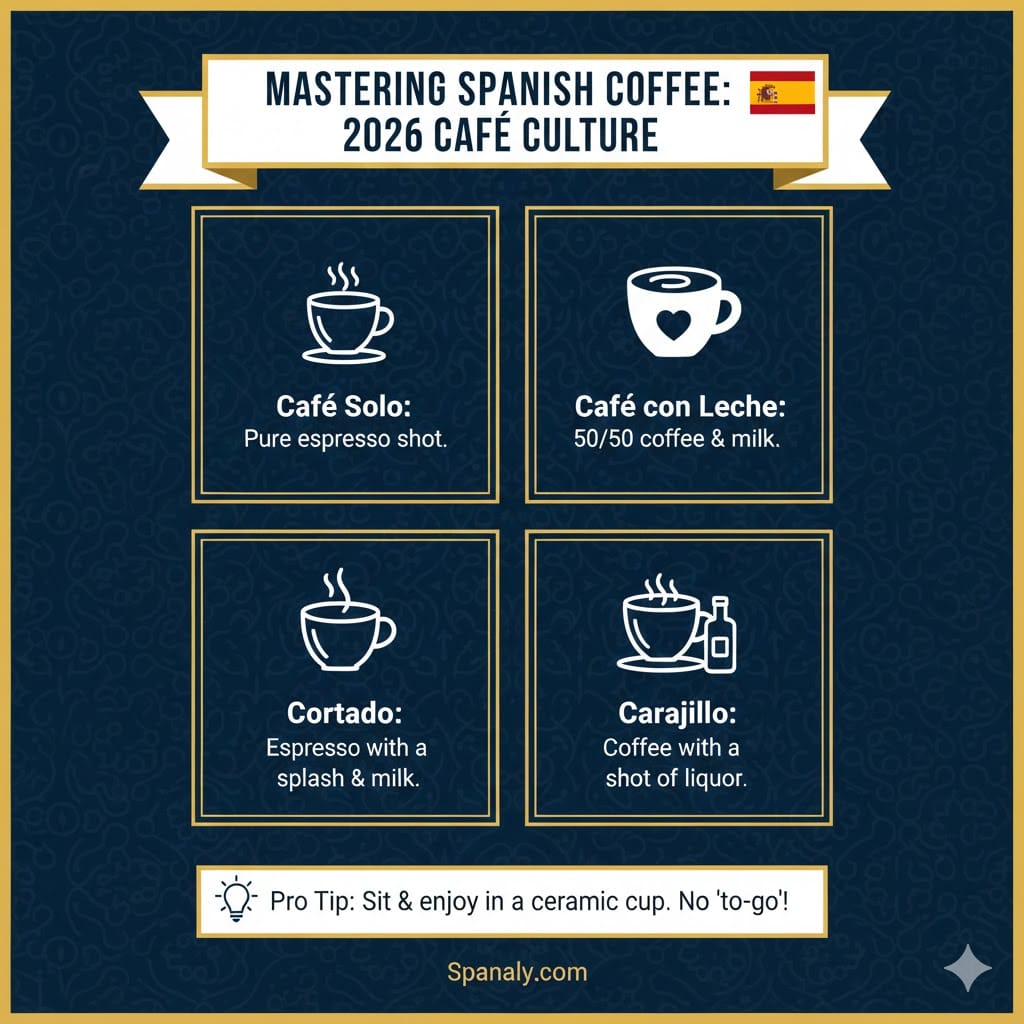
Spanish coffee culture follows its own set of rules. In 2026, you should use this vocabulary to get exactly what you want:
Café Solo: You should order this if you want a small, powerful shot of pure espresso.
Café con Leche: This represents the most popular choice—half espresso and half steamed milk.
Cortado: You should choose this if you prefer your espresso “cut” with just a small splash of milk.
Carajillo: For a traditional kick, you can order this coffee which includes a shot of brandy or rum.
Festive Energy: During major events, you will see locals drinking coffee late into the night. Check our Spanish Festivals guide to see where coffee keeps the party going.
💡 Local Tip: You should avoid ordering coffee “to go” (para llevar) if you want to blend in. Spaniards view coffee as a moment to sit, relax, and watch the world go by.
🗣️ How to Communicate With Waiters
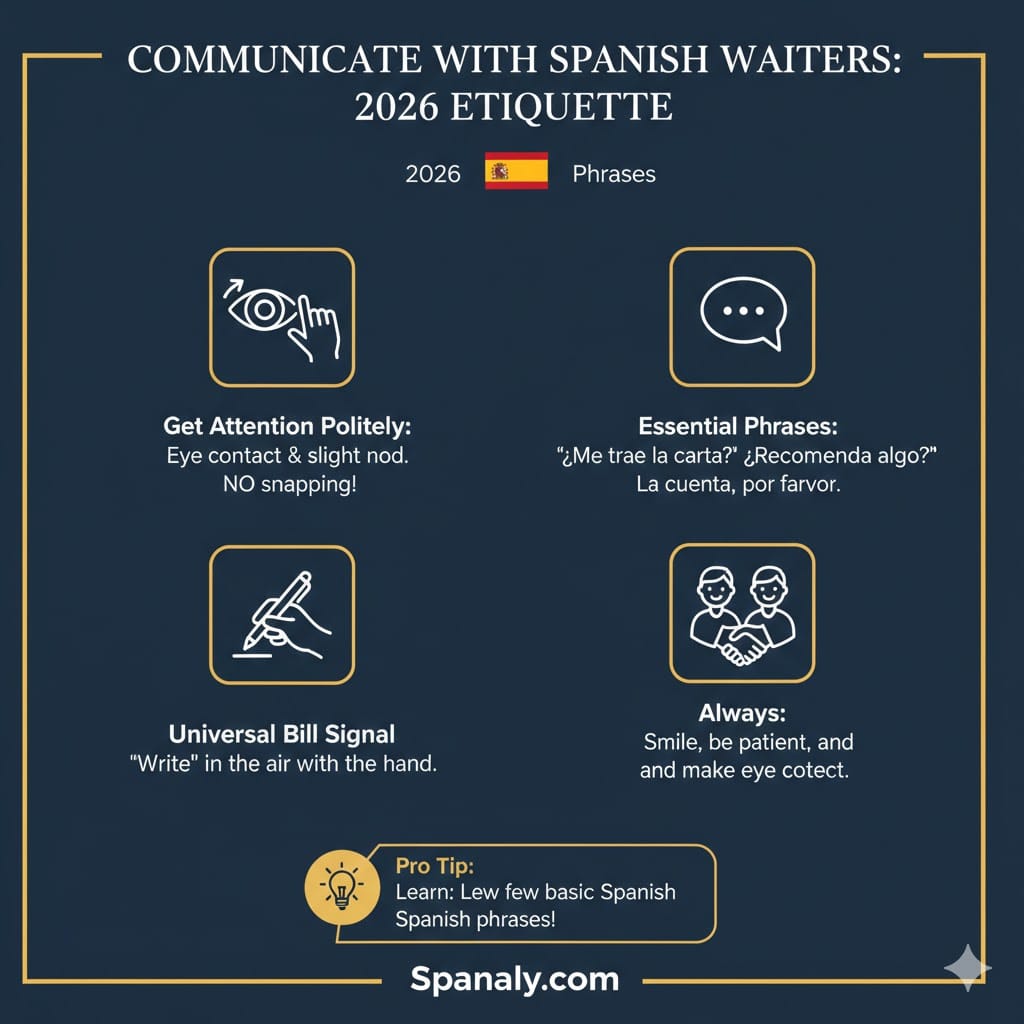
To ensure a smooth dining experience in 2026, you should maintain a polite yet direct communication style. Spanish service is professional but rarely over-attentive:
Get Attention Politely: You should catch the waiter’s eye and give a slight nod. Avoid snapping your fingers or shouting, as this is considered very rude.
Use Essential Phrases: * “¿Me puede traer la carta?” (Can you bring me the menu?)
“¿Nos puede recomendar algo típico?” (Can you recommend something local?)
“La cuenta, por favor” (The bill, please).
The Universal Signal: When you are ready for the bill and cannot find the waiter, you can mimic writing in the air with your hand—every waiter in Spain understands this signal immediately.
💳 Paying and Tipping Etiquette
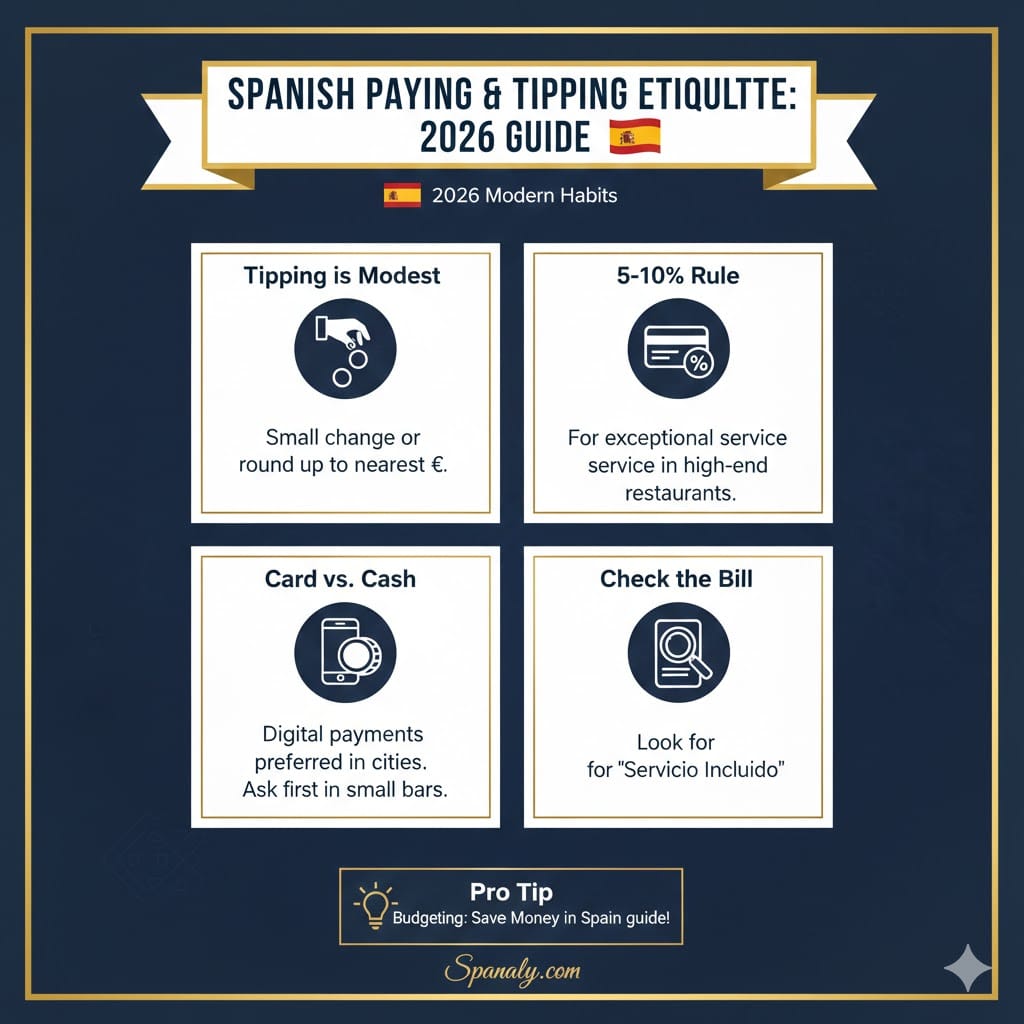
In 2026, paying the bill in Spain remains a straightforward process, but you should understand the tipping culture to avoid overpaying or appearing rude:
Tipping is Modest: Unlike in North America, you do not need to leave a large percentage. Leaving small change or rounding up to the nearest Euro shows enough appreciation for good service.
The 5-10% Rule: For exceptional service in a high-end restaurant, you can leave 5-10%. However, locals rarely do this in casual tapas bars.
Card vs. Cash: You should ask “¿Puedo pagar con tarjeta?” before dining in very small, rural bars. In 2026, most city establishments prefer digital payments.
Check the Bill: Always look for “Servicio incluido” (Service included). If it is already there, you don’t need to add anything extra.
Budgeting: To manage your travel funds wisely, read our guide on How to Save Money While Traveling in Spain for more tips on dining and transport.
🌟 Dining Confidence: Blending In
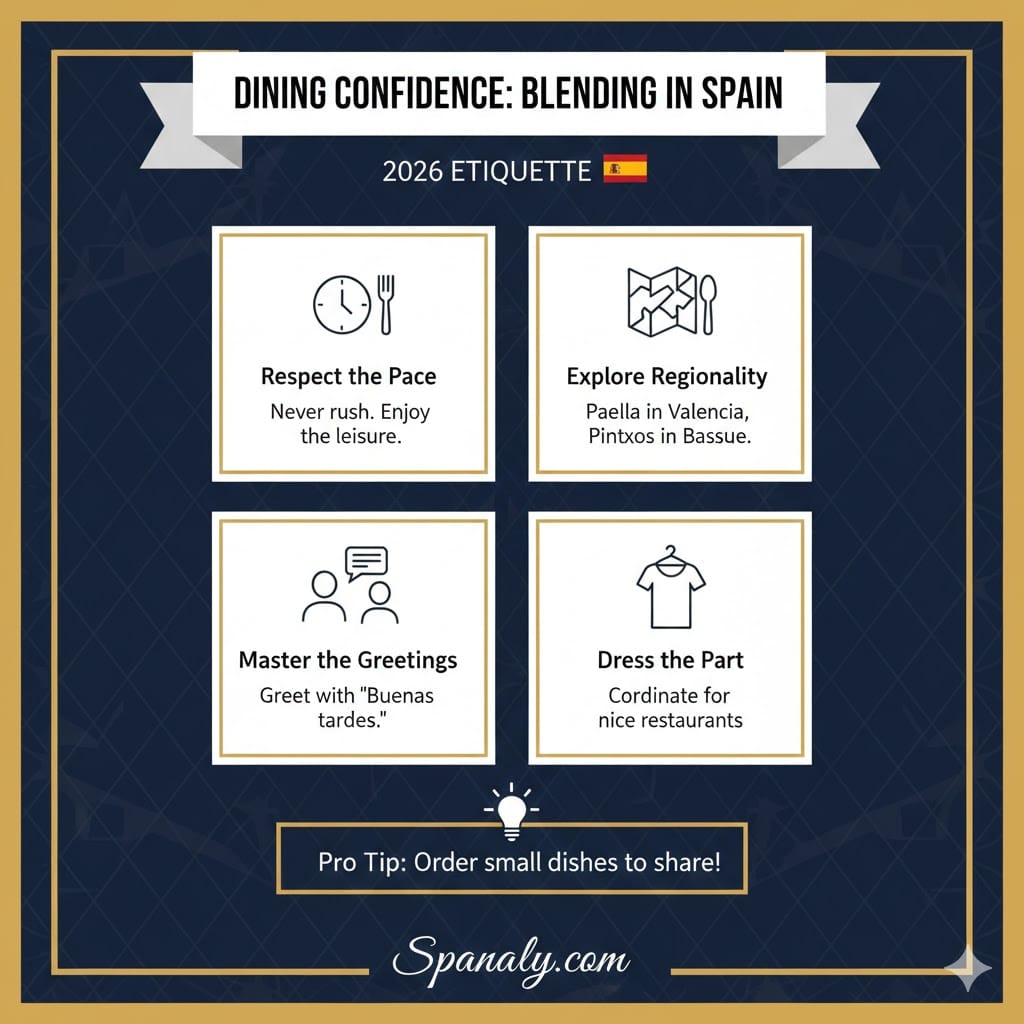
To dine like a local in 2026, you must embrace the cultural mindset as much as the food itself. Follow these final steps to ensure total confidence:
Respect the Pace: You should never rush your meal. Spaniards view dining as a leisure activity, so you must relax and enjoy the rhythm.
Explore Regionality: You should try paella in Valencia, pintxos in the Basque Country, and fresh seafood in Galicia to truly understand Spanish diversity.
Master the Greetings: Always greet the staff with a friendly “Buenas tardes” upon entering and a “Gracias, hasta luego” when leaving.
Dress the Part: To feel even more like a local at a nice restaurant, you should coordinate your outfit. Check our What to Pack for Spain guide to ensure you have the right attire for every dining occasion.
💡 Final Insight: When you order small dishes to share before your main course, you demonstrate cultural awareness and immediately gain the respect of the local staff.
🌟 Exclusive Insider Tips: Dine Like a Local Pro
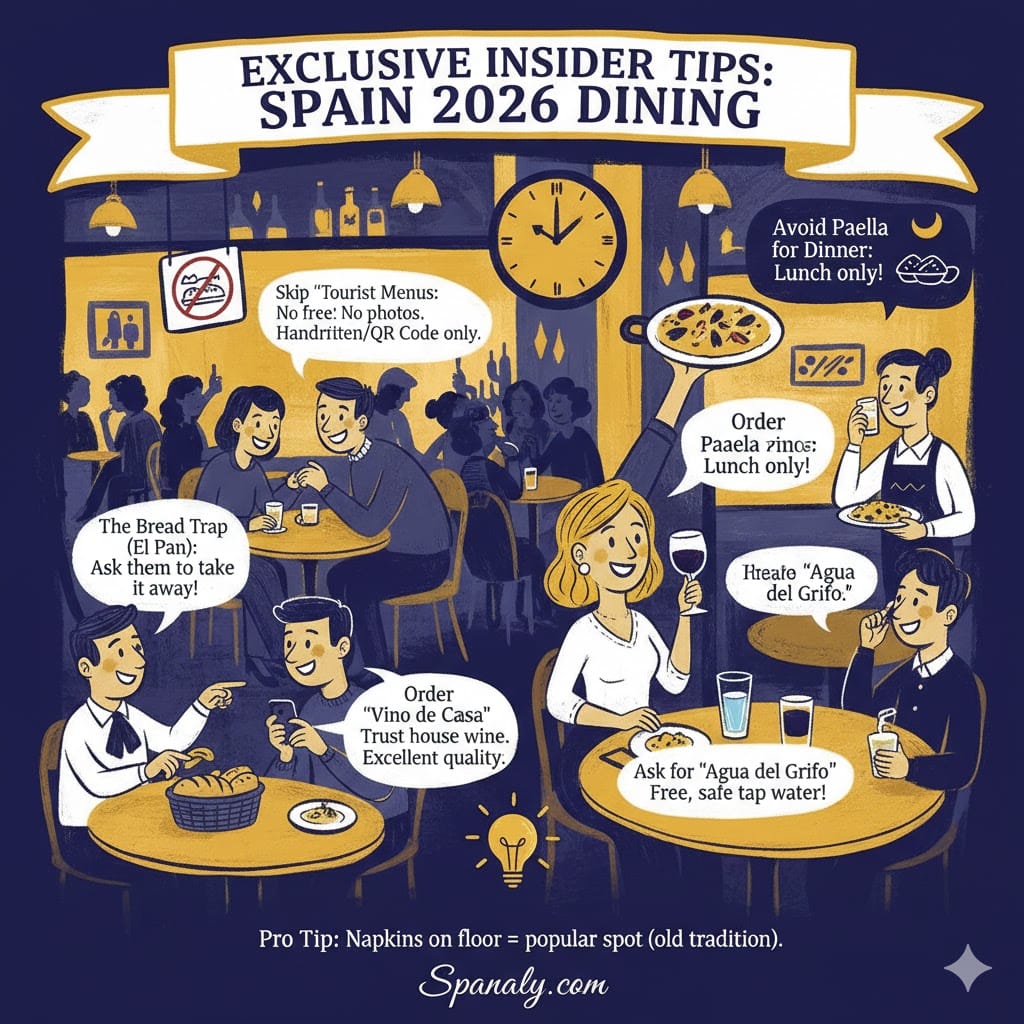
To truly master the Spanish dining scene in 2026, you should follow these rare and highly effective tips that most tourists overlook:
The Bread Trap (El Pan): In many traditional restaurants, waiters will place a basket of bread on your table without you asking. You should know that this is usually not free. If you eat it, they will add a small charge (cubierto) to your bill. If you don’t want it, simply ask them to take it away.
Skip the “Tourist Menus” with Pictures: You should avoid any restaurant that displays large boards with photos of food outside. Authentic local spots usually have handwritten menus or QR codes only in Spanish.
Order “Vino de la Casa”: Instead of expensive bottled wines, you should trust the house wine. In Spain, even the cheapest house wine is often of excellent quality and significantly lowers your bill.
Avoid “Paella” for Dinner: Locals strictly eat paella for lunch because it is a heavy dish. If a restaurant serves paella at night, they are likely reheating it for tourists. You should order seafood or lighter tapas for your evening meal instead.
Ask for “Agua del Grifo”: In 2026, sustainability is huge in Spain. You should feel confident asking for tap water (agua del grifo); it is perfectly safe, free by law in restaurants, and saves you from paying for plastic bottles.
💡 The Secret Rule: If you see napkins thrown on the floor in a traditional old-school tapas bar, don’t be alarmed. Historically, this was a sign of a busy and popular place! However, in modern 2026 spots, this tradition is fading, so stick to the bins unless you see the locals doing it.
🍽️ Visitor FAQs – Ordering Food Like a Local Guide 2026
🥖 What is the difference between a Tapa, a Ración, and a Pincho in 2026?
In 2026, the distinction remains vital: A Tapa is a small snack-sized portion often served with a drink. A Ración is a large plate meant for sharing between 2-4 people—this is the most "local" way to dine. A Pincho (or Pintxo), typical in Northern Spain, is usually a gourmet bite served on bread with a toothpick. You should count your toothpicks, as the waiter uses them to calculate your bill!
☕ How do I order coffee in Spain without looking like a tourist?
You should avoid "to-go" cups. Instead, ask for a "Café con leche" for breakfast or a "Cortado" for a mid-day boost. In 2026, if you want a black espresso, ask for a "Café Solo." Locals always sit down to enjoy their coffee in ceramic cups, viewing it as a social ritual rather than a quick caffeine fix.
💸 Is tipping mandatory in Spanish restaurants in 2026?
No, tipping is not mandatory. You should only leave small change (rounding up to the nearest Euro) for casual meals. For exceptional service in high-end spots, a 5-10% tip is generous. In 2026, most locals pay via contactless mobile apps, and you can often add a tip digitally if the terminal allows it, though cash is still appreciated by staff.
🥘 Why shouldn't I order Paella for dinner?
Authentic Paella is a heavy, rice-based dish that Spaniards strictly eat for lunch (around 2:00 PM). If a restaurant promotes paella at 9:00 PM, it is likely a pre-frozen version designed for tourists. For the best experience, you should book a table at a specialized "Arrocería" during lunch hours to ensure your meal is cooked fresh from scratch.
💧 Can I ask for free tap water in Spanish restaurants?
Yes! Under Spanish law in 2026, all restaurants and bars must provide "Agua del Grifo" (tap water) for free upon request. This is a sustainable move to reduce plastic waste. You should simply ask your waiter: "¿Me puede traer un vaso de agua del grifo, por favor?" and they will comply without charge.
Ordering Food Guide by Spanaly.com
🌟 Your Seat at the Spanish Table
Mastering the art of dining in Spain in 2026 involves more than just ordering food; it is about embracing a lifestyle. When you follow these local customs, you transform every meal into a cultural celebration.
Embrace the Pace: You should view “Sobremesa” as the most important part of your meal.
Trust the Locals: Always look for the house specialties and regional flavors to ensure authenticity.
Stay Prepared: Use your digital tools for reservations but keep your manners traditional and polite.
Next Steps: To complete your travel preparation beyond the restaurant, you must check our Ultimate Seville Travel Guide to find the city’s best-hidden tapas gems.
Final Thought: In Spain, you don’t just eat to live; you eat to share moments. Relax, enjoy the rhythm, and let the flavors of 2026 guide your journey. ¡Buen provecho!