Table of Contents
Toggle🌟 Where History Breathes Through Every Stone
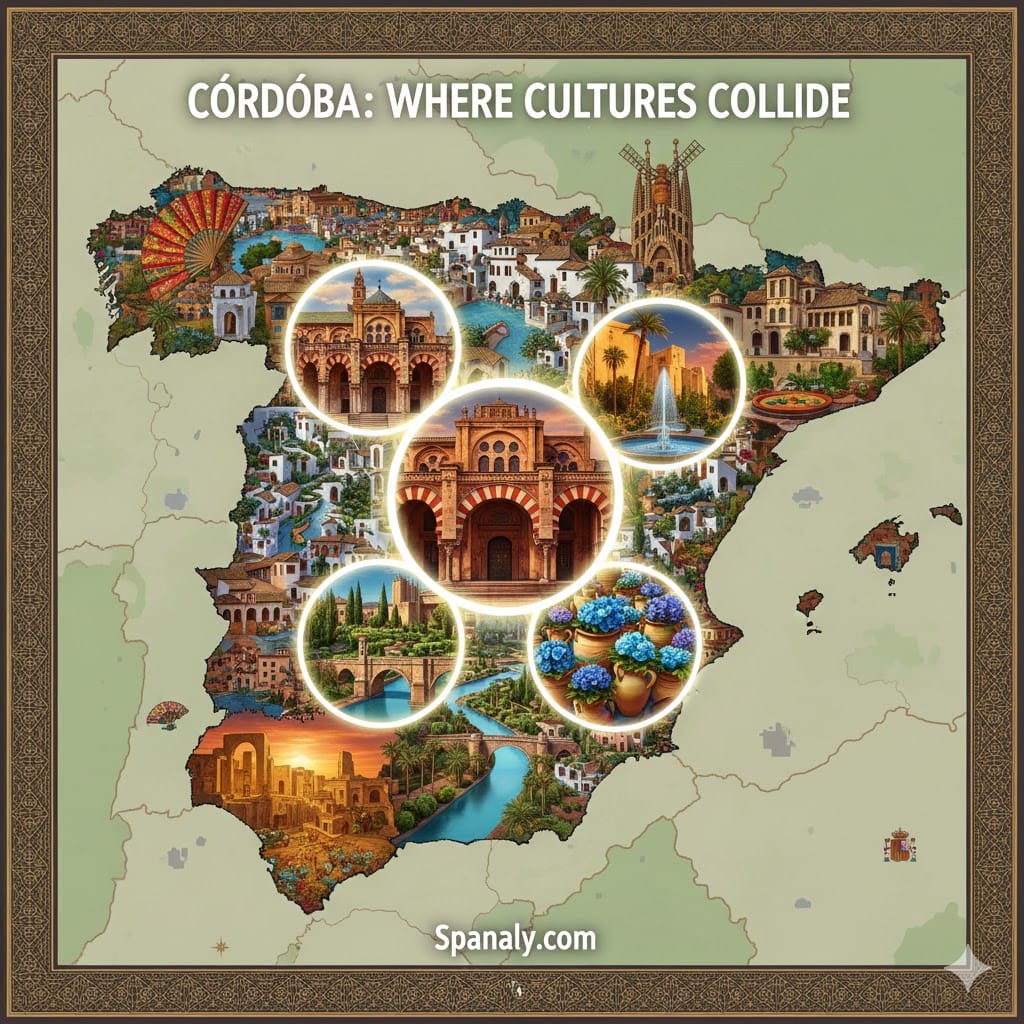
Córdoba, Spain, is a city that doesn’t just show you history—it invites you to live it. This Córdoba Spain Travel Guide is your gateway to the heart of Andalusia, a city that once dazzled the world as the radiant capital of Al-Andalus.
Walking through its sunlit, flower-lined alleys, you’ll feel centuries of art, coexistence, and wisdom blending into a single, timeless rhythm. Home to legendary poets, philosophers, and dreamers, Córdoba remains a masterpiece written in stone, arches, and the sweet scent of jasmine.
🗺️ Why Córdoba is a Must-Visit in 2026:
🕌 Architectural Wonders: Home to the world-famous Mosque-Cathedral.
🌸 The Patios: Discover hidden courtyards overflowing with vibrant flowers.
🏰 Royal History: Walk the halls where kings ruled and explorers dreamt.
🚆 Easy Access: It’s one of the Best Day Trips from Seville, making it a perfect addition to your Andalusian itinerary.
✨ Spanaly Thought: > Córdoba isn’t just a stop on a map; it’s a portal to the past. Whether you are coming for a day or a week, prepare to let time disappear in its ancient Jewish Quarter.
📜 The Golden Legacy: A Brief History of Córdoba
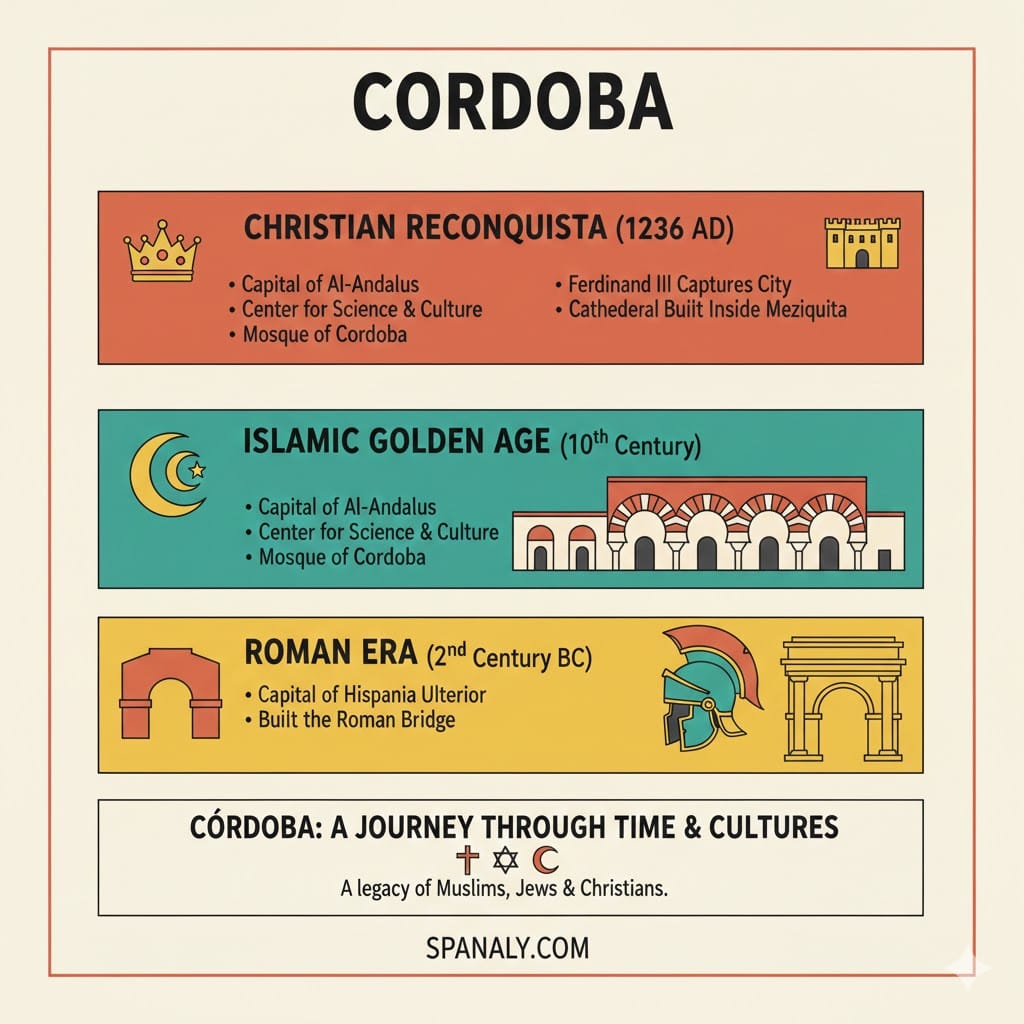
To walk through Córdoba is to flip through the pages of a grand historical epic. Before you explore its monuments, you must understand the layers of civilization that shaped its soul.
🏛️ The Roman Era: Founded by the Romans in the 2nd century BC, Córdoba became the capital of Hispania Ulterior. The massive Roman Bridge remains as a testament to their engineering genius.
🌙 The Islamic Golden Age: In the 10th century, under the Caliphate, Córdoba was the most sophisticated city in Europe. It was a global hub for science, medicine, and philosophy, where the Mosque of Córdoba stood as a beacon of light.
⚔️ The Christian Reconquista: In 1236, the city returned to Christian rule. Instead of destroying the past, the new rulers built upon it, creating the unique “layered” architecture you see today in the Alcázar and the Cathedral.
🤝 The City of Three Cultures: Córdoba is legendary for the “Convivencia”—a time when Muslims, Jews, and Christians lived together, making it a Spanish Attraction unlike any other in the world.
💡 Spanaly Pro Tip: Keep an eye out for the statue of Maimonides in the Jewish Quarter; rubbing his golden shoes is a local tradition said to bring wisdom and luck!
🕌 The Great Mosque–Cathedral: A Forest of Arches
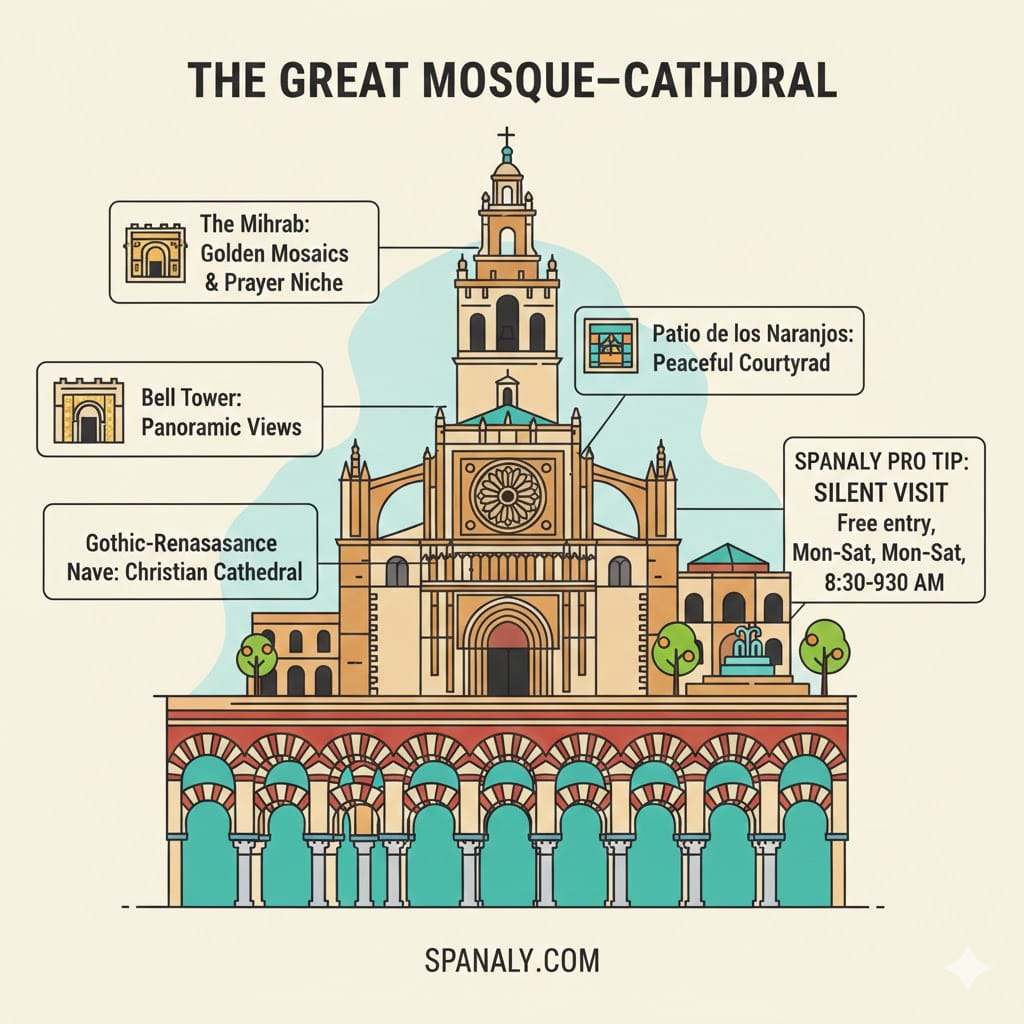
The Mosque-Cathedral of Córdoba, also known as the Mezquita, is a UNESCO World Heritage site and a breathtaking masterpiece of human history. Originally established in the 8th century as the spiritual heart of the Islamic Caliphate, this monument later saw a majestic Renaissance cathedral constructed within its walls during the 16th century.
Walking inside is an ethereal experience. You are immediately surrounded by a “forest” of over 850 columns crafted from jasper, onyx, marble, and granite. The iconic red-and-white double arches create a hypnotic rhythm that symbolizes the city’s golden age, making it one of the most significant Spanish Attractions you will ever witness.
✨ Top Highlights to Explore Inside:
The Mihrab: A golden prayer niche adorned with intricate mosaics that once directed thousands of worshippers.
The Cathedral Nave: A stunning contrast of Gothic and Renaissance styles rising from the center of Islamic arches.
The Bell Tower: Climb this historic minaret-turned-belfry for the best panoramic views of the old city.
Patio de los Naranjos: A serene courtyard filled with orange trees, serving as a peaceful entry to the sanctuary.
💡 Spanaly Pro Tip: To experience the Mezquita in its most spiritual and silent form, take advantage of the “Silent Visit” (usually Monday-Saturday, 8:30 AM to 9:30 AM). Entrance is often free during this hour, providing a perfect, crowd-free moment for photography.
🔗 Planning your Andalusian journey? If you are visiting Córdoba as a detour, don’t miss our Ultimate Seville Travel Guide to help you navigate the region’s top sights like a pro.
🏛️ Medina Azahara: The Forgotten Royal City
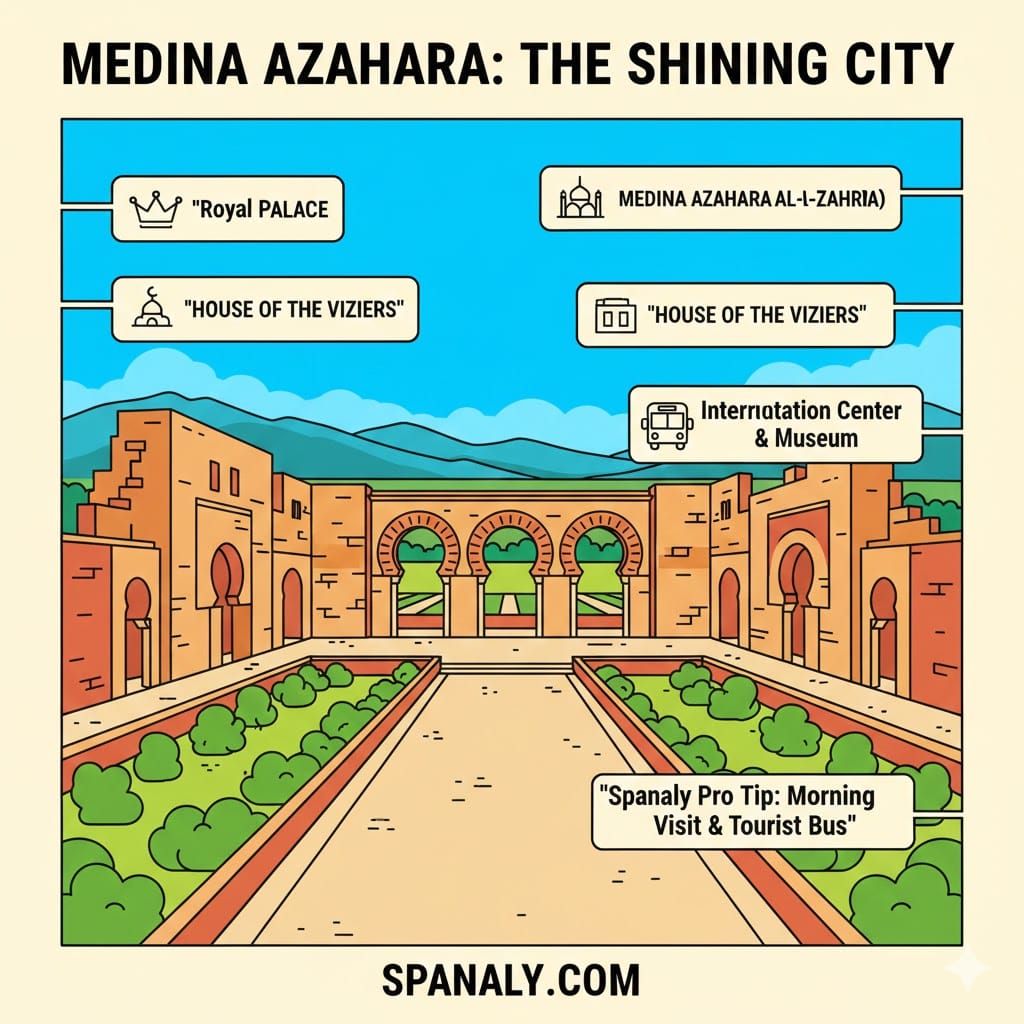
Located just 8 kilometers outside the city center, Medina Azahara (Madinat al-Zahra) is a UNESCO World Heritage site that every traveler should include in their Córdoba Spain Travel Guide. Built in the 10th century by Abd-ar-Rahman III, this “Shining City” was designed as the magnificent capital of the Caliphate, showcasing the absolute power and wealth of Al-Andalus.
Though it lay hidden for centuries under ruins, the excavated site today reveals the sophisticated urban planning of the Moors. Walking through its royal reception halls and terrace gardens, you can still feel the echo of a civilization that was centuries ahead of its time.
✨ Why You Must Visit Medina Azahara:
The House of the Viziers: Marvel at the intricate limestone carvings and horseshoe arches that have been painstakingly restored.
The Royal Palace: See where caliphs received foreign ambassadors in halls once famous for their luxury.
The Interpretation Center: A world-class museum that explains the city’s rise and tragic fall through immersive displays.
Panoramic Views: Its location on the slopes of the Sierra Morena offers a stunning view of the Guadalquivir valley.
💡 Spanaly Pro Tip: To get there easily, use the daily tourist bus from Avenida de los Custodios. Since the site is mostly outdoors, we recommend visiting in the early morning. Check our guide on the Best Time to Visit Spain to plan your trip during the cooler months for the best experience.
🏰 Alcázar de los Reyes Cristianos: A Fortress of Light
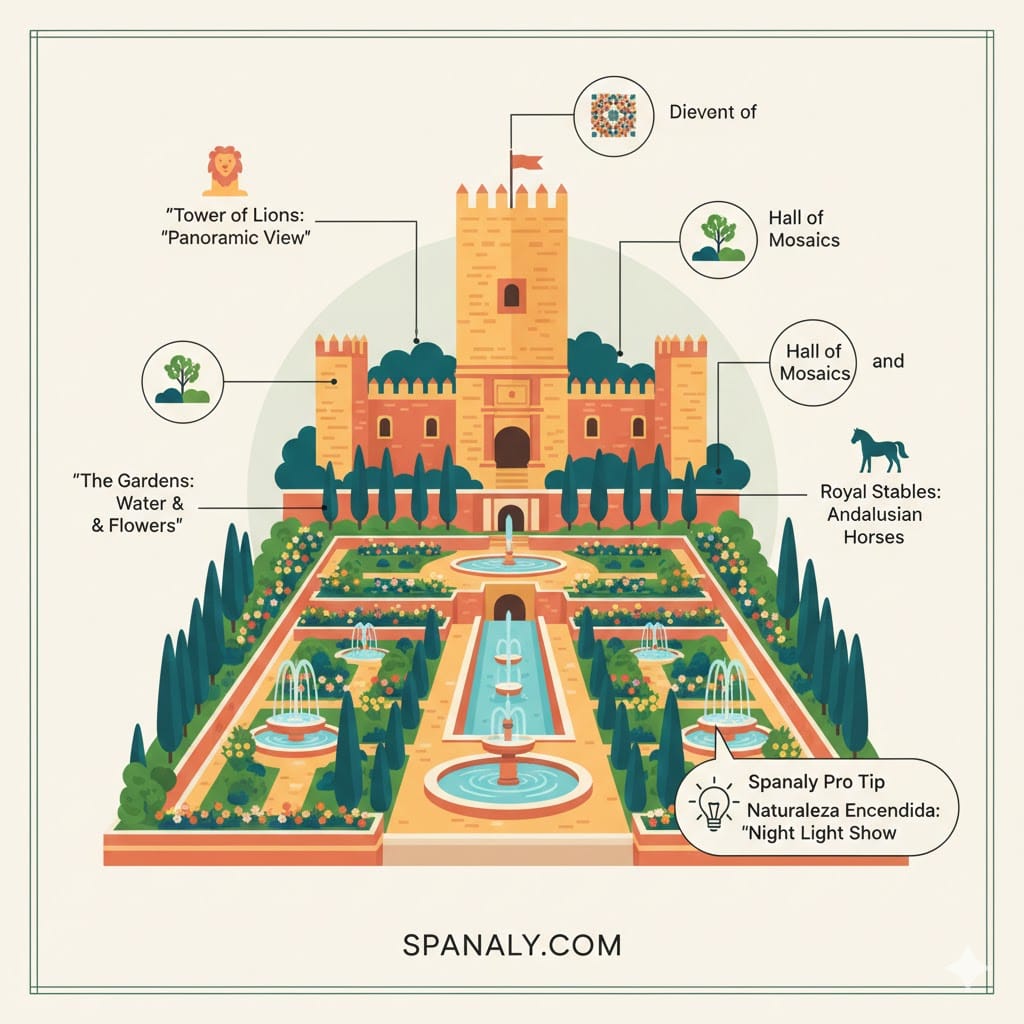
Just steps from the Guadalquivir river, the Alcázar de los Reyes Cristianos rises like a fortress of light. This castle-palace is a mosaic of history; its towers once echoed with royal footsteps—Ferdinand and Isabella ruled here for eight years, and even Christopher Columbus once stood in these halls before his historic voyage to the New World.
While the interior houses Roman mosaics and austere stone halls, the true magic of the Alcázar lies outside. The gardens feel eternal—alive with tiered fountains, aromatic orange trees, and colorful flowers that capture the essence of Andalusian life.
✨ Must-See Highlights of the Alcázar:
The Gardens (Jardines del Alcázar): A breathtaking display of water architecture and floral beauty that rivals the Alhambra.
Tower of the Lions (Torre de los Leones): The oldest tower, offering a panoramic view of Córdoba’s domes and rooftops.
Hall of Mosaics: A grand room showcasing impressive Roman mosaics discovered beneath the city’s Plaza de la Corredera.
The Royal Stables: Located right next door, where you can often see the majestic Andalusian horses practicing their “ballet.”
💡 Spanaly Pro Tip: For a truly mystical experience, visit during the “Naturaleza Encendida” night show. The gardens are illuminated with thousands of lights and projections, turning the historical site into a glowing fairytale.
🔗 Traveling through Spain? If you are navigating the country’s transportation network, our guide on Getting Around Spain will help you find the best high-speed trains to reach Córdoba comfortably.
🌉 The Roman Bridge: Córdoba’s Ancient Spine
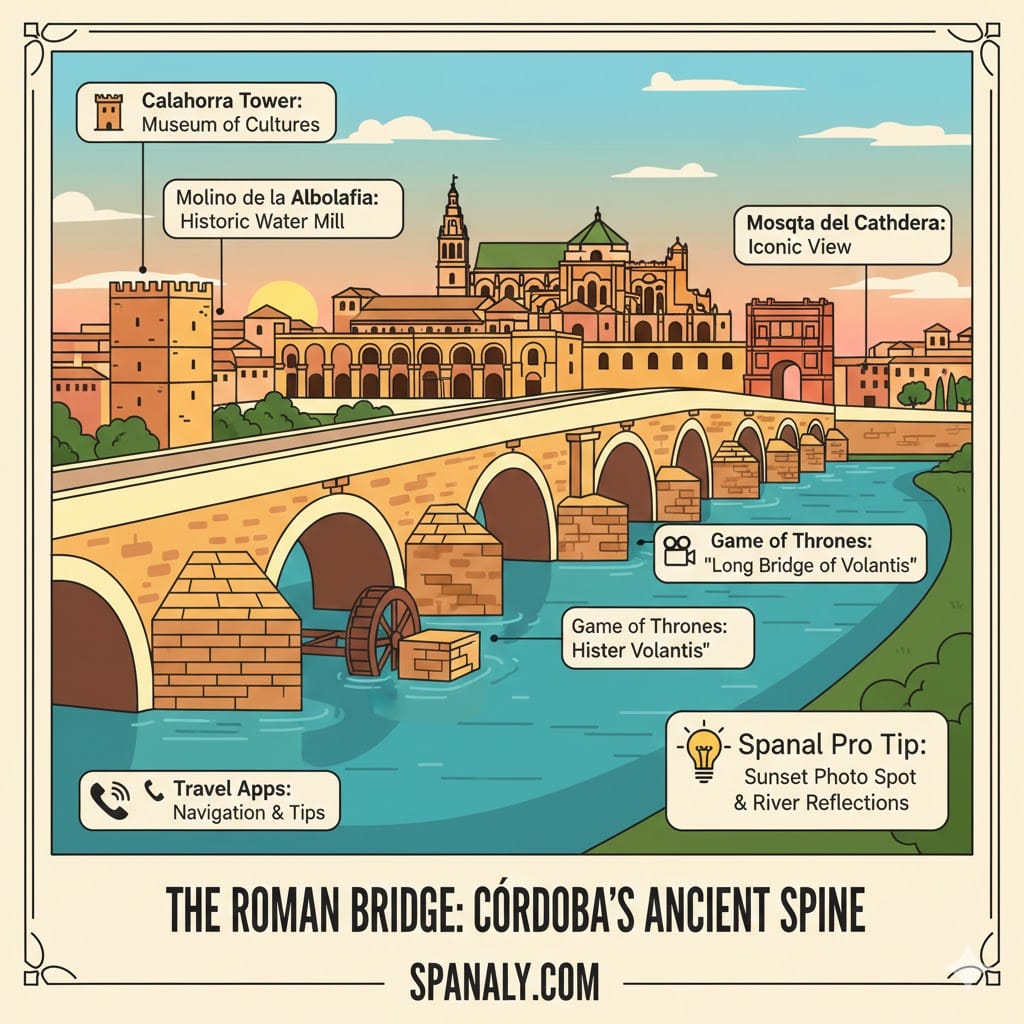
The Roman Bridge of Córdoba (Puente Romano) is much more than a river crossing; it is the city’s ancient spine, connecting its glorious past with the vibrant present. Built in the 1st century BC, this massive stone structure has carried Roman soldiers, Islamic traders, and Christian kings across the shimmering Guadalquivir River for over two millennia.
Crossing the bridge at sunset is a rite of passage for any visitor. As the golden light hits the arches and the Mosque-Cathedral rises in the background, the view becomes one of the most iconic sights in all of Spain.
✨ Key Highlights of the Riverfront:
Calahorra Tower: Located at the southern end, this fortified gate houses a fascinating museum dedicated to the “Convivencia” (coexistence) of the three cultures.
Puerta del Puente: The grand triumphal arch that serves as the ceremonial entrance to the old city.
The Roman Mill (Molino de la Albolafia): A historic water mill near the bridge that once pumped water to the Alcázar’s gardens.
Game of Thrones Link: Fans might recognize this bridge as the “Long Bridge of Volantis”—a testament to its epic, cinematic scale.
💡 Spanaly Pro Tip: For the absolute best photography spot, cross the bridge and walk a few meters along the southern bank. From there, you can capture the entire bridge and the Mezquita reflecting in the river water—especially magical after dark when the monuments are illuminated.
🔗 Pro Tip for Travelers: To make your trip even smoother, check our guide on the Best Travel Apps for Spain to help you navigate local transport and find hidden historical markers along the river.
🏘️ La Judería: Exploring the Jewish Quarter & Synagogue
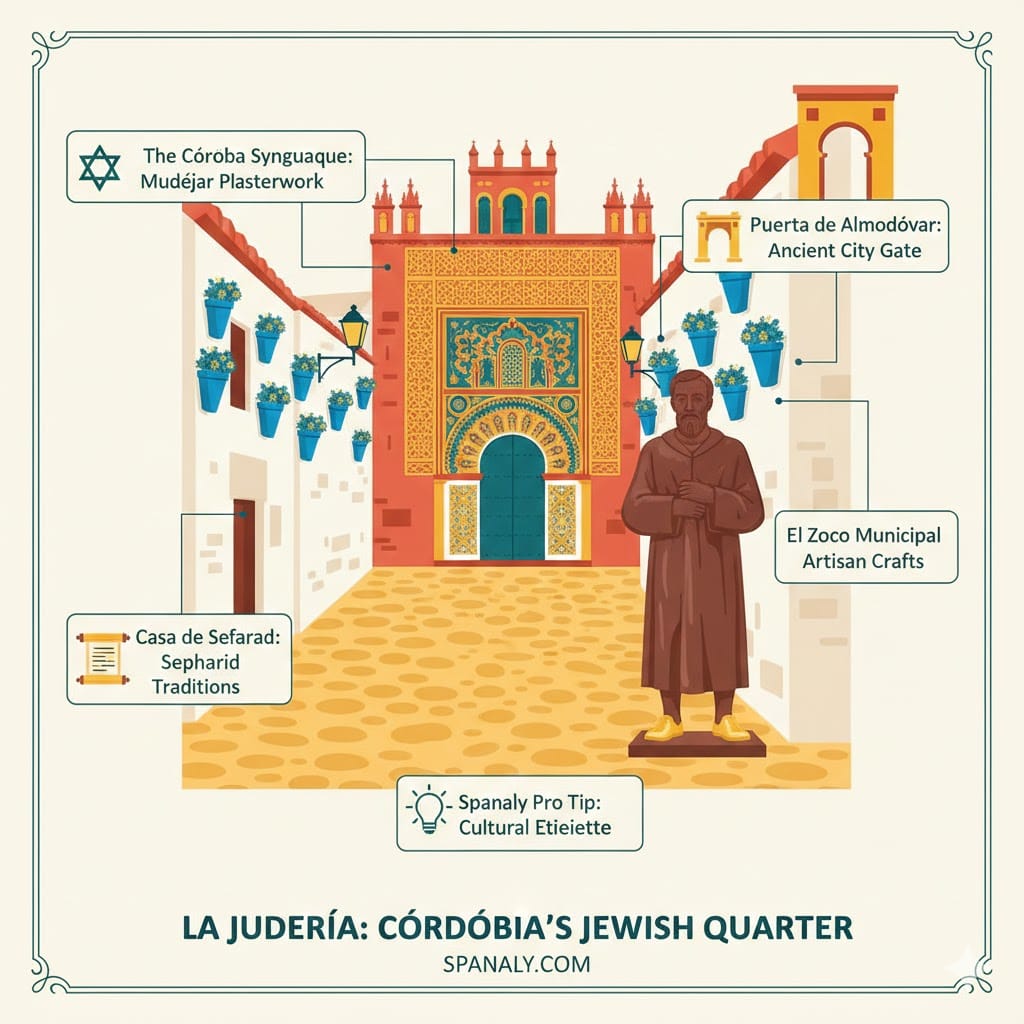
Stepping into La Judería, the historic Jewish Quarter of Córdoba, feels like entering a living museum of whitewashed walls and narrow, winding stone paths. This labyrinthine neighborhood, a UNESCO World Heritage site, was the intellectual and spiritual heart of the city between the 10th and 15th centuries.
As you wander, you’ll discover quiet plazas, hidden craft shops, and the famous statue of Maimonides, the legendary philosopher. The area is a masterclass in ancient urban design, where every corner reveals a new secret, from a burst of blue flowerpots to a hidden Sephardic courtyard.
✨ Top Highlights of the Jewish Quarter:
The Córdoba Synagogue: One of the only three original pre-1492 synagogues left in Spain. Its Mudéjar-style plasterwork is incredibly detailed and rare.
Casa de Sefarad: A cultural house dedicated to the memory and traditions of the Sephardic Jews, located right across from the synagogue.
The Souk (Zoco Municipal): A beautiful 16th-century courtyard where local artisans practice traditional Cordobese crafts like silver filigree.
Ancient City Walls: Walk along the Almodóvar Gate (Puerta de Almodóvar), the majestic entrance that once protected this historic enclave.
💡 Spanaly Pro Tip: The streets of La Judería can be extremely narrow and are often shared with locals. To ensure a respectful visit, check our guide on Cultural Etiquette in Spain to learn how to navigate historic residential areas like a seasoned traveler.
🌸 The Patios of Córdoba & Viana Palace: A Celebration of Flowers
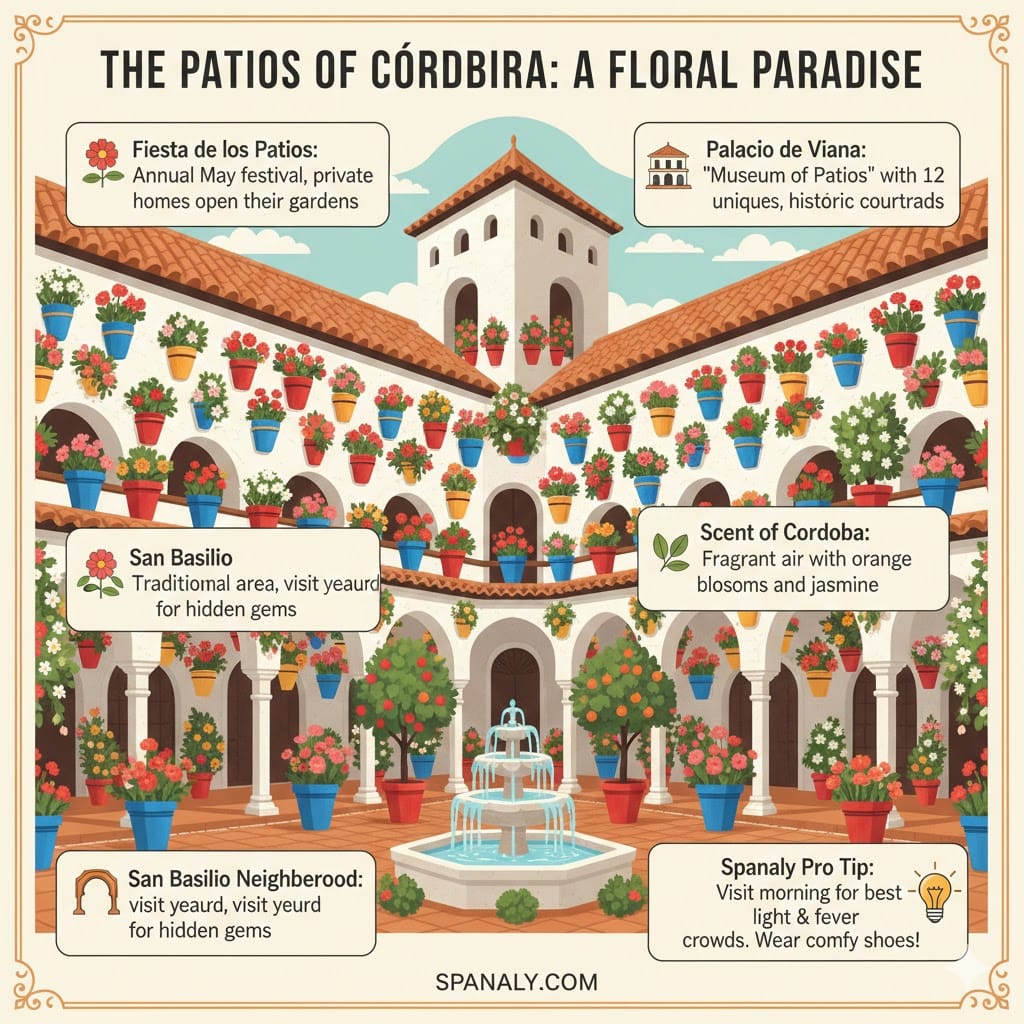
In Córdoba, beauty hides behind closed doors. The Patios of Córdoba are world-famous courtyards that turn the city into a living garden. This tradition dates back to Roman times. It was designed to keep homes cool during hot Andalusian summers. Today, these floral spaces are a UNESCO Intangible Cultural Heritage.
For the ultimate experience, visit Palacio de Viana. This 15th-century palace is known as the “Museum of Patios.” It features 12 unique courtyards, each with its own floral style and peaceful atmosphere.
✨ Must-See Patio Highlights:
Fiesta de los Patios: A famous May festival where private homes open their secret gardens to the public.
Viana Palace Courtyards: Explore “Patio de los Gatos” for stunning photography and history.
San Basilio Neighborhood: The best area to find beautifully decorated patios year-round.
Fragrant Blooms: Enjoy the sweet scent of jasmine and orange blossoms.
💡 Spanaly Pro Tip: Most patios are open all year, not just in May. Visit in the morning to avoid crowds and get the best light. Wear comfortable shoes for the cobblestone alleys.
🔗 Traveling on a budget? Learn how to enjoy these wonders with our guide: Is Spain Expensive? for smart saving tips.
💎 Hidden Gems: Calleja de las Flores & Plaza de la Corredera
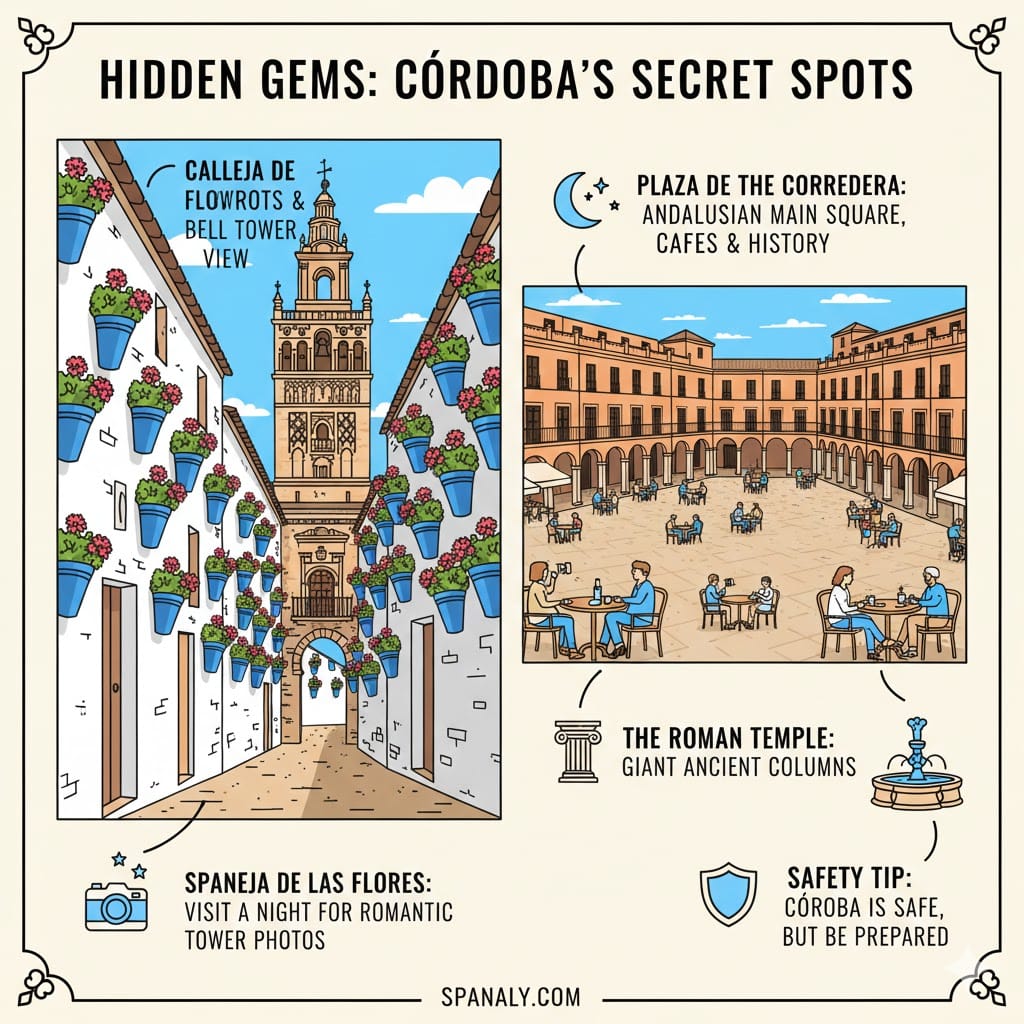
Beyond the main monuments, Córdoba hides treasures that many tourists miss. Calleja de las Flores is perhaps the most photographed street in the city. This narrow alley is famous for its blue flowerpots and white walls. It offers a perfectly framed view of the Mosque-Cathedral’s bell tower.
For a change of pace, head to Plaza de la Corredera. This is the only rectangular “Plaza Mayor” in Andalusia. It resembles the famous squares in Madrid or Salamanca. In the past, it hosted bullfights and public events. Today, it is the perfect spot to enjoy a coffee and watch local life.
✨ Secret Spots You Must Visit:
Calleja del Pañuelo: Known as one of the narrowest streets in the world. It is only as wide as a folded handkerchief.
The Roman Temple: Stand beneath giant stone columns that once belonged to a grand Roman temple.
Plaza del Potro: A historic square mentioned in Don Quixote. It features a beautiful fountain and the Museum of Fine Arts.
Cuesta del Bailío: A picturesque staircase decorated with mosaics and colorful flowers.
💡 Spanaly Pro Tip: Visit Calleja de las Flores at night or very early in the morning. Since the street is extremely narrow, it gets crowded quickly. A nighttime visit offers a romantic and quiet atmosphere for photos.
🔗 Thinking about safety? Even in hidden alleys, Córdoba is very safe. Still, it’s wise to be prepared. Read our guide on Is Spain Safe for Tourists? for essential travel security tips.
🏨 Where to Stay in Córdoba: The Best Neighborhoods

Choosing the right area is key to enjoying Córdoba. Most travelers prefer staying in the historic center. This allows you to walk to all major sites easily. Here are the top neighborhoods for every traveler:
The Jewish Quarter (La Judería): Best for first-time visitors. Stay here to be steps away from the Mosque-Cathedral. You will find charming boutique hotels in restored houses.
Old Town (Centro): Perfect for those who love shopping and local life. It is located between the historic sites and the modern city. It offers a great mix of hotels.
Vial Norte: Ideal for travelers arriving by train. This modern area is near the station. It features larger, contemporary hotels with great amenities.
San Basilio: The quietest and most authentic choice. It is famous for its flower patios. Stay here for a peaceful, local Andalusian experience.
💡 Spanaly Pro Tip: Córdoba is a very walkable city. You don’t need a car if you stay near the historic center. If you visit in May during the Patio Festival, book your stay early. Prices rise quickly during this peak season.
🔗 Planning an Andalusian road trip? If your next stop is the capital of Andalusia, don’t miss our comprehensive guide on Where to Stay in Seville to find the best hotels and neighborhoods.
🍽️ Spanish Cuisine: What to Eat in Córdoba
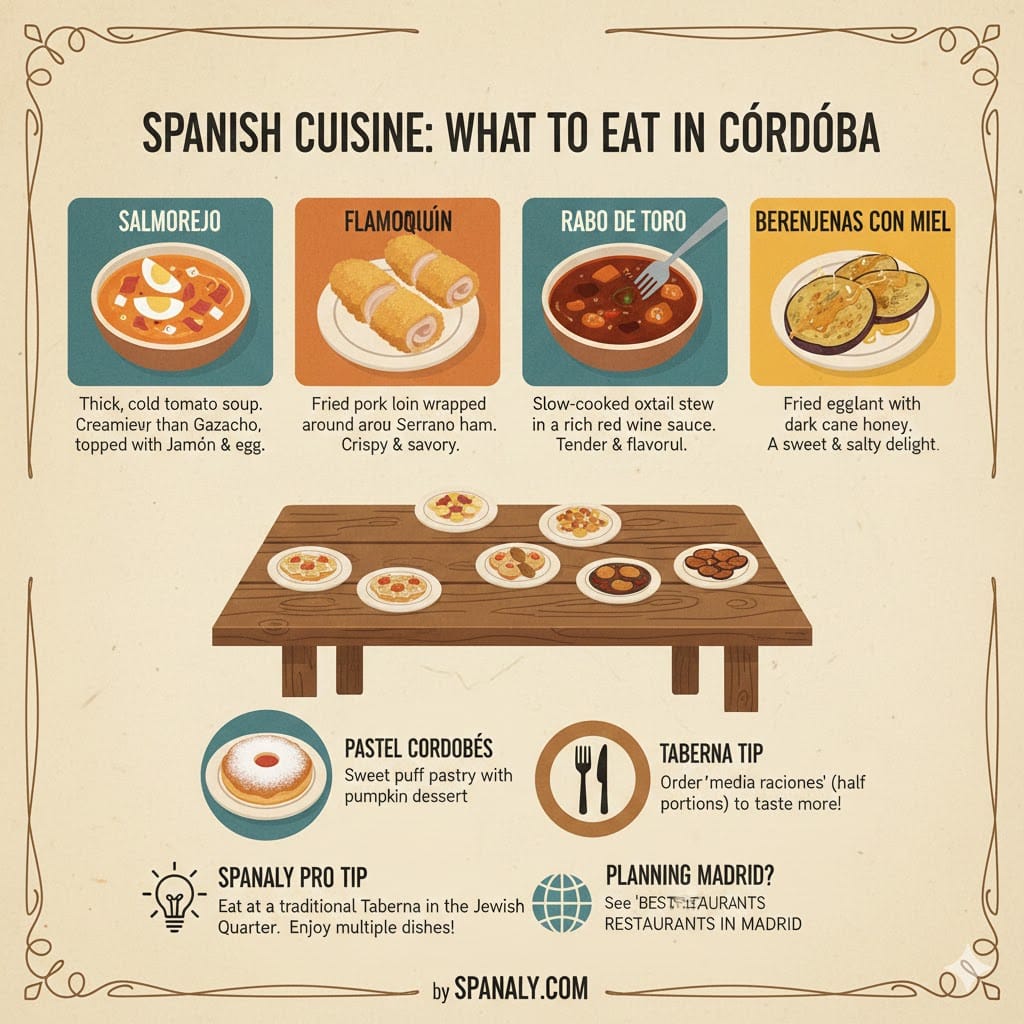
Food in Córdoba is a delightful journey through history. The city’s dishes reflect its Roman, Islamic, and Christian roots. You cannot leave without trying the local specialties. They are fresh, flavorful, and deeply traditional.
✨ Iconic Dishes You Must Try:
Salmorejo: A thick, cold tomato soup. It is creamier than Gazpacho. It is topped with hard-boiled eggs and Spanish ham (Jamón).
Flamenquín: Slices of pork loin wrapped around Serrano ham. It is breaded and deep-fried to perfection.
Rabo de Toro: A rich, slow-cooked bull’s tail stew. It is tender and served in a savory red wine sauce.
Berenjenas con Miel: Fried eggplant slices drizzled with dark cane honey. This is a perfect mix of salty and sweet.
Pastel Cordobés: A sweet puff pastry filled with “cabello de ángel” (pumpkin jam). It is a classic local dessert.
💡 Spanaly Pro Tip: For the most authentic experience, head to a traditional “Taberna” in the Jewish Quarter. Order several “media raciones” (half portions). This allows you to taste many different local flavors in one meal.
🔗 Heading to the capital next? If your food tour continues north, make sure to check our curated list of the Best Restaurants in Seville for more unforgettable culinary experiences.
✨ Traditional Crafts: Silver & Leather
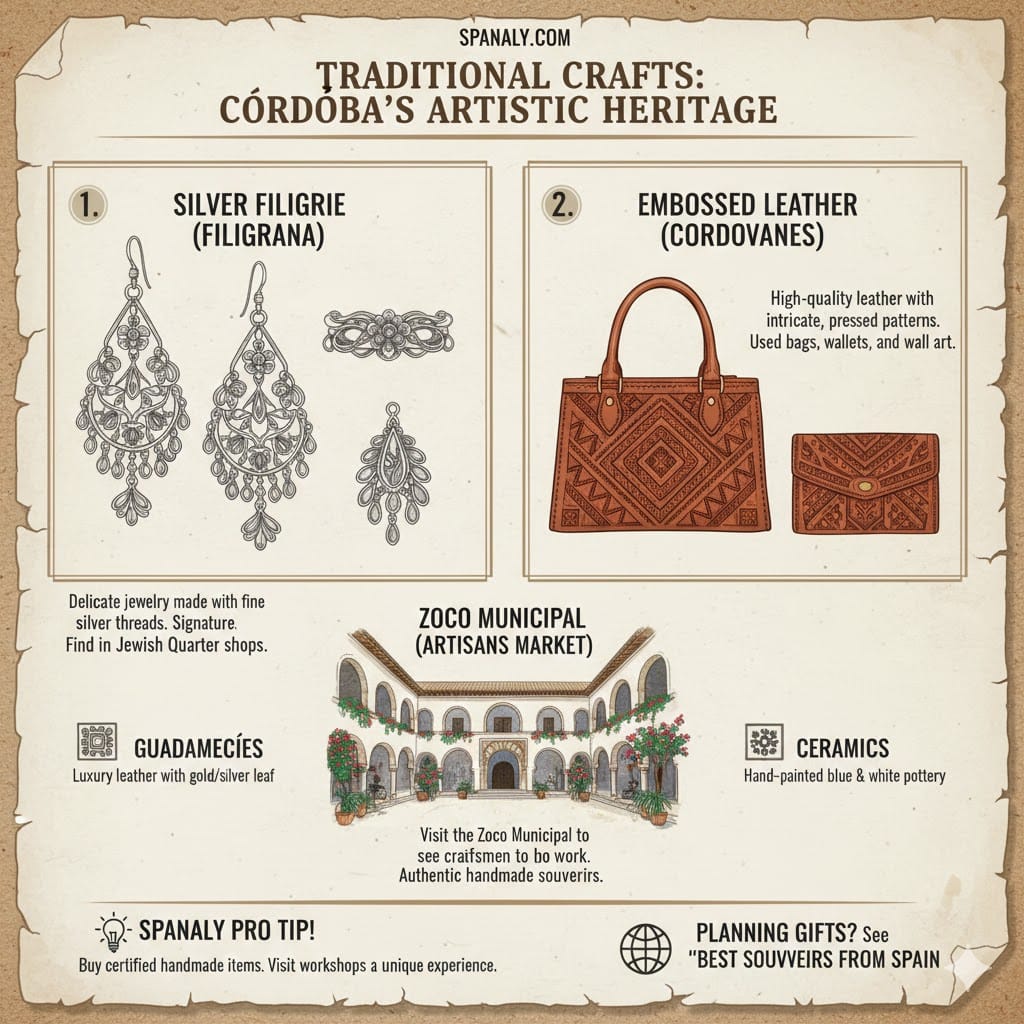
Córdoba is famous for its exquisite craftsmanship. This heritage dates back to the era of the Caliphate. The city is especially known for two noble materials: silver and leather. Buying these items is like taking a piece of Córdoba’s history home with you.
✨ Iconic Cordobese Crafts:
Silver Filigree (Filigrana): Artisans create delicate jewelry using fine silver threads. This technique is a signature of Córdoba. You will find beautiful earrings, brooches, and pendants in the Jewish Quarter.
Cordovanes (Embossed Leather): This high-quality leather is famous worldwide. It is tanned and decorated with intricate embossed patterns. Look for handmade bags, wallets, and unique wall decorations.
Guadamecíes: A luxury leather craft that includes gold or silver leaf. It was used in the past to decorate royal palaces.
Ceramics: Many local shops sell hand-painted pottery. These feature the traditional blue and white patterns of Andalusia.
💡 Spanaly Pro Tip: For the most authentic experience, visit the Zoco Municipal (Artisans Market) near the Synagogue. Here, you can watch master craftsmen at work in a beautiful 16th-century courtyard. It is the best place to find certified handmade souvenirs.
🎉 Festivals & Nightlife: Córdoba’s Vibrant Spirit

Córdoba is a city that loves to celebrate. Throughout the year, its streets come alive with music, dance, and tradition. The energy is infectious, and the nightlife offers a perfect blend of modern fun and historic charm.
✨ Top Festivals in Córdoba:
The Patio Festival (May): The city’s most famous event. Locals open their flower-filled courtyards to the world.
Feria de Córdoba: A massive celebration at the end of May. Expect flamenco dresses, horse parades, and lively “casetas” (tents) with music and food.
Semana Santa (Holy Week): A deeply emotional week. Beautiful processions move through the narrow streets of the Jewish Quarter.
Guitar Festival (July): An international event celebrating all styles of guitar music, from Flamenco to Rock.
🌃 Nightlife & Evening Vibes:
Tablaos Flamencos: Experience authentic flamenco in the heart of the Old Town.
Rooftop Bars: Enjoy a cocktail with a view of the illuminated Mosque-Cathedral.
Plaza de la Corredera: The go-to spot for late-night tapas and drinks in a historic setting.
💡 Spanaly Pro Tip: If you want to experience the festivals, book your trip for May. It is the most beautiful month, but also the busiest. For a quieter nightlife, explore the riverside bars near the Roman Bridge.
⏱️ The Perfect Córdoba Day Trip Itinerary
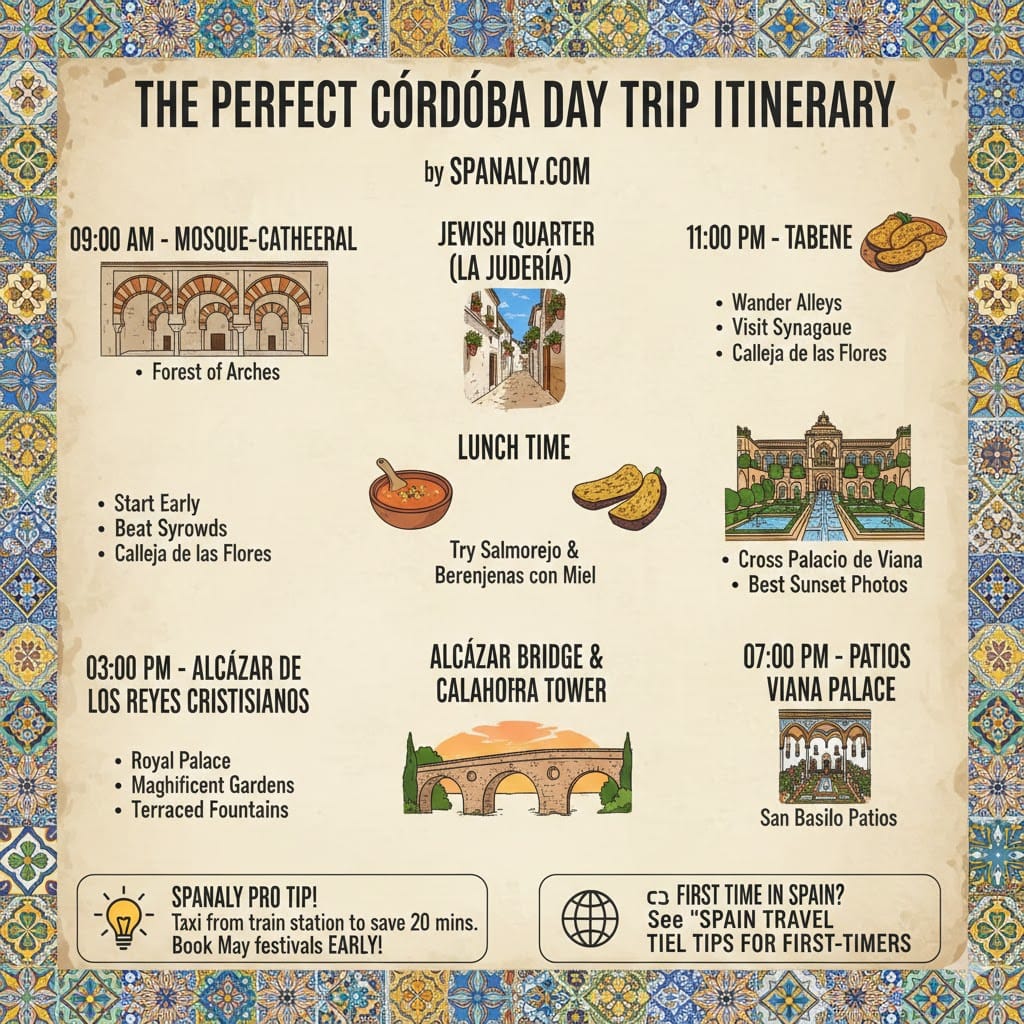
If you only have one day in Córdoba, you need a plan. The city is compact, so you can see most highlights on foot. Here is the best way to spend 24 hours in this Andalusian gem:
09:00 AM – The Mosque-Cathedral: Start early to beat the crowds. Explore the forest of arches and the stunning Cathedral within.
11:00 AM – The Jewish Quarter (La Judería): Wander through the narrow white alleys. Visit the Synagogue and the charming Calleja de las Flores.
01:00 PM – Lunch Time: Head to a local taberna. Try Salmorejo and Berenjenas con Miel for an authentic taste of Córdoba.
03:00 PM – Alcázar de los Reyes Cristianos: Walk through the royal palace and its magnificent terraced gardens and fountains.
05:00 PM – Roman Bridge & Calahorra Tower: Cross the bridge for the best panoramic view of the city. It’s the perfect spot for sunset photos.
07:00 PM – Patios or Viana Palace: If time permits, visit the Palacio de Viana or the traditional patios in the San Basilio neighborhood.
💡 Spanaly Pro Tip: If you are arriving by high-speed train (AVE), take a quick taxi or bus from the station to the historic center. This saves you 20 minutes of walking and gives you more time for sightseeing!
💡 Essential Practical Tips for a Smooth Córdoba Visit
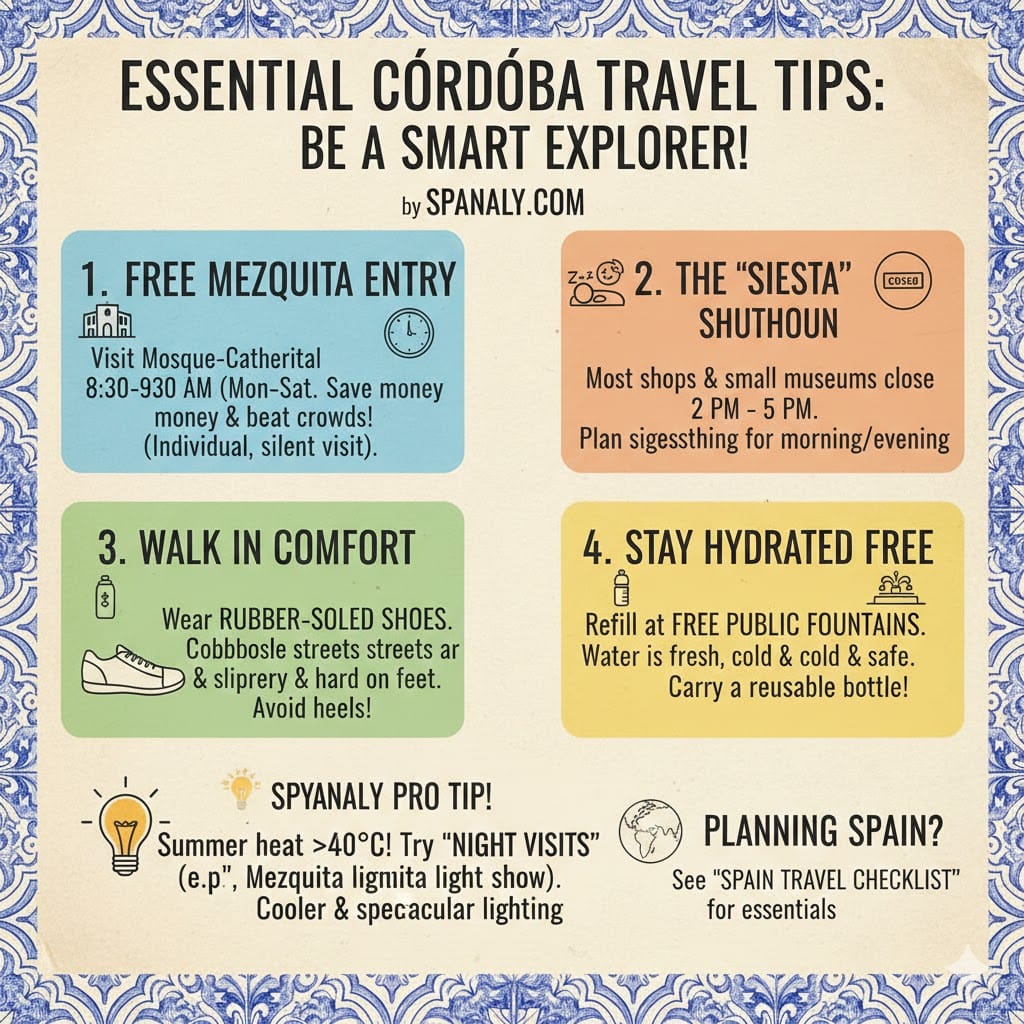
To make your trip to Córdoba perfect, you need to know more than just where the monuments are. These “insider” tips will save you time, money, and effort.
Book “Early Bird” Tickets: The Mosque-Cathedral offers free entry from 8:30 AM to 9:30 AM (Monday to Saturday), but only for individual visitors and in silence. It’s a great way to save money and experience the magic without crowds.
The “Patios” Outside May: If you miss the May festival, don’t worry. You can still visit the Trueque Four patio, which is open as a museum year-round, or the Palacio de Viana with its 12 magnificent courtyards.
The “Siesta” is Real: In Córdoba, especially during summer, many local shops and smaller museums close between 2:00 PM and 5:00 PM. Plan your heavy sightseeing for the morning and enjoy a long lunch or a nap during these hours.
Wear Rubber-Soled Shoes: The streets of the Jewish Quarter are paved with smooth, historic cobblestones. They can be very slippery and hard on your feet. Avoid heels or thin sandals.
Free Public Fountains: You will find historic drinking fountains throughout the old city. The water is fresh, cold, and safe to drink. Carry a reusable bottle to stay hydrated for free.
💡 Spanaly Pro Tip: If you are visiting in summer, the heat in Córdoba can exceed 40°C. Many monuments offer “Night Visits” (like The Soul of Córdoba light show in the Mosque). It is much cooler and the lighting is spectacular.
🔗 Traveling across Spain? If Córdoba is part of a larger journey, make sure you are fully prepared by reading our Essential Spain Travel Checklist to ensure you haven’t forgotten any important documents or gear.
🗺️ Essential Córdoba Travel FAQs
🛡️ Is Córdoba safe for solo travelers?
Yes, Córdoba is considered one of the safest cities in Spain. Even late at night, the historic center is well-lit and lively. Just follow standard precautions in crowded areas to avoid pickpockets, as in any tourist destination.
💳 Can I pay with credit cards in local shops?
Absolutely. Visa and Mastercard are accepted almost everywhere, including small souvenir shops and tapas bars. However, it is always good to carry a little cash for small purchases under €5 or for tips at local tabernas.
🗣️ Do people speak English in Córdoba?
In major tourist sites, hotels, and restaurants, English is widely spoken. In smaller, more local spots, people might only speak Spanish, but they are very friendly and used to helping tourists with gestures or translation apps.
🏺 Is Medina Azahara worth visiting?
If you love history, definitely yes. Located 8km outside the city, these ruins of a 10th-century palace-city are a UNESCO site. There is a dedicated shuttle bus (Bus Turístico) that takes you there from the city center in 20 minutes.
🚰 Can I drink tap water in Córdoba?
Yes, the tap water is 100% safe and of high quality. You don't need to buy bottled water. Just refill your bottle at your hotel or at any of the public drinking fountains found in the old city squares.
Expert Travel Insights by Spanaly.com
🏰 Your Córdoba Adventure Awaits
Córdoba is a city of layers. It blends Roman, Islamic, and Christian history perfectly. The streets are narrow but full of stories. The food is rich and the people are welcoming. It is a place where time seems to slow down. Don’t just visit Córdoba; feel its soul.
🔗 Expanding your Spanish journey? If you are planning to head north after exploring Andalusia, don’t miss our comprehensive guide on How to Plan Your Trip to Barcelona for the best Mediterranean vibes and Gaudi’s masterpieces.
💡 Spanaly Pro Tip: For the most magical view of the city, cross the Roman Bridge at Blue Hour (just after sunset). The lights of the Mosque-Cathedral reflect on the Guadalquivir river. It is the perfect moment for a quiet walk and breathtaking photos away from the midday heat.
💬 What do you think? Are the flower-filled patios calling your name? Or is the Mosque-Cathedral at the top of your list? Tell us in the comments below! We love helping you plan your perfect Spanish escape.