Table of Contents
Toggle🏎️ Your 2026 Spanish Road Adventure
Driving in Spain is the ultimate way to unlock the country’s hidden soul. From the rugged cliffs of the north to the olive groves of Andalusia, having your own wheels offers a level of freedom that trains simply cannot match.
In 2026, Spain has transformed into a premier destination for “Smart Road Trips,” blending scenic historic routes with modern, eco-friendly infrastructure.
🌟 Why Choose a Road Trip in 2026?
📍 Hidden Gems: You can reach secluded coves and mountain villages that public transport misses.
⏰ Total Freedom: You should set your own pace—stop for a spontaneous tapas lunch or a sunset photo.
⚡ Modern Tech: Most Spanish highways now feature integrated smart sensors and extensive EV charging networks.
🛡️ Safety First: Spain ranks among the safest European countries for drivers. However, you should always stay informed about local risks by checking our Travel Safety in Spain: Avoid Tourist Scams guide before you start your engine.
This guide will walk you through the essential 2026 laws, digital tolls, and the most breathtaking routes to ensure your journey is nothing short of legendary.
⚖️ Driving Rules & Legal Requirements (2026 Update)
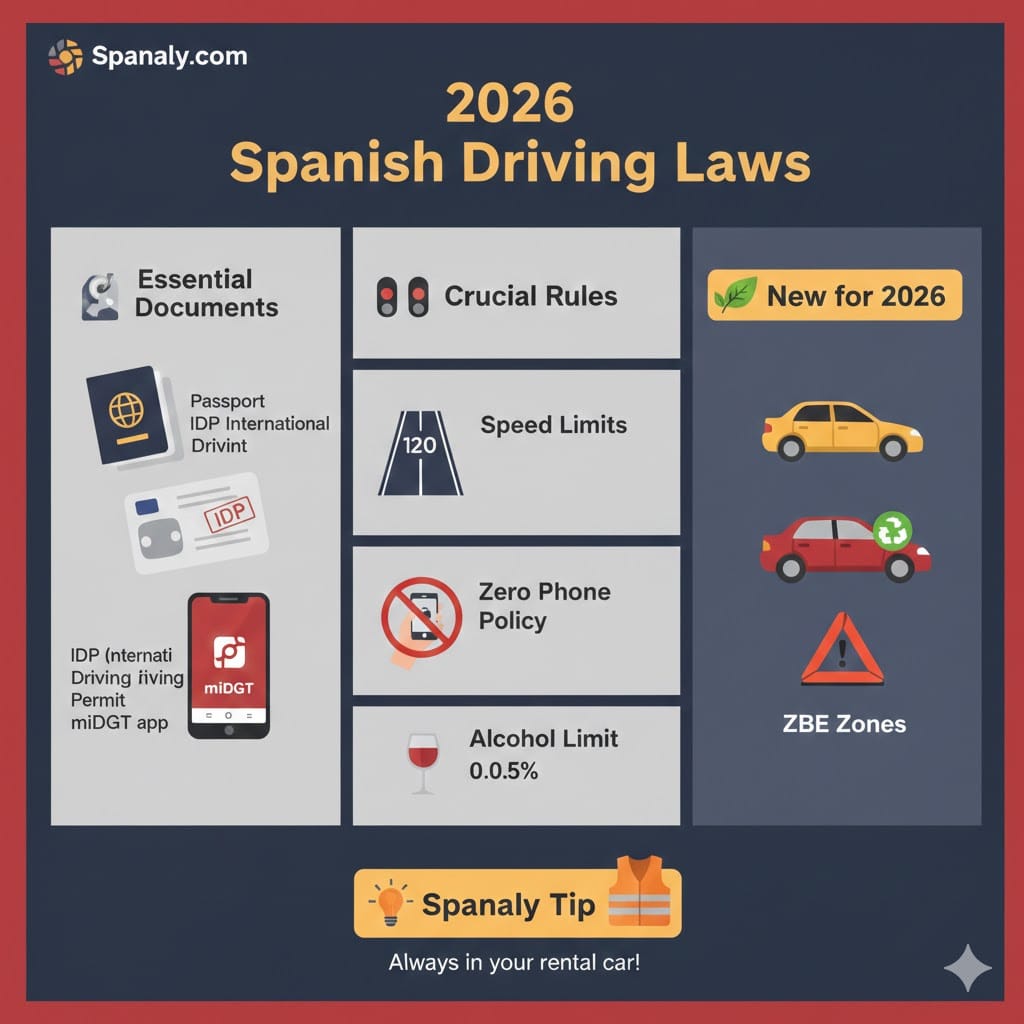
Before you hit the gas, you must be legally prepared. Spain has strictly modernized its traffic laws in 2026, focusing on technology and environmental safety.
📜 Essential Documentation
Driving License: EU licenses are fully valid.
IDP Requirement: Non-EU drivers (USA, UK, Canada, etc.) must carry an International Driving Permit.
Vehicle Papers: You should always keep the rental contract and insurance documents in the glove box.
Digital ID: You can use the miDGT app for a digital version of your permit, but keep the physical one as a backup.
🚥 Crucial Road Rules
🛣️ Speed Limits: * 120 km/h on Highways.
30 km/h in most urban streets (Strictly enforced).
📵 Zero Phone Policy: You are prohibited from even touching your phone while driving. You must use a dashboard mount or hands-free Bluetooth.
🍷 Alcohol Limits: The limit is 0.05%. You should strictly avoid drinking and driving, as 2026 checkpoints are frequent.
🚸 Roundabouts: Vehicles already inside the circle always have the right of way. You should signal clearly when exiting.
🌿 New for 2026: ZBE Zones
You must check if your car has a Distintivo Ambiental (Environmental Sticker). Most city centers now restrict cars without these stickers to reduce pollution.
💡 Spanaly Tip: Always ensure your rental car includes a Reflective Jacket and Warning Triangles. These are required by law in case of a breakdown or emergency stop.
🛣️ Understanding Spanish Roads
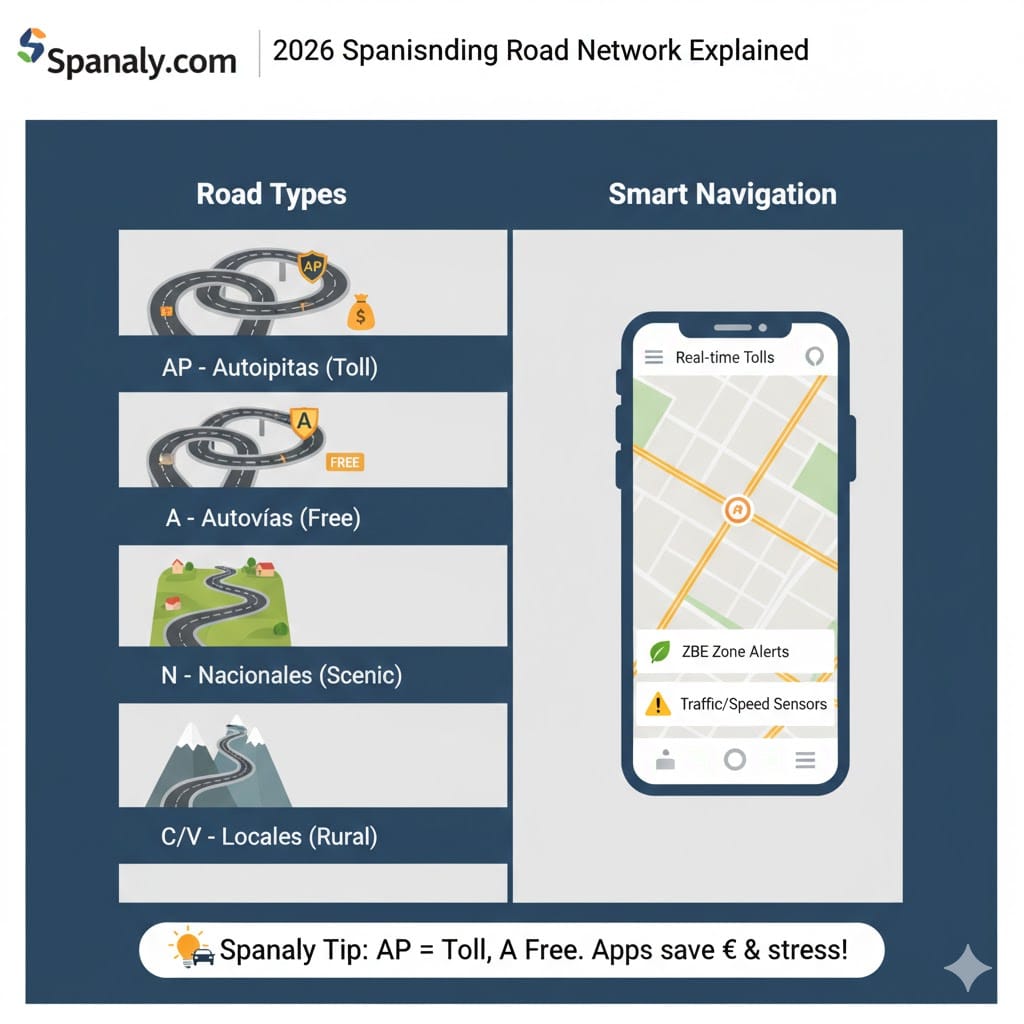
Spain boasts one of the most advanced road networks in Europe. However, the system uses a specific lettering code that you should understand to save both time and money.
🚗 Types of Highways
Autopistas (AP): These are high-quality motorways, often toll-based (Peajes). In 2026, many use “Electronic Tolls” (No barrier), so you should ensure your rental car has a transponder or you register your plate online.
Autovías (A): These are free, high-speed highways. They connect major cities and offer a similar speed limit to Autopistas but can be busier during peak hours.
Carreteras Nacionales (N): These are single-carriageway national roads. They are slower but perfect if you want to enjoy the Spanish scenery. When stopping in smaller towns along these roads, it’s helpful to know the Cultural Etiquette in Spain to interact smoothly with the locals.
Carreteras Locales (C/V): Rural or regional roads. You should use these for “Slow Travel” in areas like the Pyrenees or the Andalusian countryside.
📍 Navigation in 2026
You should not rely solely on traditional signs. Using apps like Google Maps or Waze is highly recommended as they now provide real-time updates on:
Active Tolls: Live pricing for Autopistas.
ZBE Alerts: Warnings if you are approaching a restricted low-emission zone.
Smart Sensors: Real-time traffic flow and weather-related speed adjustments.
💡 Spanaly Tip: If you see a road marked with “AP”, expect a toll. If it’s just “A”, it’s free. Choosing the Autovía (A) can save you money, but the Autopista (AP) often saves you time and stress.
🅿️ Tolls, Parking & Fuel Tips (2026 Update)
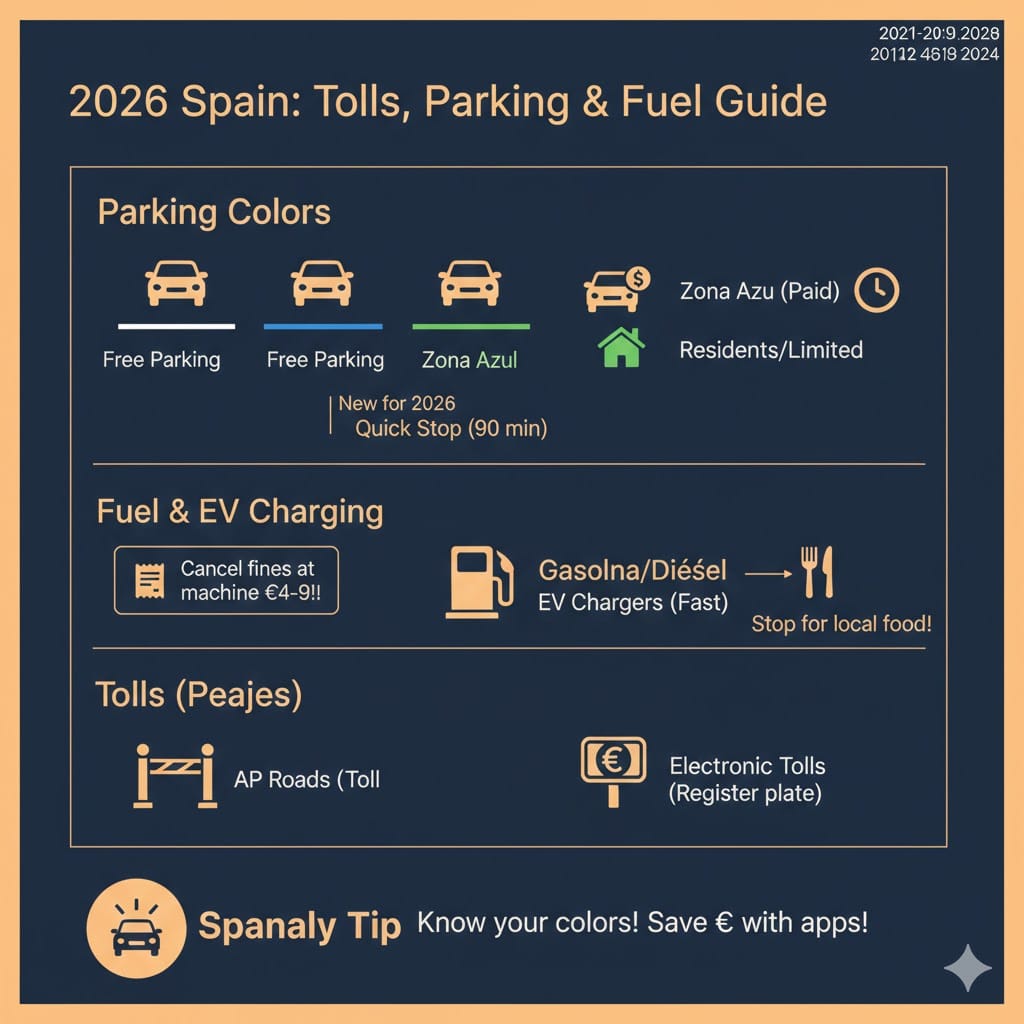
Managing your car in Spain requires a bit of local “know-how” to avoid unnecessary costs. Here is the 2026 breakdown of how to handle the logistics like a pro.
🚥 Deciphering Parking Colors
Don’t just park anywhere! Look at the lines on the ground:
⚪ White Lines: Free parking for everyone. These are rare in city centers but common in residential areas and small villages.
🔵 Blue Zones (Zona Azul): Paid parking for everyone (usually 2-4 hours max). You must pay at the meter or via apps like Telpark or ElParking.
🟢 Green Zones: Primarily for residents. You can park here, but it’s more expensive and often limited to 1-2 hours.
🟠 Orange Zones (New for 2026): These are “High Rotation” zones. They are meant for quick stops (usually 90 mins) near shops or markets.
💡 Pro Tip: If you get a parking fine in a Blue Zone because your ticket expired, don’t panic! Many machines allow you to “cancel” the fine (Anulación de denuncia) by paying a small fee (around €4-€9) right there on the spot.
⛽ Fuel & Charging
Fuel Types: Look for Gasolina 95/98 (Petrol) or Gasóleo (Diesel). Self-service is the norm at large stations, but in rural “Pueblos,” you might still find attendants.
Dining & Refueling: Long drives can be tiring. When you stop at a local roadside “Venta” for fuel, it’s the perfect time to practice Mastering the Art of Ordering Food Like a Local to enjoy a quick, authentic Spanish lunch.
⚡ EV Charging: In 2026, most major gas stations (Gasolineras) are equipped with ultra-fast electric chargers.
💸 Tolls (Peajes)
As mentioned before, AP roads require payment. While most accept credit cards, many now use barrier-free electronic tolls. If your rental car doesn’t have a “Via-T” transponder, you should register your license plate on the official motorway website to avoid a fine being sent to your rental agency.
🚗 Renting a Car in Spain (Smart 2026 Tips)
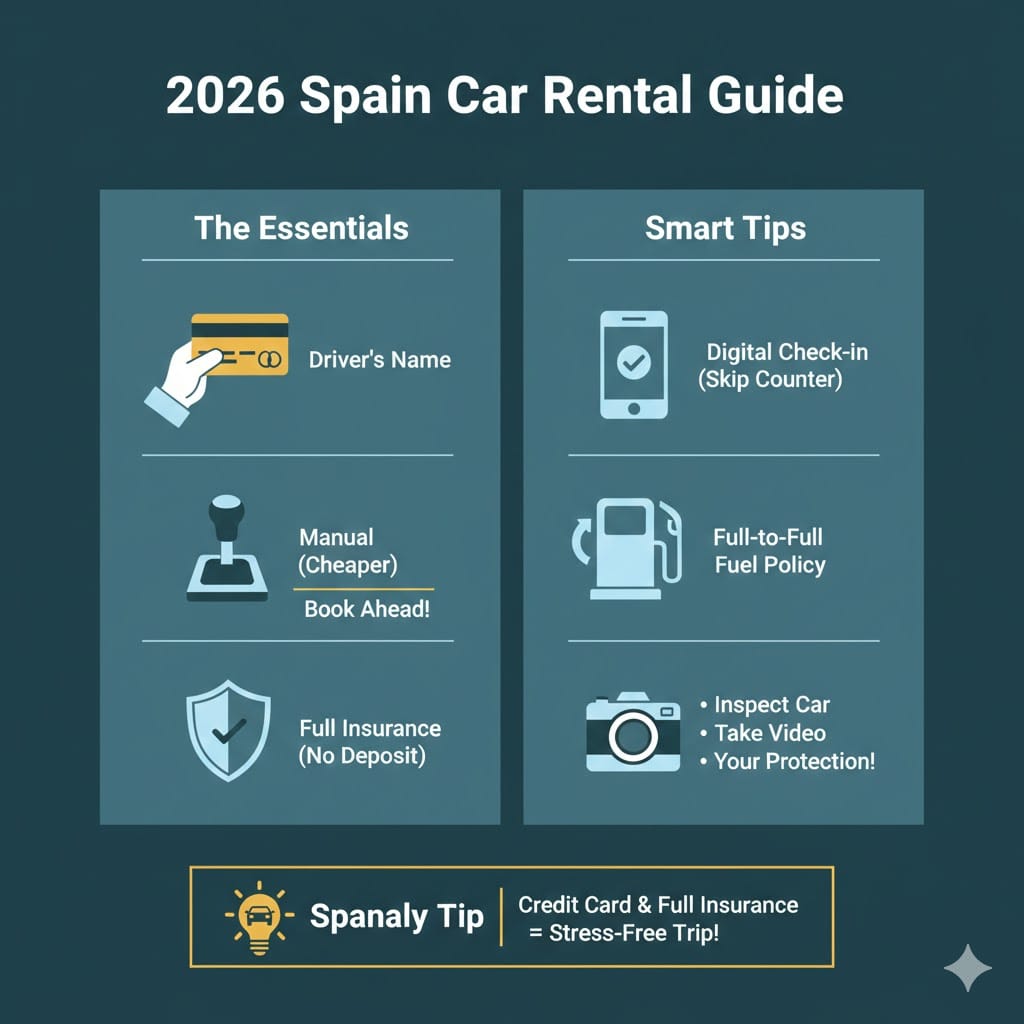
Renting a car in Spain is straightforward, but in 2026, the “fine print” matters more than ever. To avoid unexpected charges at the counter, you should follow these essential steps.
💳 The Credit Card Rule
You must have a physical credit card in the lead driver’s name. In 2026, most agencies in Spain will refuse a debit card for the security deposit or will force you to buy their most expensive insurance (Full Coverage) as an alternative.
⚙️ Manual vs. Automatic
Standard: Manual cars are the default and much cheaper.
Premium: Automatic cars are available but limited. You should book at least 4-6 weeks in advance if you cannot drive a manual. Many travelers pick up their cars directly upon arrival; if you are starting your journey in the Catalan capital, our Ultimate Barcelona Travel Guide provides excellent tips on navigating the city before you head out on the open road.
🛡️ Insurance & Fuel Policies
Zero-Excess Insurance: We highly recommend choosing “Full Insurance” directly from the rental company. It’s more expensive but avoids high deposits (often €1,000+) being blocked on your card.
Full-to-Full Policy: Always choose the “Full-to-Full” fuel policy. You receive the car with a full tank and return it full.
📱 Digital Check-in
In 2026, many local companies now offer digital key collection via smartphone. You should check if your rental agency allows you to “Skip the Counter” to save time during peak seasons.
💡 Spanaly Tip: Before driving away, take a video of the car’s exterior and interior. In 2026, companies use high-resolution cameras for inspections, so having your own evidence is your best protection.
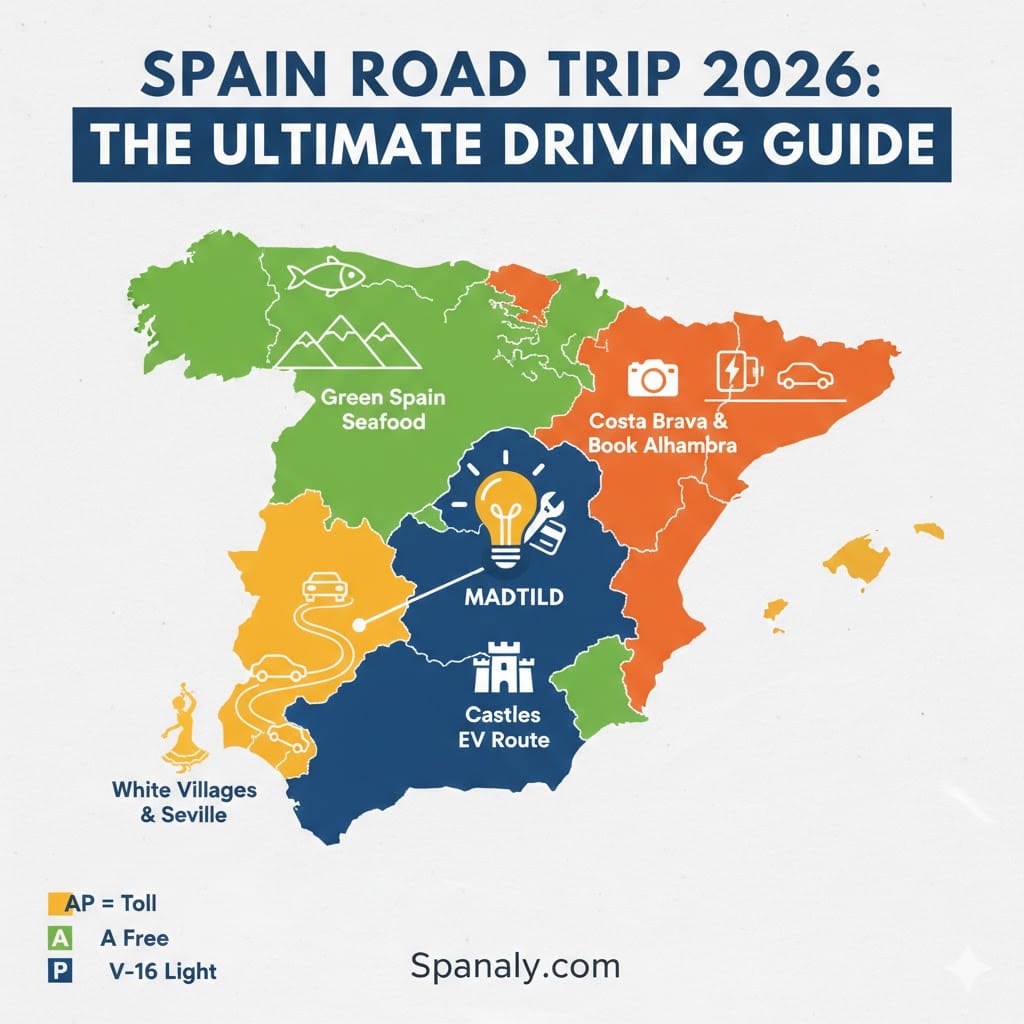
🗺️ Best 2026 Road Trip Routes
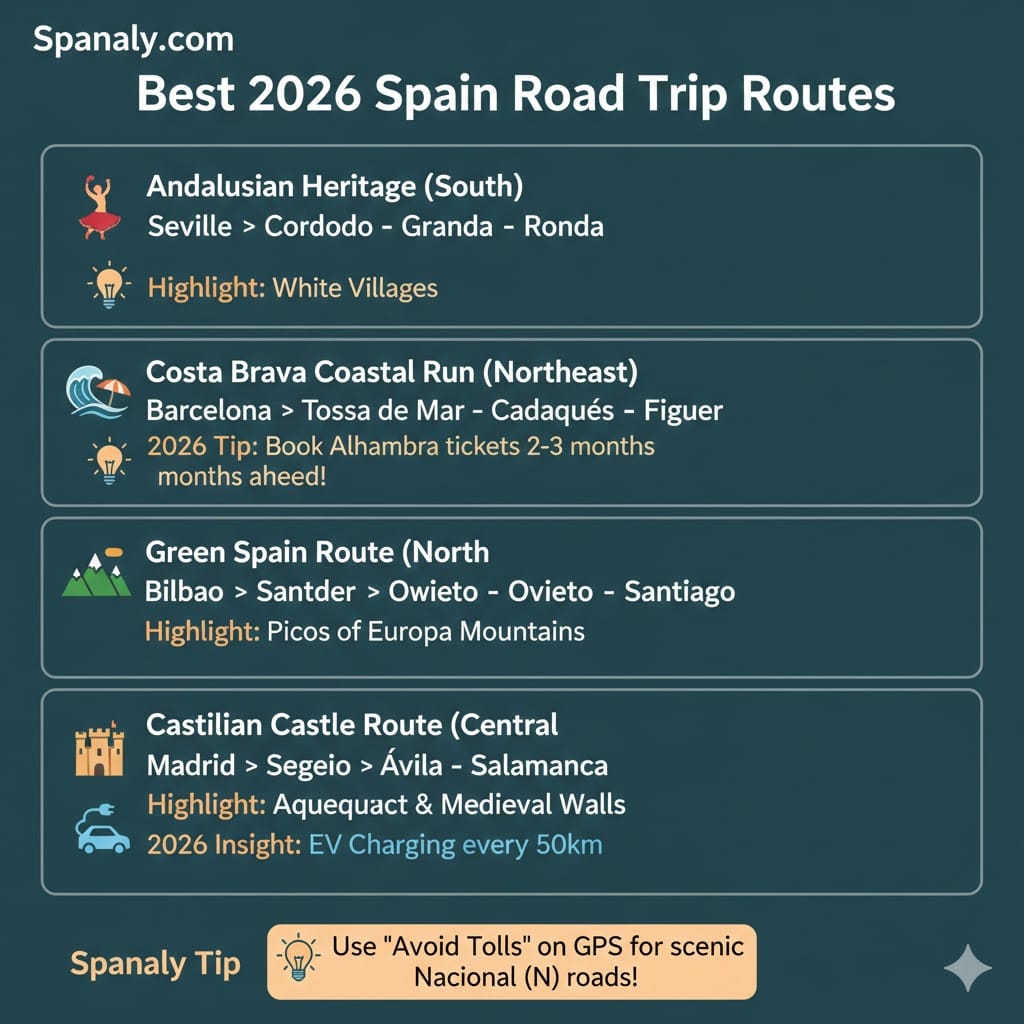
To experience the true soul of Spain, you should step off the beaten path. Here are four curated routes that combine famous landmarks with hidden 2026 gems.
💃 The Andalusian Heritage (South)
Route: Seville → Córdoba → Granada → Ronda.
Highlight: Driving through the Pueblos Blancos (White Villages).
2026 Tip: While exploring the south, our Ultimate Seville Travel Guide is essential for navigating the city’s narrow historic streets before heading out to the open olive groves.
⚠️ Crucial: You must book tickets for the Alhambra (Granada) at least 2-3 months in advance. In 2026, daily visitor limits are strictly enforced.
🌊 The Costa Brava Coastal Run (Northeast)
Route: Barcelona → Tossa de Mar → Cadaqués → Figueres.
Highlight: Rugged cliffs and the turquoise waters of the Mediterranean.
Hidden Gem: Stop at Begur for secluded coves that are less crowded in the 2026 shoulder season.
🌳 The Green Spain Route (North)
Route: Bilbao → Santander → Oviedo → Santiago de Compostela.
Highlight: The Picos de Europa mountains and world-class seafood.
Ideal For: Travelers who prefer cooler temperatures and lush, emerald landscapes.
🏰 The Castilian Castle Route (Central)
Route: Madrid → Segovia → Ávila → Salamanca.
Highlight: Seeing the Roman Aqueduct of Segovia and the medieval walls of Ávila.
2026 Insight: This route is now fully equipped with ultra-fast EV charging stations every 50km, making it the most eco-friendly road trip in central Spain.
💡 Spanaly Tip: Use the “Avoid Tolls” setting on your GPS if you have extra time. The Nacional (N) roads often run parallel to the highways and offer much better photo opportunities of the Spanish countryside.
🏎️ Driving Etiquette & Local Customs
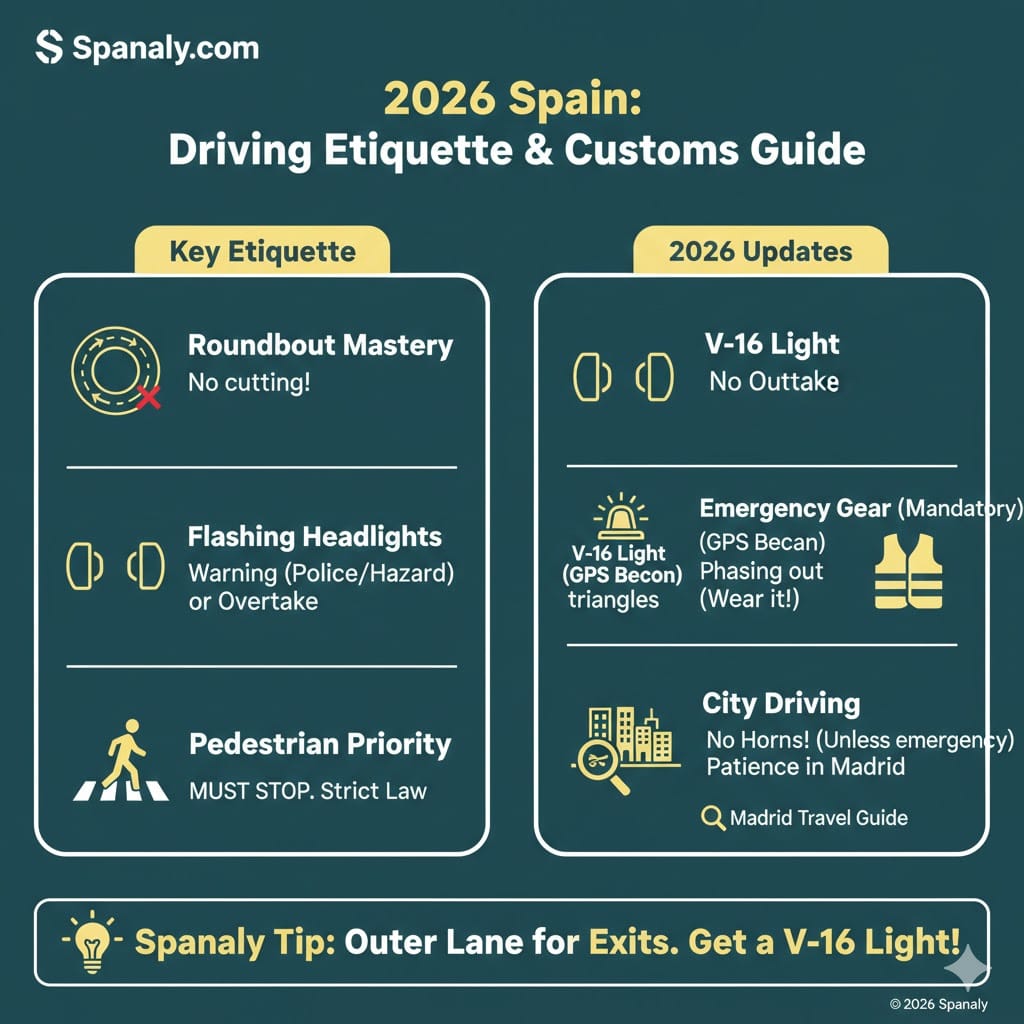
Spanish driving culture is generally confident and fast-paced, but there are unwritten rules you should follow to blend in and stay safe.
🚥 Roundabout Mastery
Spanish roundabouts are notorious. The rule is simple: Always exit from the outer lane. If you are in the inner lane and miss your exit, you should go around again rather than cutting across traffic. This is the #1 reason for minor accidents among tourists.
🔦 Flashing Headlights
Friendly Warning: If an oncoming driver flashes their lights at you, they might be warning you of a hazard ahead (or a police checkpoint).
Overtaking: On highways, a driver behind you might flash their lights to indicate they intend to overtake. You should move to the right lane as soon as it’s safe.
🏙️ City Driving: Madrid & Beyond
Driving in major hubs requires patience. If you are starting your trip or spending time in the capital, our Ultimate Madrid Travel Guide offers deep insights into navigating city traffic and finding the best parking hubs before you head to the suburbs.
🚨 Emergency Gear (2026 Mandatory)
As of January 1, 2026, traditional warning triangles are being phased out on highways. You should ensure your rental car is equipped with the V-16 Emergency Light (a flashing amber beacon with GPS). If you break down:
Stay inside the car with your seatbelt on if possible.
Place the V-16 light on the roof (it’s magnetic).
Only exit if you are wearing your Reflective Jacket.
🚶 Pedestrian Priority
Spain takes pedestrian crossings (Pasos de Cebra) very seriously. You must stop if someone is waiting to cross. Failing to do so is considered very rude and can result in a quick fine if a local officer is nearby.
💡 Spanaly Tip: Never use your horn in cities unless it’s to prevent an immediate accident. Excessive honking is illegal in many Spanish urban zones and is seen as a sign of an “angry tourist.”
💎 Spanaly’s Golden Rules for Driving in Spain (2026)
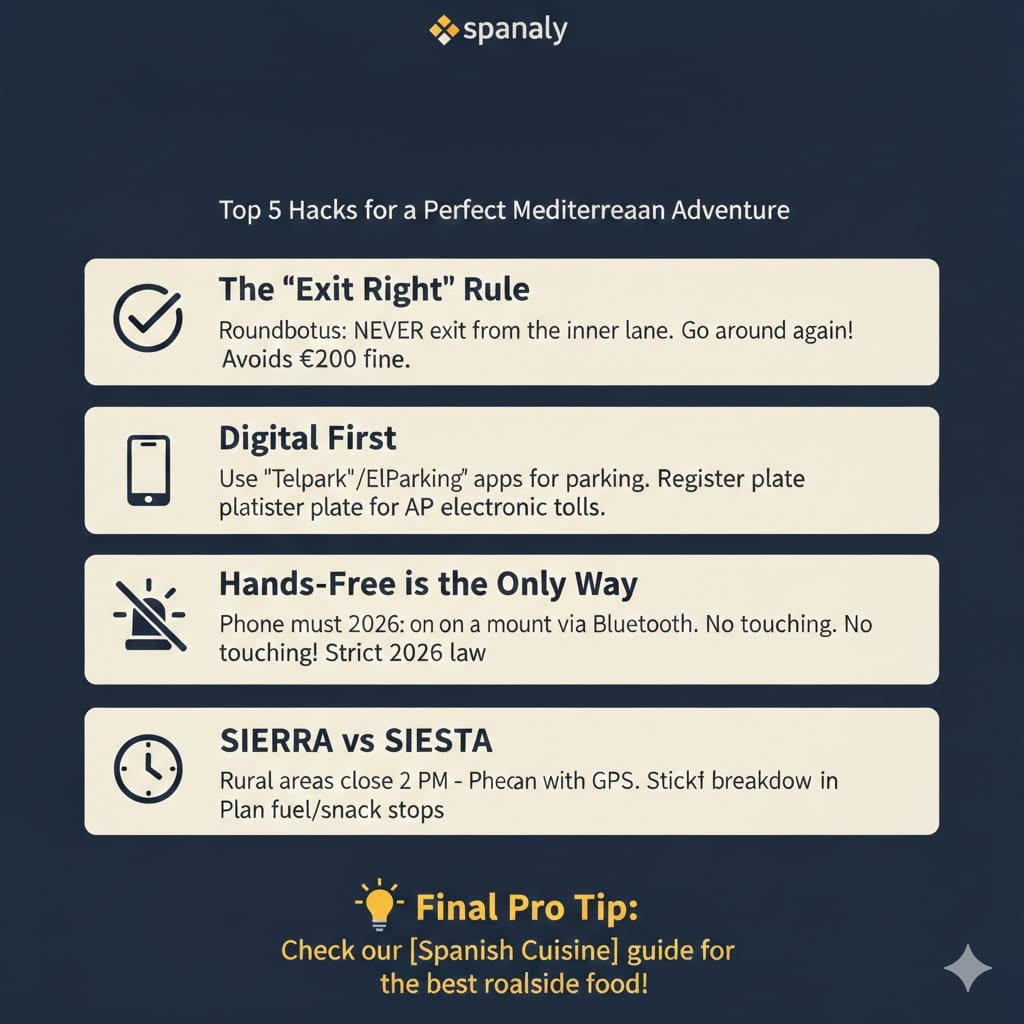
If you remember nothing else from this guide, keep these Top 5 Hacks in your pocket. They are the difference between a stressful trip and a perfect Mediterranean adventure.
✅ The “Exit Right” Rule: On roundabouts, NEVER exit from the inner lane. If you can’t get to the outside lane in time, just go around again. It’s safer and avoids a €200 fine.
✅ Digital First: In 2026, paper is out. Ensure you have the Telpark or ElParking apps installed for city parking, and register your license plate for electronic tolls before you hit the AP highways.
✅ Hands-Free is the Only Way: Even holding your phone at a red light can cost you a heavy fine and points in 2026. If it’s not on a dashboard mount and connected via Bluetooth, don’t touch it.
✅ The V-16 Safety Light: Check your rental’s glovebox for a small amber flashing beacon (V-16). In 2026, it’s your best friend during a breakdown—just stick it on the roof and stay inside.
✅ SIERRA vs. SIESTA: Remember that in rural Spain, many gas stations and shops close between 2:00 PM and 5:00 PM. Plan your fuel stops and snacks accordingly!
✨ Final Pro Tip: If you’re feeling hungry while driving through the Spanish plains, don’t settle for fast food. Check out our guide on Spanish Cuisine to discover the best traditional dishes to look for at roadside “Ventas.”
🚗 Visitor FAQs – Driving in Spain Guide (2026 Edition)
🛂 Do I need an International Driving Permit (IDP) in Spain?
If you hold a non-EU driver's license (e.g., from the US, Canada, or Middle East), you officially need an International Driving Permit (IDP) alongside your original license. Police (Guardia Civil) strictly require the physical IDP booklet in 2026 if you are stopped.
🅿️ What do the different colored parking lines mean?
White: Free parking. Blue (Zona Azul): Paid parking for everyone. Green: Mainly for residents (limited for tourists). Orange (New in 2026): High-rotation zones for quick stops (usually 90 mins). Avoid Yellow lines entirely.
🚨 What is the V-16 Emergency Light mandatory in 2026?
As of January 2026, triangles are obsolete on highways. All Spanish-registered cars must carry a V-16 connected light. If you break down, place it on the roof—it automatically sends your GPS location to traffic authorities.
⚙️ Are automatic cars common in Spanish rental agencies?
Manual is still the standard. While automatic availability has increased in 2026, they are still more expensive. Book 4-6 weeks in advance if you need an automatic to ensure availability.
🚔 What should I do if I get a traffic fine?
If you receive a fine, pay it within 20 days to get a 50% discount. For parking fines, check the meter for the "Anulación de denuncia" option to cancel it on the spot for a small fee.
Created by Spanaly.com
🏁 Your Spanish Horizon Awaits
Driving in Spain in 2026 is more than just a way to get from point A to point B; it is an invitation to witness the country’s soul at your own pace. From the high-tech, barrier-free Autopistas to the sun-drenched Nacional roads winding through olive groves, every kilometer tells a story.
By mastering the parking colors, embracing the new V-16 safety standards, and respecting local driving etiquette, you’ve transformed from a visitor into a savvy Spanish explorer. The road is open, the GPS is set, and the vibrant culture of the Iberian Peninsula is waiting just around the next bend.
¡Buen viaje! (Have a great trip!)
🎒 What’s Your Next Stop?
Now that you’re ready to hit the road, make sure your destination is just as prepared as your vehicle:
Starting in the Capital? Don’t miss our Ultimate Madrid Travel Guide for the best city-center parking hubs.
Heading South? Check out the Ultimate Seville Travel Guide to plan your Andalusian route.
Hungry on the road? Learn how to find the best roadside gems with our guide to Spanish Cuisine.