🏛️ The Royal Heart of Madrid
Madrid is a city where imperial grandeur blends seamlessly with vibrant everyday life. Specifically, nowhere is this more visible than at the Royal Palace and Plaza Mayor. These two landmarks serve as the dual beating hearts of the capital. While one represents the sophisticated elegance of the monarchy, the other acts as the soulful, historic center of the people.
⏳ A Journey Through Time: Walking between these sites is like traversing centuries of history in minutes.
🏰 More Than Just Icons: Beyond the stone facades lie royal stories and architectural secrets. Additionally, you will find the best culinary traditions Madrid has to offer.
🚀 The Perfect Starting Point: Understanding these two pillars is essential for any Ultimate Madrid Travel Guide experience. Therefore, this is the best place to begin your Spanish adventure.
💡 Spanaly Insight: To truly feel the city’s pulse, start your walk at the Royal Palace just before the “Golden Hour.” Consequently, you will see the light hit the white limestone beautifully. The transition toward the warm, red tones of Plaza Mayor is a visual experience you won’t find anywhere else in Europe.
👑 Royal Palace of Madrid (Palacio Real)
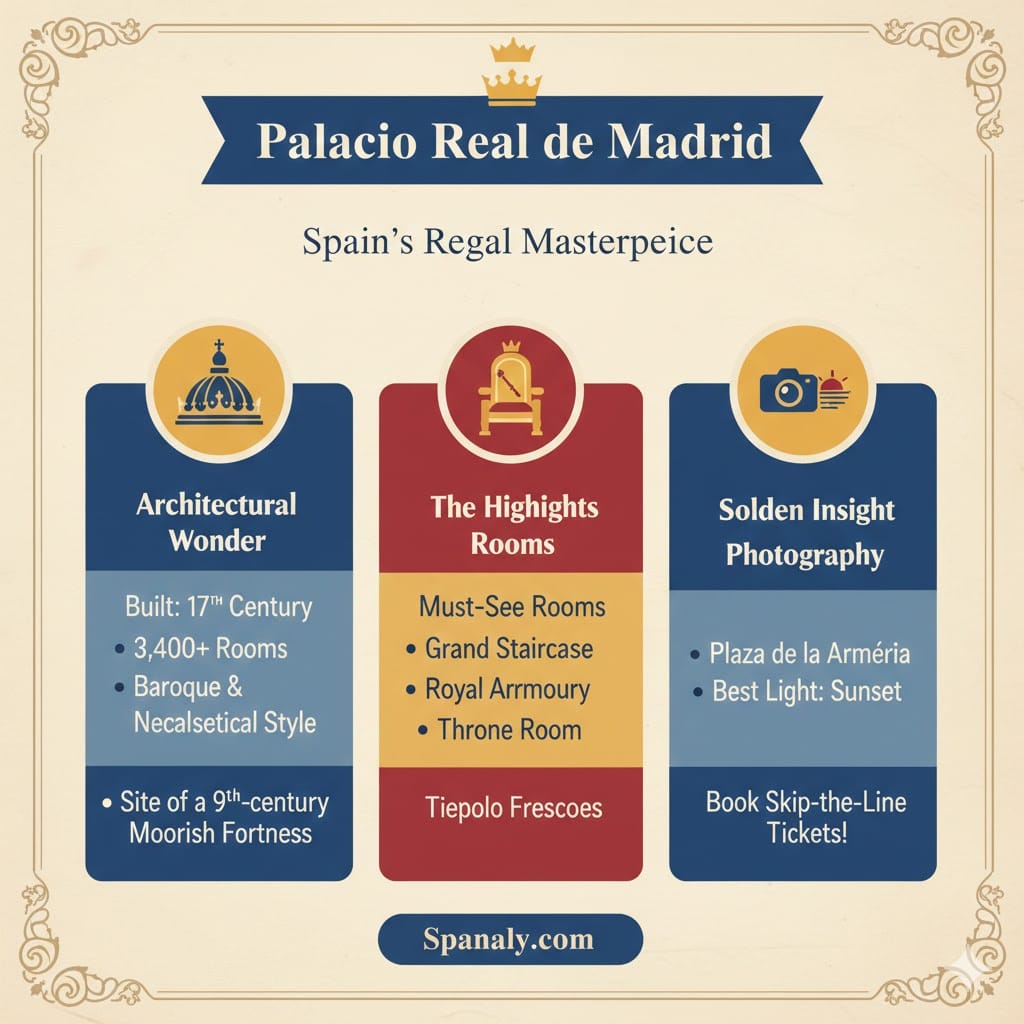
The Royal Palace of Madrid is a stone-carved testament to Spain’s imperial past. Notably, it is the largest functioning royal residence in Western Europe, boasting over 3,400 rooms. Although the royal family now resides at the Zarzuela Palace, this site remains the official heart of the Spanish State. Therefore, it is still the primary venue for grand ceremonies and state galas.
🏛️ Architectural Wonder: The current structure stands on a 9th-century Moorish fortress site. Specifically, it is a 17th-century masterpiece that blends Baroque and Neoclassical styles.
🛡️ The Highlights: Do not miss the Grand Staircase or the Royal Armoury. Furthermore, the Throne Room features a stunning Tiepolo-painted ceiling that is world-renowned.
🎫 Essential Planning: Queues can often exceed two hours. Consequently, booking a “skip-the-line” ticket is highly recommended. You can find more practical advice in our Essential Spain Travel Tips.
💡 Spanaly Insight: For the most breathtaking views without the crowds, head to the Plaza de la Armería during the “Golden Hour.” As a result, you will see the white Colmenar stone reflect the sunset beautifully. This creates a perfect backdrop for your photos.
🛡️ The Changing of the Guard: A Spectacle of Tradition
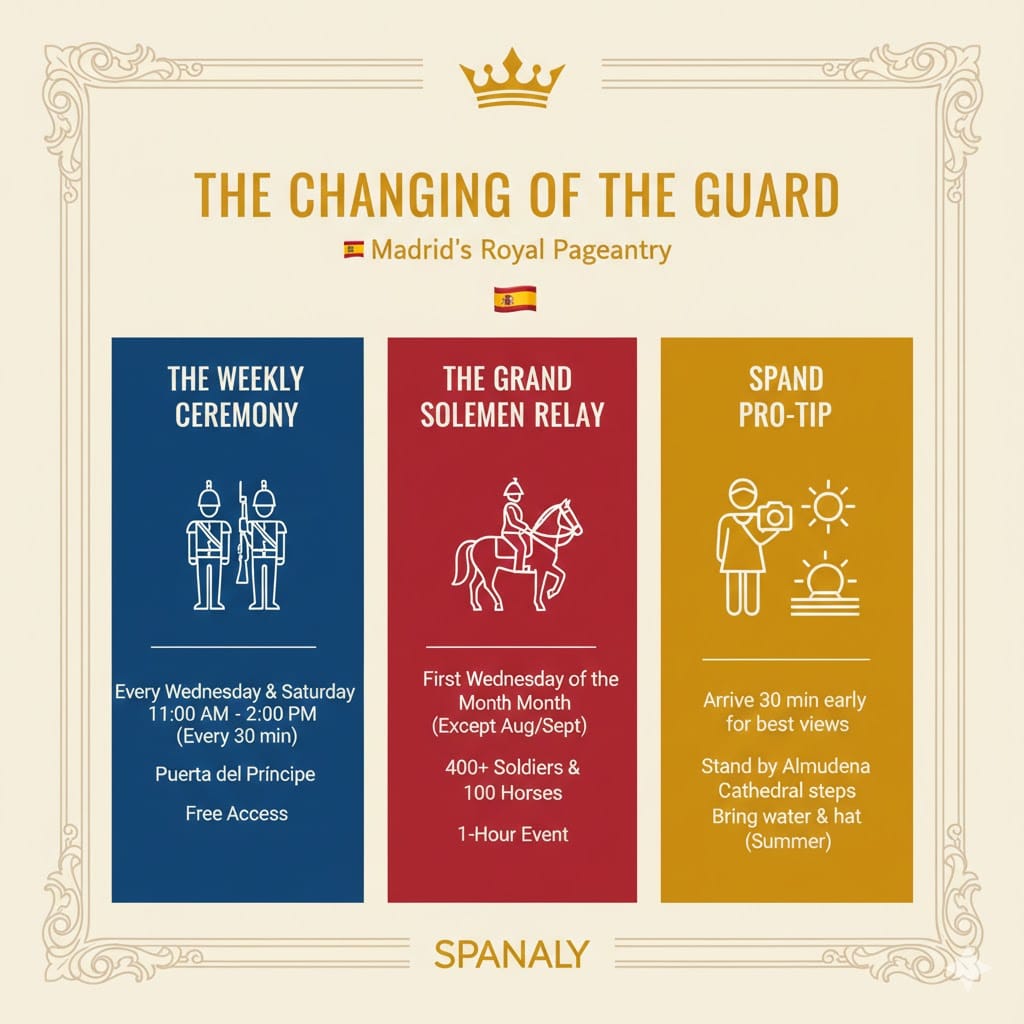
Witnessing the Changing of the Guard at the Royal Palace is like watching history come to life. This traditional ceremony showcases the discipline and pageantry of the Spanish Royal Guard, dressed in uniforms similar to those worn during the era of King Alfonso XIII.
The Weekly Ceremony: Takes place every Wednesday and Saturday at the Puerta del Príncipe (Príncipe Gate). It occurs every 30 minutes between 11:00 AM and 2:00 PM (weather permitting).
The Grand Solemn Relay: On the first Wednesday of every month (except August and September), the palace hosts the “Relevo Solemne.” This massive event features over 400 soldiers and 100 horses, lasting about an hour.
Best Vantage Point: Arrive at least 30 minutes early and secure a spot near the palace railings or at the steps of the Almudena Cathedral for an elevated view.
💡 Spanaly Insight: Access to watch the ceremony is completely free. If you are visiting during the summer months, bring water and a hat, as there is very little shade in the viewing areas around the Plaza de la Armería.
For more cultural highlights across the country, don’t miss our Ultimate Spain Festivals Guide.
🏘️ Plaza Mayor: The Living Soul of Old Madrid
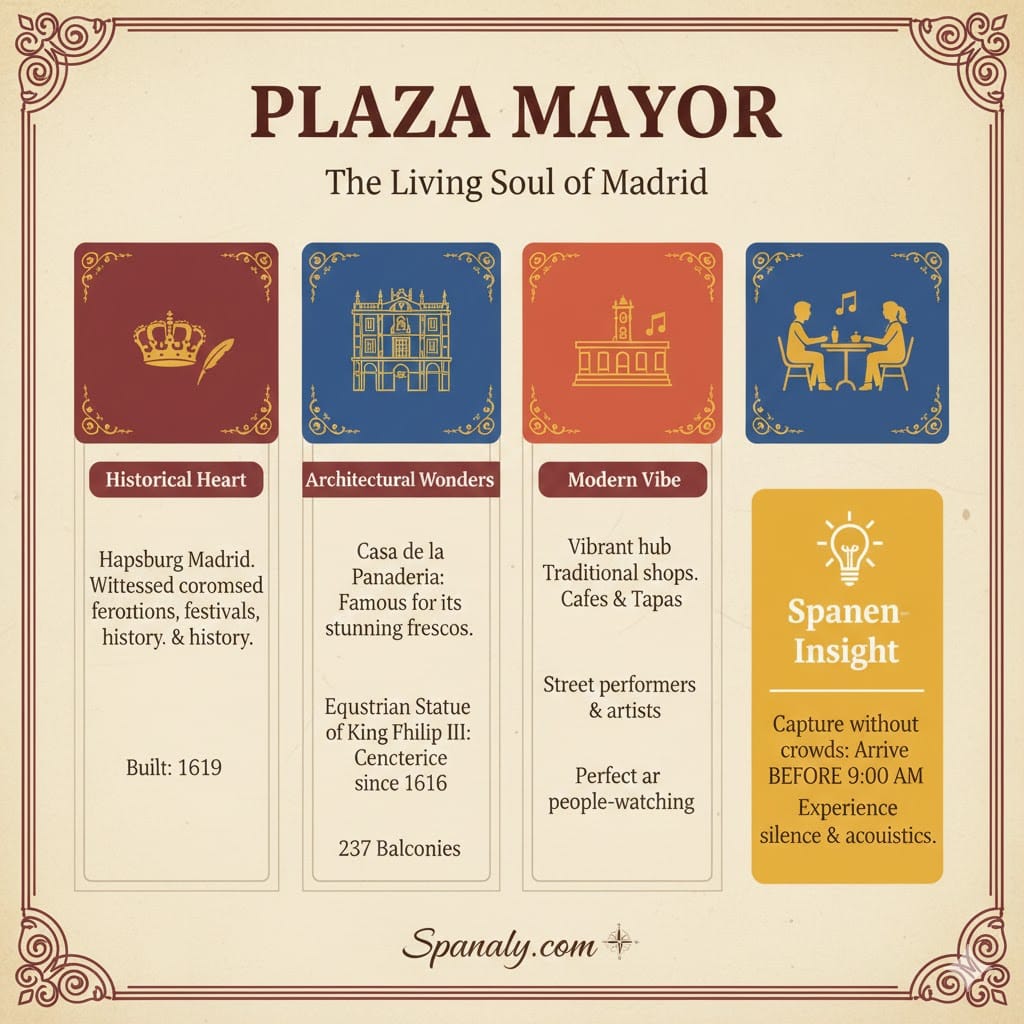
A short, scenic walk from the palace takes you to Plaza Mayor. Notably, this is the grand central square of “Hapsburg Madrid.” With its uniform architecture and slate-covered towers, this arcaded plaza has a rich history. Indeed, it has witnessed everything from royal coronations to dark trials during the Spanish Inquisition.
🎨 The Architecture: Admire the Casa de la Panadería. This is the most famous building on the square. Furthermore, it is easily recognizable by its stunning frescoes depicting mythological scenes.
🏇 The Centerpiece: The bronze equestrian Statue of King Philip III stands in the heart of the square. Since 1616, this masterpiece has been a silent witness to Madrid’s evolution.
🎭 Modern Vibe: Today, the square is a vibrant hub. It is filled with traditional shops and outdoor terraces. Consequently, it is the perfect spot for people-watching and enjoying street performers.
💡 Spanaly Insight: To capture the square without the crowds, arrive before 9:00 AM. As a result, the morning silence allows you to appreciate the acoustics. You can also truly see the sheer scale of the 237 balconies facing the plaza.
For more inspiration on where to go next, check out our Spain’s Best Cities Guide.
🥪 A Culinary Icon: The Famous Calamari Sandwich
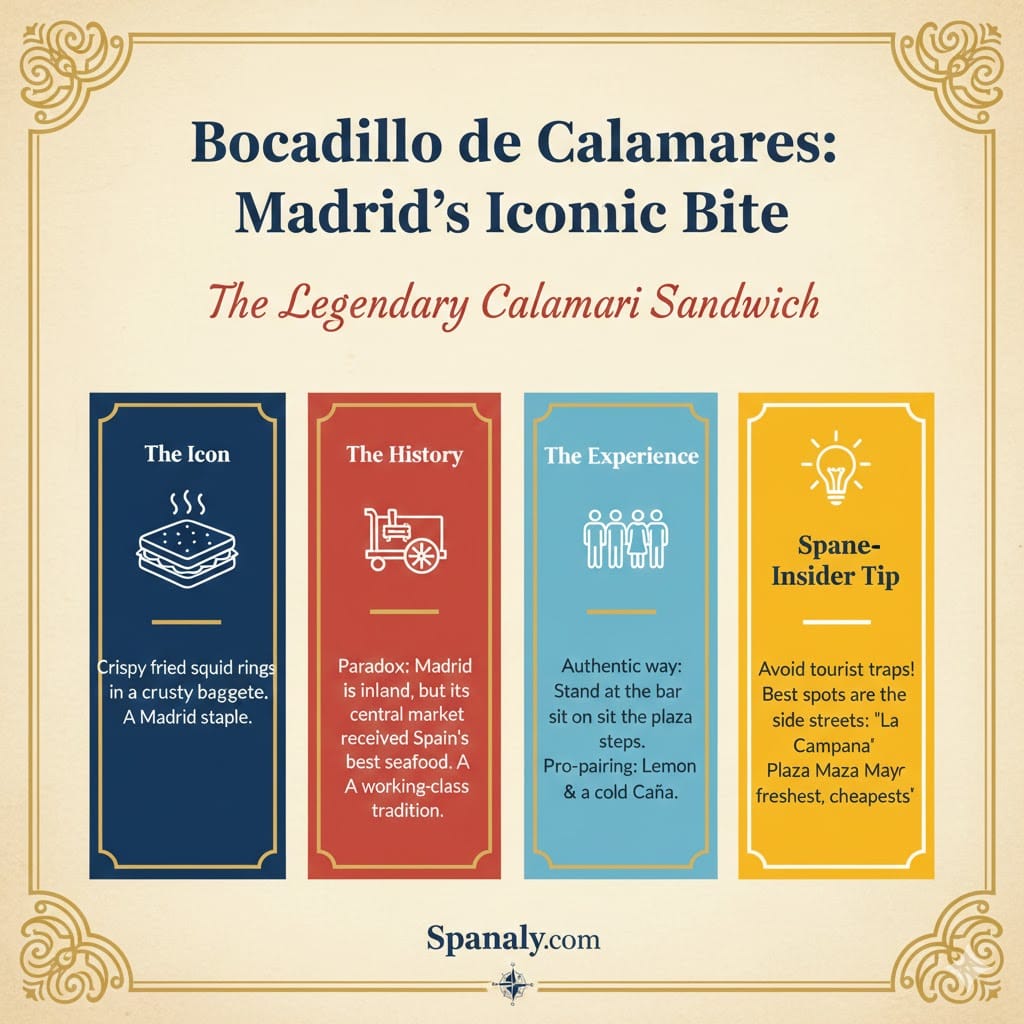
You cannot claim to have experienced Madrid without tasting the legendary Bocadillo de Calamares (squid sandwich) at Plaza Mayor. This simple yet iconic street food—consisting of fresh, crispy fried squid rings inside a crusty baguette—is a ritual for locals and tourists alike.
Why it’s a Must: It is the quintessential taste of Madrid’s history. Despite being far from the coast, Madrid’s central market has historically received the best seafood in Spain, making this sandwich a city staple.
The Experience: Don’t expect fancy seating; the most authentic way to enjoy it is standing at a small bar counter or sitting on the granite steps of the plaza.
Pro Pairing: Squeeze a bit of fresh lemon over the squid and pair it with a small glass of beer (caña) for the ultimate local experience.
💡 Spanaly Insight: While many restaurants inside the plaza offer this sandwich, the real “insider” spots are tucked away in the narrow side streets leading into the square. Look for small, crowded bars like La Campana or Cervecería Plaza Mayor for the freshest, crunchiest calamari at the best prices.
For a deeper dive into Spain’s food scene, check out our Spanish Cuisine Guide.
⛪ Almudena Cathedral: The Modern Neighbor
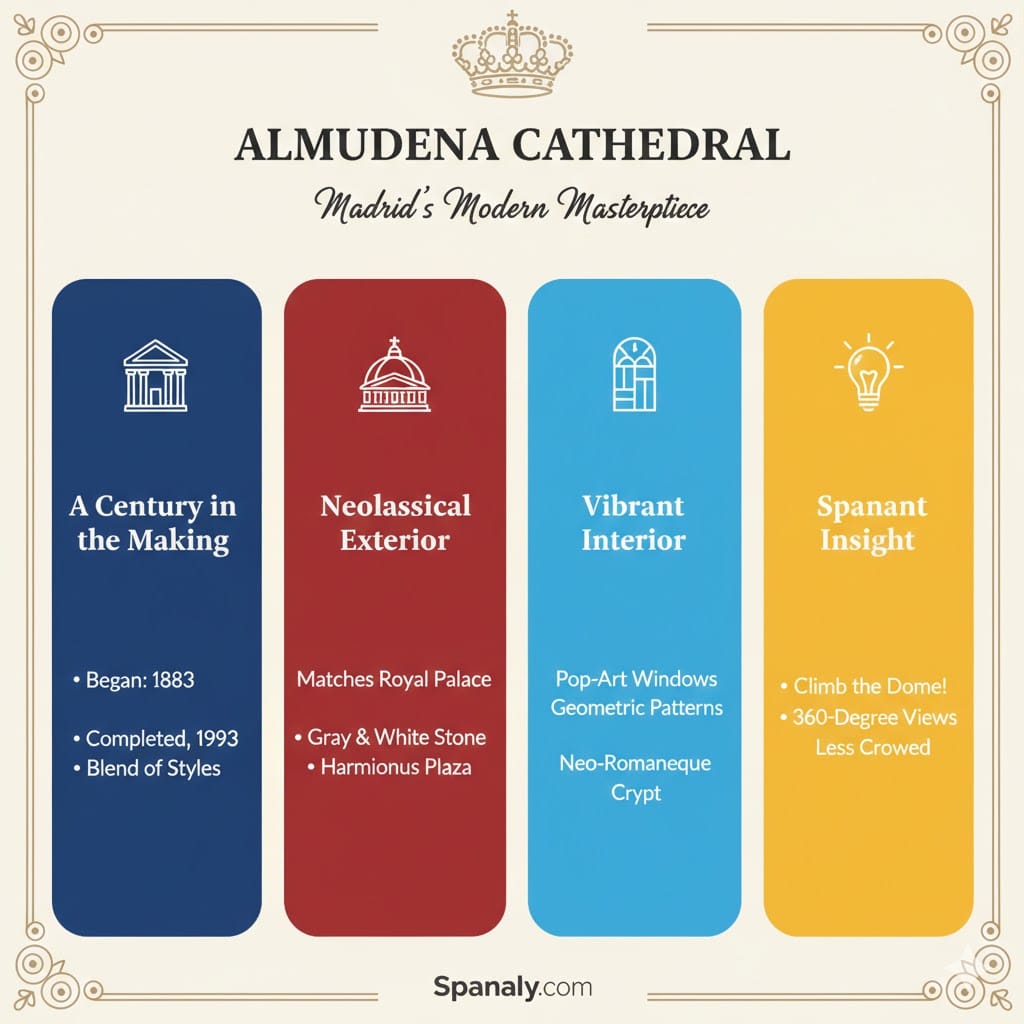
The Almudena Cathedral stands directly opposite the Royal Palace. Consequently, it offers a fascinating contrast to its regal neighbor. Unlike many of Spain’s ancient cathedrals, this one was only completed in 1993. Therefore, it is considered a modern masterpiece that blends various architectural styles.
⏳ A Century in the Making: Construction began in 1883. However, political and financial turmoil delayed its completion for over 100 years.
🏛️ The Neoclassical Exterior: The outside matches the Royal Palace’s gray and white limestone. Specifically, this design creates a harmonious “Royal Square” at the Plaza de la Armería.
🎨 Vibrant Interior: Step inside to see a surprising departure from tradition. The ceilings feature bright, pop-art-inspired patterns. Furthermore, the stained-glass windows avoid traditional dark Gothic scenes in favor of geometric designs.
🕯️ The Crypt & Museum: Don’t miss the Neo-Romanesque Crypt. Indeed, it is one of the most atmospheric hidden gems in Madrid.
💡 Spanaly Insight: For the best panoramic view of the Royal Palace, climb to the Cathedral’s Dome. As a result, you will enjoy a 360-degree perspective of the skyline. This spot is often less crowded than other famous viewpoints in the city center.
🛣️ Calle Mayor: Walking the Historic Path
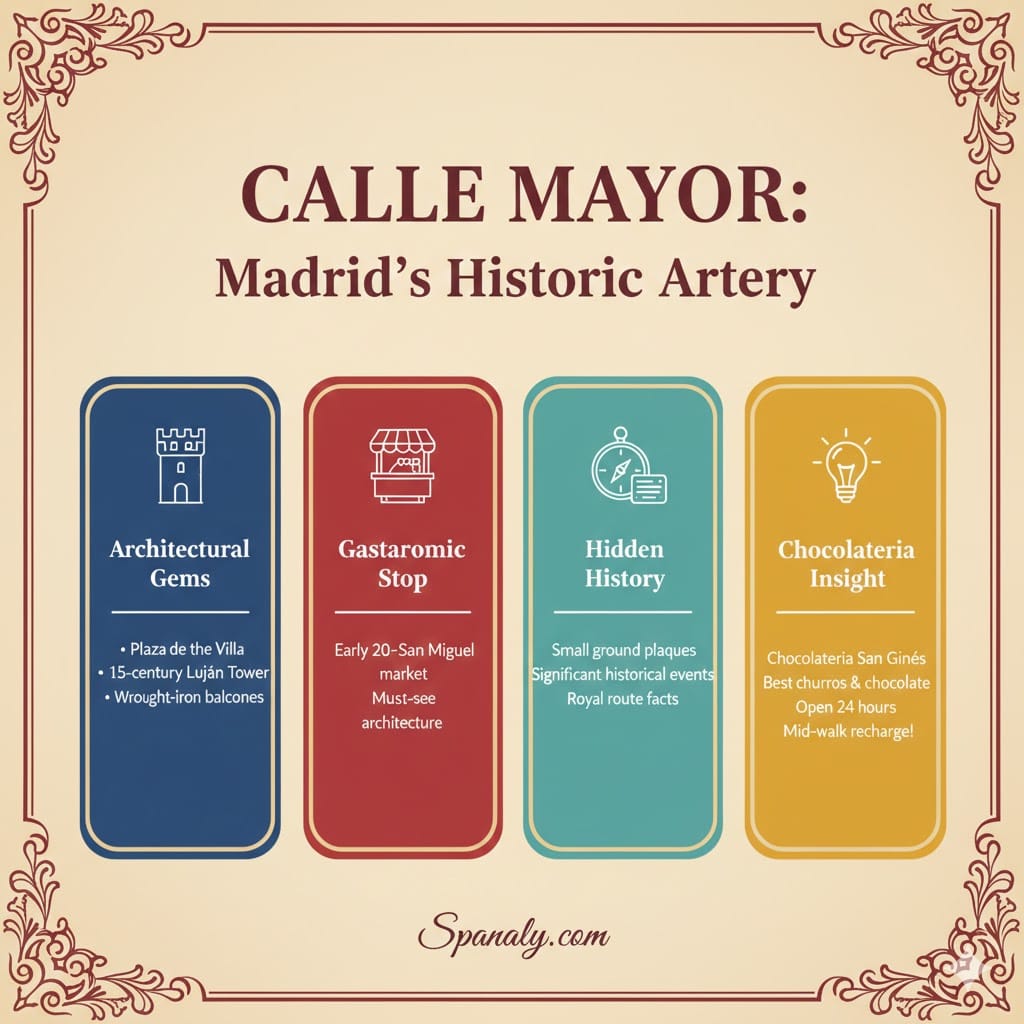
The walk between the Royal Palace and Plaza Mayor is a journey in itself. Calle Mayor (Main Street) is one of Madrid’s oldest and most atmospheric thoroughfares, serving as the historical artery that connected the royal court to the rest of the city.
Architectural Gems: As you walk, look up at the elegant wrought-iron balconies and the Plaza de la Villa, which houses some of the oldest buildings in Madrid, including the 15th-century Luján Tower.
The Gastronomic Stop: You will pass by the famous Mercado de San Miguel. Even if you don’t stay for a full meal, stepping inside this early 20th-century glass market to admire the iron architecture is a must.
Hidden History: Keep an eye out for the small plaques on the ground that mark significant historical events along this royal route.
💡 Spanaly Insight: If you have a sweet tooth, stop at Chocolatería San Ginés, located just a few steps off Calle Mayor. It has been serving the city’s best churros and chocolate since 1894 and is open 24 hours a day—perfect for a mid-walk recharge!
For more tips on navigating the capital, see our guide on Getting Around Madrid.
☀️ Puerta del Sol: Spain’s Symbolic Kilometer Zero
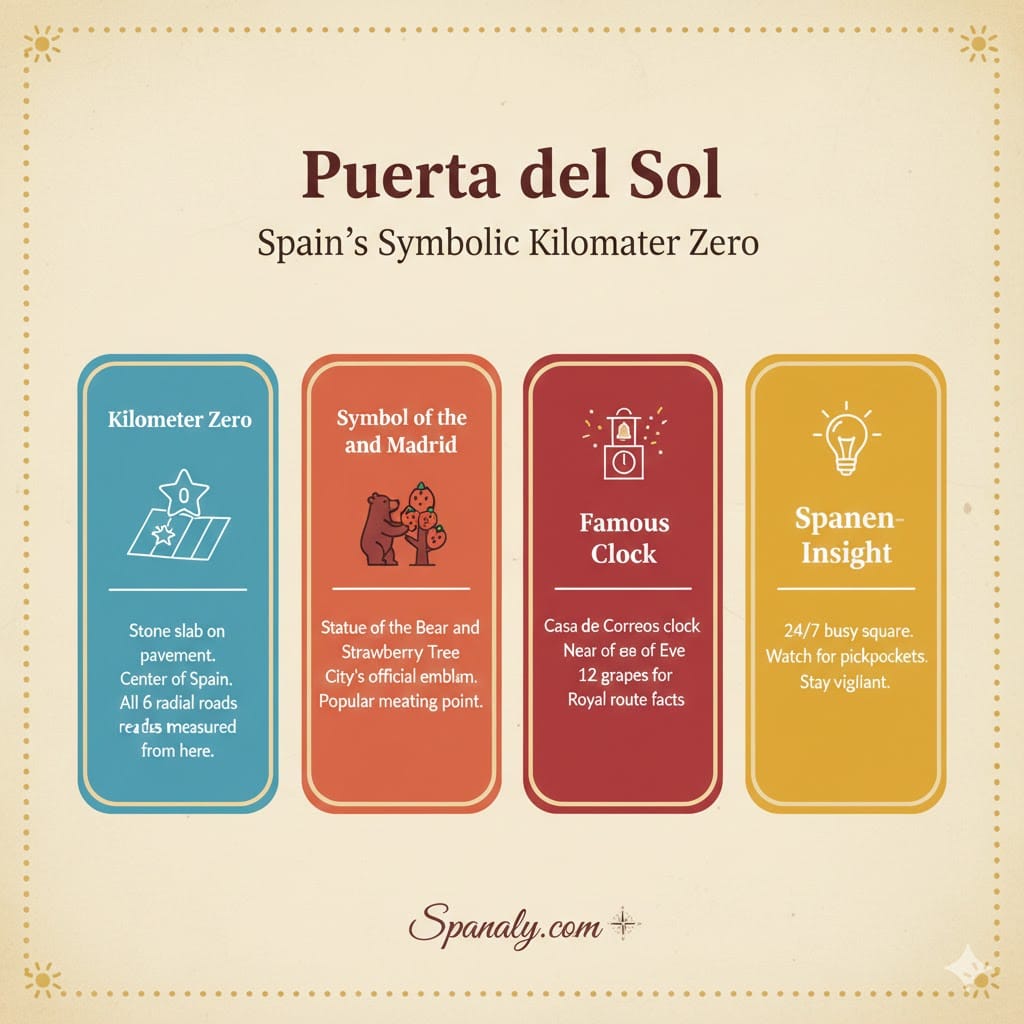
Just a few minutes’ walk from Plaza Mayor, you’ll find yourself in Puerta del Sol, arguably the most famous and busiest square in Spain. This is the place where Madrileños gather for protest, celebration, and the iconic New Year’s Eve countdown.
Kilometer Zero (Km. 0): Look for the stone slab on the pavement in front of the Royal Post Office (Casa de Correos). This is the symbolic center of Spain, from which all six national radial roads are measured.
The Symbol of Madrid: Don’t miss the Statue of the Bear and the Strawberry Tree (El Oso y el Madroño). It is the city’s official emblem and the most popular meeting point for locals.
The Famous Clock: Above the Casa de Correos is the clock that rings in the Spanish New Year. According to tradition, Spaniards eat 12 grapes—one for each chime—to ensure good luck for the coming year.
💡 Spanaly Insight: Puerta del Sol is a hub of activity 24/7, making it a prime spot for pickpockets. While it’s perfectly safe, stay vigilant with your belongings, especially when watching street performers. For more safety tips, check our Spain Travel Safety Guide.
🌅 Temple of Debod: An Egyptian Sunset in Madrid
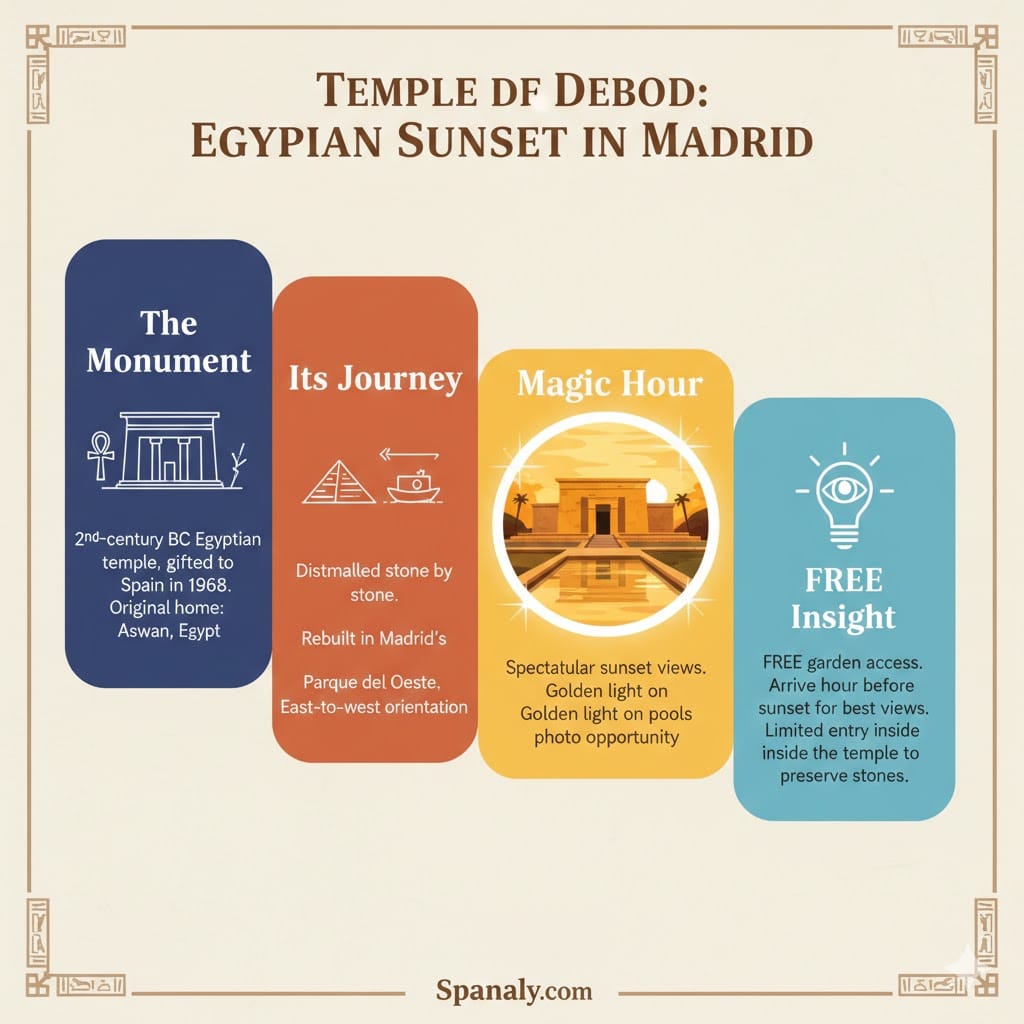
It may come as a surprise to find an authentic ancient Egyptian temple in the heart of Madrid. Specifically, the Temple of Debod is a 2nd-century BC monument. The Egyptian government gifted it to Spain in 1968. This was a thank-you for Spain’s help in saving the Abu Simbel temples.
🐫 The Journey of Debod: The temple was originally located near Aswan. Later, it was dismantled stone by stone and rebuilt in Madrid’s Parque del Oeste. Notably, it maintains its original orientation from east to west.
📷 Best Time to Visit: While the temple museum is fascinating, the real magic happens at sunset. Furthermore, the way the golden light reflects off the surrounding pools is unparalleled.
🔭 Panoramic Views: The temple sits on a hill. Consequently, it offers one of the best viewpoints (miradores) of the Royal Palace and the Almudena Cathedral in the distance.
💡 Spanaly Insight: Access to the surrounding gardens is free. However, if you wish to enter the temple interior, be prepared for a wait. Capacity is limited to preserve the ancient stones. Therefore, it is best to arrive an hour before sunset to enjoy the view without the pressure of the queue.
🌳 Green Escapes: Sabatini Gardens & Retiro Park
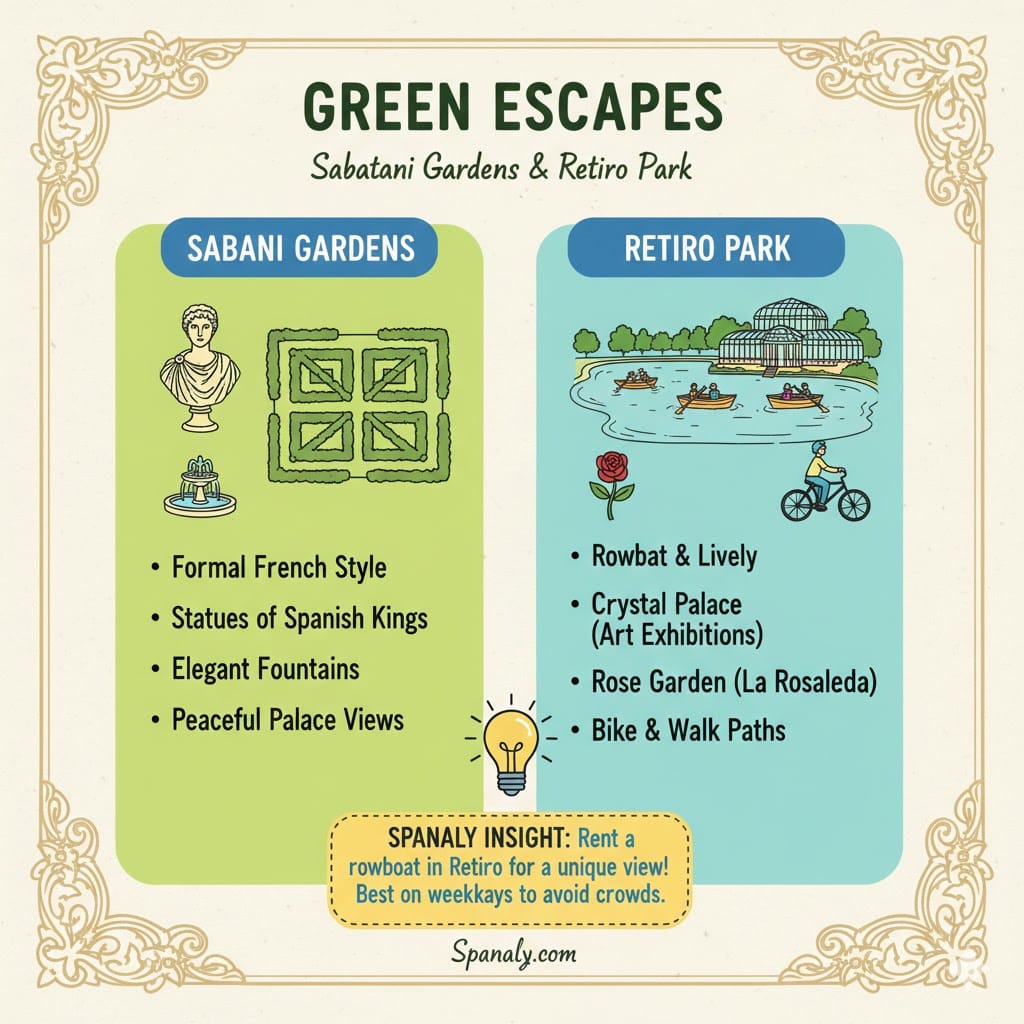
Madrid is a city that breathes through its magnificent parks. In particular, this royal itinerary focuses on two distinct “green lungs.” They offer very different experiences, ranging from formal elegance to vibrant local life. While these spaces are classic, those who enjoy the artistic side of nature might also want to explore the famous Park Güell in Barcelona for a different perspective on Spanish park design.
🌿 Sabatini Gardens (Jardines de Sabatini): These gardens are located on the northern side of the Royal Palace. Specifically, they are a masterpiece of Neoclassical design. With manicured hedges and marble statues, they provide a peaceful atmosphere. Indeed, it is the best place to admire the palace’s symmetry.
⛲ Retiro Park (El Retiro): This UNESCO World Heritage site is just a short metro ride away. Furthermore, it is Madrid’s most famous park.
The Crystal Palace: A stunning glass structure that looks like a fairy tale.
The Great Pond: The heart of the park. Here, you can rent a rowboat and enjoy the sun.
The Rose Garden: A romantic spot featuring over 4,000 roses.
💡 Spanaly Insight: If you want a quiet, “royal” moment, head to Sabatini. On the other hand, visit Retiro to experience the true “Madrileño” lifestyle with families and musicians. Pro Tip: Rent a rowboat on a weekday morning to avoid the long weekend queues.
🏛️ Puerta de Alcalá: The Neoclassical Landmark
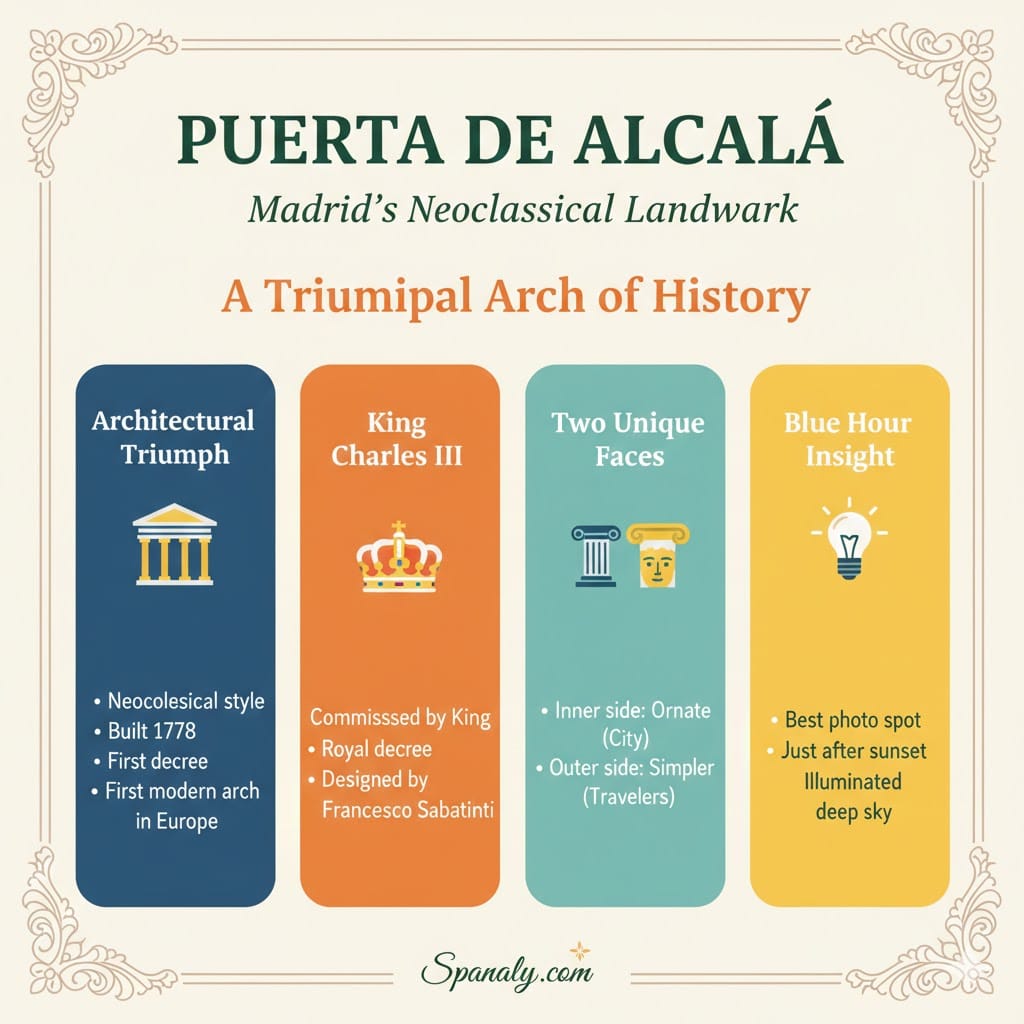
The Puerta de Alcalá stands majestically at the entrance to Retiro Park. Specifically, it is more than just a gate. It is a triumphal arch that serves as a gateway to Madrid’s history. While Madrid boasts this neoclassical masterpiece, those traveling south will find a similarly grand historical elegance in the lush avenues of Maria Luisa Park in Seville. Notably, King Charles III commissioned this arch, and it was completed in 1778.
🎨 Architectural Triumph: Francesco Sabatini designed the gate as a masterclass in Neoclassical style. Furthermore, it was built with granite and limestone to impress anyone entering from the east.
🎭 The Two Faces: A unique detail of this monument is that its two sides are different. On one hand, the inner side is ornate with pilasters. Conversely, the outer side is simpler to welcome travelers.
🛡️ Symbol of Resilience: Look closely at the stone. As a result, you might see scars from various battles and political shifts over the centuries.
💡 Spanaly Insight: For the most breathtaking photo, visit the gate at “blue hour” just after sunset. Consequently, the monument is beautifully illuminated against the deepening sky. This creates a truly royal photograph in the heart of Plaza de la Independencia.
📜 Cultural Insight: From Absolute Monarchy to Modern Madrid
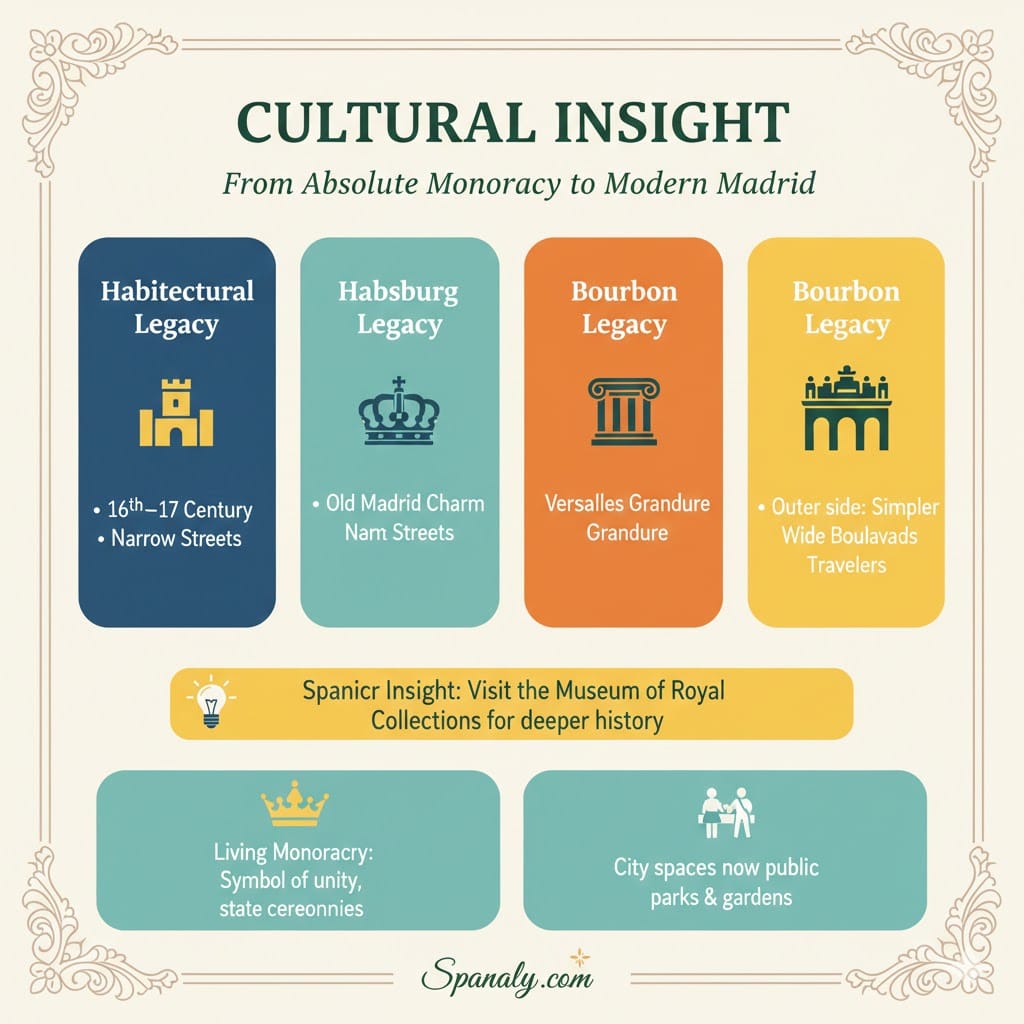
To truly appreciate the “Royal Heart” of Madrid, one must understand how the city evolved from a seat of absolute power to the vibrant, democratic capital it is today. This transition is etched into the very stones of the buildings you’ve explored, reflecting a shift in how the city lives and breathes.
The Habsburg vs. Bourbon Legacy: Madrid’s royal identity is a tale of two dynasties. The Habsburgs gave the city its “Old Madrid” charm, while the Bourbons brought the wide boulevards and neoclassical grandeur. Understanding this historical shift is key to navigating the city’s social fabric; for instance, knowing the local cultural etiquette in Spain will help you appreciate why Madrileños treat these regal spaces with such a unique blend of reverence and casual daily use.
The Living Monarchy: While Spain is now a parliamentary monarchy, the Royal Family remains a central symbol of national unity. You won’t see them living in the Royal Palace (they reside at Zarzuela Palace), but the “Royal Heart” is still the stage for state ceremonies that connect Spain’s modern democracy to its thousand-year history.
A City of the People: Today, the former royal hunting grounds (Retiro Park) and royal gardens (Sabatini) are filled with locals enjoying life. This “democratization of space” is what gives Madrid its unique energy—regal grandeur that is now owned and enjoyed by everyone.
💡 Spanaly Insight: If you want to dive deeper into this history, visit the Museum of Royal Collections (Galería de las Colecciones Reales) located right next to the Palace. It houses some of the most stunning tapestries, carriages, and artworks ever owned by the Spanish Crown.
📍 The Ultimate Royal Madrid 1-Day Itinerary
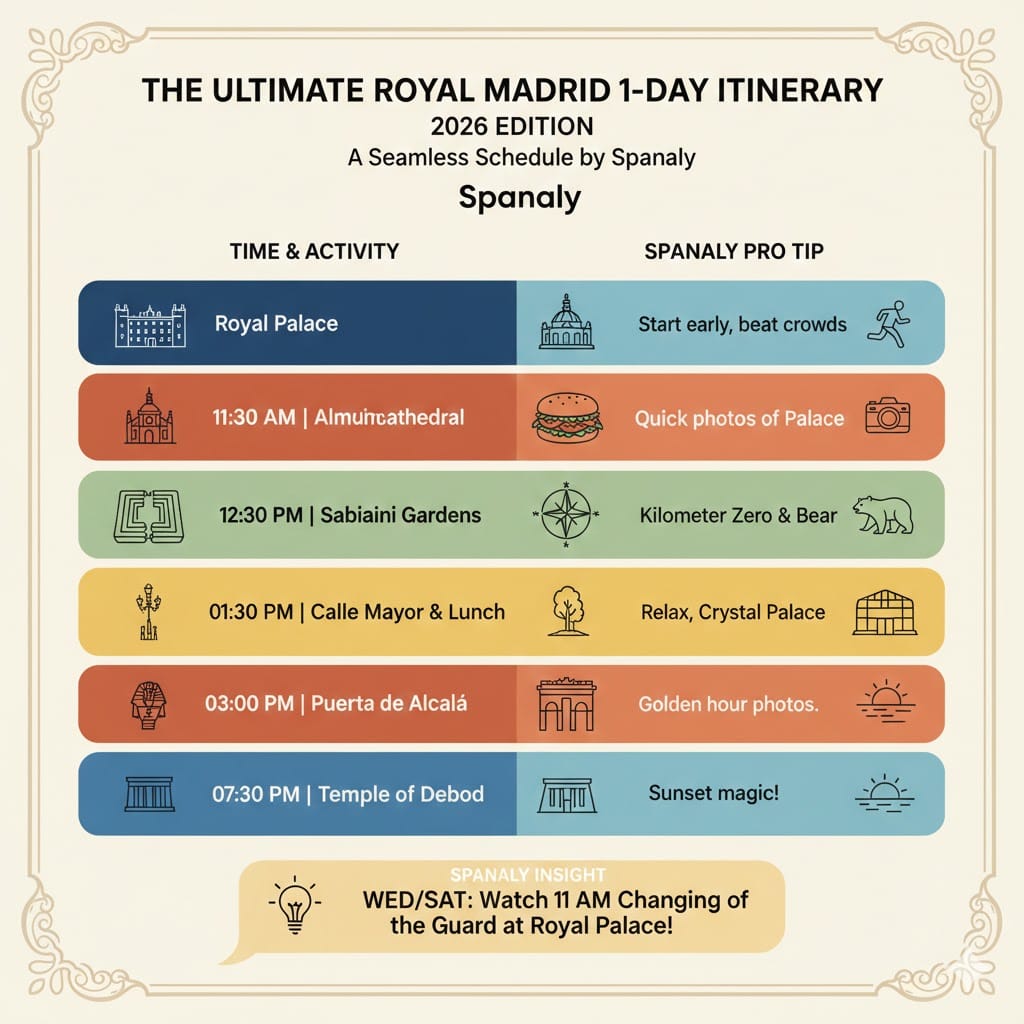
Planning your day efficiently is the secret to mastering Madrid’s royal heart without feeling overwhelmed. Based on our local expertise, here is the perfect 2026-optimized schedule for a seamless experience:
| Time | Activity | Spanaly Pro Tip |
| 09:30 AM | Royal Palace of Madrid | Start early to beat the crowds and enter as soon as doors open. |
| 11:30 AM | Almudena Cathedral | Explore the Neo-Gothic interior and climb the dome for views. |
| 12:30 PM | Sabatini Gardens | A quick walk around for symmetrical photos of the Palace’s north side. |
| 01:30 PM | Calle Mayor & Lunch | Walk toward Plaza Mayor and grab a Calamari Sandwich or tapas. |
| 03:00 PM | Puerta del Sol | Visit Kilometer Zero and take a photo with the Bear Statue. |
| 04:30 PM | Retiro Park & Crystal Palace | Relax by the pond or visit the Crystal Palace as the light softens. |
| 06:30 PM | Puerta de Alcalá | Catch the golden hour at this neoclassical landmark nearby. |
| 07:30 PM | Temple of Debod (Sunset) | End your day with the most iconic Egyptian sunset in Madrid. |
💡 Spanaly Insight: If you are visiting on a Wednesday or Saturday, try to be at the Royal Palace by 11:00 AM to catch the Relieve de Guardia (Solemn Changing of the Guard). It adds a majestic touch to your morning!
💰 Estimated Budget for a Royal Madrid Day (2026 Prices)
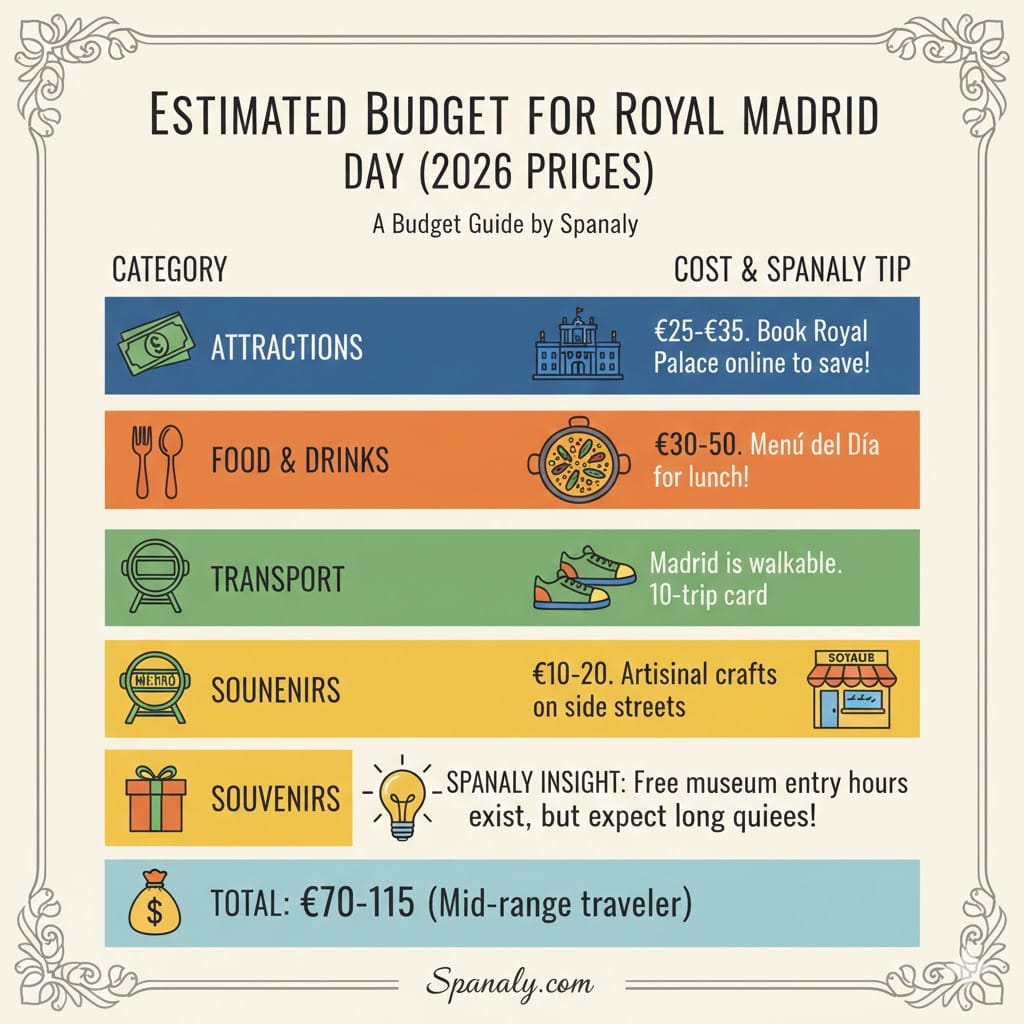
To help you plan your royal adventure, we’ve broken down the estimated costs for this itinerary. Madrid remains one of the more affordable European capitals, but knowing where to spend and where to save is key to a “royal” experience without the royal debt. Mastering a few local secrets on how to save money while traveling in Spain can make your budget go much further, allowing you to splurge on a fine dinner near the Palace instead of overpaying for basic transport.
| Category | Estimated Cost (Per Person) | Spanaly Saving Tip |
| Attractions | €25 – €35 | Book the Royal Palace online in advance to avoid “convenience fees” at the gate. |
| Food & Drinks | €30 – €50 | Enjoy a luxury breakfast, but go for a Menú del Día (fixed-price lunch) for value. |
| Transport | €5 – €10 | Madrid is very walkable; use a 10-trip Metro card only when necessary. |
| Souvenirs | €10 – €20 | Skip the palace gift shop; look for artisanal crafts in the side streets of Calle Mayor. |
| Total | €70 – €115 | Prices are estimated for a mid-range traveler in 2026. |
💡 Spanaly Insight: Many state-owned museums and the Royal Palace offer free entry hours (usually late afternoon on certain weekdays). While this is a great way to save, be prepared for very long queues that might eat into your precious sunset time at the Temple of Debod!
🛡️ Practical Traveler Tips: Transport, Safety & Timing
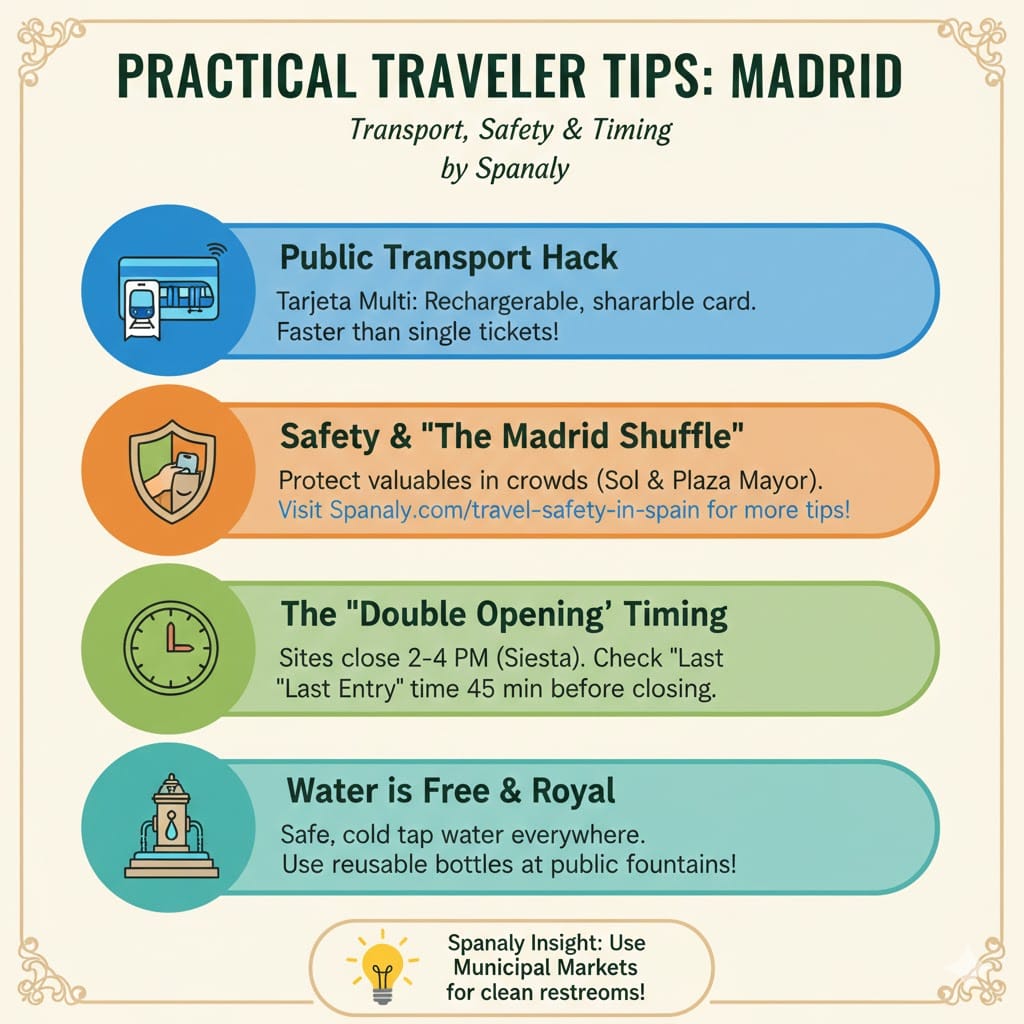
To ensure your journey through Madrid’s royal heart is as smooth as a palace floor, keep these practical, “insider-only” tips in mind. These focus on the logistics that can make or break your daily flow:
🎫 Public Transport Hack: While you can buy single tickets, the “Tarjeta Multi” is your best friend. It’s a contactless, rechargeable card you can share with your travel companions. For the royal itinerary, it’s much faster than queuing at machines every time you need to jump on the Metro.
⚠️ Safety & “The Madrid Shuffle”: Madrid is generally very safe, but areas like Puerta del Sol are hotspots for pickpockets. Familiarizing yourself with travel safety in Spain is essential; for instance, the “Golden Rule” is to never leave your phone on an outdoor café table and always keep your bag zipped and in front of you in crowded Metro stations.
🕒 The “Double Opening” Timing: Most royal sites have a “split schedule,” often closing briefly between 2:00 PM and 4:00 PM. Always check the specific “Last Entry” time, as it is usually 45–60 minutes before the official closing to ensure you aren’t turned away at the gates.
💧 Water is Free and Royal: Don’t keep buying plastic bottles. Madrid has some of the best tap water in Europe, and the city is dotted with historic stone drinking fountains (fuentes de agua potable). They are safe, cold, and eco-friendly.
💡 Spanaly Insight: If you need a restroom while exploring, look for the Municipal Markets. They are generally cleaner than public toilets and more welcoming than jumping into a random busy café just for the facilities.
👑 Visitor FAQs – Royal Madrid & Plaza Mayor
💂 How long does the Changing of the Guard ceremony last?
The solemn Changing of the Guard takes place every Wednesday and Saturday and lasts about 30 minutes. However, the "Grand Chain" (first Wednesday of the month) is a full military parade that can last nearly an hour. Pro tip: Arrive 20 minutes early to secure a spot at the palace railings.
🎟️ Should I book tickets in advance for the Royal Palace?
Absolutely. While EU and Ibero-American citizens have specific free hours (Mon-Thu), general tourists should book online. Waiting in the physical line can take over 90 minutes during peak season, wasting valuable exploring time.
🥪 What is the average price for a Calamari Sandwich?
Expect to pay between €4.50 and €6.50 for a Bocadillo de Calamares. If you are inside Plaza Mayor, prices might be higher; for the best value and quality, head to the side streets like Calle de Postas or Calle de Botoneras.
🕍 Is there a dress code for the Almudena Cathedral?
Yes. As a place of worship, visitors are expected to dress respectfully. Ensure your shoulders and knees are covered. While entry to the main nave is free (donations are welcome), there is a small fee if you wish to visit the Museum and the Dome.
☕ When is the best time to visit Chocolatería San Ginés?
Since it's open 24 hours, the best time to avoid the massive crowds is late at night or early morning (before 9:00 AM). Weekend afternoons are usually the busiest, with queues wrapping around the building.
Created by Spanaly.com
👑 Your Royal Journey Awaits
Madrid’s royal heart is more than just a collection of stone monuments; it’s a living museum where history meets the vibrant energy of the Spanish sun. Whether you are marvelling at the Palace’s frescoes or sharing a bocadillo in Plaza Mayor, you are now part of Madrid’s story.
✨ Final Takeaways for Your Visit:
🏛️ Contrast is Key: Balance the formal elegance of the Royal Palace with the lively, local atmosphere of Retiro Park.
📸 Golden Opportunities: Remember to catch the sunset at the Temple of Debod for the perfect end to your day.
🥘 Eat Like a Local: Don’t be afraid to wander into side streets for the most authentic flavors away from the tourist crowds.
🌍 Go Beyond the Capital: If you’ve fallen in love with the grandeur of Madrid, there are countless other Spanish Attractions waiting to be discovered across the peninsula.
Ready to start your adventure? Pack your most comfortable walking shoes, keep your camera charged, and let Madrid’s regal charm lead the way.
💡 Spanaly Final Tip: Always keep a small amount of cash for the historic churrerías—some traditions in Madrid haven’t changed in a century, and they still prefer the “royal” touch of physical coins!