🏛️ A Master’s Journey in El Born
The Picasso Museum (Museu Picasso) sits in the heart of the vibrant El Born district, serving as a cornerstone of Spain’s artistic heritage. Unlike other galleries, this museum offers an intimate look at the formative years of Pablo Picasso, showcasing how a young prodigy transformed into a world-renowned genius.
🎨 Artistic Evolution: Discover over 4,000 works that track Picasso’s growth from a talented teenager to a modern art pioneer.
🏰 Medieval Setting: Explore five interconnected Gothic palaces that house the collection, blending historical architecture with revolutionary art.
📍 Prime Location: The museum sits near the Gothic Quarter, making it an easy addition to any walking tour of the city center.
Whether you are an art historian or a casual traveler, this museum provides a deep emotional dialogue with the man who redefined 20th-century creativity. For a seamless trip, check our Ultimate Barcelona Guide to plan your full itinerary.
🌟 Spanaly Insight: The museum focuses heavily on Picasso’s early years. It is the best place in the world to understand his “Blue Period” and his deep-rooted connection to the Catalan capital before he moved to Paris.
🎨 Picasso vs. Miró: Which Museum for You?
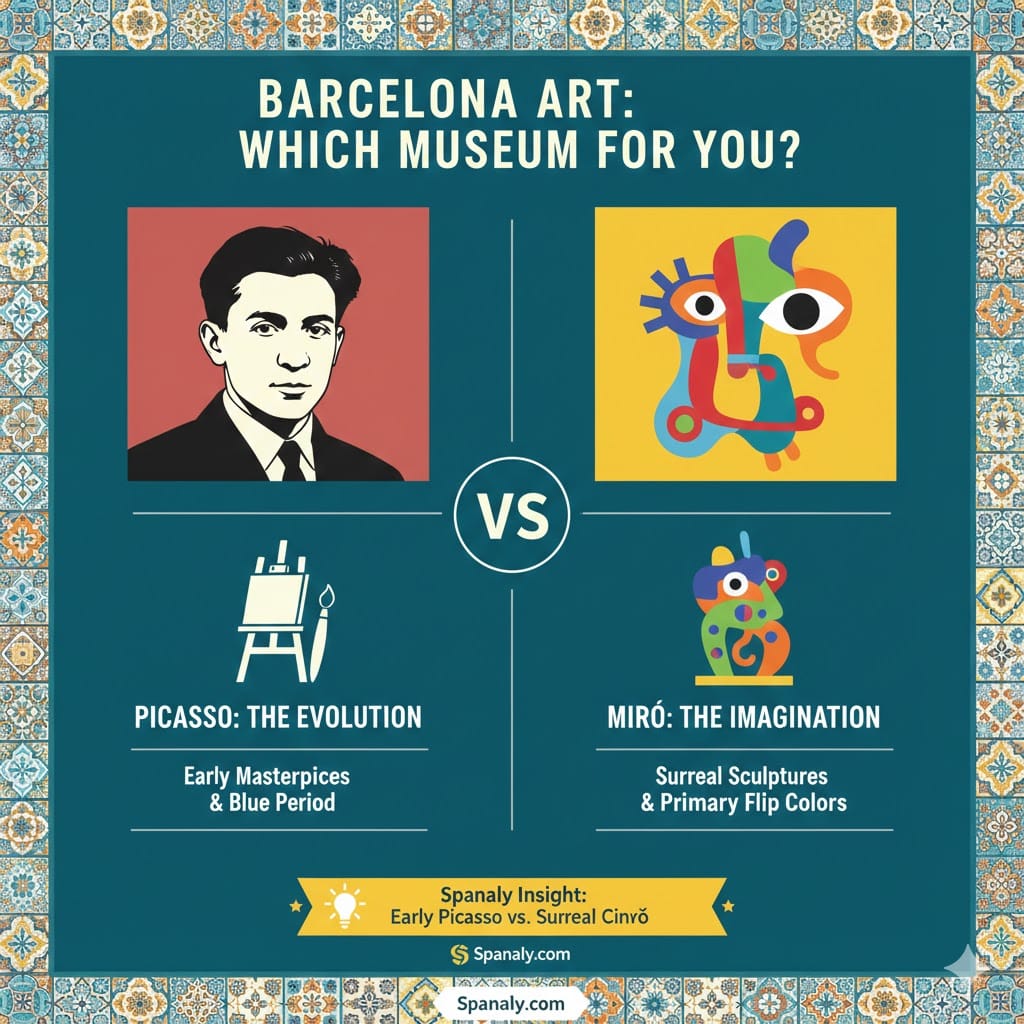
Barcelona is a city of artistic giants. If you are short on time, you might wonder whether to visit the Picasso Museum or the Joan Miró Foundation on Montjuïc Hill. Both are essential, but they offer very different vibes.
🏛️ Picasso (The Evolution): This museum is for those who want to see how a master is made. You will see hyper-realistic paintings from his teenage years that look like they were painted by an old master.
🔵 Miró (The Imagination): Choose Miró if you prefer large-scale surrealist sculptures, bold primary colors, and abstract dreamscapes.
🖼️ Unique Focus: Unlike the Picasso Museum in Paris, which focuses on his later Cubist fame, the Barcelona collection is the world’s best for exploring his formative years and personal sketches.
Choosing between them is hard, but both define the Catalan spirit. For a broader look at the city’s artistic landscape, don’t miss our guide to the National Art Museum of Catalonia (MNAC), which covers 1,000 years of history.
🌟 Spanaly Insight: Many visitors expect to see “Guernica” or heavy Cubism here. While there are Cubist elements, the real treasure of this museum is seeing Picasso’s school notebooks and early portraits—it makes the legend feel human.
🏘️ Barcelona: The Muse of Young Picasso
Picasso’s relationship with Barcelona was far more than a simple residency. Instead, it was a lifelong bond that nurtured his revolutionary spirit. He arrived as a teenager. During this time, the city’s raw energy and bohemian cafés provided the perfect backdrop for his first masterpieces.
🎨 Creative Roots: The city offered Picasso the freedom to experiment. Furthermore, he connected with avant-garde thinkers long before he moved to Paris.
🌊 Mediterranean Influence: The unique coastal light deeply influenced his early palette. Specifically, it shaped his famous Blue Period.
🚶 Walking Inspiration: Picasso spent endless hours sketching the city’s daily life. To explore the city like he did, check our guide on Getting Around Barcelona on Foot & Bike.
Ultimately, Barcelona became the laboratory where Picasso forged his genius. As he famously stated: “Barcelona is where it all began.” To explore his old haunts safely, read our tips on Night Safety in Popular Areas in Barcelona.
🌟 Spanaly Insight: Many subjects in the museum’s early portraits were Picasso’s real-life friends. Consequently, this personal connection makes the collection feel like a private diary of his youth.
🏰 The 5 Gothic Palaces: Art Inside History
The Picasso Museum represents a masterpiece of urban architecture. Instead of occupying a single modern building, the collection spans five adjoining medieval palaces on Carrer de Montcada. These structures date back to the 13th and 15th centuries. As a result, they offer a stunning backdrop of stone arches and hidden courtyards.
🏛️ Aguilar Palace: This palace stands out for its beautiful central courtyard and grand Gothic windows.
🎭 Meca Palace: It features a unique blend of historical layers. Specifically, it showcases the noble past of Barcelona.
🌿 Finely Restored Spaces: The seamless connection between these palaces allows you to walk through history. Meanwhile, you can explore modern art at the same time.
The street itself hosted the city’s wealthiest merchants in the past. Consequently, walking through these halls is a sensory experience. It is where the scent of old stone meets the vibrant colors of Picasso’s canvas. To discover more about the city’s architectural evolution, check our guide on Casa Batlló & Casa Milà.
🌟 Spanaly Insight: Don’t forget to look up! The ceilings in many rooms feature original wooden beams and intricate carvings. Remarkably, these details have survived for over 500 years. It’s a “two-for-one” experience: a world-class art gallery and a medieval palace tour.
🎨 Inside the Collection: Must-See Masterpieces
The collection offers a fascinating journey through Picasso’s artistic DNA. While most museums display his famous abstract works, you witness the raw skill of a prodigy here. Furthermore, the museum organizes the galleries chronologically. Consequently, this allows you to walk through his mental and creative transformation step by step.
🩺 Science and Charity (1897): This is one of Picasso’s most important early works. He painted it when he was just 15 years old. Specifically, it showcases his mastery of classical realism and traditional technique.
👑 The Las Meninas Series (1957): This breathtaking room contains 58 paintings. In these works, Picasso reinterprets Velázquez’s masterpiece. It serves as a masterclass in how to deconstruct and reinvent art.
🖼️ The Blue Period: Look for “The Fugitives” and other haunting works. Indeed, these pieces use shades of blue to express deep sorrow and human struggle.
Beyond the oils, the museum houses rare ceramics and personal sketches. These items reveal the artist’s spontaneous side. After soaking in these masterpieces, you might want to see how other legends left their mark on the city by visiting Park Güell.
🌟 Spanaly Insight: Don’t rush the Las Meninas room. In fact, it is the only complete series of this theme kept together in one museum. Seeing the evolution from the first sketch to the final abstract interpretation is like watching Picasso’s brain at work.
💙 The Blue Period: Melancholy in Barcelona
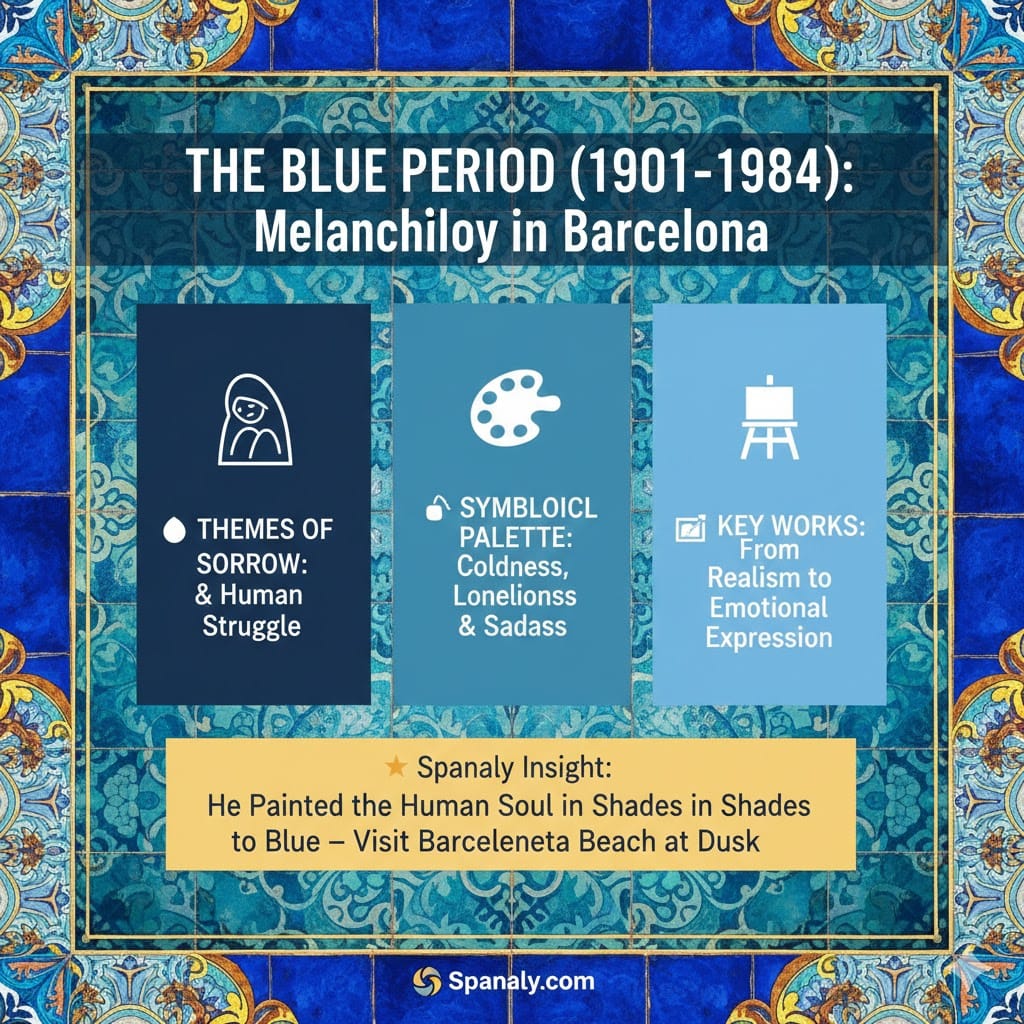
The Blue Period (1901–1904) defines a pivotal chapter in Picasso’s career, characterized by monochromatic paintings in shades of blue and blue-green. This era was triggered by personal grief and the poverty he witnessed in the streets of Barcelona.
🌑 Themes of Sorrow: The works focus on outcasts, beggars, and the fragile side of society, reflecting Picasso’s own struggle and empathy.
🎨 Symbolic Palette: Using blue wasn’t just an aesthetic choice; it was a psychological tool to convey coldness, loneliness, and deep sadness.
🖼️ Key Works on Display: The museum houses several essential pieces from this time, including sketches and oils that show his transition from realism to emotional expressionism.
Understanding this period is essential to seeing Picasso as more than just a painter of shapes—he was a painter of the human soul. If you are interested in exploring the more colorful and festive side of the city to balance this artistic depth, check our guide to the La Mercè Festival.
🌟 Spanaly Insight: Many of the scenes from the Blue Period were inspired by the neighborhoods surrounding the museum. To see where Picasso found his “blue” inspiration, consider exploring Barceloneta Beach at dusk, when the Mediterranean light takes on those exact haunting tones.
✏️ The Paper Genius: Sketches & Ceramics
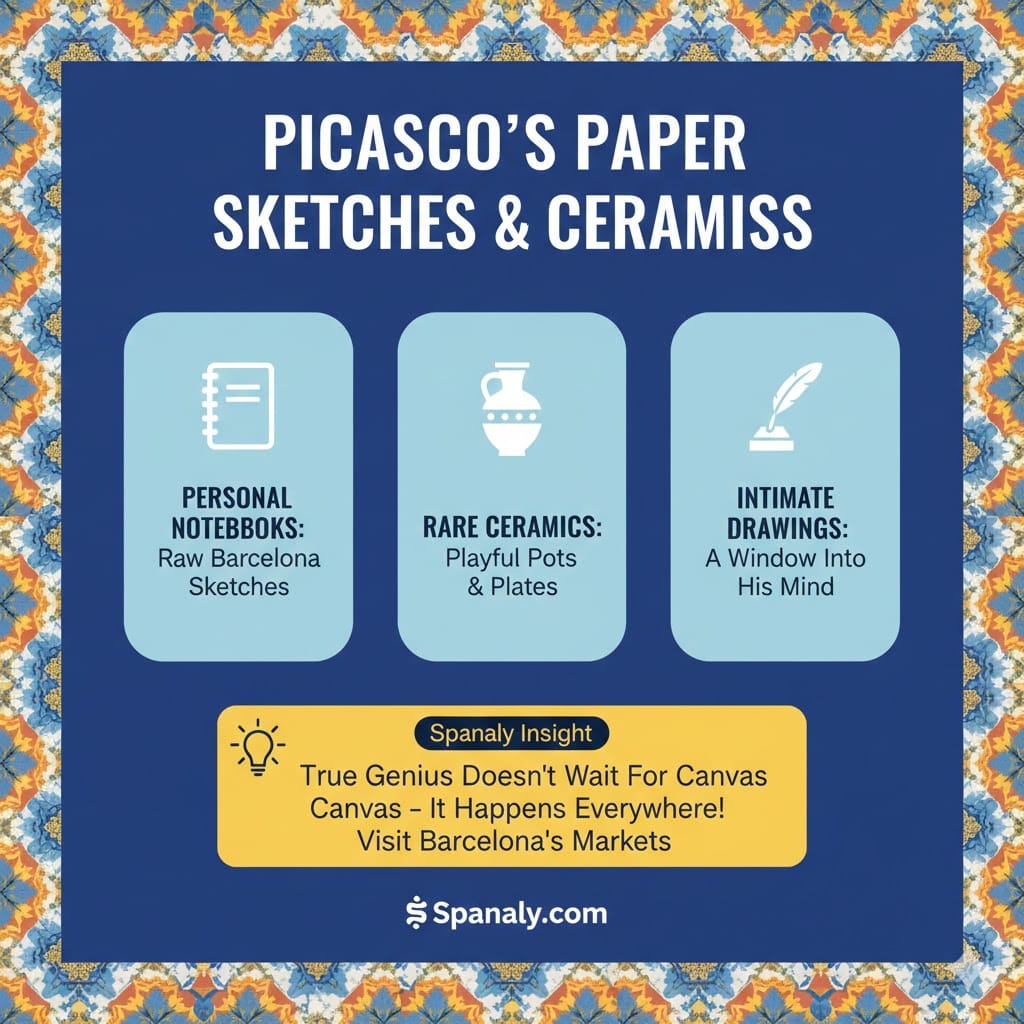
Beyond the grand oil canvases, the Picasso Museum houses an incredible treasure trove of paper works and ceramics. In fact, this part of the collection reveals the artist’s restless mind. Moreover, it shows his constant need to create on any surface available.
📒 Personal Notebooks: Flip through digital displays of Picasso’s early sketchbooks. Here, you can see his raw drawings of Barcelona’s street life. Additionally, you can witness his first attempts at challenging classical forms.
🏺 Rare Ceramics: Discover a stunning room dedicated to Picasso’s pottery. These works show his playful side. Specifically, he turned simple plates and jugs into faces and mythological creatures.
✍️ Intimate Drawings: These works feel like a direct window into his creative process. They range from quick charcoal sketches to detailed ink drawings.
Picasso believed that “Art washes away from the soul the dust of everyday life.” Indeed, these personal items prove that he lived every moment as an artist. After exploring these delicate treasures, you can find more inspiration by visiting the colorful Local Markets – La Boqueria & Beyond.
🌟 Spanaly Insight: Pay attention to the drawings on the margins of old newspapers. Picasso often sketched on whatever was in front of him. Consequently, this reminds us that true genius doesn’t wait for a perfect canvas—it happens everywhere!
📸 Expert Photography Guide: Capturing the Art
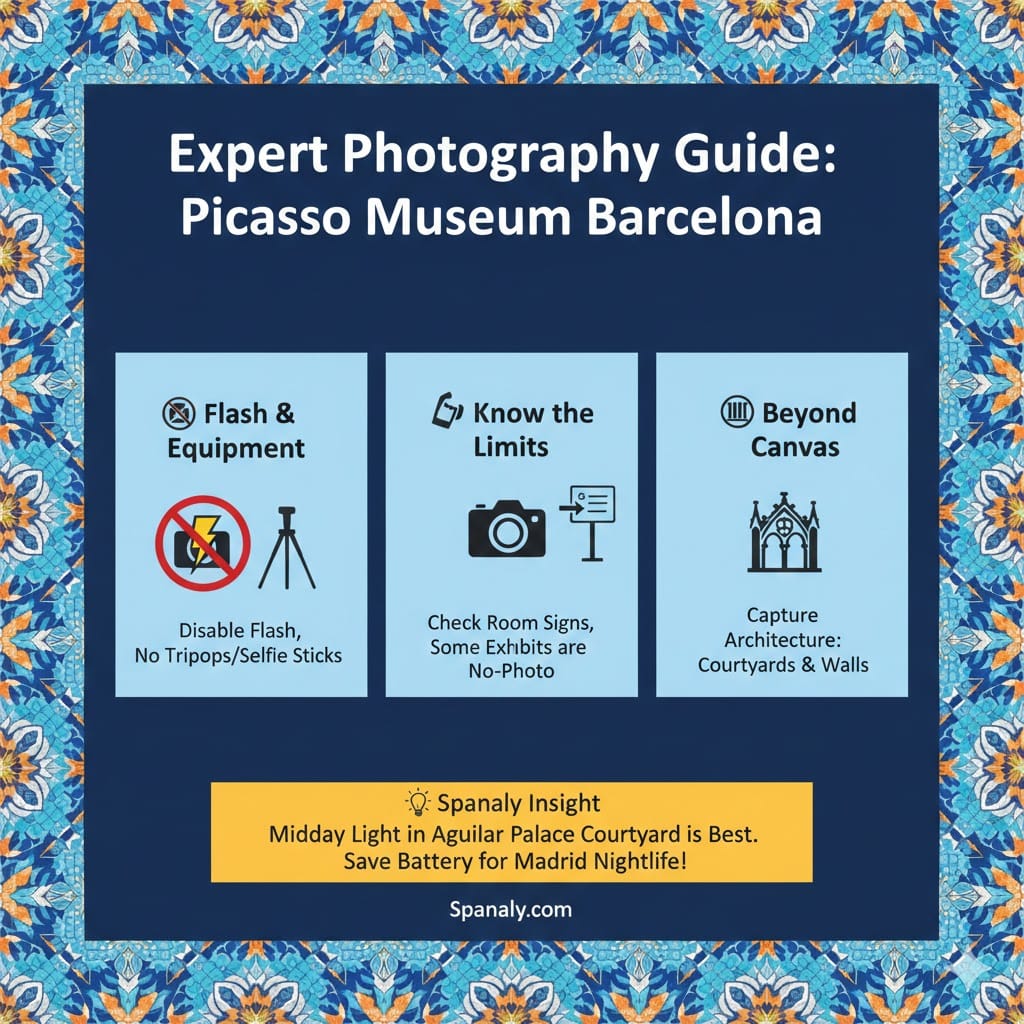
Capturing the essence of the Picasso Museum requires a bit of planning. Since the museum enforces strict rules to protect its delicate collection, you should prepare in advance. Therefore, keep these professional tips in mind to avoid any issues with security while documenting your trip.
🚫 Flash and Equipment: Always disable your flash. In fact, high-intensity light damages sensitive pigments over time. Additionally, leave your tripods and selfie sticks in the lockers. This helps maintain a smooth flow through the narrow Gothic halls.
🤳 Know the Limits: The museum usually permits photography for the permanent collection. However, some temporary exhibitions have strict “no-photo” zones. Consequently, you should always check the signs in each room.
🏛️ Beyond the Canvas: If you want to practice architectural photography, the medieval courtyards are perfect. They offer a unique contrast to the neoclassical beauty found in our Prado Museum Madrid guide.
The best way to document your visit is to focus on the interplay between stone walls and art. Furthermore, if you are visiting multiple galleries, read our Essential Spain Travel Tips. These tips provide vital advice on museum etiquette and planning.
🌟 Spanaly Insight: The most beautiful natural light enters the Aguilar Palace courtyard around midday. Thus, use this time to capture the texture of the 15th-century stone. It’s also a great way to save your battery for later when you follow our Madrid Nightlife Guide.
🏘️ The El Born District: Beyond the Museum
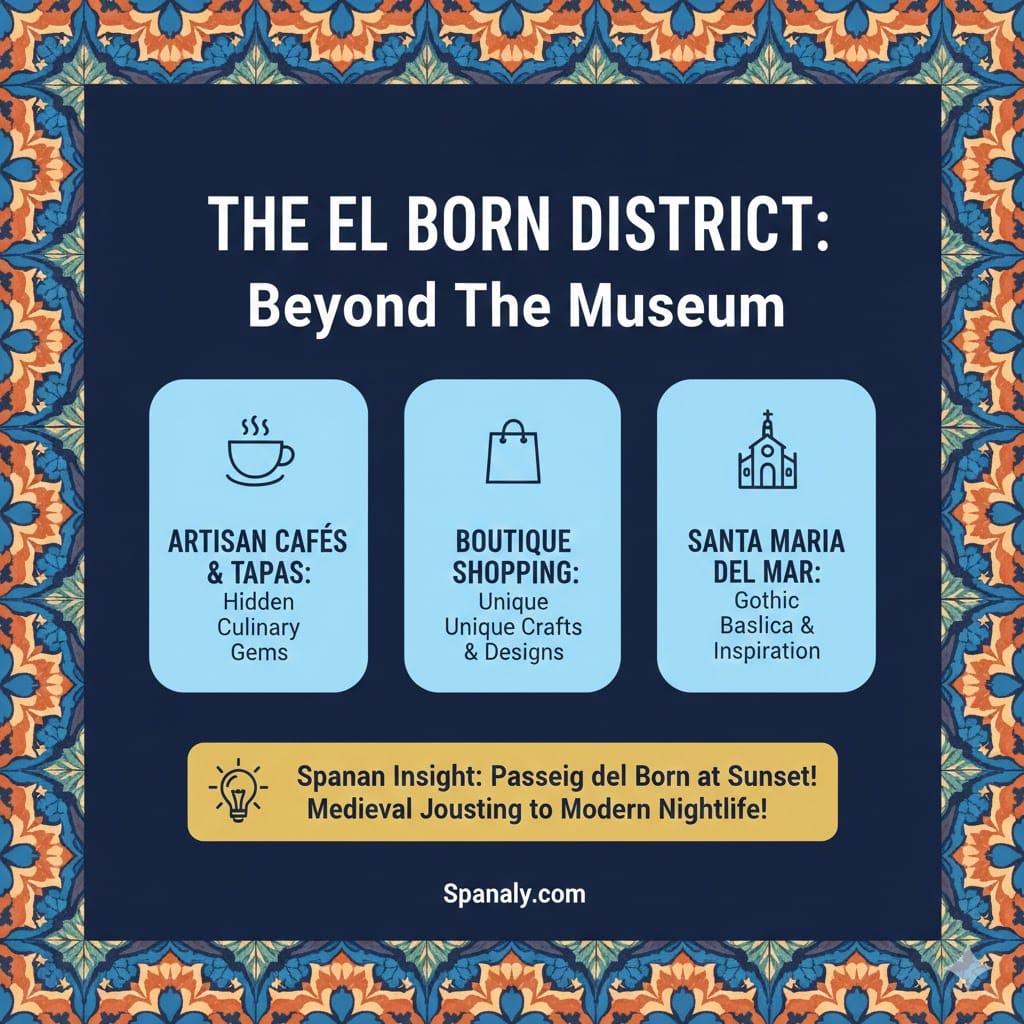
Stepping out of the Picasso Museum puts you in the heart of El Born, a neighborhood where medieval history meets modern bohemian lifestyle. This area was Picasso’s old playground, and today it remains the creative soul of Barcelona’s old city.
☕ Artisan Cafés & Tapas: The narrow streets surrounding the museum are packed with hidden gems. After a morning of art, there’s nothing better than relaxing with a local snack. For a full culinary experience, check our guide on How to Order Food Like a Local in Spain.
🛍️ Boutique Shopping: El Born is famous for its independent designers and craft shops. You can find unique handmade leather goods and jewelry that you won’t see anywhere else in the world.
⛪ Santa Maria del Mar: Just a short walk away is this stunning 14th-century basilica, a masterpiece of Catalan Gothic architecture that often inspired local artists.
The energy of El Born is contagious. It’s a place where you can easily lose track of time wandering through stone alleys. To make the most of your day, it’s essential to understand the Spain Daily Rhythm: Siesta & Mealtimes, so you don’t find the shops closed during your walk!
🌟 Spanaly Insight: For the best atmosphere, head to Passeig del Born just before sunset. It was once the site of medieval jousting tournaments, but today it’s the perfect spot for people-watching with a cold drink. It’s the ultimate way to transition from “museum mode” to “Barcelona night mode.”
🗺️ Day Trip: Must-See Landmarks Nearby
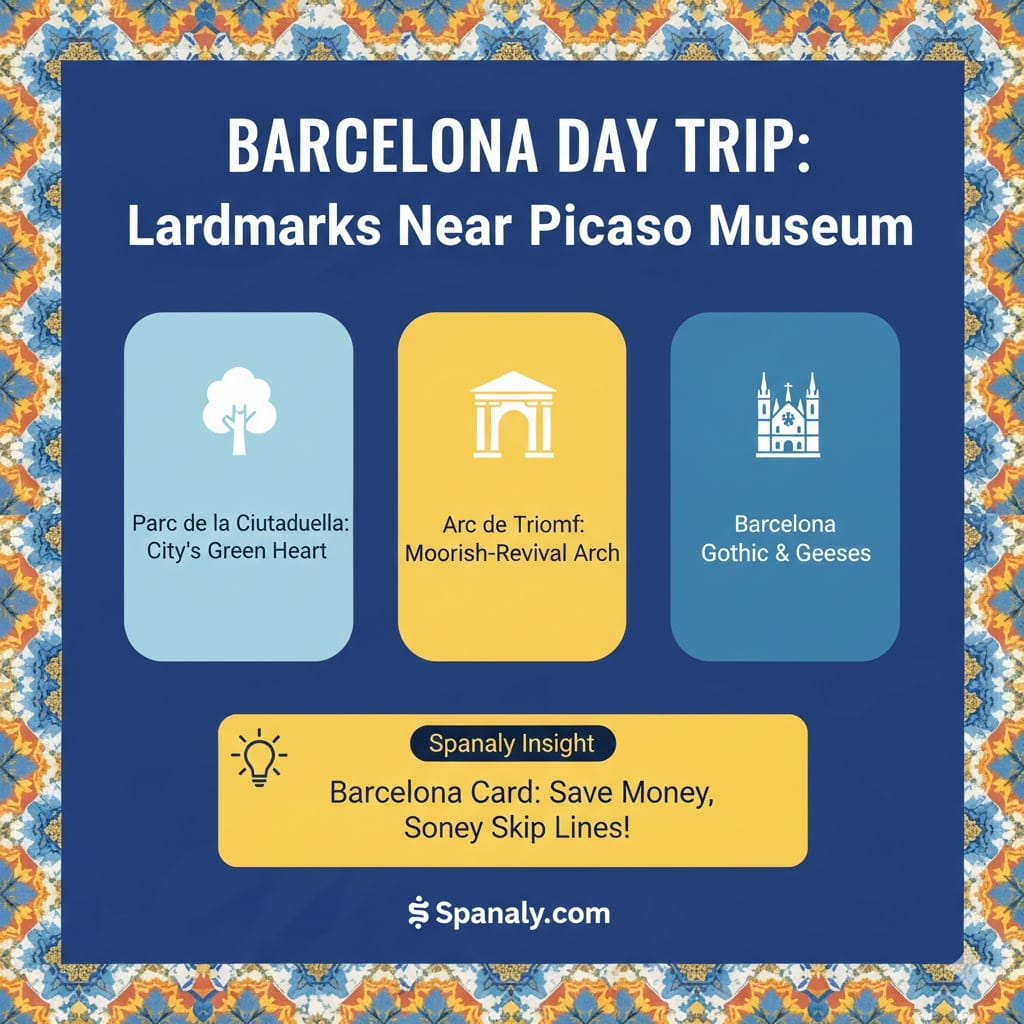
The Picasso Museum is perfectly situated to be the centerpiece of your Barcelona day trip. Because it’s located in the historic heart of the city, you can easily walk to several world-class landmarks within 10 to 15 minutes.
🌳 Parc de la Ciutadella: Just a short stroll away, this is Barcelona’s most famous park. It’s perfect for a picnic after your museum visit. If you enjoy green spaces, you’ll love comparing it to the Retiro Park Madrid: Green Heart.
🏛️ Arc de Triomf: Located at the entrance of the park, this grand brick arch is a masterpiece of Moorish-revival architecture and a favorite spot for photographers.
⛪ Barcelona Cathedral: Don’t confuse this with the Sagrada Família! This stunning Gothic cathedral in the nearby Gothic Quarter is famous for its cloister and 13 white geese. It shares the same spiritual majesty as the Almudena Cathedral Madrid.
Combining these spots creates a perfect balance of art, history, and nature. To make your journey between these landmarks even easier, consider Getting Around Spain using the city’s highly efficient bike-sharing or metro systems.
🌟 Spanaly Insight: If you’re planning to visit multiple museums and landmarks in one day, look into the Barcelona Card. It often includes free entry to the Picasso Museum and unlimited public transport, which is a great way to Save Money Travel Spain.
🛡️ Safety & Practical Tips: Master Your Visit

Planning a visit to the Picasso Museum in 2026 requires more than just a ticket. To navigate the crowds and the stone-walled palaces like a local, you need a strategy that covers everything from digital prep to physical comfort.
📱 Stay Connected: The thick medieval walls of the palaces can sometimes block mobile signals. To ensure you can access your digital tickets and maps throughout Barcelona, check our guide on Internet and SIM Cards in Spain.
🎒 Gear & Comfort: Large bags are not permitted inside the galleries. We recommend carrying a small cross-body bag for your essentials and wearing comfortable shoes for the cobblestone streets of El Born. For a complete checklist, see our guide on What to Pack for Spain.
🎟️ Booking Strategy: Tickets sell out rapidly. Always book your time slot online at least a week in advance, especially if you plan to visit during the free Sunday sessions.
🌟 Spanaly Insight: If you’re visiting during the summer, the museum’s stone courtyards provide a natural cooling effect. It’s the perfect place to take a “digital break” and simply soak in the history before heading back into the vibrant energy of the city.
🎨 Expert FAQ: Insider Tips for Your Visit
🎧 Is there an audio guide in different languages?
Yes. The museum offers an excellent audio guide (available via your smartphone or a rented device) in several languages, including English, Spanish, and French. It is vital for understanding the complex transition between his realistic and cubist periods.
👗 Is there a dress code for the museum?
There is no official dress code, but we recommend "smart casual" and, most importantly, comfortable walking shoes. The museum is housed in five medieval palaces with uneven stone floors that can be tiring for your feet.
❄️ Is the museum air-conditioned?
Yes, fully. The climate is strictly controlled to preserve the delicate 19th-century paper and oil works. This makes the museum a perfect refuge during the hot Barcelona summer afternoons.
♿ Is the museum accessible for people with reduced mobility?
Surprisingly, yes. Despite being inside 15th-century Gothic palaces, the museum has been modernized with elevators and ramps, making almost all galleries accessible for wheelchairs and strollers.
🥪 Can I eat or drink inside the galleries?
No. Food and drinks are strictly prohibited inside the exhibition rooms to protect the art. However, the El Born neighborhood is famous for its tapas bars just steps away from the exit.
The Ultimate Picasso Experience by Spanaly.com
✨ Your Artistic Journey Awaits
Visiting the Picasso Museum is more than just a walk through a gallery; it’s an intimate encounter with the soul of a genius in the city that shaped him. Whether you are a hardcore art lover or a curious traveler, this museum will change how you see Barcelona.
🎨 Emotion in Every Room: Experience the transition from realistic portraits to the revolutionary Blue Period.
🏰 History Meets Modernity: Walk through five medieval palaces that are works of art themselves.
🌆 Beyond the Frame: Step out into the vibrant streets of El Born to live the same energy Picasso once felt.
If your love for Spanish masterpieces is just getting started, don’t stop here! Your next stop should be the world-renowned Prado Museum Madrid, where you can witness the works of Velázquez and Goya that inspired Picasso himself.
🌟 Spanaly Final Tip: Take your time. Don’t rush from painting to painting. Find one work that speaks to you, sit on a museum bench, and just let the “Blue” magic soak in.
Safe travels and enjoy your Barcelona adventure! 🇪🇸