🏰 The Limestone Miracle of Aragon
The Castle of Loarre (Castillo de Loarre) is more than just a fortress. It is a limestone miracle. Notably, this 11th-century masterpiece crowns the rugged Aragon landscape. It remains the world’s finest example of Romanesque military architecture. Specifically, medieval builders fused the stronghold into the cliffs. They designed it to survey the horizon and repel invaders for centuries.
🛡️ A Living Time Capsule: Loarre remains remarkably intact. It offers a pure, 1,000-year-old medieval atmosphere.
🦅 Epic Vantage Point: The castle sits at 1,070 meters. It commands breathtaking views over the Hoya de Huesca plains.
🎬 Cinematic Legend: These authentic walls hosted Ridley Scott’s Hollywood epic, Kingdom of Heaven.
💎 Architectural Gem: The site showcases Romanesque genius. It blends a brutal stronghold with a refined royal monastery.
Ultimately, every history lover should walk through these gates. Indeed, the fortress represents the raw power of the medieval frontier. Specifically, if you crave more history, explore the legendary Moros y Cristianos in Alicante.
💡 Spanaly Insight: Stop at the winding approach road first. In fact, medieval architects used the mountain’s own limestone to build the walls. This brilliant technique made the castle invisible from a distance. It still baffles visitors today!
📜 History & Significance: The Frontier of Aragon
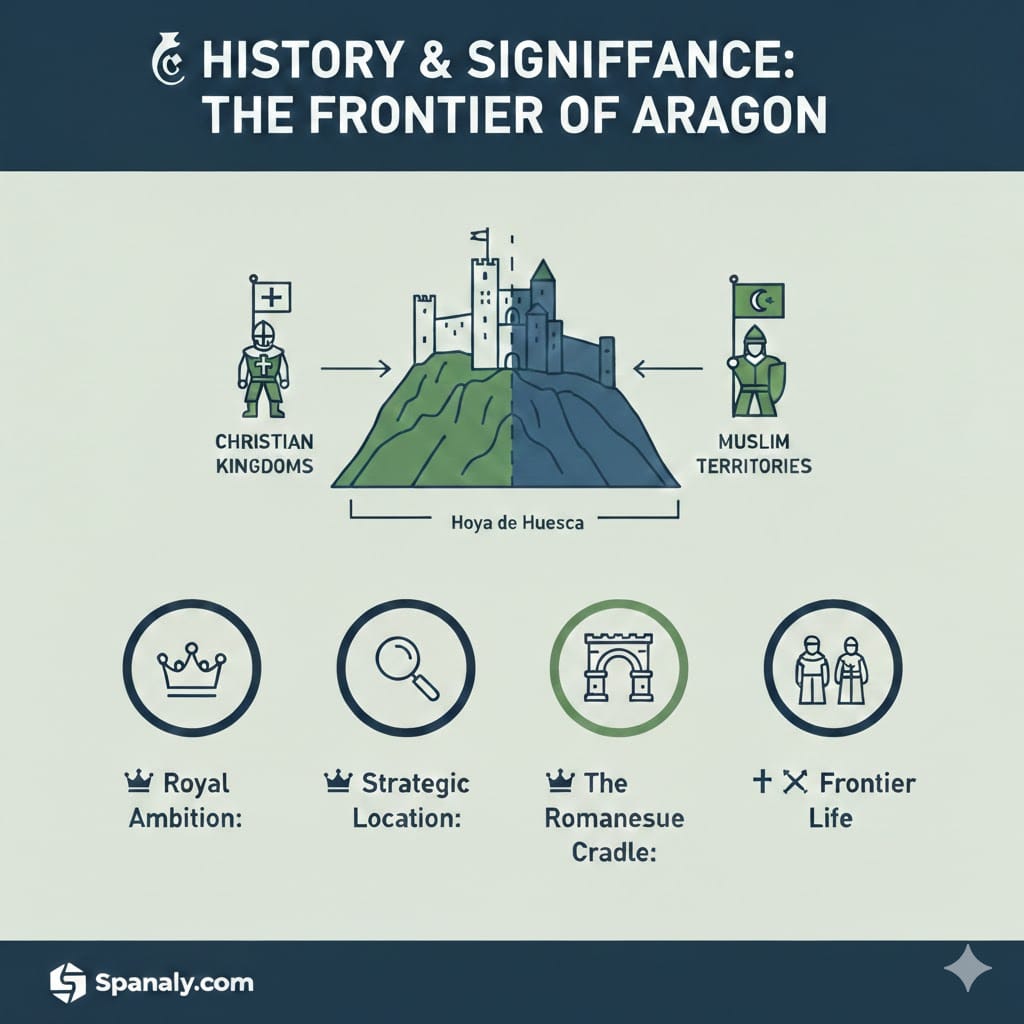
The Castle of Loarre was the “Shield of Christianity” during the 11th century. Built on the orders of King Sancho III, it served as a vital strategic outpost during the Reconquista, marking the border between Christian and Muslim territories.
🔑 Historical Milestones:
Royal Ambition: Expanded by King Sancho Ramírez, who transformed it into a combined royal palace and a religious monastery.
Strategic Location: Its position allowed the Kings of Aragon to survey the plains and prepare for the capture of Huesca.
The Romanesque Cradle: It is recognized as one of the oldest and most authentic strongholds in Spain’s history.
Frontier Life: Walking its halls gives you a raw look at how medieval soldiers and monks lived side-by-side.
Travel Insight: While Loarre represents the rugged northern frontier, you can experience a completely different side of Spain’s cultural evolution in our Ultimate Madrid Travel Guide.
🛡️ Architectural Highlights: Military Genius in Stone
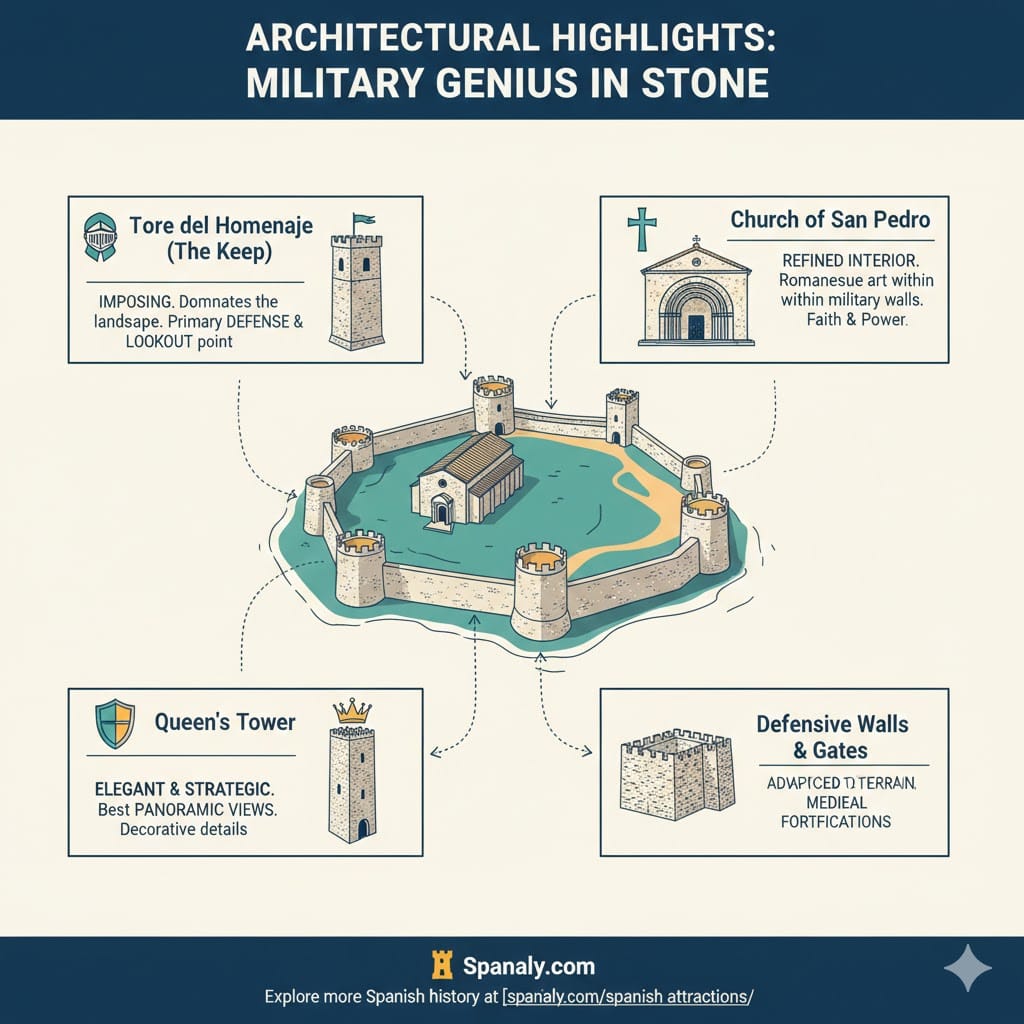
The architecture of Loarre is a masterclass in 11th-century engineering. It was designed not only to repel invaders but also to house a religious community within its impenetrable walls.
🏰 Torre del Homenaje (The Keep): The castle’s tallest point. It served as the final line of defense and offers a 360-degree view of the Aragon landscape.
⛪ Church of San Pedro: A hidden treasure. Inside these thick military walls lies a refined Romanesque church with a stunning dome and ancient carvings.
👑 Queen’s Tower: Famous for its elegant windows and decorative details, it served as a strategic lookout point for the royal family.
🧱 Double Defensive Walls: The fortress is protected by a massive outer wall featuring cylindrical towers, perfectly adapted to the rocky terrain.
Traveler Tip: After exploring this northern fortress, you can discover a different architectural world in our Ultimate Barcelona Travel Guide, where Gothic and Modernist styles take center stage.
🎥 Hollywood in Aragon: The Kingdom of Heaven Connection
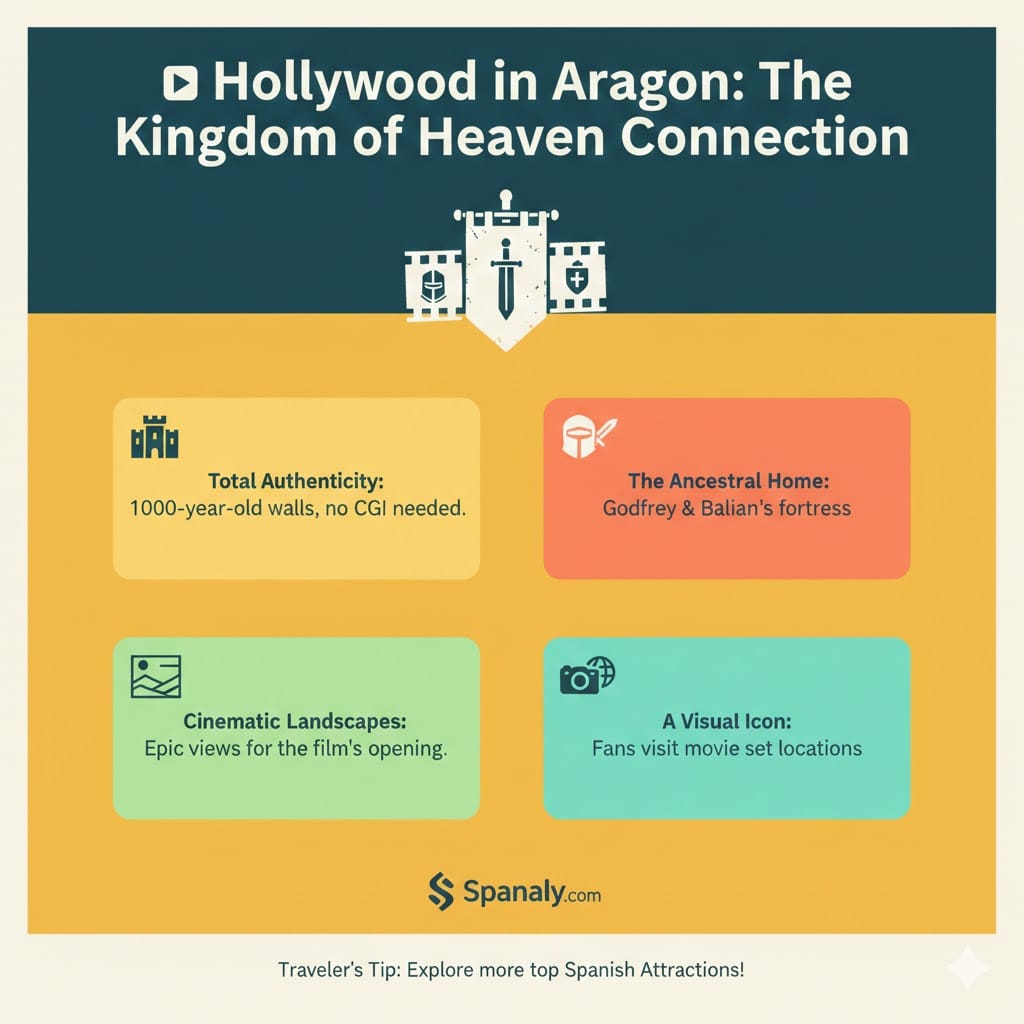
The Castle of Loarre isn’t just a historical monument; it is a global movie star. Its authentic medieval silhouette caught the eye of legendary director Ridley Scott, making it the centerpiece of the 2005 epic, Kingdom of Heaven.
🎬 Why Loarre was the Perfect Set:
Total Authenticity: Unlike many European castles, Loarre required almost no CGI or modern sets—its 1,000-year-old walls are perfectly preserved.
The Ancestral Home: In the film, the castle serves as the fortified estate of Godfrey of Ibelin (Liam Neeson) and his son Balian (Orlando Bloom).
Cinematic Landscapes: The vast plains of the Hoya de Huesca seen from the castle walls provided the perfect “crusader” atmosphere for the movie’s opening acts.
A Visual Icon: Today, fans of the film visit from all over the world to stand in the exact spots where the iconic scenes were filmed.
Explore More: Beyond the silver screen, this fortress remains one of the most visited Spanish Attractions for those seeking the true soul of medieval Europe.
📍 Planning Your Visit: Location, Tickets & Timing
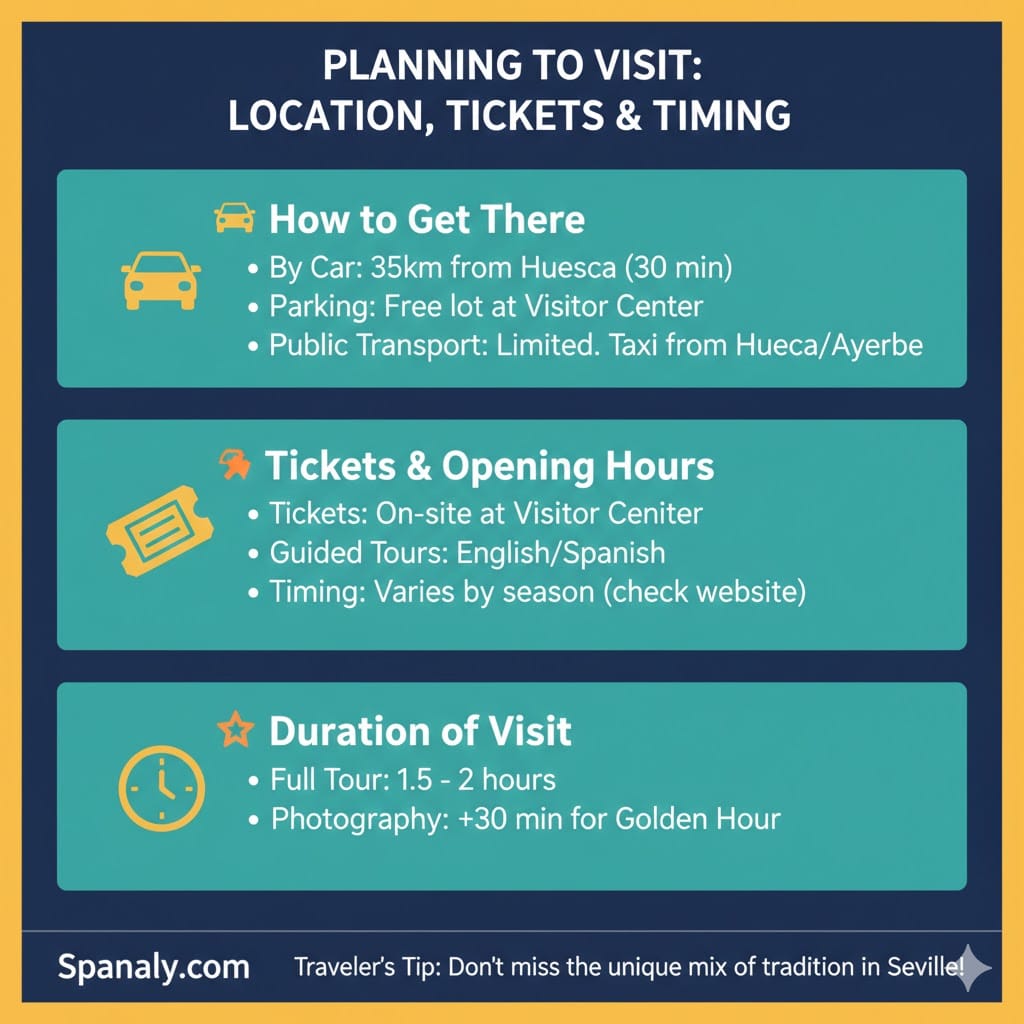
Getting to the Castle of Loarre requires a bit of planning, as its remote location is part of its medieval charm. Here is everything you need to know for a smooth trip in 2026.
🚗 How to Get There:
By Car: This is the most recommended way. The castle is about 35 km (30 minutes) from the city of Huesca and 100 km from Zaragoza.
Parking: There is a large, free parking area located right next to the Visitor Center.
Public Transport: Extremely limited. If you don’t have a car, you can take a train to Huesca or Ayerbe and then hire a taxi to the fortress.
🎟️ Tickets & Opening Hours:
Standard Entry: Tickets can be purchased at the Visitor Center on-site.
Guided Tours: Highly recommended to understand the military secrets of the walls (available in Spanish and English).
Timing: The castle usually opens at 10:00 AM. Closing times vary by season (earlier in winter, later in summer).
⏰ Duration of Visit:
The Full Tour: Expect to spend between 1.5 to 2 hours exploring the towers, the church, and the dungeons.
Photography Time: Add an extra 30 minutes if you want to capture the golden light over the Hoya de Huesca plains.
Traveler Tip: While exploring the historical heart of Aragon is a unique experience, those looking for a mix of tradition and luxury should not miss our Ultimate Seville Travel Guide for a Southern Spanish adventure.
👟 Essential Tips for a Rewarding Medieval Journey
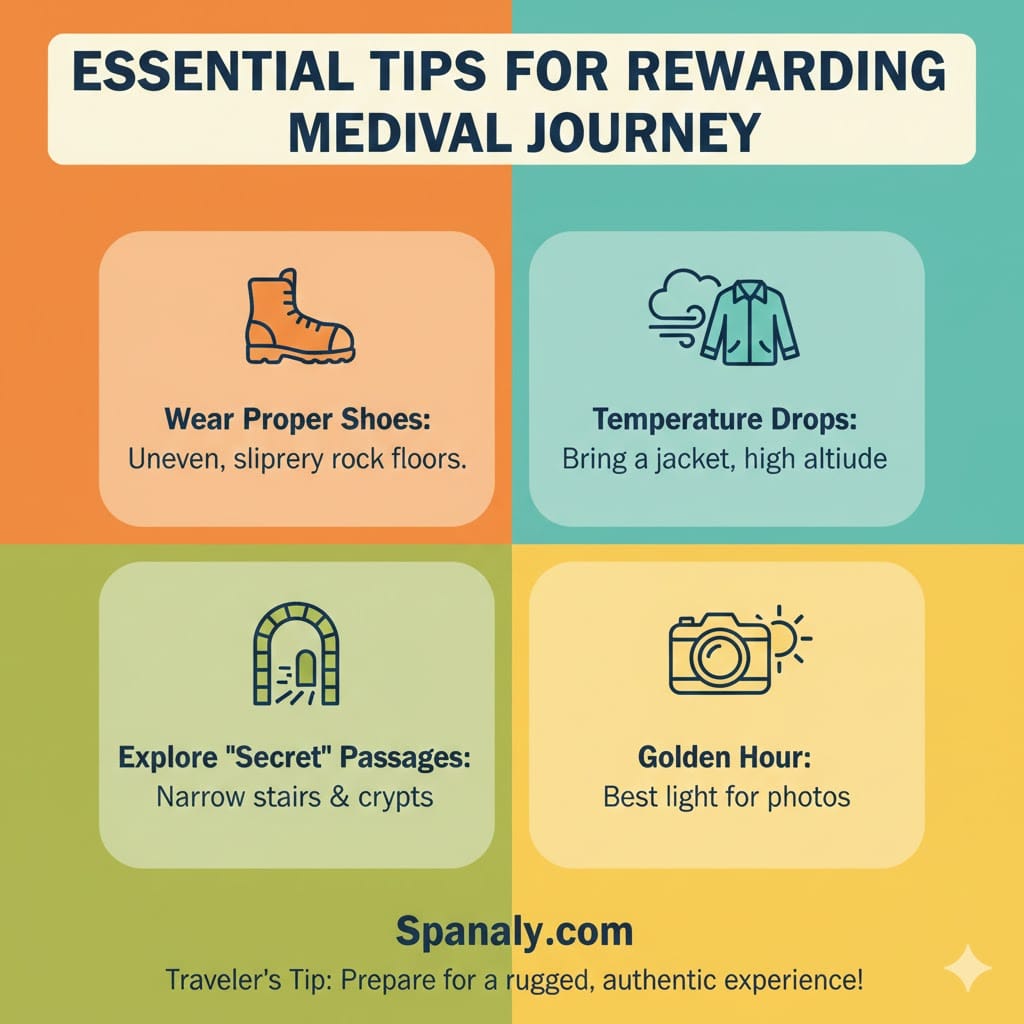
To make the most of your trip to the Castle of Loarre, a little preparation goes a long way. This isn’t your typical museum visit; it’s a rugged, authentic experience.
✔️ What You Need to Know:
Wear Proper Shoes: The castle is built directly onto limestone rock. The floors are uneven and can be slippery, so leave the sandals behind and wear sturdy walking shoes or sneakers.
Temperature Drops: Because it sits at over 1,000 meters, it is often much windier and cooler at the castle than in the valley below. Bring a light jacket, even in summer.
The “Secret” Passages: Don’t just stay in the main courtyard. Explore the narrow staircases and the crypt beneath the church for the full medieval atmosphere.
Golden Hour: If you are a photographer, try to visit during the late afternoon. The sun hitting the limestone walls creates a spectacular golden glow.
Local Insight: Planning a trip across the country? Just as you prepare for the rugged terrain of Aragon, you can find expert advice for other major regions in our Ultimate Seville Travel Guide.
📍 Beyond the Fortress: The Perfect Aragon Day Trip
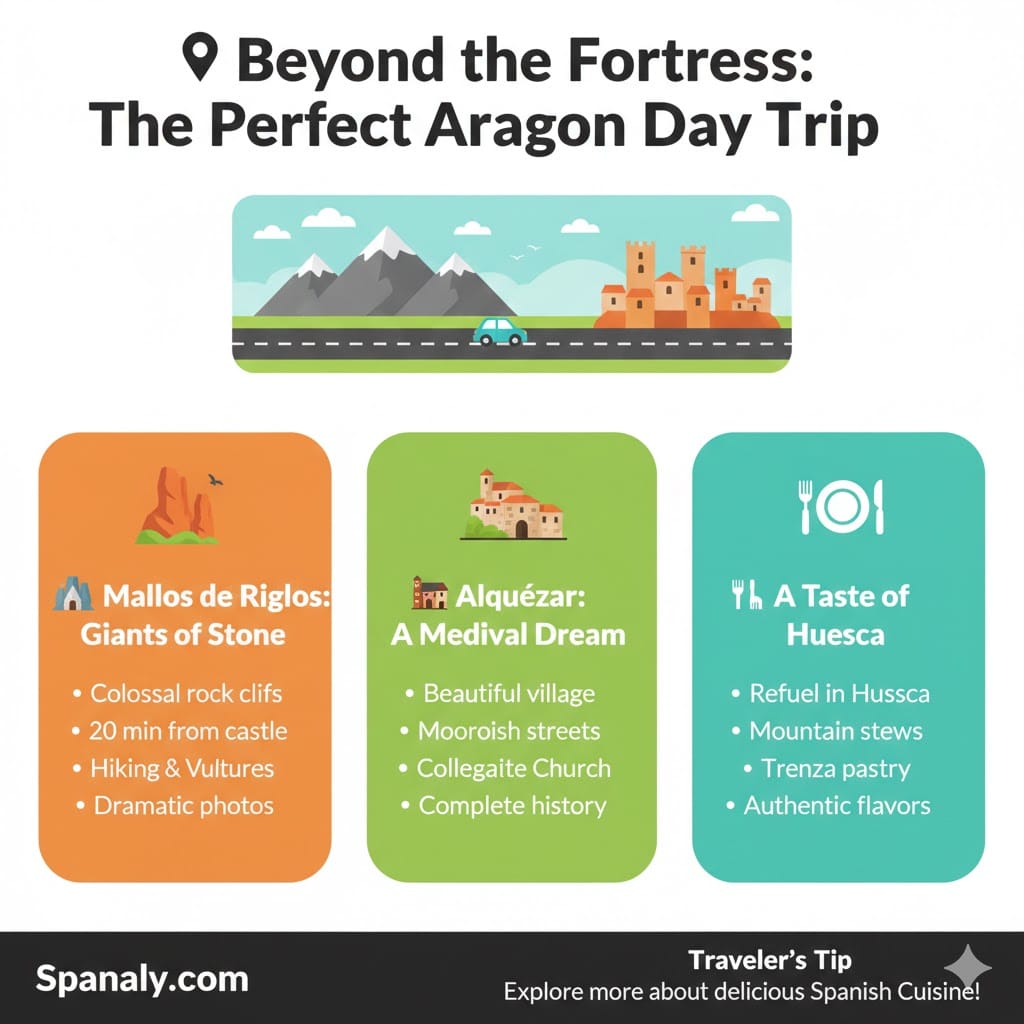
The Castle of Loarre is the crown jewel, but the surrounding region of Hoya de Huesca is packed with hidden gems that deserve a spot on your itinerary. To truly experience the soul of Aragon, consider these nearby stops:
⛰️ Mallos de Riglos: The Giants of Stone
Just a 20-minute drive from the castle, these colossal conglomerate rock formations rise 300 meters into the air. It is a paradise for hikers and birdwatchers (watch out for the massive vultures circling the peaks). The village of Riglos at the foot of the cliffs offers some of the most dramatic photo opportunities in Spain.
🏘️ Alquézar: A Medieval Dream
A bit further away but worth every minute of the drive, Alquézar is often voted one of the most beautiful villages in Spain. Walk its narrow Moorish streets and visit the Collegiate Church of Santa María to complete your medieval journey.
🍴 A Taste of Huesca
No road trip is complete without diving into the local flavors. The nearby city of Huesca is the perfect place to refuel. From hearty mountain stews to delicate pastries like Trenza de Almudévar, the region offers a rustic and authentic culinary experience.
Foodie Guide: If you want to explore more about the rich flavors of the peninsula, from the tapas of the south to the stews of the north, check out our guide to Spanish Cuisine.
📸 Best Time to Visit & Photography Guide

Capturing the majesty of the Castle of Loarre requires more than just a good camera; it’s all about the timing and the angles. Because the castle is built from local limestone, its color changes dramatically with the sun’s position.
🕒 When to Capture the Best Light:
The Golden Hour: The absolute best time is 60–90 minutes before sunset. The fortress glows in a deep orange hue, and the shadows accentuate the rugged texture of the Romanesque masonry.
The Morning Mist: If you visit in autumn or winter, arrive early. Seeing the towers of Loarre poking through a sea of low-lying clouds over the Hoya de Huesca is a bucket-list shot.
Spring Blooms: Visiting in April or May adds vibrant green fields and wildflowers to your foreground, creating a beautiful contrast with the ancient stone.
🔭 Top Angles for Your Gallery:
The Outer Wall Approach: Take a shot from the winding road leading up to the castle to capture its full scale against the mountains.
The Queen’s Tower Window: Frame the vast plains of Aragon through one of the arched Romanesque windows for a “time-travel” perspective.
The Church Dome: Look straight up inside the Church of San Pedro; the symmetry of the Romanesque dome is a masterpiece of medieval geometry.
Photography Tip: Loarre is undoubtedly one of the most photogenic Spanish Attractions, but remember that drones are generally restricted to protect the historical site and the local birdlife.
🔍 The Secrets in the Stone: Medieval Mason Marks
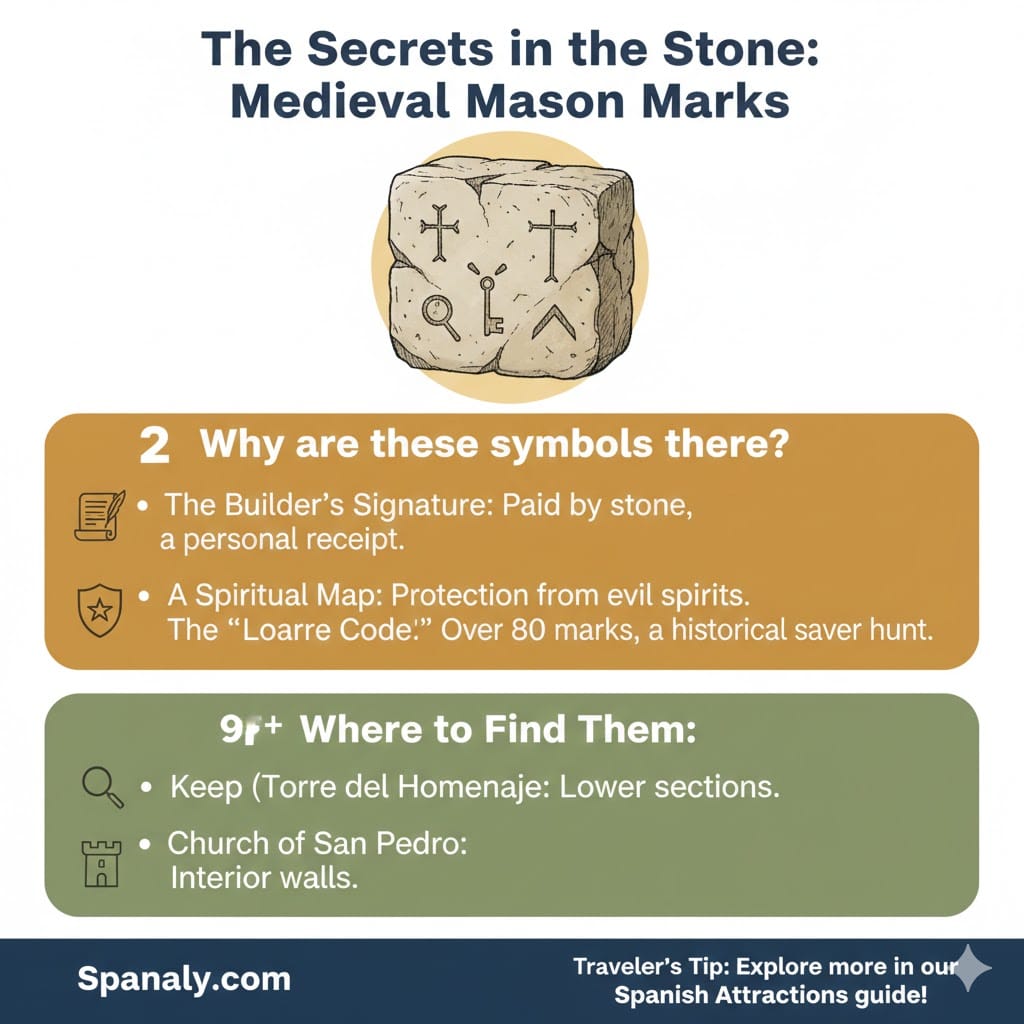
One of the most fascinating aspects of the Castle of Loarre is hidden in plain sight. If you look closely at the limestone blocks forming the walls, you will notice strange, engraved symbols: crosses, keys, arrows, and geometric shapes. These are the Mason Marks.
🧩 Why are these symbols there?
The Builder’s Signature: In the 11th century, master stonemasons were paid by the number of stones they carved. These marks were their personal “receipts” to ensure they received their fair wages.
A Spiritual Map: Some historians believe certain symbols were placed strategically to “protect” the fortress from evil spirits, blending military function with medieval superstition.
The “Loarre Code”: There are over 80 different types of marks throughout the castle. Finding them is like a historical scavenger hunt that reveals the individual hands that built this masterpiece over 900 years ago.
🕵️ Where to Find Them:
Check the lower sections of the Keep (Torre del Homenaje).
Look at the interior walls of the Church of San Pedro, where the craftsmanship was most refined.
Deep Dive: Just as these stones tell a story of ancient craftsmanship, the diverse regions of Spain each have their own “signatures.” For another layer of discovery, explore the cultural landmarks in our Spanish Attractions guide.
🏰 Visitor FAQs – Castle of Loarre Guide 2026
🎬 Was the Castle of Loarre featured in Hollywood movies?
Absolutely! Its iconic silhouette served as the primary set for Ridley Scott’s epic "Kingdom of Heaven". Today, it remains the most remarkably preserved Romanesque fortress in Europe, offering a truly cinematic atmosphere.
🚗 Is it possible to visit the castle without a car?
It is challenging. Given its remote location in the Aragonese foothills, renting a car is highly recommended. While taxis are available from Ayerbe, a private vehicle offers the best way to navigate the scenic roads of Hoya de Huesca.
⏳ How much time do I need for a full tour?
Plan for approximately 1.5 to 2 hours. This allows enough time to explore the royal chapel, the military towers, and the crypts. Photography enthusiasts should add 30 minutes to capture the breathtaking vistas over the plains.
♿ Is the fortress accessible for travelers with limited mobility?
Accessibility is limited. Due to its 11th-century architecture, the castle features steep stairs and uneven stone paths. However, the modern Visitor Center is fully accessible and provides stunning external views of the walls.
👨👩👧 Is the castle suitable for families with children?
Yes, but stay alert. Children find the medieval setting magical, but constant supervision is necessary due to steep drops. We strongly advise wearing sturdy footwear as the ancient limestone can be slippery.
Aragon Medieval Guide by Spanaly.com
🏰 A Journey into Medieval Aragon
The Castle of Loarre is more than just a fortress; it is a time machine built of limestone and legend. Standing on its ramparts, looking out over the vast plains of Aragon, you don’t just see history—you feel it.
Why Loarre Stays With You:
The Silence: Broken only by the wind and the shadows of vultures.
The Stones: Each one carrying a secret mark from a thousand years ago.
The Spirit: A rare chance to visit a place that remains truly wild and authentic.
Whether you are a fan of cinematic history, an architecture enthusiast, or a traveler seeking the road less traveled, this Romanesque masterpiece is a destination that delivers on every promise.
Spain is waiting. The fortress is ready. Are you?