Table of Contents
Toggle👑 Royal Palace of Aranjuez
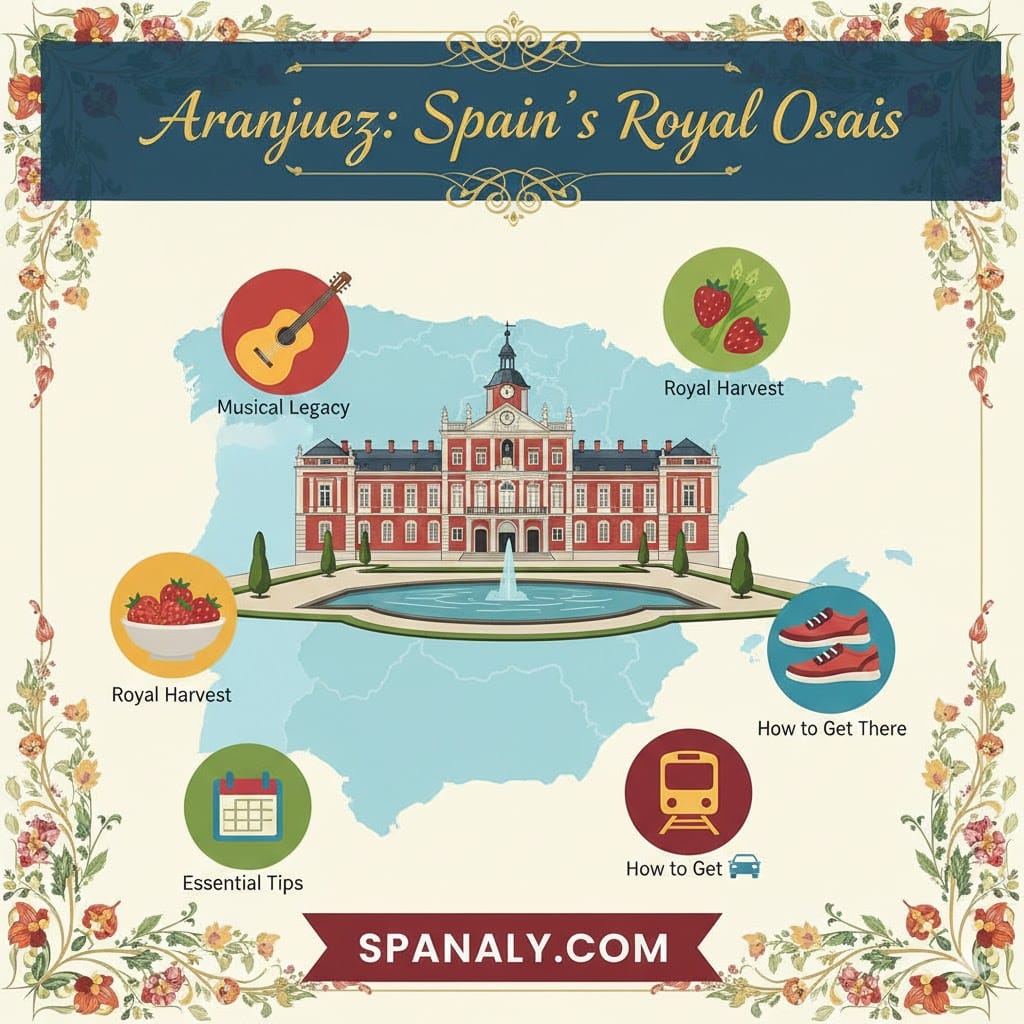
The Royal Palace of Aranjuez (Palacio Real de Aranjuez) stands as one of Spain’s most breathtaking royal residences, where history, art, and nature converge seamlessly. This architectural masterpiece sits in the heart of Aranjuez town, just 50 km south of Madrid along the fertile banks of the Tagus River. Visitors often find this palace offers a more intimate glimpse into Spain’s royal heritage than the grand Royal Palace of Madrid, thanks to its elegant design and legendary sprawling gardens.
📍 Prime Location: Nestled along the Tagus River, offering a refreshing microclimate.
🏛️ Architectural Gem: A stunning blend of red brick and white limestone.
🌿 Nature’s Canvas: Famous for its UNESCO-listed cultural landscapes and gardens.
📜 Royal Heritage: The preferred spring and summer retreat for Spanish monarchs for centuries.
Consequently, exploring this site feels like walking through a living painting. Whether you admire the intricate interiors or stroll through the shaded avenues, Aranjuez promises a regal escape from the city’s hustle.
🌟 Spanaly Insight: To experience Aranjuez like a true local, try to visit during the “Fiestas del Motín” in September. This historical reenactment brings the palace’s 1808 history to life with period costumes and drama, making your visit far more immersive than a standard tour!
⚔️ The Royal Duel: Madrid vs. Aranjuez

Understanding the difference between these two icons is essential for any traveler. While the Royal Palace of Madrid represents the political heart and monumental power of the Spanish Empire, Aranjuez serves as its serene, soul-soothing counterpart.
🏛️ Atmosphere: Madrid is grand and ceremonial; Aranjuez is intimate and romantic.
🌿 Landscape: Madrid dominates the city skyline; Aranjuez melts into the lush Tagus riverside.
🎨 Artistic Focus: Madrid highlights gold and marble; Aranjuez celebrates porcelain, nature, and light.
👑 Purpose: Kings ruled in Madrid, but they lived and breathed in Aranjuez.
Consequently, while Madrid inspires awe, Aranjuez inspires peace. Visiting both allows you to see the full spectrum of Spanish royal life, shifting from the throne room’s gravity to the garden’s melody.
🌟 Spanaly Insight: Think of Aranjuez as the “Spanish Versailles.” If you have to choose, visit Madrid for the history of the crown, but choose Aranjuez for the history of the family. The Porcelain Room here is far more intricate and mesmerizing than its counterpart in Madrid—don’t miss the details on the walls!
🛡️ History & The Legend of the Porcelain Room

The roots of the Royal Palace of Aranjuez reach back to the 16th century when Philip II envisioned a riverside sanctuary. While the King focused on building the monumental El Escorial as a symbol of faith, he chose Aranjuez as a symbol of spring and relaxation. Over the decades, the palace evolved, reaching its artistic zenith in the 18th century under Charles III.
👑 A Royal Vision: Philip II selected this specific location for its unique microclimate, created by the meeting of the Tagus and Jarama rivers.
💎 Porcelain Perfection: The Porcelain Room stands as the palace’s crown jewel. Unlike many royal sites, every inch of its walls is covered in exquisite tiles from the Buen Retiro factory.
🎨 Artistic Rivalry: This room reflects a level of detail that rivals even the intricate Moorish tiles found in the Alhambra in Granada, showcasing Spain’s shift toward European Chinoiserie styles.
📜 Global Heritage: Consequently, UNESCO declared the entire area a World Heritage site in 2001, recognizing it as a masterpiece of human landscape design.
The palace interiors breathe luxury, shifting from velvet-lined throne rooms to the delicate ceramics of the private cabinets. In fact, the tranquility here offers a stark contrast to the bustling energy of the Puerta del Sol in nearby Madrid.
🌟 Spanaly Insight: If you are a fan of interior design, pay attention to the floor of the Porcelain Room. It was specifically designed to be easily cleaned after royal banquets, yet it looks like a continuous silk carpet. This is where 18th-century “smart design” meets royal opulence—a rare combination for that era!
🏛️ Architecture & Interior Highlights

The Royal Palace of Aranjuez stands as a visual symphony of red brick and white limestone, a style that became the blueprint for Spanish royal architecture. While the exterior exudes a balanced, symmetrical grace, the interior unfolds into a labyrinth of 18th-century luxury and artistic treasures.
🧱 The Hapsburg Facade: The iconic red-and-white exterior reflects the classic Hapsburg style, similar to the traditional structures found in the Plaza Mayor in Madrid.
⛪ The Royal Chapel: Architecture enthusiasts shouldn’t miss the chapel, which features soaring Renaissance ceilings and intricate gold leaf detailing that rivals the Almudena Cathedral.
👑 The Throne Room: Designed for majesty, this hall is draped in red velvet and crystal chandeliers, serving as a reminder of the monarchs’ ceremonial duties.
🏺 Private Chambers: Beyond the grand halls, the palace houses an impressive collection of 18th-century furniture, Flemish tapestries, and antique musical instruments.
Consequently, walking through these halls feels like a journey through Spain’s shifting tastes, from the rigid Renaissance to the playful Baroque. It is an essential stop for anyone wishing to understand the evolution of Spanish royalty beyond the bustling streets of Gran Via.
🌟 Spanaly Insight: Keep an eye out for the “Gabinete Árabe” (Arab Room). It was inspired by the Hall of the Two Sisters in the Alhambra. While the Porcelain Room is the most famous, this Neo-Moorish smoking room is a hidden masterpiece of plasterwork and vibrant colors that often surprises visitors with its exotic beauty!
🚤 The Museum of Royal Barges (Museo de Falúas Reales)
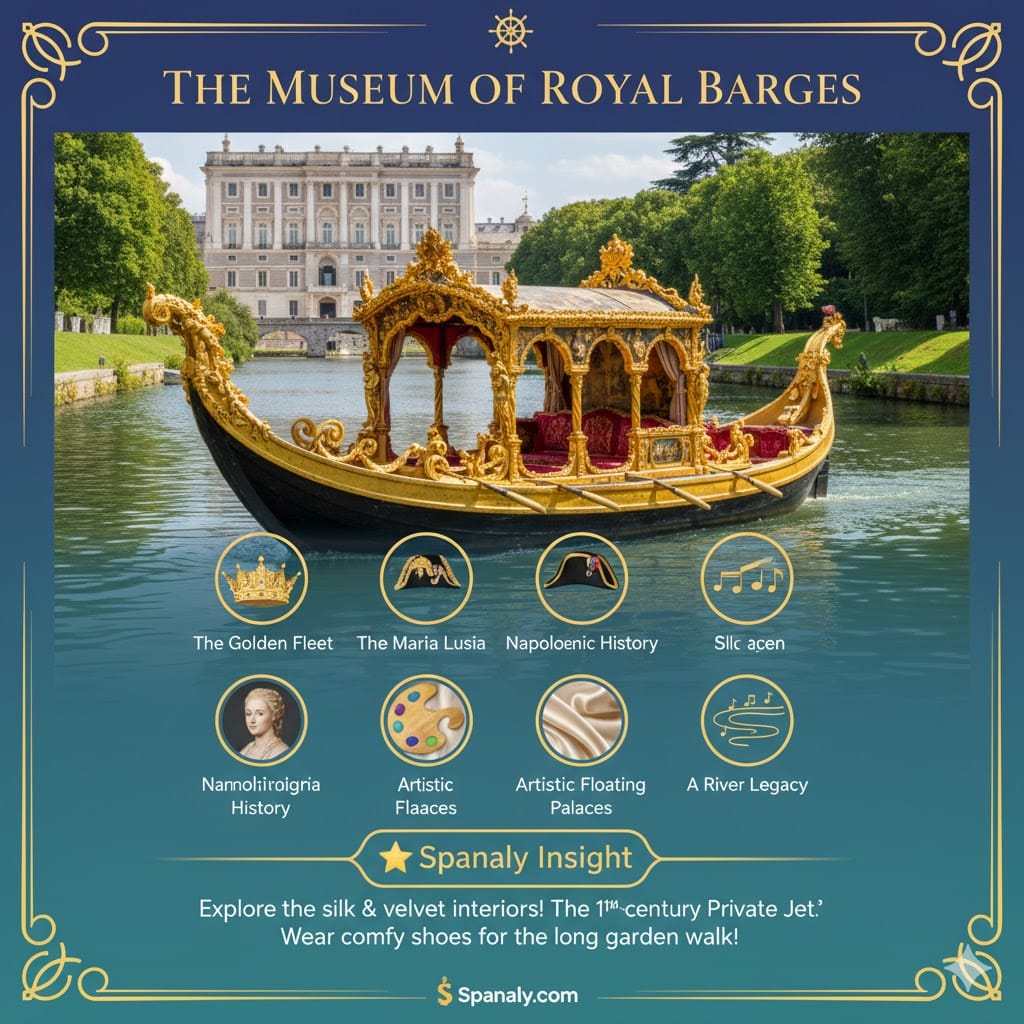
Nestled within the lush Prince’s Garden sits a unique treasure: the Museum of Royal Barges. This facility houses the spectacular fleet of ceremonial and recreational boats used by the Spanish monarchy. While the Alcazar in Seville provides an unparalleled look into Mudejar royal architecture, this collection reveals how the court turned the Tagus River into a floating stage for music and festivities.
✨ The Golden Fleet: The collection displays magnificent “Falúas” (barges), including the gold-leafed vessel of King Charles IV. It shines with intricate carvings and royal emblems.
👑 Napoleonic History: One of the most famous pieces remains the barge belonging to Queen Maria Luisa, which remarkably survived the turbulent times of the Peninsular War.
🎨 Artistic Floating Palaces: These vessels function as art, featuring silk upholstery, delicate paintings, and masterful baroque craftsmanship.
🌊 A River Legacy: Historically, these boats allowed the monarchy to enjoy private concerts and banquets while drifting along the scenic riverside.
Consequently, exploring this museum shifts the perspective from state power to private recreation. It stands as a vital cultural stop, much like exploring the masterpieces within the Golden Triangle of Art in Madrid, offering a slower and more poetic glimpse into Spain’s past.
🌟 Spanaly Insight: Focus on the interiors of the cabin sections! You can still observe the original silk and velvet decorations used by the royals. It represents the 18th-century equivalent of a “Royal Private Jet.” Also, since the walk from the Palace to this museum through the Jardín del Príncipe takes time, ensure you pack light and follow our essential Spain travel tips to manage your energy levels effectively!
🌳 The Gardens of Aranjuez: A Symphony of Nature
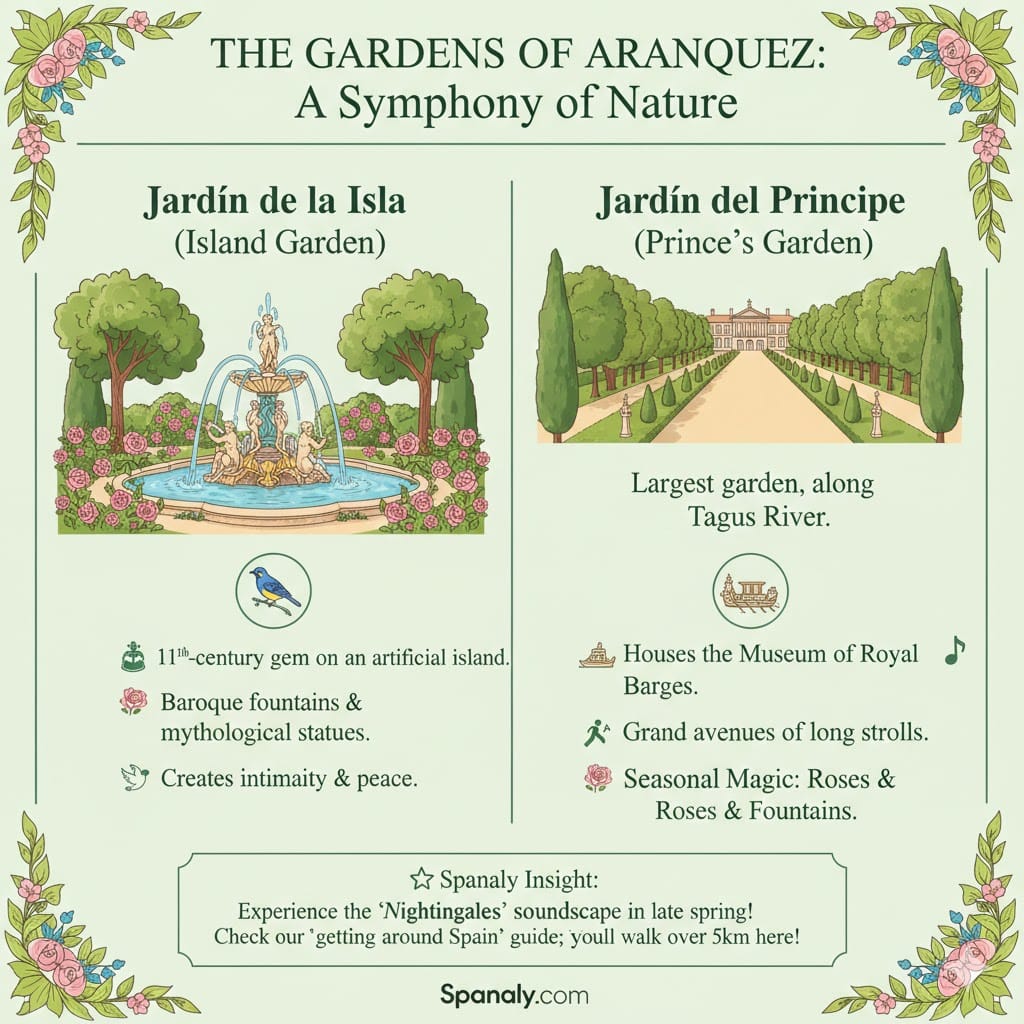
Surrounding the palace are meticulously designed gardens that reflect the Spanish tradition of integrating architecture with the natural world. These landscapes are so poetic that they inspired Joaquín Rodrigo’s world-famous Concierto de Aranjuez. While the Retiro Park in Madrid offers a central urban escape, the gardens here provide a more vast and romantic riverside experience.
🏝️ Jardín de la Isla (Island Garden): Located on an artificial island, this 18th-century gem features Baroque fountains and statues of mythological figures. It creates an atmosphere of intimacy and peace.
👑 Jardín del Príncipe (Prince’s Garden): The largest of the gardens, stretching along the Tagus River. It houses the Museum of Royal Barges and features grand tree-lined avenues perfect for long strolls.
🎭 The Casa del Labrador: Tucked away in the Prince’s Garden, this neoclassical “farmhouse” is actually a luxurious mini-palace filled with silk and marble.
🍃 Seasonal Magic: During spring, the scent of roses and the sound of fountains rival the floral beauty of the Maria Luisa Park in Seville.
Consequently, these gardens are not just an addition to the palace; they are the heart of the Aranjuez experience. They offer a unique microclimate that stays cool even during the peak of summer, making it a perfect refuge for nature lovers.
🌟 Spanaly Insight: If you are visiting in late spring, look for the “Nightingales” in the Jardín de la Isla. Their singing, combined with the splashing water of the fountains, is the exact soundscape that inspired Spanish classical music. To fully appreciate the vastness of these gardens, consider checking our getting around Spain guide to plan enough time for your trip, as you will likely walk more than 5 kilometers!
🍓 The Strawberry Train (Tren de la Fresa): A Journey Back in Time

Traveling to Aranjuez can be more than just a commute; it can be a historical reenactment. The Tren de la Fresa (Strawberry Train) has been running since 1851, marking the second railway line ever built in Spain. This seasonal vintage train offers a romantic escape, transporting you from Madrid to the palace gates just as the 19th-century elite once traveled.
🚂 Vintage Railcars: Passengers ride in meticulously restored wooden coaches, some dating back to the 1920s.
🎭 Living History: Actors dressed in period costumes interact with travelers, sharing stories of the royal court’s journey.
🍓 A Sweet Tradition: During the trip, hostesses serve the famous Aranjuez strawberries, a local delicacy celebrated across the country.
📅 Seasonal Availability: This unique experience typically runs during spring (April–June) and autumn (September–October) to match the harvest seasons.
Consequently, choosing this train turns a simple day trip into a full cultural immersion. While the modern public transport in Barcelona focuses on speed, the Strawberry Train focuses on the elegance of slow travel.
🌟 Spanaly Insight: Tickets for the Strawberry Train usually include the palace entrance and a guided tour of the gardens, which can save you money! However, these seats sell out weeks in advance. If you miss out, don’t worry—the standard C3 Cercanías train is a reliable alternative, and you can still buy fresh strawberries from the street vendors near the station!
🎨 Aranjuez in Culture: The Sound of the Tagus

Aranjuez is not merely a collection of stones and statues; it is a living muse that has whispered into the ears of history’s greatest artists. The most profound legacy of this royal site isn’t found in a crown, but in the strings of a guitar. Joaquín Rodrigo’s “Concierto de Aranjuez” made this palace immortal, capturing the fragrance of its magnolias and the rhythmic splashing of its fountains in a melody recognized worldwide.
🎸 A Musical Icon: The Concierto de Aranjuez is the most performed Spanish classical work in history. It translates the palace’s unique “microclimate” into a sensory auditory experience.
🎬 Cinematic Backdrop: Because of its perfectly preserved 18th-century aesthetics, the palace and its gardens have served as filming locations for numerous international productions, rivaling the cinematic charm of the Gothic Quarter in Barcelona.
✍️ Literary Inspiration: Poets and writers have long sought refuge here, finding the “tranquility that inspires peace” a stark contrast to the intellectual fervor of the Reina Sofia Museum circles.
🎭 Seasonal Festivals: Every year, the city celebrates its cultural roots through traditional performances that bring the “Royal Duel” era back to life for modern audiences.
Consequently, Aranjuez serves as a bridge between the physical grandeur of the monarchy and the spiritual depth of Spanish art. It reminds us that while kings build palaces, artists give them a soul that lasts forever.
🌟 Spanaly Insight: For a truly magical experience, try to attend a classical guitar concert held within the palace grounds during the summer months. Hearing the Concierto de Aranjuez in the very gardens that inspired it is a “bucket list” moment. It’s a completely different vibe compared to the high-energy Primavera Sound in Barcelona, offering a moment of pure, historical reflection.
🍴 Aranjuez Gastronomy: The Royal Harvest

Aranjuez is often called the “Orchard of the King” (La Huerta de Aranjuez). The same fertile soil that feeds the palace gardens also produces some of Spain’s most celebrated ingredients. Dining here is a transition from royal aesthetics to rustic, earthy flavors that have graced royal tables for centuries.
🍓 The Queen of Berries: The Aranjuez strawberry (fresón) is famous for its intense sweetness and aroma. In late spring, you will find it served with cream (fresas con nata) in every local cafe.
🌱 The White Gold: The local asparagus is tender, thick, and world-renowned. It is best enjoyed grilled with a drizzle of virgin olive oil, a staple of traditional Spanish food.
🍲 Game Meat Traditions: Reflecting the palace’s history as a hunting lodge, many traditional restaurants serve pheasant or partridge stews, mirroring the flavors of Catalan cuisine but with a Castilian twist.
🍷 Riverside Dining: Consequently, a meal by the Tagus river is the perfect way to conclude your tour, blending history with a Mediterranean lifestyle.
🌟 Spanaly Insight: If you want an authentic experience, visit the Mercado de Abastos (local market). It’s much smaller than La Boqueria in Barcelona, but it’s where you can buy fresh produce directly from the farmers. Pro tip: Don’t buy strawberries from the first stall you see at the train station; walk into the town center for better prices and fresher picks!
🚀 How to Get to Aranjuez from Madrid

Reaching this royal sanctuary is very simple. It is one of the easiest day trips from the capital. Much like the efficient system for getting around Seville, Madrid’s links to Aranjuez are seamless. You can choose the charm of the rails or the flexibility of the road. Here is how to reach the “Orchard of the King” in 2026.
🚆 The Cercanías Train (Top Choice): Use the C3 Line. You can board at Chamartín, Sol, or Atocha. Trains run every 20 minutes. The journey takes about 45 minutes. It is cheap, green, and stops at a beautiful historic station.
🚌 The Intercity Bus: Take the 423 Bus from Méndez Álvaro station. This is great if you stay in southern Madrid. The ride takes one hour. It often drops you closer to the city center.
🚗 Private Car & Driving: Follow the A-4 motorway South. The 48km drive takes roughly 45 minutes. A car is perfect if you want to visit nearby Chinchón later.
Consequently, the train remains the most authentic way to arrive. You will see the landscape change from urban buildings to lush riverside greenery.
🌟 Spanaly Insight: Take a moment to admire the Aranjuez Railway Station. Its Neo-Mudejar tiles and wood ceilings are stunning. A vital 2026 tip: Your Zone A Transport Pass (Abono) does not cover Aranjuez. You must buy an extension for Zone C3. Always validate your ticket to avoid fines!
📍 The Perfect Day Trip: Aranjuez & Nearby Gems

Planning your visit to Aranjuez requires a smart balance. You must manage your time between opulent palace interiors and sprawling estates. To help you, we designed this ultimate 2026 itinerary. Much like our 3-day Seville itinerary, this plan bridges the gap between royal history and local charm.
🕗 09:00 AM – Departure from Madrid: Start your morning at Atocha Station. Board the C3 Cercanías train for a scenic 45-minute ride. The transition from urban buzz to the royal countryside is very smooth.
🕙 10:00 AM – Royal Immersion: Head straight to the Royal Palace. Starting early helps you beat the tour bus crowds. Do not miss the Porcelain Room. Its artistic complexity rivals the famous Alcazar of Seville.
🕛 12:30 PM – Stroll through the Island Garden: Cross the bridge to Jardín de la Isla. This is the best time for photography. The noon light reflects beautifully off the Baroque fountains.
🍴 02:00 PM – Lunch in the “King’s Orchard”: Secure a table at a riverside terrace. Indulge in local asparagus and strawberries. The freshness of the produce here is legendary across Spain.
🕒 03:30 PM – River History & The Labrador: Visit the Museum of Royal Barges. Then, take a scenic walk to the Casa del Labrador. This mini-palace sits at the edge of the Prince’s Garden.
🌇 05:30 PM – Bonus Stop: Chinchón: If you have a car, drive 20 minutes to Chinchón. Its medieval Plaza Mayor is world-famous. It offers a rustic contrast to grand urban squares like Barcelona’s Plaza de Catalunya.
🌟 Spanaly Insight: If you wish to visit the Casa del Labrador, you must book your slot well in advance. Entry is strictly by guided tour and groups are small. Also, remember that the Museum of Royal Barges (reopened in Feb 2026 after restoration) is included in your main Palace ticket. Do not pay twice! To save energy, use the “Tourist Train” (Chiquitren) that connects the Palace to the far corners of the gardens for a few euros.
💡 Essential Tips for Your Aranjuez Visit

Visiting the Royal Palace of Aranjuez is a journey into the heart of Spanish history. However, to truly enjoy the “Versailles of Spain” without the stress of logistics, a bit of planning is required. Here are our expert tips for a seamless 2026 experience:
🎟️ Smart Ticketing: We highly recommend purchasing tickets online in advance to skip the long queues. For a deeper dive into the royal secrets, a guided tour is indispensable. It provides context you won’t find on plaques, much like a guided walk through the Royal Palace of La Granja.
👟 Footwear is Key: The gardens are vast, covering over 300 hectares. You will likely walk several kilometers, so leave the formal shoes behind. Just as you’d prepare for the hilly streets of the Albaicin in Granada, comfort is your best friend here.
📸 Photography Etiquette: Photos are generally allowed in the gardens and most public halls. However, flash is strictly prohibited to preserve the delicate 18th-century fabrics and artworks.
♿ Accessibility: While the palace has made great strides in accessibility with ramps and elevators, some historic garden paths can be uneven. If you have specific mobility needs, it’s best to consult our Spain travel tips for more general advice on navigating historic sites.
🕙 Timing Your Trip: Spring (April–June) and Autumn (September–October) are the golden windows. During these months, the weather is mild, and the gardens are in full bloom, offering a color palette that rivals the best hidden gems in Madrid.
Consequently, by arriving early and prepared, you’ll avoid the midday crowds and have the gardens almost to yourself, allowing for a much more intimate connection with the site’s royal past.
🌟 Spanaly Insight: Check the official schedule for “Free Entry” days! Usually, on certain afternoons (often Wednesdays or Sundays for EU/Ibero-American citizens), entry is free. However, these days are exceptionally crowded. If you prefer a quiet, contemplative visit to appreciate the Spanish culture at its finest, we suggest paying for a morning slot on a weekday.
👑 Aranjuez 2026: Expert Answers for Your Royal Visit
💰 How much are the entrance fees in 2026?
As of 2026, the standard adult ticket for the Royal Palace of Aranjuez costs €9. Students under 25 and seniors over 65 enjoy a reduced rate of €4. If you want to experience the Casa del Labrador, remember it requires a separate ticket (approx. €5-10) and an advance reservation, as it is only accessible via guided tours.
🛶 Can I take a boat trip on the Tagus River?
Yes! The "Curiosity" Tourist Boat offers 45-minute cruises along the Tagus. It’s a fantastic way to see the gardens from a royal perspective. Much like navigating the canals of Seville, this water tour provides a unique angle of the palace architecture that you can't get on foot.
🆓 When can I enter the palace for free?
In 2026, free admission is available for EU and Ibero-American citizens on Wednesdays and Sundays from 3:00 PM to 6:00 PM (winter) or 7:00 PM (summer). Additionally, the palace opens its doors for free on May 18th (International Museum Day) and October 12th (Spain's National Day).
🚂 Is the Chiquitrén (Tourist Train) worth it?
Absolutely, especially if you have limited time or are traveling with kids. For about €7, this small train takes you through the historic center and deep into the Prince's Garden. It’s a great way to cover the massive 300-hectare grounds without exhausting your legs.
🎒 Are there lockers for my luggage?
The palace provides mandatory lockers for large backpacks, umbrellas, and sharp objects. Small bags are allowed inside but will be screened. If you are arriving from the airport or Atocha with heavy luggage, we recommend using lockers at the train station as the palace facilities have limited space.
2026 Essential Guide by Spanaly.com
🏛️ A Royal Escape Awaits
Aranjuez is more than a destination. It is a sensory journey through Spain’s golden past. From the scent of fresh strawberries to the echoes of classical guitar, every corner tells a story.
✨ Pure Elegance: Experience the seamless blend of French-inspired gardens and Spanish soul.
🍓 Sweet Traditions: Taste the flavors that have graced royal tables for centuries.
🏰 Beyond the Capital: Discover why kings chose this oasis to escape the city’s heat.
⚔️ Artistic Rivalry: See how its architectural beauty stands tall alongside the legendary Alcazar of Seville.
Whether you are a history buff, a nature lover, or a foodie, Aranjuez promises a day you will never forget. Don’t let the 2026 season pass you by—pack your comfortable shoes, book your train ticket, and step into the royal lifestyle!
🌟 Spanaly Insight: The magic of Aranjuez is best felt at sunset. As the light hits the red bricks of the palace, the entire city glows. It’s the perfect moment to reflect on your journey before heading back to the modern world.