
Table of Contents
Toggle🏰 The Moorish Soul of Granada
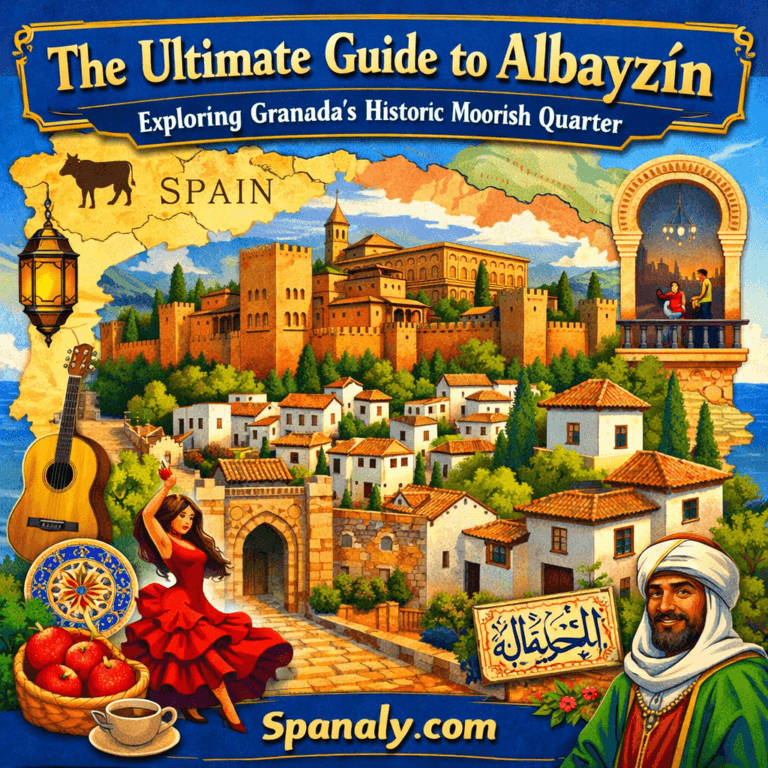
Perched on a hill overlooking the majestic Alhambra, Albayzín (also written Albaicín) is the historic heart of Granada and one of the most atmospheric neighborhoods in all of Spain. This former Moorish quarter preserves the urban fabric of medieval Al-Andalus, featuring winding alleys, whitewashed houses, and hidden courtyards.
As a declared UNESCO World Heritage Site, Albayzín offers visitors a rare chance to walk through centuries of Islamic, Christian, and Andalusian history. It stands as a premier destination among Spanish Attractions, woven into a single living district that captures the essence of the city’s multicultural past. This ultimate guide explores its origins, landmarks, and the secrets of Granada’s most soulful quarter.
📜 Historical Roots: Albayzín's Enduring Legacy
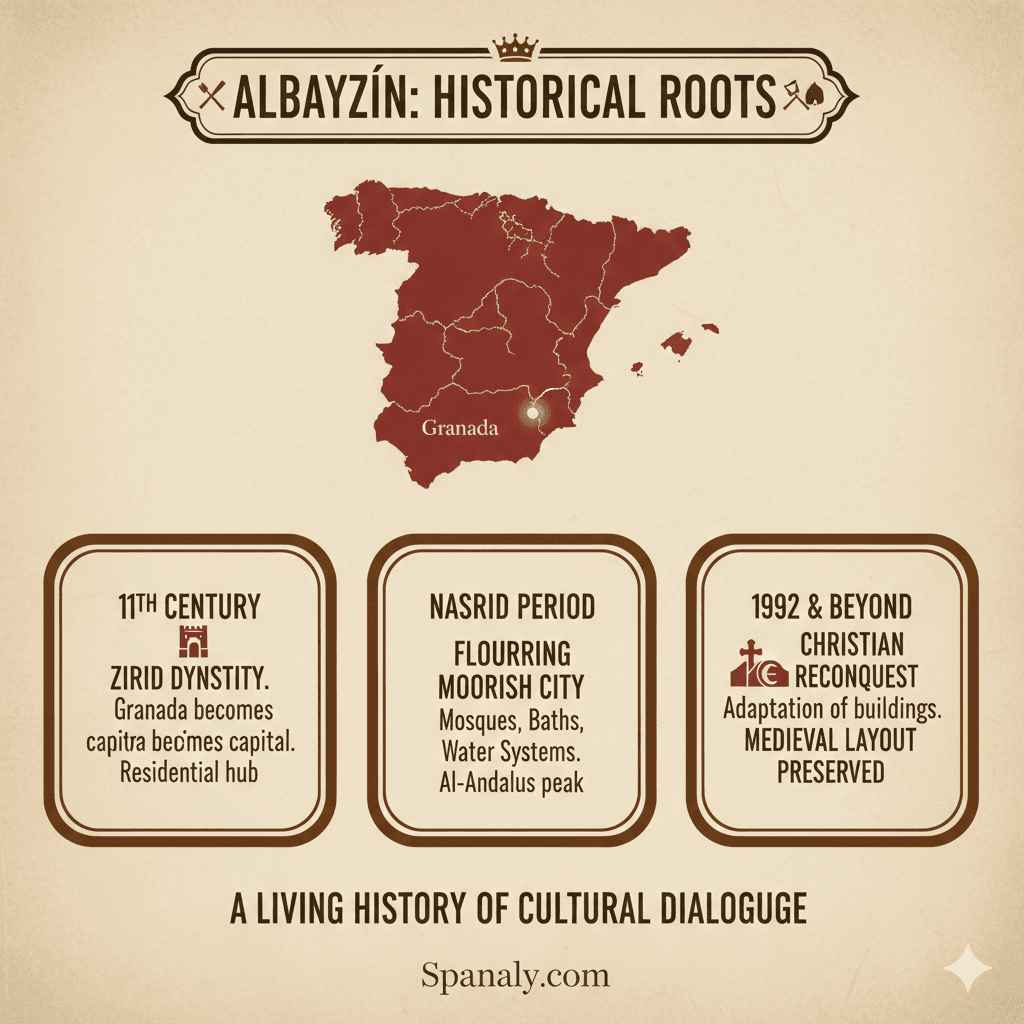
The history of Albayzín is a tapestry woven from centuries of diverse cultures. Its origins trace back to the 11th century, when it emerged as the primary residential hub for the Zirid dynasty after Granada ascended as the region’s capital, succeeding Medina Elvira. During the subsequent Nasrid period, Albayzín truly flourished, evolving into a bustling Moorish city rich with mosques, public baths, and sophisticated water networks—a testament to advanced urban planning in Al-Andalus.
Even after the Christian Reconquest in 1492, when many Islamic structures were transformed into churches and convents, Albayzín miraculously retained its intricate medieval street layout. This remarkable preservation makes it one of Europe’s most intact Islamic urban landscapes, a living museum that mirrors the deep historical layers explored in our Ultimate Seville Travel Guide. It stands as a powerful symbol of Granada’s enduring cultural dialogue and adaptation.
✨ What Makes Albayzín Unique?
Albayzín is not merely a district; it is a sensory experience that stands out among Spanish Attractions. Several distinct features contribute to its unparalleled atmosphere:
Authentic Moorish Urbanism: The labyrinthine layout of narrow, irregular streets was designed to provide shade and defense, creating an intimate world away from the modern city.
The “Carmen” Houses: These traditional dwellings are unique to Granada, featuring high walls that hide lush, private gardens and interior patios—a perfect blend of Islamic and Christian residential styles.
A Landscape of Miradors: The neighborhood is naturally terraced, offering iconic panoramic views of the Alhambra and the snow-capped Sierra Nevada mountains.
Architectural Fusion: Everywhere you look, you see the Mudéjar style—where Islamic craftsmanship meets Christian architecture, much like the artistic diversity found in our Ultimate Madrid Travel Guide.
Living Heritage: Unlike many historic centers, Albayzín remains a vibrant, lived-in community with a strong local identity, traditional bakeries, and deep-rooted customs.
📍 Top Landmarks: The Jewels of Albayzín
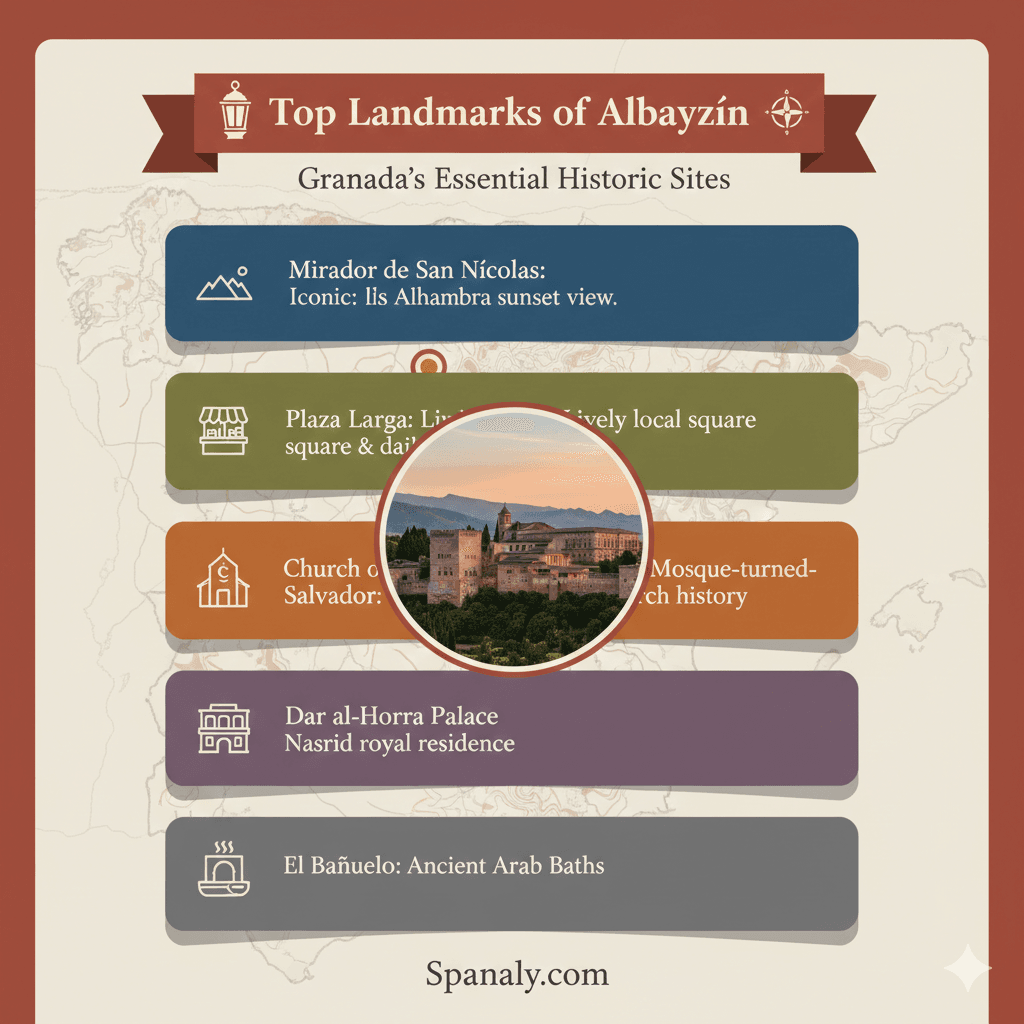
Exploring Albayzín is like walking through a living museum. To truly capture the essence of Granada, these are the essential spots you must visit:
Mirador de San Nicolás: The crown jewel of Granada’s viewpoints. It offers a postcard-perfect view of the Alhambra against the Sierra Nevada. This spot is particularly famous for its sunsets, which are as vibrant as the energy found in Spanish Festivals.
Plaza Larga: This is the beating heart of the district. A lively square filled with local cafés and market stalls where you can experience the authentic daily life of residents.
Church of San Salvador: A fascinating site built directly over the former Great Mosque of Albayzín. It still preserves the original courtyard (Sahn), symbolizing the city’s complex religious transition.
Dar al-Horra Palace: A 15th-century Nasrid palace that was the residence of Sultana Aixa. Its architecture provides a rare look into royal Moorish life, comparable to the historic grandeur seen in our Ultimate Barcelona Travel Guide.
El Bañuelo (Arab Baths): One of the oldest and best-preserved hammams in Spain. These 11th-century baths showcase the sophisticated hygiene and social culture of Al-Andalus.
🕊️ Cultural and Spiritual Significance
Albayzín is far more than just a historic district; it is a profound symbol of Granada’s multicultural identity. Its very stones tell a story of centuries of coexistence and architectural adaptation.
A Tapestry of Faiths: The neighborhood features unique “mosques-turned-churches,” where Christian bell towers often sit atop original Islamic minarets, symbolizing the city’s religious transition.
The Ancient Water Legacy: The district still relies on historic Aljibes (underground cisterns) and ancient water channels (acequias), reflecting the sophisticated engineering of Al-Andalus.
Secretive Courtyards: The whitewashed walls hide secretive interior patios and gardens, illustrating a unique cultural exchange between Islamic privacy and Christian botanical traditions.
The Soul of the Art: While the physical layout is Islamic, the neighborhood’s spirit is fueled by the echoes of Flamenco from nearby Sacromonte. This fusion makes it a cornerstone of Spanish Festivals and vibrant cultural celebrations.
👟 Visitor Tips for Exploring Albayzín
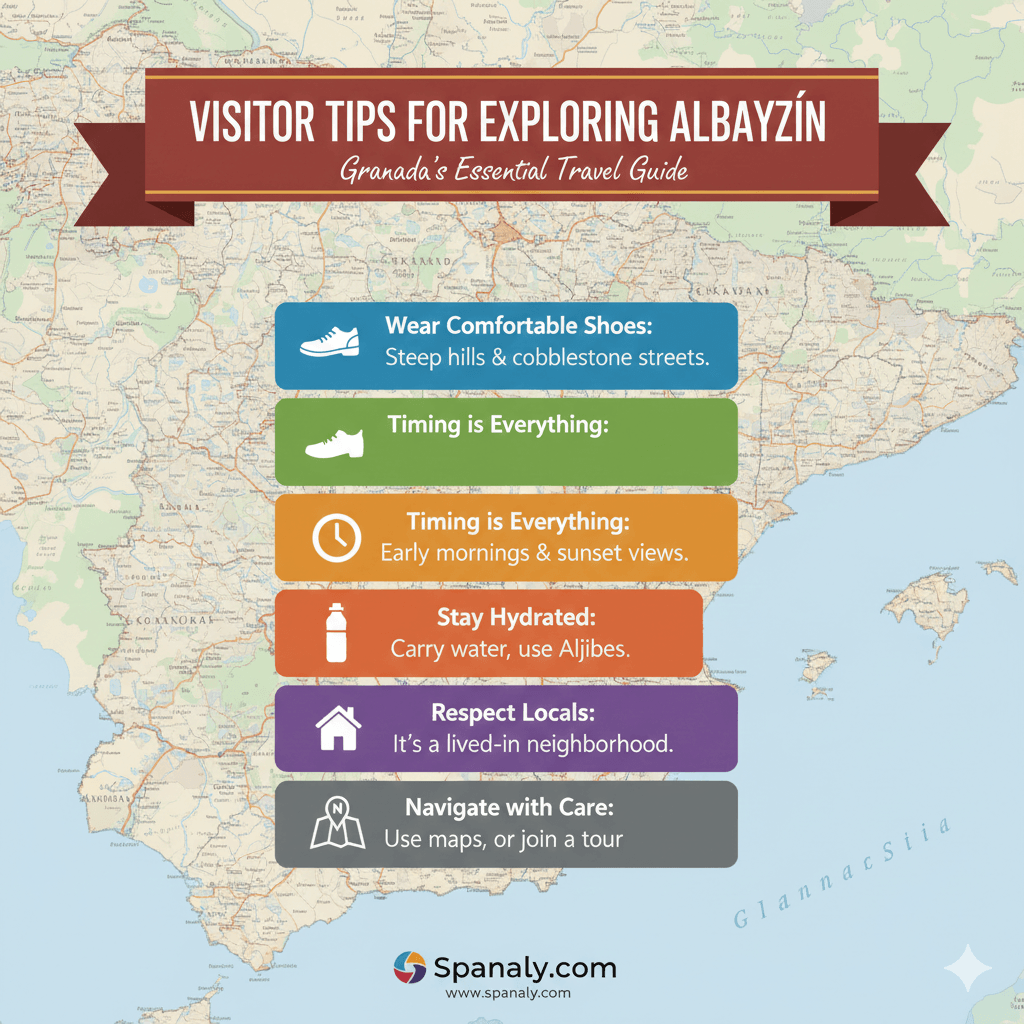
To make the most of your journey through these historic slopes, keep these practical tips in mind:
Wear Comfortable Footwear: The streets are steep and paved with traditional cobblestones (empedrado granadino). Avoid heels and choose shoes with a good grip.
Timing is Everything: Visit in the early morning to enjoy the silence, or late afternoon to witness the legendary sunset from the Mirador.
Stay Hydrated: You will find several historic public fountains (Aljibes), but it is always wise to carry a water bottle during the uphill climb.
Respect the Local Rhythm: Remember that Albayzín is a lived-in neighborhood. Keep noise levels down, especially in the narrow residential alleys.
Navigate with Care: Google Maps can sometimes get confused in the labyrinth. Look for the tiled street signs or join a guided tour to discover hidden gems you might otherwise miss.
📅 Best Time to Visit Albayzín
The atmosphere of the district changes beautifully with the seasons:
🌸 Spring (March to May): Ideally the best time. The gardens (Cármenes) are in full bloom, and the scent of jasmine fills the air.
🍂 Autumn (September to November): Offers mild temperatures and the most spectacular golden light for photography.
❄️ Winter (December to February): The air is crisp and clear, providing the sharpest views of the snow-capped Sierra Nevada behind the Alhambra.
☀️ Summer (June to August): Can be very hot during the day. We recommend exploring only after sunset when the neighborhood comes alive with cool breezes.
📸 Photography Tips: Capturing the Soul of Albayzín
Albayzín is a paradise for photographers seeking contrast, texture, and the “Golden Hour” glow. To get the best shots:
Focus on the Details: Look for intricate ironwork, colorful Andalusian tiles, and the weathered wooden doors of the Cármenes.
Play with Light: The narrow alleys create dramatic shadows and light pockets. Early morning provides a soft, ethereal glow on the white walls.
The “Million Dollar” View: For the classic shot of the Alhambra with the Sierra Nevada, head to Mirador de San Nicolás just before sunset.
Frame Your Subject: Use the arches and narrow street openings to frame the Alhambra in the distance for a more professional composition.
🌟 Why Albayzín is Essential to Your Visit
Without exploring Albayzín, your understanding of Granada remains incomplete. This district provides the necessary context to the city’s royal past through several key perspectives:
The Human Scale of History: While the Alhambra represents royal grandeur, Albayzín reveals the intimate, everyday side of Moorish civilization—how people lived, traded, and prayed.
A Living Museum: Walking these streets isn’t just a tour; it’s an immersion into a district where history is shared through centuries of cultural dialogue and architectural evolution.
The Perfect Complement: It serves as the architectural and spiritual mirror to the Alhambra, offering the best vantage points to truly appreciate the Red Castle’s scale.
Authentic Andalusian Soul: It remains one of the few places where you can feel the true essence of ancient Al-Andalus, making it a highlight among Spanish Attractions.
🏰 Visitor FAQs – Albayzín District Granada 2026
🚶♂️ Is the walk up to Albayzín very difficult?
The walk is steep and paved with cobblestones, which can be challenging. For a more comfortable experience, we recommend taking the C31 or C32 minibus from Plaza Nueva to the top (San Nicolás) and then walking downhill to explore the alleys, as this is much easier on the legs.
📸 When is the best time for the Alhambra sunset view?
The "Golden Hour" at Mirador de San Nicolás is legendary. In 2026, it remains the most popular spot. To secure a good position for photography, arrive at least 45 minutes before sunset. If you prefer quiet, the sunrise offers a crystal-clear view of the Sierra Nevada mountains with far fewer crowds.
🕌 What is a "Carmen" and can I visit one?
A Carmen is a traditional Granada villa with a walled garden. While many are private residences, some are open to the public as museums or restaurants. The Fundación Rodríguez-Acosta and the Carmen de los Mártires (near Alhambra) are excellent examples where you can see this unique Moorish-Christian garden fusion.
🎟️ Do I need the "Dobla de Oro" ticket?
Yes, if you love history. The Dobla de Oro is a combined ticket that includes the Alhambra and key sites in Albayzín like El Bañuelo and Dar al-Horra Palace. It is cheaper than buying individual entries and provides a complete narrative of Granada’s Islamic and Christian transition.
🍽️ Where can I find authentic local food in the district?
For an authentic vibe, head to Plaza Larga. It’s where locals buy bread and tapas. For a more "Moroccan" experience, the tea houses (Teterías) on Calle Calderería Nueva offer incredible mint tea and Arabic pastries, making you feel as if you've crossed the sea to Tangier.
Granada Travel Guide by Spanaly.com
Albayzín stands as one of Spain’s most evocative historic quarters, where history lives in the rhythms of daily life. For travelers seeking authenticity, depth, and timeless beauty, exploring this Moorish soul is an unforgettable journey. It is a vital chapter in any Spanish Attractions itinerary and a highlight of our Ultimate Seville Travel Guide comparisons.