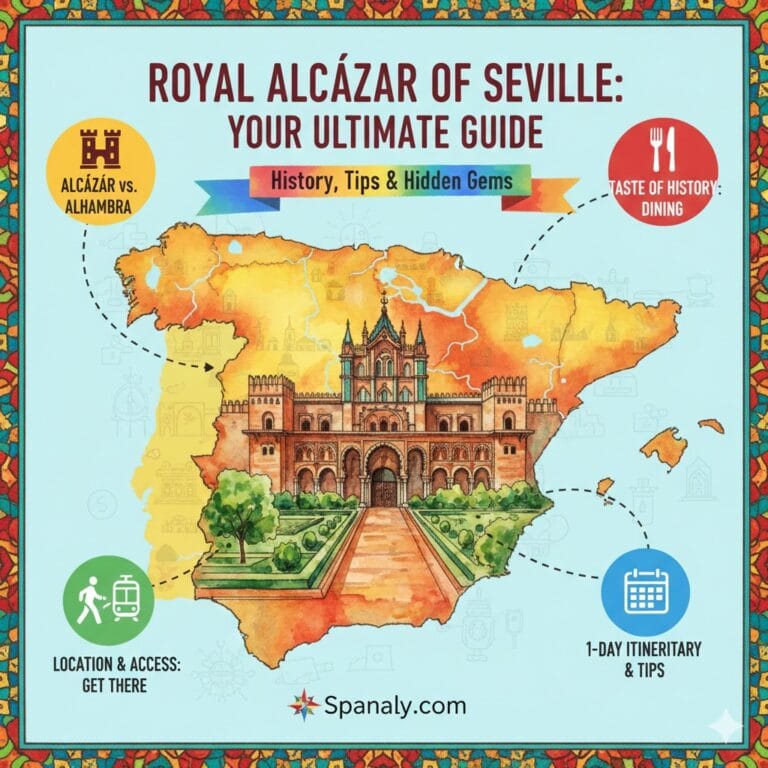

Table of Contents
Toggle🏰 A Royal Gateway to History
Seville’s Royal Alcázar is not merely a monument; it is a breathtaking dialogue between stone and spirit. Notably, as the oldest royal palace still in use in Europe, it stands as a living masterpiece of Andalusian heritage. Specifically, it is a place where the intricate carvings of Islamic artisans meet the grand ambitions of Christian kings.
👑 Royal Legacy: It remains an active residence for the Spanish Royal Family, blending ancient history with modern monarchy.
✨ Mudéjar Genius: The palace showcases the pinnacle of Mudéjar art, featuring mesmerizing symmetry and delicate plasterwork.
🌿 Garden Paradise: Every corner smells of blooming jasmine, leading you to legendary gardens that inspired poets and filmmakers alike.
🏛️ UNESCO Wonder: As a World Heritage site, it captures the heartbeat of the Ultimate Seville Travel Guide experience.
Ultimately, walking through its halls is like leafing through a centuries-old manuscript. Indeed, whether you are a history seeker or an architecture enthusiast, the Alcázar is the beating heart of Seville. Specifically, to make your Spanish journey seamless, you can explore our insights on the Ultimate Madrid Travel Guide to compare these royal legacies.
💡 Spanaly Insight: Many visitors rush through the entrance, but the true magic starts at the Puerta del León. In fact, the red walls here still hold the sturdy military soul of the original 10th-century fortress before it transformed into a delicate palace!
📜 History of the Alcázar: A Tapestry of Eras

The story of the Royal Alcázar is one of continuous transformation. Notably, it did not emerge as a palace all at once. Specifically, it grew like a living organism through three distinct and powerful chapters:
🏰 The Fortress of the Caliphs (10th – 12th Century): It all began in 913 AD. The first Umayyad Caliph, Abd-ar-Rahman III, ordered a fortress (Al-Qasr) on Roman ruins. In fact, it served as a strategic powerhouse guarding the Guadalquivir River.
⚔️ The Christian Reconquista (13th – 14th Century): Seville fell to King Ferdinand III in 1248. Consequently, the fortress became a royal residence. The most defining change occurred under King Pedro I, also known as “Peter the Cruel.”
✨ The Mudéjar Revolution: King Pedro obsessed over Islamic aesthetics. Specifically, he hired the finest artisans from Granada and Toledo to build his palace. This created a unique cultural fusion where Arabic inscriptions praise a Christian king.
👑 Renaissance & Modern Era: During Spain’s Golden Age, emperors like Charles V added grand halls. Ultimately, these additions blended European elegance with Andalusian tradition. Today, it remains the oldest royal palace in Europe still in active use.
Indeed, if you want to see a similar blend of history and power, check out our guide to the Royal Palace of Madrid. Specifically, both sites represent the living legacy of the Spanish Monarchy.
💡 Did you know? Look closely at the Ambassadors’ Hall. You will see the phrase “Only God is Victorious” (Wa la ghaliba illa Allah). Notably, this is the same motto found in the Alhambra of Granada, proving the deep respect Christian kings had for Moorish art.
✨ The Mudéjar Heart: The Palace of Pedro I

The Palacio de Don Pedro stands as the undisputed crown jewel of the complex. Notably, King Pedro I commissioned this masterpiece in the 1360s. It represents the ultimate peak of Mudéjar architecture on the Iberian Peninsula. Specifically, it honors a unique era where Islamic and Christian cultures created beauty together.
💠 The Geometric Soul: Notice the complex star patterns and floral motifs. In fact, these infinite patterns represent the divine nature in Islamic art.
🎨 Yesería & Azulejos: Master artisans used intricate plasterwork (Yesería) and vibrant tiles (Azulejos) to decorate every wall. Specifically, they turned cold stone into delicate, stone-carved lace.
🐎 The Horseshoe Arch: This iconic Islamic arch defines the palace’s elegance. Consequently, it invites soft natural light into every royal chamber.
👑 A Sultan’s Ambition: King Pedro I admired the Alhambra of Granada deeply. Ultimately, he successfully recreated its mystical beauty right here in Seville.
Indeed, water acts as the “silent architect” in this space. Specifically, still pools reflect the arches to create perfect symmetry. If you love this intricate style, you must also explore the Patios de Córdoba. Notably, there you will find floral beauty meeting traditional Andalusian stone.
💡 Expert Tip: Look closely at the tiles. If you see small raised ridges separating the colors, you are witnessing the Cuerda Seca technique. In fact, this Moorish legacy survived centuries of change!
🏰 Gothic Grandeur & Renaissance Elegance
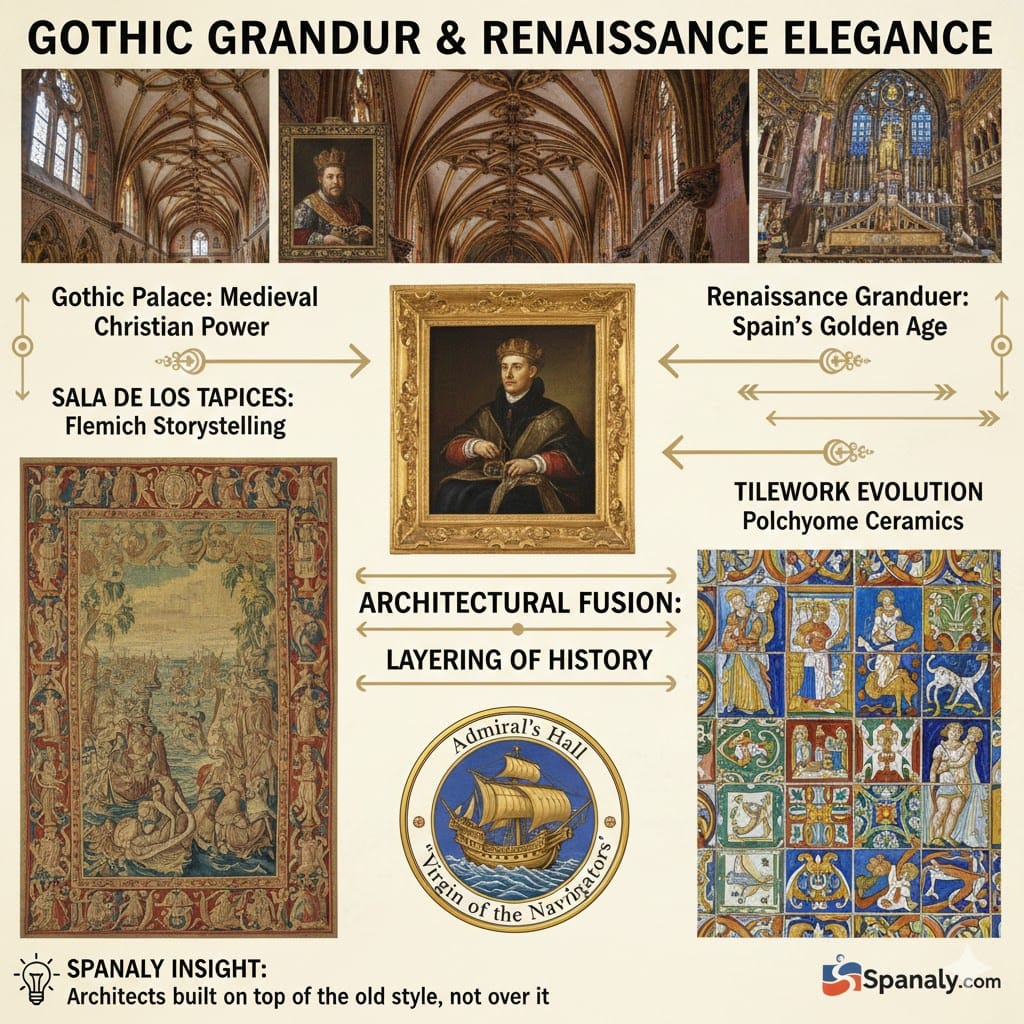
As you move deeper into the complex, the atmosphere shifts dramatically. Notably, the Gothic Palace, built by Alfonso X, offers a striking contrast to the Mudéjar sections. Specifically, its high-vaulted ceilings and grand halls reflect the raw power of medieval Christian monarchs.
🧵 The Sala de los Tapices: This hall houses massive Flemish tapestries. In fact, these artworks depict the conquest of Tunis, showcasing Renaissance storytelling at its peak.
🎨 Tilework Evolution: The Renaissance era introduced “polychrome” tiles. Specifically, these vibrant ceramics replaced geometric patterns with complex human and mythical figures.
🛡️ Grand Altarpieces: Visit the Admiral’s Hall to see the “Virgin of the Navigators.” Ultimately, it honors Spain’s Golden Age and the legendary explorers of the time.
Indeed, this architectural mix mirrors the diversity found in our Ultimate Madrid Travel Guide. Specifically, seeing how different eras blend here helps you understand the true soul of Spain. If you enjoy monumental history, don’t miss the Seville Cathedral right next door.
💡 Spanaly Insight: Notice the transition from the Mudéjar arches to the Gothic vaults. In fact, architects didn’t destroy the old style; they built right on top of it. This “layering” is the secret to the Alcázar’s unique charm!
🏛️ The Iconic Courtyards: The Heart of the Palace
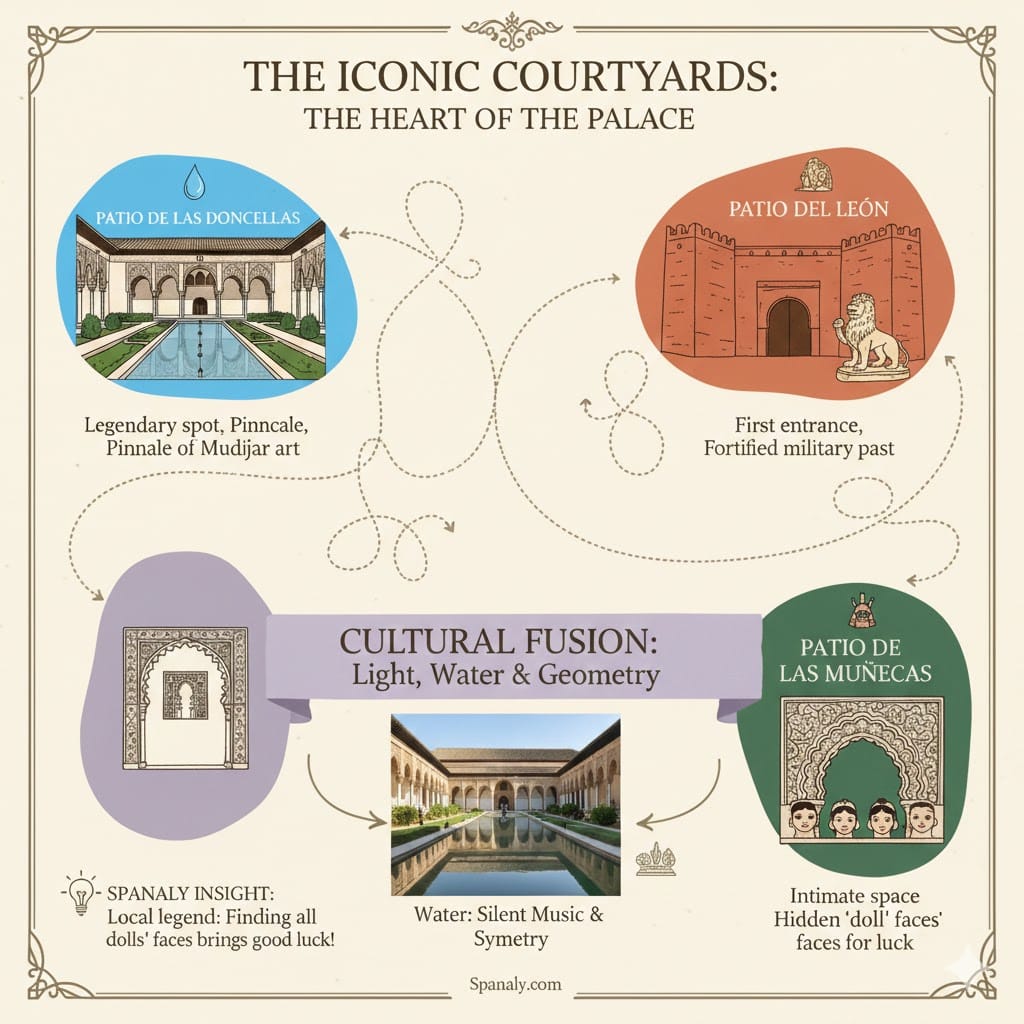
The courtyards (Patios) serve as the lungs of the Alcázar. Notably, light, water, and geometry breathe together in these spaces. Specifically, each courtyard offers a unique perspective on the Andalusian lifestyle and architectural genius.
💧 Patio de las Doncellas (Courtyard of the Maidens): This is the most legendary spot in Seville. In fact, its long reflecting pool and sunken gardens represent the pinnacle of Mudéjar art. It remains one of the most photographed Spanish Historical Monuments.
🦁 Patio del León (Lion’s Courtyard): This space welcomes you first. Notably, its sturdy walls remind us of the palace’s fortified military past.
🎎 Patio de las Muñecas (Dolls’ Courtyard): This smaller space feels much more intimate. Specifically, it takes its name from tiny faces carved at the base of the arches—a hidden detail for curious travelers.
Indeed, the symmetry in these patios creates a sense of peace and order. Ultimately, walking through them allows you to experience the “silent music” of Islamic design. If you enjoy such serene environments, you should explore our guide to the Generalife gardens in Granada.
💡 Spanaly Insight: Look closely at the small dolls’ faces in the Patio de las Muñecas. In fact, local legend says that finding all of them brings good luck to your journey!
🌿 The Royal Gardens: A Seven-Hectare Paradise
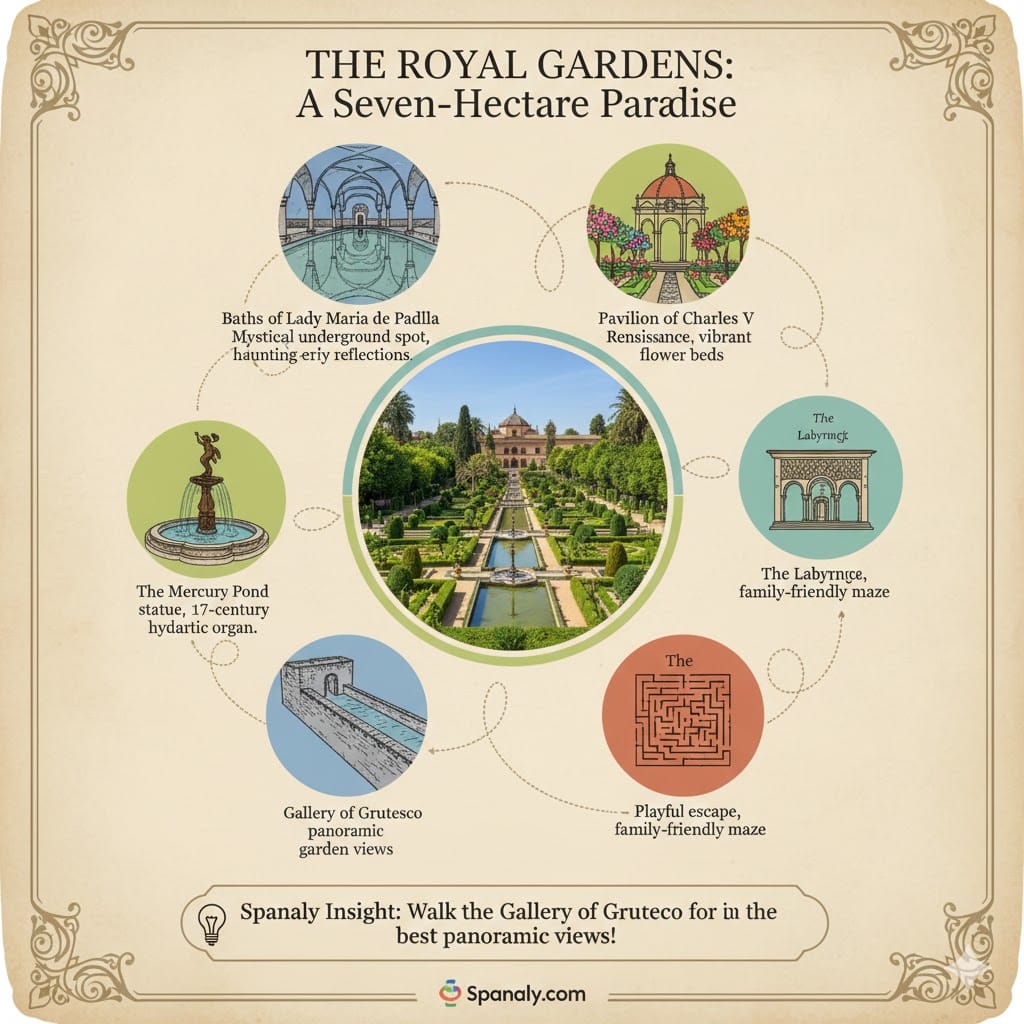
The gardens of the Alcázar serve as a sprawling oasis of peace. Notably, covering seven hectares, they represent a stunning blend of Moorish design and Renaissance luxury. Specifically, walking through these paths allows you to escape the city’s heat under the shade of ancient orange trees.
🏺 Baths of Lady María de Padilla: Head underground to find this mystical spot. In fact, these vaulted rainwater tanks offer a mirror-like reflection that creates the most hauntingly beautiful photos in Seville.
🦚 The Pavilion of Charles V: This elegant structure stands in the heart of the greenery. Specifically, it showcases the transition into the Renaissance style, surrounded by vibrant flower beds.
⛲ The Mercury Pond (Estanque de Mercurio): This giant fountain features a bronze statue of the Roman god. Notably, it houses a 17th-century hydraulic organ—one of the few still functional in the world.
🧩 The Labyrinth: Challenge yourself in the garden’s maze. Ultimately, it offers a playful escape for families and travelers looking for a bit of adventure.
Indeed, the scent of blooming jasmine defines the Andalusian experience. Specifically, these gardens act as the perfect conclusion to your royal tour. If you plan to explore more green havens, check out our insights on Retiro Park in Madrid.
💡 Spanaly Insight: Don’t miss the “Gallery of Grutesco.” In fact, this elevated walkway allows you to walk along the top of the old walls. Ultimately, it provides the best panoramic view of the entire garden landscape!
🎬 Cinematic Legend: Game of Thrones & Hollywood
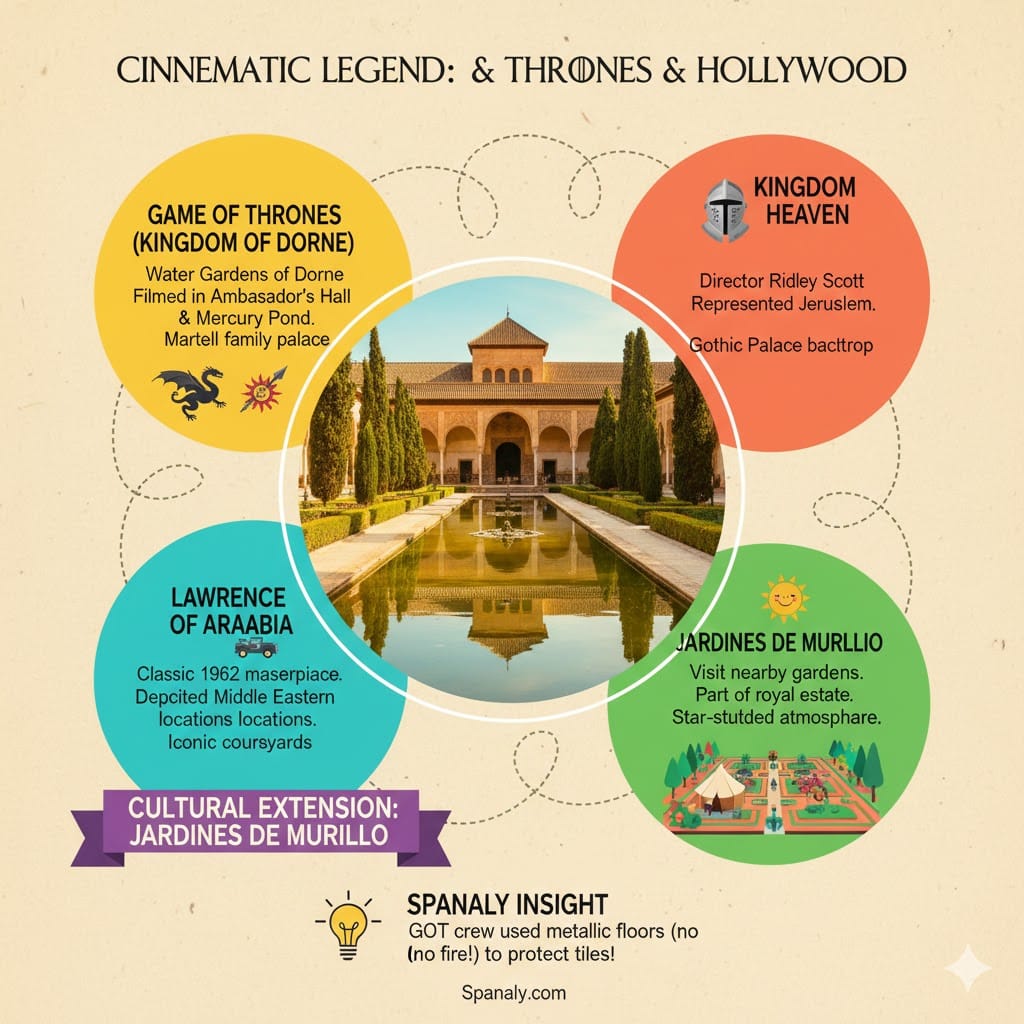
The Royal Alcázar of Seville acts as a global movie star. Notably, its exotic beauty attracts Hollywood’s top directors for their epic stories. Specifically, its Mudéjar arches and lush greenery provide a ready-made set for legendary kingdoms.
🐉 Game of Thrones (Kingdom of Dorne): Fans recognize the Alcázar as the Water Gardens of Dorne. In fact, the production team filmed key scenes in the Ambassador’s Hall and the Mercury Pond. It served as the private palace of the Martell family.
🎥 Kingdom of Heaven: Director Ridley Scott chose the palace to represent Jerusalem. Notably, the Gothic Palace provided the perfect medieval backdrop for this historical epic.
⚔️ Lawrence of Arabia: Even classic cinema fell in love with these courtyards. Ultimately, this 1962 masterpiece used the site to depict various Middle Eastern locations.
Indeed, the cinematic magic extends beyond the palace walls. Specifically, you should also visit the nearby Jardines de Murillo. These gardens once formed part of the royal estate and offer a similar, star-studded atmosphere. If you enjoy filming locations, don’t miss our guide to Girona’s Medieval Streets.
💡 Spanaly Insight: The Game of Thrones crew followed strict heritage rules. Notably, they used custom-made metallic floors to protect the ancient tiles. In fact, they couldn’t use a single drop of real fire inside the halls!
🕵️ Hidden Secrets: Decoding Symbols and Mason Marks
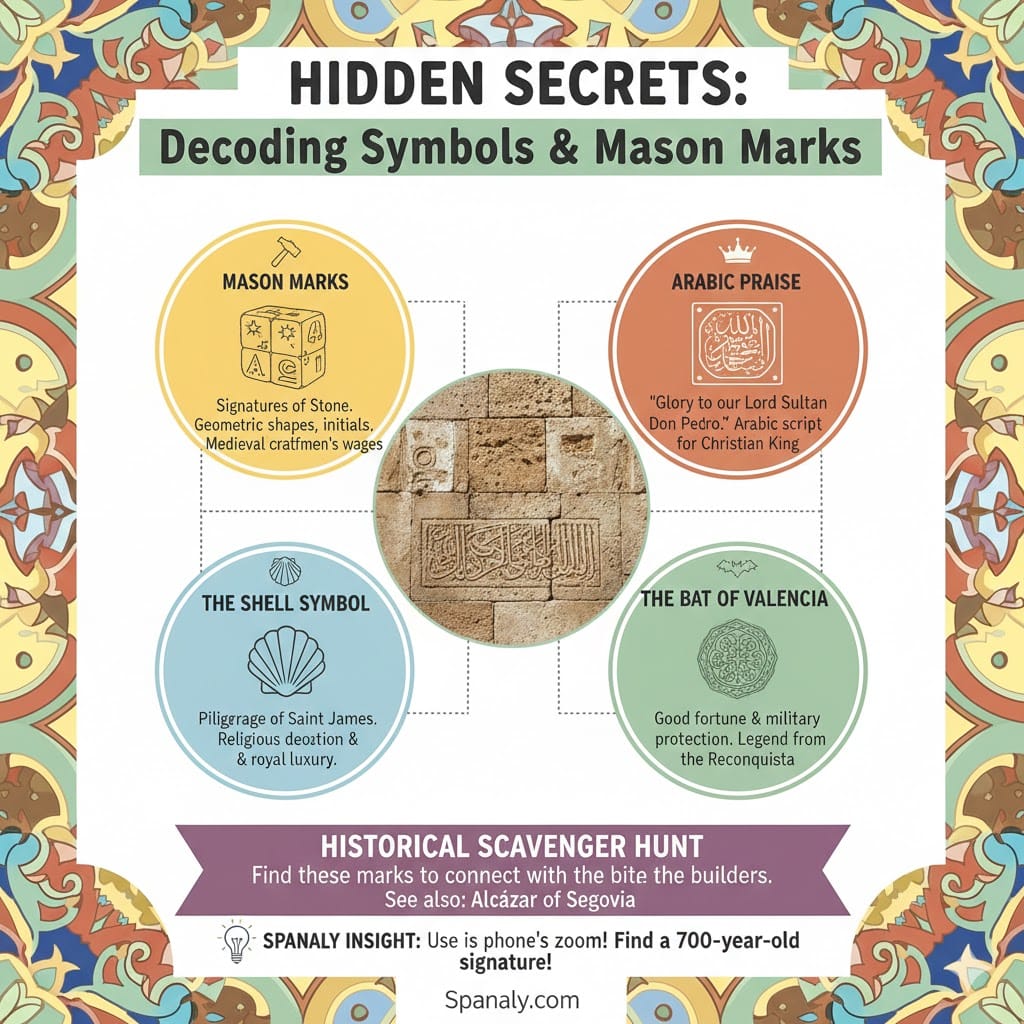
The walls of the Alcázar hold secrets that most tourists miss. Notably, these carvings and symbols act as a secret language left by the original craftsmen. Specifically, decoding these marks reveals the deep respect between different cultures during the palace’s construction.
🧱 Mason Marks (Signatures of Stone): Look closely at the stones in the oldest sections. In fact, you will find small geometric shapes like stars or initials. Specifically, medieval stonemasons carved these marks to identify their work and claim their wages.
🛡️ Arabic Praise for a Christian King: In the Palace of Pedro I, Arabic script decorates the walls. Notably, these inscriptions repeat phrases like “Glory to our Lord Sultan Don Pedro.” Ultimately, it proves that Christian kings deeply valued Moorish artistry.
🐚 The Shell Symbol: You will notice scallop shells carved into various arches. Specifically, this symbol represents the Pilgrimage of Saint James, blending religious devotion with royal luxury.
🦇 The Bat of Valencia: Search for the small bat symbols hidden in the plasterwork. In fact, legend links this creature to good fortune and military protection.
Indeed, these tiny details turn a simple visit into a historical scavenger hunt. Specifically, finding these marks helps you connect with the humans who built this masterpiece. If you enjoy uncovering hidden architectural gems, you must also see our guide to the Alcázar of Segovia. Notably, that fortress offers its own set of legends and royal mysteries.
💡 Spanaly Insight: Bring your phone’s zoom to look at the high walls! Notably, some of the most interesting “Mason Marks” hide in plain sight. In fact, finding one feels like discovering a 700-year-old signature from a master builder!
📸 Photography Guide: Best Spots for the Perfect Shot
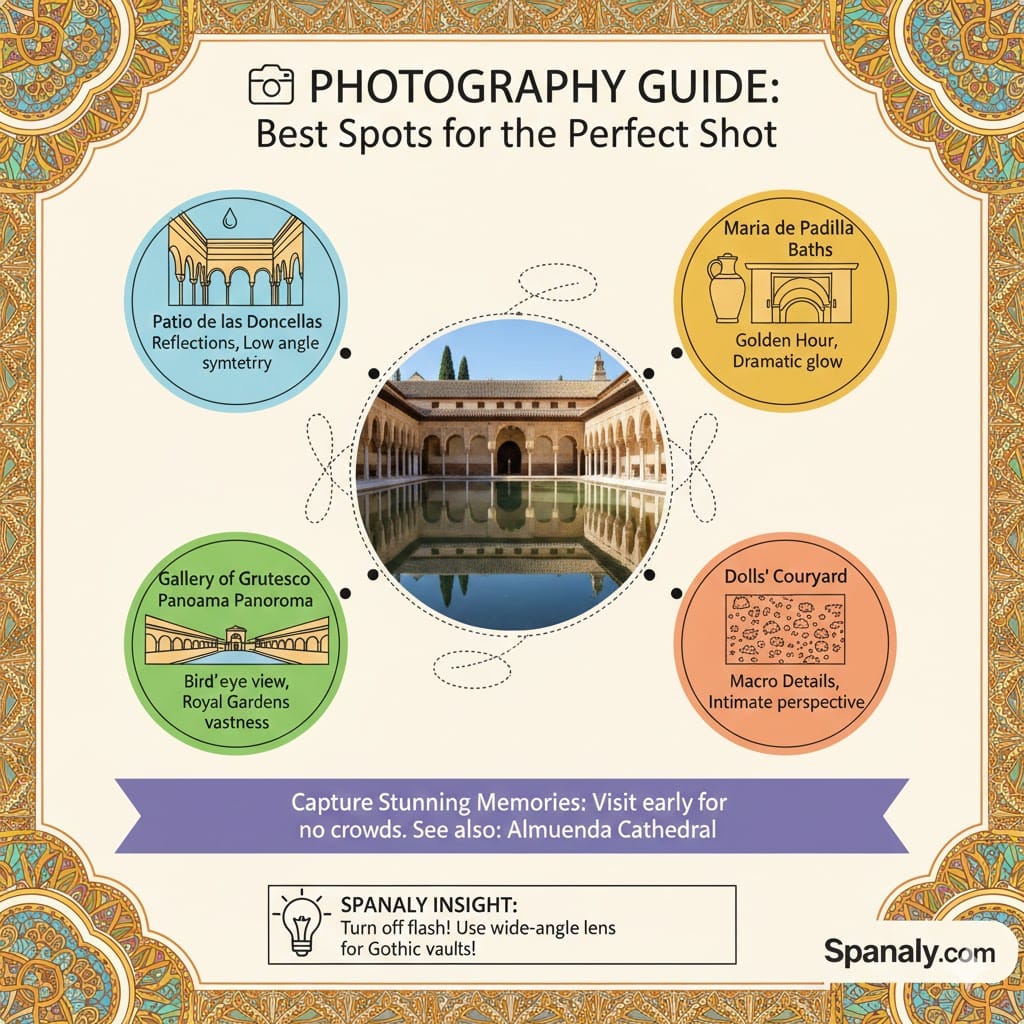
The Royal Alcázar of Seville offers endless visual treasures. Notably, finding the right angle transforms a simple photo into a professional masterpiece. Specifically, timing and perspective act as your best tools to capture the palace’s true soul.
💧 The Reflections of Patio de las Doncellas: Position your camera at the very edge of the central pool. In fact, this low angle captures the perfect symmetry of the Mudéjar arches reflected in the water.
🏺 The Golden Hour at María de Padilla Baths: Visit the underground baths when the sun is high. Specifically, the light filters through the side openings, creating a dramatic, golden glow on the water’s surface.
🌿 The Gallery of Grutesco Panorama: Climb to the elevated walkway for a bird’s-eye view. Notably, this spot allows you to capture the vastness of the Royal Gardens with the palace in the background.
🎎 Macro Details in the Dolls’ Courtyard: Switch to your portrait mode. Ultimately, focusing on the tiny carved faces provides a unique, intimate perspective that most tourists overlook.
Indeed, these spots guarantee stunning memories for your travel album. Specifically, arriving early helps you capture these locations without the crowds. If you enjoy photographing grand religious architecture, you should also explore the Almudena Cathedral in Madrid. Notably, its colorful ceilings and neo-Gothic interior offer a completely different, yet equally breathtaking, photographic challenge.
💡 Spanaly Insight: Turn off your flash! In fact, the natural light inside the courtyards is much softer and more flattering. Ultimately, using a wide-angle lens helps you fit the massive Gothic vaults into a single, breathtaking frame.
📍 Suggested Route: How to Navigate the Complex
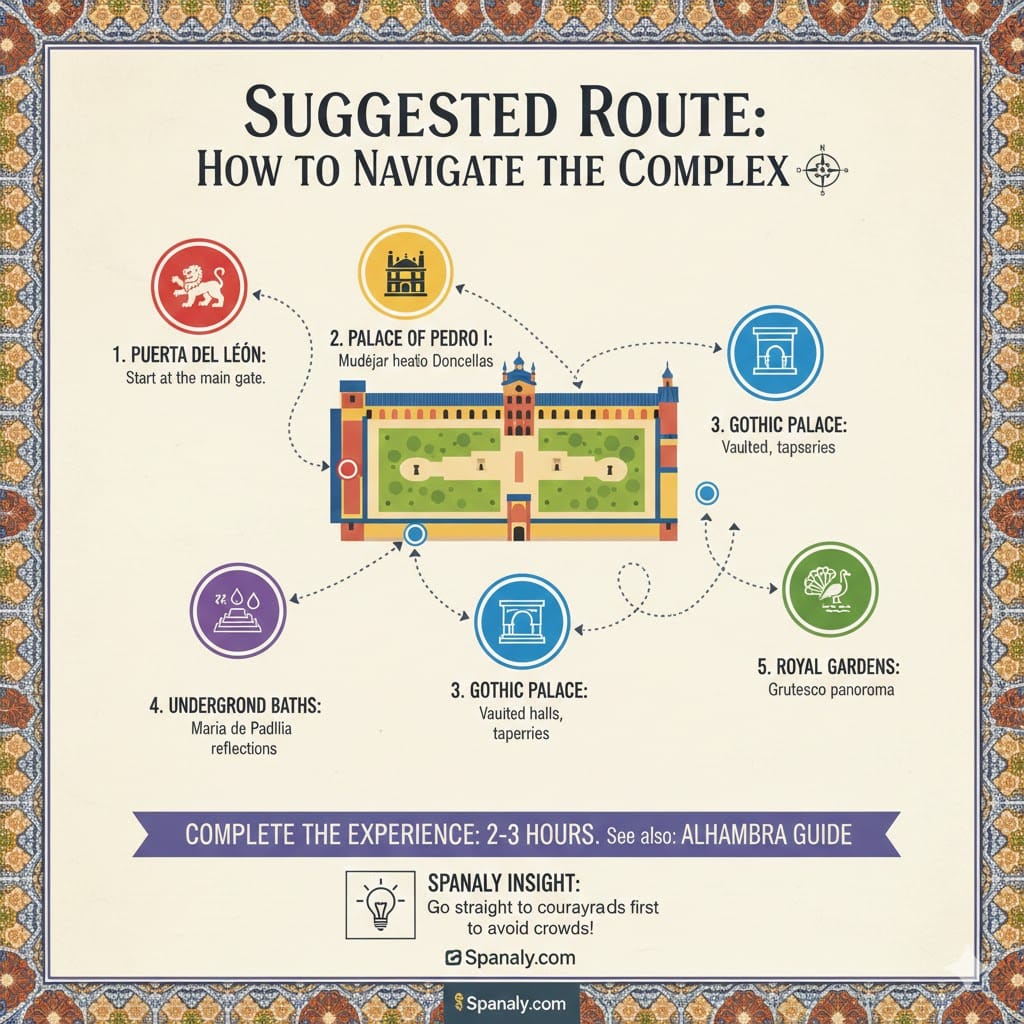
Navigating the Alcázar requires a smart plan. Notably, the complex features a maze-like layout that can confuse even seasoned travelers. Specifically, following this logical flow ensures you experience the palace’s evolution from a military fortress to a royal paradise without missing a single highlight.
Enter through the Puerta del León: Start your journey at the main gate. Specifically, cross the Lion’s Courtyard to feel the palace’s ancient defensive power.
Explore the Palace of Pedro I: Head straight to the Mudéjar heart. In fact, spend time in the Patio de las Doncellas and the Ambassador’s Hall before the crowds peak.
Visit the Gothic Palace: Walk towards the vaulted halls. Notably, this section offers a cool escape and houses stunning Flemish tapestries.
Descend to the Underground Baths: Find the entrance near the gardens. Specifically, witness the haunting reflections in the Baths of Lady María de Padilla.
Finish in the Royal Gardens: End your tour with a relaxing stroll. Ultimately, walk along the Gallery of Grutesco for a final panoramic view.
Indeed, this route balances historical discovery with visual beauty. Specifically, it takes approximately 2 to 3 hours to complete. If you love exploring Moorish masterpieces, you must also read our comprehensive Alhambra Granada Guide. Notably, comparing these two iconic palaces gives you a complete understanding of Al-Andalus history.
💡 Spanaly Insight: Most people turn left immediately after entering. Notably, if you head straight toward the courtyards first, you will stay ahead of the large tour groups! Ultimately, this simple trick gives you much better photo opportunities.
🏰 Alcázar vs. Alhambra: Understanding the Difference
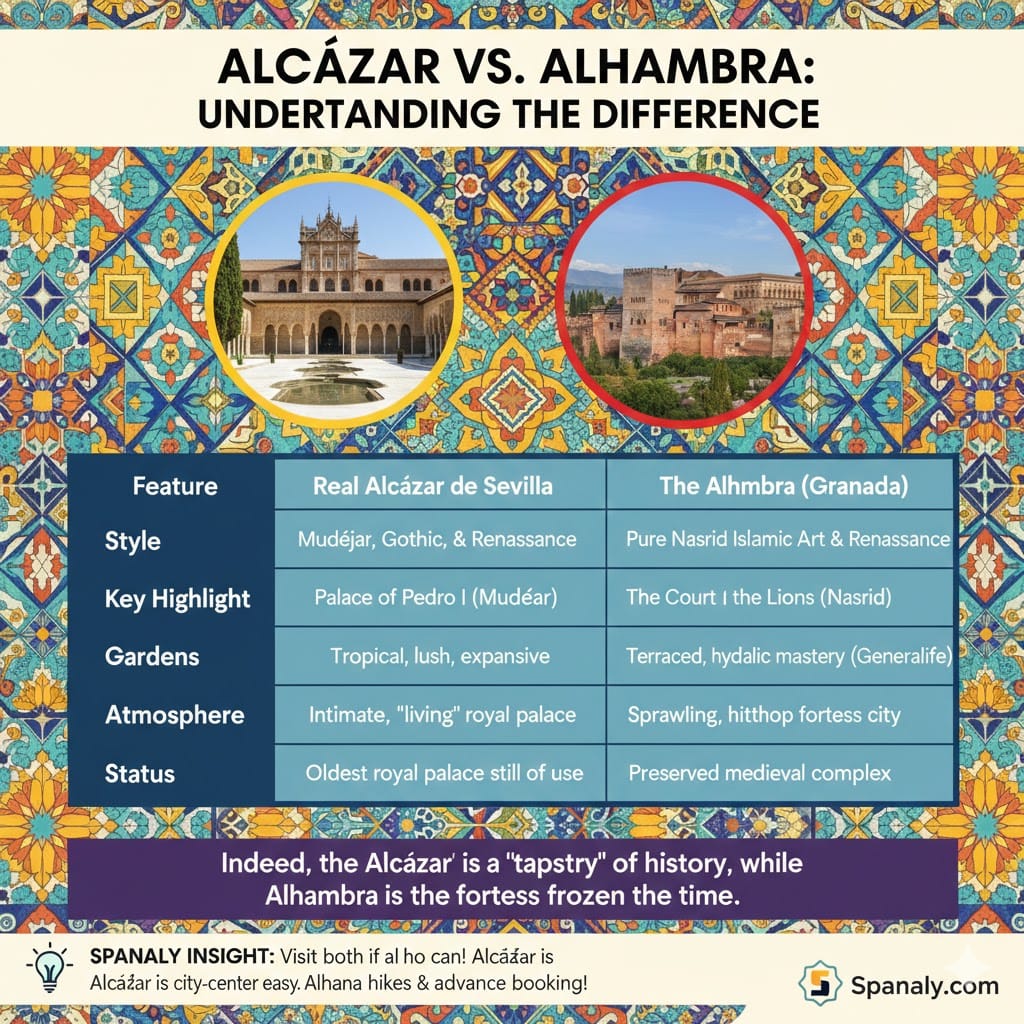
Choosing between the Alcázar of Seville and the Alhambra in Granada can feel impossible. Notably, both palaces showcase the peak of Al-Andalus architecture. Specifically, understanding their unique personalities helps you appreciate the distinct history of each city.
| Feature | Royal Alcázar of Seville | The Alhambra (Granada) |
| Style | A mix of Mudéjar, Gothic, & Renaissance | Pure Nasrid Islamic Art & Renaissance |
| Key Highlight | The Palace of Pedro I (Mudéjar) | The Court of the Lions (Nasrid) |
| Gardens | Tropical, lush, and expansive | Terraced, hydraulic mastery (Generalife) |
| Atmosphere | An intimate, “living” royal palace | A sprawling, hilltop fortress city |
| Status | Oldest royal palace still in use | A preserved medieval monumental complex |
Indeed, while the Alhambra feels like a fortified city frozen in time, the Alcázar represents a continuous “tapestry” of Spanish history. Specifically, the Alcázar’s blend of styles proves how Christian and Muslim cultures influenced each other for centuries. If you want to dive deeper into the red fortress of Granada, don’t miss our Alhambra Granada Guide.
💡 Spanaly Insight: Visit both if you can! Notably, the Alcázar is easier to access in the city center, while the Alhambra requires more hiking and advanced booking. Ultimately, both offer a unique window into the soul of Andalusia.
🍴 A Taste of History: Dining Near the Royal Gates
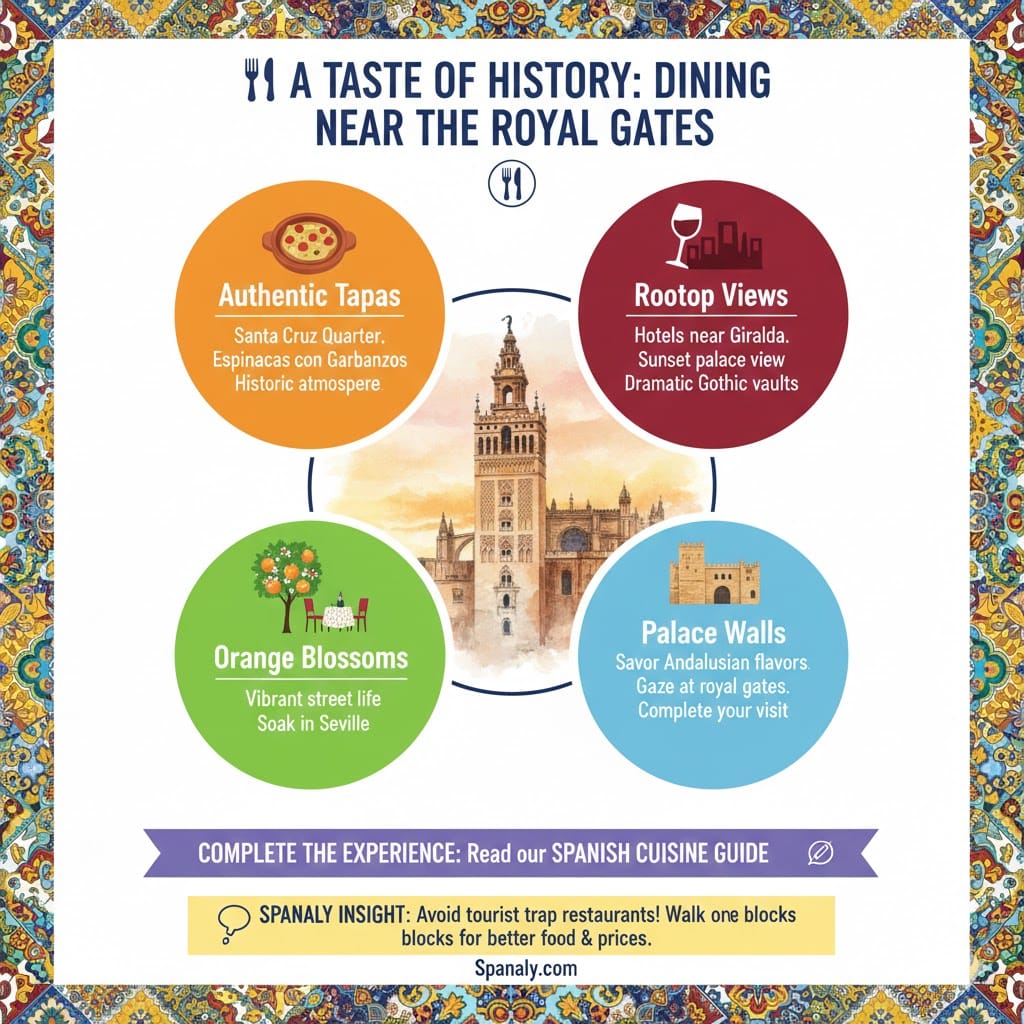
Exploring the Alcázar’s seven hectares of beauty naturally builds an appetite. Notably, the area surrounding the palace features some of Seville’s most authentic culinary gems. Specifically, choosing the right spot allows you to savor Andalusian flavors while gazing at the palace walls.
🥘 Authentic Tapas in Santa Cruz: Wander into the narrow streets of the Jewish Quarter just steps from the exit. In fact, local taverns serve classic dishes like Espinacas con Garbanzos in a historic atmosphere.
🍷 Rooftop Views with a Twist: Several boutique hotels near the Giralda offer terrace dining. Specifically, these spots provide a breathtaking perspective of the palace’s Gothic vaults during sunset.
🍊 The Scent of Orange Blossoms: Many nearby plazas feature outdoor seating under bitter orange trees. Ultimately, dining outside lets you soak in the vibrant street life of Seville.
Indeed, your visit to the Alcázar is incomplete without understanding the secrets of local flavors. Specifically, we recommend reading our Spanish Cuisine Guide to discover the history behind the dishes you see on the menu. Notably, this guide helps you distinguish between authentic tradition and tourist traps.
💡 Spanaly Insight: Avoid the restaurants directly facing the main tourist entrance. Notably, walking just two blocks deeper into the Santa Cruz neighborhood often cuts the price in half. In fact, the food quality improves significantly the further you get from the “tourist menus”!
📍 Location & Accessibility: How to Get There
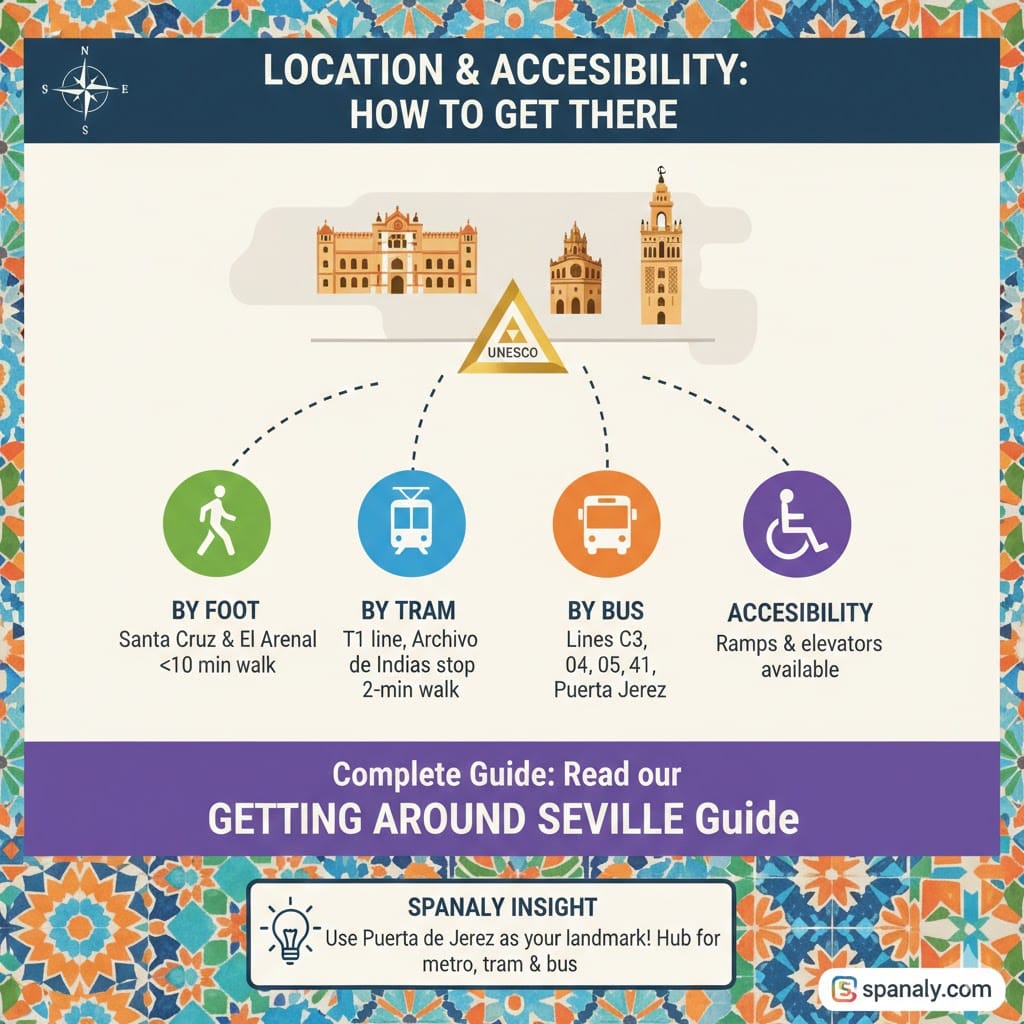
Finding the Royal Alcázar is easy, as it sits in the very heart of Seville. Notably, the palace forms part of a UNESCO World Heritage triangle alongside the Cathedral. Specifically, its central location makes it the perfect starting point for any city itinerary.
🚶 By Foot: Most visitors reach the palace by walking. In fact, if you stay in the Santa Cruz or El Arenal neighborhoods, you can reach the main entrance (Puerta del León) in less than 10 minutes.
🚋 By Tram (Metro-Centro): Take the T1 tram line and exit at the Archivo de Indias stop. Specifically, the entrance is just a 2-minute walk from this station.
🚌 By Bus: Use lines C3, C4, 05, or 41. Ultimately, these buses drop you at Puerta de Jerez, which offers a scenic 5-minute stroll to the palace gates.
♿ Accessibility: The Alcázar provides ramps and elevators for most areas. Notably, while some garden paths have uneven stones, the complex remains largely accessible for wheelchairs.
Indeed, the palace’s location is one of its greatest strengths. Specifically, navigating the city’s transport network is straightforward once you know the hubs. For a complete breakdown of transport costs and maps, read our guide on Getting Around Seville. Notably, that guide helps you master the tram and bus systems like a local.
💡 Spanaly Insight: Use Puerta de Jerez as your main landmark! Notably, this hub connects the metro, tram, and buses. In fact, it is the most convenient meeting point if you are traveling with a group before heading to the palace entrance.
⏳ The Perfect 1-Day Seville Itinerary
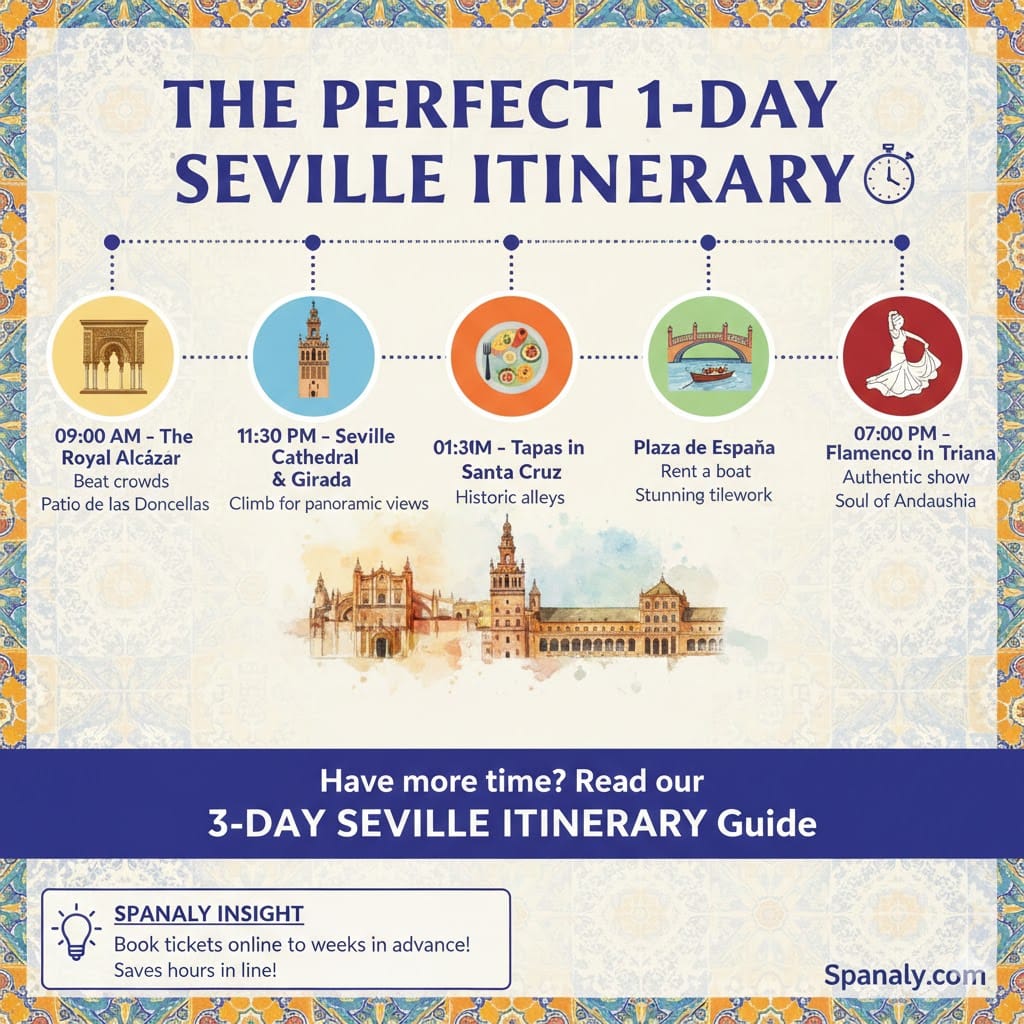
Maximizing a single day in Seville requires a strategic flow. Notably, the city’s most iconic landmarks cluster within walking distance of each other. Specifically, following this curated timeline ensures you experience the heart of the city without feeling rushed.
🌅 09:00 AM – The Royal Alcázar: Start your morning here to beat the heat. Specifically, enter as soon as the gates open to enjoy the quietest moments in the Patio de las Doncellas.
⛪ 11:30 AM – Seville Cathedral & Giralda: Walk just across the plaza. In fact, climbing the Giralda ramp offers the best panoramic view of the palace gardens you just explored.
🥘 01:30 PM – Tapas in Santa Cruz: Wander the winding alleys for a traditional lunch. Ultimately, this is the perfect time to rest your feet and soak in the historic charm.
⛲ 03:30 PM – Plaza de España: Head south to witness this Renaissance-style masterpiece. Notably, renting a small boat on the canal provides a unique perspective of the stunning tile work.
💃 07:00 PM – Flamenco in Triana: Cross the bridge to the Triana neighborhood. Specifically, ending your day with an authentic Flamenco show captures the true soul of Andalusia.
Indeed, this schedule balances architectural wonders with local culture. Specifically, it helps you navigate the city like a pro. However, if you have more time to spare, we highly recommend our comprehensive 3-Day Seville Itinerary. Notably, that guide dives deeper into hidden gems and local secrets that a single day simply cannot cover.
💡 Spanaly Insight: Book all your tickets online at least two weeks in advance! Notably, Seville remains incredibly popular year-round. In fact, having your QR codes ready on your phone saves you hours of waiting in line under the sun.
💡 Visiting Tips: Mastering Your Alcázar Experience
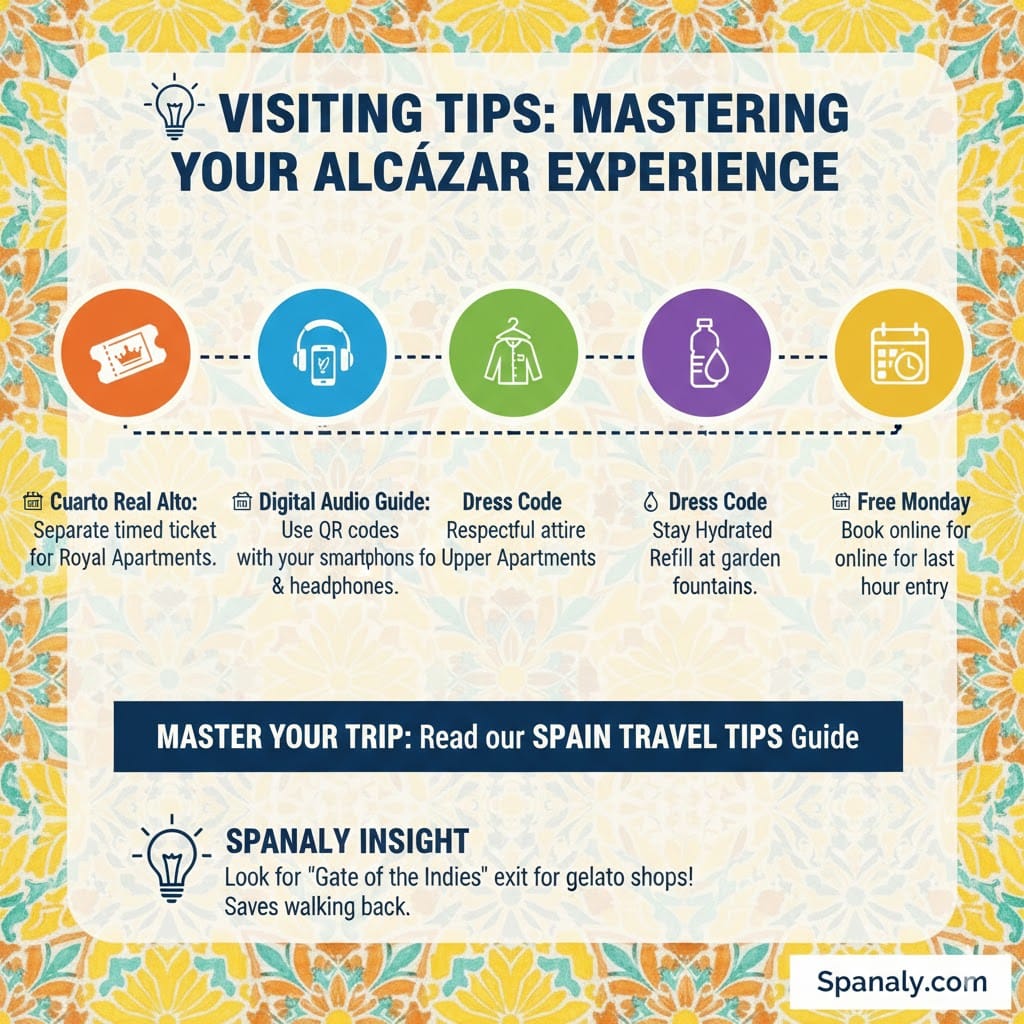
Planning your visit involves more than just buying a ticket. Notably, small logistical choices can define whether you spend your day fighting crowds or enjoying royal serenity. Specifically, following these insider tips ensures a seamless and professional-grade tour of the palace.
🎟️ Selection of the “Cuarto Real Alto”: Purchase the specific “Upper Royal Apartments” add-on ticket if you want to see where the Spanish Royals still stay. Specifically, these rooms require a separate timed entry and have much stricter security than the rest of the complex.
🎧 Skip the Physical Audio Guide: Use your smartphone instead. In fact, the palace now offers QR codes in many areas that link to digital explanations. Ultimately, bringing your own noise-canceling headphones provides a much more immersive experience than the bulky rented devices.
🧥 Observe the Dress Code: Dress respectfully if you plan to visit the upper apartments. Notably, while the gardens are casual, the official royal rooms maintain a standard of decorum. Specifically, avoid wearing very short swimwear-style clothing to ensure entry without issues.
💧 Hydration is Key: Carry a reusable water bottle. In fact, the palace gardens feature several historic (and safe) drinking fountains. Ultimately, staying hydrated allows you to explore the vast seven-hectare estate without fatigue.
📅 The “Free Monday” Strategy: Take advantage of free entry during the last hour of Mondays. Notably, you still need to book these tickets online in advance for a small processing fee. Specifically, this is the best option for budget travelers who don’t mind a shorter, faster visit.
Indeed, these practical details transform a standard tour into a tailored royal experience. Specifically, they help you navigate the “invisible” rules of the palace. For more expert travel hacks across Spain, dive into our Spain Travel Tips guide. Notably, that resource covers everything from train bookings to local etiquette.
💡 Spanaly Insight: Look for the “Gate of the Indies” exit! Notably, many tourists walk all the way back to the main entrance to leave. In fact, using the side exits near the gardens places you directly in front of the best gelato shops in Seville! Ultimately, it’s the sweetest way to end your tour.
🏰 Quick Answers – Alcázar of Seville Essentials
👑 Is the Alcázar of Seville still a royal residence?
☀️ What is the best time of day to visit?
⛪ Can I visit the Cathedral and Alcázar on the same day?
🎟️ Are "Skip-the-Line" tickets really necessary?
📸 Is professional photography allowed inside?
Expertly curated by Spanaly.com
🌟 Why the Alcázar is the Soul of Seville
The Royal Alcázar is more than just a monument; it is a living timeline of Spain’s heart and history. Ultimately, walking through its gates feels like stepping into a dream where civilizations meet.
🏰 Endless Beauty: From the intricate Mudéjar carvings to the lush, peacock-filled gardens.
🕰️ Living History: Experience the world’s oldest royal palace still in use today.
✨ Pure Magic: Discover why it remains a UNESCO treasure and a top global destination.
Indeed, Seville captures your heart, but your Andalusian journey doesn’t have to end at the palace walls. Notably, if you love historic architecture and stunning views, you must see the Roman Bridge of Cordoba. Specifically, this iconic landmark offers a different but equally breathtaking glimpse into Spain’s ancient Roman and Islamic past.
💡 Final Spanaly Tip: Don’t just rush through for photos. Notably, take a moment to sit in the gardens and listen to the water fountains. Ultimately, that is where the true spirit of the Alcázar lives.