
Table of Contents
Toggle📍 How to Travel from Barcelona to Alicante
Ready to swap Gaudí’s architectural masterpieces for the sun-drenched beaches of the Costa Blanca? 🏖️ Whether you are a digital nomad, a family on vacation, or a solo backpacker, getting from Barcelona to Alicante is one of the most scenic journeys in Spain.
Covering a distance of approximately 500 km (310 miles) along the sparkling Mediterranean coast, this route offers the perfect balance of speed and scenery.
What is the best way to travel? * 🚆 High-Speed Euromed Train: The local favorite—fast, comfortable, and offers stunning sea views.
✈️ Direct Flight: The quickest airtime, best for those with very limited time.
🚗 Coastal Road Trip: Perfect for explorers wanting to stop in Tarragona or Valencia.
🚌 Budget Bus: The go-to option for last-minute travelers and backpackers.
🌟 Pro Traveler Tip: Once you arrive at the “City of Light,” you’ll want to hit the ground running. To make sure you don’t miss the sunset at Santa Bárbara Castle or the best paella in the Marina, check out our curated Alicante Itinerary for the perfect stay.
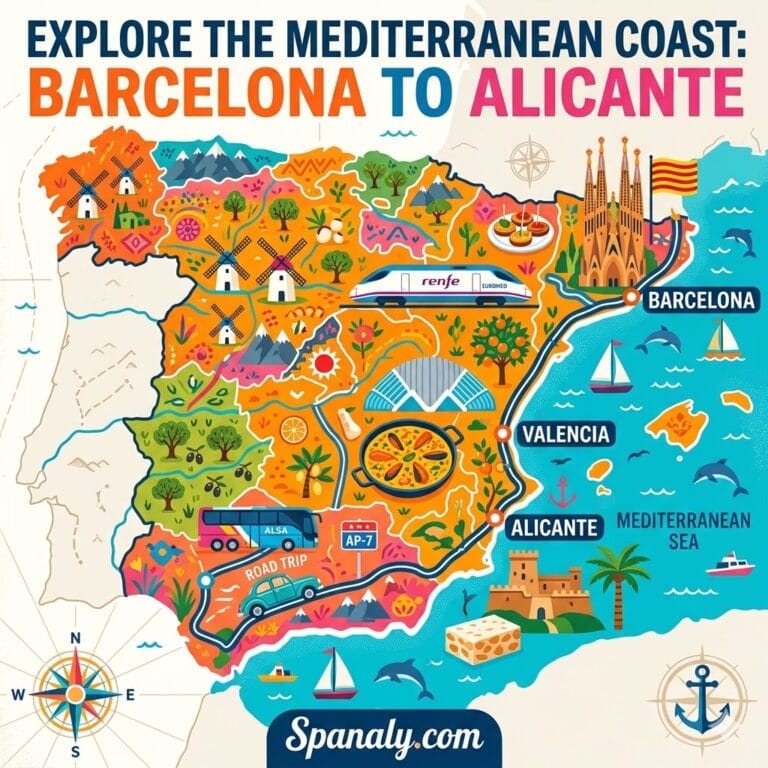
📍 Route Snapshot: Barcelona to Alicante
Barcelona to Alicante: Interactive Route Guide
📍 How to Travel from Barcelona to Alicante: Step-by-Step Guide
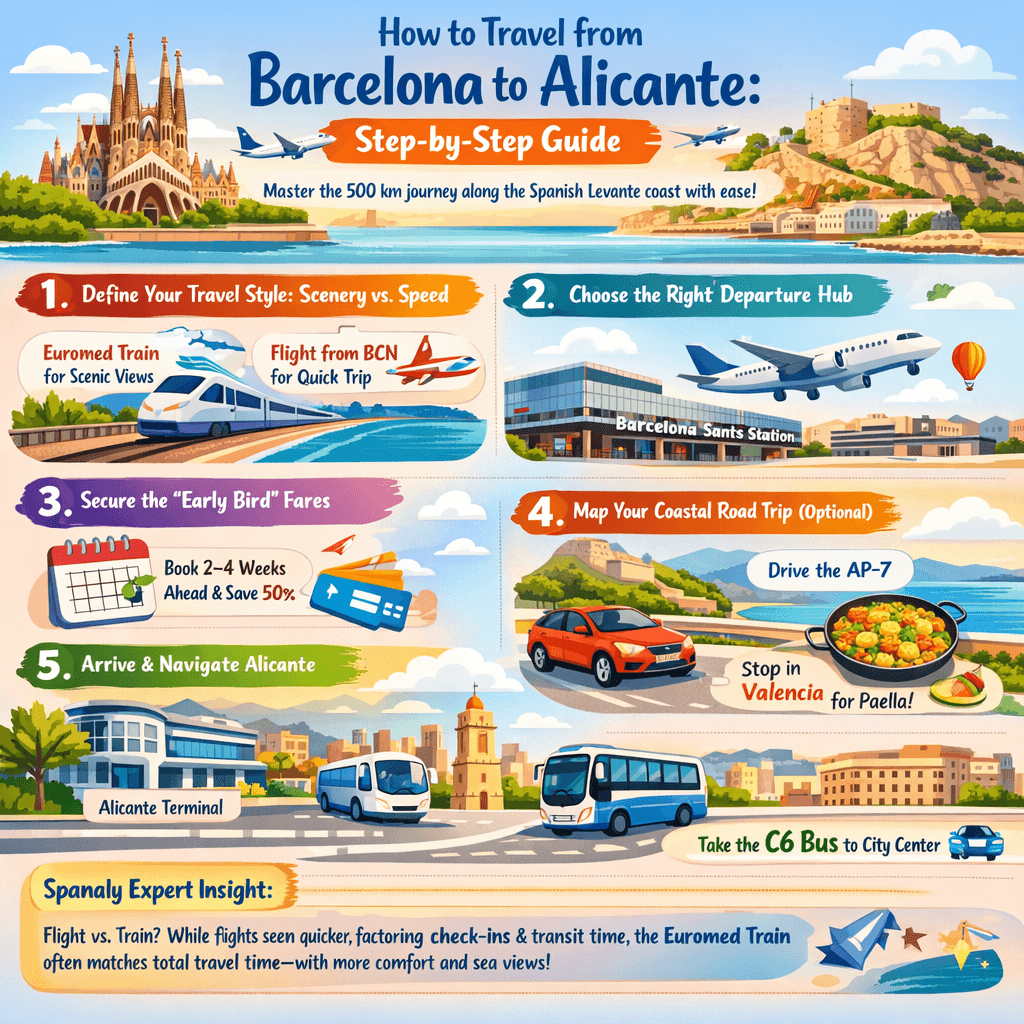
Mastering the 500 km journey along the Spanish Levante coast requires more than just buying a ticket. To ensure a seamless transition from the Catalan capital to the “City of Light,” follow these essential steps:
🎯 Step 1: Define Your Travel Style (Scenery vs. Speed): If you want to see the Mediterranean blue from your window, the Euromed Train is your best bet. If you are in a massive hurry, a direct flight from El Prat (BCN) takes just over an hour.
🚉 Step 2: Choose the Right Departure Hub: For trains, your destination is the bustling Barcelona Sants Station. If you choose to fly, stick to El Prat (BCN); avoid Reus or Girona airports as they are too far from the city center for this specific route.
⏳ Step 3: Secure the “Early Bird” Fares: Prices on the Euromed train fluctuate based on demand. Booking at least 2–4 weeks in advance can save you up to 50% compared to last-minute tickets. Check our Spain Travel Tips for the best booking platforms.
🛣️ Step 4: Map Your Coastal Road Trip (Optional): If you are driving, you’ll be taking the AP-7 highway. This is one of Spain’s most beautiful drives. Plan for a 5-hour journey, and consider a 90-minute stop in Valencia for an authentic paella lunch mid-way.
🚀 Step 5: Arrive & Navigate Alicante: Once you arrive at Alicante Terminal (train) or the Airport (ALC), the city center is just minutes away. From the airport, take the C6 Bus (blue bus) which runs every 20 minutes directly to the waterfront and Plaza de los Luceros.
✨ Spanaly Expert Insight: While the flight is technically faster, once you add the 2-hour early arrival at the airport and the transit at both ends, the Euromed train often equals the total travel time. Plus, you get much better legroom and a constant view of the sea!
📊 Transport Comparison: Barcelona to Alicante
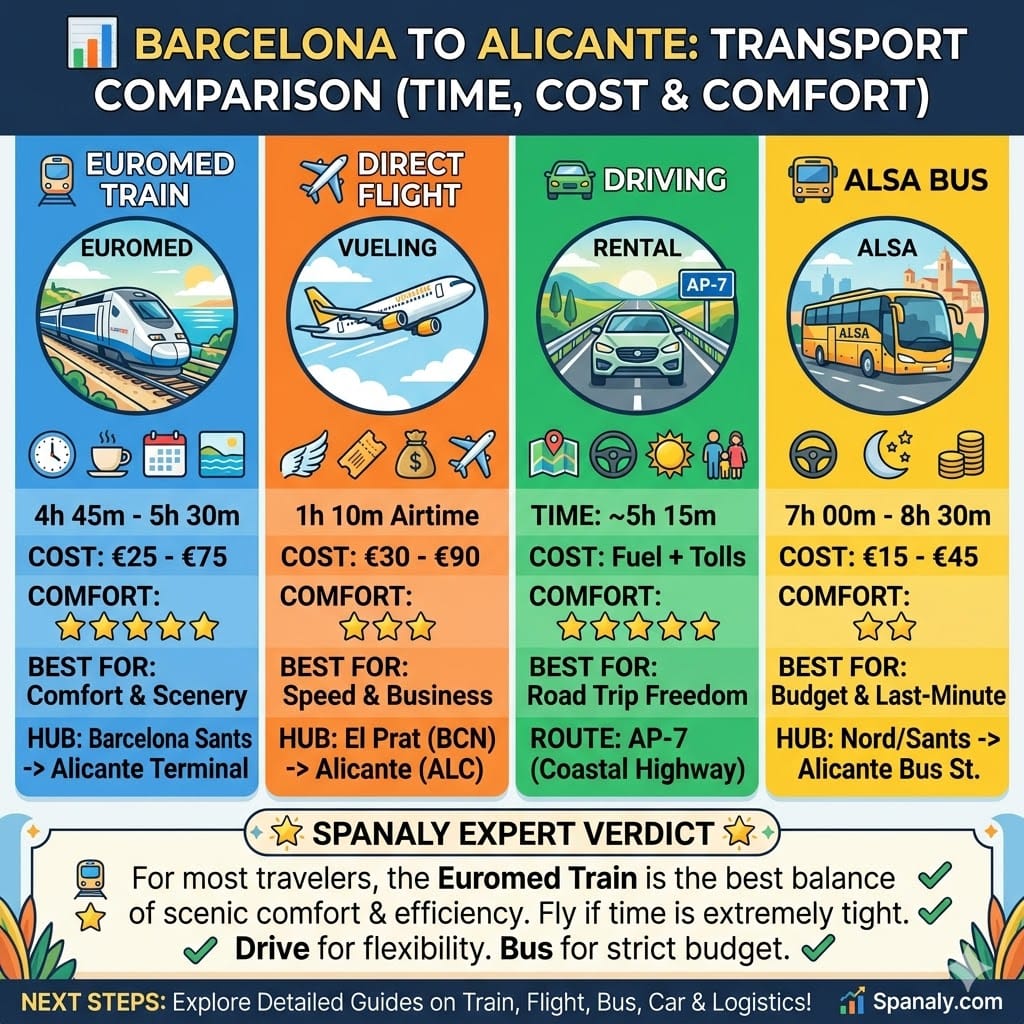
How you choose to travel from Gaudí’s Mediterranean capital to the sunny Costa Blanca depends entirely on your budget and how much you value city-center convenience. Since the distance is manageable (around 500 km), here is how the top options stack up for the Mediterranean corridor:
| Transport Mode | Travel Time | Typical Cost | Comfort Level | Best For… |
| 🚆 Euromed Train | 4h 45m – 5h 30m | €25 – €75 | ⭐⭐⭐⭐⭐ | Comfort & Scenery |
| ✈️ Direct Flight | 1h 10m (Airtime) | €30 – €90 | ⭐⭐⭐ | Business & Speed |
| 🚗 Driving | ~5h 15m | Fuel + Tolls | ⭐⭐⭐⭐ | Road-trip Freedom |
| 🚌 ALSA Bus | 7h 00m – 8h 30m | €15 – €45 | ⭐⭐ | Last-Minute Savings |
🚆 Go with the Train (Euromed) for City-Center Convenience
Euromed trains (operated by Renfe) are the preferred choice for a premium, stress-free experience. There’s no airport security hassle, and you’re taken directly from Barcelona Sants to Alicante Terminal. This is our top recommendation, offering spacious seats and constant coastal views.
✈️ Book the Flight (Vueling) for the Fastest Connection
Carriers like Vueling provide the absolute fastest city-to-city connection. If you’re traveling for business or have a very tight schedule, this is your best option, and low-cost operators can make it incredibly affordable if booked well in advance. Don’t forget to check our Barcelona El Prat Airport Guide for a smooth departure.
🚗 Take the Wheel (Driving) for the Ultimate Road Trip Freedom
Embrace the legendary AP-7 (Autopista del Mediterráneo) coastal route for total flexibility. This scenic drive allows you to turn your transit into an adventure. Valencia is the perfect mid-way point for a break. If you have time to explore, make sure to read our Valencia 3-Day Itinerary to create the perfect mini-break.
🚌 Hop on the Bus (ALSA) for Reliable Budget Travel
The ALSA bus is your dependable low-cost option. While significantly longer, it’s a great last-minute alternative if train or flight prices have spiked. ALSA operates a modern and reliable fleet.
🚆 Option 1: The Mediterranean Euromed Train
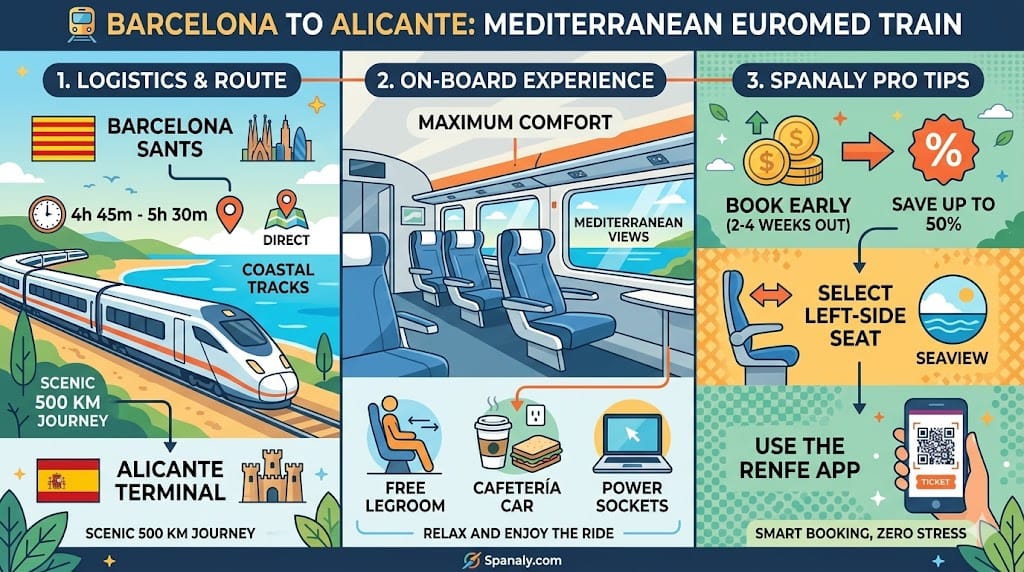
For most travelers, the Euromed high-speed service is the gold standard for this journey. Unlike the inland tracks, this specific route hugs the coastline, transforming a simple transit into a scenic tour of the Spanish Levant. It offers a premium, stress-free experience that connects the hearts of both cities.
📍 Key Station & Journey Logistics
Departure Hub: All direct trains depart from Barcelona Sants. Before you head to the station, make sure you’ve ticked off everything from our guide to the Barcelona Top Attractions to make the most of your time in the Catalan capital.
Arrival Point: You will arrive at Alicante Terminal, perfectly situated in the city center and just a short walk from the main shopping district and the waterfront.
Travel Time: The journey typically takes between 4h 45m and 5h 30m, depending on the number of coastal stops.
💰 Budgeting for Your Ticket
Early Bird (2-4 weeks out): €25 – €45.
Last-Minute / Peak Season: €65 – €95.
Travel Classes: Choose Básico for the best value, or upgrade to Elige for more flexible cancellation options and seat selection.
🌟 Why the Euromed Wins Over Flying
The Coastal Panorama: Once the train clears the suburbs of Tarragona, the tracks run remarkably close to the Mediterranean. Spanaly Pro Tip: When booking on Renfe.com, try to select a seat on the Left Side (facing the direction of travel) for the best sea views heading south.
Maximum Comfort: You’ll enjoy significantly more legroom than on any low-cost flight. Every seat features a power socket and a fold-down table, and you have full access to the Cafetería carriage for fresh coffee and Spanish bocadillos.
Zero Hidden Fees: Unlike airlines, your train ticket includes up to 3 pieces of luggage (totaling 25kg) for free. Plus, there are no long security queues or expensive airport transfers to worry about.
✈️ Option 2: Direct Flights from El Prat (BCN)
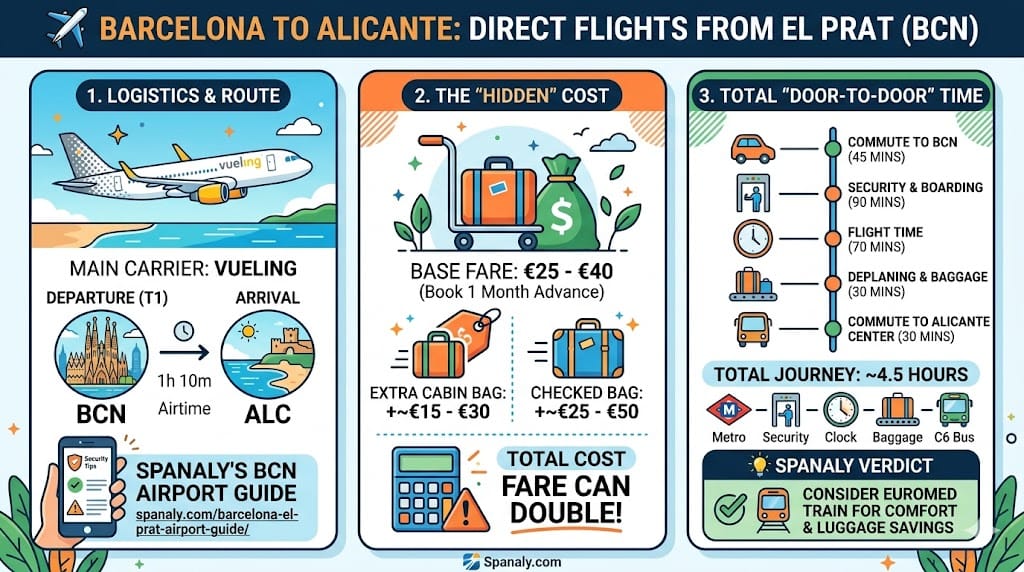
If you are a solo traveler with just a backpack or a business professional on a tight schedule, taking to the skies is the fastest way to bridge the 500 km gap. However, as we always say at Spanaly, the “70-minute flight” is only part of the story.
📍 Terminal & Airline Logistics
Main Carrier: Vueling is the king of this route, offering multiple daily flights.
Departure Hub: You will depart from Terminal 1 (T1) at Barcelona El Prat Airport. For a stress-free departure, make sure to check our Barcelona El Prat Airport Guide to navigate the security gates like a pro.
Arrival Point: You’ll land at Alicante-Elche Miguel Hernández Airport (ALC), located about 9km south of the city center.
💰 The Real Cost of Flying
Base Fare: €25 – €40 (if booked 1 month in advance).
The “Hidden” Extras: Remember that low-cost fares usually exclude cabin bags and checked luggage. Adding a 10kg cabin bag can often double the price of your ticket.
Ground Transport: Factor in €3.85 for the C6 Airport Bus in Alicante or approximately €25 for a taxi to the Marina.
⚠️ The “Total Time” Reality Check
While the actual airtime is only 1 hour and 10 minutes, your total “door-to-door” journey looks more like this:
45 mins: Commute to BCN Airport.
90 mins: Security & Boarding.
70 mins: Flight time.
30 mins: Deplaning & Baggage.
30 mins: Commute to Alicante Center. Total: ~4.5 Hours. > 💡 Spanaly Verdict: > If the Euromed train is similarly priced, we recommend the rails. You’ll save on luggage fees and enjoy a much more relaxing environment without the liquid restrictions and middle-seat squeeze.
🚗 Option 3: The Mediterranean Coastal Road Trip (AP-7)
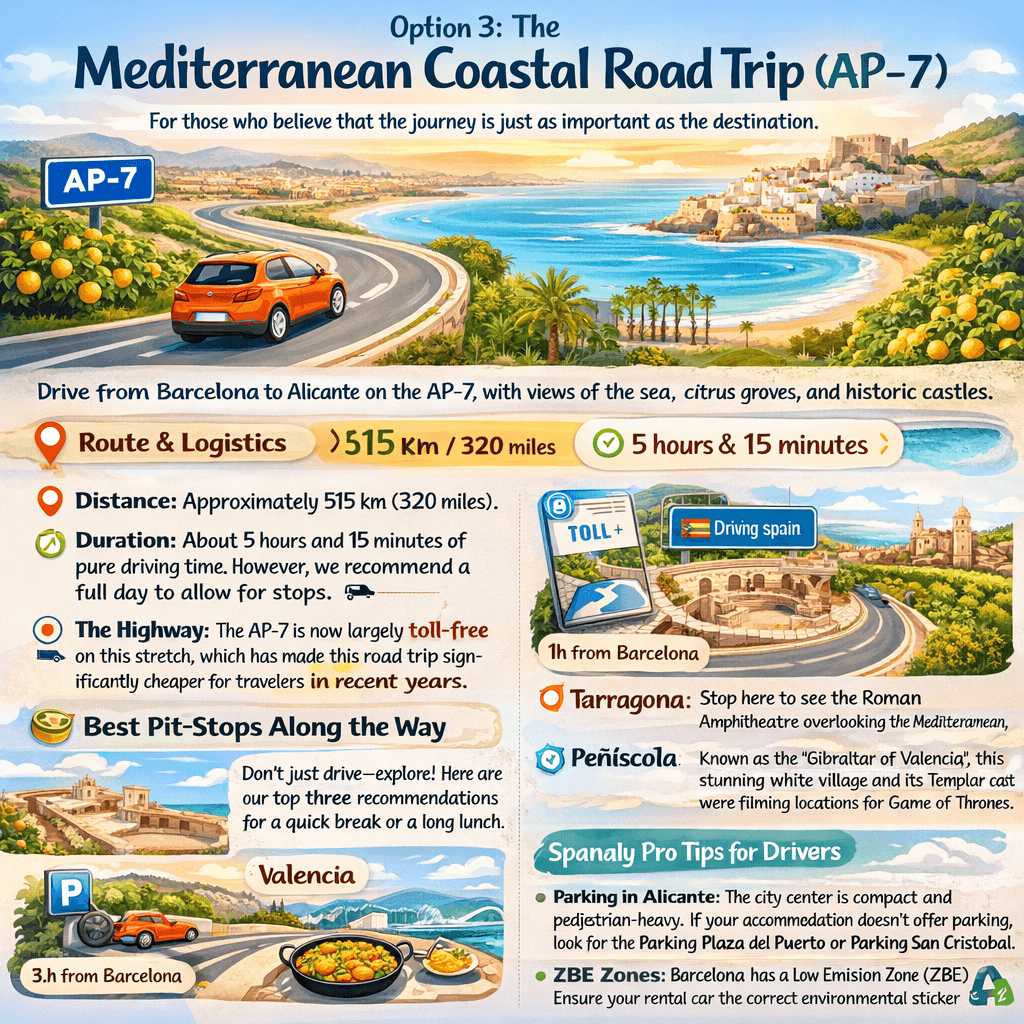
For those who believe that the journey is just as important as the destination, driving from Barcelona to Alicante is a dream come true. You’ll be cruising along the AP-7 (Autopista del Mediterráneo), a highway that offers sweeping views of the sea, citrus groves, and historic castles.
📍 Route & Logistics
Distance: Approximately 515 km (320 miles).
Duration: About 5 hours and 15 minutes of pure driving time. However, we recommend a full day to allow for stops.
The Highway: The AP-7 is now largely toll-free on this stretch, which has made this road trip significantly cheaper for travelers in recent years.
Driving Rules: Before you hit the road, make sure you are familiar with local regulations by reading our comprehensive guide on Driving in Spain.
📸 Best Pit-Stops Along the Way
Don’t just drive—explore! Here are our top three recommendations for a quick break or a long lunch:
Tarragona (1h from Barcelona): Stop here to see the Roman Amphitheatre overlooking the Mediterranean.
Peñíscola (2.5h from Barcelona): Known as the “Gibraltar of Valencia,” this stunning white village and its Templar castle were filming locations for Game of Thrones.
Valencia (3.5h from Barcelona): The perfect halfway point. Park near the City of Arts and Sciences for a futuristic walk and some authentic paella.
💡 Spanaly Pro Tips for Drivers
Parking in Alicante: The city center is compact and pedestrian-heavy. If your accommodation doesn’t offer parking, look for the Parking Plaza del Puerto or Parking San Cristóbal. They are secure and centrally located.
Rental Advice: If you are picking up a car at Barcelona El Prat Airport, book in advance to secure the best rates. An automatic car is easier for city driving, but a manual (stick-shift) is usually much cheaper in Spain.
ZBE Zones: Barcelona has a Low Emission Zone (ZBE). Ensure your rental car has the correct environmental sticker (Distintivo Ambiental) to avoid heavy fines when leaving the city.
🚌 Option 4: The Budget-Friendly ALSA Bus
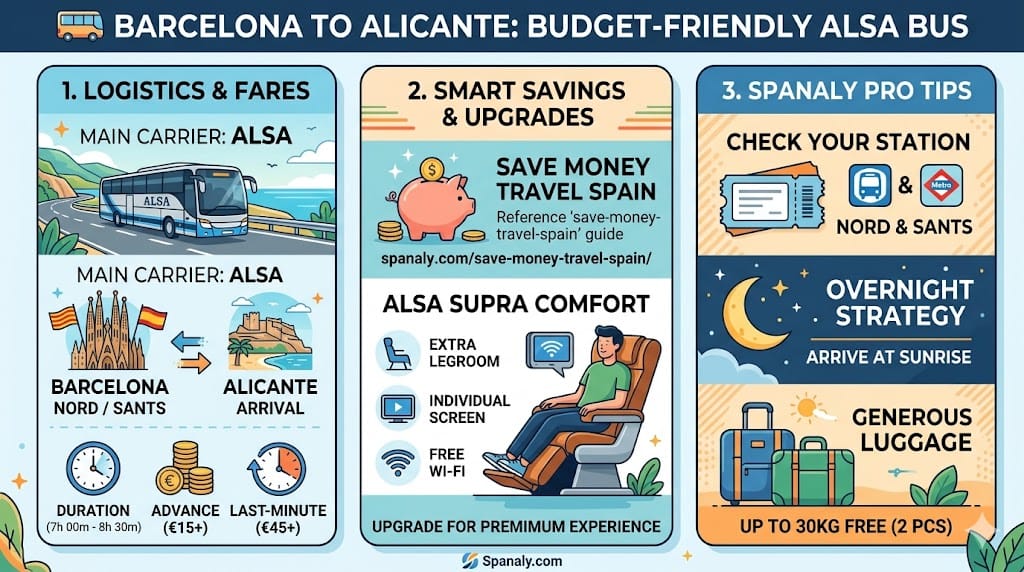
When trains are fully booked or flight prices skyrocket during peak season, the bus becomes your most reliable ally. While it is the longest journey, it remains the champion of affordability for the 500 km Mediterranean route.
📍 Logistics & Fares
The Main Carrier: All major departures are operated by ALSA, Spain’s premier bus network.
Duration: Expect a travel time between 7h 00m and 8h 30m, depending on whether you choose an express or a multi-stop route.
Estimated Cost: Advance tickets start as low as €15, while last-minute fares rarely exceed €45.
💰 Smart Savings & Comfort Upgrades
If you are looking to stretch your Euros even further, don’t miss our expert guide on how to Save Money Travel Spain for more local hacks.
To make the long haul more enjoyable, we highly recommend upgrading to the “ALSA Supra” service. For a small premium, you’ll get:
Extra Legroom: Spacious leather reclining seats.
On-Board Entertainment: Individual screens and free Wi-Fi.
Generous Luggage: Up to 30kg of free baggage (2 pieces), far beating any airline policy.
🌟 Spanaly Pro Tips for Bus Travelers
Check Your Station: ALSA buses depart from both Barcelona Nord and Barcelona Sants. Always verify your departure point on your digital ticket.
The Overnight Strategy: Consider taking the midnight bus. Not only do you save on a night’s hotel stay, but you’ll also arrive in Alicante just in time for a sunrise breakfast by the Marina.
The “Front Row” Hack: For the best views of the coastal cliffs, try to book a seat in the first few rows on the left side of the bus.
🧳 Essential Logistics: Baggage, Accessibility & Last-Mile Travel
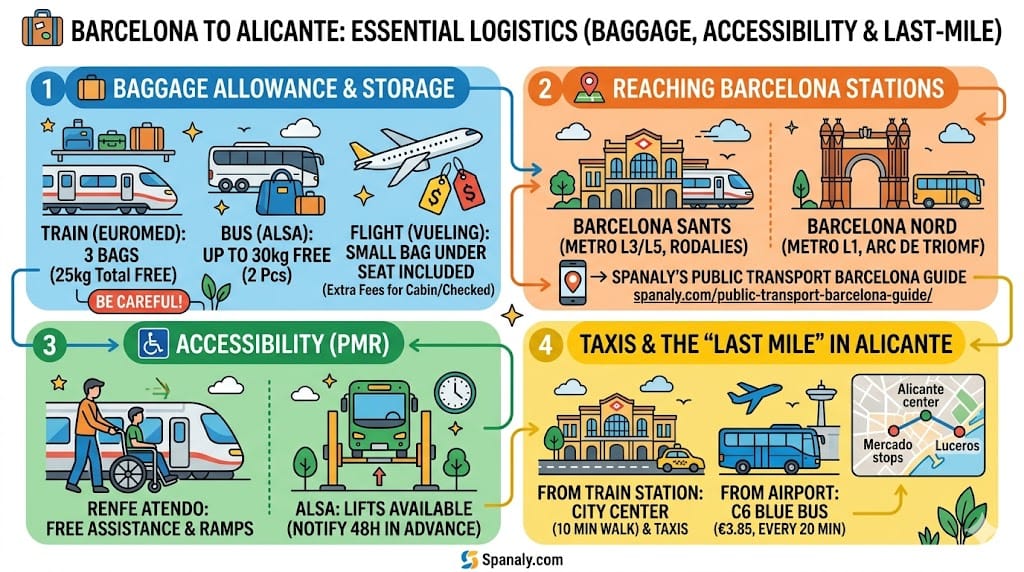
Navigating the 500 km journey from Barcelona to Alicante is more than just picking a seat. To ensure your trip is as smooth as a Mediterranean breeze, keep these logistical details in mind:
🚆 Baggage Allowance & Storage
Train (Euromed): You are allowed up to 3 pieces of luggage (max 25kg total). There are no scales, but you must be able to carry your bags onto the train yourself. Large racks are available at the end of each carriage.
Bus (ALSA): Offers the most generous policy with up to 30kg for free. Perfect if you are moving for a long stay or have heavy sports gear.
Flight (Vueling): Be careful! Their “Basic” fare often only includes a small bag that fits under the seat. Checking a bag at the airport can cost triple the online price.
🚉 Reaching the Station in Barcelona
Getting to your departure point is easy if you know the layout. Barcelona Sants and Nord are well-connected by the metro and rodalies. For a full breakdown of tickets and lines, see our Public Transport Barcelona Guide.
♿ Accessibility (PMR)
Renfe Atendo: If you have reduced mobility, Renfe offers a free “Atendo” service. They will meet you at the station, help you board the train with a ramp, and ensure you are safely seated.
ALSA: Most modern coaches are equipped with hydraulic lifts, but you must notify them at least 48 hours in advance when booking your ticket.
🚕 Arriving in Alicante: The “Last Mile”
From the Train Station: You are already in the center! Taxis wait right outside, and the tram (TRAM Metropolitano) is a short 5-minute walk away.
From the Airport: Take the C6 Blue Bus. It costs €3.85, runs every 20 minutes, and stops at the main plazas (Luceros and Mercado).
🏆 Final Recommendation: Which Choice is Best for You?
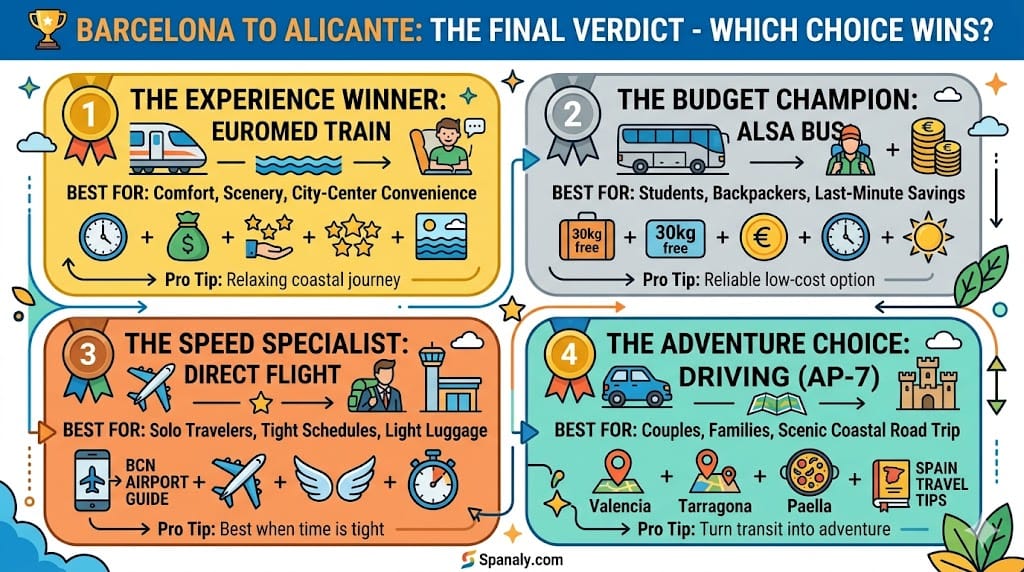
Choosing your 500 km journey from Barcelona to Alicante depends on your “Travel Personality.” Here is the Spanaly shortlist:
🥇 The Experience Winner: Euromed Train
Best for: Comfort, scenery, and city-center convenience.
Pro Tip: Choose this for a stress-free trip with the best Mediterranean views.
🥈 The Budget Champion: ALSA Bus
Best for: Students, backpackers, and last-minute savings.
Pro Tip: Great if you have heavy luggage (30kg free) and want to keep costs under €25.
🥉 The Speed Specialist: Direct Flight
Best for: Solo travelers with just a backpack and a tight schedule.
Pro Tip: Use our Barcelona El Prat Airport Guide to breeze through security.
🏅 The Adventure Choice: Driving (AP-7)
Best for: Couples or families who want to stop in Valencia or Tarragona.
Pro Tip: Perfect for those following our Essential Spain Travel Tips for a true road trip.
💡 Final Spanaly Hack: No matter which one you pick, book 3 weeks early. Prices on the Mediterranean corridor can double if you wait until the last minute!
📅 Best Time to Travel: Barcelona to Alicante

While both cities enjoy a glorious Mediterranean climate, the “perfect” time for your 500 km journey depends on whether you are chasing the sun, avoiding the crowds, or hunting for the best transport deals. For a broader look at the country’s seasons, don’t miss our master guide on the Best Time to Visit Spain.
☀️ Summer (June – August): The Beach Peak
The Vibe: Hot, vibrant, and crowded. This is the ultimate time for beach lovers heading to Alicante’s Postiguet or San Juan beaches.
Transport Tip: Book early! Train and bus prices are at their highest, and seats on the Euromed can sell out weeks in advance.
Average Temp: 28°C – 32°C.
🍂 Shoulder Season (April – May & September – October): The Spanaly Choice
The Vibe: This is our top recommendation. The weather is warm enough for the sea but pleasant enough for city walking.
The Perk: You’ll find much better availability for the Euromed train and more competitive rates for car rentals.
Average Temp: 20°C – 25°C.
❄️ Winter (November – March): The Budget Window
The Vibe: Mild and sunny compared to Northern Europe. While not “swimming weather,” Alicante remains one of the warmest places in mainland Spain.
The Perk: This is the cheapest time to fly or take the bus. You can often find last-minute bargains that aren’t available in the summer.
Average Temp: 12°C – 17°C.
🎉 Special Events to Watch For
If your travel dates are flexible, try to align your trip with these local highlights:
Late June (Alicante): The Hogueras de San Juan. The city erupts in a massive festival of fire, art, and parades. Expect transport to be packed!
September (Barcelona): La Mercè. Barcelona’s biggest street festival with free concerts and “Castellers” (human towers).
March (Valencia – Midway): If you are driving, stop for Las Fallas. It’s the perfect excuse for a Mediterranean road trip.
💡 Spanaly Pro Tips: Master Your Mediterranean Transit
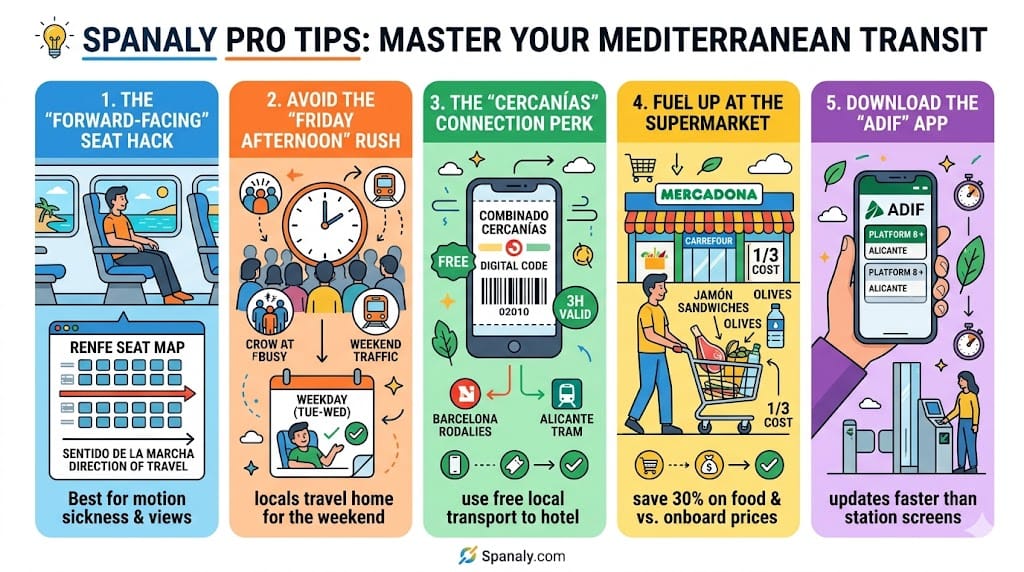
To truly travel like a local and avoid common tourist pitfalls, keep these “under-the-radar” tips in your travel arsenal:
1. The “Forward-Facing” Seat Hack
On Spanish trains, you can sometimes end up facing backward. If you get motion sickness or simply prefer looking forward, use the Renfe seat map during booking. Look for the arrow indicating the “Sentido de la marcha” (direction of travel) to ensure you’re facing Alicante.
2. Avoid the “Friday Afternoon” Rush
The Mediterranean corridor is a massive commuter route. From 2:00 PM on Fridays, trains and buses from Barcelona to Alicante fill up with locals heading home for the weekend. If possible, travel on a Tuesday or Wednesday for a much quieter experience and cheaper fares.
3. The “Cercanías” Connection Perk
Did you know your long-distance Euromed ticket often includes a “Combinado Cercanías” code? This allows you to use the local Barcelona Rodalies or the Alicante TRAM/Cercanías for FREE to reach your final hotel within 3 hours of your main trip. Don’t pay for a metro ticket if you don’t have to!
4. Fuel Up at the Supermarket (Mercadona)
While the train has a cafeteria and the bus stops at service stations, the prices are “tourist-inflated.” Stop at a Mercadona or Carrefour near Barcelona Sants before you board. Grab some Jamón sandwiches, fresh olives, and water for 1/3 of the price you’d pay on board.
5. Download the “Adif” App
For real-time updates on train platforms (which are often announced only 15 minutes before departure in Spain), use the Adif app. It usually updates faster than the station screens, allowing you to be first in line for boarding.
✨ One Last Secret: If you are driving and want the absolute best view of the coast without the highway noise, take a small detour through Altea. It’s the “Santorini of Spain” and is located just 45 minutes before you reach Alicante. It’s the perfect spot for a sunset photo!
🛡️ Visitor FAQs – Barcelona to Alicante Travel & Safety
🛡️ Is it safe to leave my luggage in the train or bus racks?
Yes, Spanish intercity transport is very secure. On the Euromed train, luggage racks are located at the ends of each carriage and are generally safe. However, for peace of mind, we recommend keeping your valuables (passports, electronics) in a smaller bag at your seat. For buses, your large suitcases are locked in the lower compartment, which is only opened by the driver at official stops.
🎫 Can I use my train ticket for free local transport in Alicante?
Yes! Your long-distance Renfe ticket includes a "Combinado Cercanías" code. In Alicante, you can use this digital code at the station's ticket machines to get a free local transit pass (Cercanías or TRAM) to reach your final destination or hotel, saving you extra costs upon arrival.
❄️ Is the air conditioning too cold on Spanish trains and buses?
This is a common surprise! Spain takes its Aire Acondicionado very seriously. Even in the height of summer, the interior of the Euromed train or ALSA bus can feel quite chilly. We highly recommend keeping a light jacket or a pashmina in your carry-on to stay comfortable during the journey.
🔌 Are there power outlets for my devices on all transport options?
On the Euromed train, every seat is equipped with a standard European power socket. On ALSA buses, most modern coaches (especially Supra and Premium) provide USB charging ports. However, low-cost flights like Vueling rarely have charging facilities, so make sure your power bank is ready if you choose to fly.
🥪 What if I get hungry during the 5-hour trip?
The Euromed train features a Cafetería carriage for coffee and sandwiches. ALSA buses often make a brief rest stop on longer routes. To save money, we recommend buying a fresh bocadillo from a local bakery near Barcelona Sants before you board.
Expertly curated by Spanaly.com – Your Mediterranean Travel Guide.
Whether you choose the panoramic Euromed train, a speedy flight, or a scenic road trip, your journey from Barcelona to Alicante is bound to be a highlight of your Spanish adventure.
✨ Final Checklist for a Perfect Trip:
✅ Book in Advance: Secure those €15-€30 fares at least 3 weeks early.
🚆 Choose the Left Side: Best sea views for the train ride south!
🔋 Charge Up: Keep your devices ready for those stunning coastal photos.
🥖 Pack a Snack: A fresh bocadillo makes any 5-hour journey better.
📍 Planning Your Next Move?
If you loved the vibe of this trip and want to keep heading further south along the coast, don’t miss our complete guide on traveling from Barcelona to Malaga for the ultimate Andalusian experience.
Safe travels, and enjoy the Mediterranean sunshine! ☀️🌊