
Table of Contents
Toggle🌍 Beyond the Language Barrier
Visiting Spain in 2026 transforms from a simple holiday into a deeply immersive journey when you master a few essential phrases. While you will find English speakers in major hubs like Seville or Madrid, making an effort to speak the local tongue is the ultimate sign of cultural respect. It opens doors to authentic experiences that most tourists miss.
Whether you are navigating the sun-drenched streets of Andalusia or exploring the rich world of Spanish Cuisine, knowing how to communicate with confidence is key. You don’t need to be fluent; you just need the right toolkit. This guide provides the most practical language tips to ensure your trip is smooth, respectful, and filled with “warmer” local interactions.
🤝 Why Learning Basic Spanish Matters in 2026
In 2026, travel is all about deep connection. Even a small effort to speak the local language can significantly enhance your experience across the Iberian Peninsula. Here is why it matters:
🏆 Better Service & Smiles: Locals deeply appreciate the effort. A simple greeting often rewards you with clearer directions and more authentic cultural encounters.
🎉 Festival Immersion: Understanding basic phrases is vital when attending vibrant Spanish Festivals. In these high-energy celebrations, a few words in Spanish help you blend in like a local.
🏘️ Neighborhood Secrets: In traditional areas—like Triana in Seville or the Albaicín in Granada—Spanish is the bridge to a truly memorable and friendly conversation that you won’t find in any guidebook.
🙏 Essential Spanish Greetings and Polite Expressions
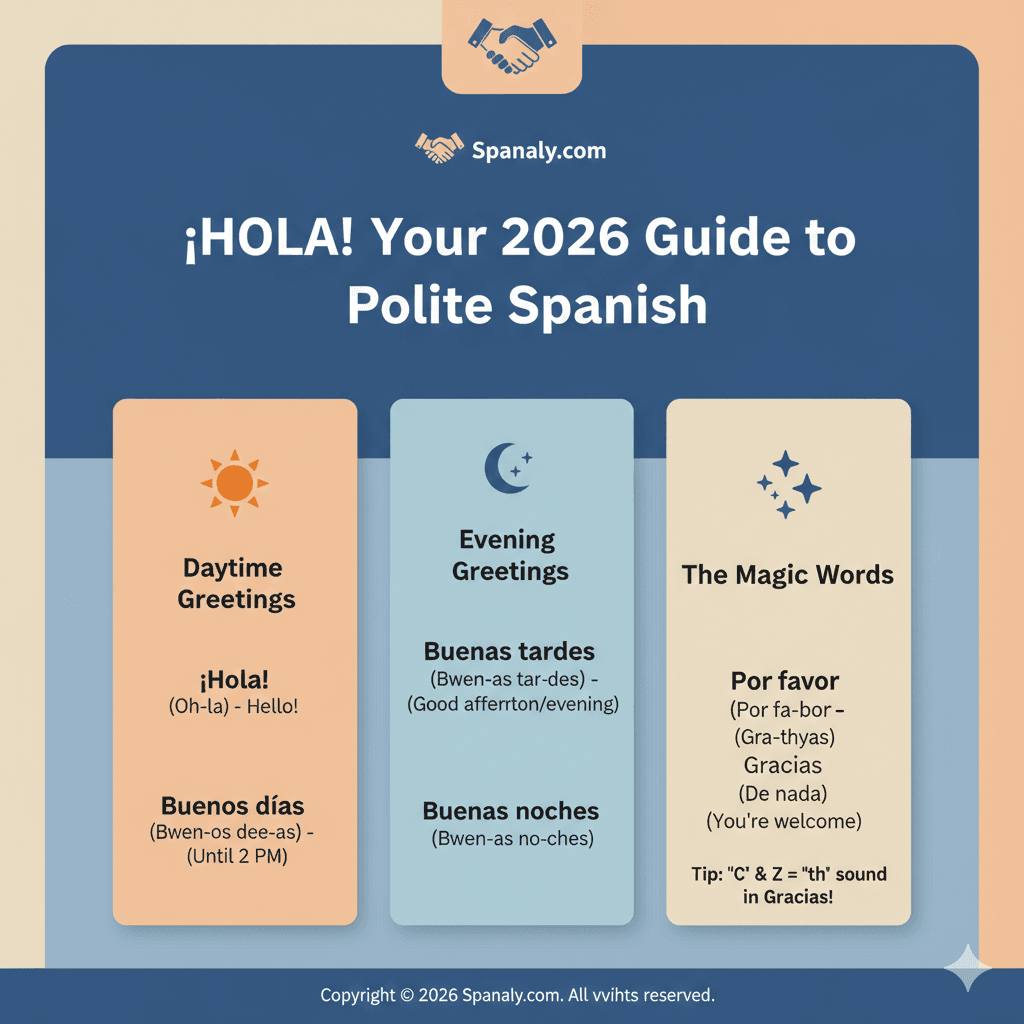
Politeness is the “golden key” to Spain. Starting every interaction with a proper greeting is expected and highly appreciated. Here are the must-know expressions for your 2026 trip:
🌞 Daytime Greetings:
¡Hola! (Oh-la): Hello! Use it anytime.
Buenos días (Bwen-os dee-as): Good morning. Use this until lunch (around 2:00 PM).
🌙 Evening Greetings:
Buenas tardes (Bwen-as tar-des): Good afternoon/evening.
Buenas noches (Bwen-as no-ches): Good night.
✨ The Magic Words:
Por favor (Por fa-bor): Please. Essential when visiting crowded Spanish Attractions.
Gracias (Gra-thyas): Thank you. In most of Spain, the “c” sounds like a soft “th”.
De nada (De na-da): You’re welcome
🆘 Survival Phrases & Emergency Essentials
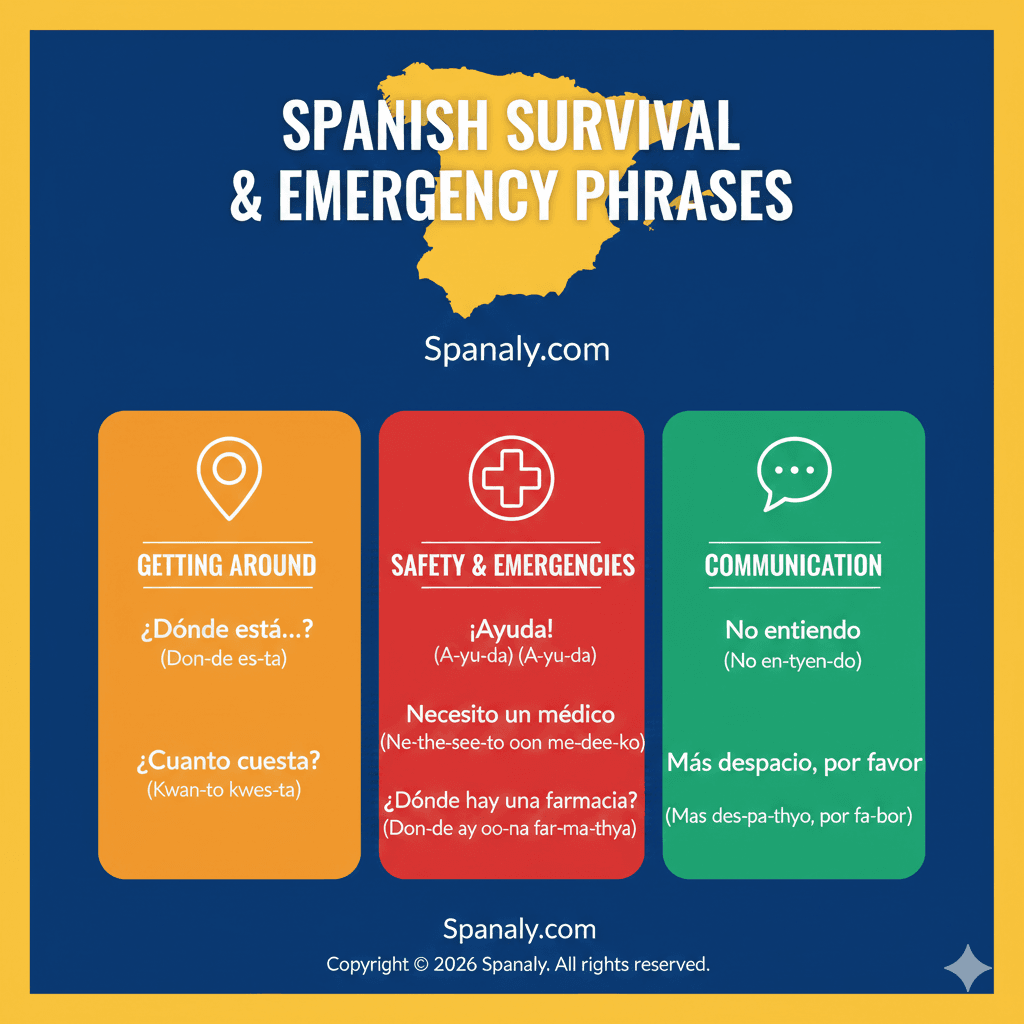
Navigating daily life in Spain becomes much smoother when you have these survival phrases ready. Whether you are exploring the bustling plazas mentioned in our Ultimate Madrid Travel Guide or lost in a quiet village, these expressions are your safety net:
📍 Getting Around:
¿Dónde está…? (Don-de es-ta): Where is…? (Useful for landmarks or hotels).
¿Cuánto cuesta? (Kwan-to kwes-ta): How much does it cost?
¿Habla inglés? (Ab-la een-gles): Do you speak English?
⚠️ Safety & Emergencies (New Essentials):
¡Ayuda! (A-yu-da): Help!
Necesito un médico (Ne-the-see-to oon me-dee-ko): I need a doctor.
¿Dónde hay una farmacia? (Don-de ay oo-na far-ma-thya): Where is a pharmacy?
He perdido mi bolsa (E per-dee-do mee bol-sa): I have lost my bag.
✅ Understanding Others:
No entiendo (No en-tyen-do): I don’t understand.
Más despacio, por favor (Mas des-pa-thyo, por fa-bor): More slowly, please.
🗣️ Spanish Pronunciation Tips for Beginners
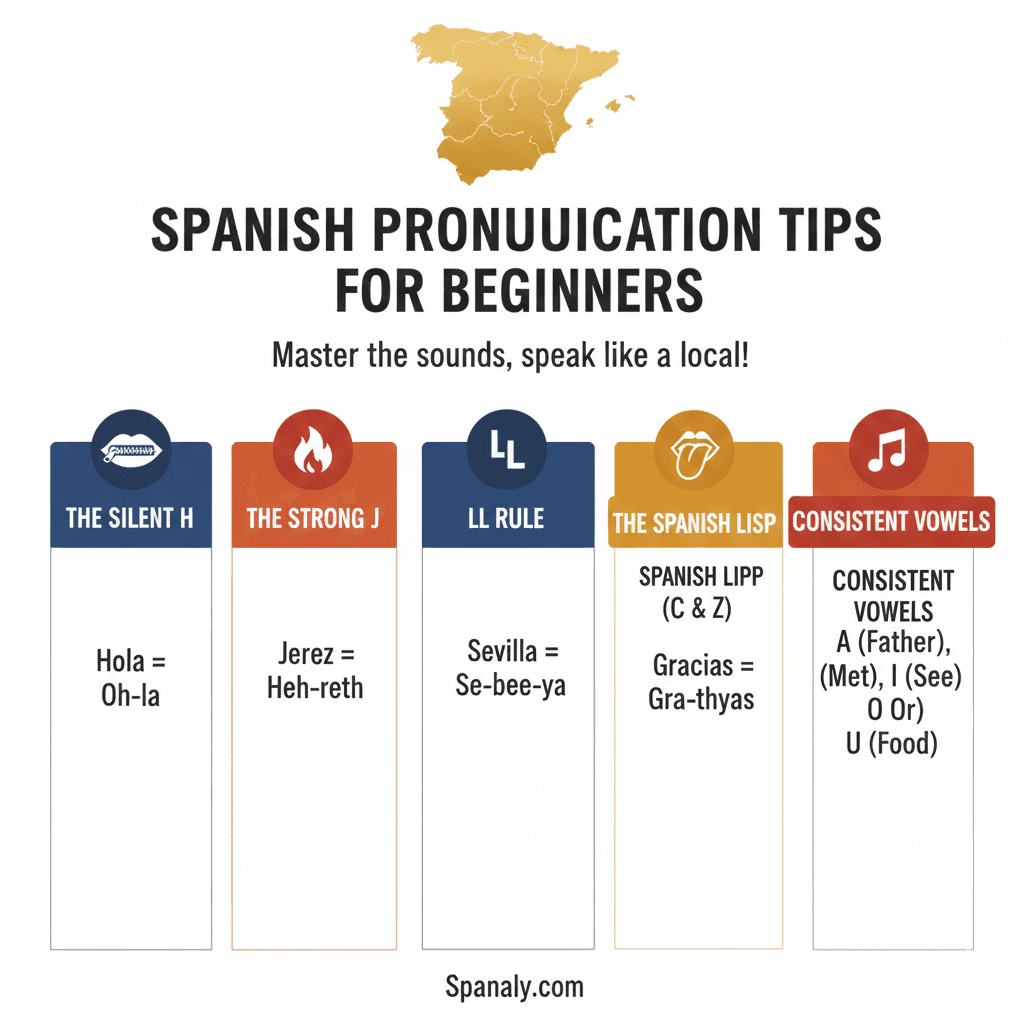
One of the best secrets for travelers is that Spanish is a phonetic language—it is pronounced exactly as it is written. Once you master a few simple rules, you can read any sign or menu during your trip, whether you are following our Ultimate Barcelona Travel Guide or wandering through local villages.
🤐 The Silent “H”: The letter “H” is always silent.
Example: Hola is pronounced “Oh-la” and Hotel is “Oh-tel.”
🔥 The Strong “J”: The letter “J” sounds like a breathy English “H.”
Example: Jerez (Heh-reth) or José (Ho-seh).
✨ The “LL” Rule: Double “LL” sounds like a “Y.”
Example: Sevilla is “Se-bee-ya” and Calle (street) is “Ka-yeh.”
👅 The Spanish Lisp (C & Z): In most of Spain, “C” (before E or I) and “Z” sound like the “th” in “think.”
Example: Gracias is “Gra-thyas.”
🍎 Consistent Vowels: Unlike English, Spanish vowels never change their sound:
A (Father), E (Met), I (See), O (Or), U (Food).
🔢 Useful Spanish Numbers and Time Expressions
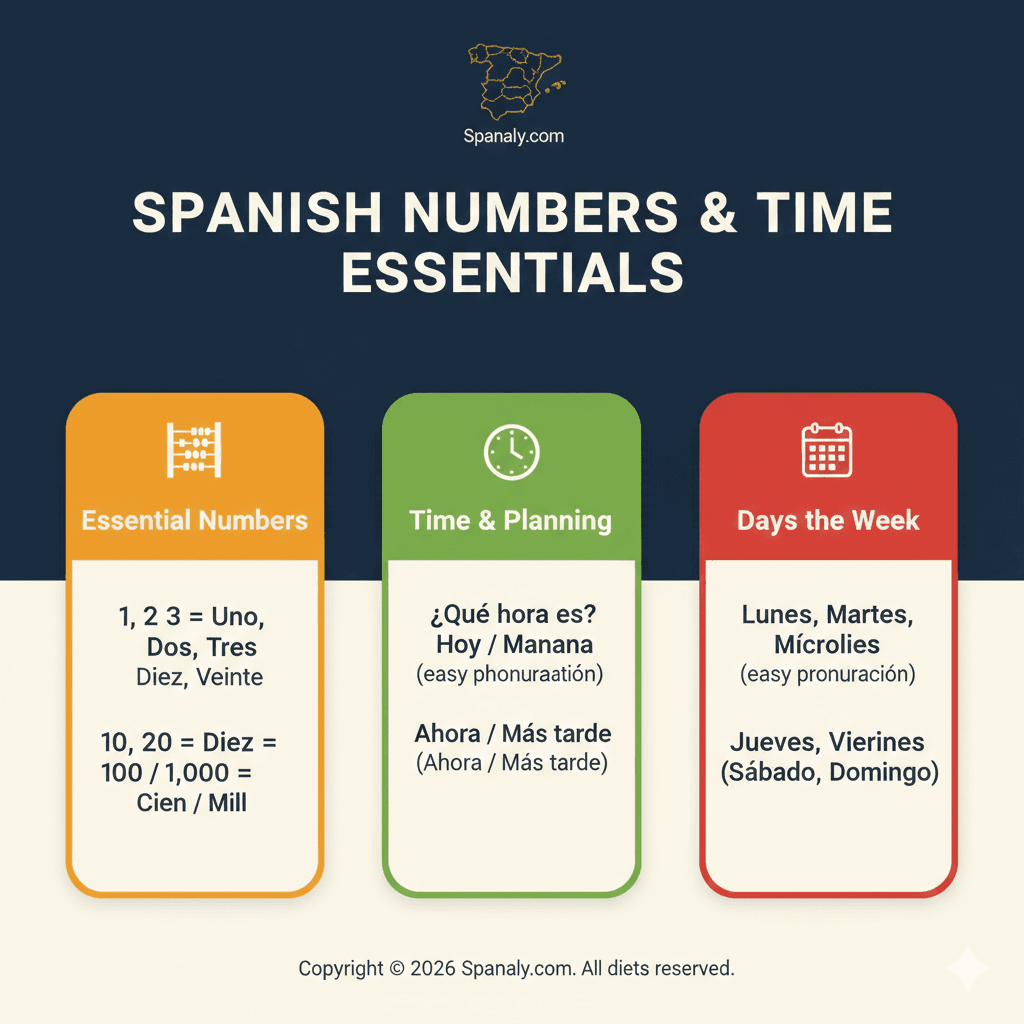
Understanding numbers and time is vital for checking train schedules, making restaurant reservations, or shopping at local markets. Whether you are booking a Flamenco show in our Ultimate Seville Travel Guide or catching a bus to the Alhambra, these essentials will keep you on schedule:
🔢 Essential Numbers:
1, 2, 3: Uno, Dos, Tres.
10, 20: Diez, Veinte.
100 / 1,000: Cien / Mil.
⏰ Time & Planning:
¿Qué hora es?: What time is it?
Hoy / Mañana: Today / Tomorrow.
Ahora / Más tarde: Now / Later.
📅 Days of the Week (New Essential):
Lunes, Martes, Miércoles: Monday, Tuesday, Wednesday.
Jueves, Viernes: Thursday, Friday.
Sábado, Domingo: Saturday, Sunday.
💃 The "Andalusian" Twist: Dropping Letter Sounds
If you are visiting southern cities like Seville, Granada, or Malaga, you might notice that the local accent is a bit different from what you hear in textbooks. In the heart of Andalusia, the language has a unique, rhythmic “flow.” Understanding this is essential, especially when following our Ultimate Seville Travel Guide to explore local hidden gems.
✂️ Dropping the “S”: Many Andalusians tend to “drop” the “s” sound at the end of words.
Instead of “Dos cervezas,” it might sound like “Do’ cerve’a”.
📉 The Disappearing “D”: Words ending in “-ado” often lose the “d” sound.
Example: “Pescado” (fish) often sounds like “Pesca’o”.
⚡ The Need for Speed: The southern accent is famously fast. Don’t worry if you don’t understand immediately.
Pro Tip: Simply smile and say: “Más despacio, por favor” (More slowly, please). They will be happy to slow down for you!
🍴 Dining Out: Mastering Tapas Etiquette
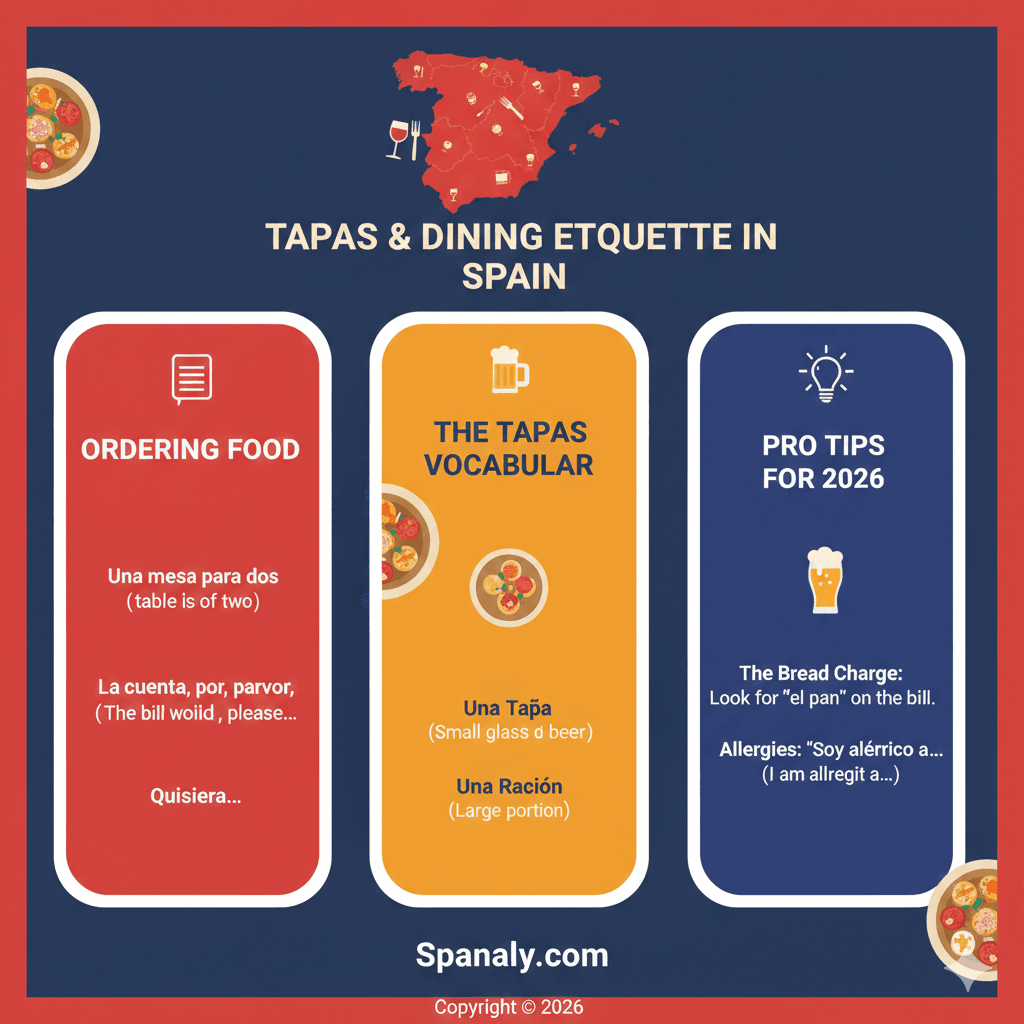
Eating is a sacred ritual in Spain, and the social culture around food is just as important as the flavor. Whether you are searching for the best local bites in our Spanish Attractions guide or hitting a hidden tavern, these phrases will help you eat like a true Spaniard:
🥘 Ordering Food:
Una mesa para dos: A table for two.
La cuenta, por favor: The bill, please (The most vital phrase!).
Quisiera…: I would like… (A polite way to order).
🍺 The “Tapeo” Vocabulary:
Una Caña: A small, chilled glass of beer (The standard order).
Una Tapa: A small snack or saucer-sized portion.
Una Ración: A large portion intended for sharing (Para compartir).
💡 Pro Tips for 2026:
The Bread Charge: Don’t be surprised if you see a small charge for “el pan” (bread) on your bill; it’s a standard practice in many regions.
Allergies: If you have dietary needs, say: “Soy alérgico a…” (I am allergic to…) or “Sin…” (Without…) followed by the ingredient.
🤝 Beyond Words: Spanish Cultural Etiquette
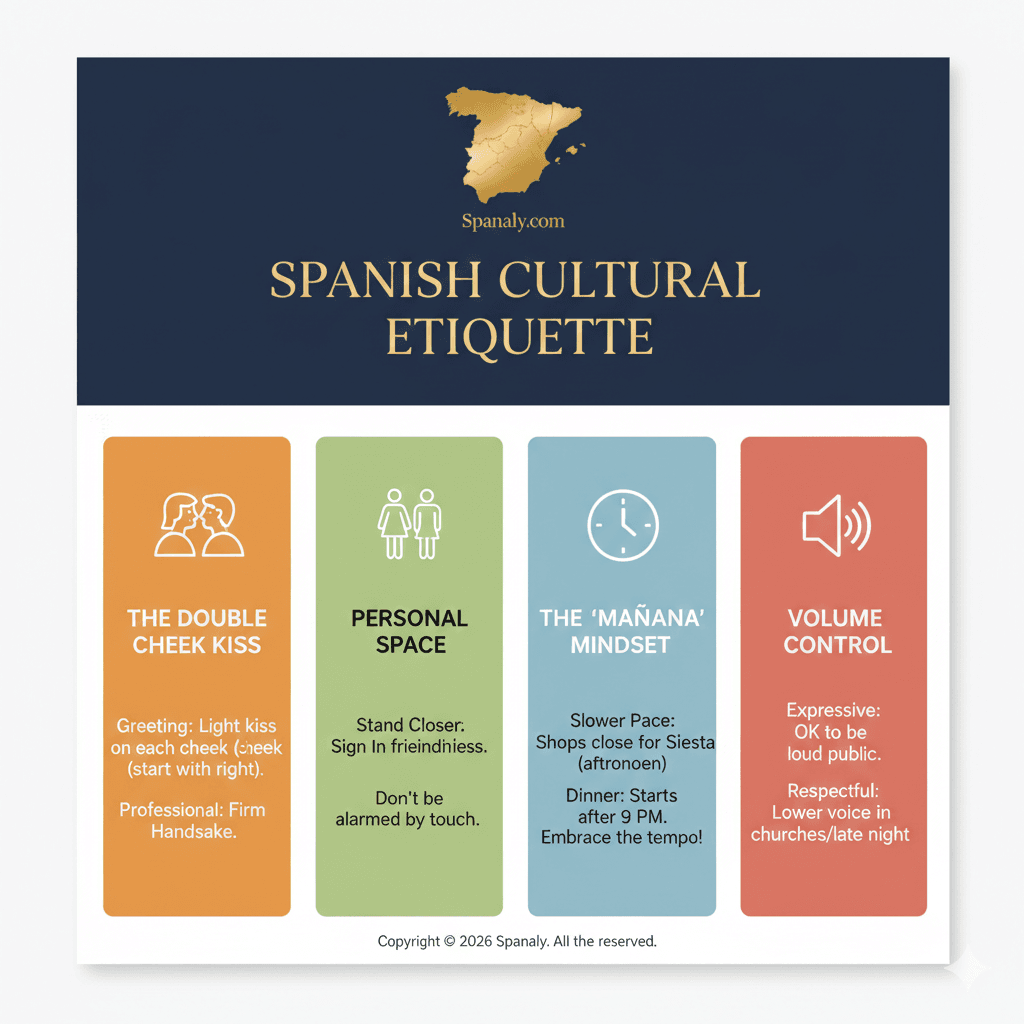
In Spain, communication is more than just words; it’s about gestures, proximity, and timing. Understanding these unwritten rules will help you connect with locals more authentically during Spanish Festivals or even in simple daily interactions.
💋 The Double Cheek Kiss: When meeting friends or being introduced in a social setting, the common greeting is a light kiss on each cheek (starting with the right). In professional settings, a firm handshake is the standard.
📏 Personal Space: Spaniards tend to stand closer together when talking than people in many other cultures. Don’t be alarmed if someone touches your arm while speaking—it’s a sign of friendliness and engagement!
🕒 The “Mañana” Mindset: Life in Spain moves at a different pace. Shops often close for a few hours in the afternoon (the Siesta period), and dinner usually starts late (after 9:00 PM). Embrace the slower tempo!
🤫 Volume Control: Spaniards are expressive and can be loud in public spaces. However, in churches or quiet neighborhoods late at night, it is important to lower your voice out of respect.
💡 How to Communicate Without Fluency
You don’t need to be a master of grammar to have a successful trip. These Basic Spanish Language Tips for Travelers focus on getting the message across effectively:
🖐️ Use Natural Gestures: Pointing at a menu or using hand signals for “the bill” (miming writing in the air) is common and perfectly accepted in Spain.
🐢 Speak Slowly, Not Louder: If someone doesn’t understand you, increasing your volume won’t help. Speak slowly and use simple, single words.
🔄 Combine Languages: It is perfectly okay to mix. Saying “Hola, one café con leche, please” is much better than not trying at all.
😊 Smile and Be Patient: A friendly smile is a universal language. If you are patient and polite, locals will often go out of their way to help you.
📲 Recommended Tools for Your Journey
Keep these digital resources at your fingertips to boost your confidence on the go:
Google Translate (Offline Mode): Download the Spanish dictionary so you can translate menus even without Wi-Fi.
DeepL: Excellent for more nuanced and natural translations if you need to understand a longer text.
SpanishDict: The best app for quick vocabulary lookups and specific travel-related nouns.
Pocket Phrasebooks: Carrying a small physical guide is often faster than unlocking your phone in a busy, sunny market.
✅ Quick Travel Tips: The Do’s and Don’ts
If you remember nothing else from this guide, keep these four golden rules in mind:
✔️ DO: Use “¡Hola!” and “Perdone” constantly. These two words are your best friends for getting positive attention and help from locals.
✔️ DO: Try the local “Lisp.” Pronouncing “C” and “Z” as “th” (like in Gracias) will make you sound much more like a local.
❌ DON’T: Shout. Many travelers mistakenly speak louder when they aren’t understood. It’s better to speak slowly and use simple nouns.
❌ DON’T: Expect English everywhere. While common in tourist centers, English is less frequent in local markets or smaller villages.
🗣️ Visitor FAQs – Basic Spanish for Travelers 2026
🗣️ Do I need to be fluent in Spanish to travel in Spain?
No, but basic phrases go a long way. In major cities like Madrid, Barcelona, or Seville, English is common in hotels and large restaurants. However, in local markets or traditional tapas bars, knowing a few words like "Hola" (Hello) and "Gracias" (Thank you) will earn you warmer smiles and much better service.
🇪🇸 How will locals react if my Spanish is not perfect?
Spaniards are incredibly encouraging and patient. They value the effort of trying to speak their language more than perfect grammar. Don't be afraid to make mistakes—locals will often help you with the correct word and appreciate your interest in their culture.
🍴 What are the essential phrases for eating out?
Start with "Una mesa para dos, por favor" (A table for two, please). When ordering, use "Quisiera..." (I would like...) followed by the dish name. And the most important phrase at the end: "La cuenta, por favor" (The bill, please). Knowing these will make your dining experience smooth and authentic.
🎧 Why does the accent in Seville and Andalusia sound so fast?
Andalusians have a distinctive and rhythmic accent; they often drop the final "s" of words or the "d" in endings like "-ado". It may sound like a different language at first! If you're struggling, politely say "Más despacio, por favor" (Slower, please), and they will be happy to accommodate you.
📱 Can I rely solely on translation apps?
Translation apps are great for menus or translating signs, but they can be a barrier to human connection. Use them as a backup, but try to use your voice for greetings and simple requests. A smile combined with a basic "Perdón" (Excuse me) is much more effective than pointing at a screen.
Language & Culture Tips by Spanaly.com
✔️ Your Journey Starts with a “Hola”
Learning Basic Spanish Language Tips for Travelers is the most rewarding investment you can make for your trip to Spain. It’s not about perfect conjugation; it’s about showing respect and opening doors to authentic experiences that most tourists miss.
Whether you are navigating the historic streets of Seville, enjoying the coastal vibes of Barcelona, or exploring the grand plazas of Madrid, remember that a little effort goes a long way. Use these phrases, trust your translation apps as a backup, and most importantly, keep smiling.
¡Buen viaje! (Have a great trip!)