Table of Contents
Toggle✨ A Spiral of Flavor and Heritage
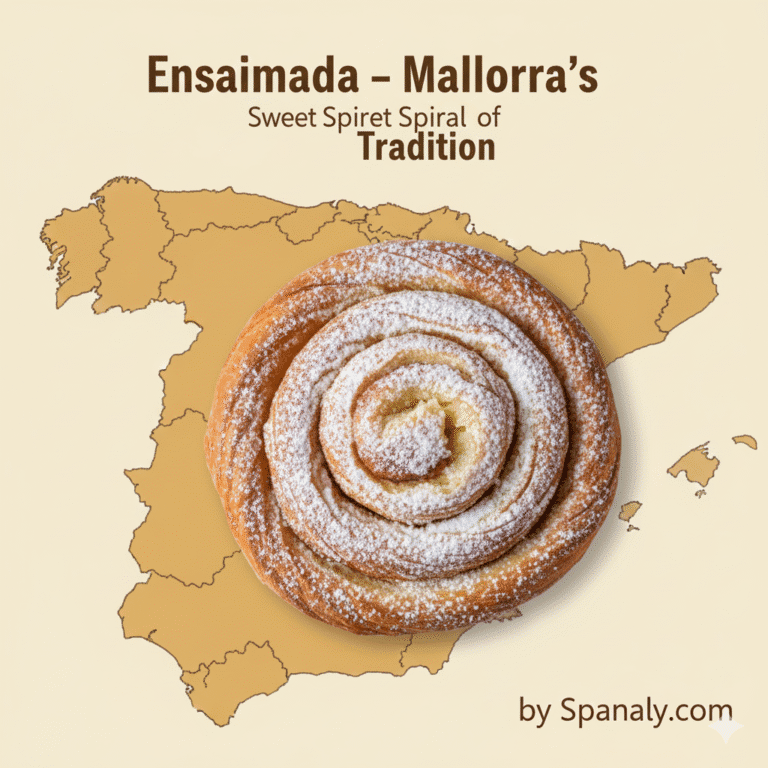
Some pastries transcend being mere food; they become cultural icons. The Ensaimada de Mallorca is exactly that. In the sun-soaked kitchens of the Balearic Islands, bakers craft this soft, spiral-shaped delight with a level of patience that borderlines on meditation.
When you land at Palma Airport, you’ll see travelers clutching the iconic octagonal cardboard boxes like treasures. But the Ensaimada is more than a souvenir; it is a centuries-old connection to Mallorcan identity, accompanying every celebration from sunrise breakfasts to festive weddings.
🏛️ Deep Dive: To see how this sweet spiral fits into the broader mosaic of Spanish flavors, explore our Spanish Cuisine hub.
📜 A Heritage Wrapped in Dough
The Ensaimada first appeared in the 17th century. Old Mallorcan manuscripts describe a coiled bread enriched with saïm—pork lard. The pastry’s name, Ensaimada, directly reflects this defining ingredient.
Some food historians believe the recipe has Arab-Andalusian roots, inspired by coiled pastries made during Moorish times. Still, the use of lard clearly marks the post-Islamic era in Mallorca. Over centuries, the Ensaimada evolved into a beloved specialty, enjoyed during holidays, festivals, and family gatherings.
By the early 2000s, the pastry had become so closely tied to Mallorca that authorities granted it Protected Geographical Indication (PGI) status. Only Ensaimadas produced on the island now carry the prestigious name Ensaimada de Mallorca.
🎨 The Art of Making Ensaimada: The Secret Steps

Creating the perfect Ensaimada is not a task for the rushed. It is a slow, rhythmic process that blends tradition with precision.
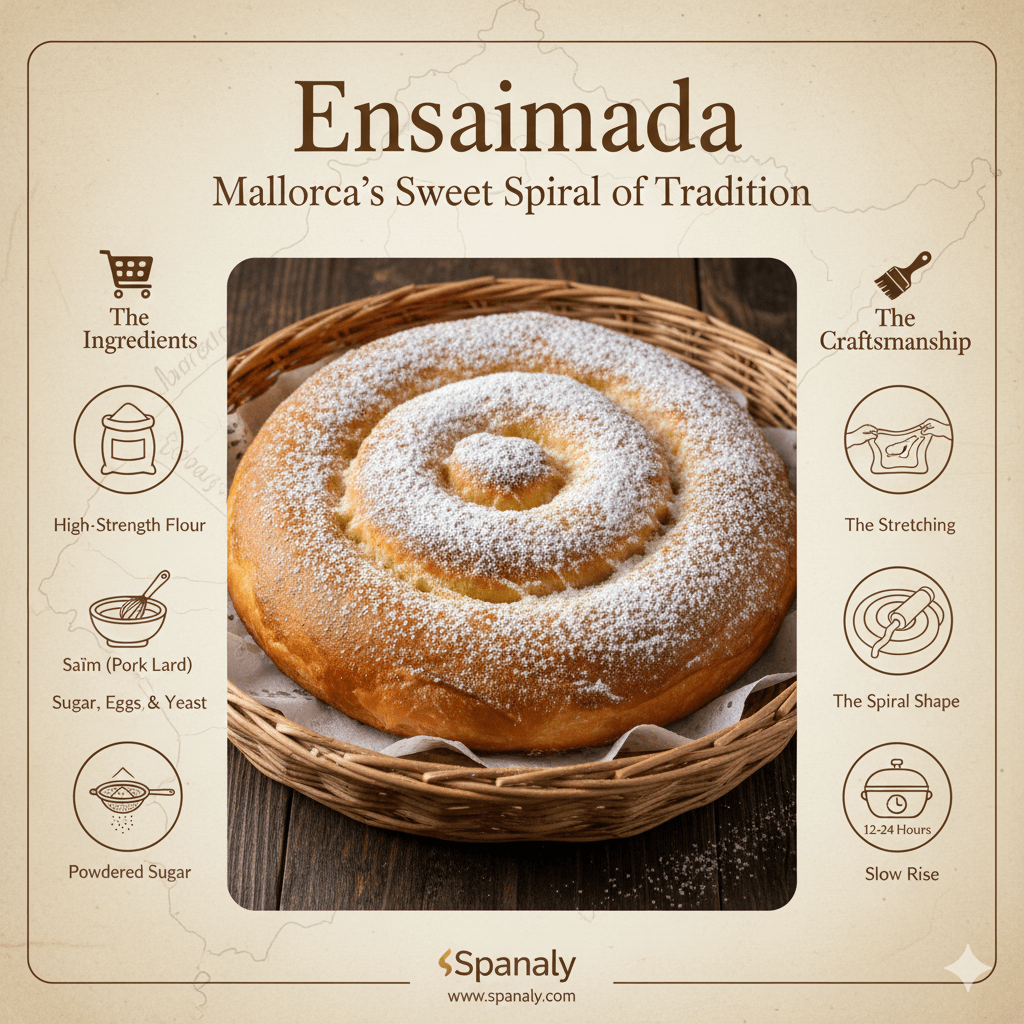
🛒 The Ingredients (The Authentic Base)
High-Strength Flour: To handle the extreme stretching.
Saïm (Pork Lard): The secret to the legendary flaky layers.
Sugar, Eggs, & Yeast: For the perfect lift and sweetness.
Powdered Sugar: For that final, snowy “Mallorcan” finish.
👨🍳 The Craftsmanship (Technique)
The Stretching: Bakers pull the dough until it is paper-thin and translucent—so thin you can almost see the history through it.
The Lard Layer: A generous layer of saïm is brushed over the dough, creating the lamination that makes it melt in your mouth.
The Spiral Shape: Rolling the dough into a tight, golden coil symbolizes continuity and celebration.
The Slow Rise: The dough must rest and ferment for at least 12 to 24 hours to achieve its signature lightness.
🍯 Varieties: From Classic to Creative
Not all Ensaimadas are identical. Each variation tells a slightly different story:
Ensaimada Lisa: The plain version, simple yet divine, perfect for purists.
Ensaimada de Cabell d’Àngel: Filled with sweet pumpkin jam made from candied squash fibers. A true local favorite.
Chocolate Ensaimada: Modern creation that delights every chocolate lover.
Cream-Filled Ensaimada: Rich and festive, often enjoyed during holidays.
Fruit or Custard Ensaimada: A newer innovation blending Mediterranean flavors.
Each bakery has its secrets. Some make the pastry lighter, others denser. Yet, all preserve the spiral shape that defines Mallorca’s most iconic dessert
🍰 Sweet Comparisons: If you enjoy the delicate almond notes in Spanish desserts, you must also try the legendary Tarta de Santiago from Galicia.
📍 Where to Taste the Best Ensaimadas
If you want an authentic taste, visit bakeries that craft Ensaimadas by hand:
Forn Fondo (Palma): Established in 1748, one of the oldest and most cherished bakeries.
Ca’n Joan de s’Aigo: Famous for pairing Ensaimadas with thick Mallorcan hot chocolate.
Fornet de la Soca: Known for artisanal methods and historical recipes.
Panadería S’Estació (Inca): A hidden gem for traditional island flavors.
Official Tourism Reference: Visit Mallorca – Traditional Gastronomy
🌍 Beyond Borders: A Global Journey
The Ensaimada’s spiral has reached far-flung corners of the globe. In the Philippines, it evolved into the Ensaymada, topped with cheese and butter. In Puerto Rico and Argentina, it adapted to local tastes with guava and coconut. Yet, the signature swirl remains—a universal symbol of warmth and shared memory.
Just as a warm bowl of Escudella i Carn d’Olla warms the heart in Catalonia, the Ensaimada brings a gentle sweetness to mornings across the Spanish world.
🥐 Visitor FAQs – Authentic Mallorcan Ensaimada
✨ What exactly is "Saïm" and why is it used?
Saïm is the Mallorcan word for pork lard. It is the core of the Ensaimada, giving the pastry its unique flaky texture. To maintain the Protected Geographical Indication (PGI) status, a true Ensaimada de Mallorca must use lard.
✈️ Can I take an Ensaimada on a flight?
Yes! The iconic octagonal cardboard boxes are designed for travel. Most airlines at Palma Airport (PMI) allow these boxes as a separate carry-on item, but it’s always wise to check your specific airline's "pastry policy" before boarding.
⏳ How long does an Ensaimada stay fresh?
A plain (Lisa) version stays fresh for 3 to 5 days. Filled versions (cream or custard) must be eaten within 24 hours. To revive a slightly dry one, give it 10 seconds in a preheated oven to soften the lard layers.
🍃 Is there a vegetarian version available?
Traditionally no, as lard is essential. However, some modern bakeries offer Ensaimada de aceite (made with olive oil) for those who don't eat pork. While tasty, the lard version remains the only "official" one.
🎃 What is "Cabell d’Àngel" filling?
It translates to "Angel's Hair"—a sweet jam made from the golden fibers of the Siam squash (pumpkin). It is the most traditional filling, providing a honey-like contrast to the salty-sweet dough.
Created by Spanaly.com
The Ensaimada is more than a pastry. Each layer carries echoes of Mallorcan kitchens, the hum of Palma’s streets at dawn, and the rhythm of island life.
Its spiral symbolizes continuity — generations folding traditions over one another. Like the dough that rests and rises, the Ensaimada evolved over centuries, shaped by patient hands.
Tasting an Ensaimada is tasting Mallorca itself: the gentle sweetness of mornings, the warmth of its people, and the pride of a land that transforms simplicity into art.
Even thousands of miles away, the Ensaimada maintains its voice. Cafés in Palma, family kitchens in Manila, or bakeries in Buenos Aires all share the same story: tradition is not preserved by remaining still, but by being shared, savored, and loved.