
Table of Contents
Toggle🍅 Gazpacho Andaluz
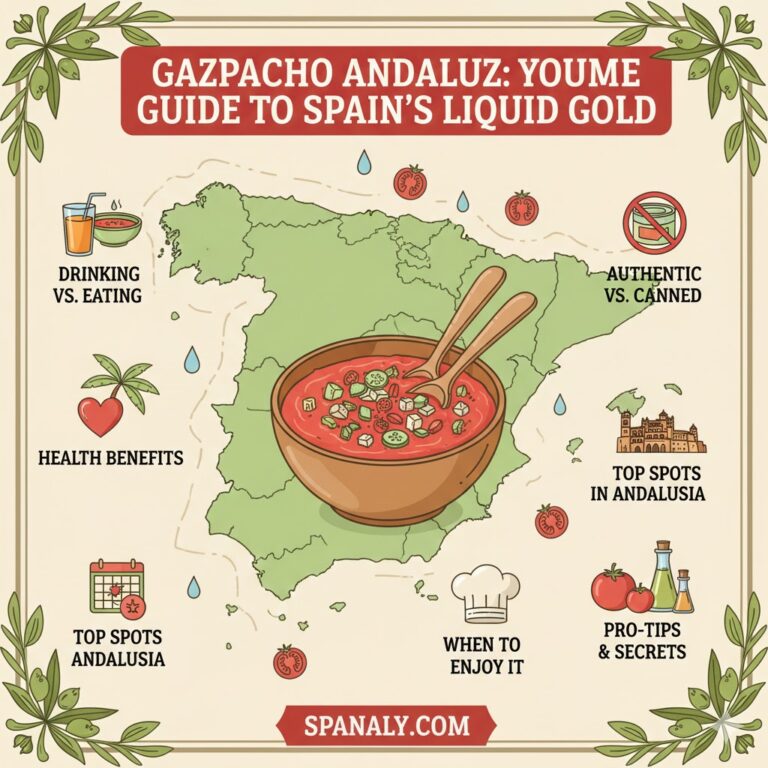
When the Andalusian sun hits its peak, locals turn to one legendary remedy: Gazpacho Andaluz. This vibrant cold soup is more than a dish; it is a refreshing ritual that captures the Mediterranean lifestyle in a single glass.
🌿 Pure Freshness: We use only raw, sun-ripened vegetables for an authentic taste.
💪 Nutrient Boost: This “liquid salad” provides essential vitamins and natural hydration.
✨ Total Versatility: Serve it as an elegant starter or a chilled drink on the go.
🇪🇸 Spanish Heritage: A humble peasant meal that became a global culinary icon.
The secret to a perfect Gazpacho lies in the quality of your olive oil. Indeed, knowing the Cost of Living in Spain shows how affordable these premium local ingredients can be. Whether you are a chef or a home cook, fresh produce is your key to success.
📜 A Sip Through History: From Peasant Roots to Global Fame
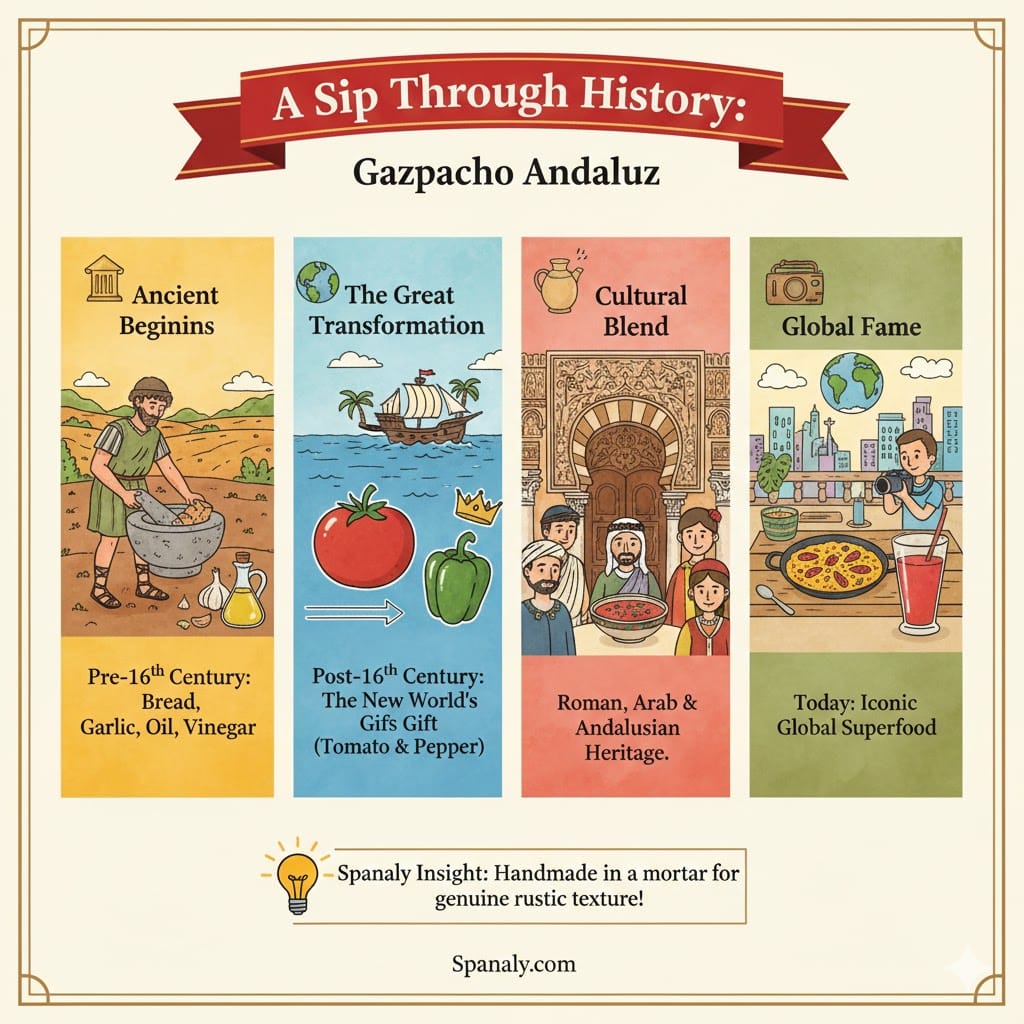
The story of Gazpacho Andaluz begins in the sun-drenched fields of Southern Spain. Long before it graced fine dining tables, it served as a vital survival tool for farmers seeking relief from the heat.
🏛️ Ancient Beginnings: The original version existed before tomatoes arrived in Europe. It relied on a simple mix of bread, garlic, water, and olive oil.
🌍 The Great Transformation: In the 16th century, the addition of tomatoes and peppers turned the soup into the vibrant red icon we love today.
🏺 Cultural Blend: Much like the Basic Culture Etiquette In Spain you learn for travel, Gazpacho represents a mix of Roman and Arab influences.
🥘 Global Fame: What started as a humble laborer’s lunch evolved into a cornerstone of the Spain Food Guide found worldwide.
💡 Spanaly Insight: Respect the texture! Historical Gazpacho was often “pounded” by hand in a mortar. Therefore, we recommend using a high-quality blender today to honor that traditional smoothness without the manual labor.
⚖️ Gazpacho vs. Salmorejo: The Key Differences
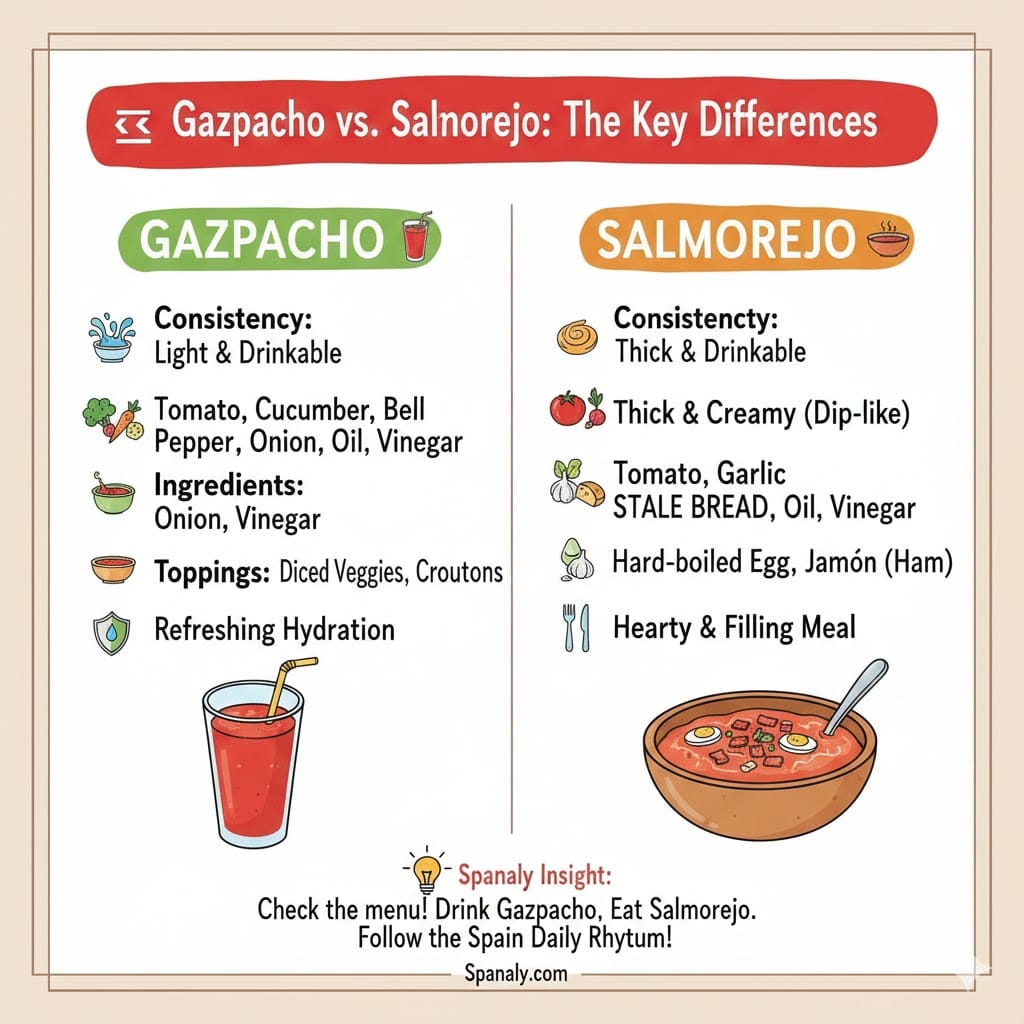
Many travelers confuse Spain’s two most famous cold soups. While both share a red tomato base, they offer completely different culinary experiences.
🥣 Consistency: Gazpacho is a light, drinkable soup. In contrast, Salmorejo is thick and creamy, often served as a rich dip.
🥦 Ingredients: Gazpacho includes cucumber, onion, and bell peppers for freshness. Salmorejo focuses strictly on tomatoes, garlic, and bread.
🥚 Toppings: We serve Gazpacho plain or with diced veggies. However, Salmorejo always features hard-boiled eggs and savory Jamón (Spanish ham) on top.
🥗 Purpose: Think of Gazpacho as “liquid salad” for hydration. Salmorejo is a filling, hearty starter that packs more calories.
💡 Spanaly Insight: Check the menu carefully! If you want a refreshing drink to beat the heat, go for Gazpacho. If you want a spoonable, satisfying meal, Salmorejo is your best bet. Follow the Spain Daily Rhythm to enjoy them like a local.
🛒 The Essential Ingredients: Quality is Key
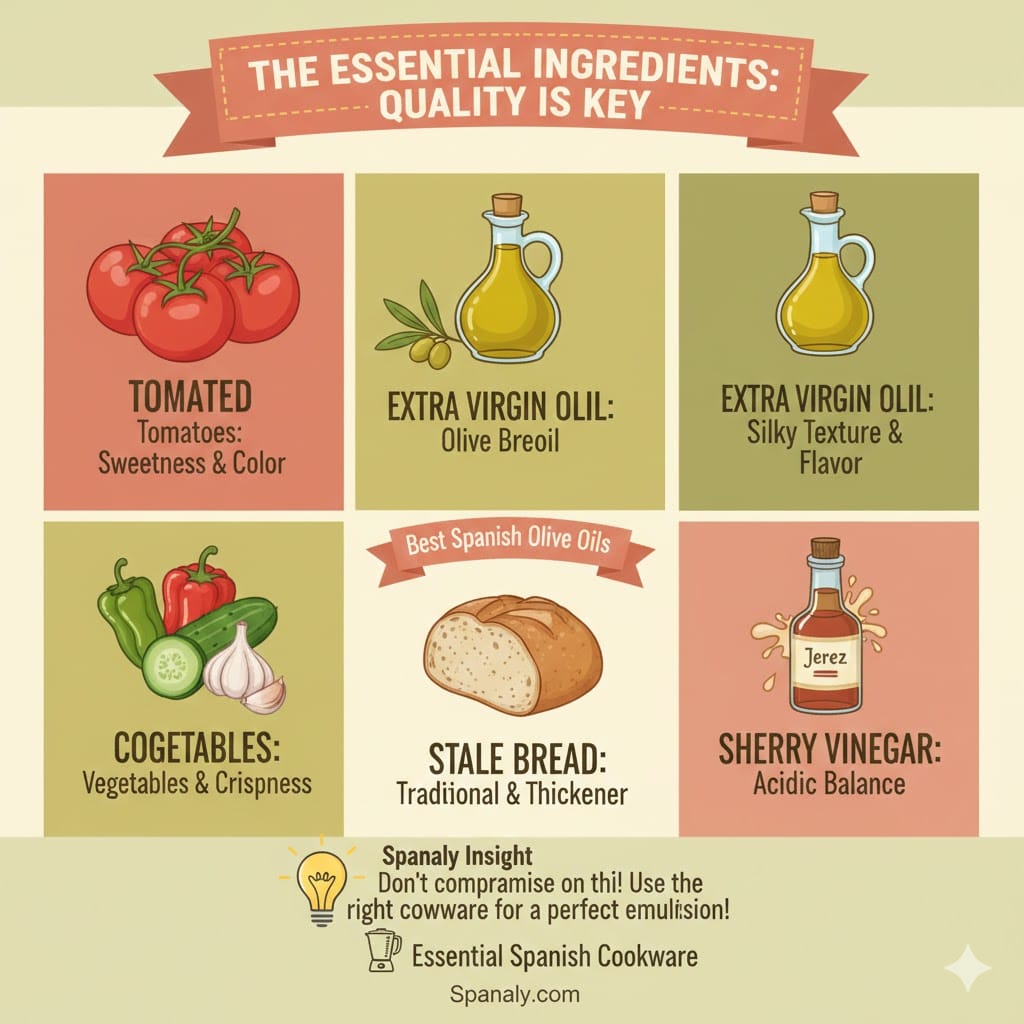
To create an authentic Gazpacho, your produce must be at its peak. In Andalusia, we say the soup is only as good as the tomatoes you choose.
🍅 Vine-Ripened Tomatoes: Use the reddest, juiciest ones available. They provide both the base sweetness and the iconic color.
🫒 Extra Virgin Olive Oil: This is non-negotiable for a silky texture. Selecting from the Best Spanish Olive Oils defines the final flavor profile.
🥒 Cooling Vegetables: Green Italian peppers and cucumbers provide that essential refreshing bite.
🥖 The Thickener: A small amount of stale bread helps bind the emulsion, though you can omit it for a lighter, gluten-free version.
🍷 Sherry Vinegar: Known as Vinagre de Jerez, this adds the sophisticated acidic balance that makes the soup pop.
💡 Spanaly Insight: Don’t compromise on the oil! Since Gazpacho is a raw soup, the flavor stays prominent. We recommend using the right Essential Spanish Cookware to emulsify your oil and vegetables into a perfectly smooth masterpiece.
👨🍳 The Master Method: Achieving Perfect Texture

Creating a high-end Gazpacho is a meticulous dance between timing and technique. The goal is a velvety, orange-red emulsion that feels like silk on the palate.
🥗 The Marinade: Roughly chop your vegetables and let them sit with salt and vinegar for 30 minutes. This “sweating” process releases natural juices and intensifies the flavor.
🌪️ High-Speed Blending: Blend the mixture for at least 5 minutes. Using the right tools from our Essential Spanish Cookware guide is vital to break down every fiber.
🧴 The Emulsion: Slowly drizzle in your olive oil while the blender is running. This creates a stable, creamy bond between the water and fat.
🕸️ The Fine Strain: For a “fine-dining” result, pass the soup through a fine-mesh strainer (Chinois). This removes any remaining seeds or skin fragments.
❄️ The Deep Chill: Never serve Gazpacho immediately. It requires at least 3 hours in the fridge to let the flavors marry and reach its refreshing peak.
💡 Spanaly Insight: Master the timing! In Spain, we often serve this during the peak heat of the day. If you want to eat like a pro, learn How to Order Food Like a Local in Spain to ensure you get the freshest batch of the day.
🥤 Drinking vs. Eating: The Golden Rules of Serving

In Spain, how you serve Gazpacho depends entirely on the setting and the time of day. While technically a soup, it often functions as a refreshing beverage.
🥂 The Glass Method: In many tapas bars, we serve Gazpacho in a chilled glass. This version is perfectly smooth, allowing you to drink it like a savory, healthy smoothie.
🥣 The Bowl Method: When served as a formal starter, it comes in a shallow bowl. This style usually has a slightly thicker body to support various fresh garnishes.
🥗 Traditional Toppings: Authentic Gazpacho in a bowl is never “plain.” Expect finely diced cucumber, onion, and crunchy croutons on top for a delightful texture contrast.
☀️ The Noon Ritual: Locals enjoy a glass as a midday refresher. It is the perfect way to stay energized while Getting Around Seville or exploring the sun-drenched streets of Andalusia.
💡 Spanaly Insight: Know your portions! If you see “Vaso de Gazpacho” on a menu, it is a drink. For a full experience, pair it with Traditional Sevillian Tapas to balance the refreshing acidity of the soup with savory local bites.
🚫 Avoid the Cans: How to Spot Authentic Gazpacho
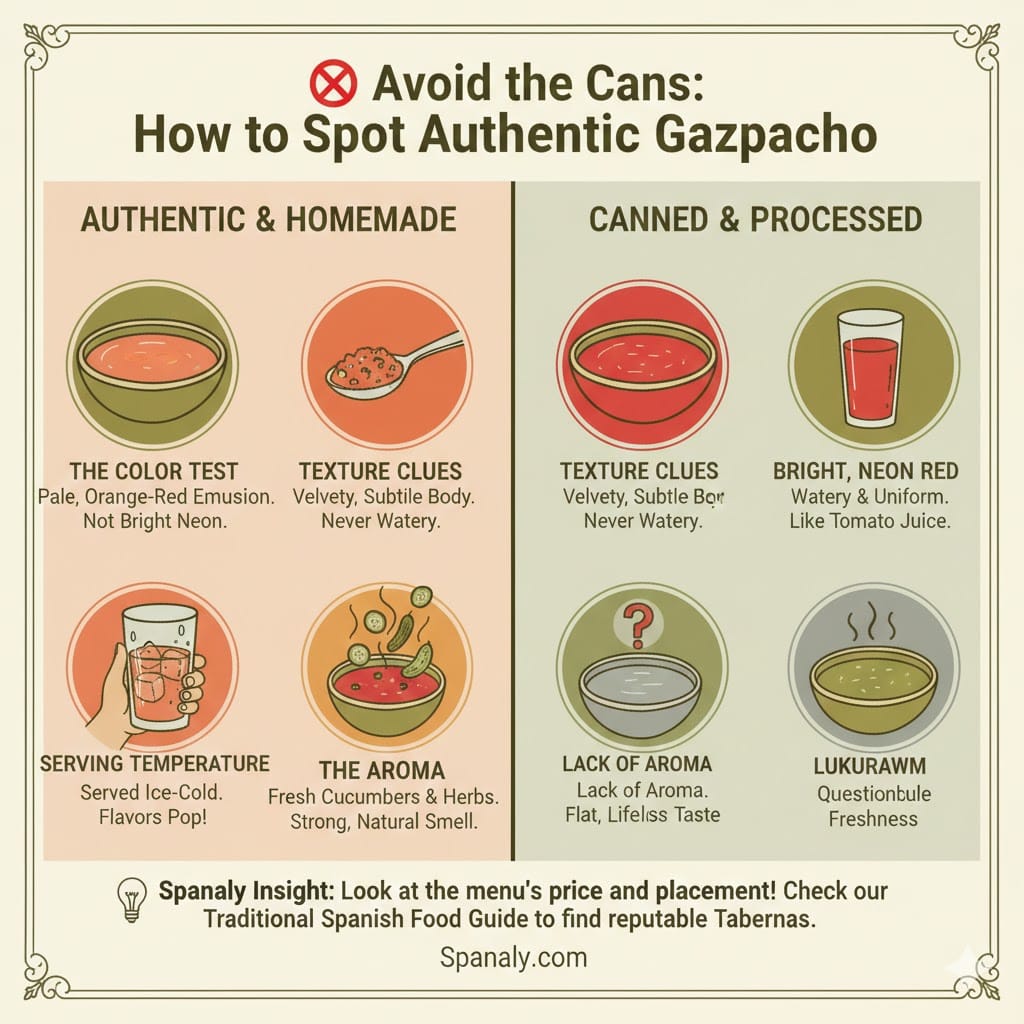
In popular tourist areas, some restaurants might serve bottled or canned versions. Learning to spot the “real deal” is essential for an authentic Andalusian experience.
🎨 The Color Test: Authentic Gazpacho is rarely bright neon red. Due to the emulsion of olive oil, it should have a slightly orange or pale red hue.
🥣 Texture Clues: If it feels too watery or perfectly uniform like tomato juice, it’s likely processed. Real Gazpacho has a subtle, velvety body from fresh vegetables.
👃 The Aroma: Freshly made soup smells strongly of cucumbers and high-quality vinegar. If it lacks aroma, it has probably been sitting on a shelf.
🧊 Serving Temperature: A true local spot will serve it ice-cold. If it’s lukewarm, the flavors won’t pop, and the freshness is questionable.
💡 Spanaly Insight: Look at the menu’s price and placement! Authentic, house-made Gazpacho is a pride of the kitchen. If you’re unsure, check our Traditional Spanish Food Guide to know what quality standards to expect from a reputable Taberna.
🏥 Health Benefits: The Mediterranean’s Liquid Gold

Gazpacho isn’t just a culinary delight; it is a nutritional powerhouse. In Andalusia, we view it as a liquid shield against the summer heat and a cornerstone of the Mediterranean diet.
🍅 Lycopene Boost: Cooked tomatoes are famous for lycopene, but raw tomatoes in Gazpacho provide a massive dose of this antioxidant, known for heart health and skin protection.
🛡️ Vitamin Explosion: Since the vegetables are never heated, you get 100% of the Vitamin C, Vitamin A, and Vitamin E. It’s a natural multivitamin in a glass.
💧 Natural Hydration: With its high water content and essential salts from sea salt and vinegar, it acts as a natural isotonic drink to keep you hydrated.
🧄 Immune Support: Raw garlic and onions provide powerful antimicrobial and anti-inflammatory benefits, helping your body stay resilient while traveling.
⚖️ Weight Management: High in fiber and low in calories, it’s the perfect satisfying snack that aligns with a healthy Spain Daily Rhythm.
💡 Spanaly Insight: Think of Gazpacho as your “travel fuel.” To stay safe and energized during your Spanish adventures, check our Travel Safety in Spain guide for more tips on staying healthy and secure while exploring our beautiful cities.
📍 Top Spots: Where to Find the Best Gazpacho in Andalusia
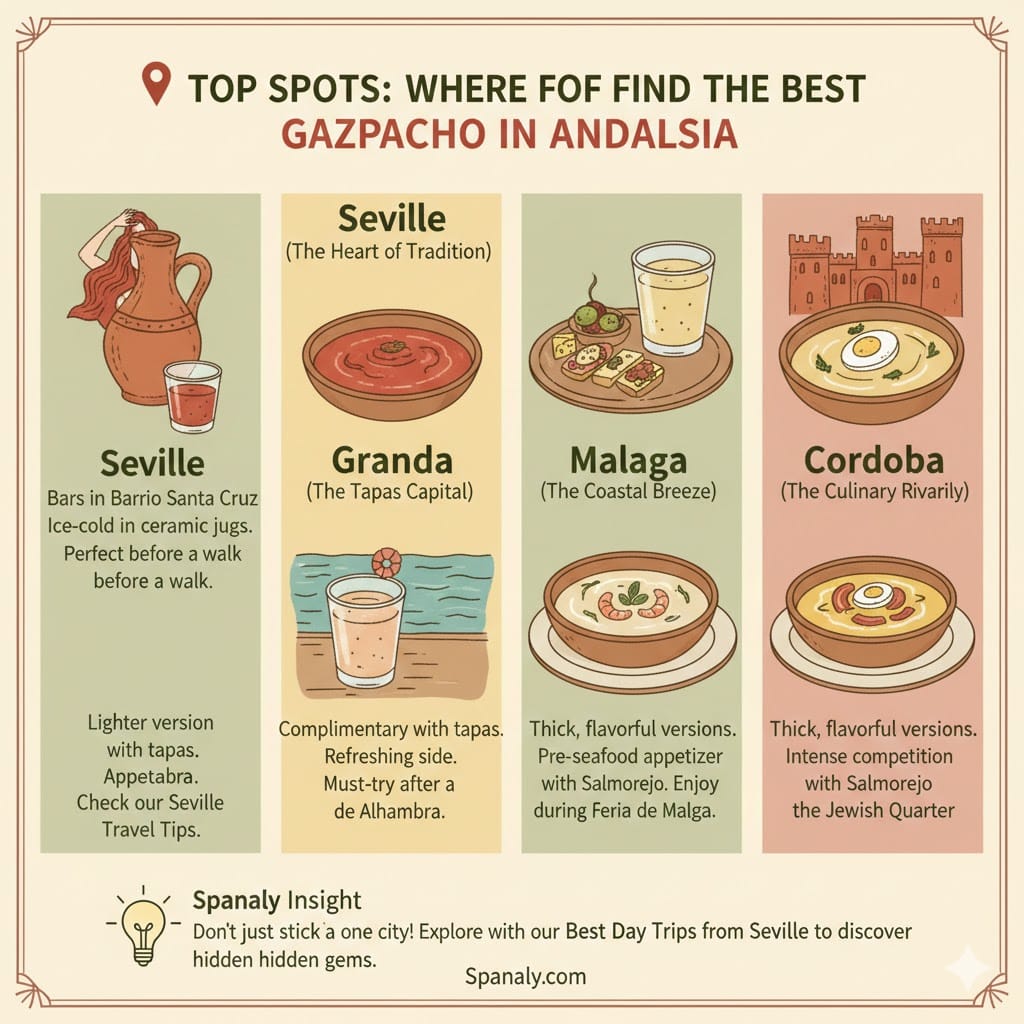
While this cold soup is a Spanish staple, certain Andalusian cities have transformed its preparation into a true art form. To taste the authentic “soul” of the south, you must follow the local crowds.
💃 Seville (The Heart of Tradition): In the winding streets of Barrio Santa Cruz, taverns serve Gazpacho in chilled ceramic jugs. It’s the ultimate refreshment before a long walk. Review our Seville Travel Tips to locate the most authentic hidden gems in the city.
🕌 Granada (The Tapas Capital): Granada is famous for its generous food culture. Here, a glass of Gazpacho often arrives as a complimentary, refreshing side to your drink—a perfect palate cleanser after visiting the Alhambra.
🌊 Malaga (The Coastal Breeze): Malaga offers a lighter version, often enjoyed as an appetizer before a feast of fried fish. It is particularly invigorating when experienced during the vibrant Feria de Malaga.
🏰 Cordoba (The Culinary Rivalry): Although Salmorejo takes center stage here, the competition ensures that Gazpacho remains world-class. You will find some of the most vibrant, flavor-packed versions within the historic Jewish Quarter.
💡 Spanaly Insight: Don’t limit your culinary journey to just one province! Andalusia’s flavor profile changes every few miles. We recommend checking the Best Day Trips from Seville to explore nearby white villages where family recipes have remained untouched for centuries.
⏳ When to Eat Gazpacho: Timing Your Perfect Sip
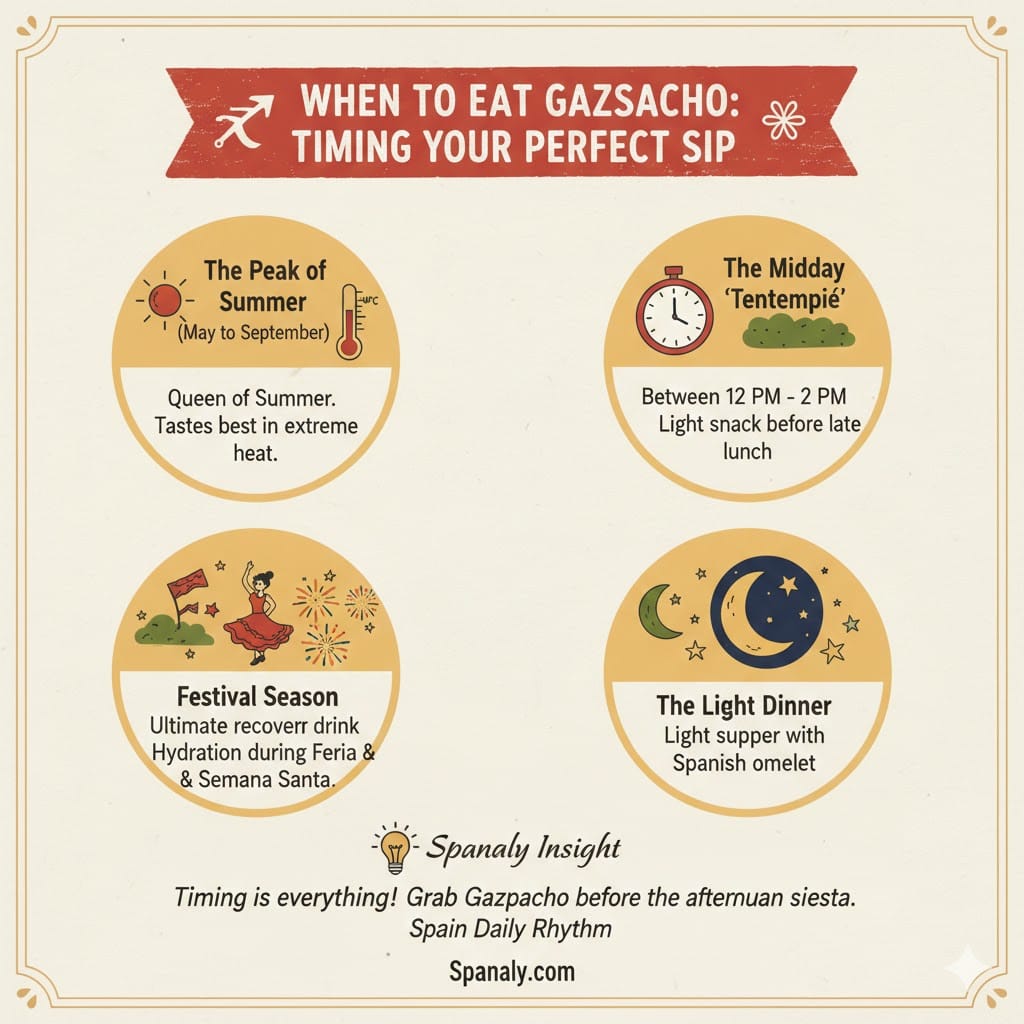
In Spain, Gazpacho isn’t just a dish; it’s a biological response to the sun. Knowing when to order it will help you enjoy it just like a local.
☀️ The Peak of Summer (May to September): While available year-round, Gazpacho is the “Queen of Summer.” It tastes best when the Andalusian heat hits 40°C, serving as a natural air conditioner for your body.
🕛 The Midday “Tentempié”: The most traditional time is between 12:00 PM and 2:00 PM. Locals often have a glass as a light snack to bridge the gap between breakfast and the late Spanish lunch.
🎉 Festival Season: It is the ultimate recovery drink during the Feria de Malaga or the intense heat of Semana Santa in Spain. It keeps you hydrated while you navigate the crowded, festive streets.
🌙 The Light Dinner: On humid Mediterranean nights, a bowl of Gazpacho is the preferred light supper, often paired with a simple Spanish omelet.
💡 Spanaly Insight: Timing is everything! If you are visiting during the crowded festival months, remember that the Spain Daily Rhythm means many authentic spots might close for siesta. Always grab your chilled Gazpacho before the afternoon break!
💡 Pro-Tips for the Ultimate Gazpacho Experience
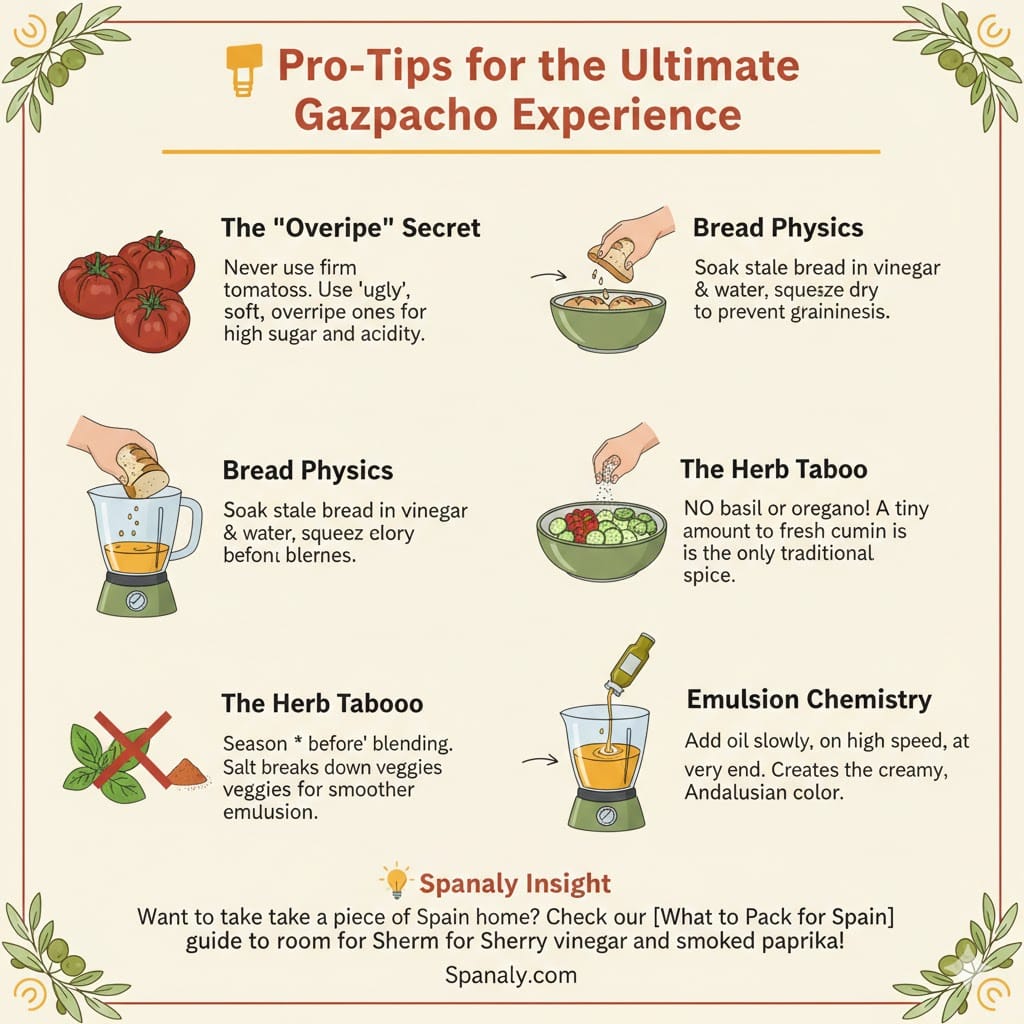
To elevate your Gazpacho from a simple cold soup to a gourmet masterpiece, follow these insider secrets that even some locals keep to themselves.
🍅 The “Overripe” Secret: Never use firm, “pretty” supermarket tomatoes. For the best flavor, look for “ugly,” soft, overripe heirloom tomatoes. They have the highest sugar content and natural acidity required for that signature tang.
🥖 Bread Physics: If you are adding bread for thickness, soak it in a little water and vinegar first, then squeeze it dry before blending. This ensures the bread integrates perfectly without making the texture “grainy.”
🧂 Salt Timing: Season your vegetables before blending. Salt helps break down the cellular structure of the peppers and cucumbers, leading to a much smoother emulsion when the olive oil is added.
🌿 The Herb Taboo: Authentic Andalusian Gazpacho never contains basil or oregano. If you want a herbaceous kick, a tiny amount of fresh cumin is the only traditional spice allowed.
🧴 Emulsion Chemistry: Treat your Gazpacho like a mayonnaise. Adding the oil at the very end while the blender is on high speed is what turns the color from dark red to that beautiful, creamy Andalusian orange.
💡 Spanaly Insight: Want to take a piece of Spain home? While you can’t pack the soup, you can pack the flavor! Check our guide on What to Pack for Spain to make room in your suitcase for high-quality Sherry vinegar and smoked paprika, the two secret weapons for a perfect home-made batch.
🍅 Essential Visitor FAQs – Gazpacho Andaluz
🥣 What is the secret to authentic Gazpacho flavor?
Beyond ripe tomatoes, the real secret lies in the quality of the Sherry Vinegar (Vinagre de Jerez) and extra virgin olive oil. This combination creates the signature zing and creamy emulsion that differentiates homemade versions from processed ones.
🥤 Can I drink Gazpacho on the go?
Absolutely! In many Spanish "Chiringuitos" (beach bars) and markets, it is served in chilled glasses or bottles as a nutritional hydrator. It is the local alternative to sugary sports drinks during the intense Mediterranean summer.
🥄 Is it vegan and gluten-free?
Traditional Gazpacho is naturally vegan. While some old-school recipes use bread for thickness, many modern versions are gluten-free, relying solely on high-speed blending and olive oil to achieve a velvety texture. Always ask for "sin pan" if you have dietary restrictions.
📍 Why is Seville considered the best place to try it?
Seville is the gateway to the Andalusian countryside where the best ingredients are grown. Tasting Gazpacho at Mercado de Triana allows you to experience the dish where the temperature and local produce create the perfect environment for its refreshing properties.
🥗 Does it vary by region in Spain?
Yes! While the red tomato version is king, you might encounter Ajoblanco (almond and garlic) in Málaga or the fruit-infused versions (like strawberry or watermelon) in modern fusion restaurants across Barcelona and Madrid.
Expertly Curated by Spanaly.com
✨ More Than Just a Soup
Gazpacho is the true taste of a Spanish summer—a vibrant, chilled masterpiece that captures the soul of Andalusia in every sip. It’s more than a dish; it’s a lifestyle of freshness and health.
🍅 A Mediterranean Icon: From the sun-drenched fields to your table, it’s the ultimate liquid gold.
❄️ Your Summer Shield: The perfect way to stay cool and energized while exploring Spain.
🤝 The Perfect Pair: While Gazpacho is refreshing on its own, it’s even better when part of a full Andalusian feast.
💡 Spanaly Insight: Ready to complete your culinary journey? After a refreshing glass of Gazpacho, the locals love to head to the coast or a cozy tavern for some crispy Pescaito Frito in Seville. It is the legendary “crunch” that perfectly balances the smooth, zesty flavors of your soup!
¡Buen provecho! We hope you enjoy every refreshing drop of your Andalusian adventure.