
Table of Contents
Toggle🚆 Exploring Madrid Made Easy
Madrid boasts one of Europe’s most efficient transport networks, making city exploration swift and affordable. Whether you’re visiting iconic Spanish Attractions or hidden local gems, the system connects every corner of the capital seamlessly.
🚇 Metro: Fast, clean, and the city’s underground backbone.
🚌 Buses: Comprehensive routes perfect for sightseeing.
🚆 Cercanías: Ideal for quick regional getaways.
💡 Pro Tip: For a complete trip plan including stays and top sights, check our Ultimate Madrid Travel Guide.
💳 Madrid Travel Cards & Tickets (2026 Prices)

To move efficiently between your hotel and the best spots for Spanish Cuisine, you must first understand the “Multi Card” system. Use this quick comparison to select the most cost-effective ticket for your trip:
💳 The Multi Card (Tarjeta Multi): A reusable, non-personal card costing €2.50. You must buy this first to load almost any ticket type.
🎟️ Single Ticket: Best for one-off trips. Prices range from €1.50 to €2.00 depending on the distance (Zone A).
🔟 MetroBús (10-Trip Pass): The most popular choice for visitors. At €12.20, it covers 10 journeys on both the Metro and EMT buses.
✈️ Airport Supplement: A €4.50 fee is required for Metro trips to/from Barajas Airport (unless you have a Tourist Pass).
⚠️ Note: Multiple people can share the same 10-Trip Pass on one Multi Card, making it perfect for families or groups.
🎟️ Tourist Transport Pass (Abono Turístico 2026)
If you plan to explore Madrid intensely, the Tourist Pass is your best friend. It offers unlimited travel on all public transport within chosen days, helping you save both time and money.
⏱️ Validity: Available for 1, 2, 3, 5, or 7 consecutive days.
📍 Zone A: Covers all of central Madrid, including the Airport (supplement included).
📍 Zone T: Covers the entire region, including day-trip destinations like El Escorial.
💰 2026 Prices (Zone A): Starts at €8.40 (1 day) up to €35.40 (7 days).
💡 Traveler Tip: While Madrid is highly efficient, if your next stop is the south of Spain, check our Seville Travel Guide for a completely different (and equally charming) transport experience.
🧒 Discounts: Children under 4 travel for free, and those under 11 get a 50% discount.
🛒 Where to buy: All Metro ticket machines and the Tourist Information centers at Sol or Barajas Airport.
🚇 Madrid Metro – The City’s Backbone
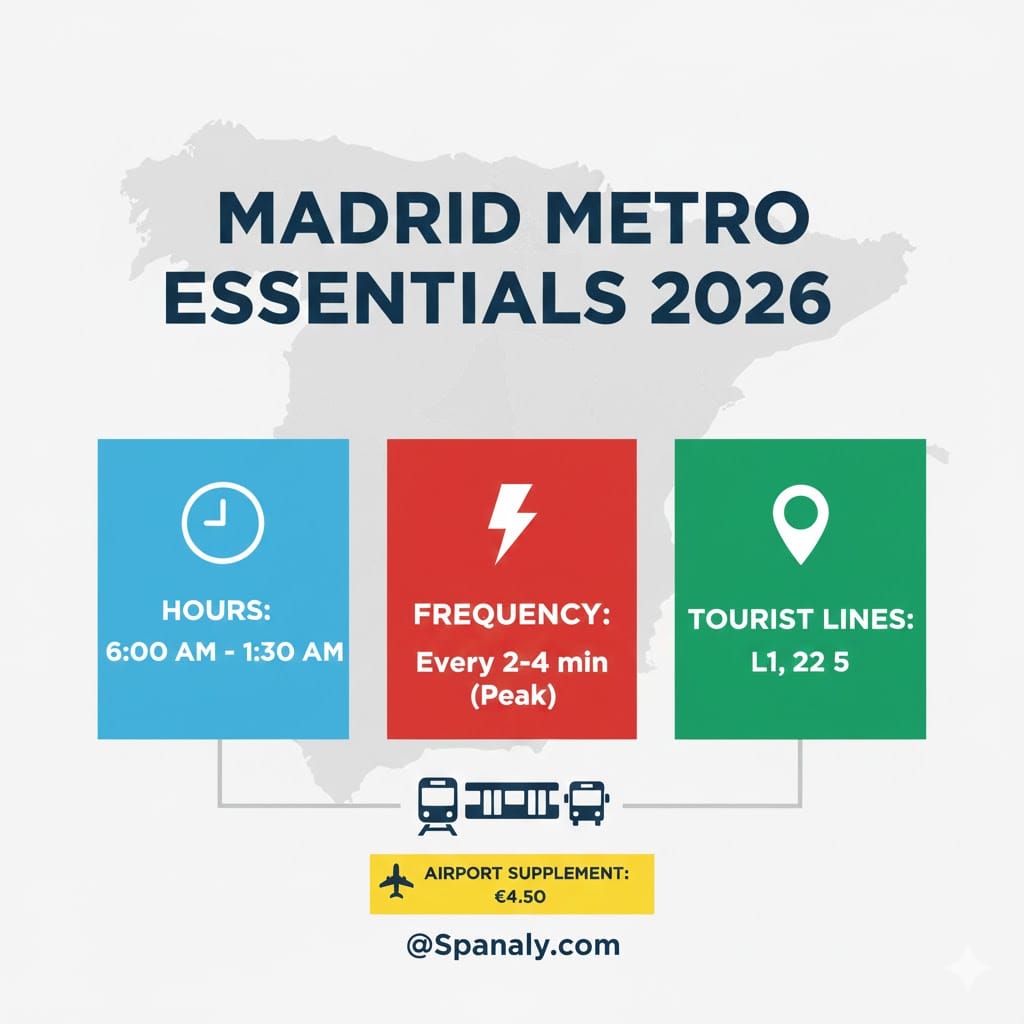
Madrid’s Metro is world-renowned for being fast, clean, and incredibly easy to navigate. It is the primary way to reach most Spanish Attractions across the capital.
⏰ Operating Hours: Runs daily from 6:00 AM to 1:30 AM.
⚡ Frequency: Trains arrive every 2–4 minutes during peak hours.
🗺️ Key Tourist Lines: * Line 1 (Blue): Connects Atocha Station to the central Sol area.
Line 2 (Red): Directly serves Retiro Park and the Opera house.
Line 8 (Pink): Your direct link to Barajas Airport.
⚠️ Pro Tip: Always validate your card at the turnstile before entering. If traveling to the airport without a Tourist Pass, remember the mandatory €4.50 supplement.
🚌 Buses – Madrid on the Move
Madrid’s EMT buses are the perfect complement to the Metro, offering a scenic way to travel through the city’s grand avenues. They are essential for reaching areas not directly served by the underground.
☀️ Day Buses (Blue): Operate from 6:00 AM to 11:30 PM across a comprehensive network.
🦉 Night Buses (“Búhos”): Starting at midnight from Plaza de Cibeles, these buses (marked with an “N”) ensure you can get home safely at any hour.
🔝 Top Sightseeing Lines:
Line 27: Cruises along the iconic Paseo del Prado and Castellana.
Line 001: A zero-emissions, free line that runs through the very heart of the city.
💳 Payment: Tap your Multi Card or use contactless bank cards. Cash is no longer accepted on board.
💡 Traveler Tip: Planning to head to the coast after the capital? Check out our Barcelona Travel Guide to see how the bus network compares in Catalonia.
🚆 Cercanías – Regional Trains for Quick Getaways
The Cercanías Renfe trains act as Madrid’s high-speed suburban rail system. They are much faster than the Metro for traveling long distances across the city or reaching locations where major Spanish Festivals are held throughout the year.
📍 Major Hubs: Most lines pass through Atocha and Chamartín stations, the two main railway arteries of Madrid.
🏰 Top Day Trips:
Line C3: Directly to El Escorial in approx. 1 hour.
Line C2: Takes you to the birthplace of Cervantes in Alcalá de Henares in 40 minutes.
✈️ Airport Connection (T4): Lines C1 & C10 link the city center to Airport Terminal 4 in just 25 minutes—often faster than the Metro.
🎫 Tickets: You can use your Tourist Pass here, or buy a dedicated “Cercanías” ticket at the red machines.
💡 Local Secret: If you have a long-distance AVE (High-Speed Train) ticket, you often get a free “Combinado Cercanías” code to use these local trains at no extra cost!
🎟️ Tourist Transport Passes (Abono Turístico 2026)
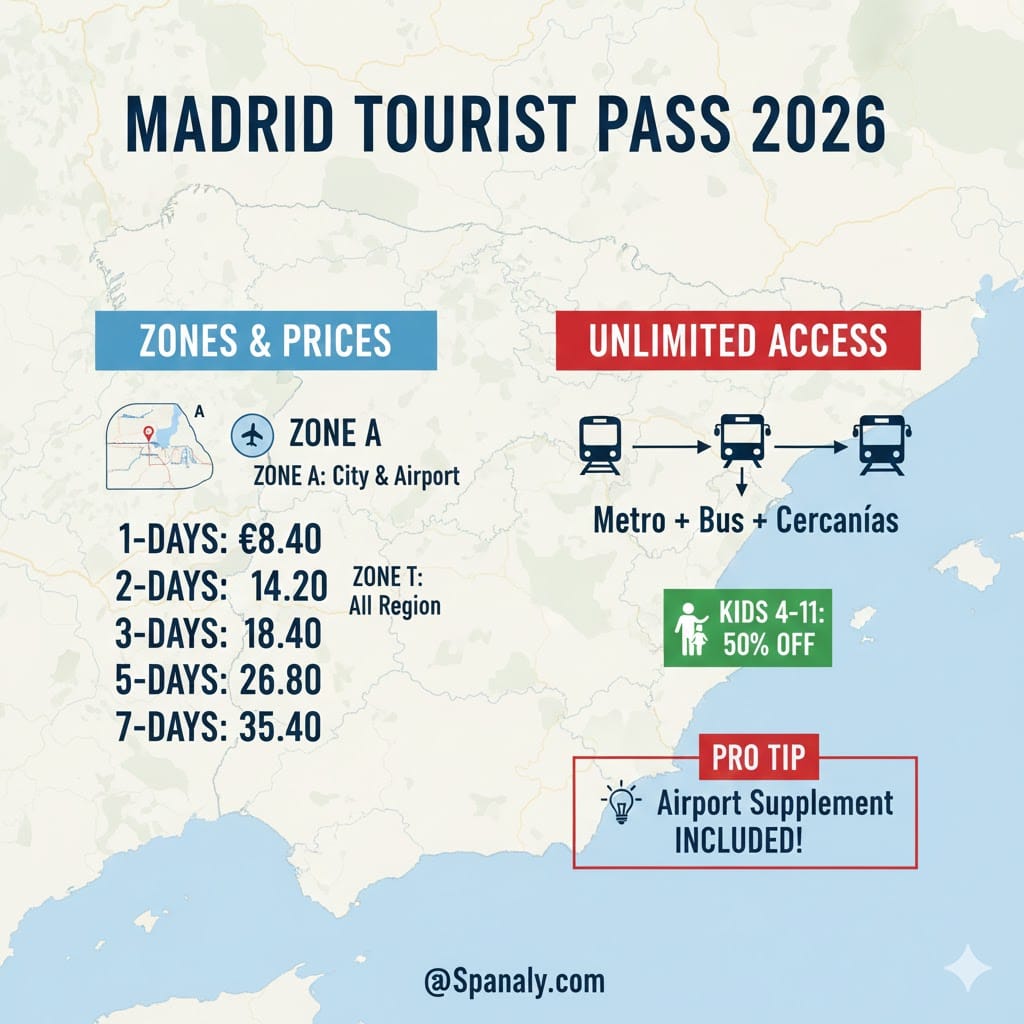
The Abono Turístico (Tourist Pass) is a flat-rate card that allows unlimited travel. It is the most convenient and cost-effective option for visitors who want to explore Madrid without worrying about individual ticket costs.
📍 Zone A vs. Zone T: * Zone A: Perfect for most tourists; covers central Madrid and Barajas Airport.
Zone T: Includes all areas, including farther suburbs like Toledo or Guadalajara.
💰 Pricing for 2026 (Zone A):
1-Day Pass: €8.40
2-Day Pass: €14.20
3-Day Pass: €18.40
5-Day Pass: €26.80
7-Day Pass: €35.40
✅ Includes: Unlimited use of the Metro, Blue EMT Buses, and Cercanías trains within the selected zone.
🧒 Children: Kids under 4 years old travel for free, and those between 4 and 11 get a 50% discount on the pass.
💡 Smart Savings: If you purchase the Tourist Pass at the airport, the €4.50 Airport Supplement is automatically waived, saving you money from the very first minute.
✈️ From Barajas Airport to the City Center
Madrid-Barajas Airport (MAD) is just 12 km from the heart of the city. Depending on your budget and luggage, you have four excellent ways to reach your hotel or start exploring Spanish Attractions.
🚇 Metro Line 8 (Pink): * Route: Terminals T1, T2, T3, and T4 to Nuevos Ministerios.
Time: ~20–25 minutes.
Cost: Ticket + €4.50 Airport Supplement (Included if you have a Tourist Pass).
🚌 Airport Express Bus (203):
Route: 24/7 service from all terminals to Atocha Train Station.
Cost: €5 flat fare (Pay on board with contactless). Ideal if you are staying near the Art Triangle.
🚕 Official Taxi:
Rate: €33 fixed flat rate to any location within the M-30 central ring.
Pros: No surprises; luggage is included in the price.
🚗 Rideshare (Uber/Cabify):
Availability: Designated pick-up points at all terminals. Prices vary by demand but are often competitive with taxis.
💡 Planning Tip: If Madrid is your first stop before exploring the rest of Spain, check our Madrid Travel Guide for the best hotels near these transport hubs.
📱 Useful Apps & Travel Tools
To navigate Madrid like a professional and avoid long waits, downloading these essential apps before you arrive is highly recommended. They provide real-time updates and the most efficient routes.
🚇 Metro de Madrid: The official app for live maps, line status, and exact train arrival times.
🚌 EMT Madrid: Perfect for tracking bus locations in real-time and finding the nearest stops.
🗺️ Citymapper: Often considered the best all-in-one app for Madrid, integrating Metro, buses, trains, and even walking paths.
🚆 Renfe Cercanías: Essential if you plan on taking regional trains for day trips outside the city center.
📍 Google Maps: Reliable for walking directions and finding the best spots for Spanish Cuisine near your current station.
💡 Digital Tip: Most Metro stations and EMT buses offer free public Wi-Fi, so you can check your routes on the go without using all your mobile data.
💡 Local Tips for Smooth Travel
Implement these essential tips to travel through Madrid like a seasoned local and avoid common tourist mistakes:
⏳ Avoid Rush Hour: The Metro can be extremely crowded between 8:00–9:30 AM and 6:00–8:00 PM. If possible, plan your sightseeing outside these windows.
👟 The Metro/Walk Combo: Sometimes walking is faster! For example, walking from Sol to Plaza Mayor takes 5 minutes, while taking the Metro might take longer with station transfers.
✅ Validate Always: Never enter a bus or pass a turnstile without tapping your card. Inspectors are common, and fines for non-validated tickets are steep.
🦉 Safe Night Travel: Madrid is very safe at night. The “Búhos” (night buses) are a reliable and cheap alternative to taxis after the Metro closes at 1:30 AM.
🛡️ Stay Alert: While the system is safe, be mindful of your belongings in crowded stations like Sol or Atocha to enjoy your trip without worries.
🌟 Final Thought: Navigating Madrid is intuitive and efficient. Once you have your Multi Card ready, the entire city is at your fingertips. Enjoy every ride!
🚇 Visitor FAQs – Getting Around Madrid
🚇 What is the easiest way to get around the city?
The Madrid Metro is the fastest and most reliable option. For areas not covered by metro, the EMT blue buses are excellent. We recommend getting a reloadable Multi Card at any station machine to pay for all your journeys.
🎟️ Are tourist travel passes worth it?
If you plan to use public transport more than 5-6 times a day, the Tourist Travel Pass (Abono Turístico) is worth it as it offers unlimited travel. For occasional trips, simply loading a 10-journey ticket onto your Multi Card is usually more cost-effective.
🚉 Can I use one card for both metro and buses?
Yes. The red "Multi Card" is a unified contactless card. You can use it across the metro, blue city buses (EMT), and light rail (Metro Ligero) within the covered zones. Just tap the card at the reader when you enter.
👮 Is the city safe, and how can I avoid pickpockets?
Madrid is very safe, but crowded areas like Sol or the Metro attract pickpockets. Keep your bags zipped and in front of you, avoid keeping your phone in back pockets, and stay alert in busy tourist spots.
📅 When is the best time to visit to avoid crowds?
The shoulder seasons (late spring and early autumn) offer the best balance of mild weather and fewer tourists. If you want to avoid peak crowds on transport, try to avoid the morning rush hour (8:00 AM – 9:30 AM).
Transport Guide by Spanaly.com
🏁 Ready to Explore Madrid?
Navigating Madrid’s transport system in 2026 is easier than ever. Whether you choose the speed of the Metro, the scenic routes of the EMT buses, or the convenience of a Tourist Pass, you are now equipped with all the knowledge to move like a local. Madrid is a city meant to be explored, and its world-class infrastructure ensures that your journey will be as enjoyable as the destinations themselves.
Safe travels, and enjoy every corner of the Spanish capital!