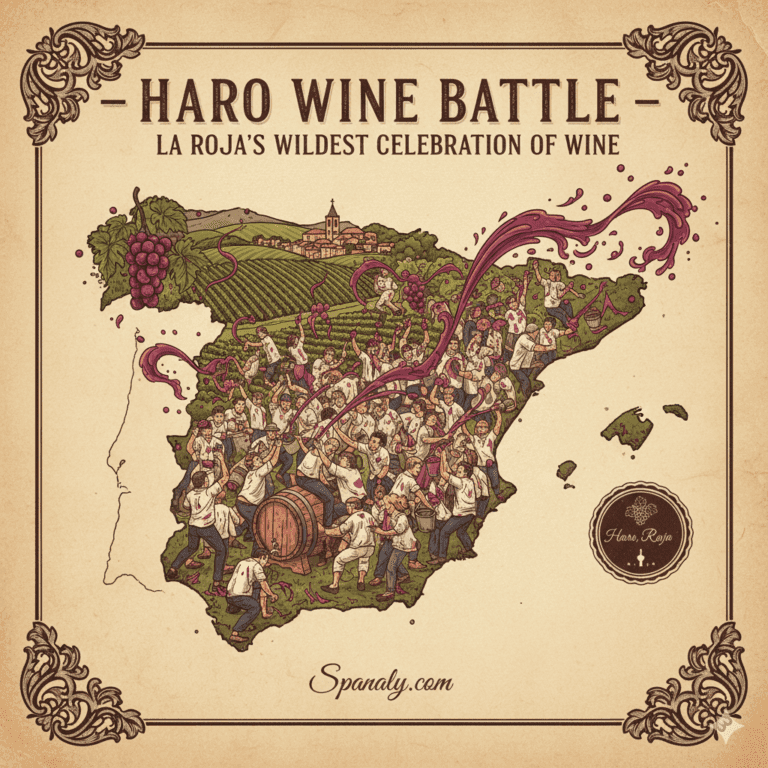

Every summer, the small wine town of Haro, in Spain’s La Rioja region, transforms into a sea of laughter, music, and red wine. Known locally as “La Batalla del Vino”, the Haro Wine Battle is one of the most unique experiences featured in our Ultimate Guide to Spain’s Festivals. Indeed, it is one of Spain’s wildest and most unforgettable celebrations—a tribute to joy, community, and the deep-rooted love of wine that defines this region.
What began centuries ago as a religious pilgrimage has evolved into a spectacular wine fight that attracts thousands from around the world. Imagine sunrise over the vineyards, locals wearing white clothes with red scarves, and gallons of wine flying through the air — that’s the magic of Haro. Consequently, visitors don’t just watch the event; they become part of a living tradition.
Table of Contents
Toggle🏰 Origins and History of the Haro Wine Battle
The origins of this unique tradition trace back to the 10th century, when Haro’s residents would climb Bilibio Mountain (Riscos de Bilibio) to celebrate Saint Peter’s Day on June 29. Initially, this was a peaceful religious pilgrimage. However, over time, the ritual turned playful—locals began splashing each other with wine to mark the occasion.
By the early 20th century, the ritual evolved into a full-blown festival. In fact, it was in 1949 that the event was officially recognized by local authorities. Today, it stands as a symbol of La Rioja’s joyful spirit and is a key highlight in the Spanish Gastronomy & Wine Hub, representing the region’s rich wine heritage.
🍇 3. The Main Event – A River of Wine
The battle is a breathtaking spectacle that transforms the landscape into a purple masterpiece. Initially, the climb to the Cliffs of Bilibio sets the stage for what’s to come:
The Dawn Procession: Thousands march at sunrise, armed with buckets, bottles, and wine-filled water guns.
The Official Start: As soon as the Mayor of Haro leads the procession on horseback, the “chaos” is officially unleashed.
A Purple Sea: Suddenly, wine flies in every direction. Consequently, by the end of the morning, every white shirt is stained a vibrant violet.
Indeed, this “battle” is a rare moment where total strangers become friends through shared laughter and gallons of Rioja wine.
🍷 4. The Celebration in Town
Once the battle on the mountain concludes around 10 a.m., the energy shifts back to the historic heart of Haro. In fact, the party is just getting started:
Plaza de la Paz: The main square becomes a hub of live music, traditional dancing, and endless energy.
Winery Open House: Similarly to the atmosphere of the Fiesta de la Vendimia in Logroño, local bodegas open their doors to welcome thirsty visitors.
A Culinary Reward: Furthermore, the wild fun transitions into a refined tasting. You can enjoy:
Patatas a la Riojana: Spicy potatoes with local chorizo.
Chuletillas al Sarmiento: Lamb chops grilled over vine shoots.
Therefore, the celebration perfectly balances the wild spirit of the mountain with the sophisticated culinary heritage of La Rioja.
🛡️ Practical Information for Visitors
To make the most of your trip to La Rioja, keep these essential details in mind:
📅 Date: Every year on June 29 (Saint Peter’s Day).
📍 Location: Haro, La Rioja, Spain.
✈️ Nearest Airport: Logroño-Agoncillo (45 mins) or Bilbao Airport (1 hour).
🎒 What to Bring: * Old white clothes (they will be ruined!).
A traditional red scarf (pañuelo).
Waterproof protection for your phone.
Goggles (to protect your eyes from the wine).
Pro Tip: Arrive a few days early to join the pre-festival celebrations and explore the city’s historic Spanish Wineries and Bodegas .
✨ Cultural Meaning: More Than Just a Fight
The Haro Wine Battle is a deep tribute to the region’s identity. In fact, it represents:
A Way of Life: Wine is not just a product here; it’s a family legacy.
Community Bond: The festival unites locals and tourists in a shared, joyful chaos.
Tradition: Similarly to other religious-turned-playful festivals, it keeps ancient history alive through celebration.
Therefore, participating in the battle is like stepping into the very soul of Spain’s most famous wine region.
🗺️ Nearby Attractions to Explore
If you have extra time, don’t miss these gems around Haro:
🍷 Museo del Vino: Discover the evolution of local winemaking at the Rioja Alta Wine Museum.
🏰 San Millán de la Cogolla: Visit these stunning monasteries, a UNESCO World Heritage Site.
🍇 Vineyard Tours: Consequently, taking a scenic drive through the endless rows of grapes is the perfect way to relax after the battle.
🍷 Visitor FAQs – Haro Wine Battle Guide
🌍 Is the Haro Wine Battle suitable for international tourists?
Absolutely! Thousands of travelers worldwide join locals every year. The welcoming atmosphere of La Rioja makes it a standout highlight in our Ultimate Guide to Spain’s Festivals.
👕 What should I wear to the Battle?
The official "uniform" is white clothes with a red neckerchief. Be prepared: by the end of the morning, everything you wear will be stained deep purple, so make sure to wear old clothes you don't mind ruining!
🎟️ Do I need to buy tickets for the event?
No, the Wine Battle is completely free and open to everyone. You simply need to show up at the Cliffs of Bilibio at dawn. It remains one of Spain's most accessible and authentic folk traditions.
👦 Is it safe for children to participate?
Yes, and there is even a dedicated "Batalla del Vino Infantil" (Children's Battle) held a few days earlier. While the main event is generally safe, it can be slippery and crowded, so parental supervision is highly recommended.
🚌 How do I get to the Cliffs of Bilibio from Haro?
Most visitors take the free shuttle buses provided by the town council or hike up the hill. Arriving early (around 7:00 AM) is key, as transport becomes very busy and you'll want to be there for the official start.
Created by Spanaly.com
🏁 Your Purple Badge of Honor
In summary, the Haro Wine Battle is a one-of-a-kind experience that combines Spain’s passion for life with its devotion to wine. Whether you are a wine connoisseur or an adventure seeker, this festival will leave you with unforgettable memories (and a purple-stained shirt!).
Indeed, there is no better way to “taste” the spirit of La Rioja than by being drenched in its finest product.