
Table of Contents
Toggle🌿 Jardines de Murillo
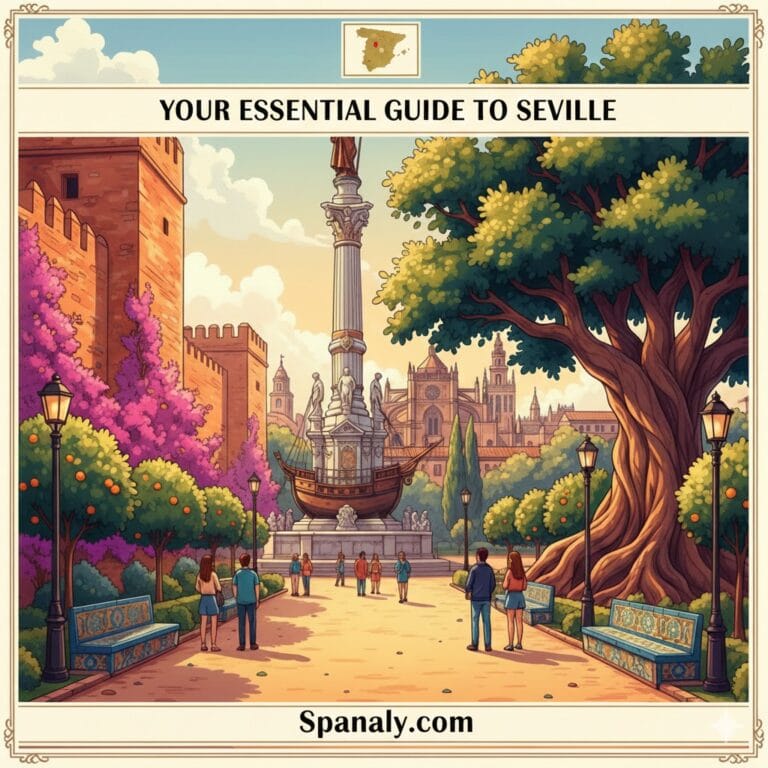
Just steps away from Seville’s most iconic landmarks—the Alcázar, Barrio Santa Cruz, and the historic Murillo Walls—lies one of the city’s most atmospheric green spaces: Jardines de Murillo.
🌸 A Sensory Escape: These gardens blend history, architecture, and nature in a uniquely Andalusian way.
🌳 Natural Grandeur: Walk beneath massive ficus trees and follow winding shaded paths that offer a cool retreat from the city heat.
🏺 Artistic Details: Rest on mosaic-covered benches and admire fragments of Seville’s medieval fortifications peeking through lush greenery.
📍 Perfect Location: Whether you’re exploring the Jewish Quarter or looking for a peaceful sanctuary, these gardens are the ultimate bridge between history and tranquility.
Notably, Jardines de Murillo serves as a scenic gateway, connecting the grandeur of the royal palace to the romantic alleys of the city. Consequently, to see how this hidden gem fits into your broader adventure, be sure to explore our Seville Travel Guide, your master resource for navigating the city.
💡 Spanaly Insight: For the best experience, visit in the late afternoon. The way the sun hits the ancient stone walls while the scent of orange blossoms fills the air is pure Seville magic.
🎨 A Brief History of Jardines de Murillo
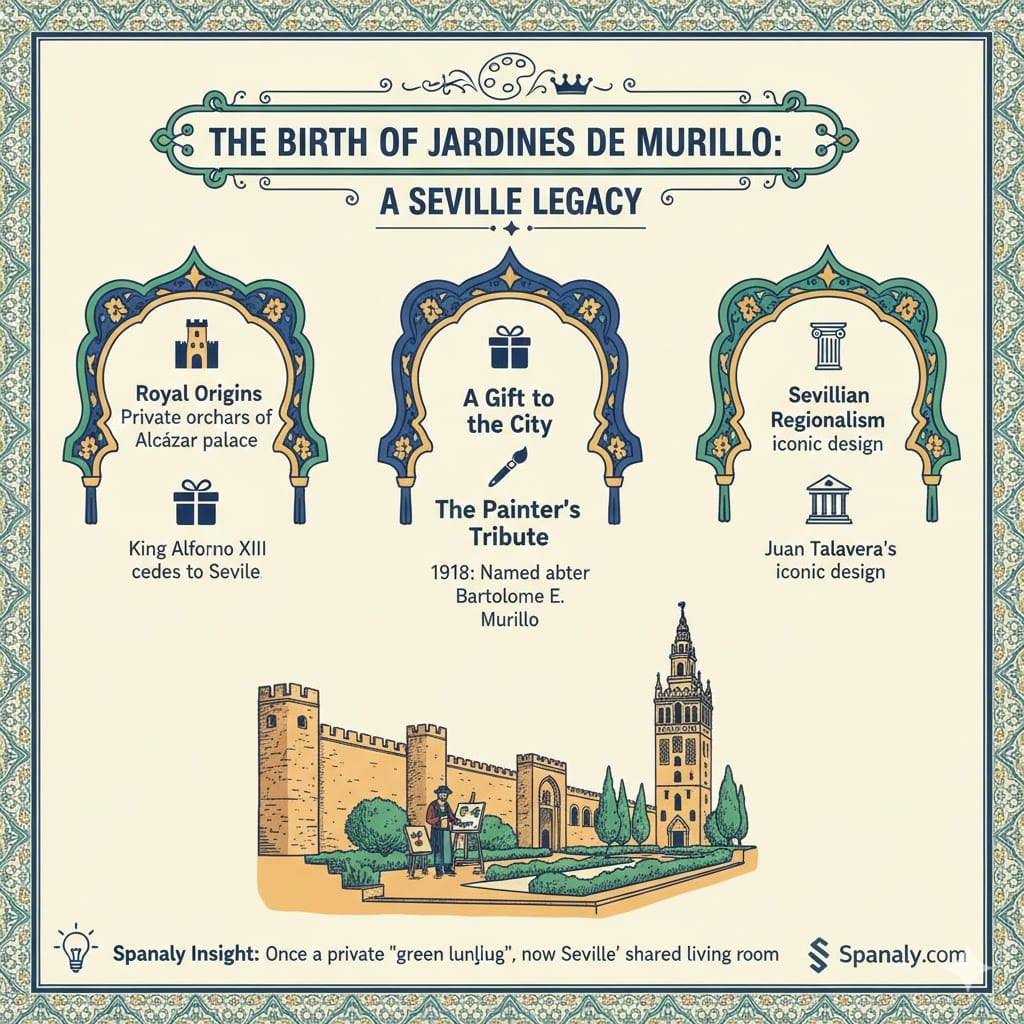
Historically, the lush ground you walk on today was never meant for the public. For centuries, these lands were the private, high-walled orchards of the Alcázar – Seville royal complex.
🏰 Royal Origins: Originally known as the “Huerta del Retiro,” this area provided fruits and seclusion for Spanish monarchs and Almohad caliphs alike.
🎁 A Gift to the City: In 1911, King Alfonso XIII ceded this portion of the royal gardens to the city of Seville, opening its gates to the public for the first time.
🎨 The Painter’s Tribute: In 1918, to mark the tercentenary of the birth of the legendary Seville painter Bartolomé Esteban Murillo, the gardens were officially named in his honor.
🏛️ Sevillian Regionalism: The design was perfected by Juan Talavera, a master architect who ensured the gardens reflected the soul of Seville: The Heart of Andalusia through traditional tilework and symmetry.
Notably, the house where Murillo lived and died is located just on the other side of the walls in the Jewish Quarter. Consequently, the name is not just a label, but a deep geographical and artistic connection to the neighborhood.
💡 Spanaly Insight: If you look at the old maps of Seville, you can see how this area was once a total “green lung” locked away from the citizens. Today, it is the city’s shared living room.
🛡️ The Historic Walls: Traces of Medieval Seville
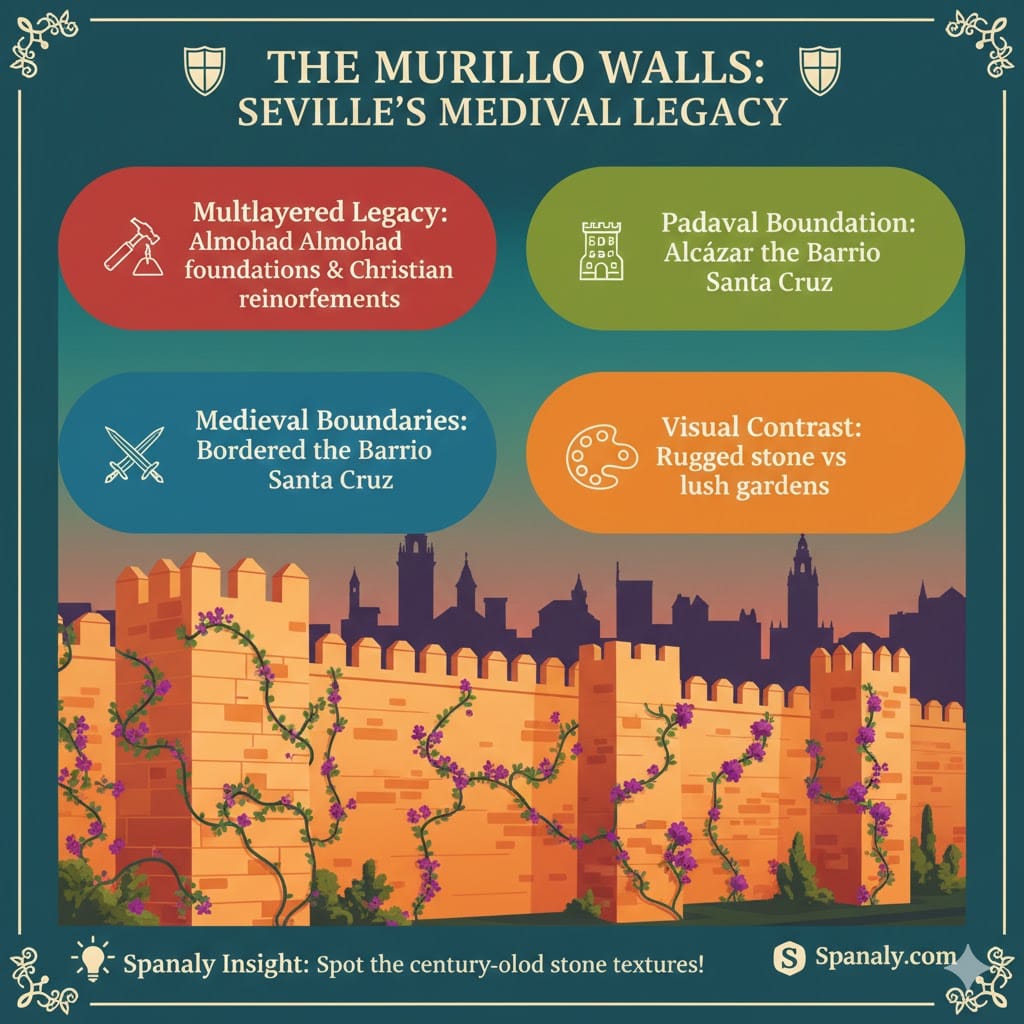
One of the most striking features is the presence of the ancient Murillo Walls. These structures form the defensive perimeter of the royal palace. Specifically, they act as a living chronicle of the city’s military past.
A Multilayered Legacy: The walls display distinct architectural styles. For instance, you can see original Almohad foundations alongside Christian reinforcements.
Palace Protection: These structures served as the primary defense for the royal residence. Consequently, they ensured the fortress remained impregnable for centuries.
Medieval Boundaries: The walls acted as a vital boundary for the neighboring Jewish Quarter. To explore the streets on the other side, check our .
Visual Contrast: Rugged stone offers a magnificent backdrop against the greenery. This contrast is especially beautiful during the .
Notably, these walls were essential for controlling water flow into the palace via ancient aqueducts. Therefore, walking alongside them gives you a direct sense of medieval power. Ultimately, this ingenuity defines Seville: The Heart of Andalusia.
💡 Spanaly Insight: Look closely at the base of the walls. In fact, you can often see different stone textures. These marks reveal exactly where a new century of construction began.
🌳 The Botanical Giants: The Ficus Trees
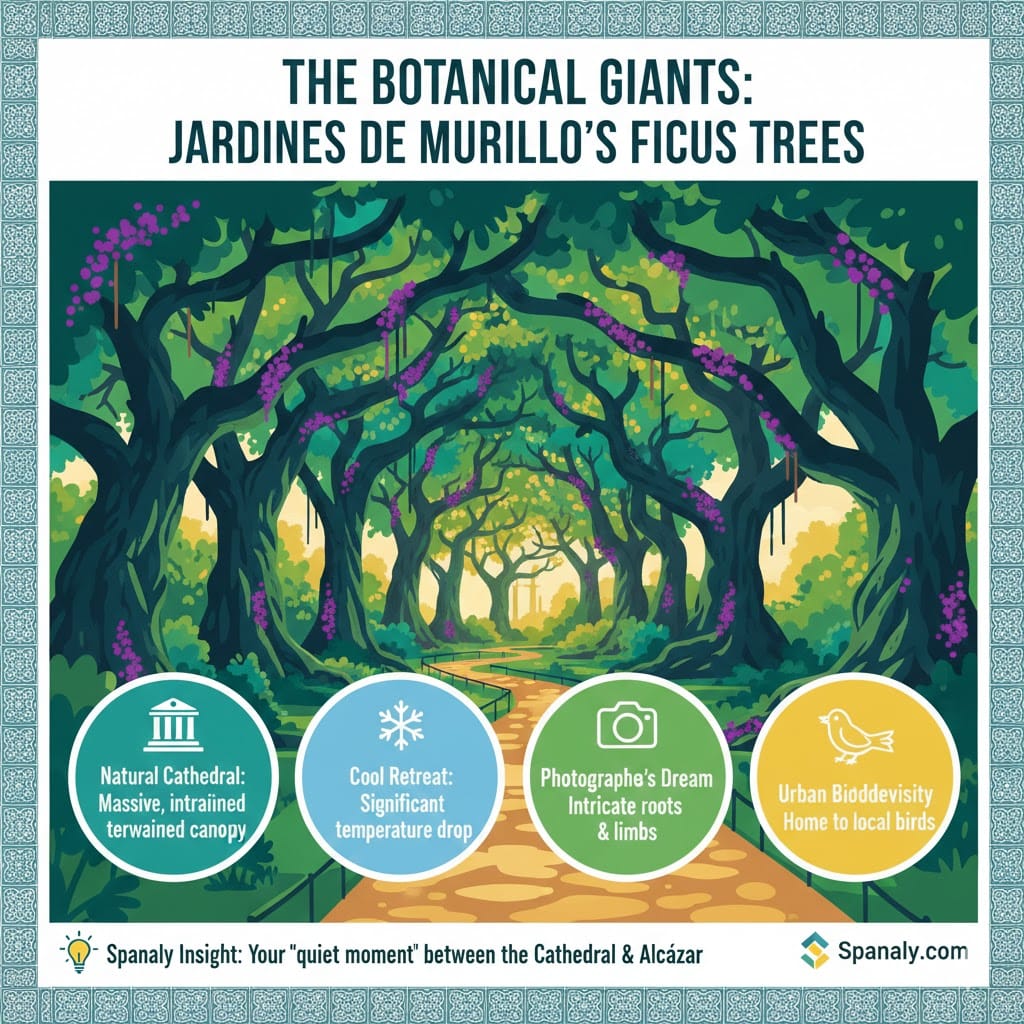
While the history is captivating, the natural architecture of the gardens is equally breath-taking. The Ficus Trees of Jardines de Murillo are not just plants; they are massive, living monuments that define the park’s skyline.
🏛️ A Natural Cathedral: These giant Australian banyans (Ficus macrophylla) feature massive, intertwined branches that create a dense canopy, offering a “natural cathedral” effect of deep, cool shade.
🌬️ The Cool Retreat: Even during the peak summer heat, the temperature beneath these giants drops significantly. For more advice on handling the local climate, see our Spain Travel Tips.
📸 Photographer’s Dream: The intricate root systems and expansive limbs provide an incredible backdrop for photography, rivaling the beauty found in the nearby Maria Luisa Park.
🦜 Urban Biodiversity: These trees are home to a variety of local birds, creating a tranquil soundscape of chirping that masks the city’s hustle and bustle.
Notably, some of these trees are over a century old, with roots that have grown to mirror the strength of the ancient walls beside them. Consequently, standing beneath them makes you feel incredibly small in the face of nature’s slow, steady grandeur.
💡 Spanaly Insight: If you’re following our 3 Days in Seville itinerary, make the Ficus avenue your “quiet moment” between the intensity of the Cathedral and the Alcázar.
🏺 The "Azulejos" Art: Seville’s Ceramic Legacy
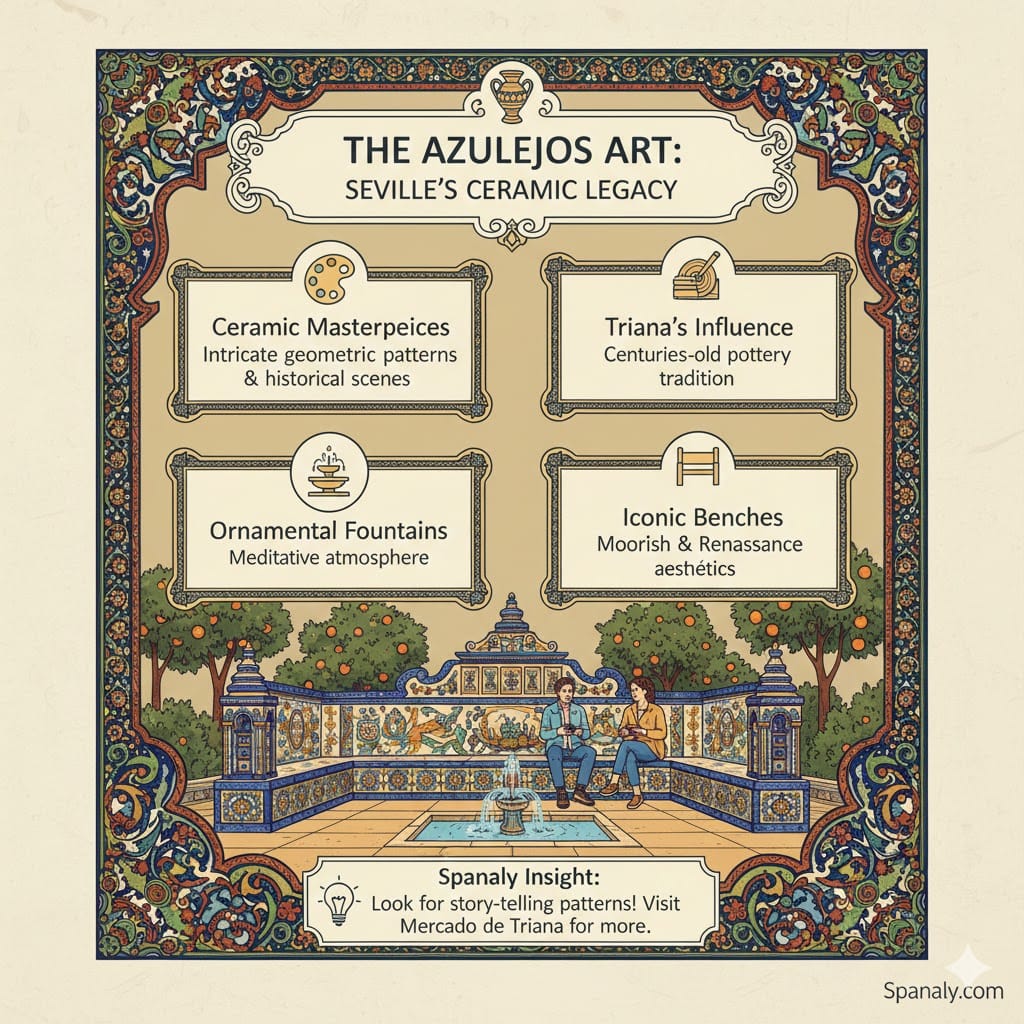
One of the most charming elements of Jardines de Murillo is the abundance of Azulejos (hand-painted ceramic tiles). These colorful details are not just decorations; they represent a craft that has defined the city for centuries.
🎨 Ceramic Masterpieces: Every bench and fountain in the garden is a canvas, showcasing intricate geometric patterns and scenes that reflect the “Sevillian Regionalism” style.
🏺 Triana’s Influence: Most of these tiles were produced in the nearby Triana District, famous for its centuries-old pottery tradition.
⛲ Ornamental Fountains: The gardens feature small, tile-covered fountains where the sound of trickling water creates a meditative atmosphere, much like the courtyards of the Alcázar – Seville.
🛋️ Iconic Benches: Each tiled bench is unique, offering a perfect spot to rest and admire the blend of Moorish and Renaissance aesthetics.
Notably, these ceramics are designed to stay cool to the touch even in the direct sun. Consequently, they are as functional as they are beautiful, providing a refreshing place to sit while you soak in the local culture.
💡 Spanaly Insight: Take a close look at the tile patterns; many of them tell stories of Seville’s history or represent local flora. If you love this art form, a visit to the Mercado de Triana is the perfect next step to see where the magic happens.
⛲ Hidden Courtyards & Shaded Corners

Beyond the main walkways, Jardines de Murillo is a maze of intimate spaces and “secret” corners. These areas are designed for slow exploration, offering a peaceful sanctuary in the middle of the bustling historic center.
🌿 The Poetry of Shade: Winding paths lead to secluded plazas where the sound of the city fades away, replaced by the rustle of palms and the scent of bitter oranges.
⛲ Secret Fountains: Discover hidden, stone-carved fountains tucked away in shaded alcoves, perfect for a moment of reflection or a quiet photo away from the crowds.
🕯️ Romantic Ambience: The gardens are a favorite for couples, especially as the golden hour light filters through the leaves. If you are on a romantic trip, this is one of the Best Places to Stay in Seville nearby.
🚪 Gateway to the Past: Many of these shaded corners lead directly to the ancient gates of the Barrio Santa Cruz Seville Guide, allowing for a seamless transition into the Jewish Quarter.
Notably, the layout of these courtyards follows the traditional Moorish garden philosophy—intended to be a “Paradise on Earth” where water and greenery provide spiritual rest. Consequently, spending even ten minutes here can recharge your energy for the rest of your day.
💡 Spanaly Insight: If you find a bench near the “Plaza de Alfaro” side, you’ll be sitting right under the legendary balcony that inspired the scene in Romeo and Juliet (locally known as the Rosina balcony).
🏛️ Iconic Monuments: From Columbus to The Lions
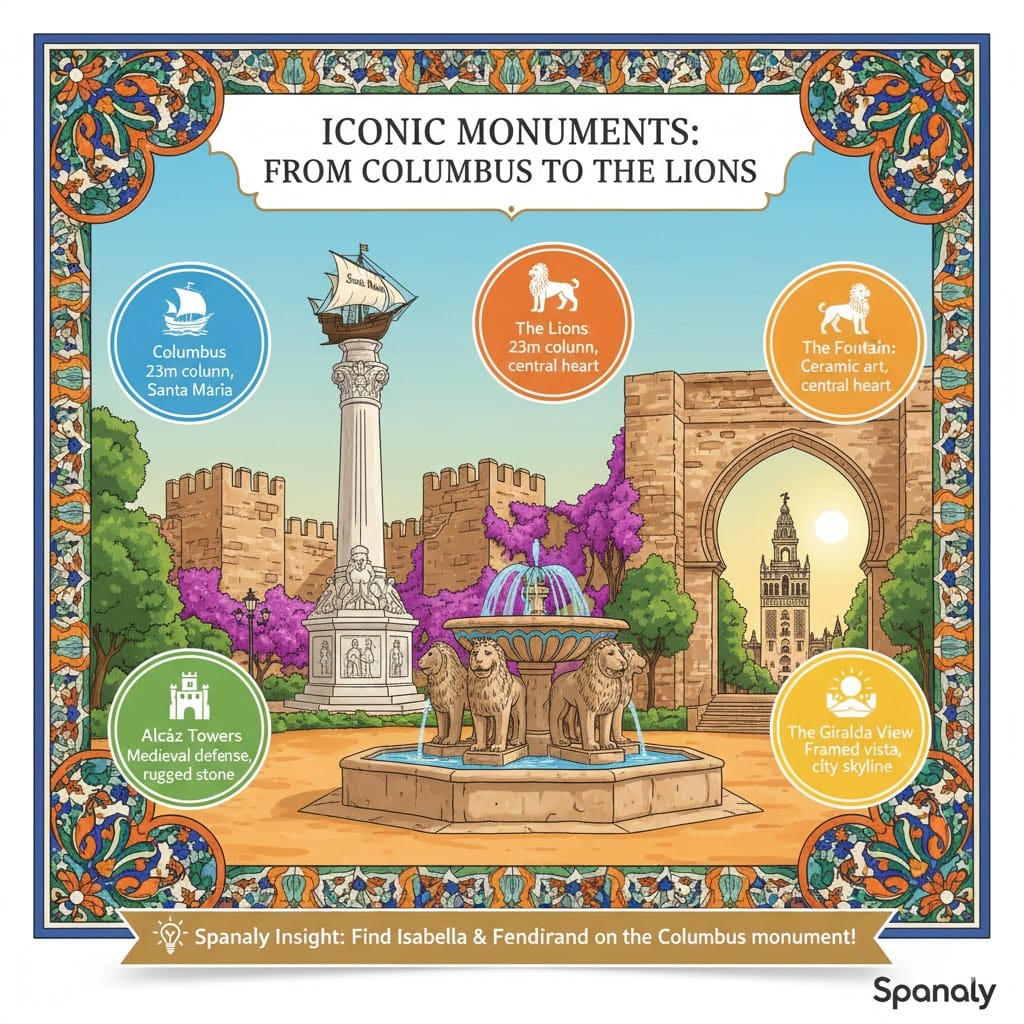
Jardines de Murillo is more than just a collection of plants. In fact, it serves as an open-air museum. It houses some of Seville’s most symbolic landmarks. These structures guide you through the city’s rich narrative.
Monument to Christopher Columbus: This towering 23-meter column is the garden’s centerpiece. Specifically, it features a bronze caravel caught between two white columns. This design represents the historical link between Spain and the Americas.
The Lions Fountain (Fuente de los Leones): You can find this fountain at the heart of the park. It features four stone lions supporting a central basin. Moreover, it is a classic example of traditional Sevillian ceramic art.
Alcázar Defensive Towers: Several medieval towers are built directly into the walls. Their rugged texture creates a striking contrast with the refined monuments nearby. Consequently, they remind visitors of the city’s ancient military strength.
The Giralda View: You can catch a stunning framed view of from near the Columbus monument. Indeed, the Giralda rises beautifully above the treetops.
Notably, most of these monuments were installed for the 1929 Ibero-American Exposition. Therefore, the gardens reflect a time when Seville was redefining its global identity. Ultimately, walking here connects you to the spirit of the and the discovery of the New World.
💡 Spanaly Insight: If you look closely at the Columbus monument, you will see the names of Queen Isabella and King Ferdinand. In addition, this spot is perfect for reflecting on the history that shaped modern Spain.
🎬 Cinematic Seville: Famous Filming Locations

The dramatic beauty of these gardens has not gone unnoticed. In fact, world-class filmmakers often use the ancient limestone walls as a backdrop. This park has hosted stories ranging from historical dramas to epic fantasy worlds.
Game of Thrones (Kingdom of Dorne): The Murillo Walls were used for several exterior shots. Specifically, they represented the exotic Kingdom of Dorne. Moreover, the lush greenery captured a regal and mysterious atmosphere.
The Kingdom of Heaven: Director Ridley Scott utilized the medieval texture of the ancient walls. Consequently, he successfully recreated the aesthetic of 12th-century Jerusalem in this epic film.
Historical Backdrop: Numerous productions use these gardens to depict the city’s “Golden Age.” In addition, the architecture perfectly preserves the soul of Seville. This spirit truly comes alive during Semana Santa.
Instagrammer’s Paradise: Beyond big movies, the gardens are a constant set for travel influencers. Indeed, they seek that quintessential Andalusian aesthetic and the perfect morning light.
Notably, the contrast between ancient fortifications and vibrant flowers provides a rare visual depth. Therefore, walking through these paths feels like stepping onto a living film set. Ultimately, history and fiction blur in every corner.
💡 Spanaly Insight: If you visit during the early morning, the silence creates a cinematic atmosphere. Indeed, the light filtering through the trees makes you feel like the protagonist of your own Seville adventure.
🚶♂️ Suggested Walking Route (10–20 Minutes)
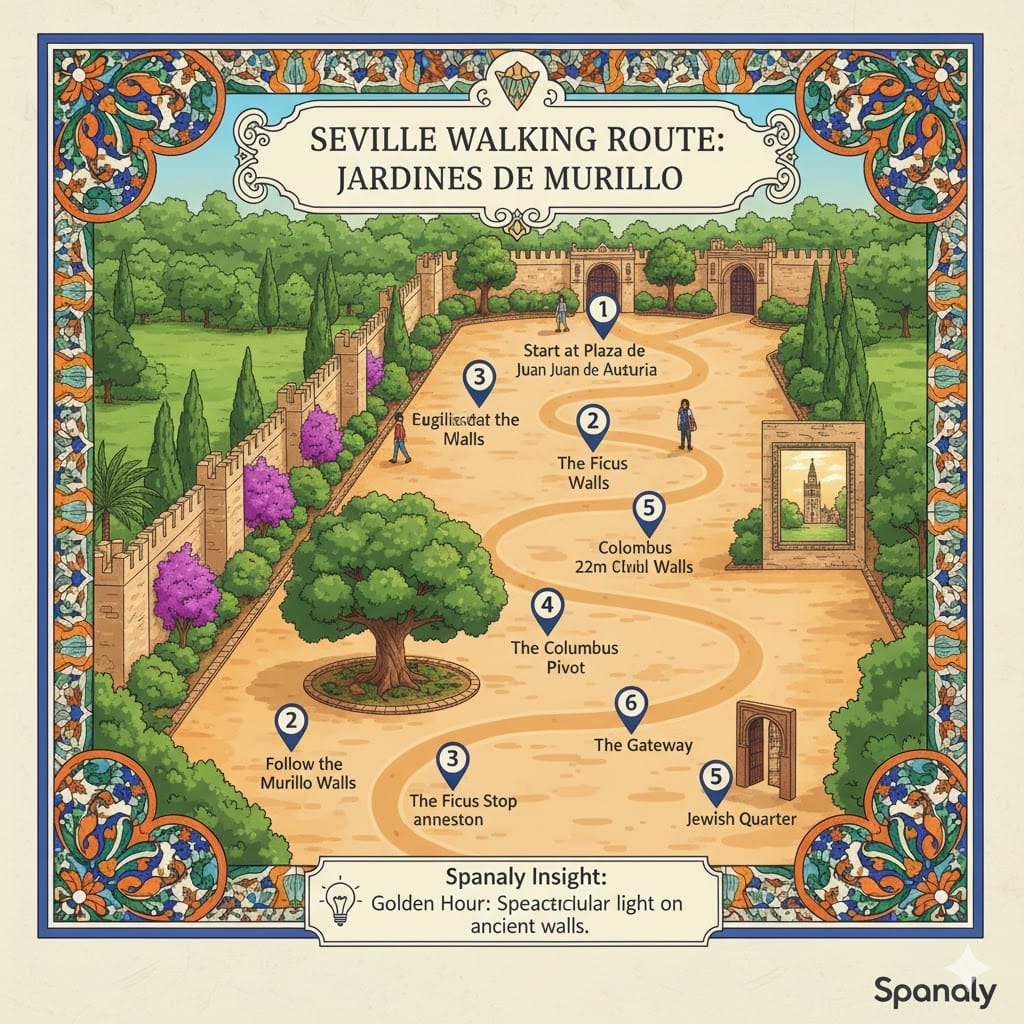
To truly experience the magic of Jardines de Murillo, follow this curated path. This route flows naturally from the royal palace towards the historic center. Furthermore, it is a key highlight in our guide on Getting Around Seville.
Start at Plaza de Don Juan de Austria: Enter the gardens from the main eastern gate. Immediately, you will see wide, palm-lined avenues. These paths easily rival the beauty of Maria Luisa Park.
Follow the Murillo Walls: Keep the ancient fortifications on your left. Specifically, this stretch is best for admiring the contrast between orange stone and purple bougainvillea.
The Ficus Stop: Reach the giant Ficus trees midway through your walk. In addition, take a moment to enjoy the “natural cathedral” created by their massive roots.
The Columbus Pivot: Head towards the center of the park. Indeed, you cannot miss the Monument to Christopher Columbus, which is the towering centerpiece.
The Ceramic Finish: Walk past the Lions Fountain. Afterward, rest for a minute on one of the iconic tiled benches to soak in the atmosphere.
The Gateway: Finally, exit through the northern side. This path leads you directly into the narrow alleys of the Barrio Santa Cruz Seville Guide.
Notably, this route is mostly flat and fully accessible. Consequently, it serves as the perfect “cool-down” walk after a busy morning of sightseeing. Ultimately, it is the most scenic way to transition between major monuments.
💡 Spanaly Insight: Try this walk during the “Golden Hour” just before sunset. In fact, the way the light hits the ancient walls is nothing short of spectacular.
🍴 Gastronomy Nearby: Where to Eat After Your Walk
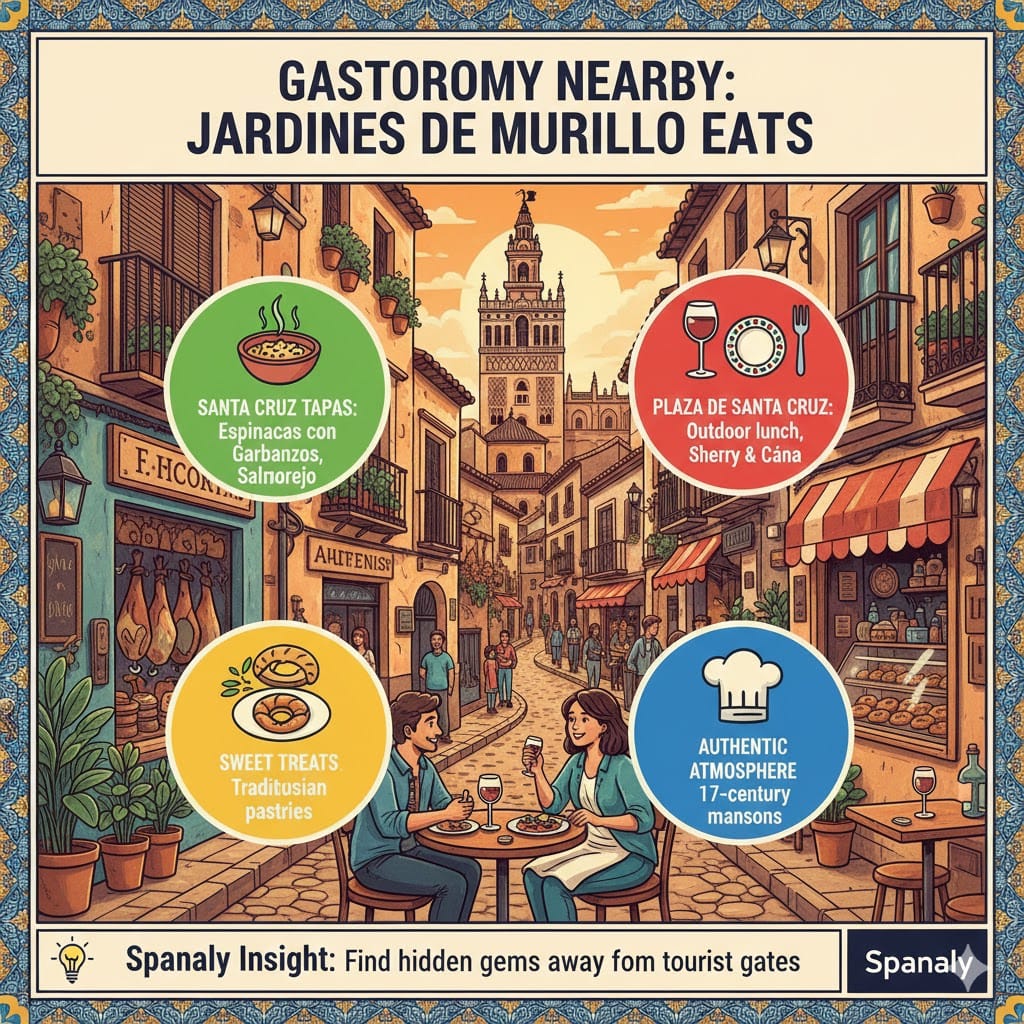
After a refreshing stroll through the gardens, you’ll likely find yourself with an appetite. Fortunately, Jardines de Murillo is bordered by some of Seville’s most iconic culinary spots, making it the perfect starting point to dive into our Spanish Cuisine Guide.
🥘 Santa Cruz Tapas: Just a few steps from the northern exit, the narrow streets of the Jewish Quarter are lined with authentic taverns. It is the ideal place to try Espinacas con Garbanzos (spinach with chickpeas) or a fresh Salmorejo.
🍷 Plaza de Santa Cruz: A perfect spot for an outdoor lunch. Many terraces here offer views of historic facades while you enjoy a glass of local Sherry or a cold Caña in the Mediterranean sun.
🍰 Sweet Treats: Near the Plaza de Alfaro, you can find small bakeries selling traditional Andalusian pastries, perfect for a quick energy boost after your exploration.
🍽️ Authentic Atmosphere: For a more formal experience, the area hosts several renowned restaurants that blend traditional Mozarabic flavors with contemporary culinary techniques.
Notably, many restaurants in this area are housed in renovated 17th-century mansions. Consequently, your meal becomes an extension of your historical tour, allowing you to dine surrounded by Seville’s architectural heritage.
💡 Spanaly Insight: Avoid the restaurants directly facing the main tourist gates. Walk just two or three alleys deeper into the Barrio Santa Cruz to find the hidden gems where the locals enjoy their tapas.
ℹ️ Essential Visitor Information

Planning a visit to Jardines de Murillo is simple, but knowing these key details will help you integrate this beautiful stop seamlessly into your Seville itinerary.
| Category | Details |
| 📍 Location | Paseo de Catalina de Ribera, 41004 Seville (Bordering the Alcázar and Barrio Santa Cruz). |
| ⏰ Opening Hours | Open 24/7 (Public park with unrestricted access). |
| 🎟️ Entrance Fee | Free Admission. It is one of the best free experiences in the city. |
| ⏳ Duration | 15–30 minutes for a quick stroll; 1 hour for a relaxed visit with photos. |
| ♿ Accessibility | Fully accessible with flat, paved paths suitable for wheelchairs and strollers. |
| 🐕 Pet Friendly | Yes, dogs are welcome (on a leash). |
Best Time to Visit: Early morning (for photography and cooler temperatures) or late afternoon during the “Golden Hour.”
Safety Tip: Like any popular city park, keep an eye on your belongings, especially in the more secluded corners or when occupied with taking photos.
Facilities: While there are no public restrooms inside the gardens, numerous cafes and bars in the adjacent Barrio Santa Cruz are available.
Notably, the gardens are illuminated at night, offering a safe and romantic atmosphere for a moonlit walk. Consequently, they are a great way to transition from a day of sightseeing to a night of tapas.
💡 Spanaly Insight: If you are visiting in late spring (May/June), the scent of the blooming jasmine and orange blossoms is intoxicating. It’s the ultimate sensory experience of Seville.
🗺️ One Day in Seville: Integrating Jardines de Murillo
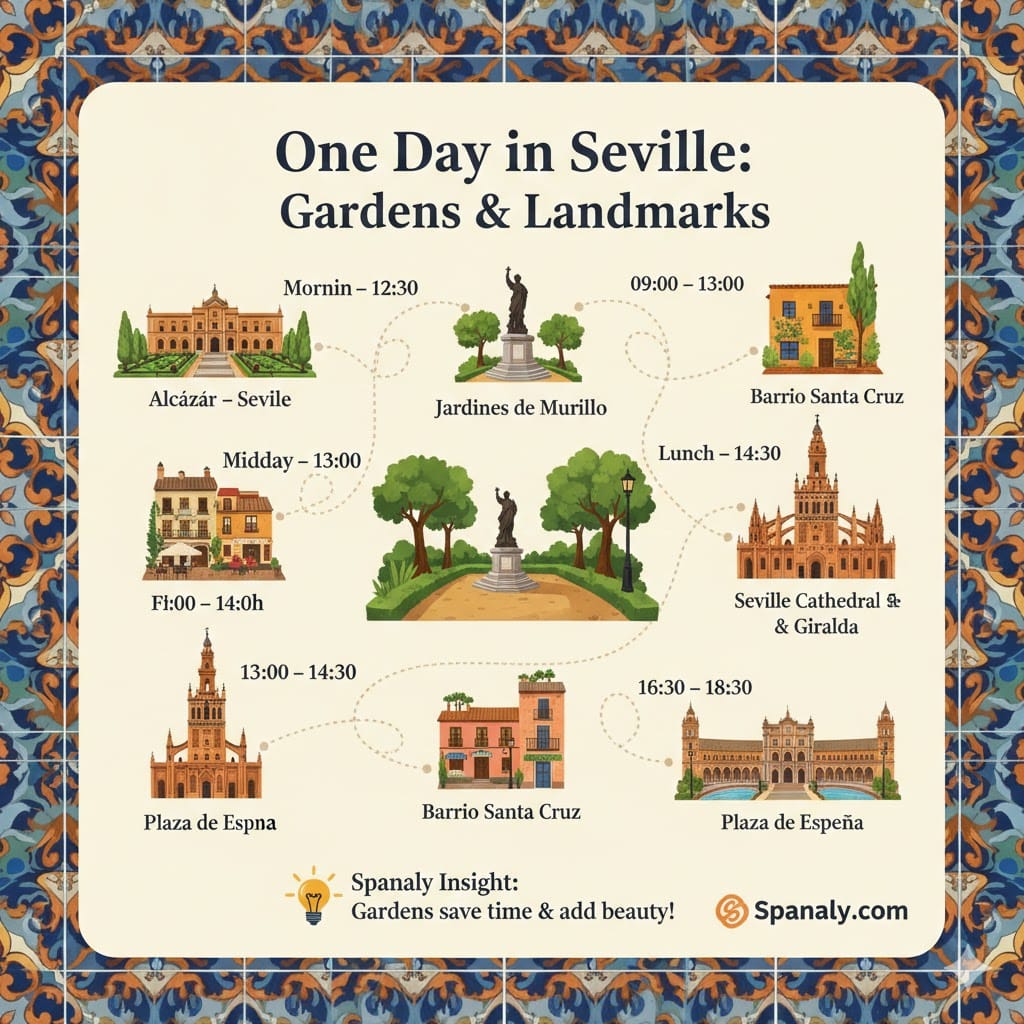
If you only have 24 hours in the city, Jardines de Murillo serves as the perfect “green bridge” between Seville’s royal history and its most charming neighborhood. Here is how to fit it into a perfect one-day itinerary:
Morning (09:00 – 12:30): Start your day early at the Alcázar – Seville. Explore the royal palaces and the vast gardens.
Midday (12:30 – 13:00): Exit the Alcázar and walk through the Jardines de Murillo. Use this time to admire the Monument to Columbus and the giant Ficus trees while catching a breeze away from the sun.
Lunch (13:00 – 14:30): Following our Spanish Cuisine Guide, dive into the Barrio Santa Cruz for a tapas lunch.
Afternoon (14:30 – 16:30): Visit the Seville Cathedral & La Giralda, which is just a 5-minute walk from the garden’s northern exit.
Late Afternoon (16:30 – 18:30): Take a scenic walk towards Maria Luisa Park and Plaza de España to see the city’s grandest square.
Notably, Jardines de Murillo is the most efficient transit point for those Getting Around Seville by foot between the major monuments. Consequently, including it in your route doesn’t just add beauty to your trip—it saves you time.
💡 Spanaly Insight: If you’re staying nearby, Jardines de Murillo is also a great spot for a quick morning jog or a peaceful coffee before the main tourist crowds arrive at the Cathedral area.
💡 Insider Tips for an Enhanced Visit

To make your visit truly professional and avoid common tourist mistakes, keep these exclusive “Spanaly” tips in mind:
📅 Avoid the Monday Crowds: While many of Seville’s monuments (like the Alcázar) have limited hours or special schedules on Mondays, the gardens remain open. This makes it the busiest day for the park. Try visiting on a Tuesday or Wednesday morning for maximum tranquility.
👟 Footwear is Key: The paths in Jardines de Murillo are a mix of pavement and traditional Albero (yellow crushed stone). This dust can stain delicate shoes. Wear comfortable, easy-to-clean footwear, especially if you plan to continue into the cobbled streets of Santa Cruz.
💧 Hydration Hack: There is a historic ornamental fountain near the center, but for drinking water, look for the modern “Grifo” (water tap) located near the children’s play area. It’s a lifesaver during the Seville summer.
🔋 The “Silent” Recharge: If you are a digital nomad or just need to recharge your phone, some of the modern cafes bordering the gardens on Calle Cano y Cueto offer Wi-Fi and power outlets with a view of the greenery.
🌸 The Seasonal Scent Peak: Most guides mention spring, but few tell you that the night-blooming jasmine (Dama de Noche) is at its peak in late August and September evenings. The scent is different and even more powerful than the orange blossoms of April.
Notably, the gardens are a transition zone between the tourist-heavy areas and the local residential zones. Consequently, observing the etiquette—like keeping noise levels down near the shaded courtyards—will earn you appreciative nods from the locals (Sevillanos).
💡 Spanaly Insight: If you see a local artist sketching near the Ficus trees, don’t be shy to take a peek from a distance. The gardens have been a hub for painters since the 19th century, and it’s a beautiful way to see the park through a different creative lens.
🌿 Visitor FAQs – Jardines de Murillo Seville Guide
📸 Can I use a tripod for professional photography in the gardens?
For personal use and travel memories, tripods are generally allowed and great for capturing the low light under the giant Ficus trees. However, for professional or commercial shoots involving models or large equipment, you technically need a permit from the Seville City Council (Ayuntamiento) to avoid fines.
💧 Is there a place to refill water bottles inside the park?
Yes! While the ornamental fountains (like the Lions Fountain) are not for drinking, there is a modern drinking water tap (bebedero) located near the children's playground area at the southern end. It's a perfect spot to refill before heading into the narrow streets of the Jewish Quarter.
🚻 Does the park have public restroom facilities?
There are no dedicated public restrooms inside the gardens. The best strategy is to visit one of the many traditional cafés on Calle Cano y Cueto or inside the Barrio Santa Cruz. Buying a quick "café con leche" or a bottle of water will give you access to much cleaner facilities.
🚲 Can I ride a bike or an electric scooter through the gardens?
Cycling is permitted on the main wide avenues of the gardens, which connect to the city's extensive bike lane network. However, riding through the narrower, shaded side paths is discouraged to prioritize pedestrians. Always keep a low speed as families and children frequently use the space.
🎒 Is there luggage storage nearby for travelers?
Since many visitors walk through the gardens after checking out of their hotels, you can find several locker services (Consignas) just 5 minutes away on Calle Santa María la Blanca. This allows you to explore the gardens and the nearby Cathedral comfortably without dragging suitcases over the gravel paths.
Created by Spanaly.com
As your journey through Seville unfolds, this garden will likely become one of your most cherished memories. It’s where the city’s royal past meets its vibrant present, offering a unique charm that stands in beautiful contrast to the modern energy found in our Barcelona Travel Guide.
🌿 A Natural Escape: The perfect spot to breathe and reset between busy monument tours.
🏰 History in Every Corner: From ancient walls to the legends of the New World.
📸 Pure Visual Magic: Whether it’s the cinematic light or the colorful tiles, your camera will love it.
🚶♂️ The Ultimate Shortcut: The most beautiful way to walk between the Royal Palace and Santa Cruz.
In short, don’t just “pass through” Jardines de Murillo—take a seat, listen to the fountains, and let the scent of jasmine tell you the story of Seville.
💡 Spanaly Farewell: We hope this guide helps you find your own favorite corner in the gardens. Don’t forget to tag us in your photos—we love seeing Spain through your eyes!