
Table of Contents
Toggle🔥 Las Fallas
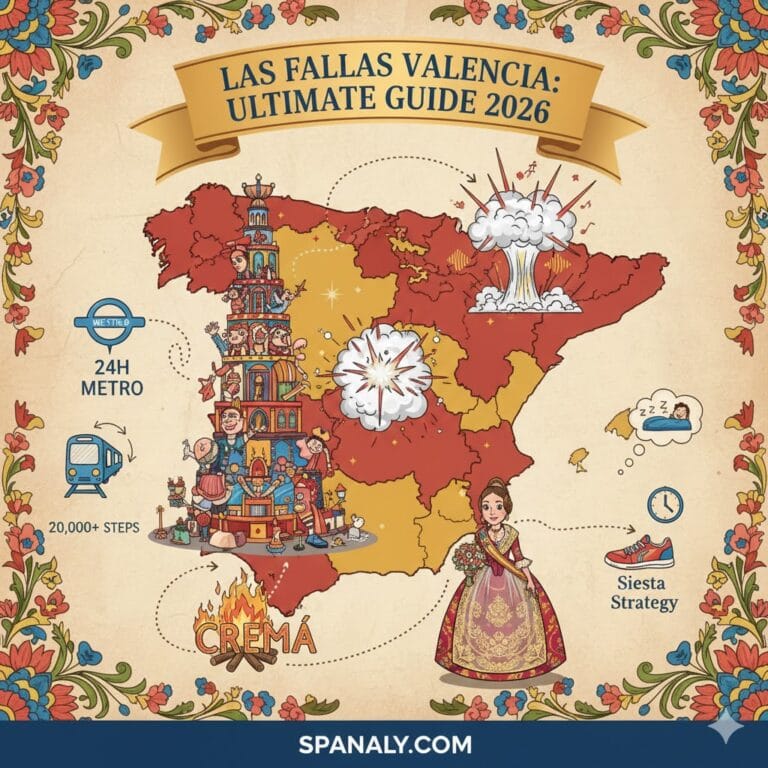
Every March, Valencia transforms into a breathtaking open-air theater of fire, art, and satire. Notably, Las Fallas is not just a party; it is a UNESCO-recognized masterpiece that celebrates the arrival of spring through a spectacular ritual of renewal. Specifically, the city vibrates with the sound of gunpowder and the sight of towering monuments that challenge the sky.
🎭 Artistic Satire: Giant sculptures (Fallas) that mock modern society with sharp humor.
🔊 Sonic Power: The thunderous Mascletà that shakes the very ground beneath your feet.
💐 Emotional Devotion: A massive floral offering that blankets the city in color and scent.
🔥 Dramatic Renewal: The final Cremà, where fire cleanses the old to make way for the new.
Indeed, this celebration is a highlight of the Ultimate Spain Festivals Guide, representing the peak of Valencian identity. Ultimately, Las Fallas is a sensory explosion that captures the true essence of Spanish passion and creativity.
💡 Spanaly Insight: Did you know? In fact, while the festival peaks in March, the artists (Falleros) work for an entire year to build these monuments. Notably, some structures cost over €200,000, only to be burned in a single night of spectacular fire!
⏳ The Origin: From Carpentry to Art
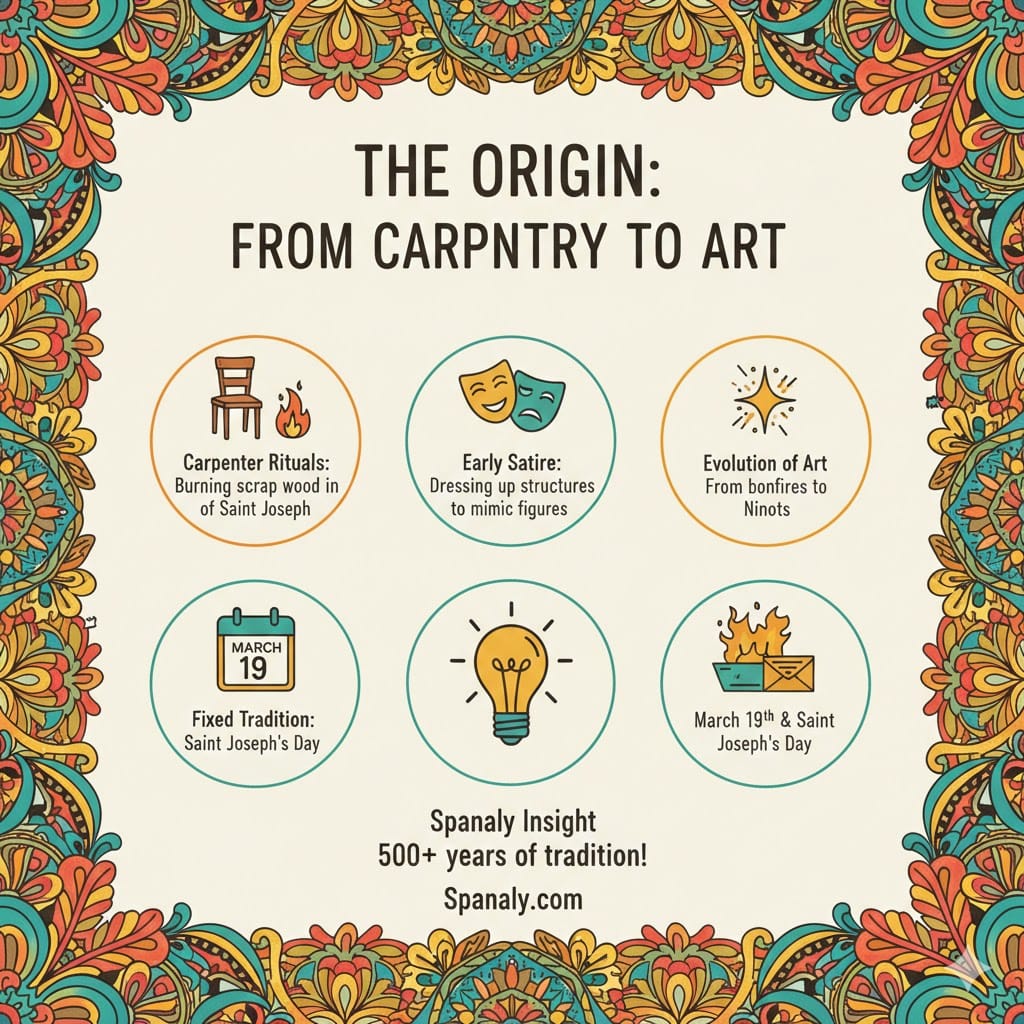
The roots of Las Fallas lie in a simple medieval tradition of spring cleaning. Notably, it began with Valencia’s carpenters burning the wooden supports (parots) they used for lamps during the winter. Specifically, this act of lighting bonfires symbolized the victory of light over darkness as the days grew longer.
🪑 Carpenter Rituals: Burning scrap wood in honor of Saint Joseph, the patron saint of carpenters.
🎭 Early Satire: Neighbors began “dressing up” these wooden structures with old clothes to mimic local figures.
✨ Evolution of Art: What started as simple bonfires evolved into the sophisticated Ninots we see today.
📅 Fixed Tradition: By the 18th century, the festival became a structured event, forever linked to the city’s identity.
Indeed, just as the History of Madrid is etched into its stone plazas, Valencia’s history is written in its seasonal fires. Ultimately, Las Fallas transformed from a humble neighborhood cleanup into a world-class cultural phenomenon.
💡 Spanaly Insight: Notice the date! In fact, the festival officially concludes on March 19th. Notably, this coincides with Saint Joseph’s Day, keeping the ancient link to the carpenters’ guild alive for over 500 years!
📅 The Major Highlights: A City on Fire
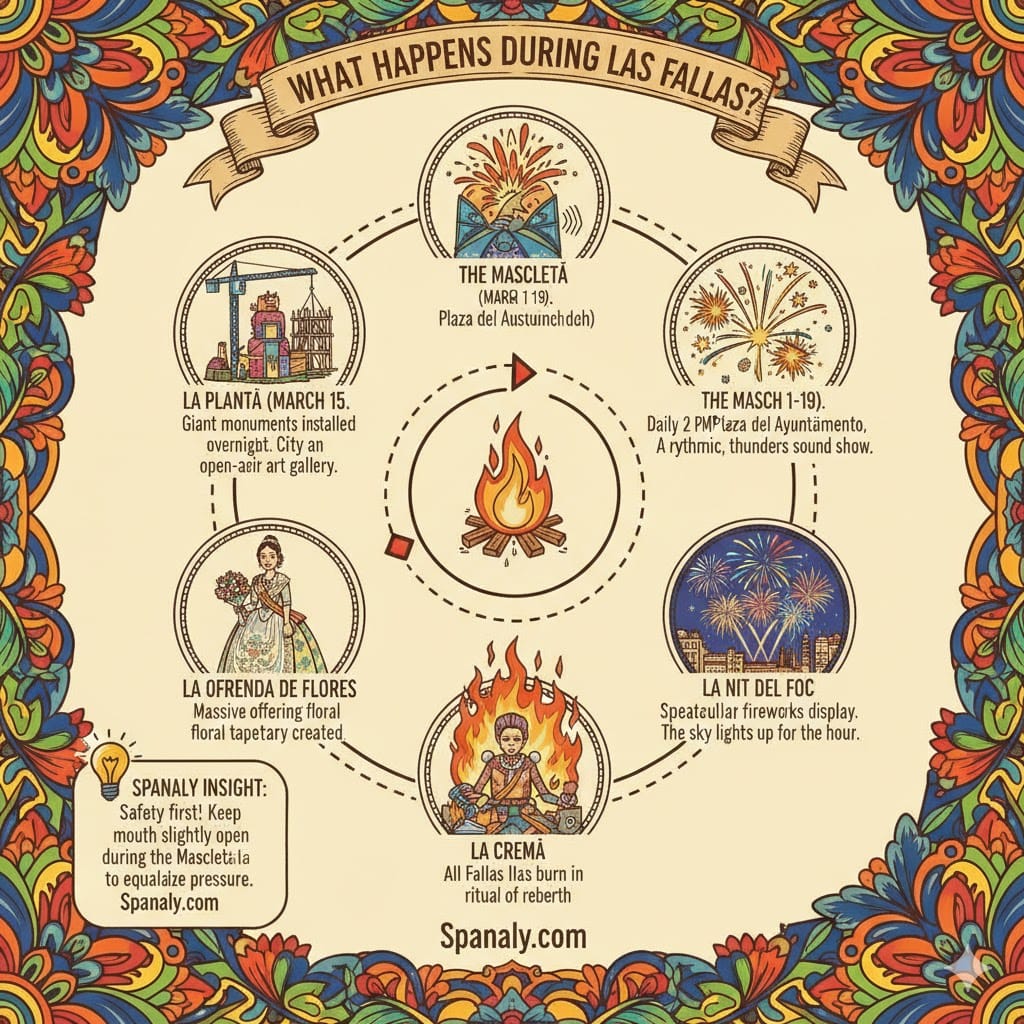
During Las Fallas, Valencia doesn’t just host a party; it transforms into an immersive sensory experience. Notably, the festival follows a strict and thrilling timeline that builds momentum until the final spark. Specifically, you must experience these five core pillars to truly say you’ve witnessed the city’s burning soul.
🔊 The Mascletà (March 1–19): Every day at 2:00 PM in Plaza del Ayuntamiento. It is a rhythmic “concert” of gunpowder and smoke that shakes your heart.
🏗️ La Plantà (March 15): The night when over 800 monuments are fully assembled. Overnight, the city turns into a giant, colorful art gallery.
💐 La Ofrenda (March 17–18): A deeply emotional parade where thousands of locals in traditional silk costumes offer flowers to create a 15-meter floral cape for the Virgin.
🎆 La Nit del Foc (March 18): “The Night of Fire.” A world-class fireworks display that illuminates the sky for nearly 20 minutes before the grand finale.
🔥 La Cremà (March 19): The dramatic climax. At midnight, every monument in the city is set ablaze, symbolizing rebirth and the start of spring.
Indeed, while the fire dominates the streets, don’t forget to visit La Lonja Valencia, a UNESCO Gothic masterpiece that stands as a silent witness to the city’s rich history. Ultimately, whether you prefer the thunder of the Mascletà or the beauty of the architecture, Valencia offers a spectacle for every soul.
💡 Spanaly Insight: Safety first! In fact, when attending the Mascletà, keep your mouth slightly open. Notably, this helps equalize the pressure in your ears from the intense 120-decibel explosions!
🎨 The Art of the Ninot: Satire in Polystyrene

At the heart of every Falla monument are the Ninots—individual figures that blend master craftsmanship with biting humor. Notably, these are not just statues; they are satirical caricatures that mirror the current state of the world. Specifically, the artists (Artistas Falleros) spend an entire year in massive workshops creating these temporary masterpieces from wood, wax, and polystyrene.
🎭 Sharp Satire: Most Ninots mock politicians, celebrities, or global events with a cheeky, Valencian twist.
🔨 Master Craftsmanship: The detail in the faces and expressions is so realistic it rivals the statues in the Prado Museum.
🗳️ The People’s Vote: Every year, the public votes for their favorite Ninot at the Exposición del Ninot.
🏆 The “Pardon”: The winner—the Ninot Indultat—is “pardoned” from the fire and preserved forever in the Fallas Museum.
Indeed, the level of detail is a testament to Spain’s deep artistic roots. Ultimately, walking through the streets during the festival is like visiting a massive, outdoor satirical gallery that only exists for a few days.
💡 Spanaly Insight: Look for the “hidden” details! In fact, many Ninots contain small poems or signs in the Valencian language (Valencià) that explain the joke. Notably, these “Critique” signs are what make the satire truly complete!
👗 Silk & Gold: The Fallera’s Traditional Attire
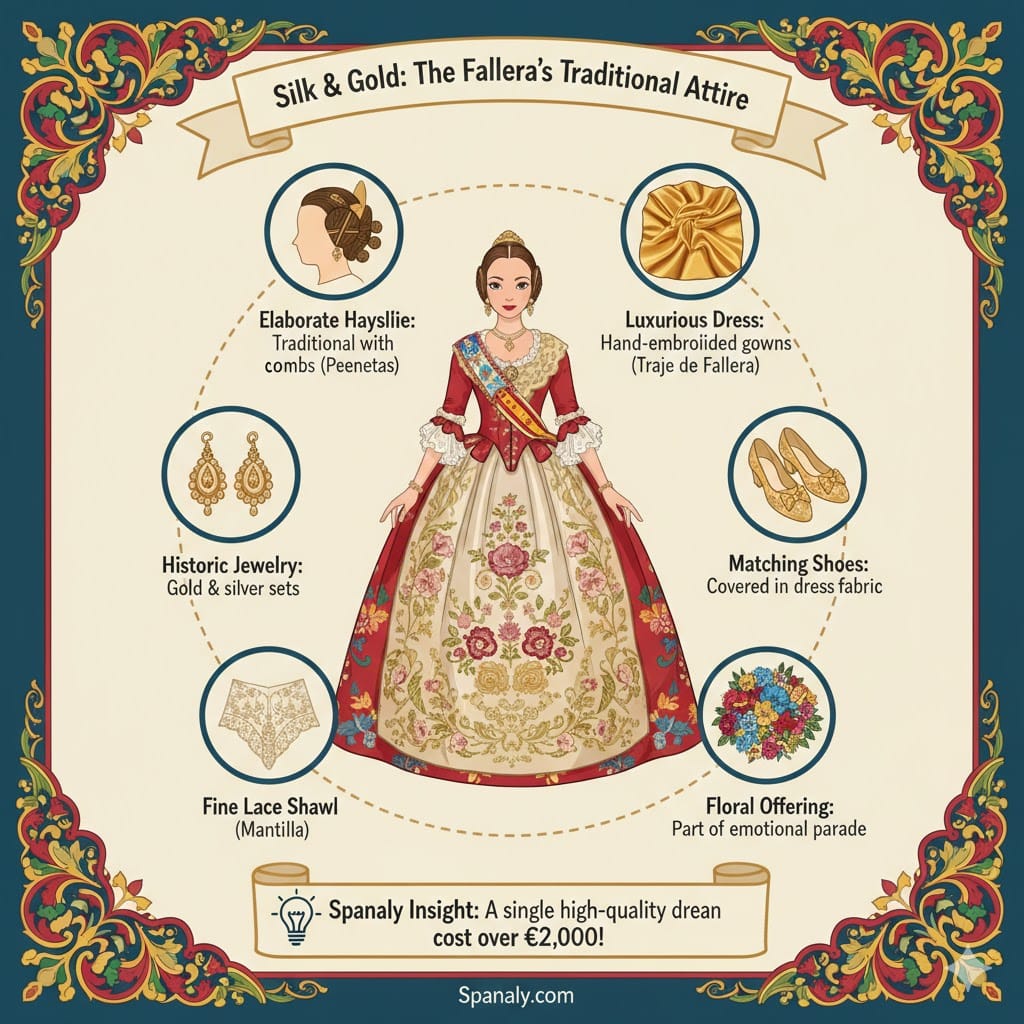
One of the most stunning sights of Las Fallas is the traditional clothing worn by the participants. Notably, the Traje de Fallera is considered one of the most expensive and intricate folk costumes in the world. Specifically, every detail—from the hand-woven silk to the historic jewelry—is a tribute to Valencia’s textile heritage.
🧵 Silk Masterpieces: The dresses are made from locally produced silk, often featuring floral patterns inspired by 18th-century designs.
💇 Elaborate Hairstyles: Women wear their hair in three buns (moños), decorated with golden or silver combs called Peinetas.
💎 Historic Jewelry: Gold or silver sets, often passed down through generations, include earrings, brooches, and necklaces.
👞 Matching Accessories: Even the shoes are covered with the same silk fabric as the dress to ensure a perfect match.
Indeed, the dedication to preserving these traditions is as deep as the respect for Spanish history found at the Royal Palace of Madrid. Ultimately, seeing thousands of Falleras marching in their silk finery is a visual experience that rivals any royal procession.
💡 Spanaly Insight: It is an investment! In fact, a complete, high-quality Fallera outfit can cost anywhere from €3,000 to over €20,000. Notably, many families start saving for their daughter’s first dress from the moment she is born!
🥘 Flavors of the Festival: Beyond Paella
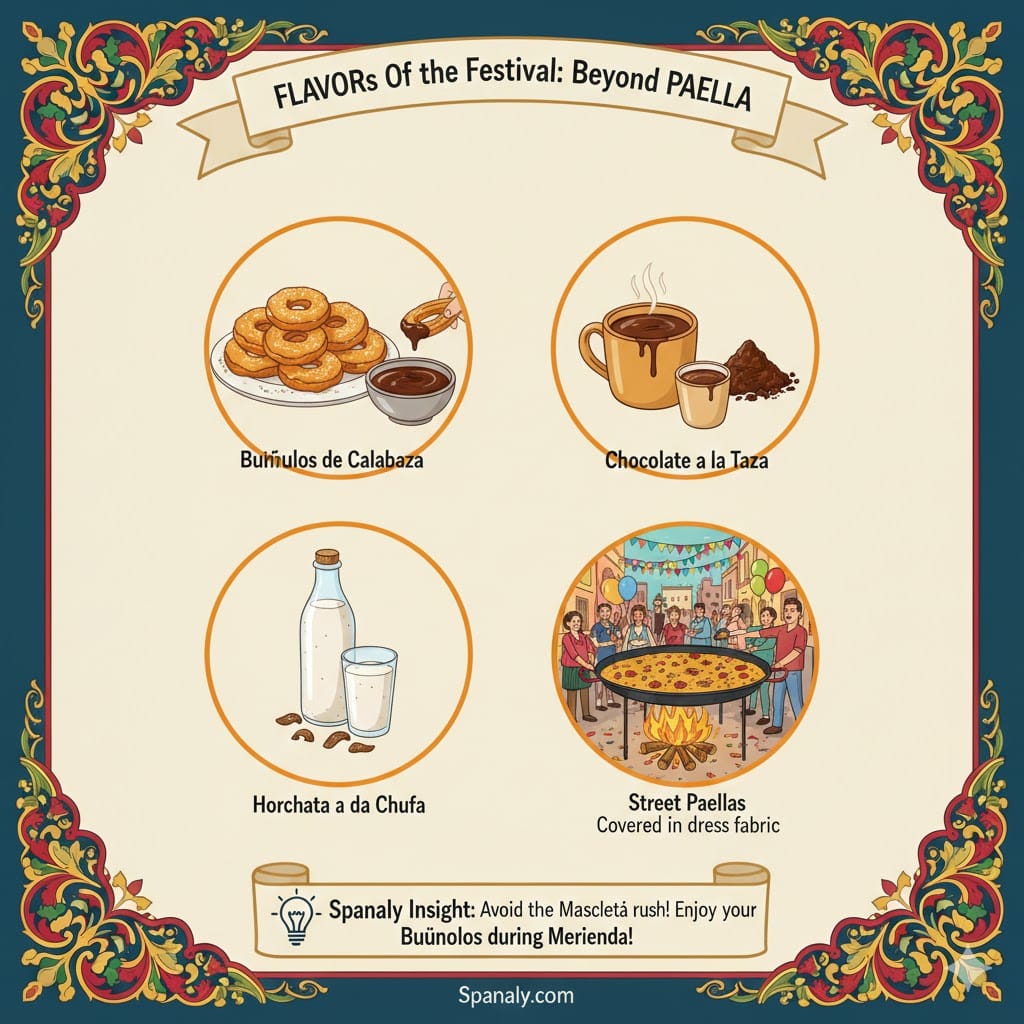
During Las Fallas, the scent of gunpowder mixes with the sweet, irresistible aroma of frying dough. Notably, while Valencia is the world-renowned cradle of Paella, the festival has its own unique street-food vocabulary. Specifically, you haven’t truly experienced the festival until you’ve refueled at a traditional puesto (stall) after a long day of walking.
🍩 Buñuelos de Calabaza: These pumpkin fritters are the undisputed kings of the festival. Crispy on the outside and airy inside, they are the fuel of every true Fallero.
☕ Chocolate a la Taza: Thick, rich, and served steaming hot. In fact, it is the mandatory dipping partner for your buñuelos during the chilly March nights.
🥤 Horchata de Chufa: A refreshing, milky drink made from tiger nuts. Notably, it’s the perfect non-alcoholic way to cool down under the Valencian sun.
🥘 Street Paellas: Entire neighborhoods gather to cook massive paellas over open wood fires right on the asphalt, turning the city into a giant open-air kitchen.
Indeed, exploring these seasonal treats is a delicious gateway to the wider Spanish Cuisine Guide. Ultimately, Las Fallas is a celebration that satisfies the stomach as much as it dazzles the eyes.
💡 Spanaly Insight: Beware of the “post-Mascletà” rush! In fact, the lines at the best buñolerías can take over an hour right after 2:00 PM. Notably, try to grab your treats during the Merienda (around 5:30 PM) for a more relaxed and authentic experience.
📍 The Masterpiece Route: Where to Find the Best Fallas
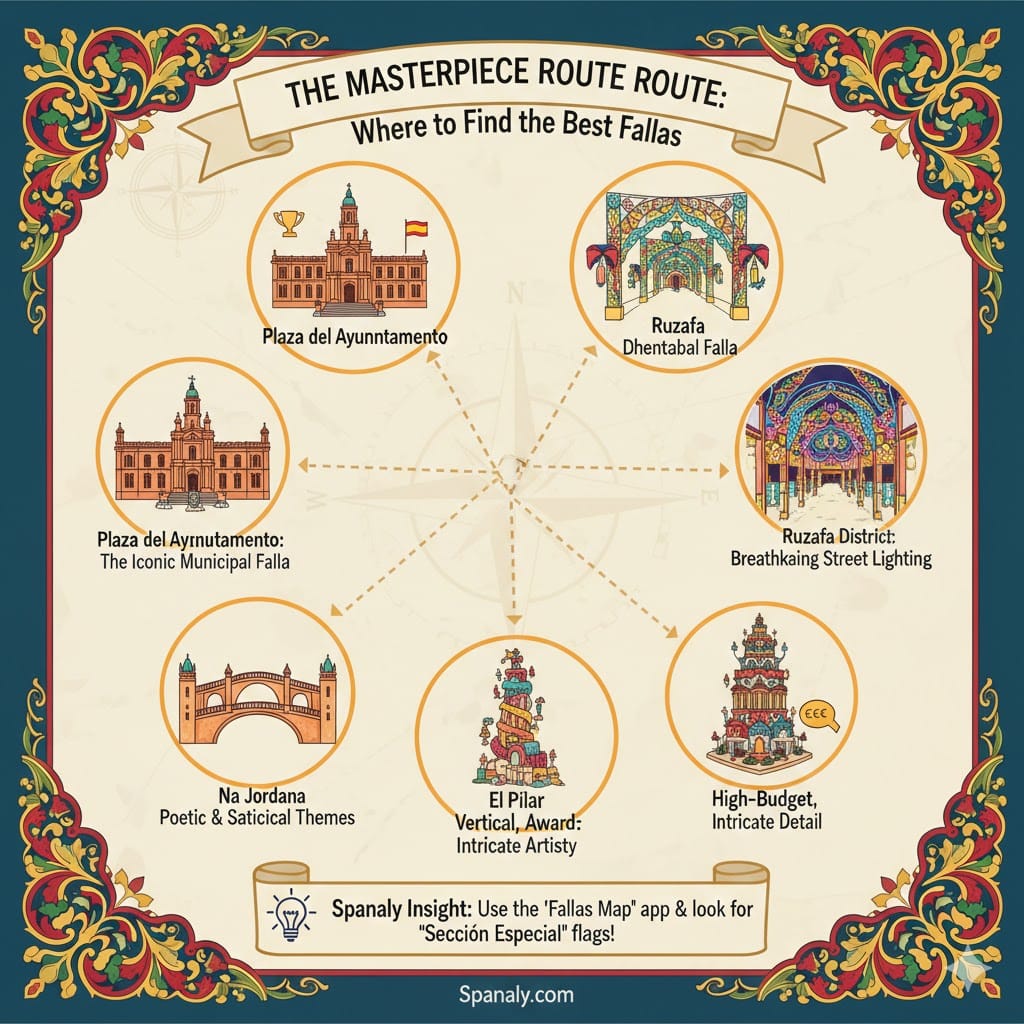
With over 800 monuments scattered across the city, knowing where to start is crucial. Notably, not all Fallas are created equal. Specifically, you should focus on the Sección Especial—the high-budget elite monuments that compete for the title of “Best in City.” Indeed, walking this route is like navigating a grand outdoor museum, much like exploring the historic streets of Valencia Spain Travel.
🏆 Plaza del Ayuntamiento: The “Municipal Falla.” While it doesn’t compete, it’s always the most iconic and stands right in the city center.
🎭 Ruzafa District (Cuba-Puerto Rico & Sueca-Literato Azorín): Famous not just for its massive monuments, but for its breathtaking street lighting displays that dance to music.
🏛️ El Pilar: Often the winner for “Best Monument.” Tucked in a small plaza, its verticality and gravity-defying figures are legendary.
🏘️ Convento Jerusalén: Located near the North Station, this Falla consistently boasts the highest budget and most intricate detail.
🌉 Na Jordana: Located in the Carmen neighborhood, it is known for its poetic, artistic, and deeply satirical themes.
Ultimately, to see these giants without the suffocating crowds, try to visit them during the Madrugà (very early morning) or the late night of March 16th.
💡 Spanaly Insight: Get the “Fallas Map” app! In fact, every year the official festival committee releases a GPS-guided map. Notably, looking for the “Special Section” (Sección Especial) flag on top of a monument is the easiest way to know you’ve found a masterpiece.
🔊 The Sound of Valencia: Understanding the Mascletà
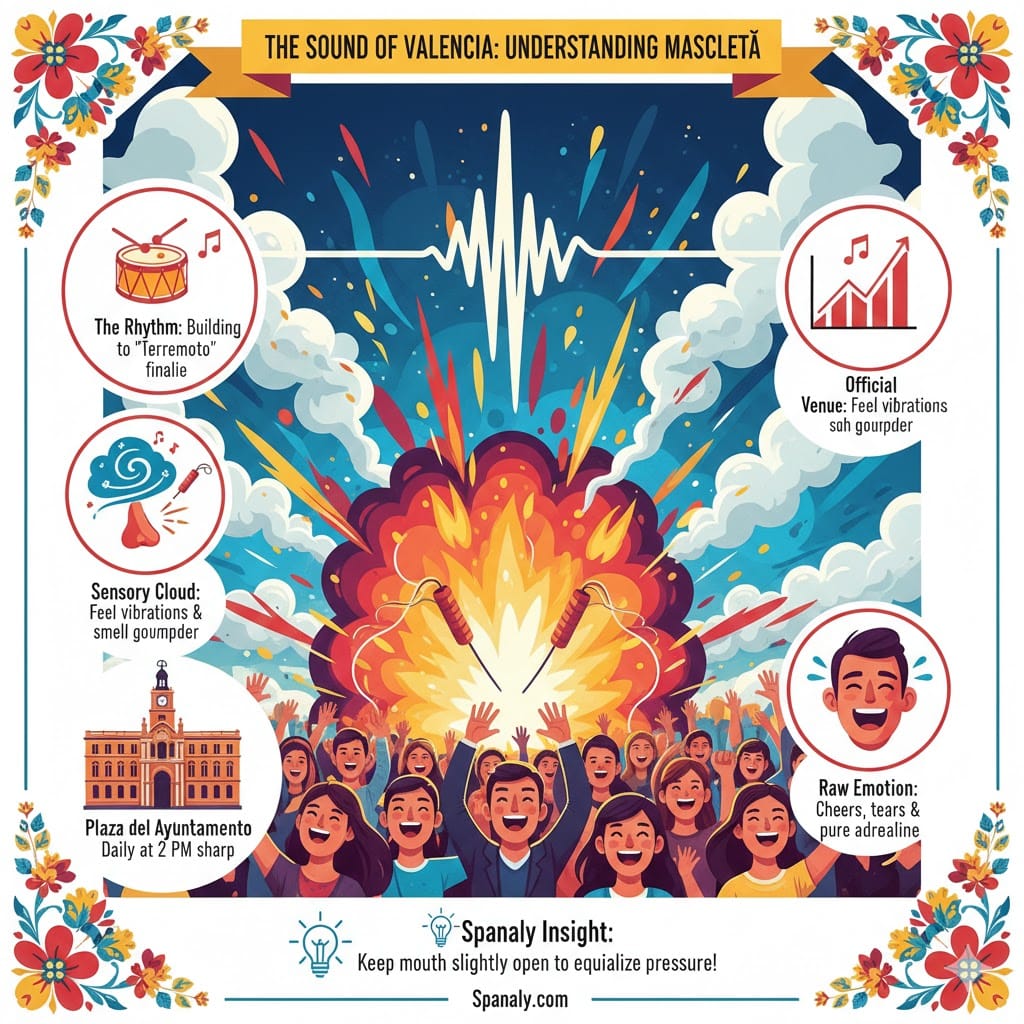
To the uninitiated, it might sound like a battlefield, but to a Valencian, it is a symphony. Notably, the Mascletà is perhaps the most unique aspect of Las Fallas. Specifically, it is a daily pyrotechnic concert where the “instruments” are different types of firecrackers (masclets) tied in complex lines to create a rhythmic, building crescendo.
🥁 The Rhythm: A good Mascletà isn’t just loud; it has a beat. It starts slowly, develops a melody of explosions, and ends with the “Terremoto” (Earthquake)—a final, earth-shaking blast.
☁️ The Sensory Cloud: It’s not just about hearing; you feel the vibrations in your chest and smell the thick, nostalgic scent of gunpowder filling the air.
📍 Plaza del Ayuntamiento: This is the “Santiago Bernabéu” of pyrotechnics. Every day at 2:00 PM, thousands gather to judge the Pirotécnico (the conductor of the fire).
🙌 The Emotion: When the final bang echoes, the crowd erupts in cheers, often moved to tears by the sheer power of the sound.
Indeed, this passion for gunpowder is a regional trait you’ll also find in the Moros y Cristianos in Alcoy, where arquebuses thunder through the streets. Ultimately, the Mascletà is the heartbeat of Valencia; without the noise, there is no festival.
💡 Spanaly Insight: Do not cover your ears with your hands! In fact, local experts advise keeping your mouth slightly open. Notably, this simple trick helps balance the internal pressure and prevents your eardrums from feeling the “punch” of the 120-decibel finale.
🛡️ Survival Guide: Navigating the Chaos Like a Local
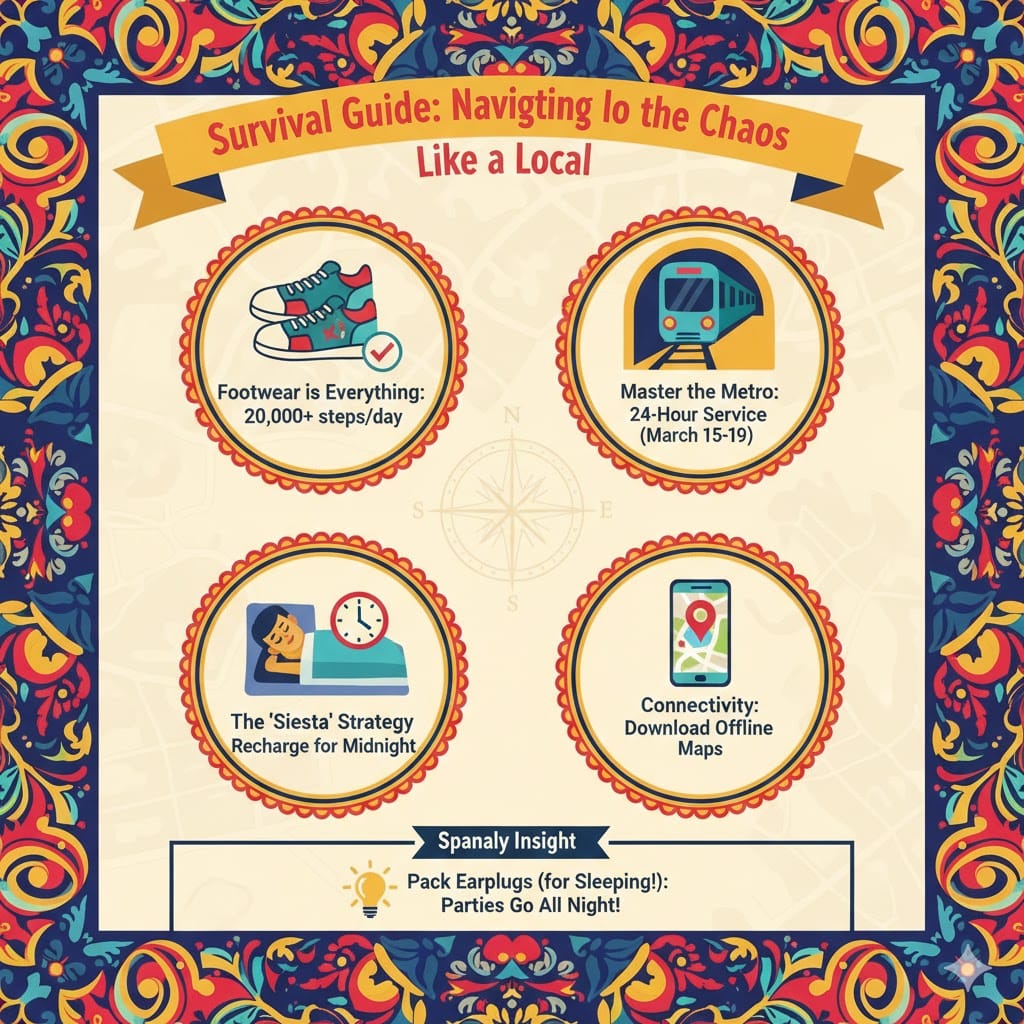
Visiting Valencia during Las Fallas is an exhilarating adrenaline rush, but it requires a solid local strategy. Notably, with the city’s population tripling and hundreds of streets closed to traffic, you need to plan your movements carefully. Specifically, many travelers use the energy of the festival as a starting point before heading to discover the quieter, more mysterious side of Spain, such as the Madrid Hidden Gems that offer a peaceful contrast to the Valencian roar.
👟 Footwear is Everything: You will walk—a lot. In fact, it’s common to clock over 20,000 steps a day hopping between monuments. Wear your most supportive sneakers.
🚇 Master the Metro: Taxis and buses are virtually useless in the center. Notably, Metro Valencia runs 24 hours during the peak days (March 15–19), making it the only reliable way to move around.
⏰ The “Siesta” Strategy: The party never stops. Indeed, locals take a strategic nap in the late afternoon to prepare for the midnight fireworks and the sunrise street parties (Verbenas).
📱 Connectivity: With millions of people packed into small plazas, mobile signals can drop. Ultimately, download offline maps and set a specific “lost and found” meeting point for your group.
Indeed, staying prepared is the key to a great Spanish adventure. Ultimately, if you embrace the noise and the crowds with the right mindset, you’ll find that the “chaos” is actually the most vibrant part of the experience.
💡 Spanaly Insight: Pack earplugs—but not for the Mascletà! In fact, you’ll need them to sleep. Notably, street celebrations and firecrackers occur at all hours. If your accommodation is near a Falla, earplugs are your only ticket to a few hours of rest!
🌍 Impact & Legacy: Why it’s UNESCO Heritage

In 2016, Las Fallas was officially added to UNESCO’s Representative List of the Intangible Cultural Heritage of Humanity. Notably, this wasn’t just because of the giant statues, but for the living culture that thrives behind them. Specifically, the festival represents a unique collective identity that has survived for centuries, blending ancient craftsmanship with modern social commentary.
🤝 Social Cohesion: The festival is run by nearly 400 Comisiones Falleras (neighborhood associations). In fact, these groups work year-round, fostering a sense of community that is rare in modern cities.
🎨 Preservation of Arts: From the master sculptors (Artistas Falleros) to the silk weavers and traditional musicians, Las Fallas keeps ancient trades alive. Indeed, without this festival, many of these skills would have vanished.
🗣️ Satire and Freedom of Speech: The festival’s essence is “Critique.” Notably, it provides a space where citizens can laugh at social and political issues, turning the “fire” into a symbolic cleansing of the past year’s problems.
🕊️ Ritual Rebirth: The Cremà (burning) is a profound ritual of renewal. Ultimately, it teaches the beauty of ephemeral art—creating something magnificent just to let it go.
Indeed, this deep respect for heritage is a common thread across Spain, from the fire of Valencia to the architectural wonders of Granada Spain. Ultimately, Las Fallas is more than a party; it is a testament to the human spirit’s need for art, community, and rebirth.
💡 Spanaly Insight: UNESCO status isn’t just a title! In fact, it brings strict regulations to protect the traditional methods of making the Ninots. Notably, there is a massive push now to use more sustainable materials like wood and rice straw to make the “rebirth” as green as possible.
💎 Insider Pro Tips: Secrets of a Valencian Falla
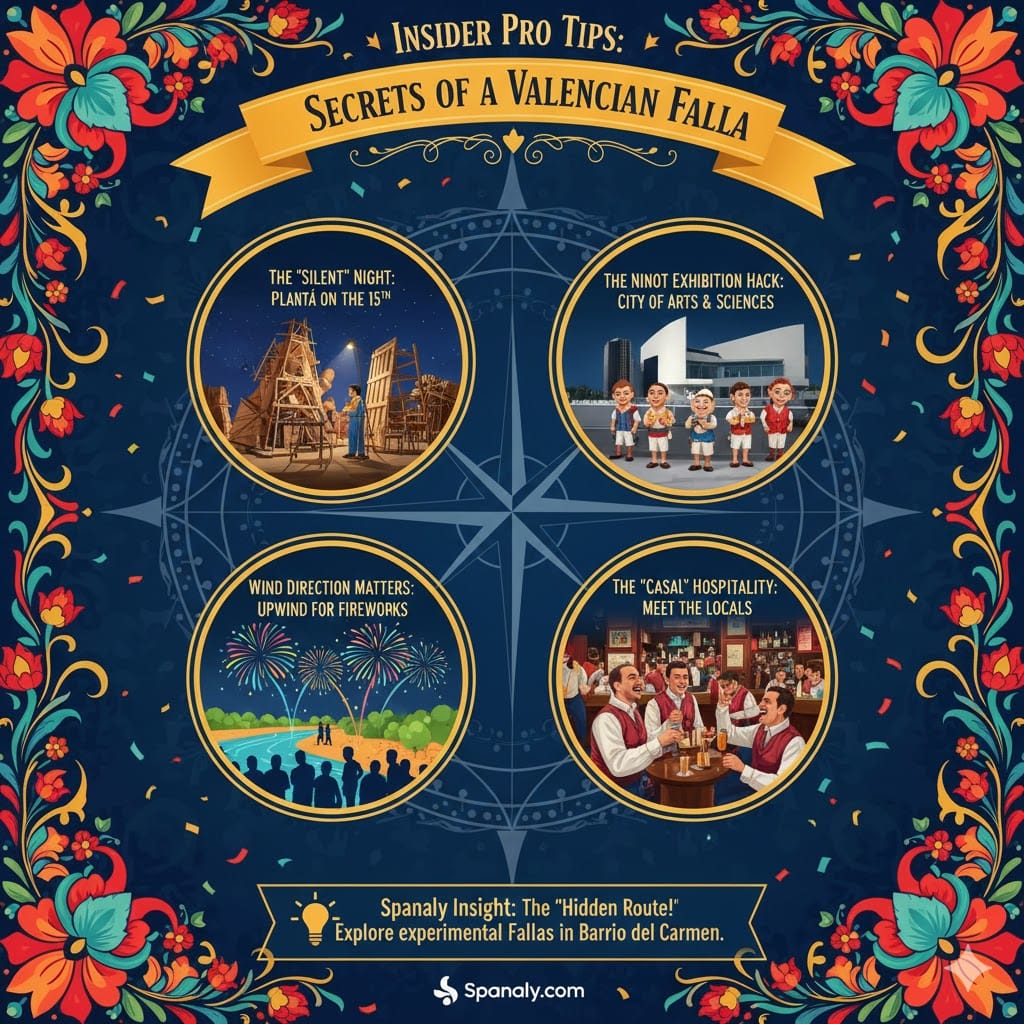
To experience Las Fallas like a true Fallero, you must look beyond the crowds. Notably, the most authentic moments happen in the gaps between the official events. Specifically, these “pro tips” are designed to help you bypass common tourist traps and discover the festival’s soul.
🚶 The “Silent” Night: While everyone waits for the Cremà on the 19th, the night of the 15th (the Plantà) is magical. In fact, you can watch the artists work through the night to assemble the giants. It’s the only time the city feels like a giant, quiet workshop.
🖼️ The Ninot Exhibition Hack: If you hate crowds, don’t wait for the statues to hit the streets. Notably, you can see the best individual figures at the Exposició del Ninot in the City of Arts and Sciences weeks before the festival starts.
💨 Wind Direction Matters: When watching the fireworks (Castillos) at the Turia Garden, always check the wind. Indeed, if the wind is blowing towards you, you’ll be engulfed in smoke and miss the entire show. Stand upwind for the best view.
🎫 The “Casal” Hospitality: Each Falla has a Casal (a private clubhouse). Ultimately, while many are private, some sell drinks and food to the public to raise funds. It’s the cheapest and most authentic place to grab a beer and meet the locals.
Indeed, these nuances are what separate a tourist from a traveler. Ultimately, once you’ve mastered the fire of Valencia, you might find yourself craving a different kind of Spanish magic, perhaps by exploring the historic charm of Alhambra Granada Spain.
💡 Spanaly Insight: Use the “Hidden Route”! In fact, most people follow the main roads between monuments. Notably, if you cut through the backstreets of the Barrio del Carmen, you’ll find smaller, “experimental” Fallas that are often more artistic and thought-provoking than the giant ones.
🔥 Essential Visitor FAQs – Las Fallas 2026
🐾 Is Las Fallas pet-friendly for travelers?
Generally, no. The constant firecrackers (petardos) and 120dB explosions can be extremely traumatic for animals. It is highly recommended to leave pets in a quiet area outside the city center or at a specialized pet hotel during the main days.
🎫 Do I need tickets to see the Fallas monuments?
No, viewing the monuments in the streets is 100% free. However, if you wish to enter the gated areas for close-up photos or access the "Special Section" balconies for the Mascletà, you may need to purchase specific passes from individual Falla commissions.
🧥 What should I wear for the night events?
While days are sunny, Valencian March nights are chilly and humid. **Notably**, wear layers and clothes you don't mind getting "ashy." During the Cremà, small sparks can fly, so avoid wearing highly flammable synthetic fabrics like thin nylon.
♿ Is the festival accessible for wheelchair users?
The city is flat and mostly accessible, but crowds make movement difficult. **Specifically**, visit the monuments early in the morning (before 10 AM) to enjoy the art without the dense crowds that block the sidewalks and narrow historic streets.
📸 Are drones allowed for festival photography?
No, flying drones over crowds or near the monuments is strictly prohibited and heavily fined for safety reasons. For the best aerial-style shots, head to the rooftop bars around Plaza del Ayuntamiento or the Torres de Serranos.
Curated by Spanaly.com
🌅 Farewell Valencia: The Rebirth from Ashes
As the last spark fades and the streets of Valencia return to their quiet Mediterranean charm, the spirit of Las Fallas remains. Notably, this festival is a reminder that beauty is ephemeral, and rebirth is always possible.
✨ The Magic: You came for the fire, but you’ll leave with the warmth of the Valencian people.
🔥 The Lesson: Burning the old to make way for the new is the ultimate Mediterranean philosophy.
👣 The Journey: Valencia is just one chapter of the Spanish story.
Indeed, if the passion of Las Fallas touched your heart, you might find a different kind of eternal devotion in the legendary tale of Isabel de Segura. Ultimately, Spain is a land where history and emotion are woven into every cobblestone.
💡 Spanaly Final Word: Don’t be sad it’s over. In fact, the artists start planning the next year’s monuments the very next morning. Notably, Valencia is already dreaming of its next rebirth. See you in 2027!