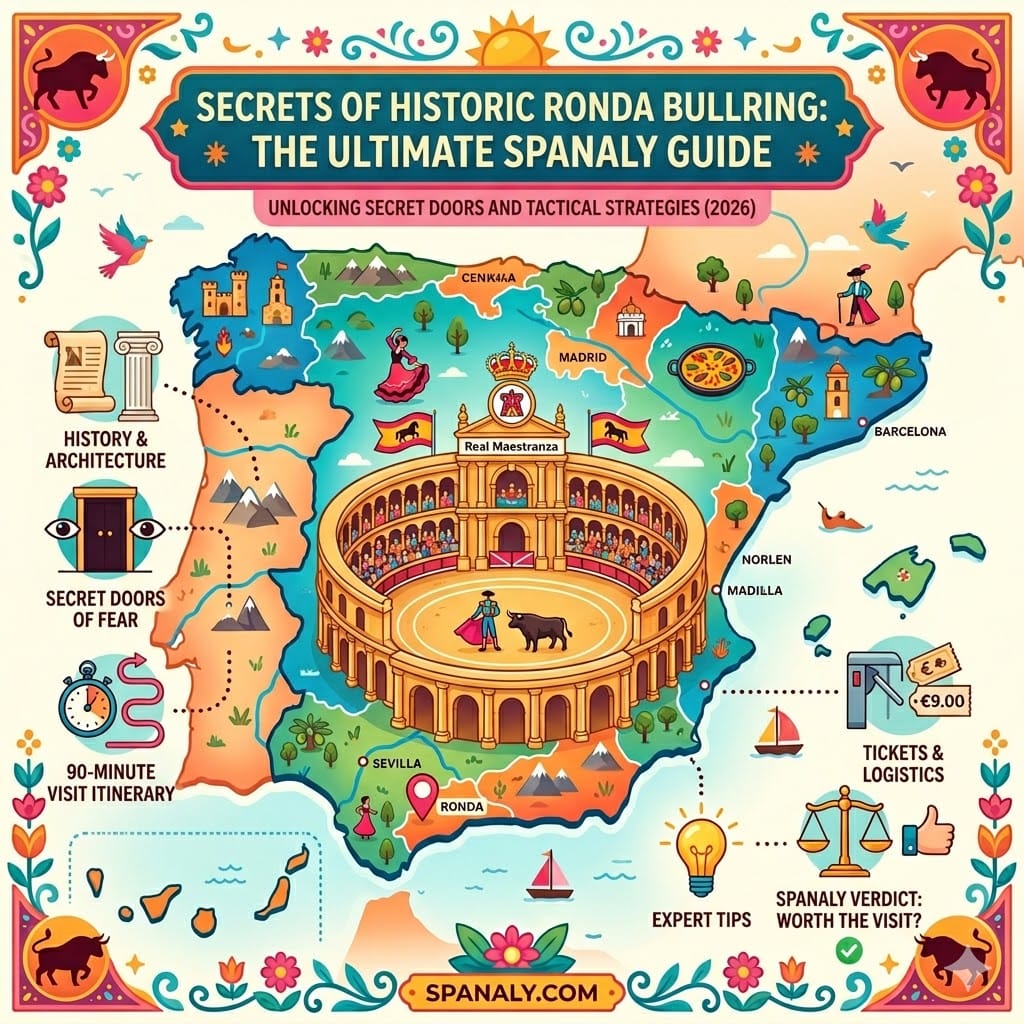
Table of Contents
Toggle🏁 The Cradle of Spanish Tradition
Walking into the Plaza de Toros de Ronda is a tactical encounter with Spanish soul. Unlike the modern arenas in Madrid or Seville, this neoclassical masterpiece is where the rules of modern bullfighting were born. If you are planning a broader mission to the city, check our Ultimate Ronda Travel Guide to see how this landmark fits your day.
📍 Tactical Briefing:
The Stone Giant: Built in 1785, it is one of the oldest and most architecturally significant rings in Spain.
The Circular Mastery: Its double-tiered arcade of 136 Tuscan columns makes it a masterpiece of Enlightenment-era engineering.
The Cultural Weight: This isn’t just a sports venue; it is a museum of the Romero and Ordóñez dynasties.
The Global Connection: Legends like Hemingway and Orson Welles found their creative spark within these sandstone walls.
Spanaly Insight: Most tourists walk straight to the center of the ring for a selfie. Tactical Move: Go to the upper gallery first. The acoustics are so precise that you can hear a whisper from across the 66-meter diameter. It is the best spot to appreciate the symmetry before the midday crowds arrive.
📊 The Spanaly Snapshot: Plaza de Toros de Ronda
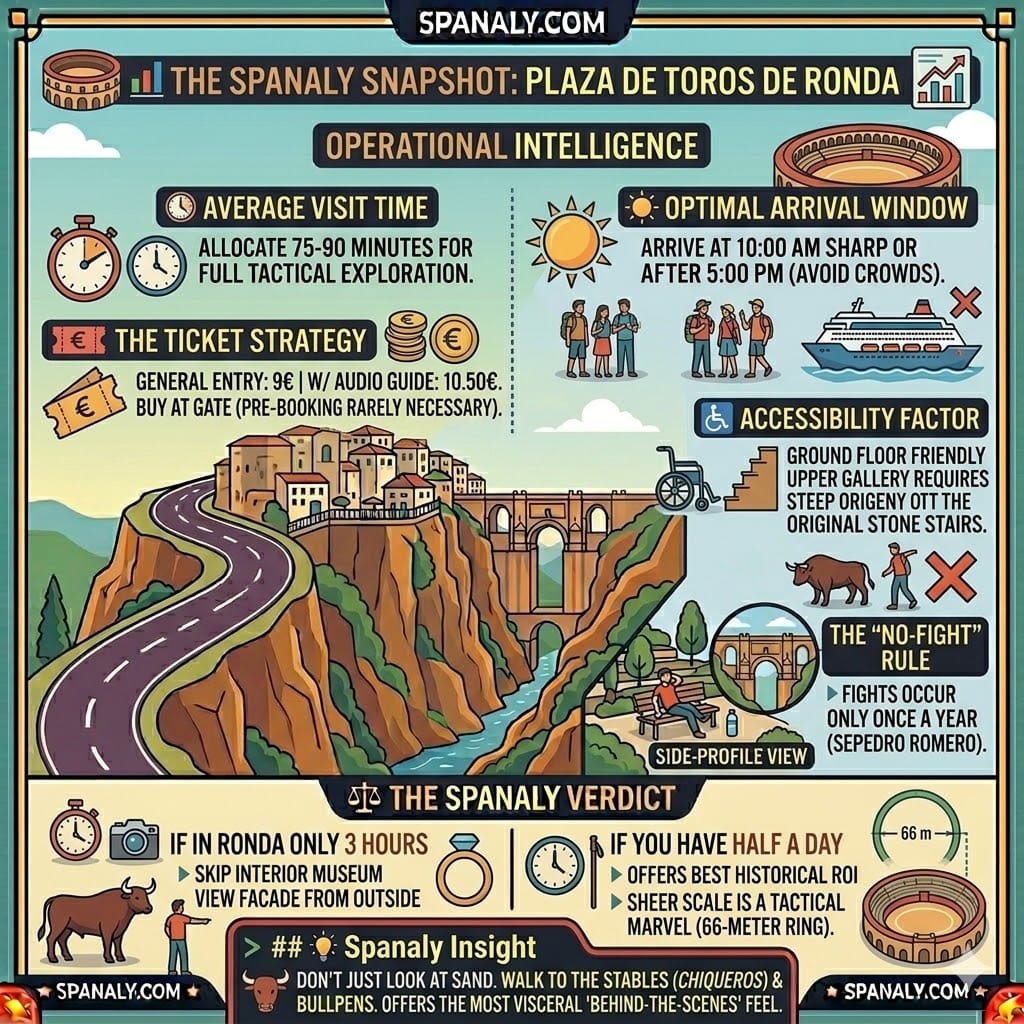
Before you commit your afternoon to the Plaza de Toros de Ronda, review these mission-critical details. This is the oldest bullring in Spain, and its management follows a strict operational protocol. For a broader view of Andalusia’s history, check our guide on Spanish Festivals to see the Goyesca influence in action.
📍 Operational Intelligence:
Average Visit Time: Allocate 75 to 90 minutes for a full tactical exploration.
Optimal Arrival Window: Arrive at 10:00 AM sharp or after 5:00 PM to avoid the cruise-tour crowds.
The Ticket Strategy: The general entry is 9€ (or 10.50€ with an audio guide). Buy tickets at the gate; online pre-booking is rarely necessary unless it’s a festival week.
Accessibility Factor: The ground floor is wheelchair-friendly, but the historic upper gallery requires navigating steep, original stone stairs.
The “No-Fight” Rule: Note that actual bullfights only occur once a year during the Feria de Pedro Romero in September.
⚖️ The Spanaly Verdict:
If you are only in Ronda for 3 hours, skip the interior museum and view the facade from the outside. However, if you have half a day, the Plaza de Toros de Ronda offers the best historical ROI (Return on Investment) in the city center. The sheer scale of the 66-meter ring is a tactical marvel that photos cannot fully capture.
Spanaly Insight: Don’t just look at the sand. Walk to the stables (Chiqueros) and the bullpens. Most tourists miss these narrow corridors, but they offer the most visceral “behind-the-scenes” feel of the 18th-century structure. It is where the tension of the tradition is most palpable.
🧱 The Battle of Architecture: Ronda vs. Las Ventas
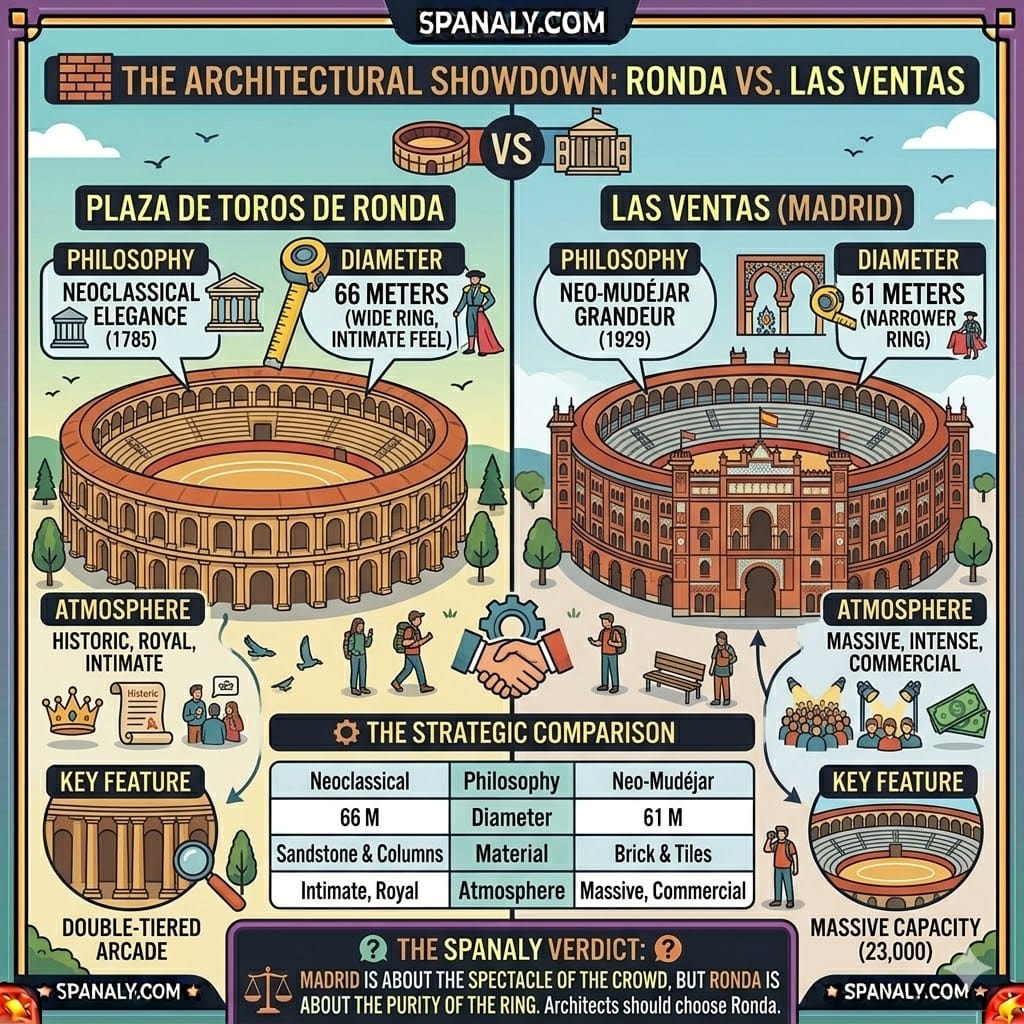
When exploring the Plaza de Toros de Ronda, you aren’t just looking at a stadium; you are witnessing Neoclassical mastery. While Madrid’s Las Ventas is famous for its massive scale and Neo-Mudéjar style, Ronda wins the tactical battle of “Pure Aesthetics” and historical priority.
📍 The Strategic Comparison:
| Feature | Plaza de Toros de Ronda | Las Ventas (Madrid) |
|---|---|---|
| Philosophy | Neoclassical Elegance (1785). | Neo-Mudéjar Grandeur (1929). |
| Diameter | 66 Meters (One of Spain’s widest). | 61 Meters (Narrower ring). |
| Material | Golden Sandstone and Tuscan Columns. | Red Brick and Ceramic tiles. |
| Atmosphere | Intimate, Royal, and Historic. | Massive, Intense, and Commercial. |
⚖️ The Spanaly Verdict:
Madrid is about the spectacle of the crowd, but Ronda is about the purity of the ring. If you are an architecture lover, the Plaza de Toros de Ronda is superior because of its double-tiered arcade of 136 Tuscan columns. In Madrid, you feel like a spectator; in Ronda, you feel like you’ve stepped back into the 18th-century Enlightenment.
Spanaly Insight: Don’t let the seating capacity fool you. While Madrid holds 23,000 people, Ronda’s ring diameter is actually larger. This was a tactical design to give the bullfighter more “escape space” before modern techniques were perfected. Stand in the center and look up; the symmetry here is a photographer’s dream that Madrid simply cannot replicate.
🛡️ The Romero Legacy: How Ronda Invented Modern Bullfighting
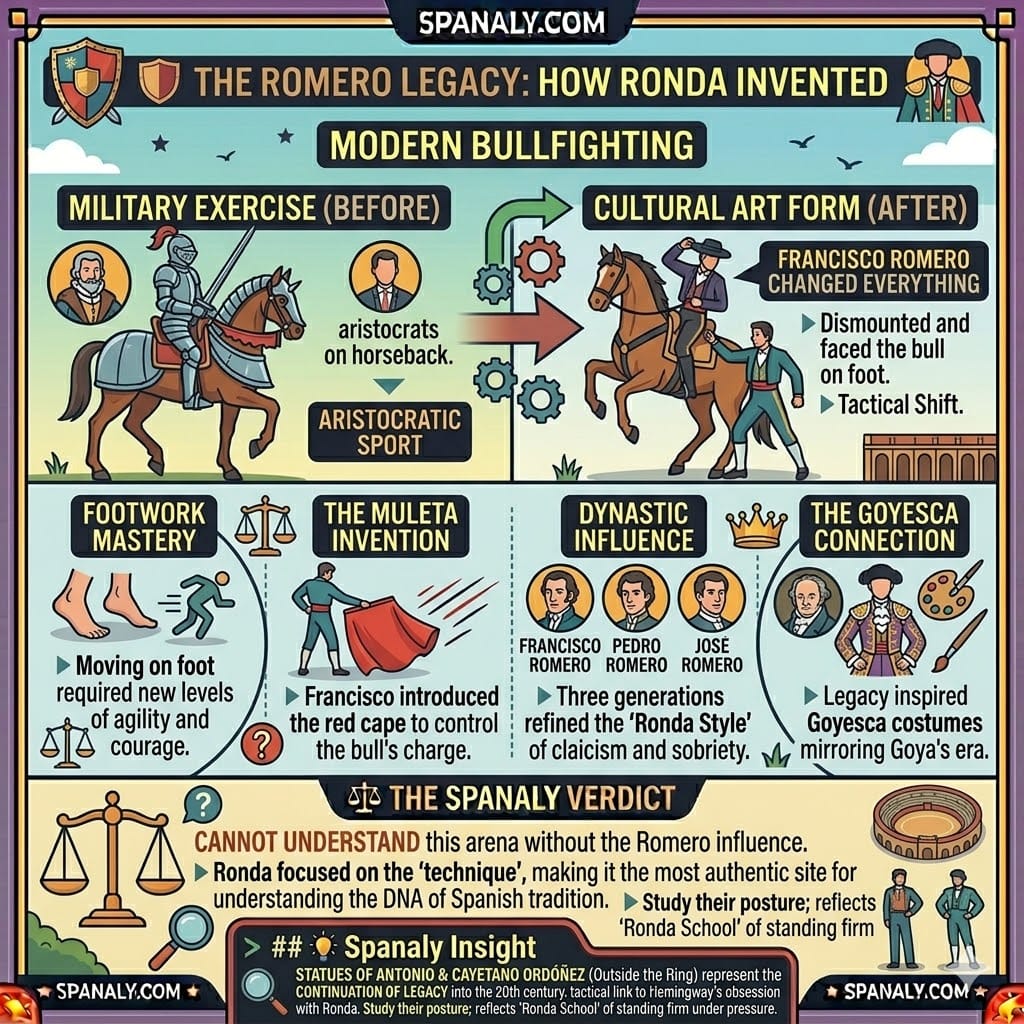
Ronda is the tactical birthplace of modern bullfighting. Before the Romero family, this was a sport for aristocrats on horseback. Francisco Romero changed everything by dismounting and facing the bull on foot. This shift transformed a military exercise into a cultural art form. To see how these traditions fit into your itinerary, check our Things to Do in Ronda guide.
📍 The Tactical Evolution:
Footwork Mastery: Moving on foot required new levels of agility and courage.
The Muleta Invention: Francisco introduced the red cape to control the bull’s charge.
Dynastic Influence: Three generations of Romeros refined the “Ronda Style” of sobriety.
The Goyesca Connection: This legacy inspired costumes mirroring the era of painter Francisco Goya.
⚖️ The Spanaly Decision:
You cannot understand this arena without acknowledging the Romero influence. While other cities focused on “spectacle,” Ronda focused on “technique.” This makes it the most authentic site for understanding the DNA of Spanish tradition. It is a place of deep history, not just tourist entertainment.
Spanaly Insight: Look for the statues of Antonio Ordóñez and Cayetano Ordóñez outside the ring. These figures represent the continuation of the Romero legacy into the 20th century. Most tourists ignore them, but they are the tactical link to Hemingway’s obsession with Ronda. Study their posture; it reflects the “Ronda School” of standing firm under pressure.
🖼️ Inside the Museo Taurino: Exploring the Real Armory
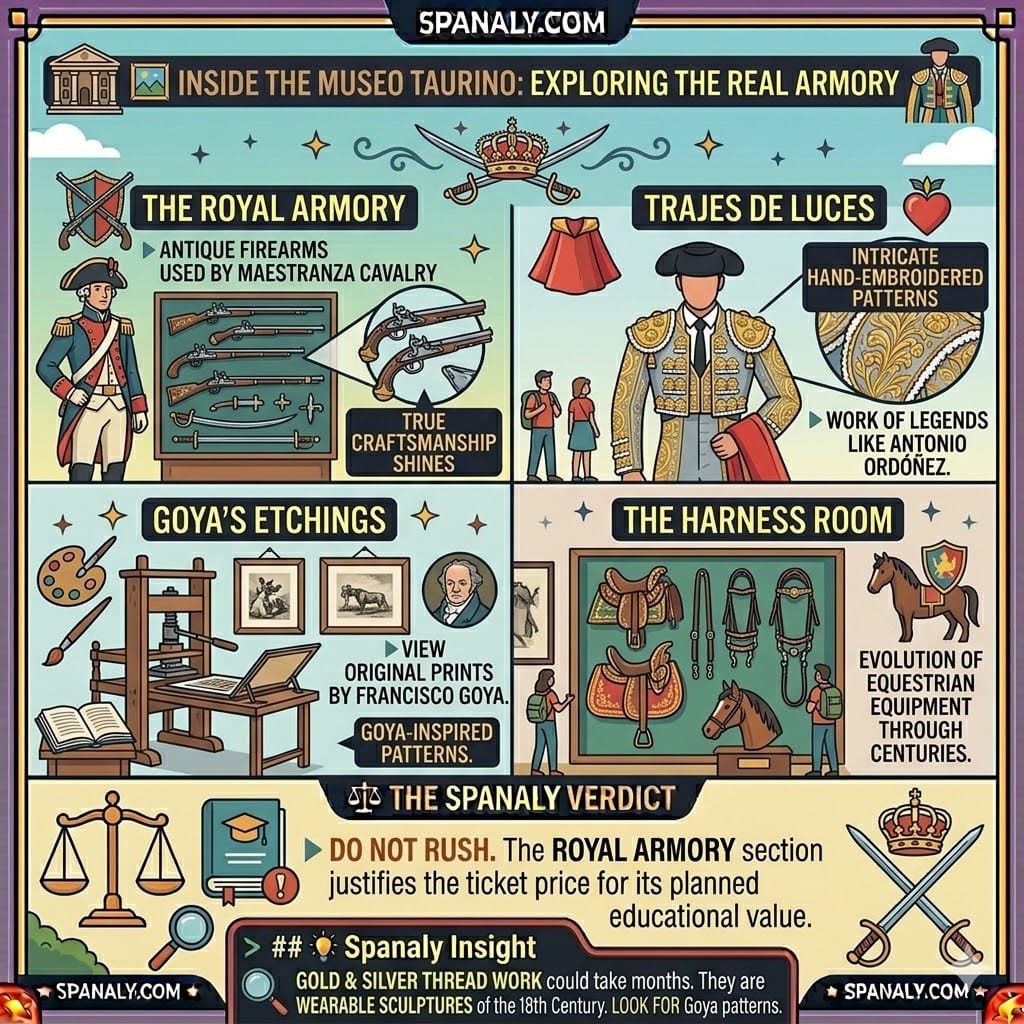
The museum inside the Plaza de Toros de Ronda is an expert-level deep dive into Spanish history. It houses more than just costumes; it is a repository of artistic and military artifacts. To see how these historic crafts compare to other regions, explore our guide on Toledo Steel Swords and Gold Crafts.
📍 Key Highlights for Your Visit:
The Royal Armory: Discover an impressive collection of antique firearms used by the Maestranza cavalry.
Trajes de Luces: Study the intricate “Suits of Lights” worn by legends like Antonio Ordóñez.
Goya’s Etchings: View original prints from the Tauromaquia series by the master Francisco Goya.
The Harness Room: A dedicated space showing the evolution of equestrian equipment through the centuries.
⚖️ The Spanaly Decision:
Do not rush through the corridors. Many visitors only focus on the bullfighting capes, but the Royal Armory section is where the true craftsmanship shines. If you appreciate fine metalwork and historical weaponry, this part of the museum justifies the entire entry ticket price. It provides a planned, educational layer to your Ronda mission.
Spanaly Insight: Pay close attention to the embroidery on the 18th-century costumes. The gold and silver thread work was done entirely by hand and could take months to complete. These aren’t just clothes; they are wearable sculptures that represent the peak of Spanish textile art. Look for the Goya-inspired patterns; they are the most valuable pieces in the collection.
🐎 Real Maestranza de Caballería: More Than Just a Bullring
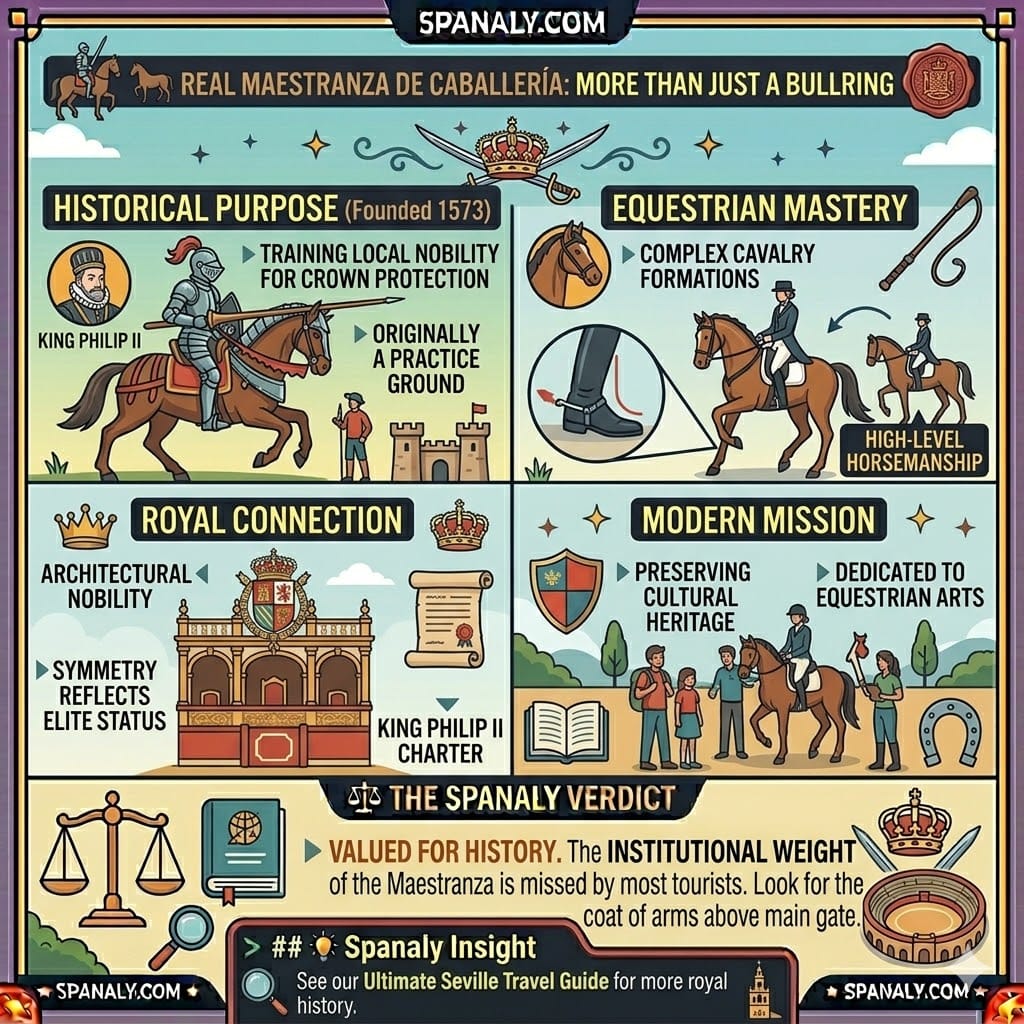
The Plaza de Toros de Ronda is not merely a venue for public spectacle; it is the headquarters of the Real Maestranza de Caballería, one of Spain’s oldest and most noble orders of chivalry. Founded in 1573, this institution served a critical defensive purpose, training the local nobility in equestrian maneuvers and high-level weaponry to protect the Crown. For a broader look at royal history in Andalusia, explore our Ultimate Seville Travel Guide, home to Spain’s other legendary cavalry ring.
📍 Strategic Institutional Facts:
The Royal Charter: Established by King Philip II to ensure a ready supply of skilled horsemen for the kingdom.
Equestrian Mastery: The arena was originally a practice ground for complex cavalry formations and horsemanship.
Architectural Nobility: The building’s symmetry and the presence of the Royal Box (Palco Real) reflect its elite status.
Modern Mission: Today, it remains a prestigious institution dedicated to preserving cultural heritage and equestrian arts.
⚖️ The Spanaly Decision:
When you walk across the sand, remember you are in a military training ground of the Enlightenment era. Most visitors miss the institutional weight of the Maestranza, focusing only on the “ring.” If you value history, take a moment to look at the coat of arms above the main gate; it is a direct link to Ronda’s status as a frontier stronghold.
🎥 The Orson Welles & Hemingway Connection: Ronda’s Global Fame
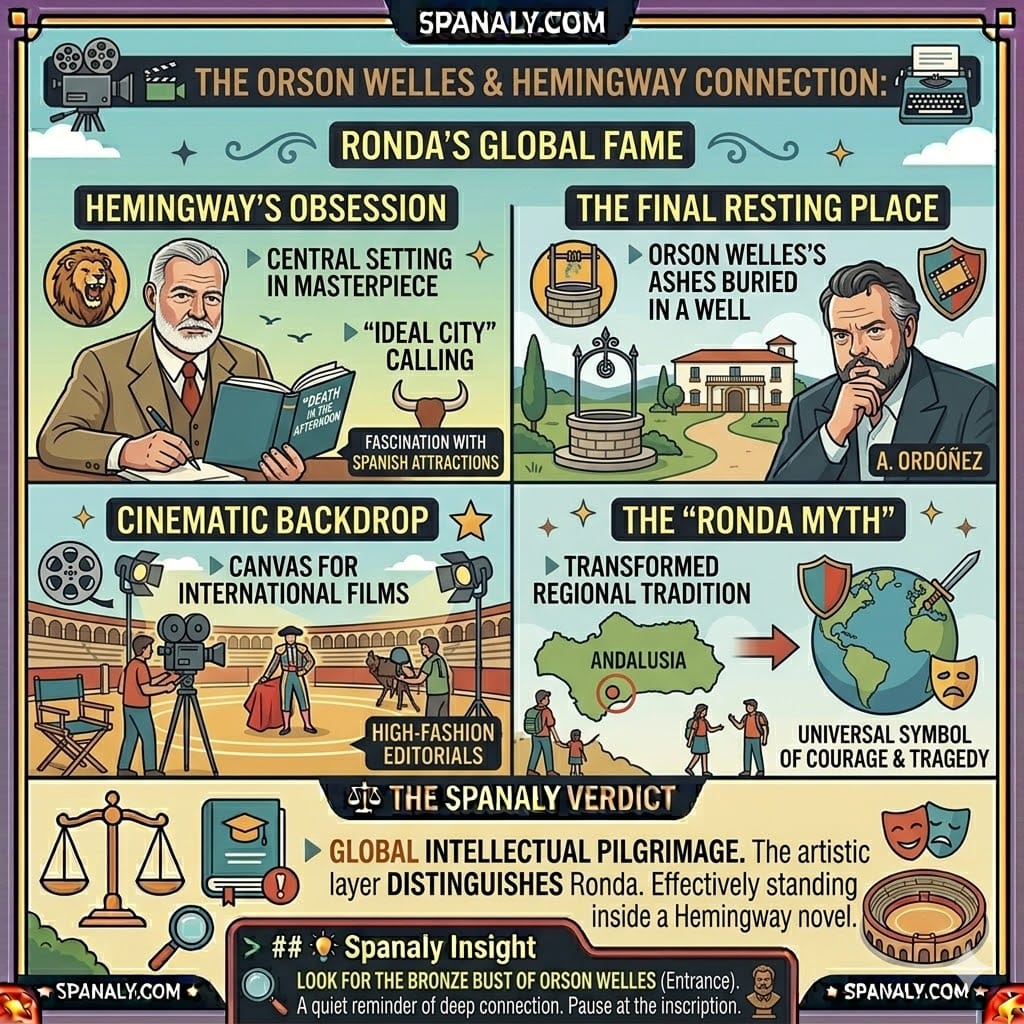
The international legend of the Plaza de Toros de Ronda was cemented by two American icons: Ernest Hemingway and Orson Welles. These visionaries didn’t just visit; they became global ambassadors for Ronda’s “stark beauty” and cultural intensity. Hemingway’s fascination with this arena was deeply tied to his love for all traditional Spanish Attractions, where history and art collide in the sand.
📍 The Artistic Impact:
Hemingway’s Obsession: The author used Ronda as a core setting in his masterpiece, Death in the Afternoon, calling it the “ideal city.”
The Final Resting Place: Orson Welles loved Ronda so much that his ashes were buried in a well on the estate of his friend, Antonio Ordóñez.
Cinematic Backdrop: The ring’s unique symmetry has served as a canvas for countless international films and high-fashion editorials.
The “Ronda Myth”: These artists helped transform a regional tradition into a universal symbol of courage and tragedy.
⚖️ The Spanaly Decision:
Ronda owes its high international visitor numbers to the literary and cinematic “marketing” of the mid-20th century. When you stand in the ring, you are effectively standing inside a Hemingway novel. This artistic layer is what distinguishes Ronda from any other arena in the world—it is a site of global intellectual pilgrimage.
Spanaly Insight: Look for the bronze bust of Orson Welles near the entrance to the bullring. It is a quiet reminder of his deep connection to the city. Most travelers take a quick photo and move on, but if you pause at the inscription, you’ll feel the weight of a man who found his spiritual home in these Andalusian mountains.
🌑 The Underworld: Chiqueros, Chapels, and the Infirmary
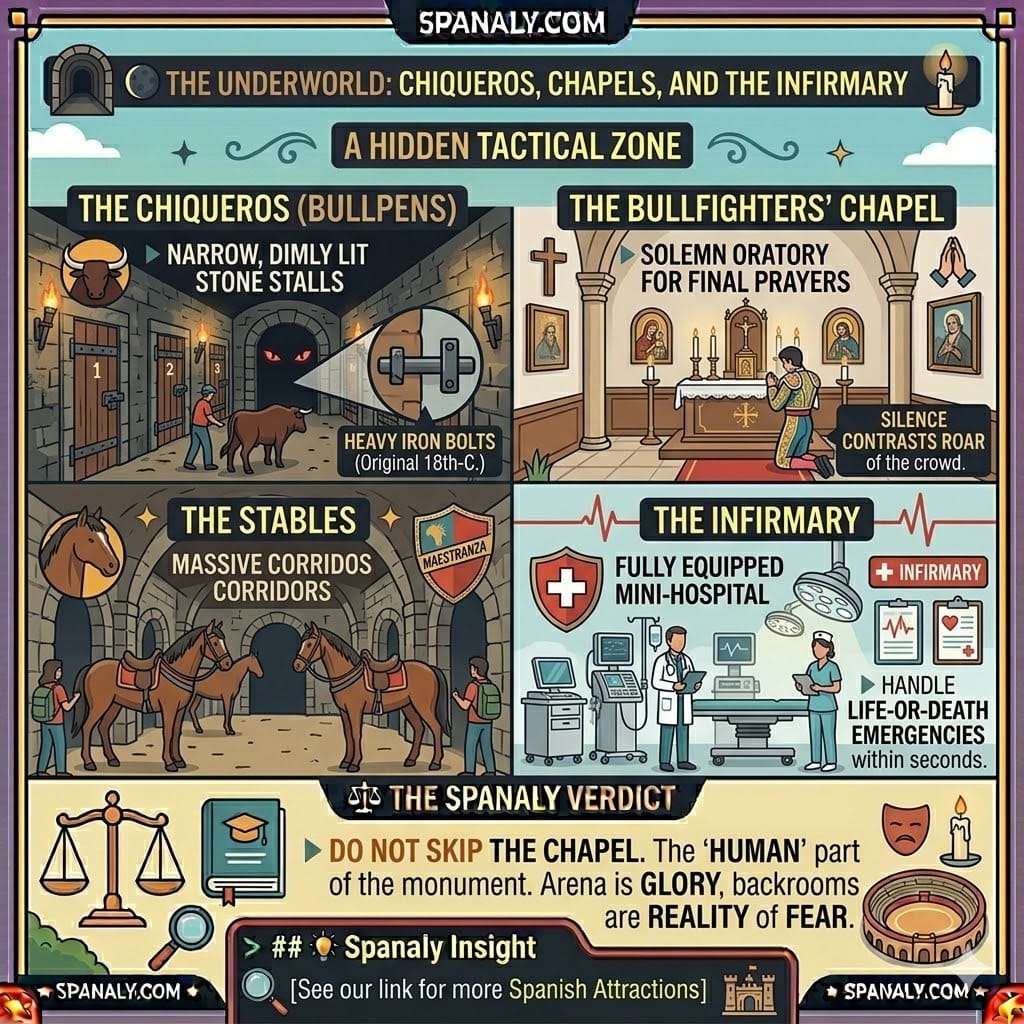
To truly master the Plaza de Toros de Ronda, you must descend into its “Underworld.” Most tourists remain on the sand, but the real drama lies behind the heavy wooden gates. This area represents the raw, human side of the tradition, much like the hidden depths found in other Spanish Attractions.
📍 The Hidden Tactical Zones:
The Chiqueros (Bullpens): Explore the narrow, dimly lit stone stalls where the bulls are held in total darkness before entering the ring.
The Bullfighters’ Chapel: Visit the small, solemn oratory where matadors offer their final prayers. The silence here is a stark contrast to the roar of the crowd outside.
The Infirmary: A chilling reminder of the risk, this fully equipped mini-hospital was designed to handle life-or-death emergencies within seconds.
The Stables: Walk through the massive stone corridors where the horses of the Maestranza are prepared for their equestrian displays.
⚖️ The Spanaly Decision:
Do not skip the Chapel. Even if you aren’t religious, the atmosphere inside this tiny room explains the mental pressure of the Ronda School of bullfighting. It is the most “human” part of the monument. While the arena is about glory, the backrooms are about the reality of fear and preparation.
Spanaly Insight: Look at the heavy iron bolts on the Chiquero doors. They are original 18th-century pieces. When you stand in the corridor between the pens and the ring, you are standing in the “Alley of Terror.” This is the best spot for a high-contrast photo that captures the authentic, gritty history of Ronda away from the bright Mediterranean sun.
⏱️ The Spanaly Itinerary: 90 Minutes Inside the Ring
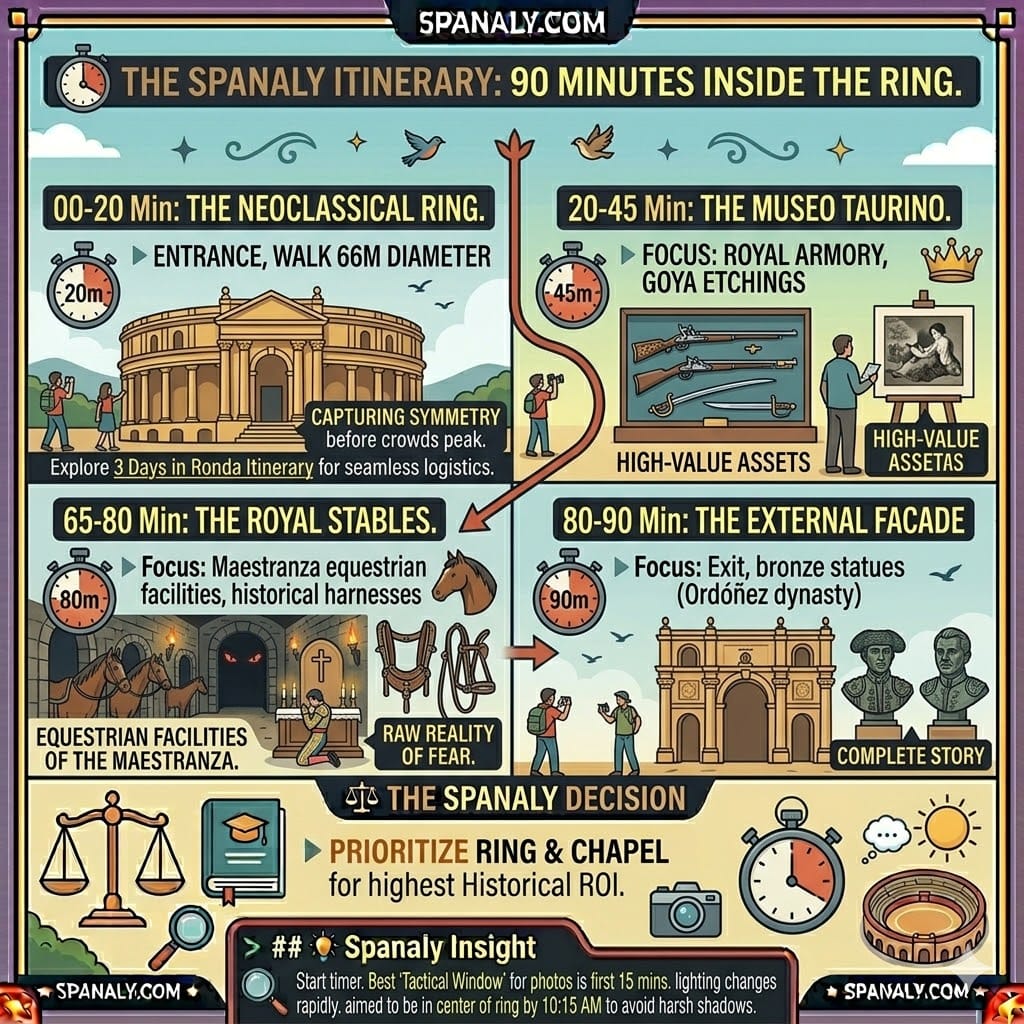
Efficiency is the key to mastering this monument. Most visitors wander aimlessly, but a planned approach ensures you witness the architectural mastery and the “Underworld” without fatigue. If you are balancing this with other city goals, see our 3 Days in Ronda Itinerary for seamless logistics.
📍 The Tactical Execution:
00-20 Min: The Neoclassical Ring. Enter and walk the full 66-meter diameter. Capture the symmetry of the 136 Tuscan columns before the crowds peak.
20-45 Min: The Museo Taurino. Focus on the Royal Armory and the Goya etchings. These are the high-value assets of the museum collection.
45-65 Min: The Underworld Mission. Descend into the Chiqueros (bullpens) and spend five minutes in the silent Bullfighters’ Chapel.
65-80 Min: The Royal Stables. Observe the equestrian facilities of the Maestranza and the historical harnesses used for centuries.
80-90 Min: The External Facade. Exit through the main gate and photograph the bronze statues of the Ordóñez dynasty for a complete story.
⚖️ The Spanaly Decision:
If you have limited time, prioritize the Ring and the Chapel. These two spots offer the highest “Historical ROI” (Return on Investment). Skipping the middle sections of the museum is acceptable if you are on a tight schedule, but never skip the spiritual atmosphere of the backrooms.
Spanaly Insight: Start your timer the moment you pass the ticket booth. The best “Tactical Window” for photos is the first 15 minutes because the lighting on the golden sandstone changes rapidly. Aim to be in the center of the ring by 10:15 AM to avoid the harsh shadows that ruin high-contrast architectural shots.
🎟️ Operational Logistics: Tickets, Entry, and Avoiding Scams
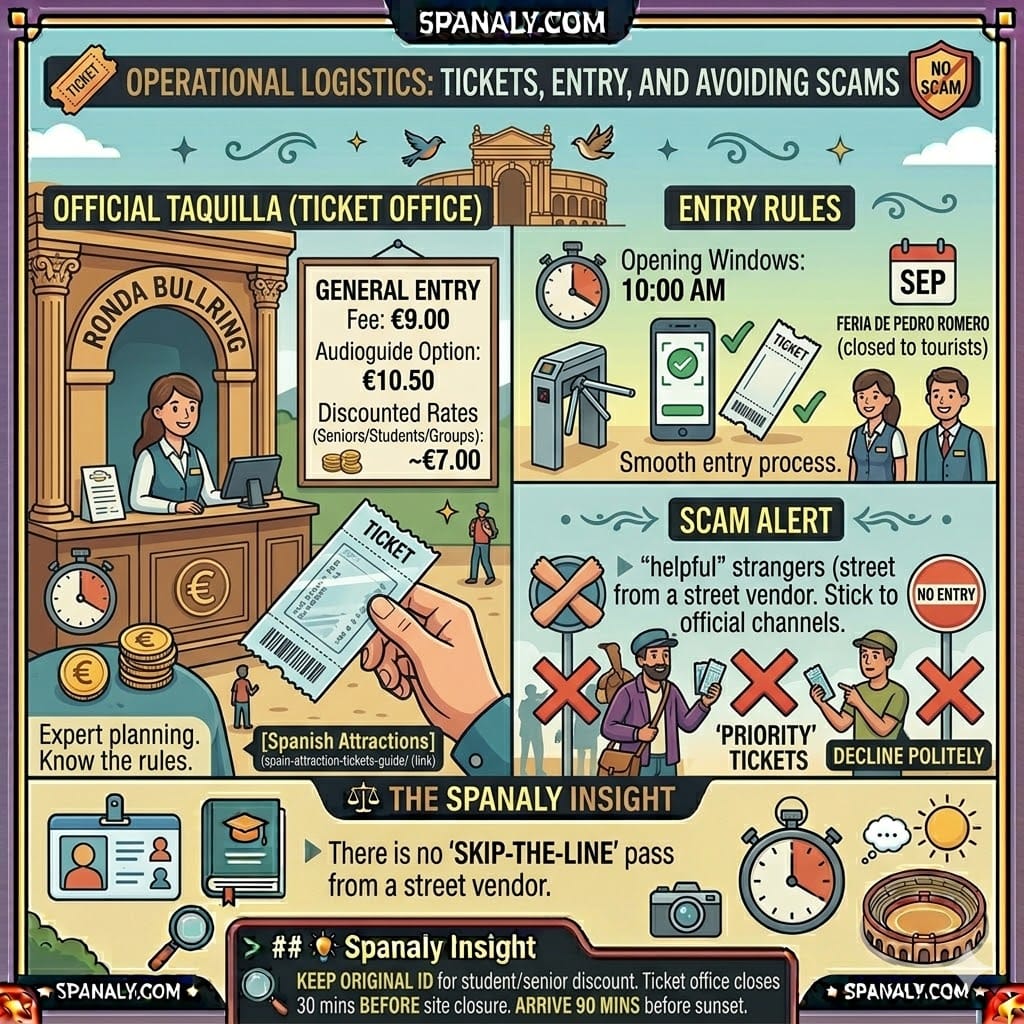
Navigating the entry process for the Plaza de Toros de Ronda requires a bit of expert planning. This is one of the most visited Spanish Attractions, and knowing the ground rules will save you both time and money. While pre-booking is rarely a strict necessity for the museum, having a clear objective for your visit is essential.
📍 Critical Visitor Data (2026):
General Entry Fee: Expect to pay €9.00 for a standard ticket. If you prefer a deep dive, the Audioguide option is €10.50.
Discounted Rates: Seniors (65+), students (with valid ID), and groups typically enjoy reduced entry around €7.00.
Opening Windows: The gates generally open at 10:00 AM and close between 6:00 PM and 8:00 PM depending on the season.
The “Feria” Exception: Be aware that the ring closes to tourists during the Feria de Pedro Romero in early September.
⚖️ The Spanaly Decision:
Always purchase your tickets directly at the official ticket office (Taquilla) located at the main entrance. You might encounter “helpful” strangers offering “priority” tickets or guided tours in the surrounding plaza—politely decline. There is no such thing as a “skip-the-line” pass from a street vendor. Stick to the official channels to ensure your entry is valid and your budget is protected.
Spanaly Insight: If you are a student or a senior, keep your original ID or passport handy. Digital copies are sometimes rejected by strict staff members. Also, remember that the ticket office closes 30 minutes before the official site closure. If you arrive at 5:35 PM for a 6:00 PM closing, you will be denied entry. Plan to arrive at least 90 minutes before sunset for the best experience.
⛈️ Seasonal Tactics: When to Visit (And Every Expert Window)
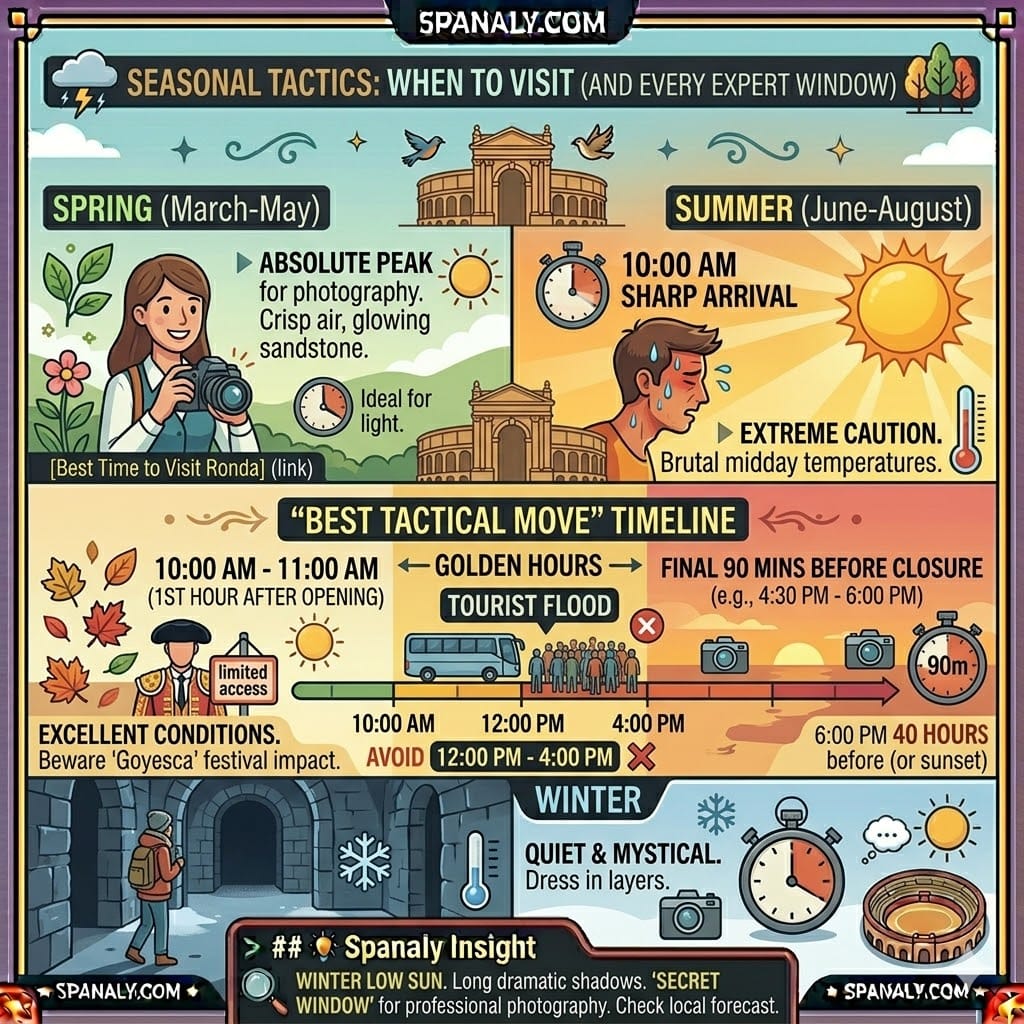
Timing your mission to the Plaza de Toros de Ronda is just as critical as the visit itself. Because Ronda sits on a high plateau, it experiences dramatic temperature swings that can affect your experience in the open-air ring. For a complete climate breakdown and peak festival dates, explore our guide on the Best Time to Visit Ronda to align your trip with perfect weather.
📍 The Strategic Seasonal Windows:
Spring (March–May): The absolute peak for photography. The air is crisp, and the golden sandstone of the ring glows under a mild Mediterranean sun.
Summer (June–August): Extreme caution is advised. Midday temperatures in the open ring can be brutal. If visiting now, arrive at 10:00 AM sharp.
Autumn (September–October): Excellent conditions, but be aware of the Goyesca festival in early September which occasionally limits tourist access.
Winter (November–February): Quiet and mystical. Ronda can be surprisingly cold, so dress in layers to explore the stone corridors comfortably.
⚖️ The Spanaly Decision:
Avoid the “Day Trip Rush” between 12:00 PM and 4:00 PM regardless of the season. This is when tour buses from the coast arrive, flooding the museum and the arena floor. Your best tactical move is to visit during the “Golden Hours”—either the first hour after opening or the final 90 minutes before closure.
Spanaly Insight: If you visit in winter, the low sun creates long, dramatic shadows across the 136 Tuscan columns. This is the “Secret Window” for professional photographers to capture the ring’s neoclassical symmetry without the interference of harsh, vertical light. Keep an eye on the local forecast; a rainy day in Ronda makes the arena floor muddy and difficult to navigate.
⚖️ The Spanaly Verdict: Is the Entry Fee Actually Worth It?
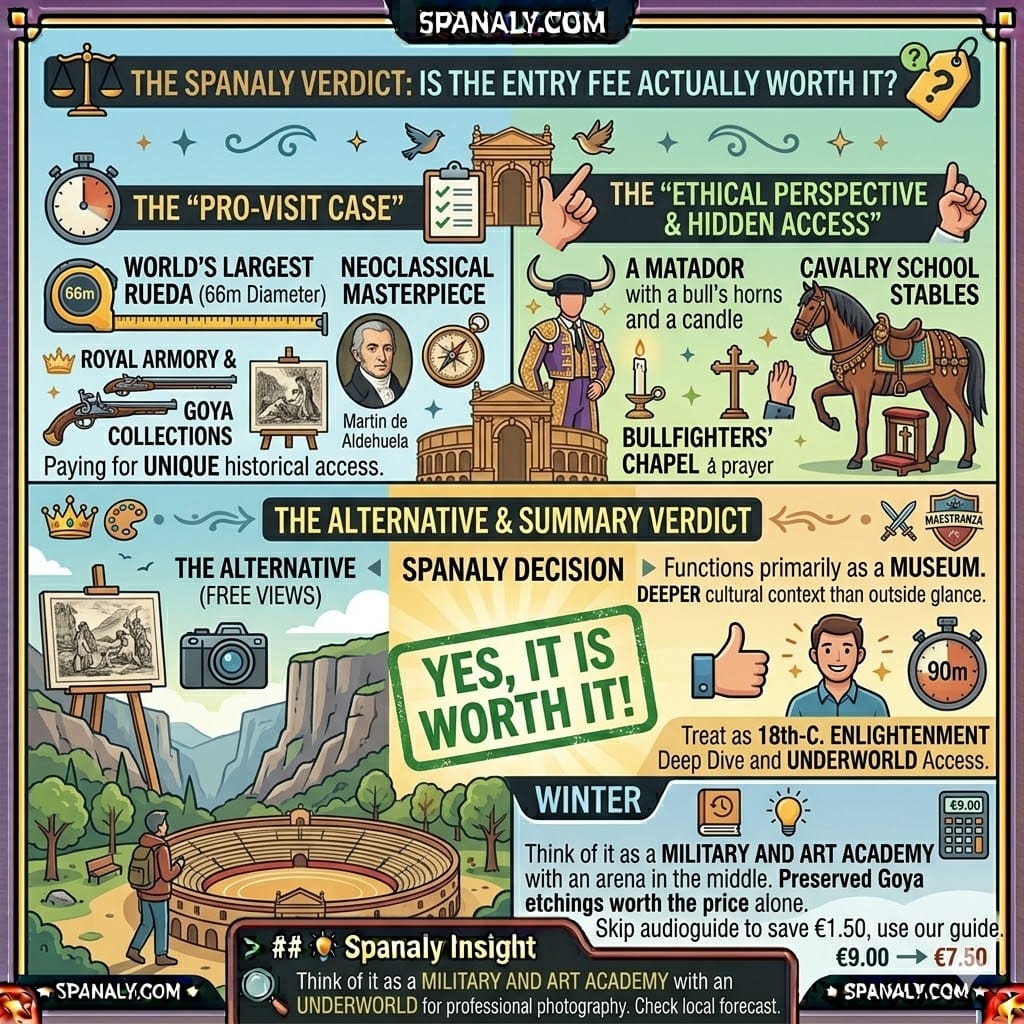
After exploring the architecture, the “Underworld,” and the royal history, the final question remains: Is the €9.00 entry fee justified? For most travelers, the answer depends on whether you view the Plaza de Toros de Ronda as a sports arena or a social-history museum.
📍 The “Value ROI” Breakdown:
The Pro-Visit Case: You are paying for access to the world’s largest rueda (66m diameter) and a neoclassical masterpiece by Martín de Aldehuela. The inclusion of the Royal Armory and the Goya collections adds significant weight to the ticket price.
The Ethical Perspective: Many visitors who oppose bullfighting still find value here. The site functions primarily as a museum of Spanish identity and equestrian art, with actual fights occurring only once a year.
The “Hidden” Access: Your ticket grants entry to the Cavalry School stables and the Bullfighters’ Chapel, areas that provide a much deeper cultural context than a simple glance from the outside.
The Alternative: If you only want a photo of the exterior, the park behind the ring offers stunning views of the cliffs and the facade for free.
⚖️ The Spanaly Decision:
In our expert opinion, yes, it is worth it, but only if you follow our 90-minute itinerary. If you simply walk in, take one selfie on the sand, and leave, the fee might feel steep. However, if you treat it as a deep dive into the 18th-century Enlightenment and the “Underworld” of the ring, it becomes one of the most cost-effective cultural experiences in Andalusia.
Spanaly Insight: Don’t let the “Bullring” label deter you if you are a history buff. Think of it as a Military and Art Academy that happens to have an arena in the middle. The sheer quality of the 136 Tuscan columns and the preserved Goya etchings inside the museum are worth the price of admission alone. If you are on a budget, skip the audioguide and use our guide—you’ll save €1.50 and get more tactical details.
💡 Spanaly Pro Tips: Master Your Visit Like a Local
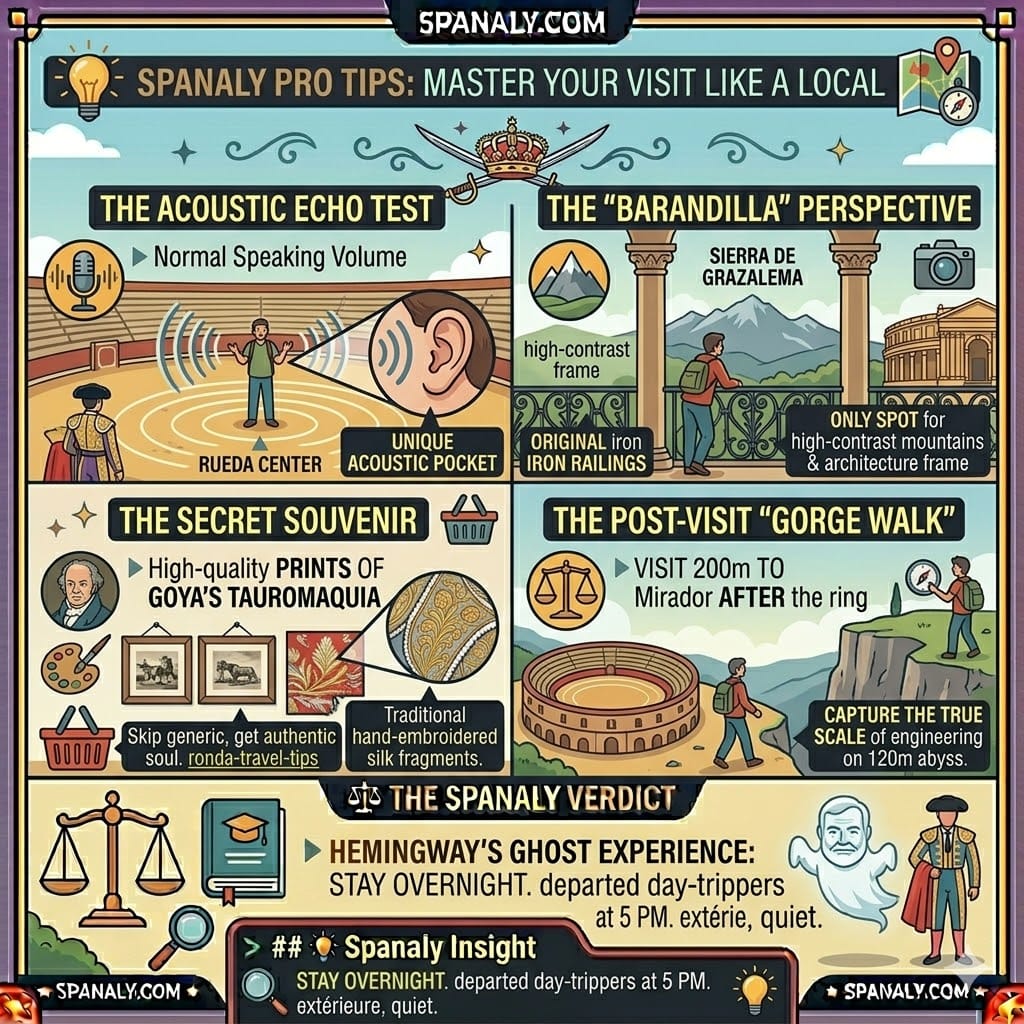
Forget the basic advice about “wearing comfortable shoes.” To truly experience the Plaza de Toros de Ronda with professional precision, you must master the subtle details that standard guidebooks overlook. For a broader strategic look at navigating the city’s unique challenges, explore our full collection of Ronda Travel Tips before you arrive.
📍 The “Insider” Tactical Maneuvers:
The Echo Test: Stand exactly in the center of the arena (the rueda) and speak at a normal volume. The neoclassical symmetry creates a unique acoustic pocket that was designed to let the crowd hear the matador’s breath—a detail missed by 90% of visitors.
The “Barandilla” Perspective: Head to the upper gallery and look for the original iron railings. Instead of looking at the ring, look through the columns toward the Sierra de Grazalema. This is the only spot where you can capture the 18th-century architecture and the rugged Andalusian mountains in a single frame.
The Secret Souvenir: Skip the generic plastic bulls. The official museum shop often stocks high-quality prints of Goya’s Tauromaquia and traditional hand-embroidered silk fragments. These are authentic pieces of Ronda’s artistic soul.
The Post-Visit “Gorge Walk”: Immediately after exiting, walk 200 meters to the Mirador de Ronda. Most people do this first, but doing it after seeing the ring gives you the scale of how this massive stone structure was built on the very edge of a 120-meter abyss.
⚖️ The Spanaly Decision:
If you want the ultimate “Ghost of Hemingway” experience, stay in Ronda overnight. After the day-trippers leave at 5:00 PM, the exterior of the bullring becomes hauntingly quiet. The way the streetlights hit the yellow sandstone creates a cinematic atmosphere that no daytime visit can replicate. It’s not just about what you see; it’s about the silence you feel when the crowds are gone.
🛡️ Visitor FAQs – Plaza de Toros de Ronda Guide
🛡️ Is it allowed to film or use professional cameras inside the ring?
Yes, personal photography and filming are permitted for tourists. However, the use of professional tripods or drones is strictly prohibited without a prior media permit from the Real Maestranza de Caballería de Ronda. For the best cinematic shots, use a wide-angle lens to capture the full 66-meter diameter of the arena.
🎫 Can I re-enter the bullring later in the day with the same ticket?
No, the standard ticket for the Plaza de Toros is for single entry only. Once you scan your QR code and exit through the turnstiles, you cannot return. We recommend completing your full 90-minute mission, including the "Underworld" and the Stables, before heading to the exit gate.
👔 Is there a specific dress code to enter the museum and arena?
There is no formal dress code, but we advise avoiding delicate footwear. The arena floor (the albero) consists of fine yellow sand that can easily stain light-colored fabric shoes or enter open sandals. Opt for closed-toe walking shoes to navigate the stone corridors and sandy ring comfortably.
🎒 Does the site offer luggage storage for travelers on day trips?
The monument does not provide on-site lockers or luggage storage. If you are arriving from the train or bus station with heavy bags, it is best to use the commercial lockers located in the city center near the Plaza del Socorro before walking to the bullring entrance.
👶 Is the Plaza de Toros de Ronda stroller-friendly for families?
Partially. The arena floor and the main museum level are accessible, but the underground "Chiqueros" and the upper gallery involve steep stone stairs. If traveling with young children, a baby carrier is much more tactical than a stroller for exploring the hidden "Underworld" areas.
Plaza de Toros Guide by Spanaly.com
The Plaza de Toros de Ronda is more than just a monument; it is the physical soul of Andalusia’s history. Whether you come for the neoclassical symmetry or the mysterious “Underworld,” you are walking through 240 years of Spanish identity.
📍 Your Post-Visit Tactical Move:
🚶 The Short Walk: Exit the ring and head 200 meters toward the edge of the abyss.
🌉 The Next Objective: You cannot truly understand Ronda’s scale without crossing its most iconic bridge.
📖 The Deep Dive: Explore our comprehensive Puente Nuevo Ronda Guide to master the best viewpoints and hidden paths under the bridge.
📸 The Final Frame: Capture the bridge at sunset to complete your “Ronda Master Collection.”
⚖️ The Spanaly Final Word:
Don’t rush back to the coast. Ronda is a city that rewards the patient traveler. After finishing your mission at the bullring, take a moment to sit in the nearby Alameda del Tajo gardens. The silence of the cliffs, combined with the history you’ve just witnessed, is the real “Spanaly Experience.”
Spanaly Insight: If you followed our 90-minute itinerary, you now have the afternoon free. Use this time to explore the white-washed streets of the La Ciudad (Old Town). Most tourists stay in the new part near the shops, but the real architectural treasures are hidden across the bridge in the narrow Moorish alleys.