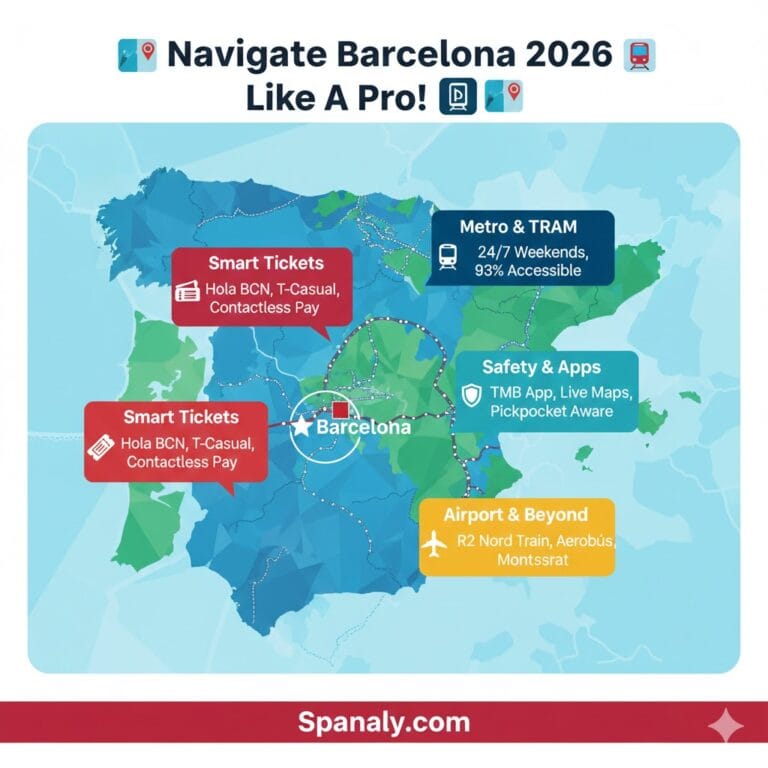

🌟 Barcelona is one of the easiest cities in Europe to explore thanks to its clean, efficient, and affordable public transport network. Whether you’re visiting Gaudí’s masterpieces, relaxing on Mediterranean beaches, or discovering historic neighborhoods, the city’s metro, buses, trams, and commuter trains make getting around simple and stress-free.
This comprehensive guide covers everything a traveler needs:
Metro Mastery: Which lines tourists need most.
Tickets & passes: Finding the best value for 2026.
Airport Routes: Fast and cheap ways to reach the center.
Safety Tips: Moving confidently and avoiding pickpockets.
Plan Your Trip: To make the most of your visit, don’t forget to check our Ultimate Barcelona Travel Guide for a full itinerary of the city’s top spots.
Table of Contents
Toggle⚙️ How Barcelona’s Transport System Works
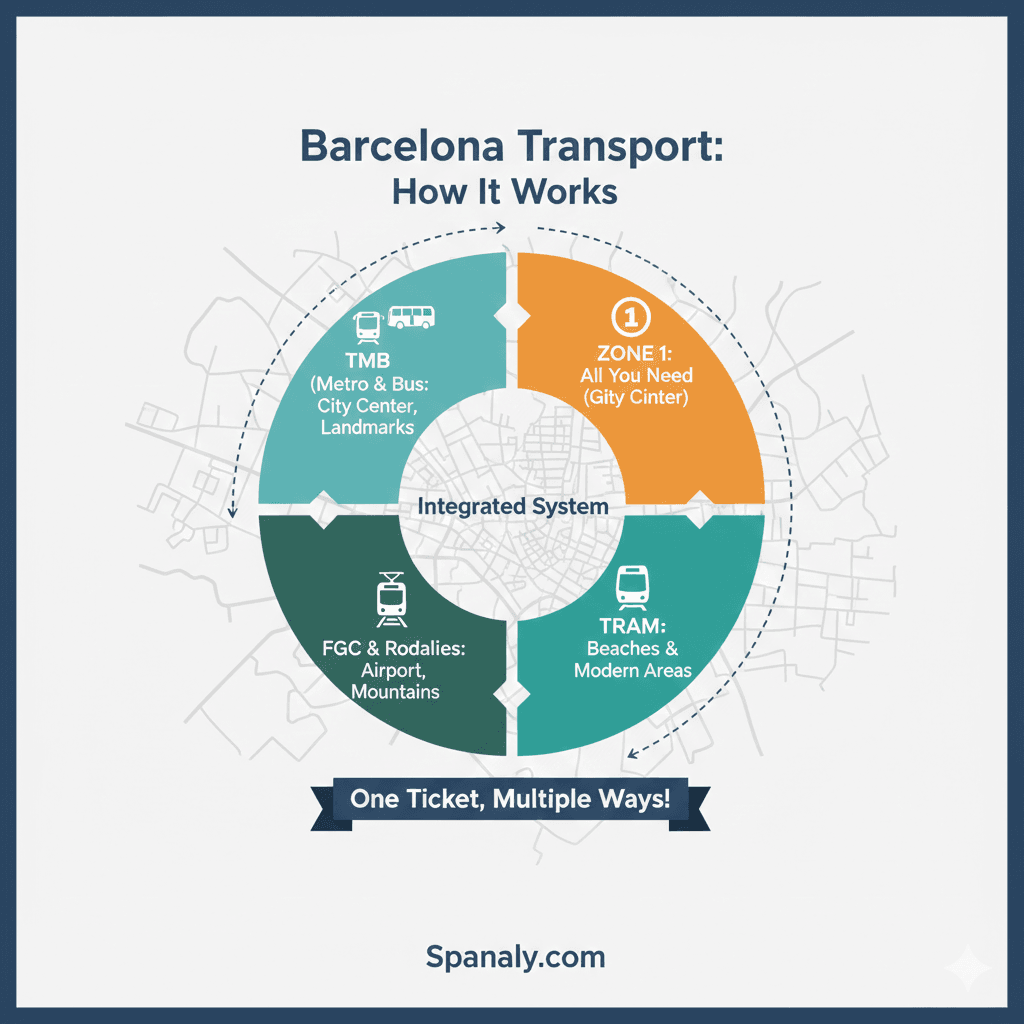
Barcelona’s transport system is integrated and incredibly easy to understand. Most services use the same tickets and zones, meaning you can switch between different modes of transport without extra costs within a specific time window.
Note: For 99% of travelers, Zone 1 is all you will ever need, as it covers the entire city center and the main Spanish Attractions.
🏢 Main Operators You’ll Use:
TMB (Transports Metropolitans de Barcelona): Operates the extensive Metro network and most city buses.
TRAM: Modern, silent tram networks mainly serving coastal areas and new urban districts.
Rodalies RENFE: Regional trains connecting the city center with the airport and coastal towns like Sitges.
FGC (Ferrocarrils de la Generalitat): Suburban trains perfect for reaching Tibidabo or starting your journey to see more Spanish Festivals in nearby municipalities.
💡 Good News for 2026: All metro, city bus, FGC (inside the city), and tram routes fall under Zone 1, making your travel planning very simple and cost-effective.
🚇 Metro in Barcelona – Fast, Reliable & Tourist-Friendly
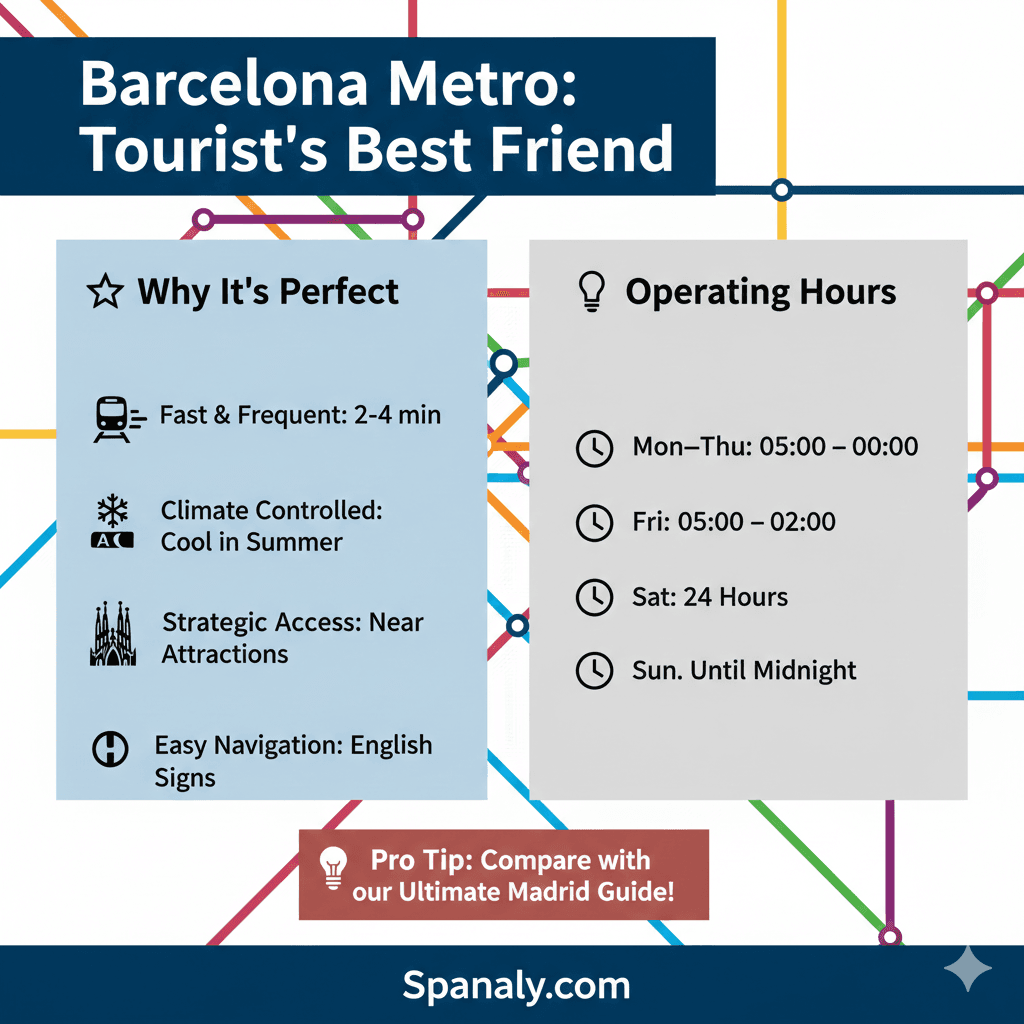
The metro is the best way to move quickly across the city. With 12 lines and over 180 stations, you’re always close to a connection. In 2026, the network remains the most popular choice for visitors due to its efficiency and reach.
🌟 Why the Metro Is Perfect for Tourists:
Fast & Frequent: Trains typically arrive every 2–4 minutes.
Climate Controlled: All cars are air-conditioned, providing a cool escape during summer.
Strategic Access: Stations are located directly beneath or very close to major Spanish Attractions.
Easy Navigation: Signs are clear and available in Catalan, Spanish, and English.
💡 Operating Hours:
Mon–Thu: 05:00 – 00:00 (Midnight)
Fri & Holiday Eves: 05:00 – 02:00
Sat: 24 Hours (Continuous service)
Sun: Closes at Midnight
Traveler Tip: If you’re planning a broader trip through Spain, our Ultimate Madrid Travel Guide offers a great comparison of how the capital’s metro system differs from Barcelona’s.
🚇 Barcelona Metro Guide — Useful Info for Visitors
| Line | Color | Main Areas & Attractions | Frequency | Operating Hours |
|---|---|---|---|---|
| L1 | 🔴 Red | Plaça Catalunya, Arc de Triomf, Plaça d'Espanya | 3–5 min | 5:00–00:00 |
| L2 | 🟣 Purple | Sagrada Família, Passeig de Gràcia | 3–5 min | 5:00–00:00 |
| L3 | 🟢 Green | La Rambla, Gothic Quarter, Park Güell | 2–4 min | 5:00–00:00 |
| L4 | 🟡 Yellow | Barceloneta Beach, Ciutadella Park | 3–6 min | 5:00–00:00 |
| L5 | 🔵 Blue | Sagrada Família, Eixample District | 3–5 min | 5:00–00:00 |
| L9 Sud | 🟠 Orange | Barcelona Airport → City | 7–10 min | 5:00–00:00 |
|
🕐 Weekend Hours:
• Friday: 5:00 – 02:00 • Saturday: Open all night (24h service) | ||||
| 🎟️ Tickets Accepted on Metro: T-Casual • T-Usual • Airport Ticket • Day Pass • Hola BCN | ||||
| 📱 Apps Recommended: TMB App • Google Maps • Citymapper | ||||
🚌 City Buses – Great for Scenic Routes
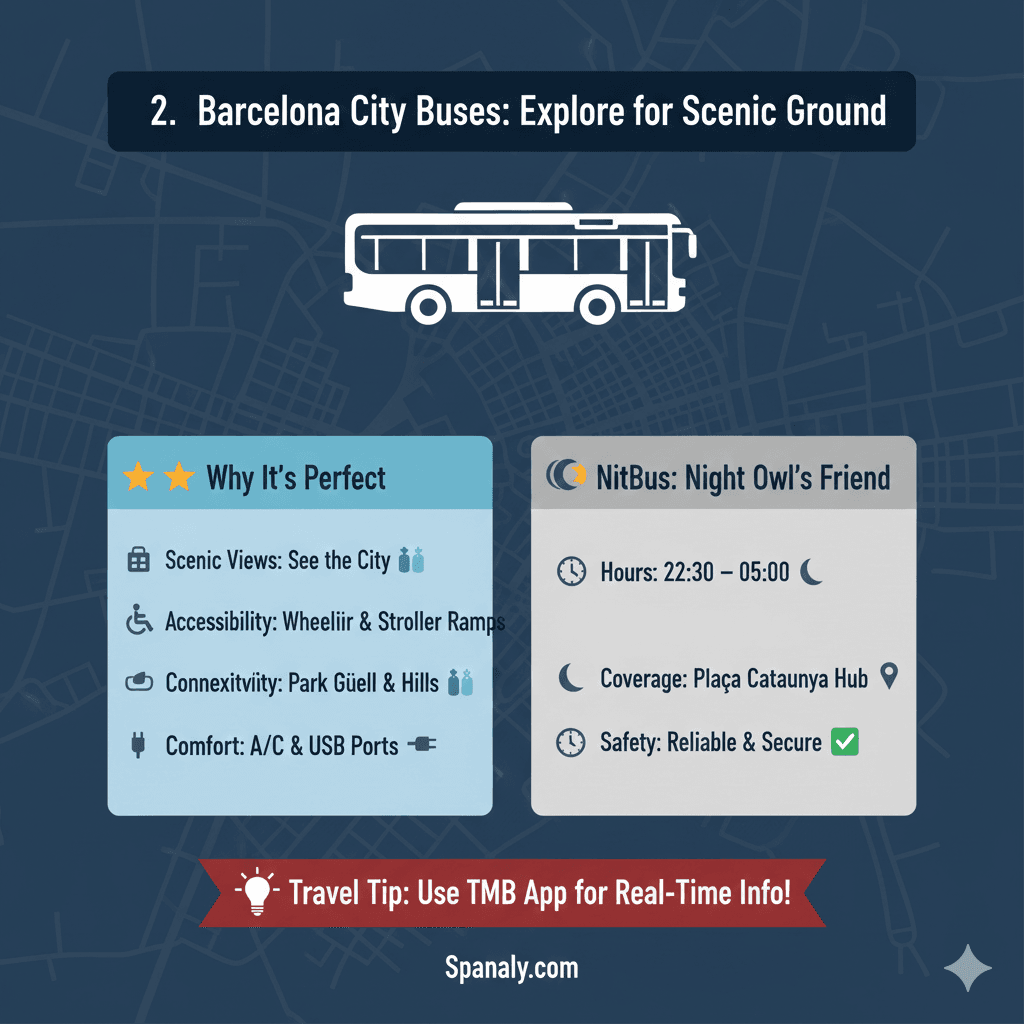
Barcelona’s extensive bus network reaches places the metro doesn’t, including hilltop neighborhoods, coastal areas, and local residential zones. It is the perfect choice for travelers who prefer sightseeing while moving between Spanish Attractions.
🌟 Advantages of Using Buses:
Scenic Views: Enjoy the city’s architecture rather than traveling underground.
Accessibility: Every bus is equipped with ramps for strollers and wheelchairs.
Connectivity: Reaches specific spots like Park Güell or Tibidabo more directly.
Comfort: Modern, air-conditioned, and equipped with USB charging ports in many 2026 models.
🌓 NitBus – The Night Owl’s Friend:
When the metro closes, the NitBus (Night Bus) takes over.
Hours: Operates from 22:30 to 05:00.
Coverage: Connects Plaça de Catalunya to almost every corner of the city.
Safety: A reliable and safe way to return to your hotel after experiencing Spanish Festivals or late-night dinners.
💡 Travel Tip: Use the TMB App or Google Maps for real-time bus arrivals. If you are also planning a trip to the south, our Ultimate Seville Travel Guide explains how their bus system is equally vital for exploring the old town.
🚋 Trams – Clean, Modern, and Perfect for Coastal Areas
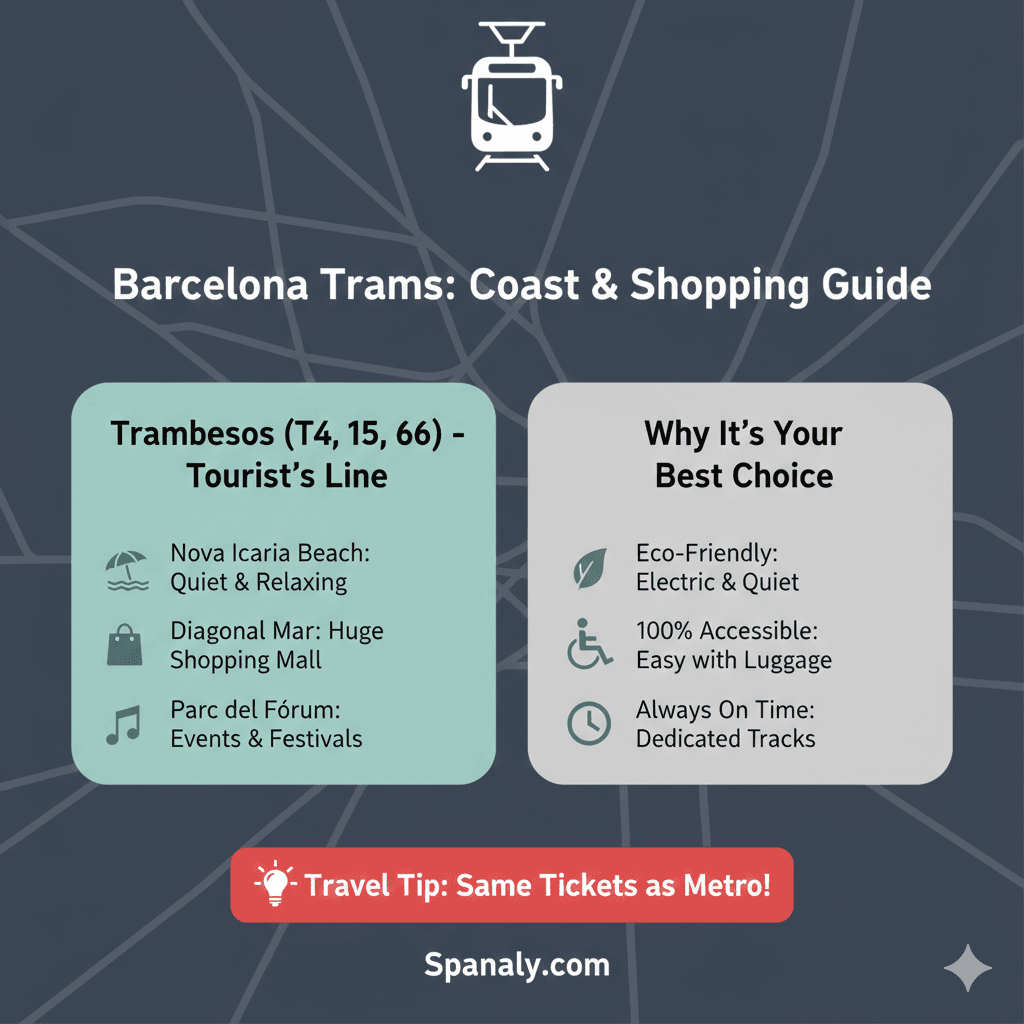
Barcelona’s tram system is a hidden gem for tourists. It is small compared to the metro, but extremely useful for reaching beach zones, shopping malls, and newer urban districts. If you are looking for a smooth, eco-friendly ride, the tram is your best choice in 2026.
🏙️ Tram Networks You Should Know:
Trambesòs (T4, T5, T6): This is the most popular line for visitors. It connects the city to:
Nova Icaria Beach: A quieter alternative to Barceloneta.
Diagonal Mar: One of the city’s largest shopping hubs.
Parc del Fòrum: The heart of major Spanish Festivals and music events.
Trambaix (T1, T2, T3): Primarily serves the southwest residential and business areas.
🌟 Why Use the Tram?
Eco-Friendly: A 100% electric and sustainable way to travel.
Accessibility: Trams are at street level, making them the easiest option for those with limited mobility or heavy luggage.
Punctuality: They run on dedicated tracks, so they are never stuck in Barcelona’s traffic.
💡 Travel Tip: Trams use the same integrated tickets as the Metro and Bus. If you’ve just enjoyed some authentic Spanish Cuisine at a seaside chiringuito, the T4 line is the perfect way to head back to the center.
🚆 Rodalies & FGC – Trains for Airport & Beyond
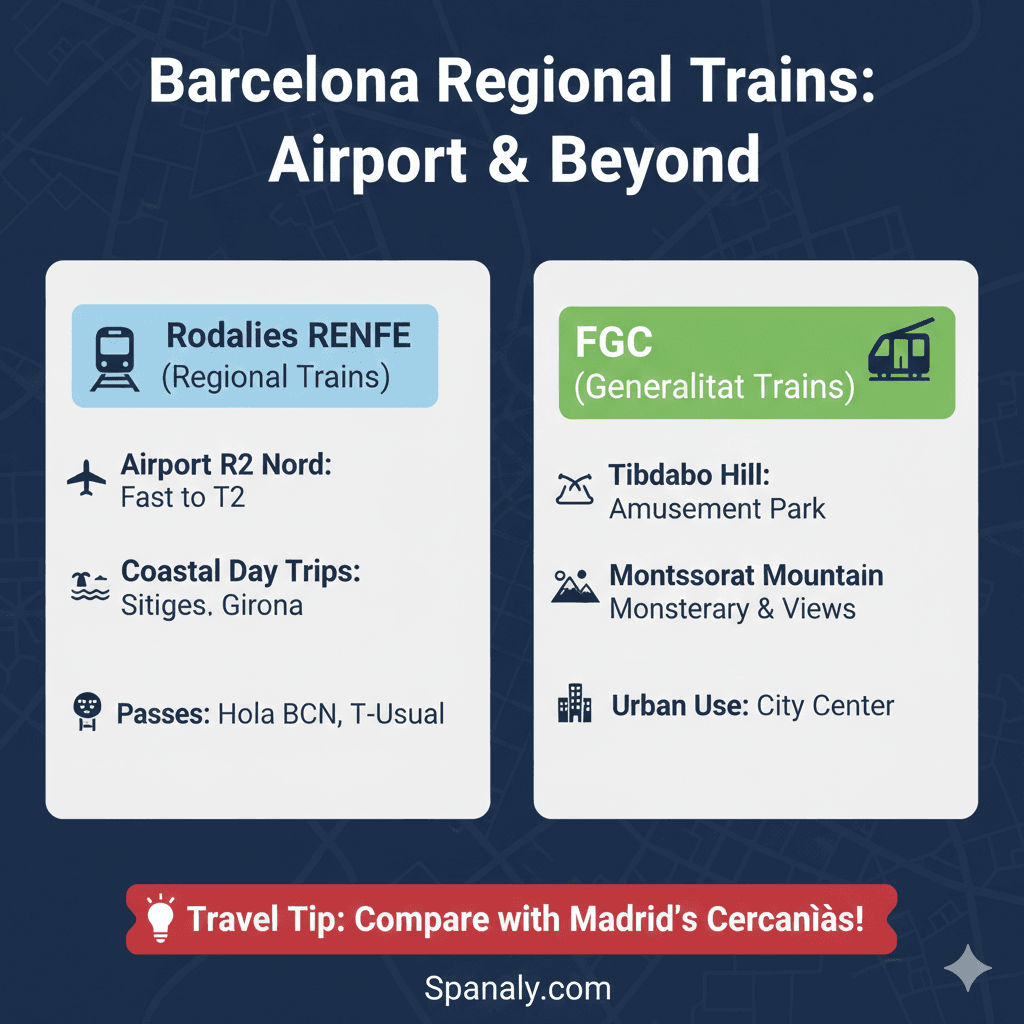
While the Metro covers the city, these trains connect you to the broader wonders of Catalonia. Whether you are heading to the airport or a mountain retreat, understanding these two operators is key for a 2026 trip.
🚉 Rodalies RENFE (Regional Trains)
Airport Connection (R2 Nord): The fastest train link from Terminal 2 (T2) to the city center (Passeig de Gràcia) in just 25 minutes.
Coastal Day Trips: Use these to visit the beautiful beaches of Sitges or the historic city of Girona.
Passes: Included in Zone 1 travel passes like the Hola BCN and T-Usual.
🚠 FGC (Generalitat Trains)
Tibidabo Hill: The best way to reach the starting point for Tibidabo’s amusement park and views.
Montserrat Mountain: Provides the essential link to the cable cars for one of Spain’s most famous Spanish Attractions.
Urban Convenience: Functions like a second metro system within the city center.
💡 Travel Tip: If you’re planning to explore more of the country, our Ultimate Madrid Travel Guide highlights how their “Cercanías” trains compare to Barcelona’s Rodalies for day trips.
🎟️ Tickets & Travel Passes — Which One Should You Choose?
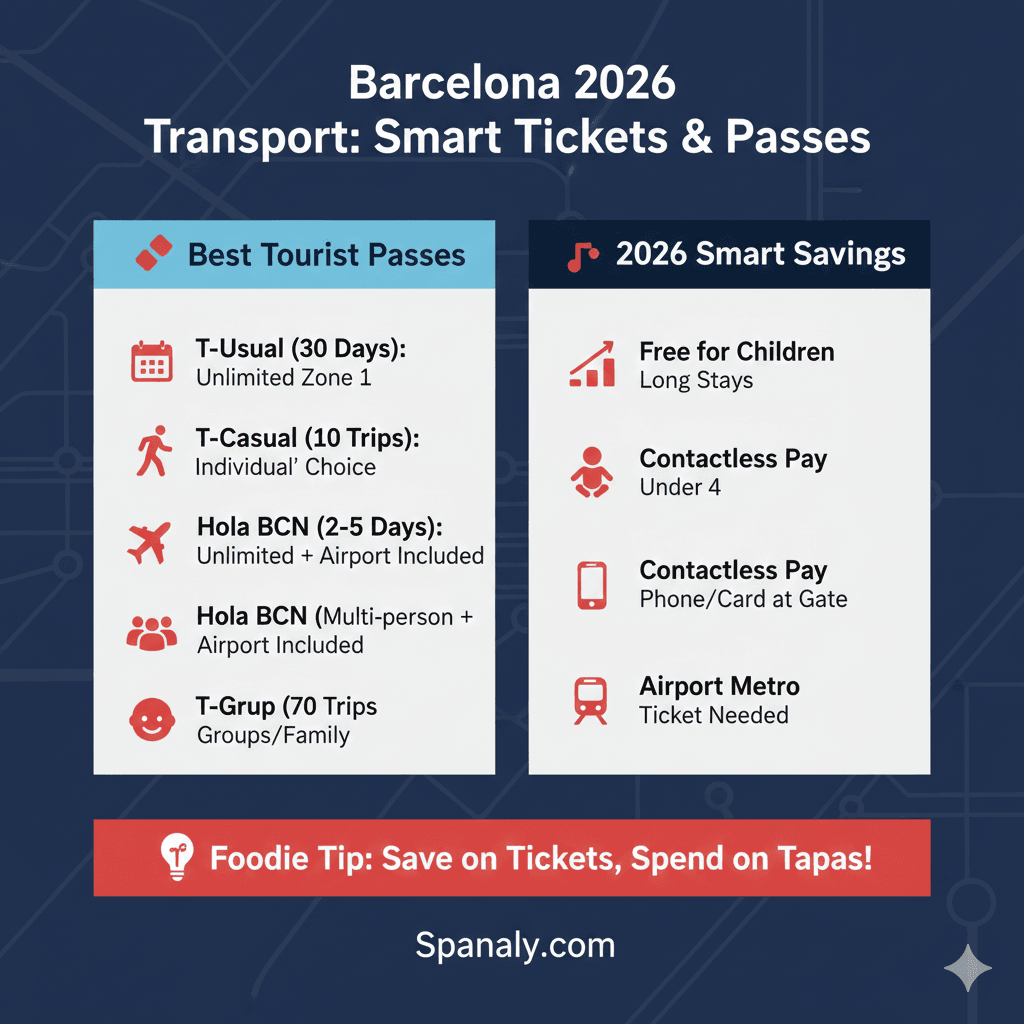
In 2026, Barcelona has simplified its ticketing system. Almost all tickets are now digital or integrated into a single card. Choosing the right pass depends entirely on how long you stay and how much you plan to explore Spanish Attractions.
💳 Best Value Passes for Tourists:
T-Usual (The Best for Long Stays): Unlimited travel for 30 days in Zone 1. It’s incredibly cheap and perfect if you’re staying more than 5 days.
T-Casual: A 10-trip card. Great for those who prefer walking but want the metro for longer distances. Note: This is an individual card and cannot be shared.
Hola Barcelona Travel Card: Offers unlimited travel for 2, 3, 4, or 5 days. It includes the airport metro supplement, making it a hassle-free choice for short trips.
T-Grup: A multi-person card with 70 trips in 30 days. Best for large families or groups attending Spanish Festivals together.
📉 2026 Smart Savings:
Children under 4: Travel for free.
Contactless Pay: You can now use your smartphone or bank card for single journeys directly at the gate.
Airport Supplement: Remember that a standard single ticket or T-Casual does not cover the Metro to the Airport; you must buy a specific “Airport Ticket.”
💡 Foodie Tip: If you’re saving money on transport, use those extra Euros to dive into authentic Spanish Cuisine! A T-Usual pass practically pays for a high-end Tapas dinner with the savings.
✈️ Getting to and from Barcelona Airport (El Prat)
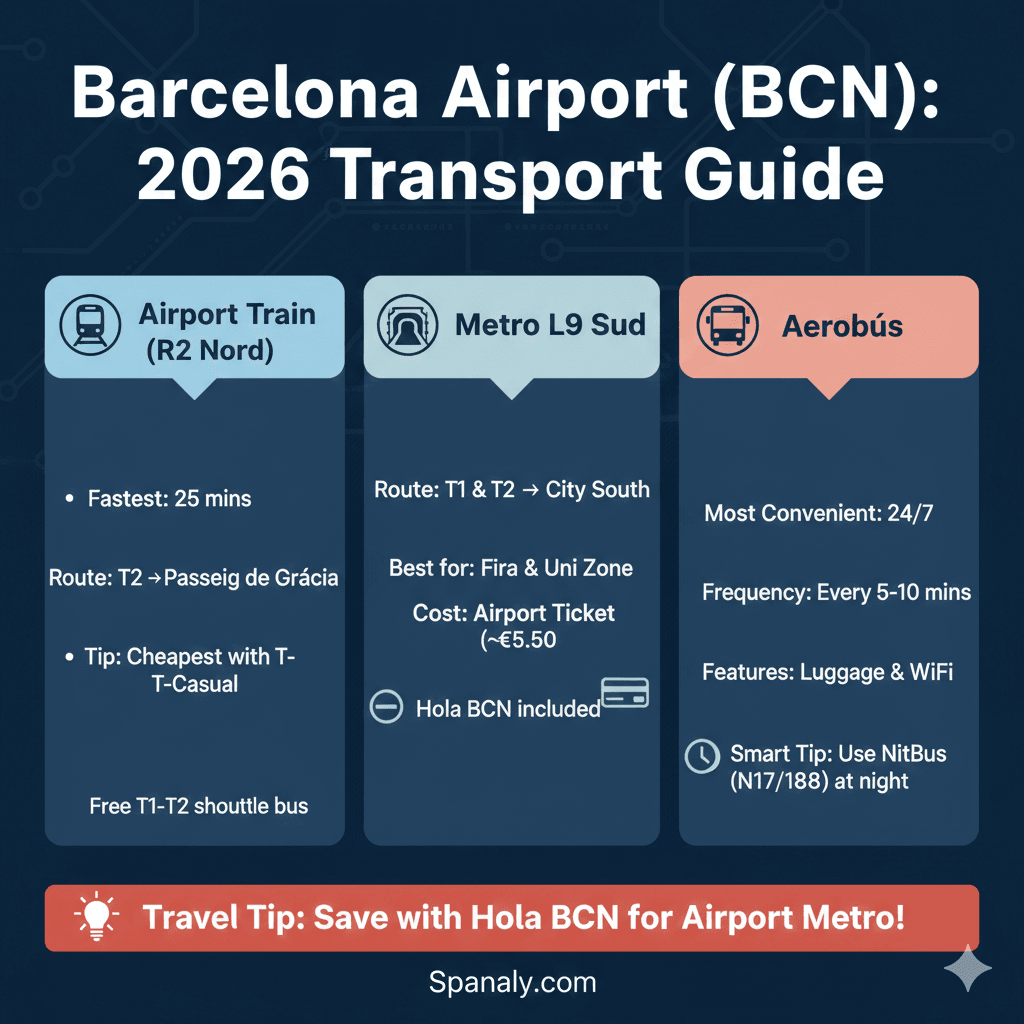
Barcelona-El Prat Airport (BCN) is well-connected to the city center. In 2026, you have three primary ways to make the trip, depending on your budget and where your hotel is located.
🚆 The Airport Train (R2 Nord) – Fastest to Center
Route: From Terminal 2 (T2) to Passeig de Gràcia or Sants Station.
Why Choose It: It’s the quickest rail link (approx. 25 mins) and the cheapest if you use a T-Usual or T-Casual pass.
Note: If you land at T1, a free shuttle bus connects you to the T2 train station.
🚇 Metro Line L9 Sud – Best for Fira & South
Route: Direct from T1 and T2 to the southern parts of the city.
Why Choose It: Great if your accommodation is in the Europa | Fira area or near University zones.
Cost: Requires a special Airport Ticket (approx. €5.50) unless you have the Hola Barcelona Travel Card.
🚌 Aerobús – The Most Convenient
Route: Direct shuttle from T1 & T2 to Plaça de Catalunya.
Why Choose It: Runs every 5–10 minutes, 24/7. It has large luggage racks and free Wi-Fi.
Tickets: Can be bought online or at the bus stop.
💡 Smart Tip: If you’re arriving late at night, the NitBus (N17 or N18) is a life-saver, offering a very cheap way to reach the center when other services have slowed down. After settling in, you can start exploring the city’s famous Spanish Attractions.
📱 Maps, Apps & Safety Tips for Public Transport
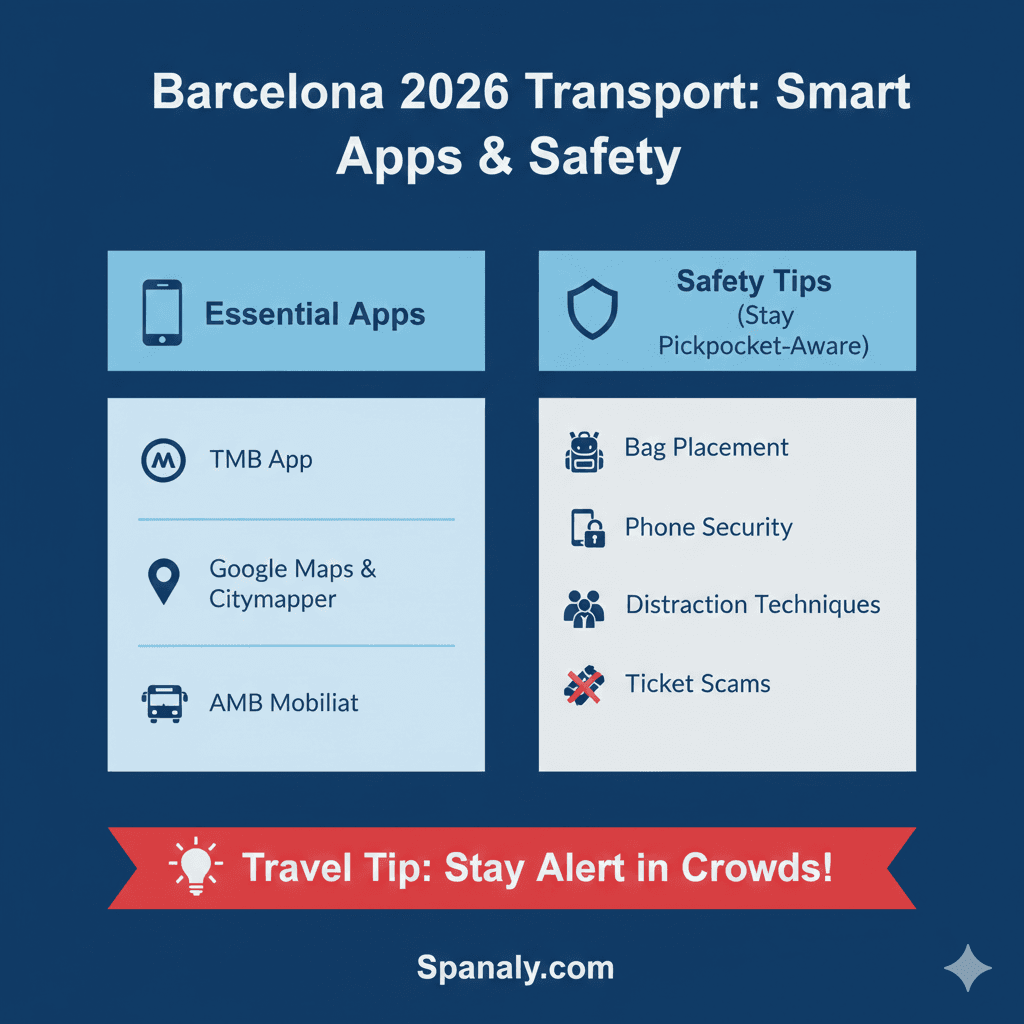
To navigate Barcelona like a local in 2026, you need the right digital tools and a bit of street smarts. While the city is generally very safe, its popularity means tourists should always stay alert.
📲 Essential Apps for Your Phone:
TMB App: The official app for metro and bus. It provides real-time arrivals, service alerts, and a handy route planner.
Google Maps & Citymapper: Both are exceptionally accurate in Barcelona for walking directions and integrated transport switches.
AMB Mobilitat: Excellent for checking the exact location of buses and NitBus lines.
🛡️ Safety Tips (Stay Pickpocket-Aware):
Barcelona is famous for its beauty, but also for its clever pickpockets in crowded areas.
Bag Placement: Always wear your backpack on your front in crowded metro stations or buses.
Phone Security: Avoid holding your phone loosely near the subway doors; “snatch and run” is a common tactic as doors close.
Distraction Techniques: Be wary of strangers offering “help” or creating a minor commotion—this is often a distraction.
Ticket Scams: Only buy tickets from official TMB machines or verified apps. Never buy “leftover” tickets from individuals in the station.
📍 Finding Your Way:
Every metro station has a large neighborhood map near the exits. Check these to find the correct “Sortida” (Exit) to save time walking on the street.
💡 Pro Tip: If you enjoy the organized chaos of big cities but want to see how the capital compares, don’t miss our Ultimate Madrid Travel Guide for specific safety tips in Madrid’s Sol and Gran Vía areas.
🚇 Visitor FAQs – Barcelona Public Transport Guide 2026
🎫 Which transport ticket is best for a 3-day tourist visit?
For most tourists, the Hola Barcelona Travel Card is the best choice as it includes the airport metro. For single trips, you can now use Contactless Payment with your phone or card directly at the gates.
🕘 What are the operating hours for the Barcelona Metro?
The Metro opens at 5:00 AM. It closes at midnight (Sun-Thu), 2:00 AM on Fridays, and runs 24 hours on Saturdays. This continuous Saturday service is a lifesaver for weekend visitors!
🛡️ Is public transport safe from pickpockets?
Yes, but stay alert! In 2026, the most common theft is phone snatching near closing doors. Keep your bag in front of you and avoid holding your phone loosely while the train is at the station.
♿ Are metro stations accessible for strollers and wheelchairs?
Absolutely. Over 93% of stations are now fully accessible. All buses and trams have ramps. Just look for the Elevator (Ascensor) signs when entering or exiting the stations.
📱 Which app should I use for real-time transport info?
The official TMB App is the gold standard for real-time info. For night buses (NitBus), AMB Mobilitat is highly recommended, while Google Maps remains great for overall navigation.
Barcelona Transport Guide by Spanaly.com
🌟 Ready to Explore Barcelona Like a Local?
Navigating Barcelona in 2026 is easier, greener, and more efficient than ever. By mastering the metro, utilizing the scenic bus routes, and choosing the right travel pass, you’ve already cleared the biggest hurdle of your trip. Whether you’re heading to the beach by tram or catching a train to the mountains, the city’s integrated system is designed to keep you moving smoothly.
Remember, the best way to experience the city is to stay flexible, keep your apps updated, and always remain mindful of your surroundings. Now that you know how to get around, it’s time to focus on what really matters: the culture, the views, and the unforgettable memories.
🚀 Your Next Steps:
Save this guide to your bookmarks for quick access during your trip.
Download the TMB App before you land to stay ahead of the schedule.
Explore more of Spain! If you’re curious about how other cities compare, check out our deep dives into Spanish Attractions and find your next destination.
Safe travels, and enjoy every moment of your Barcelona adventure! ¡Buen viaje!