Table of Contents
Toggle🏰 The Heart of the Tajo Gorge
Puente Nuevo Ronda is one of Spain’s most dramatic landmarks, spanning the deep El Tajo Gorge. This guide covers the best viewpoints, hiking routes, history, and practical tips to help you experience the bridge without the crowds. our Ultimate Ronda Travel Guide provides the essential foundation for your visit.
📍 Quick Snapshot:
The Scale: It connects the old Moorish town (La Ciudad) with the “newer” 15th-century district (El Mercadillo).
The Drop: A sheer 390-foot plunge into the Guadalevín River that tests even the strongest nerves.
The Secret: There is a hidden chamber inside the central arch—a former prison that most tourists walk right over without noticing.
The Reality: If you arrive after 10:30 AM, you aren’t visiting a landmark; you are joining a crowded queue.
⚖️ The Spanaly Verdict:
Forget the postcards. The true power of Puente Nuevo Ronda is felt at dawn or dusk. During midday, the bridge becomes a bottleneck for tour groups. To truly “feel” the gorge, you must leave the pavement and head for the lower trails where the scale of the stone-work actually hits you.
🛡️ Snapshot: Puente Nuevo Ronda Essentials
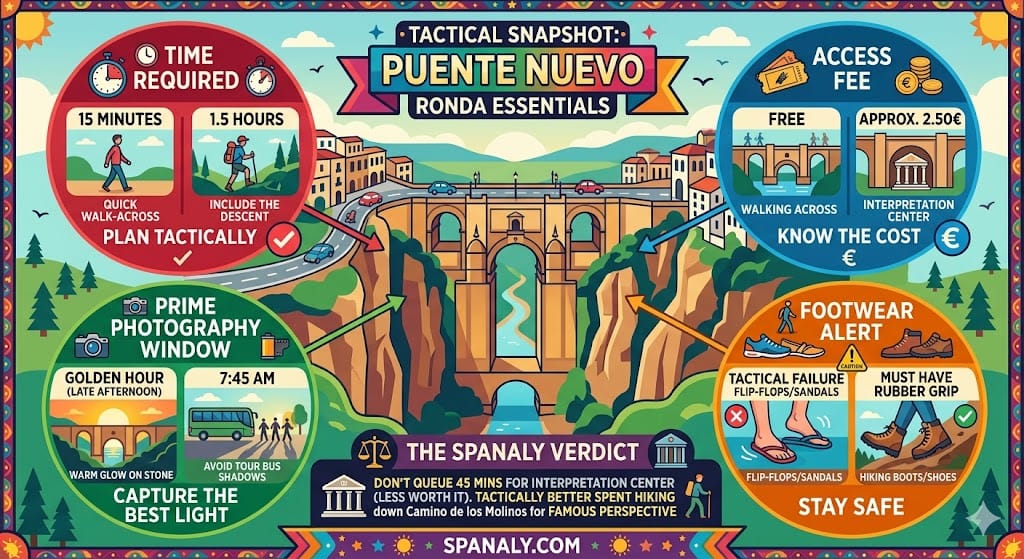
If you only have 30 minutes at the bridge, these are the hard facts and expert decisions you need to make right now. No fluff, just the logistics that matter for your visit to Puente Nuevo Ronda.
⏱️ Time Required: 15 minutes for a quick walk-across; 1.5 hours if you include the descent to the gorge floor.
🎟️ Access Fee: Walking across the bridge is Free. Entering the “Interpretation Center” inside the central arch costs roughly 2.50€.
📸 Prime Photography Window: Golden Hour (late afternoon) for the warm glow on the stone, or 7:45 AM to avoid the tour bus shadows.
🚶 Footwear Alert: The bridge surface is polished stone. If it rains, or if you plan to hike down, flip-flops are a tactical failure. Use shoes with rubber grip.
♿ Accessibility: The top sidewalk is wheelchair friendly, but the descent to the valley is strictly for those with full mobility.
Spanaly Insight: Most tourists overlook the wind factor. Because of the narrow gorge (El Tajo), the wind accelerates significantly as it passes under the bridge. If you are wearing a hat or using a lightweight tripod for photos, secure them before leaning over the stone parapet. I’ve seen more than one “souvenir” fly into the Guadalevín River below.
⚖️ The Battle of Stone: Puente Nuevo vs. Segovia Aqueduct
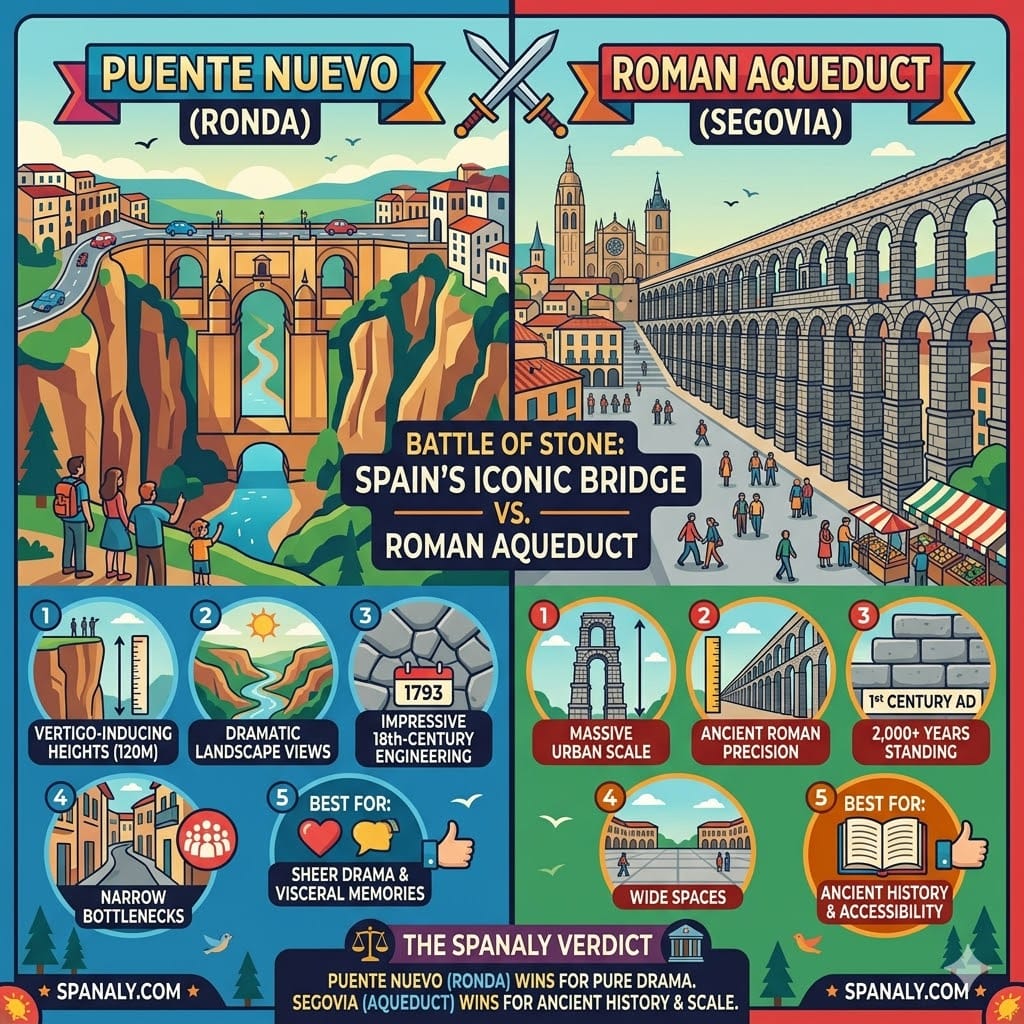
When planning a trip through Spain, travelers often ask if they should prioritize the Roman engineering of Segovia or the dramatic heights of Ronda. While both are stone masterpieces, they offer completely different experiences.
⚔️ Quick Comparison:
| Feature | Puente Nuevo (Ronda) | Roman Aqueduct (Segovia) |
|---|---|---|
| Primary Draw | Vertigo-inducing heights (120m) and gorge views. | Ancient Roman precision and massive scale. |
| Tactical Setting | Integrated into a cliffside “clinging” city. | A centerpiece of a flat, historic urban plaza. |
| Crowd Control | Narrow bottlenecks; requires a sunrise strategy. | Open spaces; easier to navigate even with crowds. |
| Best Experience | Hiking to the valley floor for the “under-view.” | Touching the mortar-less granite blocks at eye level. |
⚖️ The Spanaly Verdict:
If you are looking for drama and landscape, Puente Nuevo Ronda wins every time. Segovia is a feat of ancient math, but Ronda is a feat of sheer human audacity against nature. If your itinerary is tight, Ronda offers a more “visceral” memory because of the surrounding Tajo Gorge, which Segovia simply cannot match.
📜 The Blood & Stone: A Brief History
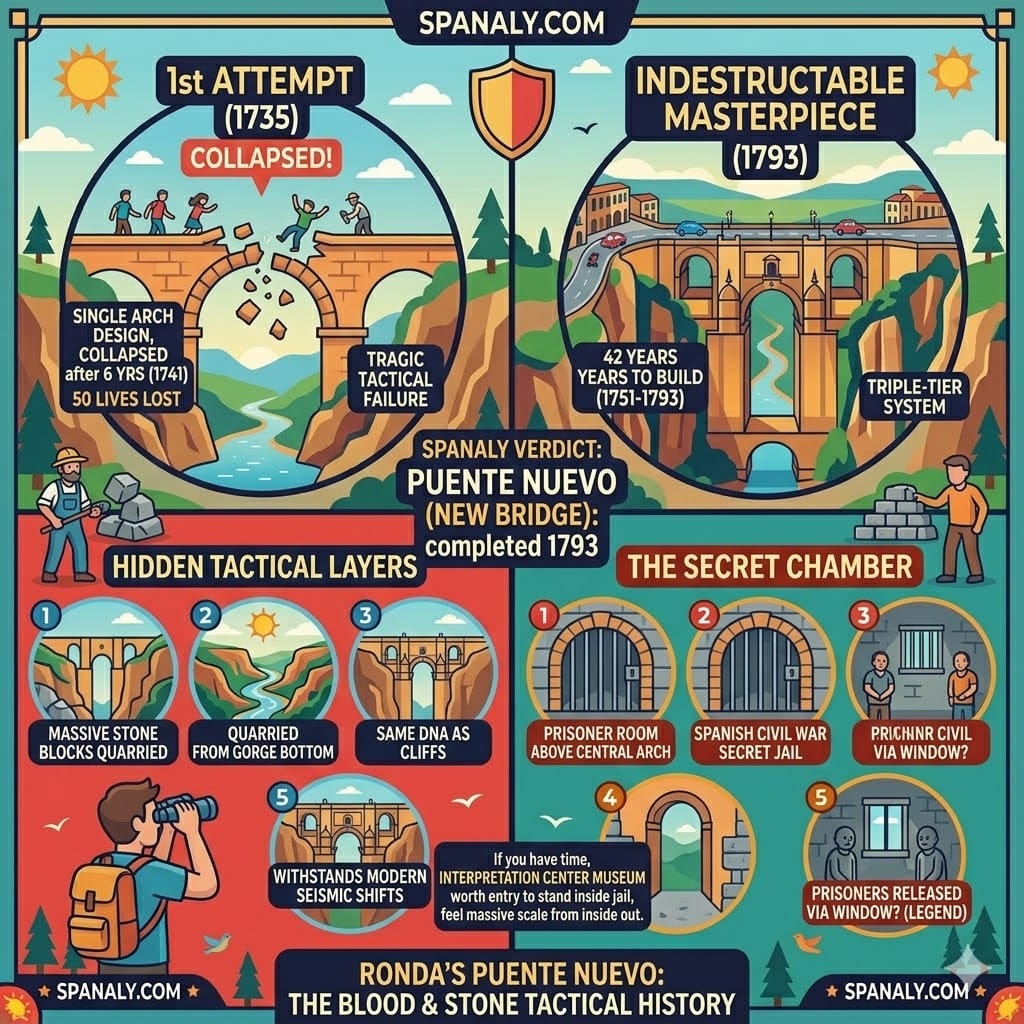
Puente Nuevo Ronda (New Bridge) is a historical joke. Workers completed it in 1793. However, it earned the title “New” because its predecessor was a tactical disaster. The first 1735 bridge collapsed after six years, tragically taking 50 lives. This failure forced architects to build the triple-tier masterpiece you see today. As one of the Spanish Attractions, it stands as a testament to human persistence.
📍 Hidden Layers:
Architectural Grit: Jose Martin de Aldehuela used stone blocks quarried from the gorge floor. This ensured the structure shared the same DNA as the cliffs.
The Secret Chamber: Look closely at the window above the central arch. This hidden room served as a prison during the Spanish Civil War. Legend says prisoners were occasionally “released” into the abyss.
Structural Logic: The current design uses a triple-arch system. It distributes immense weight across the gorge walls to withstand seismic shifts.
⚖️ The Spanaly Verdict:
Don’t just look at the bridge as a photo op. Look at it as a survivor. The “New Bridge” represents a period where Spanish engineering conquered the Tajo’s geography. The small Interpretation Center is worth the entry for history buffs. You can stand inside the prison room and feel the scale of the walls.
Spanaly Insight: When visiting the secret chamber, pay attention to the sound dampening. The walls are so thick that the river’s roar disappears entirely. This chilling silence was tactically used to isolate prisoners from the world above.
📸 The Ultimate Photography Map: Best Viewpoints
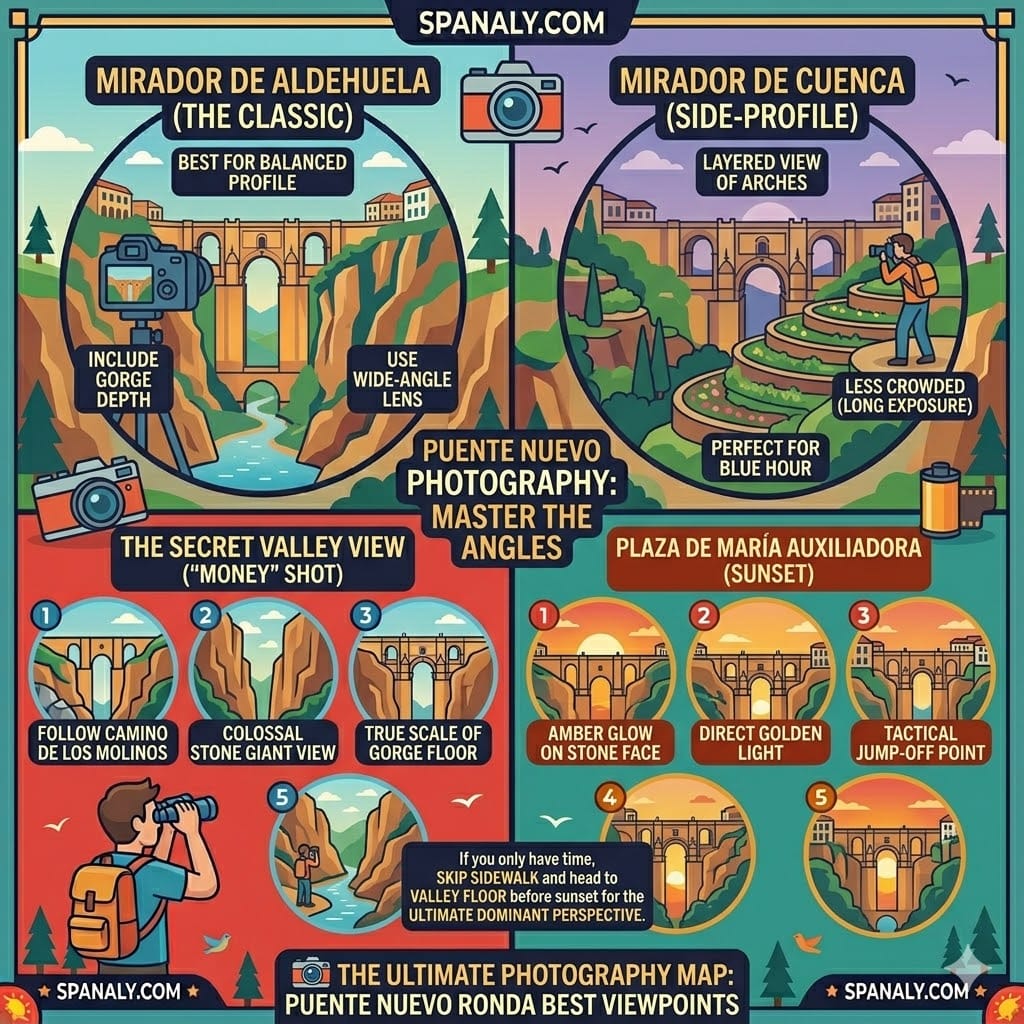
Most tourists cluster on the bridge’s sidewalk, resulting in flat, uninspired photos. To capture the true scale of Puente Nuevo Ronda, you need to execute a movement strategy across different elevations. If you are serious about your craft, check our guide on the Best Photography Spots in Spain to see how Ronda compares to other iconic landmarks.
📍 Strategic Viewing Angles:
Mirador de Aldehuela (The Classic): Located near the Parador, this offers the most balanced “profile” view of the bridge. Practical Tip: Use a wide-angle lens to include the gorge’s depth.
Mirador de Cuenca (The Side-Profile): On the eastern side, these terraced gardens provide a layered view of the arches. It is less crowded and perfect for “blue hour” long exposures.
The Secret Valley View (The “Money” Shot): Follow the Camino de los Molinos trail down into the valley. From the bottom, the bridge looks like a colossal stone giant guarding the sky. This is where the 120-meter drop actually becomes visible in your frame.
Plaza de María Auxiliadora: This is the tactical “jump-off” point for the best sunset views. The golden light hits the stone face directly, turning the grey granite into glowing amber.
⚖️ The Spanaly Verdict:
If you only have time for one spot, skip the bridge sidewalk and head to the Valley Floor. The perspective from below is the only way to truthfully document the bridge’s dominance over the landscape. Arriving at the bottom 45 minutes before sunset is the ultimate tactical move for any photographer.
Spanaly Insight: Watch out for the “Shadow Trap.” Because the Tajo Gorge is narrow and deep, the bottom of the bridge falls into shadow much earlier than the top. To get a balanced exposure without “blown-out” skies, aim to shoot during the early morning (before 9:00 AM) when the light is diffused and even across the entire stone surface.
🥾 Descent to El Tajo: The Hiking Trail Strategy
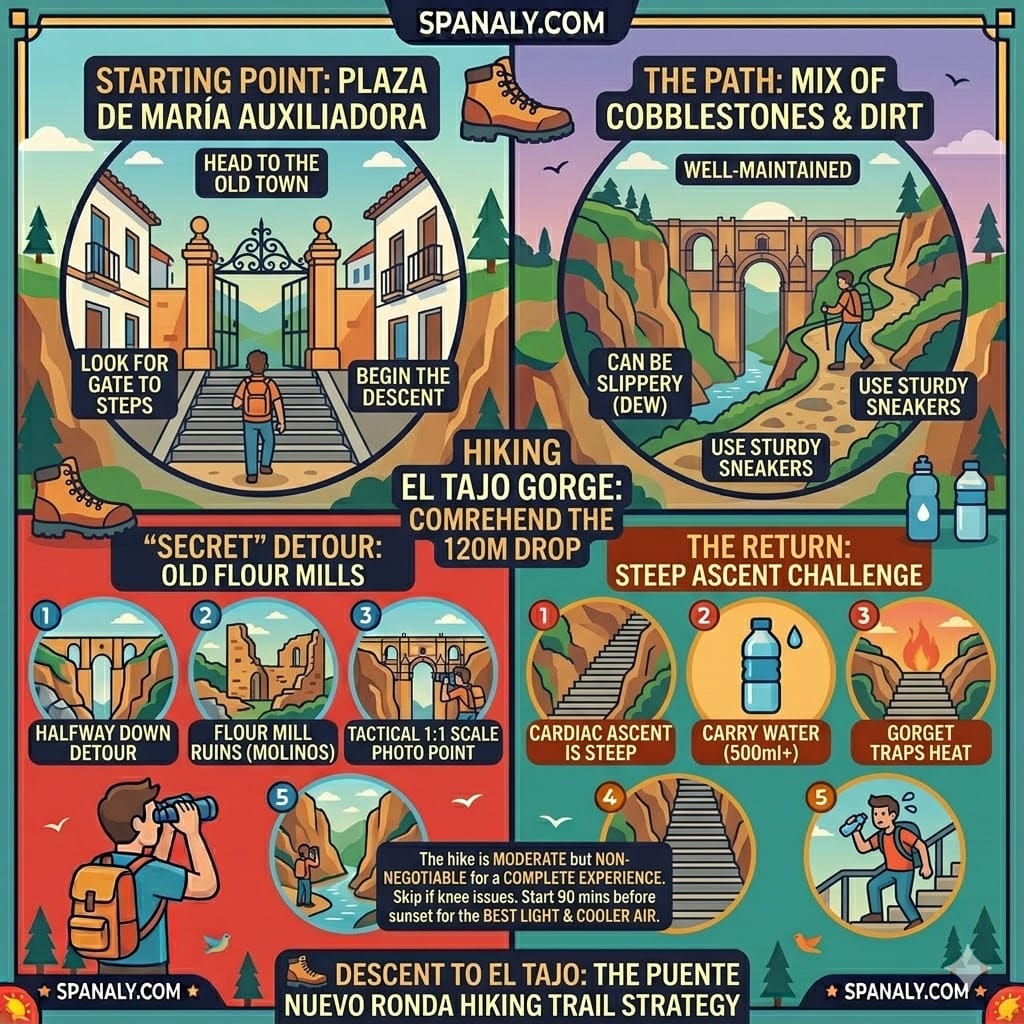
To truly comprehend the 120-meter sheer drop of Puente Nuevo Ronda, you must leave the asphalt behind. While thousands of visitors stare down from the railings, the tactical move is to descend the Camino de los Molinos. This trail is one of the most rewarding Things to do in Ronda, offering a perspective that makes the bridge look like it was carved by giants.
📍 Route Intelligence:
The Starting Point: Head to Plaza de María Auxiliadora in the Old Town (La Ciudad). Look for the small gate that leads to a series of stone steps.
The Path: The trail is a mix of cobblestones and packed dirt. It is well-maintained but can be slippery if the morning dew hasn’t evaporated.
The “Secret” Detour: Halfway down, there is a small plateau where the ruins of old flour mills (Molinos) sit. This is the tactical sweet spot for a 1:1 scale photo of the bridge’s central arch.
The Return: Remember, what goes down must come up. The ascent is steep and will test your cardio. Tip: Carry at least 500ml of water, even in winter, as the gorge traps heat.
⚖️ The Spanaly Verdict:
The hike is moderate but non-negotiable for a complete experience. If you have knee issues or are wearing high-fashion shoes, stay at the top. But if you have 45 minutes and a pair of sturdy sneakers, the view from the “Arco del Cristo” (Christ’s Arch) at the bottom is the single most powerful visual in Andalusia.
Spanaly Insight: Timing is everything for this hike. Most tourists attempt the descent at midday when the sun is brutal and the shadows are harsh. Tactically, you should start your descent 90 minutes before sunset. This allows you to reach the bottom just as the stone turns golden, and you’ll finish the climb back up in the cool twilight air.
🛡️ Pro-Tactical Mastery: Timing & Logistics
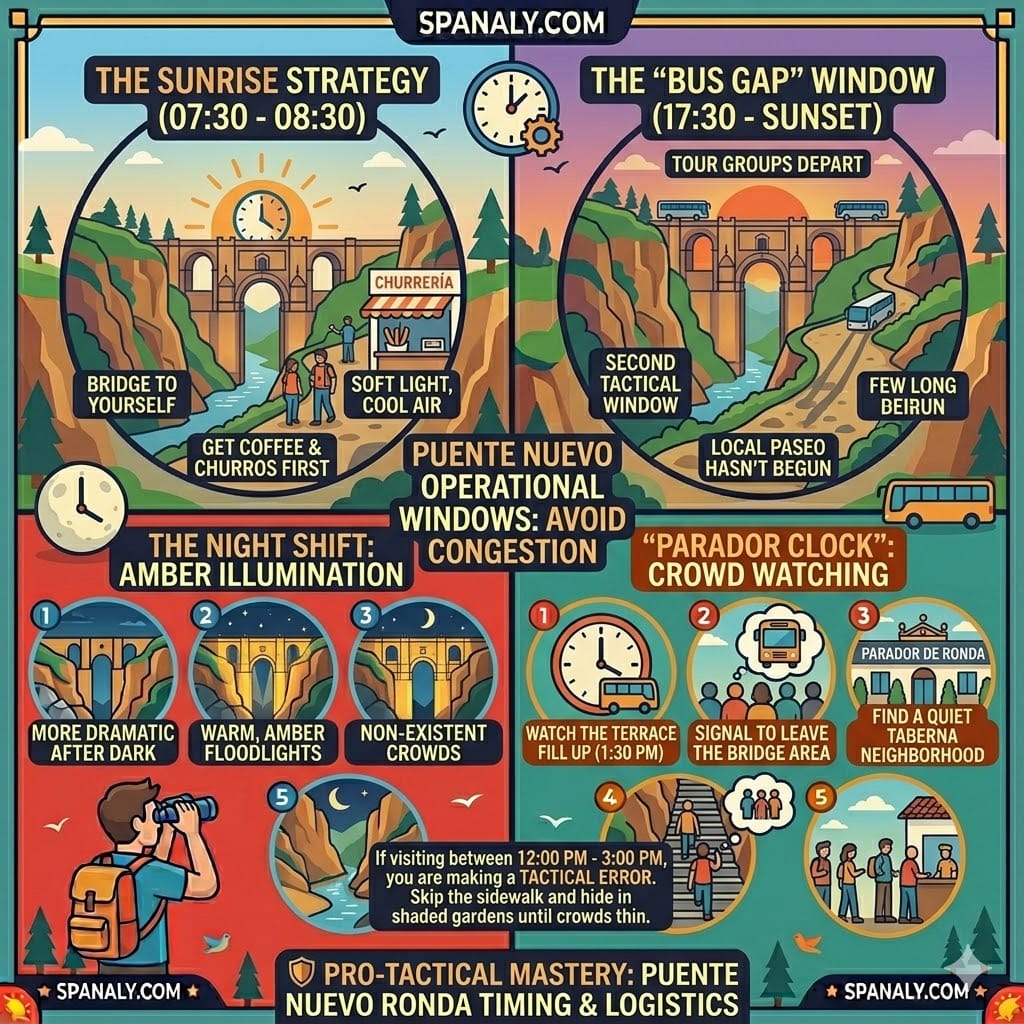
Puente Nuevo is a victim of its own fame. Between 11:00 AM and 5:00 PM, the bridge becomes a congested corridor for day-trippers arriving by bus from the Costa del Sol. To truly experience the majesty of the gorge, you must operate outside these “high-traffic” windows. Mastering Essential Spain Travel Tips will give you the tactical edge needed to navigate landmarks like this without the stress.
📍 Timing Operations:
The Sunrise Strategy (07:30 – 08:30): This is the only time you will have the bridge to yourself. The light is soft, the air is cool, and the only sound is the Guadalevín River below. Tactical Move: Have your coffee at a local “Churrería” at 07:00 AM and be on the bridge by first light.
The “Bus Gap” Window (17:30 – Sunset): Most tour groups depart by 5:00 PM. This is your second tactical window. The day-trippers are gone, and the local “Paseo” (evening stroll) hasn’t fully begun.
The Night Shift: Puente Nuevo is illuminated after dark with warm, amber floodlights. It is arguably more dramatic at night, and the crowds are non-existent.
⚖️ The Spanaly Verdict:
If you visit between 12:00 PM and 3:00 PM, you are making a tactical error. The heat radiates off the stone, the noise levels are high, and photography is nearly impossible due to harsh shadows. If your schedule forces a midday visit, skip the bridge sidewalk and hide in the shaded gardens of Cuenca until the crowds thin out.
Spanaly Insight: Watch the “Parador Clock.” The Parador de Ronda hotel sits right next to the bridge. When you see their terrace filling up for lunch (around 1:30 PM), that is your signal to leave the bridge area and find a quiet “Taberna” in the San Francisco neighborhood. Come back three hours later when the tour buses are halfway back to Málaga.
⛈️ The Gorge Reality: Weather & Safety Tactics
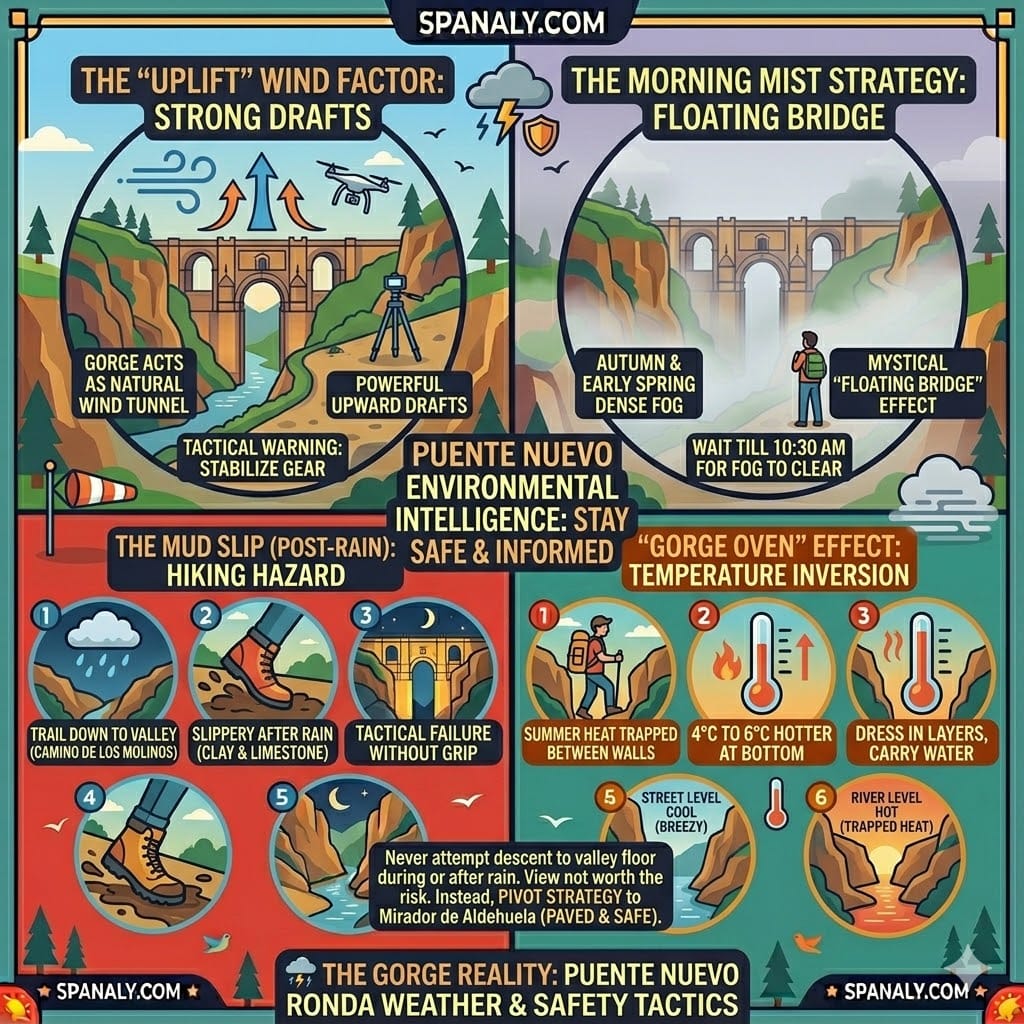
While Puente Nuevo Ronda looks like an immovable stone giant, the environment surrounding the 120-meter Tajo Gorge is dynamic and can be tactically challenging. Understanding the local climate is as important as knowing the history. If you are planning a broader trip, make sure to check the Best Time to Visit Spain to align your Ronda visit with optimal weather windows.
📍 Environmental Intelligence:
The “Uplift” Wind Factor: Because the gorge acts as a natural wind tunnel, southern winds hitting the cliff face create a powerful upward draft. Tactical Warning: If you are using a drone or a lightweight tripod on the bridge, the “Uplift” can destabilize your gear in seconds.
The Morning Mist Strategy: In autumn and early spring, the gorge often fills with dense fog. While this creates a mystical “floating bridge” effect, it can completely obscure the view from the top. If you encounter mist, wait until 10:30 AM when the sun typically burns it off.
The Mud Slip (Post-Rain): The trail down to the valley (Camino de los Molinos) is composed of limestone and clay. After even light rain, the path becomes a “Tactical Failure” for anyone without high-grip hiking boots. The clay sticks to soles, turning a moderate hike into a sliding hazard.
⚖️ The Spanaly Verdict:
Never attempt the descent to the valley floor during or immediately after a rainstorm. The view is not worth a 120-meter risk. Instead, pivot your strategy to the Mirador de Aldehuela, which remains paved and safe even in wet conditions, providing the best “rainy day” perspective of the bridge.
Spanaly Insight: Temperature inversion is real here. In summer, the top of the bridge might feel breezy and cool, but as you descend into the gorge, the heat becomes trapped between the stone walls. It can be 4°C to 6°C hotter at the river level than at the street level. Dress in layers and never underestimate the “Gorge Oven” effect.
🍴 Cliffside Gastronomy: Dining & Staying with a View
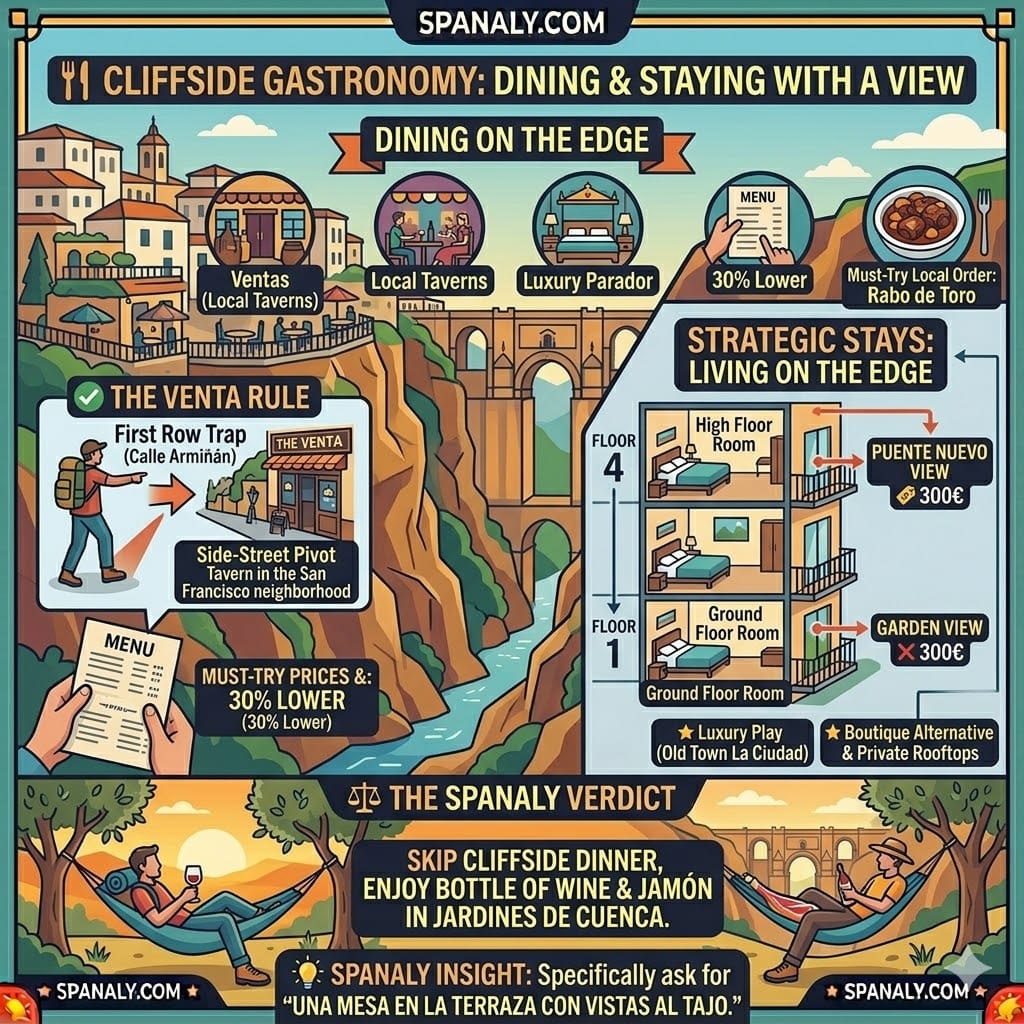
Finding a table with a view of Puente Nuevo Ronda is easy; finding one that serves authentic food at a fair price is a tactical challenge. To truly master the local flavors without the “tourist tax,” you should understand the basics of Spanish Cuisine before you sit down.
📍 The Venta Rule: Dining Strategy
The “First Row” Trap: Restaurants directly on the bridge sidewalk (Calle Armiñán) often prioritize the view over the kitchen. You are paying for the real estate, not the Paella.
The Side-Street Pivot: Look for “Ventas” or “Tabernas” just two blocks away from the bridge in the San Francisco neighborhood. You will find the same cliffside views from their back terraces but at 30% lower prices.
Must-Try Local Order: Do not leave Ronda without trying Rabo de Toro (Oxtail stew). It is the tactical energy boost needed after the gorge hike.
🏨 Strategic Stays: Living on the Edge
The Luxury Play: The Parador de Ronda is the undisputed king of views, sitting in the former Town Hall right at the cliff’s edge. Tactical Tip: Request a room on the higher floors specifically facing the bridge, or you’ll end up looking at the garden for 300€ a night.
The Boutique Alternative: Look for hotels in the Old Town (La Ciudad). Many smaller, historic houses have been converted into boutique stays that offer private rooftop terraces with views of the bridge that no public viewpoint can match.
⚖️ The Spanaly Verdict:
If your budget is tight, skip the cliffside dinner. Instead, buy a bottle of local wine and some Jamón Ibérico, and head to the Jardines de Cuenca at sunset. You’ll get a 5-star view for the price of a supermarket receipt. This is the ultimate tactical pivot for the smart traveler.
Spanaly Insight: When booking a restaurant, never ask for “a good table.” Specifically ask for “una mesa en la terraza con vistas al tajo” (a table on the terrace with gorge views). If they say it’s reserved but the restaurant is empty, it’s a tactical move to lure you inside. Move on to the next spot; Ronda has plenty of cliffs.
🚗 Operational Logistics: Arrival & Parking
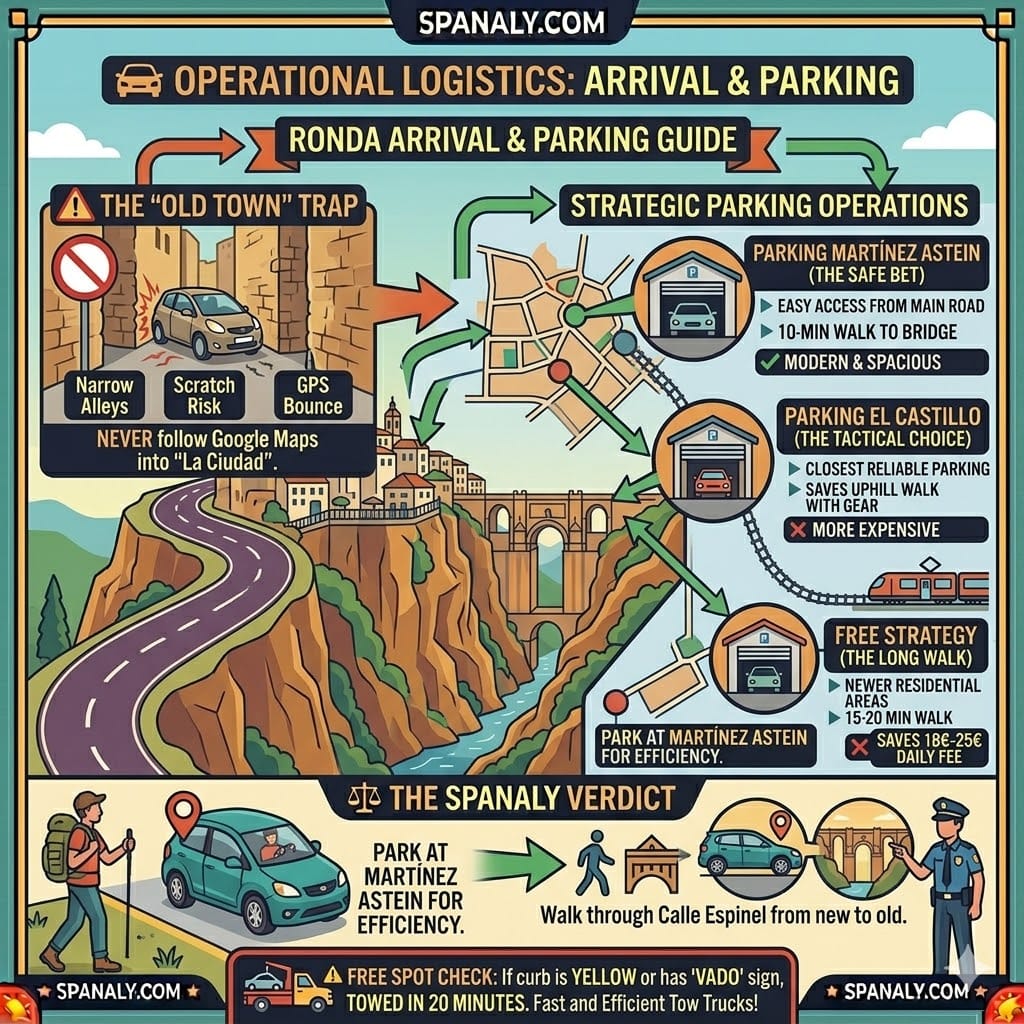
Driving in Ronda’s historic center is a “Tactical Nightmare” for anyone unfamiliar with 18th-century street widths. If you are arriving at Puente Nuevo as part of a larger road trip, ensure your Spain Trip Checklist includes a verified offline map, as GPS signals often bounce off the gorge walls.
📍 Strategic Parking Operations:
The “Old Town” Trap: Never follow Google Maps into the narrow alleys of La Ciudad (Old Town). You risk scratching your rental car and facing hefty fines.
Parking Martínez Astein (The Safe Bet): Located about a 10-minute walk from the bridge. It is a large underground garage that is easy to access from the main entrance road.
Parking El Castillo (The Tactical Choice): The closest “reliable” parking to the bridge. It’s slightly more expensive but saves you an uphill walk if you have heavy gear.
Free Strategy (The Long Walk): Look for spots in the newer residential areas near the train station. It’s a 15-20 minute walk, but you save the 18€ – 25€ daily parking fee.
⚖️ The Spanaly Verdict:
The most efficient tactical move is to park at Parking Martínez Astein. It is modern, spacious, and allows you to walk through the main shopping street (Calle Espinel) toward the bridge, giving you a full sense of the city’s transition from new to old.
Spanaly Insight: If you see a “Free” spot on a narrow street, check the curb. If it’s yellow or has a “VADO” sign, you will be towed within 20 minutes. In Ronda, the tow trucks are surprisingly fast and efficient. Spend the few Euros on a secure garage; it’s cheaper than a 150€ recovery fee.
⏱️ The Spanaly Itinerary: 4 Hours at Puente Nuevo
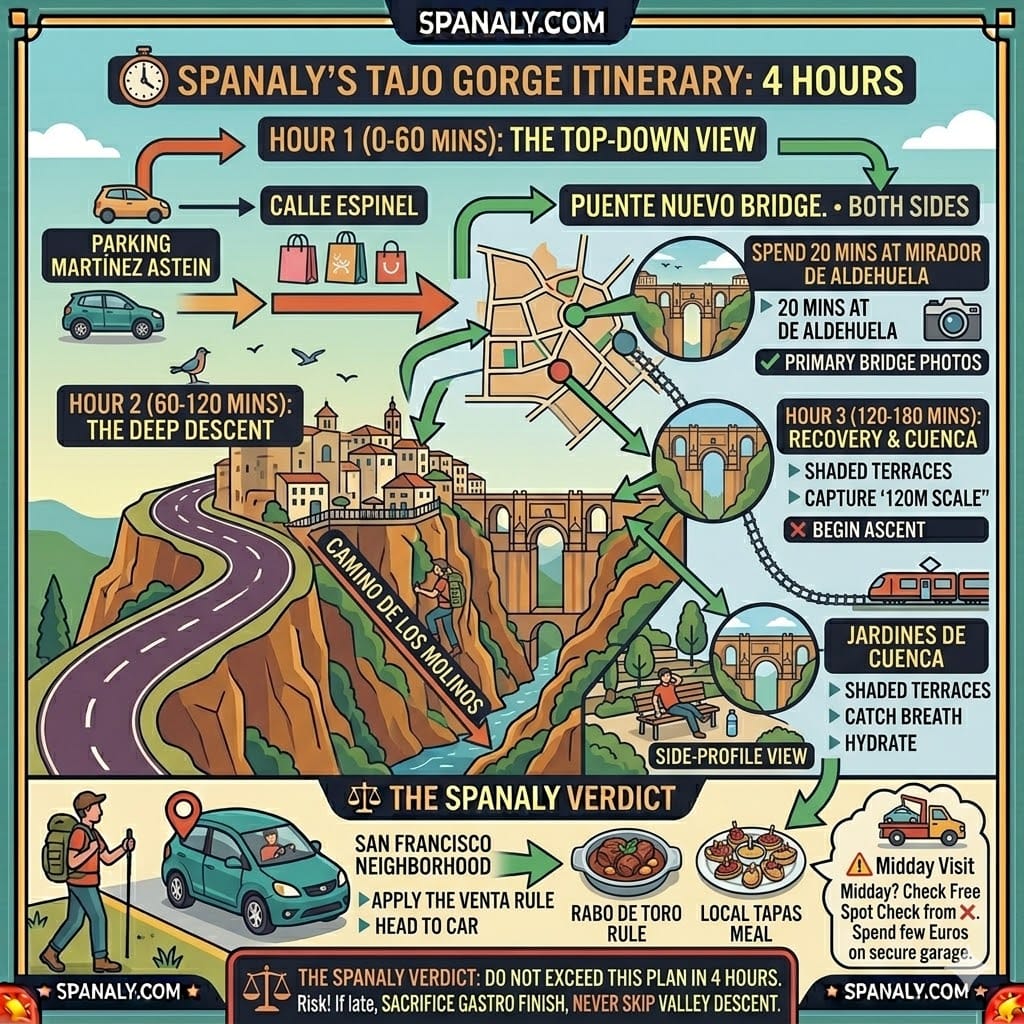
If you only have half a day, you cannot afford a “Tactical Failure” by wandering aimlessly. This 240-minute plan ensures you experience the bridge from every angle while still having time for local culture. For a broader perspective on the area, check our guide on the Best Spanish Attractions to see how Ronda fits into your Andalusia tour.
📍 Hour-by-Hour Execution:
Hour 1: The Top-Down View (0-60 mins): Park at Martínez Astein and walk through Calle Espinel. Reach the bridge and walk across both sides. Spend 20 minutes at Mirador de Aldehuela for your primary photos.
Hour 2: The Deep Descent (60-120 mins): Head to Plaza de María Auxiliadora and begin the descent to the valley floor via Camino de los Molinos. Reach the base, capture the “120m scale” shot, and start your ascent.
Hour 3: The Recovery & Recovery (120-180 mins): Once back at the top, head to the Jardines de Cuenca. These terraces offer a shaded, side-profile view of the bridge arches. It is the perfect spot to catch your breath and hydrate.
Hour 4: The Gastronomic Finish (180-240 mins): Apply the Venta Rule in the San Francisco neighborhood. Enjoy a quick Rabo de Toro or some local tapas before heading back to your car.
⚖️ The Spanaly Verdict:
Attempting to do more than this in 4 hours will lead to exhaustion. If you find yourself running late, sacrifice the Gastronomic Finish and grab a quick sandwich to ensure you don’t rush the valley descent—the view from the bottom is the soul of Ronda and cannot be skipped.
Spanaly Insight: Don’t waste time waiting in line for the Bullring (Plaza de Toros) if you are on this strict 4-hour clock. While iconic, the Bullring requires at least 90 minutes for a proper visit. Focus your “Tactical Window” entirely on the Tajo Gorge and the bridge to get the highest visual ROI (Return on Investment) for your time.
⚖️ The Spanaly Verdict: Is the Interpretation Center Worth It?
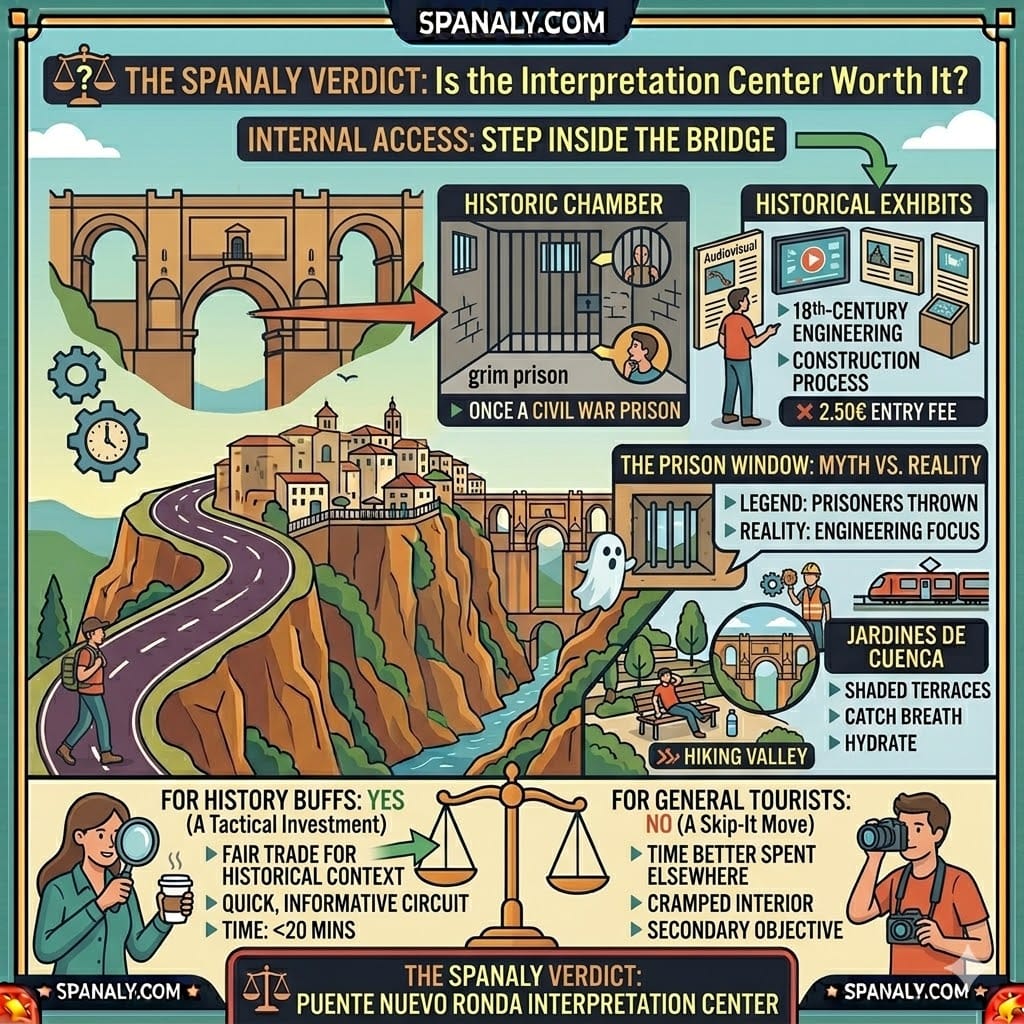
Inside the central arch of Puente Nuevo Ronda sits a small, historic chamber. This room once served as a grim prison during the Spanish Civil War. Today, it functions as the Centro de Interpretación del Puente Nuevo. Before paying the 2.50€ fee, compare this experience to other Famous Spanish Festivals or monuments.
📍 The Breakdown:
Internal Access: You get to stand inside the bridge’s massive stone structure.
Historical Exhibits: Audiovisual panels explain the 18th-century engineering and construction process.
The Prison Window: A small, barred window offers a unique “insider” view of the gorge.
Time Required: Most visitors finish the entire circuit in under 20 minutes.
⚖️ The Spanaly Verdict:
For History Buffs: YES. The price of a coffee is a fair trade for this historical context. It is a quick, informative “in-and-out” tactical operation.
For General Tourists: NO. Your time is better spent at the Jardines de Cuenca or hiking the valley. The interior is cramped and offers limited photographic value for most travelers.
Spanaly Insight: The “Prison Window” myth is a popular local legend. While the history is dark, the center focuses primarily on Aldehuela’s engineering marvel. Only visit this if you have completed the 4-Hour Itinerary first. It is a “secondary objective” for your Ronda mission.
🛡️ Visitor FAQs – Puente Nuevo Ronda Guide
🛂 Is there a luggage storage service near Puente Nuevo?
Yes, several local shops and cafes near Plaza de Toros offer secure luggage storage via apps like Bounce or Radical Storage. This is a tactical move if you are visiting Ronda as a day trip by train and want to hike the gorge without carrying heavy bags.
👗 What is the recommended dress code for the gorge hike?
Prioritize function over fashion. While the bridge is perfect for "Instagram dresses," the descent to the valley requires sturdy sneakers or hiking boots. The rocks near the Guadalevín River are often polished and slippery; avoid flip-flops or smooth-soled shoes to prevent a tactical slip.
🚁 Can I legally fly a drone over Puente Nuevo?
Generally, no. Most of Ronda's historic center is a restricted flight zone due to its status as a protected heritage site and the proximity of residential buildings. Flying a drone without a specific permit can result in heavy fines. Stick to the established viewpoints for safe and legal photography.
☀️ Is the bridge accessible for visitors with limited mobility?
The bridge surface itself is flat and wheelchair-friendly. However, the viewpoints and hiking trails are mostly composed of steep steps and uneven cobblestones. We recommend staying on the main bridge sidewalk and visiting the Parador terrace for the best accessible views of the gorge.
🍽️ Do I need to book cliffside restaurants in advance?
During weekends and peak season, reservations are mandatory for front-row tables. If you want a sunset view, book at least 48 hours in advance. Always mention you want a table on the terrace (en la terraza) to avoid being seated in the back of the restaurant.
Puente Nuevo Ronda Guide by Spanaly.com
Standing on Puente Nuevo is more than just a photo op; it is a tactical victory over gravity and time. You’ve mastered the heights, survived the gorge heat, and (hopefully) found a parking spot that didn’t cost a fortune.
🛡️ Final Spanaly Checklist:
📸 Photos: Did you get the valley shot? If not, the ghost of Aldehuela is watching.
🥙 Food: If you didn’t try the Rabo de Toro, did you even visit Ronda?
🥾 Legs: If they aren’t shaking from the ascent, you didn’t go deep enough!
🗺️ The Next Objective:
Now that you’ve conquered the bridge, why stop here? Ronda is just the gateway to a white-washed paradise. The most efficient move now is to grab your car keys and start the White Villages Road Trip from Ronda. Trust us, those hidden Andalusian alleys are waiting for your next exploration.
Spanaly Insight: Remember, the bridge looks different every time you visit. Whether it’s the golden hour glow or the mystical morning mist, Puente Nuevo always has a surprise for those who look closely. See you in the next white village, traveler!