
Table of Contents
Toggle☕ Art & Ambiance: Where to Pause
The Reina Sofia Museum Madrid is more than just a gallery—it is a powerful mirror of the nation’s journey and a capture of Spain’s modern identity. Furthermore, as a mandatory stop for every traveler, mastering its history and layout is the first step toward an unforgettable artistic experience.
🌟 Why It’s Unmissable:
Mastering the Icons: Experience the evolution of art through the eyes of giants like Picasso, Dalí, and Miró.
A Bold Rebellion: Unlike its classical neighbors, this museum’s soul is rooted in surrealism and political expression.
The Prime Location: It marks the final, essential vertex of Madrid’s legendary Golden Triangle of Art.
In addition to its stunning collection, the Reina Sofia Museum Madrid offers a raw, emotional contrast to the traditional Prado Museum. Consequently, whether you are here for the masterpieces or the architecture, it remains the ultimate destination for modern art lovers.
💡 Spanaly Pro-Tip: To navigate the Reina Sofia Museum Madrid and the rest of the city’s art scene like a local, make sure to check our Ultimate Madrid Travel Guide before you head out.
🖼️ Masterpieces You Cannot Miss

Don’t get overwhelmed by the museum’s 23,000 works. If you are short on time, focus on these top icons that defined the 20th century:
| Masterpiece | Artist | Location | Why It Matters |
| Guernica | Picasso | Room 205.10 | The world’s most famous anti-war statement. |
| The Great Masturbator | Dalí | Room 205.14 | A surreal deep-dive into the subconscious. |
| Woman and Bird | Miró | Floor 2 | A poetic masterpiece of cosmic symbolism. |
| Portrait of Josette Gris | Juan Gris | Floor 2 | The peak of Spanish Cubism. |
🚀 Spanaly’s “Fast-Track” Route:
Enter through the Sabatini Building: This is where the core permanent collection lives.
Head Straight to the 2nd Floor: This is the “Heart of the Museum” where Guernica and the 1900-1945 avant-garde works are located.
Finish at the Nouvel Terrace: After the emotional intensity of Picasso, take the glass elevator to the rooftop for some of the best views of Madrid.
“For the most up-to-date schedule and official bookings, visit the Museo Reina Sofía Official Website.”
🛡️ The Hidden Journey of Picasso’s Guernica
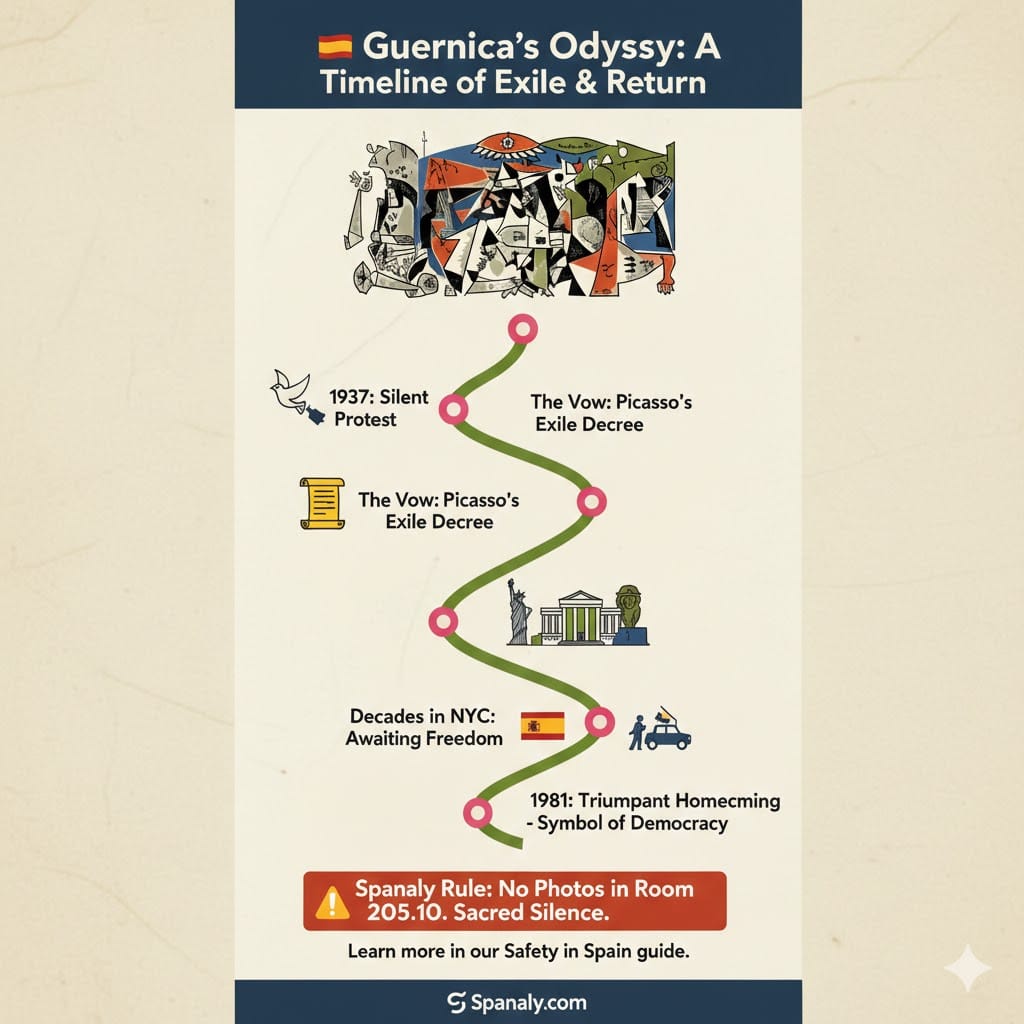
The centerpiece of the museum is undoubtedly Guernica, Picasso’s monumental anti-war masterpiece. But beyond the canvas lies a dramatic backstory of struggle, exile, and an emotional homecoming.
📜 A Timeline of Resistance:
🕊️ 1937: The Silent Protest Painted as a raw, immediate response to the brutal bombing of the Basque town of Guernica during the Spanish Civil War.
🔒 The Vow of Exile Picasso was so devastated by the regime that he forbade the painting from ever entering Spain until democracy was fully restored.
🗽 The New York Years For decades, it was “protected” at the MoMA in New York, serving as a global ambassador for Spanish freedom.
🇪🇸 1981: The Grand Return Six years after the transition to democracy, Guernica finally came home under heavy military escort—marking a new era for the nation.
⚠️ Spanaly Essential Rule: > Photography is strictly forbidden in Room 205.10. Guards ensure a “sacred silence” to preserve the gravity of the work. To avoid any issues with local regulations or museum staff during your trip, we recommend reviewing our Safety in Spain: Local Laws & Tips guide.
🔍 Beyond Picasso: Secret Corners & Hidden Gems

While Guernica is the undisputed star, the Museo Reina Sofía hides treasures that many tourists walk right past. To truly experience the soul of the museum, make sure to seek out these “insider” spots:
🧩 Dalí’s Visual Puzzle (Room 205.12): Don’t miss The Invisible Man (1930). This double-image masterpiece is a surrealist riddle that reveals its hidden figures only when viewed from specific angles.
📽️ The Cinema of Resistance (Room 430): Experience Spain’s artistic bravery by watching rare, experimental short films that were once strictly banned.
🌇 The Secret Rooftop Escape: Take the futuristic glass elevator to the top of the Nouvel Building. You’ll discover a stunning terrace overlooking the city. It’s the perfect spot to relax and plan your next stop using our Ultimate Madrid Travel Guide.
📚 The Artist’s Vault: The museum’s library and archive hold over 100,000 sketches and letters. It is a peaceful sanctuary for any art lover looking to escape the crowds.
💡 Spanaly Tip: While the rooftop is peaceful, always keep an eye on your belongings in crowded museum galleries. For more peace of mind, check our Safety in Spain guide.
🚀 The Strategy: How to Visit Like a Pro
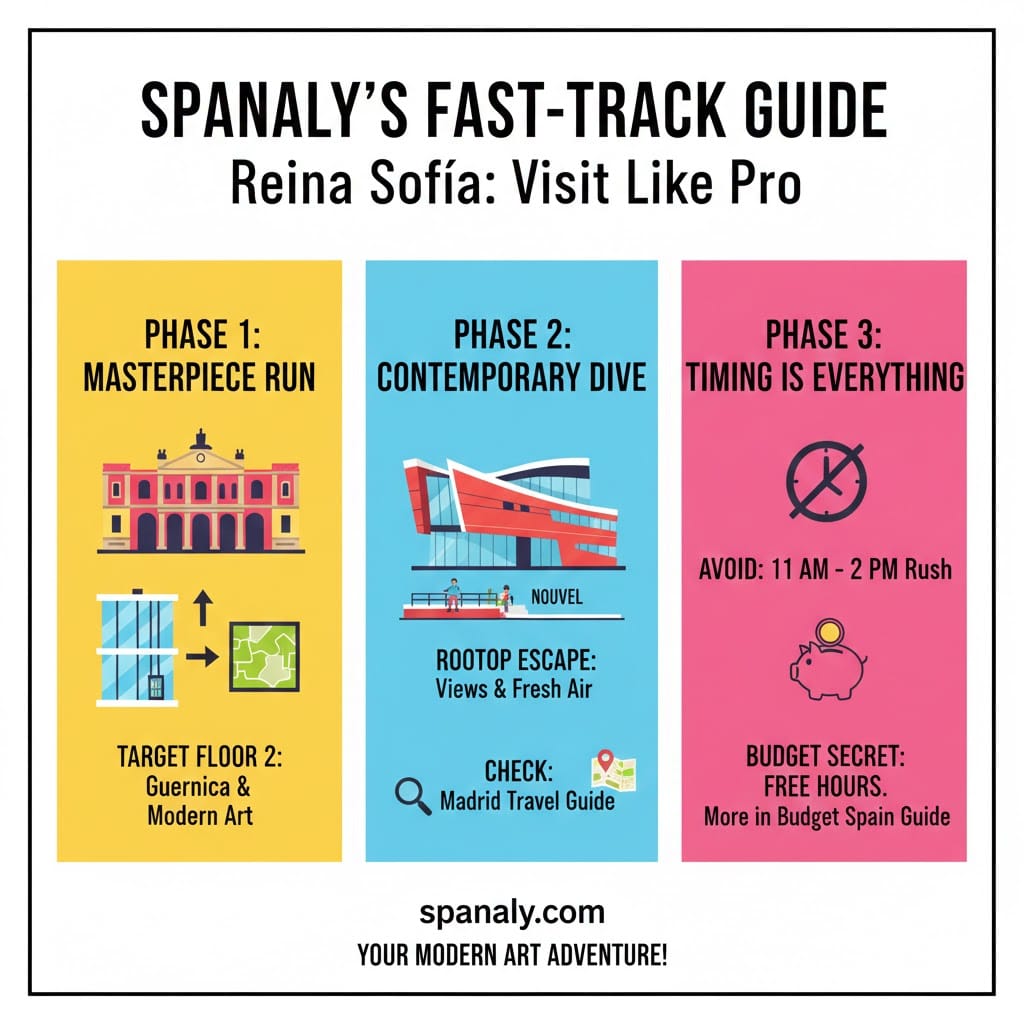
The Reina Sofía is split between two massive buildings: the historic Sabatini and the futuristic Nouvel. Without a plan, you might spend half your time just looking for the exit. Consequently, here is your Spanaly-approved strategy to navigate the Reina Sofia Museum Madrid efficiently:
❶ 🏛️ Start with The Masterpiece Run (Sabatini Building)
Target Floor 2: Head straight here immediately. This is the heart of the museum where Guernica and the pre-war avant-garde collections live.
The Glass Elevators: Use them! They offer a great view and are certainly the fastest way to reach the upper floors.
❷ 🔴 Transition to The Contemporary Dive (Nouvel Building)
Cross Over: Use the connecting walkways to enter the Nouvel extension smoothly.
The Terrace: Furthermore, head to the rooftop for a breather and some fresh air. It’s the perfect place to check your Ultimate Madrid Travel Guide for your next destination.
❸ 🕒 Master Your Timing
Avoid the Morning Rush: The museum is most crowded between 11:00 AM and 2:00 PM.
The Budget Secret: If you’re traveling on a budget, take advantage of the free entry hours. For more tips on saving money while exploring, make sure to read our Budget Travel in Spain guide.
🏗️ Architecture: Where History Meets Modernity
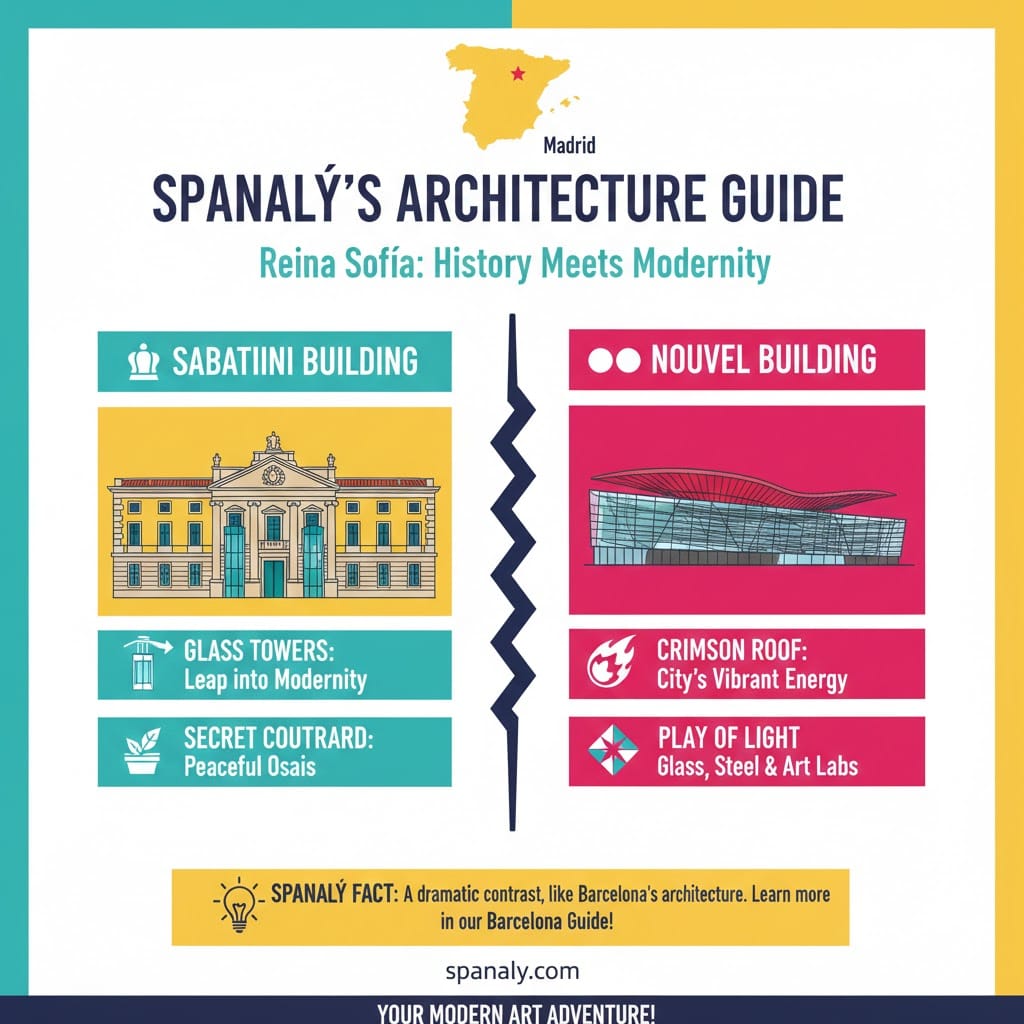
The Museo Reina Sofía is a masterpiece of architectural evolution. It is not just a building, but a vivid dialogue between the 18th-century “Sabatini” stone and the 21st-century “Nouvel” steel expansion.
🏛️ The Sabatini Building (The Historic Soul)
Originally designed as the Hospital General de San Carlos, this limestone giant was transformed into a museum in the 1980s.
🛗 The Glass Towers: The three iconic glass-and-steel elevator towers on the facade were added later, symbolizing the museum’s leap into the modern era.
🌿 The Secret Courtyard: Don’t miss the inner garden—a peaceful oasis that still retains the serene, healing atmosphere of the original hospital.
🔴 The Nouvel Building (The Futuristic Vision)
In 2005, world-renowned architect Jean Nouvel added a bold extension that completely reshaped Madrid’s skyline.
☄️ The Crimson Roof: Famous for its massive, hovering red steel roof that reflects the vibrant light and energy of the Spanish capital.
💠 Play of Light: This wing is a playground of glass, mirrors, and steel, creating a “transparency” that houses the library and temporary art labs.
💡 Spanaly Fact: The contrast between the heavy stone of Sabatini and the light steel of Nouvel is as dramatic as the architectural shift seen in other iconic landmarks, such as those featured in our Ultimate Barcelona Travel Guide.
👻 Rare Facts Few People Know
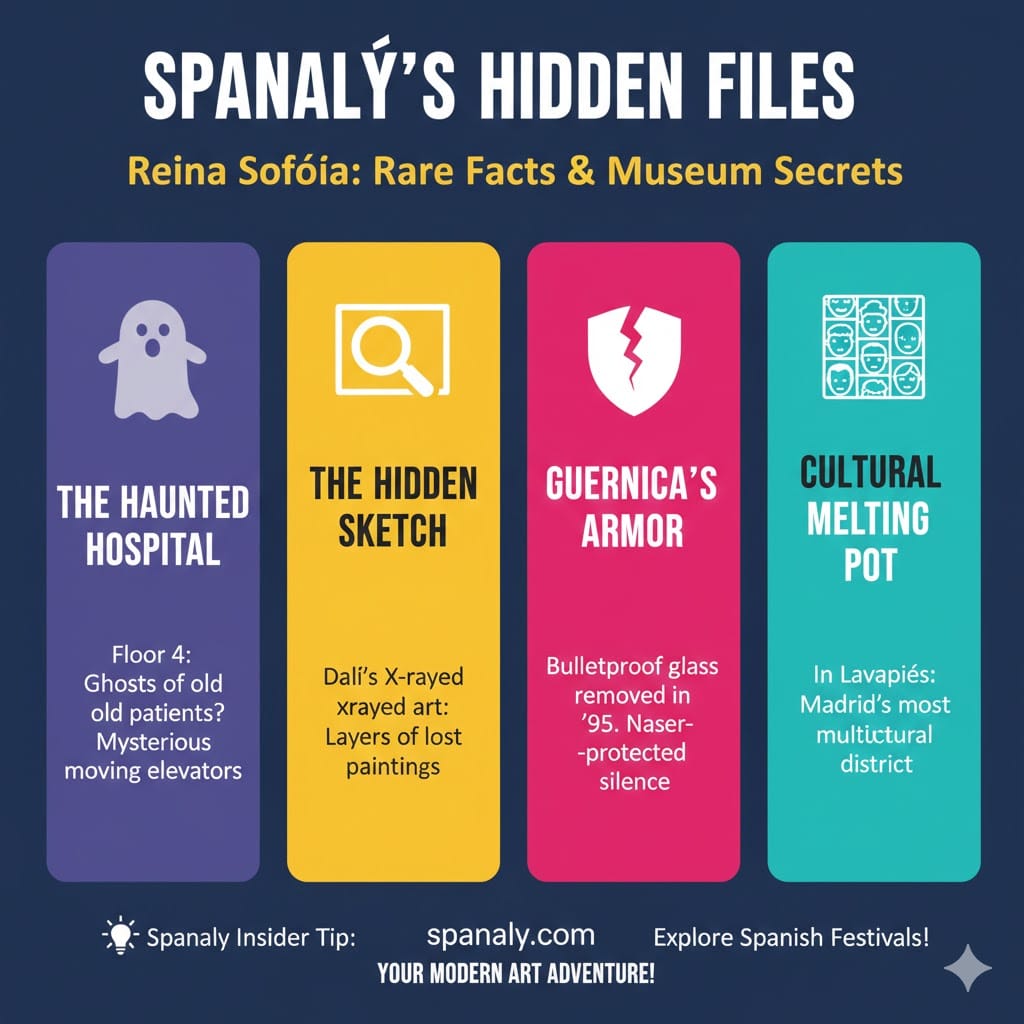
Beyond the canvas and the steel, the Museo Reina Sofía holds secrets that even some locals don’t know. From ghostly legends to hidden symbols, here is the “darker” side of the museum:
🏚️ The Haunted Hospital: Before it was an art sanctuary, the Sabatini building was a general hospital. Legends say that the spirits of former patients still roam the corridors of Floor 4. During the 1990s, security guards even reported “mysterious elevators” moving on their own!
🎨 The Hidden Sketch: X-rays of some of the museum’s masterpieces have revealed that artists like Dalí often painted over older works. It’s literally a museum built on layers of hidden history.
🎥 The Guernica Bulletproof Glass: Until 1995, Picasso’s Guernica was kept behind massive bulletproof glass. Today, it stands open to the air, protected only by a laser sensor and a strictly enforced “No-Photo” zone.
🎭 A Cultural Melting Pot: The museum is located in the Lavapiés district, the most multicultural neighborhood in Madrid. It’s a perfect reflection of how modern art breaks all borders.
💡 Spanaly Insider Tip: If you’re interested in more Spanish traditions and the stories that shaped the nation, you’ll love exploring our guide on Spanish Festivals, where art and history come alive in the streets.
📅 Planning Your Reina Sofia Museum Madrid Visit

To make the most of your trip to the Museo Reina Sofía in 2026, you need to master the clock. Here is the essential logistical breakdown for every savvy traveler:
⏰ Opening Hours
Monday, Wednesday – Saturday: 10:00 AM – 9:00 PM.
Sunday: 10:00 AM – 2:30 PM (The entire museum), 2:30 PM – 7:00 PM (Selected galleries only).
Tuesday: Closed (Don’t let this ruin your plans!).
💸 The “Free Entry” Secret
Why pay when you can enter for free? The museum offers complimentary access during these hours:
Monday, Wednesday – Saturday: 7:00 PM – 9:00 PM.
Sunday: 12:30 PM – 2:30 PM.
Full Free Days: April 18, May 18, and October 12.
🎟️ Booking Tips
Online is King: Avoid the long queues at the Sabatini entrance by booking your tickets in advance on the official website.
Combined Tickets: If you’re visiting other landmarks, check for the “Paseo del Arte” pass to save money. For more advice on smart spending, visit our Budget Travel in Spain guide.
📍 Location & Connections
Located in the heart of the “Art Triangle,” the museum is just a short walk from the central station. If you are arriving from another city, our Ultimate Seville Travel Guide or Barcelona guides provide excellent tips on using Spain’s high-speed rail to reach Madrid.
💡 Spanaly Pro Tip: The “Free Hours” are very popular. If you want a peaceful experience with Guernica, it is worth paying the standard ticket price (approx. €12) to enter during the quieter morning hours.
📍 Attractions Near Reina Sofia Museum Madrid

Once you step out of the futuristic Nouvel exit, you are in the heart of Madrid’s cultural pulse. Here is what you should explore next to round off your artistic journey:
🏛️ The Golden Triangle of Art: The Reina Sofía is just one piece of the puzzle. Within walking distance, you’ll find the Prado and Thyssen-Bornemisza museums. These are among the most iconic Spanish Attractions that every traveler must witness at least once.
🥘 Lavapiés Culinary Scene: Directly behind the museum lies the multicultural district of Lavapiés. It is the best place to recharge with authentic Spanish Cuisine, offering everything from traditional tapas to modern fusion dishes.
🌳 El Retiro Park: A 10-minute walk will take you to Madrid’s “green lung.” It’s a UNESCO site perfect for a relaxing stroll after the intensity of Guernica.
🚂 Atocha’s Tropical Forest: Right across the street is the Atocha train station. Even if you aren’t catching a train, its indoor tropical garden is a unique architectural feat worth a quick visit.
💡 Spanaly Tip: Many of the best tapas bars in Lavapiés open late. If you finish your museum visit during the “Free Hours” (7:00 PM – 9:00 PM), you’ll arrive just in time for the vibrant Madrid nightlife!
💡 Spanaly’s Golden Tips for a Flawless Visit
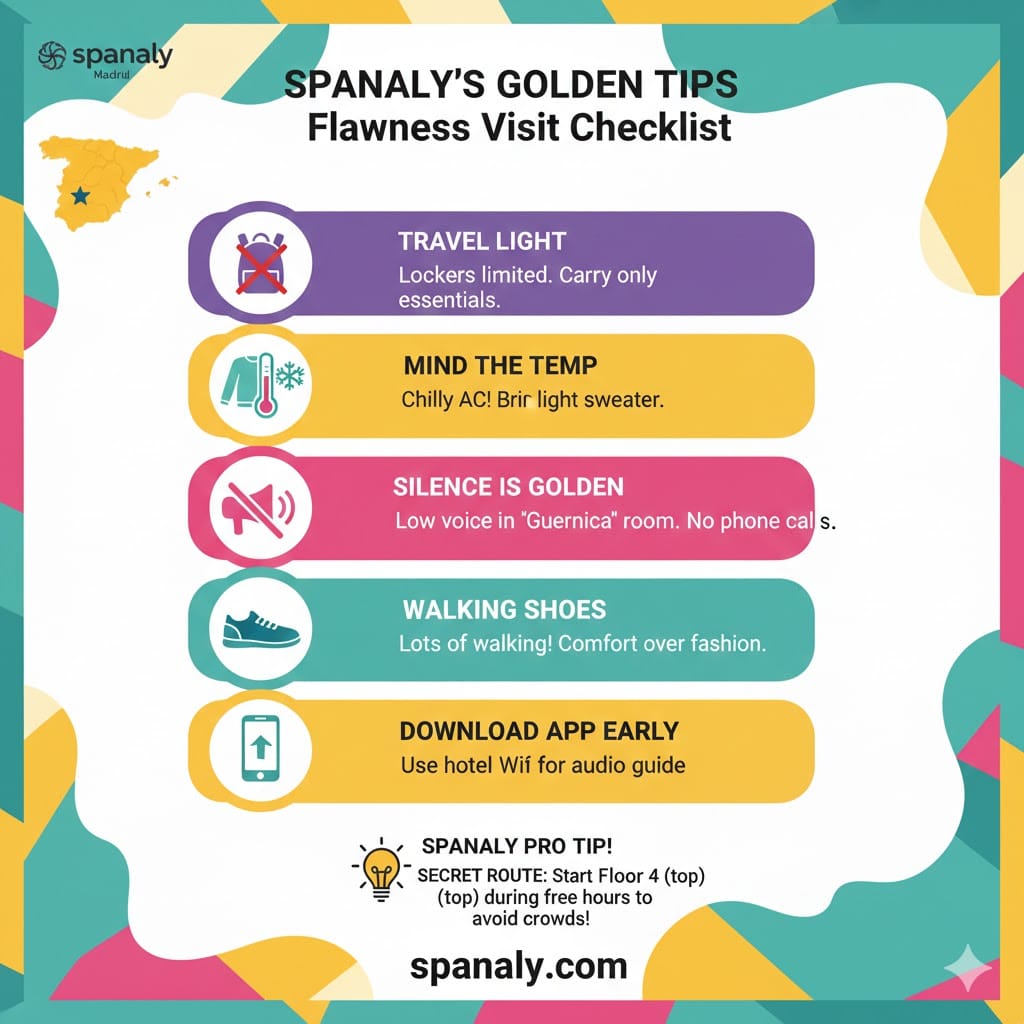
To ensure your visit to the Museo Reina Sofía is as smooth as a Dalí brushstroke, keep these exclusive “insider” tips in mind:
🎒 Travel Light: The museum has a strict policy regarding large bags and backpacks. While there are lockers available in the Sabatini building, they can fill up quickly during peak hours. Try to carry only the essentials.
🧥 Mind the Temperature: Like many world-class museums, the climate control is set to protect the art (quite chilly!). Even in the Madrid summer, bringing a light sweater or pashmina is a smart move.
🔇 Silence is Golden: Especially in the Guernica room, the atmosphere is meant to be solemn. Security is very strict about noise levels and phone conversations—keep your voice low to respect the art and other visitors.
👟 Wear Your Best Walking Shoes: Between the two buildings and multiple floors, you will easily clock in several kilometers of walking. Comfort is more important than fashion here!
📱 Download the App Early: The museum offers an official app with audio guides. Download it using your hotel’s Wi-Fi to save your mobile data and avoid the slow connection inside the thick stone walls of the Sabatini.
✨ One Last Secret: If you visit during the free hours, start from the top floor (Floor 4) and work your way down. Most crowds cluster on Floor 2 for Guernica first, so you’ll enjoy a much quieter experience by reversing the route!
🖼️ Visitor FAQs – Reina Sofía Museum Guide 2026
🎨 Can I take photos of Picasso’s Guernica?
No, photography is strictly forbidden in the room housing Guernica. This is strictly enforced in 2026 to protect the masterpiece. However, you can take photos without flash in most other areas. For more photography spots in the city, check our Ultimate Madrid Travel Guide.
🕒 When is the Reina Sofía Museum free to visit?
The museum offers free entry on Monday and Wednesday to Saturday (7:00 PM – 9:00 PM) and Sunday (12:30 PM – 2:30 PM). If you're looking for more ways to save, don't miss our guide on Budget Travel in Spain.
🏢 What is the difference between the Sabatini and Nouvel buildings?
The Sabatini is the historic 18th-century soul, while the Nouvel is the futuristic red-steel expansion. This architectural contrast is a staple of Spanish Attractions in the capital.
📍 Is the museum located near the train station?
Yes, it's right across from Atocha Station. If you're arriving from the south, our Ultimate Seville Travel Guide has tips on the high-speed AVE trains that stop here.
Modern Art Guide by Spanaly.com
🏁 Is the Reina Sofía Worth It?
Absolutely. Whether you are an art aficionado or a casual traveler, the Museo Reina Sofía is more than just a gallery—it’s the emotional heartbeat of Spain.
🌟 Why You Should Go:
History in Motion: Seeing Guernica in person is a bucket-list experience that no photo can replicate.
Architectural Wonder: The blend of the old hospital walls with Jean Nouvel’s red steel is a visual feast.
Modern Perspective: It challenges you to see the world through the eyes of geniuses like Dalí and Miró.
✨ Your Next Step:
Don’t just read about it—experience it! Pair your visit with a stroll through Lavapiés to enjoy some authentic Spanish Cuisine or continue your journey across the country with our Ultimate Seville Travel Guide.
Madrid is waiting. Art is calling. Are you ready?