
Table of Contents
Toggle💎 Discover the Secret Side of the City
Most travelers stand on the Puente Nuevo, take a photo, and believe they have “seen” Ronda. They missed the secret water mines, the star-lit Arab baths, and the silent hanging gardens hidden just meters away.
To truly experience this cliffside icon, you must ghost the crowds and descend into its Moorish soul. Whether you are seeking a private sunset view or an ancient subterranean escape, this guide reveals the city’s most guarded secrets.
🛡️ The Secret Side Protocol
Goal: Escape the tourist traps and discover authentic, quiet historical sites.
Effort: Requires descending into the gorge and navigating narrow, ancient alleys.
Reward: Exclusive views and a deep connection to Ronda’s Islamic and medieval heritage.
Key Advice: Start your exploration in the lower San Miguel district before the tour buses arrive.
Spanaly Insight: The true magic of Ronda isn’t found at the top of the bridge, but at its base. While the crowds fight for space on the upper balconies, the Ultimate Ronda Travel Guide strategies recommend moving vertically to find the absolute silence of the Tajo Gorge’s ancient flour mills.
⚡ Quick Scan: The Hidden Gems Blueprint

If you are short on time but crave an authentic experience, use this logistical summary to prioritize your movement across the cliffside.
| Feature | The Hidden Gem | Why It’s Exclusive |
|---|---|---|
| Best Silence | Baños Árabes | Tucked in the valley; perfectly preserved 13th-century stars. |
| Best Adventure | The Water Mine | 200+ steps carved into solid rock reaching the river bed. |
| Best View | Virgen de la Cabeza | A 2km trek offering a “floating city” perspective. |
| Best Secret | Convent Sweets | Buying pastries via a silent, rotating wooden window. |
Average Walking Distance: Expect to cover 5km to 7km of steep, uneven terrain.
Total Vertical Gain: Approximately 120m if descending to the gorge floor.
Ideal Timing: Complete the valley sites (Baths/Mills) before 10:30 AM to avoid heat.
Access Protocol: Carry €10–€20 in small cash for entrance fees at smaller historical sites.
🏰 The Subterranean Legacy: La Casa del Rey Moro & The Water Mine
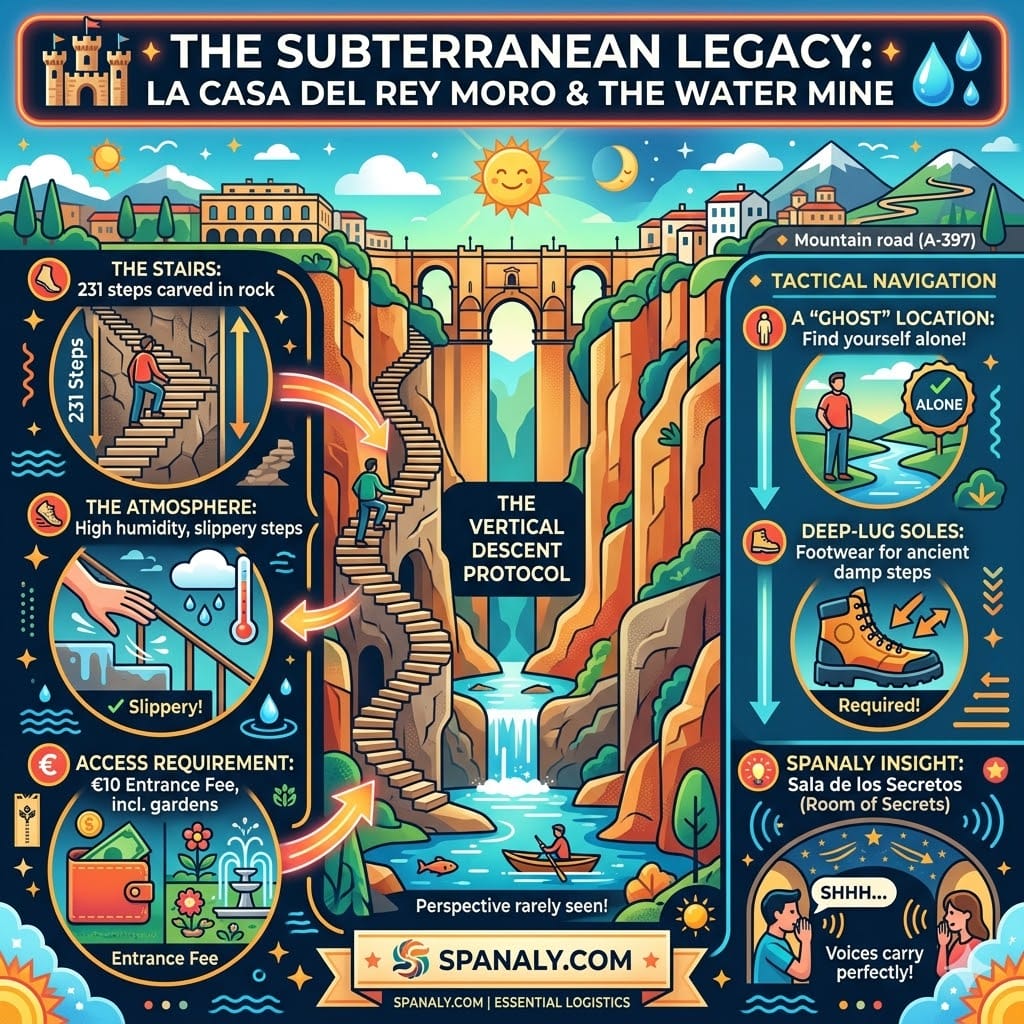
While most visitors admire the Puente Nuevo from above, the real secret lies 60 meters below the surface. The Water Mine (La Mina de Agua) at the Casa del Rey Moro is a masterpiece of 14th-century military engineering, designed to provide the Moorish city with water during Christian sieges.
The Vertical Descent Protocol
The Stairs: You must descend exactly 231 steps carved directly into the limestone rock.
The Atmosphere: Expect high humidity and slippery surfaces; the temperature drops significantly as you descend.
The Reward: You reach the very bottom of the Tajo Gorge, where the Guadalevín River flows in absolute silence—a perspective few tourists ever experience.
Access Requirement: The entrance fee is approximately €10, which includes access to the neo-Mudejar gardens.
Tactical Navigation
The climb back up is strenuous and requires a steady pace. Unlike the crowded viewpoints, this site is a “ghost” location where you can often find yourself alone at the river’s edge. Mastering this descent is one of the most rewarding things to do in Ronda for those seeking historical depth over quick photos. Ensure your footwear has a deep-lug sole to handle the damp, ancient stone steps.
Spanaly Insight: The true secret isn’t just the water—it’s the “Room of Secrets” (Sala de los Secretos). If two people stand in opposite corners of this subterranean chamber and whisper, their voices carry perfectly across the ceiling while remaining silent to anyone standing in the center.
🌿 The Andalusian Oasis: Palacio de Mondragón’s Hanging Gardens
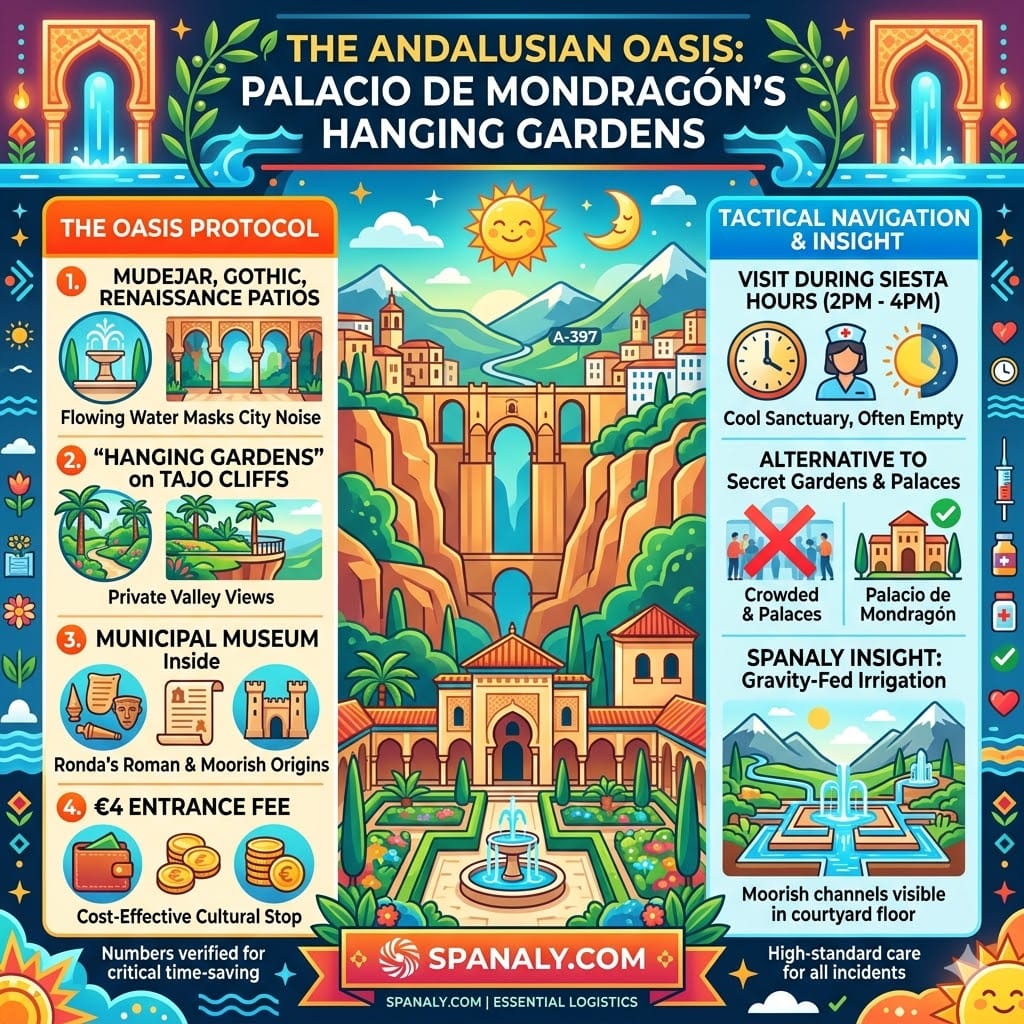
While the crowds converge on the bullring, the Palacio de Mondragón remains Ronda’s most sophisticated architectural secret. Once the residence of Moorish kings and later the Catholic Monarchs, this palace is a masterclass in Mudejar design, featuring intimate courtyards and intricate tilework that rival larger Andalusian monuments.
The Oasis Protocol
The Patios: Explore three distinct courtyards (Mudejar, Gothic, and Renaissance) where the sound of flowing water masks the city’s exterior noise.
The Gardens: The “Hanging Gardens” are perched directly on the edge of the Tajo cliffs, offering a private, framed perspective of the valley.
The History: The small municipal museum inside provides context on Ronda’s Roman and Moorish origins without the exhaustion of larger museums.
Entrance Logic: Admission is approximately €4, making it one of the most cost-effective cultural stops in the old quarter.
Tactical Navigation
Visit this site during the siesta hours (2:00 PM – 4:00 PM). The thick stone walls provide a natural, cool sanctuary from the Andalusian heat, and the gardens are often completely empty. It is a perfect alternative to the more exposed Ronda secret gardens & palaces that often see higher foot traffic during peak hours.
🌟 Architectural Time-Travel: The Arab Baths (Baños Árabes)
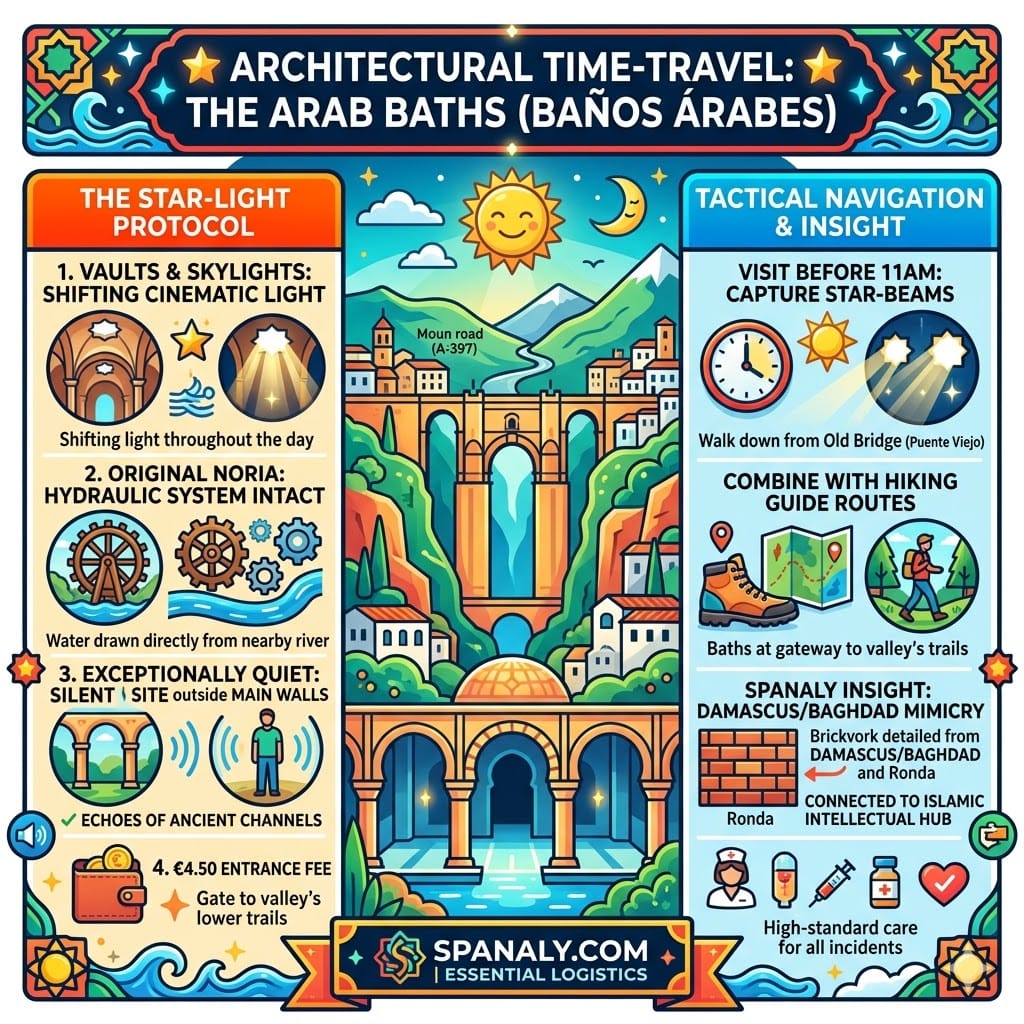
Hidden in the lower San Miguel district, the Baños Árabes of Ronda are the best-preserved Islamic thermal baths in the entire Iberian Peninsula. While most visitors stay on the plateau, descending to this 13th-century site feels like stepping into a silent, star-lit past.
The Star-Light Protocol
The Vaults: The main chambers feature barrel-vaulted ceilings with star-shaped skylights. These weren’t just decorative; they provided ventilation and a shifting, cinematic light play throughout the day.
The Preservation: Unlike many other sites, the original waterwheel (noria) and the hydraulic system are still largely intact, showing how water was drawn directly from the nearby river.
The Experience: Because it sits outside the main tourist walls, the site is exceptionally quiet, allowing you to hear the echoes of the ancient water channels.
Entrance Logic: Admission is approximately €4.50. It is a short, steep walk down from the Old Bridge (Puente Viejo).
Tactical Navigation
The walk down is easy, but the climb back up to the town center can be taxing in the afternoon sun. We recommend combining this visit with your exploration of the hiking in Ronda guide routes, as the baths sit at the gateway to the valley’s lower trails. Visit before 11:00 AM to capture the sharpest “star-beams” of light through the ceiling vents.
⛪ The Sacred Palimpsest: Iglesia de Santa María la Mayor

Standing on the historic Plaza Duquesa de Parcent, the Iglesia de Santa María la Mayor is more than just a cathedral; it is a architectural “palimpsest” where layers of Roman, Islamic, and Christian history coexist. While most visitors take a quick photo of the facade, the true secrets are hidden within its multi-era walls.
The Hidden Mihrab Protocol
The Moorish Core: Built on the site of Ronda’s former Grand Mosque, the church still preserves a 13th-century Mihrab (prayer niche). You can find its delicate plasterwork and Arabic inscriptions hidden behind the main Christian altar.
The Royal Balconies: One of the most unique features is the double-decker balcony system. Historically, these were used by the city’s nobility to watch bullfights and festivities held in the plaza below.
The Architectural Clash: The interior is a fascinating visual struggle between Gothic columns and flamboyant Baroque altarpieces, reflecting the turbulent transition of power in Andalusia.
Entrance Logic: Admission is approximately €4.50. It is one of the quietest religious sites in the city compared to the often-overcrowded Plaza de Toros Ronda.
Tactical Navigation
Do not miss the climb to the church tower. The stairs are narrow but the rooftop provides a unique “eye-level” view of the Old Town’s rooftops and the Sierra de las Nieves in the distance. This is the best spot for photography when the sun begins to dip, as it highlights the textured stone of the historic center.
🥾 Beyond the Cliffs: The Rupestrian Hermitage of Virgen de la Cabeza
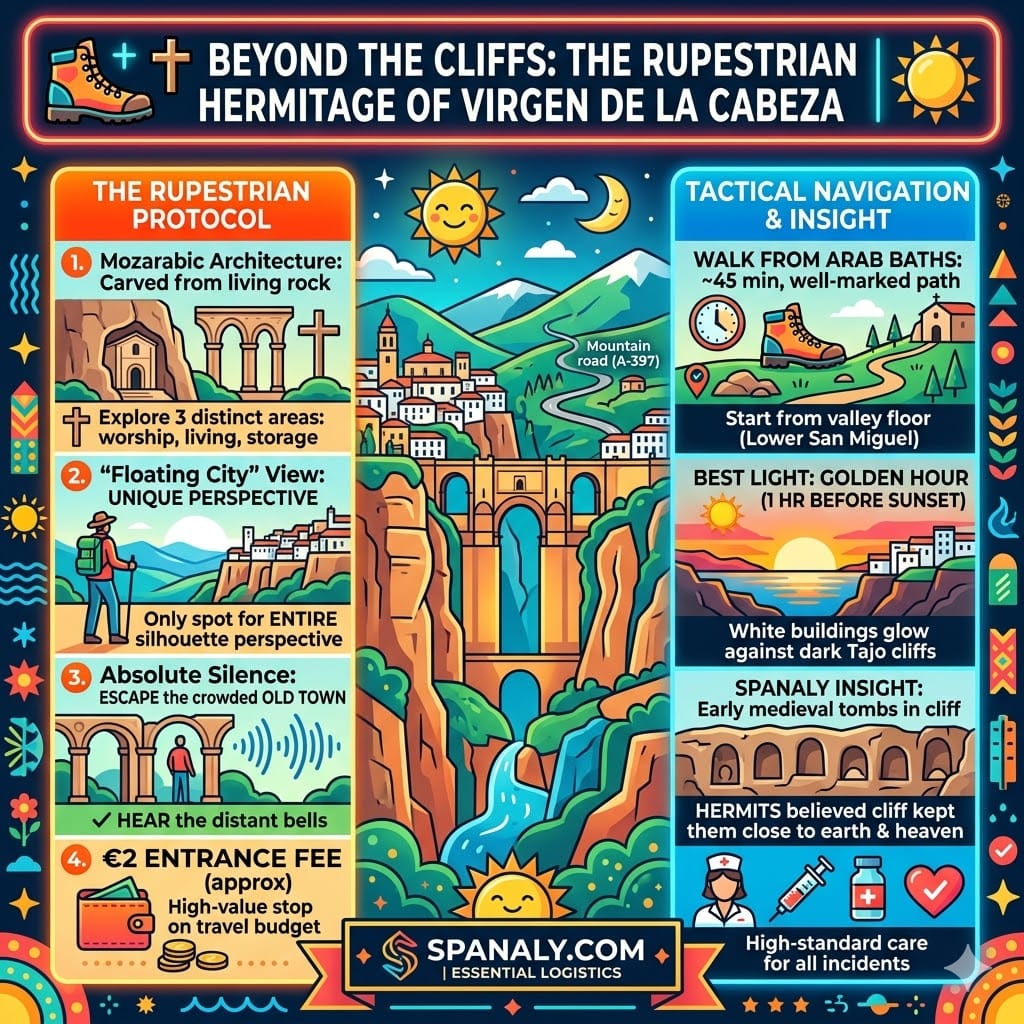
For the ultimate perspective of Ronda, you must leave the city walls behind. The Ermita de la Virgen de la Cabeza is a 9th-century Mozarabic church carved entirely into the living rock. This site is the definition of a “hidden gem,” as it sits 2 kilometers away from the center, discouraging the casual day-tripper but rewarding the dedicated explorer.
The Rupestrian Protocol
The Architecture: Explore three distinct areas: one for worship, one for living quarters (used by hermits), and a large storage area—all hollowed out from the cliffside.
The “Floating City” View: This is the only spot where you can see the entire silhouette of Ronda “floating” on its limestone pedestal against the backdrop of the mountains.
The Atmosphere: Absolute silence. Unlike the echoing streets of the Old Town, here you only hear the wind and the distant bells of Ronda’s cathedrals.
Entrance Logic: The site is open limited hours (usually mornings). Admission is approximately €2, making it a high-value stop for those on a Ronda travel budget guide mission.
Tactical Navigation
The walk follows a well-marked dirt path starting from the bottom of the valley (near the Arab Baths). It takes approximately 45 minutes to reach. If you are driving, the turn-off is located on the A-366 road towards Campillos. The best light for photography is during the Golden Hour (one hour before sunset), when the white-washed buildings of Ronda glow against the dark Tajo cliffs.
🛡️ The Fortress Silence: The Murallas of Albacara & Almocábar Gate
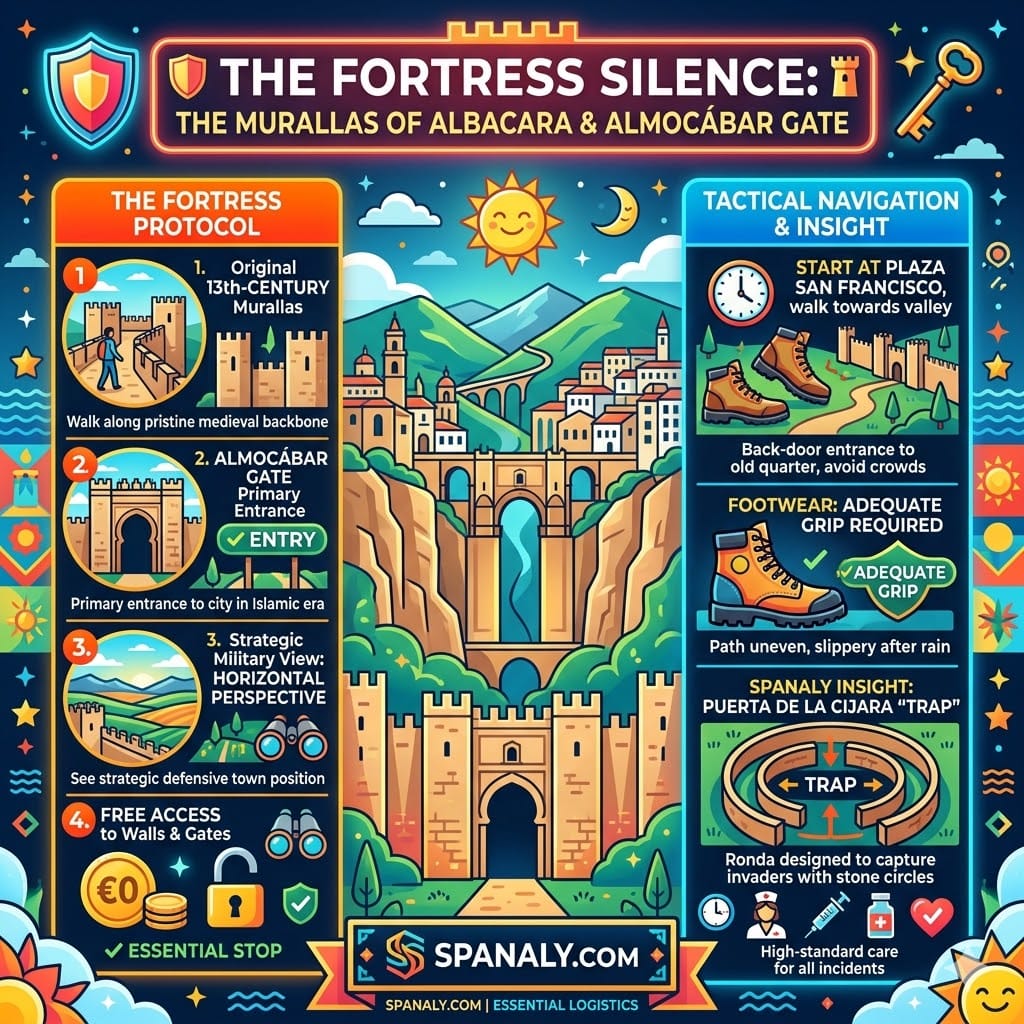
While the Puente Nuevo is Ronda’s most famous landmark, the Murallas de Albacara represent its true medieval backbone. These defensive walls once protected the city’s outskirts and agricultural lands. Today, they offer a silent, wind-swept trail that most tourists completely ignore in favor of the main shopping streets.
The Fortress Protocol
The Murallas: Walk along the limestone ramparts of the Albacara walls; they remain largely in their original 13th-century state.
The Gates: Pass through the Puerta de Almocábar, a massive stone gate that served as the primary entrance to the city during the Islamic era.
The Military View: Unlike the vertical gorge views, these walls offer a horizontal perspective of the rolling Andalusian countryside and the strategic defensive position of the town.
Entrance Logic: Access to the walls and gates is free, making it an essential stop for any one day Ronda itinerary focused on historical immersion.
Tactical Navigation
The best way to experience the walls is to start at the Plaza de San Francisco and walk towards the valley floor. The path is uneven and can be slippery after rain, so ensure your footwear has adequate grip. This route provides a “back-door” entrance into the old quarter, avoiding the crowded main arteries and offering unique angles of the city’s southern defenses.
⚙️ The Valley’s Ghost: The Ancient Flour Mills (Los Molinos)
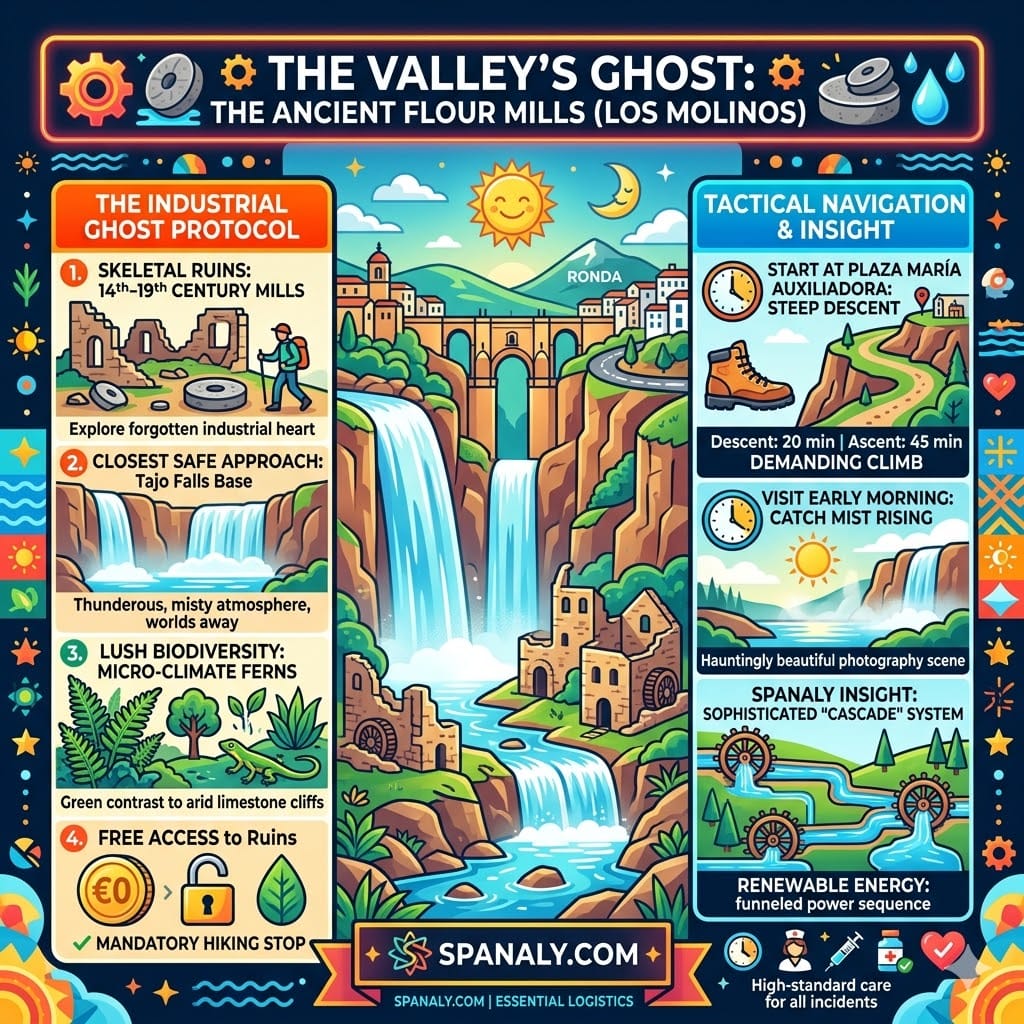
Deep within the Guadalevín Valley, far below the tourist-heavy viewpoints, lie the skeletal remains of the Ancient Flour Mills (Los Molinos). These stone ruins represent Ronda’s forgotten industrial heart, where the power of the falls was harnessed for centuries to grind grain for the entire Serranía.
The Industrial Ghost Protocol
The Ruins: Explore the crumbling structures of several 14th to 19th-century mills; some still feature their original grinding stones embedded in the earth.
The Waterfall Proximity: This is the closest you can safely get to the base of the Tajo falls, providing a thunderous, misty atmosphere that feels worlds away from the city above.
The Biodiversity: The humidity around the mills creates a micro-climate of lush ferns and wild fig trees, offering a green contrast to the arid limestone cliffs.
Entrance Logic: Access is free, but the site is rugged. It is a mandatory stop for anyone following a comprehensive hiking in Ronda guide to experience the valley’s rawest side.
Tactical Navigation
The descent starts from the Plaza de María Auxiliadora via a steep, winding stone path (the Camino de los Molinos). The trek down takes 20 minutes, but the ascent is a demanding 45-minute climb. We recommend visiting during the early morning to catch the mist rising from the river, which creates a hauntingly beautiful scene for photography.
🍬 The Silent Exchange: Convent Sweets & Cloistered Traditions
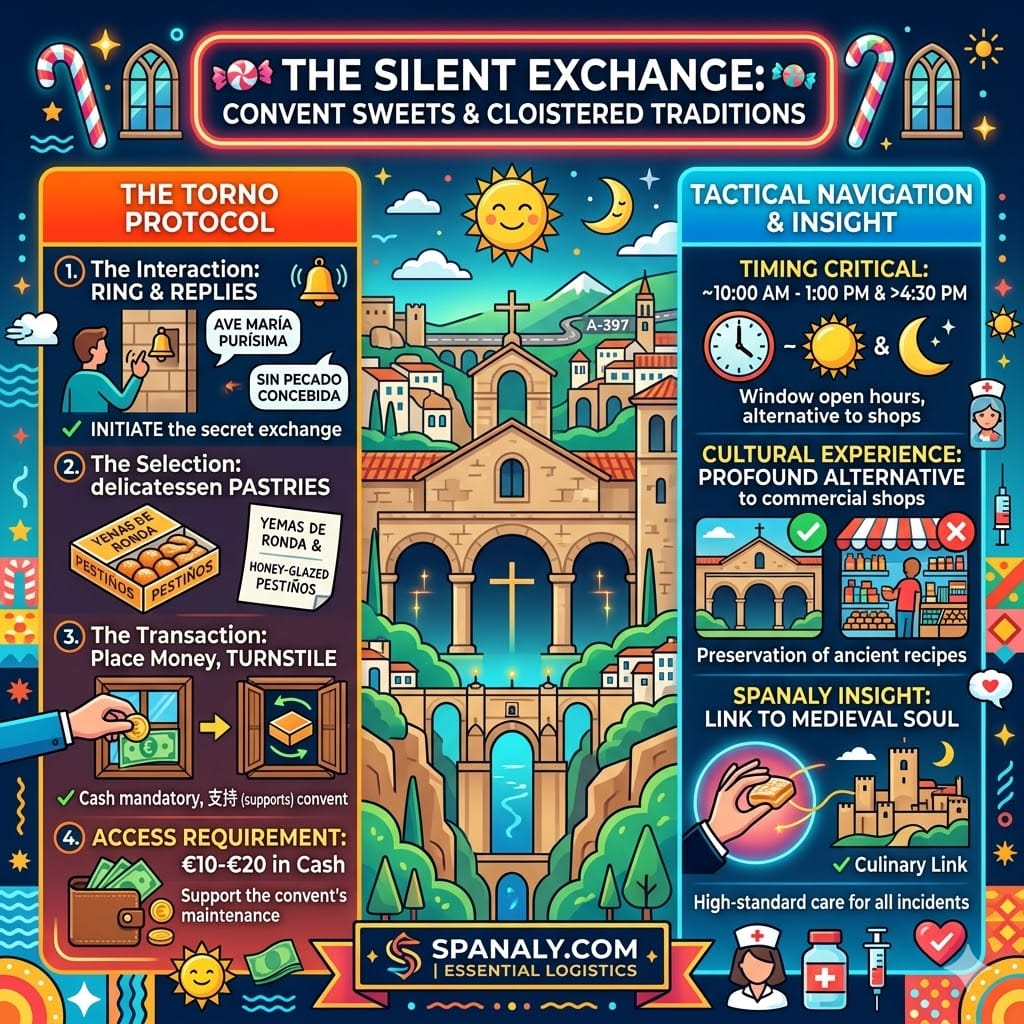
In the quiet corners of the Barrio San Francisco, a centuries-old ritual continues in near-absolute silence. At the Convento de las Carmelitas Descalzas, cloistered nuns produce some of Andalusia’s most delicate pastries, sold through a wooden revolving window (the torno) that ensures the sisters remain unseen by the outside world.
The Torno Protocol
The Interaction: Locate the small bell at the convent entrance. Ring it once and wait for the greeting “Ave María Purísima”. Respond with “Sin Pecado Concebida” to initiate the exchange.
The Selection: Popular items include Yemas de Ronda (sweetened egg yolks) and Pestiños (honey-glazed pastries). The menu is often a simple handwritten list taped near the window.
The Transaction: Place your money on the wooden turnstile. The sister will rotate it, take the cash, and return it with your box of fresh sweets.
Access Requirement: Cash is mandatory. Most boxes range between €10 and €20, supporting the convent’s maintenance.
Tactical Navigation
Timing is critical; the “sweet window” usually opens from 10:00 AM to 1:00 PM and again after 4:30 PM. This experience is a profound alternative to the commercial shops in the new town and remains a highlight of Spanish festivals and traditions where these ancient recipes are most celebrated.
🍷 The Monk’s Vintage: Descalzos Viejos Winery
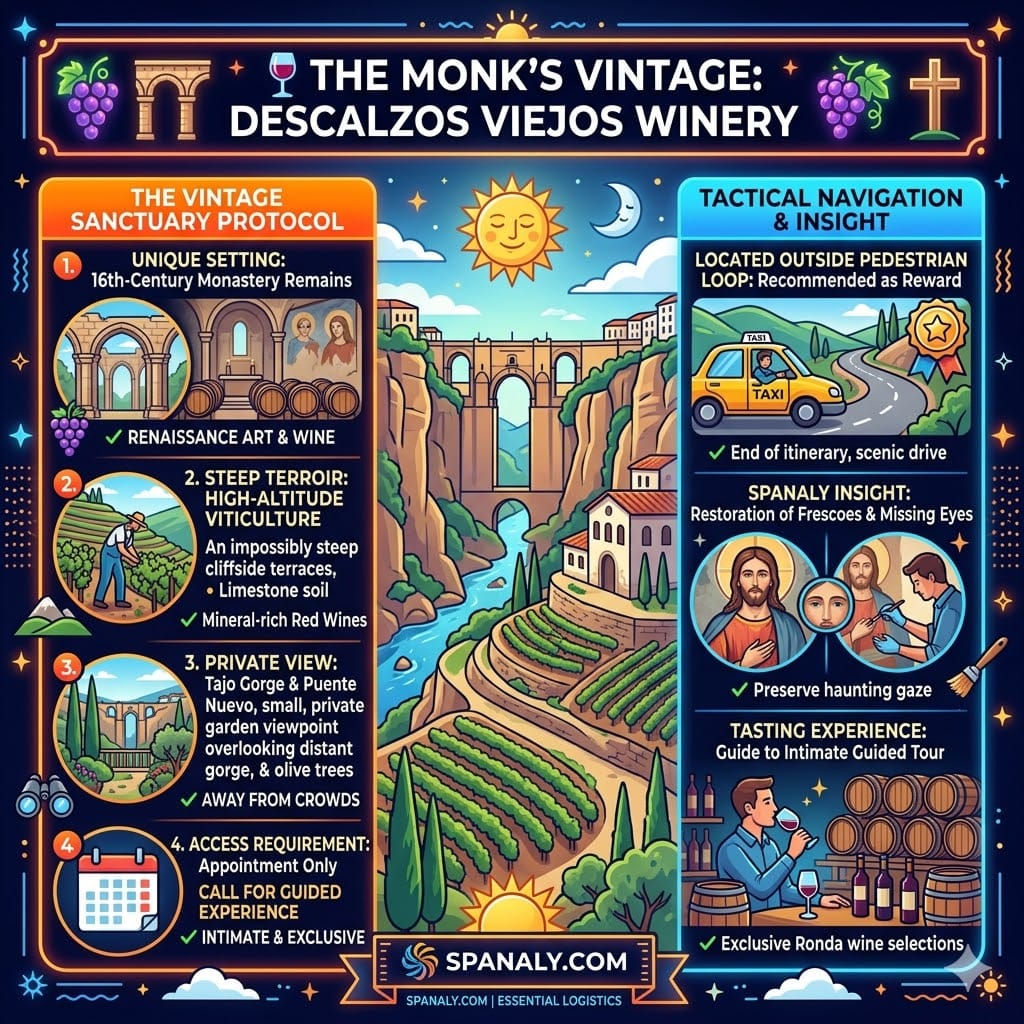
Perched on the steep slopes of the Tajo Gorge, Descalzos Viejos is arguably one of the most stunning wineries in the world. Housed within the restored remains of a 16th-century Trinitarian monastery, this family-run bodega combines high-altitude viticulture with Renaissance art in a way that feels almost ethereal.
The Vintage Sanctuary Protocol
The Setting: The main tasting room is located inside the former chapel, where the high altar has been replaced by oak barrels, and original 16th-century frescoes still adorn the walls.
The Terroir: The vineyards are planted on the actual terraces of the cliff, benefiting from the limestone soil and a unique micro-climate that produces intense, mineral-rich red wines.
The View: The winery’s garden offers a “private” perspective of the Puente Nuevo, far from the crowds, framed by ancient olive trees and cypress.
Access Requirement: Visits are by appointment only. This isn’t a walk-in tourist trap; it is an intimate, guided experience that usually includes a deep dive into the restoration of the frescoes.
Tactical Navigation
Since this winery is located outside the main pedestrian loop, we recommend including it as a reward at the end of your 3 days in Ronda itinerary. The descent to the winery is scenic, but the road is narrow; booking a local taxi is the most “tactical” way to enjoy the tasting without worrying about the drive back up the mountain.
Spanaly Insight: Look at the frescoes during your tasting. You’ll notice that some figures are missing their eyes—this wasn’t accidental but the result of 19th-century occupants who believed the “gaze” of the monks was too haunting. Today, those same stone walls guard some of the most exclusive Ronda wine guide selections.
🍴 Gastronomic Hiding Holes: Where Locals Escape the "Menu del Dia"
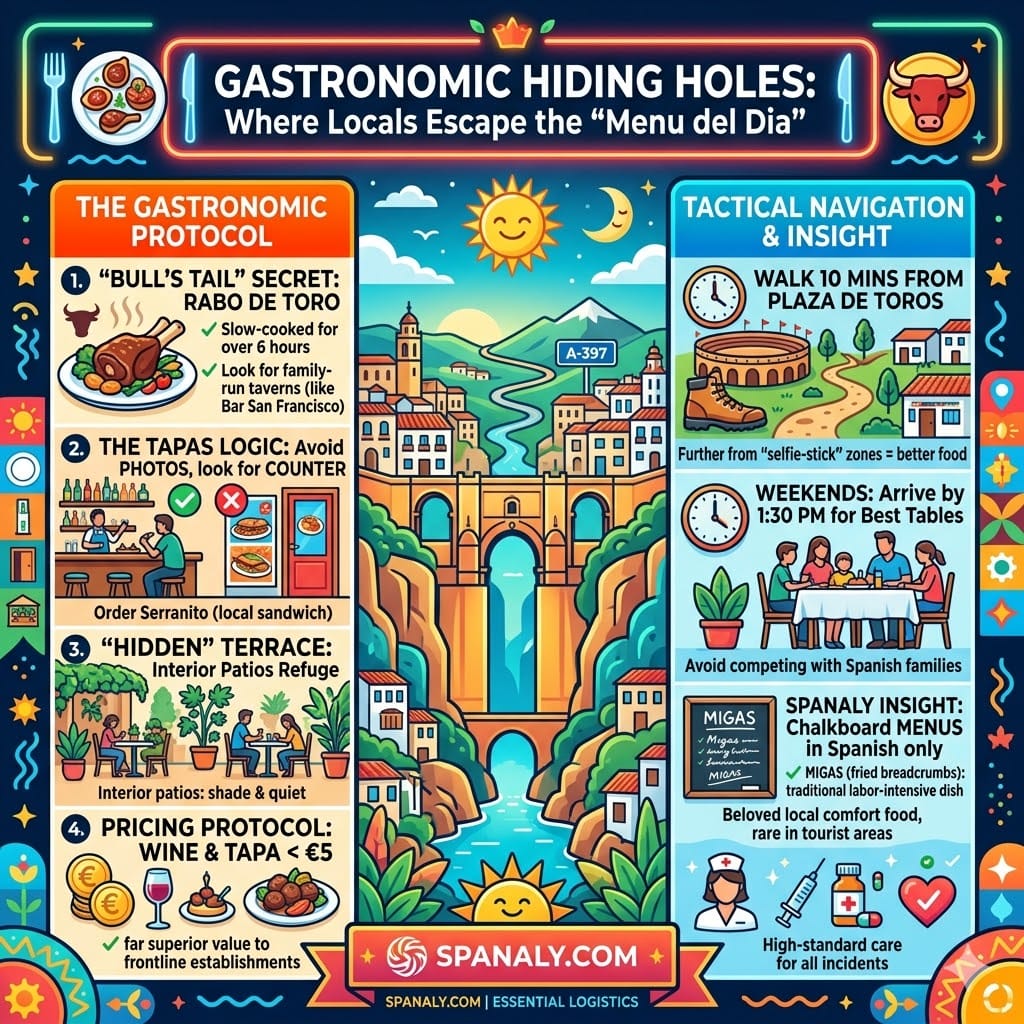
While the restaurants overlooking the Tajo gorge offer spectacular views, they often serve overpriced, standardized “tourist menus.” To find the soul of Ronda’s culinary scene, you must head to the narrow backstreets of the Barrio San Francisco or the residential areas of the Mercadillo district, where the focus is on seasonal ingredients rather than the scenery.
The Gastronomic Protocol
The “Bull’s Tail” Secret: While Rabo de Toro is a Ronda staple, locals look for places that slow-cook it for over 6 hours. Seek out family-run taverns like Bar San Francisco, where the atmosphere is loud, authentic, and unpretentious.
The Tapas Logic: Avoid any place with photos of food on the door. Instead, look for bars where locals are standing at the counter. Order the Serranito (a classic local sandwich) or fresh Payoyo Cheese from the nearby Grazalema mountains.
The “Hidden” Terrace: Some of the best local spots are tucked away in interior patios. These “hiding holes” provide shade and quiet, serving as a perfect refuge during the intense Andalusian midday heat.
Pricing Protocol: In these local gems, a glass of wine and a generous tapa will rarely exceed €5, making them far superior in value to the frontline establishments.
Tactical Navigation
Walk ten minutes away from the Plaza de Toros toward the southern part of the city. The further you get from the “selfie-stick” zones, the better the food becomes. If you are exploring on a weekend, arrive by 1:30 PM; otherwise, you’ll be competing with large Spanish families for the best tables. This is the real Spanish Cuisine experience—raw, social, and incredibly flavorful.
🗺️ Strategic Planning: An Hour-by-Hour Hidden Gems Itinerary
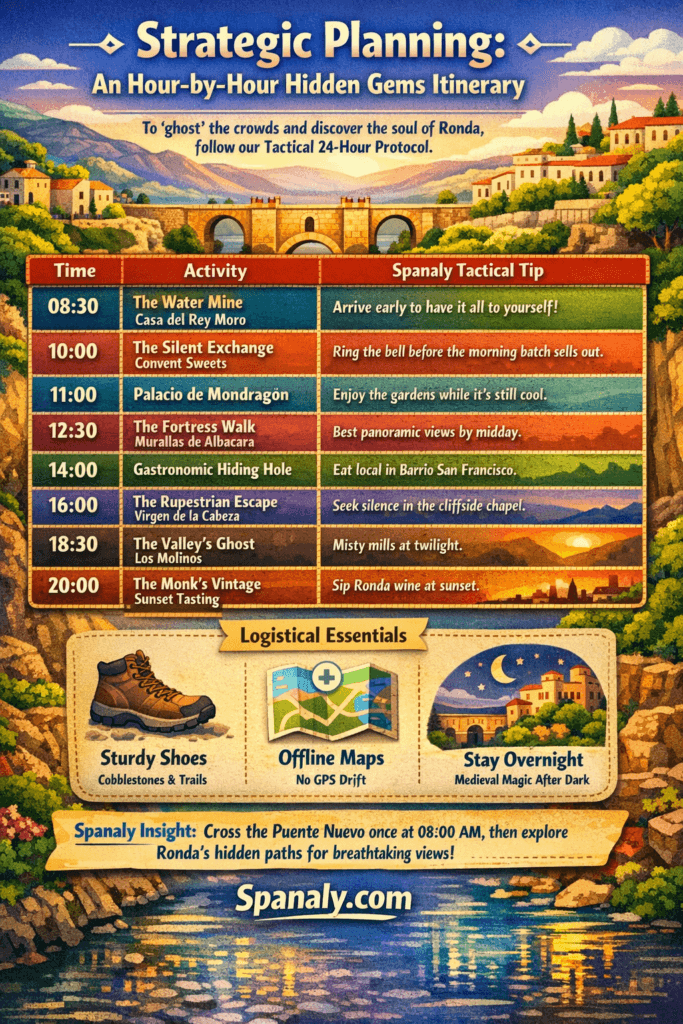
To truly “ghost” the crowds and witness the soul of Ronda, you need more than just a map; you need a timeline. This tactical itinerary is designed to keep you one step ahead of the tour buses while ensuring you hit every “hidden gem” we’ve discussed.
The Tactical 24-Hour Protocol
| Time | Activity | Spanaly Tactical Tip |
|---|---|---|
| 08:30 | The Water Mine (Casa del Rey Moro) | Arrive at opening to have the 200+ steps to the river all to yourself. |
| 10:00 | The Silent Exchange (Convent Sweets) | Ring the bell at the Carmelitas Descalzas before the morning batch sells out. |
| 11:00 | Palacio de Mondragón | Explore the hanging gardens while the sun is still low and the patios are cool. |
| 12:30 | The Fortress Walk (Murallas de Albacara) | Hike the walls towards the Arab Baths; the horizontal views are peak at midday. |
| 14:00 | Gastronomic Hiding Hole (Lunch) | Head to Barrio San Francisco for local Rabo de Toro. Avoid the Puente Nuevo zone. |
| 16:00 | The Rupestrian Escape (Virgen de la Cabeza) | A 45-min walk or 10-min drive to the cliff-carved church for absolute silence. |
| 18:30 | The Valley’s Ghost (Los Molinos) | Descend to the flour mills. The mist starts to rise, creating a haunting photo op. |
| 20:00 | The Monk’s Vintage (Sunset Tasting) | Final stop at Descalzos Viejos (by appointment) to toast the day with Ronda wine. |
Logistical Essentials
Footwear: Ronda is made of cobblestones and steep dirt paths. Do not attempt this itinerary in sandals; high-grip walking shoes are non-negotiable.
Navigation: Download offline maps. In the deep gorge or the narrow streets of the Old Town, GPS signals can often “drift,” leading you into dead-end residential alleys.
Stay Over: If possible, stay one night. Once the day-trippers leave at 17:00, the city transforms into a silent, medieval sanctuary. Check our Best Neighborhoods to Stay in Seville for a similar deep-dive into Andalusian logistics.
Spanaly Insight: Most visitors walk across the Puente Nuevo ten times a day. You only need to cross it once at 08:00 AM. After that, stay in the “back-door” routes we’ve mapped out. The most beautiful parts of Ronda aren’t on the bridge; they are looking at it from the hidden terraces below.
🧭 Visitor FAQs – Essential Ronda Hidden Gems Guide
💎 Is the descent to the "Water Mine" safe for children?
The 200+ steps are steep and can be damp. While safe for older children, we do not recommend it for toddlers or carrying infants in arms. Always use the handrails, as the limestone stairs have been polished by centuries of use and can be surprisingly slippery.
🅿️ Where is the most "tactical" place to park near the Old Town?
Avoid driving into the La Ciudad (Old Town) as streets are narrow and restricted. The best tactical choice is the Parking Plaza del Socorro or Parking Martínez Astein. From there, it is a short, flat walk to the Puente Nuevo and the start of our hidden gem routes.
🕒 Do I really need to book the Descalzos Viejos Winery in advance?
Yes, absolutely. This is a private family estate, not a public museum. To maintain the "Monk's Vintage" atmosphere, they limit visitors. We recommend emailing them at least 72 hours before your arrival to secure a spot for an intimate tasting session.
🧥 What is the temperature like at the bottom of the Tajo Gorge?
Even on hot Andalusian days, the bottom of the gorge near the flour mills remains 5-7 degrees cooler due to the mist from the waterfalls and the shade of the cliffs. If you are visiting during the early morning or late evening, a light windbreaker is recommended.
⛪ Can I visit the Iglesia de Santa María without paying the fee?
Entry during active mass is technically for worshipers, but you won't be able to explore the Mihrab or the tower. To access the "Palimpsest" layers and the rooftop views we’ve described, the €4.50 ticket is necessary and directly funds the ongoing restoration of the Moorish plasterwork.
Ronda Hidden Gems Guide by Spanaly.com
Ronda is a city of two faces: the one the world sees from the bridge, and the one you’ve just discovered hidden in its cliffs and silence. To walk its “unseen” paths is to truly understand why poets and rebels have called this place home for centuries.
The Spanaly Takeaway
Go Deep: Don’t just look at the gorge—descend into it.
Respect the Silence: The best parts of Ronda are found where the crowds aren’t.
Trust the Locals: From convent sweets to backstreet tapas, follow the authentic flavor.
Stay Tactical: Use our hour-by-hour guide to keep your journey stress-free.
Travel Smart
Before you set out to explore the winding alleys and cliffside trails, make sure you are prepared for the logistical side of the city. For a seamless experience, check out our expert Ronda safety and scams guide to navigate the town like a pro.
Final Thought: Ronda doesn’t reveal its secrets to those in a hurry. Slow down, look closer, and let the “Floating City” tell you its story.