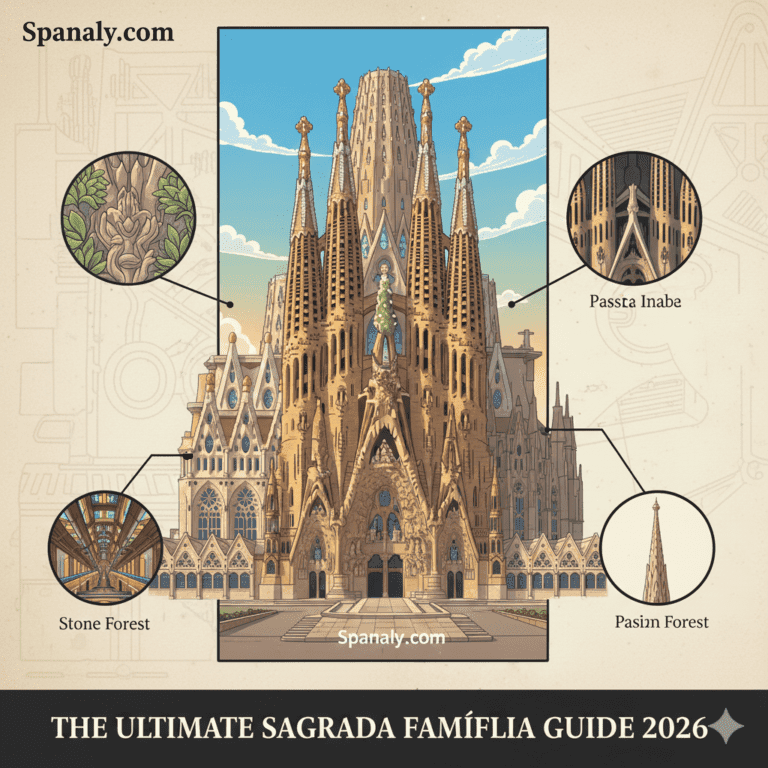

Barcelona is a city where history dances with modernity. At its heart stands a marvel unlike any other: the Sagrada Família. For travelers exploring Catalonia, this basilica is more than just a building. It is a living testament to human imagination and artistic genius.
Table of Contents
Toggle✨ Why the Sagrada Família is Unmissable in 2026
The year 2026 is a turning point for this iconic landmark. Here is why you must visit now:
🏁 The Final Chapter: 2026 marks the historic completion of the main towers. This happens exactly 100 years after Gaudí’s death.
🌲 A Forest of Light: Experience the “Stone Forest” interior. Here, stained glass creates a kaleidoscopic symphony.
🌍 UNESCO Heritage: It is a global icon that redefines the Barcelona skyline.
🗺️ Your Ultimate Visitor Strategy
Whether you want a deep dive or a quick stop, we have you covered. Don’t miss our Ultimate Barcelona Travel Guide for essential local tips.
This exclusive Spanaly guide explores every dimension of the basilica. We cover everything from hidden symbols to the latest strategies for the grand completion year.
🕰️ Historical Background: From a Simple Vision to a Global Icon
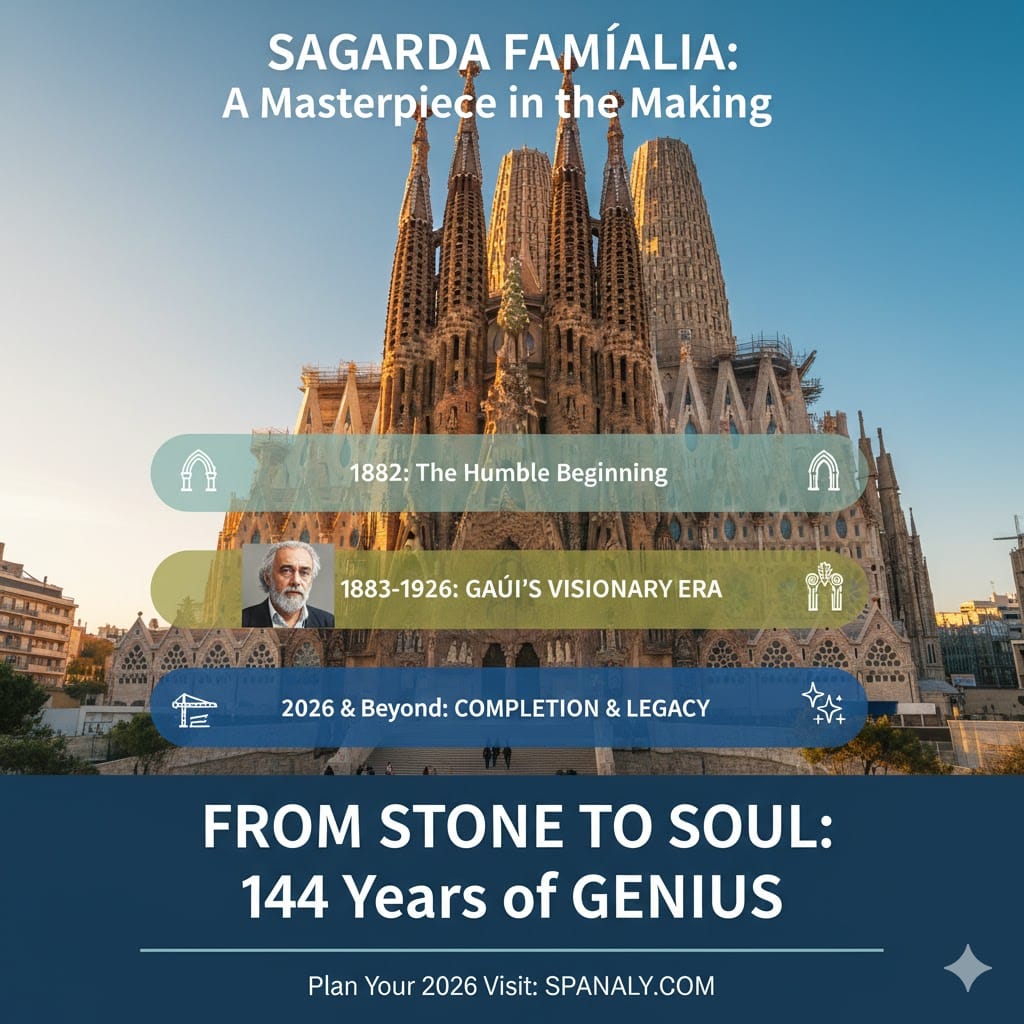
The story of the Sagrada Família began in 1882. Initially, Francisco de Paula del Villar led the project with a traditional design. However, fate intervened a year later. A young and visionary Antoni Gaudí took over, completely redefining the project. He merged Gothic grandeur with Art Nouveau innovation.
📜 The Evolution of a Masterpiece
👑 The Royal Shift: Gaudí devoted his final 15 years exclusively to the basilica. He often lived on-site in his workshop to stay close to his work.
🕯️ Tragedy & Perseverance: His sudden death in 1926 did not halt the dream. Despite losing original plans during the Spanish Civil War, architects persevered. They reconstructed his vision using surviving 3D plaster models.
💎 A Living Feature: Today, we witness the final stones being set in 2026. The basilica remains the crown jewel among Spanish Attractions, proving that true art is an evolving dialogue.
💡 Pro Traveler Note: Walking through the nave today feels like traversing the timeline of Barcelona. It has grown from a humble neighborhood project to a UNESCO World Heritage site that defines the city’s soul.
🏗️ The 2026 Milestone: A Dream Finally Realized
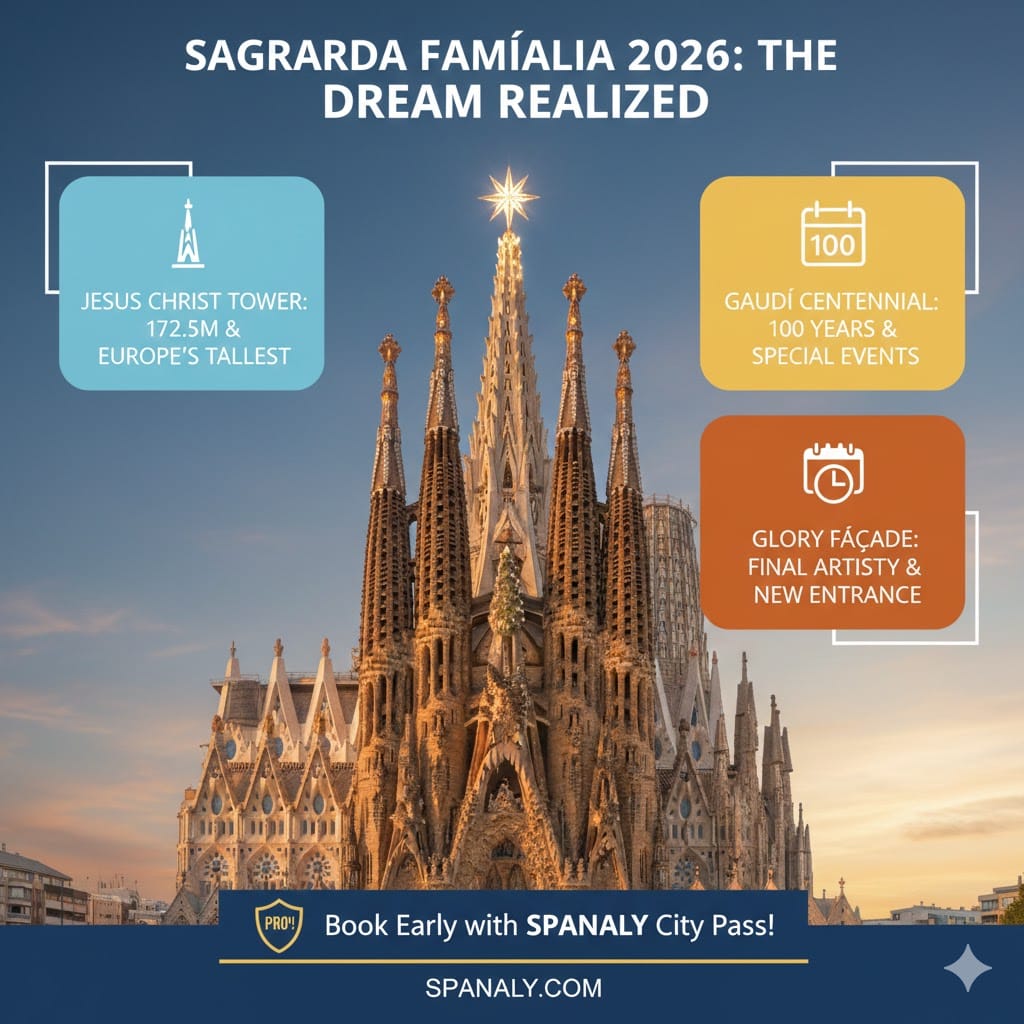
As we reach this historic year, the Sagrada Família finally claims its title. It is now the tallest religious structure in Europe. This isn’t just a date on a calendar. It is the culmination of a 144-year journey. The project survived wars, economic shifts, and generations of architects.
🆕 What’s New for Your 2026 Visit?
🏗️ The Jesus Christ Tower: Standing at 172.5 meters, this newly completed spire dominates the skyline. For the best vantage points, check our guide on Montjuïc Hill – Culture & Views.
🎉 Centennial Celebration: 2026 marks the 100th anniversary of Antoni Gaudí’s passing. The city is buzzing with energy. Expect special tributes during the La Mercè Festival.
🏠 The Modernisme Connection: We recommend visiting Casa Batlló & Casa Milà on the same day. See how Gaudí’s domestic designs inspired his sacred work.
🎟️ Pro Planning Tip: Crowds are at an all-time high in 2026. Make sure to review our Barcelona City Pass Guide to secure your time slot early and save on entry fees.
🌿 Gaudí’s Vision: A Masterclass in Natural Architecture
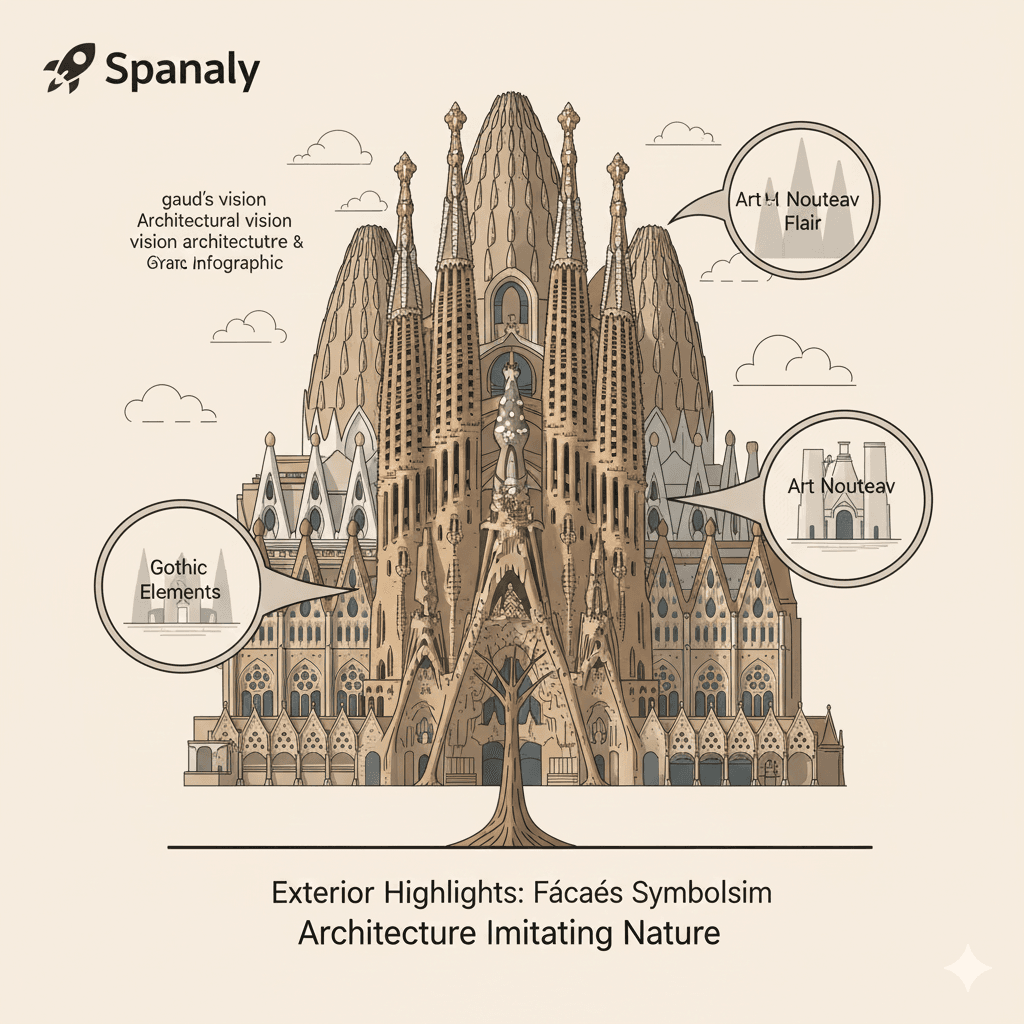
The genius of Gaudí lies in his rejection of straight lines. He famously claimed that straight lines “do not exist in nature.” Instead, he embraced organic forms. His vision was a perfect blend of advanced science and deep spirituality.
🏗️ The Core of His Philosophy
⛪ Gothic Reimagined: He used dramatic stone carvings and extreme verticality. However, he added a fluid, Art Nouveau flair to every surface.
🐚 Nature as Architect: Look for columns that branch out like ancient trees. Even the spiral staircases mimic the intricate curves of sea shells.
📐 Geometric Brilliance: Gaudí used complex shapes like hyperboloids to ensure stability. This allowed him to build massive towers without needing heavy, external buttresses.
✨ Insight: This philosophy of “Natural Architecture” is a signature of Catalan culture. You can explore this vibrant energy further in our guide to Spanish Festivals.
🎨 The Gaudí Connection: Extending Your Modernisme Journey
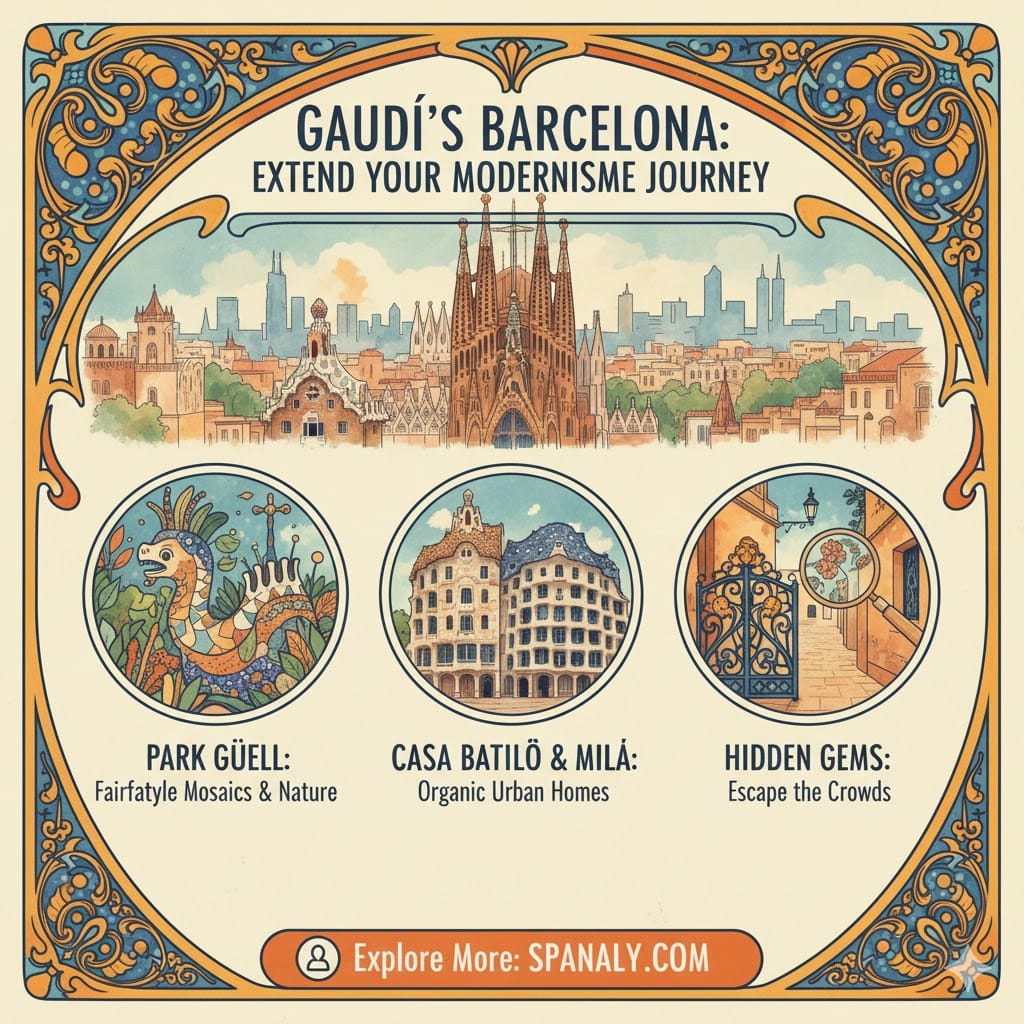
The Sagrada Família is the pinnacle of Gaudí’s genius. However, it is part of a much larger architectural revolution. To truly grasp his philosophy, you must explore his other masterpieces across Barcelona.
📍 Where to Go Next:
🎨 Park Güell : This is a fairytale public park. Here, Gaudí experimented with organic shapes and colorful mosaics. You will see these same patterns in the basilica’s spires.
🏢 Casa Batlló & Casa Milà : These residential jewels sit on Passeig de Gràcia. They showcase how Gaudí applied his “no straight lines” rule to everyday living.
💎 Hidden Gems: Want to escape the massive 2026 crowds? Explore our guide to the Top 5 Hidden Gems in Barcelona for lesser-known Modernisme spots.
💡 Spanaly Tip: Many of these sites are within walking distance or a short metro ride from each other. Planning your route ahead is the best way to save time.
🏰 Exterior Highlights: The Stone Bible & Its Secrets
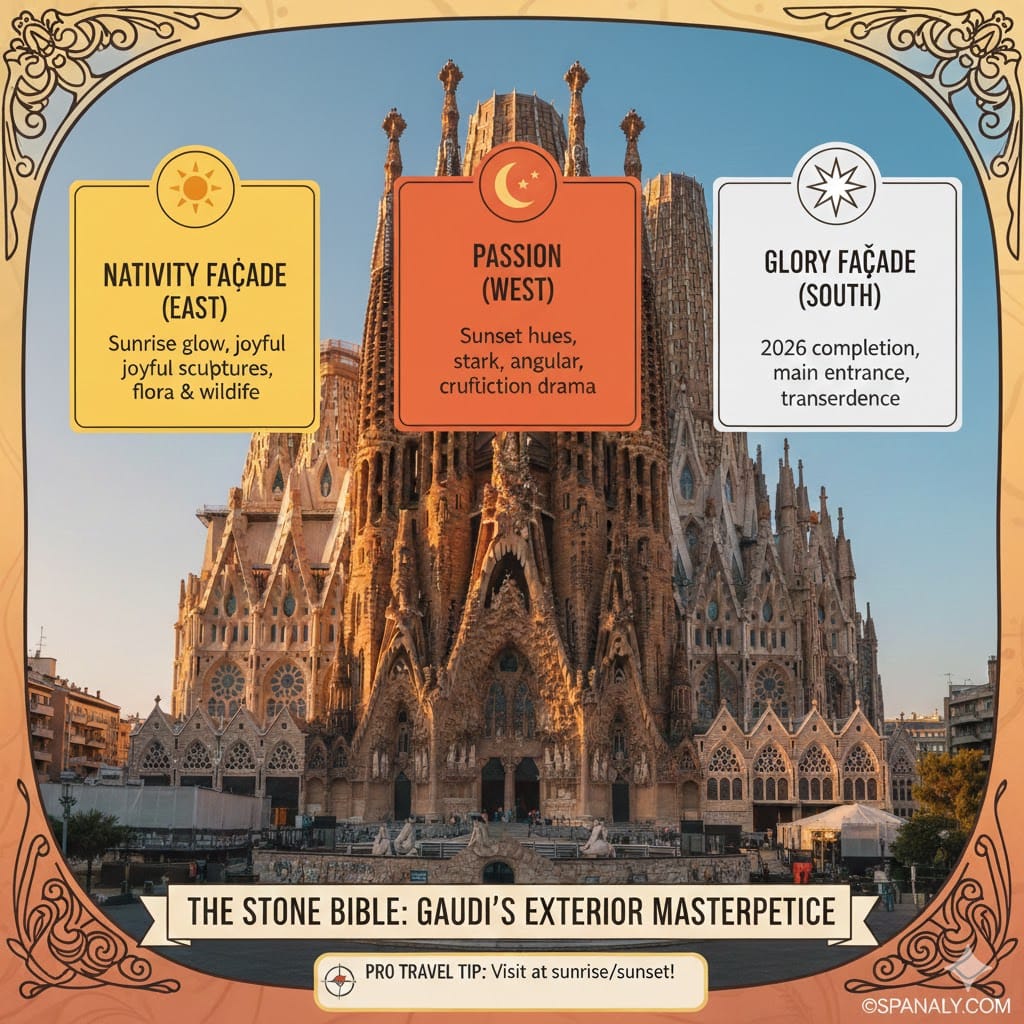
The basilica’s exterior is not just a wall; consequently, it acts as a monumental narrative. Three principal façades tell the chapters of Christ’s life. Specifically, to see how this compares to older roots, you should stroll through the Gothic Quarter.
📖 The Three Masterpieces of Stone
🐣 Nativity Façade (East): This is a celebration of life and joy. Furthermore, it is overflowing with sculptures of angels and wildlife. Notably, this is the only façade Gaudí personally supervised.
✝️ Passion Façade (West): This side is stark, minimalist, and angular. In contrast to the Nativity, it uses dramatic shadows to evoke raw emotion. Moreover, the bone-like pillars offer a sharp architectural contrast.
👑 Glory Façade (South): This represents the grandest side of all. Currently, it is reaching its final stages for the 2026 completion. Therefore, it will serve as the main entrance and represent spiritual transcendence.
☀️ The Sun’s Artistic Role
Interestingly, the stone reacts dynamically to the Mediterranean sun. For instance, the Nativity glows with soft light at sunrise. On the other hand, the Passion is bathed in fiery orange hues during sunset. As a result, every hour offers a new perspective for photographers.
✨ Interior Wonders: A Forest of Stone and Light
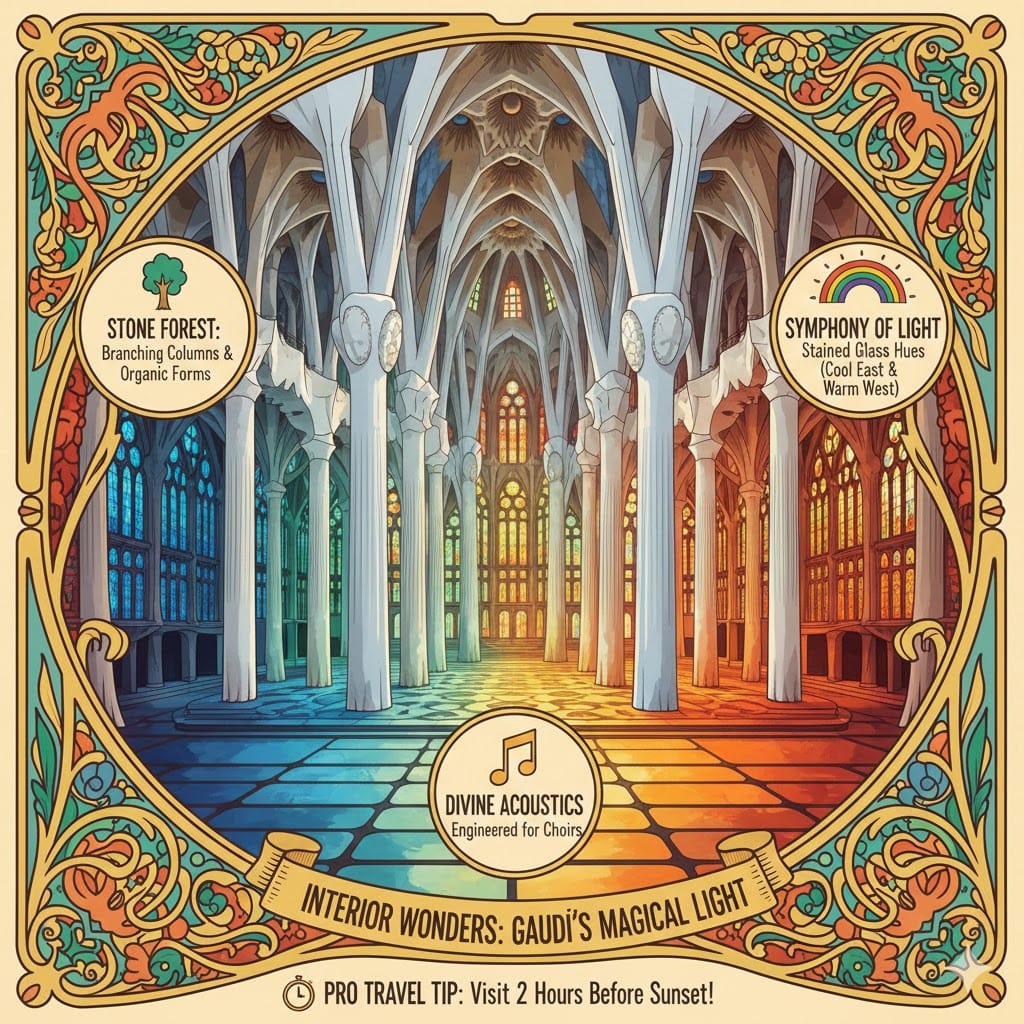
Stepping inside the Sagrada Família is like entering a sacred forest. In fact, Gaudí’s interior is a revolutionary departure from traditional cathedrals. Instead of dark walls, he focused on verticality and organic flow.
🏛️ The Engineering of the Stone Forest
To achieve this, Gaudí replaced traditional pillars with arborescent columns. These structures branch out like giant trees. Moreover, he used different stones, such as basalt and granite, for maximum strength. Consequently, this allows the towers to reach immense heights while the interior remains airy.
🌈 A Symphony of Stained Glass
Additionally, the most magical feature is the use of stained glass. The atmosphere changes specifically based on the sun’s position:
The Cold Side (East): Deep blues represent Christ’s birth. Thus, it evokes the freshness of the morning.
The Warm Side (West): Vibrant reds symbolize the Passion. Similarly, they capture the glow of the sunset.
The Rainbow Effect: Ultimately, at midday, the entire nave is bathed in a kaleidoscopic glow.
🎵 Immersive Divine Acoustics
Finally, the interior is a masterpiece of sound. Because the choir galleries can hold 1,500 singers, the acoustics are powerful. Specifically, Gaudí engineered the sound to resonate through the “branches” of the columns. Therefore, it creates a truly immersive spiritual experience.
🔍 Hidden Details & Artistic Secrets: The Da Vinci Code of Barcelona
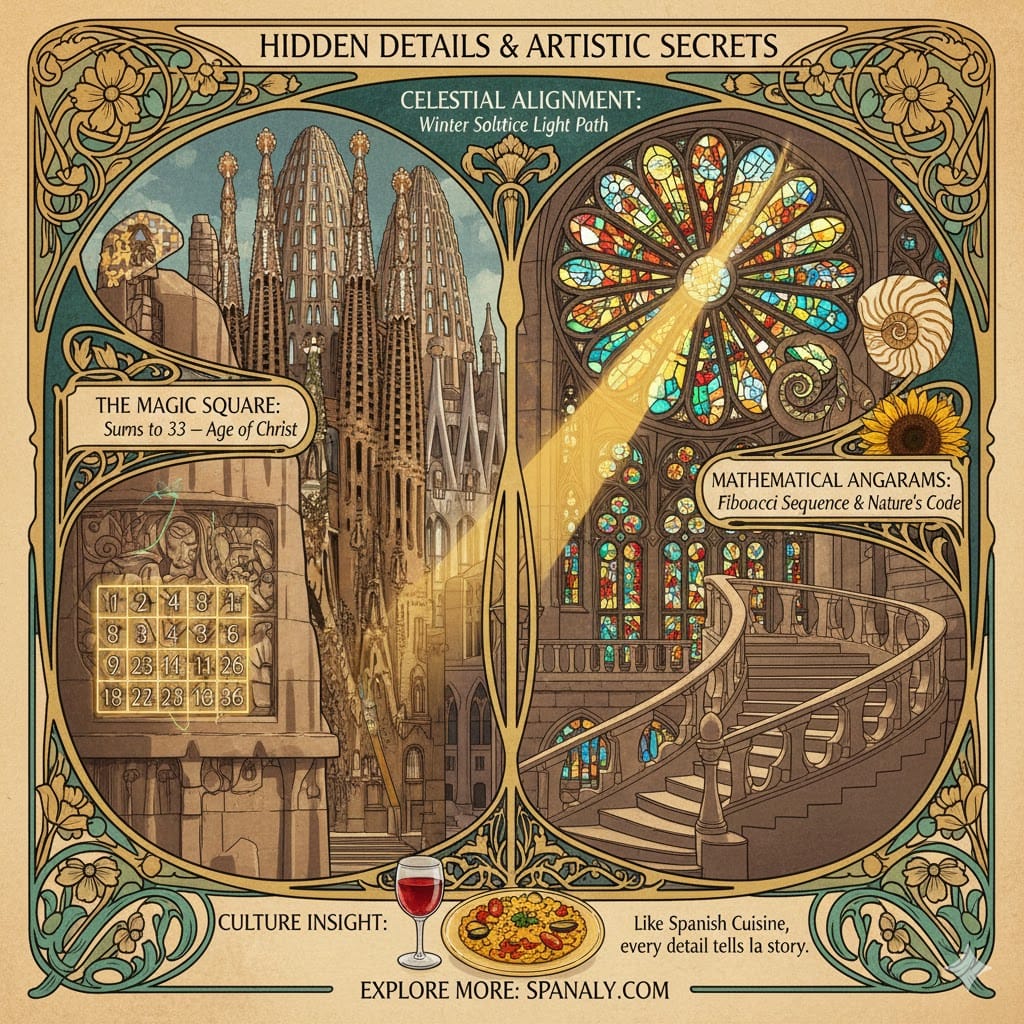
The Sagrada Família is a labyrinth of hidden meanings. Beyond the towering spires lie secrets that showcase Gaudí’s multi-disciplinary genius. Even frequent visitors often miss these subtle codes.
🔍 Uncovering the Codes:
🔢 The Magic Square: On the Passion Façade, you will find a 4×4 grid of numbers. No matter how you add them (horizontally, vertically, or diagonally), the sum is always 33. This represents the age of Christ at his death.
🌀 Mathematical Anagrams: Look closely at the ironwork and stone. You will find hidden botanical codes and mathematical sequences, like the Fibonacci spiral, embedded in the staircases.
☀️ A Celestial Alignment: Gaudí designed certain windows to align perfectly with the winter solstice. This creates a path of light that pierces the nave, blending science with spirituality.
🍽️ Insight: Understanding these intricate details is like discovering the layers of Spanish Cuisine. Every technique and ingredient tells a story of cultural fusion and history.
🏛️ The Museum & Crypt: Exploring the Roots of Genius
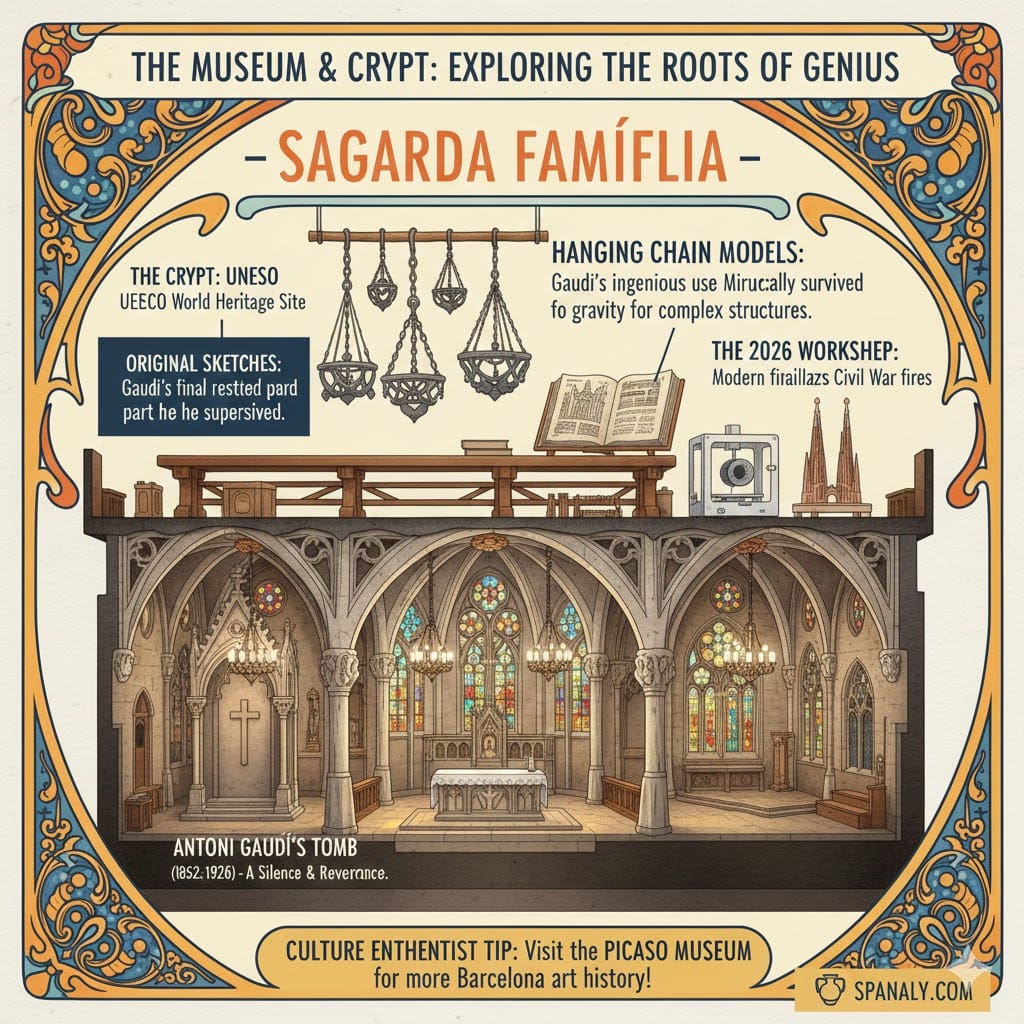
While the towers reach for the sky, the true soul of the basilica lies beneath the surface. To appreciate the 2026 completion, you must descend into the foundations. This is where the magic first ignited.
🕯️ The Crypt: A UNESCO World Heritage Site
The Crypt is the final resting place of Antoni Gaudí. It is a sanctuary of silence and reverence.
Historical Style: A beautiful Neo-Gothic design from the project’s early days.
Gaudí’s Heart: It is the only part (along with the Nativity Façade) he saw finished.
Final Respects: Visitors can visit the tomb of the man who gave Barcelona its heartbeat.
🔬 The Gaudí Museum: Science Behind the Art
How did Gaudí design such complex curves without computers? The museum reveals his “Low-Tech, High-Intelligence” methods:
| Feature | What You’ll Discover |
| ⛓️ Hanging Chain Models | His genius use of gravity and strings to calculate loads. |
| 📜 Original Sketches | Rare drawings that survived the Spanish Civil War fires. |
| 🖨️ The 2026 Workshop | How modern architects use 3D printing to finish his vision. |
🎨 Culture Enthusiast Tip: Love diving into the city’s artistic soul? Don’t miss the Picasso Museum. It is a short metro ride away and perfectly complements the Gaudí experience.
🗼 Climbing the Towers: A Bird’s Eye View of Barcelona
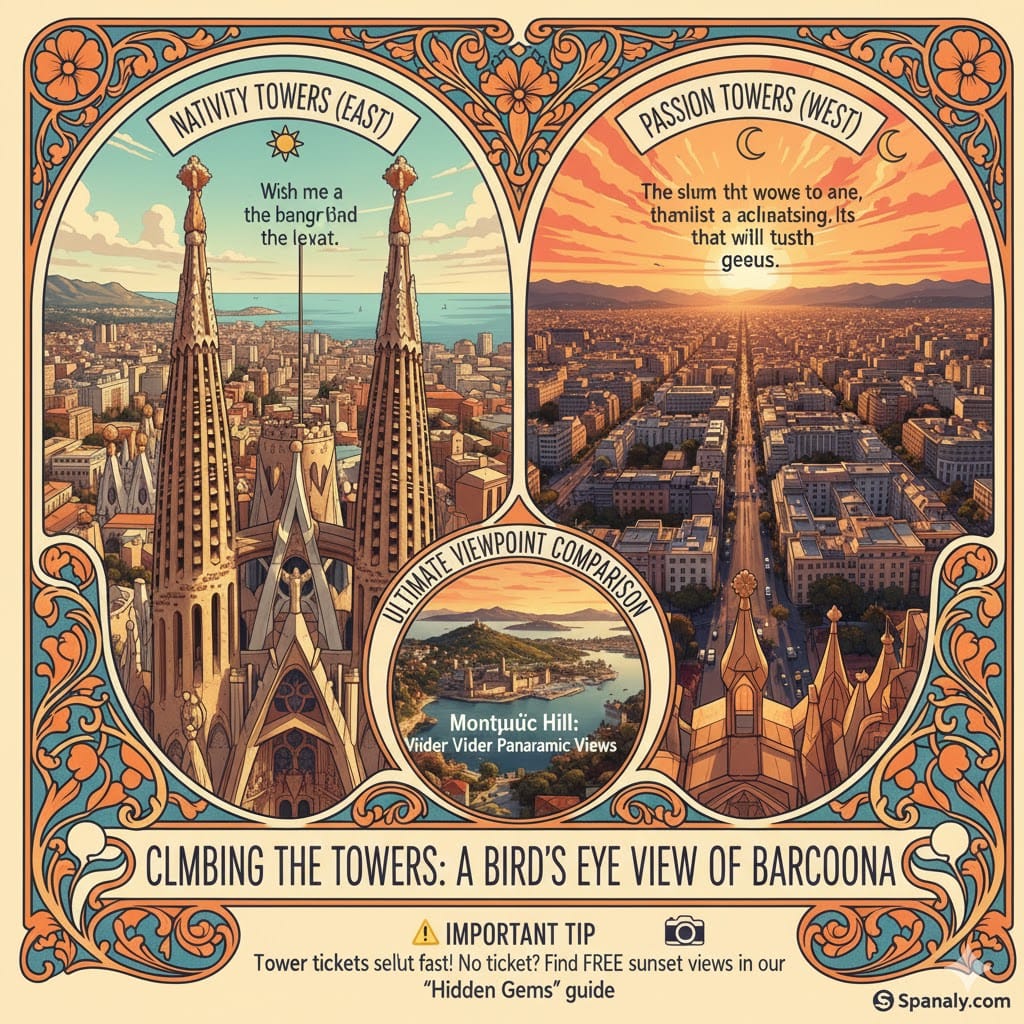
While the interior is a spiritual forest, the towers are your gateway to the Mediterranean horizon. Climbing the towers of the Sagrada Família offers a unique perspective. You simply cannot find these views anywhere else in the city.
🏙️ Two Towers, Two Different Experiences:
🌊 The Nativity Towers (East): These offer a close-up look at organic carvings and fruit-topped spires. The view faces the sea and the historic, older parts of Barcelona.
⛰️ The Passion Towers (West): These overlook the city center and the grid-like streets of the Eixample district. It is the perfect spot to watch the sun dip over the mountains.
🔭 The Ultimate Viewpoint Comparison:
The basilica’s towers provide a vertical look at the city’s heart. However, for a wider, panoramic horizon of the harbor, we highly recommend Montjuïc Hill. Combining both spots gives you the “Full Barcelona Experience.”
⚠️ Important Tip: Tower tickets are separate from general admission. they often sell out weeks in advance. If you miss out, don’t worry! You can find breathtaking (and free!) sunset views in our guide to the Top 5 Hidden Gems in Barcelona.
🏛️ A Living Monument: The Legacy of Gaudí
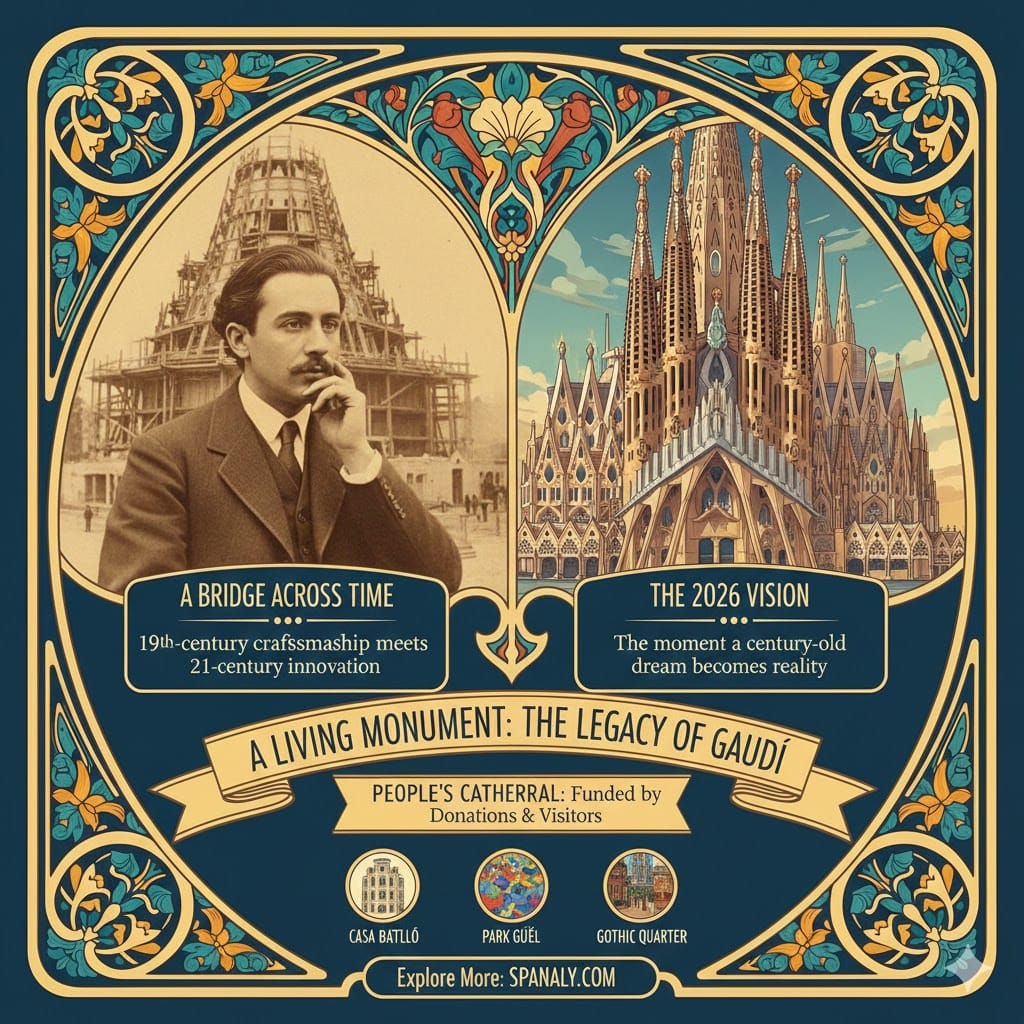
The Sagrada Família is more than just a building. It is a living organism. It has survived wars, fires, and the passing of generations. As we reach the 2026 completion milestone, the basilica stands as a testament to a vision that refused to be limited by time.
🌟 Why It Matters:
⏳ A Bridge Across Time: It is a rare place where 19th-century craftsmanship meets 21st-century 3D printing.
🤝 The People’s Cathedral: For over 140 years, construction was funded solely by private donations. Every visitor becomes a part of its history.
🎨 An Ever-Evolving Masterpiece: Gaudí’s influence breathes through the city. You can feel it from the curves of Casa Batlló to the mosaics of Park Güell.
💭 Reflection: Visiting the basilica in 2026 is a once-in-a-lifetime experience. It is the moment a century-old dream finally becomes reality. Much like the charm of the Gothic Quarter, Gaudí’s legacy reminds us that true beauty is worth the wait.
📅 Planning Your Visit: Tips for the 2026 Milestone

As Barcelona prepares for the historic 2026 unveiling, the rules are changing. To stay ahead of the crowds, keep these exclusive tips in mind:
👗 Dress Code Awareness
The Sagrada Família is a functioning Catholic church. To avoid being turned away, follow these rules:
Coverage: Shoulders and knees must be covered.
Details: Avoid transparent clothing or hats inside the nave.
Pro Tip: Keep a light scarf in your bag. It is a lifesaver during hot Barcelona summers!
🎒 The “Small Bag” Strategy
Security is as strict as an airport. Large backpacks and suitcases are not allowed. Also, there are no storage lockers on-site.
Advice: Carry only a small daypack. This helps you breeze through scanners and spend more time admiring the art.
🍴 Post-Visit Dining (Avoid the Traps)
Restaurants immediately surrounding the basilica are often overpriced. Instead, walk 5–10 minutes towards the Sant Pau Recinte Modernista.
Where to eat: You’ll find authentic Catalan tapas and cafes where locals eat.
What to order: For a deeper dive, explore our guide to Spanish Cuisine.
🎧 The Silent Journey
While guided tours are great, the official app offers an excellent AR experience.
Strategy: Download the app and bring your own headphones. It is the best way to enjoy the “Divine Acoustics” without a noisy tour group.
❓ FAQ: Your 2026 Sagrada Família Guide
⏳ When will the Sagrada Família finally be finished?
🎟️ How far in advance should I book my tickets for 2026?
🌅 When is the best time for photography inside the Basilica?
👗 What is the official dress code for entry?
🗼 Nativity Tower vs. Passion Tower: Which view is better?
♿ Is the Basilica fully wheelchair accessible?
Expertly curated by Spanaly.com
🌟 Witnessing History in 2026
The Sagrada Família is more than just a destination. It is a bridge between centuries. It is a dialogue between nature and stone. In 2026, a century-old dream finally reaches its peak. This is your once-in-a-lifetime chance to see Gaudí’s vision in its full glory.
✅ Why Your Visit Matters Now:
🏆 Witness History: You are part of the generation that will see the final stone placed.
🎨 Artistic Immersion: Experience the “Forest of Light” at its absolute architectural peak.
❤️ Cultural Heartbeat: Support the legacy that defines Barcelona’s unique identity.
🚀 Ready to Explore More?
Don’t stop at the basilica! Barcelona is a city of endless layers. From the secret paths of Montjuïc Hill to the historic echoes of the Gothic Quarter, every corner has a story.