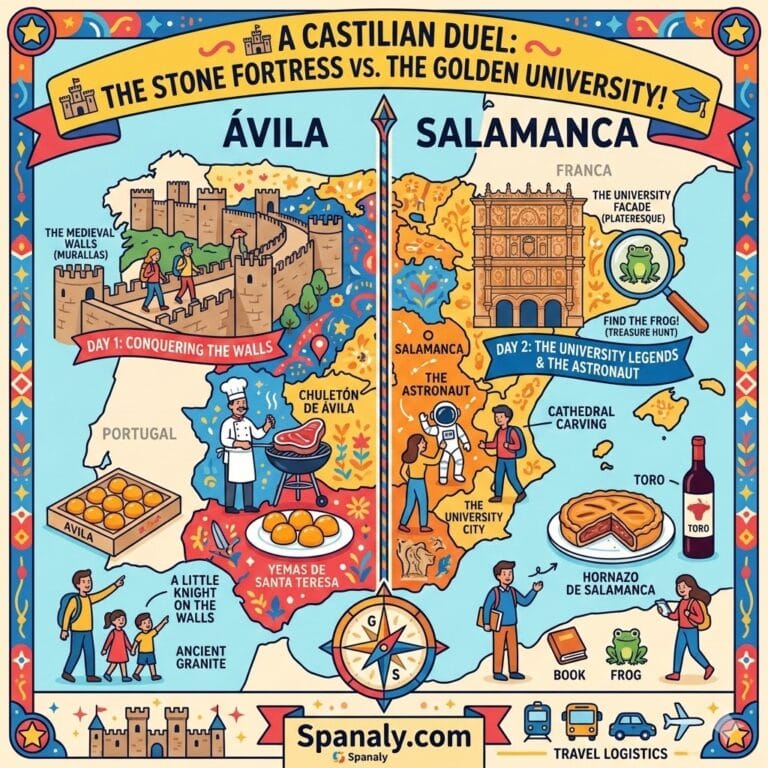

Table of Contents
Toggle🏰 Step Into the Golden Soul of Spain
If Madrid is the heart of Spain, then Salamanca and Ávila are its historic soul. In just 72 hours, you can travel from the world’s most stunning medieval walls to a city that literally glows at sunset.
This isn’t just a trip; it’s a journey through the “Golden City” and the birthplace of mystics. Whether you are a history buff, a photography lover, or a foodie seeking the best roast meats in Castile, this itinerary is your 2026 roadmap to perfection.
✨ The Glow of Salamanca: Discover why every corner of the Salamanca Spain Golden City feels like a living museum.
🛡️ The Walls of Ávila: Walk atop the best-preserved medieval fortifications in Europe.
🎓 Academic Legends: Explore one of the world’s oldest universities and its hidden secrets.
🍷 Castilian Flavors: From Hornazo to Chuletón, prepare for a culinary masterclass.
💡 Spanaly Tip: The secret to this journey is “The Light.” Start your day in Ávila early to see the mist dancing around the stone walls, and aim to be in Salamanca’s Plaza Mayor 30 minutes before sunset to watch the sandstone turn into liquid gold.
⚔️ The Face-Off: Medieval Walls vs. Golden Sandstone
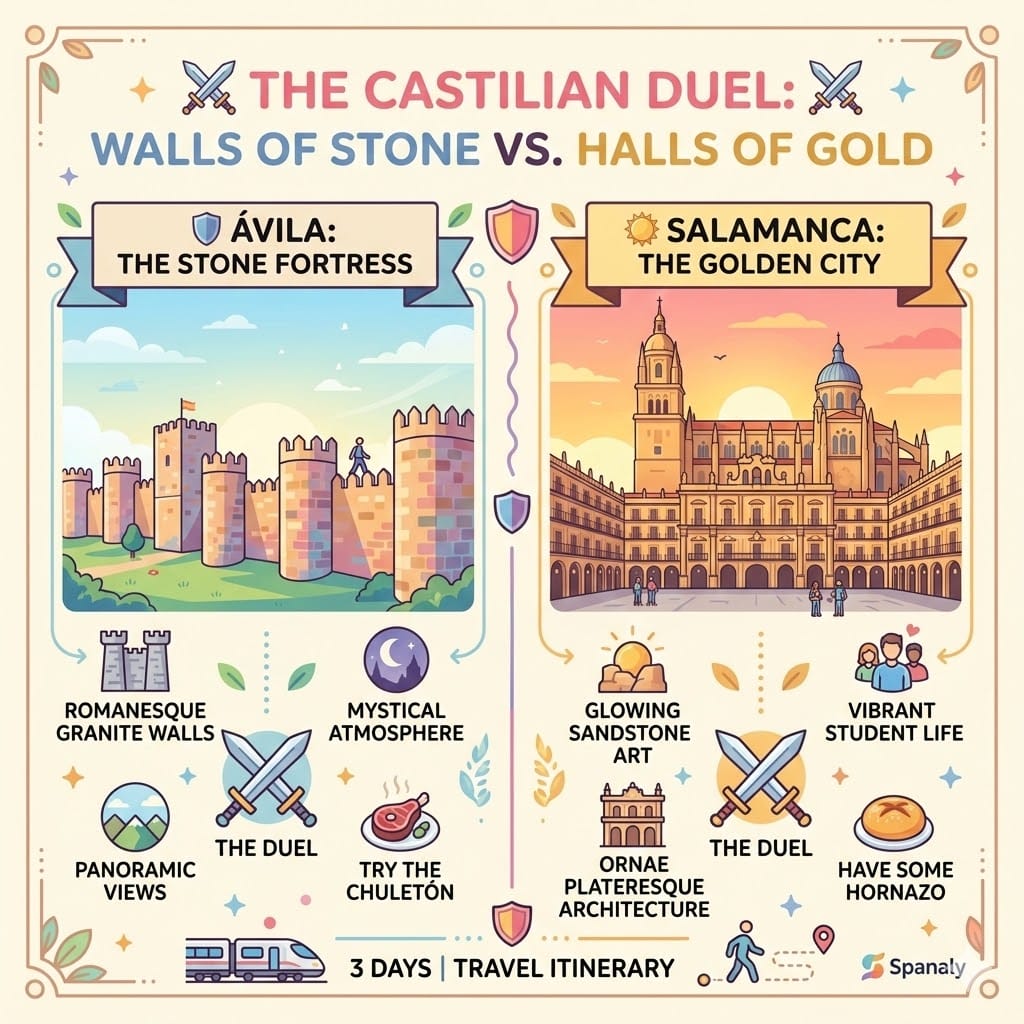
Choosing between these two UNESCO World Heritage gems is like choosing between a knight’s armor and a king’s crown. While both sit in the heart of Castile, they offer distinct architectural souls that every 2026 traveler must experience.
Quick Comparison at a Glance
| Feature | Ávila: The Fortress | Salamanca: The Masterpiece |
| Architectural Soul | Rugged Granite & Romanesque | Glowing Sandstone & Plateresque |
| Defining Icon | The City Walls of Ávila | The 13th-Century University |
| Experience | Walking atop 2.5km of history | Getting lost in academic legends |
| Culinary King | Chuletón de Ávila (Steak) | Hornazo (Savory Meat Pie) |
The Deep Dive
The Stoic Sentinel: Ávila is defined by its silence and strength. Its main allure is the ability to walk the entire perimeter of its medieval fortifications, providing a panoramic view of history that remains unchanged for centuries.
The Vibrant Scholar: Salamanca, on the other hand, is a living museum of elegance. Known as the “Golden City,” its buildings are crafted from Villamayor stone, which contains high iron content that “rusts” into a brilliant gold under the Spanish sun.
💡 Spanaly Tip: For the ultimate 2026 experience, visit Ávila for the “Physicality” (climbing the walls) and Salamanca for the “Atmosphere” (enjoying the sunset). If you only have one afternoon, prioritize the walls in Ávila; there is truly nothing else like them in the world.
🎒 Packing Guide: Essentials for Ávila & Salamanca
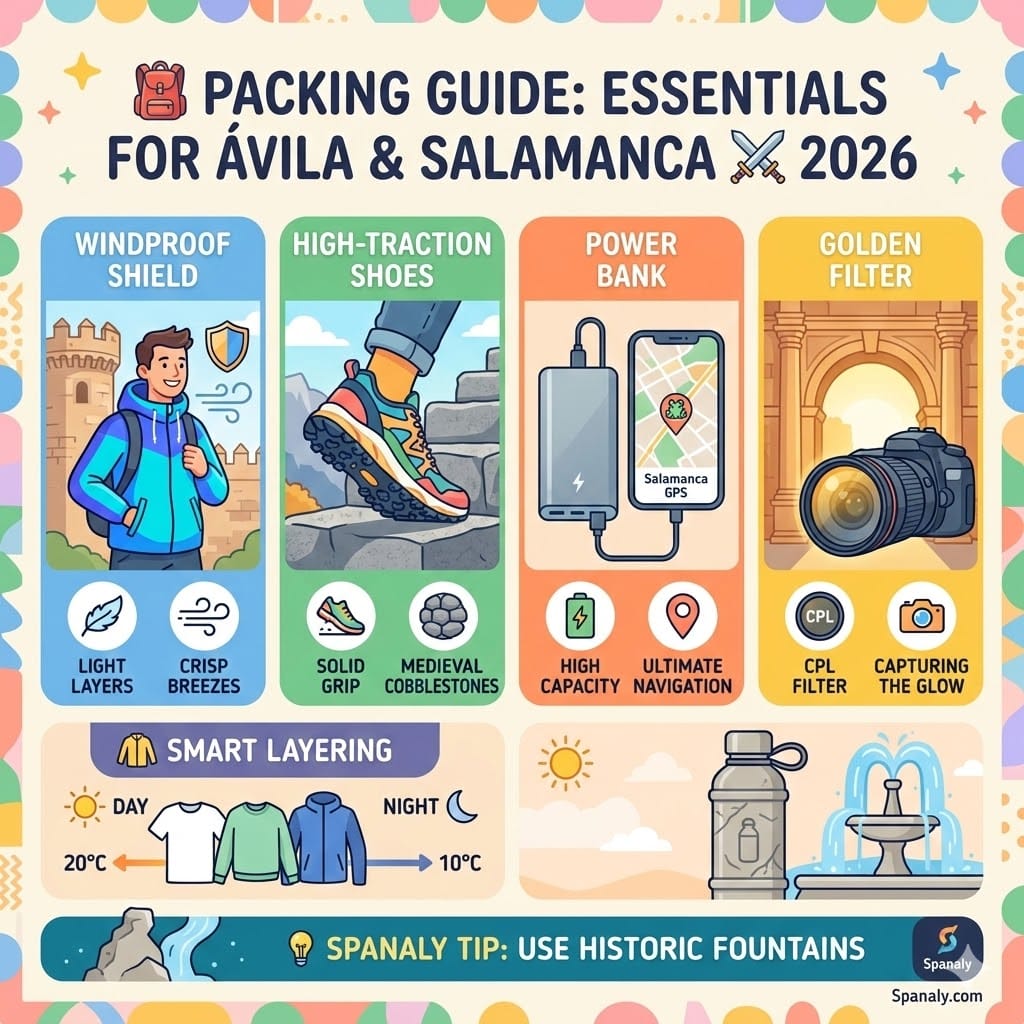
Packing for the Castilian highlands in 2026 requires a “layering” strategy. Unlike the coastal weather, these cities are known for significant temperature shifts between day and night.
🛡️ The 2026 Checklist:
Windproof Layers: Ávila is famous for its crisp mountain breezes. A stylish windbreaker is a must-have when walking the exposed city walls.
High-Traction Shoes: You’ll be conquering steep granite steps and medieval cobblestones. Ensure your footwear has a solid grip.
Power Bank: Navigating the “Golden City” and capturing 2026 aesthetics will drain your battery quickly.
The “Golden” Filter: For photography lovers, a CPL filter is perfect for capturing the deep orange hues of Salamanca’s sandstone without the glare.
🧥 Smart Layering:
If you’ve already checked our guide on what to pack for Spain, remember that Castile is the exception where a proper jacket is needed even in late spring. Nights near the Tormes River can drop to 10°C (50°F) rapidly.
💡 Spanaly Tip: Carry a reusable water bottle. Both cities feature historic fountains with crystal-clear mountain water. It’s the most authentic (and free) way to stay hydrated while exploring these high-altitude gems.
🏨 Accommodation Guide: Where to Stay in Castile
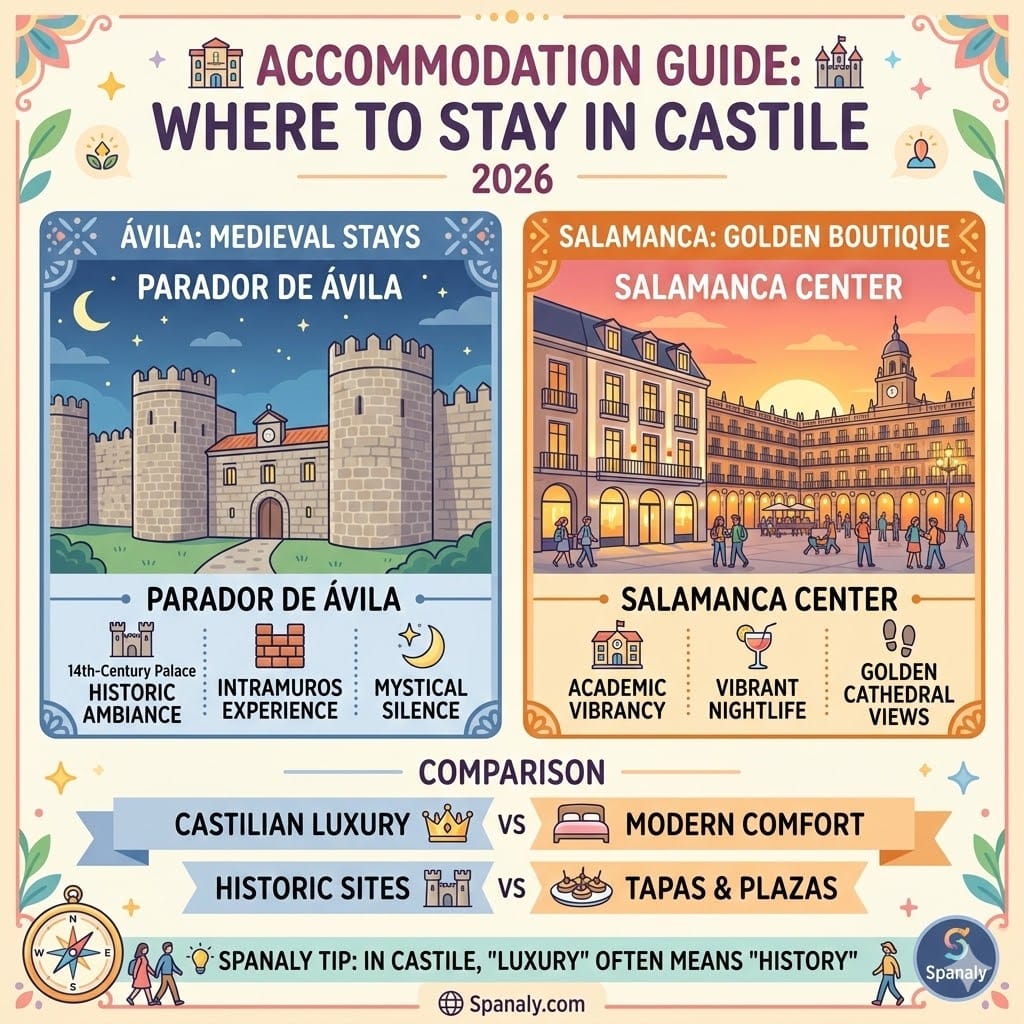
Choosing your base in 2026 is a choice between sleeping inside a medieval fortress or a vibrant academic hub. Both cities offer exceptional value compared to Madrid, but the “vibe” is completely different.
🏰 Staying in History: The Paradores
If you want the ultimate Castilian experience, the Paradores of Spain are unbeatable.
Parador de Ávila: Located in a 14th-century palace (Palacio de Piedras Albas), it is literally attached to the city walls.
Parador de Salamanca: Perched on a hill across the Tormes River, offering the best panoramic view of the “Golden Cathedral” at sunset.
✨ Modern Boutique & Local Stays
For travelers who prefer a more central, walkable academic atmosphere:
Salamanca Center: Look for boutique hotels near Plaza Mayor. You’ll be steps away from the nightlife and the best tapas spots.
Ávila Within the Walls: Staying inside the old town (Intramuros) is magical at night when the day-trippers leave and the stone streets fall silent.
💡 Spanaly Tip: If you are on a wider Spanish journey and looking for high-end comfort, check our guide on luxury hotels vs boutique stays in Barcelona to compare how Castilian hospitality differs from the Mediterranean style. In Castile, “Luxury” often means “History.”
🛌 At a Glance: Which City Should You Sleep In?
| Goal | Stay in Ávila | Stay in Salamanca |
| Vibe | Quiet, Mystical, Medieval | Vibrant, Academic, Lively |
| Best For | Couples & Peace Seekers | Social Travelers & Students |
| Morning View | Stone Walls & Mist | Golden Sandstone & Cathedrals |
🚆 Logistics: Navigating the Castilian Route
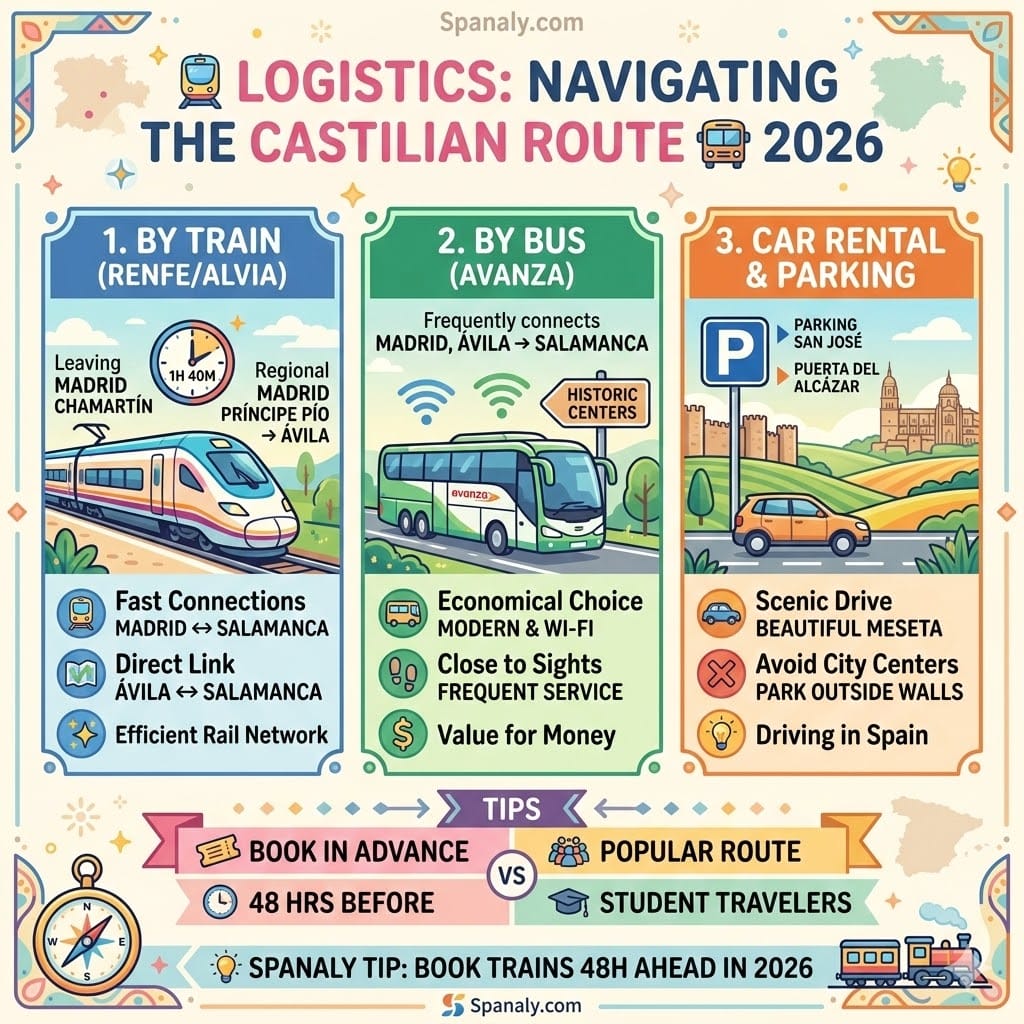
Reaching the heart of Castile in 2026 is seamless, thanks to Spain’s efficient rail and bus networks. Whether you are starting from the capital or moving between the two cities, here is how to handle the logistics like a local.
🚉 By Train (Renfe & Alvia)
From Madrid: The high-speed Alvia train from Madrid Chamartín reaches Salamanca in just 1 hour and 40 minutes. If you’re heading to Ávila first, the regional train from Madrid Príncipe Pío takes about 1 hour and 30 minutes.
Between Cities: There is a direct rail connection between Ávila and Salamanca (approx. 1 hour and 15 minutes), making it easy to split your 3-day trip.
🚌 By Bus (Avanza)
Often the most economical choice, the Avanza bus service connects Madrid, Ávila, and Salamanca frequently. The buses are modern, equipped with Wi-Fi, and often drop you closer to the historic centers than the train stations.
🚗 Car Rental & Parking
Driving through the Meseta is beautiful, but parking inside the medieval walls of Ávila or the pedestrianized center of Salamanca is a challenge. If you are driving in Spain, we recommend parking at the large “Parking de San José” in Salamanca or outside the “Puerta del Alcázar” in Ávila.
💡 Spanaly Tip: Buy your train tickets at least 48 hours in advance during the 2026 season. The Madrid-Salamanca route is extremely popular with students and weekend travelers, and last-minute seats can be scarce.
🏰 Day 1: Conquering the Walls of Ávila
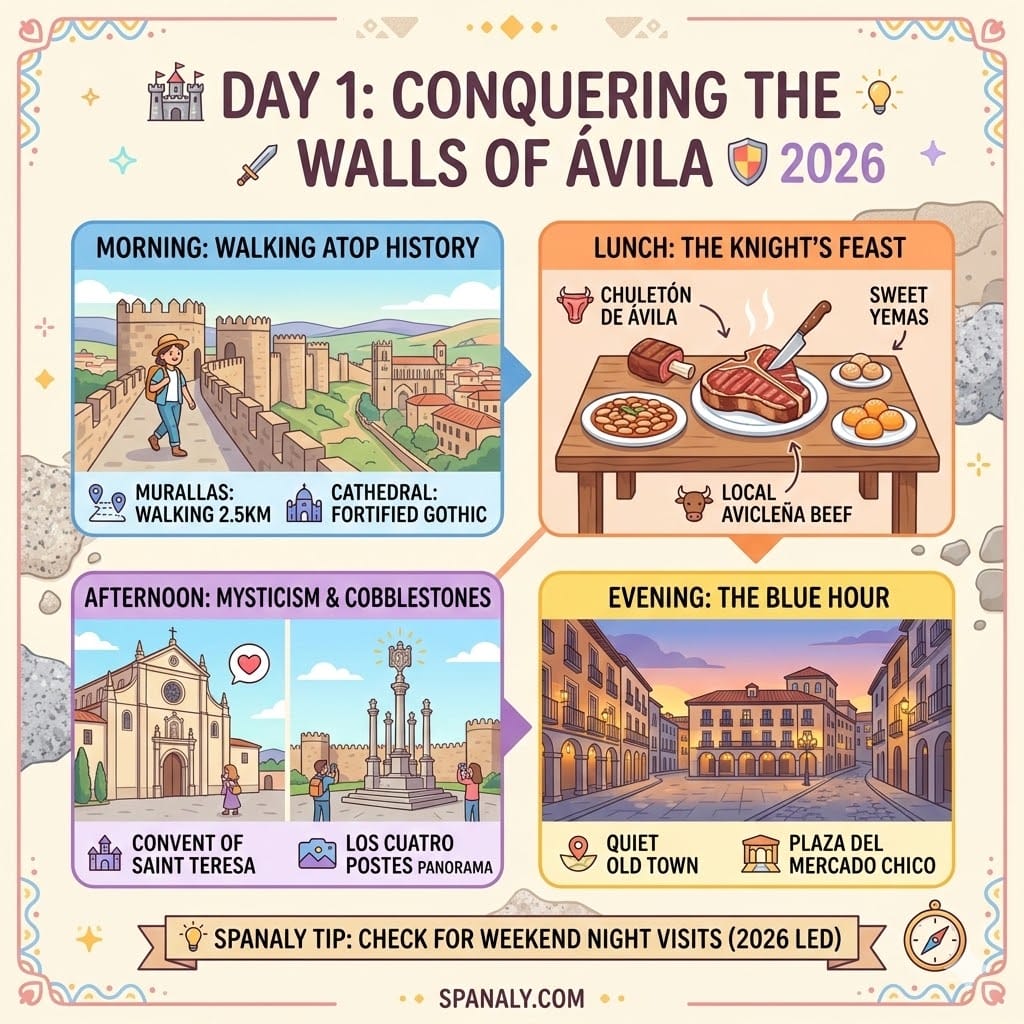
Your journey begins at the highest provincial capital in Spain. Today is about scale, history, and the sheer strength of the best-preserved medieval walls in the world.
Morning: Walking Atop History
The Murallas (City Walls): Start early at the Casa de las Carnicerías to access the top of the walls. Walking these 2.5 kilometers of granite fortifications provides a 360-degree view of the city and the rolling hills of the Meseta.
The Cathedral of Ávila: Built directly into the city walls, this is the first Gothic cathedral in Spain. Its “Cimorro” (fortified tower) is a masterpiece of Romanesque-Gothic transition.
Lunch: The Knight’s Feast
You cannot visit Ávila without trying the Chuletón de Ávila. This massive T-bone steak from local Avileña cows is a culinary icon. For a lighter side, try the Judiones de El Barco (large white beans). If you’re curious about other Spanish delicacies, our traditional Spanish food guide covers more regional stars.
Afternoon: Mysticism & Cobblestones
Convent of Saint Teresa: Built over the birthplace of the famous mystic, this site offers a deep look into the spiritual soul of Castile.
Los Cuatro Postes: Just before sunset, take a short walk (or taxi) outside the walls to this monument. It offers the most iconic panoramic view of the illuminated walls—the perfect 2026 Instagram shot.
Evening: The Blue Hour
As the day-trippers return to Madrid, the old town becomes quiet and mystical. Wander through the Plaza del Mercado Chico and grab some Yemas de Santa Teresa (sweet egg-yolk treats) for dessert.
💡 Spanaly Tip: If you are visiting during the weekend, check for “Night Visits” to the walls. Walking the battlements under the stars with 2026 LED illumination is a hauntingly beautiful experience you won’t forget.
✨ Day 2: The Golden Glow of Salamanca
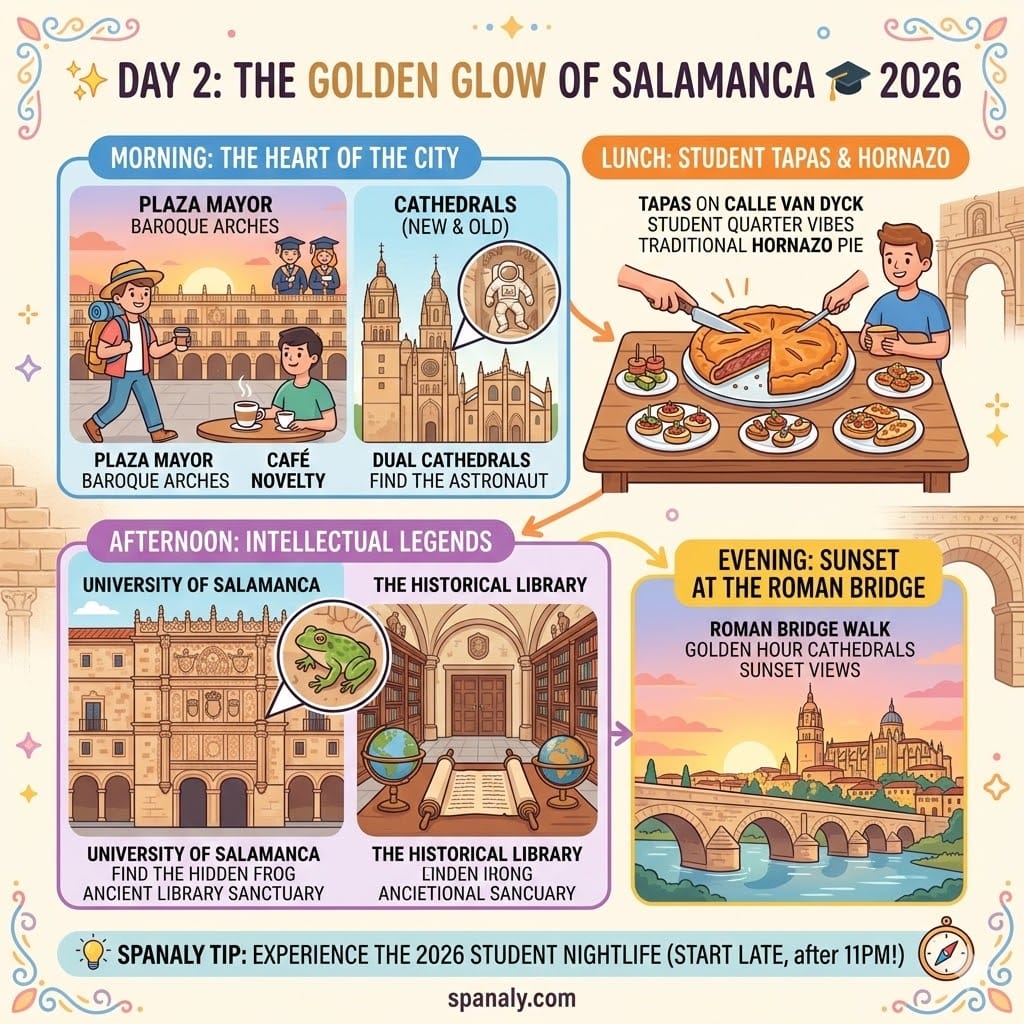
After a short train or bus ride from Ávila, you’ll arrive in a city that literally glows. Built almost entirely from local Villamayor sandstone, Salamanca is an open-air museum of Plateresque art.
Morning: The Heart of the City
Plaza Mayor: Start your day in what is widely considered the most beautiful square in Spain. Grab a coffee at Café Novelty (the city’s oldest) and watch the light hit the baroque arches.
The Cathedrals (New and Old): Salamanca has two cathedrals joined together. Look for the famous “Astronaut” carved into the New Cathedral’s facade—a quirky restoration detail that has become a 2026 must-spot.
Lunch: Tapas in the Student Quarter
Salamanca is a student city, which means incredible tapas at friendly prices. Head to the streets around Calle Van Dyck for authentic local bites. Try the Hornazo, a traditional meat pie stuffed with pork, chorizo, and hard-boiled eggs. If you are exploring other regions, check our Seville travel tips to see how the tapas culture differs between the North and South.
Afternoon: Intellectual Legends
The University of Salamanca: Visit one of the oldest universities in the world. Challenge yourself to find the “hidden frog” on the ornate facade—legend says students who find it will pass their exams!
The Library: Step into the stunning historical library, a sanctuary of ancient scrolls and globes.
Evening: Sunset at the Roman Bridge
Cross the Roman Bridge of Cordoba style—but this time over the Tormes River in Salamanca. The view of the illuminated Cathedrals from across the river is the “Golden Hour” at its finest.
💡 Spanaly Tip: Salamanca’s nightlife is legendary but starts late. If you want to experience the 2026 student vibe, head to the bars near the University after 11:00 PM for live music and a vibrant, safe atmosphere.
🏛️ Day 3: Art Deco, Hidden Gardens, and Beyond
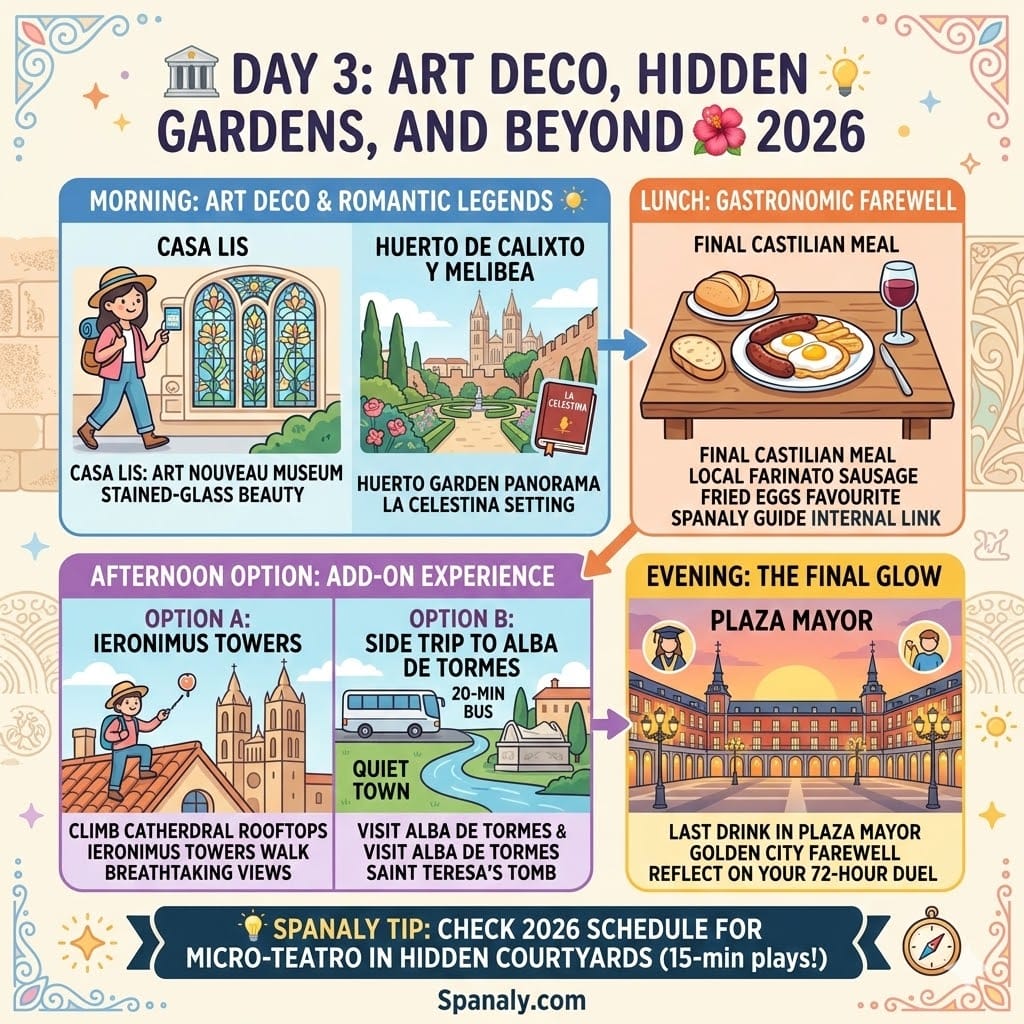
On your final day, we move away from the main monuments to discover the “soul” of Salamanca—its artistic elegance and quiet, romantic corners.
Morning: Art Deco & Romantic Legends
Casa Lis: This is a stunning Art Nouveau and Art Deco museum housed in a palace with magnificent stained-glass windows. In 2026, it remains the most photographed interior in the city.
Huerto de Calixto y Melibea: A small, romantic garden located atop the old walls. It’s the setting for the famous Spanish literary work La Celestina. It offers a peaceful view of the cathedrals and the river.
Lunch: A Gastronomic Farewell
For your final Castilian meal, try Farinato (a local sausage made with breadcrumbs and spices) often served with fried eggs. It’s a humble yet delicious local favorite. If you’re looking for more inspiration for your next Spanish trip, our Toledo & Segovia 3-day itinerary is the perfect follow-up to this Castilian adventure.
Afternoon Option: The “Add-on” Experience
Option A (In the City): Climb the Ieronimus Towers for a breathtaking walk through the cathedral’s rooftops.
Option B (The Side Trip): Take a 20-minute bus to Alba de Tormes, a quiet town where Saint Teresa is buried, offering a serene end to your journey.
Evening: The Final Glow
Return to Plaza Mayor for one last drink. As the lights turn on, you’ll truly understand why it’s called the “Golden City.” It’s the perfect time to reflect on your 72-hour duel between stone and gold.
💡 Spanaly Tip: Check the 2026 schedule for “Micro-teatro” (short plays) often performed in hidden courtyards around the university. They are usually 15 minutes long and provide a unique glimpse into the city’s living culture.
📍 Beyond the Duel: Nearby Landmarks & Day Trips
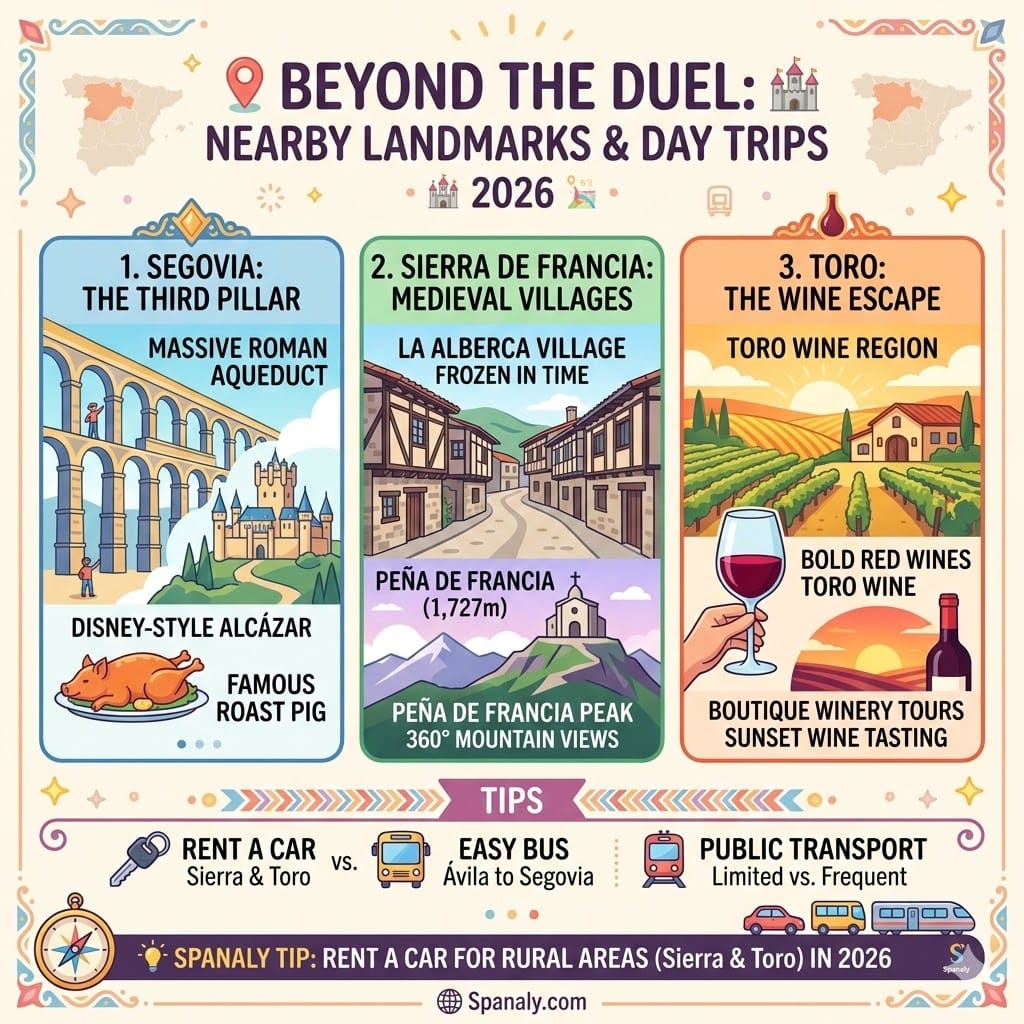
If your 2026 calendar allows for an extra day or two, the area surrounding Ávila and Salamanca is dotted with hidden gems that offer a different perspective on Castilian life.
🏰 Segovia: The Third Pillar
Only an hour from Ávila, Segovia is the logical next step. With its massive Roman Aqueduct, the “Disney-style” Alcázar, and its famous roast suckling pig, it completes the “Castilian Trinity.” If you are planning to extend your trip, don’t miss our guide on how to spend 3 days in Seville to see how Castile’s fortresses compare to Andalusia’s palaces.
🏞️ Sierra de Francia: Medieval Villages
For nature and folklore lovers, a drive south of Salamanca leads to the Sierra de Francia.
La Alberca: A stunning village with half-timbered houses and stone streets that feel frozen in time.
Peña de Francia: A sanctuary perched on a mountain peak at 1,727 meters, offering 360-degree views of the Castilian plains.
🍇 Toro: The Wine Escape
Located between Salamanca and Zamora, the Toro Wine Region is a 2026 hotspot for oenophiles. Known for its bold, powerful red wines (Tinta de Toro), it’s the perfect place for a boutique winery tour and a sunset tasting.
💡 Spanaly Tip: For the Sierra de Francia or Toro, renting a car is essential as public transport is limited in these rural areas. However, for Segovia, the bus connection from Ávila is frequent and reliable.
🥩 Local Cuisine: A Feast for the Senses
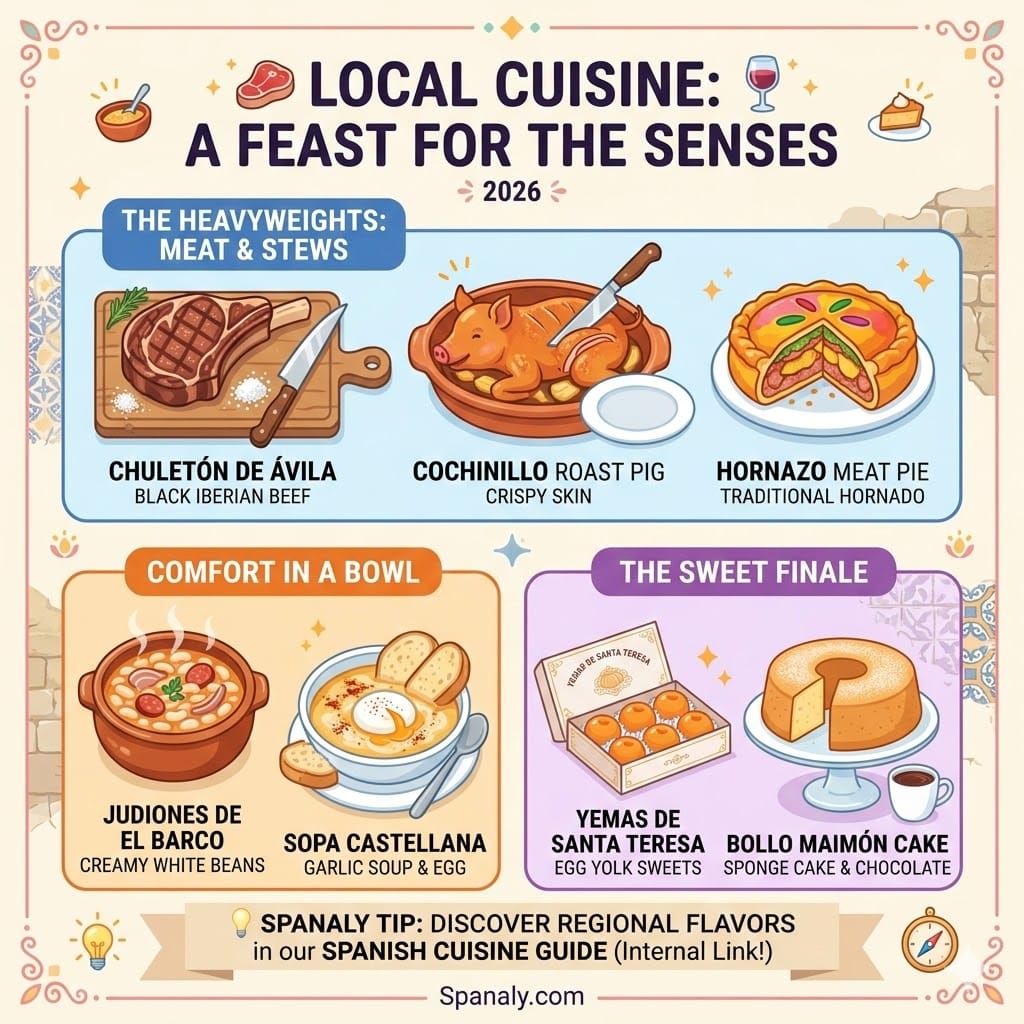
In 2026, the culinary duel between Ávila and Salamanca is just as intense as their architectural one. Castilian food is honest, hearty, and deeply rooted in the land. Here is what you must order to eat like a local knight or a modern scholar.
🔥 The Heavyweights: Meat & Stews
Chuletón de Ávila: The undisputed king. A massive, charcoal-grilled T-bone steak from the local Avileña-Black Iberian breed. It’s usually served rare to medium-rare to preserve its buttery texture.
Cochinillo (Suckling Pig): While famous in Segovia, both Ávila and Salamanca serve incredible roast pig with skin so crispy it can be cut with a plate.
Hornazo de Salamanca: This is not just a meat pie; it’s a tradition. Stuffed with lomo (pork loin), chorizo, and ham, it’s the ultimate “power lunch” for a day of sightseeing.
🍲 Comfort in a Bowl
Judiones de El Barco: Large, creamy white beans stewed with chorizo and pig’s ear. It’s the perfect soul food for a crisp Castilian afternoon.
Sopa Castellana: A humble yet brilliant garlic soup with bread, paprika, and a poached egg—a true 2026 winter essential.
🍯 The Sweet Finale
Yemas de Santa Teresa: Ávila’s signature sweet. These delicate orange spheres made of egg yolks and sugar melt in your mouth.
Bollo Maimón: A light, ring-shaped sponge cake from Salamanca, often enjoyed with thick hot chocolate.
💡 Spanaly Tip: If you If you love discovering regional flavors, explore our comprehensive Spanish cuisine guide to see how these hearty Castilian meats fit into the wider world of Spanish gastronomy. From northern stews to southern delights, every bite tells a story.
🛡️ Family & Kids Travel: Legends for Little Knights
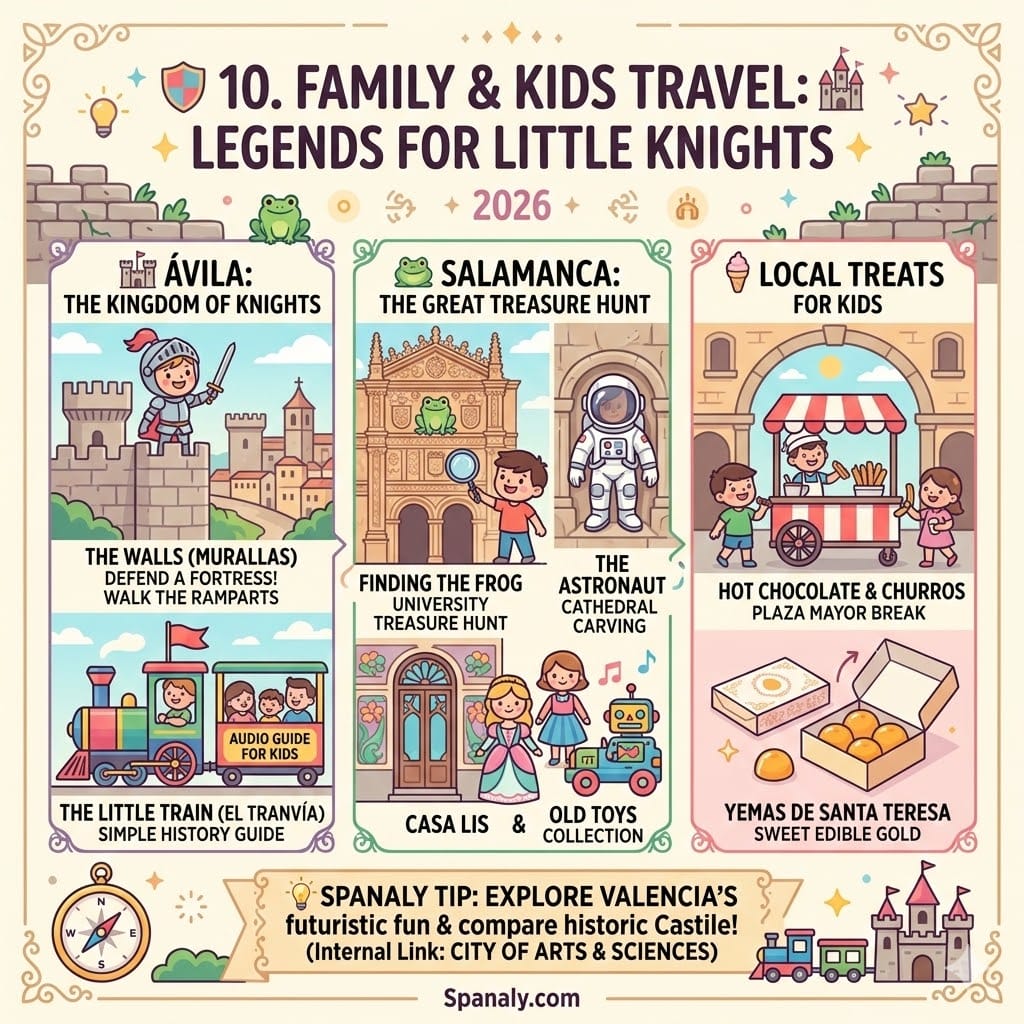
Exploring Ávila and Salamanca in 2026 is like stepping into a giant storybook for children. Whether it’s playing at being a medieval knight or searching for hidden animals on stone walls, Castile is surprisingly family-friendly.
🏰 Ávila: The Kingdom of Knights
The Walls (Murallas): To a child, these aren’t just historic monuments; they are a fortress waiting to be defended. Walking the ramparts feels like a real-life video game.
The Little Train (El Tranvía): A great way for little legs to see the city walls without getting tired. It provides an audio guide that simplifies the history for kids.
🐸 Salamanca: The Great Treasure Hunt
Finding the Frog: The most famous activity for kids (and adults!) is spotting the frog on the University facade. It keeps them engaged and looking closely at the incredible architecture.
The Astronaut: Another hit for kids is finding the modern astronaut carved into the Cathedral’s ancient stone.
Museum of Art Nouveau (Casa Lis): While it’s an art museum, the colorful dolls and old toys collection inside are always a favorite for younger visitors.
🍦 Local Treats for Kids
Take a break in Plaza Mayor with some traditional ice cream or a thick Spanish hot chocolate with churros. In Ávila, the Yemas de Santa Teresa are like sweet, edible gold that kids usually adore.
💡 Spanaly Tip: Check out our guide on exploring the City of Arts and Sciences in Valencia to see how Spain blends futuristic family fun with the historic experiences you find here in Castile.
💰 Castile on a Budget: 2026 Price Guide
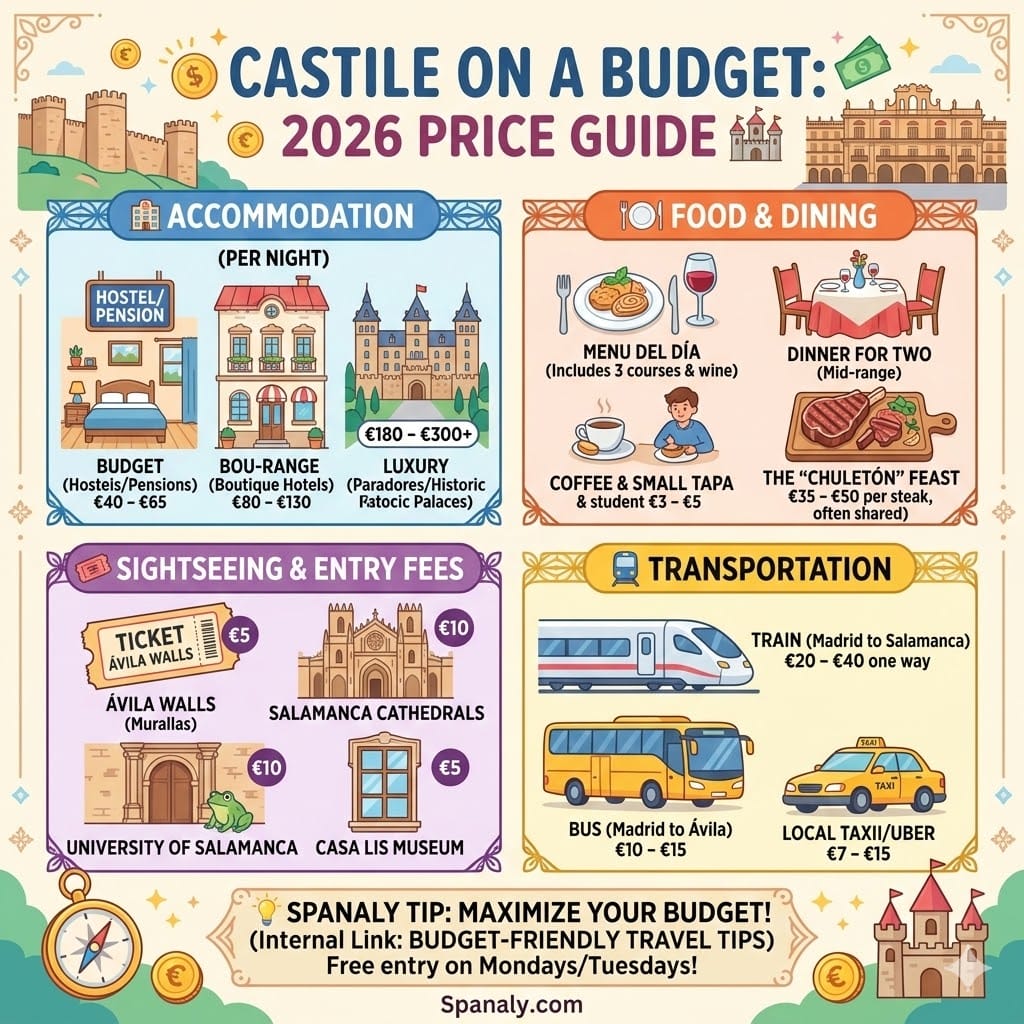
Visiting Ávila and Salamanca is generally more affordable than staying in Madrid or Barcelona. However, with the 2026 travel trends, prices have stabilized to offer great value for a premium historical experience.
🏨 Accommodation (Per Night)
Budget (Hostels/Pensions): €40 – €65.
Mid-Range (Boutique Hotels): €80 – €130.
Luxury (Paradores/Historic Palaces): €180 – €300+.
🍽️ Food & Dining
Menu del Día: €15 – €22 (Includes 3 courses and wine).
Dinner for two (Mid-range): €50 – €80.
Coffee/Small Tapa: €3 – €5.
The “Chuletón” Feast: €35 – €50 (per steak, often shared).
🎟️ Sightseeing & Entry Fees
Ávila Walls (Murallas): €5.
Salamanca Cathedrals: €10.
University of Salamanca: €10.
Casa Lis Museum: €5.
🚆 Transportation
Train (Madrid to Salamanca): €20 – €40 (one way).
Bus (Madrid to Ávila): €10 – €15.
Local Taxis/Uber: €7 – €15 for city transfers.
💡 Spanaly Tip: If you want to maximize your budget for more trips, check out our guide on budget-friendly travel tips for Spain. Many monuments in Salamanca offer free entry on certain afternoons (usually Monday or Tuesday), so plan accordingly!
🔐 Exclusive Insider Hacks: The Secret Glow
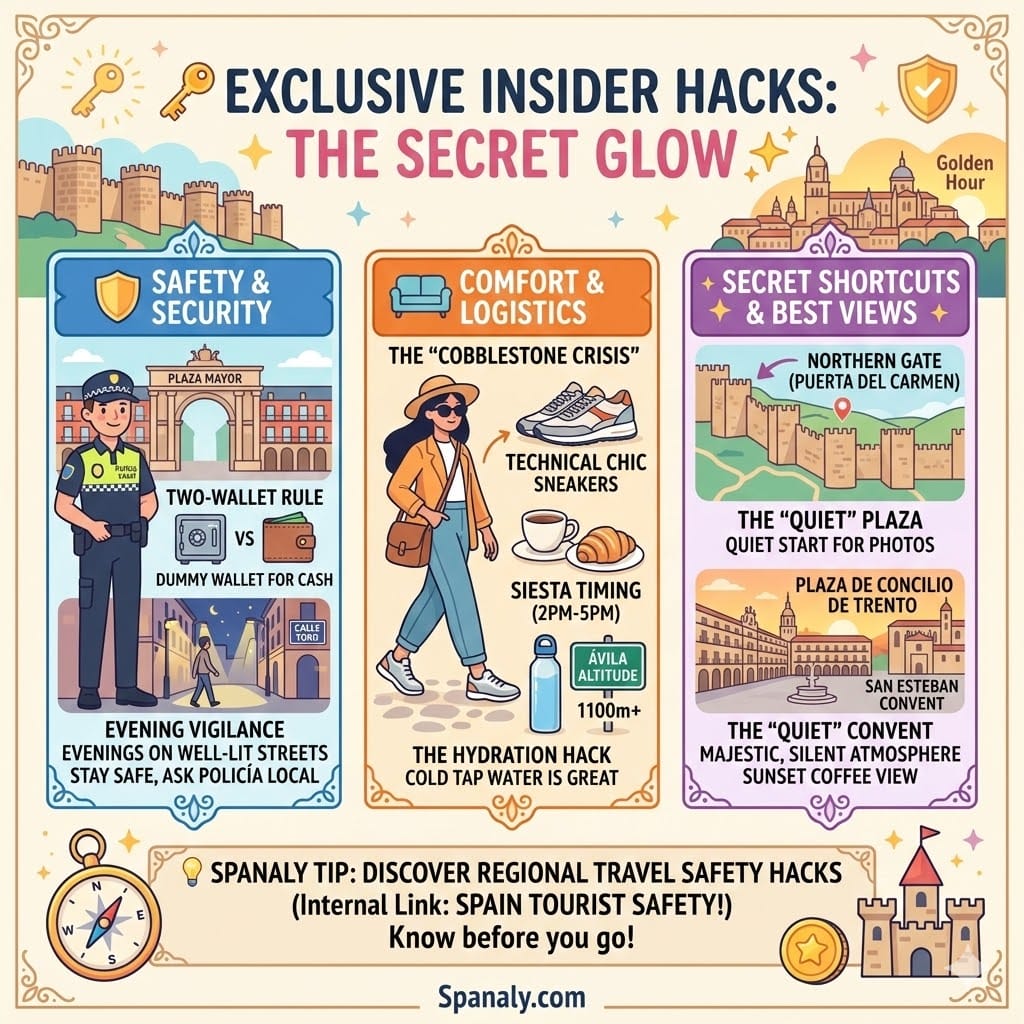
To truly master the duel between Ávila and Salamanca in 2026, you need more than just a map. Here are the professional secrets for safety, comfort, and elite navigation.
🛡️ Safety & Security: The Peace of Mind
The “Two-Wallet” Rule: While Castile is incredibly safe, Plaza Mayor in Salamanca can get crowded at night. Keep your main documents in a hotel safe and carry a “dummy” wallet with just enough cash for the evening.
Evening Vigilance: Salamanca is a student city that stays awake until 6:00 AM. Stick to well-lit streets like Calle Toro when walking back late. The local police (Policía Local) are very friendly and visible in 2026.
🛋️ Comfort & Logistics: The Pro Way
The “Cobblestone Crisis”: Both cities are 90% cobblestone. Leave the heels or thin-soled shoes at home. In 2026, the trend is “Technical Chic”—high-quality walking sneakers that look good but save your ankles.
Siesta Timing: Remember, smaller shops in Ávila still close between 2:00 PM and 5:00 PM. Use this time for your long “Chuletón” lunch or a nap to recharge for the night lights.
The Hydration Hack: Ávila’s high altitude (over 1,100m) means you’ll dehydrate faster than in Madrid. Always carry a reusable bottle; the tap water in both cities is among the best and coldest in Spain.
✨ Secret Shortcuts to the Best Views
Ávila’s Northern Gate: Most people enter the walls at the Cathedral. For a quieter experience and better light for photos, start at the Puerta del Carmen on the northern side.
The “Quiet” Plaza: If Plaza Mayor feels too loud, head to Plaza de Concilio de Trento in Salamanca. It’s right in front of the San Esteban Convent and offers a majestic, silent atmosphere for a sunset coffee.
💡 Spanaly Tip: For more expert advice on staying safe while exploring the vibrant streets of Spain, check out our safety tips for tourists in Spain. Knowledge is the best souvenir!
🛡️ Visitor FAQs – 2026 Castile Travel Safety & Logistics
🛡️ Is the walk on Ávila’s walls safe for solo travelers at night?
Yes, Ávila is one of Spain’s safest cities. In 2026, the night visits to the Murallas are highly controlled and well-lit with modern LED systems. Security staff are present at every entrance, making it a peaceful and secure experience even if you are traveling alone.
🎫 How do I avoid "Reseller" scams for monument tickets?
Always book directly through the official city websites or at the monument gate. In 2026, some unofficial guides near the Salamanca Cathedral might try to sell "express tickets" at double the price. Authentic tickets always include a QR code that can be verified via the official tourism app.
💧 Is tap water safe to drink in Ávila and Salamanca?
Absolutely. In 2026, the tap water in the Castilian plateau is among the purest in Europe, sourced directly from the Sierra de Gredos. It is safe, cold, and delicious. You can refill your reusable bottle at the numerous public "Fuentes" (fountains) to stay hydrated during your walks.
🚑 What should I do in case of a minor medical emergency?
Spain’s public health system is excellent. For minor issues, look for a Farmacia (marked with a glowing green cross). In 2026, most pharmacists speak basic English. For emergencies, dial 112. If you have travel insurance, the private clinics in Salamanca offer very fast service for international visitors.
🏰 Are the cobblestone streets accessible for those with mobility issues?
While historic, both cities have made great strides in 2026. Salamanca’s center is mostly flat and pedestrianized. Ávila’s walls have elevator access at the Puerta del Alcázar. However, we recommend using a motorized wheelchair or requesting a specially adapted taxi for the steeper streets in Ávila’s old quarter.
Last updated for 2026 by Spanaly.com
🏰 The Timeless Magic of Castile
The duel between Ávila and Salamanca isn’t about choosing a winner; it’s about experiencing two different souls of the same historic heartland.
🛡️ Ávila will give you the strength of its granite walls and mystical silence.
🎓 Salamanca will charm you with its golden glow and vibrant energy.
In 2026, these cities remain the ultimate escape for those who seek history, flavor, and soul without the rush of the modern world.
🧭 Ready for your next adventure?
If the golden stones of Castile have captured your heart, don’t stop here!
Extend your journey through the “Castilian Trinity” by exploring our Toledo and Segovia 3-day itinerary. From Roman engineering to Imperial grandeur, the magic of Spain is just a train ride away.
¡Buen viaje! See you on the golden streets of Spain. ✨🇪🇸☀️