
⏳ Time in Spain doesn’t just pass—it breathes. To truly master Spain’s Daily Rhythm, you must understand that if you’ve ever felt “out of sync” while traveling, it’s probably because you haven’t unlocked the secret code of the Spanish clock.
In 2026, while the rest of the world rushes, Spain remains the ultimate sanctuary for those who want to:
Live Authentically: Move from being a tourist to a local.
Eat Better: Sync with the kitchen hours of the best restaurants.
Travel Smarter: Coordinate your travel times with the local flow.
For instance, if you are planning a road trip, knowing how Spain’s Daily Rhythm affects the traffic is as crucial as knowing the 7 Golden Rules for Driving in Spain to avoid the rush and enjoy the scenery.
💡 The Spanaly Secret: Understanding the rhythm isn’t just about knowing the time; it’s about embracing a lifestyle where “slow” is beautiful and “late” is just the beginning.
This guide will walk you through a perfect 24-hour cycle of Spain’s Daily Rhythm, ensuring you never miss a beat—or a meal!
Table of Contents
Toggle☕ Morning in Spain: Slow Starts & Coffee Culture
In Spain, the morning doesn’t “rush” in—it gradually unfolds. Most locals won’t even consider the day started until they’ve had their first caffeine fix.
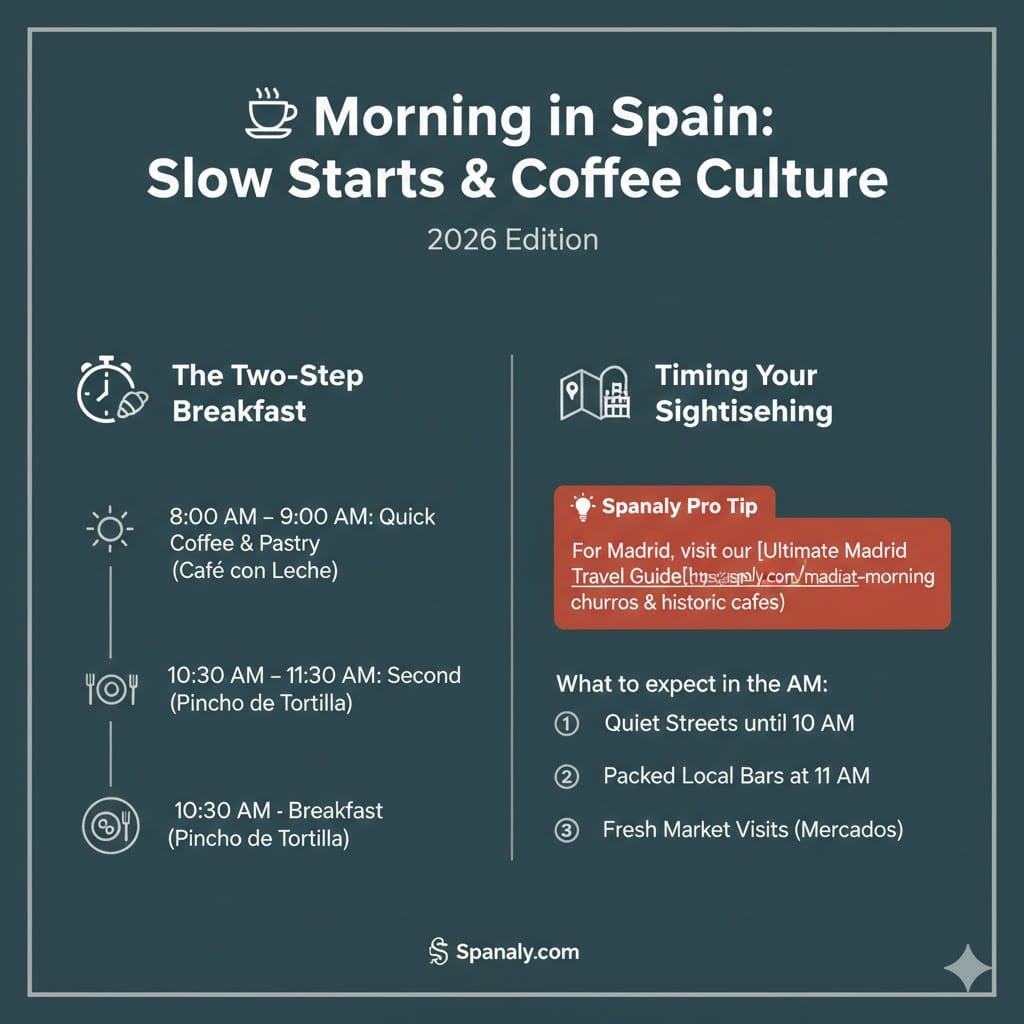
🥐 The Two-Step Breakfast Tradition
Unlike the heavy breakfasts of the north, Spaniards prefer a lighter, dual-phase approach:
The Early Spark (8:00 AM – 9:00 AM): A quick café con leche paired with a croissant or a simple galleta (biscuit).
The Sacred “Second Breakfast” (10:30 AM – 11:30 AM): This is the cultural highlight. Offices and shops pause as everyone heads to the local bar for a pincho de tortilla (potato omelet) or tostada con tomate.
🏛️ Timing Your Sightseeing
If you’re planning to explore the capital’s iconic landmarks, remember that many monuments don’t open until 10:00 AM.
📍 Spanaly Pro Tip: For the best morning churros and historic cafe atmosphere, check out our Ultimate Madrid Travel Guide to plan your early city route perfectly.
What to expect in the AM:
Quiet Streets: Cities are surprisingly calm until 10:00 AM.
The “Breakfast Break”: Expect local bars to be packed around 11:00 AM—this is the best time for people-watching!
Fresh Markets: This is the golden hour to visit Mercados (markets) while the produce is fresh and the crowds are light.
☀️ Midday: The Long Lunch & The Famous Siesta
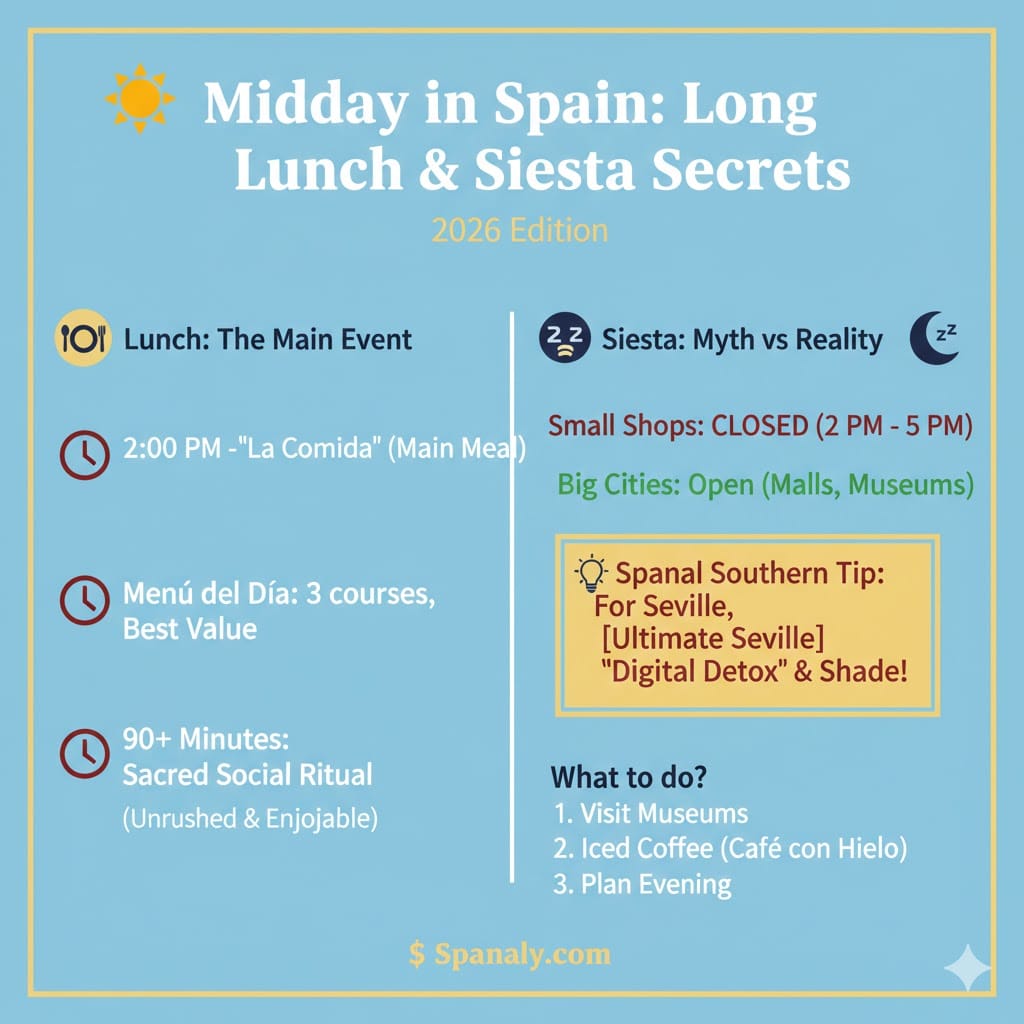
By 2:00 PM, the energy in Spain shifts. The streets grow quiet, the shutters come down, and the focus turns entirely to one thing: The Meal. ### 🥘 Lunch: The Main Event (2:00 PM – 4:00 PM) In Spain, lunch (La Comida) is not a sandwich at a desk; it is a sacred social ritual.
The “Menú del Día”: Almost every restaurant offers a fixed-price three-course menu. It’s the highest quality food you’ll get for the lowest price.
The Pace: Expect to spend at least 90 minutes at the table. In 2026, many restaurants now offer “Express Menus” for workers, but as a traveler, you should embrace the slow pace.
😴 The Siesta Myth vs. Reality (2:00 PM – 5:00 PM)
Does everyone sleep? Not exactly. But the country does “pause.”
In Big Cities: Major stores like El Corte Inglés stay open, but small family-owned boutiques will close without exception.
In Southern Spain: In regions like Andalusia, the heat makes the Siesta mandatory.
2026 Evolution: The Siesta is now more of a “Digital Detox” hour—a time to stay out of the sun, enjoy a long coffee, and recharge.
☀️ Spanaly Southern Tip: If you are visiting the South, timing is everything. Our Ultimate Seville Travel Guide explains how to navigate the city’s schedule so you don’t end up walking the streets when everything is closed and the sun is at its peak.
💡 What to do during the Siesta?
Visit Major Museums: Places like the Prado or Reina Sofia stay open and are often less crowded.
Long Coffee Break: Find a shaded plaza and enjoy a Café con Hielo (iced coffee).
Plan Your Evening: Use this downtime to book tickets or look up your next tapas stop.
🍷 Evening: Social Hours, The "Paseo" & Late Dinners
After 5:00 PM, Spain undergoes a transformation. The sun begins to mellow, the shutters fly open, and the streets fill with the sound of laughter and clinking glasses.
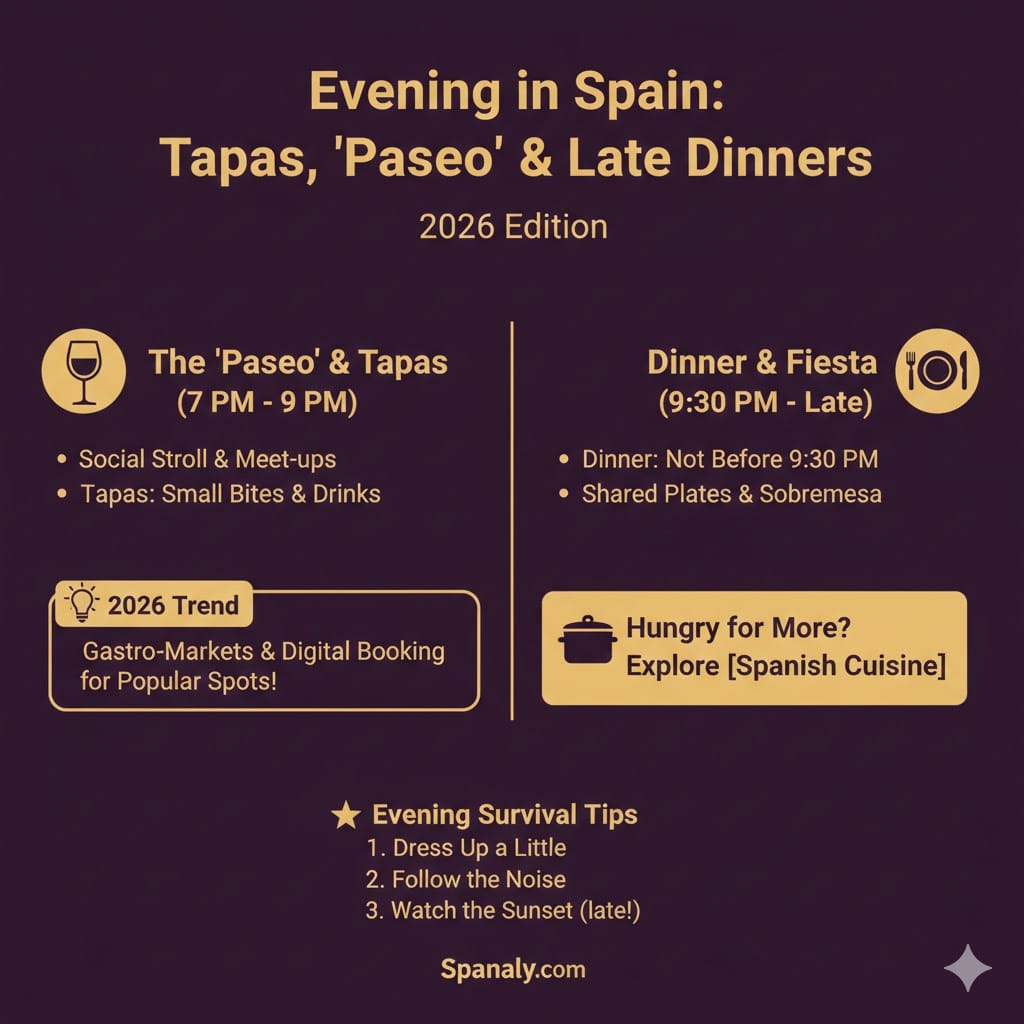
🚶 The “Paseo”: Spain’s Social Soul (7:00 PM – 9:00 PM)
The Paseo is more than a walk; it’s a cultural phenomenon.
Multi-Generational: You’ll see everyone from toddlers to grandparents walking together in the local plazas.
The “Tapas Run”: This is the time to visit one or two bars for a caña (small beer) or a glass of wine, accompanied by a single tapa.
2026 Trend: In modern neighborhoods, “Gastro-Markets” have become the go-to spot for the Paseo, offering a mix of traditional and fusion snacks.
🍽️ Dinner: The Late-Night Feast (9:30 PM – 11:00 PM)
If you try to find dinner at 7:00 PM, you’ll only find other tourists.
Kitchen Hours: Authentic Spanish kitchens rarely fire up their stoves for dinner before 8:30 PM or 9:00 PM.
The Atmosphere: Dinner is the time for shared plates (Raciones) and long conversations (Sobremesa).
🍲 Hungry for more? To navigate a Spanish menu like a pro and know exactly what to order during these late-night feasts, dive into our comprehensive guide on Spanish Cuisine.
⚠️ Important Missed Details (2026 Updates):
The “Merienda” (5:00 PM – 6:30 PM): Many travelers forget this! It’s the afternoon snack. If you don’t have a merienda (like coffee and a small pastry), you will be starving by the time dinner starts at 10 PM.
Reservations: In 2026, the most popular “Tapas spots” in cities like Madrid and San Sebastian require digital booking even for standing tables. Don’t just show up!
💡 Evening Survival Tips:
Dress Up a Little: The Paseo is when Spaniards look their best. Shed the “tourist gear” to blend in.
Follow the Noise: The louder the bar, the better the food.
Watch the Sun: In summer, the sun doesn’t set until nearly 10:00 PM in the north—adjust your internal clock accordingly!
🌙 Late Nights: The Spanish Nightlife & The Sunday Shift
Spain doesn’t just “stay up late”—it lives its most vibrant life after the clock strikes midnight. Whether you are a party person or just a night owl, the 2026 nightlife scene has its own set of unwritten rules.
💃 Nightlife: From Bars to Discotecas
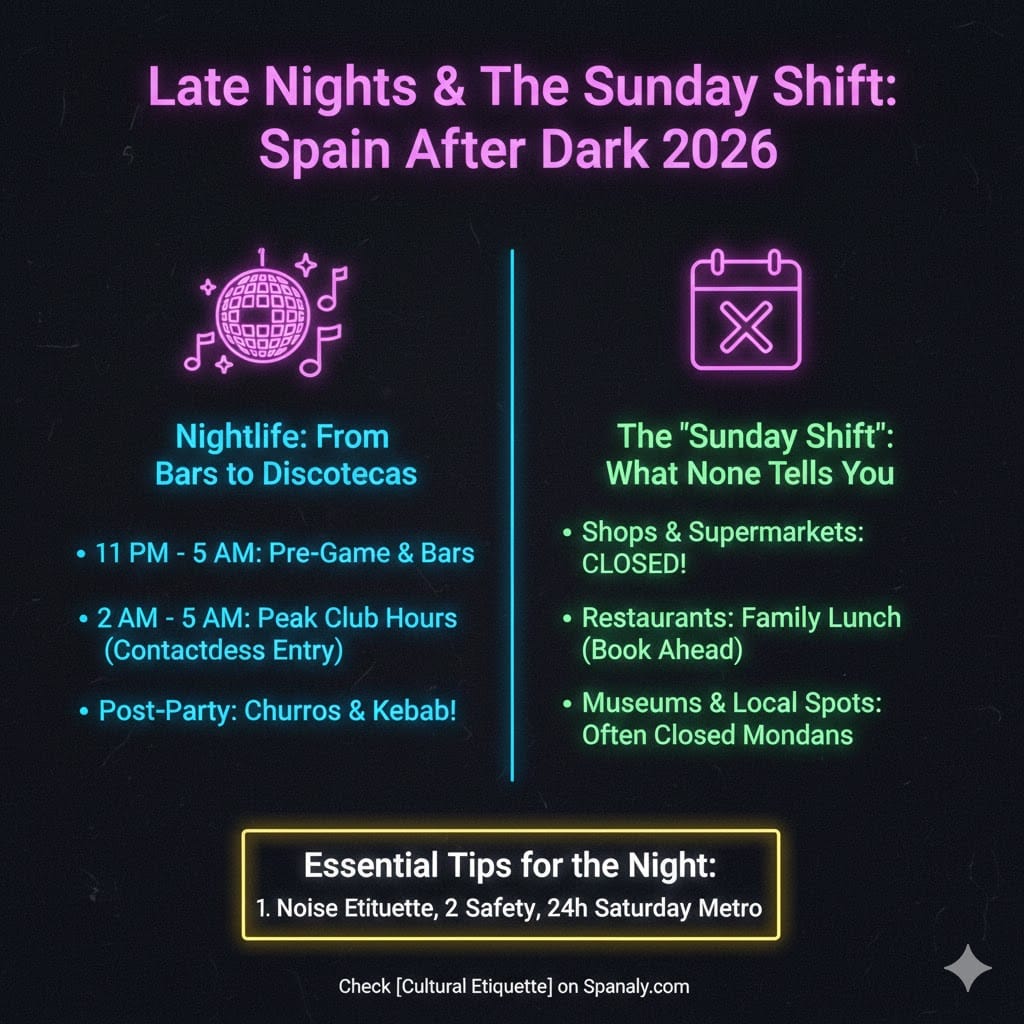
The “Pre-Game” (11:00 PM – 1:00 AM): Locals gather in music bars or “pub-style” spots. If you go to a club before 1:30 AM, you will likely be the only person on the dance floor.
Peak Hours (2:00 AM – 5:00 AM): This is when the energy is highest. In 2026, many clubs in cities like Barcelona and Ibiza now use “Contactless Entry,” so having your digital wallet ready is essential.
The “After-Party” Snack: No night out is complete without stopping for Churros con Chocolate or a late-night kebab before heading home as the sun rises.
🛑 The “Sunday Shift” (What No One Tells You)
The rhythm changes drastically on Sundays and Public Holidays:
The Ghost Towns: In many cities, shops (even big supermarkets) are CLOSED on Sundays.
The Family Lunch: Sunday is for the “Great Family Meal.” Restaurants will be packed with locals, so reservations are mandatory.
Monday Morning Blues: Many museums and local restaurants stay closed on Mondays to recover from the busy weekend.
🤝 Cultural Note: Navigating these late-night social scenes and Sunday traditions requires a bit of local “know-how.” To avoid any social faux pas, check out our guide on Cultural Etiquette in Spain.
⚠️ Essential Tips for the Night:
Noise Etiquette: While the streets are loud, once you enter a residential building or hotel, silence is strictly expected.
Safety: Spanish nightlife is remarkably safe, but always keep an eye on your belongings in crowded “nightlife districts.”
Transport: In 2026, the Metro in cities like Madrid runs 24 hours on Saturdays—but check the app for Sunday schedules, as they are less frequent.
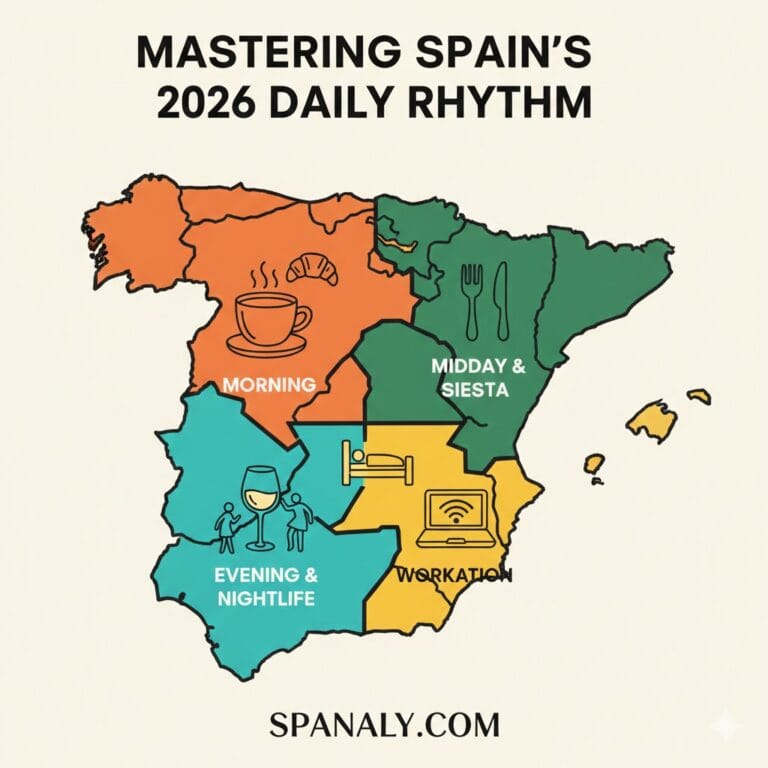
🗺️ Regional Variations in Spain’s Daily Rhythm
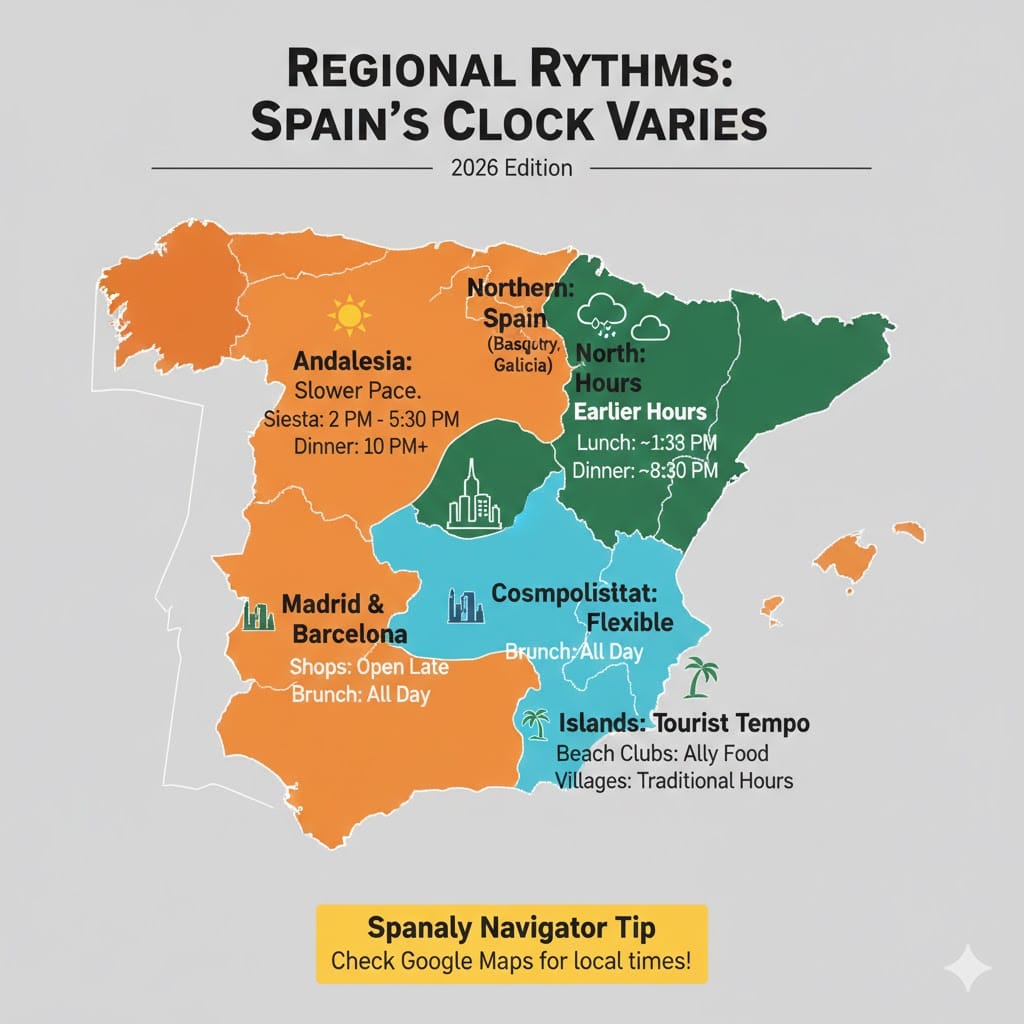
Spain is not a monolith. The “daily schedule” is a flexible concept that changes based on the climate and culture of each region. As you are Getting Around Spain via high-speed train or bus, you’ll notice the clock shift.
☀️ Southern Spain (Andalusia)
The Heat Factor: The most extreme version of the Spanish rhythm.
The Schedule: Siestas are longer (often until 5:30 PM), and dinner rarely starts before 10:00 PM.
Vibe: Very social, outdoor-centric, and laid-back.
🌲 Northern Spain (Basque Country & Galicia)
The Atlantic Influence: Because it’s cooler and rains more, the rhythm is closer to the rest of Europe.
The Schedule: Lunch and dinner happen about 30 to 60 minutes earlier than in the south.
Vibe: Focused on indoor gastronomy and early evening “Pintxo” crawls.
🏙️ Madrid & Barcelona (The Cosmopolitan Hubs)
The Non-Stop Rhythm: These cities are more flexible to accommodate tourists and international business.
The Schedule: You’ll find “All-Day Brunch” spots and shops that never close for siesta.
Vibe: Fast-paced but still respecting the late-night dinner tradition.
🏝️ The Balearic & Canary Islands
The Tourist Tempo: Here, the rhythm is dictated by the sun and the sea.
The Schedule: Beach clubs might serve food all day, but authentic local villages still stick to the traditional 2:00 PM lunch.
📍 Spanaly Navigator Tip: When traveling between these zones, always check the local opening hours on Google Maps—an “Open” shop in Santander might be “Closed” in Seville at the exact same hour!
💻 The 2026 "Workation" Sync: Productivity vs. Siesta
With the rise of Digital Nomad visas, Spain’s daily rhythm has adapted. If you are working while traveling in 2026, here is how to stay productive without missing the Spanish soul:
The Coworking Catch: Most coworking spaces in Madrid, Valencia, and Malaga stay open 24/7 with badge access, but they are quietest between 2:00 PM and 5:00 PM—the perfect time for deep work while the city naps.
WiFi & Terraces: In 2026, the “Laptop-Friendly” tag on Google Maps is your best friend. However, many traditional cafes in Seville and Bilbao have “No Laptop” policies during lunch hours (2 PM – 4 PM) to prioritize social dining.
The Meeting Trap: If you have international calls, remember that Spain’s late dinner (10:00 PM) is often the perfect time for a US-based afternoon meeting, but it might mean missing the best Raciones at the local tavern.
💡 Spanaly Hack: Schedule your “Deep Work” during the Siesta and your “Social Network” during the Paseo. It’s the only way to survive a Spanish work-week!
📅 The 2026 Spanish Day Master-Plan
Follow this timeline to live like a true Spaniard.
Grab a Café con Leche at a local bar. In 2026, many locals use mobile-order for speed, but staying at the counter is still the true experience.
This is the "real" breakfast. Offices empty as everyone hunts for the best Pincho de Tortilla in town.
The main event. Look for the Menú del Día. It’s a 3-course ritual that defines the Spanish afternoon.
Siesta or cultural visit. In 2026, many use this quiet time for digital tasks or museum tours to avoid the heat.
The city breathes again. Walk the plazas and enjoy your first drink with a light snack to bridge the gap to dinner.
The ultimate social hour. Expect long conversations (sobremesa) that can last until midnight.
🕒 Visitor FAQs – Spain’s Daily Schedule & Mealtimes
😴 Does the "Siesta" mean everything closes in the afternoon?
🍽️ Can I find restaurants serving dinner before 9:00 PM?
☕ What is the "Second Breakfast" and should I join in?
🚶 What exactly is the "Paseo" and when does it happen?
🌙 Are Spanish cities safe late at night?
Created by Spanaly.com
🏁 Your Turn to Sync with Spain
Mastering the Spanish daily rhythm is more than just a scheduling trick—it’s a mindset shift. In 2026, as the world moves faster, Spain offers you a rare invitation to slow down, eat well, and prioritize the moments that truly matter.
By aligning your day with the local flow, you stop being a spectator and start living the authentic Spanish experience. Whether it’s that sacred second breakfast or a midnight dinner under the stars, the magic happens when you stop fighting the clock and start following the pulse of the streets.
🎒 The Spanaly Final Checklist:
Be Patient: Let the 2:00 PM lunch guide you.
Be Social: Don’t skip the Paseo.
Be Local: Trust the rhythm, and the city will reveal its secrets to you.
✨ The Spanaly Challenge: On your first day in Spain, try to wait until at least 9:30 PM for dinner. We promise, once you see the plazas come alive at night, you’ll never want to eat at 6:00 PM ever again!
Safe travels, and enjoy every second of your Spanish journey!