
Table of Contents
Toggle🏛️ Córdoba Beyond the Arches
If you think Córdoba is just a quick stop between Madrid and Seville, your tactical assessment is wrong. This city was once the intellectual HQ of the world, and today, it offers a dense, high-value mission for travelers who crave authentic history without the “Disney-fied” crowds of larger hubs.
⚔️ The Vibe Check: Why Córdoba?
The Atmosphere: A sophisticated blend of Roman foundations, Islamic golden-age genius, and Christian grandeur.
The Compact Core: 95% of your primary targets are within walking distance, making it a high-efficiency destination.
The Sensory Hit: The scent of orange blossoms (Azahar) mixed with the savory aroma of fresh Salmorejo.
💡 Spanaly Decision: To truly master this Andalusian jewel, you must go beyond the Mezquita. Our Ultimate Córdoba Spain Travel Guide is your primary briefing for navigating the streets that once shaped Western civilization.
⚡ Quick Summary: Mission Intelligence
Primary Target: The Mosque-Cathedral (Mezquita).
Time Required: 24h for the icons, 72h for a cultural deep-dive.
Best Strategy: Enter the historic monuments early; spend the afternoon in the flower-filled patios.
📍 Why Visit Córdoba? The Strategic Value
Córdoba isn’t just another Spanish city; it’s a time-traveling mission. While Madrid is about energy and Seville is about soul, Córdoba is about intellectual and architectural dominance.
⚔️ The Tactical Edge:
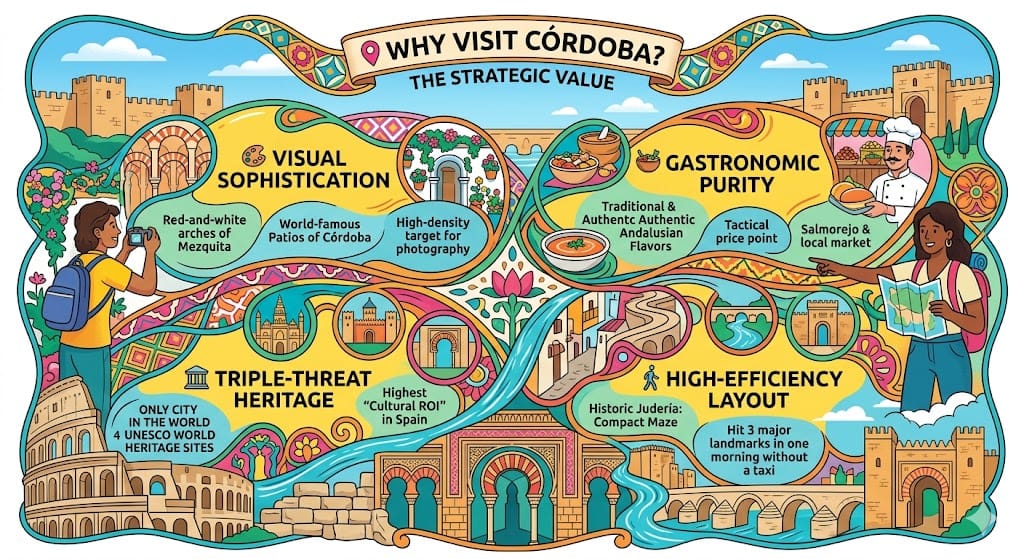
🏛️ Triple-Threat Heritage: It is the only city in the world with four UNESCO World Heritage sites. Your “cultural ROI” (Return on Investment) here is the highest in Spain.
🚶 High-Efficiency Layout: The historic Judería (Jewish Quarter) is a compact maze. You can hit three major landmarks—the Mosque, the Roman Bridge, and the Alcázar—in a single morning without a taxi.
🎨 Visual Sophistication: From the red-and-white arches of the Mezquita to the world-famous Patios of Córdoba, this is a high-density target for photography and aesthetics.
🥙 Gastronomic Purity: Córdoba remains more traditional and less “tourist-trapped” than its neighbors, offering authentic Andalusian flavors at a tactical price point.
💡 Spanaly Insight: If you seek the “Great Mosque” experience but want to avoid the chaotic crowds of Barcelona or the heat of Seville’s peak summer, Córdoba offers a more focused, refined, and historically rewarding mission.
🏰 Top 5 Must-See Landmarks: The Icons of Córdoba
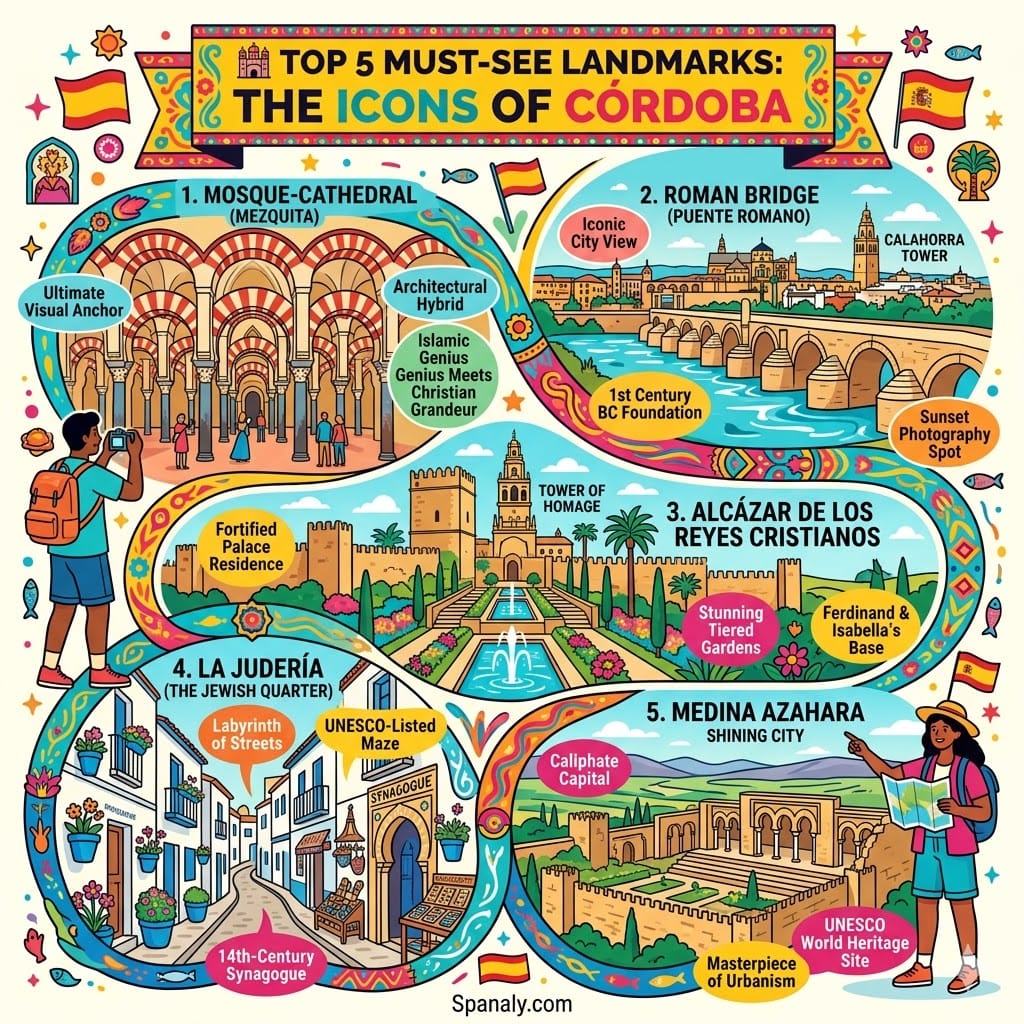
To conquer Córdoba, you must secure its most fortified historic objectives. These five landmarks define the city’s complex identity, from Roman foundations to the pinnacle of Caliphate architecture.
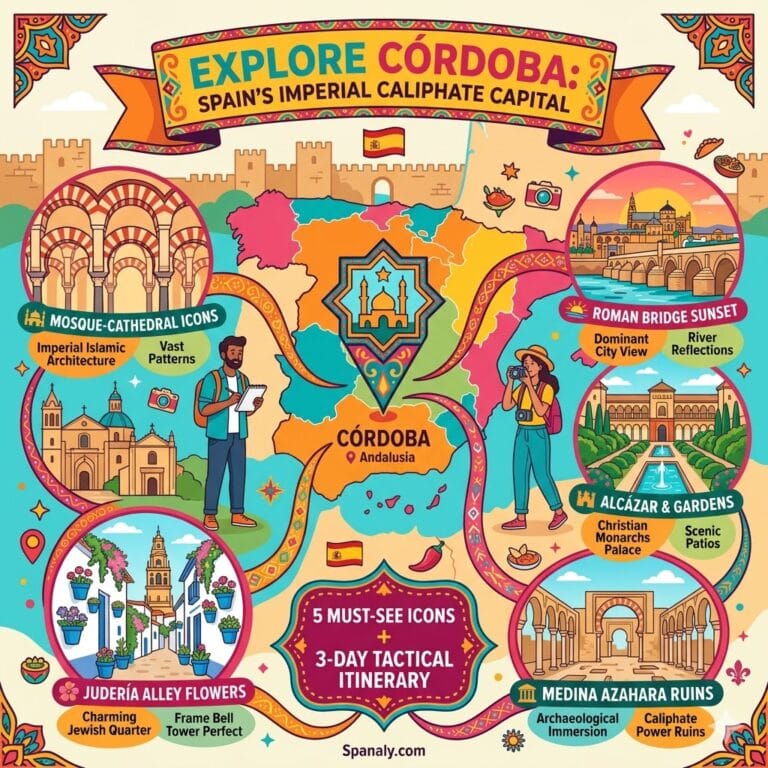
The Mosque-Cathedral (Mezquita): The ultimate visual anchor of Andalusia. This architectural hybrid, with its iconic “forest” of 856 columns and red-and-white arches, rules the city’s spirit. It is a breathtaking fusion where Islamic genius meets Christian grandeur.
Spanaly Tip: Enter between 8:30 and 9:30 AM for a quieter, more spiritual atmosphere before the large tour groups arrive.The Roman Bridge (Puente Romano): Originally built in the 1st century BC, this bridge offers the most iconic view of the city’s skyline. It’s a prime spot for sunset photography and feeling the ancient pulse of the Guadalquivir river. For the best tactical angles, follow our guide to the Roman Bridge Córdoba.
Alcázar de los Reyes Cristianos: A fortified palace with stunning terraced gardens and fountains. It served as the primary residence for the Catholic Monarchs during the conquest of Granada and is an essential target in any Spain Historical Monuments Guide.
La Judería (The Jewish Quarter): A labyrinth of narrow white-washed streets and hidden craft shops. This UNESCO-listed maze houses the 14th-century Synagogue—one of only three original medieval synagogues remaining in all of Spain.
Medina Azahara: Located 8km outside the city, this “Shining City” was the 10th-century capital of the Caliphate. It is a masterpiece of Islamic urbanism. To master the logistics of your visit, check our detailed briefing on Medina Azahara Córdoba.
⚡ Quick Summary: Icon Status & Strategy
| Landmark | Tactical Objective |
| Mezquita | Secure early entry for the “Forest of Columns” photo. |
| Roman Bridge | Cross at sunset for the best city skyline view. |
| Alcázar Palace | Focus on the tiered gardens and water features. |
| The Judería | Navigate the Calleja de las Flores for the iconic vista. |
| Medina Azahara | Plan for the shuttle bus and the interpretation center. |
💡 Spanaly Decision: Mastering these landmarks is the key to a stress-free trip. Córdoba’s density of history is staggering; understanding the chronological layers of these sites is what transforms a simple visit into a true cultural conquest.
🎨 Hidden Gems & Local Secrets
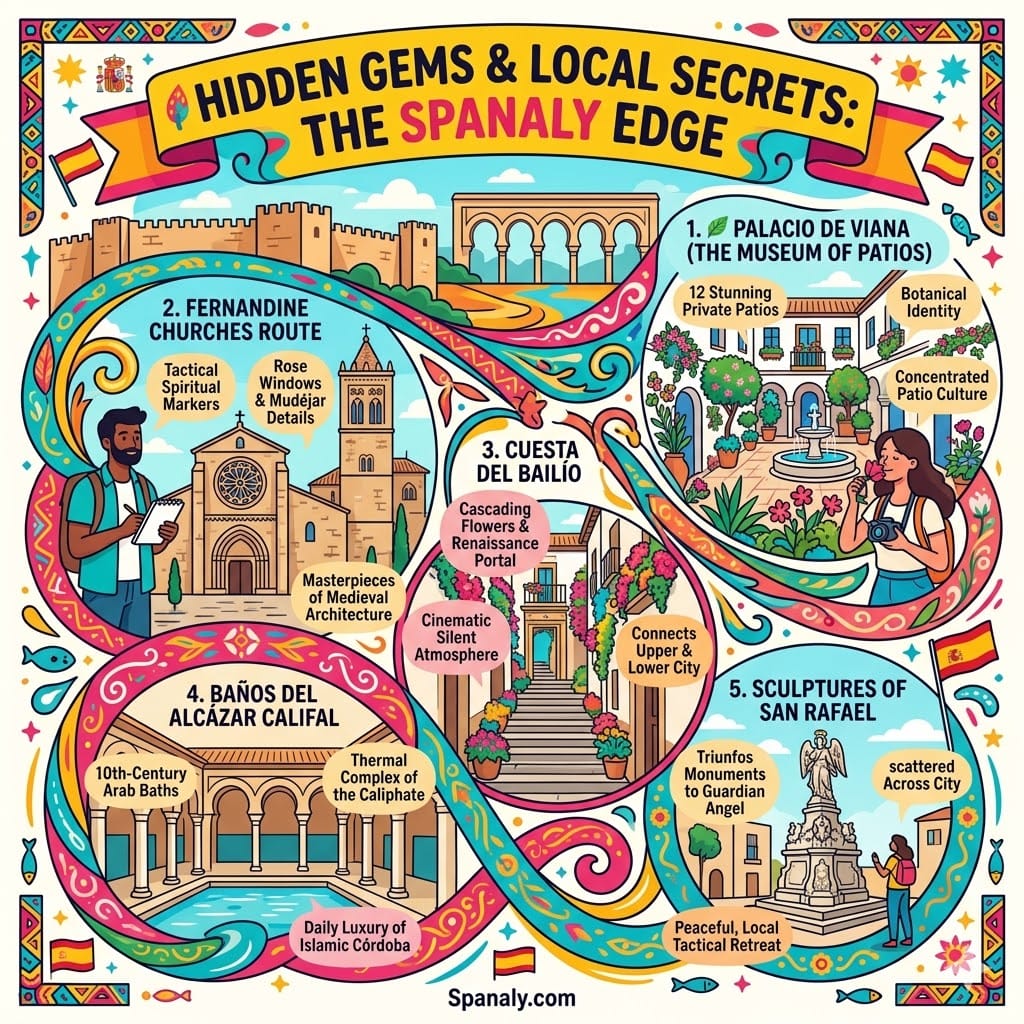
To truly conquer Córdoba, you must look beyond the red-and-white arches. These “off-radar” targets offer a quiet, high-value mission for travelers seeking the city’s authentic soul.
Palacio de Viana (The Museum of Patios): While everyone battles for a photo in the Calleja de las Flores, the elite move to this palace. It features 12 stunning private patios, each with a unique botanical identity. It is the most concentrated dose of Córdoba’s “Patio Culture” without the seasonal festival crowds.
The Fernandine Churches Route: After the Christian conquest, 12 churches were built as tactical spiritual markers. Santa Marina and San Lorenzo are masterpieces of medieval architecture, featuring rose windows and Mudéjar details that most tourists walk right past.
Cuesta del Bailío: A hidden, stepped street framed by a Renaissance portal and cascading flowers. It connects the upper and lower city and offers a cinematic, quiet atmosphere that feels like stepping into a 16th-century painting.
Baños del Alcázar Califal: These 10th-century Arab baths are often overshadowed by the main Alcázar. They are the most important thermal complex of the Caliphate, offering a chillingly beautiful look at the daily luxury of Islamic Córdoba.
The Sculptures of San Rafael: Scattered across the city are “Triunfos” (monuments) to the city’s guardian angel. Finding the one near the Roman Bridge is easy, but the hidden one in Plaza de la Compañía offers a peaceful, local tactical retreat.
⚡ Tactical Intelligence: Beyond the Crowds
| Target | Why It’s a Gem |
| Viana Palace | 12 private patios in one single ticket. |
| San Lorenzo | The most beautiful rose window in Andalusia. |
| Baños Califales | Pure 10th-century Caliphate engineering. |
| Cuesta del Bailío | The city’s most “Instagrammable” silent street. |
💡 Spanaly Decision: The true secret of Córdoba is the vertical layer of history. To see how to fit these hidden gems into a perfect schedule, check out our Cordoba 3-Day Itinerary for a complete tactical breakdown of your time in the city.
🍽️ Gastronomy: The Flavors of the Caliphate
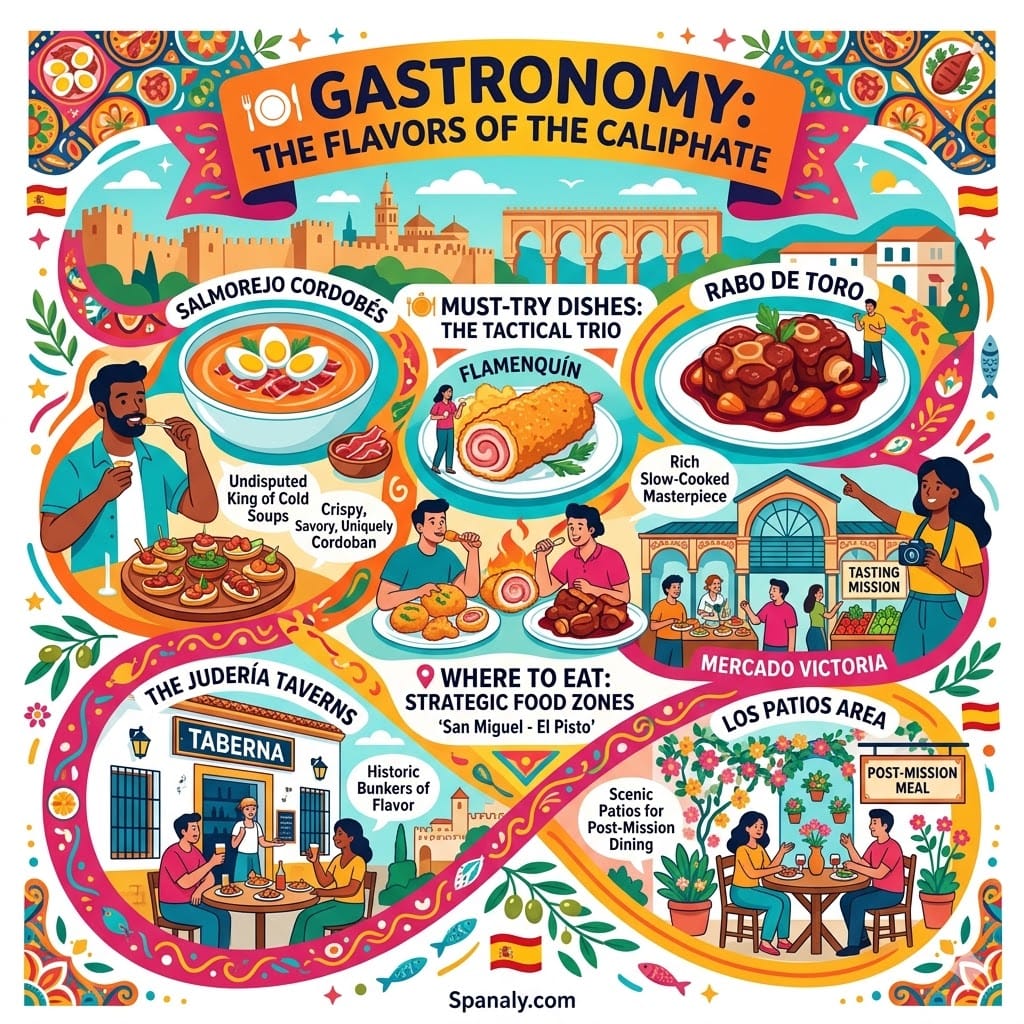
Dining in Córdoba is a tactical exercise in simplicity and tradition. The city doesn’t rely on fusion; it relies on the absolute purity of its local ingredients, especially the world-class olive oil from the nearby mountains.
🥘 Must-Try Dishes: The Tactical Trio
Salmorejo Cordobés: The undisputed king. Thicker and creamier than Gazpacho, this cold tomato and bread soup is topped with hard-boiled eggs and Jamón Ibérico. It’s the ultimate fuel for a hot Andalusian afternoon.
Flamenquín: A powerful tactical roll of pork loin wrapped around Serrano ham, breaded, and deep-fried. It’s crispy, savory, and uniquely Cordoban.
Rabo de Toro (Oxtail Stew): A slow-cooked masterpiece. The meat is so tender it falls off the bone, served in a rich, dark red wine sauce. It represents the soul of the city’s culinary heritage.
📍 Where to Eat: Strategic Food Zones
Mercado Victoria: A sophisticated gastro-market built in a 19th-century pavilion. It’s the perfect high-efficiency spot to try multiple tapas in one mission.
The Judería Taverns: Look for “Tabernas” like Taberna San Miguel (El Pisto). These are historic bunkers of flavor where locals have been eating for decades.
Los Patios Area: Ideal for a scenic “Post-Mission” meal, though prices can be slightly higher due to the aesthetic ROI.
💡 Spanaly Insight: For the most authentic experience, pair your meal with a glass of Montilla-Moriles, the local fortified wine. It is Córdoba’s answer to Sherry and is essential for a true Spanish Cuisine deep dive.
📸 Best Photo Spots: Capturing Córdoba’s Soul
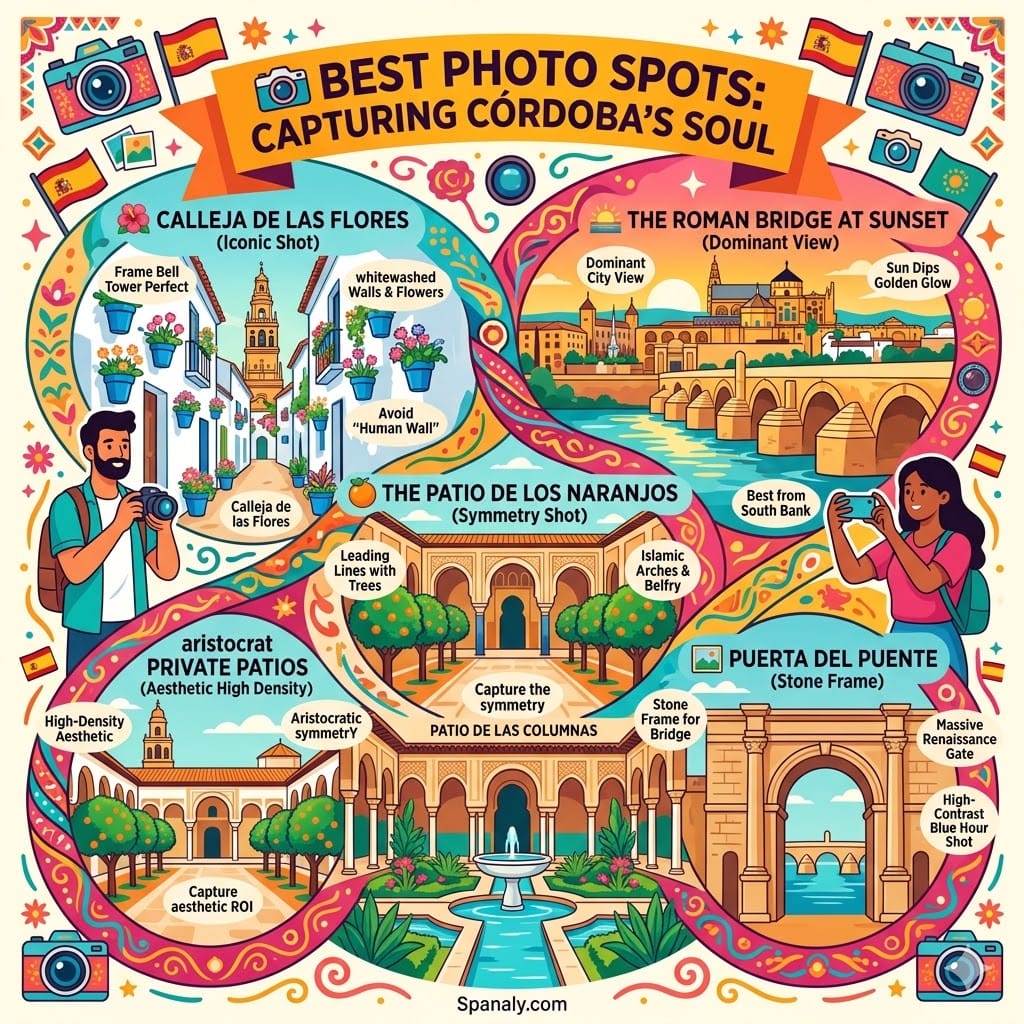
To dominate the visual narrative of your trip, you need to hit these specific coordinates. Timing is everything in Córdoba—the difference between a “tourist snap” and a “professional conquest” is the angle and the hour.
Calleja de las Flores: The most iconic shot. Standing at the end of this narrow alley, you can frame the bell tower of the Mezquita perfectly between white-washed walls and blue flower pots. Tactical Timing: Arrive at 8:00 AM to avoid the “human wall” of tour groups.
The Roman Bridge at Sunset: Position yourself on the south bank (near Torre de la Calahorra). As the sun dips, the Mezquita and the bridge light up in a golden glow, reflecting beautifully on the Guadalquivir river.
The Patio de los Naranjos: Inside the Mezquita’s courtyard, use the rows of orange trees to create leading lines toward the stunning Islamic arches and the Christian belfry.
The Viana Palace Courtyards: Specifically the Patio de las Columnas. The symmetry and the water features offer a high-density aesthetic that feels purely aristocratic.
Puerta del Puente: This massive Renaissance gate acts as a perfect stone frame for the Roman Bridge. It’s a powerful, high-contrast shot during the “blue hour.”
💡 Spanaly Insight: Don’t just look up; look through. Many historic houses in the Judería have beautiful iron gates (rejas) that offer a “peek” into private, lush patios. These “frame-within-a-frame” shots are the secret to authentic storytelling.
🗺️ Suggested Itineraries: Strategic Mission Briefs
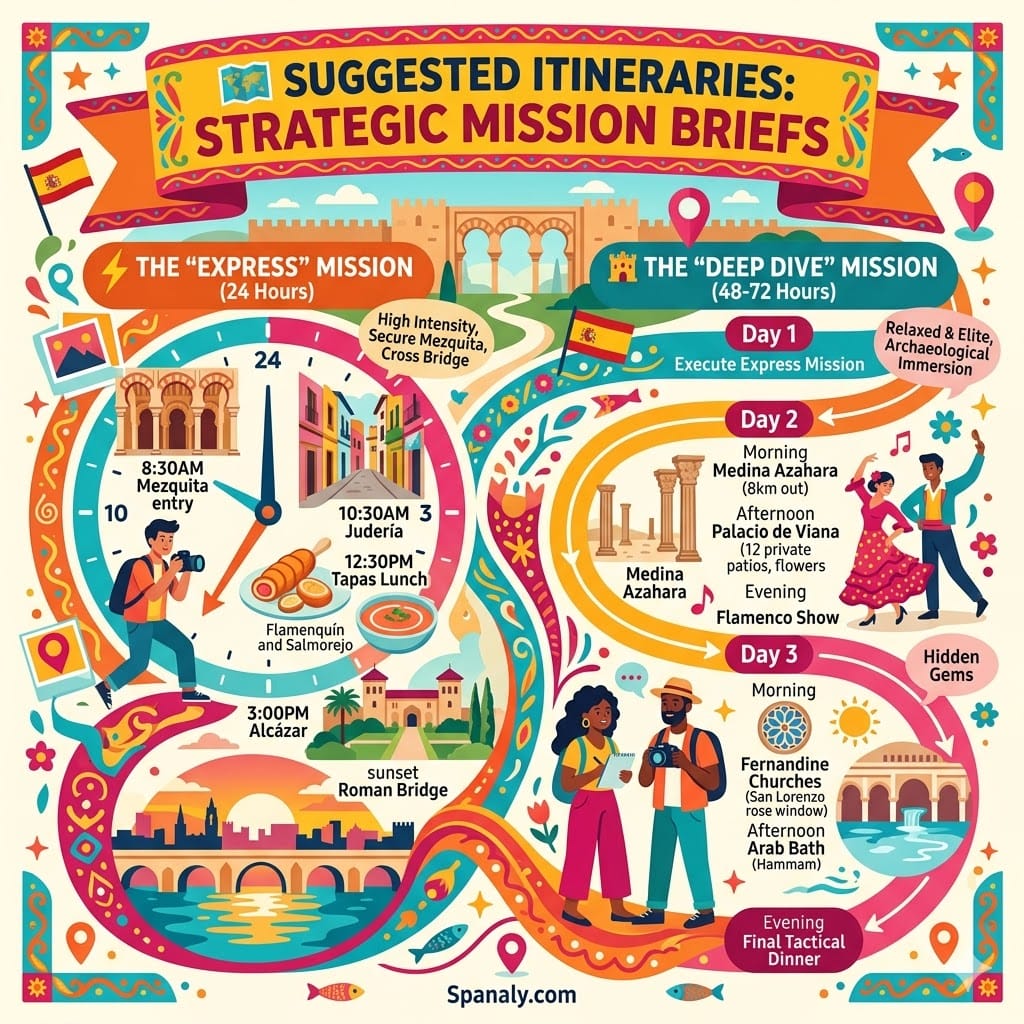
To maximize your cultural ROI, you must follow a logical flow. These itineraries are designed to avoid backtracking and ensure you hit your targets during optimal lighting and crowd conditions.
⚡ The “Express” Mission (24 Hours)
08:30 – 10:00: Secure the Mezquita (Mosque-Cathedral) before the crowds. Focus on the Mihrab and the Christian Choir.
10:30 – 12:00: Navigate the Judería (Jewish Quarter). Visit the Synagogue and the Calleja de las Flores.
12:30 – 14:30: Tactical Lunch at Mercado Victoria or a tavern for Salmorejo and Flamenquín.
15:00 – 17:00: Reconnaissance of the Alcázar de los Reyes Cristianos and its terraced gardens.
18:30 – Sunset: Cross the Roman Bridge for the definitive city skyline photo.
🏰 The “Deep Dive” (48-72 Hours)
Day 1: Execute the Express Mission above.
Day 2: * Morning: Deploy to Medina Azahara (8km out) for a 3-hour archaeological immersion.
Afternoon: Visit Palacio de Viana to explore the 12 private patios.
Evening: Attend a Flamenco show in a traditional Judería cave.
Day 3: * Morning: Follow the Fernandine Churches route (Santa Marina & San Lorenzo).
Afternoon: Relax at the Hammam Al Ándalus for a traditional Arab bath experience.
Evening: Final tactical dinner in the San Lorenzo neighborhood.
💡 Spanaly Decision: Córdoba is often paired with its Andalusian sister. If you are continuing your mission south, make sure to sync your schedule with our Seville 3-Day Itinerary to ensure a high-efficiency transition between these two historic powerhouses.
⚡ Tactical Summary: Mission Objectives
| Duration | Main Focus | Difficulty |
| 24 Hours | The Imperial Icons (Mezquita & Bridge) | High Intensity |
| 48 Hours | Caliphate Power (Medina Azahara added) | Moderate |
| 72 Hours | Total Immersion (Hidden Gems & Patios) | Relaxed & Elite |
🧳 Essential Logistics: Securing Your Córdoba Mission
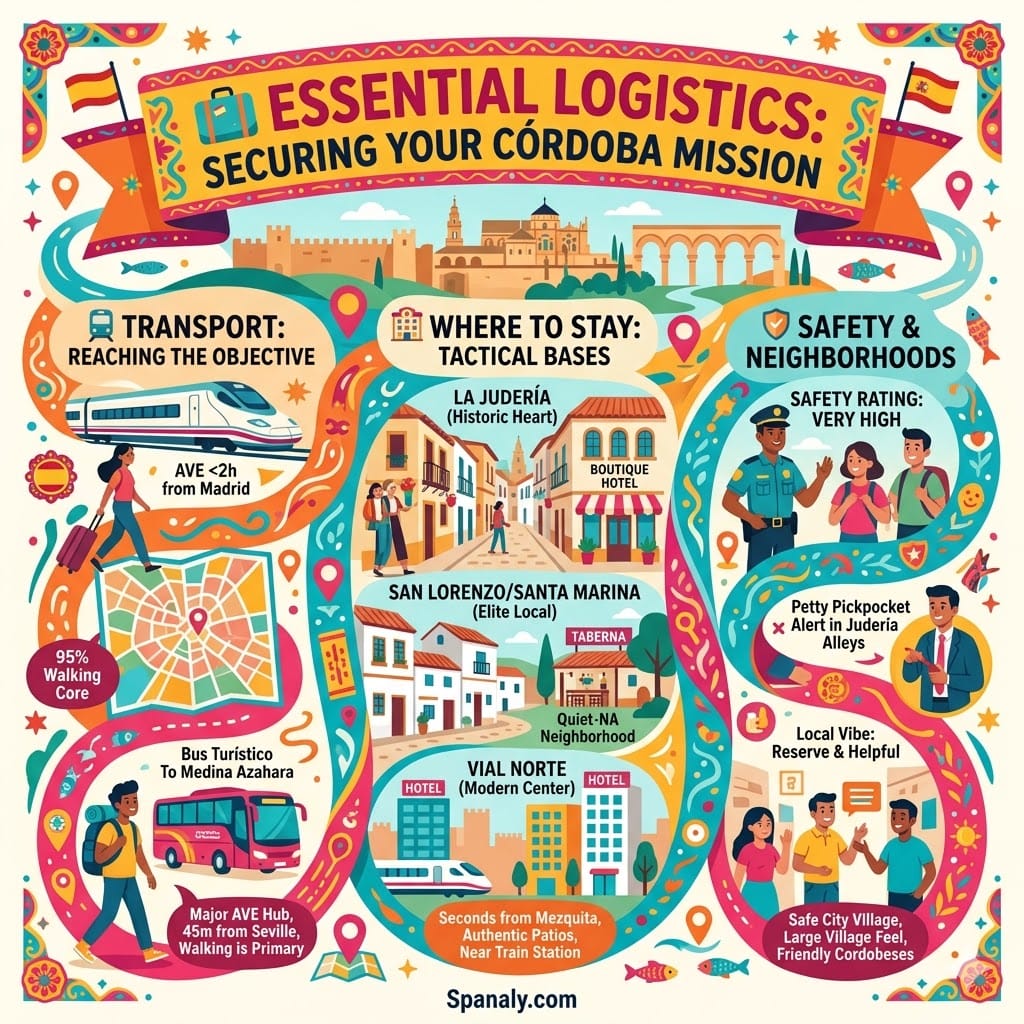
To execute a flawless trip, your logistics must be as precise as a Caliphate architect. Córdoba’s compact nature is its greatest tactical advantage, provided you choose the right base and transport methods.
🚆 Transport: Reaching the Objective
High-Speed Rail (AVE): The most efficient way to arrive. Córdoba is a major hub on the Madrid-Seville line. You can reach the city in under 2 hours from Madrid and just 45 minutes from Seville.
Walking: Once in the historic center, your primary transport is your feet. 95% of your targets are within a 15-minute walking radius.
The “Bus Turístico”: A solid tactical choice if you want to reach Medina Azahara or the further Fernandine churches without navigating the local bus system.
🏨 Where to Stay: Tactical Bases
La Judería (Historic Heart): Ideal for first-timers. You’ll be seconds away from the Mezquita, but expect narrow streets and higher noise levels.
San Lorenzo/Santa Marina: For an elite, local experience. Quiet, authentic, and surrounded by the best traditional taverns.
Vial Norte (Modern Center): Perfect if you prioritize proximity to the train station and modern hotel amenities.
🛡️ Safety & Neighborhoods
Safety Rating: Very High. Córdoba is one of the safest cities in Spain. However, stay alert in the crowded alleys of the Judería to avoid petty pickpocketing.
Neighborhood Vibe: The city feels like a large village. The locals (Cordobeses) are generally reserved but very helpful if you initiate contact.
💡 Spanaly Insight: The “Best Time to Visit” is a critical tactical decision. May is the peak of the mission due to the Patios Festival, but it’s also the most crowded. For a high-value, low-stress experience, target late October or March for mild weather and clear photo angles.
⚔️ Tactical Comparison: Córdoba vs. Granada
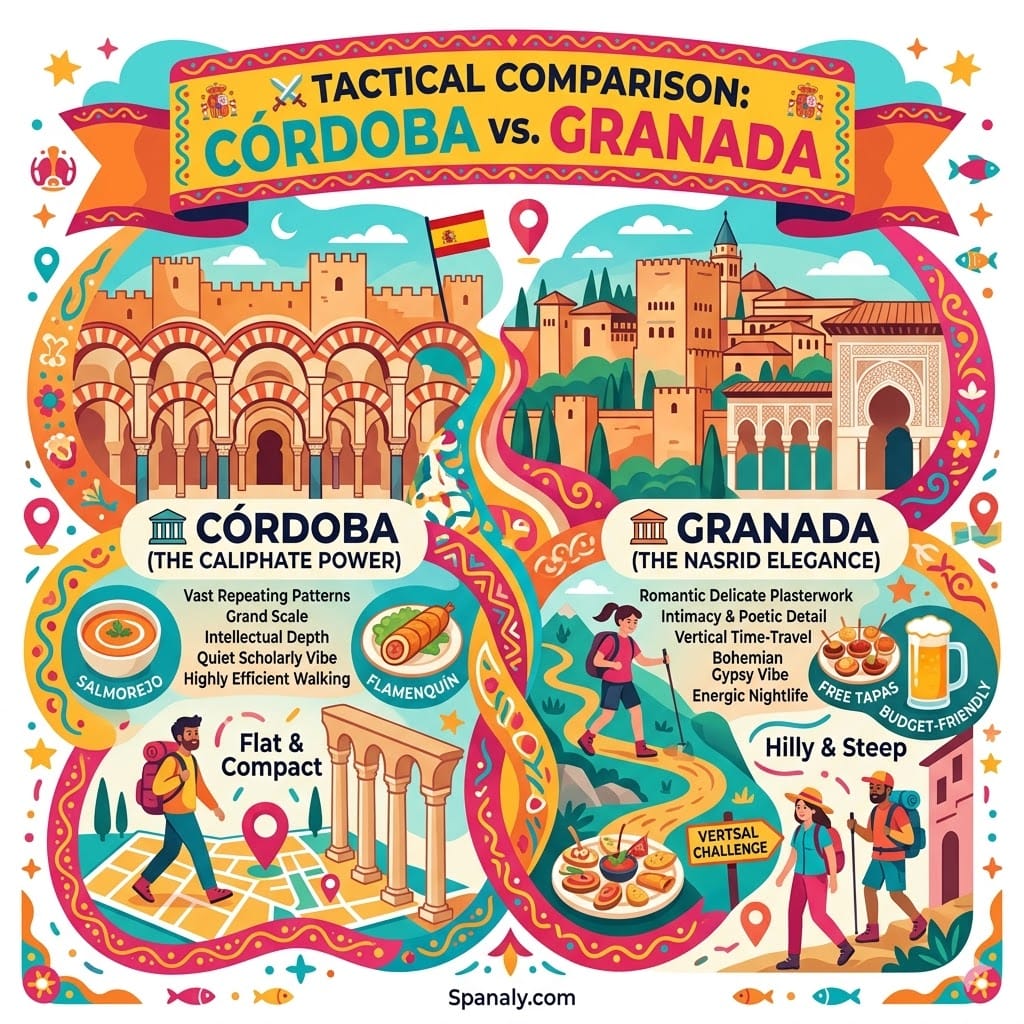
Choosing between these two Andalusian titans is a common strategic dilemma. While both share a Moorish DNA, their “mission profiles” are distinctly different.
🏛️ Architecture & Heritage
Córdoba (The Caliphate Power): Focuses on the 10th-century grandeur. The Mezquita is an intellectual and religious statement of a global superpower. It’s about vast, repeating patterns and grand scale.
Granada (The Nasrid Elegance): Focuses on the 14th-century refinement. The Alhambra is a romantic, delicate fortress of water and intricate plasterwork. It’s about intimacy and poetic detail.
🚶 Maneuverability & Vibe
Córdoba (The Compact Core): Highly efficient. You can conquer the main targets on foot in a single day. The vibe is quiet, scholarly, and traditionally Andalusian.
Granada (The Vertical Challenge): More physically demanding. You’ll be hiking the steep hills of the Albayzín and Sacromonte. The vibe is bohemian, energetic, and heavily influenced by gypsy culture and students.
🥘 Gastronomic ROI
Córdoba: Famous for its Salmorejo and Rabo de Toro. You pay for quality, and the taverns are authentic “flavor bunkers.”
Granada: Famous for its Free Tapas culture. You buy a drink, and the food comes free. It’s high-volume, social, and budget-friendly.
💡 Spanaly Insight: If you seek intellectual depth and walking efficiency, Córdoba wins. If you seek romantic vistas and a vibrant nightlife, Granada takes the objective. For a complete tactical overview of the southern rival, check out our Granada Spain’s Moorish Past guide.
⚡ Comparison Scorecard
| Feature | Córdoba | Granada |
| Main Icon | Mezquita (Mosque) | Alhambra (Palace) |
| Walkability | 10/10 (Flat & Compact) | 6/10 (Hilly & Steep) |
| Crowd Levels | Moderate (Day-trip heavy) | High (Year-round) |
| Food Style | Traditional Tabernas | Free Tapas Culture |
💡 Spanaly Tips: Tactical Field Advice for Córdoba
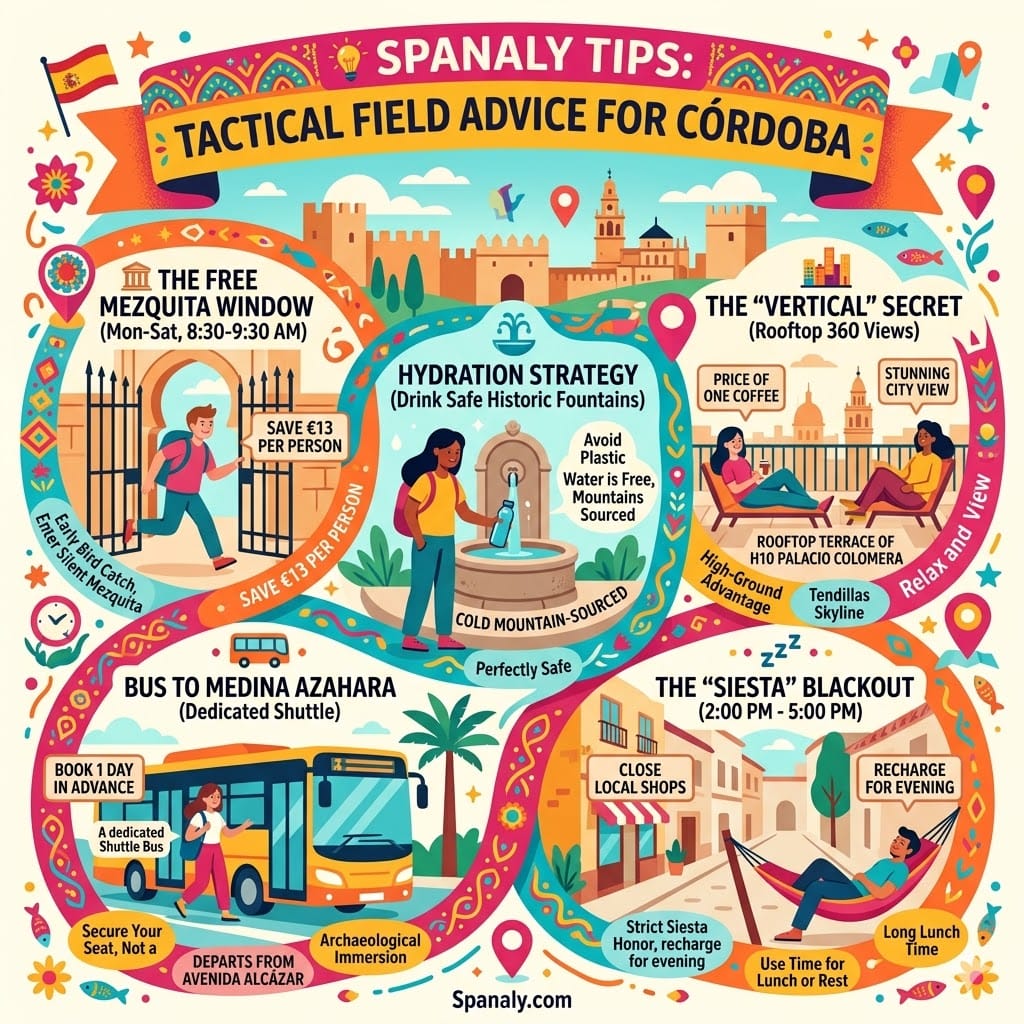
To dominate your Córdoba mission like a pro, you need more than just a map. These field-tested tips will give you the “Spanaly Edge,” ensuring you save money, avoid crowds, and experience the city like a local.
The Free Mezquita Window: If you are an early riser, you can enter the Mosque-Cathedral for free between 8:30 AM and 9:30 AM (Monday to Saturday). It’s a tactical saving of €13 per person, provided you don’t mind a shorter, silent visit.
Hydration Strategy: Córdoba is one of Spain’s hottest cities. Don’t keep buying plastic bottles. Use the historic stone fountains scattered around the Judería; the water is cold, mountain-sourced, and perfectly safe to drink.
The “Vertical” Secret: Many tourists only see the city at eye level. For a high-ground advantage, head to the rooftop terrace of the H10 Palacio Colomera in Plaza de las Tendillas. It offers a stunning 360-degree view of the city skyline for the price of one coffee.
Bus to Medina Azahara: Don’t take a taxi to Medina Azahara (it’s expensive). There is a dedicated Shuttle Bus that departs from Avenida Alcázar. You must book it at least a day in advance at the tourism office to secure your seat.
The “Siesta” Blackout: Remember that Córdoba honors the Siesta strictly. Between 2:00 PM and 5:00 PM, almost all local shops (outside the immediate Mezquita area) will close. Use this time for a long lunch or a rest to recharge for the evening.
💡 Spanaly Insight: If you’re visiting in May, the Patios Festival is free, but the lines are massive. Tactical tip: Visit the patios during the last two hours before closing (usually 8:00 PM – 10:00 PM) when the day-trippers have already headed back to Seville or Madrid.
🛡️ Visitor FAQs – Ultimate Córdoba Travel Guide
🎫 Do I need to book Mosque-Cathedral tickets in advance?
Absolutely. While you can try the ticket office, online booking is the only way to guarantee entry, especially during peak hours. Tickets for the Bell Tower (Campanario) are separate and limited, so secure them at least 48 hours before your mission to avoid the "Sold Out" sign.
🌡️ How do I handle the extreme summer heat in Córdoba?
Córdoba is often the hottest city in Europe. The tactical move is the "Split-Day Mission": execute all outdoor sightseeing (Mezquita, Bridge) before 11:00 AM, retreat to air-conditioned museums or a Siesta until 6:00 PM, and then rejoin the city for dinner and night photography.
👗 Is there a specific dress code for religious monuments?
Yes. While not as strict as the Vatican, the Mosque-Cathedral is an active place of worship. We recommend respectful attire: avoid very short shorts or tank tops. Carrying a light scarf is a smart tactical choice to cover shoulders if needed while staying cool in the Andalusian heat.
🚉 Can I visit Córdoba as a day trip from Seville?
Yes, it is highly efficient. The AVE high-speed train takes only 45 minutes from Seville. However, to see Medina Azahara and the illuminated Roman Bridge at night, an overnight stay is recommended for the full Spanaly experience.
💰 Is Córdoba more expensive than Madrid or Barcelona?
On the contrary, Córdoba offers excellent value for money. Food and accommodation are significantly cheaper than in the major capitals. You can enjoy a high-quality "Menu del Día" for a fraction of the price you would pay in Barcelona, making it a budget-friendly powerhouse.
Córdoba Logistics Guide by Spanaly.com
Córdoba is not just a stop on the map; it’s a high-value journey through the peak of human history. From the towering arches of the Caliphate to the quiet, flower-scented patios of the Judería, every street tells a story of cultural mastery.
🏰 Summary: Secure the Mezquita early, walk the Roman Bridge at sunset, and don’t skip the Salmorejo.
🚶 Maneuverability: Keep your gear light—this city is meant to be conquered on foot.
💡 Final Advice: Respect the Siesta, embrace the heat, and look for the hidden history beneath your feet.
🚀 Next Objective: Ready to expand your Spanish mission further north? If you enjoyed the Roman and Moorish layers of Córdoba, you must see how they blend in the Aragonese capital. Check our tactical guide on the Things to Do in Zaragoza to plan your next strategic move!