
Table of Contents
Toggle🏰 The City of the Three Cultures
Toledo is much more than just a day trip from the capital. Notably, it is a living masterpiece rising above the plains of Castilla-La Mancha. Travelers often call it the “City of Three Cultures.” Specifically, Christian, Muslim, and Jewish influences shaped the city’s identity over centuries. Consequently, every cobblestone street whispers stories of knights, artists, and ancient empires.
🛡️ Medieval Heritage: A hilltop fortress filled with Gothic cathedrals and ancient synagogues.
🎨 Artistic Legacy: The legendary home of El Greco, where every corner inspires creativity.
🤝 Cultural Fusion: A unique place where different worlds created stunning architecture.
🌆 Iconic Views: Home to one of the most famous city skylines in all of Spain.
Indeed, Toledo offers an unforgettable experience for history enthusiasts and photographers. Its deep history makes it a perfect inland counterpart to the coastal heritage found in our Cádiz Travel Guide. Ultimately, the city’s unique charm serves as a bridge between modern urban vibes and the ancient Moorish soul of Spain.
💡 Spanaly Insight: Many visitors rush through Toledo in just a few hours. In fact, the city reveals its true magic after sunset. Notably, when the day-trip crowds leave, the illuminated stone walls create a mysterious atmosphere you won’t find anywhere else!
⚔️ Toledo vs. Segovia: Which One to Choose?
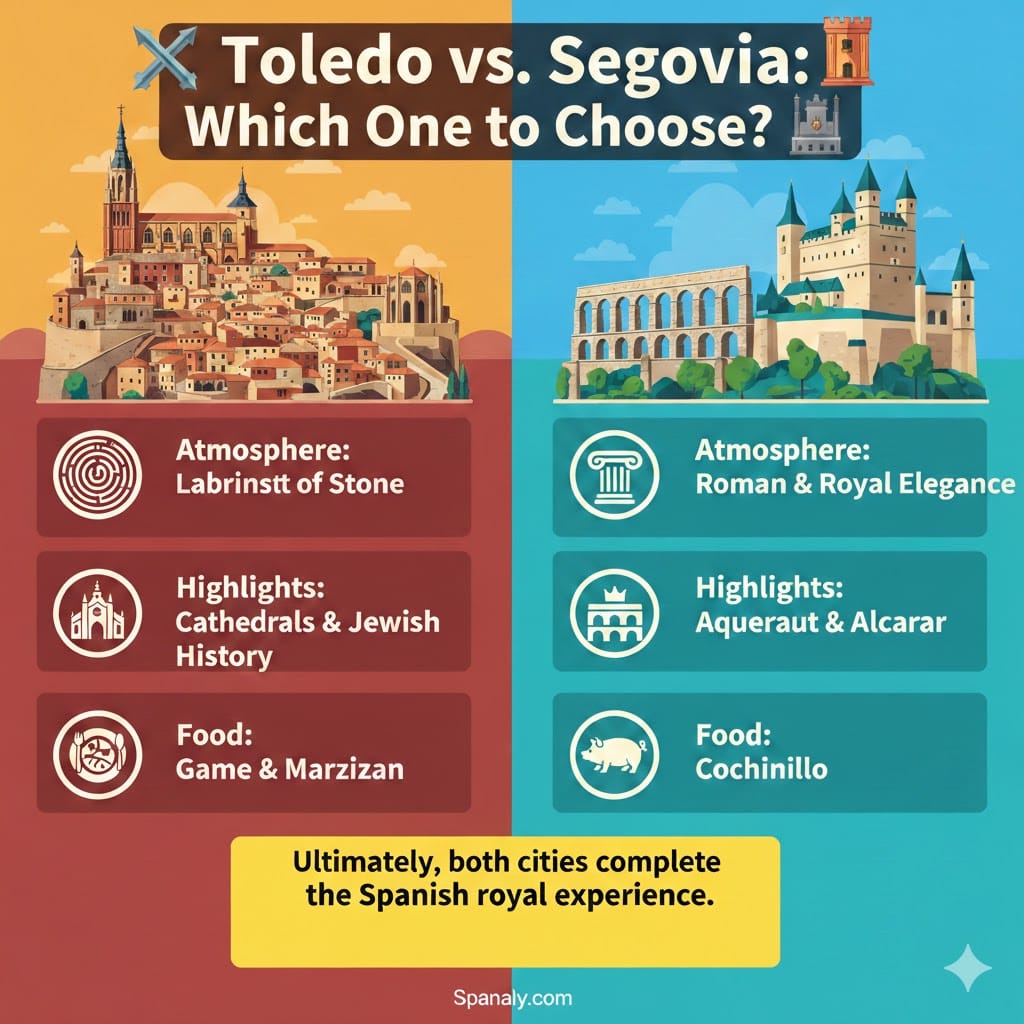
Many travelers wonder which historic city to visit first. Notably, while both are UNESCO sites near the capital, they offer very different vibes. Specifically, Toledo feels like a dense, vertical medieval fortress with deep religious roots. In contrast, Segovia is more open, famous for its fairy-tale castle and massive Roman Aqueduct.
🏛️ Atmosphere: Toledo is a labyrinth of stone; Segovia is a blend of Roman and Royal elegance.
⛪ Highlights: Choose Toledo for Gothic cathedrals and Jewish history. Pick Segovia for the “Disney” castle (Alcázar) and Roman engineering.
🥘 Food: Toledo excels in game meat and marzipan. Segovia is world-famous for its roast suckling pig (Cochinillo).
Indeed, if you love the “City of Three Cultures” feel, Toledo is your winner. However, if you prefer seeing a Roman wonder, you should explore our guide on Segovia Guide. Ultimately, both cities complete the Spanish royal experience in different ways.
📍 Quick Facts: Planning Your Toledo Trip
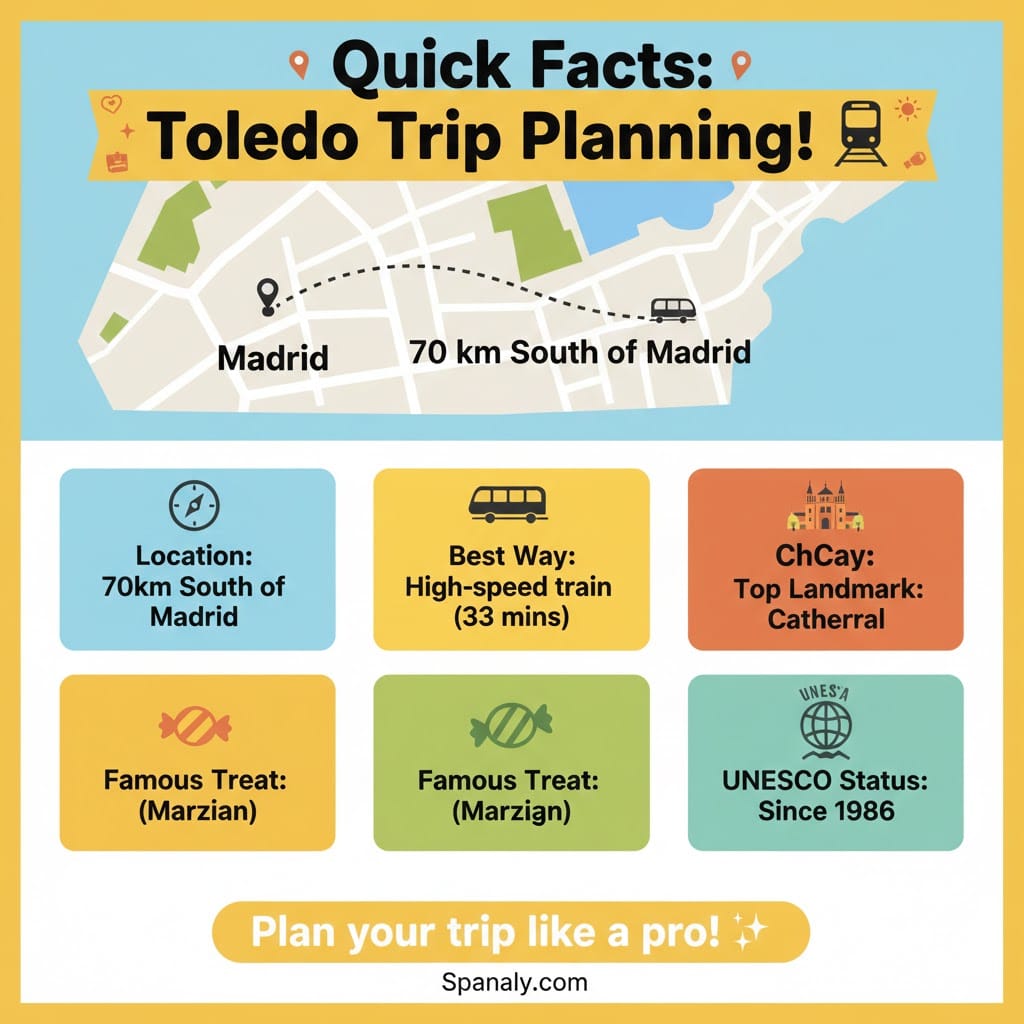
Before you pack your bags for the “City of Three Cultures,” here is everything you need to know at a glance. Notably, Toledo is a compact city, making it one of the most efficient destinations for history lovers. Specifically, its location in central Spain ensures easy access while offering a completely different atmosphere from the coastal vibes of the south.
📍 Location: 70 km South of Madrid, perched on a dramatic gorge above the Tagus River.
🚆 Best Way to Reach: High-speed train (AVANT) takes only 33 minutes from Madrid’s Atocha station.
⛪ Top Landmark: Santa María de Toledo Cathedral, a pinnacle of Spanish Gothic architecture.
🍬 Famous Treat: Mazapán (Marzipan)—look for the “IGP” seal to ensure it’s the authentic local delicacy.
🌍 UNESCO Status: Proudly listed as a World Heritage Site since 1986.
Indeed, having these basics covered ensures a smoother journey. For travelers who enjoy organized logistics, this quick overview is as vital as the planning tips found in our Madrid Travel Guide. Ultimately, a few minutes of preparation will help you master the steep, winding streets of this medieval fortress.
💡 Spanaly Insight: Did you know that Toledo was the capital of the Spanish Empire until 1561? In fact, that is why the city feels so grand and monumental. Notably, when the court moved to Madrid, Toledo remained frozen in time, preserving its incredible medieval layout!
🚆 How to Get to Toledo: The Best Routes
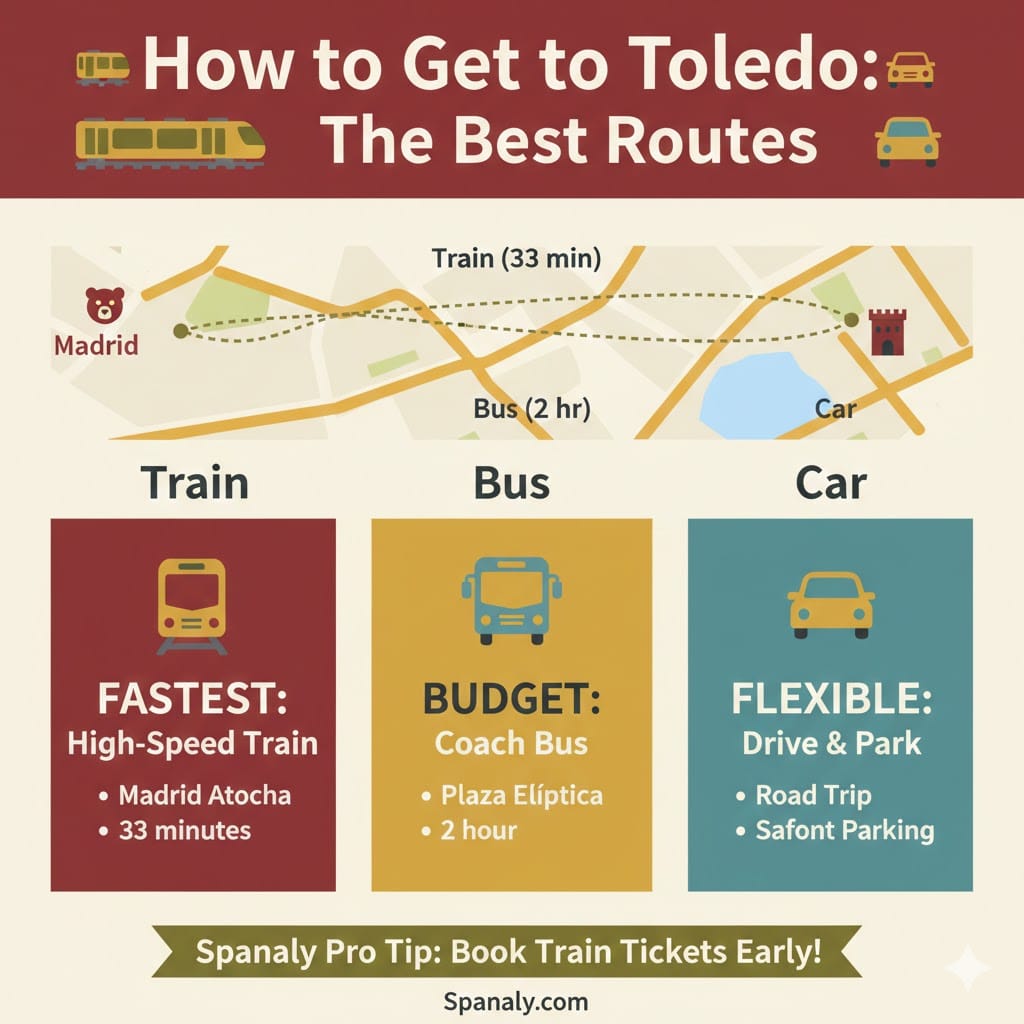
Reaching this historic gem is incredibly easy, especially if you are starting from the capital. Notably, the infrastructure connecting the two cities is world-class. Specifically, you have three main ways to make the journey, depending on your budget and travel style.
🚆 By Train (Recommended): The high-speed AVANT train from Madrid’s Atocha station takes only 33 minutes. It is the fastest and most comfortable option for a day trip.
🚌 By Bus: A more budget-friendly choice, taking around 1 hour from the Plaza Elíptica station. It offers a closer look at the Spanish countryside for a fraction of the price.
🚗 By Car: Ideal if you are planning a wider road trip. In fact, we recommend parking at the “Safont” area near the bus station, as driving inside the narrow medieval Old Town is nearly impossible.
Indeed, the seamless connection makes it an effortless escape. To ensure a smooth departure from the city center, you can review our guide on Getting Around Madrid for expert transport tips. Ultimately, whether you choose the speed of the train or the flexibility of a car, your arrival at Toledo’s Neo-Mudéjar station marks a beautiful start to your trip.
💡 Spanaly Insight: Planning to take the train? In fact, you should book your tickets at least a few days in advance during weekends. Notably, the morning trains to Toledo and the late afternoon returns often sell out quickly because of their massive popularity!
📅 Best Time to Visit Toledo
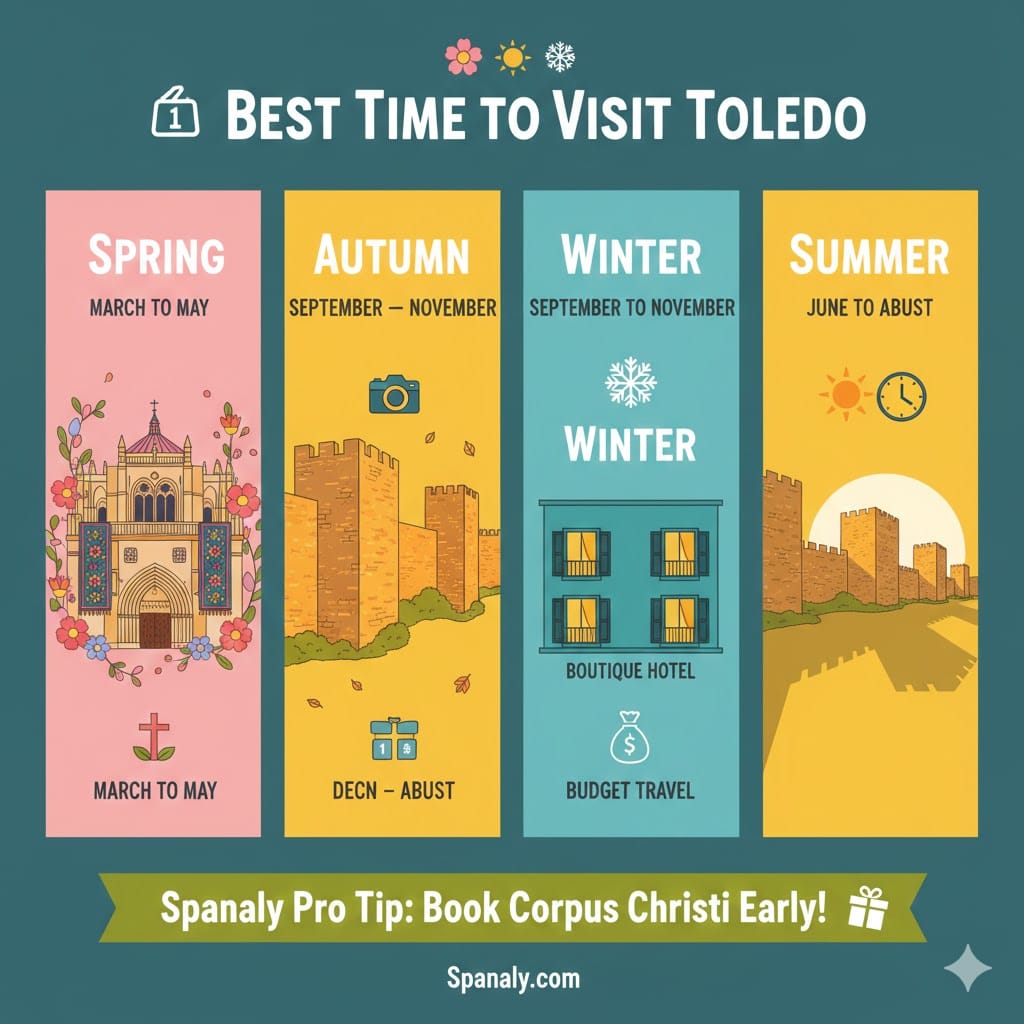
Toledo’s weather can be extreme due to its location in the heart of the Spanish plateau. Notably, choosing the right season is crucial for a comfortable walking experience through its steep alleys. Specifically, the city transforms with each season, offering different vibes for photographers and festival lovers.
🌸 Spring (March to May): This is the ideal time. The weather is mild, and you can witness the famous Corpus Christi festival, where the streets are decorated with ancient tapestries.
🍂 Autumn (September to November): Another excellent choice. In fact, the golden autumn light hitting the stone walls is perfect for photography, and the crowds are significantly thinner.
❄️ Winter (December to February): It can be quite cold and windy. However, it is the best time for budget travelers to find great deals on boutique hotels.
☀️ Summer (June to August): Temperatures often exceed 35°C. Consequently, if you visit now, we recommend exploring early in the morning or late at night to avoid the intense heat.
Indeed, timing your trip correctly ensures you enjoy the “City of Three Cultures” to the fullest. To compare these seasons with other regions, you can check our guide on the Best Time to Visit Spain for a complete weather overview. Ultimately, whether you prefer the blooming flowers of spring or the quiet chill of winter, Toledo’s beauty remains timeless.
💡 Spanaly Insight: Visiting during the Corpus Christi festival in June? In fact, you should book your stay months in advance. Notably, this is the city’s biggest event, and the entire Old Town becomes a massive, aromatic garden filled with herbs and flowers!
🏛️ Top Attractions: The Must-See Landmarks
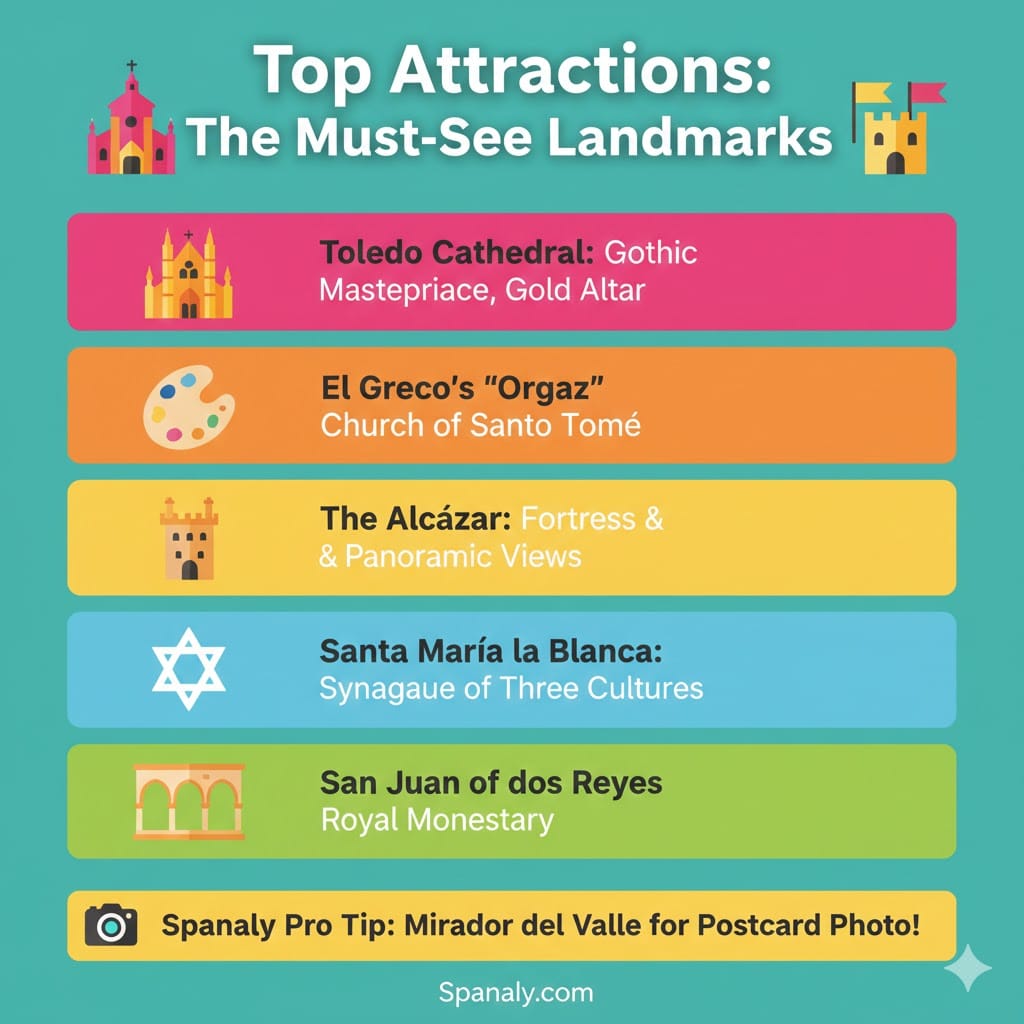
Toledo is an architectural maze where every building tells a story of cultural fusion. Notably, the city is compact enough that you can visit most of its high-priority highlights on foot. Specifically, these monuments represent the peak of Spanish Gothic and Mudéjar art.
⛪ Toledo Cathedral: A masterpiece of Gothic art. In fact, its interior is filled with gold, stunning stained glass, and the famous Transparente altar.
🎨 Church of Santo Tomé: Home to El Greco’s most famous painting, The Burial of the Count of Orgaz. It is an essential stop for art lovers.
🏰 The Alcázar of Toledo: This massive stone fortress dominates the skyline. Today, it houses a military museum and offers panoramic views of the entire valley.
🕍 Synagogue of Santa María la Blanca: A symbol of the “Three Cultures.” Interestingly, it was built by Moorish architects for Jewish worship under Christian rule.
🌿 Monastery of San Juan de los Reyes: Built by the Catholic Monarchs. Consequently, its two-level cloisters are considered some of the most beautiful in Spain.
Indeed, the scale of these stone wonders is breathtaking. Furthermore, if you are impressed by these historic fortresses, you will find the Alhambra in Granada equally magnificent in its Moorish detail. Ultimately, walking through Toledo is like stepping into an open-air museum that hasn’t changed in five centuries.
💡 Spanaly Insight: Want the best photo of the entire city? In fact, you must cross the river to the Mirador del Valle. Notably, it is a 15-minute taxi ride or a scenic 40-minute walk, but it offers the iconic “postcard” view you see on every travel magazine!
🏘️ Barrio de la Judería: Exploring the Jewish Quarter
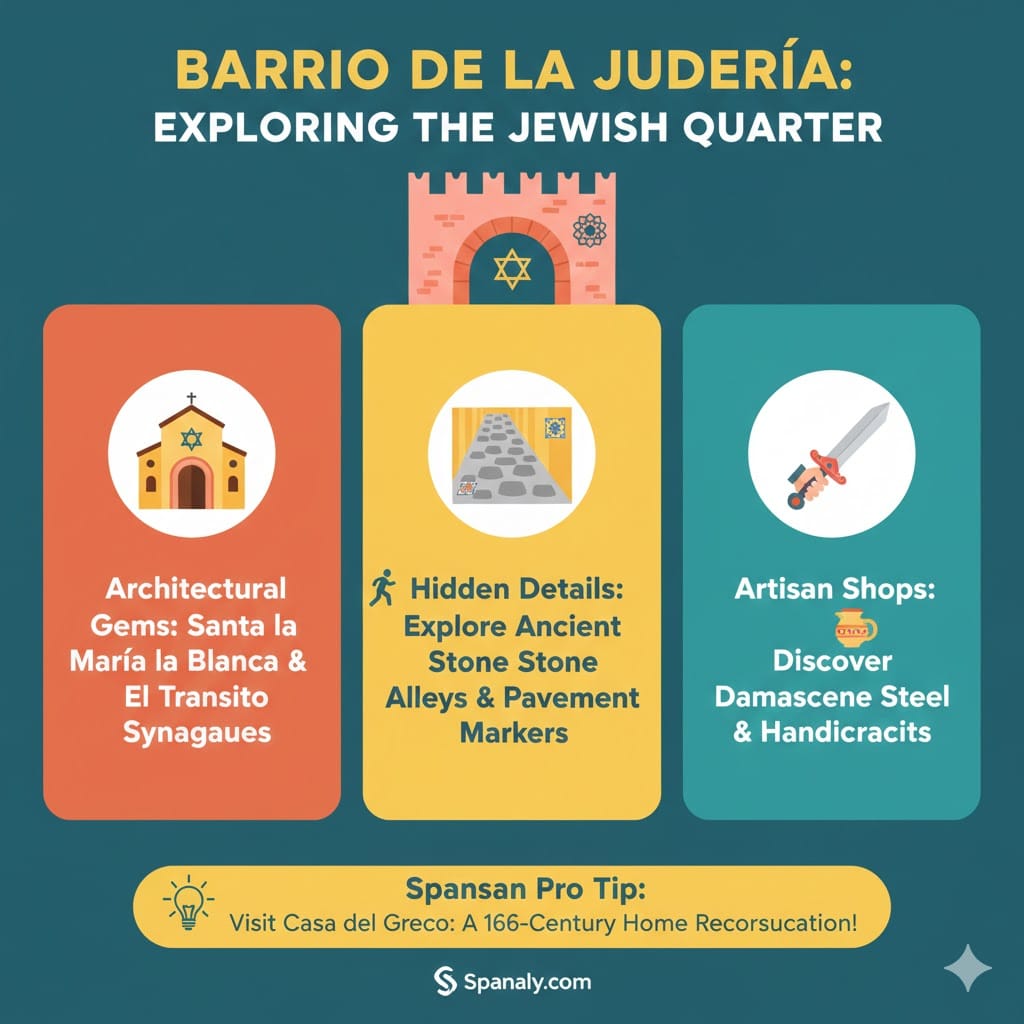
Walking into the Jewish Quarter of Toledo feels like stepping back into a golden age of history. Notably, this area was once the heart of one of the most important Sephardic communities in the world. Specifically, its narrow, winding alleys are designed to keep the sun away, creating a cool and mysterious atmosphere that invites exploration.
🕍 Architectural Gems: Home to the stunning Synagogues of Santa María la Blanca and El Tránsito, which showcase incredible Hebrew inscriptions and Moorish plasterwork.
🚶 Hidden Details: Keep your eyes on the ground. In fact, you will find small ceramic tiles embedded in the pavement marking the historic Jewish path.
🏺 Artisan Shops: The area is filled with workshops where craftsmen still practice the ancient art of Damascene steel.
Indeed, the Judería is a place where history is felt in every stone. Similarly, if you enjoy the charm of ancient urban labyrinths, you should compare this experience with the narrow streets of the Gothic Quarter in Barcelona. Ultimately, getting lost in these alleys is the only way to truly understand the spirit of the “Three Cultures” that defined Toledo’s past.
💡 Spanaly Insight: Look for the “Casa del Greco” in this district. In fact, while the famous painter didn’t actually live in this specific house, the building is a perfect reconstruction of a 16th-century Toledo home, complete with a beautiful courtyard!
🎨 The Art of El Greco: A City’s Master
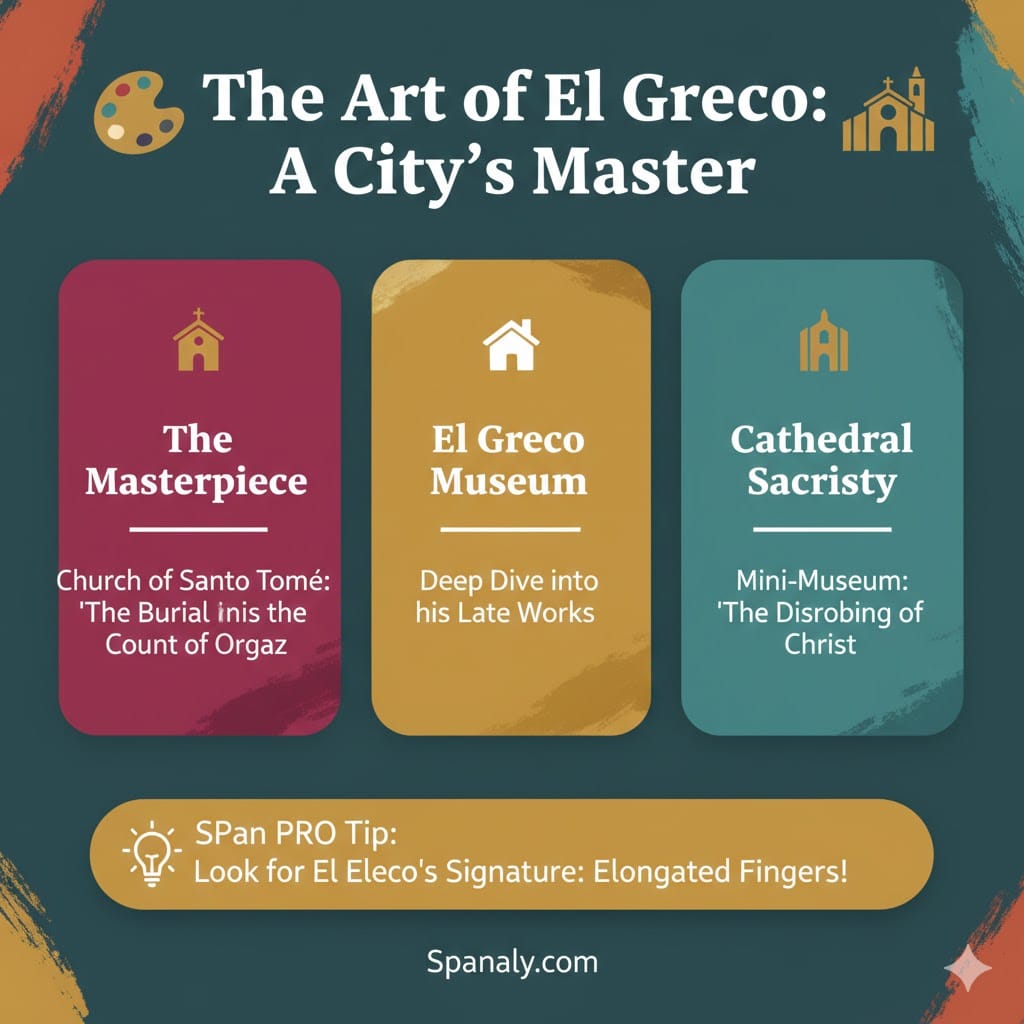
No artist is more deeply intertwined with the identity of a city than El Greco is with Toledo. Notably, while born in Crete, he found his true creative voice within these medieval walls. Specifically, his unique style—characterized by elongated figures and mystical lighting—perfectly captured the religious fervor of 16th-century Spain.
🖼️ The Masterpiece: You cannot leave the city without visiting the Church of Santo Tomé. In fact, it houses The Burial of the Count of Orgaz, widely considered one of the greatest paintings in Western art.
🏠 El Greco Museum: Located in the Jewish Quarter, this museum offers a deep dive into his late works and the environment that inspired him.
⛪ The Sacristy of the Cathedral: Often called a “mini-museum,” it features The Disrobing of Christ (El Expolio), a painting so vibrant it seems to glow in the dim light.
Indeed, experiencing his work in the very buildings they were painted for is a spiritual journey. If you are an art enthusiast, you should follow this trail by visiting the Prado Museum in Madrid, which houses the world’s largest collection of his other major works. Ultimately, seeing El Greco’s art in Toledo provides a context and emotion that no traditional gallery can replicate.
💡 Spanaly Insight: Notice the hands in El Greco’s paintings. In fact, he often painted elongated fingers with the middle and ring fingers joined. Notably, this “signature” gesture was a sign of elegance and deep emotion during the Spanish Renaissance!
🏘️ Where to Stay: Top Recommendations

Choosing where to sleep in Toledo depends on whether you want to wake up surrounded by medieval stone or enjoy a modern view of the skyline. Notably, the city offers a range of stays from historic convents to luxury villas. Specifically, we have categorized the best areas to help you decide.
🏰 Inside the Old Town (Casco Histórico): Best for those who want to be steps away from the Cathedral. Staying here allows you to experience the magic of the city at night after the day-trippers leave.
🌿 Los Cigarrales: These are traditional country estates located just across the river. In fact, they offer the most luxury and the famous “postcard views” of Toledo from a distance.
🚉 Near the Train Station (Santa Bárbara): A practical choice for those with heavy luggage or early morning departures. It is well-connected to the center by the famous city escalators.
Indeed, the atmosphere in Toledo is remarkably peaceful once the sun sets. While this city offers a deep dive into history, you might eventually crave a different kind of relaxation. For a complete change of scenery, you can explore the best coastal retreats in our guide to Cádiz Beaches. Ultimately, whether you choose a boutique hotel in a former palace or a quiet villa on the hills, Toledo’s hospitality is legendary.
💡 Spanaly Insight: Many hotels in the Old Town are converted historic buildings. In fact, don’t be surprised if your room has original 15th-century wooden beams or a hidden Moorish courtyard. Notably, always check if your hotel has an elevator, as many preserved buildings are only accessible by stairs!
🧀 Toledo Gastronomy: Flavors of Castilla-La Mancha
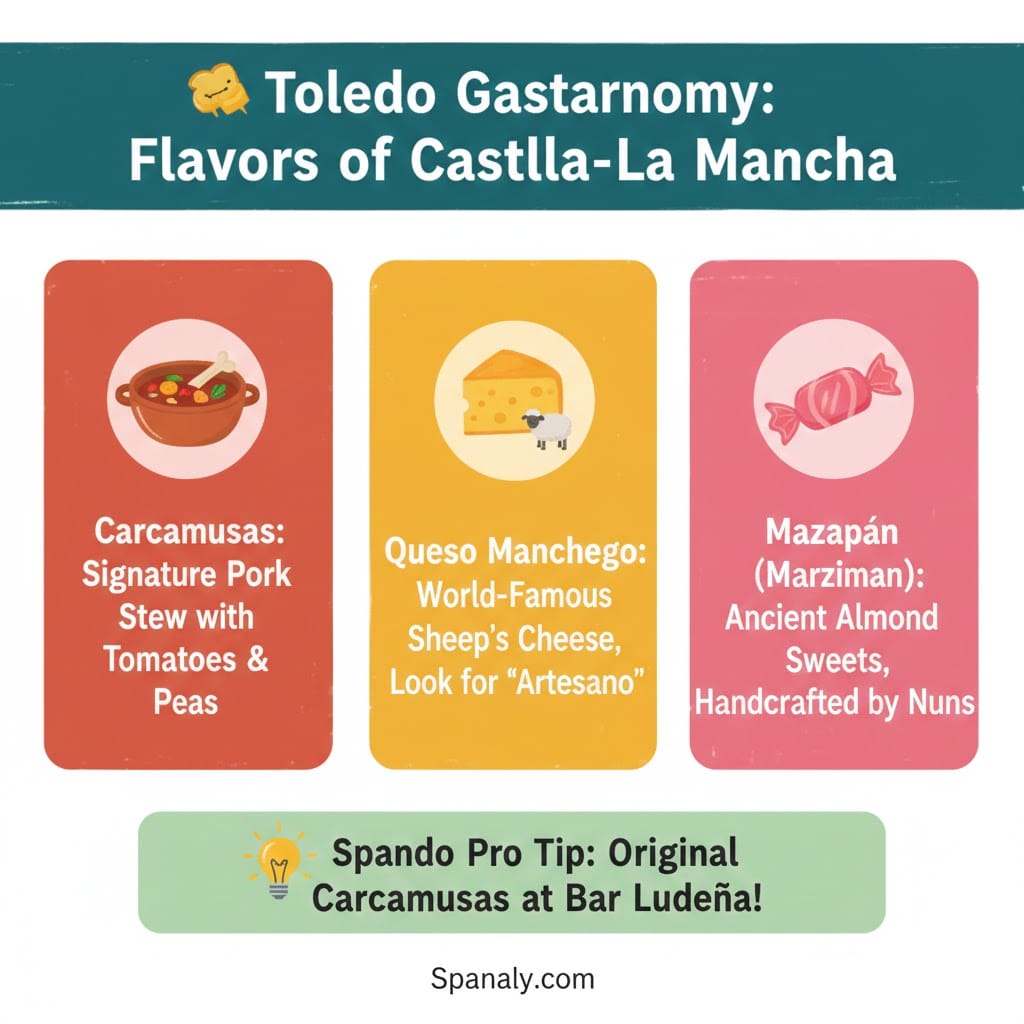
Dining in Toledo is an adventure for the senses, rooted in the rustic traditions of the Castillian plateau. Notably, the city’s cuisine is a hearty blend of game meats, world-class saffron, and ancient sweets. Specifically, you cannot truly say you have visited Toledo without trying its three culinary pillars.
🍖 Carcamusas: A signature pork stew slow-cooked with tomatoes, peas, and a hint of spice. In fact, it’s traditionally served in small clay dishes and is best enjoyed with a piece of crusty local bread.
🧀 Queso Manchego: This world-famous sheep’s milk cheese hails from this very region. Interestingly, for the most authentic experience, look for the “Artesano” label, which means it’s made from raw milk and aged in natural caves.
🍬 Mazapán (Marzipan): A legacy of the city’s Moorish past. These almond-based sweets are still handcrafted by local nuns and artisans using centuries-old recipes.
Indeed, every bite in Toledo tells a story of survival and celebration. To dive deeper into the ingredients that define this nation, explore our guide to Traditional Spanish Food. Ultimately, whether you are savoring a plate of Perdiz a la Toledana (stewed partridge) or snacking on Manchego, you are tasting the very soul of Spain.
💡 Spanaly Insight: Looking for the original Carcamusas? In fact, you should visit Bar Ludeña near Plaza de Zocodover. Notably, they are the inventors of the recipe, and the bar still retains that authentic, old-school tavern atmosphere that hasn’t changed in decades!
🕌 The Echoes of Islam: The Mosque of Cristo de la Luz

While Toledo is famous for its Gothic cathedral, its heart still beats with the rhythm of its Islamic past. Notably, the Mosque of Cristo de la Luz is one of the most significant Moorish monuments in Spain. Specifically, it is a rare example of a 10th-century mosque that remains almost entirely intact, offering a window into the era of the Caliphate of Córdoba.
🧱 Architectural Ingenuity: Despite its small size, the mosque features nine different brick vaults, each with a unique geometric design.
🕰️ A Layered History: After the Christian conquest, it was converted into a chapel. In fact, you can still see the 12th-century Christian frescoes painted directly onto the Islamic walls.
🌿 The Arabic Garden: The mosque is surrounded by a peaceful garden that offers stunning views of the Puerta del Sol, another masterpiece of Mudéjar military architecture.
Indeed, this site is a living testament to how cultures in Toledo layered upon one another rather than erasing each other. Similarly, if you find this fusion of styles fascinating, you will be mesmerized by the Mezquita de Córdoba, which remains the ultimate symbol of Islamic architecture in the West. Ultimately, a visit to this mosque is essential to understand the “Moorish soul” that still haunts the streets of Toledo.
💡 Spanaly Insight: Look closely at the exterior brickwork. In fact, there is a Kufic inscription that reveals the name of the architect and the date it was finished (year 999). Notably, it is one of the oldest surviving buildings in the city, even older than the great Cathedral itself!
🌙 Toledo at Night: Legends & Magic
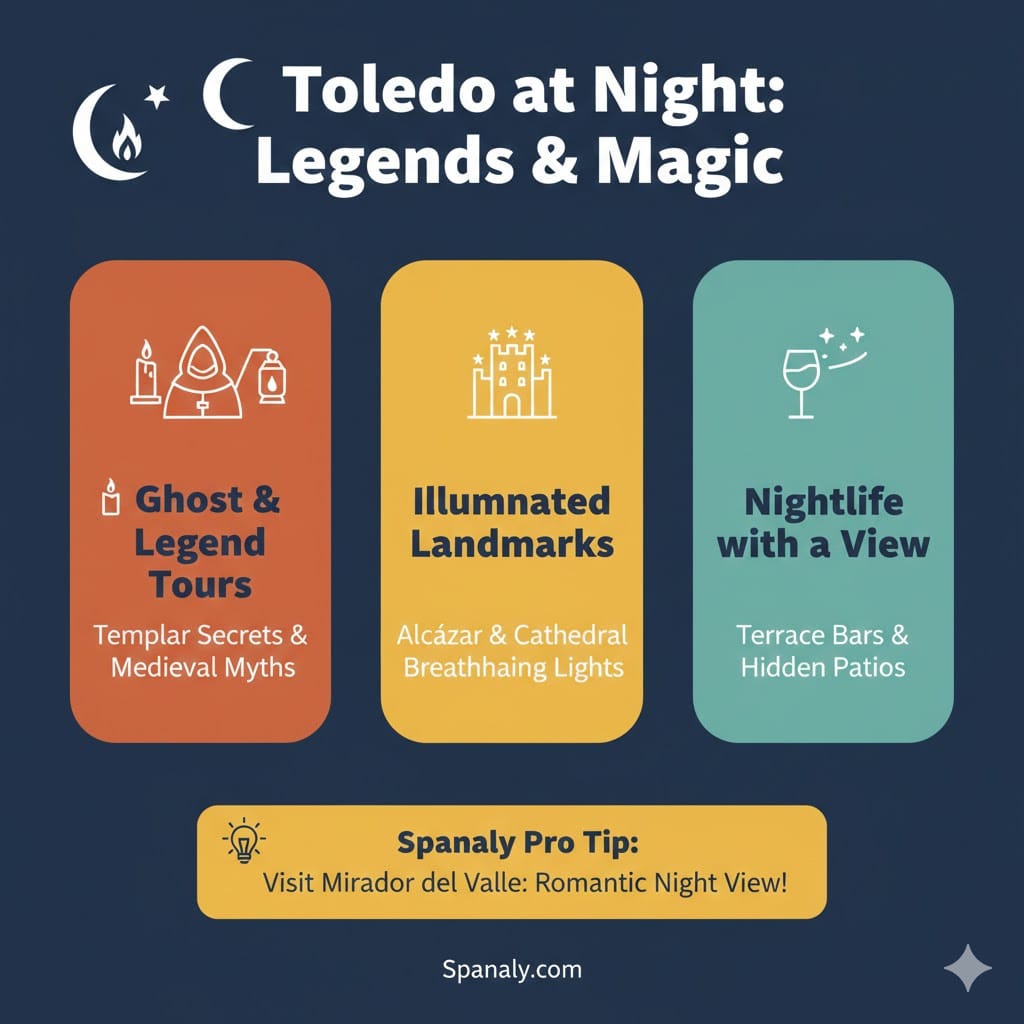
When the sun sets and the day-trippers return to Madrid, Toledo undergoes a profound transformation. Notably, the yellow streetlights cast long shadows on the stone walls, turning the city into a stage for ancient legends. Specifically, walking through the silent streets at night is a completely different experience that reveals the “hidden” soul of the city.
🕯️ Ghost & Legend Tours: Toledo is famous for its dark history. In fact, many local guides offer night walks focused on Templar secrets, medieval myths, and the tales of the Spanish Inquisition.
🏰 Illuminated Landmarks: Seeing the Alcázar and the Cathedral glowing against the dark sky is breathtaking. The lighting is carefully designed to highlight the intricate Gothic and Mudéjar details.
🍷 Nightlife with a View: Head to the terrace bars in the Plaza de Zocodover or the hidden patios in the Jewish Quarter for a glass of local La Mancha wine in a serene atmosphere.
Indeed, the silence of the night allows you to hear the echoes of the past. If you are captivated by the mystery of illuminated fortresses, you will find the night-time aura of the Alcázar of Segovia equally legendary and straight out of a fairy tale. Ultimately, staying overnight in Toledo isn’t just a convenience; it is the only way to experience the true magic of this “City of Legends.”
💡 Spanaly Insight: Visit the Mirador del Valle at night. In fact, while it’s beautiful during the day, the view of the fully illuminated city reflected in the Tagus River is one of the most romantic sights in all of Spain!
🛍️ Shopping Guide: Swords, Steel, and Sweets
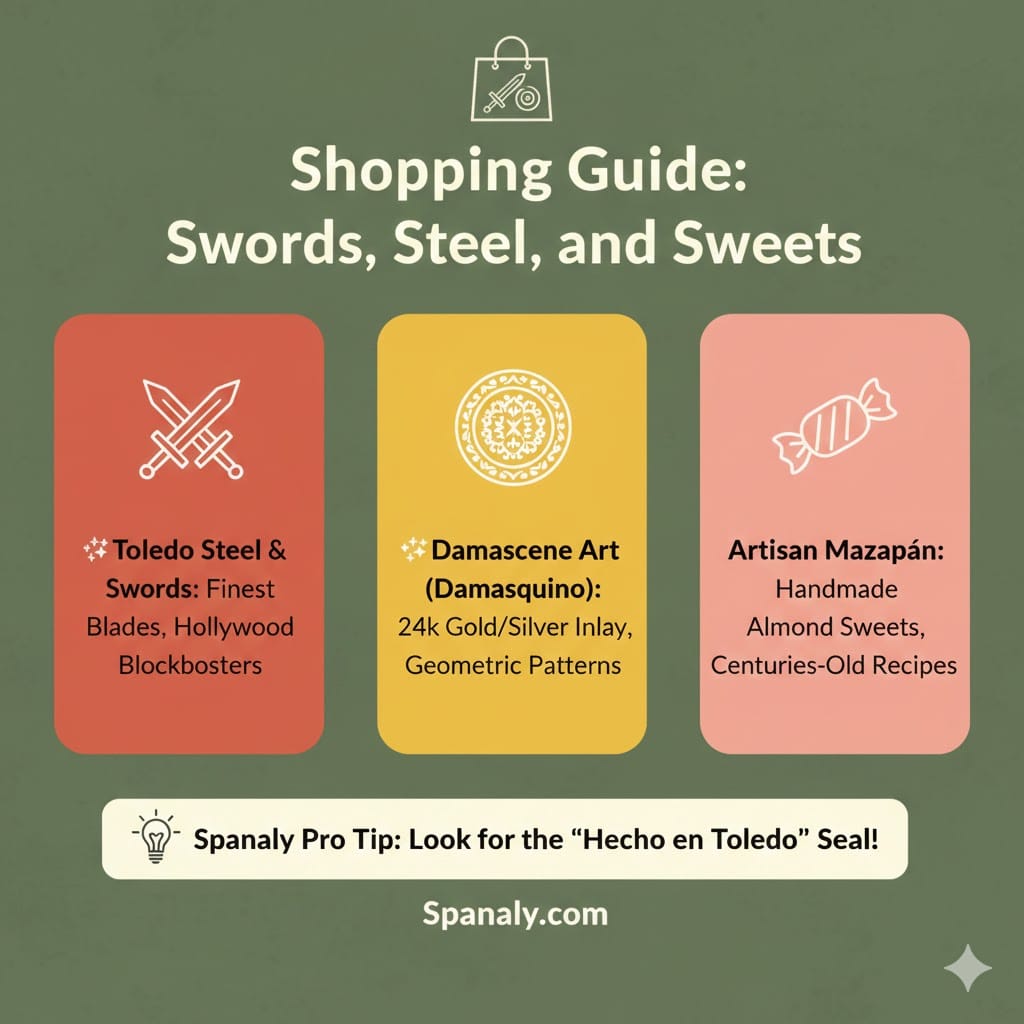
Bringing a piece of Toledo home is like owning a fragment of history. Notably, the city has been the world’s capital for high-quality steel and intricate craftsmanship for over two millennia. Specifically, shoppers should focus on the authentic “Made in Toledo” treasures that reflect its knightly and Moorish heritage.
⚔️ Toledo Steel & Swords: Famous since Roman times, this steel was used to forge the finest blades in Europe. In fact, many Hollywood blockbusters, from Lord of the Rings to Game of Thrones, commissioned Toledo’s master smiths to create their iconic swords.
✨ Damascene Art (Damasquino): This ancient technique involves inlaying 24k gold or silver threads into oxidized steel. Interestingly, the geometric patterns are deeply influenced by the city’s Islamic past, creating stunning jewelry and decorative plates.
🍬 Artisan Mazapán: Beyond being a tasty treat, Toledo’s marzipan is an art form. Consequently, you will find shops displaying elaborate edible sculptures made entirely of almond paste and sugar.
Indeed, the craftsmanship here is unparalleled and represents the pinnacle of Spanish tradition. However, if your taste leans more towards modern elegance and high-end lifestyle, you should explore the contrast between traditional heritage and contemporary refinement in our guide to Luxury Hotels vs. Boutique Stays in Barcelona. Ultimately, whether you buy a miniature decorative dagger or a box of handmade sweets, a souvenir from Toledo is a symbol of enduring quality.
💡 Spanaly Insight: Beware of cheap imitations! In fact, if a piece of Damascene jewelry is very cheap, it’s likely machine-stamped rather than hand-inlaid. Notably, always look for the official “Hecho en Toledo” (Made in Toledo) seal to ensure you are supporting genuine local artisans!
🛡️ Day Trips: Explore the Land of Don Quixote
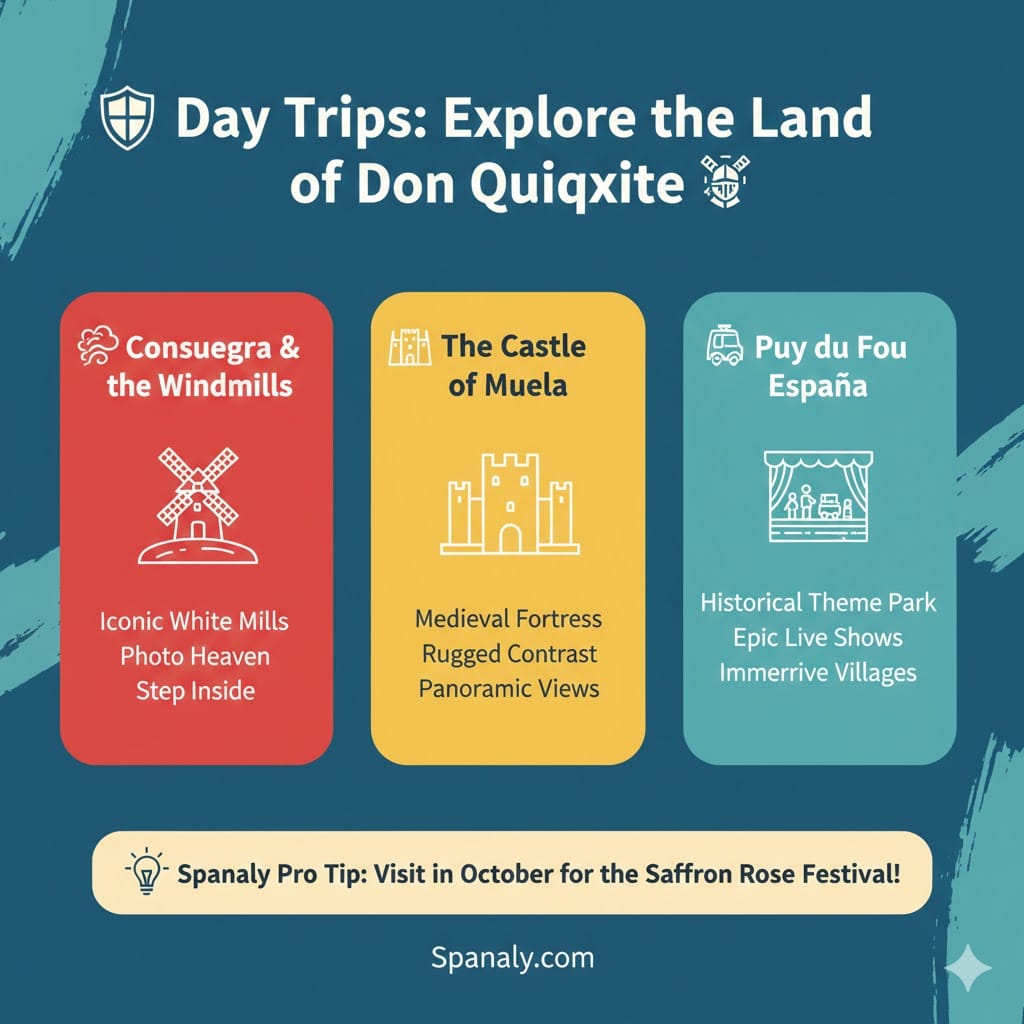
While Toledo itself is a masterpiece, its surroundings offer a journey into the heart of Spanish folklore. Notably, the vast plains of Castilla-La Mancha are famous for being the setting of Miguel de Cervantes’ legendary novel, Don Quixote. Specifically, there are two nearby destinations that perfectly complement your Toledo experience.
🌬️ Consuegra & the Windmills: Located about 40 minutes south, these iconic white windmills standing against the blue sky are a dream for photographers. In fact, you can step inside one of the restored mills to see the ancient grinding machinery in action.
🏰 The Castle of Muela: Sitting right next to the windmills, this medieval fortress offers a rugged contrast to the refined palaces of the cities.
🚂 Puy du Fou España: A world-class historical theme park located just minutes from the city center, featuring spectacular night shows and immersive villages from different eras of Spanish history.
Indeed, exploring these rural landscapes gives you a deeper appreciation for the scale of Spanish history. After witnessing the rustic charm of the windmills, you might want to return to the architectural grandeur of the capital to see the Royal Palace of Madrid, which represents the peak of Spanish imperial power. Ultimately, combining a trip to Toledo with a drive through the land of Don Quixote is the best way to experience the “real” Spain.
💡 Spanaly Insight: If you visit Consuegra in late October, you might catch the Saffron Rose Festival. In fact, the region produces some of the world’s most expensive saffron. Notably, it’s a great opportunity to buy high-quality “Red Gold” directly from the local producers!
📸 Expert Travel Tips & Best Photo Spots

To make your trip to Toledo as smooth as the local silk, you need to know a few “insider” secrets. Notably, while the city is welcoming, its medieval layout can be challenging for the unprepared. Specifically, following these practical tips will save you time, money, and quite a few blisters!
👟 The Footwear Rule: Forget fashion for a day. In fact, the cobblestones in Toledo are polished by centuries of use and can be incredibly slippery. Notably, wear shoes with a strong grip to navigate the steep inclines safely.
🗺️ Use the Escalators: Don’t hike up from the station with your luggage. Specifically, Toledo has hidden outdoor escalators (Escaleras Mecánicas de Safont) that take you from the lower city directly to the heart of the historic center for free.
🕙 Timing is Everything: Many monuments close between 2:00 PM and 4:00 PM for the traditional Siesta. Consequently, use this time for a long lunch or to explore the outdoor viewpoints (Miradores).
Indeed, capturing the perfect memory is just as important as the journey itself. For the best photo spots, head to the Puerta del Cambrón at sunset for a golden glow on the stone walls, or find the hidden terrace of the Library of Castilla-La Mancha (inside the Alcázar) for a stunning, high-angle shot of the Cathedral’s spire. Ultimately, planning your route around these small details will turn a good trip into an unforgettable one.
💡 Spanaly Insight: Looking for a free “secret” view? In fact, you can enter the Church of San Ildefonso (Jesuit Church) and climb its twin towers. Notably, it offers arguably the most central and highest panoramic view of the city, even better than the more expensive tourist spots!
🛡️ Essential Visitor FAQs – Toledo Guide
🚆 What is the fastest way to get to Toledo from Madrid?
The AVANT high-speed train from Madrid's Atocha Station is the best option. It takes only 33 minutes. Notably, it is highly recommended to book your return ticket in advance, especially on weekends, as they frequently sell out.
🏰 Is the Alcázar of Toledo worth visiting inside?
Yes, primarily for history buffs. It houses the Army Museum and an incredible library. In fact, even if you don't tour the museum, you can visit the top-floor cafeteria for one of the highest and cheapest panoramic views of the city.
☀️ When is the best time of year to visit Toledo?
Spring (April-June) and Autumn (September-October) offer the most pleasant weather. Specifically, try to avoid July and August, as temperatures in the Castillian plains can exceed 40°C, making the steep climbs quite exhausting.
🚕 Can I take a taxi or bus inside the Old Town?
Large buses cannot enter the narrow medieval streets, but the small "L41" city bus and local taxis can. Ultimately, the best way to explore the heart of the city is on foot, as most major sights are within walking distance of each other.
🎭 Are there any unique festivals in Toledo?
The Corpus Christi festival is Toledo's most important event. The streets are draped in ancient tapestries and flower carpets. Notably, it is the only time many of the city's private "patios" and courtyards are opened to the public.
Expertly curated by Spanaly.com
✨ Toledo in a Nutshell
Toledo isn’t just a stop on a map; it’s a walk through a living history book. Notably, its magic stays with you long after you leave its stone walls.
🏰 Atmosphere: A perfect blend of medieval mystery and Spanish soul.
🎨 Culture: A rare jewel where three worlds (Christian, Muslim, and Jewish) once shook hands.
📸 Memory: Whether it’s the glow of the Cathedral or the taste of Marzipan, every corner is a story.
Indeed, if the “City of Three Cultures” captured your heart, you will be equally enchanted by the Moorish courtyards and flower-filled alleys of the south. Specifically, your next adventure should be exploring our Córdoba Spain Travel Guide.
Ultimately, Toledo is a place you visit once and remember forever.
¡Buen viaje! 🇪🇸