
Table of Contents
Toggle⚔️ The Legendary Crafts of Toledo
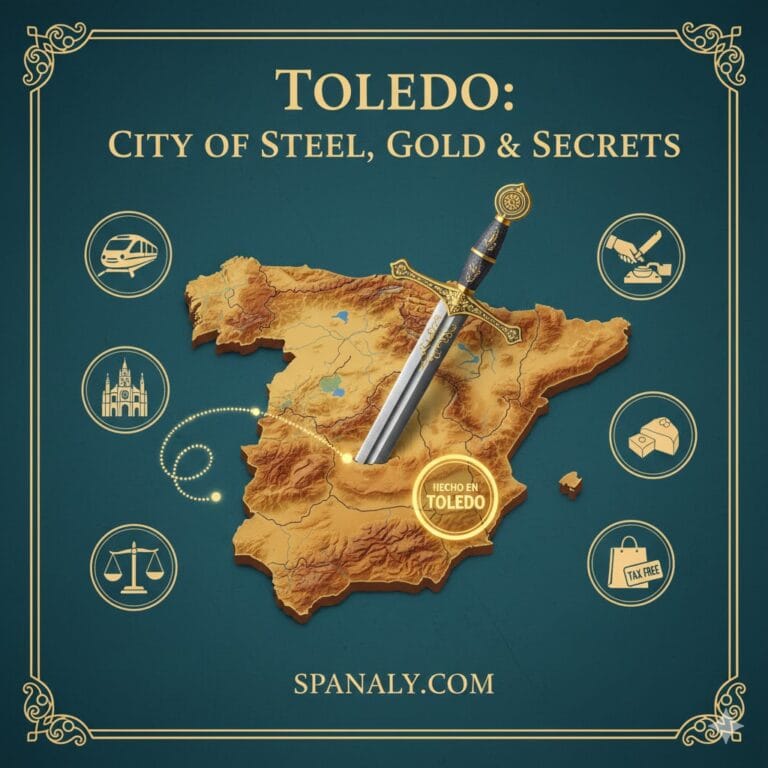
Toledo stands as the historic world capital of master craftsmanship. In fact, for over two millennia, the city’s blacksmiths forged the finest blades in Europe. Beyond the famous skyline, this city preserves the “steel heart” of Spain through ancient techniques. Specifically, exploring these artisanal traditions offers a deeper look at the heritage found in our Spain Historical Monuments Guide.
🛡️ The Steel Legacy: Discover why Roman legions and Hollywood directors alike chose Toledo blades.
✨ Damascene Art: Master the secrets of embedding 24k gold into oxidized steel.
🔨 Artisan Workshops: Enter the hidden spaces where craftsmen still use centuries-old hammers.
💎 Authentic Souvenirs: Learn how to identify genuine “Hecho en Toledo” masterpieces.
Consequently, understanding these crafts transforms your visit into a journey through living history. Ultimately, you don’t just see the monuments; you touch the very materials that built the Spanish Empire.
🌟 Spanaly Insight: Most travelers only view swords through shop windows. However, the real magic happens in the small, dusty workshops tucked away in the side streets. Specifically, look for artisans working with real fire and hammers to find the most authentic treasures!
🛡️ The Soul of Toledo Steel: A 2,000-Year Secret
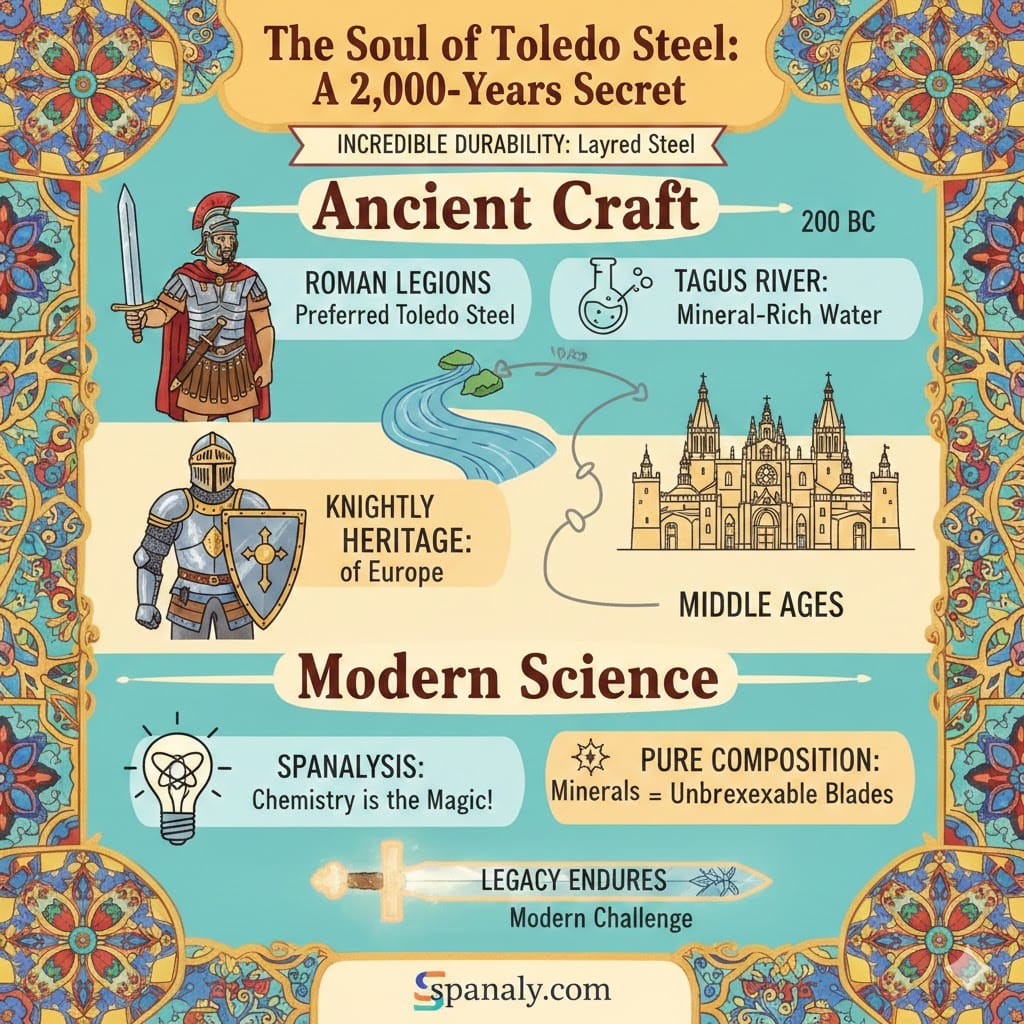
The legend of Toledo Steel dates back to the Roman Empire. In fact, Roman legions preferred blades forged here because of their unique strength. This level of craftsmanship reflects the same dedication to excellence seen in the Cathedral of Santiago de Compostela. The secret of these blades lies in a meticulous tempering process using the mineral-rich waters of the Tagus River.
🔥 Incredible Durability: Masters layered hard and soft steel to create blades that remained flexible yet unbreakable.
💧 The Tagus Secret: The specific temperature of the river provided the perfect environment for cooling the red-hot metal.
🛡️ Knightly Heritage: During the Middle Ages, Toledo served as the armory for knights who protected fortresses like the Castle of Loarre in Aragon.
Consequently, this technical perfection turned the city into the military heart of Europe. Ultimately, the steel of Toledo remains a lasting testament to Spanish resilience and artisanal ingenuity.
🌟 Spanaly Insight: Modern science confirms that the “magic” was actually chemistry. Indeed, the specific minerals of the Tagus River allowed for a reaction that made the steel exceptionally pure. Remarkably, replicating this exact quality remains a challenge even for modern blacksmiths!
⚔️ Toledo Steel vs. The World: A Global Duel

While many cultures perfected the art of weaponry, Toledo Steel remains in a league of its own. In fact, when compared to the legendary Japanese Katana or the Damascus blades of the East, Toledo’s craft offers a unique balance of flexibility and “impact resistance.” Specifically, these European blades were designed to pierce heavy plate armor, a challenge rarely seen in other regions.
🗡️ Toledo vs. Katana: The Japanese Katana is incredibly sharp but can be brittle. In contrast, a Toledo sword can bend significantly without snapping, making it more reliable in long, chaotic battles.
🏺 The “Secret” Alchemy: Unlike the folded steel of the East, Toledo masters used a “sandwich” technique. Consequently, they encased a flexible iron core within a hard steel exterior.
🌍 Cultural Impact: Just as the Mezquita de Córdoba represents a peak of architectural fusion, the Toledo blade represents the pinnacle of metallurgical science in the Middle Ages.
Ultimately, this global reputation for quality ensured that Spanish steel traveled far beyond the Mediterranean. From the conquest of the Americas to the royal courts of the Royal Palace of Madrid, these swords defined the era of empires.
🌟 Spanaly Insight: The “bend test” was the ultimate proof of quality. Indeed, a master would bend a Toledo blade into a semi-circle; if it returned to its original straight shape without a single crack, it was deemed fit for a King. Remarkably, very few other steel types in history could pass this grueling examination!
🎬 From Knights to Hollywood: Forging Cinematic Legends
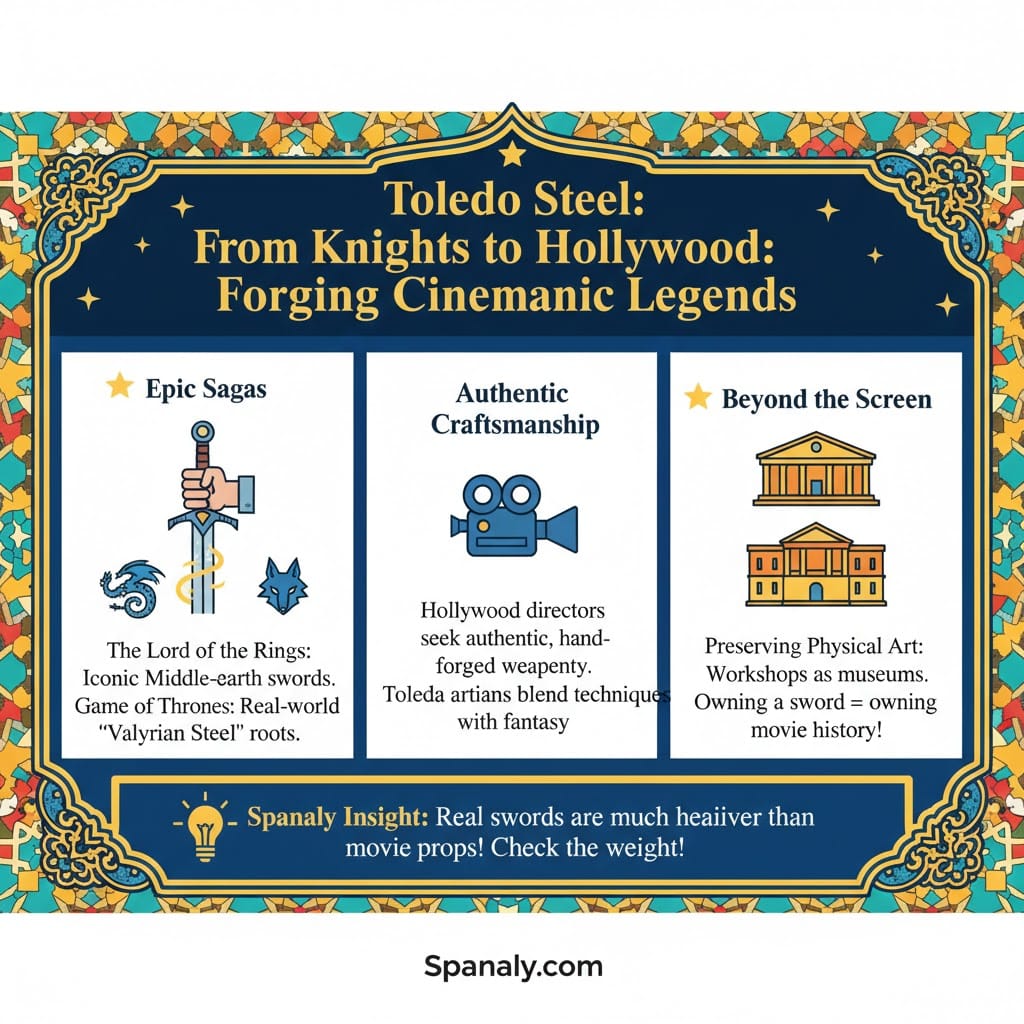
Toledo’s steel did not remain buried in the medieval past. In fact, the city’s master smiths transitioned from arming knights to equipping the heroes of modern cinema. Specifically, when Hollywood directors seek authentic, hand-forged weaponry that looks powerful on screen, they turn to the legendary workshops of this historic city.
⚔️ The Lord of the Rings: Many of the iconic swords used in Middle-earth were designed and crafted by Toledo artisans, blending ancient techniques with cinematic fantasy.
🐉 Game of Thrones: The “Valyrian steel” of the screen often finds its real-world roots in the furnaces of Toledo, where masters create blades that carry a true sense of weight and history.
🎥 Beyond the Screen: Just as the Reina Sofia Museum in Madrid preserves modern artistic masterpieces, these workshops preserve the physical art of the blade for future generations.
Consequently, owning a sword from Toledo today often means owning a piece of movie history. Ultimately, whether it’s for a 16th-century conquistador or a fantasy king, the craftsmanship remains as sharp as the views from the Alcázar of Segovia.
🌟 Spanaly Insight: If you visit the larger workshops, you can often see replicas of the exact swords used in blockbuster films. However, always check the weight! Remarkably, a real functional sword is much heavier than the aluminum props usually used by actors during long filming sessions.
✨ Damasquino: The Art of Gold on Steel
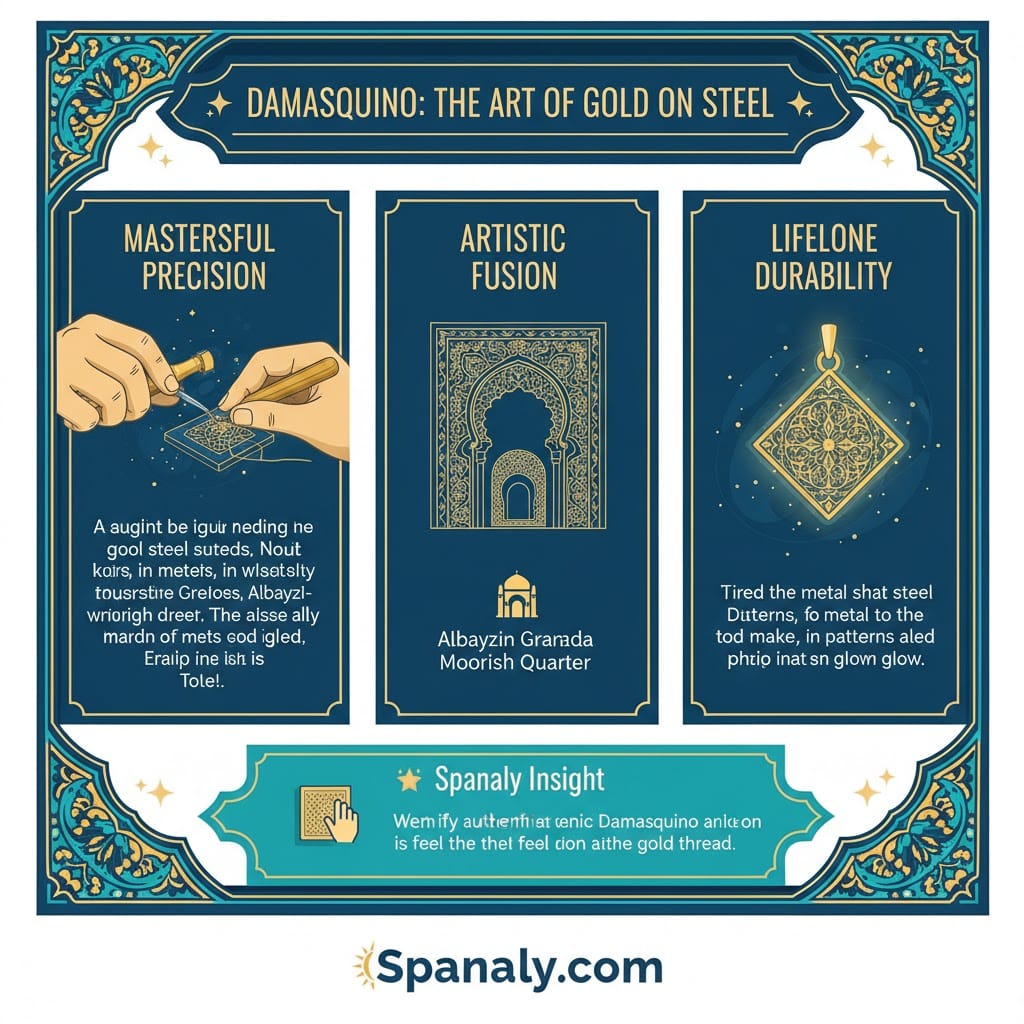
The beauty of Toledo craftsmanship reaches its peak with Damasquino. In fact, this ancient technique involves inlaying 24k gold or silver threads into oxidized steel surfaces. This delicate process mirrors the intricate artistic detail found in the Alhambra Granada Guide. Originating from Damascus and refined over centuries in Spain, it remains a vibrant symbol of the city’s multicultural soul.
🌟 Masterful Precision: Artisans use tiny chisels to carve hair-thin grooves into the steel before pressing gold wire into the metal.
🕌 Artistic Fusion: The intricate arabesque designs reflect the same Moorish aesthetic that defines the Albayzin Granada Moorish Quarter.
💎 Lifelong Durability: Once the gold is embedded, the piece is fired to darken the steel, making the golden patterns glow with an eternal brilliance.
Consequently, owning a piece of Damascene art is like holding a fragment of the Spanish Renaissance. Ultimately, this craft remains a central pillar of Spanish heritage, preserved with the same passion as the nation’s greatest historic monuments.
🌟 Spanaly Insight: Modern imitations are often machine-stamped or painted. However, you can identify authentic Damasquino by the texture. Remarkably, when running your finger over a genuine piece, a slight elevation is felt where the gold thread sits inside the steel. If the surface is perfectly flat, it’s likely a mass-produced replica!
📍 The Blacksmith’s Map: Finding the Hidden Workshops
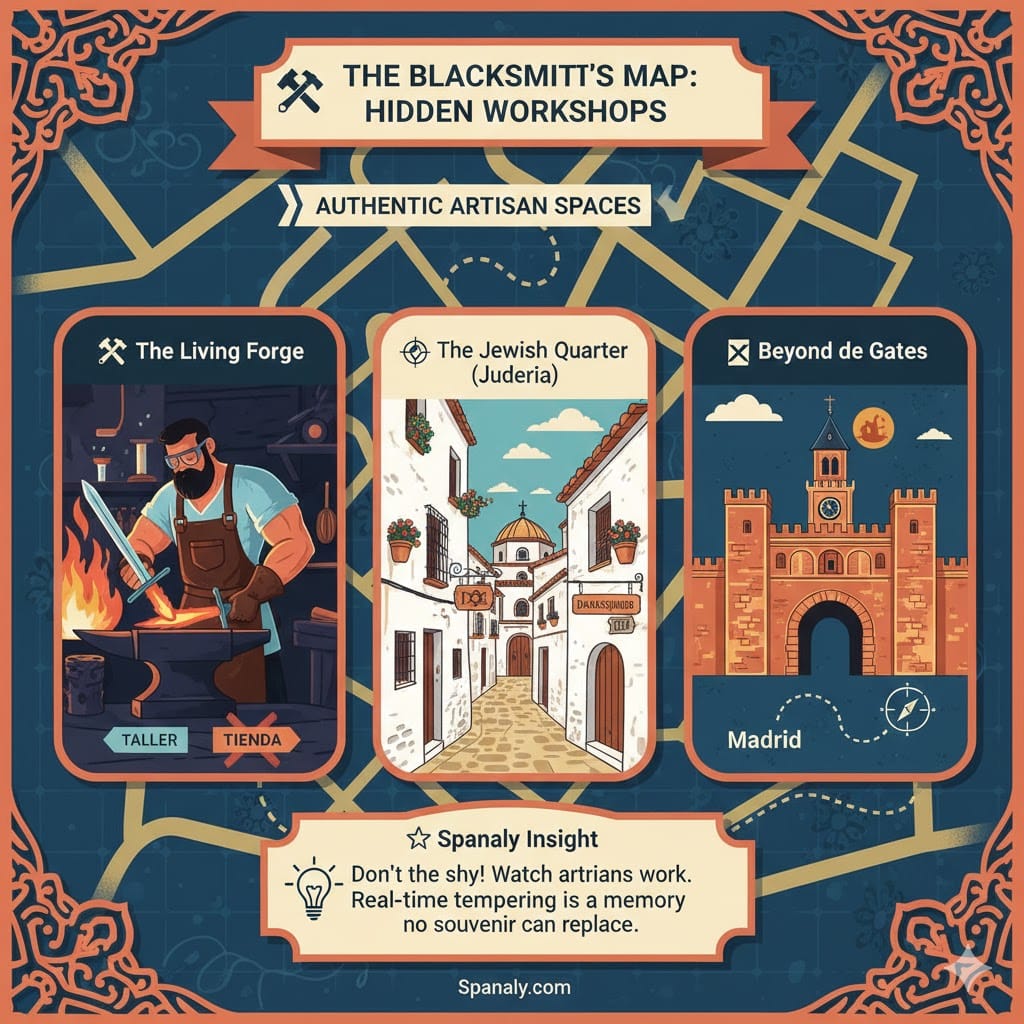
To witness the true “steel heart” of the city, you must step off the main squares. In fact, the most authentic artisan spaces hide within the labyrinth of the Jewish Quarter and near the ancient city walls. Specifically, exploring these narrow alleys offers a sense of discovery similar to finding the Madrid Hidden Gems. These workshops are not just stores; they are living museums where the air smells of coal and heated metal.
⚒️ The Living Forge: Look for signs that say “Taller” (Workshop) rather than just “Tienda” (Shop). This is where masters still hammer blades by hand.
🧭 The Jewish Quarter (Judería): Navigate the winding streets near the Synagogue of Santa María la Blanca to find family-run Damasquino studios.
🚪 Beyond the Gates: Just as the Puerta del Sol in Madrid serves as a central meeting point, the gates of Toledo like Puerta de Bisagra lead you toward historic industrial zones.
Consequently, taking the time to find these hidden spots ensures you support genuine local families. Ultimately, the rhythmic sound of a hammer hitting steel provides the most authentic soundtrack to your journey through this medieval fortress.
🌟 Spanaly Insight: Don’t be shy about peering into open doorways! Indeed, many artisans are proud to show their work-in-progress to respectful visitors. Remarkably, you might witness a blade being tempered in real-time, a memory that no mass-produced souvenir can ever replace.
📜 The Sephardic Legacy in Stone: Traces of the Past

Toledo is not only defined by its steel but also by its deep Jewish roots. In fact, the city’s Judería (Jewish Quarter) remains one of the most important Sephardic sites in Europe. As you walk through these narrow streets, you will notice small ceramic tiles and Hebrew inscriptions hidden in the stone walls. This atmosphere of cultural layers is reminiscent of the historical depth found in the Cordoba Spain Travel Guide.
🔯 Symbols in the Streets: Look closely at the ground; you will find symbols of the Red de Juderías (Jewish Quarters Network) that guide you through the historic heart of the city.
⛪ Synagogue of El Tránsito: This masterpiece features intricate stucco work that rivals the artistic complexity of the Alhambra Granada.
🪨 The School of Translators: In the Middle Ages, Jewish, Christian, and Muslim scholars worked together here, carving a legacy of knowledge into the city’s identity.
Consequently, exploring these stones is like reading a history book that has survived for centuries. Ultimately, the Sephardic influence remains a silent but powerful pillar of Toledo’s enduring multicultural soul.
🌟 Spanaly Insight: Keep an eye out for the “Life” (Chai) symbol hidden in the cobblestones. Indeed, many of these stones were preserved during restorations to honor the families who once lived here. Remarkably, some locals still possess ancient keys handed down through generations, believed to belong to their ancestral homes.
🍯 The Marzipan Secret: Handcrafted Convent Sweets
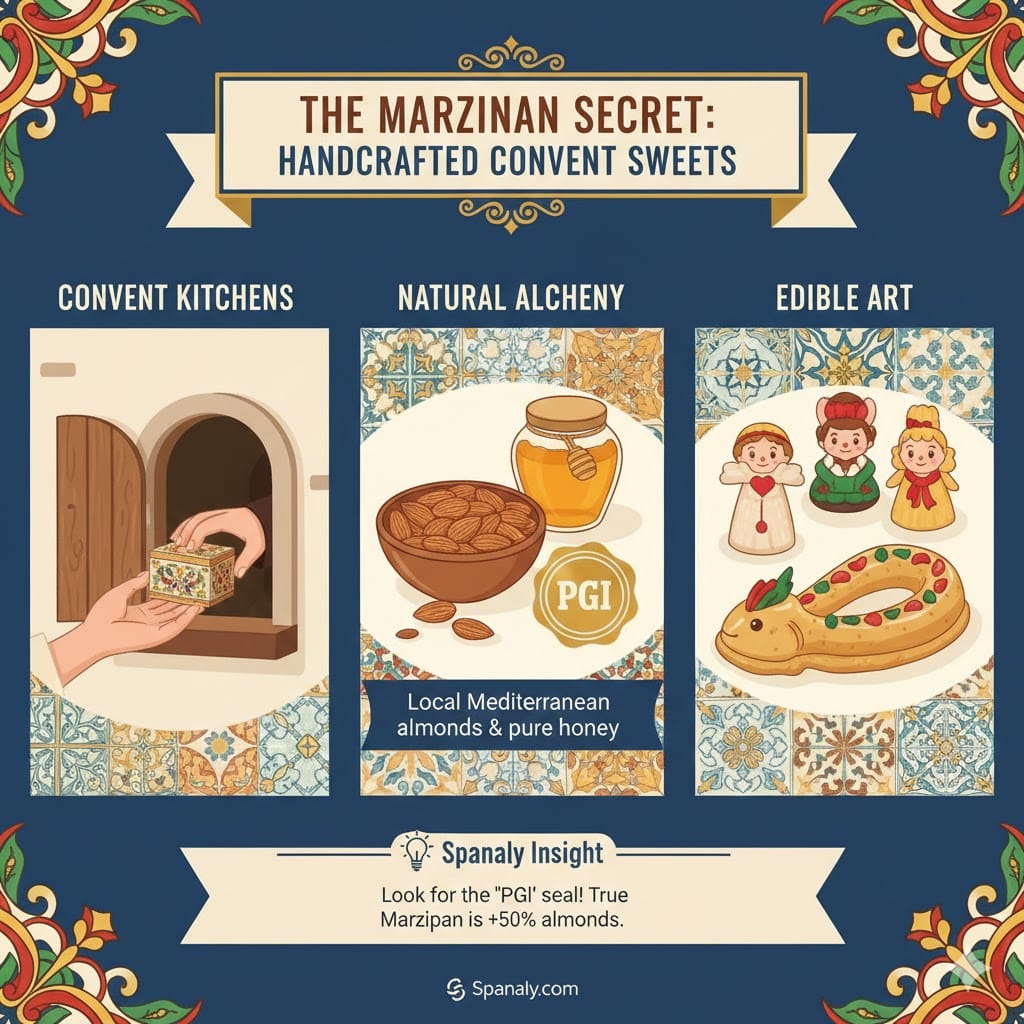
While steel is the city’s muscle, Marzipan is its heart. In fact, the art of creating these almond delights is a sacred craft that has been preserved by Toledo’s cloistered nuns for over 800 years. This dedication to authentic, traditional recipes is as vital to Spanish culture as the masterpieces found in the Prado Museum Madrid.
⛪ Convent Kitchens: Many of the best sweets are still sold through small revolving windows (tornos) in convents where the original medieval recipes were born.
🍯 Natural Alchemy: Unlike mass-produced versions, authentic Marzipan consists only of local Mediterranean almonds and pure honey. This simple yet rich tradition mirrors the historical elegance of the Royal Palace of Madrid.
🎨 Edible Art: Artisans shape the paste into intricate figures or the famous Anguila (eel-shaped cake), decorated by hand with candied fruits and egg yolk.
Consequently, buying a box of convent-made Marzipan is more than a snack; it’s a way to support the preservation of a medieval lifestyle. Ultimately, no visit to Toledo is complete without tasting this sweet legacy that bridges the city’s Moorish and Christian past.
🌟 Spanaly Insight: Always look for the “PGI” (Protected Geographical Indication) seal on the box. Indeed, many shops sell imitation marzipan made with flour. Remarkably, true Toledo marzipan must be at least 50% almonds by weight, giving it that rich, unmistakable texture that has delighted kings for centuries.
🛡️ Collector’s Guide: Avoiding the "Made in China" Trap

Finding a souvenir is easy, but finding an authentic piece of history requires a sharp eye. In fact, the market is flooded with mass-produced replicas that mimic the look of Toledo steel but lack its soul. Specifically, identifying quality craftsmanship is a skill as rewarding as discovering the artistic wonders of the Thyssen-Bornemisza Museum Madrid.
🏷️ The Official Seal: Genuine Toledo-made items often carry the “Hecho en Toledo” stamp. This mark ensures the product supports local heritage, much like visiting the historic Plaza Mayor Madrid supports the city’s living history.
⚖️ Weight and Balance: A real hand-forged sword has a specific balance point. Remarkably, if the blade feels flimsy or “plastic,” it is likely a decorative import rather than a forged masterpiece.
🎨 Detail Consistency: On authentic Damasquino, the gold thread is slightly raised. However, on cheap imitations, the pattern is often flat because it is merely printed.
Consequently, investing in a real piece supports the local families who keep these traditions alive. Ultimately, a true Toledo blade should feel like a timeless treasure, carrying a weight of history that no factory machine can ever replicate.
🌟 Spanaly Insight: Check the price! Indeed, if a “hand-forged” sword costs less than a fast-food meal, it’s a red flag. Remarkably, true artisan work takes days of manual labor, and the price will always reflect the master’s time and dedication.
🚆 The Steel Spirit: How to Reach Toledo from Madrid

Toledo is the most popular day trip from the capital, and getting there is part of the adventure. In fact, the transition from the modern energy of Madrid to the stone gates of Toledo takes less than an hour. If you have already enjoyed the lush greenery of Retiro Park Madrid, a trip to Toledo offers a perfect historical contrast.
🚄 The High-Speed Train (AVE): Departing from Atocha Station, the train whisks you to Toledo in just 33 minutes. Specifically, the Toledo train station itself is a Neo-Mudéjar masterpiece that prepares you for the city’s Moorish aesthetic.
🚌 The ALSA Bus: For a more budget-friendly route, buses depart regularly from Plaza Elíptica. While it takes about an hour, it’s as straightforward as finding your way to a match at the Santiago Bernabeu Stadium.
🚗 Private Car: Driving allows you to see the “Mirador del Valle” for the best panoramic views before entering the city walls.
Consequently, planning your transport in advance ensures you have maximum time to explore the workshops. Ultimately, whether you choose speed or scenery, the journey is the first chapter in your Toledo story.
🌟 Spanaly Insight: Book your AVE tickets at least a few days in advance, especially on weekends! Indeed, these trains fill up quickly with locals and tourists alike. Remarkably, if you miss the last train back, you might find yourself “trapped” in a medieval dream—which, to be honest, isn’t a bad way to spend an extra night!
⏳ One Day Trip: The Perfect Toledo Itinerary
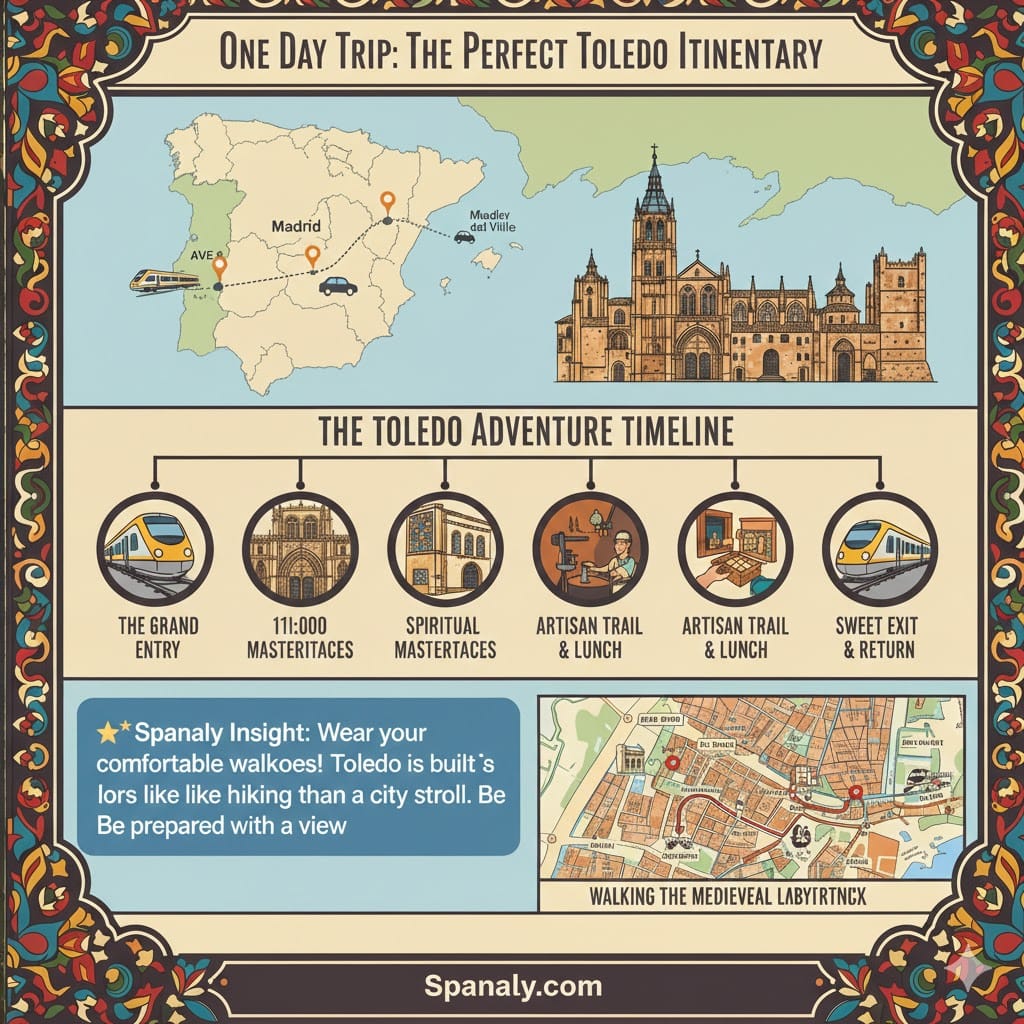
To maximize your experience in the “City of Three Cultures,” timing is everything. In fact, a well-planned day allows you to see the grand monuments and still have time for the hidden workshops. If you have already mastered the tips in the Ultimate Madrid Travel Guide, you’ll find Toledo’s labyrinthine streets a thrilling and historical change of pace.
🌅 09:30 AM – The Grand Entry: Start your journey by navigating the transport hubs. Just like Getting Around Madrid, taking the high-speed train to Toledo is seamless and places you at the city’s gates in minutes.
⛪ 11:00 AM – Spiritual Masterpieces: Visit the Toledo Cathedral and the Synagogue of El Tránsito. These sites house artistic treasures and religious history that rival the world-class collections of the Prado Museum Madrid.
⚒️ 01:30 PM – The Artisan Trail: Head to the Judería (Jewish Quarter) for a traditional lunch, then spend your afternoon in the “Hidden Workshops” to see Damasquino and steel forging in action.
🍯 04:30 PM – The Sweet Exit: Stop at a local convent for Marzipan before catching your train back to the capital.
Consequently, following this flow ensures you beat the largest crowds. Ultimately, your day in Toledo will feel less like a frantic tourist trek and more like a curated journey through Spain’s golden ages.
🌟 Spanaly Insight: Wear your most comfortable walking shoes! Indeed, Toledo is built on a steep hill with uneven cobblestones. Remarkably, many visitors find that a day in Toledo involves more “hiking” than a typical city stroll, so be prepared for a workout with a view.
📦 Pro Tips: Shipping, Customs, and Care

Owning a piece of Toledo’s soul is an investment, but getting it home requires a bit of strategy. In fact, most visitors hesitate to buy a full-sized sword due to airline restrictions. Specifically, navigating these logistics is as important as knowing the best Spain Travel Tips before arriving in Spain.
✈️ The Shipping Solution: Don’t try to pack a sword in your checked luggage; it often leads to customs delays. Instead, reputable workshops like those in the Judería offer insured international shipping. They handle the “Export License” paperwork for you, ensuring your blade arrives safely at your doorstep.
📜 The Tax-Free Advantage: If you are a non-EU resident, remember to ask for a VAT (IVA) refund form for high-value items like Damasquino plates or forged steel. This can save you up to 21%, which is a significant amount to put back into your travel budget.
✨ Damasquino Maintenance: Never use chemicals to clean your gold-inlaid pieces. Remarkably, a simple dry silk or cotton cloth is all you need. Since the gold is “pressed” into the steel, moisture is the enemy—keep it in a dry environment to prevent the steel base from oxidizing.
Consequently, by letting the artisans handle the logistics, you can enjoy your trip without carrying heavy gear. Ultimately, these professional services turn a complicated purchase into a seamless memory of your Spanish adventure.
🌟 Spanaly Insight: Always keep your original receipt and the certificate of authenticity together. Indeed, if you are carrying a small decorative letter opener in your luggage, customs may ask for proof of its origin. Remarkably, showing that it is a certified “Hecho en Toledo” craft usually clears up any “weapon” concerns instantly at airport security.
⚔️ Toledo Expert Guide – Visitor FAQs 2026
📸 Is photography allowed inside the workshops and the Cathedral?
⏰ What are the typical opening hours for shops in Toledo?
♿ Is Toledo accessible for travelers with limited mobility?
📅 What is the best month to visit Toledo?
🗡️ Can I carry a decorative sword on the AVE train back to Madrid?
Expert Travel Insights by Spanaly.com
✨ Your Toledo Story Starts Here
Toledo isn’t just a destination; it’s a living gallery of human skill and historical resilience. From the sharp precision of its steel to the delicate threads of its gold, every corner of this city tells a story that has lasted for centuries.
🏰 Must-See Landmark: Don’t forget to explore the iconic Toledo Alcázar, a fortress that perfectly embodies the city’s military and cultural soul.
🗺️ Complete Planning: For more expert tips and hidden spots, dive into our comprehensive Toledo Spain Travel Guide.
⚒️ Support Art: By choosing authentic crafts, you are helping to keep a medieval legacy alive for future generations.
Ultimately, whether you come for the history, the art, or the world-famous Marzipan, Toledo will leave an imprint on your heart long after you’ve returned to the modern world.
🌟 Final Spanaly Tip: Take a moment to just listen in the quiet alleys of the Jewish Quarter. Remarkably, you might still hear the distant rhythm of a blacksmith’s hammer—the heartbeat of Toledo that never stops.