🌍 Seville to Bilbao
From the flamenco-filled streets of Andalusia to the avant-garde spirit of the Basque Country, traveling from Seville to Bilbao is a journey across the heart of Spain. Whether you are chasing world-class pintxos or the iconic Guggenheim, we have mapped out the most efficient ways to bridge this 900 km gap.
✨ Why This Route is Special:
✈️ The Speed of Flight: Cross nearly the entire country in just over an hour.
🚄 The Scenic Rail: Experience the changing landscapes of Castile and the Basque mountains.
🚗 The Ultimate Road Trip: A chance to see “The Silver Route” (Vía de la Plata) at your own pace.
🎨 Cultural Contrast: Move from Mudéjar architecture to the modern wonders found in our Bilbao Spain Travel Guide.
🧭 What You Will Find in This Guide:
No fluff—just the facts. We compare costs, travel times, and logistical “hacks” to ensure you spend less time planning and more time enjoying the journey.
📍 Route Snapshot: Seville to Bilbao
📍 Seville to Bilbao: Cross-Country Route (2026) - Spanaly.com
Live MapSource: Spanaly.com
🏁 How to Travel from Seville to Bilbao
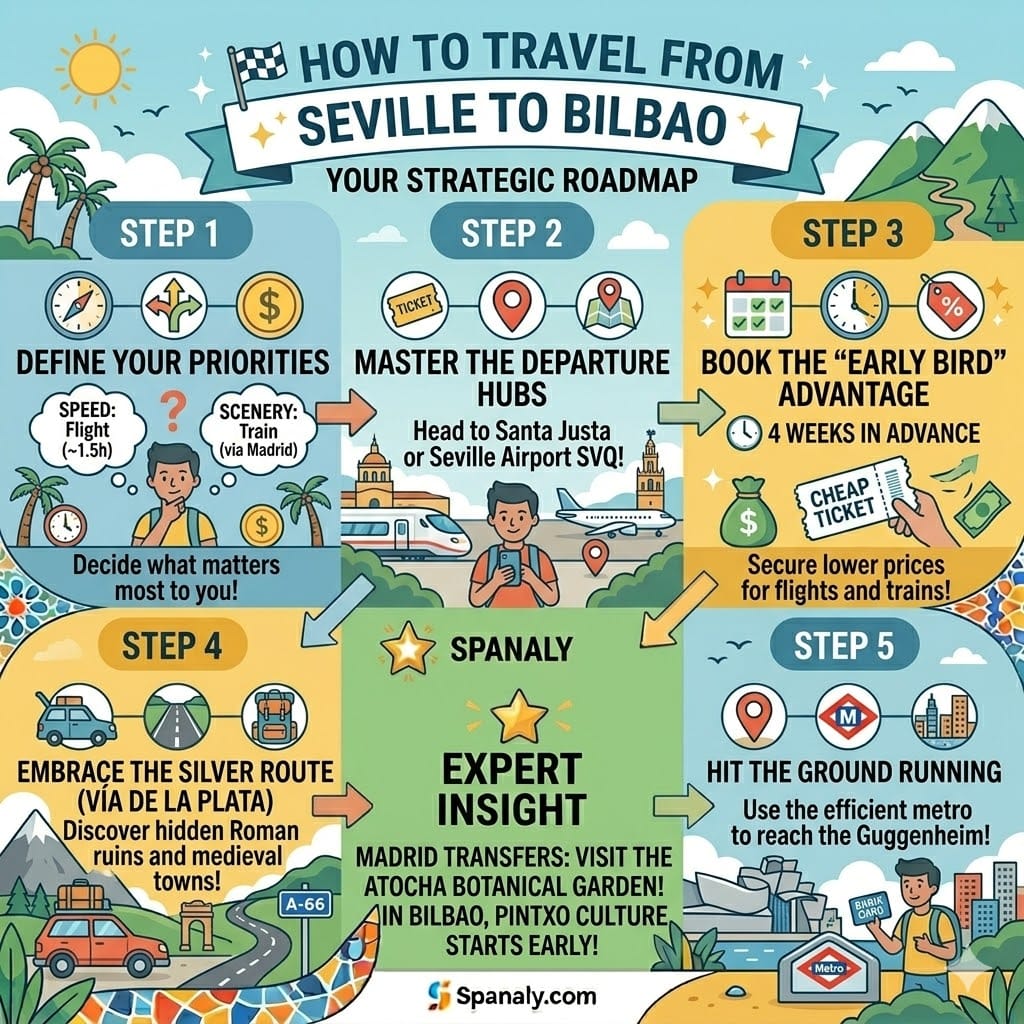
Mastering the 930 km route from the orange-scented streets of the South to the green Basque mountains requires a touch of local “Savoir-faire.” Follow these steps to ensure a seamless transition:
Define Your Priorities: Decide if you value speed (1.5h flight) or scenery (train via Madrid). For this long-haul journey, flying is the most popular choice, while the train offers a classic cross-country experience.
Master the Departure Hubs: For a smooth start, head to Sevilla Santa Justa for trains or the airport for flights. For more insider tips on navigating the Andalusian capital, check our Ultimate Seville Travel Guide.
Book the “Early Bird” Advantage: For both Vueling/Volotea flights and Renfe trains, tickets are significantly cheaper when booked at least 4 weeks in advance. Prices on this north-south corridor can spike during peak Basque festival seasons.
Embrace the Silver Route: If you choose to drive, the A-66 (Vía de la Plata) is your main path. It’s one of Spain’s most historic road trips, allowing you to discover Roman ruins and medieval towns that public transport skips.
Hit the Ground Running: Once you arrive at Bilbao Airport or Abando Station, grab a Barik card immediately. It’s your golden ticket to the city’s ultra-efficient metro, which will whisk you to the Guggenheim Museum in minutes.
✨ Spanaly Expert Insight
If you have a transfer in Madrid Atocha, don’t just wait at the gate. Head to the station’s tropical garden for a quick coffee. Once you land in Bilbao, remember that the Basque “Pintxo” culture starts early—head to Plaza Nueva for your first taste of the North!
📊 Transport Comparison: Seville to Bilbao at a Glance
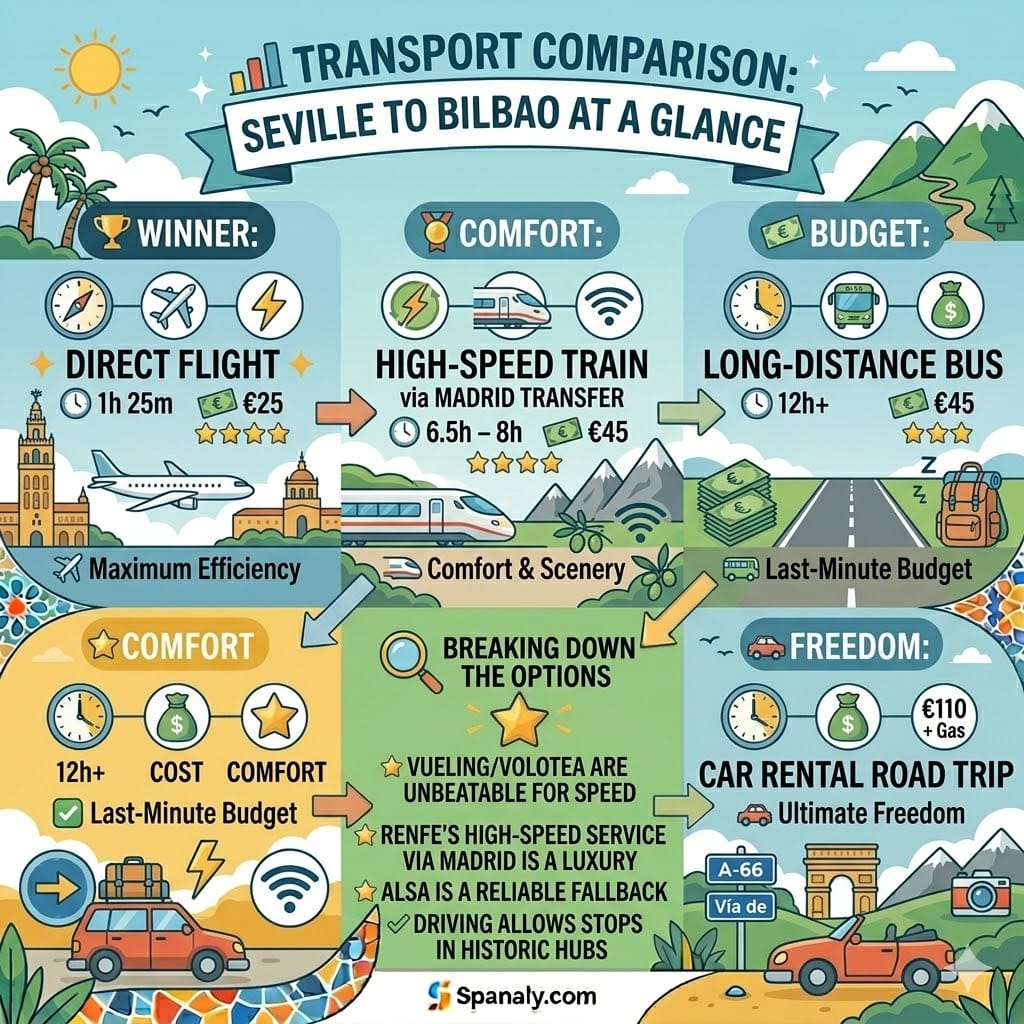
Choosing the right way to travel from the Andalusian capital to the Basque heartland depends on whether you want to reach the Guggenheim in record time or enjoy a grand cross-country adventure. Here is how the main options stack up for this 930 km journey:
| Transport Mode | Travel Time | Starting Cost | Comfort Level | Best For… |
| ✈️ Flying (Direct) | 1h 25m | €25 – €45 | ⭐⭐⭐ | Maximum Efficiency |
| 🚄 High-Speed Train | 6h 30m – 8h | €45 – €60 | ⭐⭐⭐⭐⭐ | Comfort & Scenery |
| 🚌 Long-Distance Bus | 12h 00m+ | €45 – €55 | ⭐⭐ | Last-Minute Budget |
| 🚗 Driving (Road Trip) | 8h 45m+ | €110 + Gas | ⭐⭐⭐⭐ | Ultimate Freedom |
*Note: While flying is the fastest in the air, remember to account for airport transfers. For a seamless start, check our Seville Airport (SVQ) Guide.
🔍 Breaking Down the Options
The Speed Winner: Direct flights operated by Vueling or Volotea are the undisputed champions. Crossing nearly the entire country in under 90 minutes is unbeatable for most travelers.
The Comfort King: If you despise airport queues, Renfe’s high-speed service via Madrid is a luxury. You get more legroom, Wi-Fi, and the chance to see the landscape transform from olive groves to jagged mountains.
The Budget Alternative: When flights are overpriced during peak festivals, the ALSA bus is a reliable fallback, though it requires some serious stamina for the 12-hour haul.
The Scenic Route: Driving via the A-66 (Vía de la Plata) allows you to stop in historic hubs like Mérida or Salamanca, turning a long transit into an epic Spanish road trip.
✨ Spanaly Expert Insight
If you opt for the train, you will likely have a “transfer” at Madrid Atocha. Don’t stress—it’s a high-speed connection. Use the 45-minute gap to grab a Café con Leche and admire the station’s famous indoor tropical garden before boarding your second leg to Bilbao.
🚄 High-Speed Train: The Scenic Rail Journey
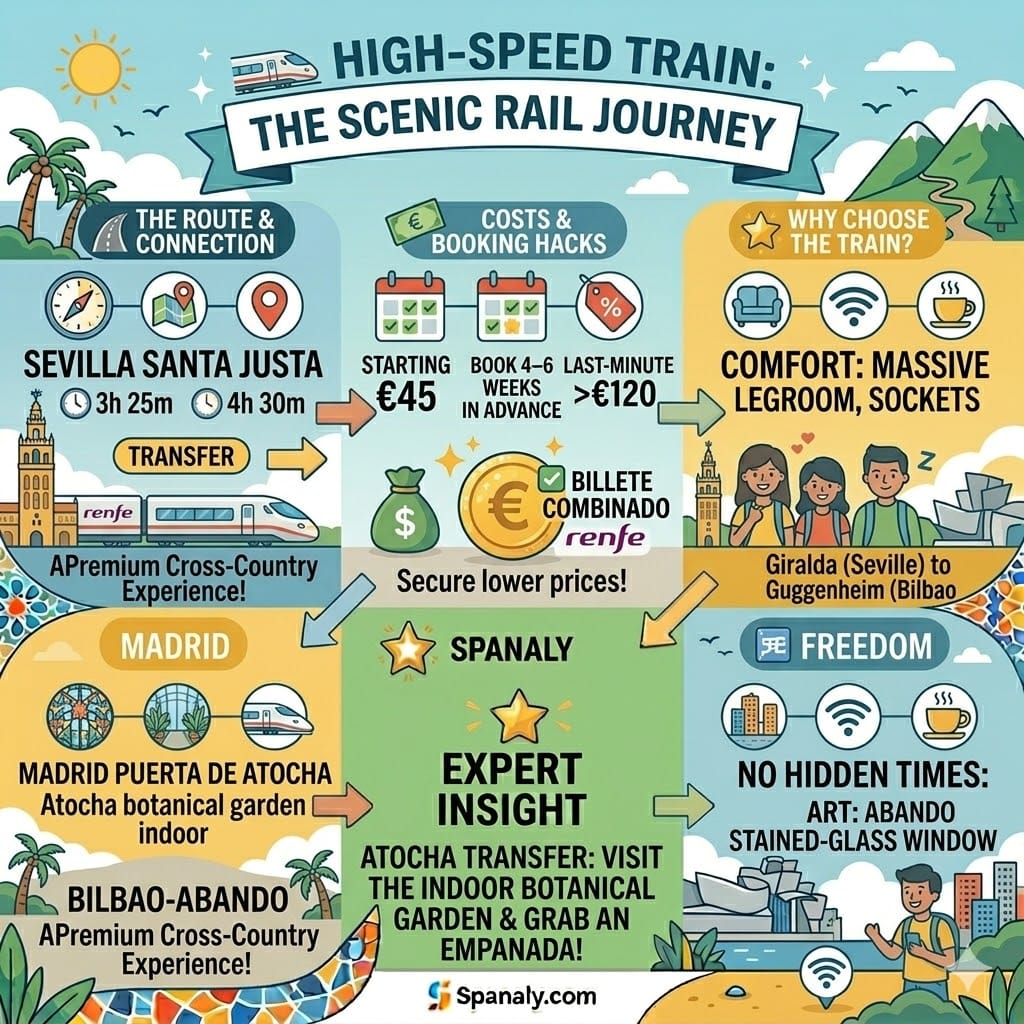
While there is no “direct” track connecting Seville to Bilbao without a stop, the High-Speed Rail (AVE) network makes this 930 km journey a premium experience. Traveling by train allows you to witness the dramatic shift from the sun-scorched plains of Andalusia to the rugged, green mountains of the Basque Country.
🛤️ The Route & Connection
The journey typically takes between 6.5 to 8 hours, depending on your transfer time in the capital.
Leg 1: Take the Renfe AVE from Sevilla Santa Justa to Madrid Puerta de Atocha.
The Transfer: You will switch from the AVE to an Alvia train. This requires a short walk through the station.
Leg 2: Board the Alvia train heading north to Bilbao-Abando Station.
💰 Costs & Booking Hacks
Starting Prices: Tickets can be found for as low as €45 if booked 4–6 weeks in advance. Last-minute fares can climb over €120.
Booking Tip: Always look for “Billete Combinado” (Combined Ticket) on the Renfe website. This ensures that if your first train is delayed, you are guaranteed a seat on the next connection to Bilbao at no extra cost.
✨ Why Choose the Train?
Comfort: Massive legroom, power sockets, and the freedom to walk to the cafeteria car.
No Hidden Times: You travel from city center to city center, avoiding long airport hauls and security lines.
The Stained Glass: Arriving at Bilbao-Abando is a treat in itself; the station features a legendary stained-glass window that serves as a perfect welcome to Basque culture.
✨ Spanaly Expert Insight
The transfer at Madrid Atocha is your best friend. Instead of rushing, give yourself at least 45 minutes. This gives you enough time to visit the station’s indoor tropical botanical garden (complete with hundreds of plants) and grab a fresh empanada for the second half of your trip.
✈️ Flying: The Speed Champion
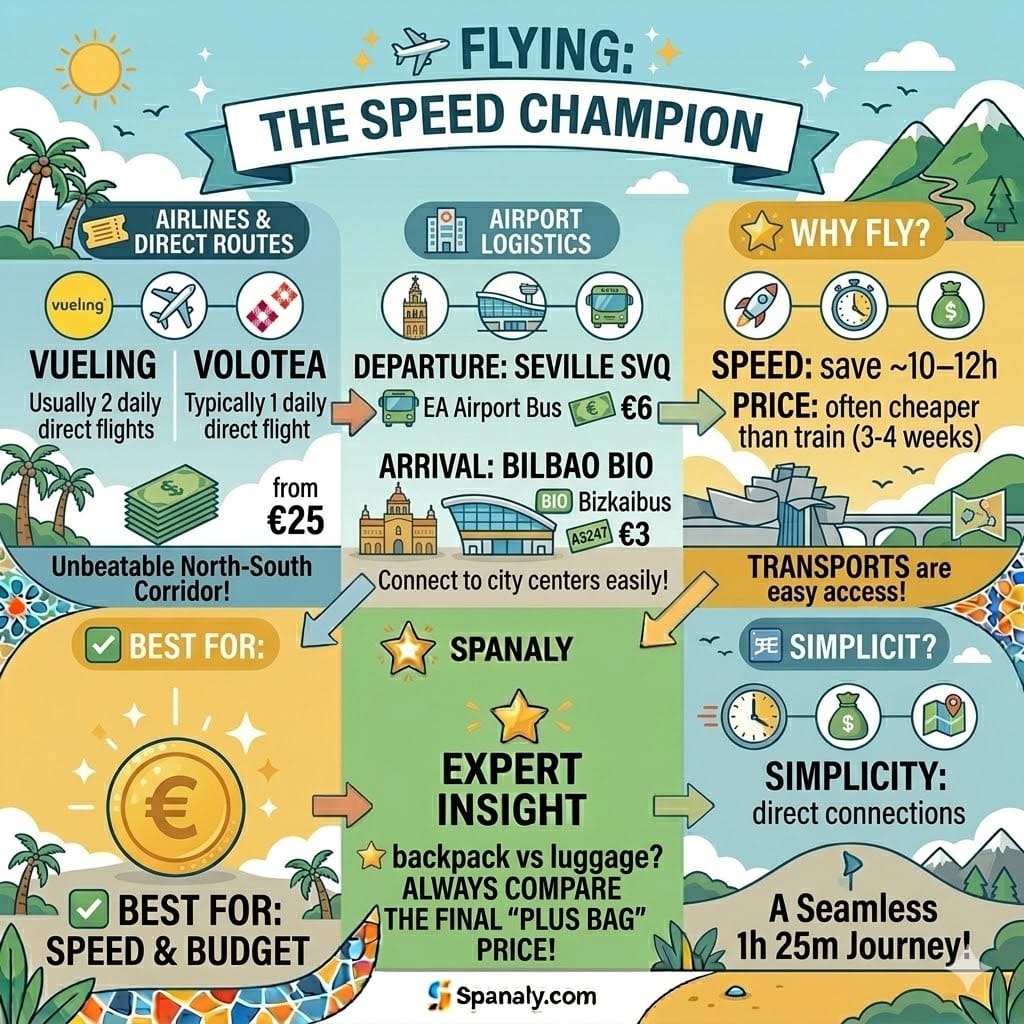
When it comes to covering the 930 km between Seville and Bilbao, flying is the undisputed king of efficiency. While other modes of transport take a full day or a long night, a direct flight gets you from the Guadalquivir to the Bay of Biscay in just 1 hour and 25 minutes.
🎫 Airlines & Direct Routes
Two main low-cost carriers dominate this north-south corridor, offering daily direct services:
Vueling: Usually offers 2 daily direct flights. Known for great punctuality and a wide range of connection options.
Volotea: Typically runs 1 daily direct flight. Often provides the most aggressive “early bird” pricing, sometimes starting as low as €25.
🏢 Airport Logistics
Departure: Head to Seville Airport (SVQ). For a stress-free start, check our Seville Airport (SVQ) Guide for details on the EA Airport Bus (€6) and security wait times.
Arrival: You will land at Bilbao Airport (BIO). To reach the city center, take the Bizkaibus A3247 located right outside arrivals. It costs only €3 and departs every 15 minutes, reaching the San Mamés hub in about 20–25 minutes.
✨ Why Fly?
Speed: You save approximately 10–12 hours compared to the bus.
Price: If booked 3–4 weeks in advance, flying is often cheaper than the high-speed train.
Simplicity: Two modern airports with very straightforward connections to their respective city centers.
✨ Spanaly Expert Insight
If you are traveling with just a backpack, Volotea often has “Megavolotea” deals that are unbeatable. However, if you have a carry-on, always compare the final “plus bag” price on Vueling, as they sometimes offer better bundles for travelers with luggage.
🚌 Long-Distance Bus: The Budget Marathon
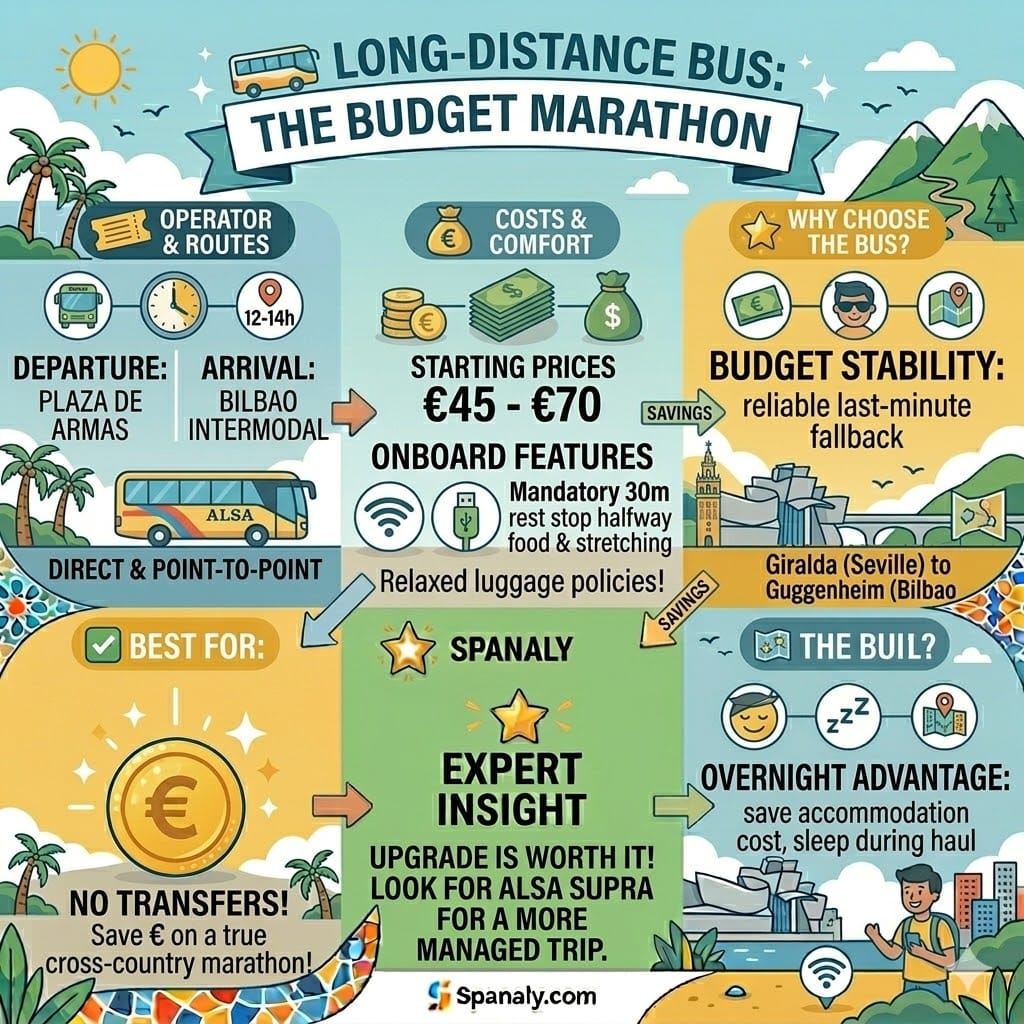
If you are a traveler who values a fixed price over speed, the bus is your steady companion. Traveling from Seville to Bilbao by bus is a true cross-country marathon, covering the vastness of the Iberian Peninsula in about 12 to 14 hours. While it requires stamina, it remains the most reliable “Plan B” when flight and train prices skyrocket at the last minute.
🎫 The Primary Operator: ALSA
ALSA is the main provider for this route, offering a direct bridge between the South and North. Most services depart from the Plaza de Armas Station. To ensure you find the station easily and grab a quick coffee before the long haul, check our Ultimate Seville Travel Guide for local transport tips.
💰 Costs & Comfort
Starting Prices: Tickets usually hover between €45 and €70. Unlike flights, bus prices remain relatively stable, even when booked just days before departure.
Overnight Advantage: Choosing the night bus (leaving late evening and arriving early morning) is a classic backpacker move—it saves you the cost of one night’s hotel and gets the “long haul” over while you sleep.
Onboard Features: Modern ALSA buses usually feature Wi-Fi and USB ports. Expect at least one mandatory 30-minute rest stop halfway for food and leg-stretching.
✨ Why Choose the Bus?
Last-Minute Stability: When the train hits €150, the bus is often still €55.
No Transfers: Unlike the train, which usually requires a change in Madrid, the bus is a direct “point-to-point” service.
Direct Arrival: You pull right into Bilbao Intermodal, located next to the San Mamés stadium and perfectly connected to the metro.
✨ Spanaly Expert Insight
For a 12-hour journey, the “comfort” upgrade is essential. Always look for the ALSA Supra service if available; the extra legroom and wider leather seats make a massive difference in how you’ll feel when you finally step out in the Basque Country.
🚗 Driving & Road Trip: The Vía de la Plata Adventure
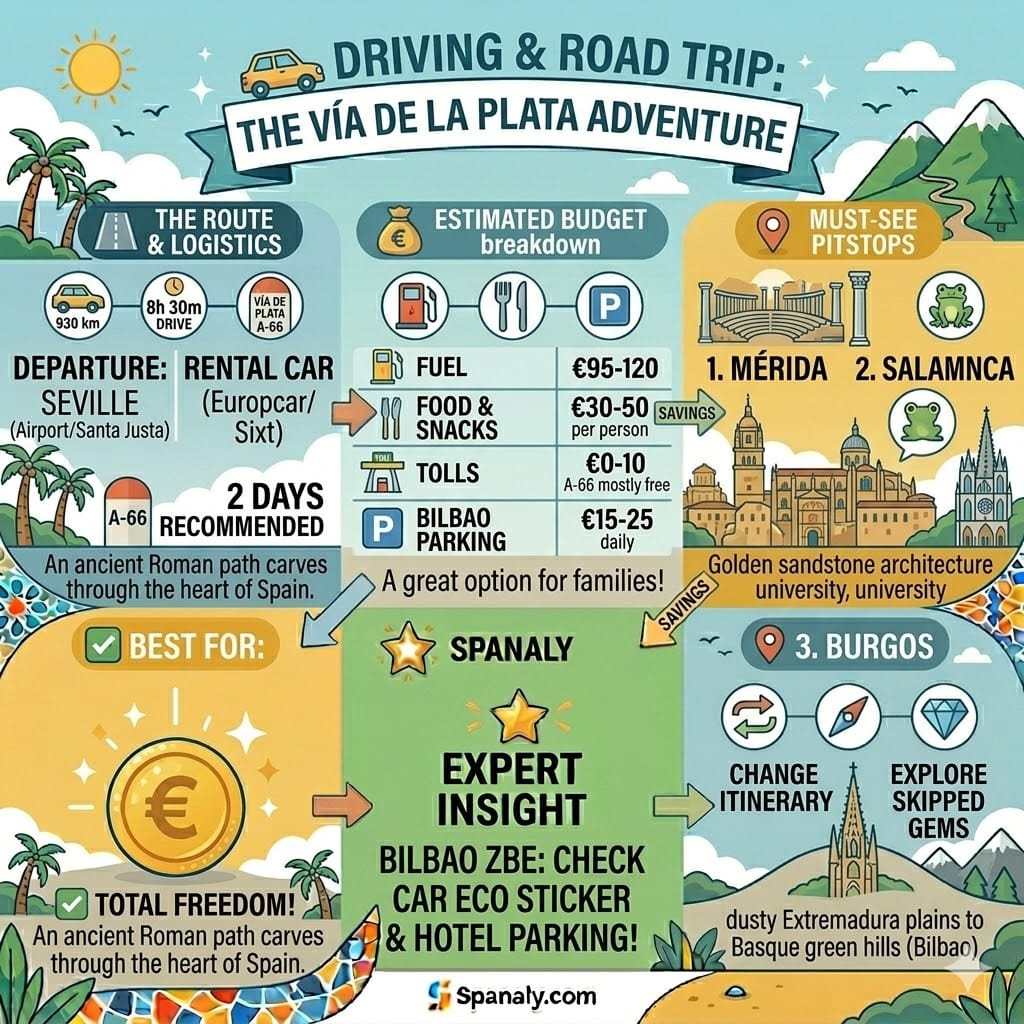
If you believe that the journey is just as important as the destination, driving from Seville to Bilbao is the ultimate Spanish experience. This 930 km route follows the historic A-66 highway, also known as the Vía de la Plata (The Silver Route), an ancient Roman path that carves through the heart of western Spain.
🛣️ The Route & Logistics
Travel Time: Approximately 8 hours and 30 minutes of pure driving. However, we recommend splitting this into 2 days to truly enjoy the scenery.
Car Rental: You can pick up a vehicle at Seville Airport or Santa Justa Station from providers like Sixt. For a deep dive into local traffic rules and rental hacks, check our guide on Driving in Spain.
💰 Road Trip Budget Breakdown (Estimated)
To help you plan, here is a quick breakdown of what this 930 km journey costs for a standard 5-seater car:
| Expense Category | Estimated Cost | Notes |
| ⛽ Fuel (Gasoline) | €95 – €120 | Based on average consumption and current prices. |
| 🍴 Food & Snacks | €30 – €50 | Per person (Roadside Ventas & Tapas stops). |
| 🛣️ Tolls | €0 – €10 | The A-66 is mostly free (Autovía). |
| 🅿️ Bilbao Parking | €15 – €25 | Daily rate for city center parking garages. |
📍 Must-See Pitstops Along the Way
Mérida: Stop for lunch and witness some of the best-preserved Roman ruins in Europe.
Salamanca: Famous for its golden sandstone architecture and the stunning Plaza Mayor.
Burgos: Don’t miss the Gothic Cathedral before the final push into the Basque mountains.
✨ Why Choose the Road Trip?
Total Freedom: Change your itinerary on a whim.
Cost Efficiency for Groups: If you are a group of 3 or 4, sharing the cost of gas and rental is significantly cheaper than individual train tickets.
Landscape Transformation: Watch the terrain shift from the dusty plains of Extremadura to the lush, emerald forests of the North.
✨ Spanaly Expert Insight
Driving in Spain is a pleasure, but be mindful of the “ZBE” (Zona de Bajas Emisiones) in Bilbao. The city center has restricted access for certain vehicles. Always ask your rental company for a car with an “Eco” or “C” sticker, and check if your Bilbao hotel offers parking, as street parking in the city center is notoriously difficult to find.
📍 Logistics: Mapping Your Start and End Points
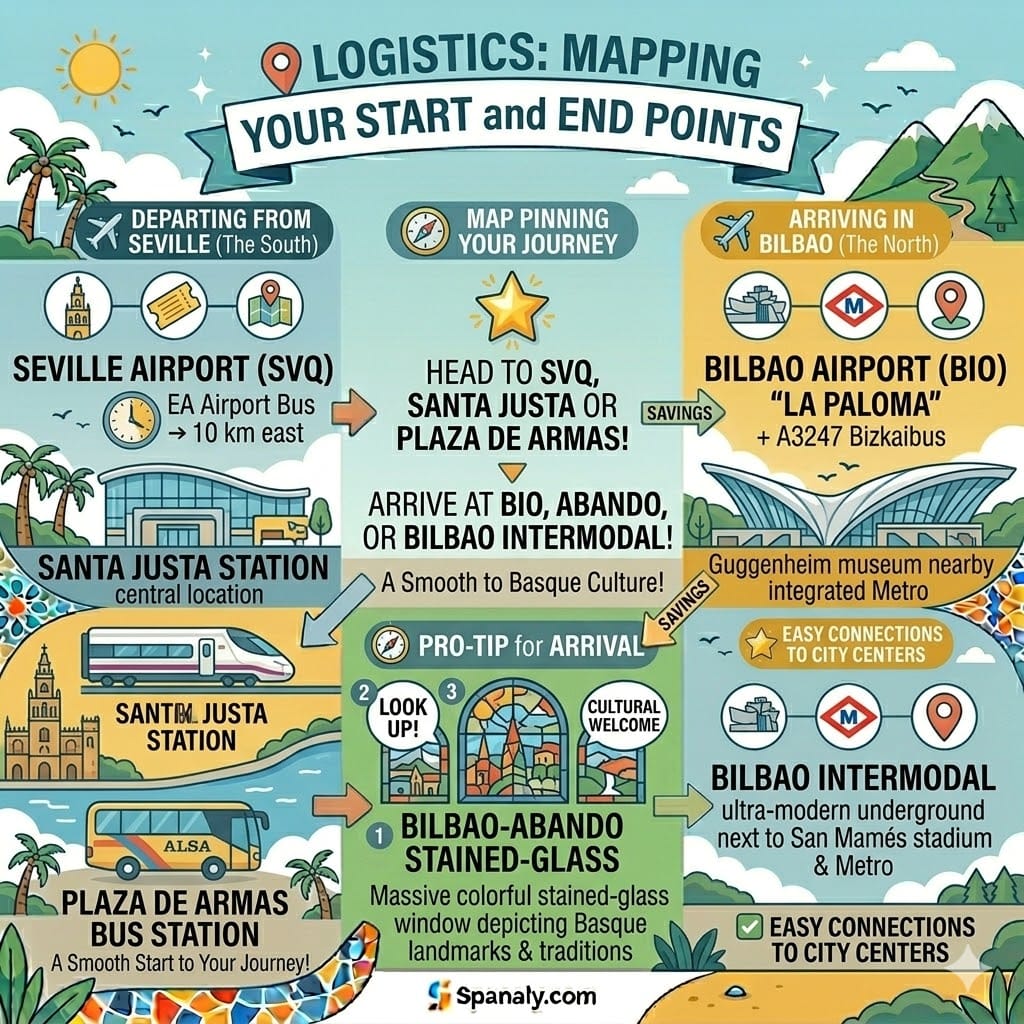
Navigating a 930 km journey requires knowing exactly where to stand. Whether you are catching a flight or boarding a train, here is the logistical breakdown of the hubs you will encounter. To make your departure even smoother, don’t forget to check our Getting Around Seville guide for local transport hacks.
🛫 Departing from Seville (The South)
Seville Airport (SVQ): Located about 10 km east of the city. The easiest way to get there is the EA (Especial Aeropuerto) bus, which stops at major hubs like Santa Justa and Plaza de Armas.
Santa Justa Station: The main rail gateway. It is centrally located and easily accessible via city buses or a quick taxi ride.
Plaza de Armas Bus Station: This is where your ALSA journey begins. It’s located near the river and the Triana bridge.
🛬 Arriving in Bilbao (The North)
Bilbao Airport (BIO): Known as “La Paloma,” this stunning airport is 12 km from the center. The A3247 Bizkaibus is your best friend here, taking you straight to the city’s main transit points.
Bilbao-Abando Station: You’ll arrive right in the heart of the city. The station is integrated with the metro, making it a breeze to reach the Guggenheim or Old Town (Casco Viejo).
Bilbao Intermodal: The main bus terminal. It is ultra-modern and underground, located right next to the San Mamés metro and tram stations.
🧭 Pro-Tip for Arrival
If you arrive at Bilbao-Abando, take a moment to look up at the massive stained-glass window before heading to the metro. It depicts Basque landmarks and traditions, offering the perfect cultural welcome to the North.
🏁 Verdict: Which Option is Best for You?
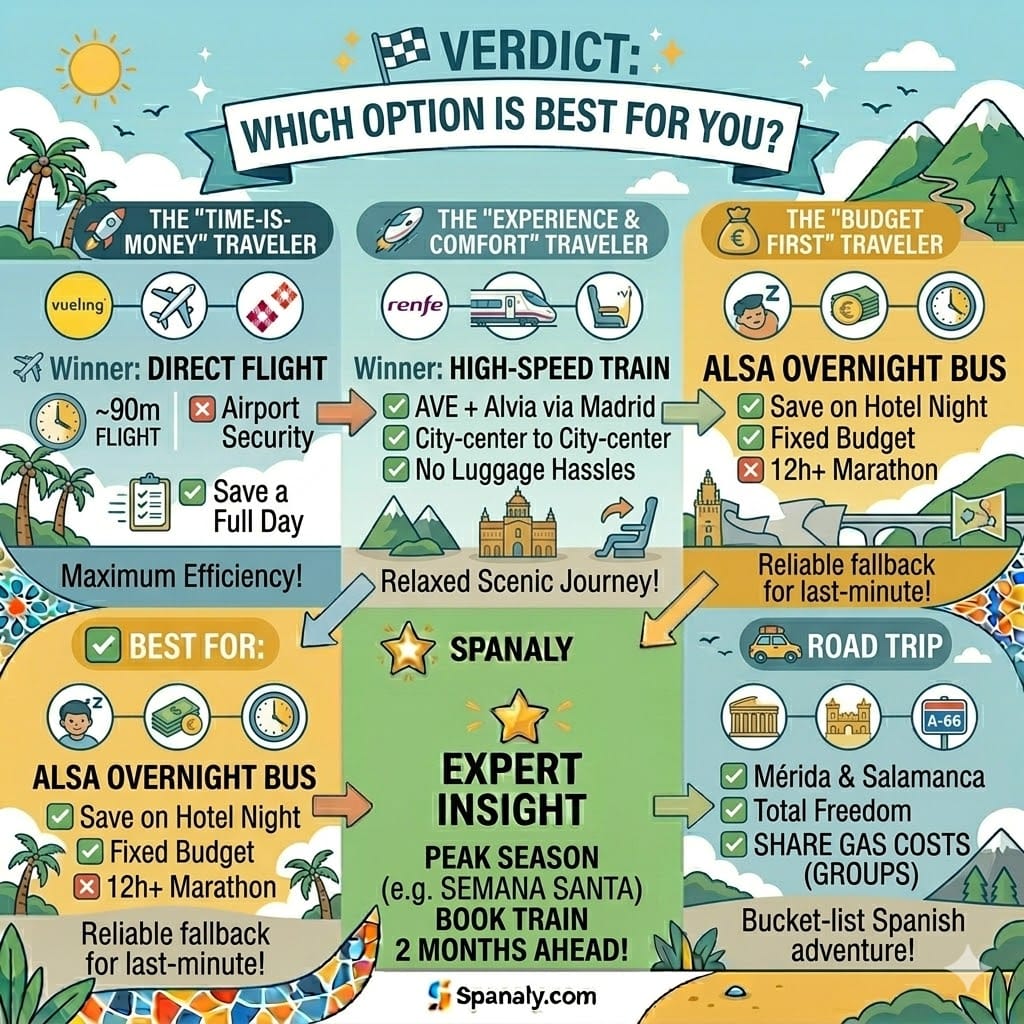
Navigating the 930 km journey from the vibrant streets of Seville to the artistic hub of Bilbao is all about matching your travel style with the right logistics. Whether you are a time-conscious professional or a budget-bound backpacker, here is our final expert take. To wrap up your planning, don’t miss our Seville Travel Tips for the best way to spend your final hours in the South.
🚀 The “Time-is-Money” Traveler
Winner: Direct Flight (Vueling/Volotea)
Why: You simply cannot beat a 90-minute flight. Even with airport security, you’ll save a full working day compared to any other mode of transport.
🚄 The “Experience & Comfort” Traveler
Winner: High-Speed Train (via Madrid)
Why: If you want to see the “real” Spain without the stress of driving, the AVE + Alvia combo is perfect. It’s city-center to city-center, meaning no luggage hassles or airport transfers.
💰 The “Budget First” Traveler
Winner: ALSA Overnight Bus
Why: It’s the most stable price-wise. By taking the night bus, you save on a hotel night and arrive in Bilbao ready for a morning coffee and a visit to the Guggenheim.
📸 The “Adventure-Seeker” Traveler
Winner: Road Trip (Vía de la Plata)
Why: For those who want to see Mérida’s Roman ruins and Salamanca’s golden plazas, the A-66 highway turns a simple transit into a bucket-list Spanish adventure.
✨ Spanaly Expert Insight
If you are traveling during the Semana Santa or Feria de Abril in Seville, or during Aste Nagusia in Bilbao, transport prices will skyrocket. In these peak seasons, the High-Speed Train often offers the best value-to-comfort ratio if you book at least 2 months in advance!
💡 Pro Tips for a Flawless Seville to Bilbao Journey
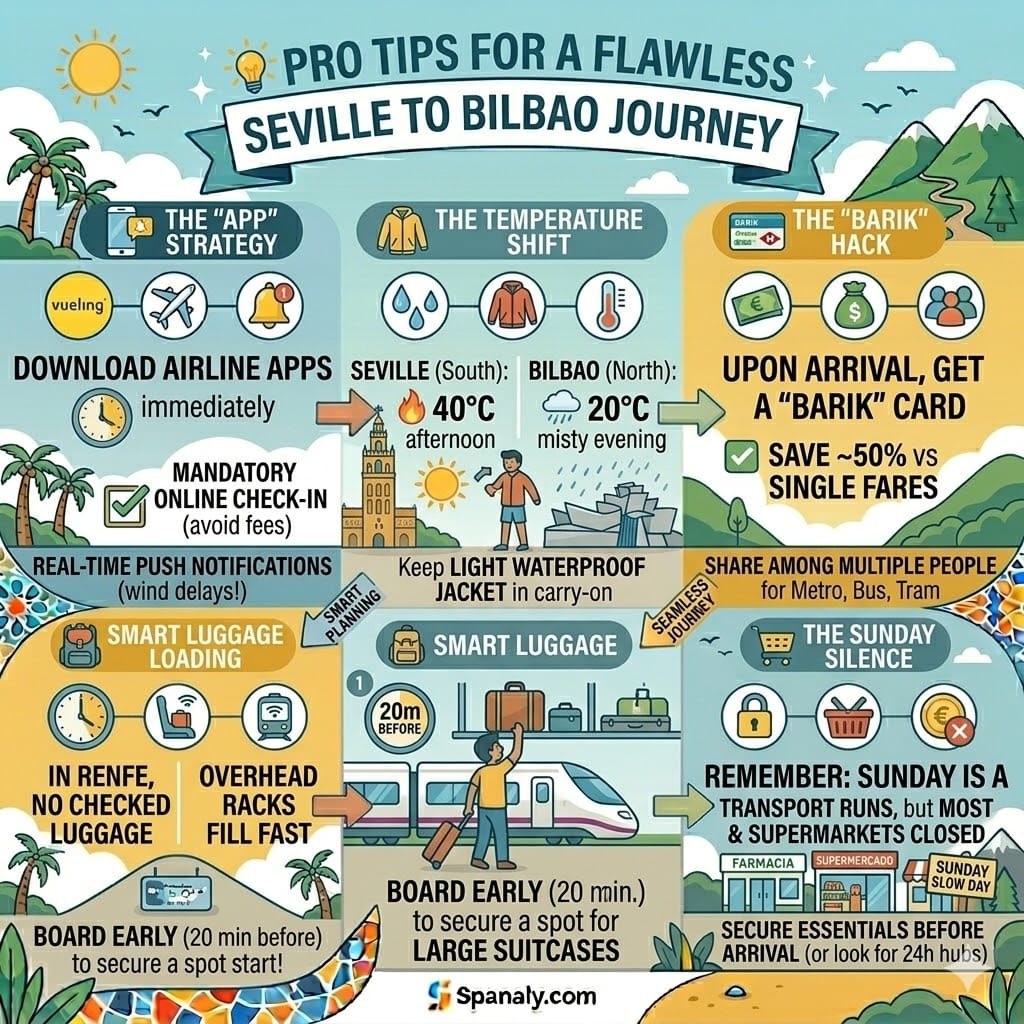
To master the transit from the sunny South to the industrial-chic North, you need more than just a ticket. For a deeper dive into making your entire Spanish adventure seamless, check out our comprehensive guide on Essential Spain Travel Tips.
📲 The “App” Strategy: If you are flying with Volotea or Vueling, download their apps immediately. Online check-in is mandatory to avoid steep airport fees, but more importantly, Bilbao’s airport is wind-sensitive—the app provides real-time notifications if the Atlantic weather affects your schedule.
🧥 The Temperature Shift: You are traveling between two distinct climates. You might leave a 40°C afternoon in Seville and land in a misty 20°C Bilbao evening. Always keep a light waterproof jacket or a “foulard” in your carry-on to handle the “Sirimiri” (the famous Basque drizzle) upon arrival.
💳 The “Barik” Hack: Upon arrival in Bilbao, avoid buying single tickets. Purchase a Barik Card from the airport or metro machines. It is rechargeable, significantly cheaper than individual fares, and—unlike in many other cities—a single card can be shared among multiple people for the metro, bus, and tram.
🎒 Smart Luggage Loading: In Renfe trains, there is no “checked” luggage. Storage racks fill up fast. Aim to be at the Sevilla Santa Justa platform 20 minutes before departure to secure a spot for your large suitcases in the racks near your seat rather than having to lift them to the high overhead shelves.
🛒 The Sunday Silence: Remember that Sunday is a “slow day” in Spain. While transport runs normally, most supermarkets and local shops in both Seville and Bilbao will be closed. If you are arriving late on a Sunday, secure your essentials beforehand or look for “Open 24h” pharmacies at the transport hubs.
🛡️ Visitor FAQs – Seville to Bilbao Travel Essentials
🍴 Is it possible to find "Sevillian Tapas" in Bilbao?
While you might find some Andalusian-themed bars, Bilbao is the kingdom of "Pintxos". Unlike Seville where tapas are often shared plates, Pintxos are small masterpieces on bread, usually pierced with a toothpick. Embrace the local culture in the Casco Viejo rather than looking for southern food!
📶 Is there free Wi-Fi on the long-distance bus and train?
Yes, both the Renfe AVE and ALSA Supra buses offer free Wi-Fi. However, since the route crosses mountainous regions in the north, connections can be spotty. We recommend downloading your offline maps and entertainment beforehand to ensure a seamless journey through the tunnels.
🗣️ Do I need to speak Basque (Euskara) to get around Bilbao?
Not at all. While the Basque language is proudly displayed on signs, everyone is bilingual in Spanish. In tourist areas like the Guggenheim or Gran Vía, English is widely understood. Learning a simple "Agur" (Goodbye) will always earn you a friendly smile from the locals!
🛍️ What is the best souvenir to bring from the North back to the South?
If you are traveling by train or car, a bottle of Txakoli (a sparkling white wine) or a traditional Boina (Basque beret) are iconic. Avoid bringing perishable seafood like fresh cod if you are taking the 12-hour bus; stick to high-quality canned Bonito del Norte instead.
🕒 Are the meal times different between Seville and Bilbao?
Yes! Bilbao tends to follow a slightly earlier schedule than Seville. While Sevillians might start dinner at 10:00 PM, many Pintxo bars in Bilbao are at their peak around 8:00 PM and might close earlier on weekdays. Adjust your clock forward by about an hour to match the northern rhythm.
Expertly curated by Spanaly.com
From the golden tower of Seville to the titanium curves of the Guggenheim, this journey is more than just travel—it is a transition between two beautiful worlds.
✈️ Fast Track: Choose the plane to maximize your time in the Basque Country.
🚄 Pure Comfort: Opt for the train for a relaxed, scenic cross-country experience.
🚌 Budget Smart: Use the overnight bus to save on hotels and travel costs.
🚗 True Freedom: Drive the Vía de la Plata to uncover Spain’s hidden historic gems.
Looking to explore more of the sunny South before heading North? Don’t miss our specialized guide on traveling from Seville to Malaga for the perfect Andalusian coastal escape.
✨ Safe Travels!
Whether you’re chasing the sun or the “Sirimiri” mist, enjoy every kilometer of the ride. ¡Buen viaje!