Table of Contents
Toggle🏛️ Vitoria-Gasteiz
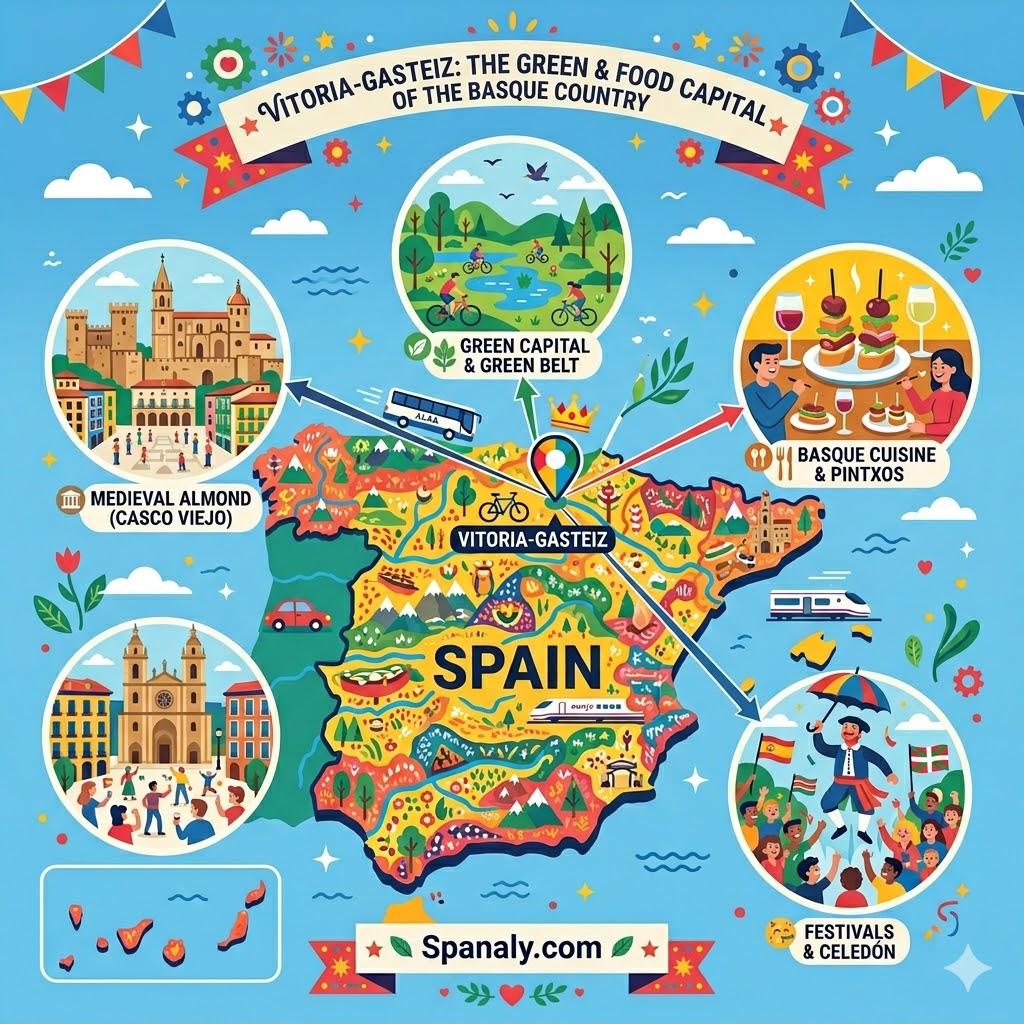
Vitoria-Gasteiz sits as the administrative heart of the Basque Country. It offers an authentic local lifestyle often missed by typical tourist crowds. You will find a city that perfectly balances 13th-century history with world-class sustainability.
Why visit this city?
🌳 España Verde: Explore over 30 kilometers of parks encircling the city center.
🏰 Medieval Roots: Walk through one of Spain’s best-preserved Gothic quarters.
🍴 Pintxo Culture: Enjoy high-quality Basque cuisine at more affordable prices.
🌧️ Real Weather: Pack an umbrella, as the Atlantic rain is a daily reality here.
If you are planning a broader trip, check our Ultimate Northern Spain Travel Guide to see how this city fits into your route. Vitoria-Gasteiz isn’t about flashy landmarks. It is about the quality of life, fresh air, and deep-rooted Basque traditions.
📊 Quick Snapshot: Essential Vitoria-Gasteiz Facts
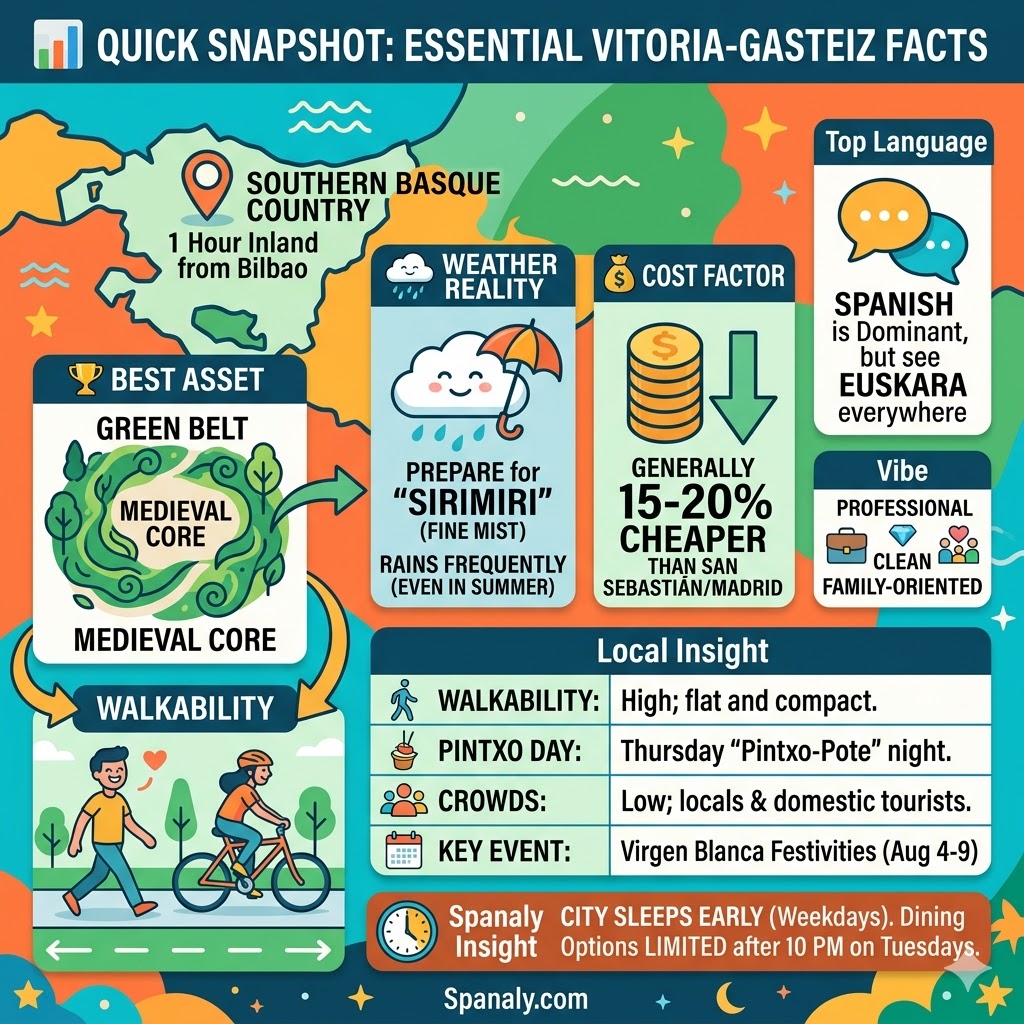
Before arriving, understand that Vitoria-Gasteiz operates differently from the coastal cities. It is quieter, greener, and follows a traditional Basque rhythm.
Location: Southern Basque Country, about an hour inland from Bilbao.
Best Asset: The “Green Belt” and a pedestrian-friendly medieval core.
Vibe: Professional, clean, and family-oriented.
Weather Reality: Prepare for the Sirimiri (fine mist). It rains frequently even in summer.
Cost Factor: Generally 15-20% cheaper than San Sebastián or Madrid.
Top Language: Spanish is dominant, but you will see Euskara everywhere.
| Feature | Local Insight |
|---|---|
| Walkability | High; the city is flat and compact. |
| Pintxo Day | Thursday is “Pintxo-Pote” night (cheap snacks and drinks). |
| Crowds | Low; mostly locals and domestic Spanish tourists. |
| Key Event | Virgen Blanca Festivities (August 4th to 9th). |
Spanaly Insight: Don’t expect a bustling nightlife like in Madrid. Vitoria-Gasteiz sleeps early on weekdays. Locals value their morning coffee and afternoon walks. If you arrive after 10 PM on a Tuesday, your dining options will be very limited.
⚖️ Vitoria-Gasteiz vs. Pamplona: Choosing Your Basque City
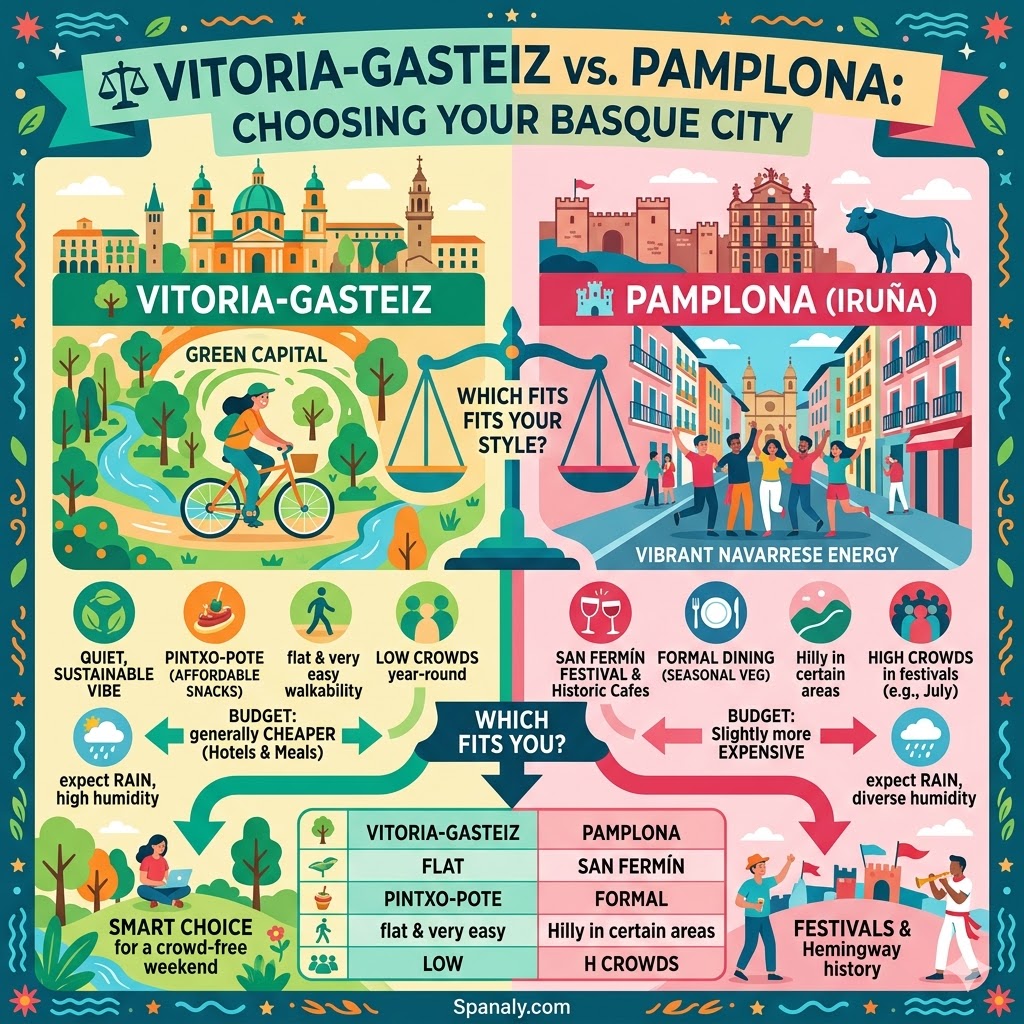
Deciding between these two inland capitals depends on your travel style. While they share a medieval history, their daily pace differs significantly.
Atmosphere: Vitoria-Gasteiz focuses on quiet, sustainable living. Pamplona offers a more vibrant, traditional Navarrese energy.
Food Scene: Vitoria is famous for the Pintxo-Pote (affordable drinks and snacks). Pamplona is known for formal dining and seasonal vegetables.
Budget: Vitoria is generally cheaper for hotels and meals. If you are tracking your expenses, check our guide on Northern Spain travel cost and budget for a better breakdown.
Weather: Expect rain in both cities. However, Vitoria’s humidity is more noticeable due to its surrounding wetlands.
| Feature | Vitoria-Gasteiz | Pamplona (Iruña) |
|---|---|---|
| Main Identity | Europe’s Green Capital. | Kingdom of Navarre history. |
| Best For | Cycling and quiet walks. | Festivals and historic cafes. |
| Crowds | Very low year-round. | High during San Fermín. |
| Walkability | Flat and very easy. | Hilly in certain areas. |
Spanaly Insight: If you prefer a crowd-free weekend, Vitoria is the smart choice. Pamplona gets very busy during its famous Spanish festivals, specifically in July. For a more sophisticated coastal vibe instead of these inland cities, you might find the San Sebastian travel guide more aligned with your interests.
✅ Why Visit Vitoria-Gasteiz?
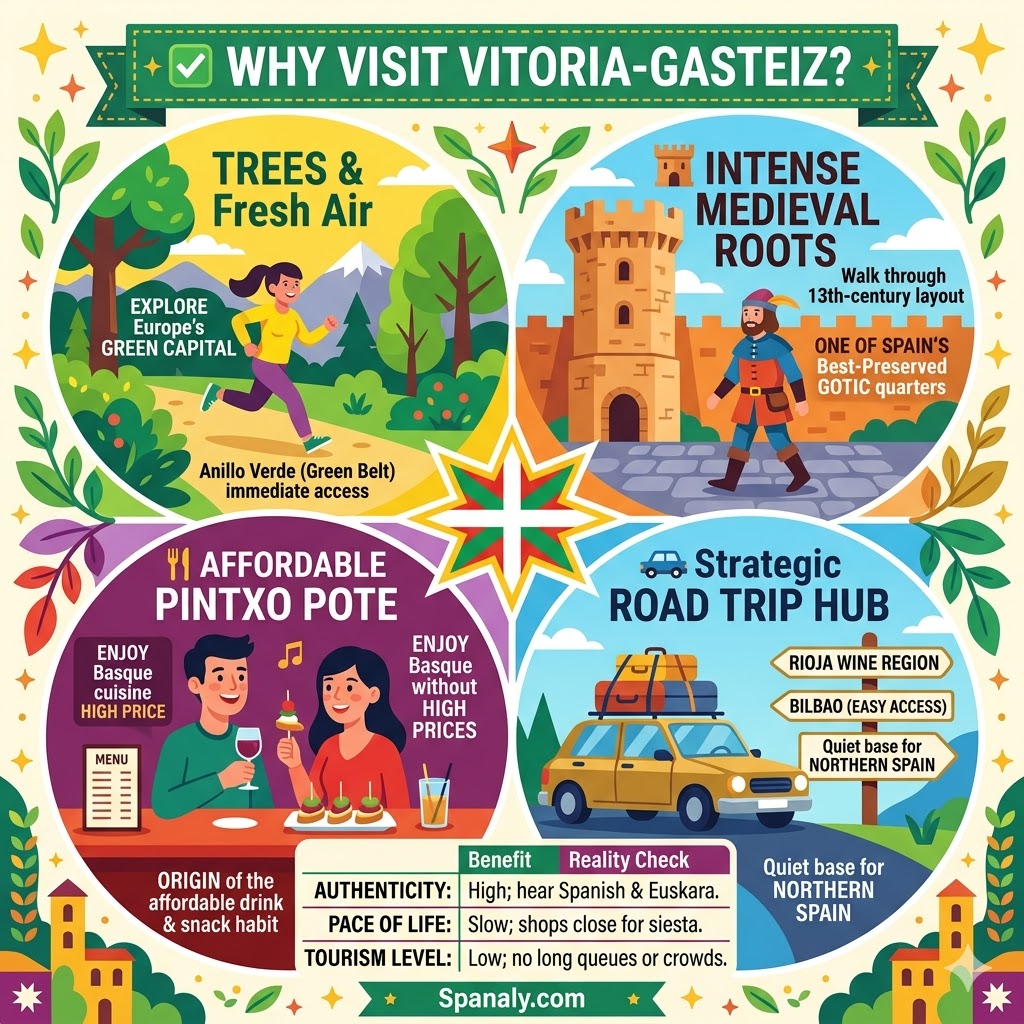
Vitoria-Gasteiz offers a different experience compared to the busy coastal hubs of Northern Spain. You should visit if you value space, local traditions, and a high quality of life without the inflated prices of major tourist centers.
Award-Winning Sustainability: Explore a city recognized as a European Green Capital. The massive “Anillo Verde” (Green Belt) provides immediate access to nature from any street corner.
Intact Medieval Heritage: Walk through the “Medieval Almond.” This 13th-century layout remains remarkably preserved, offering a clear look at Basque history without the modern commercial clutter.
Affordable Basque Dining: Enjoy premium cuisine at local rates. The city is the birthplace of the Pintxo-Pote tradition, where you get a drink and a snack for a fraction of the cost found in San Sebastián.
Strategic Road Trip Base: Use the city as a quiet hub. It is perfectly positioned for those planning a Northern Spain road trip, providing easy access to the Rioja wine region and Bilbao.
| Benefit | Reality Check |
|---|---|
| Authenticity | High; you will mostly hear Spanish and Euskara. |
| Pace of Life | Slow; most shops follow the traditional Spanish daily rhythm and close for siesta. |
| Tourism Level | Low; no long queues for attractions or crowded viewpoints. |
Spanaly Insight: Don’t visit Vitoria-Gasteiz if you are looking for nightlife or Mediterranean sun. This is a city of rain, parks, and early nights. The real value here is the silence and the ability to explore a Basque capital that still belongs to its residents, not just international visitors.
🏛️ Best Things to See in Vitoria-Gasteiz: Landmarks & Old Town
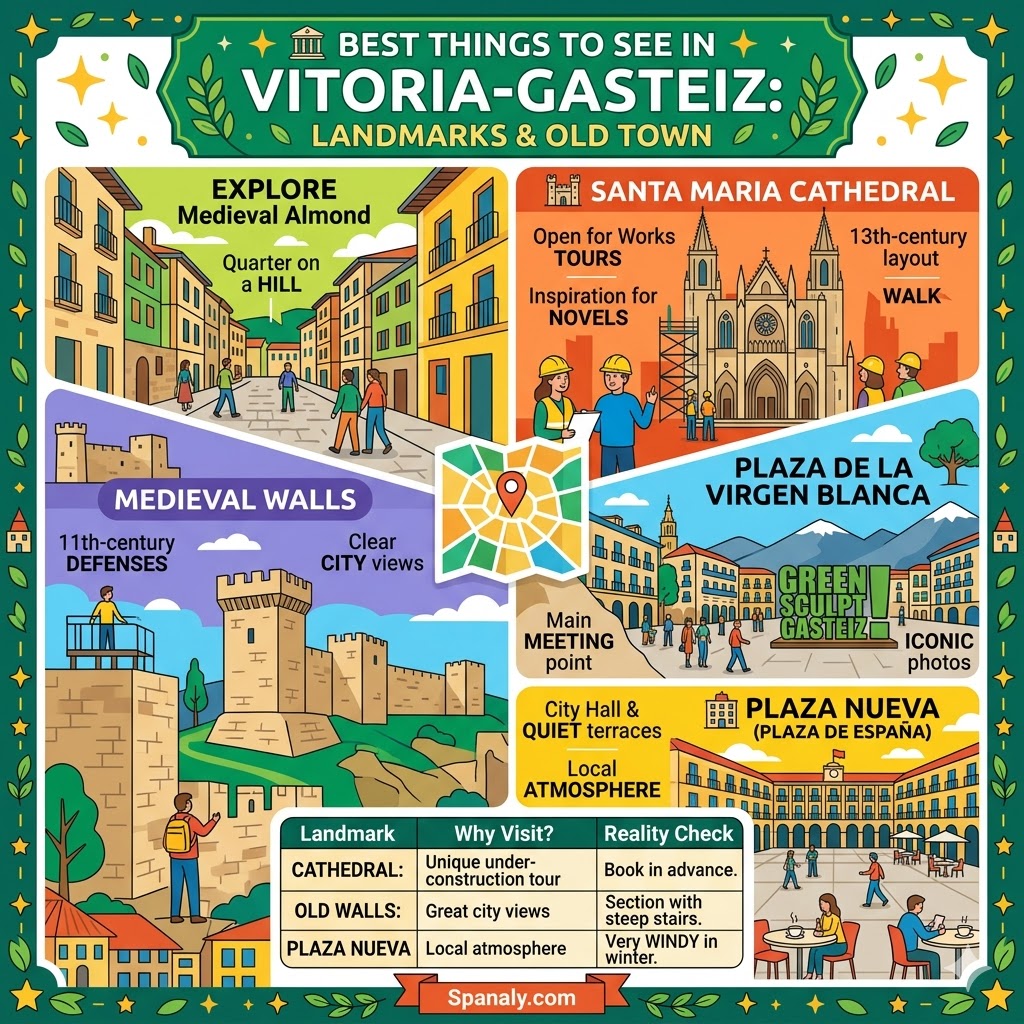
The heart of the city is the Medieval Almond, a hill-top quarter with a 13th-century layout. Walking here is the best way to understand the city’s history. Most sites are close together, making it easy to see everything on foot.
Santa Maria Cathedral: This Gothic cathedral is famous for its “Open for Works” tours. You must wear a hard hat to explore the ongoing restoration. It inspired Ken Follett’s famous novels.
The Medieval Wall: Visit the restored sections of the 11th-century walls. They offer a clear view of how the old city was defended.
Plaza de la Virgen Blanca: This is the city’s main meeting point. Look for the famous “Vitoria-Gasteiz” green sculpture for your photos.
Plaza Nueva (Plaza de España): A perfectly square neoclassical plaza. It houses the City Hall and several quiet terraces for a morning coffee.
Artium Museum: If you prefer modern art, this museum houses an important collection of Basque and Spanish contemporary works.
| Landmark | Why Visit? | Reality Check |
|---|---|---|
| Cathedral | Unique “Under Construction” tour. | Book tickets in advance; they sell out fast. |
| Old Walls | Great city views. | Some sections have steep stairs. |
| Plaza Nueva | Local atmosphere. | Can be very windy in winter months. |
Spanaly Insight: Most museums in Vitoria-Gasteiz are free or very cheap on certain days of the week. However, the city center can feel like a ghost town on Monday mornings when many shops and local sites remain closed. Plan your Spanish attractions visits for Tuesday through Sunday to avoid disappointment.
🌳 The Green Belt: Walking and Cycling in Europe’s Green Capital
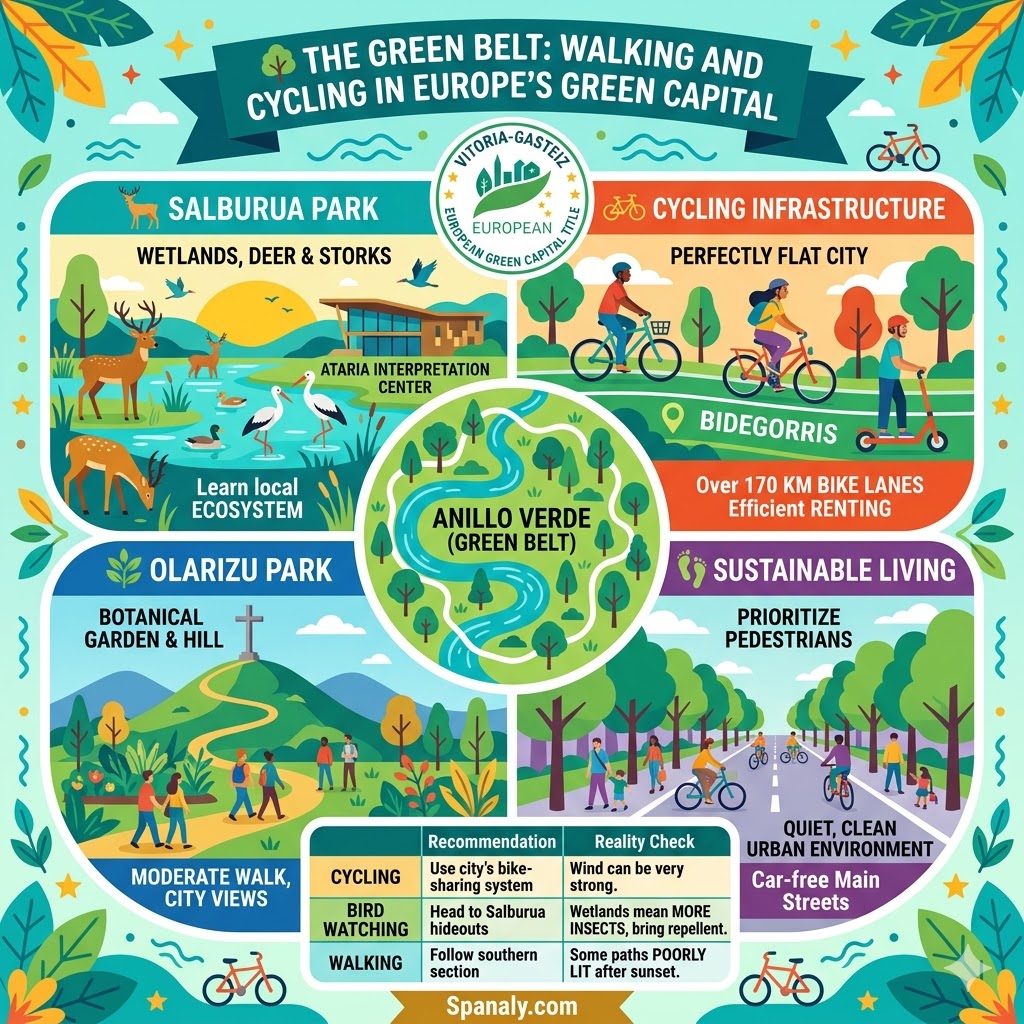
Vitoria-Gasteiz earned the European Green Capital title for its commitment to sustainability. The city is surrounded by the Anillo Verde (Green Belt), a series of linked parks. You can reach a natural space within minutes from any point in the city center.
Salburua Park: This is the most famous section. It consists of wetlands where you can see deer and storks. Visit the Ataria Interpretation Center to learn about the local ecosystem.
Cycling Infrastructure: The city is perfectly flat. It features over 170 kilometers of bike lanes (bidegorris). Renting a bike is the most efficient way to see the outer parks.
Olarizu Park: Best for a moderate walk. It features a botanical garden and a hill with a large cross at the top for city views.
Sustainable Living: Vitoria-Gasteiz prioritizes pedestrians. Many main streets are fully car-free, creating a quiet and clean urban environment.
| Activity | Recommendation | Reality Check |
|---|---|---|
| Cycling | Use the city’s bike-sharing system. | Wind can be very strong in open park areas. |
| Bird Watching | Head to the Salburua hideouts. | Wetlands mean more insects; bring repellent in summer. |
| Walking | Follow the southern section of the belt. | Some paths are poorly lit after sunset. |
Spanaly Insight: While the parks are beautiful, the weather changes fast. Always wear layers, even if the sun is out. If you enjoy this type of eco-friendly city, you should also explore Get Around Barcelona or our guide on Spain travel tips to see how other cities compare in terms of pedestrian access and public green space.
🚆 How to Get to Vitoria-Gasteiz: Transport and Arrival Tips
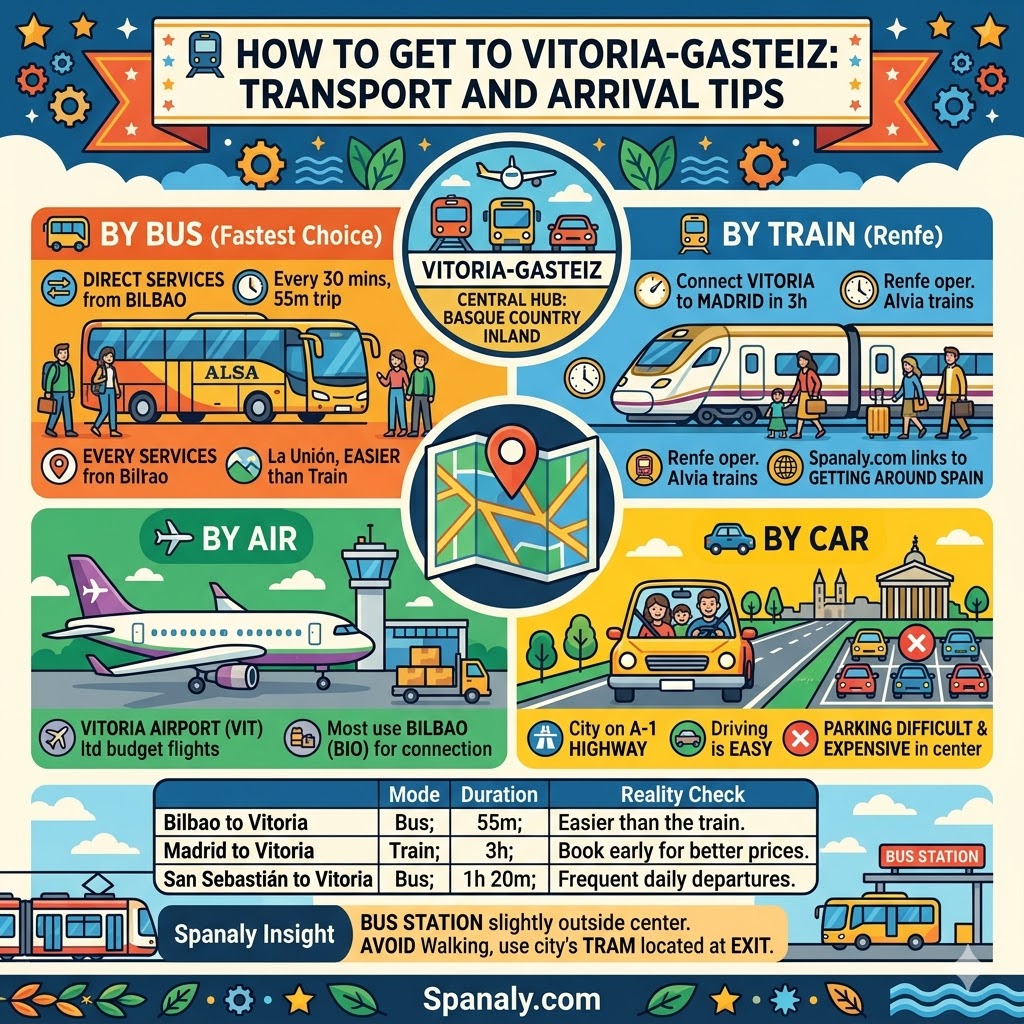
Vitoria-Gasteiz serves as a central hub for those exploring the Basque Country. Most international visitors arrive via Bilbao or Madrid before heading inland.
By Bus (Fastest Choice): Buses are more frequent than trains for this route. Companies like ALSA and La Unión run direct services from Bilbao every 30 minutes. The trip takes about 55 minutes.
By Train: Renfe operates Alvia trains connecting Vitoria to Madrid in about 3 hours. For a broader view of your options across the country, see our guide on getting around Spain for train passes and tickets.
By Air: Vitoria Airport (VIT) handles limited budget flights. Most travelers fly into Bilbao (BIO) and take a direct bus to Vitoria.
By Car: The city sits on the A-1 highway. While driving is easy, parking in the historic center is notoriously difficult and expensive.
| Route | Mode | Duration | Reality Check |
|---|---|---|---|
| Bilbao to Vitoria | Bus | 55m | Easier than the train. |
| Madrid to Vitoria | Train | 3h | Book early for better prices. |
| San Sebastián to Vitoria | Bus | 1h 20m | Frequent daily departures. |
Spanaly Insight: The bus station is located slightly outside the medieval center. Avoid walking with heavy luggage; use the city’s tram system located right at the station exit. If you are planning a more extensive trip through the region, our detailed look at transport in Northern Spain will help you coordinate your stops efficiently.
🏨 Where to Stay in Vitoria-Gasteiz: Best Areas and Hotels
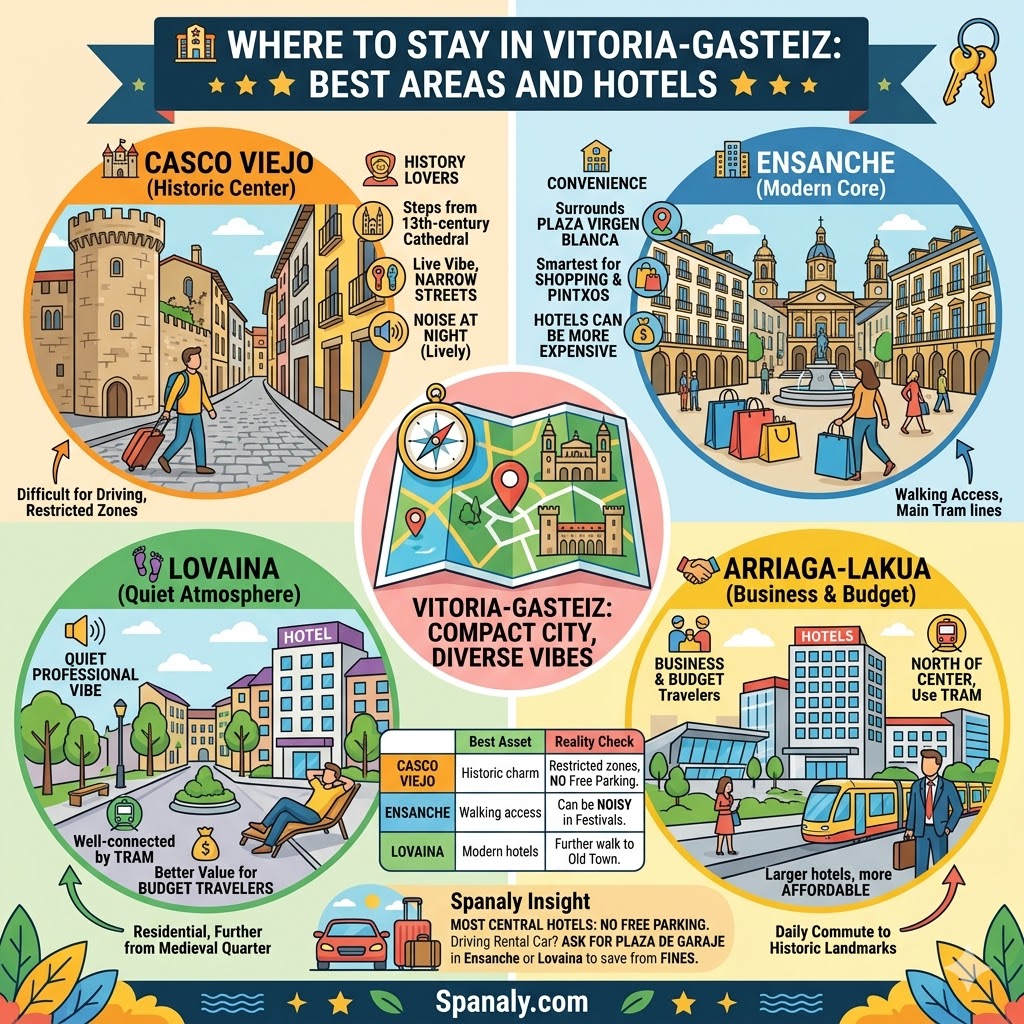
Choosing your area is simple because the city is compact. However, you should match your choice to your transport needs and budget.
Casco Viejo (Historic Center): Best for history lovers. Stay here to be steps away from the 13th-century Cathedral. Before booking, check our guide on accommodation in Spain to understand the typical layout of historic Basque buildings.
Ensanche (Modern Core): Best for convenience. This area surrounds Plaza de la Virgen Blanca. It is the smartest choice if you want to be near the main shopping streets and best pintxo bars.
Lovaina: Best for a quiet atmosphere. It is slightly west but well-connected by tram. If you are on a Spain travel budget, you will find better value for money in the hotels here compared to the city center.
Arriaga-Lakua: Best for business travelers. It is further north but offers larger hotels. You will need to use the tram to reach the historic landmarks every day.
| Area | Best Asset | Reality Check |
|---|---|---|
| Casco Viejo | Historic charm. | Very difficult for driving in Spain due to restricted zones. |
| Ensanche | Walking access. | Can be noisy during local festivals. |
| Lovaina | Modern hotels. | Further walk to the medieval quarter. |
Spanaly Insight: Most hotels in the center do not have free parking. If you are arriving with a car, ask specifically for a “Plaza de Garaje.” Street parking is strictly regulated and reserved for locals in the blue and green zones.
🍴 Where to Eat in Vitoria-Gasteiz: Best Pintxo Bars and Local Food
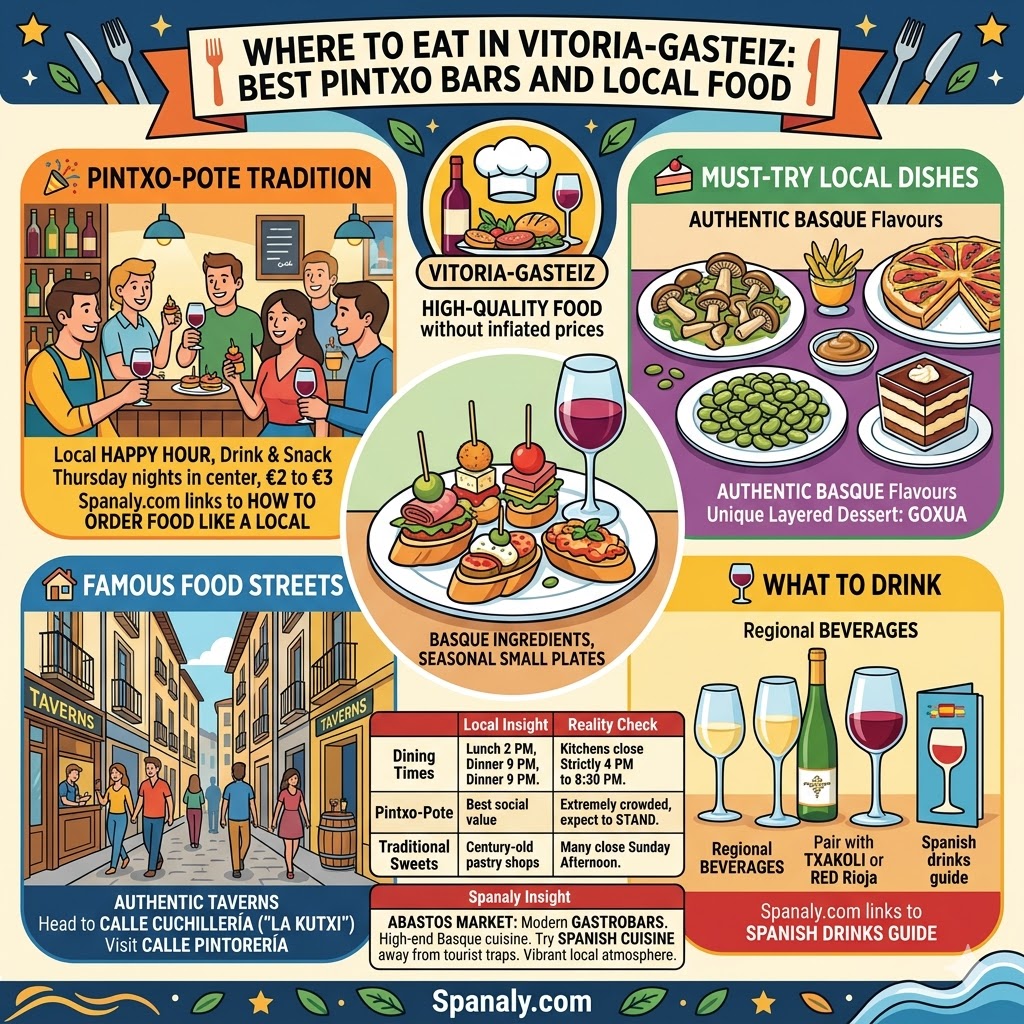
Vitoria-Gasteiz offers a high-quality food scene without the inflated prices of San Sebastián. The culture here revolves around small plates (pintxos) and seasonal Basque ingredients.
Pintxo-Pote Tradition: This is a local “happy hour” where you get a drink and a snack for around €2 to €3. It usually happens on Thursday nights in the center. Knowing how to order food like a local will help you navigate the crowded bars like a pro.
Must-Try Local Dishes: Look for Perretxikos (spring mushrooms) or Habas a la Vitoriana (broad beans with ham). For dessert, don’t miss the Goxua, a layered cream and sponge cake unique to this city.
Famous Food Streets: Head to Calle Cuchillería (locally known as “La Kutxi”) or Calle Pintorería. These streets house the most authentic taverns.
What to Drink: Pair your meal with a glass of Txakoli (sparkling white wine) or a local Rioja Alavesa red. Check our Spanish drinks guide for more details on regional beverages.
| Feature | Local Insight | Reality Check |
|---|---|---|
| Dining Times | Lunch starts at 2:00 PM; Dinner at 9:00 PM. | Kitchens close strictly between 4:00 PM and 8:30 PM. |
| Pintxo-Pote | Best value for social eating. | It gets extremely crowded; expect to stand. |
| Traditional Sweets | Visit century-old pastry shops. | Many close on Sunday afternoons. |
Spanaly Insight: If you want a more formal meal, visit the Abastos Market. It features modern “gastrobars” that serve high-end Basque cuisine in a casual market setting. It is the perfect place to try Spanish cuisine in a vibrant, local atmosphere away from the tourist traps.
🗓️ Best Time to Visit Vitoria-Gasteiz: Weather and Festivals
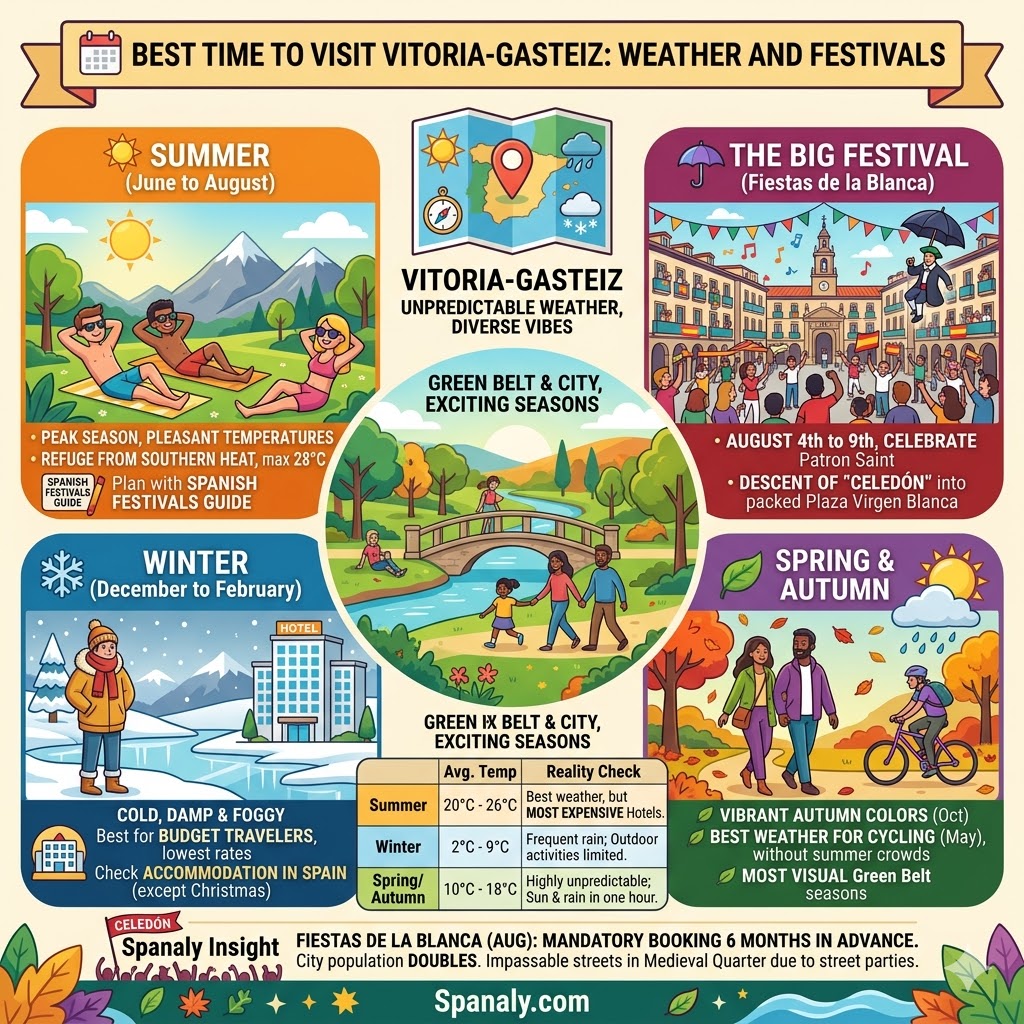
Vitoria-Gasteiz does not have the Mediterranean climate many expect from Spain. The weather is unpredictable, and festivals can completely transform the city’s atmosphere and prices.
Summer (June to August): This is the peak season. Temperatures are pleasant, rarely exceeding 28°C, making it a refuge from the southern heat. If you enjoy crowds, plan your trip around our guide to Spanish festivals to experience the local traditions.
The Big Festival (Fiestas de la Blanca): From August 4th to 9th, the city celebrates its patron saint. It starts with the descent of “Celedón” (a character with an umbrella) into a packed Plaza de la Virgen Blanca.
Winter (December to February): It is cold, damp, and often foggy. However, it is the best time for budget travelers. You will find the lowest rates for accommodation in Spain during these months, except during Christmas.
Spring & Autumn: These are the most visual seasons for the Green Belt. October brings vibrant autumn colors, while May offers the best weather for cycling without the summer crowds.
| Season | Avg. Temp | Reality Check |
|---|---|---|
| Summer | 20°C – 26°C | Best weather, but the most expensive hotels. |
| Winter | 2°C – 9°C | Frequent rain; many outdoor activities are limited. |
| Spring/Autumn | 10°C – 18°C | Highly unpredictable; you might see sun and rain in one hour. |
Spanaly Insight: If you visit during the Fiestas de la Blanca in August, booking six months in advance is mandatory. The city literally doubles in population, and most streets in the Medieval Quarter become impassable due to the massive street parties.
🗺️ Vitoria-Gasteiz Itinerary: 1 & 2 Day Plans
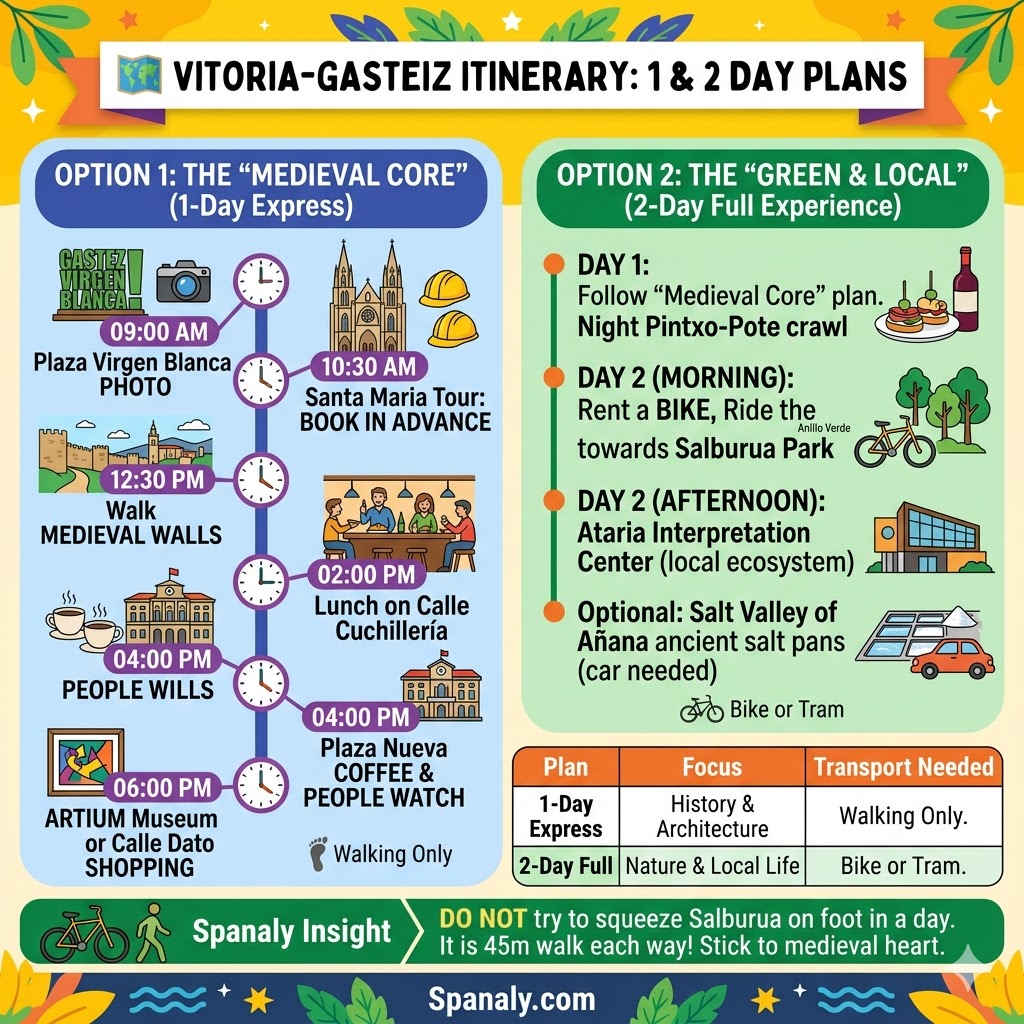
Most travelers visit Vitoria-Gasteiz as a day trip, but staying overnight allows you to experience the city when the day-trippers leave and the local pintxo scene truly starts.
Option 1: The “Medieval Core” (1-Day Express)
Best for those arriving from Bilbao or San Sebastián for the day.
09:00 AM: Start at Plaza de la Virgen Blanca. Take your photo with the green “Gasteiz” sculpture before it gets crowded.
10:30 AM: Join the “Open for Works” tour at Santa Maria Cathedral. Remember to book this Spain attraction ticket at least 48 hours in advance.
12:30 PM: Walk the Medieval Walls. Access the panoramic viewpoints near the Escoriaza-Esquivel Palace.
02:00 PM: Lunch at Calle Cuchillería. Try the daily menu in a traditional tavern.
04:00 PM: Walk down to Plaza Nueva for a coffee and watch the local pace of life.
06:00 PM: Explore the Artium Museum or shop along the pedestrianized Calle Dato.
Option 2: The “Green & Local” (2-Day Full Experience)
Best for those staying overnight to explore the outer nature belt.
Day 1: Follow the “Medieval Core” plan above. Finish the night with a Pintxo-Pote crawl in the Ensanche district.
Day 2 (Morning): Rent a bike. Ride the Anillo Verde (Green Belt) towards Salburua Park.
Day 2 (Afternoon): Visit the Ataria Interpretation Center. If you have a car, drive 15 minutes to the Salt Valley of Añana to see the ancient salt pans.
| Plan | Focus | Transport Needed |
|---|---|---|
| 1-Day | History & Architecture | Walking Only. |
| 2-Day | Nature & Local Life | Bike or Tram. |
Spanaly Insight: If you follow the 1-Day plan, do not try to squeeze in the Salburua wetlands on foot. It is a 45-minute walk from the center each way. Stick to the medieval heart to avoid exhaustion and maximize your time at the cathedral and walls.
❓ Spanaly Pro Tips: The Reddit-Tested Secrets

If you want to experience Vitoria-Gasteiz like a local and avoid the common tourist “mismatches,” follow these insider hacks:
The “Vertical” Secret: Don’t exhaust yourself climbing the steep streets of the Medieval Almond. There are public mechanical ramps and elevators (like the ones at Calle Cantón de la Soledad) that take you to the top for free. Start at the bottom, ride up, and walk down to save your knees.
The Best Tortilla in Spain? While San Sebastián gets the fame, Reddit foodies swear by Sagartoki in Vitoria. Their “liquid gold” tortilla (often served in a spoon) is a technical masterpiece. Arrive right when they open or you won’t get a spot.
The “Silent” Quarter: For a surreal experience, walk through the Medieval Almond after 11:00 PM on a weekday. The stone walls and dim yellow lights make it feel like a movie set. It is perfectly safe and completely empty of tourists.
Parking Hack: Avoid the center’s “Blue Zones” entirely. Park for free at the Mendizorrotza area near the football stadium. It’s a 15-minute walk to the center through a beautiful tree-lined promenade (Paseo de la Senda), or a 5-minute tram ride.
The “Ataria” Bird Secret: In Salburua Park, don’t just walk the paths. Go inside the Ataria building (it’s free) and head to the submerged glass viewpoint. You can watch the wetlands from below the water level—perfect for unique photography.
| The Myth | The Reddit Reality |
|---|---|
| “It’s just a green city.” | It’s a basketball city. Catching a Baskonia game at the Buesa Arena is more electric than any football match in the region. |
| “Pintxo-Pote is every day.” | No. It’s strictly Thursday nights. If you try it on a Friday, you’ll pay full price and find the bars much quieter. |
| “Bilbao is the best base.” | Many “Slow Travelers” now use Vitoria as a base because it’s 30% cheaper and more central for reaching La Rioja wine country. |
Spanaly Insight: Most people forget that Vitoria is at a higher altitude than the coast. It can be 10°C colder than Bilbao on the same day. Even in summer, locals always carry a chaquetita (light jacket). If you look at Spain weather before packing, subtract 5 degrees from the coastal forecast to be safe in Vitoria.
🛡️ Visitor FAQs – Vitoria-Gasteiz Travel Essentials
🛍️ Are shops open on Sundays in Vitoria-Gasteiz?
No, most shops and supermarkets are strictly closed on Sundays. Unlike Madrid, Vitoria follows a traditional schedule. Only small convenience stores and pastry shops remain open. If you need supplies, make sure to do your shopping on Saturday.
🚲 Can I rent a bike for free in the city?
Vitoria-Gasteiz used to have a free bike scheme, but now it operates through the VGbiziz system. You need to register via the official app. It is very affordable for short trips, and the city features over 170km of dedicated bike lanes, making it the best way to see the Green Belt.
🏰 Do I need to book the "Open for Works" Cathedral tour?
Yes, advance booking is mandatory for the Santa Maria Cathedral tour. Because it is a live restoration site, you must wear a hard hat (provided) and follow a guide. Spots fill up weeks in advance, especially for the English-language sessions.
💧 Is the tap water high quality here?
The water in Vitoria-Gasteiz is among the best in Spain. It comes from the Gorbea mountains and is perfectly safe and tasty. You will see locals refilling bottles at the public stone fountains throughout the Medieval Almond; feel free to do the same.
🗣️ Is Euskara (Basque) widely spoken by locals?
While everyone speaks Spanish, Euskara is very common in schools and government offices. You will see signs in both languages. Learning a simple "Kaixo" (Hello) or "Agur" (Goodbye) is highly appreciated by the locals in the neighborhood taverns.
Vitoria-Gasteiz Logistics Guide by Spanaly.com
Vitoria-Gasteiz is not just a stop on a map; it is a lesson in how a city can breathe alongside nature. It doesn’t scream for attention like its famous neighbors, but it rewards those who take the time to walk its “Almond” streets.
Slow Down: Enjoy a coffee in Plaza Nueva and watch the world go by.
Go Green: Rent a bike and get lost in the wetlands of Salburua.
Eat Local: Respect the Pintxo-Pote times to see the city’s true soul.
Plan Ahead: Remember that Northern Spain weather is full of surprises.
To ensure you catch the perfect weather for your trip, make sure to check our guide on the best time to visit Northern Spain before you finalize your dates.
Vitoria-Gasteiz is waiting for you with its stone walls, green parks, and the warmest Basque hospitality. Enjoy every moment! 🥂✨