
Table of Contents
Toggle📍 The Geological Marvel of the Basque Coast
The Flysch Route in Zumaia reveals 60 million years of Earth’s history in a single coastal walk. These sharp, vertical rock layers offer a rare glimpse into prehistoric times. Consequently, mastering the tides is the only way to experience this landscape fully.
📜 Ancient Strata: Walk beside vertical rock formations rising directly from the Atlantic seabed.
🎬 Cinematic Steps: Explore the real-life “Dragonstone” shores featured in Game of Thrones.
🌊 Low Tide Secrets: Discover hidden coves and jagged “ribs” revealed only as the ocean retreats.
This guide provides the essential logistics to navigate this unique Basque terrain safely. You will save time while uncovering geological secrets that most tourists overlook.
Spanaly Insight: Most visitors only view the cliffs from the safety of the shore. However, the most dramatic stratified layers require a precise 15-minute window during the lowest tide. Check our Ultimate Northern Spain Guide to complete your coastal bucket list.
⚡ Fast Facts: Zumaia Flysch Snapshot

Before you lace up your boots, here is the essential breakdown of what to expect on the Flysch Route in Zumaia.
📍 Location: Zumaia, Basque Country (between San Sebastian and Bilbao).
🚶 Trail Difficulty: Moderate; requires sturdy shoes for uneven, slippery limestone.
⏱️ Recommended Duration: 2 to 4 hours for the main cliffs and beaches.
🌊 Critical Factor: Low Tide is mandatory to see the seabed rock formations.
🎬 Pop Culture: Famous as the “Dragonstone” filming site for Game of Thrones.
🎟️ Entry Fee: Walking the trails is Free; boat tours require booking.
Spanaly Insight: Don’t just check the weather; check the Tide Table. Specifically, the “Flysch effect” is only fully visible when the tide is below 0.5 meters. Consequently, arriving during high tide means missing the most iconic geological layers.
🌍 The Basque Flysch vs. Morocco’s Legzira: A Geological Mirror

If you have ever stood under the red arches of Legzira Beach in Morocco, you will find a familiar soul in Zumaia. While they sit on different continents, both coasts share a dramatic, raw dialogue with the Atlantic Ocean.
Sculpted by Nature: Legzira is famous for its massive natural stone arches, while Zumaia captivates with its sharp, linear rock “ribs.”
The Tide Factor: Just like Legzira’s arches, the full glory of the Flysch is a “low tide secret” that disappears under the waves.
Photographic Drama: Both locations offer that rare, otherworldly atmosphere that makes you feel like you have stepped onto another planet.
Consequently, if you love the rugged, untamed beauty of the Moroccan coast, Zumaia is the European counterpart you cannot miss. It is this specific mix of wild ocean and ancient stone that defines the best coastal experiences in the region.
Spanaly Insight: While Legzira feels like a desert meeting the sea, Zumaia is a lush, green Basque paradise. Specifically, the contrast between the emerald cliffs and the grey Flysch layers creates a unique color palette you won’t find in Africa.
To see how these cliffs compare to other iconic Spanish shores, make sure to check out our Northern Spain Road Trip guide for the ultimate coastal itinerary.
📍 Getting There: How to Reach Zumaia from San Sebastian & Bilbao

Reaching the Flysch Route is remarkably simple, whether you prefer the freedom of a car or the efficiency of Basque public transport. Zumaia sits perfectly between the two major Northern hubs.
By Train (Euskotren): This is the most scenic and sustainable option. From San Sebastian (Amara Station), take the E1 line towards Bilbao; the journey takes about 40 minutes.
By Bus (Lurraldebus): Direct buses run frequently from both Bilbao and San Sebastian. Specifically, the UK09 or UK11 lines are reliable and drop you right in the town center.
By Car: If you are on a road trip, the AP-8 highway connects both cities to Zumaia. However, parking near Itzurun Beach is limited during peak summer weekends.
Spanaly Insight: If you travel by train, try to sit on the right side when coming from San Sebastian. You will get a “sneak peek” of the coastal cliffs before you even arrive at the station!
For a seamless trip, make sure to check our guide on transport in Northern Spain to master the local train and bus networks. If you are starting your journey from the sky, our Bilbao Airport guide covers everything from car rentals to city shuttles.
🎟️ Booking & Access: Planning Your Flysch Adventure
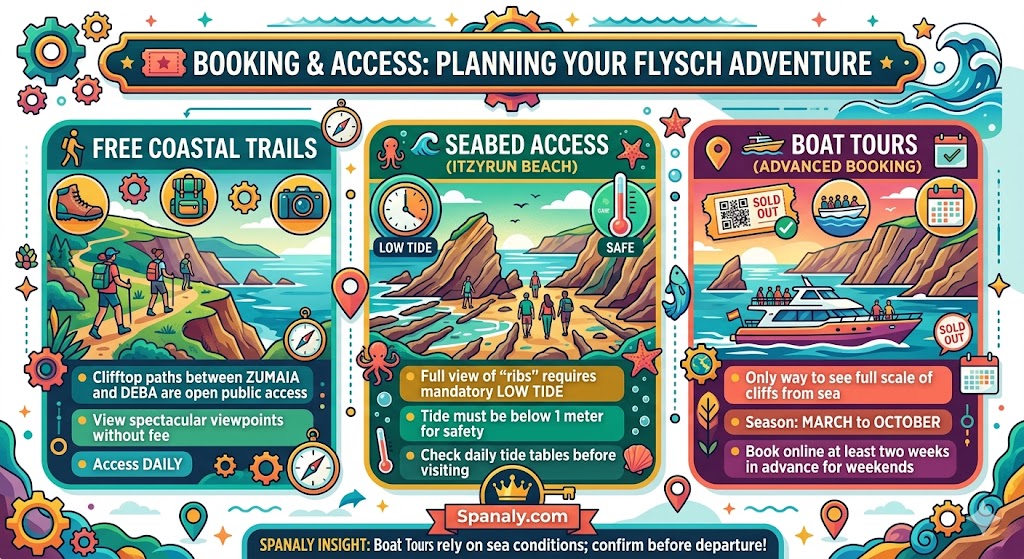
While walking the trails is free, the most iconic perspectives of the Flysch require careful planning and, in some cases, advanced booking. Mastering access is the key to unlocking the route’s secrets.
Free Coastal Trails: The spectacular clifftop paths between Zumaia and Deba are open to the public without a fee. You can access these stunning viewpoints daily.
Seabed Access: To walk on the actual Flysch “ribs” at Itzurun Beach, you need to visit during Low Tide. Specifically, the tide must be below 1 meter to expose the layers safely.
Boat Tours: This is the only way to see the full scale of the cliffs from the ocean. Tours usually last 60-90 minutes and offer the best angles for photography.
Spanaly Insight: Most boat tours only operate from March to October. Specifically, tours are heavily dependent on sea conditions. Consequently, we highly recommend booking your spot online at least two weeks in advance, as they sell out quickly during summer weekends.
For a smooth adventure, check our Spain Travel Tips to master booking platforms and local etiquette before you go.
🌊 The Science of Beauty: Understanding the Flysch Formation
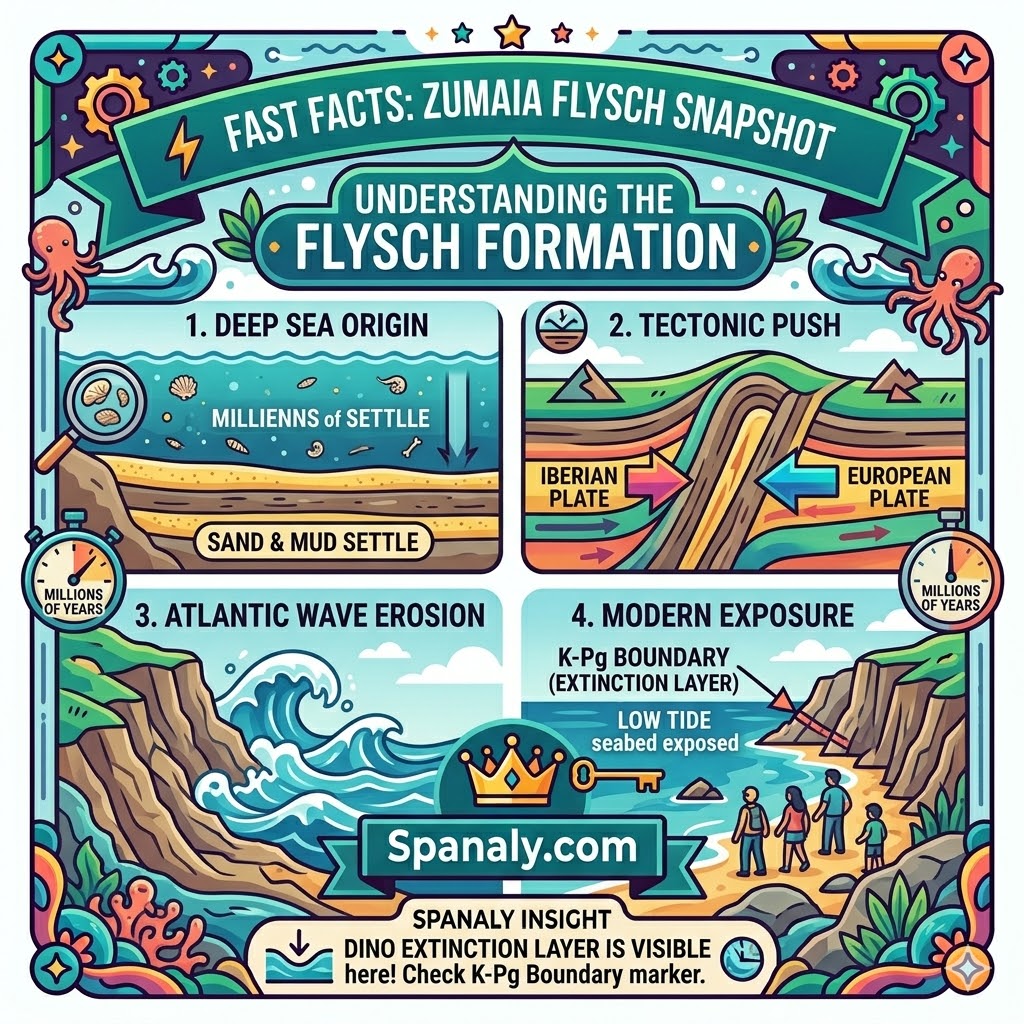
The Zumaia Flysch functions as a vertical record of Earth’s history. These rock formations, created over 60 million years, reveal the rhythmic changes in our planet’s climate and geology.
🌊 Deep Sea Origin: Millions of years ago, sediment settled on the ocean floor in consistent, alternating layers.
💎 Alternating Rhythm: The Flysch consists of repeating cycles of hard sandstone and softer shale or clay rocks.
🌍 Tectonic Push: The collision of the Iberian and European plates pushed these flat underwater layers upward and tilted them.
🌬️ Erosion’s Work: Atlantic waves eroded the softer layers faster, leaving the hard rock “ribs” exposed for us to see.
Spanaly Insight: Zumaia is one of the few places on Earth where you can touch the “K-Pg Boundary.” This thin sediment layer marks the exact moment of dinosaur extinction following the asteroid impact.
Before hitting the trails, visit the Algorri Interpretation Center in town to understand the scale of these cliffs. While the views are free, you should check our guide on Northern Spain Travel Cost to budget for museum entries and local transport.
🚶 Best Hiking Trails: From Itzurun Beach to Deba
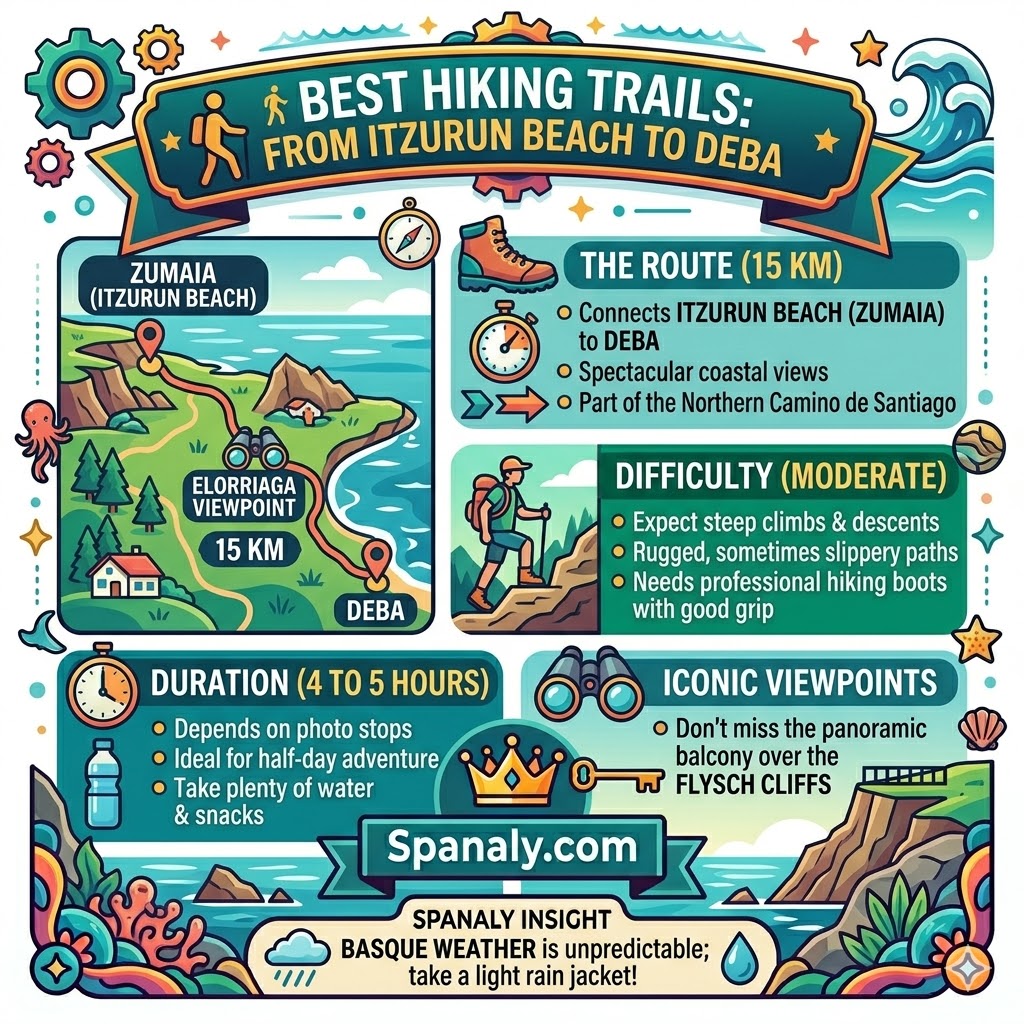
The hike from Zumaia to Deba is arguably the most spectacular coastal walk in Southern Europe. This trail is a segment of the famous Camino de Santiago (Northern Way), offering a front-row seat to millions of years of geological drama.
The Route: This 15-kilometer trail connects Zumaia’s Itzurun Beach to the neighboring town of Deba.
Difficulty: Moderate; expect several steep climbs and descents on rugged, sometimes slippery limestone paths.
Duration: It typically takes between 4 to 5 hours to complete, depending on how many photo stops you make.
Iconic Viewpoints: Don’t miss the Elorriaga Viewpoint, which offers a massive panoramic “balcony” view over the Flysch cliffs.
Spanaly Insight: Most hikers walk from Zumaia to Deba and then take the Euskotren train back. Specifically, if you are staying in the nearby culinary capital, check our San Sebastian Travel Guide for the best logistics to reach this trailhead.
Make sure to wear professional hiking boots with good grip. Furthermore, the Basque weather is unpredictable; consequently, a light rain jacket is a must, even on sunny days.
⏰ Timing Your Visit: Tide Tables & Golden Hour Secrets
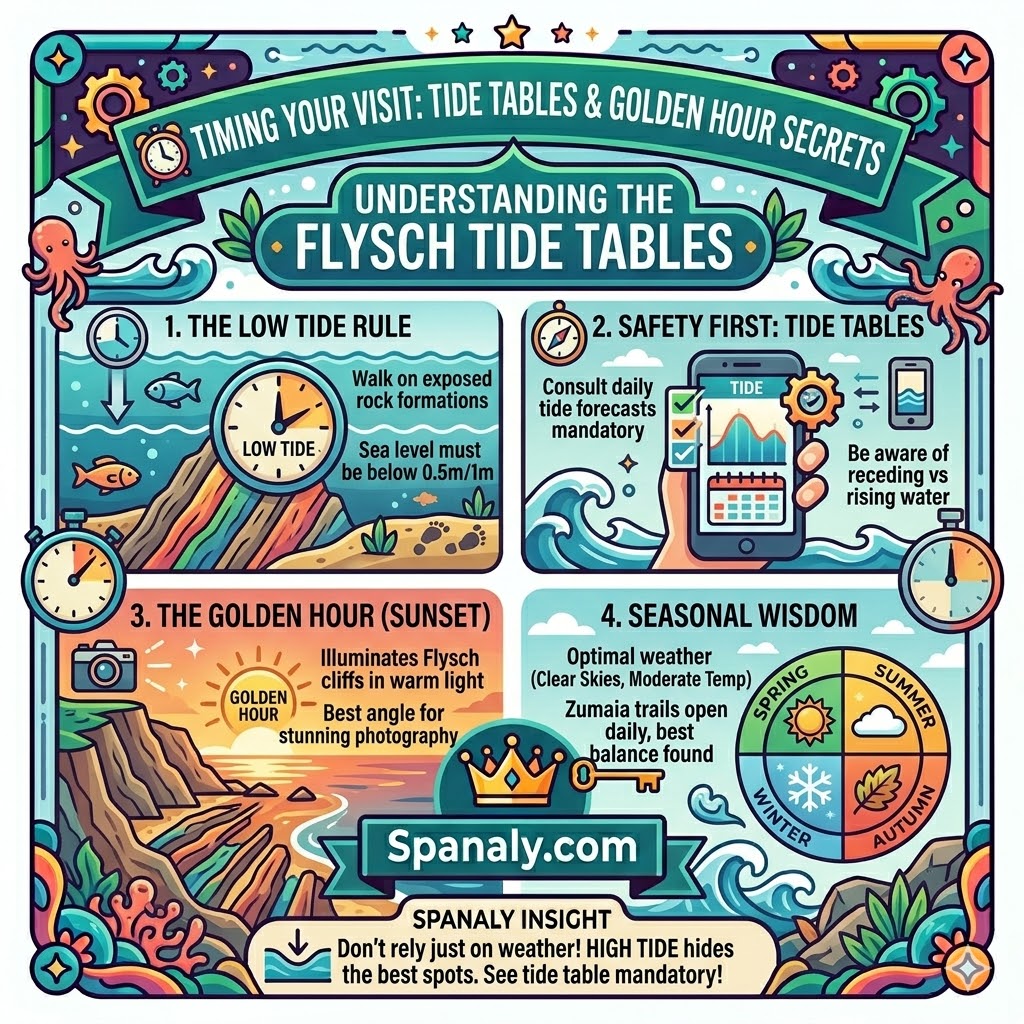
Visiting the Zumaia Flysch without checking the tide is like going to the theater and finding the curtain closed. To see the “ribs” of the Earth, timing is everything.
The Low Tide Rule: You must visit during Low Tide to walk on the exposed rock layers.
Safety First: Check the daily tide tables; specifically, a tide below 0.5m or 1m is ideal for full exposure.
The Golden Hour: For photographers, the “Golden Hour” (just before sunset) illuminates the limestone cliffs in a fiery orange glow.
Seasonal Wisdom: While the trails are open year-round, late spring and early autumn offer the best balance of clear skies and manageable temperatures.
Spanaly Insight: Don’t just check the weather; check the official Tide Forecasts before you leave San Sebastian. In fact, if the tide is high, the most spectacular parts of the beach are completely submerged and inaccessible.
Before you set your alarm, make sure to read our guide on Spanish Festivals to see if your visit coincides with local Basque celebrations, which can affect transport and crowd levels.
🎥 Game of Thrones Locations: Walking in Dragonstone Footsteps

For many visitors, the cliffs of Zumaia look instantly familiar. This is because Itzurun Beach, with its vertical Flysch strata, was chosen as the iconic filming location for Dragonstone in Game of Thrones (Season 7).
The Dragon’s Stairs: The winding staircase that leads from the cliffs to Itzurun Beach is real and accessible to the public.
The Caves: While the interior scenes were studio-built, the exterior cave entrances on the beach are genuine geological features visible at low tide.
A World Beyond: Production designers chose this site because the unique Flysch formations create a landscape that feels literally out of this world.
Spanaly Insight: Most of the dramatic coastline shots in the show were filmed here in Zumaia. Specifically, the production team often waited for low tide to get the best angles of the exposed Flysch. Consequently, to fully step into Daenerys’s shoes, you must check the tide table.
If you are hunting for more cinematic landmarks, check our guide to Spanish Attractions to discover other breathtaking locations that have graced the silver screen.
📸 Photography Tips: Capturing the Flysch Drama
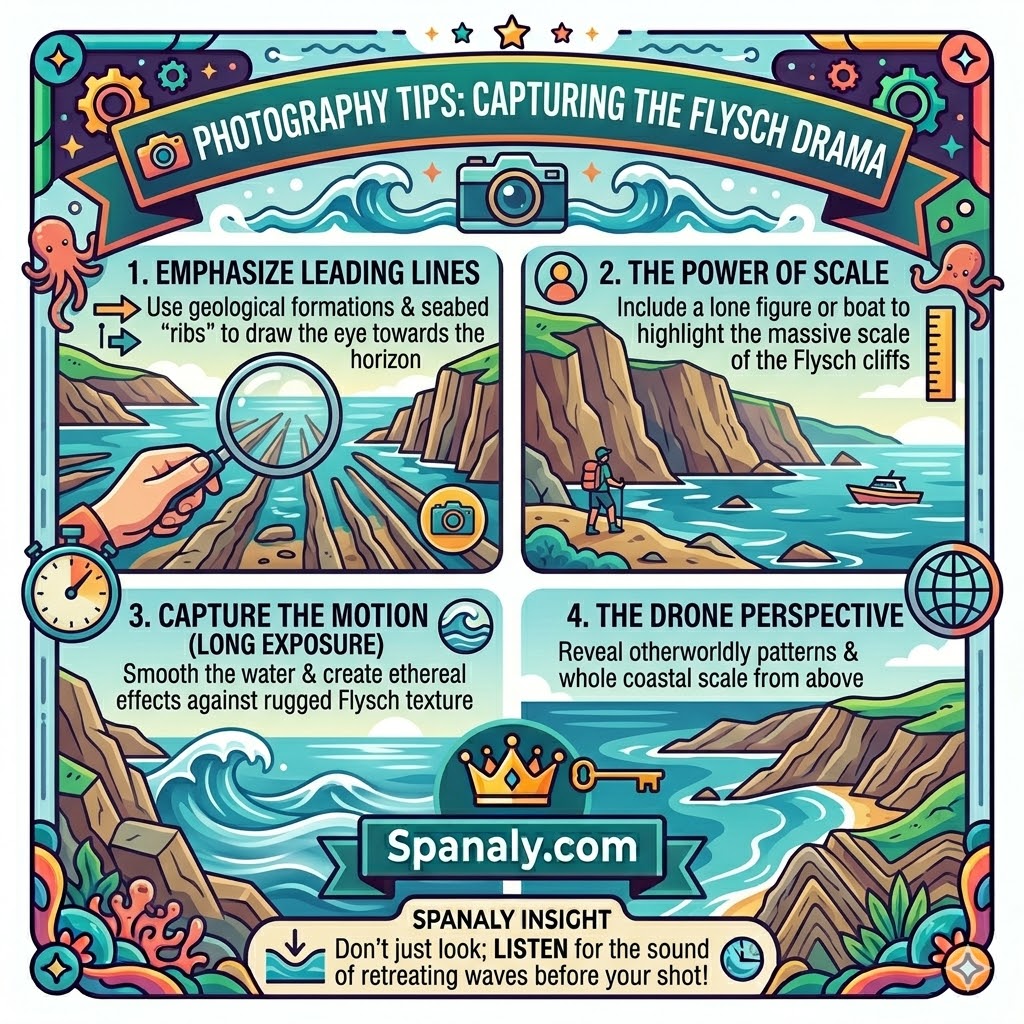
Capturing the raw texture and immense scale of Zumaia requires precise timing. Use these technical strategies to translate the jagged Basque landscape into compelling images.
📐 Leading Lines: Use the vertical strata or receding seabed “ribs” to draw the eye toward the horizon.
👤 Human Scale: Place a figure or boat in your frame to highlight the 100-meter height of the cliffs.
🌊 Long Exposure: Utilize slow shutter speeds to blur the Atlantic waves against the sharp, geometric rock textures.
🚁 Drone Angles: Aerial perspectives reveal massive geological “zigzag” patterns invisible from the ground.
Spanaly Insight: Don’t just look; listen for the waves retreating over the pebble beaches. Waiting for a dramatic splash against the cliff base often completes the perfect shot. For more inspiration, check our guide to the Best Photography Spots in Spain.
🍽️ Post-Hike Rewards: Where to Eat in Zumaia

After trekking along the Flysch cliffs, your appetite will surely demand a reward. Luckily, Zumaia is a coastal gem where the seafood is as dramatic as the geology.
Pintxos Crawl: Head to the old town area, specifically around Erreka Plaza, where local bars serve miniature culinary masterpieces.
Fresh Catch: Order the “Kogote” (hake neck) or grilled turbot. Specifically, the Basque country is world-renowned for its mastery of open-fire seafood grilling.
Local Cider & Txakoli: Pair your meal with Txakoli, a slightly sparkling, dry white wine produced in the nearby hills of Getaria.
The Sweet Finish: Don’t leave without trying a slice of Basque Cheesecake. Consequently, its creamy center and burnt top will be the perfect end to your adventure.
Spanaly Insight: For an elite experience, look for restaurants with a view of the Urola River. In fact, many locals prefer dining late (around 9:00 PM) to enjoy the cooler evening breeze after a long day of hiking.
If you are a true foodie, you must explore our extensive guide to Spanish Cuisine to understand why this region is considered the gastronomic heart of Europe.
🗺️ Suggested Itinerary: The Zumaia "Half-Day" vs "Full-Day" Experience
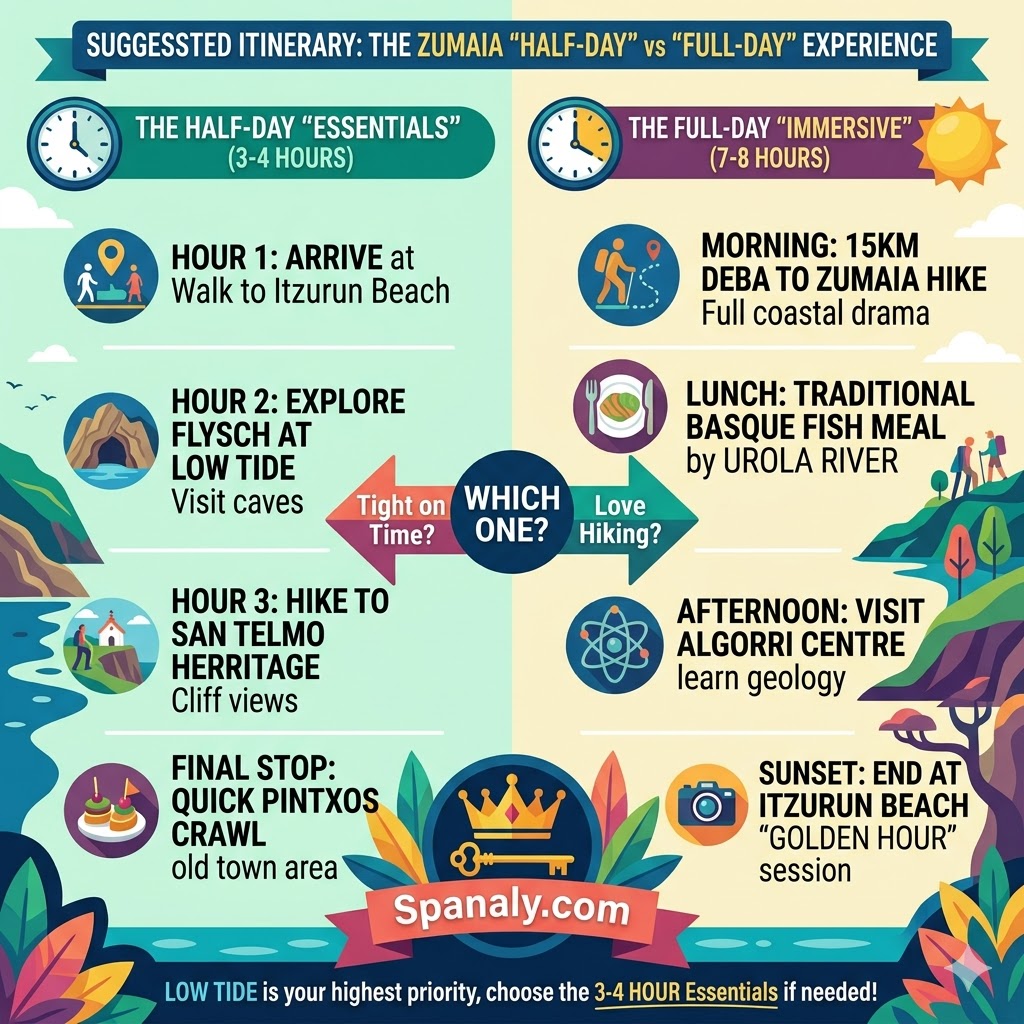
Choosing between a quick visit and a deep dive depends on your pace. Specifically, both options offer a front-row seat to geological history.
⏱️ The Half-Day “Essentials” (3-4 Hours)
Hour 1: Arrive at Zumaia station and walk directly to Itzurun Beach.
Hour 2: Explore the exposed Flysch layers during low tide and visit the “Dragonstone” caves.
Hour 3: Hike up to the Ermita de San Telmo for the iconic cliffside view.
Final Stop: Grab a quick set of Pintxos in the Old Town before heading back.
🌅 The Full-Day “Immersive” (7-8 Hours)
Morning: Start with the 15km hike from Deba to Zumaia to see the full coastal drama.
Lunch: Enjoy a traditional Basque grilled fish meal by the Urola River.
Afternoon: Visit the Algorri Interpretation Centre to learn the science behind the rocks.
Sunset: End your day at Itzurun Beach for the “Golden Hour” photography session.
Spanaly Insight: If you only have time for one, choose the Half-Day Essentials during low tide. In fact, seeing the “ribs” of the earth is more important than the long hike if time is tight.
Make sure your transport is sorted. Consequently, check our Ultimate Madrid Travel Guide if you are planning your wider Spanish connection after the North.
💡 Insider Tips: Secrets From the "Reddit" Travel Community

Beyond the basic tide tables and hiking boots, these “boots-on-the-ground” tips will elevate your Zumaia experience from a standard visit to a professional-level expedition.
The “Double Tide” Strategy: Don’t just arrive for low tide; aim for the window one hour before the peak low point. Consequently, you’ll witness the “peeling back” of the ocean, which is far more dramatic for time-lapse videos.
The Slippery Truth: The Flysch rocks are covered in a micro-algae that is incredibly slick when wet. Avoid stepping on the dark green or black patches; instead, aim for the dry, lighter-colored ridges to maintain your grip.
The San Telmo “Side-Door”: Most tourists crowd the main viewpoint at the Hermitage. Specifically, if you walk just 200 meters further along the coastal path toward Deba, you’ll find a hidden ledge that offers the same view without the selfie-sticks.
Wind Management: Zumaia is a wind tunnel. Even on sunny days, the Atlantic “Breeze” can drop the felt temperature by 5°C instantly. In fact, always carry a windbreaker, even if the forecast looks tropical.
The Shoe Sacrifice: Do not wear your favorite white sneakers. The mud on the trails (especially after a light Basque drizzle) is a heavy, clay-like soil that permanently stains fabric. It is best to use waterproof hiking shoes.
Spanaly Insight: If you’re a photography enthusiast, look for the “Mini-Waterfalls” that form between the Flysch layers as the tide recedes. These only last for about 20 minutes, but they provide the most unique foreground interest you can find on the entire Basque coast.
🛡️ Visitor FAQs – Zumaia Flysch Logistics & Safety Guide
🛡️ Is it safe to walk on the Flysch rocks during rainy weather?
It is not recommended. The Flysch layers become extremely slippery when wet, and the Basque coast is prone to sudden "Galernas" (heavy sea storms). If it starts raining, it is best to enjoy the views from the San Telmo cliffs rather than descending to the shore where the footing is unstable.
🎫 Do I need a permit or ticket to visit Itzurun Beach or the cliffs?
No, access to the beach and the main hiking trails is completely free. However, if you wish to visit the Algorri Interpretation Centre for a deep dive into the geology, a small entry fee applies. Make sure to check their official site for seasonal opening hours as they vary throughout the year.
🚉 Can I visit Zumaia as a day trip from San Sebastián or Bilbao?
Absolutely. From San Sebastián, take the Euskotren (E1 line), which takes about 40 minutes. From Bilbao, the journey is longer (approx. 1.5 to 2 hours), so we recommend taking the direct bus or a rental car to maximize your time exploring the geological formations.
🐾 Are dogs allowed on the Flysch trails and Itzurun Beach?
Dogs are allowed on the hiking trails provided they are on a leash. On Itzurun Beach, restrictions apply during the summer season (June to September), where pets are generally prohibited during peak hours. Always check the local signage at the beach entrance for the latest seasonal bylaws.
🎒 Are there public lockers to store luggage in Zumaia?
Zumaia train station does not have luggage lockers. If you are arriving with bags, it is best to leave them at your hotel or use the storage facilities in San Sebastián before heading out. Traveling light is essential as the paths to the best viewpoints involve steep inclines and uneven terrain.
Zumaia Flysch Guide by Spanaly.com
Zumaia is a place where geology and the Atlantic ocean engage in a constant dialogue. To make the most of your visit, remember these core principles:
⏱️ Respect the Tide: The landscape only reveals its true structure when the ocean retreats.
🥾 Embrace the Terrain: Focus on the sharp contrast between the ancient Flysch and the Atlantic spray.
🧘 Slow Down: Zumaia is a site for contemplation and science, not just a quick photo stop.
🌊 Continue Your North Spain Adventure!
If these cliffs have ignited your passion for the Basque coast, your next stop is nearby. A short drive away lies a legendary hermitage perched atop a rugged islet, connected by a winding stone bridge. Don’t miss the chance to explore San Juan de Gaztelugatxe, the true crown jewel of the coastline.
Ready to step into Earth’s history? Pack your hiking boots, check the tide tables, and let the Flysch reveal its ancient story. We look forward to hearing about your discovery!