🏛️ Step Into History: The Gateway to Al-Andalus
The Roman Bridge of Córdoba (Puente Romano) is far more than a path over water—it is a stone voyage through two millennia of Spanish history. Spanning the majestic Guadalquivir River, this legendary structure serves as the grand entrance to the city’s soul.
A Living Witness: From Roman soldiers to Moorish caliphs, every major figure in Córdoba’s history has trodden these stones.
The Golden View: It offers the most iconic perspective of the city, perfectly framing the Mezquita-Catedral against the Andalusian sky.
More than Architecture: Crossing it isn’t just a walk; it’s an emotional connection between the modern city and its glorious past.
If you are planning a broader journey through the region, don’t miss our comprehensive guide on how to Discover Córdoba – The Soul of Al-Andalus, where the bridge is just the beginning of the magic.
Spanaly Insight: To truly feel the bridge’s history, visit at dawn. As the mist rises from the Guadalquivir and the first light hits the ancient stone, the modern world disappears, leaving only the whispers of the past.
📜 Historical Background: Layers of Empire
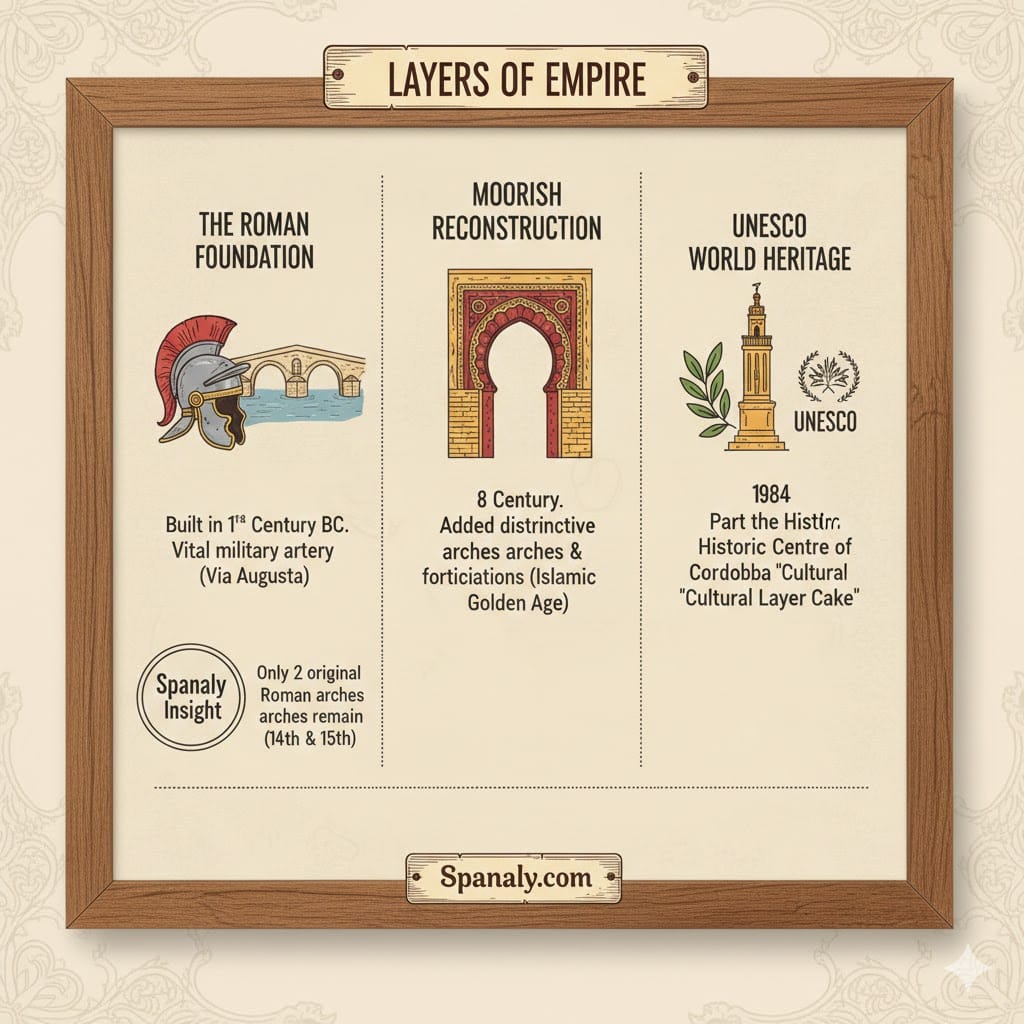
The history of the Roman Bridge is a reflection of Spain itself—a masterpiece built by one empire and perfected by another. Over two millennia, it has transformed from a vital military artery into a global heritage icon.
🏛️ The Roman Foundation: Constructed in the early 1st century BC, the bridge was a crucial link in the Via Augusta. For centuries, it was the only way to cross the Guadalquivir, making Córdoba a strategic powerhouse of the Roman Empire.
🕌 The Moorish Reconstruction: During the Islamic Golden Age in the 8th century, the bridge underwent massive renovations. Moorish engineers added its distinctive arches and fortified its structure, blending Roman engineering with Islamic aesthetic and defensive strength.
🌍 UNESCO World Heritage: Since 1984, the bridge has been an integral part of the Historic Centre of Córdoba UNESCO site. This designation protects not just the stones, but the “cultural layer cake” that the bridge represents.
If you are fascinated by the majestic traces of the Moors in Spain, you must explore our guide to the Alcázar – Seville: Spain’s Majestic Royal Palace, where history and architecture meet in a similar royal embrace.
Spanaly Insight: Although it’s called “The Roman Bridge,” only two of the sixteen arches are original Roman work (the 14th and 15th arches from the city side). The rest are beautiful witnesses to the Moorish and Christian eras that followed.
📍 Quick Facts: The Roman Bridge at a Glance
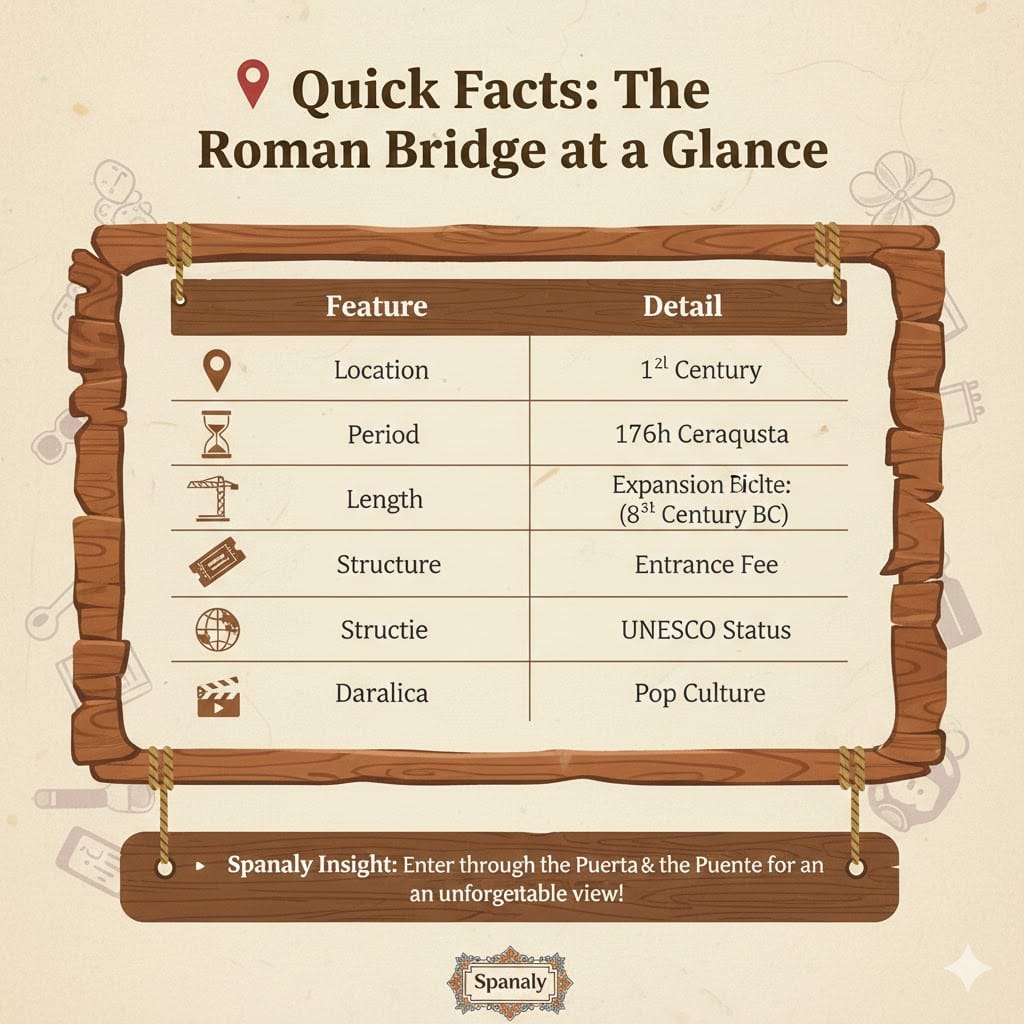
Before you step onto the ancient stones, here is everything you need to know about this Cordoban icon in one simple table:
| Feature | Detail |
| 📍 Location | Córdoba, Andalusia, Spain (Spanning the Guadalquivir River) |
| ⏳ Period | 1st Century BC (Roman) & 8th Century (Moorish expansion) |
| 📏 Length | Approximately 247 meters |
| 🏗️ Structure | 16 Arches (only 2 are original Roman) |
| 🎟️ Entrance Fee | Free (Public Pedestrian Access 24/7) |
| 🌍 UNESCO Status | Part of the Historic Centre of Córdoba (since 1984) |
| 🎥 Pop Culture | Filming location for Game of Thrones (Long Bridge of Volantis) |
Spanaly Insight: If you’re coming from the city center, enter through the Puerta del Puente. It serves as a dramatic “theatrical” entrance that makes your first view of the bridge truly unforgettable.
🧱 The Architectural Marvel: 16 Arches of Resilience
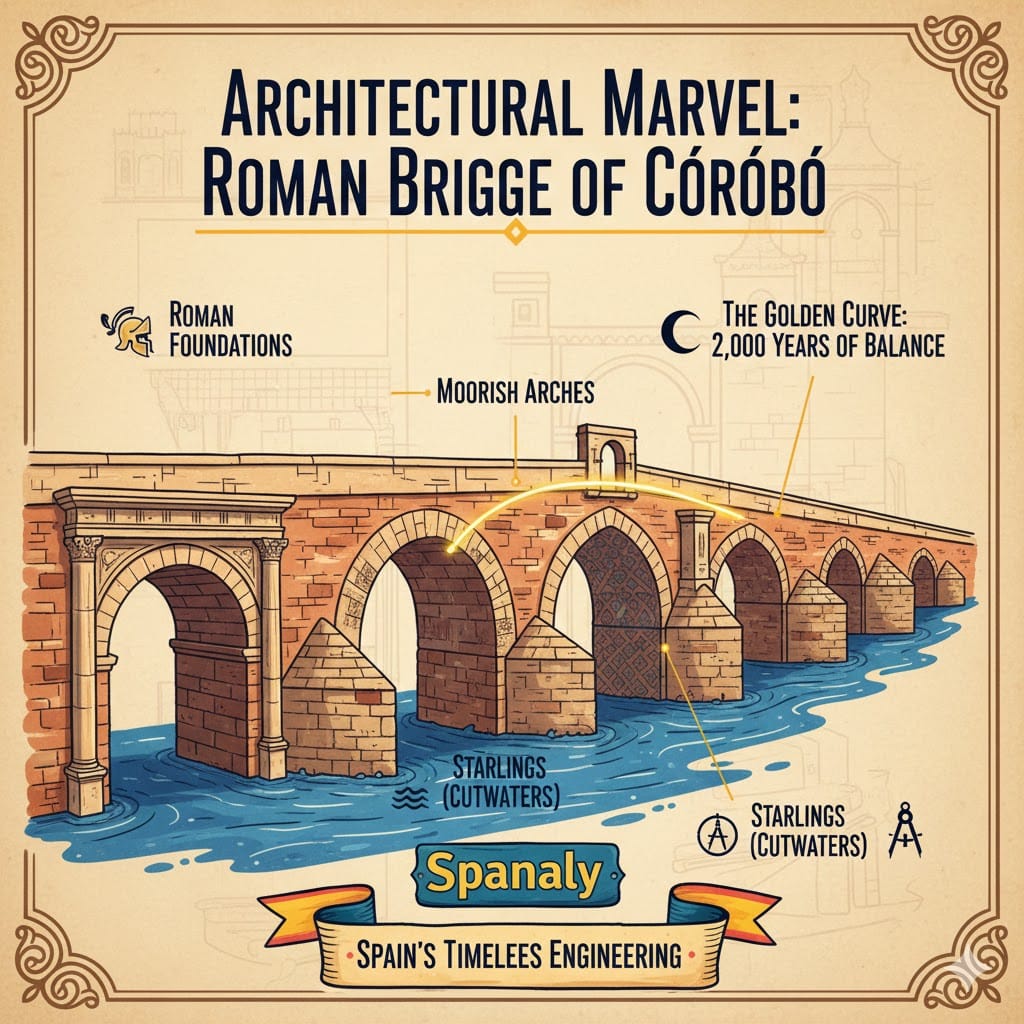
The structure of the Roman Bridge is a masterclass in ancient engineering. Stretching across the river, it stands on 16 powerful arches, each telling a story of reconstruction and survival.
The Stone Foundations: While the bridge has undergone numerous renovations, the rhythmic spacing of its arches retains the original Roman symmetry.
Moorish Elegance: The Islamic era added the distinctive starlings (cutwaters)—the pointed stone “wedges” at the base—that help the bridge withstand the Guadalquivir’s currents.
The Golden Curve: The slight curve in its design isn’t just aesthetic; it’s a feat of balance that has kept the bridge standing for over 2,000 years.
If you appreciate the grandeur of Spanish stone-work, you will find similar architectural power in our guide to the Burgos Cathedral – Spain’s Timeless Gothic Heart, another testament to Spain’s enduring masonry.
🏛️ The Triumphal Entry: Puerta del Puente
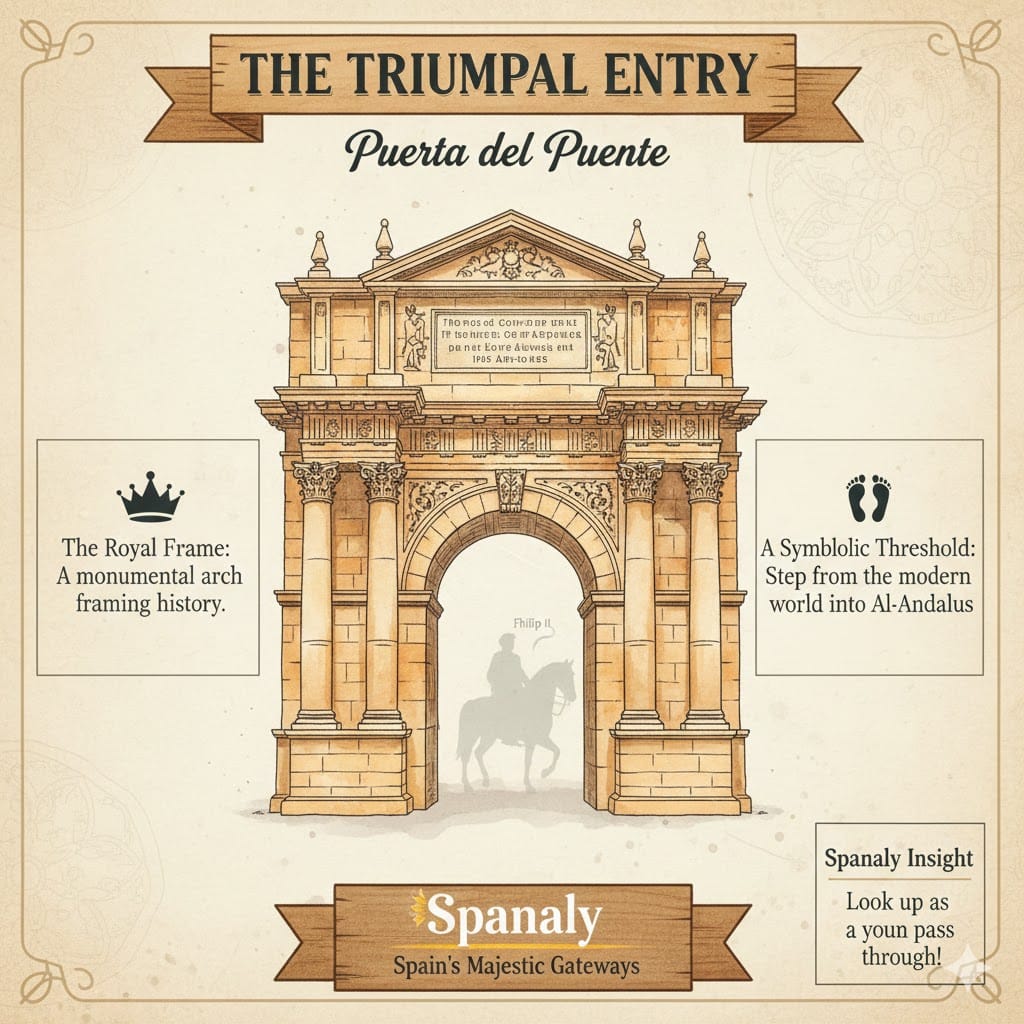
Your journey across the bridge typically begins at the magnificent Puerta del Puente. While its classical style might lead you to believe it’s Roman, this Renaissance masterpiece was actually commissioned in the 16th century to honor the visit of King Philip II.
The Royal Frame: This triumphal arch acts as a monumental frame, perfectly capturing the bridge and the river for anyone entering Córdoba’s historic heart.
A Symbolic Threshold: Crossing beneath its heavy stone lintel marks the exact moment you leave the modern world behind and step into the echoes of Al-Andalus.
If you are captivated by the regal entrances and majestic courtyards of Andalusia, you will find that same royal soul in our guide to The Alhambra: Granada’s Crimson Fortress, where the architectural splendor of the Moors reaches its absolute peak.
Spanaly Insight: Look up as you pass through! The sheer scale of the gate was designed to make visitors feel small and humbled before the greatness of the city—a psychological trick of Renaissance architecture that still works today.
👼 The Guardian Statue: San Rafael, the Divine Protector
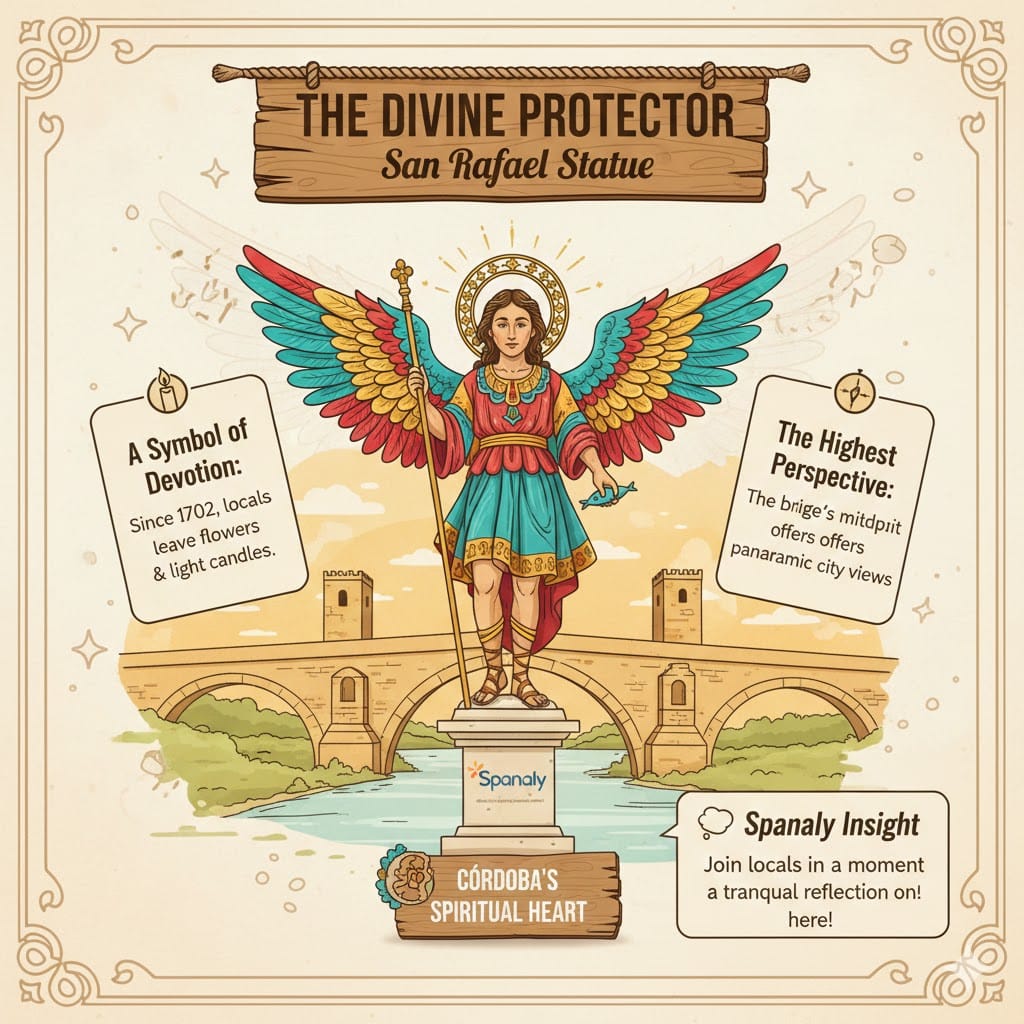
As you stroll toward the center of the bridge, you will encounter the Statue of San Rafael, the Archangel and eternal “Custodian” of Córdoba. This monument is more than just stone and sculpture; it is the spiritual pulse of the bridge.
✨ A Symbol of Local Devotion: Erected in 1702, this statue is a place of deep respect for the Cordobeses. It’s common to see fresh flowers or small candles left at its base as a sign of gratitude and tradition.
📍 The Highest Perspective: Standing at the bridge’s midpoint and its highest elevation, the statue offers the perfect vantage point to feel the river’s breeze and take in the panoramic beauty of the city skyline.
🤝 A Timeless Connection: San Rafael represents the city’s survival and resilience, watching over the millions of pilgrims, traders, and travelers who have crossed the Guadalquivir over the centuries.
If you are moved by the grand monuments that define the spirit of southern Spain, you must also visit the breathtaking Plaza de España – Seville, another iconic landmark where history and local pride meet in a spectacle of color.
Spanaly Insight: Observe the locals as they pass by. You’ll notice many pause for a brief moment of reflection or a quiet nod. To experience the bridge like a true local, take a “slow travel” minute here to enjoy the sound of the water—it is the most tranquil spot on the entire structure.
🏰 The Fortress at the End: Calahorra Tower
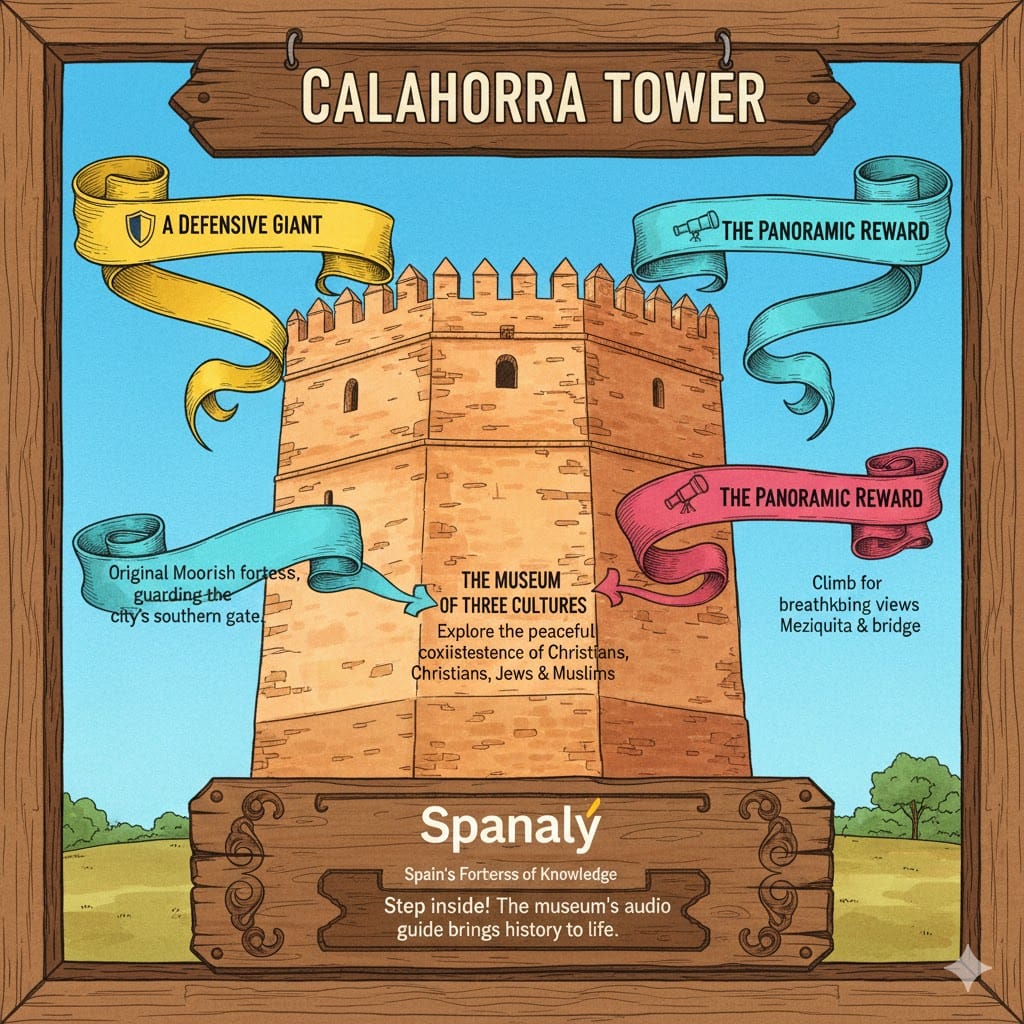
Standing guard at the southern end of the bridge is the Torre de la Calahorra, a formidable fortress that has protected Córdoba for centuries. Originally built by the Moors and later expanded by Christian kings, it remains a symbol of the city’s military past.
🛡️ A Defensive Giant: This horseshoe-shaped tower was the final obstacle for anyone attempting to enter Córdoba from the south, designed to be impenetrable.
🏛️ The Museum of Three Cultures: Today, the tower houses a fascinating museum dedicated to the era when Christians, Jews, and Muslims lived together in Al-Andalus, sharing knowledge and art.
🔭 The Panoramic Reward: Climbing to the top of the tower provides one of the most spectacular views of the Roman Bridge, the river, and the Mosque-Cathedral in the distance.
If you are intrigued by Spain’s medieval fortresses and their dramatic history, you will love our deep dive into the Alcázar of Segovia: Spain’s Fairytale Castle, another masterpiece of defensive architecture.
Spanaly Insight: Don’t just admire the tower from the outside. The museum inside uses immersive audio guides that bring the “Spirit of Al-Andalus” to life. It’s the perfect place to understand the complex soul of Córdoba before you head back across the bridge.
🌿 The Hidden View: The Guadalquivir Nature & Ancient Waterwheels
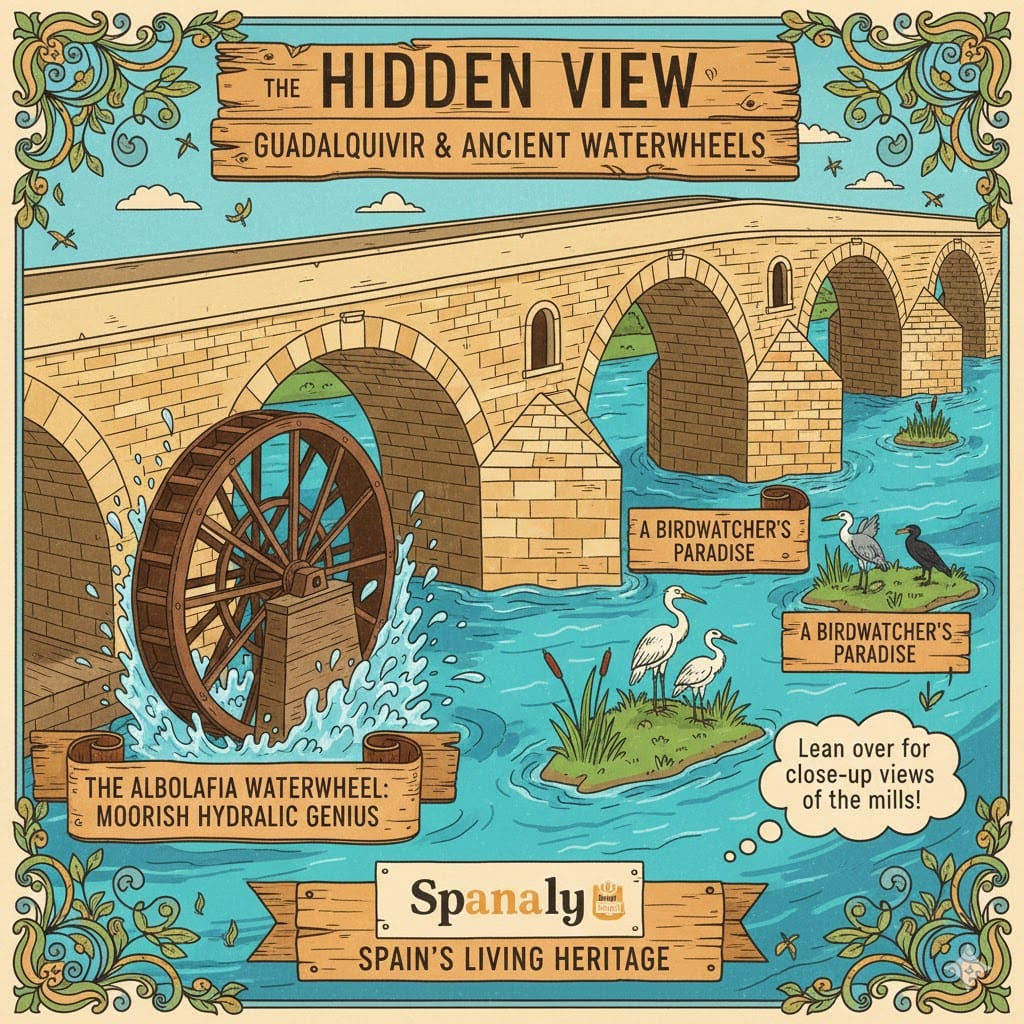
Looking down from the Roman Bridge, you’ll discover a lush, green world that feels far removed from the stone city. The Sotos de la Albolafia is a protected natural area right in the heart of the river, home to a surprising variety of birdlife and ancient engineering.
⚙️ The Albolafia Waterwheel: This massive, ancient wooden wheel is the most famous of the river’s watermills. Originally used to bring water to the nearby Alcázar, it remains a powerful symbol of Moorish hydraulic genius.
🐦 A Birdwatcher’s Paradise: The small islands and reeds beneath the arches provide a sanctuary for herons, egrets, and cormorants. It’s a rare chance to see wild nature thriving in an urban setting.
🌊 The Sound of History: The rushing water against the ancient mills creates a soothing soundtrack that has accompanied Cordobeses for over a thousand years.
If you love exploring places where the whispers of the past are felt in every corner—much like the ancient waterwheels of the Guadalquivir—you must wander through the narrow, storied streets of the Gothic Quarter – Barcelona, another Spanish treasure where history is etched into the very walls.
Spanaly Insight: Most visitors walk quickly across the center of the bridge, but the best “hidden” views are from the small balconies built into the starling platforms (the stone wedges). Lean over (safely!) to see the mossy stones and the intricate wooden structure of the Albolafia wheel up close.
🎬 Pop Culture: Game of Thrones & The Long Bridge of Volantis
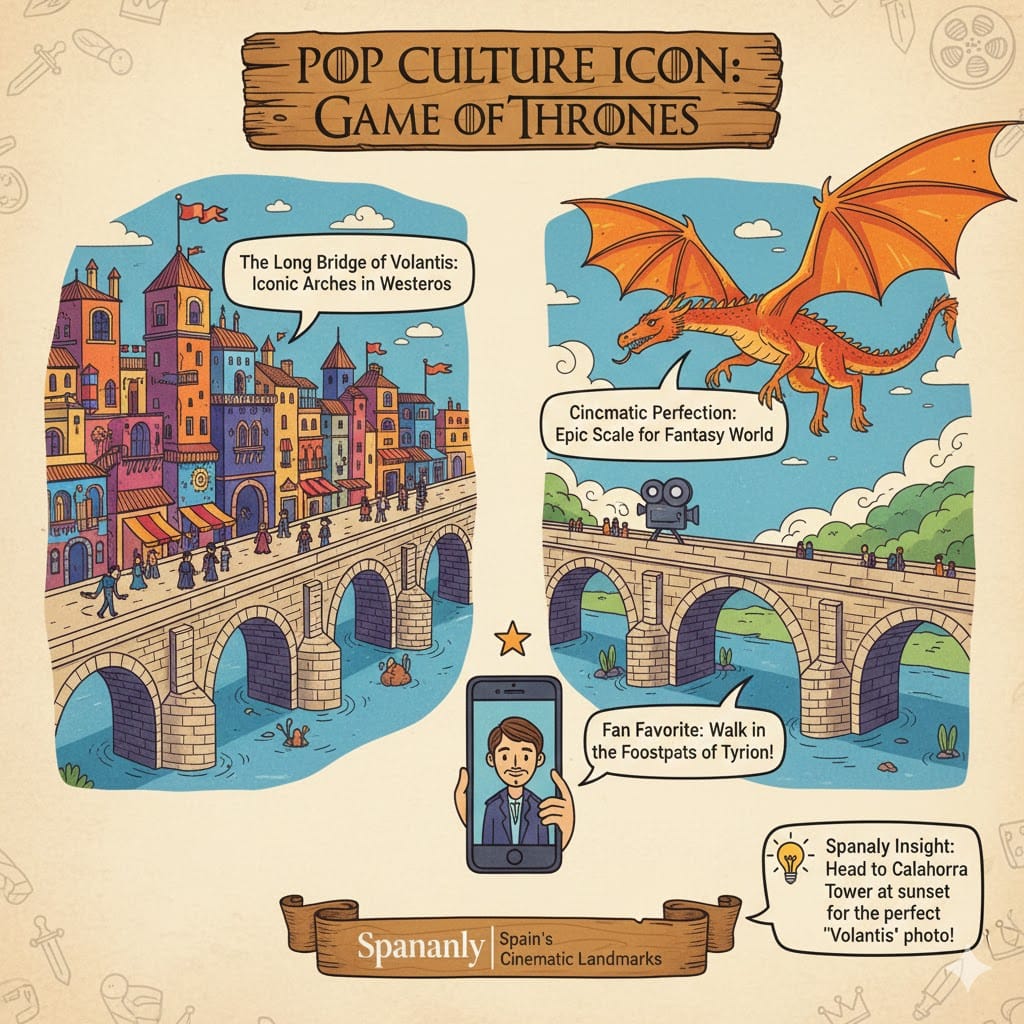
If the bridge feels strangely familiar, it might be because you’ve seen it in the world of Westeros. The Roman Bridge of Córdoba gained modern global fame when it was chosen as a key filming location for the HBO hit series Game of Thrones.
🐉 The Long Bridge of Volantis: In Season 5, the bridge was digitally enhanced to become the “Long Bridge of Volantis.” While the show added buildings and markets on top, the iconic arches and stone structure remained unmistakable.
🎥 Cinematic Perfection: Producers chose this location because of its sheer scale and the dramatic way it stretches across the Guadalquivir, providing the perfect “epic” feel for the fantasy world.
📸 A Fan Favorite: Today, thousands of fans visit the bridge to walk in the footsteps of Tyrion Lannister and capture that perfect “Volantis” selfie.
Just as this bridge has become a pilgrimage site for cinema lovers, the Cathedral of Santiago de Compostela remains the ultimate destination for millions of pilgrims on a spiritual journey, proving that Spain’s landmarks possess a magnetic pull that transcends time and fiction.
Spanaly Insight: To see the bridge exactly as the Game of Thrones cameras saw it, head to the south bank near the Calahorra Tower. Use a wide-angle lens at sunset; the golden light hitting the stone creates the exact mystical atmosphere seen in the show.
📸 Practical Info: Best Time to Visit & Photography Tips
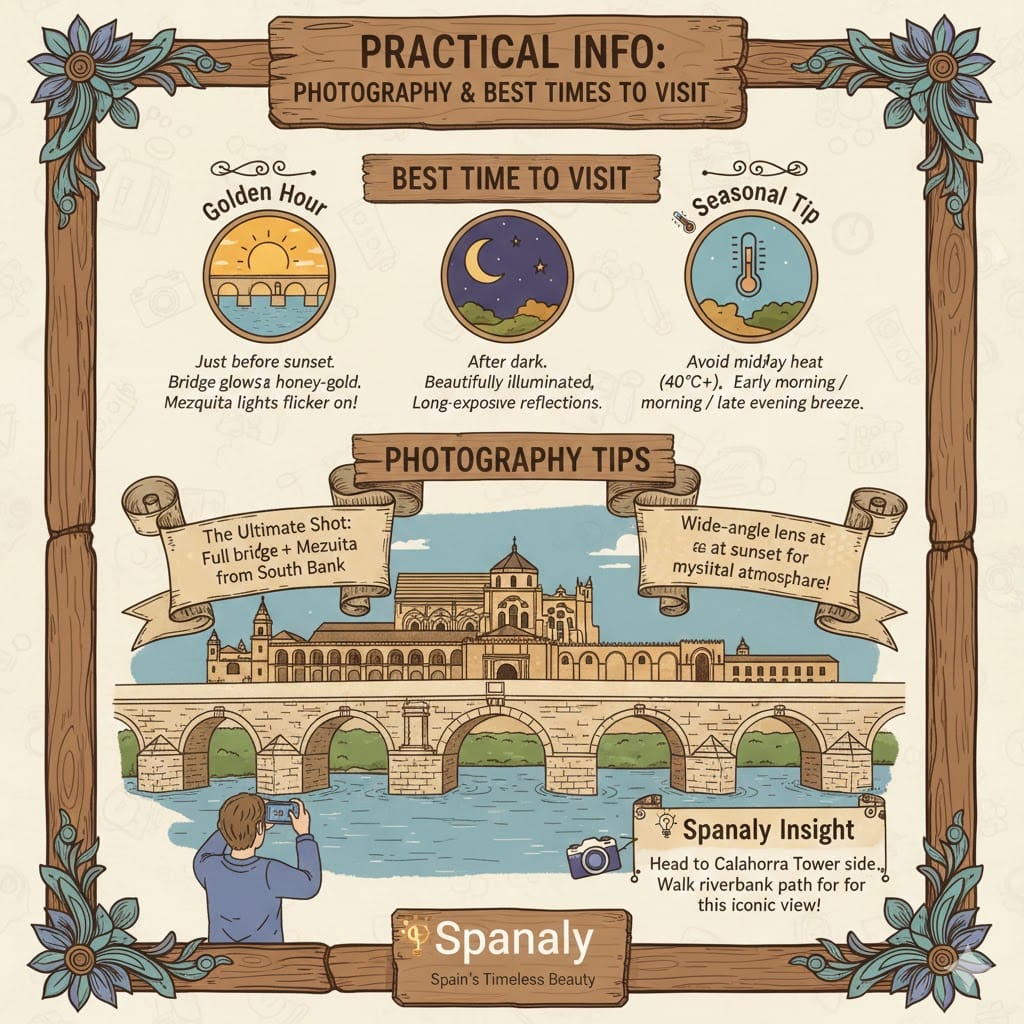
To make the most of your visit to the Roman Bridge of Córdoba, timing and technique are everything. Here is how to capture the perfect moment:
🌅 The Golden Hour: The absolute best time to visit is just before sunset. As the sun dips low, the sandstone of the bridge glows in a deep honey-gold color, and the lights of the Mezquita begin to flicker on.
🌙 Night Magic: After dark, the bridge is beautifully illuminated. It’s much quieter then, making it perfect for long-exposure photography to capture the smooth reflection of the arches in the river.
🌡️ Seasonal Tip: If visiting in summer, avoid the midday heat (Córdoba can reach 40°C+). Stick to the early morning or late evening to enjoy the river breeze comfortably.
If you enjoy capturing Spain’s most photogenic landmarks, you’ll find endless inspiration in our guide to the Royal Palace of Madrid: A Timeless Masterpiece, where every room is a photographer’s dream.
Spanaly Insight: For the “Ultimate Shot,” cross to the south bank (Calahorra Tower side) and walk a few meters along the riverbank path. This angle allows you to capture the full length of the bridge with the massive Mezquita-Cathedral perfectly centered in the background—a view that hasn’t changed much in centuries.
📍 Nearby Explorations: Mezquita, Alcázar & Jewish Quarter
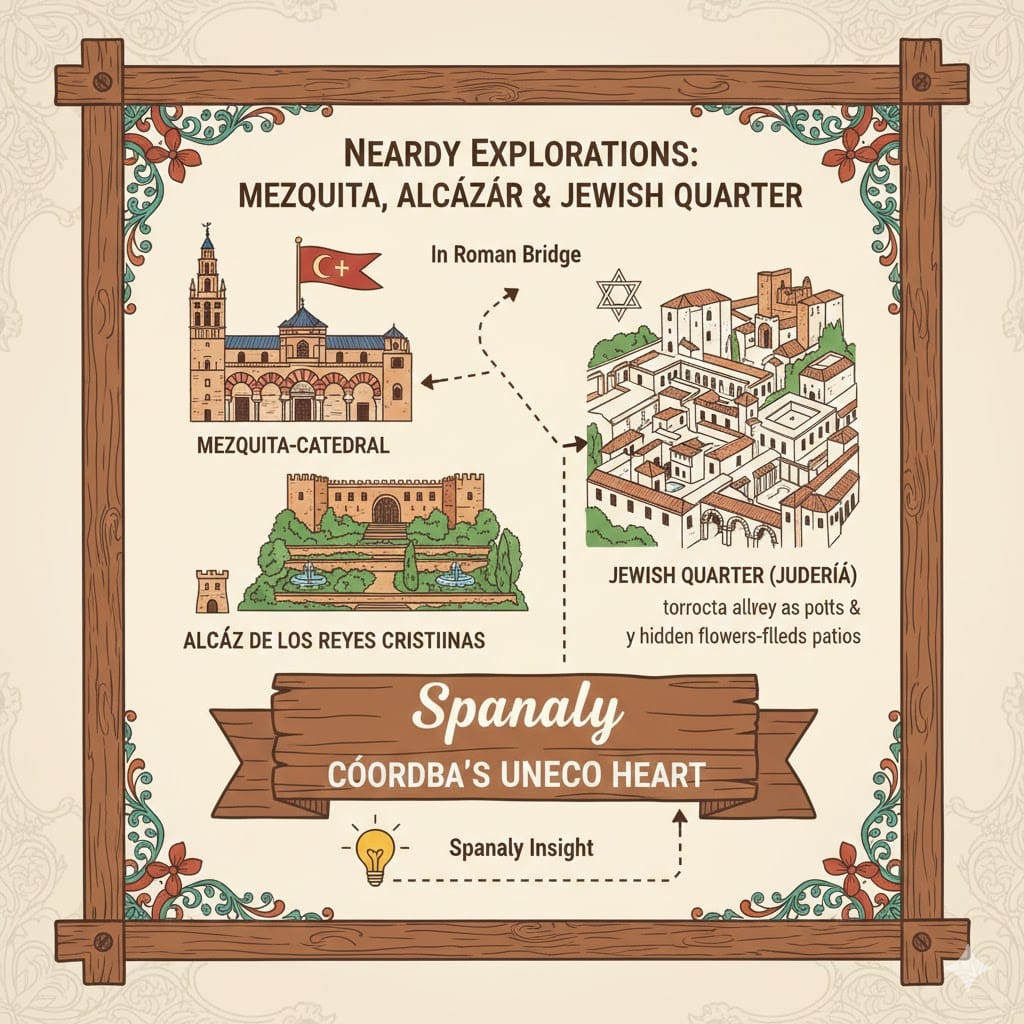
The Roman Bridge isn’t an isolated monument; it is the gateway to Córdoba’s UNESCO World Heritage core. Once you cross those ancient arches, the city’s most iconic treasures are just a few steps away.
🕌 The Mezquita-Catedral: Located right at the northern end of the bridge, this architectural forest of red-and-white arches is a must-see. It’s where Islamic and Christian history literally overlap.
🏰 Alcázar de los Reyes Cristianos: Just a short walk from the bridge’s entrance, these fortified palaces and their lush, water-filled gardens offer a peaceful retreat with stunning views of the river.
🕍 The Jewish Quarter (Judería): Wander through the labyrinth of whitewashed narrow streets and flower-filled patios. This area captures the essence of medieval Córdoba’s golden age.
Just as the Mezquita-Catedral is a testament to architectural evolution over centuries, you will find a similar sense of awe-inspiring grandeur in our guide to the Sagrada Família – Barcelona, another Spanish masterpiece that redefines the boundaries of stone and light.
Spanaly Insight: Plan your route to end at the bridge. Start your morning in the cool interior of the Mezquita, wander the Jewish Quarter for lunch, and finish your day by crossing the bridge at sunset. This “loop” is the most efficient and beautiful way to experience the heart of the city.
⏱️ The Ultimate 1-Day Itinerary: Time & Budget Savvy
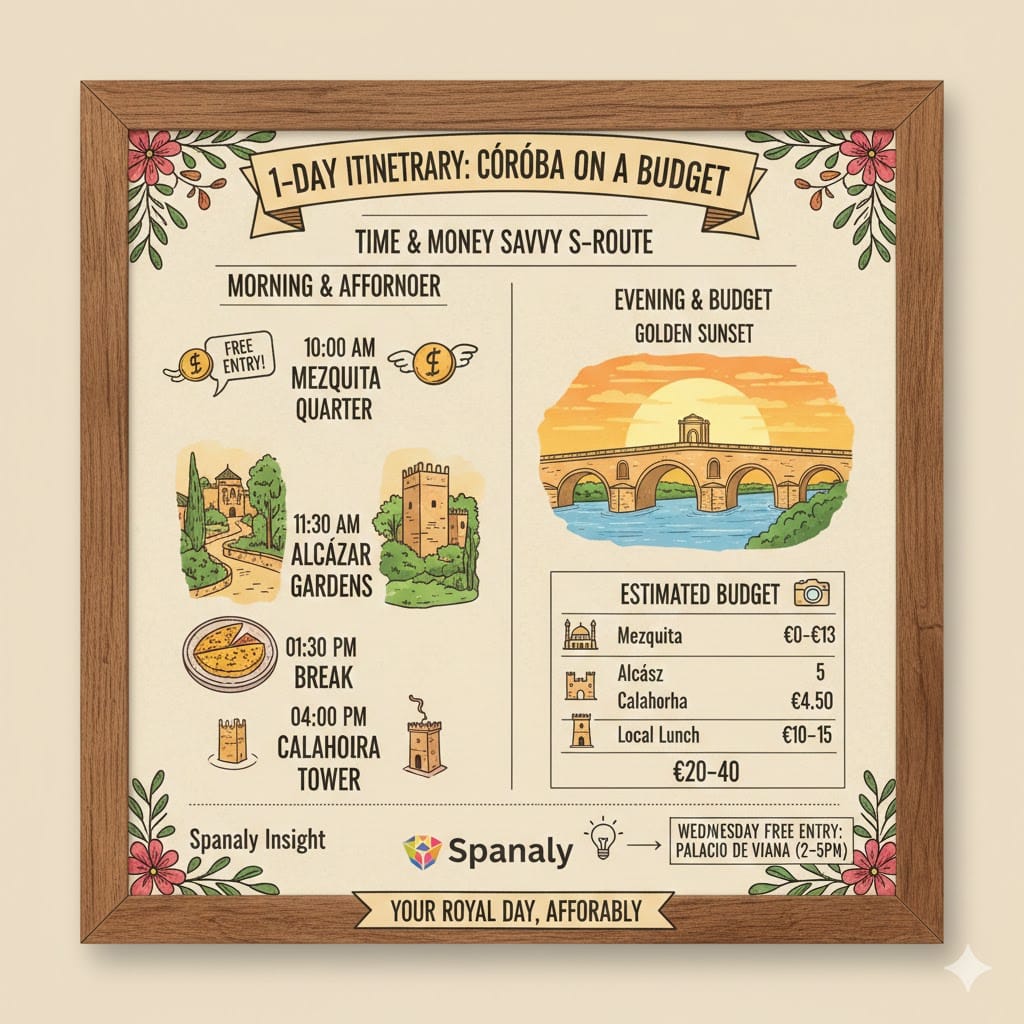
To experience Córdoba’s heart without breaking the bank or rushing through the beauty, follow this strategic “S-Route” that perfectly bridges history and economy.
08:30 AM – The “Early Bird” Secret (Mezquita): Start your day inside the Mezquita-Catedral.
Money Tip: Enter between 08:30 and 09:30 (Mon–Sat) for free admission (saving you €13). It’s the quietest and most spiritual hour.
10:00 AM – Jewish Quarter & Flower Alleys: Wander through the Judería. Visit the Synagogue (free for EU citizens, symbolic fee for others) before the narrow alleys get crowded with tour groups.
11:30 AM – Alcázar Gardens: Head to the Alcázar de los Reyes Cristianos.
Budget: Entry is approx. €5. Focus your time on the tiered gardens—they are most refreshing at this hour.
01:30 PM – Authentic Lunch Break: Skip the tourist menus in the main squares. Grab a famous giant Spanish Tortilla at Bar Santos and enjoy it like a local while looking at the Mezquita’s walls.
04:00 PM – The Southern Crossing: Walk across the Roman Bridge toward the Calahorra Tower.
The View: For €4.50, climb the tower for the best panoramic overlook of the entire bridge structure.
06:30 PM – The Golden Sunset: End your journey back on the bridge. This is when the sandstone “catches fire” in the setting sun—the best time for photos without spending a cent.
💰 Estimated Budget per Person (2026 Prices)
| Activity | Cost | Saving Tip |
| Mezquita-Catedral | €0 – €13 | Enter during the 8:30 AM free window. |
| Alcázar Gardens | €5 | Book online to skip the sun-drenched lines. |
| Calahorra Tower | €4.50 | Skip the interior if you only want the bridge walk. |
| Local Lunch | €10 – €15 | Eat “Tapas style” to try more for less. |
| Total | ~€20 – €40 | A royal experience on a traveler’s budget. |
Spanaly Insight: If your visit falls on a Wednesday, the stunning Palacio de Viana (and its 12 courtyards) usually offers free entry between 2:00 PM and 5:00 PM. It’s the best “Plan B” to add to your itinerary!
💡 Pro-Traveler Tips: Making the Most of Your Walk
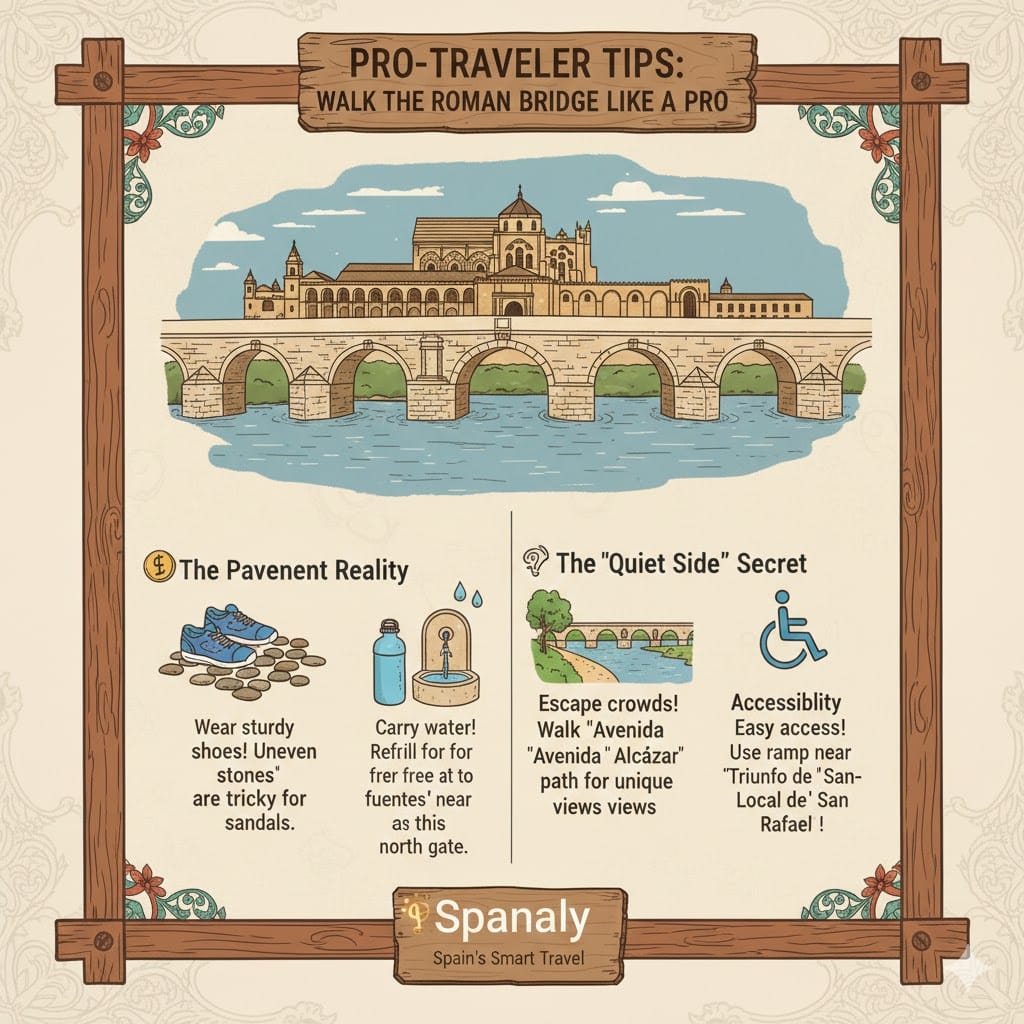
To elevate your visit from a simple stroll to a seamless experience, keep these “insider” details in mind before you step onto the ancient stones:
👟 The Pavement Reality: The bridge is paved with authentic, uneven cobblestones. While they look beautiful in photos, they can be a challenge for thin sandals or heels. Wear sturdy walking shoes to enjoy the 250-meter walk without fatigue.
💧 Hydration Station: There is very little shade on the bridge itself, and the reflection of the sun off the Guadalquivir can intensify the heat. Carry a reusable water bottle; you’ll find public drinking fountains (fuentes) near the Puerta del Puente (Northern Gate) to refill for free.
🤫 The “Quiet Side” Secret: If the bridge feels too crowded, head to the Avenida del Alcázar (the riverbank path on the northern side). It runs parallel to the river and offers a unique “profile view” of the bridge arches that most tourists miss while standing on the bridge.
♿ Accessibility Note: While the bridge is pedestrianized and accessible, the ramp leading down from the Mosque side is smoother than the stairs. If traveling with a stroller or wheelchair, use the entrance near the Triunfo de San Rafael for the easiest access.
Spanaly Insight: Keep an ear out for the local street musicians who often perform near the arches. The acoustics under the gate (Puerta del Puente) are incredible. Tossing a small coin to a Spanish guitarist here creates the perfect “soundtrack” for your walk—it’s worth every cent for the atmosphere it builds.
🌉 Visitor FAQs – The Roman Bridge of Córdoba
🚶 How long is the bridge and is it easy to walk?
The bridge is approximately 250 meters long. It is fully pedestrianized and flat, making it an easy 5-10 minute stroll. While wheelchair accessible, the cobblestones are historic and uneven, so comfortable footwear is essential.
🚗 Where is the best place to park nearby?
The bridge area is a car-free zone. The best option is to park on the south bank (near Calahorra Tower) in the Miraflores area, where you can find more street parking or public lots, then walk across toward the Mosque.
🐕 Are pets or bicycles allowed on the bridge?
Yes, pets on leashes are welcome. Bicycles are also permitted, but cyclists are expected to ride slowly and respect the heavy pedestrian flow, especially during peak sunset hours.
🌙 Does the bridge close at night?
No, the Roman Bridge is open 24/7 and completely free. It is beautifully lit after dark, offering a safe and romantic atmosphere for a night walk with stunning views of the illuminated Mezquita.
🎬 Can I see the Game of Thrones locations easily?
Absolutely! The bridge itself served as the Long Bridge of Volantis. You don't need a tour to see it, but for the best "cinematic" angle, head to the middle of the bridge and look toward the city gates.
Refined by Spanaly.com
🏛️ A Bridge That Connects Centuries
The Roman Bridge of Córdoba is more than just a stone structure over the Guadalquivir; it is a living timeline. Whether you are a history buff, a Game of Thrones fan, or a photographer chasing the golden hour, this bridge offers a unique soul that stays with you long after you’ve crossed it.
A Symbol of Resilience: It has survived empires, wars, and the passage of 2,000 years.
A Cultural Gateway: It perfectly links the Roman past with the Islamic and Christian heritage of Córdoba.
The Heart of the City: It remains the best place to feel the true pulse of Andalusia.
If your journey through Córdoba has left you hungry for more, don’t stop here. Spain is a treasure trove of world-class landmarks waiting to be discovered.
Explore our comprehensive Spain Historical Monuments Guide to plan your next adventure through the country’s most legendary sites.
Spanaly Final Note: When you stand in the middle of the bridge at sunset, take a moment to put your phone away. Listen to the rushing water and the distant sound of Spanish guitar—that is the moment you’ll truly remember.