🏖️ Playa de Cuevas del Mar
Playa de Cuevas del Mar is one of the most distinctive landscapes in Northern Spain. This beach is famous for its massive limestone arches and deep sea caves carved by the Cantabrian Sea. If you want to walk through natural stone tunnels and explore hidden caverns, this is the best spot in Asturias.
The Vibe: Geologically dramatic but very family-friendly.
The Shore: Fine golden sand protected by high vertical cliffs.
The Rule: Your entire experience depends on the tide—low tide is essential for exploring.
This coastal gem is a top contender among the best beaches in Spain because it changes completely every few hours. In this guide, I will help you time your visit perfectly and show you where to find the best photo angles among the rocks.
📸 Playa de Cuevas del Mar: Snapshot at a Glance
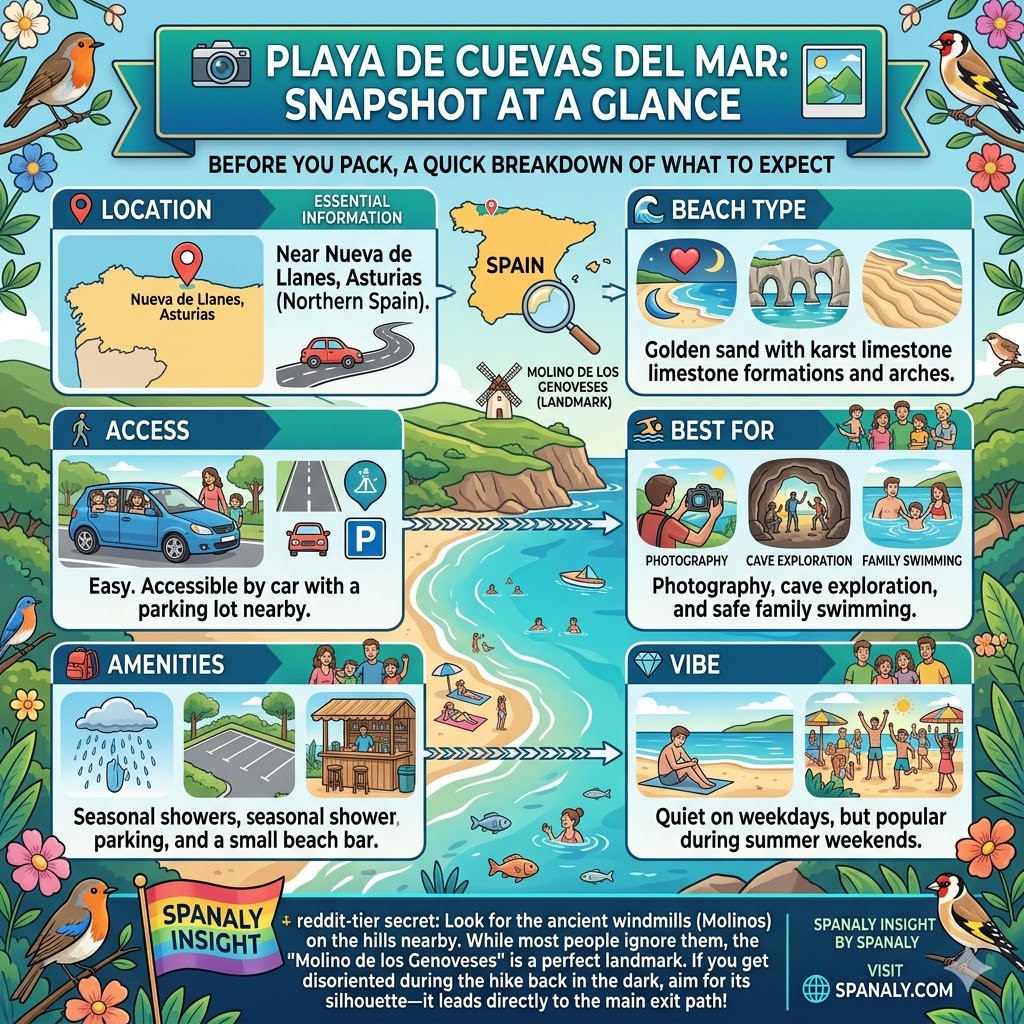
Before you pack your gear, here is a quick breakdown of what to expect at this geological sanctuary. Knowing these basics will help you decide if this is the right stop for your Asturias coastal trip.
| Feature | Essential Information |
|---|---|
| 📍 Location | Near Nueva de Llanes, Asturias (Northern Spain). |
| 🌊 Beach Type | Golden sand with karst limestone formations and arches. |
| 🚶 Access | Easy. Accessible by car with a parking lot nearby. |
| 🏊 Best For | Photography, cave exploration, and safe family swimming. |
| 🎒 Amenities | Seasonal showers, parking, and a small beach bar (chiringuito). |
| 💎 Vibe | Quiet on weekdays, but popular during summer weekends. |
⚔️ Cuevas del Mar vs. Playa de Gulpiyuri: Which One to Visit?
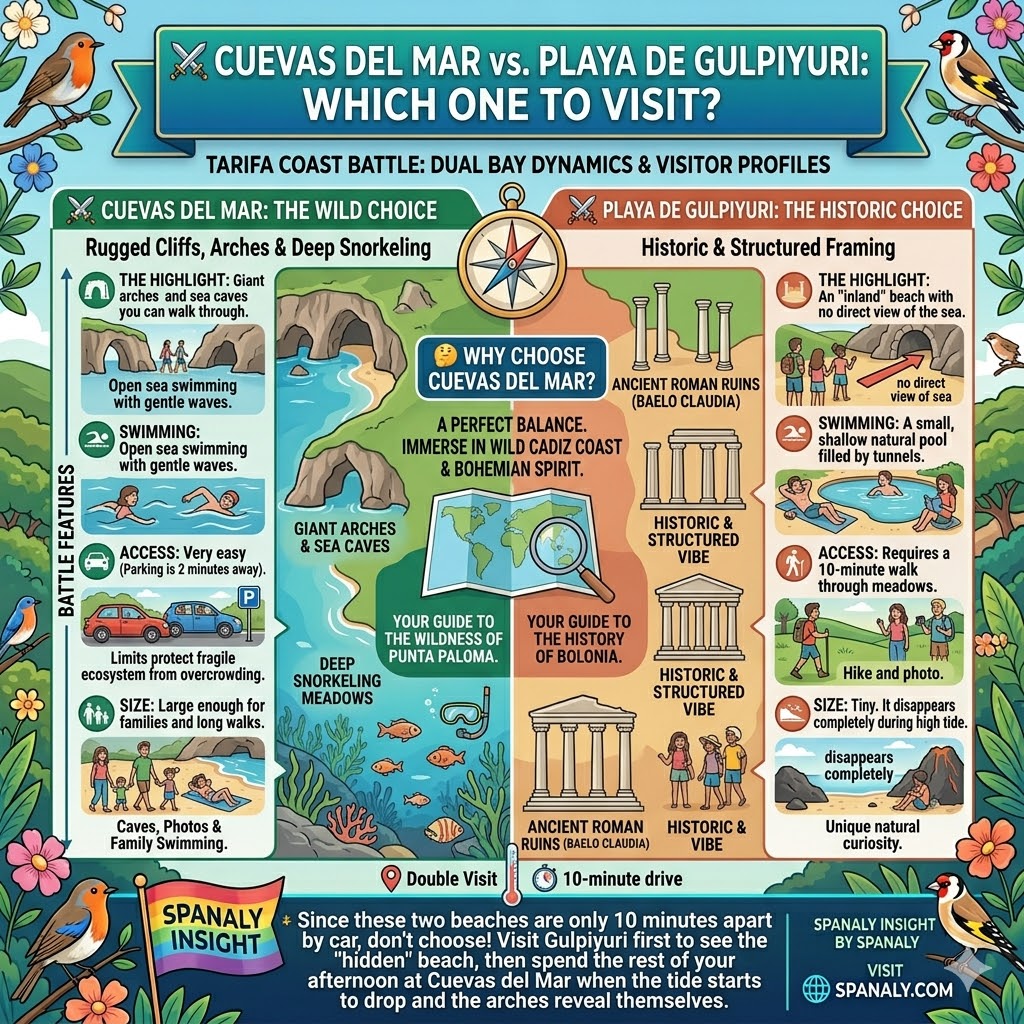
Both beaches are located in the municipality of Llanes and feature incredible karst formations. However, the experience at each one is completely different.
| Feature | Playa de Cuevas del Mar | Playa de Gulpiyuri |
|---|---|---|
| The Highlight | Giant arches and sea caves you can walk through. | An “inland” beach with no direct view of the sea. |
| Swimming | Open sea swimming with gentle waves. | A small, shallow natural pool filled by tunnels. |
| Access | Very easy (Parking is 2 minutes away). | Requires a 10-minute walk through meadows. |
| Size | Large enough for families and long walks. | Tiny. It disappears completely during high tide. |
| Best For | Photographers and cave explorers. | Travelers looking for a “natural curiosity.” |
🤔 Why Choose Cuevas del Mar?
While the Playa de Gulpiyuri Asturias guide shows a world-famous anomaly, that beach can feel cramped and disappointing if you visit during low tide when it becomes a mere puddle.
Cuevas del Mar is the better choice if you actually want to spend a full day at the beach. You get the best of both worlds: the dramatic “arch” architecture for photos and a proper shore for swimming. It offers a more complete coastal experience than its tiny neighbor.
💡 Spanaly Insight: The “Double Visit” Strategy Since these two beaches are only 10 minutes apart by car, don’t choose! Visit Gulpiyuri first to see the “hidden” beach, then spend the rest of your afternoon at Cuevas del Mar when the tide starts to drop and the arches reveal themselves.
💎 Why it’s Essential: More Than Just a Beach
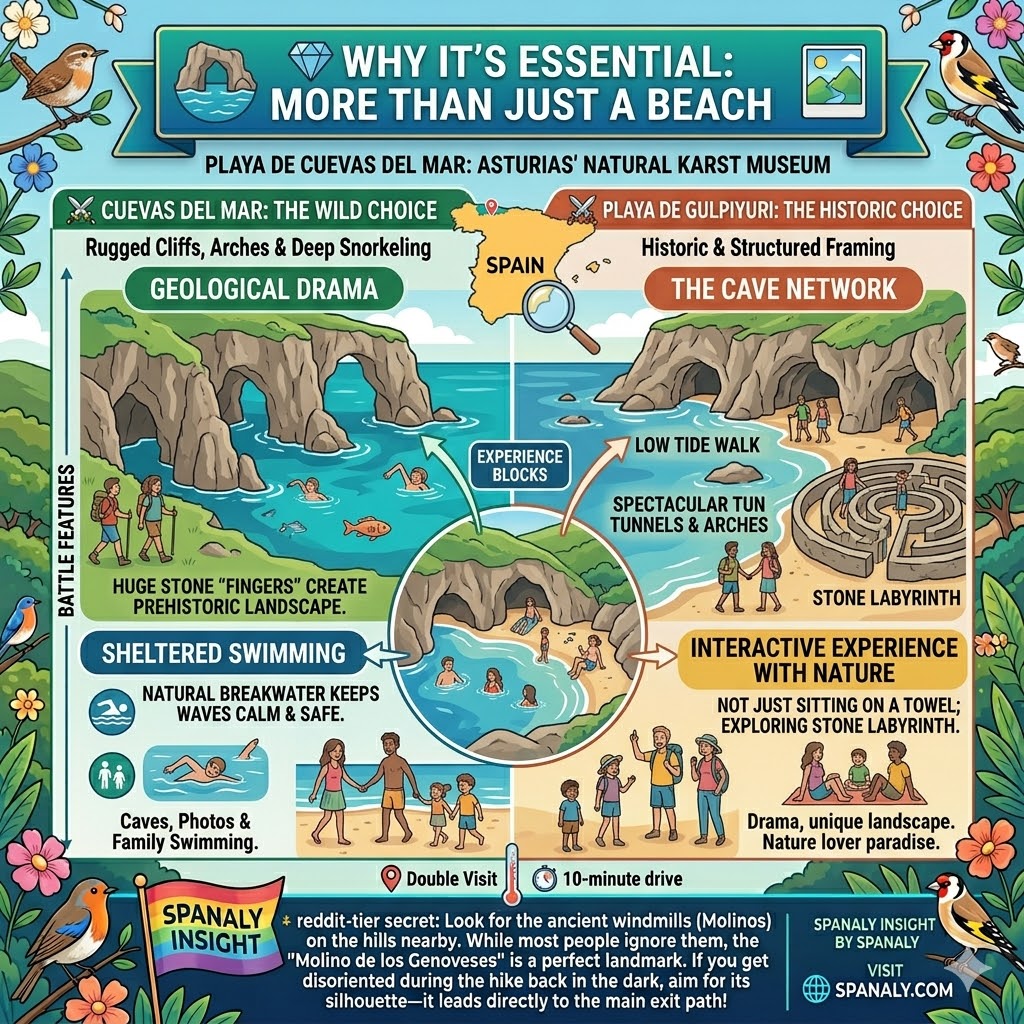
Most people visit beaches for the sand, but here, the rocks are the main event. Playa de Cuevas del Mar functions as a natural museum of karst architecture. The sea has spent centuries carving the limestone cliffs into spectacular tunnels and arches.
Geological Drama: Huge stone “fingers” stretch into the ocean, creating a landscape that feels prehistoric.
The Cave Network: You can actually walk through several caves at the base of the cliffs during low tide.
Sheltered Swimming: The surrounding rock formations act as a natural breakwater, keeping the waves calm and safe.
This beach is a highlight among Spanish Attractions because it offers an interactive experience with nature. You aren’t just sitting on a towel; you are exploring a labyrinth of stone. It is the kind of place where your camera battery will run out before you finish exploring.
💡 Spanaly Insight: The “Acoustic” Effect Try standing inside one of the larger arches when a wave hits the outer rocks. The limestone chambers amplify the sound of the Cantabrian Sea, creating a deep, resonant boom that you can feel in your chest. It’s a sensory experience most tourists miss because they stay in the center of the beach.
🗿 The Geology of Giants: How the Stone Arches Were Formed

The landscape at Playa de Cuevas del Mar wasn’t created overnight. It is the result of thousands of years of “karstification.” This process occurs when acidic rainwater and salty sea spray slowly dissolve the limestone cliffs, eating away the softer parts of the rock first.
The Hollow Out: Over centuries, small cracks in the cliffs turned into deep fissures.
The Arch Creation: Eventually, the sea punched through the remaining stone, leaving behind the massive “limestone skeletons” we see today.
Vertical Landscapes: The sharp, jagged peaks surrounding the beach are the remnants of ancient mountains that are literally melting into the sea.
This natural sculpting process has made this cove one of the best photography spots in Spain. You are essentially walking through a “work in progress” where the ocean continues to rewrite the shoreline every single day.
💡 Spanaly Insight: The “Fossilized” Details Look closely at the interior walls of the arches. You can find small fossilized marine shells embedded directly in the stone. These cliffs were once part of the seabed millions of years ago. Finding these fossils is a great way to keep kids (and adults) engaged while exploring the caves.
🌓 The Tide Factor: Why Timing is Everything
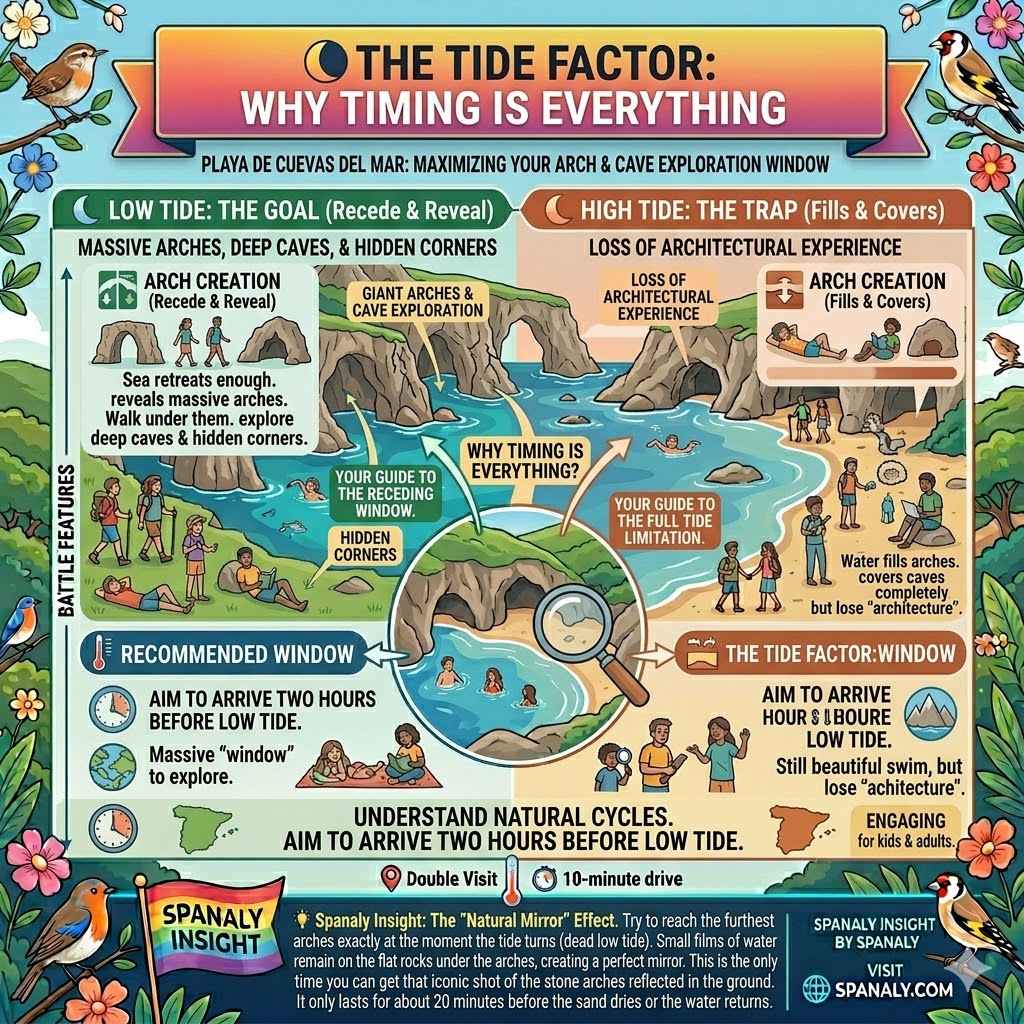
If there is one thing you must check before leaving your hotel, it is the tide table. Unlike most beaches where the tide just changes the amount of sand, at Playa de Cuevas del Mar, it changes the entire geography.
Low Tide (The Goal): This is the only time the sea retreats enough to reveal the massive arches. You can walk under them, explore the deep caves, and reach the hidden corners of the cliffs.
High Tide (The Trap): The water fills the arches and covers the caves completely. While it’s still beautiful for a quick swim, you will lose the “architecture” that makes this beach famous.
Understanding these natural cycles is as important as knowing the best time to visit Spain to avoid the rainy season. For the best experience at Cuevas del Mar, aim to arrive two hours before low tide. This gives you a massive “window” to explore the caves while the water is still receding.
💡 Spanaly Insight: The “Natural Mirror” Effect Try to reach the furthest arches exactly at the moment the tide turns (dead low tide). Small films of water remain on the flat rocks under the arches, creating a perfect mirror. This is the only time you can get that iconic shot of the stone arches reflected in the ground. It only lasts for about 20 minutes before the sand dries or the water returns.
📍 Location & Access: How to Reach the Arches
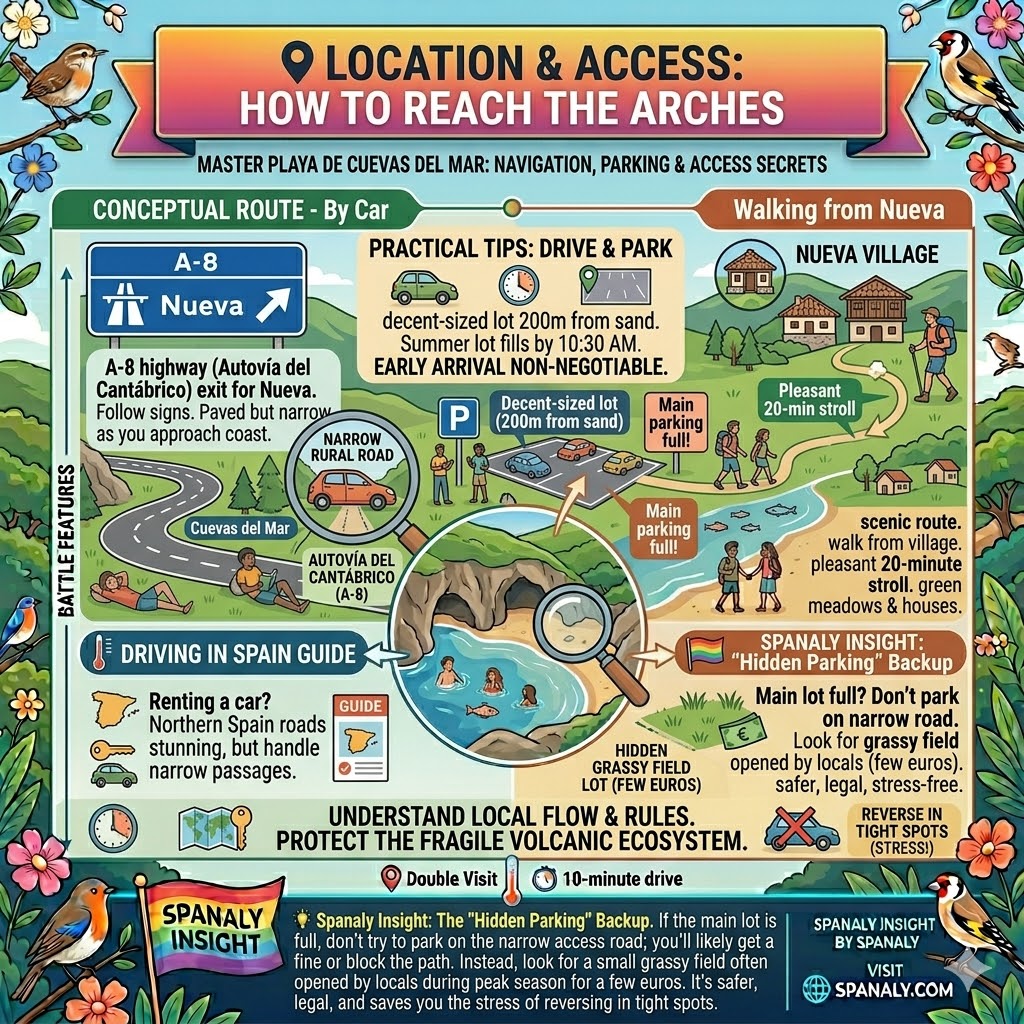
Playa de Cuevas del Mar is located in the eastern part of Asturias, specifically near the quiet village of Nueva. While it feels like a secluded paradise, getting here is surprisingly straightforward if you have your own wheels.
By Car: From the A-8 highway (Autovía del Cantábrico), take the exit for Nueva and follow the signs for “Cuevas del Mar.” The road is paved but becomes narrow as you approach the coast.
Parking: There is a decent-sized parking lot just 200 meters from the sand. On summer weekends, it fills up by 10:30 AM, so early arrival is non-negotiable.
Walking from Nueva: If you prefer a scenic route, you can walk from the village of Nueva. It’s a pleasant 20-minute stroll through green meadows and traditional Asturian houses.
If you are planning to rent a car for this trip, make sure to check our guide on driving in Spain. The rural roads in Northern Spain are stunning, but you need to be comfortable with narrow passages when passing other vehicles.
💡 Spanaly Insight: The “Hidden Parking” Backup If the main lot is full, don’t try to park on the narrow access road; you’ll likely get a fine or block the path. Instead, look for a small grassy field often opened by locals during peak season for a few euros. It’s safer, legal, and saves you the stress of reversing in tight spots.
📸 Photography Masterclass: Best Angles & Lighting
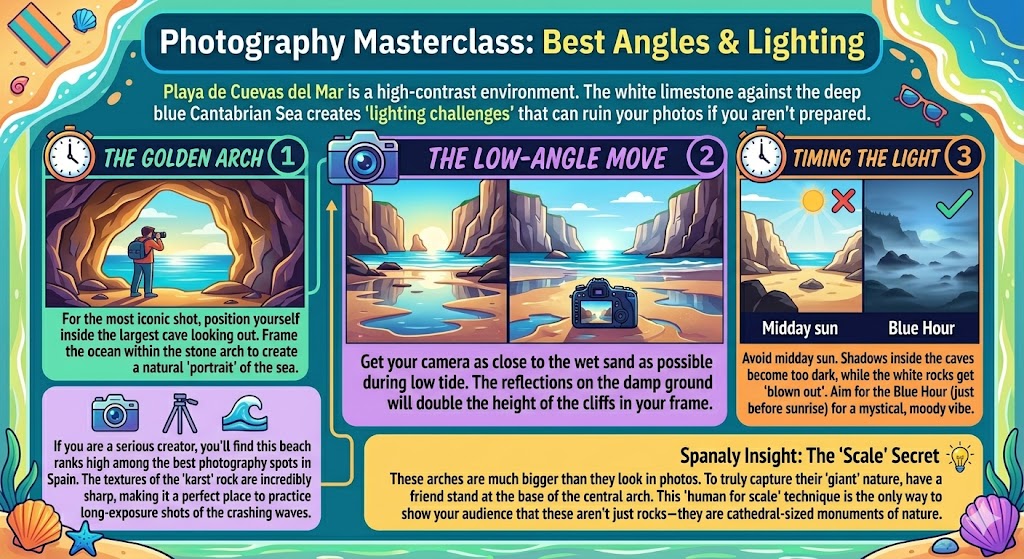
Playa de Cuevas del Mar is a high-contrast environment. The white limestone against the deep blue Cantabrian Sea creates “lighting challenges” that can ruin your photos if you aren’t prepared.
The Golden Arch: For the most iconic shot, position yourself inside the largest cave looking out. Frame the ocean within the stone arch to create a natural “portrait” of the sea.
The Low-Angle Move: Get your camera as close to the wet sand as possible during low tide. The reflections on the damp ground will double the height of the cliffs in your frame.
Timing the Light: Avoid midday sun. The shadows inside the caves become too dark, while the white rocks get “blown out.” Aim for the Blue Hour (just before sunrise) for a mystical, moody vibe.
If you are a serious creator, you’ll find this beach ranks high among the best photography spots in Spain. The textures of the “karst” rock are incredibly sharp, making it a perfect place to practice long-exposure shots of the crashing waves.
💡 Spanaly Insight: The “Scale” Secret These arches are much bigger than they look in photos. To truly capture their “giant” nature, have a friend stand at the base of the central arch. This “human for scale” technique is the only way to show your audience that these aren’t just rocks—they are cathedral-sized monuments of nature.
🥾 Coastal Hiking: The Route from Nueva de Llanes
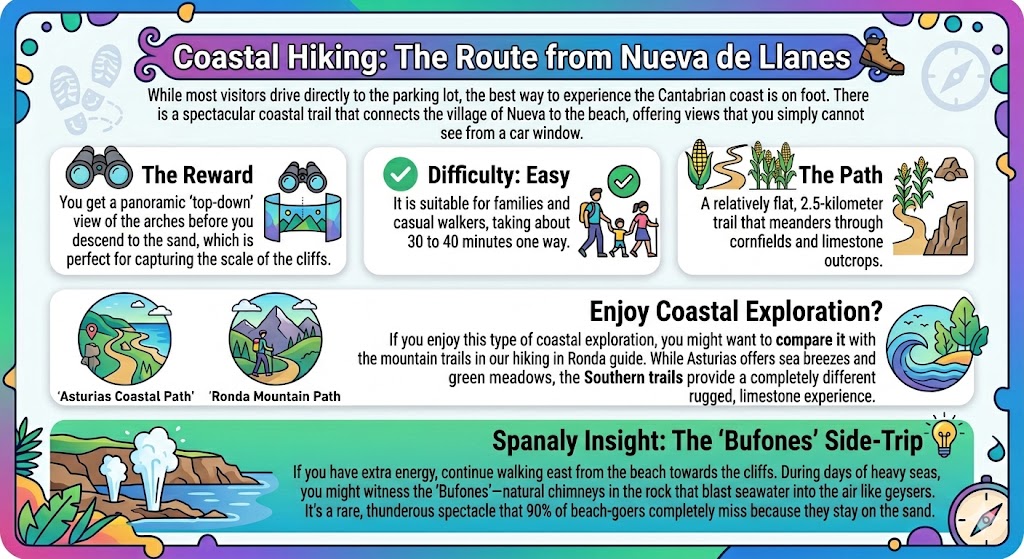
While most visitors drive directly to the parking lot, the best way to experience the Cantabrian coast is on foot. There is a spectacular coastal trail that connects the village of Nueva to the beach, offering views that you simply cannot see from a car window.
The Path: A relatively flat, 2.5-kilometer trail that meanders through cornfields and limestone outcrops.
Difficulty: Easy. It is suitable for families and casual walkers, taking about 30 to 40 minutes one way.
The Reward: You get a panoramic “top-down” view of the arches before you descend to the sand, which is perfect for capturing the scale of the cliffs.
If you enjoy this type of coastal exploration, you might want to compare it with the mountain trails in our hiking in Ronda guide. While Asturias offers sea breezes and green meadows, the Southern trails provide a completely different rugged, limestone experience.
💡 Spanaly Insight: The “Bufones” Side-Trip If you have extra energy, continue walking east from the beach towards the cliffs. During days of heavy seas, you might witness the “Bufones”—natural chimneys in the rock that blast seawater into the air like geysers. It’s a rare, thunderous spectacle that 90% of beach-goers completely miss because they stay on the sand.
🍽️ Where to Eat: Best Sidrerías Nearby

You cannot visit Playa de Cuevas del Mar without trying the local gastronomy in the nearby village of Nueva. This area is famous for its “Sidrerías”—traditional taverns where the local apple cider is poured from a height to aerate the drink.
The Signature Dish: Order Fabada Asturiana, a rich white bean stew with chorizo and morcilla. It’s heavy, but it’s the ultimate comfort food after a swim in the cold Cantabrian Sea.
Seafood Freshness: Look for Pixín (monkfish) or freshly caught sea bass. In Nueva, the “catch of the day” usually comes from the nearby ports of Llanes or Ribadesella.
The Experience: Head to Sidrería El Muelle or Restaurante San Jorge in Nueva. These spots are authentic, loud, and represent the true soul of Asturias.
To understand why Northern food differs so much from the Mediterranean coast, check our full guide to Spanish Cuisine. You’ll quickly learn that in the North, portions are generous and the flavors are bold and rustic.
💡 Spanaly Insight: The “Cider Pouring” Rule When you are in an authentic Sidrería, never pour the cider yourself! Wait for the waiter (escanciador) to do it. They pour it from high above their head into a wide glass to create “bubbles.” Drink it immediately in one gulp—leaving cider in the glass is considered a rookie mistake in Asturias.
🛡️ Safety & Regulations: Respecting the Asturias Coast
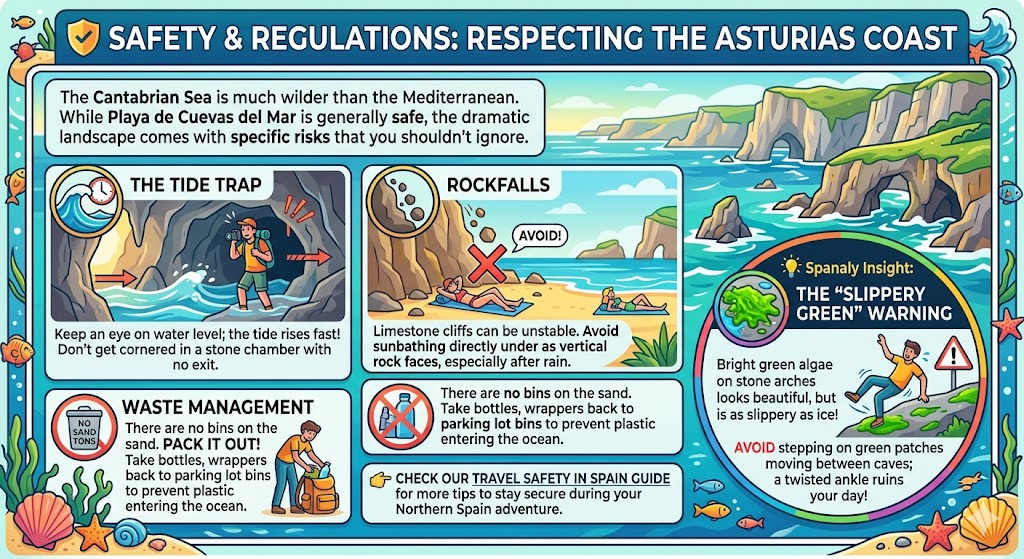
The Cantabrian Sea is much wilder than the Mediterranean. While Playa de Cuevas del Mar is generally safe, the dramatic landscape comes with specific risks that you shouldn’t ignore.
The Tide Trap: As we discussed, the tide rises fast. If you are exploring deep inside the caves, keep an eye on the water level. You don’t want to get cornered in a stone chamber with no exit.
Rockfalls: These cliffs are limestone, which can be unstable. Avoid sunbathing directly under the vertical rock faces, especially after heavy rain.
Waste Management: There are no trash cans on the sand to prevent plastic from entering the ocean. Whatever you bring (bottles, wrappers), you must take back to the parking lot bins.
For a broader look at staying secure during your trip, check our travel safety in Spain guide. Being aware of natural hazards is the first step to a stress-free adventure in Northern Spain.
💡 Spanaly Insight: The “Slippery Green” Warning The lower parts of the stone arches are covered in a thin layer of bright green algae. It looks beautiful in photos, but it is as slippery as ice. Avoid stepping on the green patches while moving between caves; a twisted ankle is the quickest way to ruin your day at the arches.
🗺️ The Perfect Day Trip: From Arches to Fishing Villages

To make the most of your trip to Playa de Cuevas del Mar, you should combine it with a visit to the nearby town of Llanes. This ensures you experience both the wild nature and the colorful coastal culture of Asturias.
09:00 AM – Early Arrival: Park at Cuevas del Mar and explore the arches before the crowds arrive.
11:00 AM – The Exploration: Spend two hours walking through the sea caves as the tide hits its lowest point.
01:30 PM – Lunch in Nueva: Head to the nearby village for a traditional Fabada Asturiana and local cider.
04:00 PM – Llanes Exploration: Drive 15 minutes to Llanes to see the “Memory Cubes” (massive painted harbor blocks) and the medieval old town.
07:00 PM – Sunset at Paseo de San Pedro: Walk along this natural grassy balcony overlooking the cliffs of Llanes for the best views.
If you enjoy the mix of modern art and coastal scenery, you should also explore the things to do in Bilbao guide. While Llanes is a charming village, Bilbao offers a larger-scale version of Northern Spain’s industrial-meets-artistic transformation.
💡 Spanaly Insight: The “East to West” Flow Most people visit Llanes and Cuevas del Mar in one go. To avoid the traffic flow, do the beach in the morning and the town in the late afternoon. Tourists usually do the opposite, meaning you’ll have more space to breathe in both locations if you follow this “reverse” schedule.
💡 Pro Tips

While travel brochures show you the arches, they forget to tell you the “logistics of reality.” Here is what the local community is talking about:
The “Shadow” Photography Rule: Avoid the center of the beach for portraits. The massive rock to the left of the entrance creates a “natural softbox” light about 90 minutes before sunset, which is perfect for skin tones.
Footwear is Non-Negotiable: Forget flip-flops if you plan to explore. The “caves” are full of sharp barnacles and jagged limestone. Bring water shoes with a solid grip to avoid cuts while climbing between the arches.
The Snorkeling Secret: Most people stay in the shallow water, but social media explorers recommend the area behind the “Double Arch” on the right. There is a deep natural pool where octopus and sea urchins hide in the rock crevices.
The “Parking Fine” Trap: Reddit users frequently warn about parking on the grass along the access road. Local police are very active here during summer; if the lot is full, drive back to Nueva and walk. A 20-minute walk is cheaper than a €90 fine.
Bag Safety: Since you’ll be busy exploring caves and arches, your stuff will be out of sight. Locals suggest using a waterproof dry bag and taking your valuables with you into the caves rather than leaving them unattended on the sand.
💡 Spanaly Insight: The “Wind” Factor Even on a sunny day, the Atlantic wind can funnel through the arches, making it feel 5 degrees colder than the parking lot. If you have kids or plan to stay for the sunset, bring a lightweight windbreaker. The “cave chill” is real and can end your trip early if you’re only in a swimsuit.
🛡️ Visitor FAQs – Playa de Cuevas del Mar Guide
🛡️ Is it safe to swim inside the sea caves at the beach?
Swimming inside the caves is only safe during very calm sea conditions and low tide. Even then, watch out for "dead swells" that can suddenly raise the water level. Always wear water shoes to protect your feet from sharp barnacles on the cave floors, and never swim deep into a cave if the tide has already started to turn.
📶 Is there mobile signal or Wi-Fi available at the beach?
Mobile signal at Playa de Cuevas del Mar is highly unstable due to the surrounding high vertical cliffs. You might get a signal near the parking lot, but it usually disappears once you enter the stone arches. There is no public Wi-Fi, so we recommend downloading your offline maps and tide tables before you leave Nueva.
🐶 Are dogs allowed on Playa de Cuevas del Mar?
During the high summer season, dogs are generally restricted during peak hours to ensure bather comfort. However, the rules are much more relaxed during the shoulder seasons (Spring and Autumn). If you travel with a pet, the nearby coastal hiking trails are dog-friendly, provided they remain on a leash near the cliff edges.
🛸 Can I fly a drone to capture the stone arches?
Since this is a protected natural landscape, strict drone regulations apply. You must check the latest ENAIRE maps to see if there are temporary bird-nesting restrictions. Even if allowed, be careful with the wind turbulence caused by the arches, which can easily destabilize light drones and cause a crash into the limestone walls.
🚿 Are there places to change clothes or wash off the sand?
The beach offers basic seasonal showers and public toilets near the entrance during the summer months. However, there are no formal "changing rooms" or lockers. Most visitors use the toilets at the local beach bar (chiringuito) or change discreetly inside their cars in the parking area.
Asturias Beach Guide by Spanaly.com
Visiting this beach is a unique trade-off. You give up the vast sandy stretches of the south for a dramatic, carved landscape of stone arches and hidden caves.
If you time your visit with the low tide and respect the power of the Cantabrian Sea, it offers a geological spectacle that feels like a prehistoric movie set.
Quick Final Tips:
Tide Timing: Check the charts; the arches are only fully walkable during low tide.
Foot Protection: Wear sturdy water shoes to navigate the sharp limestone and slippery algae.
Early Arrival: Aim for 10:00 AM to secure parking before the narrow access roads get crowded.
If you enjoy wild, rocky shores but prefer the warmer Mediterranean waters and a more desert-like vibe, check our Cala de Enmedio Almeria guide. It is a stunning, isolated alternative to the lush green cliffs of Northern Spain.
Pack your camera, watch the tides, and enjoy the echo of the waves inside the caves. Safe travels! 🥂🏖️🗿✨