🛡️ Navigating the Road: Renting a Car in Spain
Renting a car in Spain gives you the freedom to explore hidden white villages and rugged coastlines at your own pace. However, to avoid unexpected costs or safety issues, it’s important to understand the key points about insurance and local driving rules.
- 🚗 The Freedom Factor: Driving lets you reach remote places that public transport simply cannot access.
- 🛡️ Safety & Security: Spanish roads are generally very good, but knowing local driving habits helps ensure a stress-free experience.
- 💳 Financial Clarity: Learn how to spot hidden fees before you sign the rental contract, especially at the airport.
- 🚦 Legal Readiness: Make sure you have all the correct documents to avoid fines during routine police checks.
If you’re planning your trip, our Ultimate Spain Travel Guide covers all the logistical details beyond just driving. This guide focuses on the practical side of car rentals, helping you stay protected while enjoying Spain’s beautiful landscapes.
⚡ Snapshot: Essential Car Rental Logistics at a Glance
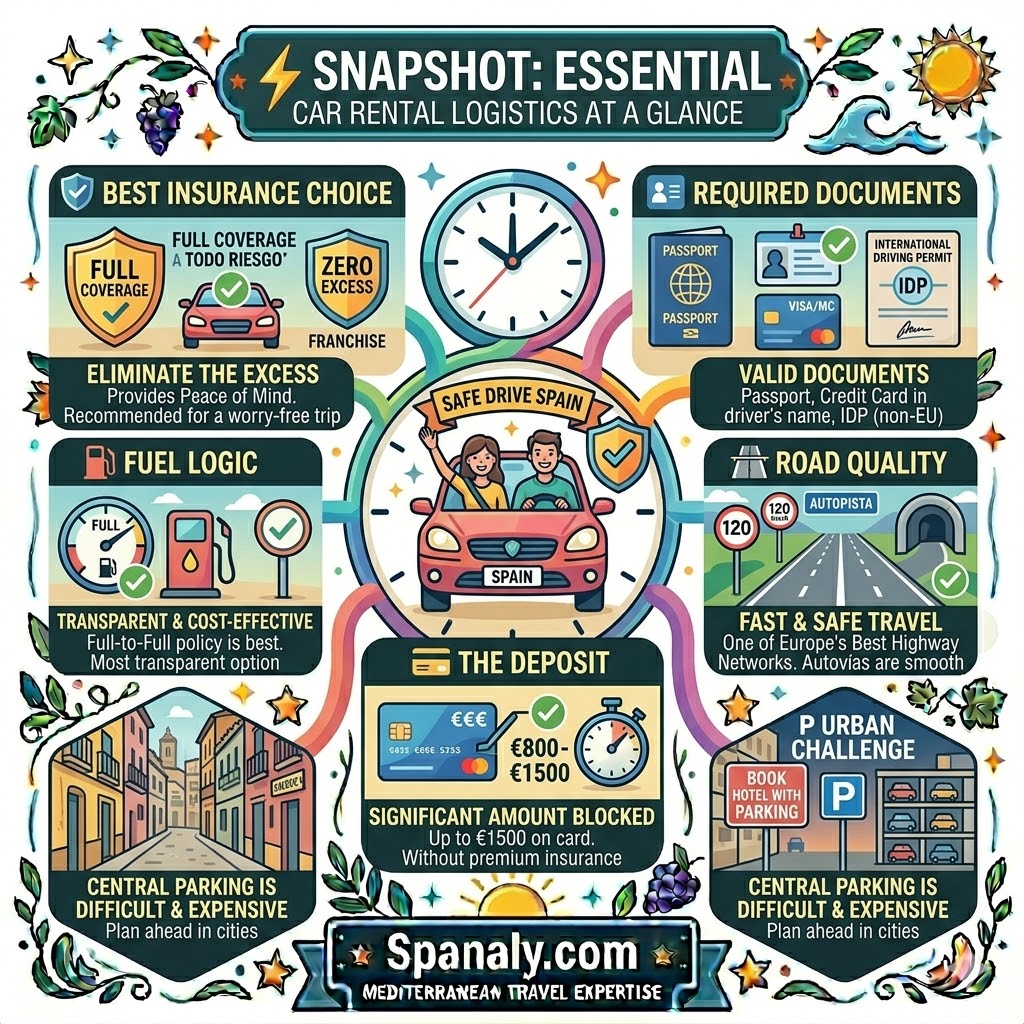
If you are looking for the bottom line on renting a car in Spain, here are the critical facts you need to know before stepping into the rental office.
🛡️ Best Insurance Choice: “Full Coverage” (Seguro a Todo Riesgo) is highly recommended to eliminate the “franchise” (excess) and provide peace of mind.
🆔 Required Documents: A valid Passport, a Credit Card (not Debit) in the driver’s name, and an International Driving Permit (IDP) for non-EU residents.
🛣️ Road Quality: Spain boasts one of Europe’s best highway networks (Autopistas and Autovías), making long-distance travel fast and safe.
🅿️ Urban Challenge: Parking in historic centers like Seville or Granada is difficult and expensive; always book hotels with dedicated parking.
💳 The Deposit: Agencies will block a significant amount (typically €800–€1,500) on your credit card if you don’t take their premium insurance.
⛽ Fuel Logic: The “Full-to-Full” policy is the most transparent and cost-effective option for travelers.
💡 Spanaly Insight
Be aware of ZBE zones (Zonas de Bajas Emisiones). Many Spanish cities now restrict access to high-emission vehicles in central areas. If your rental car doesn’t have the correct environmental sticker (Distintivo Ambiental), you could face automatic fines via camera surveillance. Always ask the rental agent if the car is authorized for “Low Emission Zones.”
📍 Choosing Your Path: Car vs. Train vs. Bus
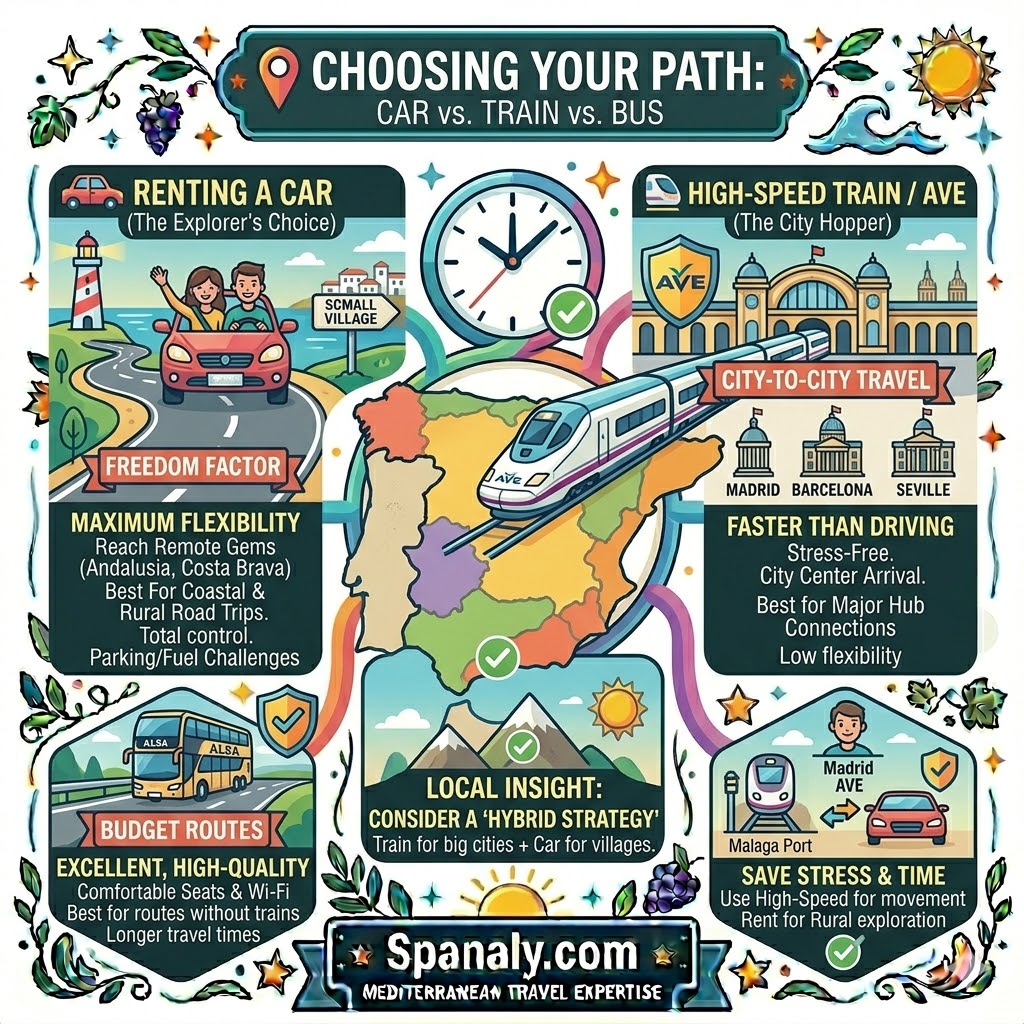
Deciding how to navigate Spain depends entirely on your specific itinerary. While renting a car in Spain offers the ultimate freedom, the country’s public transport network is one of the most efficient in Europe.
🚗 Renting a Car (The Explorer’s Choice): Best for rural areas, the white villages of Andalusia, or the rugged Costa Brava. It grants you total control over your schedule but comes with parking challenges and fuel costs.
🚄 High-Speed Train / AVE (The City Hopper): Perfect for connecting major hubs like Madrid, Barcelona, and Seville. It is faster than driving, stress-free, and drops you right in the city center, though it lacks flexibility for off-the-beaten-path stops.
🚌 Luxury Bus / ALSA (The Budget Alternative): An excellent, high-quality option for long distances where the train doesn’t reach. It is the most economical choice and offers comfortable seating with Wi-Fi, though travel times are longer.
| Feature | Rental Car | High-Speed Train (AVE) | Bus (ALSA) |
|---|---|---|---|
| Flexibility | Maximum | Low | Medium |
| Best For | Coastal & Rural Road Trips | Major City-to-City Travel | Budget-Conscious Routes |
| Urban Stress | High (Parking/ZBE) | Zero | Zero |
| Scenic Value | High (Stop anywhere) | Medium (Fast views) | Medium |
Choosing the right mode of transport is a key step when you plan trip to Spain ultimate guide. If your heart is set on the hidden gems of the Spanish countryside, the car remains the undisputed champion.
💡 Spanaly Insight
Consider a “Hybrid Strategy.” Use the high-speed train to move between major regions (e.g., Madrid to Malaga), and then rent a car only for the days you plan to explore the surrounding villages. This tactical move saves you from the stress of driving across the vast central plateau while keeping your budget optimized.
📍 When and Where to Pick Up Your Rental Car
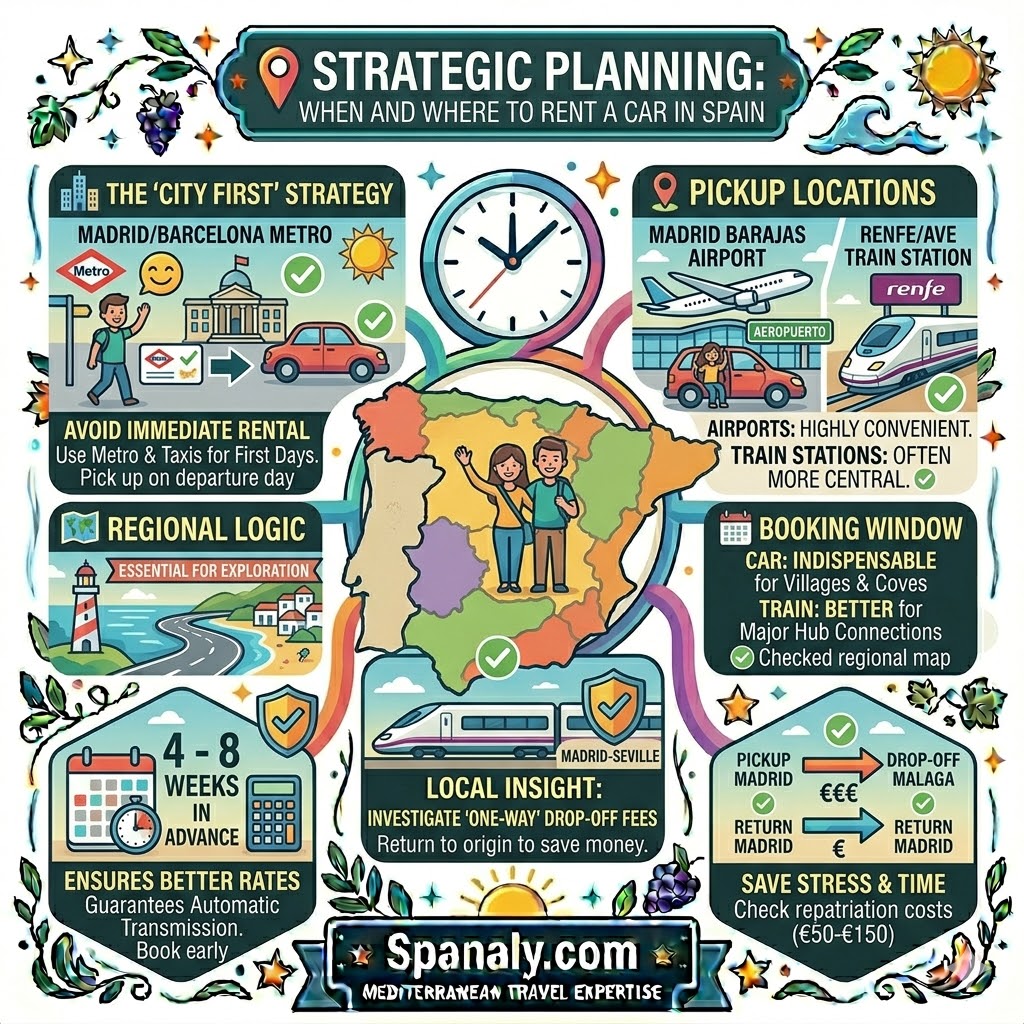
Choosing the right time and place to collect your car can save you a lot of time and unnecessary stress in the city. A car is excellent for exploring the countryside, but it can become more of a hassle than a help in busy historic centers.
- 🏙️ The “City First” Strategy: If your trip starts in Madrid or Barcelona, it’s usually better not to rent a car straight away. Use the excellent public transport for the first few days and pick up your rental only when you’re ready to leave the city.
- 📍 Pickup Locations: Collecting your car from major airports like Madrid Barajas is convenient, but it may come with an extra location fee. Train stations (such as AVE stations) are often more central, though they sometimes have fewer vehicle options available.
- 🗺️ When a Car Makes Sense: A car is very useful for visiting the white villages of Andalusia or the hidden coves along the Costa Brava. However, if your trip focuses mainly on big cities, the high-speed train is often a simpler and more practical choice.
- 📅 Booking Window: Booking your rental at least 4 to 8 weeks in advance usually gives you better rates. This is especially important if you need an automatic car, since manuals are the standard in Spain.
Planning these details in advance helps you have the car exactly when it adds real value to your trip.
Pro Tip: Always check the one-way drop-off fee if you plan to pick up the car in one city and return it in another (for example, Madrid to Málaga). Agencies often charge between €50 and €150 for this. In some cases, adjusting your route to return the car to the same location can save you money.
Manual vs Automatic: What You Need to Know
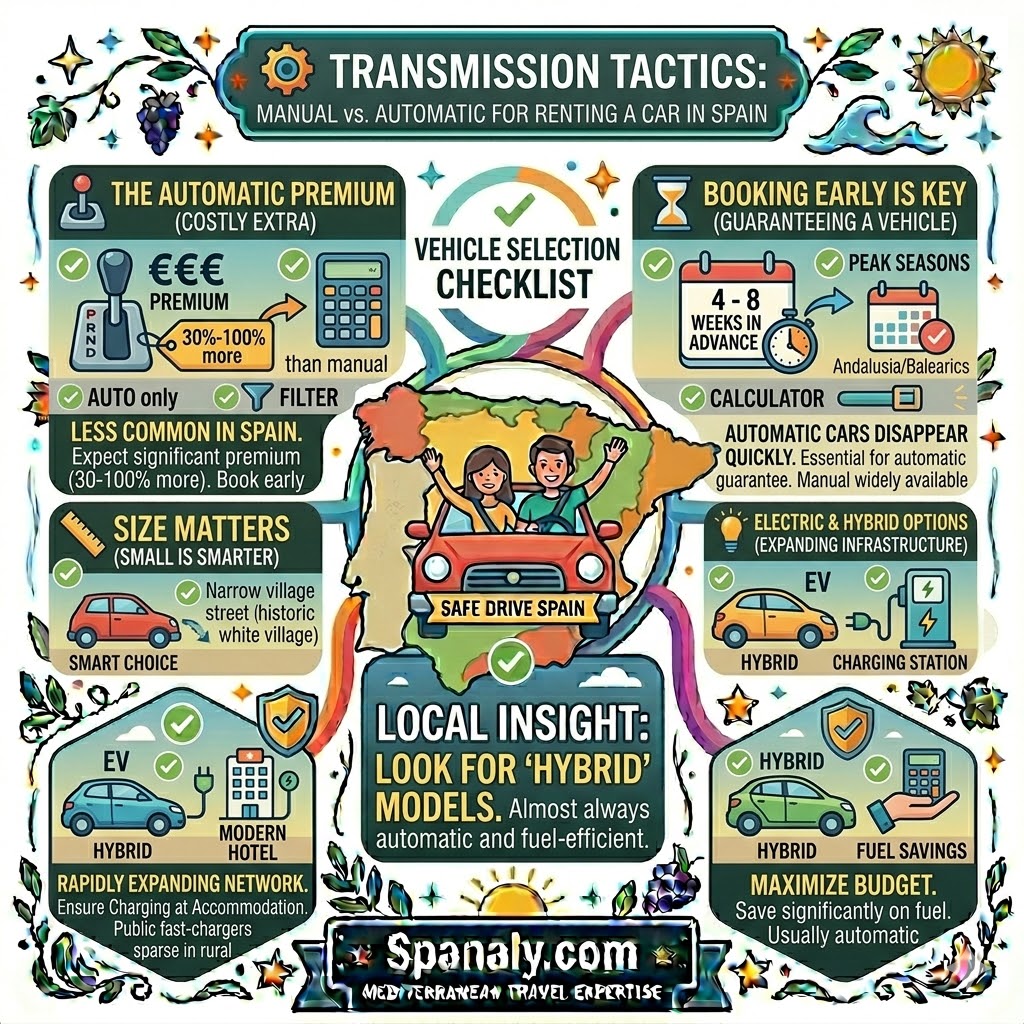
In Spain, most rental cars come with a manual transmission. If you prefer driving an automatic, it’s important to plan ahead, because automatic cars are less common and usually more expensive.
- 🕹️ The Automatic Premium: Automatic vehicles are not as widely available in Spanish rental fleets. You can expect to pay 30% to 100% more compared to a similar manual car.
- ⏳ Booking Early is Key: Manual cars are usually easy to find at the last minute, but automatic cars get booked quickly — especially during peak season in popular areas like Andalusia and the Balearic Islands.
- 📏 Size Matters: Spanish roads, particularly in historic towns and white villages, are often very narrow. A compact or mid-size car is much easier to drive and park than a large SUV, which can become difficult in tight medieval streets.
- 🔋 Electric & Hybrid Options: Spain is expanding its electric charging network, but stations are still limited in many rural areas. If you rent an electric or hybrid vehicle, check in advance that your accommodation has charging facilities.
Choosing the right type of car can make a big difference to your comfort and budget. Avoid booking the cheapest option if you’re not fully comfortable driving a manual on steep and winding mountain roads.
Pro Tip: If you need an automatic, filter your search for “Automatic Only” right from the start. Don’t assume the rental desk can upgrade you on the spot — they often don’t have any available. Hybrid models are also worth considering, as they are usually automatic and can save you money on fuel during long drives.
🆔 Rental Essentials: Requirements and Legal Documents
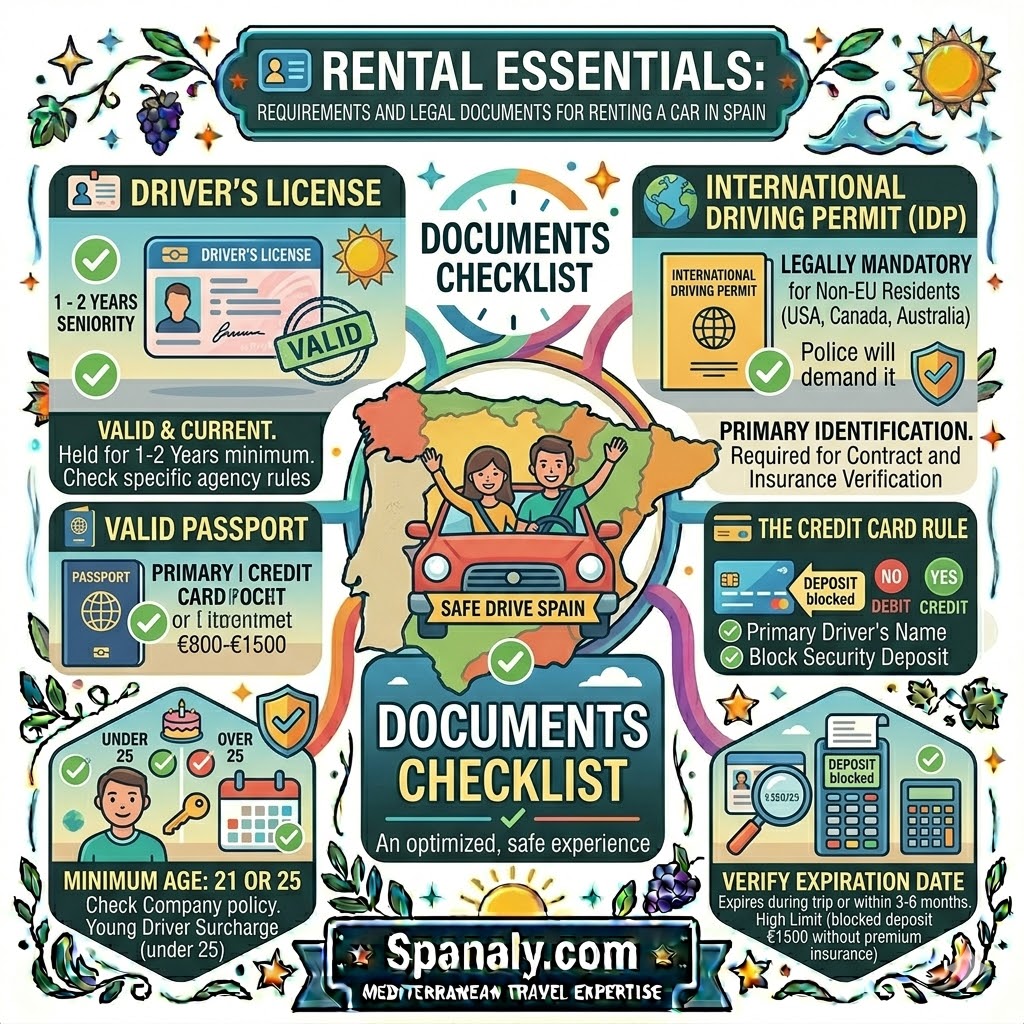
Before arriving at the rental desk, ensuring your “paperwork” is flawless is the most tactical move you can make. Spanish agencies adhere to strict legal protocols, and missing a single document can lead to a denied rental or a forced, expensive insurance upgrade.
🪪 Driver’s License: Your license must be valid and typically held for a minimum of one to two years. Always check the specific agency’s seniority requirements before booking.
🌍 International Driving Permit (IDP): For non-EU residents (e.g., USA, Canada, Australia), an IDP is legally mandatory alongside your original license. Even if the clerk forgets to ask, Spanish traffic police (Guardia Civil) will demand it during routine checks.
🛂 Valid Passport: This serves as your primary identification for the rental contract and is essential for all legal and insurance verifications.
💳 The Credit Card Rule: This is a major pitfall. Most agencies require a physical Credit Card (not Debit) in the primary driver’s name to block the security deposit.
🎂 Age Requirements: While you can drive at 18, most companies set their minimum at 21 or 25. Be prepared for a “Young Driver Surcharge” if you are under the age of 25.
Having these documents organized is a cornerstone of your preparation, much like checking our Spain trip checklist to ensure nothing is left behind. Carrying physical originals is non-negotiable, even if you keep digital backups.
💡 Spanaly Insight
Always verify the expiration date of your license well before your flight. Some agencies may decline the contract if your license expires within three to six months of the rental period. Additionally, ensure your credit card has a sufficient limit to handle a “blocked deposit” of up to €1,500, especially if you opt out of the agency’s premium insurance.
🛡️ Insurance Decoded: CDW vs. Full Coverage
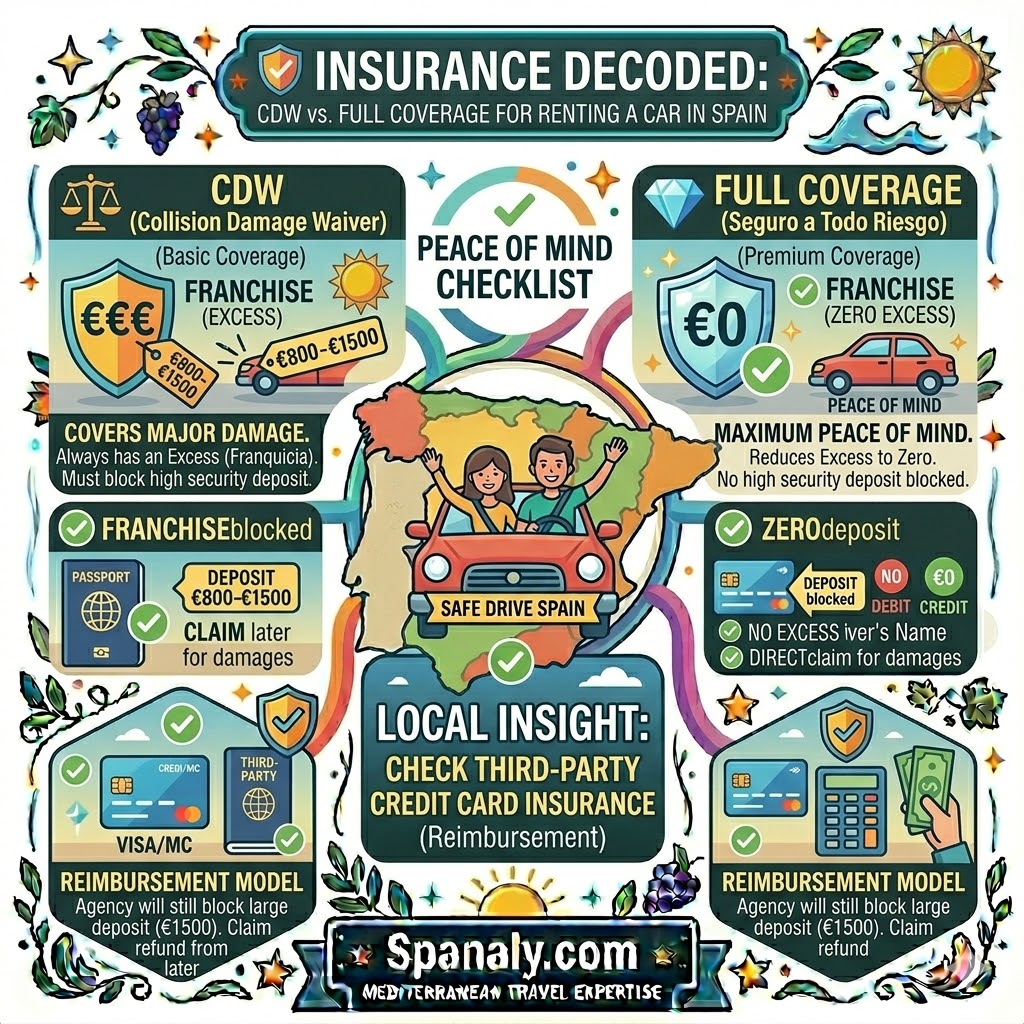
Navigating the world of car insurance in Spain can feel like walking through a legal maze. Understanding the difference between what is “included” and what is “necessary” will protect you from unexpected liabilities and ensure your travel budget stays intact.
⚖️ CDW (Collision Damage Waiver): This is the basic insurance usually included in your rental price. It covers major damage but always comes with an Excess (Franquicia). In 2026, this means if you have even a minor scratch, you might still pay the first €800 to €1,500 out of pocket.
💎 Full Coverage (Seguro a Todo Riesgo): This is the ultimate “peace of mind” option. It reduces your excess to zero, meaning you pay nothing for most damages. In Spain, we highly recommend this, especially for navigating those narrow village streets where minor scuffs are a common part of the adventure.
💳 Third-Party Credit Card Insurance: Many premium cards offer rental insurance. While effective, keep in mind that the rental agency will still block a significant deposit on your card. You will be responsible for the initial cost of any damage and must claim the refund from your bank later.
🚫 Theft Protection (TP): Usually included by default, this covers the loss of the vehicle itself. However, it rarely covers personal belongings left inside, so always keep your valuables with you.
Deciding on the right level of protection is a smart tactical choice for any traveler. Just as you wouldn’t head out without our Travel Insurance Spain Guide, you shouldn’t drive across the Peninsula without knowing exactly how your rental policy shields you from the unexpected.
Spanaly Insight: Be aware that most standard “Full Coverage” policies from rental desks still exclude tires, glass, and underbody damage. If you plan to drive on rural or coastal roads, double-check that these specific items are included in your “Zero Excess” package to avoid surprise charges upon return.
💳 Understanding the Real Cost: Hidden Fees and Fuel Policies
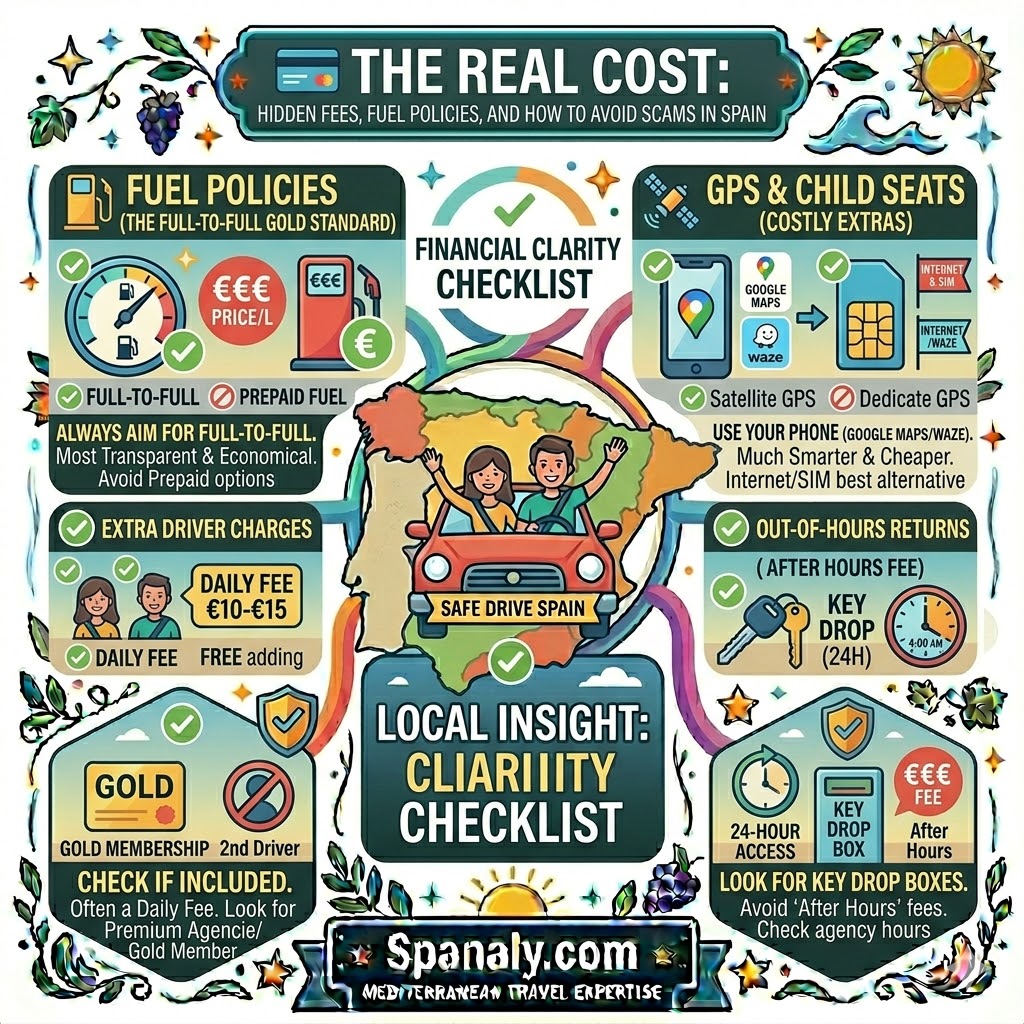
The “headline price” you see on comparison websites is rarely the final amount you will pay. Taking time to understand the main extra costs will help you protect your Spain travel budget and avoid unpleasant surprises at the rental counter.
- ⛽ Fuel Policies: Always choose the “Full-to-Full” policy if available. You pick up the car with a full tank and return it the same way. Avoid “Prepaid Fuel” options, as rental companies often charge a higher price per liter plus a service fee.
- 🛣️ Extra Driver Charges: Adding a second driver usually costs an extra €10–€15 per day. Some premium agencies or special memberships may include this for free, so always check before confirming the booking.
- 🛰️ GPS & Child Seats: These optional extras can significantly increase your daily rate. Using your phone with Google Maps or Waze (along with a local SIM card) is usually a much cheaper and more practical solution than renting a dedicated GPS.
- 🕒 Out-of-Hours Returns: Returning the car outside normal office hours (for example, a 4:00 AM flight) often comes with an additional “After Hours” fee. Look for companies that offer 24-hour key drop boxes to avoid this charge.
The key to staying in control of your budget is to be proactive. In Spain, the most common issue isn’t outright scams, but rather the upselling of services you may not actually need.
Pro Tip: Always keep your last fuel receipt from a station near the airport. If the rental company claims the tank isn’t completely full due to a sensor error, this receipt serves as strong proof. Also, carefully check whether your rental includes unlimited mileage — some budget deals limit you to as little as 100 km per day, which is rarely enough for a proper road trip in Spain.
📸 The Pre-Drive Inspection: Protecting Yourself from Damage Claims
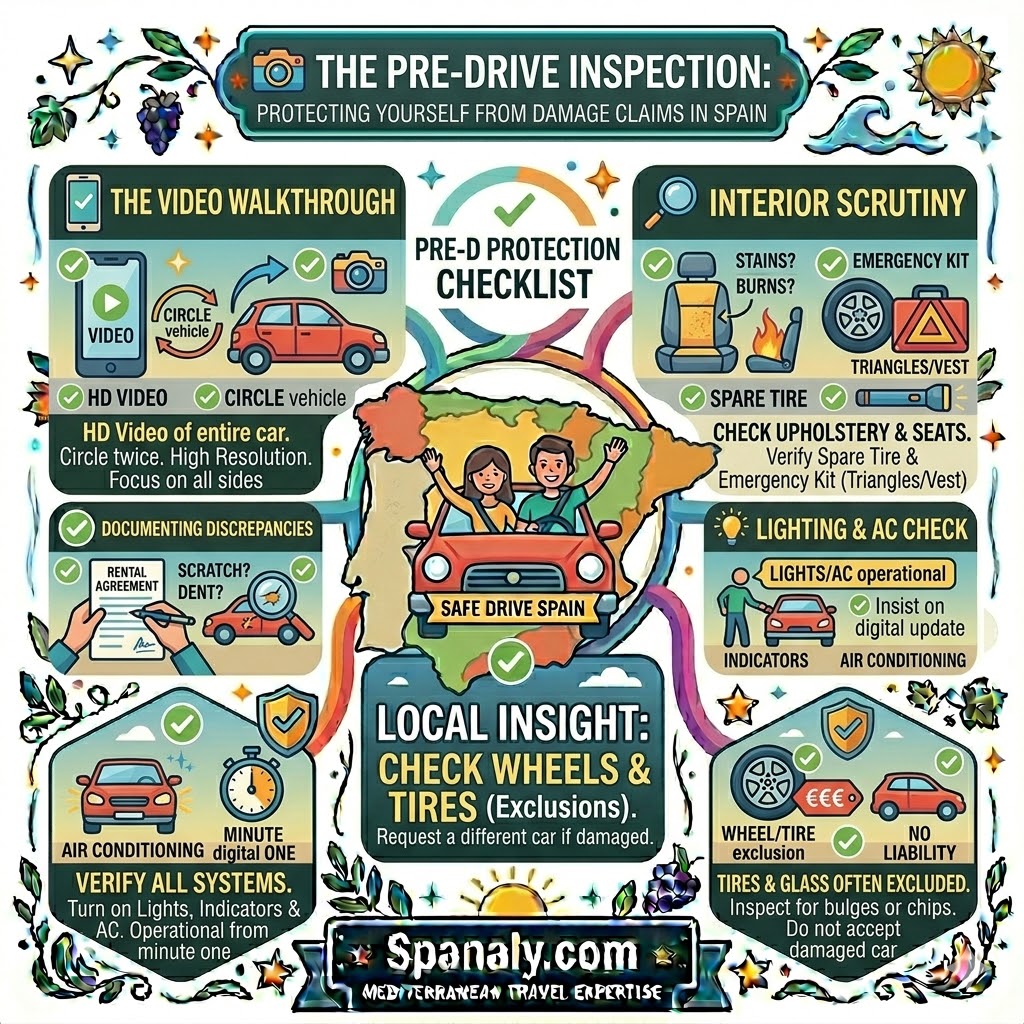
The moment you receive the keys is the most critical window for your protection. Spanish rental lots can be dimly lit or crowded, making it easy to overlook small dents or scratches that could later be charged to your account.
📱 The Video Walkthrough: Before moving the car, take a high-definition video circling the entire vehicle. Focus on the bumpers, wheel rims, and the roof.
🔍 Interior Scrutiny: Check the upholstery for stains or cigarette burns and ensure the spare tire and emergency kit (triangles and high-visibility vest) are present.
🖊️ Documenting Discrepancies: If you find even a tiny scratch not marked on the rental agreement, go back to the desk and insist they update the digital record before you leave.
💡 Lighting Check: Turn on all lights, indicators, and the air conditioning to ensure everything is operational from minute one.
This proactive approach is a vital part of your Spain trip review checklist. Taking five minutes now can save you hundreds of euros and a lengthy dispute later.
💡 Spanaly Insight
Pay special attention to the wheels and tires. Most standard insurance policies—even some “Full Coverage” ones—exclude damage to tires and glass. If you notice a “bulge” in a tire sidewall or a tiny chip in the windshield, do not accept the car. Request a different vehicle immediately to avoid being held liable for a pre-existing safety issue.
🚦 Rules of the Road: Driving Laws, Tolls, and Parking Strategies
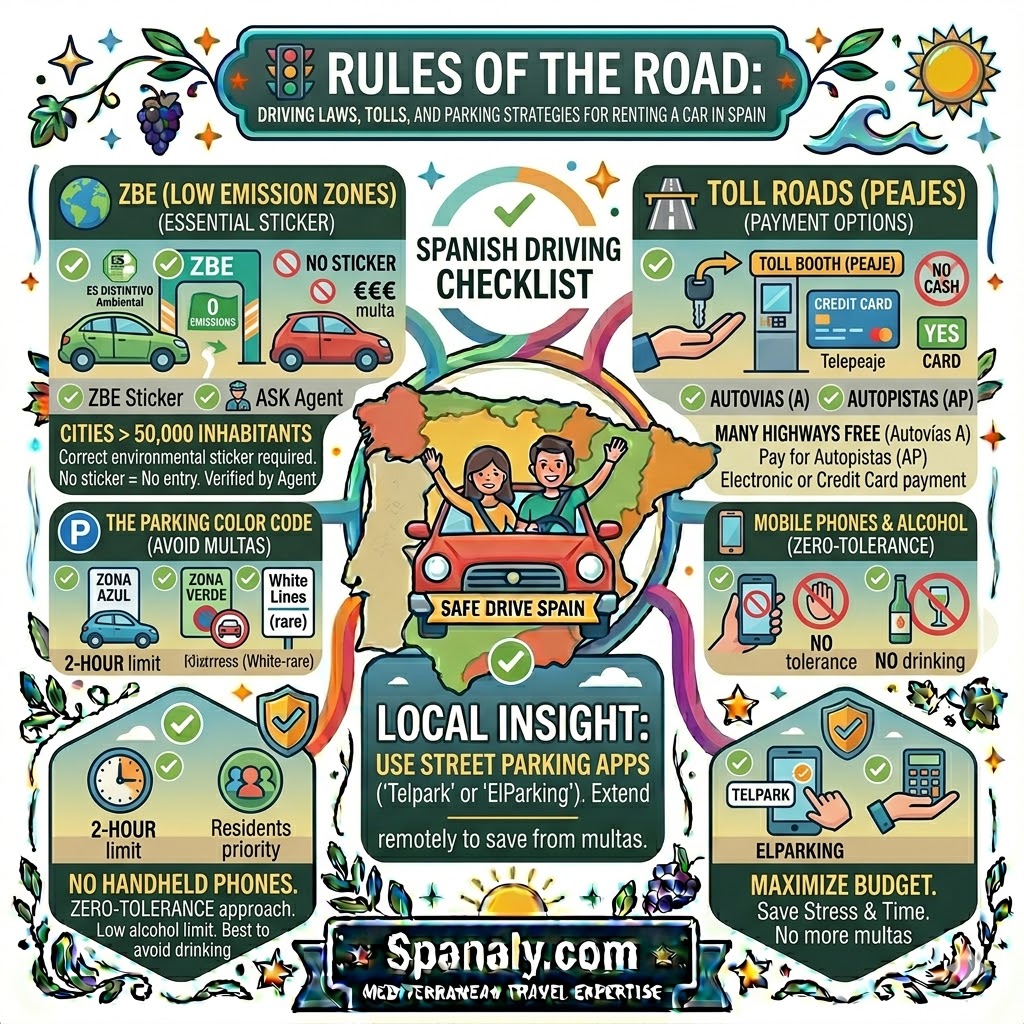
Driving in Spain is generally organized and safe, but the tactical nuances of local laws can be tricky for newcomers. Knowing the difference between a “blue line” and a “green line” can be the difference between a great day and a €90 parking fine.
🌍 ZBE (Low Emission Zones): In 2026, almost all Spanish cities with over 50,000 inhabitants have Zones of Low Emissions (ZBE). If your rental car doesn’t have the correct environmental sticker (Distintivo Ambiental), you cannot enter city centers. Always ask the rental agent: “Does this car have the ZBE sticker?”
🛣️ Toll Roads (Peajes): While many highways (Autovías – A) are free, some (Autopistas – AP) require payment. Most now use electronic “Telepeaje” or credit card taps. Cash is becoming rare at toll booths, so keep a card handy.
🅿️ The Parking Color Code: * Blue Lines (Zona Azul): Paid parking for everyone (usually 2-hour limit).
Green Lines (Zona Verde): Primarily for residents; very expensive or restricted for tourists.
White Lines: Free parking (rare in city centers).
📱 Mobile Phones & Alcohol: Spain has a zero-tolerance approach to holding a phone while driving (even at a red light). The blood alcohol limit is also very low (0.5 g/l), so it is best to avoid drinking entirely if you are the designated driver.
Adhering to these rules is a critical part of driving in Spain. Remember, speed cameras (Radares) are everywhere, and they are often hidden in non-obvious locations.
💡 Spanaly Insight
Download the “Telpark” or “ElParking” app as soon as you arrive. These apps allow you to pay for street parking directly from your phone without searching for a physical meter (Parquímetro). More importantly, if you are running late, you can extend your parking time remotely, saving you from the dreaded “Multa” (fine).
🧭 Rural vs. City Driving: Navigating Spain’s Diverse Landscapes
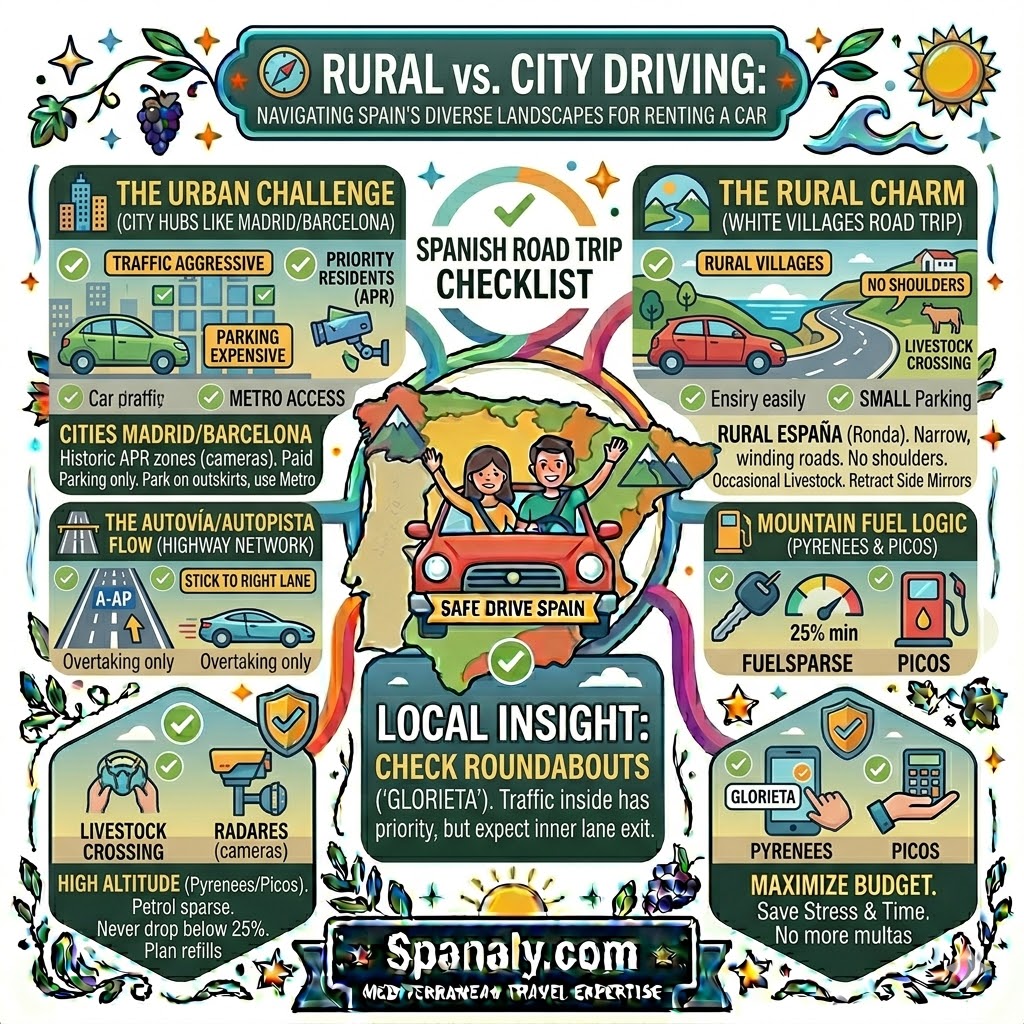
Driving in Spain is a tale of two extremes. The seamless, high-speed experience of the motorways transforms into a technical challenge the moment you enter a medieval village or a bustling metropolitan hub like Barcelona.
🏙️ The Urban Challenge: In cities like Madrid, Seville, or Valencia, traffic is aggressive and parking is expensive. Many historic centers have “Priority for Residents” streets (APR) where cameras will fine you instantly. Tactical Tip: Park in a large “Parking Público” on the outskirts and use the metro to reach the center.
🏞️ The Rural Charm: Once you hit the open road in regions like the white villages road trip near Ronda, the experience is magical. However, be prepared for narrow, winding roads with no shoulders and occasional livestock crossings.
🛣️ The Autovía/Autopista Flow: Spain’s highway network is world-class. Stick to the right lane unless overtaking, as Spanish drivers are very strict about lane discipline.
⛽ Mountain Fuel Logic: If you are heading into the Pyrenees or the Picos de Europa, never let your tank drop below 25%. Petrol stations can be sparse in high-altitude areas.
Adapting your driving style to the environment is key to a stress-free trip. Whether you are navigating the grid of Eixample or the curves of the Sierra Nevada, patience is your best co-pilot.
🚑 Safety First: Accident Protocols and Emergency Assistance
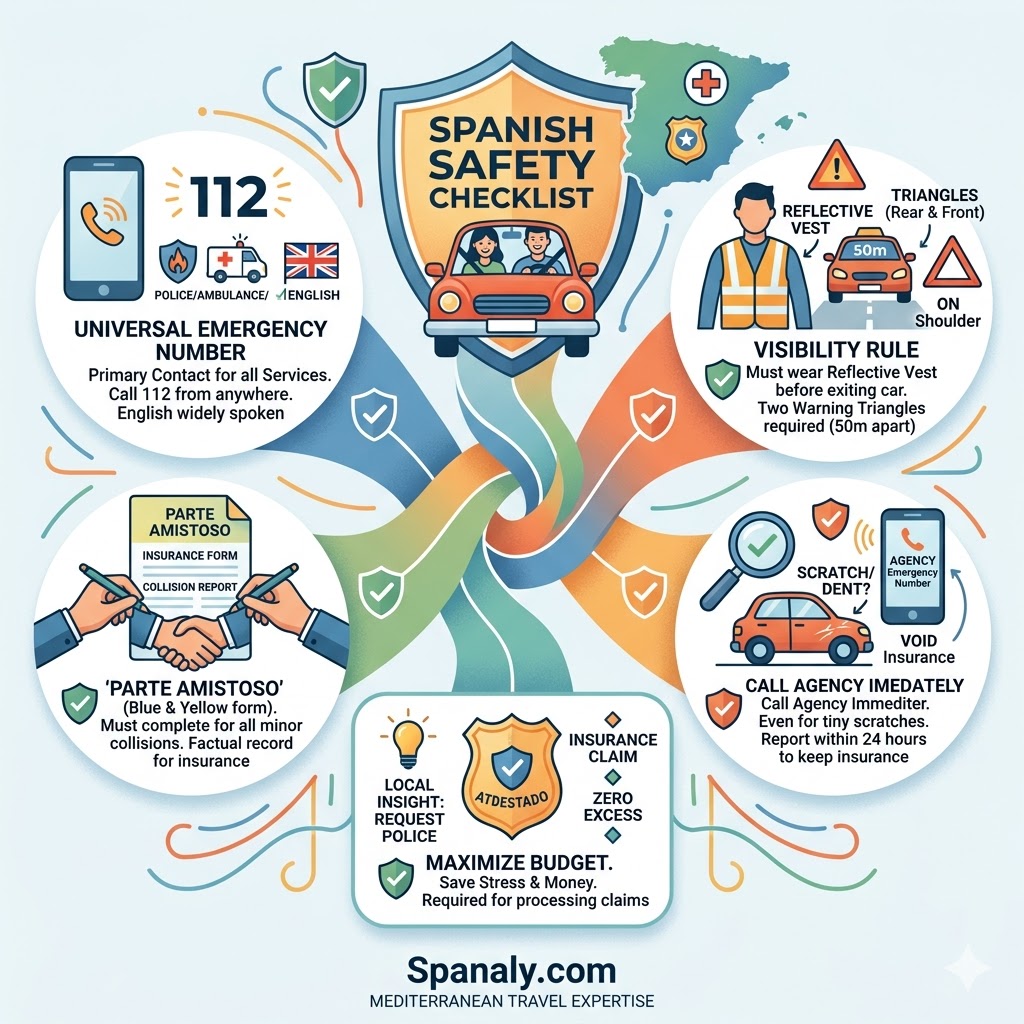
No one plans for an accident, but being well prepared can prevent a minor incident from becoming a serious legal or financial problem. Spain has clear and specific requirements for road emergencies that every driver should know in advance.
- 📞 Universal Emergency Number: Dial 112 for police, ambulance, or fire services anywhere in Spain. Most operators speak some English, but speak slowly and clearly if needed.
- ⚠️ Visibility Rule: If you need to stop on the roadside, put on the high-visibility reflective vest before stepping out of the car. On two-way roads, you must also place the two warning triangles — one 50 meters behind the vehicle and one 50 meters in front.
- 📝 The “Parte Amistoso” (Friendly Report): Every rental car contains a blue and yellow accident report form in the glove compartment. In case of a minor collision, both drivers should fill it out together. This document is not an admission of guilt — it simply records the facts for the insurance companies.
- 🚨 Immediate Incident Reporting: Even for a small scratch or dent, contact the rental agency’s emergency number right away. Failing to report an incident within 24 hours can invalidate your insurance coverage.
If the police (Guardia Civil) arrive at the scene, always ask for an official copy of the “Atestado” (police report). Even if the other driver seems friendly and accepts responsibility, most insurance companies in Spain require this official document to process a claim, especially for zero-excess coverage. It is also wise to save your rental agency’s 24/7 roadside assistance number (Asistencia en Carretera) in your phone before you start driving.
Knowing how to react in the first few minutes of an emergency is what separates a prepared traveler from one who faces unnecessary complications.
💡 Essential Tips for a Smooth Car Rental
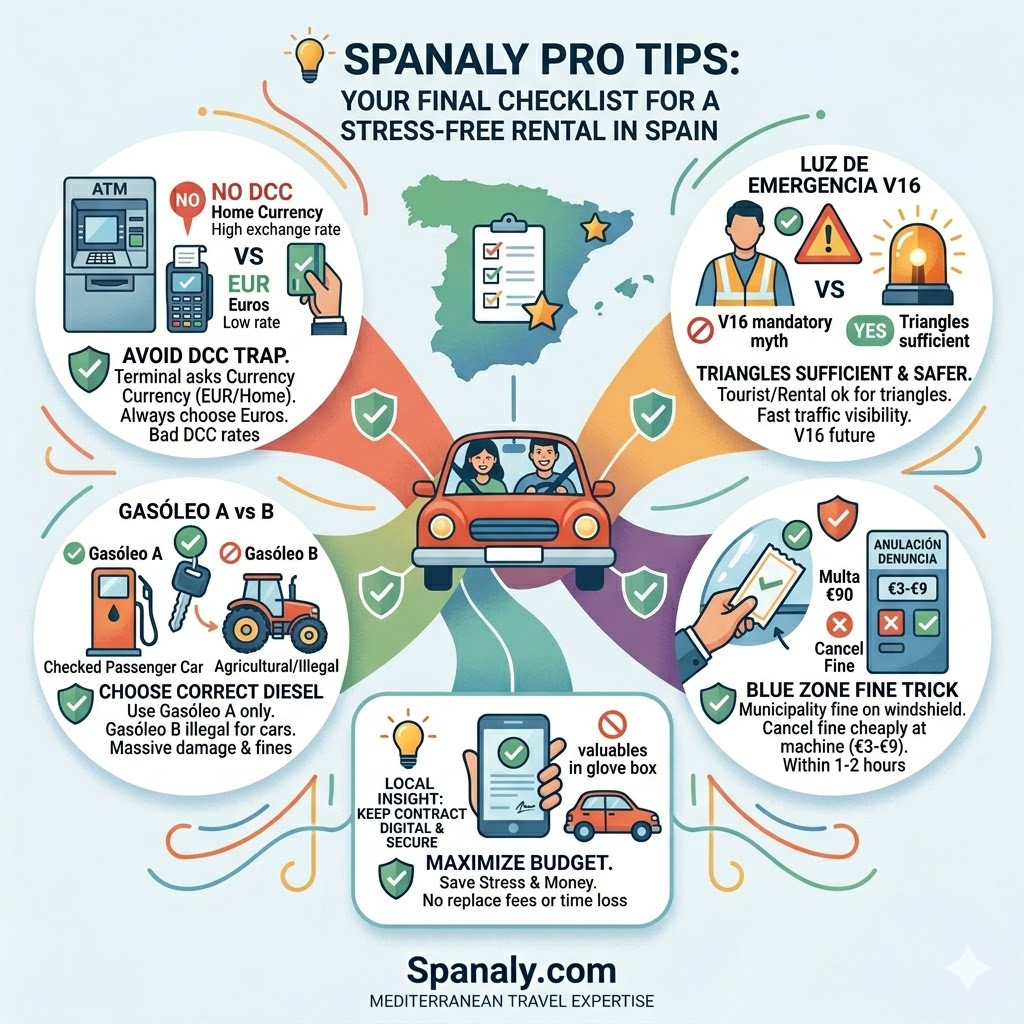
To enjoy a stress-free road trip in Spain, it helps to look beyond the basic rental contract and be aware of a few important practical details.
- 🏧 Avoid the DCC Exchange Rate Trap: When paying for your rental or at the fuel pump, the card machine may ask whether you want to pay in your home currency or in Euros. Always choose Euros. Selecting your home currency triggers Dynamic Currency Conversion (DCC), which usually adds an extra 3–5% cost compared to your own bank’s rate.
- 🅿️ The V16 Emergency Light: You might notice small amber magnetic lights on some dashboards. While these are becoming mandatory for Spanish drivers as a replacement for warning triangles, as a tourist in a rental car, the traditional warning triangles are still legally sufficient and often safer for visibility on fast roads.
- ⛽ Diesel Fuel Types – Gasóleo A vs B: If your rental car runs on diesel, make sure you only use Gasóleo A. Gasóleo B is a subsidized fuel intended only for agricultural vehicles. Using it in a normal car is illegal and can cause serious engine damage plus heavy fines.
- 🎫 Parking Ticket Cancellation: If you receive a parking fine (Multa) on your windshield in a Blue Zone, check the nearest ticket machine right away. Many cities allow you to cancel or reduce the fine for a small fee (€3–€9) if you do it within one or two hours. This is much cheaper than letting the rental company handle it and add their own administration fees.
These practical steps can help you avoid common issues and keep your road trip enjoyable and within budget.
🛡️ Visitor FAQs – Car Rental & Road Safety Logistics
🚗 Can I cross the border into Portugal or France with my Spanish rental?
Generally, yes, but you must inform the agency during booking. Most agencies allow cross-border travel within the EU, but they may charge a small "Cross-Border Fee" for additional insurance coverage. Taking a Spanish rental car to Morocco, however, is strictly prohibited by almost all agencies.
🎫 Do I need an International Driving Permit (IDP) if I have a US or UK license?
If your license is not from the EU/EEA, an International Driving Permit is legally required in Spain. While some rental desks might not ask for it, the Guardia Civil (traffic police) will. Driving without one can result in heavy fines and complications with your insurance in case of an accident.
⛽ What happens if I accidentally put the wrong fuel in the car?
Do not start the engine, as this can cause permanent damage. Call your roadside assistance immediately. Note that "Misfuelling" is almost never covered by standard or full-coverage insurance, and you will be responsible for the drainage and cleaning costs (approx. €200-€500).
💳 Can I rent a car in Spain without a Credit Card?
It is difficult but possible. Most major agencies require a credit card for the security deposit. However, some local companies like Centauro or Record Go allow debit card rentals if you purchase their highest level of "Full Coverage" insurance directly at the counter.
👶 Are child seats mandatory, and can I bring my own?
Yes, children under 135 cm must use an approved restraint system and sit in the rear. You can bring your own seat to save on rental fees (which can be €10-€15 per day), but ensure it meets EU safety standards (ECE R44 or R129).
Car Rental & Safety Guide by Spanaly.com
Ultimately, renting a car in Spain is about freedom. While the high-speed trains are excellent for city-hopping, a car unlocks the soul of the country that lies between the major hubs.
✅ The Verdict: If your goal is to explore hidden coves, white-washed mountain villages, and the rugged Atlantic coast, driving is essential.
🏙️ The Exception: If you only plan to visit Madrid, Barcelona, and Seville, stick to the trains. A car in these cities is more of a liability than an asset.
🌊 The Reward: Imagine driving north to experience the legendary Playa de la Concha in San Sebastian at your own pace, stopping at roadside cider houses that tourists never see.
🛡️ Final Word: Stay tactical, book your automatic early, and always record that pre-drive video.
Spain is a country meant to be felt, and there is no better way to feel it than with the windows down, the radio playing Spanish guitar, and an open road ahead of you.