Table of Contents
Toggle🛡️ Spain Visa & Entry Requirements
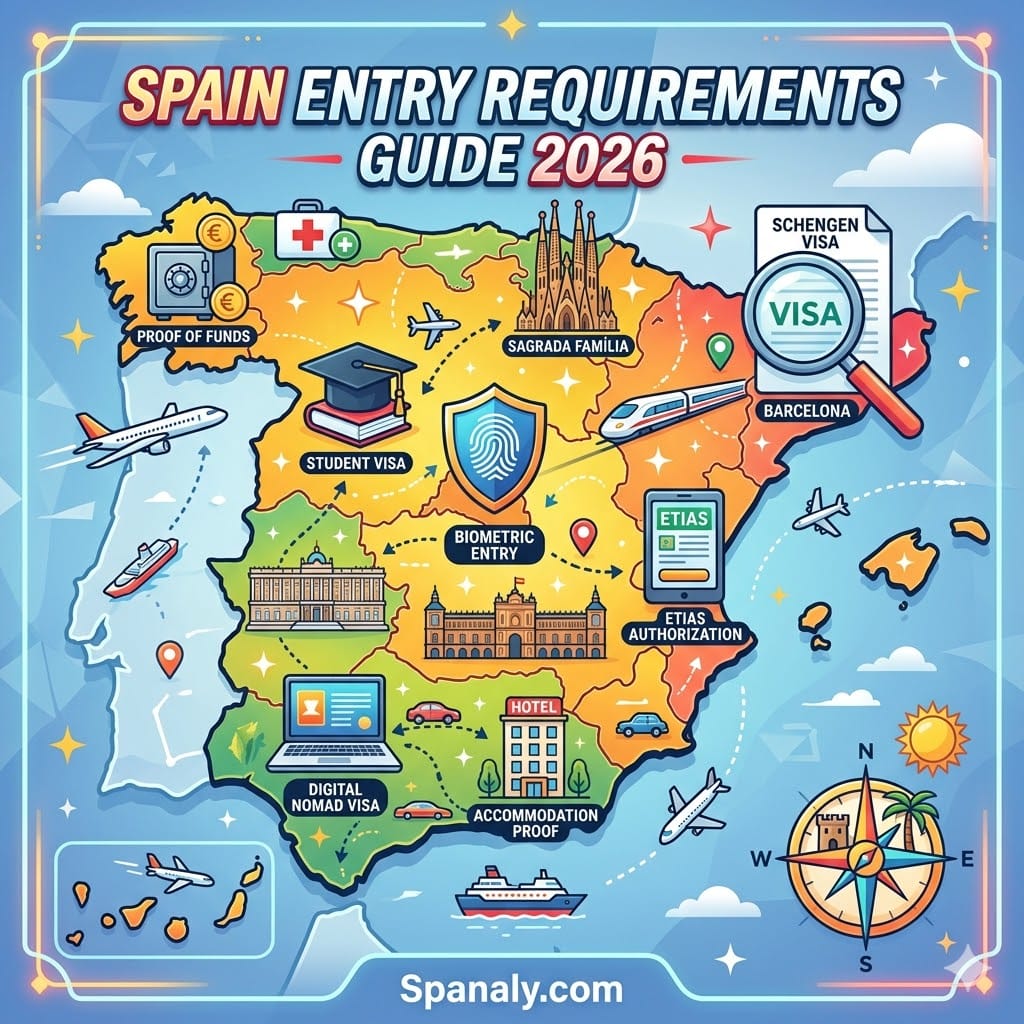
Understanding the latest Spain Visa & Entry Requirements is the first definitive step toward your Mediterranean journey. Whether you are coming for the world-class culture or the golden sunshine, ensuring your documentation is perfect is what guarantees a stress-free arrival.
Before diving into the logistics, it’s essential to understand why visit Spain is the top choice for your next escape. From historical landmarks to culinary excellence, Spain offers an experience that few destinations can match.
Entry Status: Your requirements depend entirely on your nationality (EU vs. Non-EU).
Visa Types: From the 90-day Schengen stay to specialized Digital Nomad and Residency options.
New Rules: Stay informed about the mandatory ETIAS authorization for visa-exempt travelers.
Financial Proof: You must demonstrate sufficient funds to support your stay.
💡 Spanaly Insight: Specifically, don’t leave your paperwork to the last minute. Spanish consulates and the EES (Entry/Exit System) are now more digitized than ever. Indeed, having your bank statements and travel insurance (minimum 30,000€ coverage) organized 30 days in advance is the best way to ensure a 100% smooth entry. 🛡️✨
📋 Spain Entry Requirements at a Glance
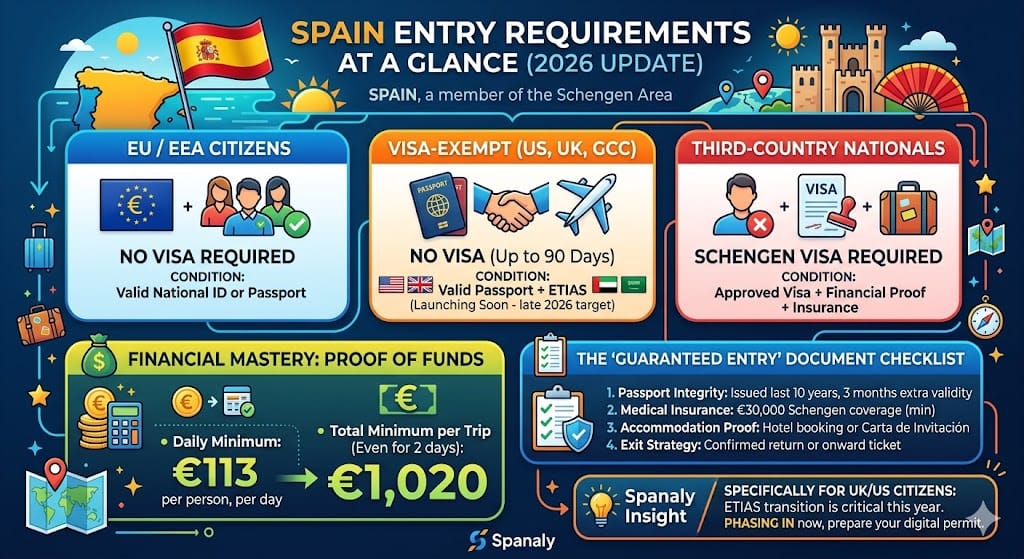
To ensure a seamless arrival, you must distinguish between your nationality and your legal status. Spain is a key member of the Schengen Area, meaning entry rules are harmonized but strictly enforced to maintain travel safety in Spain. Following these entry steps is your first requirement for a successful trip.
| Traveler Profile | Visa Requirement | Primary Entry Condition |
| EU / EEA Citizens | No Visa Required | Valid National ID or Passport. |
| Visa-Exempt (US, UK, GCC) | No Visa (Up to 90 Days) | Valid Passport + ETIAS (Launching Soon). |
| Third-Country Nationals | Schengen Visa Required | Approved Visa + Financial Proof + Insurance. |
💰 Financial Requirements: Proof of Funds
Spanish authorities require travelers to demonstrate they can support their stay. As of the latest updates, the minimum financial thresholds are:
Daily Minimum: You must hold at least 113€ per person, per day.
Total Minimum per Trip: Even for a 2-day trip, the absolute minimum balance required is 1,020€.
📋 The “Guaranteed Entry” Document Checklist
To avoid complications at immigration, ensure you have these documents ready for inspection:
Passport Validity: Must be issued within 10 years and valid for 3 months after your planned exit.
Medical Insurance: Mandatory coverage of at least 30,000€ for all Schengen territories.
Accommodation Proof: Confirmed hotel bookings or an official “Carta de Invitación”.
Return Ticket: A confirmed onward or return flight to prove your intent to leave the territory.
💡 Spanaly Insight: Specifically, for UK and US citizens, the transition to the ETIAS system is the most critical update to watch. Indeed, while the system is being phased in, having your digital “Entry Permit” ready once the portal opens is the best way to avoid airport delays. 🛡️✨
🎫 Schengen Visa for Spain: Short-Stay Guide
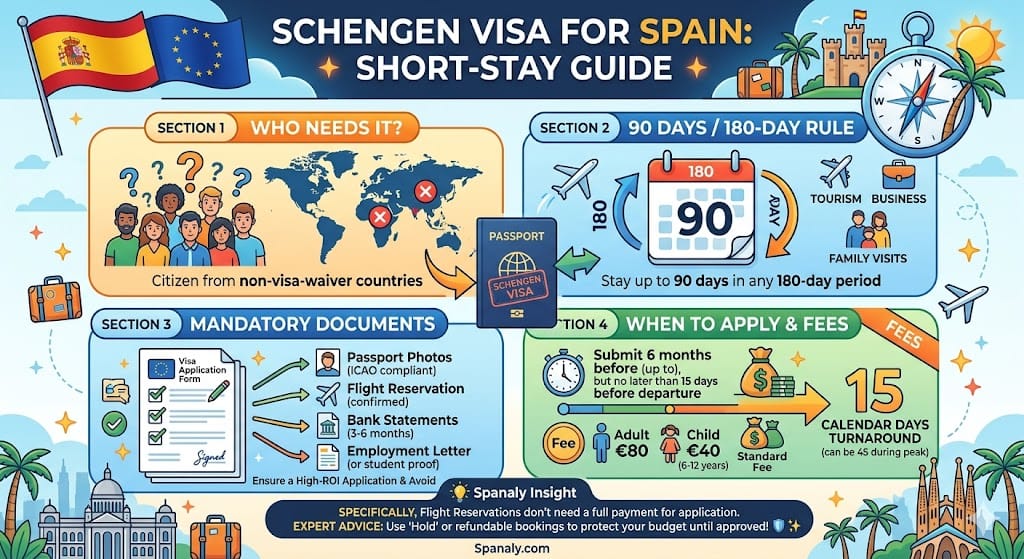
For many international travelers, the Schengen Visa is the mandatory visa process required to explore the Iberian Peninsula. This visa allows for a stay of up to 90 days within any 180-day period for tourism, business, or family visits. Once your visa is secured, you can begin planning how you’ll be getting around Spain to experience its diverse regions.
🛂 Who Needs a Schengen Visa?
If your country does not have a visa-waiver agreement with the European Union, you must apply for this visa at the Spanish Consulate or an authorized service provider like BLS International.
📋 Mandatory Documents for Success
To ensure a complete application and avoid common refusals, you must provide:
Visa Application Form: Fully completed and signed.
Recent Photographs: Two passport-sized photos meeting ICAO standards.
Proof of Purpose: Confirmed flight reservations and a detailed travel itinerary.
Economic Solvency: Recent bank statements (usually from the last 3–6 months).
Professional Status: A letter from your employer or student enrollment proof.
🕒 Processing Time & Fees
When to Apply: You can submit your application up to 6 months before your trip.
Standard Fee: Generally 80€ for adults and 40€ for children (6–12 years).
Turnaround: Expect a decision within 15 calendar days, though it can extend to 45 days.
💡 Spanaly Insight: Specifically, the “Flight Reservation” does not need to be a fully paid ticket for the initial application. Indeed, many airlines offer “Hold” options or refundable bookings. Our expert advice? Never pay for a non-refundable ticket until your visa is officially stamped in your passport to keep your travel costs 100% safe. 🛡️✨
🛡️ Spain ETIAS Authorization: The Digital Entry Permit
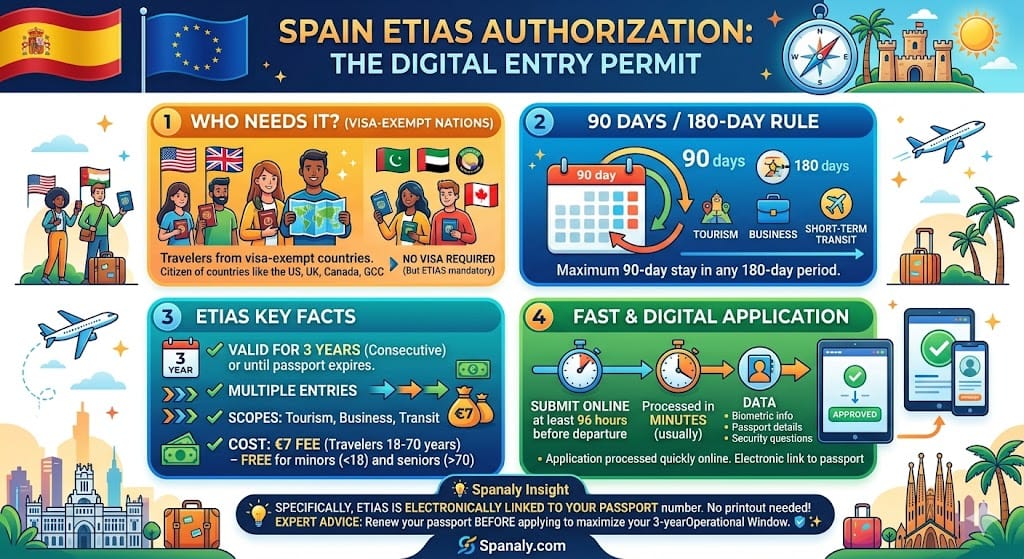
For travelers from visa-exempt nations (including the US, UK, Canada, and GCC countries), the entry process has evolved. The ETIAS (European Travel Information and Authorisation System) is now a mandatory digital requirement before you board your flight to Spain. This is not a visa, but a security pre-screening designed to ensure a safe and smooth journey.
As you prepare your digital permit, it’s the perfect time to review our essential Spain travel tips to master your trip from day one.
📋 ETIAS Key Facts: What You Need to Know
Validity: Once approved, your ETIAS is valid for 3 consecutive years or until your passport expires, whichever comes first.
The 90/180 Rule: It allows for multiple entries, but you must still adhere to the standard Schengen limit of 90 days within any 180-day period.
Scope: It covers tourism, business travel, and short-term transit through Spanish airports.
⚡ The Application Process: Fast & Digital
The goal of ETIAS is efficiency. Most applications are processed within minutes, though you should apply at least 96 hours before departure to account for any manual reviews.
Required Data: Basic biometric info, passport details, and answers to simple security questions.
Standard Fee: A small administrative fee (usually €7) applies to travelers aged 18 to 70. It is free for minors and those over 70.
Digital Link: Your ETIAS is electronically linked to your passport; there is no need to print a physical copy, though keeping a digital PDF is a pro-move.
💡 Spanaly Insight: Specifically, if you renew your passport, your ETIAS becomes void immediately. Indeed, the authorization is tied to the specific passport number used during the application. Our expert advice? Always check your passport’s expiration date before applying to maximize the 3-year “Operational Window” of your permit. 🛡️✨
🆕 Biometric Entry: The EES System in 2026
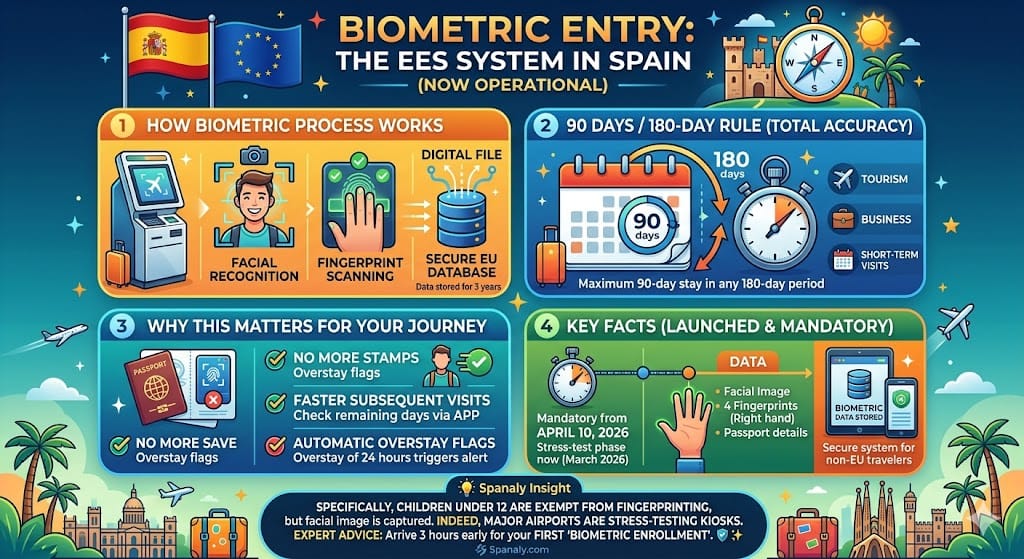
The era of manual passport stamping is officially ending. Spain, along with 28 other Schengen countries, has transitioned to the EES (Entry/Exit System)—a high-tech biometric register that tracks every non-EU traveler. This system ensures total accuracy in monitoring the 90-day rule and enhances overall security at the border.
If you are landing at a major hub, our Madrid Barajas Airport Guide provides specific insights into navigating these new digital checkpoints efficiently.
📸 How the Biometric Process Works
When you cross a Spanish external border for the first time under the new rules, you will be directed to a self-service kiosk or a dedicated border lane:
Facial Recognition: A high-resolution photo of your face will be captured.
Fingerprint Scanning: Four fingerprints from your right hand will be digitally recorded.
Digital File: This data, along with your passport info and entry/exit dates, is stored in a secure EU database for 3 years.
🚀 Why This Matters for Your Journey
No More Stamps: Your “entry proof” is now 100% digital. You can check your remaining days via a dedicated mobile app or the official EES web portal.
Faster Subsequent Visits: Once your biometrics are in the system, future entries become significantly faster as the kiosks will recognize you automatically.
Automatic Overstay Flags: The system calculates your stay down to the minute. Even a 24-hour overstay will trigger an automated alert, which could impact your future travel ROI.
💡 Spanaly Insight: Specifically, if you are traveling with children under 12, they are exempt from fingerprinting, but their facial image will still be captured at the staffed counter. Indeed, as of March 2026, major airports like Madrid, Barcelona, and Málaga are already stress-testing these kiosks 24/7. Our expert advice? Arrive at the airport 3 hours early for your first “Biometric Enrollment” to ensure a stress-free deployment. 🛡️✨
🏠 Long-Stay & Residency Missions: Staying Beyond 90 Days
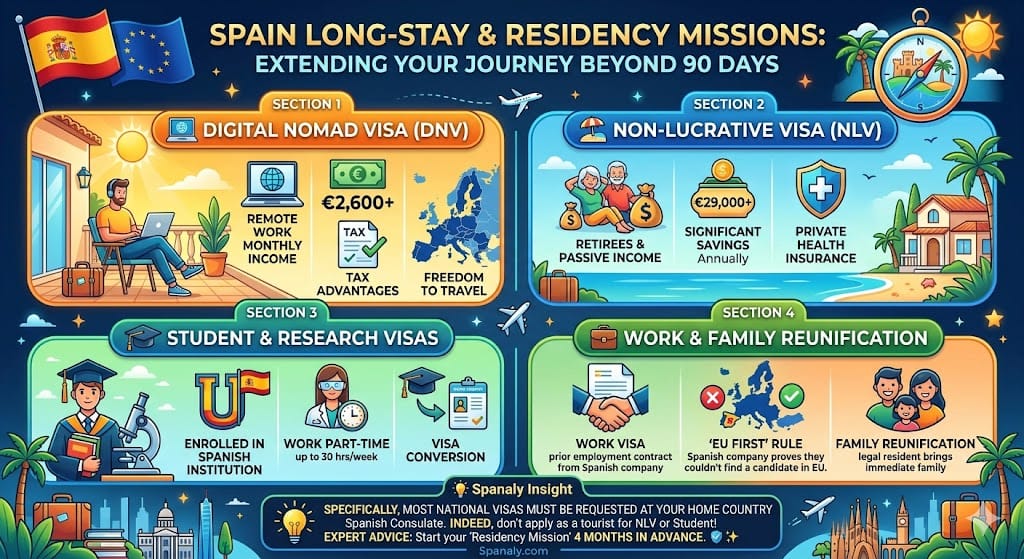
If your mission in Spain extends beyond a simple vacation, you must transition from a short-stay entry to a National Visa (Visa de Larga Duración). This path is designed for those who wish to work, study, or live in the Iberian Peninsula for more than 90 days. Securing your residence is only the first step; your next priority will be finding the right accommodation in Spain to establish your new base.
💻 The Digital Nomad Visa (DNV)
This is the most popular “Operational Route” for remote workers and freelancers. It allows non-EU citizens to live in Spain while working for companies located outside the country.
Key Requirement: You must demonstrate a stable monthly income (usually around €2,600+ for a single applicant).
Benefit: Significant tax advantages under the “Beckham Law” and the freedom to travel throughout the Schengen Area.
🎓 Student & Research Visas
Designed for those enrolled in recognized Spanish educational institutions or conducting high-level research.
Duration: Valid for the length of your studies, with the possibility to work part-time (up to 30 hours per week).
Transition: In many cases, you can convert a student visa into a work permit after graduation.
🏖️ The Non-Lucrative Visa (NLV)
Ideal for retirees or individuals with significant passive income who do not intend to work in Spain.
Focus: You must prove you have substantial savings (approximately €29,000+ annually for the main applicant).
Requirement: Private health insurance with full coverage in Spain is mandatory.
💼 Work & Family Reunification
Work Visa: Requires a prior contract from a Spanish employer who can prove they couldn’t find a suitable candidate within the EU.
Family Reunification: Allows legal residents to bring their immediate family members to join them after a certain period of residency.
💡 Spanaly Insight: Specifically, many applicants make the mistake of applying for these visas while inside Spain as tourists. Indeed, while some visas like the Digital Nomad can be initiated from Spain, most National Visas MUST be requested at the Spanish Consulate in your home country. Our expert advice? Always start your “Residency Mission” at least 4 months in advance to navigate the bureaucracy with 100% success. 🛡️✨
🛡️ The "Guaranteed Entry" Checklist: Your Operational Assets
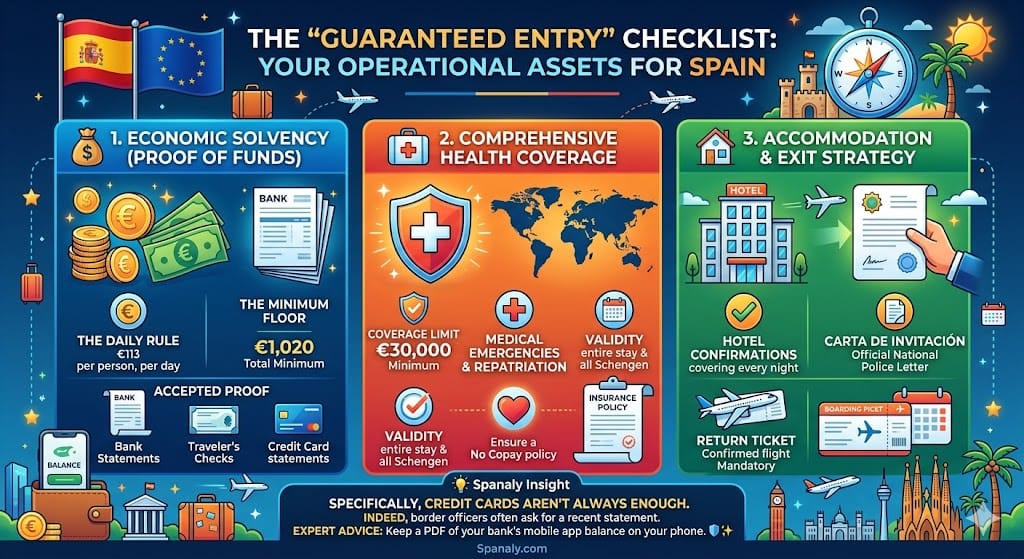
Arriving at the Spanish border without the correct documentation is a risk you don’t need to take. To ensure a 100% successful landing, you must treat your entry documents as “Strategic Assets.” While a visa or ETIAS grants you the right to travel, the final decision always rests with the border officer.
Ensuring you meet all travel insurance requirements and financial thresholds is the only way to guarantee your entry.
💰 1. Economic Solvency (Proof of Funds)
You must prove you can support yourself throughout your stay.
The Daily Rule: Minimum of €113 per person, per day.
The Minimum Floor: Even for a weekend trip, you must show at least €1,020 in available balance.
Accepted Proof: Recent bank statements (digital or printed), traveler’s checks, or a certified credit card statement.
🏥 2. Comprehensive Health Coverage
Standard insurance is often not enough. Your policy must meet specific Schengen criteria:
Coverage Limit: Minimum of €30,000 for medical emergencies and repatriation.
Validity: Must cover the entire duration of your stay and be valid in all Schengen countries.
Zero Deductible: It is highly recommended to have a “No Copay” policy to avoid issues at the consulate.
🏠 3. Accommodation & Exit Strategy
You must clearly demonstrate where you are staying and when you are leaving:
Hotel Confirmations: Printed or digital bookings covering every night of your stay.
Carta de Invitación: If staying with friends or family, an official letter issued by the Spanish National Police (not just a handwritten note).
The Return Ticket: A confirmed onward or return flight is mandatory for non-EU travelers.
💡 Spanaly Insight: Specifically, many travelers assume a credit card is enough proof of funds. Indeed, while it helps, border officers often ask for a recent statement showing the available limit. Our expert advice? Keep a PDF of your bank’s mobile app balance on your phone—it’s the fastest way to prove your “Financial ROI” at the gate. 🛡️✨
🛃 Customs & Immigration: Navigating the Spanish Gateway
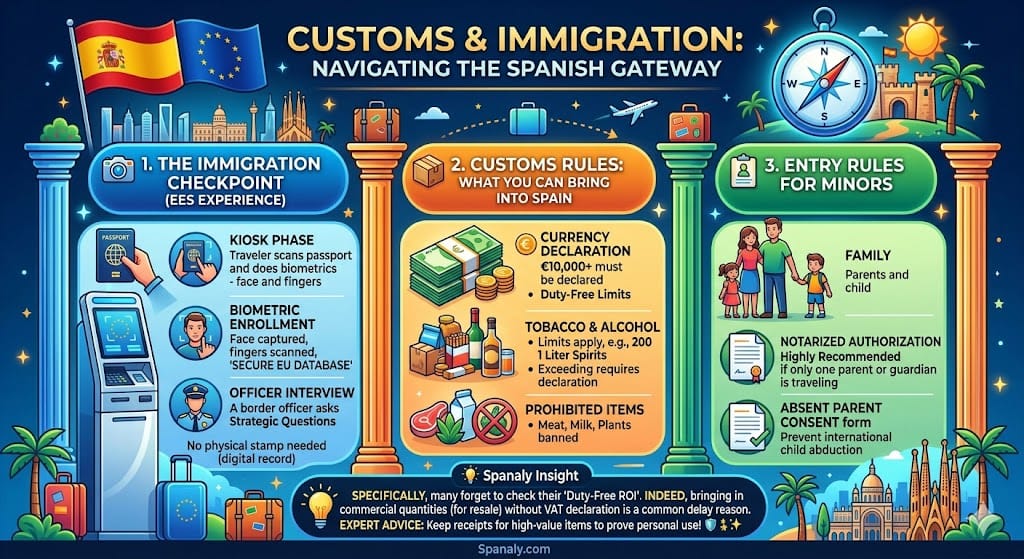
Once your flight touches down, the final “Landing Mission” begins. Navigating Spanish immigration in the era of digital border control requires a mix of patience and preparation. Whether you are arriving at a major hub or a regional terminal, our Barcelona El Prat Airport Guide offers a clear blueprint for a swift exit from the arrivals hall.
📸 The Immigration Checkpoint (EES Experience)
As discussed, the Entry/Exit System (EES) is now the standard. Here is the operational flow:
The Kiosk Phase: If it’s your first time entering since the system launch, you will use a self-service kiosk to scan your passport and register your biometrics (facial image and fingerprints).
The Officer Interview: After the kiosk, a border officer may ask “Strategic Questions” such as: What is the purpose of your visit? How long are you staying? Where is your accommodation?
The Digital Stamp: Your entry is recorded electronically. No physical stamp is needed, though you can request one if your specific visa requires it.
📦 Customs Rules: What You Can Bring Into Spain
Spain enforces strict EU customs regulations to protect its local economy and health standards:
Currency: You must declare any amount equal to or exceeding €10,000 in cash.
Tobacco & Alcohol: Limits apply (e.g., 200 cigarettes or 1 liter of spirits). Exceeding these without declaration can lead to immediate fines.
Prohibited Items: Meat, milk, and certain plant products from non-EU countries are generally banned to prevent agricultural diseases.
🛂 Entry Rules for Minors
Traveling with children requires extra attention. If a minor is traveling with only one parent or a legal guardian, Spanish authorities highly recommend carrying a notarized authorization from the absent parent to prevent international child abduction issues.
💡 Spanaly Insight: Specifically, many travelers forget to check their “Duty-Free ROI.” Indeed, while shopping is tempting, bringing in commercial quantities of goods (items intended for resale) without a VAT declaration is a common reason for delays. Our expert advice? Keep all receipts for high-value items like electronics or jewelry to prove they are for “Personal Use” during your mission. 🛡️✨
⚠️ Common Pitfalls: Why Entry is Refused & How to Fix It
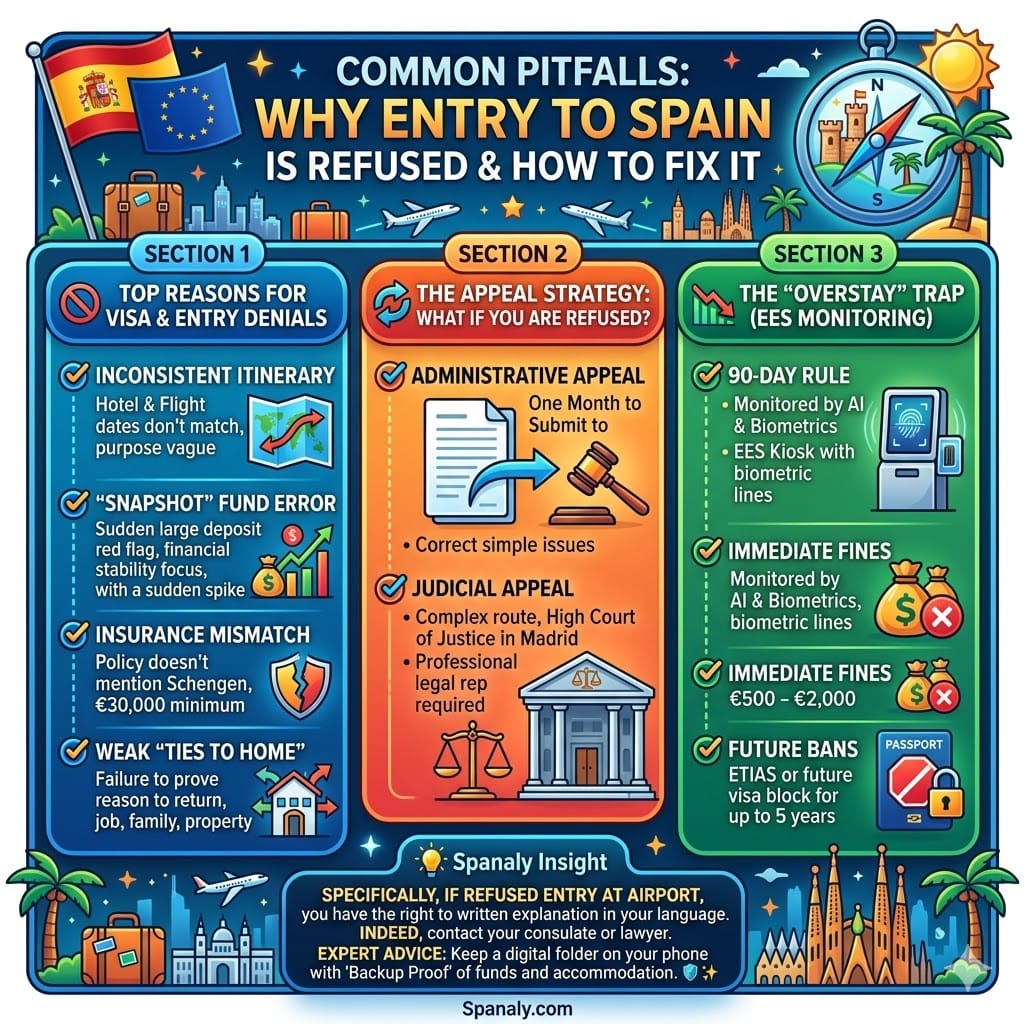
Even with a valid visa or ETIAS, entry to Spain is never 100% guaranteed until you clear the biometric kiosk. Understanding common travel errors is the only way to ensure your journey stays on track. Most refusals are entirely avoidable if you follow our essential Spain travel tips and maintain a transparent travel profile.
🚫 Top Reasons for Visa & Entry Denials
Inconsistent Itinerary: If your hotel bookings don’t match your flight dates, officers may flag your entry as “Unjustified.”
The “Snapshot” Fund Error: Showing a large, sudden deposit right before applying is a major red flag. Authorities look for financial stability, not a one-time cash injection.
Insurance Mismatch: Using a policy that doesn’t explicitly mention “Schengen Coverage” or the 30,000€ minimum is a frequent cause for rejection.
Weak “Ties to Home”: Failing to prove you have a reason to return (job or family) often leads to a refusal based on migration risk.
🔄 The Appeal Process: What if You Are Refused?
If you receive a denial notification, you have two primary legal steps:
Administrative Appeal (Recurso de Reposición): You have one month to submit this to the consulate. It’s the fastest way to correct a simple misunderstanding.
Judicial Appeal: A more complex route involving the High Court in Madrid, requiring a professional legal representative.
📉 The “Overstay” Trap
With the new EES (Entry/Exit System), the 90-day rule is monitored by AI and biometrics. Indeed, even an overstay of 24 hours is now recorded digitally. This can lead to immediate fines ranging from 500€ to 2,000€ and future travel bans for up to 5 years.
💡 Spanaly Insight: Specifically, if you are refused entry at the airport, you have the right to a written explanation in a language you understand. Indeed, you also have the right to contact your consulate immediately. Our expert advice? Always keep a digital folder on your phone with backup documents of your funds and accommodation to resolve any questions at the border in real-time. 🛡️✨
💡 Pro-Tips for a Flawless Spanish Entry
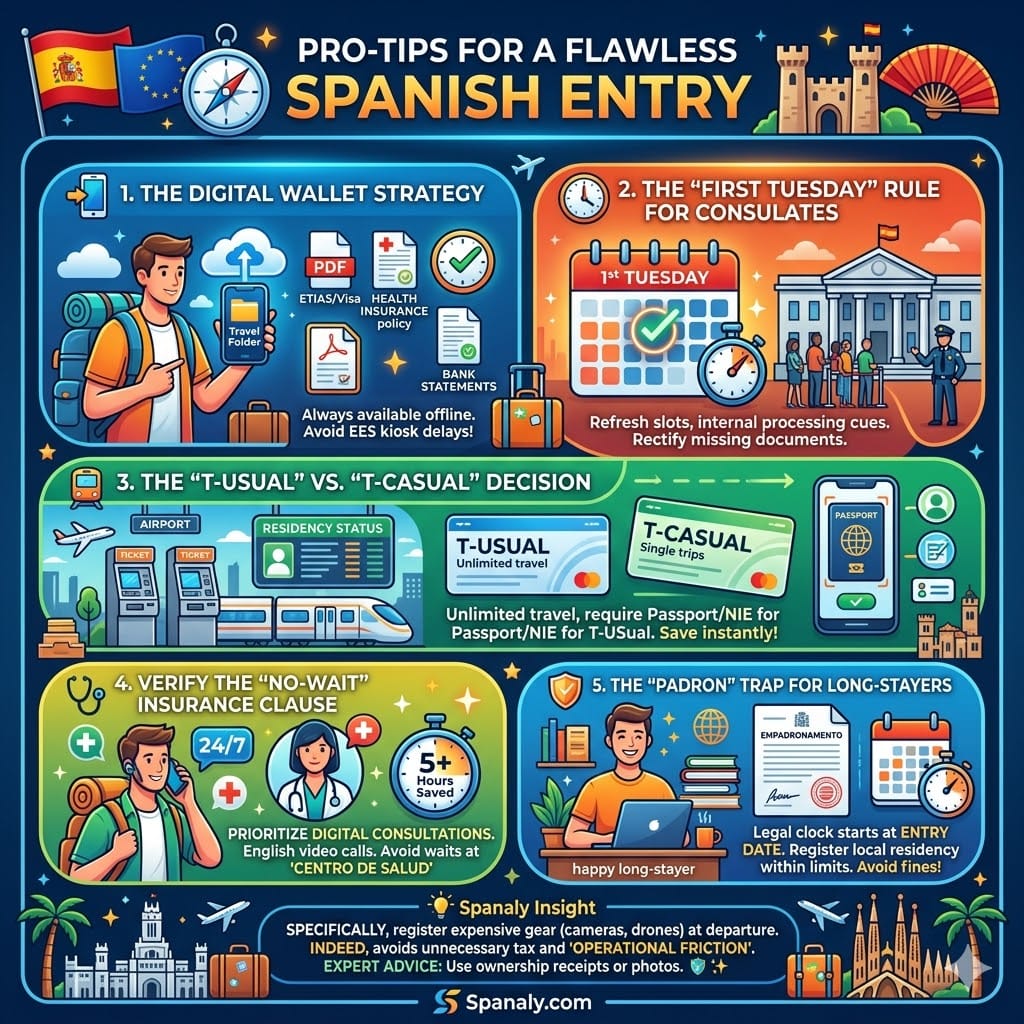
Beyond the visas and biometric kiosks, mastering the “Small Details” is what separates a tourist from a Spanaly traveler. To maximize your efficiency at the border and beyond, incorporate these expert strategies into your deployment plan. For the best digital support, make sure to download the top tourist apps in Spain before you land.
📲 1. The Digital Wallet Strategy
The Tip: Do not rely solely on physical documents or your primary bank app.
Operational Detail: Create a dedicated “Travel Folder” in your cloud (Google Drive or iCloud) that is available offline. Include a PDF of your ETIAS/Visa, your Health Insurance policy, and your Bank Statements. If the airport Wi-Fi fails at the EES kiosk, you’ll have your proof ready in seconds.
🕒 2. The “First Tuesday” Rule for Consulates
The Tip: If you are booking a visa appointment, aim for the first Tuesday morning of the month.
Operational Detail: Consulates often refresh their appointment slots and internal processing queues at the start of the month. Booking early in the week ensures that if a document is missing, you have the rest of the week to rectify it without losing your “Processing Window.”
🚉 3. The “T-Usual” vs. “T-Casual” Decision
The Tip: Don’t buy transport tickets at the airport machines without checking your “Residency Status.”
Operational Detail: If you are staying in cities like Barcelona for more than 10 days, the T-Usual card (unlimited travel) often requires your Passport or NIE number for registration. Having a digital scan of your passport on your phone allows you to register for these high-savings passes at the airport station immediately.
🩺 4. Verify the “No-Wait” Insurance Clause
The Tip: Check if your travel insurance has a “Telemedicine” feature.
Operational Detail: In 2026, many Spanish medical providers prioritize digital consultations for non-emergencies. Having an insurance provider that offers 24/7 video calls in English can save you 5+ hours of waiting in a “Centro de Salud” (Health Center) if you just need a simple prescription or advice.
🛡️ 5. The “Padron” Trap for Long-Stayers
The Tip: If you are on a Digital Nomad or Student Visa, your “Entry Date” is the start of your legal clock.
Operational Detail: Save your Boarding Pass. Even though your entry is recorded in the EES system, some local town halls (Ayuntamientos) still ask for physical proof of your entry date when you apply for your “Empadronamiento” (Residency Registration).
💡 Spanaly Insight: Specifically, if you are bringing expensive photography or drone equipment, register it with customs at your departure airport. Indeed, Spanish customs may occasionally challenge high-value gear upon entry, suspecting it’s for sale. Our expert advice? A simple “Ownership Receipt” or a photo of your gear with the serial numbers can prevent unnecessary tax “Operational Friction.” 🛡️✨
🛡️ Visitor FAQs – Spain Entry Requirements Guide
🛂 Can I enter Spain if my passport expires in 4 months?
Technically yes, but it is risky. Spain requires your passport to be valid for at least 3 months beyond your intended departure date. If you plan a 1-month trip, you are safe. However, most airlines and border officers prefer a 6-month buffer to account for unexpected travel delays.
📲 Do I need to print my ETIAS or Visa confirmation?
No physical printout is mandatory since your ETIAS or digital visa is electronically linked to your passport number. However, we strongly recommend keeping a digital PDF on your phone or a high-quality screenshot. This acts as a "Secondary Asset" in case of system glitches at the airport kiosks.
💰 Is a "Digital Bank Statement" accepted at the border?
Yes, modern Spanish border control accepts official PDF statements from your banking app. Specifically, the statement must show your name, the total balance, and a date within the last 30 days. Showing your "Live Balance" on a mobile app is often sufficient for most officers as proof of economic solvency.
🚑 Will I be refused entry if I don't have travel insurance?
For Schengen Visa holders, insurance is strictly mandatory and your entry will be refused without it. For visa-exempt travelers (US, UK, etc.), while not always checked, officers have the right to ask for it. Entry can be denied if you cannot prove you can cover potential medical costs, so never skip this "Safety Mission."
🔄 Can I extend my 90-day stay once I am in Spain?
Extending a short-stay visit is extremely difficult and only granted for "Force Majeure" (e.g., serious illness or natural disaster). You cannot simply extend it for tourism. To stay longer, you must apply for a National Visa from your home country before arriving in the Schengen Area.
Latest Requirements Guide by Spanaly.com
You’ve mastered the rules, secured your documents, and understood the biometric “Mission.” Now, the only thing left is to decide where your Spanish story begins. Whether you are landing in the imperial heart of Spain or the creative coast, your first 72 hours are crucial.
🎯 Your First Mission Options:
The Modernist Dream: Start by exploring the architectural wonders of Catalonia with our 3-day Barcelona itinerary.
The Royal Experience: Immerse yourself in the vibrant plazas and museums of the capital using our Madrid 3-day itinerary.
📝 Quick Recap Checklist:
Check your passport validity (6 months recommended). 🛂
Verify your ETIAS or Schengen Visa status. 🛡️
Confirm your travel insurance covers the €30,000 minimum. 🏥
Download your bank statements for proof of funds. 💰
Safe travels, and welcome to the Iberian Peninsula! 🇪🇸✨